ICT and Climate Change Benefits to Canada Bill St. Arnaud CANARIE Inc – www.canarie.ca [email_address] Unless otherwise noted all material in this slide deck may be reproduced, modified or distributed without prior permission of the author
The Climate Change Threat Obama’s National Science Advisor John Holdren on  Global Climate Disruption http://greenmonk.net/john-holdren-on-global-climatic-disruption Stephen Chu – new head of DoE – “Wake up America!!” http://www.thedailygreen.com/environmental-news/latest/california-agriculture-global-warming-47020402 MIT report predicts median temperature forecast of 5.2C 11C increase in Northern Canada http://globalchange.mit.edu/pubs/abstract.php?publication_id=990 Last Ice age average global temperature was 6C cooler than today Most of Canada was under 2-3 km ice
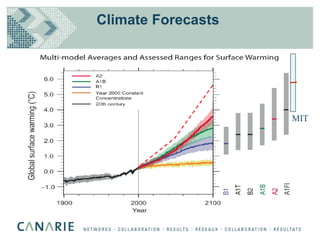
Climate Forecasts MIT
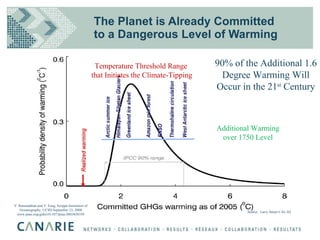
The Planet is Already Committed  to a Dangerous Level of Warming V. Ramanathan and Y. Feng, Scripps Institution of Oceanography, UCSD September 23, 2008 www.pnas.orgcgidoi10.1073pnas.0803838105 Source:  Larry Smarr CAL-It2 Temperature Threshold Range  that Initiates the Climate-Tipping Additional Warming over 1750 Level 90% of the Additional 1.6 Degree Warming Will Occur in the 21 st  Century
Climate tipping points USGS Abrupt Climate Change report finds that future climate shifts have been underestimated and warns of debilitating  abrupt shift in climate that would be devastating. http://www.climatescience.gov/Library/sap/sap3-4/final-report/default.htm http://climateprogress.org/2008/11/24/what-are-the-near-term-climate-pearl-harbors/   Tipping elements in the Earth's climate  -National Academies of Science http://www.pnas.org/content/105/6/1786.abstract?maxtoshow=&HITS=10&hits=10&RESULTFORMAT=&fulltext=tipping+elements+lenton&searchid=1&FIRSTINDEX=0&resourcetype=HWCIT “ Society may be lulled into a false sense of security by smooth projections of global change. Our synthesis of present knowledge suggests that a variety of tipping elements could reach their critical point within this century under anthropogenic climate change. “
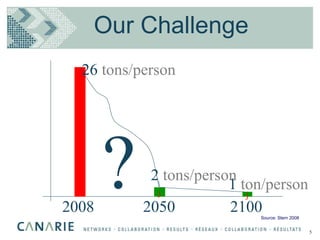
Our Challenge 5 j j 26  tons/person 1  ton/person 2008 2050 ? j 2100 2  tons/person Source: Stern 2008
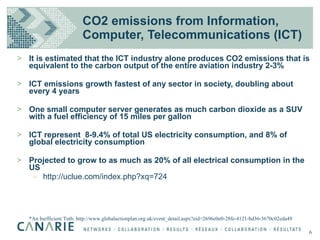
CO2 emissions from Information, Computer, Telecommunications (ICT) It is estimated that the ICT industry alone produces CO2 emissions that is equivalent to the carbon output of the entire aviation industry 2-3% ICT emissions growth fastest of any sector in society, doubling about every 4 years One small computer server generates as much carbon dioxide as a SUV with a fuel efficiency of 15 miles per gallon  ICT represent  8-9.4% of total US electricity consumption, and 8% of global electricity consumption Projected to grow to as much as 20% of all electrical consumption in the US http://uclue.com/index.php?xq=724 *An Inefficient Tuth: http://www.globalactionplan.org.uk/event_detail.aspx?eid=2696e0e0-28fe-4121-bd36-3670c02eda49 6
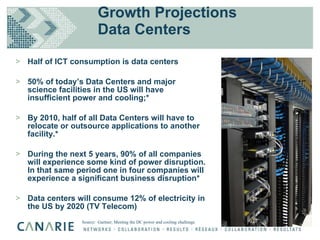
Growth Projections Data Centers Half of ICT consumption is data centers 50% of today’s Data Centers and major science facilities in the US will have insufficient power and cooling;* By 2010, half of all Data Centers will have to relocate or outsource applications to another facility.* During the next 5 years, 90% of all companies will experience some kind of power disruption. In that same period one in four companies will experience a significant business disruption* Data centers will consume 12% of electricity in the US by 2020 (TV Telecom) Source:  Gartner; Meeting the DC power and cooling challenge
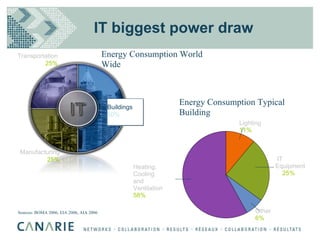
IT biggest power draw Heating, Cooling and Ventilation 58% Lighting 11% IT  Equipment 25% Other 6% Sources: BOMA 2006, EIA 2006, AIA 2006 Energy Consumption Typical Building Energy Consumption World Wide Transportation 25% Manufacturing 25% Buildings 50%
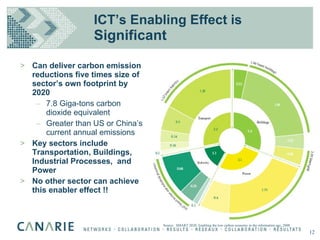
ICT’s Enabling Effect is  Significant  Can deliver carbon emission reductions five times size of sector’s own footprint by 2020 7.8 Giga-tons carbon dioxide equivalent  Greater than US or China’s current annual emissions Key sectors include Transportation, Buildings, Industrial Processes,  and Power No other sector can achieve this enabler effect !! Source:  SMART 2020: Enabling the low carbon economy in the information age, 2008 12
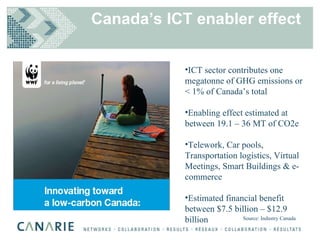
Canada’s ICT enabler effect ICT sector contributes one megatonne of GHG emissions or < 1% of Canada’s total  Enabling effect estimated at between 19.1 – 36 MT of CO2e Telework, Car pools, Transportation logistics, Virtual Meetings, Smart Buildings & e-commerce Estimated financial benefit between $7.5 billion – $12.9 billion Source: Industry Canada
Trends: Policy and Legislative Changes Provincial/Territories:  -BC (Bill 44, 31)  -AB (Climate Change and Emissions Management Act (2007)) -Saskatchewan Bill No. 95)  -Manitoba (The Climate Change and Emissions Reductions Act (June 2008))  -Ontario (Draft Bill)  -Quebec (Bill 42)  -Atlantic Canada – targets set in climate change plans Government of Canada's proposed GHG Offset System  July 8, 2009 -  Statement of G8 on energy and climate
Why is this important? RFPs from customers to include shadow carbon accounting  UK government is planning to link the funding available to universities and colleges with their performance in reducing carbon emissions. All Government RFP responses  must include shadow cost carbon accounting EU and other nations expected to follow soon   http://www.carbonoffsetsdaily.com/global/government-funding-to-reward-greenest-universities-3996.htm   21
The Carbon Economy $500 billion - Value of low-carbon energy markets by 2050 $100 billion - Demand for projects generating GHG missions credits by 2030 Global carbon market expected to grow 58% this year to $92 billion  $57 trillion - Carbon Disclosure Project signatories, 1000s of companies participating, expanding to supply chain accounting Obama’s cap and trade (Waxman-Markey) bill will force emitters to spend $1.25 on carbon offsets for every $1.00 on emission permits Source: ClimateCheck 20
Public Sector to be carbon neutral by 2010 in BC British Columbia was first government to introduce carbon tax in Western Hemisphere Provincial Government in province of British Columbia has mandated all public sector institutions to be carbon neutral by 2010 Other provinces exploring to implement the same policy New Zealand has also made the same requirements Many universities and businesses are adopting voluntary carbon neutrality objectives Dell, Cisco, Google etc This will have big impact on university research and optical networks
Moratorium on coal plants Ontario suspends nuclear power plants http://www.theglobeandmail.com/news/national/ontario-suspends-nuclear-power-plans/article1200469/ CANDU reactor safety design may limit power production to 50% http://www.theglobeandmail.com/news/national/reactor-design-puts-safety-into-question/article1200130/ Britain and Canada to phase out coal plants that don’t have CCS by 2025 http://news.mongabay.com/2009/0429-hance_cleancoal.html
The Falsehood of Energy Efficiency Most current approaches to reduce carbon footprint are focused on increased energy efficiency of equipment and processes But growth in ICT deployment of equipment and services is outstripping any gains made in efficiency Which is likely to accelerate as ICT is used to support abatement in other fields such as smart homes, smart buildings, smart grids etc Also greater efficiency can paradoxically increase energy consumption by reducing overall cost service and therefore stimulates demand Khazzoom-Brookes postulate (aka Jevons paradox aka rebound effect) In last Energy crisis in 1973 Congress passed first energy efficiency laws (CAFÉ) which mandate minimum mileage for cars, home insulation and appliances Net effect was to reduce cost of driving car, heating or cooling home, and electricity required for appliances Consumer response was to drive further, buy bigger homes and appliances 14
Zero Carbon strategy essential Zero carbon strategy using renewable energy critically important if governments mandate carbon neutrality, or if there is a climate catastrophe With a zero carbon strategy growth in demand for ICT services will not effect  GHG emissions Anything times zero is always zero Wind and solar power are most likely candidates because of opportunity cost/benefit analysis especially time to deploy Nuclear has high opportunity cost because  of time to deploy http://climateprogress.org/2008/12/14/stanford-study-part-1-wind-solar-baseload-easily-beat-nuclear-and-they-all-best-clean-coal/ But renewable energy sites are usually located far from cities and electrical distribution systems are not designed to carry load http://www.americanprogress.org/issues/2008/12/pdf/renewable_transmission.pdf 15
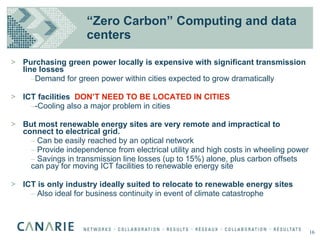
Purchasing green power locally is expensive with significant transmission line losses Demand for green power within cities expected to grow dramatically ICT facilities  DON’T NEED TO BE LOCATED IN CITIES -Cooling also a major problem in cities But most renewable energy sites are very remote and impractical to connect to electrical grid. Can be easily reached by an optical network Provide independence from electrical utility and high costs in wheeling power Savings in transmission line losses (up to 15%) alone, plus carbon offsets can pay for moving ICT facilities to renewable energy site ICT is only industry ideally suited to relocate to renewable energy sites Also ideal for business continuity in event of climate catastrophe “ Zero Carbon” Computing and data centers 16
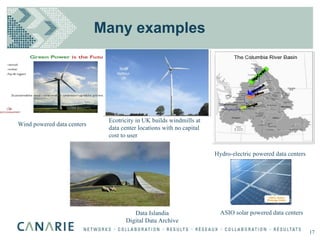
Many examples Hydro-electric powered data centers Data Islandia Digital Data Archive ASIO solar powered data centers Wind powered data centers 17 Ecotricity in UK builds windmills at data center locations with no capital cost to user
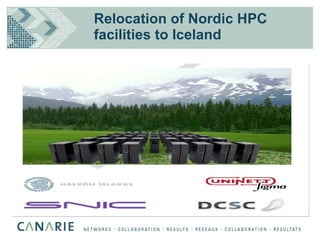
Relocation of Nordic HPC facilities to Iceland
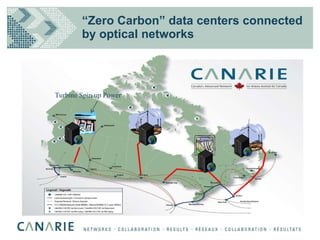
“ Zero Carbon” data centers connected by optical networks Turbine Spin up Power
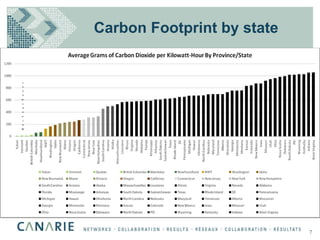
Carbon Footprint by state 7
Impact on networks Building zero carbon data centers in remote locations creates impact on network in terms of large data volumes being carried greater distances More fossil based energy will be consumed in transmission facilities (versus reduction at data centers) Optical networks will have modest increase in power consumption especially with new 100G and 1000G waves Electronic equipment such as routers and aggregators will have much larger impact
Renewable power is not reliable How do you provide mission critical ICT services when energy source is unreliable? Ebbing wind or setting sun Back up diesel and batteries are not an option because they are not zero carbon and power outages can last for days or weeks Need new network architectures and business models to ensure reliable service delivery by quickly moving compute jobs and data sets around the world to sites that have available power Will require high bandwidth networks and routing architectures to quickly move jobs and data sets from site to site 26
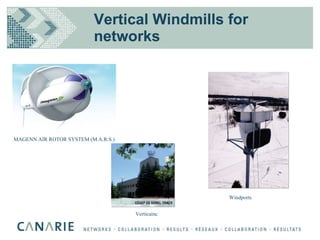
Vertical Windmills for networks MAGENN AIR ROTOR SYSTEM (M.A.R.S.) Windports Verticainc
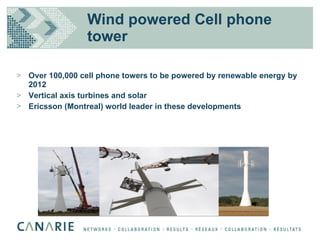
Wind powered Cell phone tower Over 100,000 cell phone towers to be powered by renewable energy by 2012 Vertical axis turbines and solar Ericsson (Montreal) world leader in these developments
CANARIE Green-IT Pilot $3m allocation for Green cyber-infrastructure-IT pilot testbed Two objectives: Technical viability and usability for relocating computers to zero carbon data centers and follow the sun/follow the wind network Business case viability of offering carbon offsets (and or equivalent in services) to IT departments and university researchers who reduce their carbon footprint by relocating computers and instrumentation to zero carbon data centers International partnership with possible zero carbon nodes using virtual router/computers in Spain, Ireland, California, Australia, British Columbia, Ottawa, Quebec and Nova Scotia  25
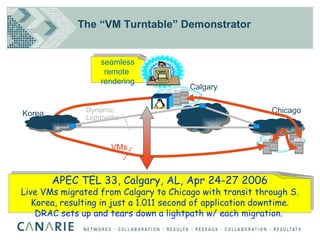
The “VM Turntable” Demonstrator seamless remote  rendering Korea Chicago Calgary VMs Dynamic Lightpaths Starlight CA*net4 KREOnet APEC TEL 33, Calgary, AL, Apr 24-27 2006 Live VMs migrated from Calgary to Chicago with transit through S. Korea, resulting in just a 1.011 second of application downtime . DRAC sets up and tears down a lightpath w/ each migration.
What are carbon offsets? Companies or individuals buy carbon offsets from projects that remove or reduce carbon Planting trees, building hydro dams, installing energy efficient processes, etc Many companies and universities that claim to be carbon neutral do so, not by reducing their CO2 footprint but by purchasing offsets Two types of markets Regulated markets – Alberta, BC , Europe and New England Voluntary markets – Air Canada, Chicago, etc Carbon buying and selling is done through registries or exchanges Pacific Carbon Trust, Montreal Carbon exchange, REGI In regulated markets  all big emitters such as power plants, steel mills,  universities , etc must purchase permits based on cap and trade
ISO 14064/2/3 ISO 14064 is the accounting process required to validate whether a project actually reduces CO2 ISO 14062/3 sets the measurement process for “life cycle” CO2 emissions for a product or service You need to implement ISO 14064 process to demonstrate actual CO2 reductions Vendors need to provide 14062/3 data for products and services
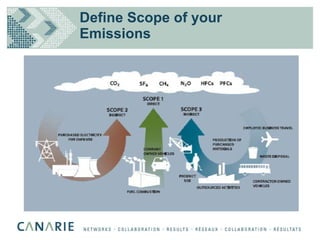
Define Scope of your Emissions
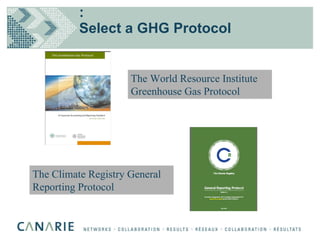
:  Select a GHG Protocol The World Resource Institute Greenhouse Gas Protocol  The Climate Registry General Reporting Protocol
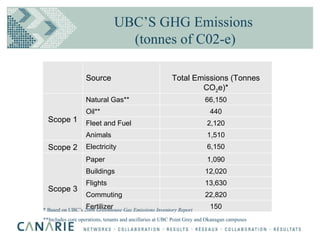
* Based on UBC’s  2006 Greenhouse Gas Emissions Inventory Report **Includes core operations, tenants and ancillaries at UBC Point Grey and Okanagan campuses UBC’S GHG Emissions (tonnes of C02-e) Source Total Emissions (Tonnes CO 2 e)* Scope 1 Natural Gas** 66,150 Oil** 440 Fleet and Fuel 2,120 Animals 1,510 Scope 2 Electricity 6,150 Scope 3 Paper 1,090 Buildings 12,020 Flights 13,630 Commuting 22,820 Fertilizer 150
Impact on UBC Background:  The greenhouse gas emissions reductions targets act (Bill 44-2007), imposes carbon neutrality on all UBC Scope 1 and 2 emissions plus paper. Carbon neutrality will be achieved through emissions reductions, and the purchasing of offsets for emissions that cannot be avoided. Offsets in BC are regulated through the Pacific Carbon Trust. Indications are that Offsets will be priced at $25/tonne.    Since July 1 st , 2008, UBC has been paying a carbon tax on all fossil fuel (natural gas, oil and fleet fuel). This tax began at $10/tonne CO2e in 2008, and will rise by $5/year to $30/tonne in 2012.  The following tables summarize UBC’s estimated GHG emissions liability
Impact on UBC         2007 GHG Inventory Summary Table (Tonnes CO2-e) [1]   UBC Vancouver Campus [2] UBC Okanagan Campus [3] Natural Gas 54 595 2 283 Oil 0 0 Electricity 3 865 254 Fleet 2 096 23 Paper 994 Cost of GHG emissions for UBC 2010 – 2012 (/tonne CO2-e)   2010 2011 2012 Carbon Offset $25 $25 $25 Carbon Tax $20 $25 $30 Total $45 $50 $55 UBC’s GHG Emissions Liability 2010-2012 [4]   2010 2011 2012 Carbon Offset [5] $ 1 602 750 $ 1 602 750 $ 1 602 750 Carbon Tax [6] $ 1 179 940 $ 1 474 925 $ 1 769 910 Total:  $ 2 782 690 $ 3 077 675 $ 3 372 660
Policy approaches to reducing CO2 Carbon taxes Politically difficult to sell Cap and trade Useful for big emitters like power companies Addresses only supply side of CO2 Carbon Neutrality imposed by law Growing in popularity especially as protests over gas tax escalates But there may be an additional approach…. 28
Carbon Rewards rather carbon taxes – “gCommerce” Although carbon taxes are revenue neutral, they payee rarely sees any direct benefit No incentive other than higher cost to reduce footprint Rather than penalize consumers and businesses for carbon emissions, can we reward them for reducing their carbon emissions? Carbon rewards can be “virtual” products delivered over broadband networks such movies, books, education, health services, collarboartive education and research technologies etc Carbon reward can also be free ICT services (with low carbon footprint) such as Internet, cellphone, fiber to the home, etc 29
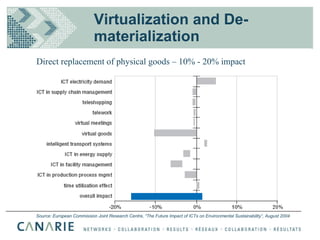
Virtualization and De-materialization Source: European Commission Joint Research Centre, “The Future Impact of ICTs on Environmental Sustainability”, August 2004 Direct replacement of physical goods – 10% - 20% impact
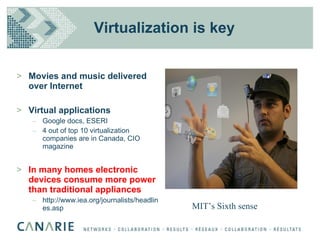
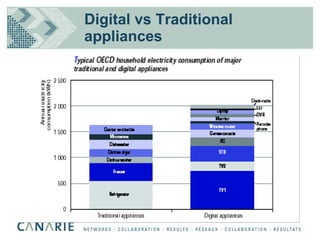
Virtualization is key Movies and music delivered over Internet Virtual applications  Google docs, ESERI 4 out of top 10 virtualization companies are in Canada, CIO magazine In many homes electronic devices consume more power than traditional appliances http://www.iea.org/journalists/headlines.asp MIT’s Sixth sense
Digital vs Traditional appliances
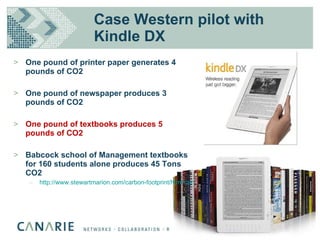
Case Western pilot with Kindle DX One pound of printer paper generates 4 pounds of CO2 One pound of newspaper produces 3 pounds of CO2 One pound of textbooks produces 5 pounds of CO2 Babcock school of Management textbooks for 160 students alone produces 45 Tons CO2 http://www.stewartmarion.com/carbon-footprint/html/carbon-footprint-stuff.html
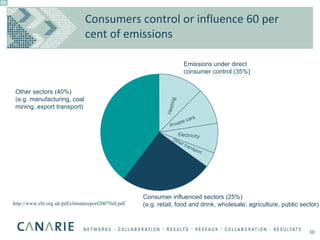
Other sectors (40%)  (e.g. manufacturing, coal mining, export transport) Emissions under direct consumer control (35%) Consumer influenced sectors (25%) (e.g. retail, food and drink, wholesale, agriculture, public sector) Heating Private cars Electricity Other transport Consumers control or influence 60 per cent of emissions http://www.cbi.org.uk/pdf/climatereport2007full.pdf 30
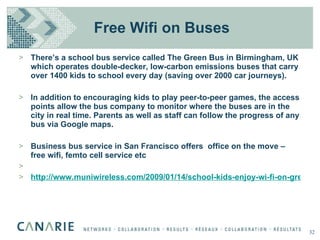
Free Wifi on Buses There’s a school bus service called The Green Bus in Birmingham, UK which operates double-decker, low-carbon emissions buses that carry over 1400 kids to school every day (saving over 2000 car journeys).  In addition to encouraging kids to play peer-to-peer games, the access points allow the bus company to monitor where the buses are in the city in real time. Parents as well as staff can follow the progress of any bus via Google maps. Business bus service in San Francisco offers  office on the move – free wifi, femto cell service etc   http://www.muniwireless.com/2009/01/14/school-kids-enjoy-wi-fi-on-green-bus/   32
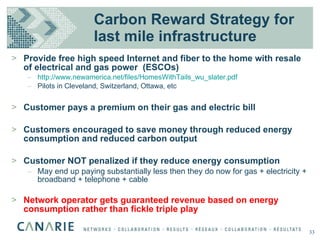
Carbon Reward Strategy for last mile infrastructure Provide free high speed Internet and fiber to the home with resale of electrical and gas power  (ESCOs) http://www.newamerica.net/files/HomesWithTails_wu_slater.pdf Pilots in Cleveland, Switzerland, Ottawa, etc Customer pays a premium on their gas and electric bill Customers encouraged to save money through reduced energy consumption and reduced carbon output Customer NOT penalized if they reduce energy consumption May end up paying substantially less then they do now for gas + electricity + broadband + telephone + cable Network operator gets guaranteed revenue based on energy consumption rather than fickle triple play 33
Train your IT staff in offsets Not for profit eLearning institute The institute offers rigorous online training and workshops on GHG accounting, auditing and management.  Most participants are from IT industry Absolutely essential if you want to sell carbon offsets http://www.ghginstitute.org/  35
Final remarks The problem we face is NOT energy consumption, but carbon emissions Think carbon, not energy Optical networks and components will play a critical role in helping us move to a zero carbon society
Thank you More information Canet List serve on Green IT Send e-mail to bill.st.arnaud@canarie.ca http://green-broadband.blogspot.com http://free-fiber-to-the-home.blogspot.com/ 33

Canarie Green It Presentation

  • 1.
    ICT and ClimateChange Benefits to Canada Bill St. Arnaud CANARIE Inc – www.canarie.ca [email_address] Unless otherwise noted all material in this slide deck may be reproduced, modified or distributed without prior permission of the author
  • 2.
    The Climate ChangeThreat Obama’s National Science Advisor John Holdren on Global Climate Disruption http://greenmonk.net/john-holdren-on-global-climatic-disruption Stephen Chu – new head of DoE – “Wake up America!!” http://www.thedailygreen.com/environmental-news/latest/california-agriculture-global-warming-47020402 MIT report predicts median temperature forecast of 5.2C 11C increase in Northern Canada http://globalchange.mit.edu/pubs/abstract.php?publication_id=990 Last Ice age average global temperature was 6C cooler than today Most of Canada was under 2-3 km ice
  • 3.
  • 4.
    The Planet isAlready Committed to a Dangerous Level of Warming V. Ramanathan and Y. Feng, Scripps Institution of Oceanography, UCSD September 23, 2008 www.pnas.orgcgidoi10.1073pnas.0803838105 Source: Larry Smarr CAL-It2 Temperature Threshold Range that Initiates the Climate-Tipping Additional Warming over 1750 Level 90% of the Additional 1.6 Degree Warming Will Occur in the 21 st Century
  • 5.
    Climate tipping pointsUSGS Abrupt Climate Change report finds that future climate shifts have been underestimated and warns of debilitating abrupt shift in climate that would be devastating. http://www.climatescience.gov/Library/sap/sap3-4/final-report/default.htm http://climateprogress.org/2008/11/24/what-are-the-near-term-climate-pearl-harbors/ Tipping elements in the Earth's climate -National Academies of Science http://www.pnas.org/content/105/6/1786.abstract?maxtoshow=&HITS=10&hits=10&RESULTFORMAT=&fulltext=tipping+elements+lenton&searchid=1&FIRSTINDEX=0&resourcetype=HWCIT “ Society may be lulled into a false sense of security by smooth projections of global change. Our synthesis of present knowledge suggests that a variety of tipping elements could reach their critical point within this century under anthropogenic climate change. “
  • 6.
    Our Challenge 5j j 26 tons/person 1 ton/person 2008 2050 ? j 2100 2 tons/person Source: Stern 2008
  • 7.
    CO2 emissions fromInformation, Computer, Telecommunications (ICT) It is estimated that the ICT industry alone produces CO2 emissions that is equivalent to the carbon output of the entire aviation industry 2-3% ICT emissions growth fastest of any sector in society, doubling about every 4 years One small computer server generates as much carbon dioxide as a SUV with a fuel efficiency of 15 miles per gallon ICT represent 8-9.4% of total US electricity consumption, and 8% of global electricity consumption Projected to grow to as much as 20% of all electrical consumption in the US http://uclue.com/index.php?xq=724 *An Inefficient Tuth: http://www.globalactionplan.org.uk/event_detail.aspx?eid=2696e0e0-28fe-4121-bd36-3670c02eda49 6
  • 8.
    Growth Projections DataCenters Half of ICT consumption is data centers 50% of today’s Data Centers and major science facilities in the US will have insufficient power and cooling;* By 2010, half of all Data Centers will have to relocate or outsource applications to another facility.* During the next 5 years, 90% of all companies will experience some kind of power disruption. In that same period one in four companies will experience a significant business disruption* Data centers will consume 12% of electricity in the US by 2020 (TV Telecom) Source: Gartner; Meeting the DC power and cooling challenge
  • 9.
    IT biggest powerdraw Heating, Cooling and Ventilation 58% Lighting 11% IT Equipment 25% Other 6% Sources: BOMA 2006, EIA 2006, AIA 2006 Energy Consumption Typical Building Energy Consumption World Wide Transportation 25% Manufacturing 25% Buildings 50%
  • 10.
    ICT’s Enabling Effectis Significant Can deliver carbon emission reductions five times size of sector’s own footprint by 2020 7.8 Giga-tons carbon dioxide equivalent Greater than US or China’s current annual emissions Key sectors include Transportation, Buildings, Industrial Processes, and Power No other sector can achieve this enabler effect !! Source: SMART 2020: Enabling the low carbon economy in the information age, 2008 12
  • 11.
    Canada’s ICT enablereffect ICT sector contributes one megatonne of GHG emissions or < 1% of Canada’s total Enabling effect estimated at between 19.1 – 36 MT of CO2e Telework, Car pools, Transportation logistics, Virtual Meetings, Smart Buildings & e-commerce Estimated financial benefit between $7.5 billion – $12.9 billion Source: Industry Canada
  • 12.
    Trends: Policy andLegislative Changes Provincial/Territories: -BC (Bill 44, 31) -AB (Climate Change and Emissions Management Act (2007)) -Saskatchewan Bill No. 95) -Manitoba (The Climate Change and Emissions Reductions Act (June 2008)) -Ontario (Draft Bill) -Quebec (Bill 42) -Atlantic Canada – targets set in climate change plans Government of Canada's proposed GHG Offset System July 8, 2009 - Statement of G8 on energy and climate
  • 13.
    Why is thisimportant? RFPs from customers to include shadow carbon accounting UK government is planning to link the funding available to universities and colleges with their performance in reducing carbon emissions. All Government RFP responses must include shadow cost carbon accounting EU and other nations expected to follow soon   http://www.carbonoffsetsdaily.com/global/government-funding-to-reward-greenest-universities-3996.htm   21
  • 14.
    The Carbon Economy$500 billion - Value of low-carbon energy markets by 2050 $100 billion - Demand for projects generating GHG missions credits by 2030 Global carbon market expected to grow 58% this year to $92 billion $57 trillion - Carbon Disclosure Project signatories, 1000s of companies participating, expanding to supply chain accounting Obama’s cap and trade (Waxman-Markey) bill will force emitters to spend $1.25 on carbon offsets for every $1.00 on emission permits Source: ClimateCheck 20
  • 15.
    Public Sector tobe carbon neutral by 2010 in BC British Columbia was first government to introduce carbon tax in Western Hemisphere Provincial Government in province of British Columbia has mandated all public sector institutions to be carbon neutral by 2010 Other provinces exploring to implement the same policy New Zealand has also made the same requirements Many universities and businesses are adopting voluntary carbon neutrality objectives Dell, Cisco, Google etc This will have big impact on university research and optical networks
  • 16.
    Moratorium on coalplants Ontario suspends nuclear power plants http://www.theglobeandmail.com/news/national/ontario-suspends-nuclear-power-plans/article1200469/ CANDU reactor safety design may limit power production to 50% http://www.theglobeandmail.com/news/national/reactor-design-puts-safety-into-question/article1200130/ Britain and Canada to phase out coal plants that don’t have CCS by 2025 http://news.mongabay.com/2009/0429-hance_cleancoal.html
  • 17.
    The Falsehood ofEnergy Efficiency Most current approaches to reduce carbon footprint are focused on increased energy efficiency of equipment and processes But growth in ICT deployment of equipment and services is outstripping any gains made in efficiency Which is likely to accelerate as ICT is used to support abatement in other fields such as smart homes, smart buildings, smart grids etc Also greater efficiency can paradoxically increase energy consumption by reducing overall cost service and therefore stimulates demand Khazzoom-Brookes postulate (aka Jevons paradox aka rebound effect) In last Energy crisis in 1973 Congress passed first energy efficiency laws (CAFÉ) which mandate minimum mileage for cars, home insulation and appliances Net effect was to reduce cost of driving car, heating or cooling home, and electricity required for appliances Consumer response was to drive further, buy bigger homes and appliances 14
  • 18.
    Zero Carbon strategyessential Zero carbon strategy using renewable energy critically important if governments mandate carbon neutrality, or if there is a climate catastrophe With a zero carbon strategy growth in demand for ICT services will not effect GHG emissions Anything times zero is always zero Wind and solar power are most likely candidates because of opportunity cost/benefit analysis especially time to deploy Nuclear has high opportunity cost because of time to deploy http://climateprogress.org/2008/12/14/stanford-study-part-1-wind-solar-baseload-easily-beat-nuclear-and-they-all-best-clean-coal/ But renewable energy sites are usually located far from cities and electrical distribution systems are not designed to carry load http://www.americanprogress.org/issues/2008/12/pdf/renewable_transmission.pdf 15
  • 19.
    Purchasing green powerlocally is expensive with significant transmission line losses Demand for green power within cities expected to grow dramatically ICT facilities DON’T NEED TO BE LOCATED IN CITIES -Cooling also a major problem in cities But most renewable energy sites are very remote and impractical to connect to electrical grid. Can be easily reached by an optical network Provide independence from electrical utility and high costs in wheeling power Savings in transmission line losses (up to 15%) alone, plus carbon offsets can pay for moving ICT facilities to renewable energy site ICT is only industry ideally suited to relocate to renewable energy sites Also ideal for business continuity in event of climate catastrophe “ Zero Carbon” Computing and data centers 16
  • 20.
    Many examples Hydro-electricpowered data centers Data Islandia Digital Data Archive ASIO solar powered data centers Wind powered data centers 17 Ecotricity in UK builds windmills at data center locations with no capital cost to user
  • 21.
    Relocation of NordicHPC facilities to Iceland
  • 22.
    “ Zero Carbon”data centers connected by optical networks Turbine Spin up Power
  • 23.
  • 24.
    Impact on networksBuilding zero carbon data centers in remote locations creates impact on network in terms of large data volumes being carried greater distances More fossil based energy will be consumed in transmission facilities (versus reduction at data centers) Optical networks will have modest increase in power consumption especially with new 100G and 1000G waves Electronic equipment such as routers and aggregators will have much larger impact
  • 25.
    Renewable power isnot reliable How do you provide mission critical ICT services when energy source is unreliable? Ebbing wind or setting sun Back up diesel and batteries are not an option because they are not zero carbon and power outages can last for days or weeks Need new network architectures and business models to ensure reliable service delivery by quickly moving compute jobs and data sets around the world to sites that have available power Will require high bandwidth networks and routing architectures to quickly move jobs and data sets from site to site 26
  • 26.
    Vertical Windmills fornetworks MAGENN AIR ROTOR SYSTEM (M.A.R.S.) Windports Verticainc
  • 27.
    Wind powered Cellphone tower Over 100,000 cell phone towers to be powered by renewable energy by 2012 Vertical axis turbines and solar Ericsson (Montreal) world leader in these developments
  • 28.
    CANARIE Green-IT Pilot$3m allocation for Green cyber-infrastructure-IT pilot testbed Two objectives: Technical viability and usability for relocating computers to zero carbon data centers and follow the sun/follow the wind network Business case viability of offering carbon offsets (and or equivalent in services) to IT departments and university researchers who reduce their carbon footprint by relocating computers and instrumentation to zero carbon data centers International partnership with possible zero carbon nodes using virtual router/computers in Spain, Ireland, California, Australia, British Columbia, Ottawa, Quebec and Nova Scotia 25
  • 29.
    The “VM Turntable”Demonstrator seamless remote rendering Korea Chicago Calgary VMs Dynamic Lightpaths Starlight CA*net4 KREOnet APEC TEL 33, Calgary, AL, Apr 24-27 2006 Live VMs migrated from Calgary to Chicago with transit through S. Korea, resulting in just a 1.011 second of application downtime . DRAC sets up and tears down a lightpath w/ each migration.
  • 30.
    What are carbonoffsets? Companies or individuals buy carbon offsets from projects that remove or reduce carbon Planting trees, building hydro dams, installing energy efficient processes, etc Many companies and universities that claim to be carbon neutral do so, not by reducing their CO2 footprint but by purchasing offsets Two types of markets Regulated markets – Alberta, BC , Europe and New England Voluntary markets – Air Canada, Chicago, etc Carbon buying and selling is done through registries or exchanges Pacific Carbon Trust, Montreal Carbon exchange, REGI In regulated markets all big emitters such as power plants, steel mills, universities , etc must purchase permits based on cap and trade
  • 31.
    ISO 14064/2/3 ISO14064 is the accounting process required to validate whether a project actually reduces CO2 ISO 14062/3 sets the measurement process for “life cycle” CO2 emissions for a product or service You need to implement ISO 14064 process to demonstrate actual CO2 reductions Vendors need to provide 14062/3 data for products and services
  • 32.
    Define Scope ofyour Emissions
  • 33.
    : Selecta GHG Protocol The World Resource Institute Greenhouse Gas Protocol The Climate Registry General Reporting Protocol
  • 34.
    * Based onUBC’s 2006 Greenhouse Gas Emissions Inventory Report **Includes core operations, tenants and ancillaries at UBC Point Grey and Okanagan campuses UBC’S GHG Emissions (tonnes of C02-e) Source Total Emissions (Tonnes CO 2 e)* Scope 1 Natural Gas** 66,150 Oil** 440 Fleet and Fuel 2,120 Animals 1,510 Scope 2 Electricity 6,150 Scope 3 Paper 1,090 Buildings 12,020 Flights 13,630 Commuting 22,820 Fertilizer 150
  • 35.
    Impact on UBCBackground: The greenhouse gas emissions reductions targets act (Bill 44-2007), imposes carbon neutrality on all UBC Scope 1 and 2 emissions plus paper. Carbon neutrality will be achieved through emissions reductions, and the purchasing of offsets for emissions that cannot be avoided. Offsets in BC are regulated through the Pacific Carbon Trust. Indications are that Offsets will be priced at $25/tonne.   Since July 1 st , 2008, UBC has been paying a carbon tax on all fossil fuel (natural gas, oil and fleet fuel). This tax began at $10/tonne CO2e in 2008, and will rise by $5/year to $30/tonne in 2012.  The following tables summarize UBC’s estimated GHG emissions liability
  • 36.
    Impact on UBC        2007 GHG Inventory Summary Table (Tonnes CO2-e) [1]   UBC Vancouver Campus [2] UBC Okanagan Campus [3] Natural Gas 54 595 2 283 Oil 0 0 Electricity 3 865 254 Fleet 2 096 23 Paper 994 Cost of GHG emissions for UBC 2010 – 2012 (/tonne CO2-e)   2010 2011 2012 Carbon Offset $25 $25 $25 Carbon Tax $20 $25 $30 Total $45 $50 $55 UBC’s GHG Emissions Liability 2010-2012 [4]   2010 2011 2012 Carbon Offset [5] $ 1 602 750 $ 1 602 750 $ 1 602 750 Carbon Tax [6] $ 1 179 940 $ 1 474 925 $ 1 769 910 Total: $ 2 782 690 $ 3 077 675 $ 3 372 660
  • 37.
    Policy approaches toreducing CO2 Carbon taxes Politically difficult to sell Cap and trade Useful for big emitters like power companies Addresses only supply side of CO2 Carbon Neutrality imposed by law Growing in popularity especially as protests over gas tax escalates But there may be an additional approach…. 28
  • 38.
    Carbon Rewards rathercarbon taxes – “gCommerce” Although carbon taxes are revenue neutral, they payee rarely sees any direct benefit No incentive other than higher cost to reduce footprint Rather than penalize consumers and businesses for carbon emissions, can we reward them for reducing their carbon emissions? Carbon rewards can be “virtual” products delivered over broadband networks such movies, books, education, health services, collarboartive education and research technologies etc Carbon reward can also be free ICT services (with low carbon footprint) such as Internet, cellphone, fiber to the home, etc 29
  • 39.
    Virtualization and De-materializationSource: European Commission Joint Research Centre, “The Future Impact of ICTs on Environmental Sustainability”, August 2004 Direct replacement of physical goods – 10% - 20% impact
  • 40.
    Virtualization is keyMovies and music delivered over Internet Virtual applications Google docs, ESERI 4 out of top 10 virtualization companies are in Canada, CIO magazine In many homes electronic devices consume more power than traditional appliances http://www.iea.org/journalists/headlines.asp MIT’s Sixth sense
  • 41.
  • 42.
    Case Western pilotwith Kindle DX One pound of printer paper generates 4 pounds of CO2 One pound of newspaper produces 3 pounds of CO2 One pound of textbooks produces 5 pounds of CO2 Babcock school of Management textbooks for 160 students alone produces 45 Tons CO2 http://www.stewartmarion.com/carbon-footprint/html/carbon-footprint-stuff.html
  • 43.
    Other sectors (40%) (e.g. manufacturing, coal mining, export transport) Emissions under direct consumer control (35%) Consumer influenced sectors (25%) (e.g. retail, food and drink, wholesale, agriculture, public sector) Heating Private cars Electricity Other transport Consumers control or influence 60 per cent of emissions http://www.cbi.org.uk/pdf/climatereport2007full.pdf 30
  • 44.
    Free Wifi onBuses There’s a school bus service called The Green Bus in Birmingham, UK which operates double-decker, low-carbon emissions buses that carry over 1400 kids to school every day (saving over 2000 car journeys). In addition to encouraging kids to play peer-to-peer games, the access points allow the bus company to monitor where the buses are in the city in real time. Parents as well as staff can follow the progress of any bus via Google maps. Business bus service in San Francisco offers office on the move – free wifi, femto cell service etc   http://www.muniwireless.com/2009/01/14/school-kids-enjoy-wi-fi-on-green-bus/ 32
  • 45.
    Carbon Reward Strategyfor last mile infrastructure Provide free high speed Internet and fiber to the home with resale of electrical and gas power (ESCOs) http://www.newamerica.net/files/HomesWithTails_wu_slater.pdf Pilots in Cleveland, Switzerland, Ottawa, etc Customer pays a premium on their gas and electric bill Customers encouraged to save money through reduced energy consumption and reduced carbon output Customer NOT penalized if they reduce energy consumption May end up paying substantially less then they do now for gas + electricity + broadband + telephone + cable Network operator gets guaranteed revenue based on energy consumption rather than fickle triple play 33
  • 46.
    Train your ITstaff in offsets Not for profit eLearning institute The institute offers rigorous online training and workshops on GHG accounting, auditing and management. Most participants are from IT industry Absolutely essential if you want to sell carbon offsets http://www.ghginstitute.org/ 35
  • 47.
    Final remarks Theproblem we face is NOT energy consumption, but carbon emissions Think carbon, not energy Optical networks and components will play a critical role in helping us move to a zero carbon society
  • 48.
    Thank you Moreinformation Canet List serve on Green IT Send e-mail to bill.st.arnaud@canarie.ca http://green-broadband.blogspot.com http://free-fiber-to-the-home.blogspot.com/ 33

Editor's Notes

  • #7 ERM has a strong pro-active dimension. As much about proactively managing as measuring It is a key part of our mission to Enable you to make decisions that are based on risk across the enterprise, levels of users,
  • #8 Assume each higher-ed produces 1-2 x 10e5 metric tons COe2 There are 3 x 10e3 higher ed institutions Therefore total higher ed CO2 emissions = 3-6 x 10e8 tons US total emissions 7 x 10e9 COe2 Therefore high ed percentage 3-6 x 10e8/7 x 10e9= 4.5 – 8.5%
  • #9 Future projections from Gartner
  • #11 Source: SMART 2020: Enabling the low carbon economy in the information age First study to quantify the enabler effect of ICT on other sectors in terms of reducing CO2 emissions. Emissions from the ICT sector are estimated to rise significantly over the coming years No other sector can supply technology capabilities so integral to energy efficiency across such a range of other sectors or industries By 2020, ICT technologies can reduce global CO2 emissions by 7.8 versus 51.9 if business as usual (BAU) 7.8 Giga-tons of carbon dioxide emissions is greater than the current annual emissions of either the US or China
  • #33 Protocols have also helped to define the scope of GHG emissions. Scope 1: Direct emissions from sources owned by the institution (heating and cooling?) fleets Scope 2: Indirect emissions from purchased energy (electricity) Scope 3: Other emissions related to the institution but not caused by sources owned by the institution Scope three emissions are voluntary emissions sources Up to the organization to choose weather or not they want to account for Scope 3 Post Sec. has an opportunity to influence emissions reductions beyond the scope of their attributed (scope 1 and 2) emissions. Next Slide- UBC Inventory UBC inventoried a number of scope 3 emissions including transportation, flights, embodied energy in building construction to name a few. I’ll expand on this when I show
  • #34 Step 3: Select a GHG protocol. GHG protocols provide a methodology for GHG inventory Answer difficult questions such as which emissions to account for, scope and boundary of emissions sources, how and where to obtain emissions factors for your calculations. Other reasons Better off using a standard that everyone else is using to benchmark and for comparison Upcoming legislations Auditable system On the screen are the 2 most commonly used protocols. Both are free to use, and can be found on-line. Anke will send around the link. UBC used the WRI protocol in developing our inventory, as at the time it was the most widely used and recognized. Both protocols adhere to ISO standards for GHG accounting, and both can be used.
  • #35 Here is a copy of the UBC 2006 GHG emissions inventory. UBC inventoried a number of scope 3 emissions including transportation, flights, embodied energy in building construction to name a few. Rational is that we can have influence even where emissions are not attributed toward us. For example, our context in British Columbia means that we are required by law to be carbon neutral by 2010. We will be carbon neutral in scope 1 and 2 emissions (plus paper), but we continue to take on projects that reduce emissions in all three scopes Example- U-Pass