The Role of Energy Efficient Cyberinfrastructure  in Slowing Climate Change Community Alliance for Distributed Energy Resources Scripps Forum, UCSD La Jolla, CA April 28, 2010 Dr. Larry Smarr Director, California Institute for Telecommunications and Information Technology Harry E. Gruber Professor,  Dept. of Computer Science and Engineering Jacobs School of Engineering, UCSD Twitter: lsmarr
Abstract The continuing rise in greenhouse gases (GHG) in Earth’s atmosphere caused by human activity is beginning to alter the delicately balanced climate system. Means to slow down the rate of GHG emissions are needed to avoid catastrophic climate change in the future. While moving from a high-carbon to a low-carbon energy system is the long term solution, more energy efficient cyberinfrastructure can provide some relief in the short term. I will review several projects which Calit2 is carrying out with our UCSD and UCI faculty in energy efficient data centers, personal computers, smart buildings, and telepresence and show how university campuses can be urban testbeds of the greener future.
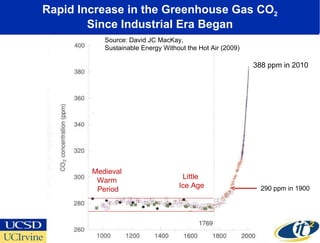
Rapid Increase in the Greenhouse Gas CO 2 Since Industrial Era Began Little  Ice Age Medieval  Warm  Period 388 ppm in 2010 Source: David JC MacKay,  Sustainable Energy Without the Hot Air (2009)  290 ppm in 1900
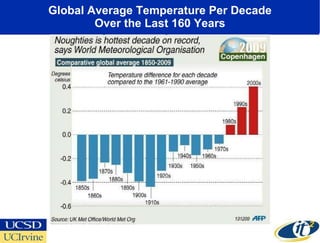
Global Average Temperature Per Decade Over the Last 160 Years
Climate Change Will Pose Major Challenges to California in Water and Wildfires “ It is likely that the changes in climate that San Diego is experiencing due to the warming of the region will increase the frequency and intensity of fires even more, making the region more vulnerable to devastating fires like the ones seen in 2003 and 2007.” California Applications Program (CAP) & The California Climate Change Center (CCCC)  CAP/CCCC is directed from the Climate Research Division, Scripps Institution of Oceanography
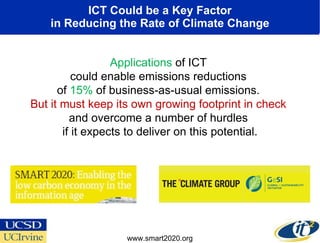
ICT Could be a Key Factor in Reducing the Rate of Climate Change Applications  of ICT  could enable emissions reductions  of  15%  of business-as-usual emissions.  But it must keep its own growing footprint in check  and overcome a number of hurdles  if it expects to deliver on this potential. www.smart2020.org
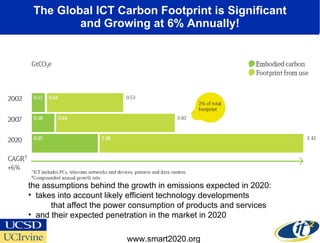
The Global ICT Carbon Footprint is Significant and Growing at 6% Annually! www.smart2020.org the assumptions behind the growth in emissions expected in 2020:  takes into account likely efficient technology developments    that affect the power consumption of products and services and their expected penetration in the market in 2020
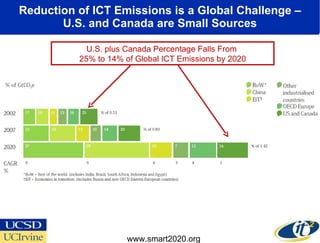
Reduction of ICT Emissions is a Global Challenge – U.S. and Canada are Small Sources U.S. plus Canada Percentage Falls From  25% to 14% of Global ICT Emissions by 2020 www.smart2020.org
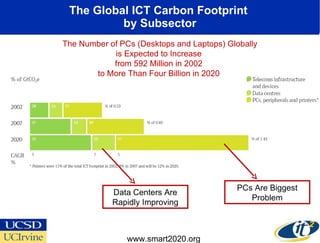
The Global ICT Carbon Footprint  by Subsector www.smart2020.org The Number of PCs (Desktops and Laptops) Globally is Expected to Increase  from 592 Million in 2002  to More Than Four Billion in 2020  PCs Are Biggest Problem Data Centers Are Rapidly Improving
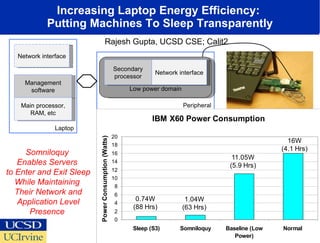
Increasing Laptop Energy Efficiency:  Putting Machines To Sleep Transparently Somniloquy  Enables Servers  to Enter and Exit Sleep While Maintaining  Their Network and Application Level Presence  Rajesh Gupta, UCSD CSE; Calit2 Peripheral Laptop Low power domain Network interface Secondary processor Network interface Management software Main processor, RAM, etc
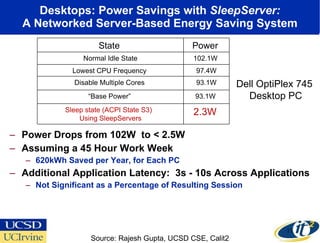
Desktops: Power Savings with  SleepServer: A Networked Server-Based Energy Saving System Power Drops from 102W  to < 2.5W Assuming a 45 Hour Work Week  620kWh Saved per Year, for Each PC Additional Application Latency:  3s - 10s Across Applications Not Significant as a Percentage of Resulting Session Dell OptiPlex 745  Desktop PC Source: Rajesh Gupta, UCSD CSE, Calit2 State  Power  Normal Idle State 102.1W  Lowest CPU Frequency  97.4W Disable Multiple Cores  93.1W “ Base Power”  93.1W  Sleep state (ACPI State S3)  Using SleepServers 2.3W
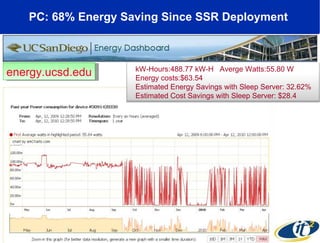
PC: 68% Energy Saving Since SSR Deployment  energy.ucsd.edu kW-Hours:488.77 kW-H  Averge Watts:55.80 W Energy costs:$63.54 Estimated Energy Savings with Sleep Server: 32.62% Estimated Cost Savings with Sleep Server: $28.4
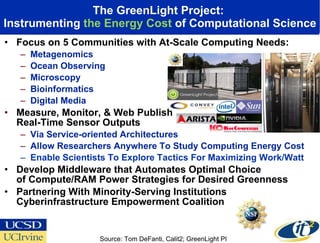
The GreenLight Project:  Instrumenting  the Energy Cost  of Computational Science Focus on 5 Communities with At-Scale Computing Needs: Metagenomics Ocean Observing Microscopy  Bioinformatics Digital Media Measure, Monitor, & Web Publish  Real-Time Sensor Outputs Via Service-oriented Architectures Allow Researchers Anywhere To Study Computing Energy Cost Enable Scientists To Explore Tactics For Maximizing Work/Watt Develop Middleware that Automates Optimal Choice  of Compute/RAM Power Strategies for Desired Greenness Partnering With Minority-Serving Institutions Cyberinfrastructure Empowerment Coalition  Source: Tom DeFanti, Calit2; GreenLight PI
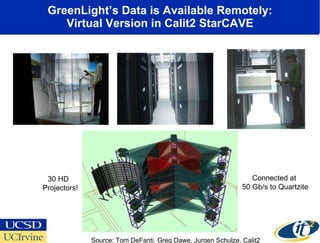
GreenLight’s Data is Available Remotely: Virtual Version in Calit2 StarCAVE Source: Tom DeFanti, Greg Dawe, Jurgen Schulze, Calit2 Connected at  50 Gb/s to Quartzite 30 HD  Projectors!
Research Needed  on How to Deploy a  Green  CI Computer Architecture  Rajesh Gupta/CSE Software Architecture, Clouds  Amin Vahdat, Ingolf Kruger/CSE CineGrid Exchange  Tom DeFanti/Calit2 Visualization  Falko Kuster/Structural Engineering Power and Thermal Management  Tajana Rosing/CSE Analyzing Power Consumption Data  Jim Hollan/Cog Sci Direct DC Datacenters Tom Defanti, Greg Hidley http://greenlight.calit2.net MRI
New Techniques for Dynamic Power and Thermal Management to Reduce Energy Requirements Dynamic Thermal Management (DTM) Workload Scheduling: Machine learning for Dynamic Adaptation to get Best Temporal and Spatial Profiles with Closed-Loop Sensing Proactive Thermal Management Reduces Thermal Hot Spots by Average 60% with No Performance Overhead Dynamic Power Management (DPM) Optimal DPM for a Class of Workloads Machine Learning to Adapt Select Among Specialized Policies Use Sensors and  Performance Counters to Monitor Multitasking/Within Task Adaptation of Voltage and Frequency Measured Energy Savings of  Up to 70% per Device System Energy Efficiency Lab (seelab.ucsd.edu) Prof. Tajana Šimunić Rosing, CSE, UCSD CNS NSF Project Greenlight Green Cyberinfrastructure in  Energy-Efficient Modular Facilities  Closed-Loop Power &Thermal Management
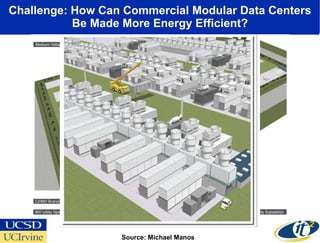
Challenge: How Can Commercial Modular Data Centers Be Made More Energy Efficient? Source: Michael Manos
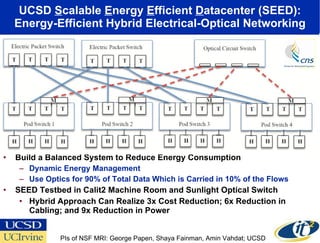
UCSD  S calable  E nergy  E fficient  D atacenter (SEED): Energy-Efficient Hybrid Electrical-Optical Networking Build a Balanced System to Reduce Energy Consumption  Dynamic Energy Management Use Optics for 90% of Total Data Which is Carried in 10% of the Flows  SEED Testbed in Calit2 Machine Room and Sunlight Optical Switch Hybrid Approach Can Realize 3x Cost Reduction; 6x Reduction in Cabling; and 9x Reduction in Power PIs of NSF MRI: George Papen, Shaya Fainman, Amin Vahdat; UCSD
Application of ICT Can Lead to a  5-Fold Greater Decrease in GHGs Than its Own Carbon Footprint Major Opportunities for the United States* Smart Electrical Grids Smart Transportation Systems Smart Buildings Virtual Meetings * Smart 2020 United States Report Addendum www.smart2020.org While the sector plans to significantly step up  the energy efficiency of its products and services,  ICT’s largest influence  will be by enabling  energy efficiencies in other sectors, an opportunity  that could deliver  carbon savings five times larger  than  the total emissions from the entire ICT sector in 2020. --Smart 2020 Report
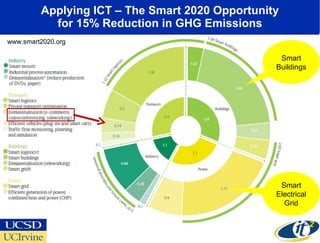
Applying ICT – The Smart 2020 Opportunity for 15% Reduction in GHG Emissions Smart Buildings Smart Electrical Grid www.smart2020.org
Making University Campuses  Living Laboratories for the Greener Future www.educause.edu/EDUCAUSE+Review/EDUCAUSEReviewMagazineVolume44/CampusesasLivingLaboratoriesfo/185217
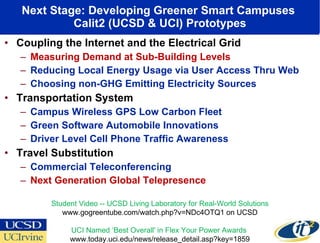
Next Stage: Developing Greener Smart Campuses  Calit2 (UCSD & UCI) Prototypes Coupling the Internet and the Electrical Grid Measuring Demand at Sub-Building Levels Reducing Local Energy Usage via User Access Thru Web Choosing non-GHG Emitting Electricity Sources Transportation System  Campus Wireless GPS Low Carbon Fleet Green Software Automobile Innovations Driver Level Cell Phone Traffic Awareness Travel Substitution Commercial Teleconferencing Next Generation Global Telepresence Student Video -- UCSD Living Laboratory for Real-World Solutions www.gogreentube.com/watch.php?v=NDc4OTQ1 on UCSD UCI Named ‘Best Overall' in Flex Your Power Awards  www.today.uci.edu/news/release_detail.asp?key=1859
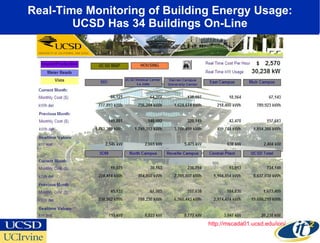
Real-Time Monitoring of Building Energy Usage: UCSD Has 34 Buildings On-Line http://mscada01.ucsd.edu/ion/
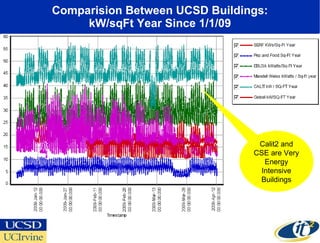
Comparision Between UCSD Buildings: kW/sqFt Year Since 1/1/09 Calit2 and CSE are Very Energy Intensive Buildings
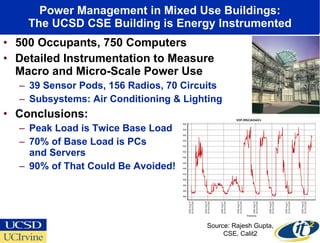
Power Management in Mixed Use Buildings: The UCSD CSE Building is Energy Instrumented 500 Occupants, 750 Computers Detailed Instrumentation to Measure Macro and Micro-Scale Power Use  39 Sensor Pods, 156 Radios, 70 Circuits Subsystems: Air Conditioning & Lighting Conclusions: Peak Load is Twice Base Load 70% of Base Load is PCs  and Servers 90% of That Could Be Avoided! Source: Rajesh Gupta, CSE, Calit2
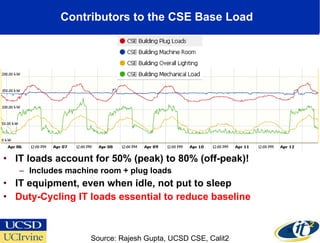
Contributors to the CSE Base Load  IT loads account for 50% (peak) to 80% (off-peak)!  Includes machine room + plug loads  IT equipment, even when idle, not put to sleep Duty-Cycling IT loads essential to reduce baseline Source: Rajesh Gupta, UCSD CSE, Calit2
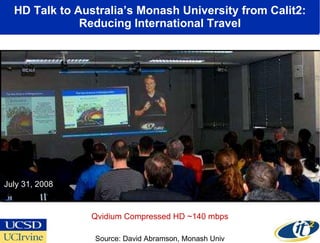
HD Talk to Australia’s Monash University from Calit2: Reducing International Travel July 31, 2008 Source: David Abramson, Monash Univ Qvidium Compressed HD ~140 mbps
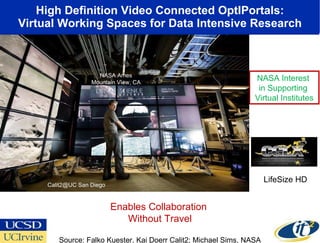
High Definition Video Connected OptIPortals: Virtual Working Spaces for Data Intensive Research Source: Falko Kuester, Kai Doerr Calit2; Michael Sims, NASA NASA Interest  in Supporting  Virtual Institutes LifeSize HD Enables Collaboration  Without Travel NASA Ames Mountain View, CA Calit2@UC San Diego
Follow My Talks and Tweets at lsmarr.calit2.net

The Energy Efficient Cyberinfrastructure in Slowing Climate Change

  • 1.
    The Role ofEnergy Efficient Cyberinfrastructure in Slowing Climate Change Community Alliance for Distributed Energy Resources Scripps Forum, UCSD La Jolla, CA April 28, 2010 Dr. Larry Smarr Director, California Institute for Telecommunications and Information Technology Harry E. Gruber Professor, Dept. of Computer Science and Engineering Jacobs School of Engineering, UCSD Twitter: lsmarr
  • 2.
    Abstract The continuingrise in greenhouse gases (GHG) in Earth’s atmosphere caused by human activity is beginning to alter the delicately balanced climate system. Means to slow down the rate of GHG emissions are needed to avoid catastrophic climate change in the future. While moving from a high-carbon to a low-carbon energy system is the long term solution, more energy efficient cyberinfrastructure can provide some relief in the short term. I will review several projects which Calit2 is carrying out with our UCSD and UCI faculty in energy efficient data centers, personal computers, smart buildings, and telepresence and show how university campuses can be urban testbeds of the greener future.
  • 3.
    Rapid Increase inthe Greenhouse Gas CO 2 Since Industrial Era Began Little Ice Age Medieval Warm Period 388 ppm in 2010 Source: David JC MacKay, Sustainable Energy Without the Hot Air (2009) 290 ppm in 1900
  • 4.
    Global Average TemperaturePer Decade Over the Last 160 Years
  • 5.
    Climate Change WillPose Major Challenges to California in Water and Wildfires “ It is likely that the changes in climate that San Diego is experiencing due to the warming of the region will increase the frequency and intensity of fires even more, making the region more vulnerable to devastating fires like the ones seen in 2003 and 2007.” California Applications Program (CAP) & The California Climate Change Center (CCCC) CAP/CCCC is directed from the Climate Research Division, Scripps Institution of Oceanography
  • 6.
    ICT Could bea Key Factor in Reducing the Rate of Climate Change Applications of ICT could enable emissions reductions of 15% of business-as-usual emissions. But it must keep its own growing footprint in check and overcome a number of hurdles if it expects to deliver on this potential. www.smart2020.org
  • 7.
    The Global ICTCarbon Footprint is Significant and Growing at 6% Annually! www.smart2020.org the assumptions behind the growth in emissions expected in 2020: takes into account likely efficient technology developments that affect the power consumption of products and services and their expected penetration in the market in 2020
  • 8.
    Reduction of ICTEmissions is a Global Challenge – U.S. and Canada are Small Sources U.S. plus Canada Percentage Falls From 25% to 14% of Global ICT Emissions by 2020 www.smart2020.org
  • 9.
    The Global ICTCarbon Footprint by Subsector www.smart2020.org The Number of PCs (Desktops and Laptops) Globally is Expected to Increase from 592 Million in 2002 to More Than Four Billion in 2020 PCs Are Biggest Problem Data Centers Are Rapidly Improving
  • 10.
    Increasing Laptop EnergyEfficiency: Putting Machines To Sleep Transparently Somniloquy Enables Servers to Enter and Exit Sleep While Maintaining Their Network and Application Level Presence Rajesh Gupta, UCSD CSE; Calit2 Peripheral Laptop Low power domain Network interface Secondary processor Network interface Management software Main processor, RAM, etc
  • 11.
    Desktops: Power Savingswith SleepServer: A Networked Server-Based Energy Saving System Power Drops from 102W to < 2.5W Assuming a 45 Hour Work Week 620kWh Saved per Year, for Each PC Additional Application Latency: 3s - 10s Across Applications Not Significant as a Percentage of Resulting Session Dell OptiPlex 745 Desktop PC Source: Rajesh Gupta, UCSD CSE, Calit2 State Power Normal Idle State 102.1W Lowest CPU Frequency 97.4W Disable Multiple Cores 93.1W “ Base Power” 93.1W Sleep state (ACPI State S3) Using SleepServers 2.3W
  • 12.
    PC: 68% EnergySaving Since SSR Deployment energy.ucsd.edu kW-Hours:488.77 kW-H Averge Watts:55.80 W Energy costs:$63.54 Estimated Energy Savings with Sleep Server: 32.62% Estimated Cost Savings with Sleep Server: $28.4
  • 13.
    The GreenLight Project: Instrumenting the Energy Cost of Computational Science Focus on 5 Communities with At-Scale Computing Needs: Metagenomics Ocean Observing Microscopy Bioinformatics Digital Media Measure, Monitor, & Web Publish Real-Time Sensor Outputs Via Service-oriented Architectures Allow Researchers Anywhere To Study Computing Energy Cost Enable Scientists To Explore Tactics For Maximizing Work/Watt Develop Middleware that Automates Optimal Choice of Compute/RAM Power Strategies for Desired Greenness Partnering With Minority-Serving Institutions Cyberinfrastructure Empowerment Coalition Source: Tom DeFanti, Calit2; GreenLight PI
  • 14.
    GreenLight’s Data isAvailable Remotely: Virtual Version in Calit2 StarCAVE Source: Tom DeFanti, Greg Dawe, Jurgen Schulze, Calit2 Connected at 50 Gb/s to Quartzite 30 HD Projectors!
  • 15.
    Research Needed on How to Deploy a Green CI Computer Architecture Rajesh Gupta/CSE Software Architecture, Clouds Amin Vahdat, Ingolf Kruger/CSE CineGrid Exchange Tom DeFanti/Calit2 Visualization Falko Kuster/Structural Engineering Power and Thermal Management Tajana Rosing/CSE Analyzing Power Consumption Data Jim Hollan/Cog Sci Direct DC Datacenters Tom Defanti, Greg Hidley http://greenlight.calit2.net MRI
  • 16.
    New Techniques forDynamic Power and Thermal Management to Reduce Energy Requirements Dynamic Thermal Management (DTM) Workload Scheduling: Machine learning for Dynamic Adaptation to get Best Temporal and Spatial Profiles with Closed-Loop Sensing Proactive Thermal Management Reduces Thermal Hot Spots by Average 60% with No Performance Overhead Dynamic Power Management (DPM) Optimal DPM for a Class of Workloads Machine Learning to Adapt Select Among Specialized Policies Use Sensors and Performance Counters to Monitor Multitasking/Within Task Adaptation of Voltage and Frequency Measured Energy Savings of Up to 70% per Device System Energy Efficiency Lab (seelab.ucsd.edu) Prof. Tajana Šimunić Rosing, CSE, UCSD CNS NSF Project Greenlight Green Cyberinfrastructure in Energy-Efficient Modular Facilities Closed-Loop Power &Thermal Management
  • 17.
    Challenge: How CanCommercial Modular Data Centers Be Made More Energy Efficient? Source: Michael Manos
  • 18.
    UCSD Scalable E nergy E fficient D atacenter (SEED): Energy-Efficient Hybrid Electrical-Optical Networking Build a Balanced System to Reduce Energy Consumption Dynamic Energy Management Use Optics for 90% of Total Data Which is Carried in 10% of the Flows SEED Testbed in Calit2 Machine Room and Sunlight Optical Switch Hybrid Approach Can Realize 3x Cost Reduction; 6x Reduction in Cabling; and 9x Reduction in Power PIs of NSF MRI: George Papen, Shaya Fainman, Amin Vahdat; UCSD
  • 19.
    Application of ICTCan Lead to a 5-Fold Greater Decrease in GHGs Than its Own Carbon Footprint Major Opportunities for the United States* Smart Electrical Grids Smart Transportation Systems Smart Buildings Virtual Meetings * Smart 2020 United States Report Addendum www.smart2020.org While the sector plans to significantly step up the energy efficiency of its products and services, ICT’s largest influence will be by enabling energy efficiencies in other sectors, an opportunity that could deliver carbon savings five times larger than the total emissions from the entire ICT sector in 2020. --Smart 2020 Report
  • 20.
    Applying ICT –The Smart 2020 Opportunity for 15% Reduction in GHG Emissions Smart Buildings Smart Electrical Grid www.smart2020.org
  • 21.
    Making University Campuses Living Laboratories for the Greener Future www.educause.edu/EDUCAUSE+Review/EDUCAUSEReviewMagazineVolume44/CampusesasLivingLaboratoriesfo/185217
  • 22.
    Next Stage: DevelopingGreener Smart Campuses Calit2 (UCSD & UCI) Prototypes Coupling the Internet and the Electrical Grid Measuring Demand at Sub-Building Levels Reducing Local Energy Usage via User Access Thru Web Choosing non-GHG Emitting Electricity Sources Transportation System Campus Wireless GPS Low Carbon Fleet Green Software Automobile Innovations Driver Level Cell Phone Traffic Awareness Travel Substitution Commercial Teleconferencing Next Generation Global Telepresence Student Video -- UCSD Living Laboratory for Real-World Solutions www.gogreentube.com/watch.php?v=NDc4OTQ1 on UCSD UCI Named ‘Best Overall' in Flex Your Power Awards www.today.uci.edu/news/release_detail.asp?key=1859
  • 23.
    Real-Time Monitoring ofBuilding Energy Usage: UCSD Has 34 Buildings On-Line http://mscada01.ucsd.edu/ion/
  • 24.
    Comparision Between UCSDBuildings: kW/sqFt Year Since 1/1/09 Calit2 and CSE are Very Energy Intensive Buildings
  • 25.
    Power Management inMixed Use Buildings: The UCSD CSE Building is Energy Instrumented 500 Occupants, 750 Computers Detailed Instrumentation to Measure Macro and Micro-Scale Power Use 39 Sensor Pods, 156 Radios, 70 Circuits Subsystems: Air Conditioning & Lighting Conclusions: Peak Load is Twice Base Load 70% of Base Load is PCs and Servers 90% of That Could Be Avoided! Source: Rajesh Gupta, CSE, Calit2
  • 26.
    Contributors to theCSE Base Load IT loads account for 50% (peak) to 80% (off-peak)! Includes machine room + plug loads IT equipment, even when idle, not put to sleep Duty-Cycling IT loads essential to reduce baseline Source: Rajesh Gupta, UCSD CSE, Calit2
  • 27.
    HD Talk toAustralia’s Monash University from Calit2: Reducing International Travel July 31, 2008 Source: David Abramson, Monash Univ Qvidium Compressed HD ~140 mbps
  • 28.
    High Definition VideoConnected OptIPortals: Virtual Working Spaces for Data Intensive Research Source: Falko Kuester, Kai Doerr Calit2; Michael Sims, NASA NASA Interest in Supporting Virtual Institutes LifeSize HD Enables Collaboration Without Travel NASA Ames Mountain View, CA Calit2@UC San Diego
  • 29.
    Follow My Talksand Tweets at lsmarr.calit2.net

Editor's Notes

  • #12 Assuming a 27% active time (use of the PC for 45 hours a week), the energy savings would translate to about $56 per year at the conservative rate of 9c/KWhr. We believe that this is around the same price of what it would cost to build a commoditized version of Somniloquy, and as a result using Somniloquy could pay for itself within a year! We have data that this use model (27% use) is actually quite common (measurements by others)!