Chemical Kinetics Made SimpleA complete functional background in chemical kinetics specifically designed for non-chemistsSeptember 2009Presented by Brian M. Frezza
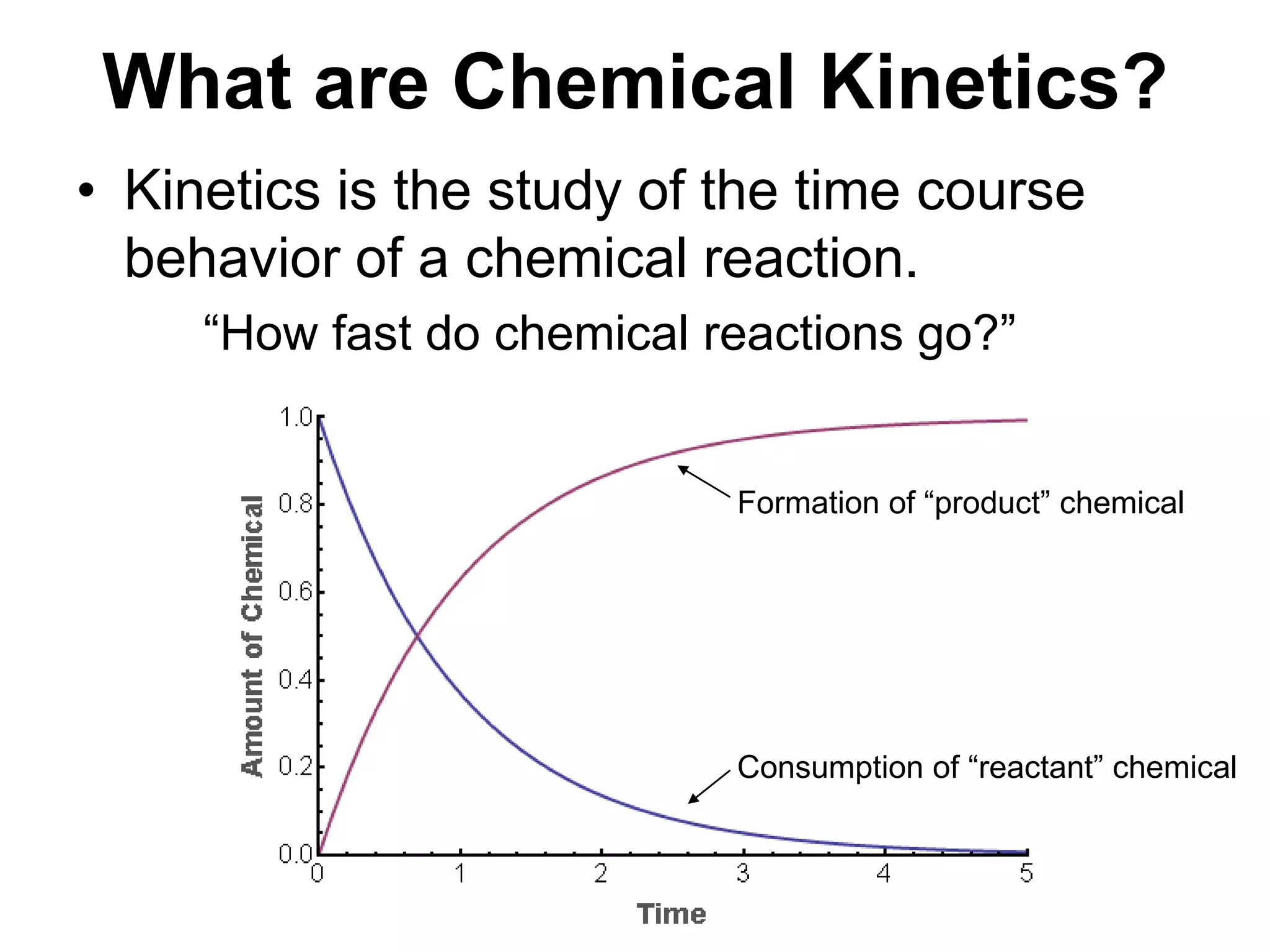
What are Chemical Kinetics?Kinetics is the study of the time course behavior of a chemical reaction.		“How fast do chemical reactions go?”Formation of “product” chemicalConsumption of “reactant” chemical
Why Should I Care?Synthetic OptimizationHow long and under what conditions should you allow a reaction to proceed to maximize yield and profit and minimize unwanted side reactions?Information ProcessingBiological SystemsLiving systems respond to their environment largely by modulating the kinetics of their signaling networks.Molecular ComputingSystematic control of kinetics mechanism can be used to design synthetic systems which process information.
Why Should I Care?Mathematical ModelsThe primary “business of science” is to produce models that faithfully represent the physical processes involved.Allows us to hypothesize what will happen in a chemical reaction without actually performing it. Mathematical models are what separate experimentation from engineering and are woefully under-employed in the life-sciences.
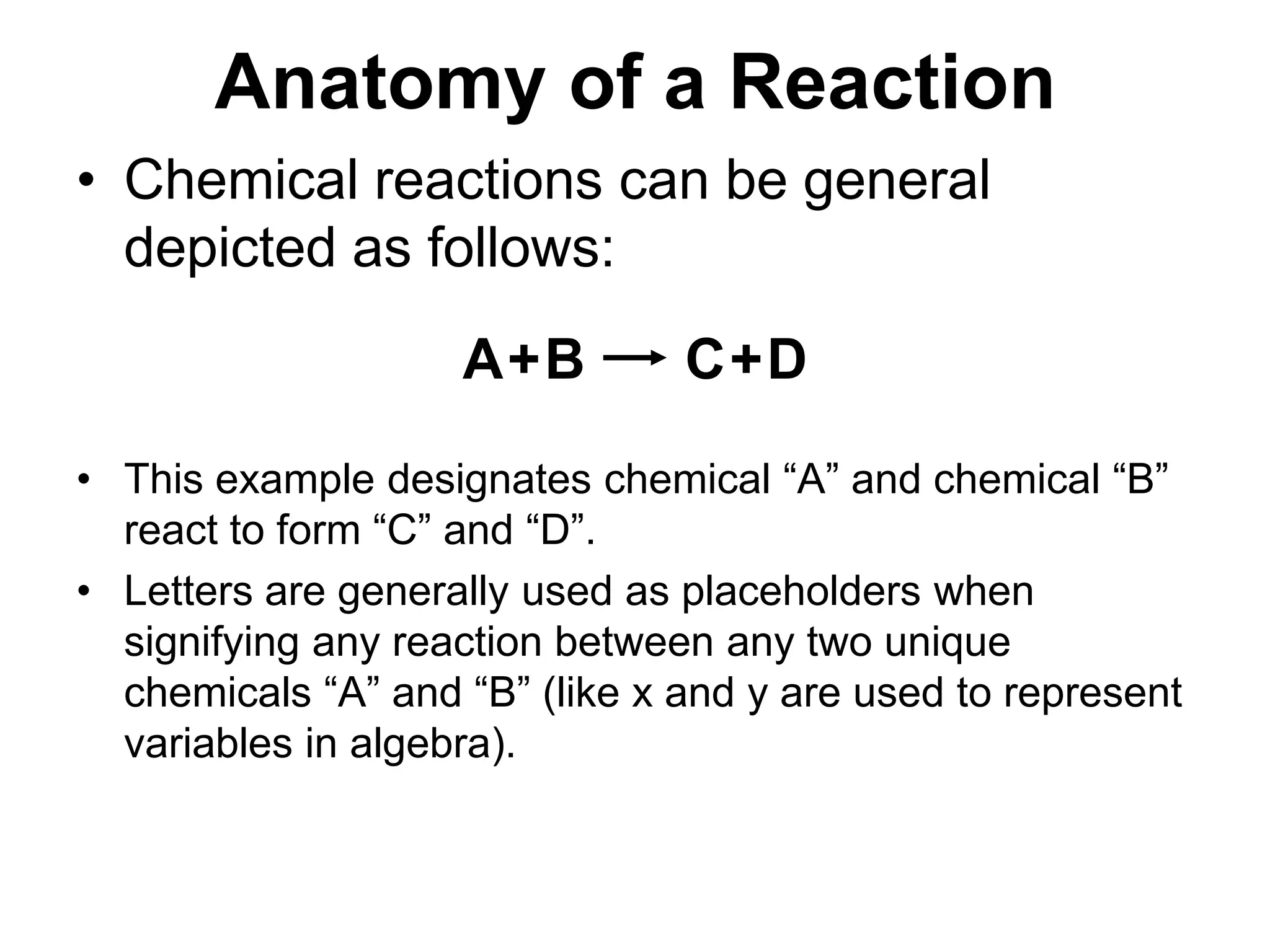
Anatomy of a ReactionABCD++Chemical reactions can be general depicted as follows:This example designates chemical “A” and chemical “B” react to form “C” and “D”. Letters are generally used as placeholders when signifying any reaction between any two unique chemicals “A” and “B” (like x and y are used to represent variables in algebra).
Anatomy of a ReactionCH4OHCH3H2O++Specific chemical reactions can be specified by supplying names or formula of the chemicals participating.For instance:Or:
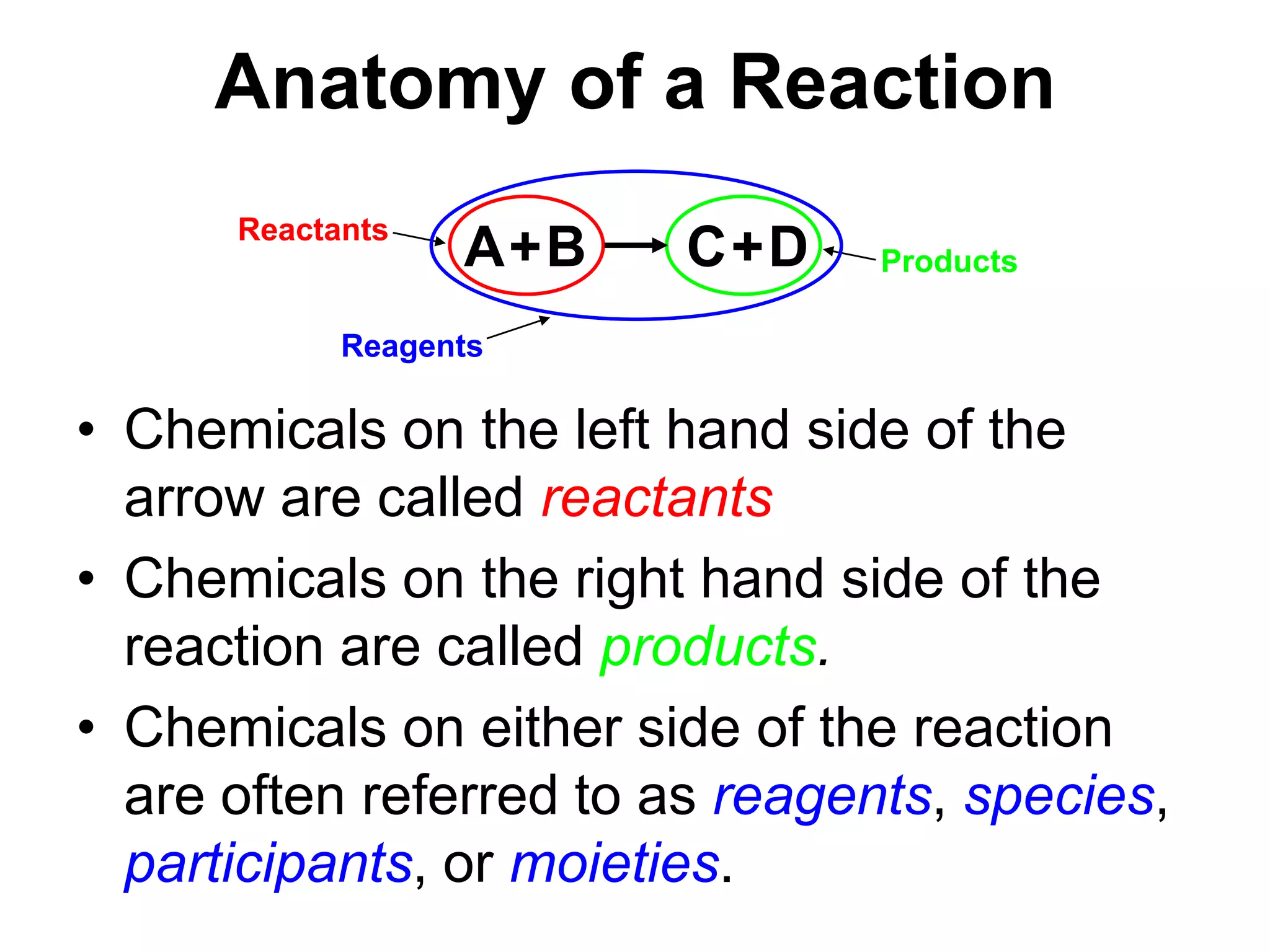
Anatomy of a ReactionABCD++ReactantsProductsReagentsChemicals on the left hand side of the arrow are called reactantsChemicals on the right hand side of the reaction are called products.Chemicals on either side of the reaction are often referred to as reagents, species, participants, or moieties.
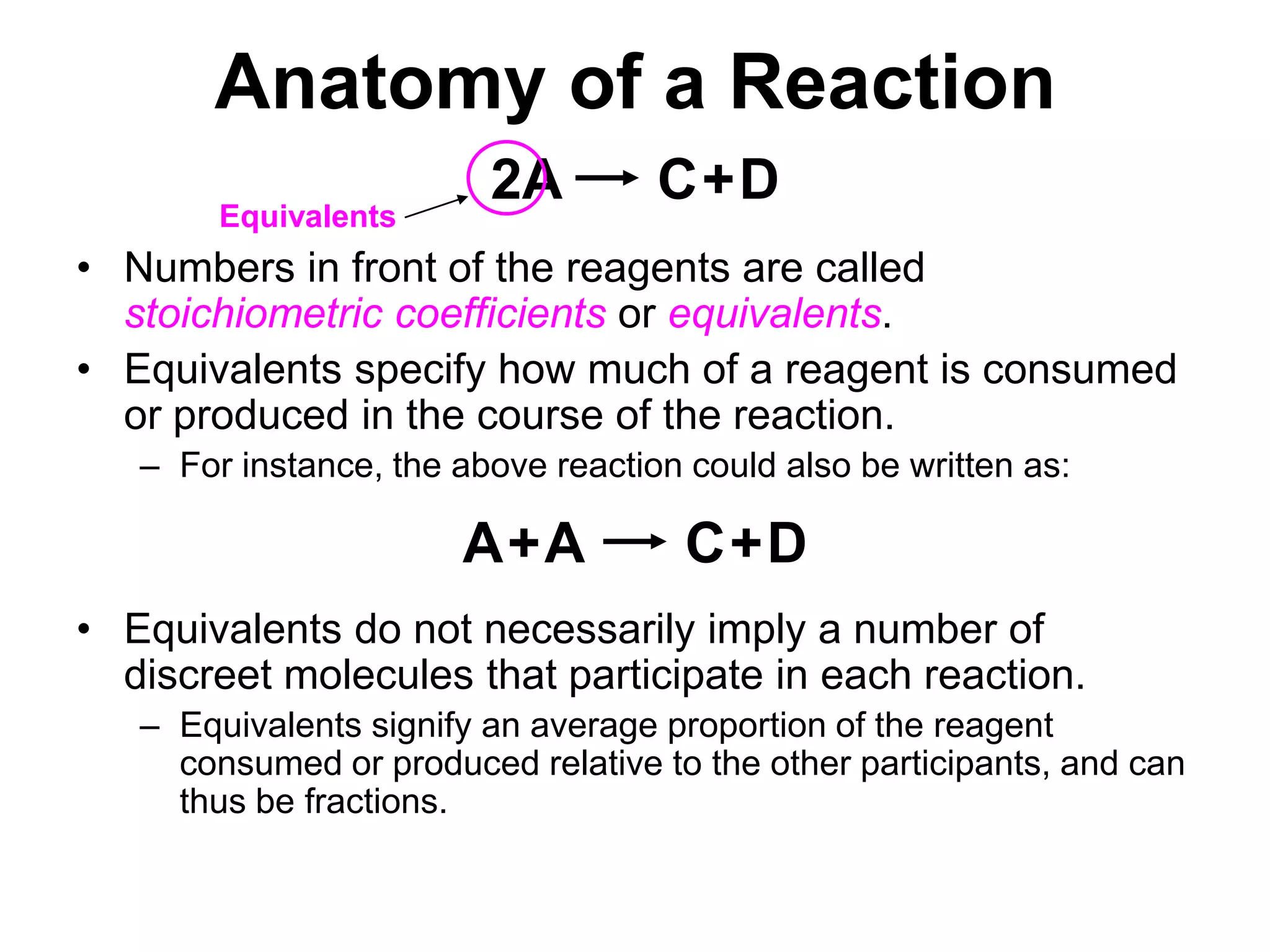
Anatomy of a Reaction2ACDAACD+++EquivalentsNumbers in front of the reagents are called stoichiometric coefficients or equivalents.Equivalents specify how much of a reagent is consumed or produced in the course of the reaction.For instance, the above reaction could also be written as:Equivalents do not necessarily imply a number of discreet molecules that participate in each reaction. Equivalents signify an average proportion of the reagent consumed or produced relative to the other participants, and can thus be fractions.
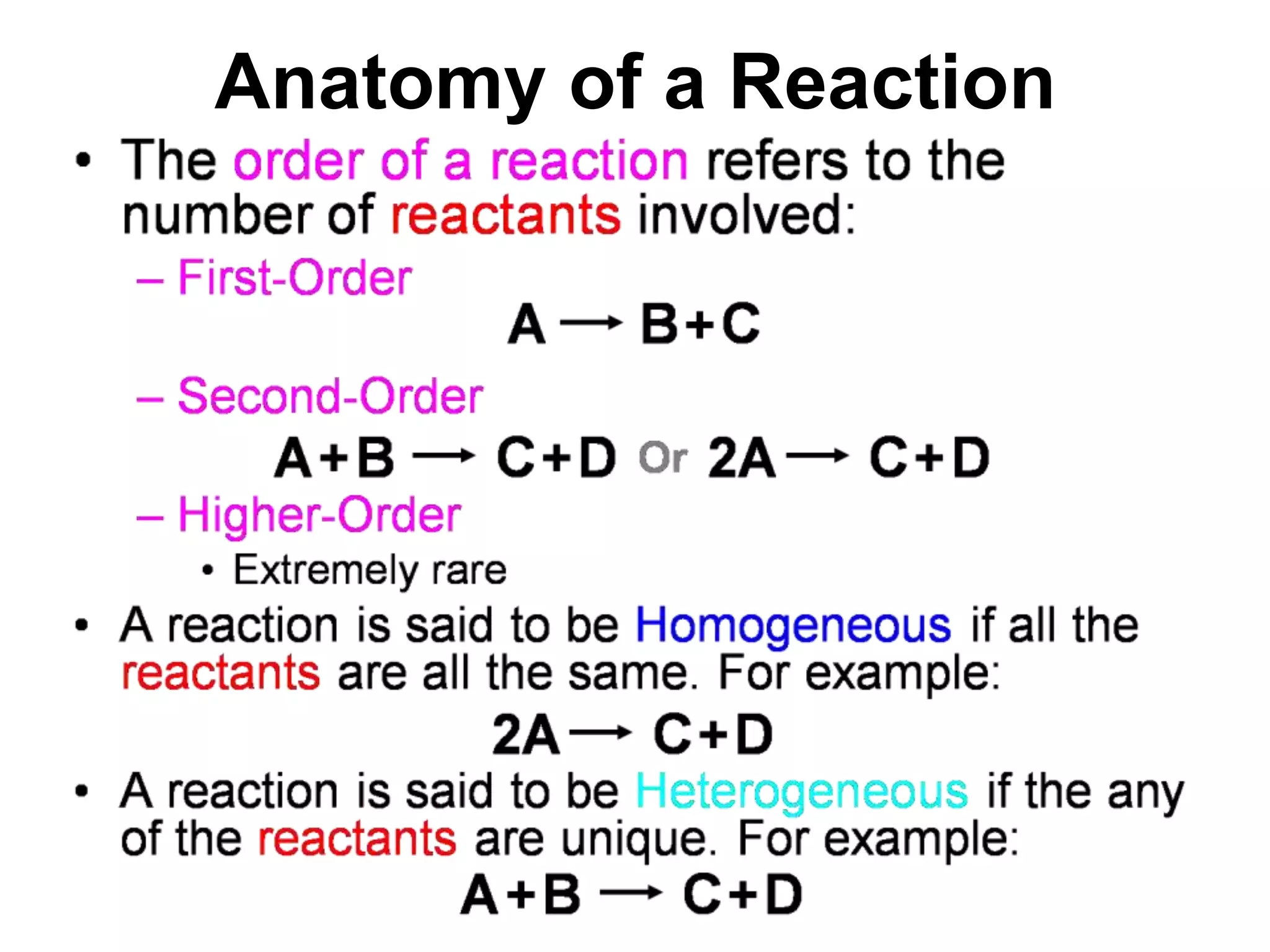
Anatomy of a Reaction
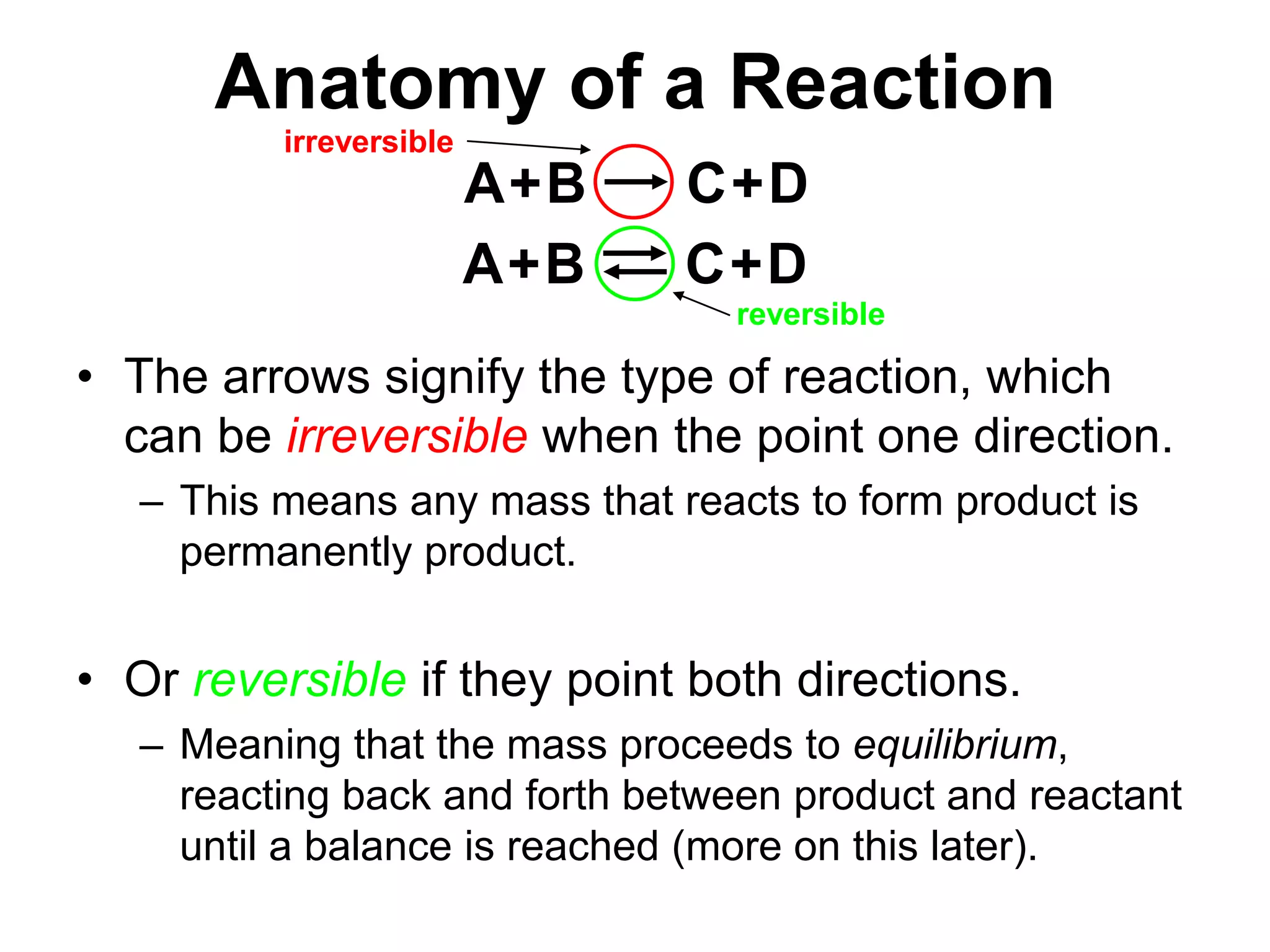
Anatomy of a ReactionABCDABCD++++irreversiblereversibleThe arrows signify the type of reaction, which can be irreversible when the point one direction.This means any mass that reacts to form product is permanently product.Or reversible if they point both directions.Meaning that the mass proceeds to equilibrium, reacting back and forth between product and reactant until a balance is reached (more on this later).
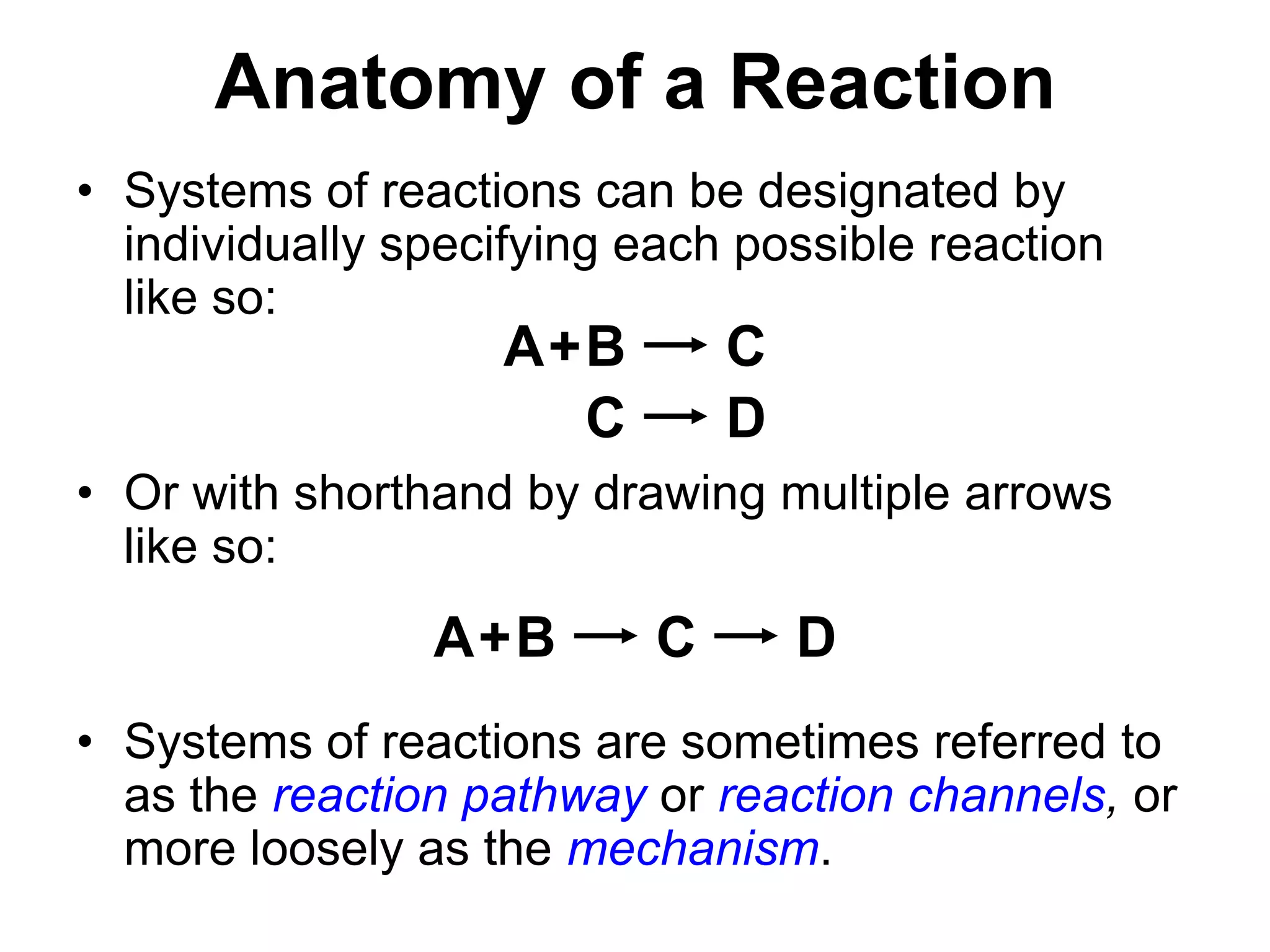
CCDCDAnatomy of a ReactionABAB++Systems of reactions can be designated by individually specifying each possible reaction like so:Or with shorthand by drawing multiple arrows like so:Systems of reactions are sometimes referred to as the reaction pathway or reaction channels,or more loosely as the mechanism.
What are the Units?Amounts, or number of molecules of a chemical, are usually specified as Moles (mol) in multiples of Avogadro’s number which is roughly 6.022 x 10²³ molecules per mol.A more relevant and commonly employed unit is concentration, or amount per volume. These are specified in Molar (M) and are in units of Moles/LiterSometimes square brackets around a name is used to denote concentration.  Eg. [A] means the concentration of A.Both of these units are in metric, so prefixes like milli-(m), micro-(μor u), nano-(n) , etc. are commonly used shorthand for order of magnitude.
Chemical Kinetics OutlineChemistry BackgroundChemical Kinetics BackgroundPhenomenological KineticsStochastic Simulation Approach
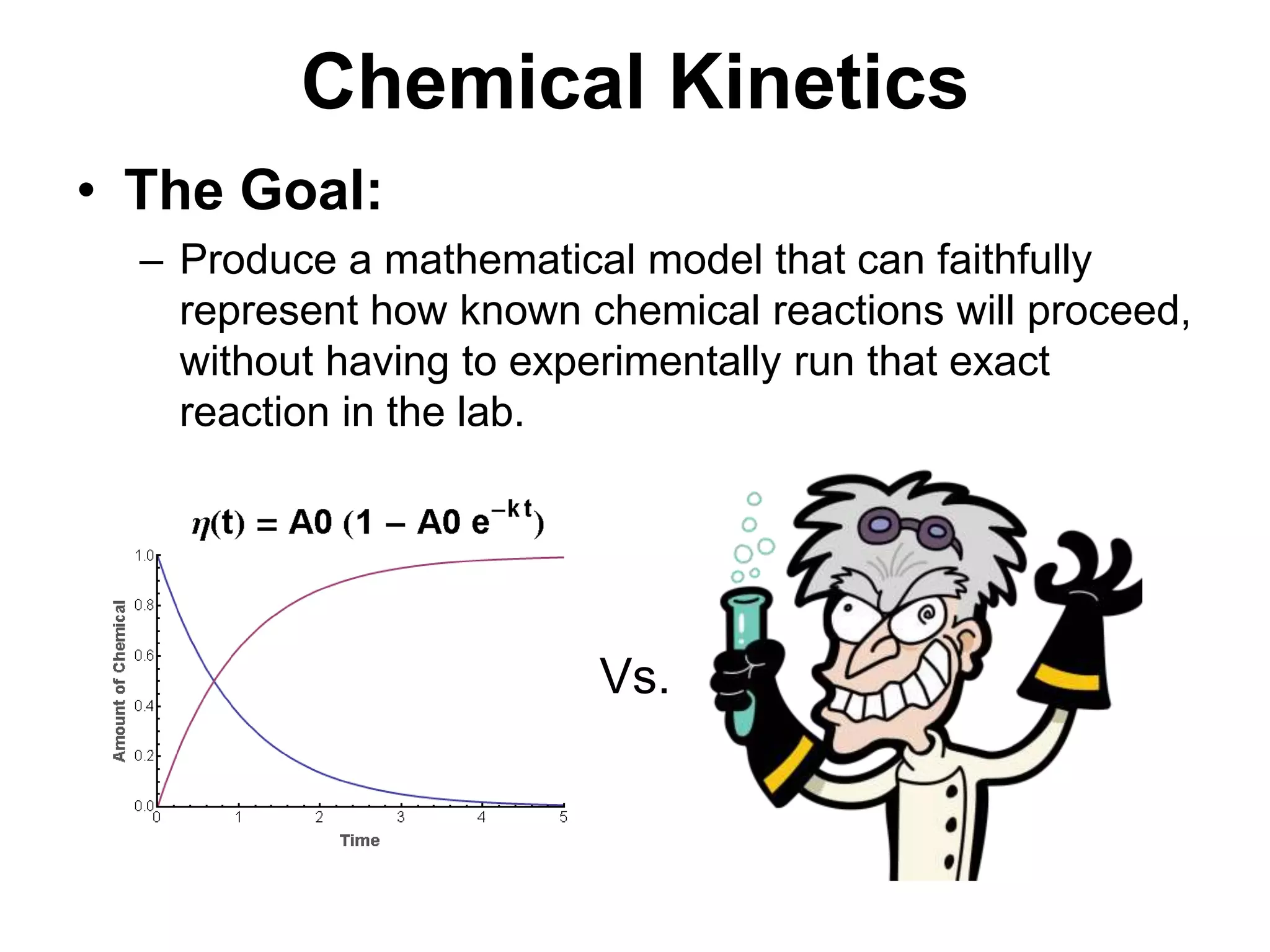
Chemical KineticsThe Goal:Produce a mathematical model that can faithfully represent how known chemical reactions will proceed, without having to experimentally run that exact reaction in the lab. Vs.
Chemical KineticsThe ProcessRun a set of experimental test reactions and use the data to extract a set of parameters regarding that reaction.Use these parameters to predict how this reaction would proceed under different conditions from the test reactions:With different concentrations of reagentsUnder different temperatures or reaction conditionsWhen run in combination with other known reactions
Chemical KineticsWhat is the Physical BasisCollision Theory and Transition State TheoryMolecules diffusing at random though a solution react when they collide with enough energy to react.Increasing concentration increases odds of collision at any given time, and thus increases the velocity at which a reaction proceeds. Likewise, lowering the energy barrier for reaction can also increase velocity by increasing the odds that any given collision is productive.	Every chemical reaction has a unique energy barrier that impacts the velocity of the reaction, and thus must be parameterized experimentally.
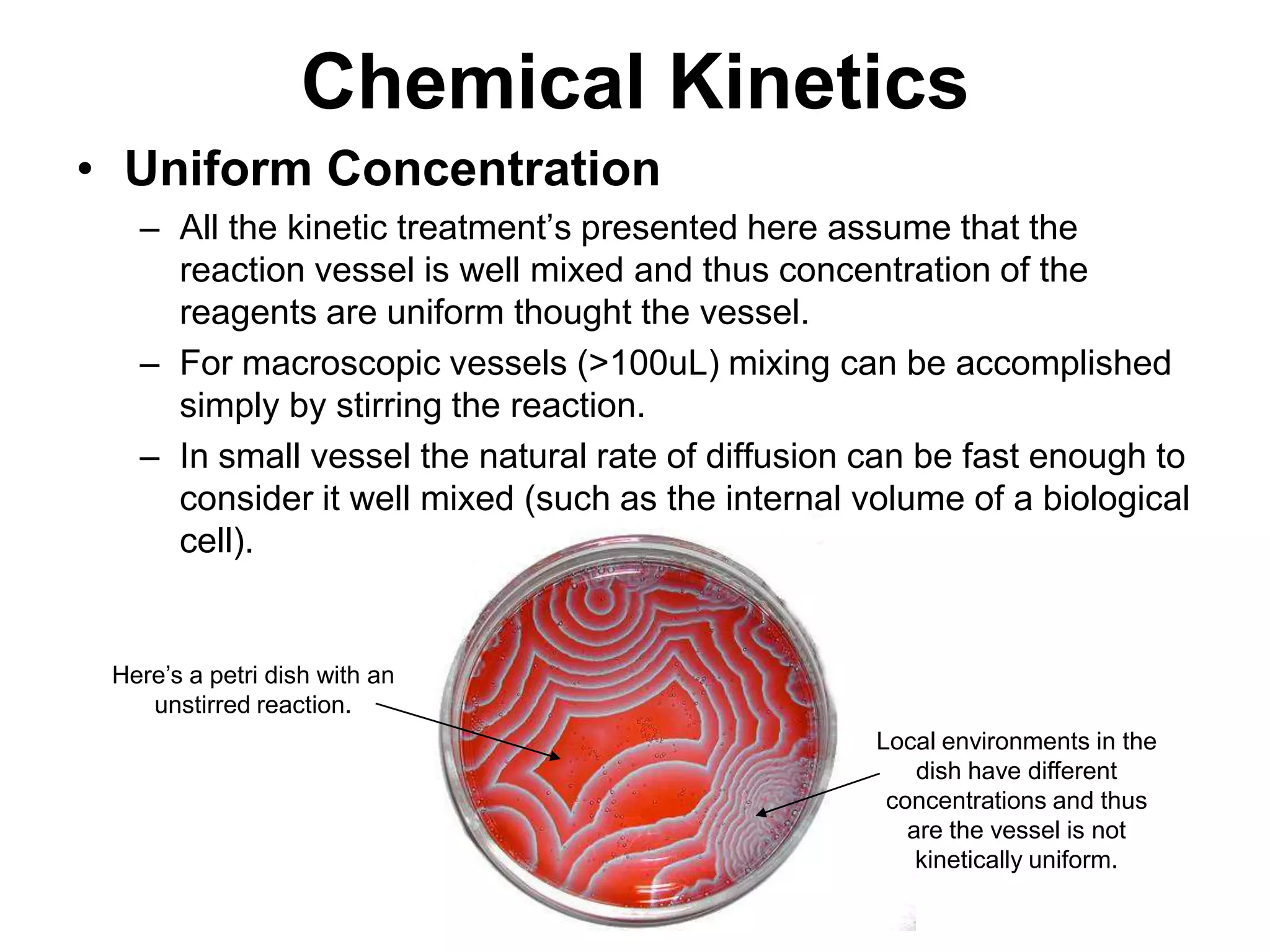
Chemical KineticsUniform ConcentrationAll the kinetic treatment’s presented here assume that the reaction vessel is well mixed and thus concentration of the reagents are uniform thought the vessel.For macroscopic vessels (>100uL) mixing can be accomplished simply by stirring the reaction.In small vessel the natural rate of diffusion can be fast enough to consider it well mixed (such as the internal volume of a biological cell). Here’s a petri dish with an unstirred reaction.Local environments in the dish have different concentrations and thus are the vessel is not kinetically uniform.
Chemical Kinetics OutlineChemistry BackgroundChemical Kinetics BackgroundPhenomenological KineticsStochastic Simulation Approach
PhenomenologicalKineticsClassical Phenomenological kinetics states:At any given time (t), the reaction proceeds at rate that is a product of the concentration of the reactants at time (t), and a so called rate constant (k).  This is called a rate equation, or a rate law.Since the concentration of the reagents is also a function of time, rate equations are first-order ordinary differential equations (ODEs).Solving these ODEs provides functions for the concentration of the reagents vs. time.
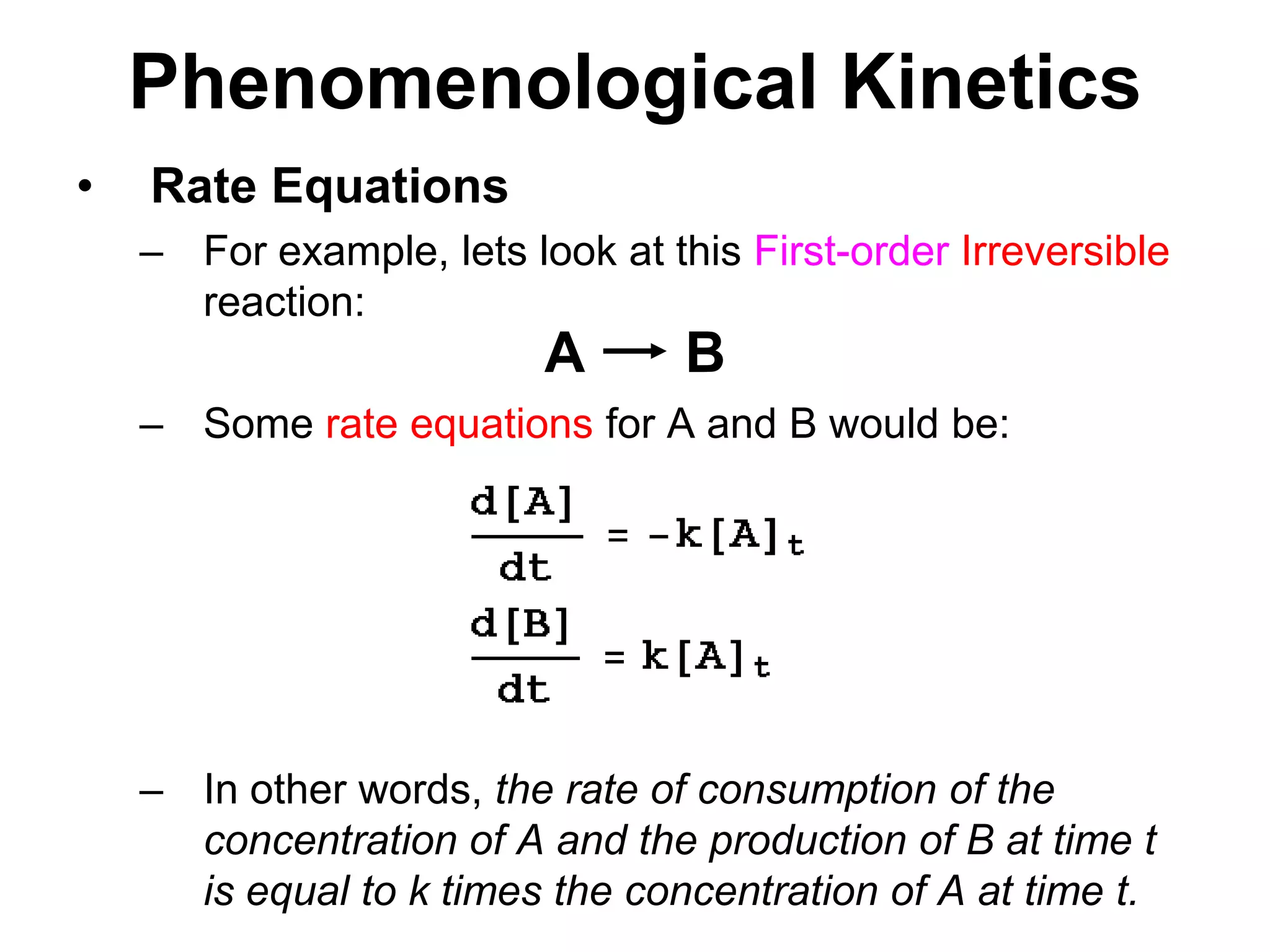
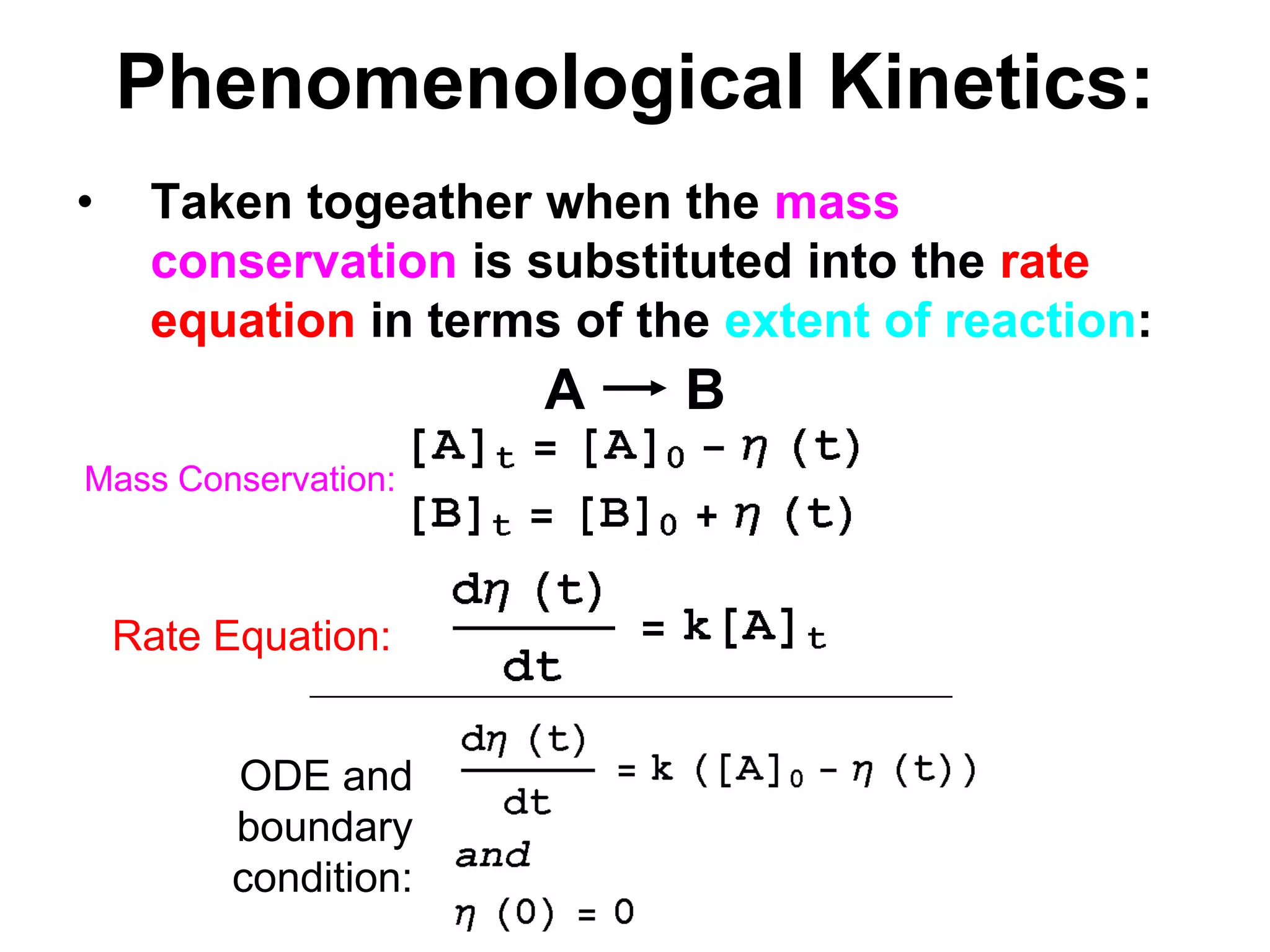
PhenomenologicalKineticsABRate EquationsFor example, lets look at this First-orderIrreversible reaction:Some rate equations for A and B would be: In other words, the rate of consumption of the concentration of A and the production of B at time t is equal to k times the concentration of A at time t.
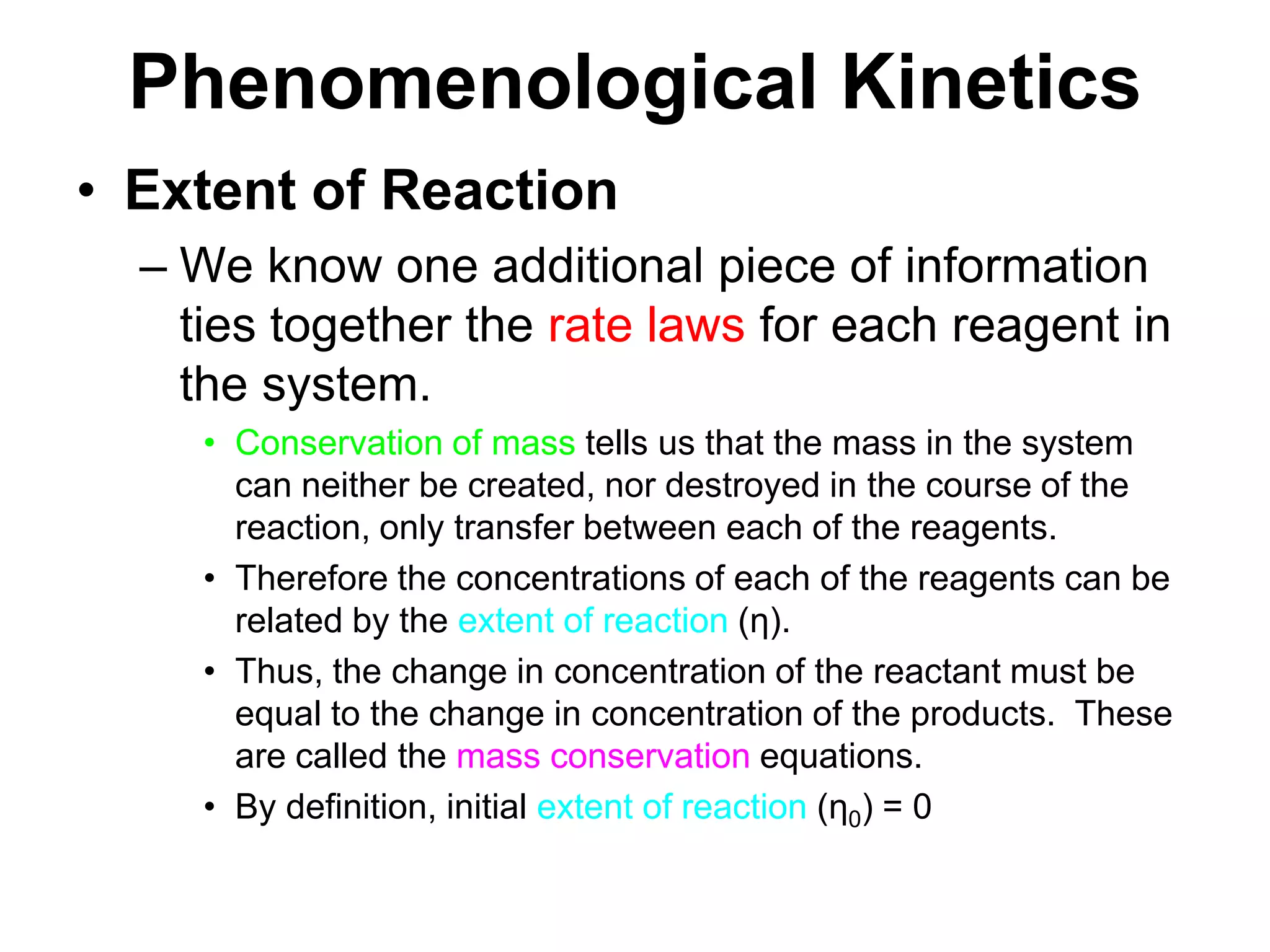
PhenomenologicalKineticsExtent of ReactionWe know one additional piece of information ties together the rate laws for each reagent in the system. Conservation of mass tells us that the mass in the system can neither be created, nor destroyed in the course of the reaction, only transfer between each of the reagents.Therefore the concentrations of each of the reagents can be related by the extent of reaction (η).Thus, the change in concentration of the reactant must be equal to the change in concentration of the products.  These are called the mass conservation equations.By definition, initial extent of reaction (η0) = 0
PhenomenologicalKineticsABExtent of ReactionSo for our example:Integrating and solving for [A]t and [B]t yields:Mass conservation:
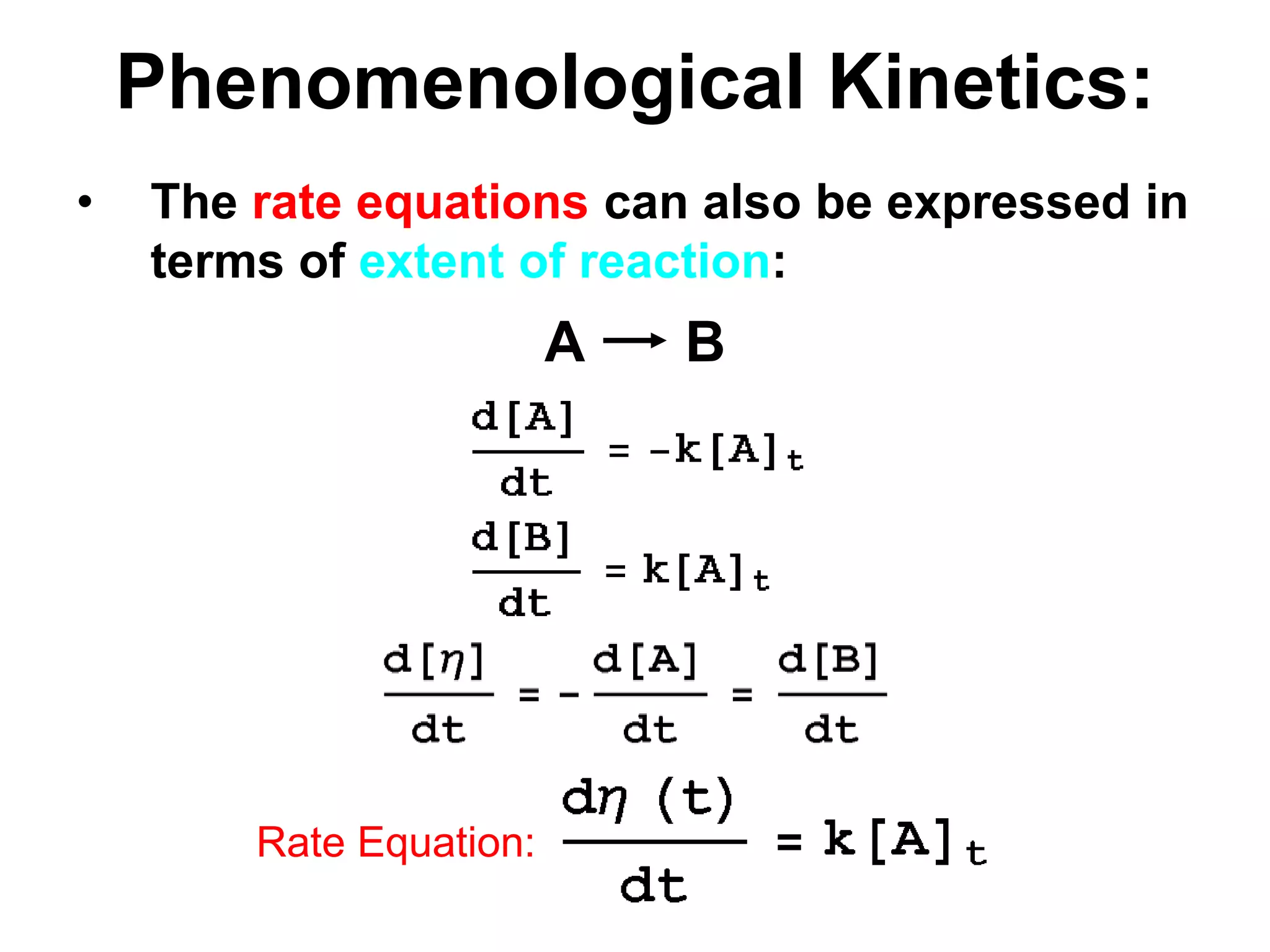
PhenomenologicalKinetics:ABThe rate equations can also be expressed in terms of extent of reaction:Rate Equation:
PhenomenologicalKinetics:ABTaken togeather when the mass conservation is substituted into the rate equation in terms of the extent of reaction:Mass Conservation:Rate Equation:ODE and boundary condition:
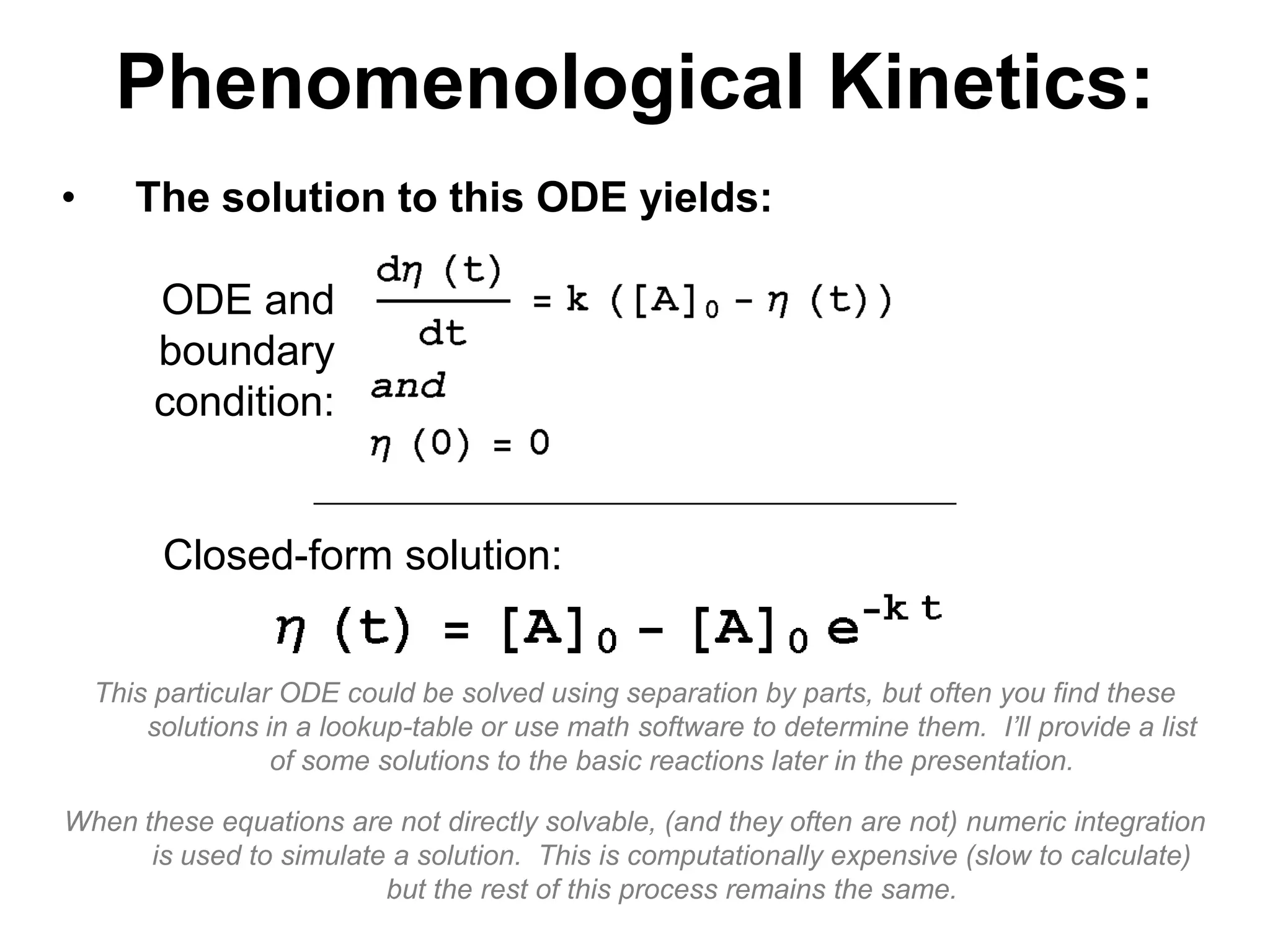
PhenomenologicalKinetics:The solution to this ODE yields:This particular ODE could be solved using separation by parts, but often you find these solutions in a lookup-table or use math software to determine them.  I’ll provide a list of some solutions to the basic reactions later in the presentation.When these equations are not directly solvable, (and they often are not) numeric integration is used to simulate a solution.  This is computationally expensive (slow to calculate) but the rest of this process remains the same.ODE and boundary condition:Closed-form solution:
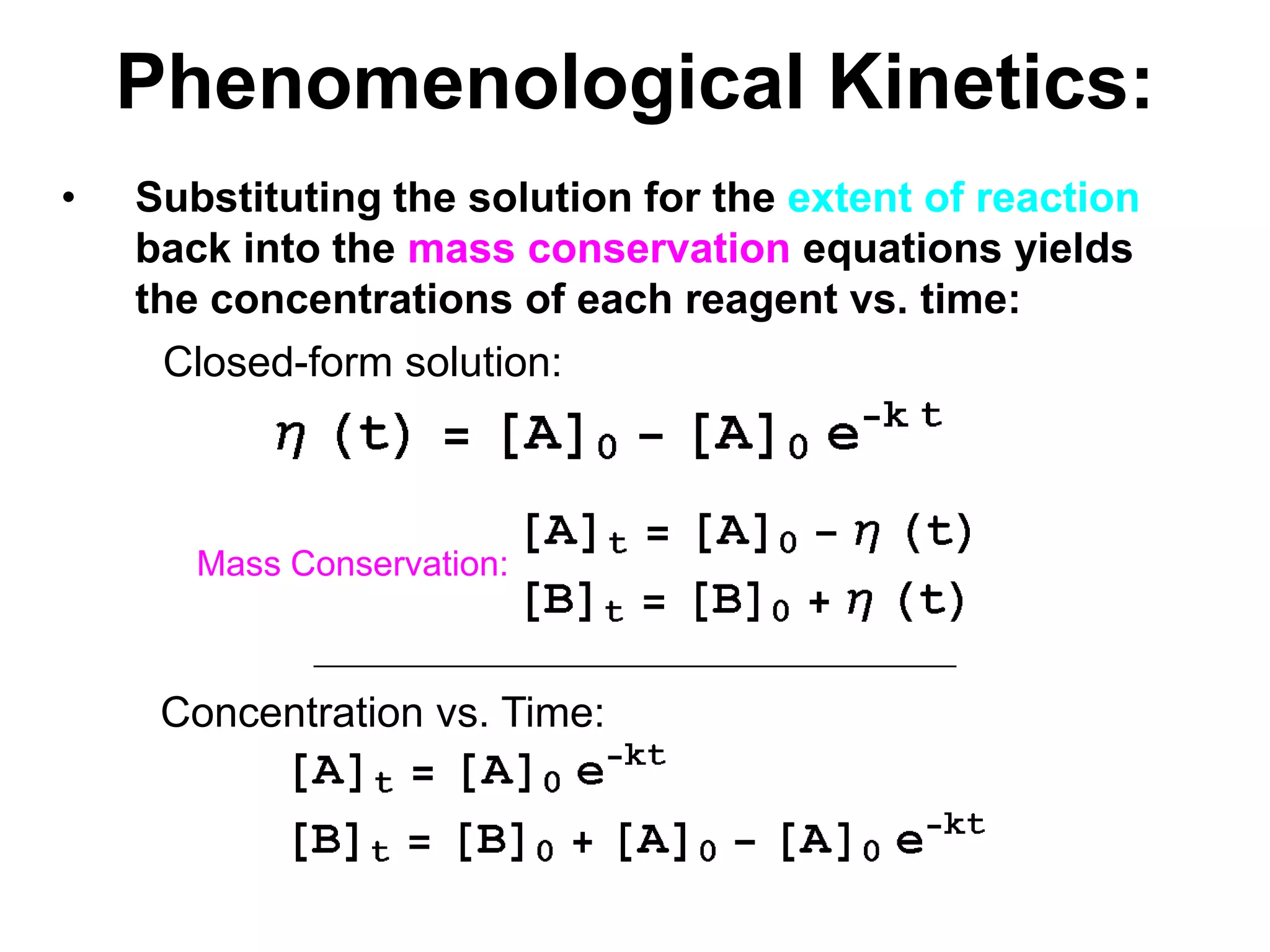
PhenomenologicalKinetics:Substituting the solution for the extent of reaction back into the mass conservation equations yields the concentrations of each reagent vs. time:Closed-form solution:Mass Conservation:Concentration vs. Time:
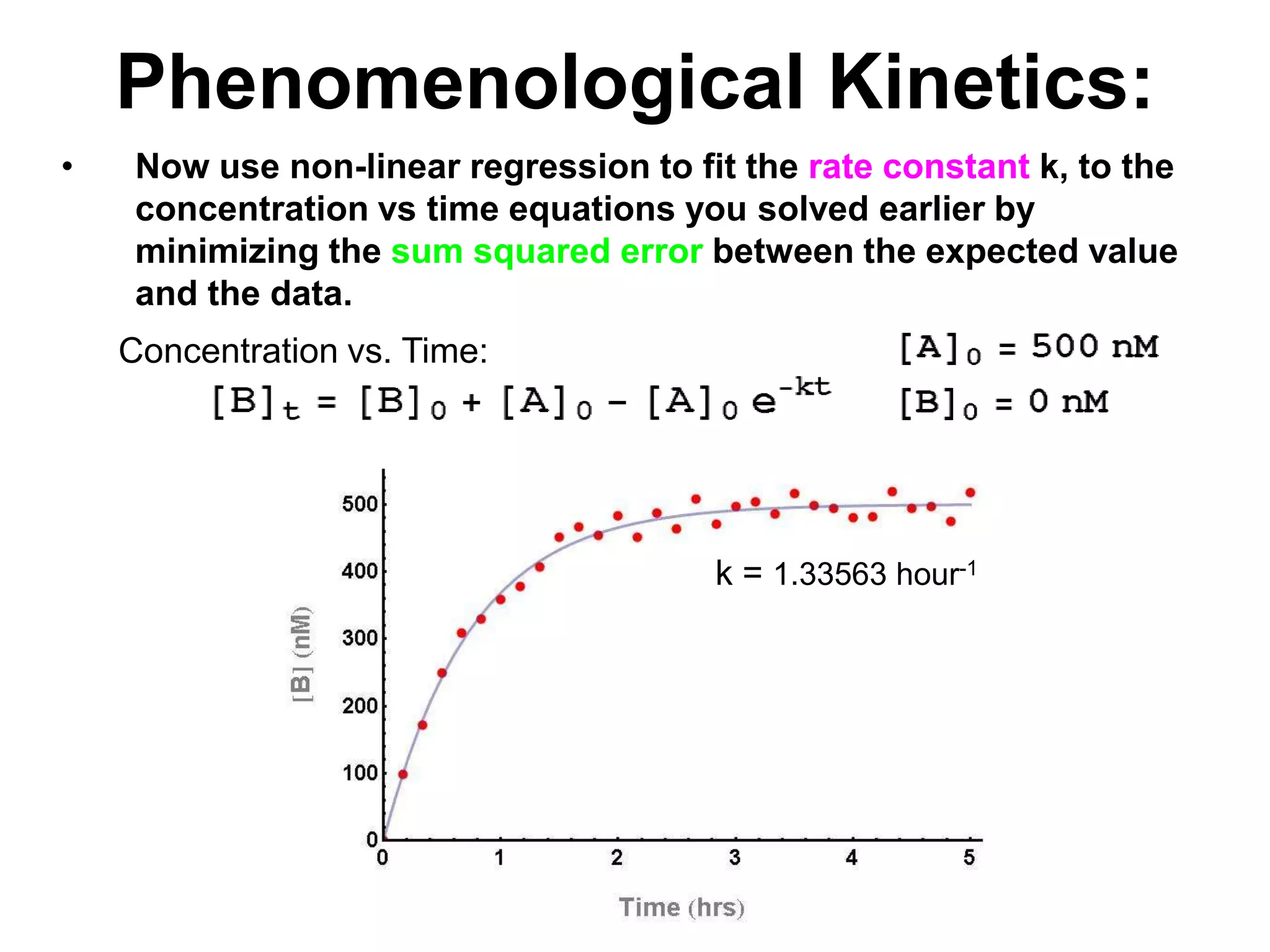
PhenomenologicalKinetics:In the lab, perform test reactions with known initial concentrations, and observe the concentration of one of the reagents as a function of time.For example, here is the data when from a test reaction run under these starting conditions:
PhenomenologicalKinetics:Now use non-linear regression to fit the rate constant k, to the concentration vs time equations you solved earlier by minimizing the sum squared error between the expected value and the data.Concentration vs. Time:k = 1.33563 hour-1
PhenomenologicalKinetics:AB	Victory!  We can now simulate this particular reaction under any starting concentrations and couple it with any other reaction.wherek = 1.33563 hour-1[A]0 = 50nM[B]0 = 450nM[A]0 = 250nM[B]0 = 250nM[A]0 = 250nM[B]0 = 0nM
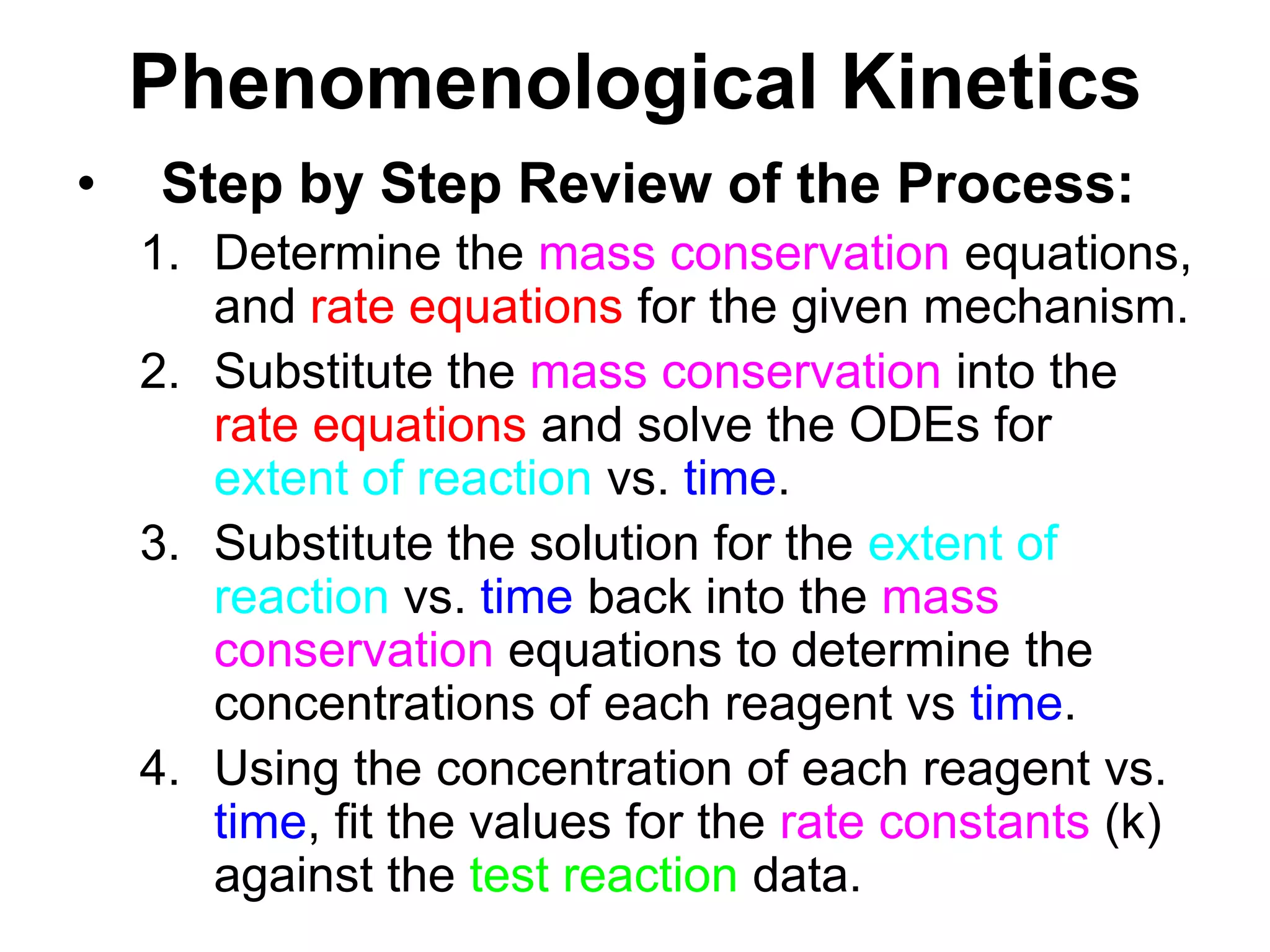
PhenomenologicalKineticsStep by Step Review of the Process:Determine the mass conservation equations, and rate equations for the given mechanism.Substitute the mass conservation into the rate equations and solve the ODEs for extent of reaction vs. time.Substitute the solution for the extent of reaction vs. time back into the mass conservation equations to determine the concentrations of each reagent vs time.Using the concentration of each reagent vs. time, fit the values for the rate constants (k) against the test reaction data.
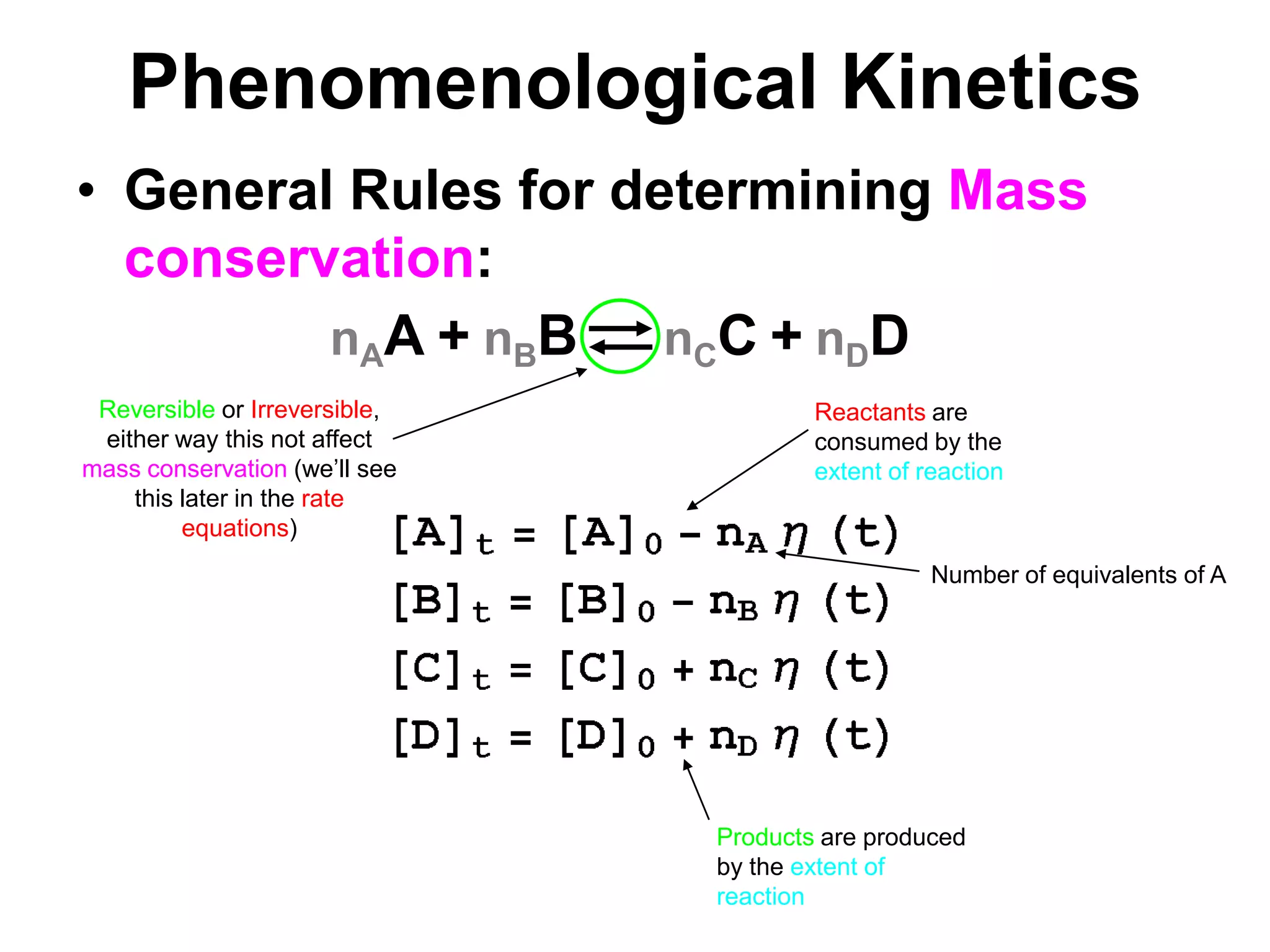
PhenomenologicalKineticsnAAnBBnCCnDD++General Rules for determining Mass conservation:Reversible or Irreversible, either way this not affect mass conservation (we’ll see this later in the rate equations)Reactants are consumed by the extent of reactionNumber of equivalents of AProducts are produced by the extent of reaction
PhenomenologicalKineticsk1nAAnBBnCCnDD++k-1k1nAAnBBnCCnDD++General Rules for determining Rate Equations:Product of the rate constant, and concentrations of reactants at time tEquivalents of BBy definition, extent of reaction always starts at 0.Forward Reactions work towards the extent of reactionReverse Reactions work against the extent of reaction
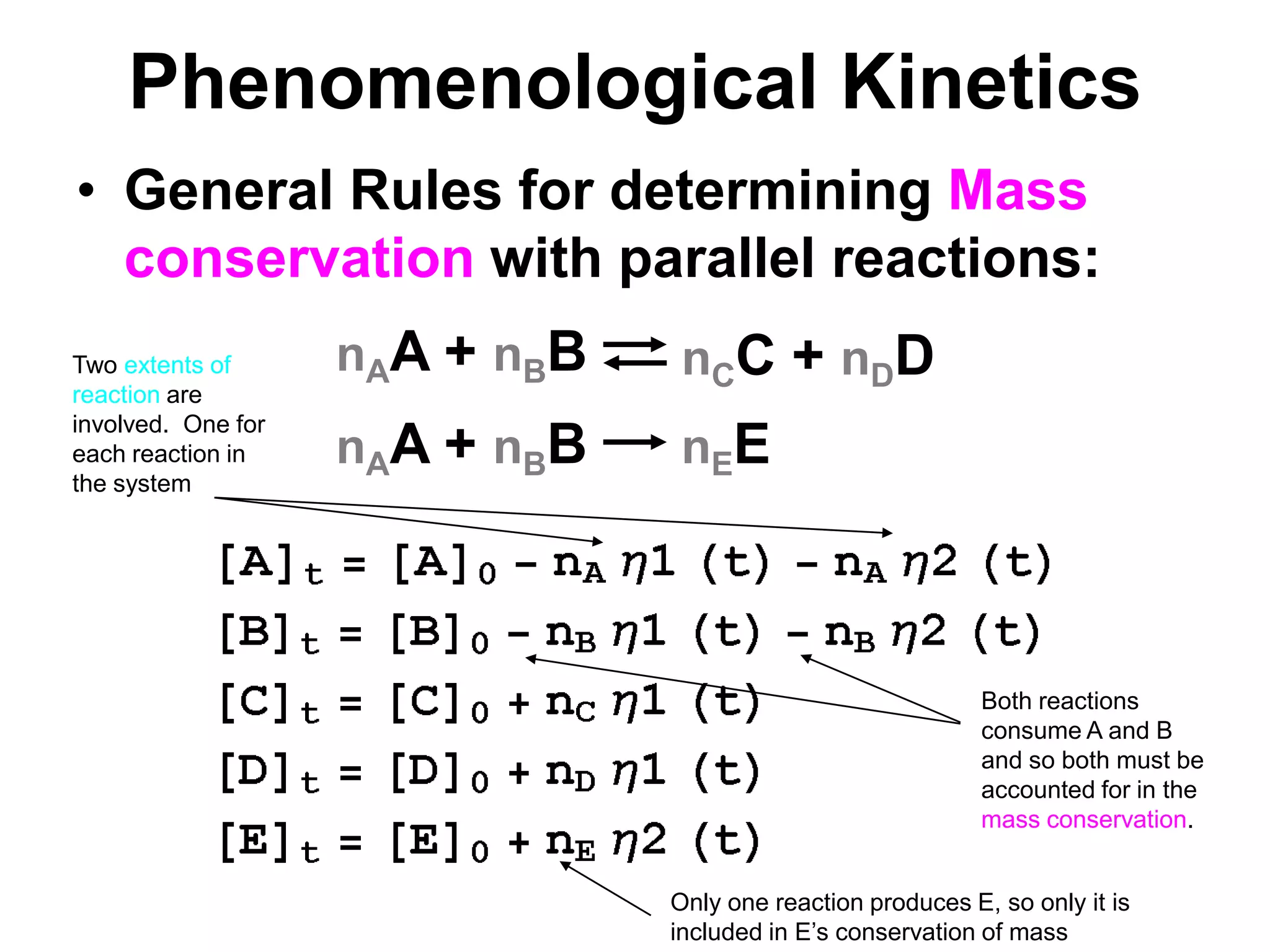
PhenomenologicalKineticsnAA + nBBnCC + nDDnAA + nBBnEEGeneral Rules for determining Mass conservation with parallel reactions:Two extents of reaction are involved.  One for each reaction in the systemBoth reactions consume A and B and so both must be accounted for in the mass conservation.Only one reaction produces E, so only it is included in E’s conservation of mass
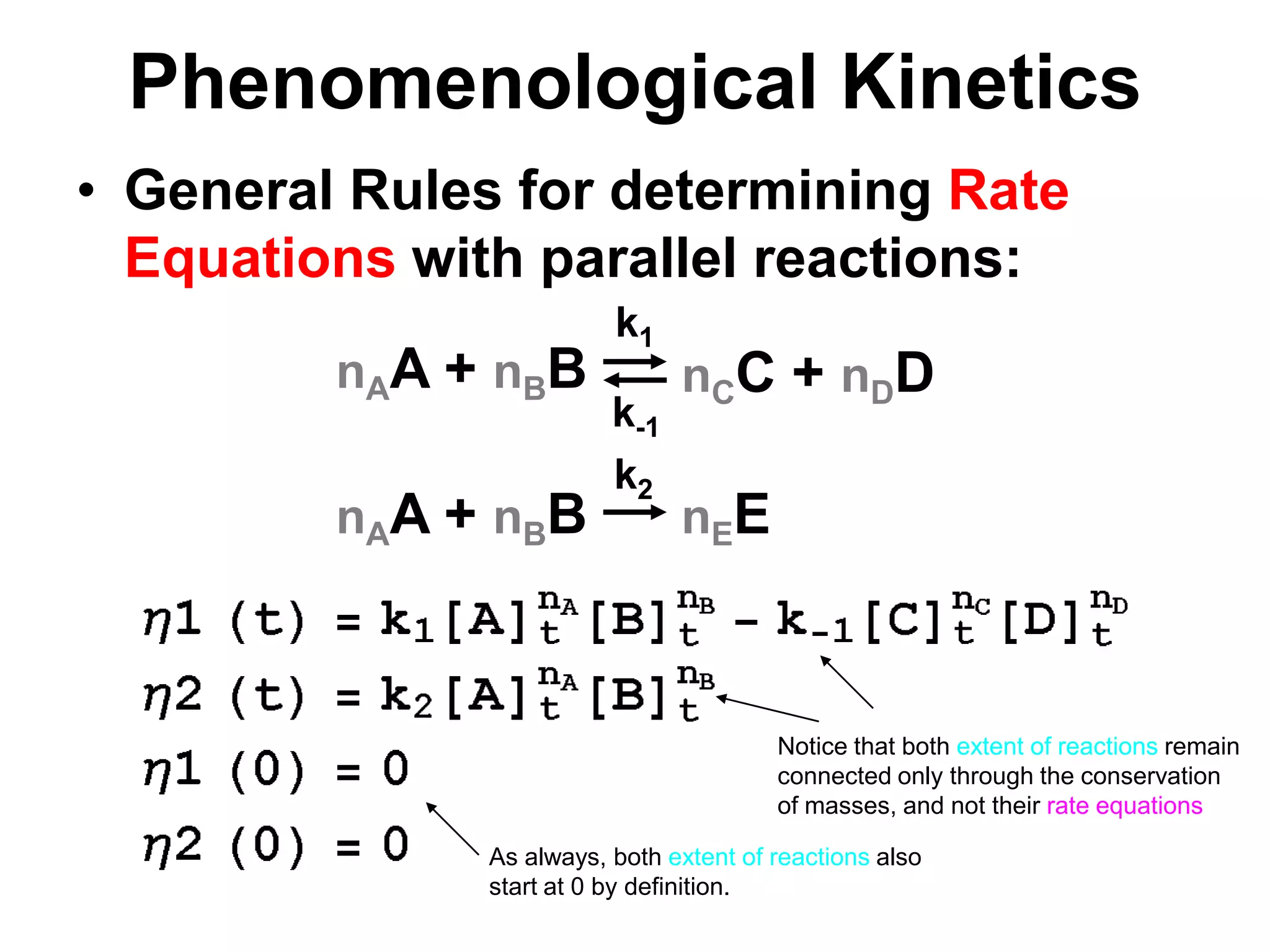
PhenomenologicalKineticsGeneral Rules for determining Rate Equations with parallel reactions:k1nAA + nBBnCC + nDDk-1k2nAA + nBBnEENotice that both extent of reactions remain connected only through the conservation of masses, and not their rate equationsAs always, both extent of reactions also start at 0 by definition.
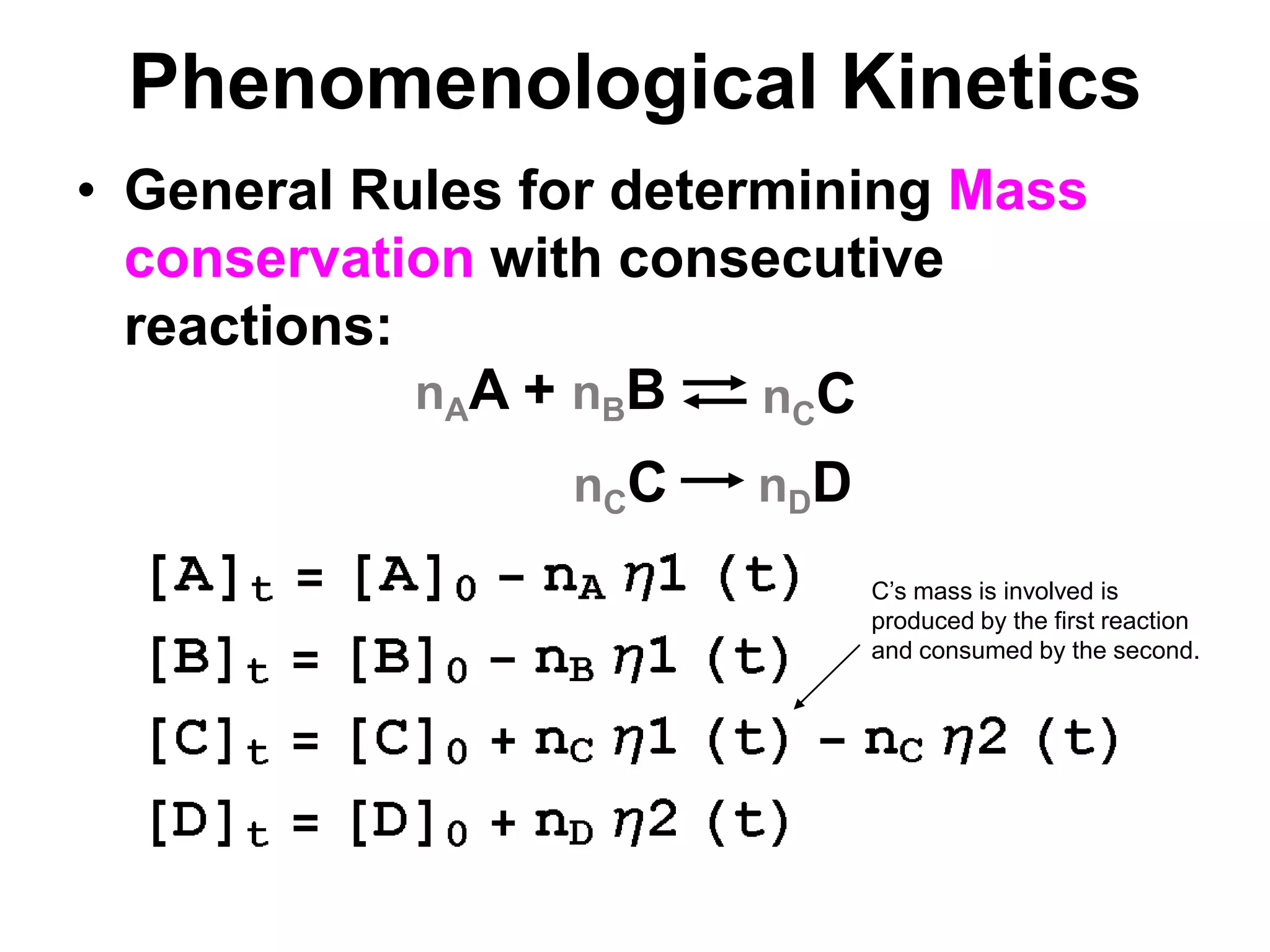
PhenomenologicalKineticsnAA + nBBnCCnCCnDDGeneral Rules for determining Mass conservation with consecutive reactions:C’s mass is involved is produced by the first reaction and consumed by the second.
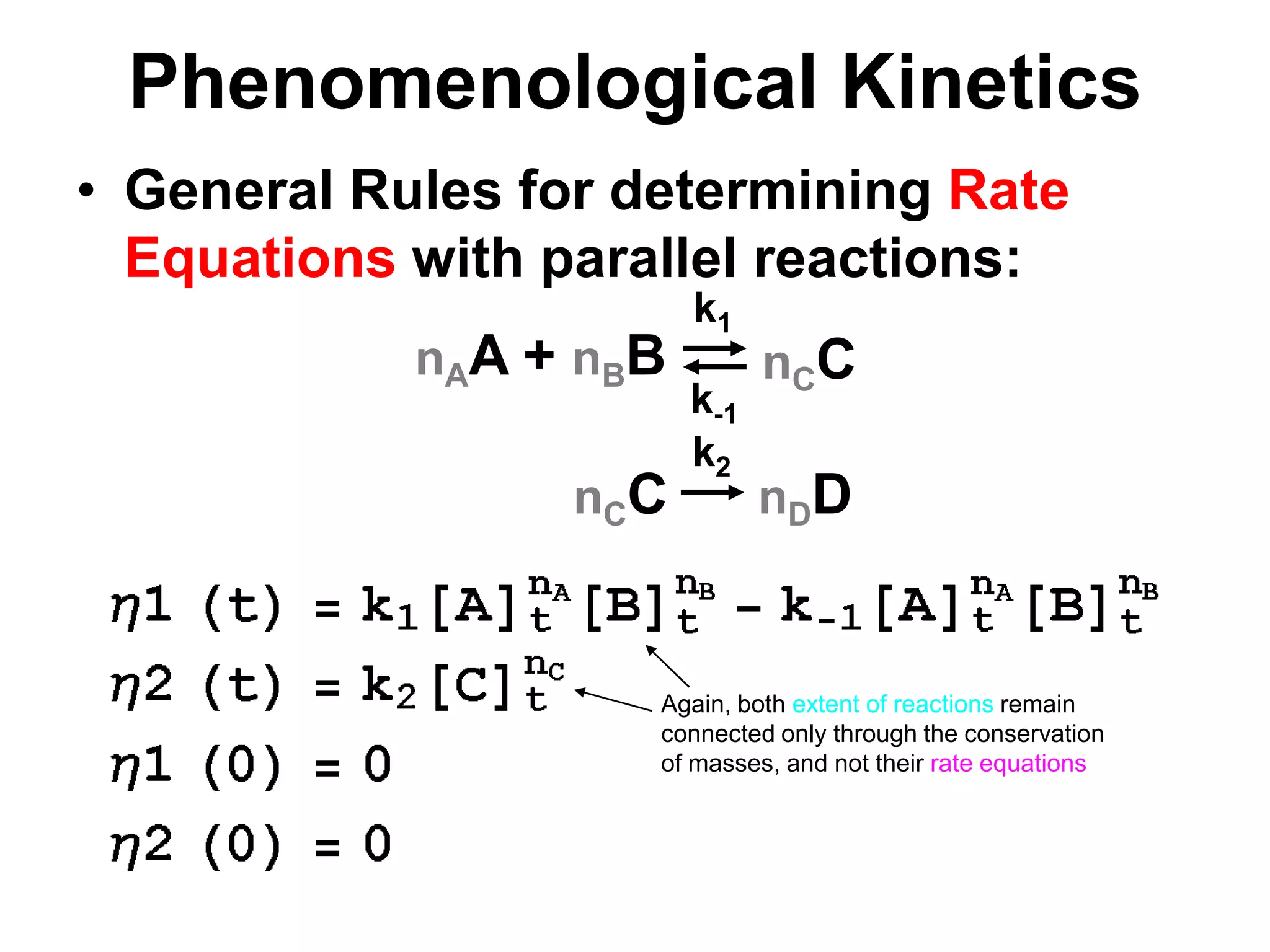
PhenomenologicalKineticsnAA + nBBnCCnCCnDDGeneral Rules for determining Rate Equations with parallel reactions:k1k-1k2Again, both extent of reactions remain connected only through the conservation of masses, and not their rate equations
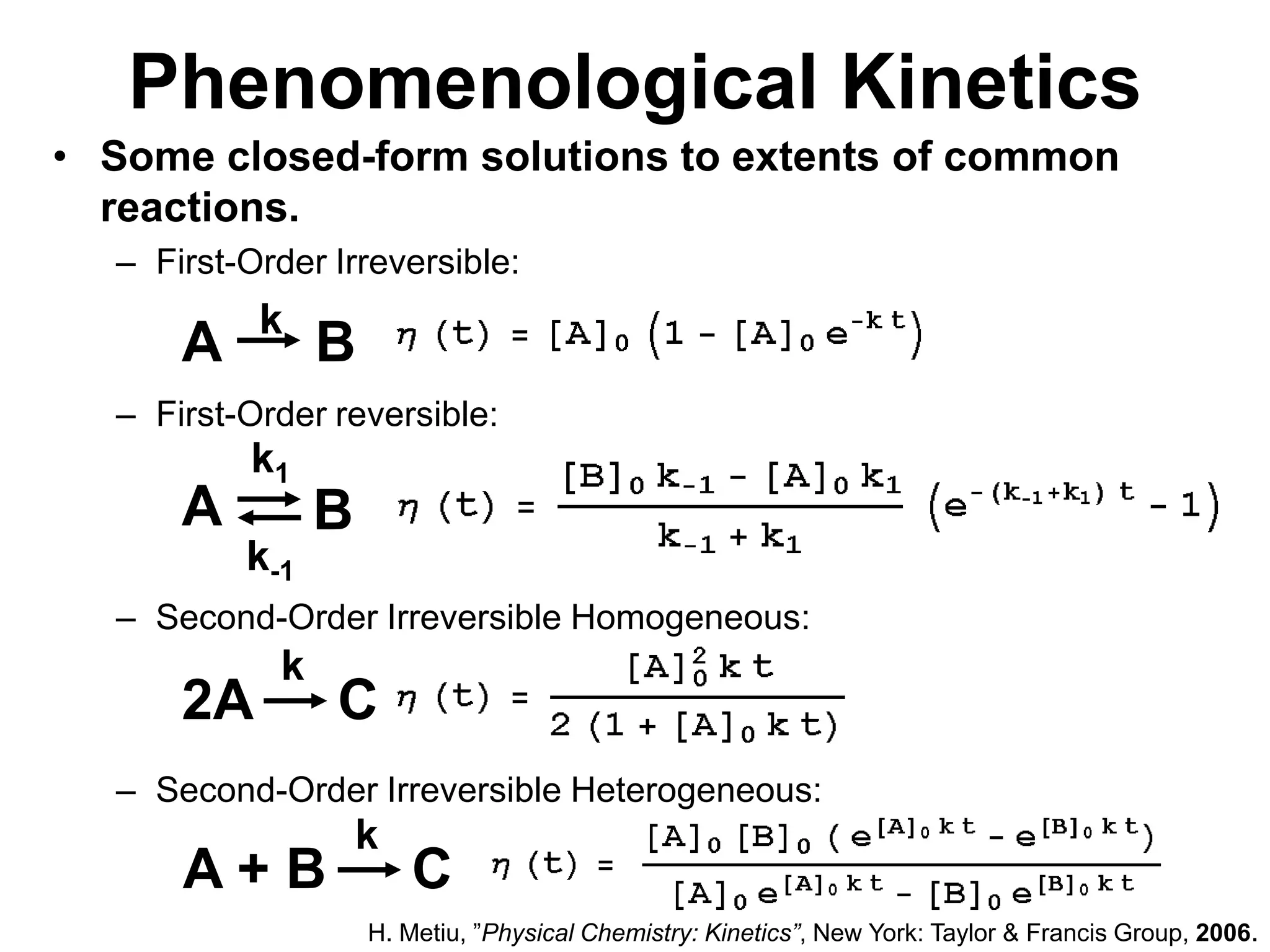
PhenomenologicalKineticsABk1ABk-1kkA + BCSome closed-form solutions to extents of common reactions.First-Order Irreversible:First-Order reversible:Second-Order Irreversible Homogeneous:Second-Order Irreversible Heterogeneous:k2ACH. Metiu, ”Physical Chemistry: Kinetics”, New York: Taylor & Francis Group, 2006.
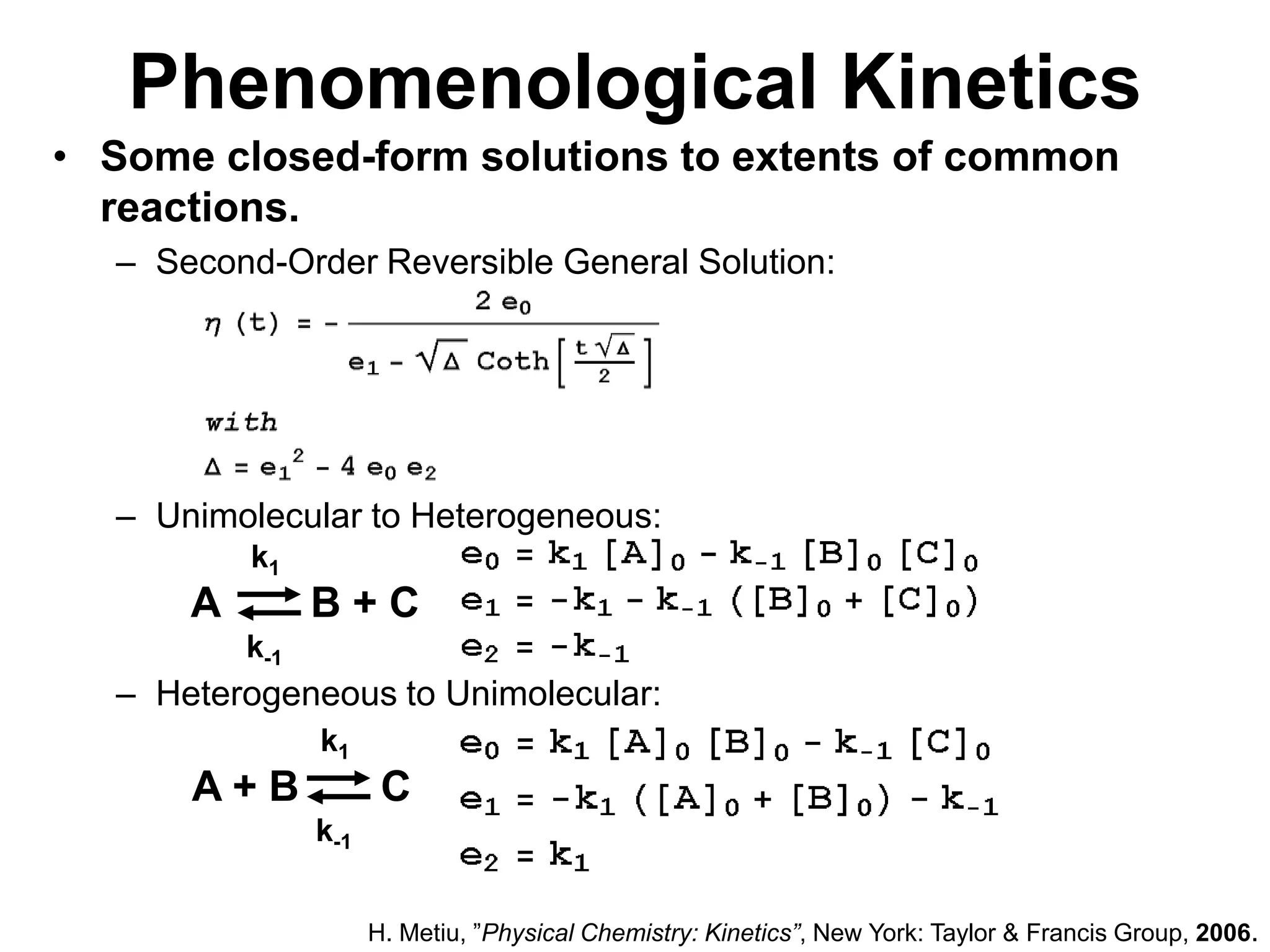
PhenomenologicalKineticsk1AB + Ck-1k1A + BCk-1Some closed-form solutions to extents of common reactions.Second-Order Reversible General Solution:Unimolecular to Heterogeneous:Heterogeneous to Unimolecular:H. Metiu, ”Physical Chemistry: Kinetics”, New York: Taylor & Francis Group, 2006.
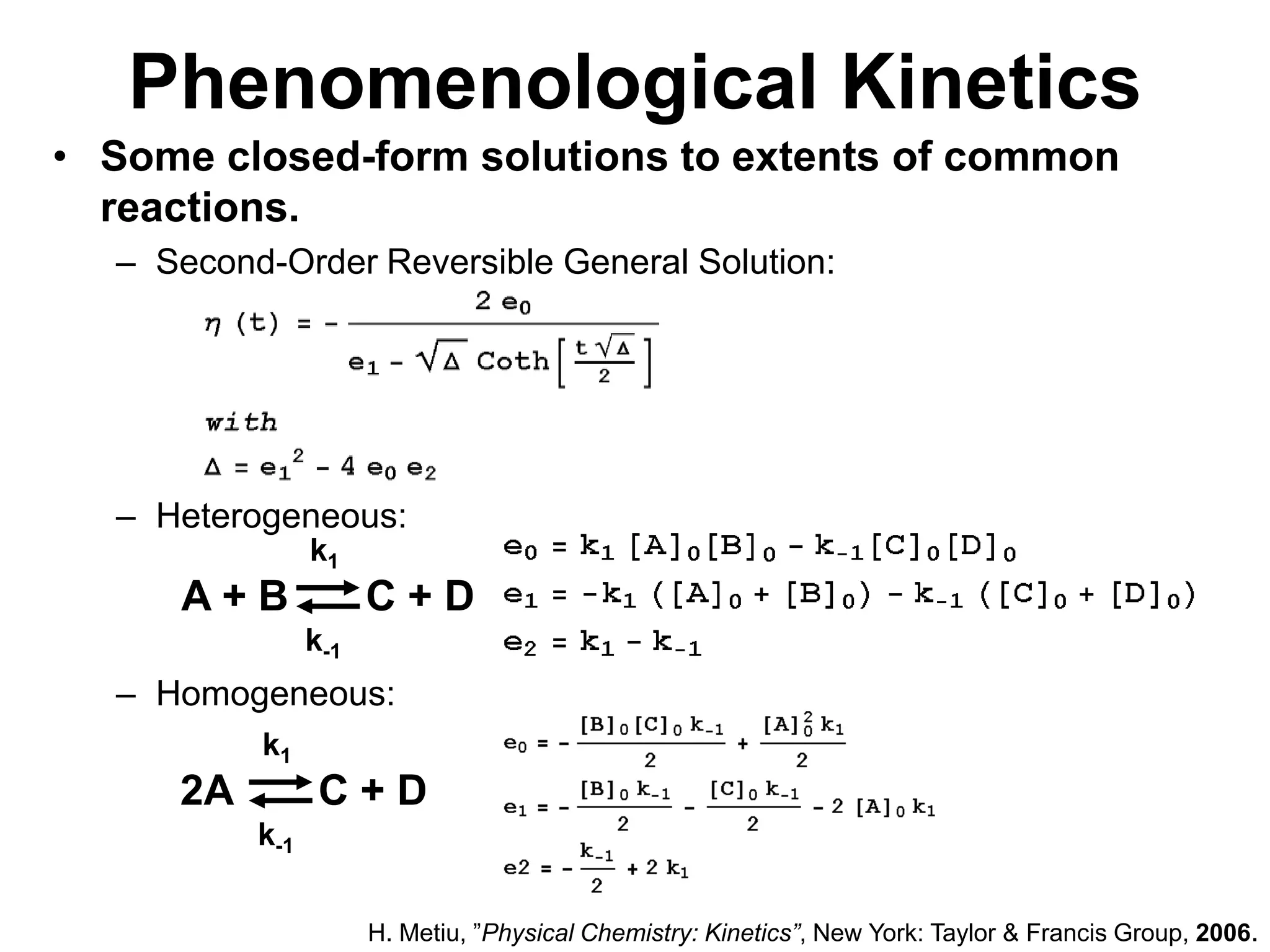
PhenomenologicalKineticsk1k1A + BC + D2AC + Dk-1k-1Some closed-form solutions to extents of common reactions.Second-Order Reversible General Solution:Heterogeneous:Homogeneous:H. Metiu, ”Physical Chemistry: Kinetics”, New York: Taylor & Francis Group, 2006.
k2k1ACABPhenomenologicalKineticsk2A + BDk1A + BCSome closed-form solutions to extents of common reactions.First-Order Irreversible parallel:Second-Order Irreversible parallel:H. Metiu, ”Physical Chemistry: Kinetics”, New York: Taylor & Francis Group, 2006.
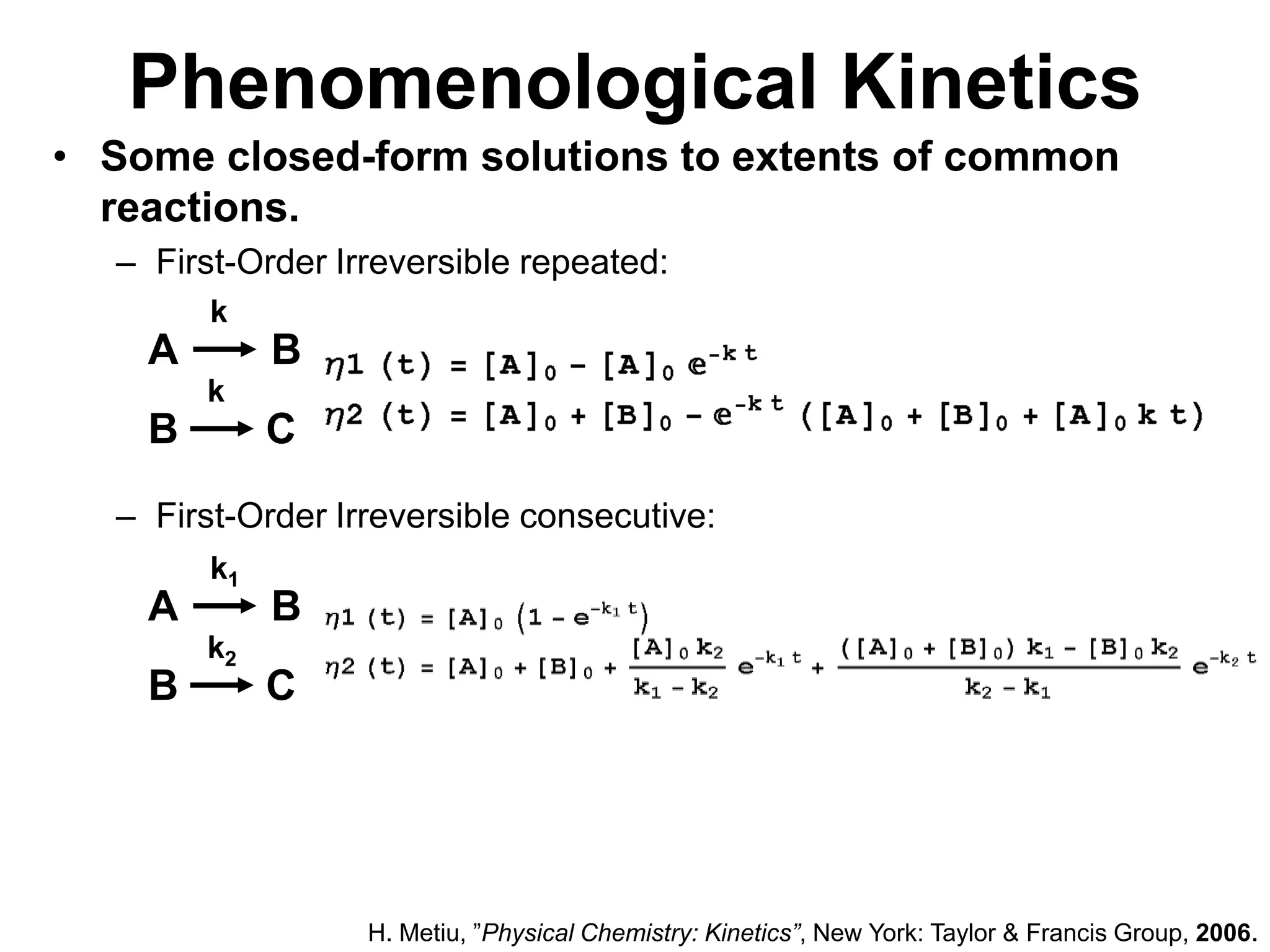
kk2kk1BCBCABABPhenomenologicalKineticsSome closed-form solutions to extents of common reactions.First-Order Irreversible repeated:First-Order Irreversible consecutive:H. Metiu, ”Physical Chemistry: Kinetics”, New York: Taylor & Francis Group, 2006.
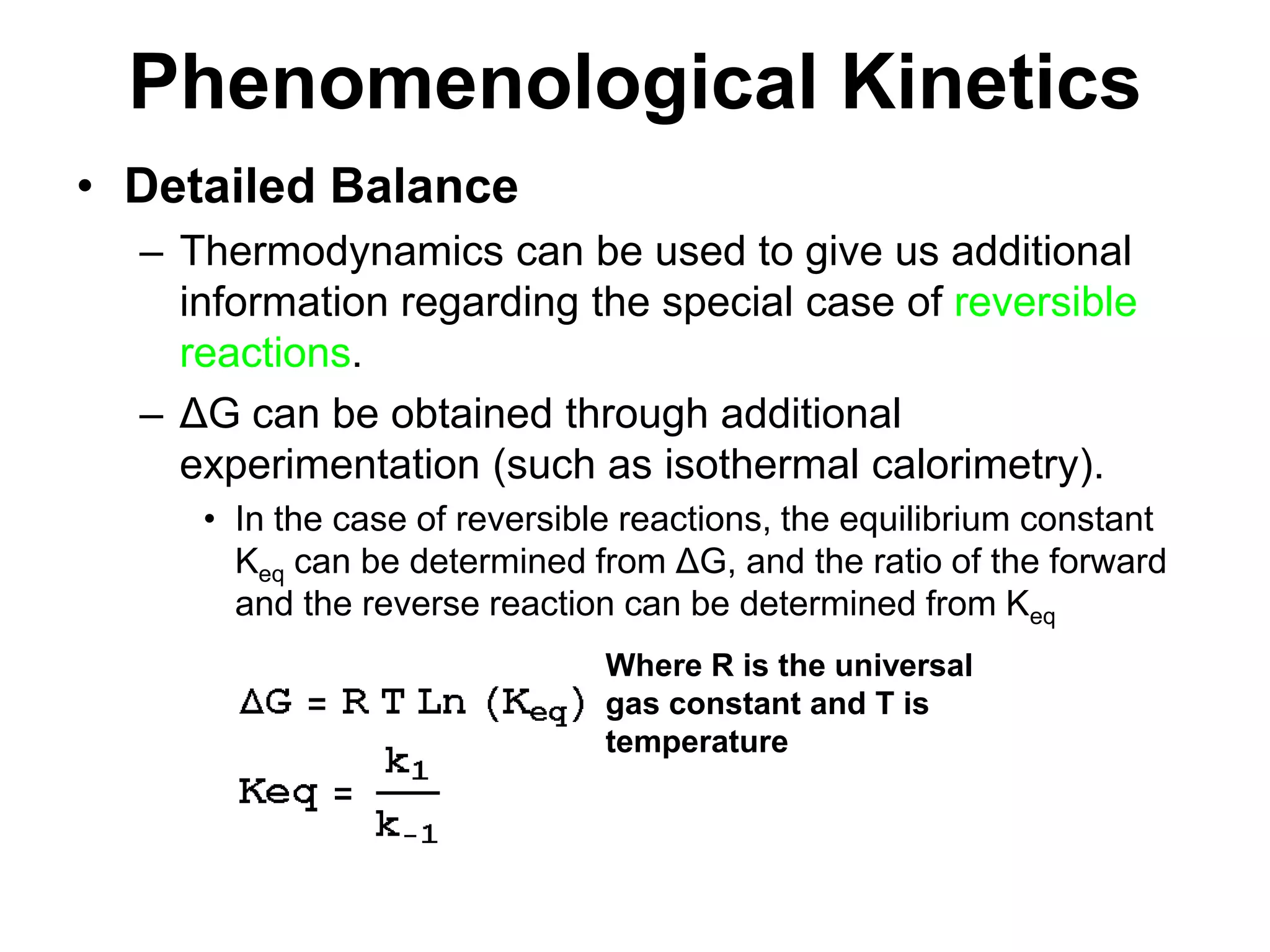
PhenomenologicalKineticsDetailed BalanceThermodynamics can be used to give us additional information regarding the special case of reversible reactions.ΔG can be obtained through additional experimentation (such as isothermal calorimetry).In the case of reversible reactions, the equilibrium constant Keq can be determined from ΔG, and the ratio of the forward and the reverse reaction can be determined from KeqWhere R is the universal gas constant and T is temperature
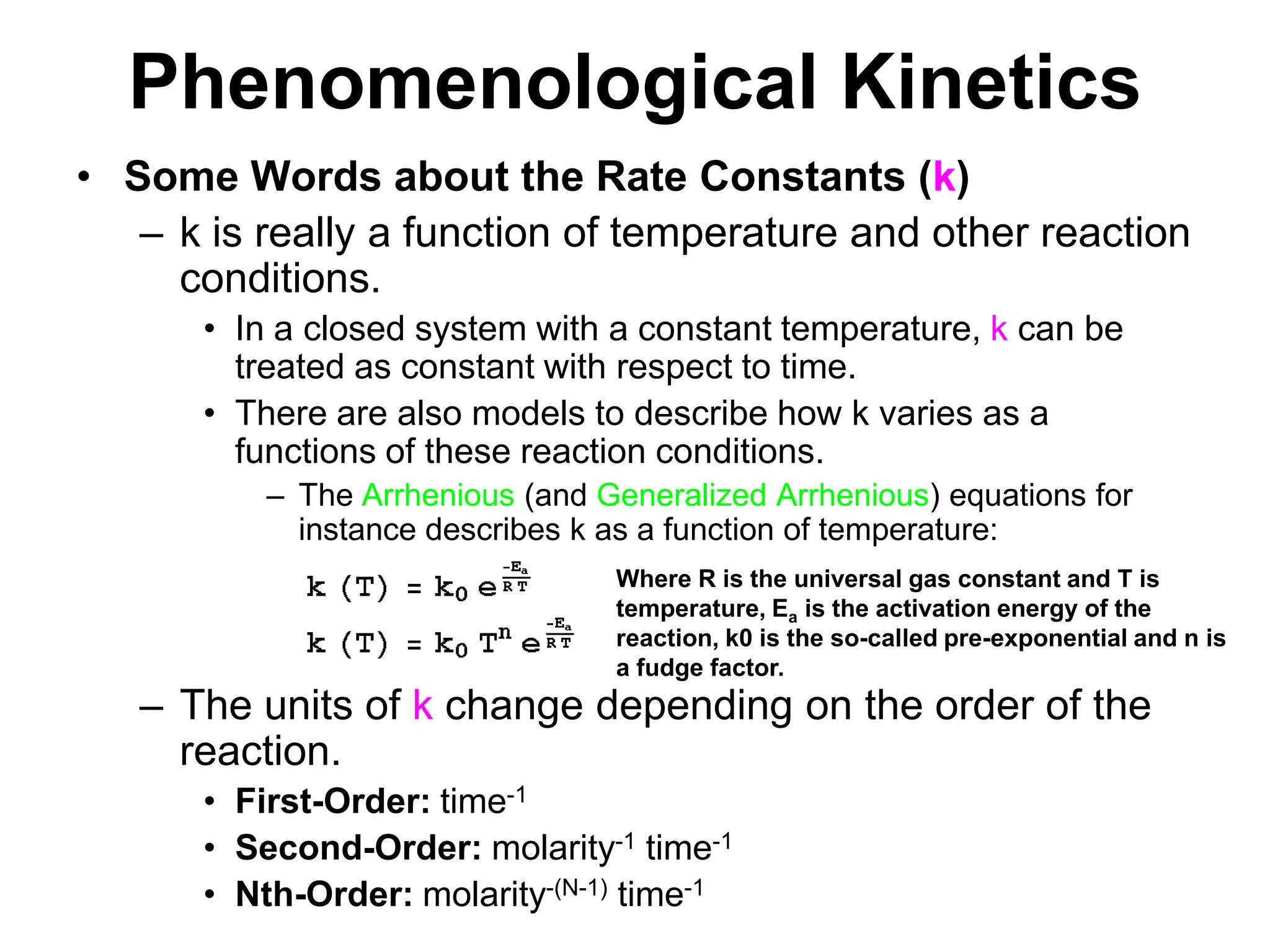
PhenomenologicalKineticsSome Words about the Rate Constants (k)k is really a function of temperature and other reaction conditions.In a closed system with a constant temperature, k can be treated as constant with respect to time.There are also models to describe how k varies as a functions of these reaction conditions.The Arrhenious (and Generalized Arrhenious) equations for instance describes k as a function of temperature: The units of k change depending on the order of the reaction.First-Order: time-1Second-Order: molarity-1 time-1Nth-Order: molarity-(N-1) time-1Where R is the universal gas constant and T is temperature, Ea is the activation energy of the reaction, k0 is the so-called pre-exponential and n is a fudge factor.
Chemical Kinetics OutlineChemistry BackgroundChemical Kinetics BackgroundPhenomenological KineticsStochastic Simulation Approach
Stochastic SimulationPhenomenological Kinetics AssumptionsBy utilizing ODE’s to describe rate laws Phenomenological kinetics imply that concentration is a continuous quantity.In reality, molecules are really discrete entities, and thus one tenth of a water molecule does not truly exist in the physical world.However, Avogadro’s number is huge (1023), and thus even a nanomole of material consists of more then one hundred trillion molecules, so in lab scale reactions this is often not a bad assumption.
Stochastic SimulationPhenomenological Kinetics AssumptionsBecause concentration is treated as continuous, the solution to the rate law is deterministic.  Meaning that the exact same number of molocules should have reacted at time t, every time you run that reaction.In reality, at any given time an individual molecule can either have reacted or not.By comparison, it’s not accurate to say that on a single coin toss the expected outcome is to receive of one half of a heads.  Again, Avogadro’s number is huge and so the average number of molecules that have reacted at any given time is very consistent.After one hundred trillion coin tosses its fairly reasonable to say that the expect outcome is around half heads.
Stochastic SimulationBut what happens when the number of molecules involved in a reaction is very low?Or what happens when the behavior of a system diverges sharply around a critical number of molecules? Both of those assumptions break down and we can only speak to the probability of a number of reactions occurring as a function of time.In these cases, we say that the reaction is stochastic, and phenomenological kinetics no longer properly apply.
Stochastic SimulationThe Stochastic Formulation state that at any given time, a probability distribution describes the possible concentration of each reagent.The function that describes this distribution of all known reagents is known as the so called “Master Function.”Instead of using concentrations as the preferred unit for amounts, the stochastic formulation’s preferred unit is a number of molecules in a fixed volume.
Stochastic SimulationStochastic Simulations Algorithms (SSA) These Monte Carlo procedures simulate a single random path, or trajectory thought the Master Function, where random choice is weighted according to the probabilities in the Master Function.Simulating multiple trajectories can then be used to estimate the original distribution of the Master Function. Instead of parameterizing reactions by rates, SSA methods are parameterized by probability of a reaction happening.In the 1970s Gillespie came up with an exact method of simulating trajectories known as the “Direct Method.”D. T. Gillespie, J. Phys. Chem. (1977), 81, 2340
Stochastic SimulationThe Direct Method (The Gillespie Method)N is the number of reagentsM is the number of possible reactions pathwaysReversible reactions count as two pathways, one for the forward and one for the reverse reaction.XN is the set containing the number of molecules of each reagent ND. T. Gillespie, J. Phys. Chem. (1977), 81, 2340
Stochastic SimulationABA + BC2ABThe Direct Method (The Gillespie Method)HM is the set of the number of combinations available for each M reaction.For a first-order reaction:Hm = XAFor a second-order heterogeneous reaction:HM= XAXBFor a second-order homogeneous reaction:HM = ½(XA)(XA-1)(This corrects for self-collision)Set CM the probability for each M reaction occurring per molecule of reactant.  This is a little like “k” in phenomenological kinetics, and is the parameter you must fit to for each individual reaction.Set or AM = CMHM or propensities for each reaction. The probability of a single reaction CM, times the number of molecules available for that reaction HM.A0 = the sum of all propensities in AMD. T. Gillespie, J. Phys. Chem. (1977), 81, 2340
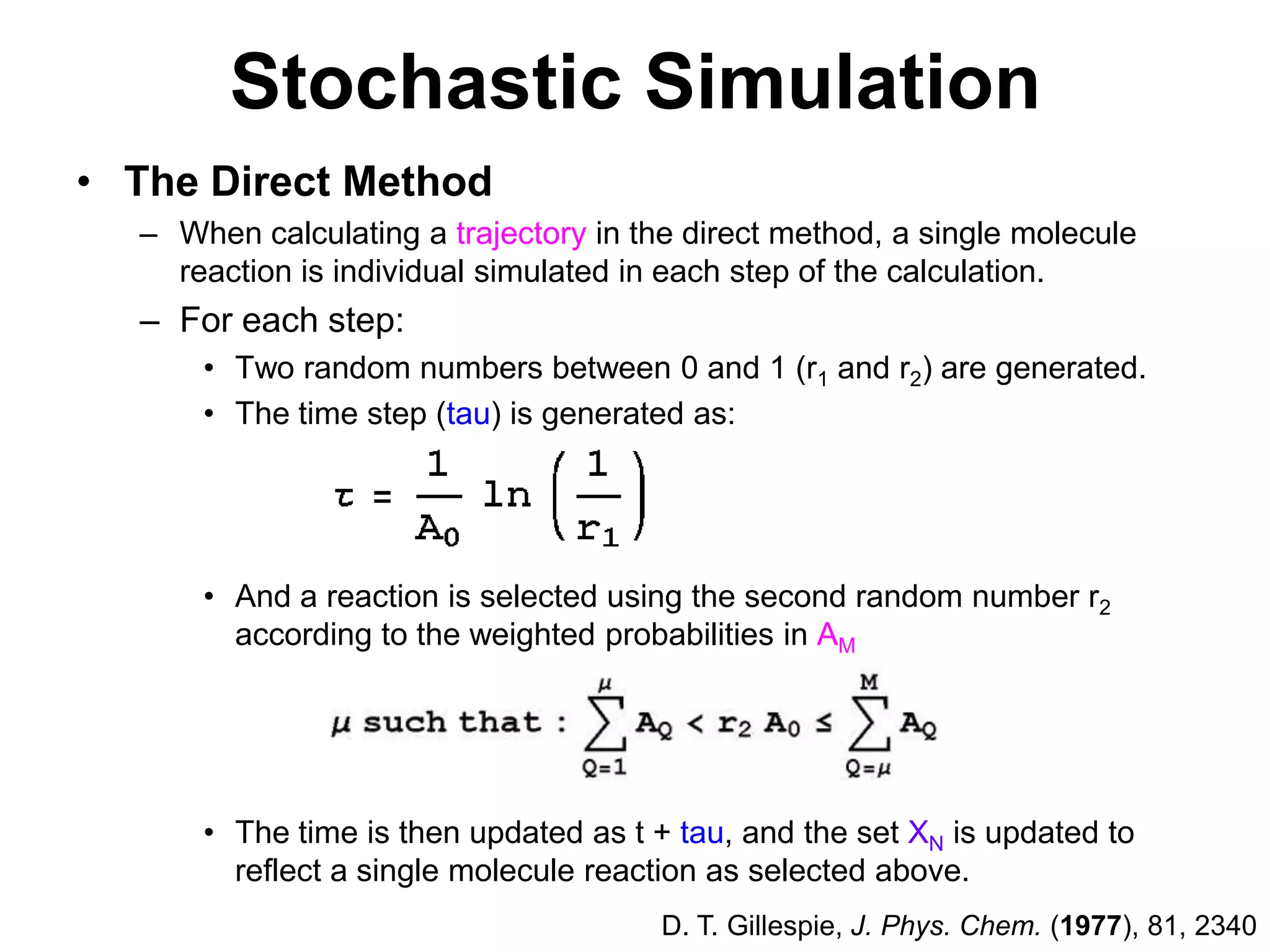
Stochastic SimulationThe Direct MethodWhen calculating a trajectory in the direct method, a single molecule reaction is individual simulated in each step of the calculation. For each step:Two random numbers between 0 and 1 (r1 and r2) are generated.The time step (tau) is generated as:And a reaction is selected using the second random number r2 according to the weighted probabilities in AMThe time is then updated as t + tau, and the set XN is updated to reflect a single molecule reaction as selected above.D. T. Gillespie, J. Phys. Chem. (1977), 81, 2340
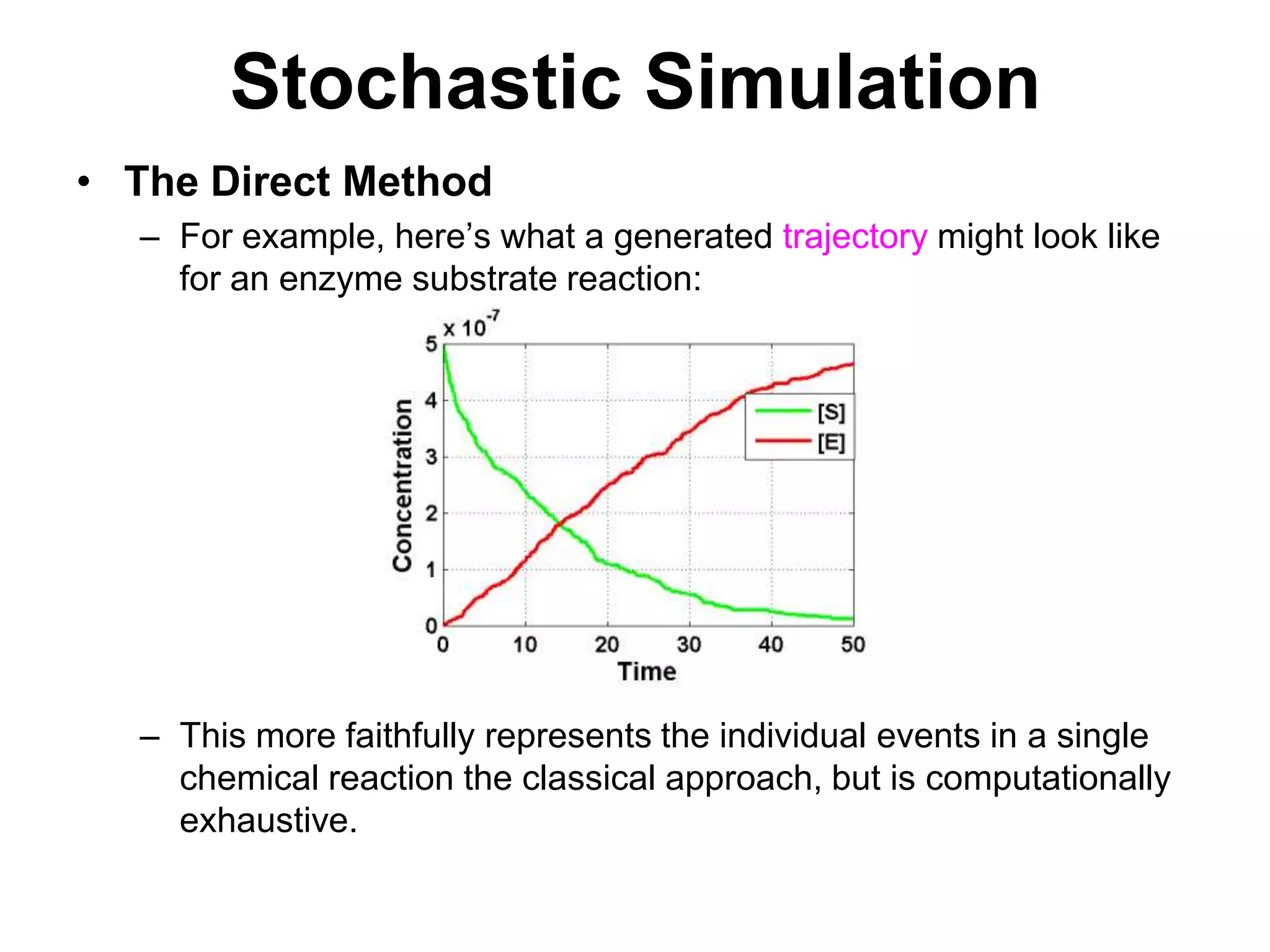
Stochastic SimulationThe Direct MethodFor example, here’s what a generated trajectory might look like for an enzyme substrate reaction:This more faithfully represents the individual events in a single chemical reaction the classical approach, but is computationally exhaustive.
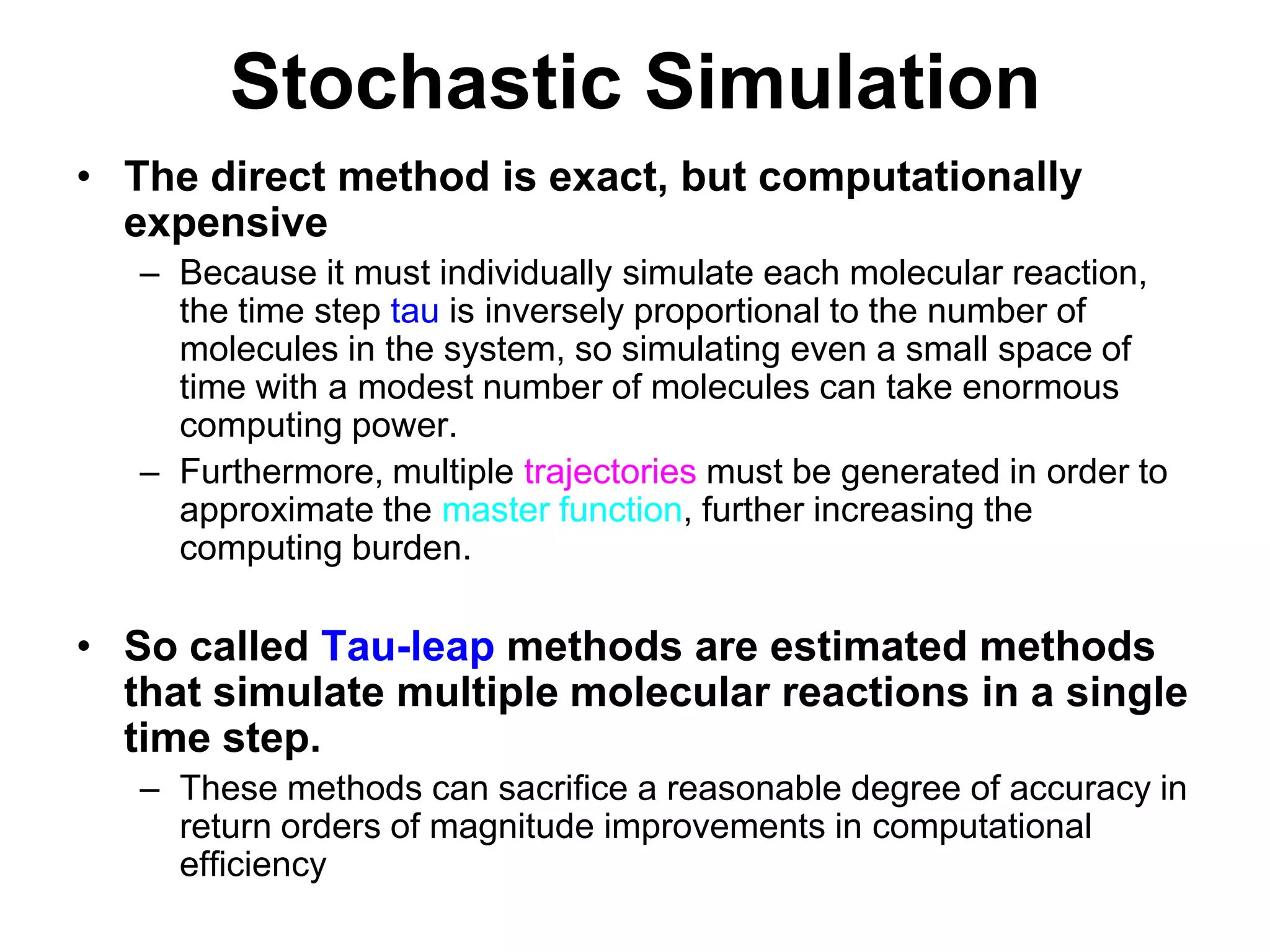
Stochastic SimulationThe direct method is exact, but computationally expensiveBecause it must individually simulate each molecular reaction, the time step tau is inversely proportional to the number of molecules in the system, so simulating even a small space of time with a modest number of molecules can take enormous computing power.Furthermore, multiple trajectories must be generated in order to approximate the master function, further increasing the computing burden. So called Tau-leap methods are estimated methods that simulate multiple molecular reactions in a single time step.These methods can sacrifice a reasonable degree of accuracy in return orders of magnitude improvements in computational efficiency
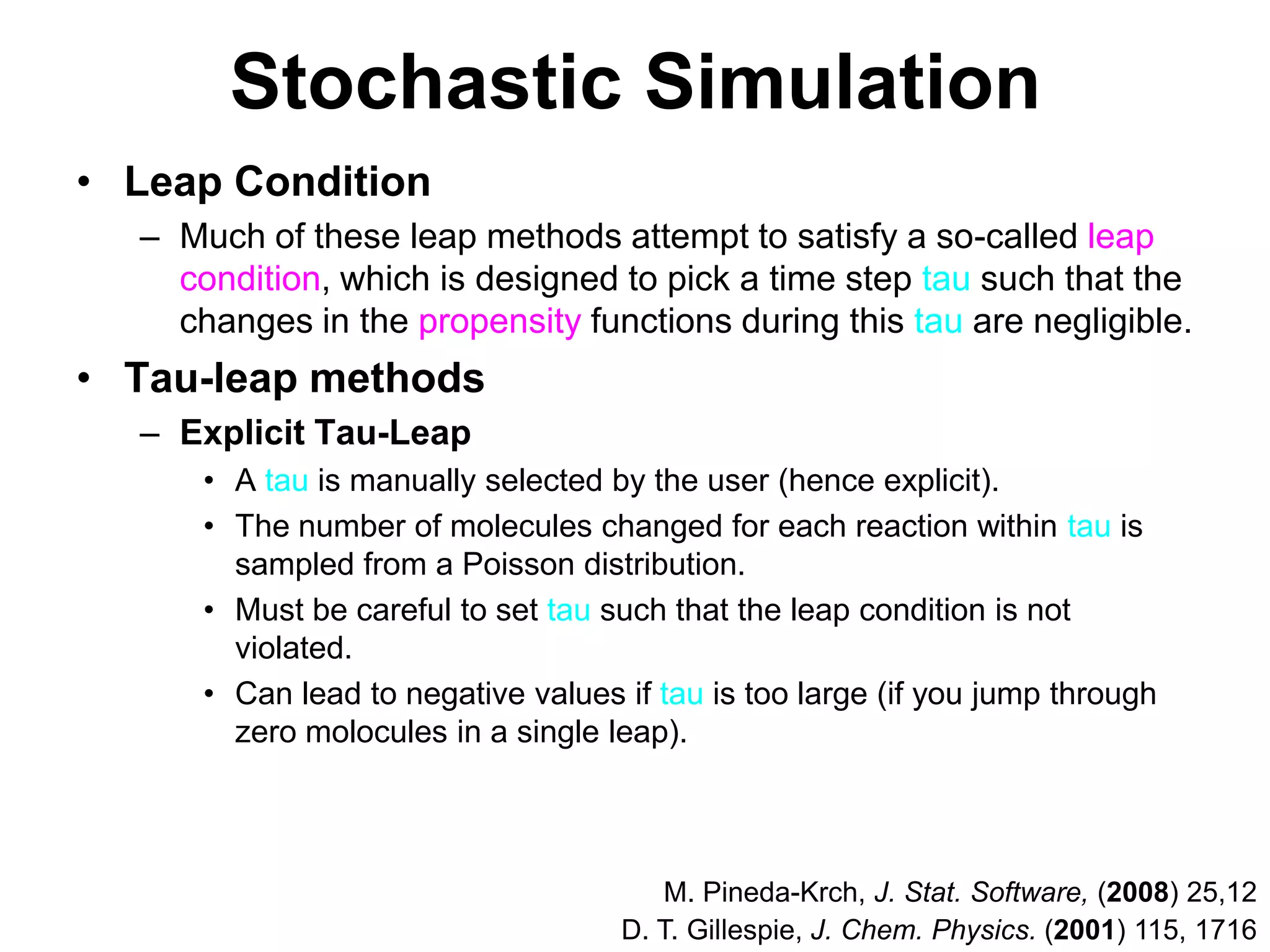
Stochastic SimulationLeap ConditionMuch of these leap methods attempt to satisfy a so-called leap condition, which is designed to pick a time step tau such that the changes in the propensity functions during this tau are negligible.Tau-leap methodsExplicit Tau-LeapA tau is manually selected by the user (hence explicit).The number of molecules changed for each reaction within tau is sampled from a Poisson distribution.Must be careful to set tau such that the leap condition is not violated.Can lead to negative values if tau is too large (if you jump through zero molocules in a single leap).M. Pineda-Krch, J. Stat. Software, (2008) 25,12D. T. Gillespie, J. Chem. Physics. (2001) 115, 1716
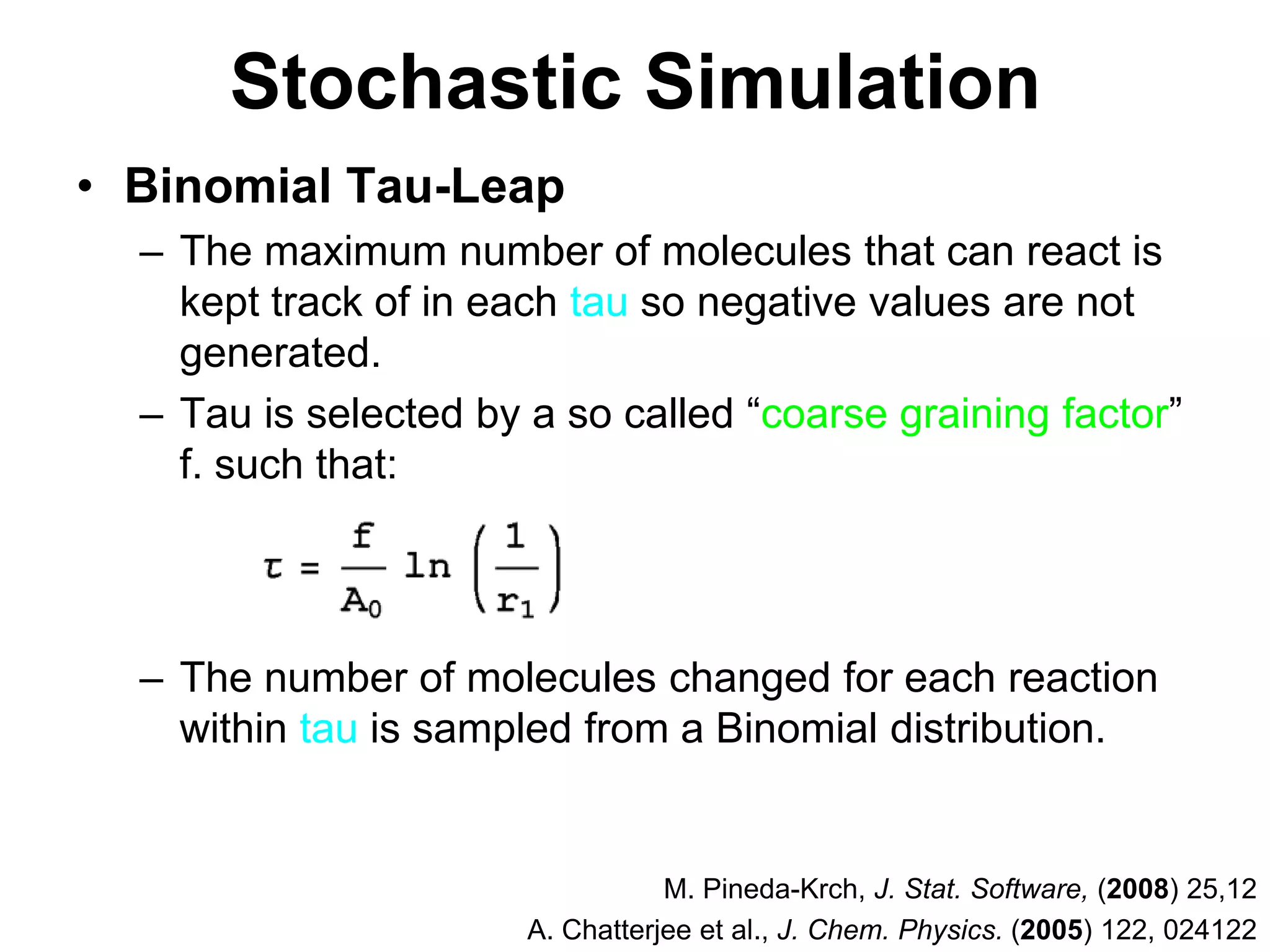
Stochastic SimulationBinomial Tau-LeapThe maximum number of molecules that can react is kept track of in each tau so negative values are not generated.Tau is selected by a so called “coarse graining factor” f. such that: The number of molecules changed for each reaction within tau is sampled from a Binomial distribution.M. Pineda-Krch, J. Stat. Software, (2008) 25,12A. Chatterjee et al., J. Chem. Physics. (2005) 122, 024122
Stochastic SimulationOptimized Tau-LeapReactions are partitioned into critical and non-critical groups.A reaction is defined as critical if the reactants are near depletion (XN< some threshold)If a critical reaction is selected, a single molecule is incremented at a time.If a non-ciritical reaction is selected, then the number of molecules changed for each reaction within tau is sampled from a Poisson distribution.A candidate time step taunc to the next non-critical reaction is calculated by estimating the percent change in the propensities and selecting a taunc such that the percent change is under a threshold value.If the candidate taunc is smaller then a selected course grain factor, then the algorithm halts the tau-leaping and simulates individual molecule reactions for a set number of steps.If the candidate taunc is greater then a selected course grain factor, then the algorithm selects another candidate time step to the next critical reaction, taucThe algorism then picks the lesser of the two (taunc and tauc) and selects that as the time step.M. Pineda-Krch, J. Stat. Software, (2008) 25,12Y. Cao et al., J. Chem. Physics. (2006) 124, 044109
Chemical Kinetics OutlineChemistry BackgroundChemical Kinetics BackgroundPhenomenological KineticsStochastic Simulation Approach
SummaryChemical Kinetics deals with the time course of a chemical reaction.Reactions are described according to a specific language.Reactions are characterized by fitting parameters in a model to test reactions.Once they have been parameterized, reactions can be simulated under unique starting conditions and when coupled with other reactions.The time course of a reaction can be modeled using multiple methodsClassical Phenomenological KineticsStochastic Simulation Algorithms
Chemical Kinetics Made Simple

Chemical Kinetics Made Simple

  • 1.
    Chemical Kinetics MadeSimpleA complete functional background in chemical kinetics specifically designed for non-chemistsSeptember 2009Presented by Brian M. Frezza
  • 2.
    What are ChemicalKinetics?Kinetics is the study of the time course behavior of a chemical reaction. “How fast do chemical reactions go?”Formation of “product” chemicalConsumption of “reactant” chemical
  • 3.
    Why Should ICare?Synthetic OptimizationHow long and under what conditions should you allow a reaction to proceed to maximize yield and profit and minimize unwanted side reactions?Information ProcessingBiological SystemsLiving systems respond to their environment largely by modulating the kinetics of their signaling networks.Molecular ComputingSystematic control of kinetics mechanism can be used to design synthetic systems which process information.
  • 4.
    Why Should ICare?Mathematical ModelsThe primary “business of science” is to produce models that faithfully represent the physical processes involved.Allows us to hypothesize what will happen in a chemical reaction without actually performing it. Mathematical models are what separate experimentation from engineering and are woefully under-employed in the life-sciences.
  • 5.
    Anatomy of aReactionABCD++Chemical reactions can be general depicted as follows:This example designates chemical “A” and chemical “B” react to form “C” and “D”. Letters are generally used as placeholders when signifying any reaction between any two unique chemicals “A” and “B” (like x and y are used to represent variables in algebra).
  • 6.
    Anatomy of aReactionCH4OHCH3H2O++Specific chemical reactions can be specified by supplying names or formula of the chemicals participating.For instance:Or:
  • 7.
    Anatomy of aReactionABCD++ReactantsProductsReagentsChemicals on the left hand side of the arrow are called reactantsChemicals on the right hand side of the reaction are called products.Chemicals on either side of the reaction are often referred to as reagents, species, participants, or moieties.
  • 8.
    Anatomy of aReaction2ACDAACD+++EquivalentsNumbers in front of the reagents are called stoichiometric coefficients or equivalents.Equivalents specify how much of a reagent is consumed or produced in the course of the reaction.For instance, the above reaction could also be written as:Equivalents do not necessarily imply a number of discreet molecules that participate in each reaction. Equivalents signify an average proportion of the reagent consumed or produced relative to the other participants, and can thus be fractions.
  • 9.
    Anatomy of aReaction
  • 10.
    Anatomy of aReactionABCDABCD++++irreversiblereversibleThe arrows signify the type of reaction, which can be irreversible when the point one direction.This means any mass that reacts to form product is permanently product.Or reversible if they point both directions.Meaning that the mass proceeds to equilibrium, reacting back and forth between product and reactant until a balance is reached (more on this later).
  • 11.
    CCDCDAnatomy of aReactionABAB++Systems of reactions can be designated by individually specifying each possible reaction like so:Or with shorthand by drawing multiple arrows like so:Systems of reactions are sometimes referred to as the reaction pathway or reaction channels,or more loosely as the mechanism.
  • 12.
    What are theUnits?Amounts, or number of molecules of a chemical, are usually specified as Moles (mol) in multiples of Avogadro’s number which is roughly 6.022 x 10²³ molecules per mol.A more relevant and commonly employed unit is concentration, or amount per volume. These are specified in Molar (M) and are in units of Moles/LiterSometimes square brackets around a name is used to denote concentration. Eg. [A] means the concentration of A.Both of these units are in metric, so prefixes like milli-(m), micro-(μor u), nano-(n) , etc. are commonly used shorthand for order of magnitude.
  • 13.
    Chemical Kinetics OutlineChemistryBackgroundChemical Kinetics BackgroundPhenomenological KineticsStochastic Simulation Approach
  • 14.
    Chemical KineticsThe Goal:Producea mathematical model that can faithfully represent how known chemical reactions will proceed, without having to experimentally run that exact reaction in the lab. Vs.
  • 15.
    Chemical KineticsThe ProcessRuna set of experimental test reactions and use the data to extract a set of parameters regarding that reaction.Use these parameters to predict how this reaction would proceed under different conditions from the test reactions:With different concentrations of reagentsUnder different temperatures or reaction conditionsWhen run in combination with other known reactions
  • 16.
    Chemical KineticsWhat isthe Physical BasisCollision Theory and Transition State TheoryMolecules diffusing at random though a solution react when they collide with enough energy to react.Increasing concentration increases odds of collision at any given time, and thus increases the velocity at which a reaction proceeds. Likewise, lowering the energy barrier for reaction can also increase velocity by increasing the odds that any given collision is productive. Every chemical reaction has a unique energy barrier that impacts the velocity of the reaction, and thus must be parameterized experimentally.
  • 17.
    Chemical KineticsUniform ConcentrationAllthe kinetic treatment’s presented here assume that the reaction vessel is well mixed and thus concentration of the reagents are uniform thought the vessel.For macroscopic vessels (>100uL) mixing can be accomplished simply by stirring the reaction.In small vessel the natural rate of diffusion can be fast enough to consider it well mixed (such as the internal volume of a biological cell). Here’s a petri dish with an unstirred reaction.Local environments in the dish have different concentrations and thus are the vessel is not kinetically uniform.
  • 18.
    Chemical Kinetics OutlineChemistryBackgroundChemical Kinetics BackgroundPhenomenological KineticsStochastic Simulation Approach
  • 19.
    PhenomenologicalKineticsClassical Phenomenological kineticsstates:At any given time (t), the reaction proceeds at rate that is a product of the concentration of the reactants at time (t), and a so called rate constant (k). This is called a rate equation, or a rate law.Since the concentration of the reagents is also a function of time, rate equations are first-order ordinary differential equations (ODEs).Solving these ODEs provides functions for the concentration of the reagents vs. time.
  • 20.
    PhenomenologicalKineticsABRate EquationsFor example,lets look at this First-orderIrreversible reaction:Some rate equations for A and B would be: In other words, the rate of consumption of the concentration of A and the production of B at time t is equal to k times the concentration of A at time t.
  • 21.
    PhenomenologicalKineticsExtent of ReactionWeknow one additional piece of information ties together the rate laws for each reagent in the system. Conservation of mass tells us that the mass in the system can neither be created, nor destroyed in the course of the reaction, only transfer between each of the reagents.Therefore the concentrations of each of the reagents can be related by the extent of reaction (η).Thus, the change in concentration of the reactant must be equal to the change in concentration of the products. These are called the mass conservation equations.By definition, initial extent of reaction (η0) = 0
  • 22.
    PhenomenologicalKineticsABExtent of ReactionSofor our example:Integrating and solving for [A]t and [B]t yields:Mass conservation:
  • 23.
    PhenomenologicalKinetics:ABThe rate equationscan also be expressed in terms of extent of reaction:Rate Equation:
  • 24.
    PhenomenologicalKinetics:ABTaken togeather whenthe mass conservation is substituted into the rate equation in terms of the extent of reaction:Mass Conservation:Rate Equation:ODE and boundary condition:
  • 25.
    PhenomenologicalKinetics:The solution tothis ODE yields:This particular ODE could be solved using separation by parts, but often you find these solutions in a lookup-table or use math software to determine them. I’ll provide a list of some solutions to the basic reactions later in the presentation.When these equations are not directly solvable, (and they often are not) numeric integration is used to simulate a solution. This is computationally expensive (slow to calculate) but the rest of this process remains the same.ODE and boundary condition:Closed-form solution:
  • 26.
    PhenomenologicalKinetics:Substituting the solutionfor the extent of reaction back into the mass conservation equations yields the concentrations of each reagent vs. time:Closed-form solution:Mass Conservation:Concentration vs. Time:
  • 27.
    PhenomenologicalKinetics:In the lab,perform test reactions with known initial concentrations, and observe the concentration of one of the reagents as a function of time.For example, here is the data when from a test reaction run under these starting conditions:
  • 28.
    PhenomenologicalKinetics:Now use non-linearregression to fit the rate constant k, to the concentration vs time equations you solved earlier by minimizing the sum squared error between the expected value and the data.Concentration vs. Time:k = 1.33563 hour-1
  • 29.
    PhenomenologicalKinetics:AB Victory! Wecan now simulate this particular reaction under any starting concentrations and couple it with any other reaction.wherek = 1.33563 hour-1[A]0 = 50nM[B]0 = 450nM[A]0 = 250nM[B]0 = 250nM[A]0 = 250nM[B]0 = 0nM
  • 30.
    PhenomenologicalKineticsStep by StepReview of the Process:Determine the mass conservation equations, and rate equations for the given mechanism.Substitute the mass conservation into the rate equations and solve the ODEs for extent of reaction vs. time.Substitute the solution for the extent of reaction vs. time back into the mass conservation equations to determine the concentrations of each reagent vs time.Using the concentration of each reagent vs. time, fit the values for the rate constants (k) against the test reaction data.
  • 31.
    PhenomenologicalKineticsnAAnBBnCCnDD++General Rules fordetermining Mass conservation:Reversible or Irreversible, either way this not affect mass conservation (we’ll see this later in the rate equations)Reactants are consumed by the extent of reactionNumber of equivalents of AProducts are produced by the extent of reaction
  • 32.
    PhenomenologicalKineticsk1nAAnBBnCCnDD++k-1k1nAAnBBnCCnDD++General Rules fordetermining Rate Equations:Product of the rate constant, and concentrations of reactants at time tEquivalents of BBy definition, extent of reaction always starts at 0.Forward Reactions work towards the extent of reactionReverse Reactions work against the extent of reaction
  • 33.
    PhenomenologicalKineticsnAA + nBBnCC+ nDDnAA + nBBnEEGeneral Rules for determining Mass conservation with parallel reactions:Two extents of reaction are involved. One for each reaction in the systemBoth reactions consume A and B and so both must be accounted for in the mass conservation.Only one reaction produces E, so only it is included in E’s conservation of mass
  • 34.
    PhenomenologicalKineticsGeneral Rules fordetermining Rate Equations with parallel reactions:k1nAA + nBBnCC + nDDk-1k2nAA + nBBnEENotice that both extent of reactions remain connected only through the conservation of masses, and not their rate equationsAs always, both extent of reactions also start at 0 by definition.
  • 35.
    PhenomenologicalKineticsnAA + nBBnCCnCCnDDGeneralRules for determining Mass conservation with consecutive reactions:C’s mass is involved is produced by the first reaction and consumed by the second.
  • 36.
    PhenomenologicalKineticsnAA + nBBnCCnCCnDDGeneralRules for determining Rate Equations with parallel reactions:k1k-1k2Again, both extent of reactions remain connected only through the conservation of masses, and not their rate equations
  • 37.
    PhenomenologicalKineticsABk1ABk-1kkA + BCSomeclosed-form solutions to extents of common reactions.First-Order Irreversible:First-Order reversible:Second-Order Irreversible Homogeneous:Second-Order Irreversible Heterogeneous:k2ACH. Metiu, ”Physical Chemistry: Kinetics”, New York: Taylor & Francis Group, 2006.
  • 38.
    PhenomenologicalKineticsk1AB + Ck-1k1A+ BCk-1Some closed-form solutions to extents of common reactions.Second-Order Reversible General Solution:Unimolecular to Heterogeneous:Heterogeneous to Unimolecular:H. Metiu, ”Physical Chemistry: Kinetics”, New York: Taylor & Francis Group, 2006.
  • 39.
    PhenomenologicalKineticsk1k1A + BC+ D2AC + Dk-1k-1Some closed-form solutions to extents of common reactions.Second-Order Reversible General Solution:Heterogeneous:Homogeneous:H. Metiu, ”Physical Chemistry: Kinetics”, New York: Taylor & Francis Group, 2006.
  • 40.
    k2k1ACABPhenomenologicalKineticsk2A + BDk1A+ BCSome closed-form solutions to extents of common reactions.First-Order Irreversible parallel:Second-Order Irreversible parallel:H. Metiu, ”Physical Chemistry: Kinetics”, New York: Taylor & Francis Group, 2006.
  • 41.
    kk2kk1BCBCABABPhenomenologicalKineticsSome closed-form solutionsto extents of common reactions.First-Order Irreversible repeated:First-Order Irreversible consecutive:H. Metiu, ”Physical Chemistry: Kinetics”, New York: Taylor & Francis Group, 2006.
  • 42.
    PhenomenologicalKineticsDetailed BalanceThermodynamics canbe used to give us additional information regarding the special case of reversible reactions.ΔG can be obtained through additional experimentation (such as isothermal calorimetry).In the case of reversible reactions, the equilibrium constant Keq can be determined from ΔG, and the ratio of the forward and the reverse reaction can be determined from KeqWhere R is the universal gas constant and T is temperature
  • 43.
    PhenomenologicalKineticsSome Words aboutthe Rate Constants (k)k is really a function of temperature and other reaction conditions.In a closed system with a constant temperature, k can be treated as constant with respect to time.There are also models to describe how k varies as a functions of these reaction conditions.The Arrhenious (and Generalized Arrhenious) equations for instance describes k as a function of temperature: The units of k change depending on the order of the reaction.First-Order: time-1Second-Order: molarity-1 time-1Nth-Order: molarity-(N-1) time-1Where R is the universal gas constant and T is temperature, Ea is the activation energy of the reaction, k0 is the so-called pre-exponential and n is a fudge factor.
  • 44.
    Chemical Kinetics OutlineChemistryBackgroundChemical Kinetics BackgroundPhenomenological KineticsStochastic Simulation Approach
  • 45.
    Stochastic SimulationPhenomenological KineticsAssumptionsBy utilizing ODE’s to describe rate laws Phenomenological kinetics imply that concentration is a continuous quantity.In reality, molecules are really discrete entities, and thus one tenth of a water molecule does not truly exist in the physical world.However, Avogadro’s number is huge (1023), and thus even a nanomole of material consists of more then one hundred trillion molecules, so in lab scale reactions this is often not a bad assumption.
  • 46.
    Stochastic SimulationPhenomenological KineticsAssumptionsBecause concentration is treated as continuous, the solution to the rate law is deterministic. Meaning that the exact same number of molocules should have reacted at time t, every time you run that reaction.In reality, at any given time an individual molecule can either have reacted or not.By comparison, it’s not accurate to say that on a single coin toss the expected outcome is to receive of one half of a heads. Again, Avogadro’s number is huge and so the average number of molecules that have reacted at any given time is very consistent.After one hundred trillion coin tosses its fairly reasonable to say that the expect outcome is around half heads.
  • 47.
    Stochastic SimulationBut whathappens when the number of molecules involved in a reaction is very low?Or what happens when the behavior of a system diverges sharply around a critical number of molecules? Both of those assumptions break down and we can only speak to the probability of a number of reactions occurring as a function of time.In these cases, we say that the reaction is stochastic, and phenomenological kinetics no longer properly apply.
  • 48.
    Stochastic SimulationThe StochasticFormulation state that at any given time, a probability distribution describes the possible concentration of each reagent.The function that describes this distribution of all known reagents is known as the so called “Master Function.”Instead of using concentrations as the preferred unit for amounts, the stochastic formulation’s preferred unit is a number of molecules in a fixed volume.
  • 49.
    Stochastic SimulationStochastic SimulationsAlgorithms (SSA) These Monte Carlo procedures simulate a single random path, or trajectory thought the Master Function, where random choice is weighted according to the probabilities in the Master Function.Simulating multiple trajectories can then be used to estimate the original distribution of the Master Function. Instead of parameterizing reactions by rates, SSA methods are parameterized by probability of a reaction happening.In the 1970s Gillespie came up with an exact method of simulating trajectories known as the “Direct Method.”D. T. Gillespie, J. Phys. Chem. (1977), 81, 2340
  • 50.
    Stochastic SimulationThe DirectMethod (The Gillespie Method)N is the number of reagentsM is the number of possible reactions pathwaysReversible reactions count as two pathways, one for the forward and one for the reverse reaction.XN is the set containing the number of molecules of each reagent ND. T. Gillespie, J. Phys. Chem. (1977), 81, 2340
  • 51.
    Stochastic SimulationABA +BC2ABThe Direct Method (The Gillespie Method)HM is the set of the number of combinations available for each M reaction.For a first-order reaction:Hm = XAFor a second-order heterogeneous reaction:HM= XAXBFor a second-order homogeneous reaction:HM = ½(XA)(XA-1)(This corrects for self-collision)Set CM the probability for each M reaction occurring per molecule of reactant. This is a little like “k” in phenomenological kinetics, and is the parameter you must fit to for each individual reaction.Set or AM = CMHM or propensities for each reaction. The probability of a single reaction CM, times the number of molecules available for that reaction HM.A0 = the sum of all propensities in AMD. T. Gillespie, J. Phys. Chem. (1977), 81, 2340
  • 52.
    Stochastic SimulationThe DirectMethodWhen calculating a trajectory in the direct method, a single molecule reaction is individual simulated in each step of the calculation. For each step:Two random numbers between 0 and 1 (r1 and r2) are generated.The time step (tau) is generated as:And a reaction is selected using the second random number r2 according to the weighted probabilities in AMThe time is then updated as t + tau, and the set XN is updated to reflect a single molecule reaction as selected above.D. T. Gillespie, J. Phys. Chem. (1977), 81, 2340
  • 53.
    Stochastic SimulationThe DirectMethodFor example, here’s what a generated trajectory might look like for an enzyme substrate reaction:This more faithfully represents the individual events in a single chemical reaction the classical approach, but is computationally exhaustive.
  • 54.
    Stochastic SimulationThe directmethod is exact, but computationally expensiveBecause it must individually simulate each molecular reaction, the time step tau is inversely proportional to the number of molecules in the system, so simulating even a small space of time with a modest number of molecules can take enormous computing power.Furthermore, multiple trajectories must be generated in order to approximate the master function, further increasing the computing burden. So called Tau-leap methods are estimated methods that simulate multiple molecular reactions in a single time step.These methods can sacrifice a reasonable degree of accuracy in return orders of magnitude improvements in computational efficiency
  • 55.
    Stochastic SimulationLeap ConditionMuchof these leap methods attempt to satisfy a so-called leap condition, which is designed to pick a time step tau such that the changes in the propensity functions during this tau are negligible.Tau-leap methodsExplicit Tau-LeapA tau is manually selected by the user (hence explicit).The number of molecules changed for each reaction within tau is sampled from a Poisson distribution.Must be careful to set tau such that the leap condition is not violated.Can lead to negative values if tau is too large (if you jump through zero molocules in a single leap).M. Pineda-Krch, J. Stat. Software, (2008) 25,12D. T. Gillespie, J. Chem. Physics. (2001) 115, 1716
  • 56.
    Stochastic SimulationBinomial Tau-LeapThemaximum number of molecules that can react is kept track of in each tau so negative values are not generated.Tau is selected by a so called “coarse graining factor” f. such that: The number of molecules changed for each reaction within tau is sampled from a Binomial distribution.M. Pineda-Krch, J. Stat. Software, (2008) 25,12A. Chatterjee et al., J. Chem. Physics. (2005) 122, 024122
  • 57.
    Stochastic SimulationOptimized Tau-LeapReactionsare partitioned into critical and non-critical groups.A reaction is defined as critical if the reactants are near depletion (XN< some threshold)If a critical reaction is selected, a single molecule is incremented at a time.If a non-ciritical reaction is selected, then the number of molecules changed for each reaction within tau is sampled from a Poisson distribution.A candidate time step taunc to the next non-critical reaction is calculated by estimating the percent change in the propensities and selecting a taunc such that the percent change is under a threshold value.If the candidate taunc is smaller then a selected course grain factor, then the algorithm halts the tau-leaping and simulates individual molecule reactions for a set number of steps.If the candidate taunc is greater then a selected course grain factor, then the algorithm selects another candidate time step to the next critical reaction, taucThe algorism then picks the lesser of the two (taunc and tauc) and selects that as the time step.M. Pineda-Krch, J. Stat. Software, (2008) 25,12Y. Cao et al., J. Chem. Physics. (2006) 124, 044109
  • 58.
    Chemical Kinetics OutlineChemistryBackgroundChemical Kinetics BackgroundPhenomenological KineticsStochastic Simulation Approach
  • 59.
    SummaryChemical Kinetics dealswith the time course of a chemical reaction.Reactions are described according to a specific language.Reactions are characterized by fitting parameters in a model to test reactions.Once they have been parameterized, reactions can be simulated under unique starting conditions and when coupled with other reactions.The time course of a reaction can be modeled using multiple methodsClassical Phenomenological KineticsStochastic Simulation Algorithms