Plasticity theory related to porous
materials
By
Bashar Ridha Younos Al-ogaidi
SUBMİTTED TO
Assistant Prof. ABDULLAH AKPOLAT
1
Introduction
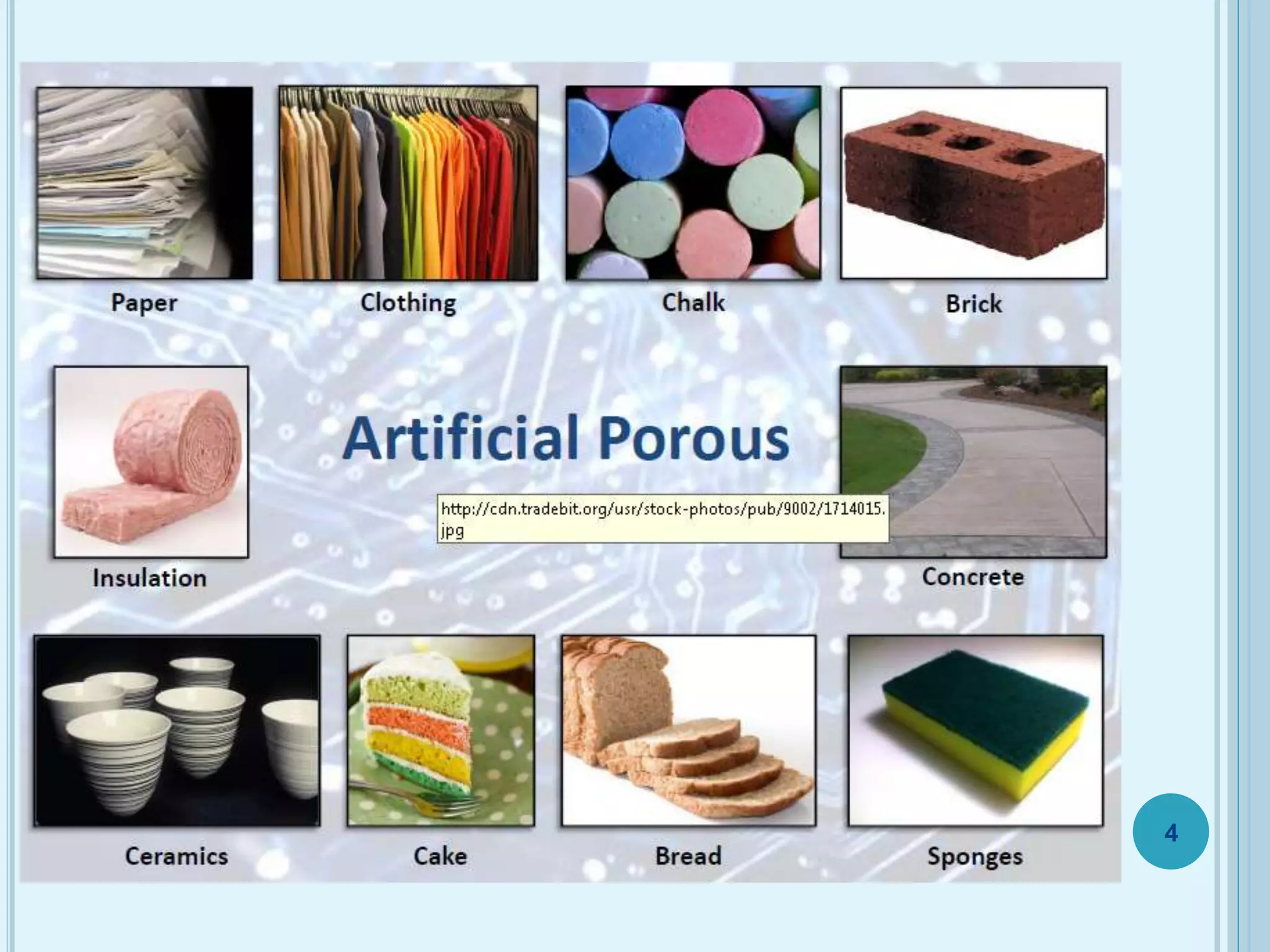
Porous materials
Elasticity and plasticity
 summary
Contents
2
Introduction
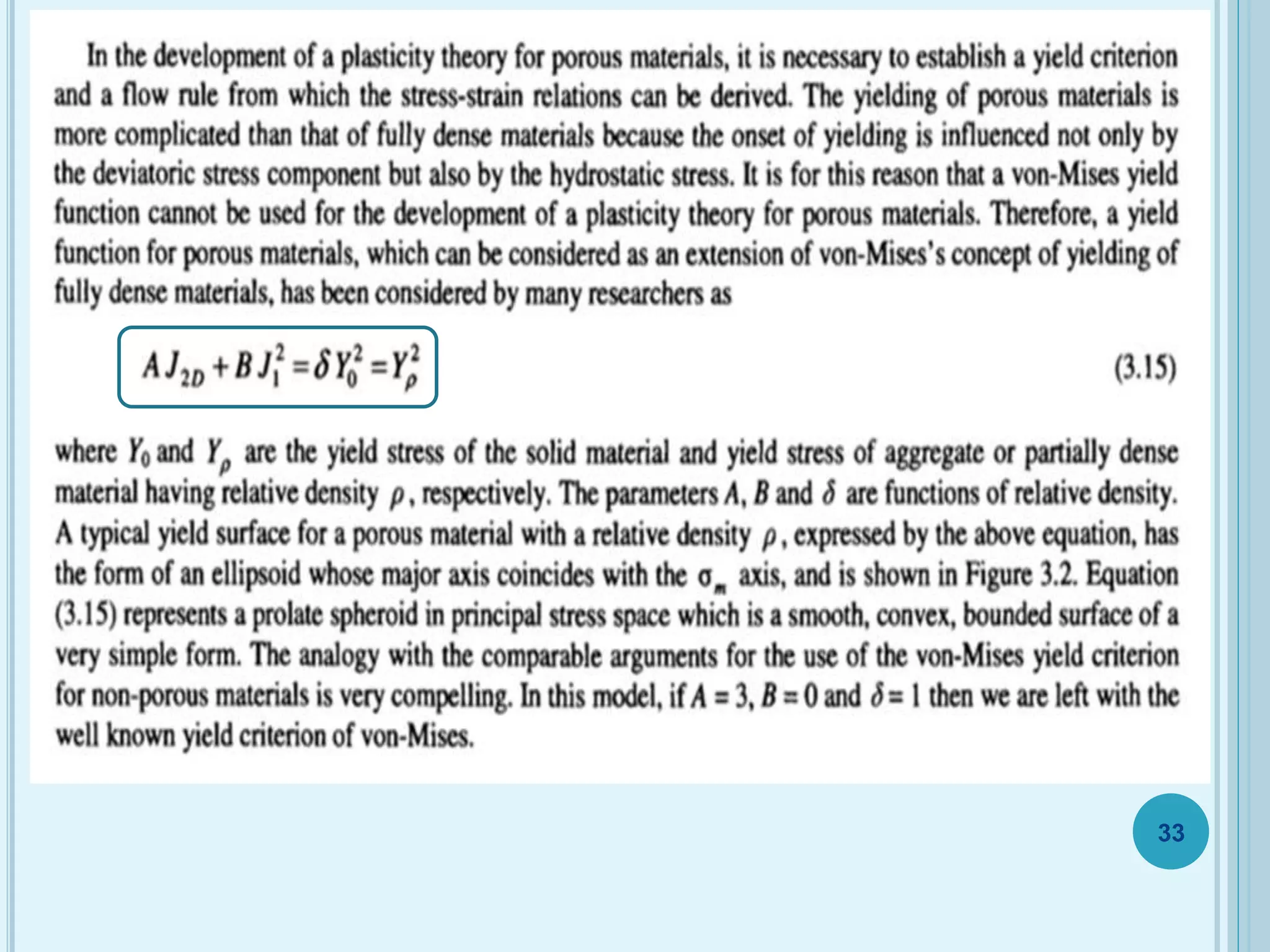
Research in plasticity of porous materials has, at least,
a 40 year history. This research appears to have
proceeded in two primary directions:
(A) plasticity at small overall strains, in particular,
determination of the macroscopic yield surface in
stress space, accounting for porosity, in the cases
when such a surface can be clearly identified
and (B) void growth and coalescence at much larger
overall strains
3
4
F. Rouquerol, J. Rouquerol, K. S. W. Sing, Adsorption by Powders and Porous
Solids, Academic Press, 1-25, 1999
WHAT ARE POROUS MATERIALS?
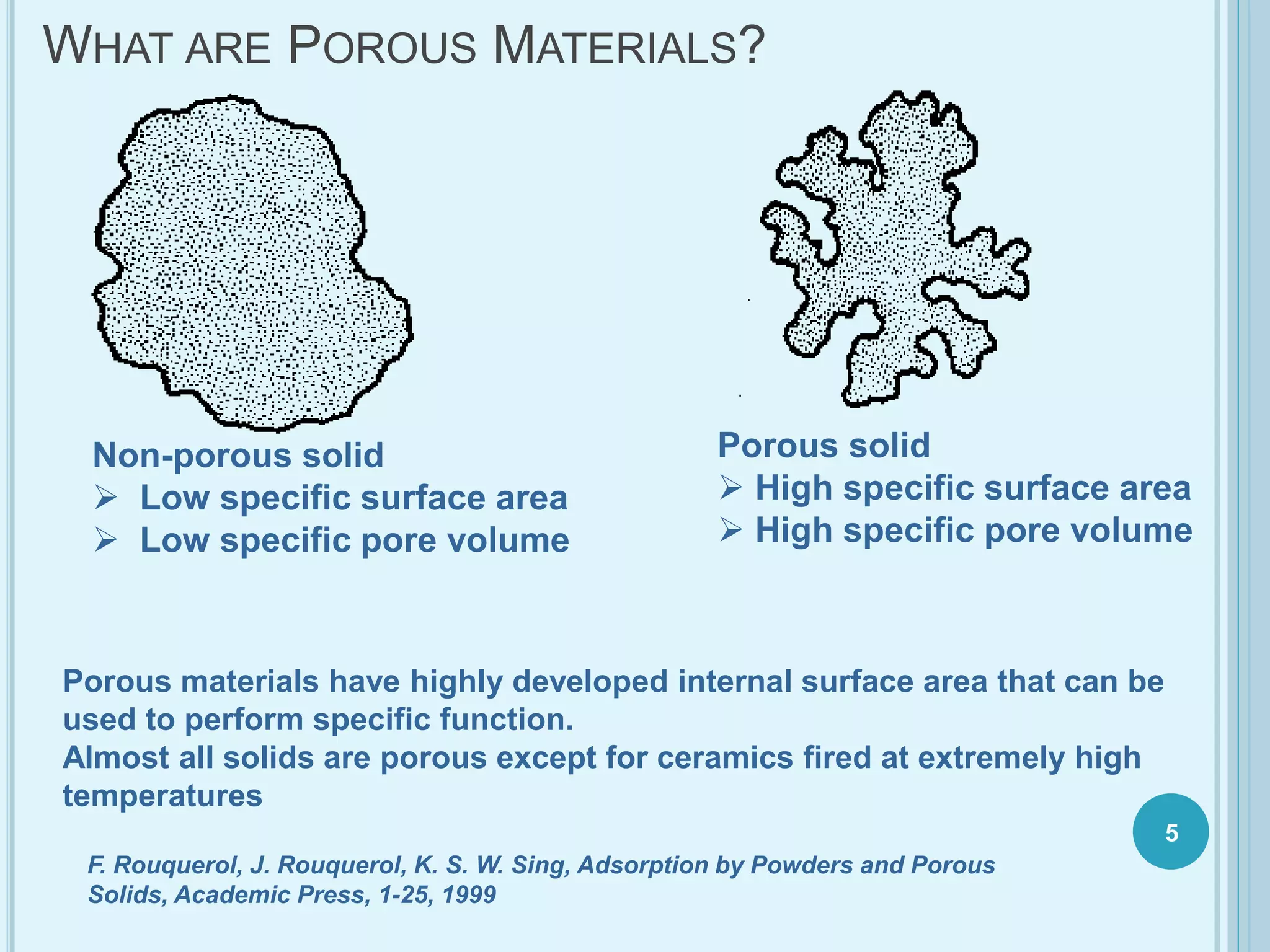
Non-porous solid
 Low specific surface area
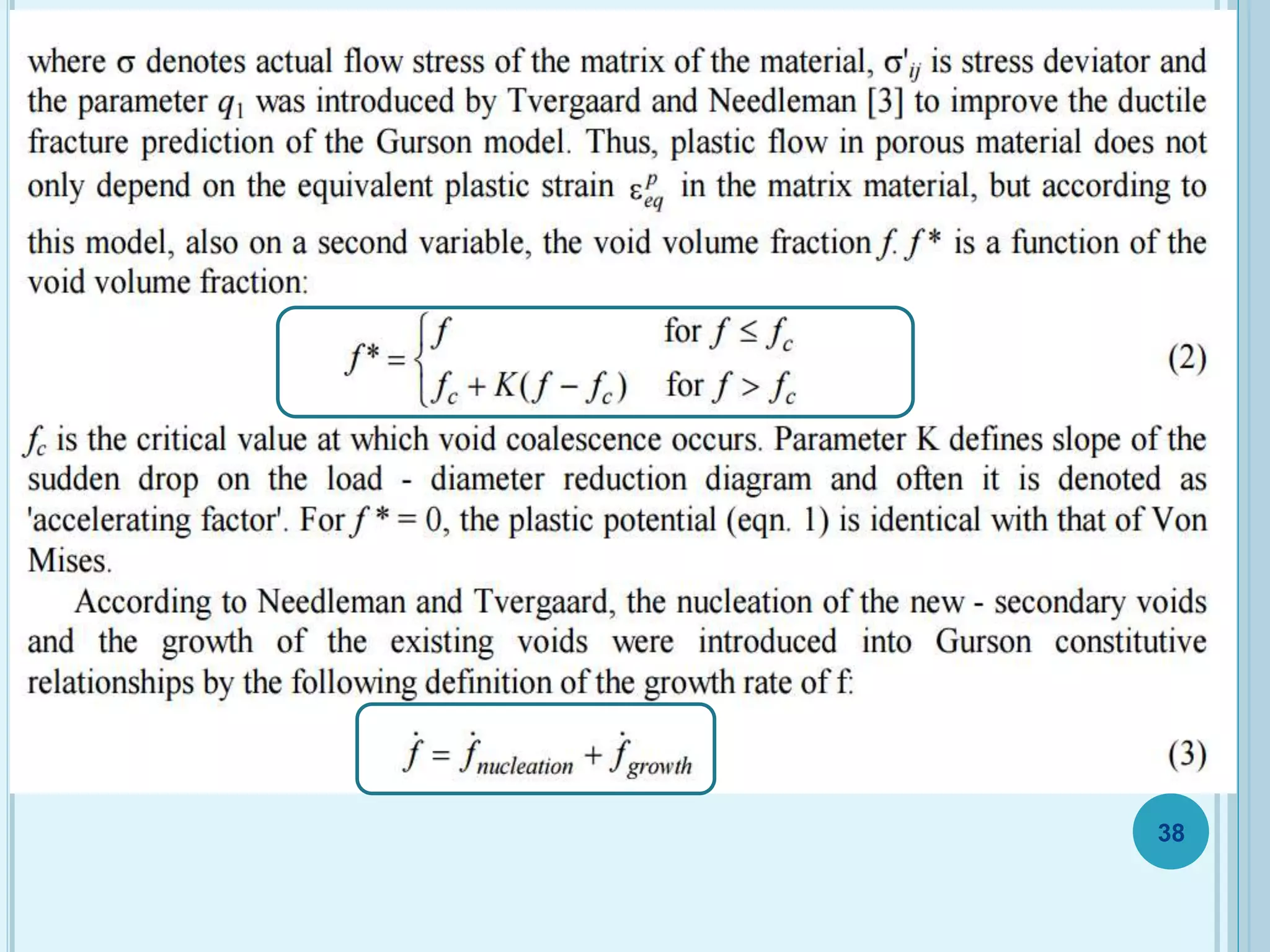
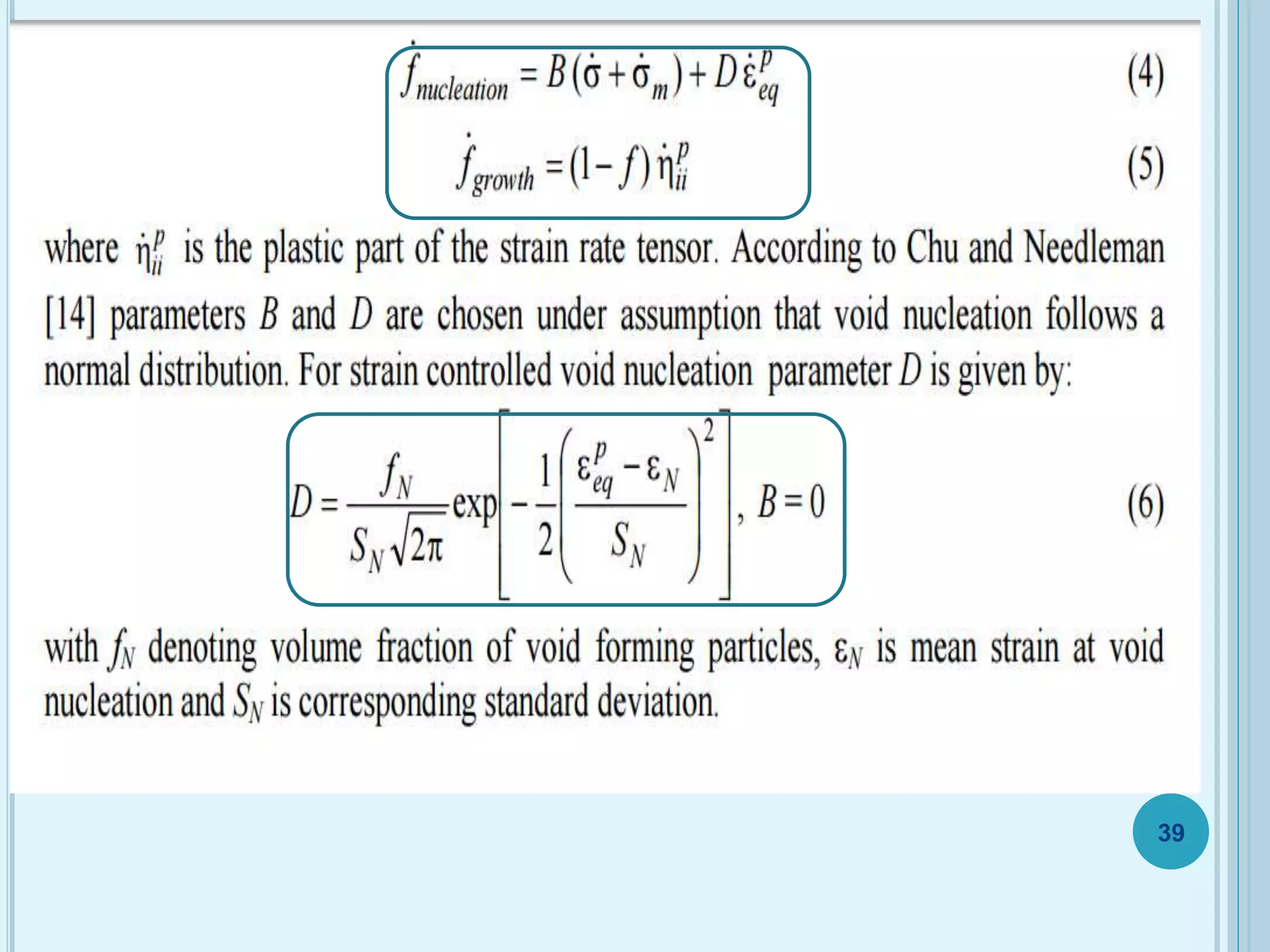
 Low specific pore volume
Porous solid
 High specific surface area
 High specific pore volume
Porous materials have highly developed internal surface area that can be
used to perform specific function.
Almost all solids are porous except for ceramics fired at extremely high
temperatures
5
MEASURE OF POROSITY
Pore size and
its distribution
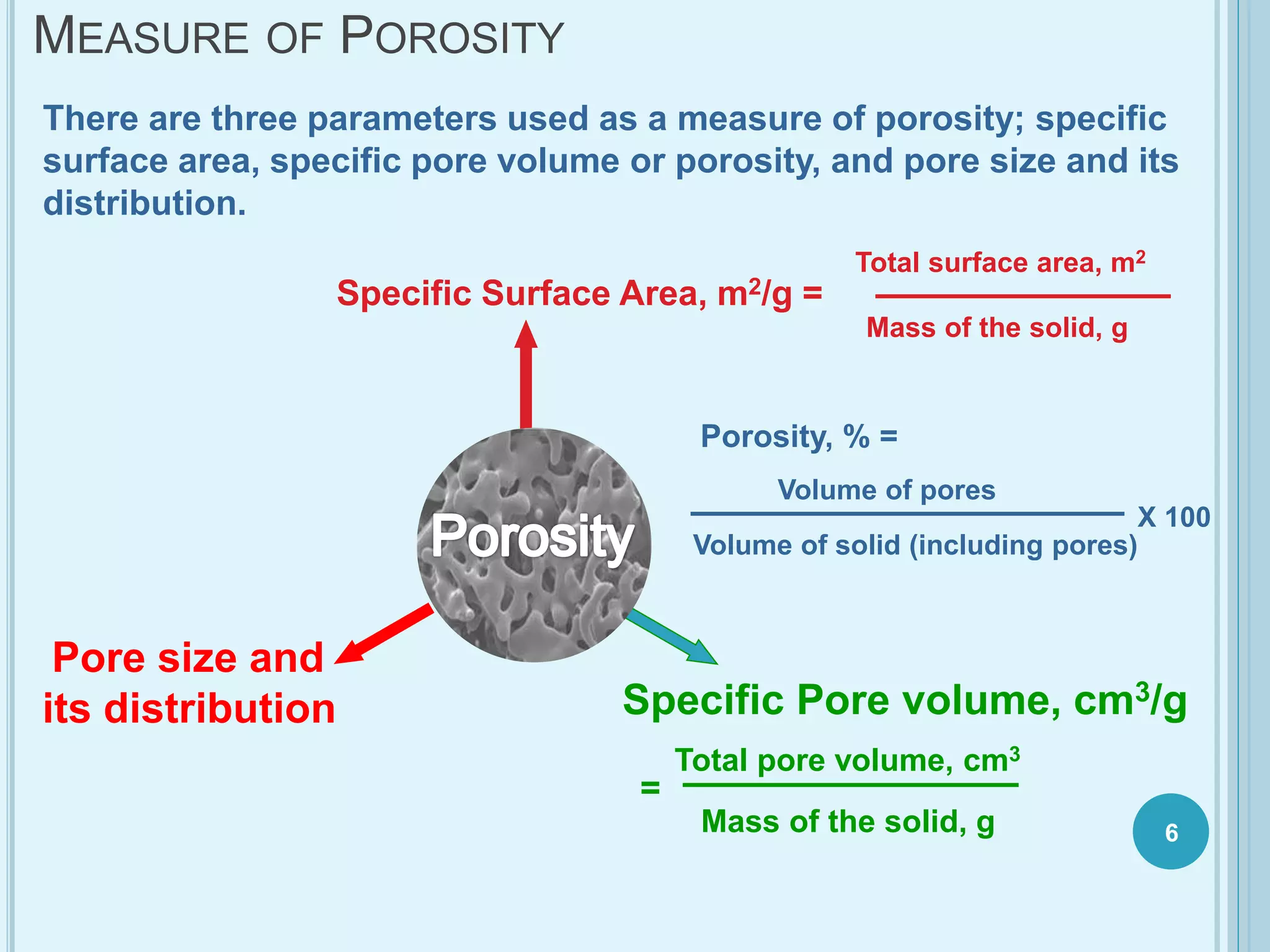
Specific Surface Area, m2/g =
There are three parameters used as a measure of porosity; specific
surface area, specific pore volume or porosity, and pore size and its
distribution.
Mass of the solid, g
Total surface area, m2
Specific Pore volume, cm3/g
Mass of the solid, g
Total pore volume, cm3
=
Porosity, % =
Volume of solid (including pores)
Volume of pores
X 100
6
Parameters that effected on porousity :-
1- partical size
2- partical shape
3- partical ditripution
7
PARTICLE SIZE
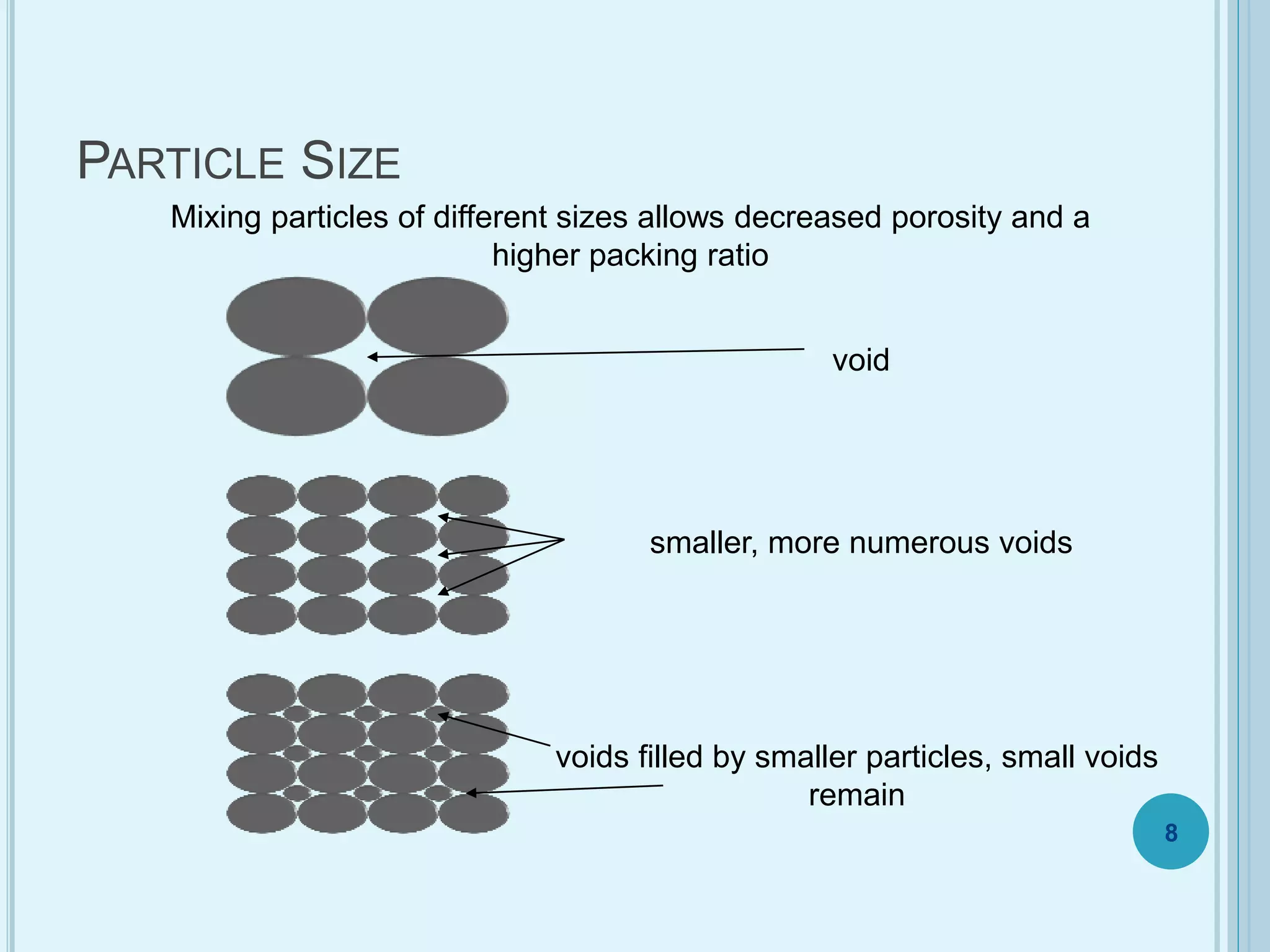
void
smaller, more numerous voids
voids filled by smaller particles, small voids
remain
Mixing particles of different sizes allows decreased porosity and a
higher packing ratio
8
PARTICLE SHAPES IN METAL POWDERS
9
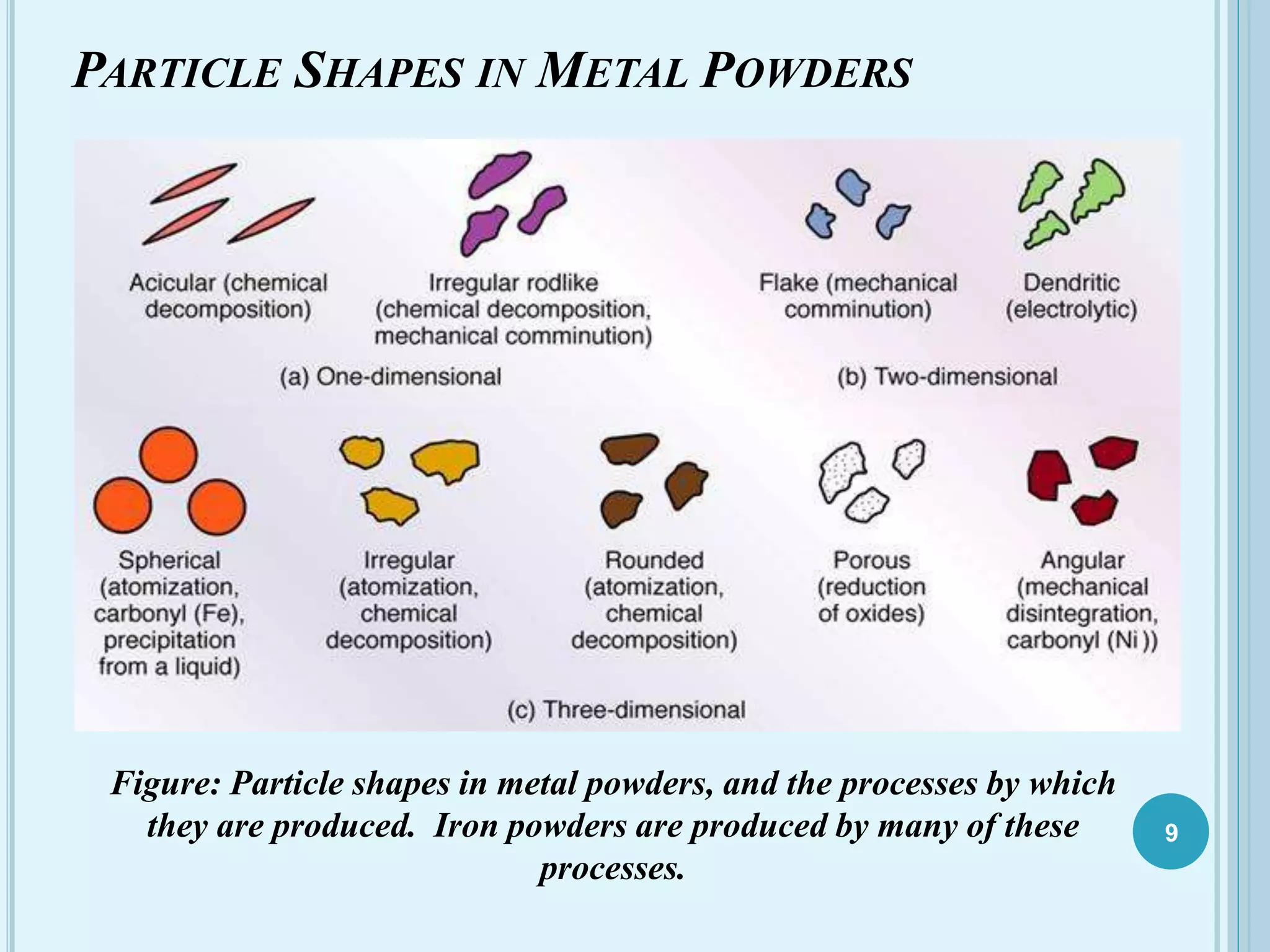
Figure: Particle shapes in metal powders, and the processes by which
they are produced. Iron powders are produced by many of these
processes.
CONCEPT OF POROSITY: OPEN VS. CLOSED
PORES
Dead end
(open)
Closed
Inter-connected
(open)
Passing
(open)
F. Rouquerol, J. Rouquerol, K. S. W. Sing, Adsorption by Powders and Porous
Solids, Academic Press, 1-25, 1999
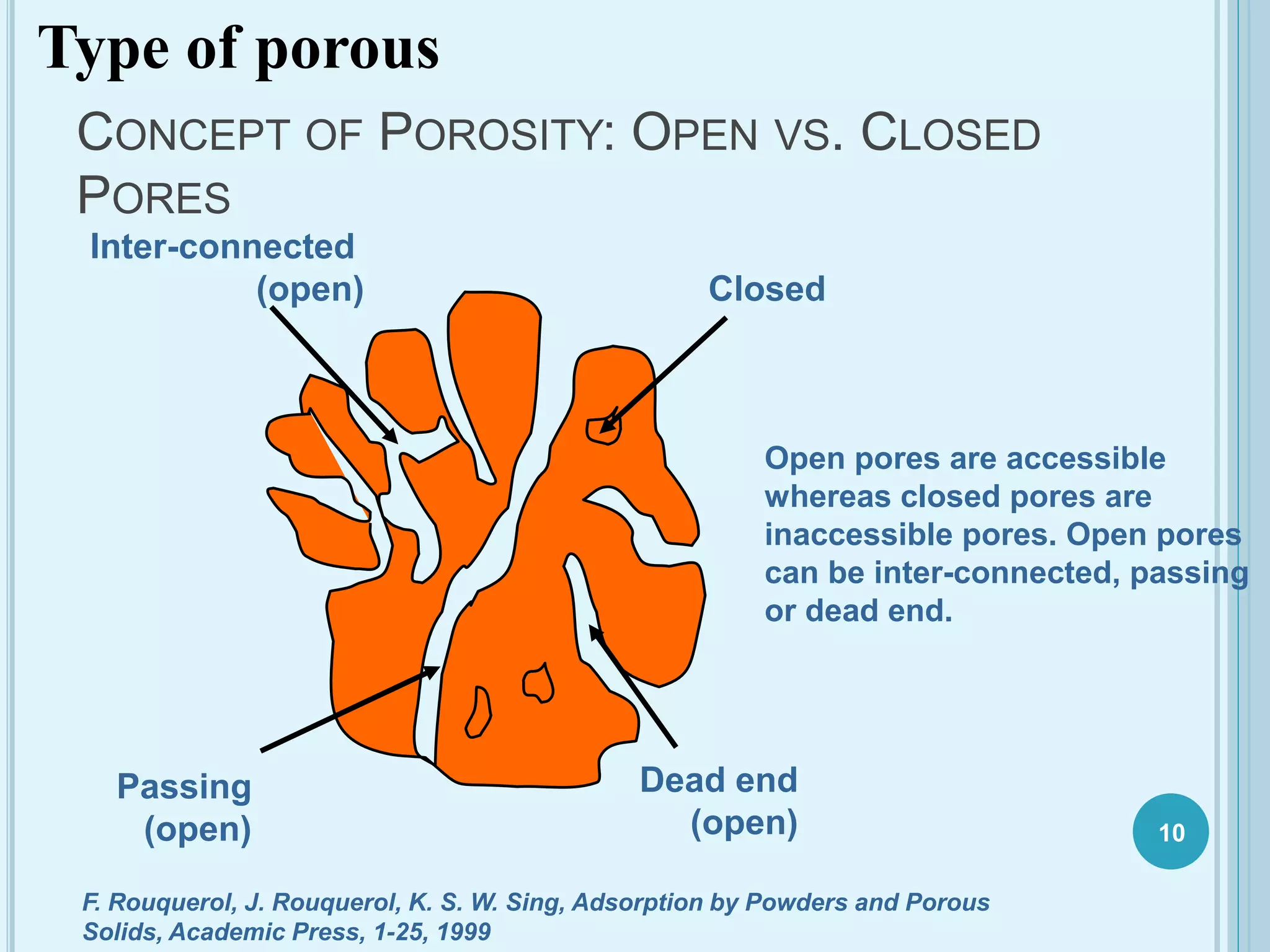
Open pores are accessible
whereas closed pores are
inaccessible pores. Open pores
can be inter-connected, passing
or dead end.
Type of porous
10
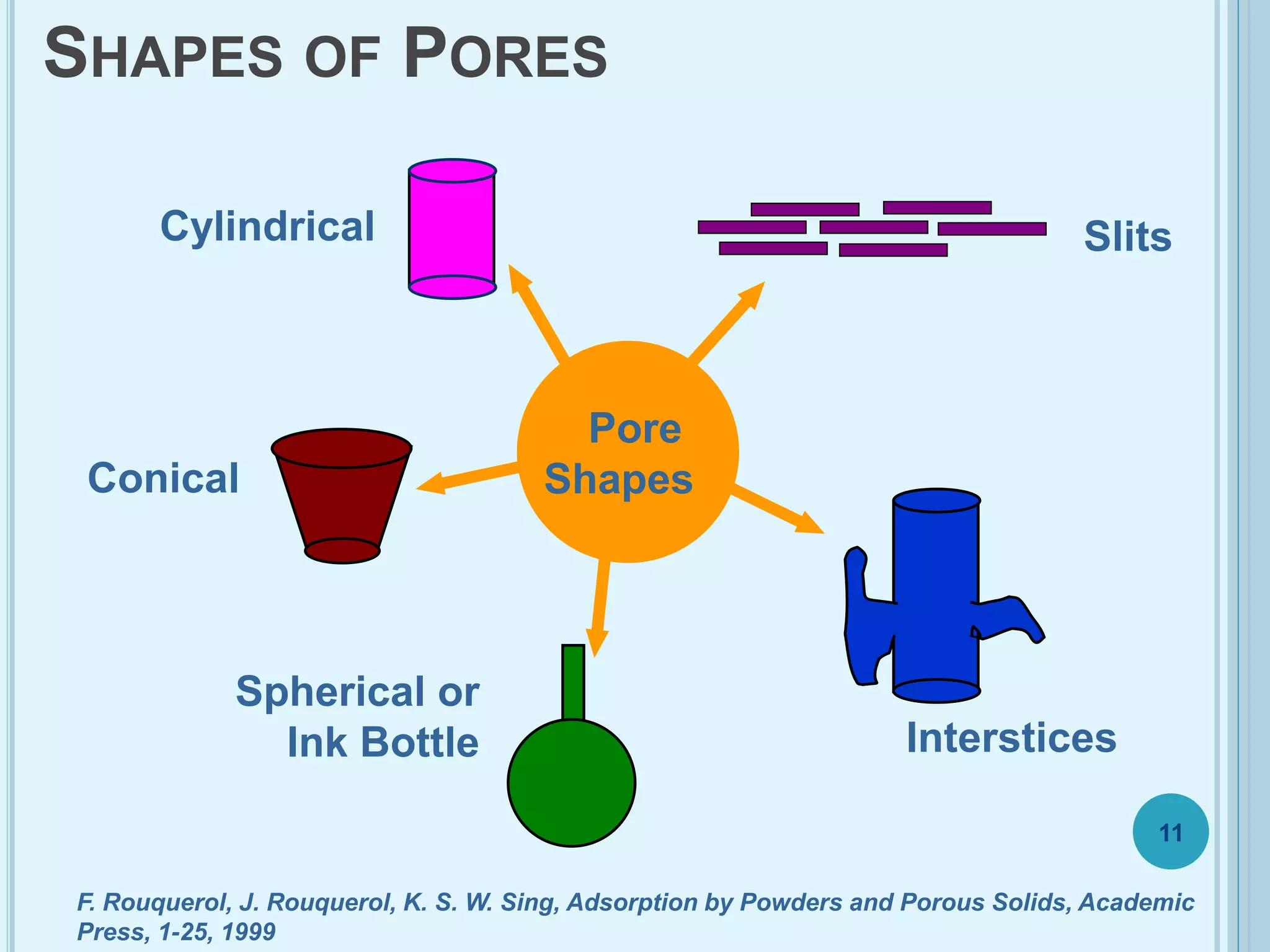
SHAPES OF PORES
Conical
Interstices
SlitsCylindrical
Spherical or
Ink Bottle
Pore
Shapes
F. Rouquerol, J. Rouquerol, K. S. W. Sing, Adsorption by Powders and Porous Solids, Academic
Press, 1-25, 1999
11
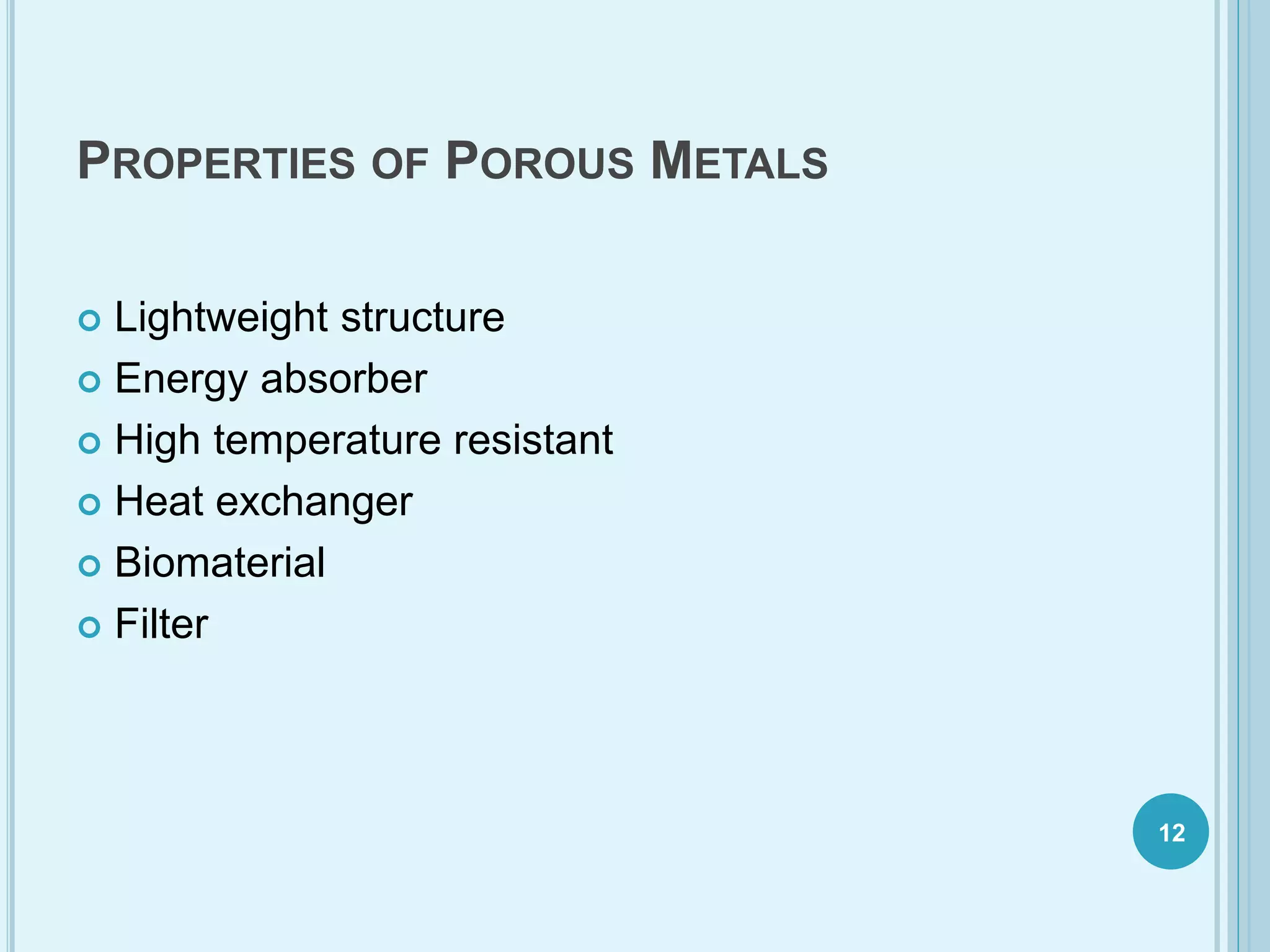
PROPERTIES OF POROUS METALS
 Lightweight structure
 Energy absorber
 High temperature resistant
 Heat exchanger
 Biomaterial
 Filter
12
ADVANTAGES OF FORMING OF POROUS METALS
 Forming to desired shape
 Control of porosity and morphology
 Work hardening of matrix
 Improvements in properties
 Unusual microstructure
 Forming of complicated shapes
13
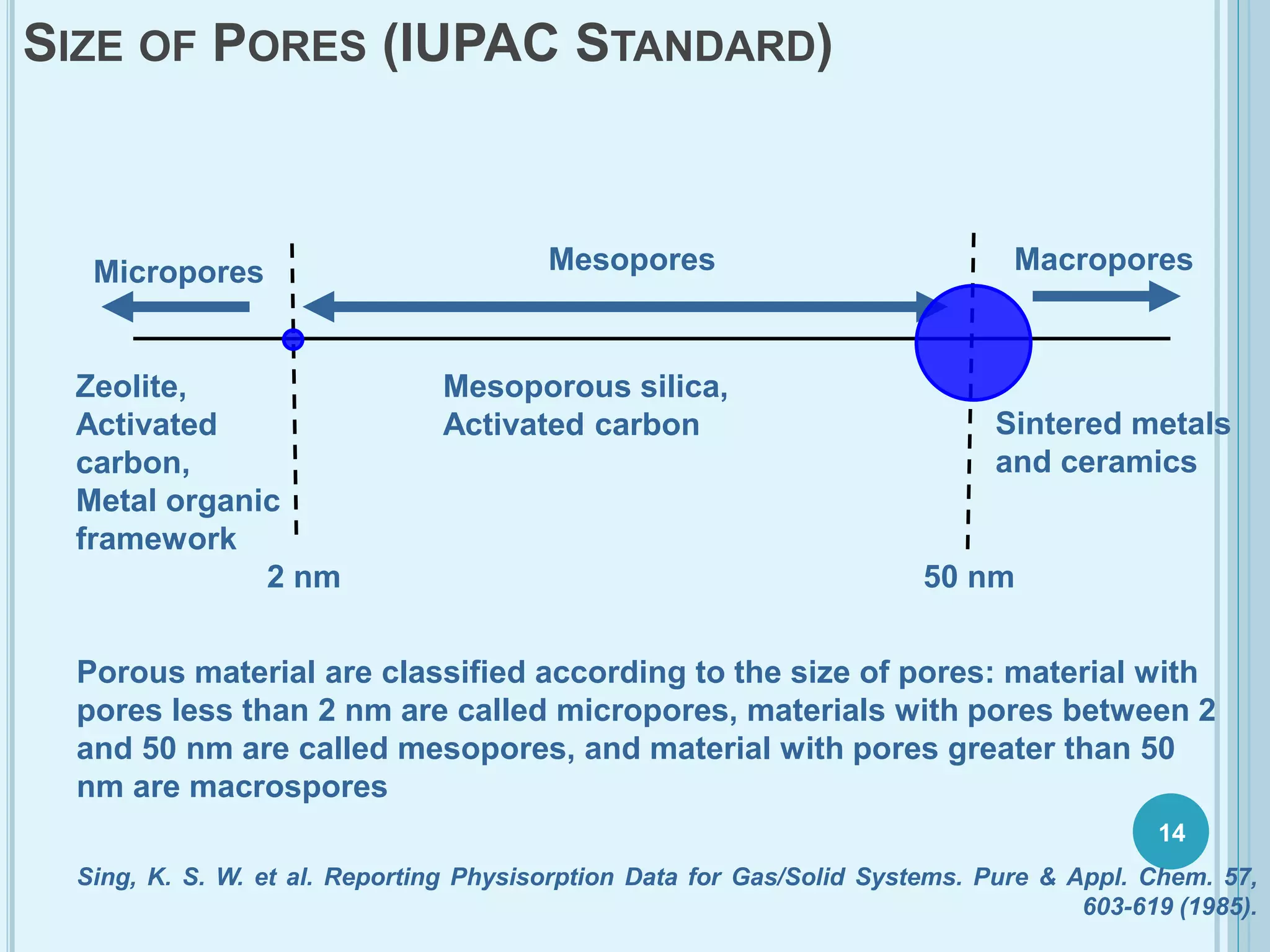
SIZE OF PORES (IUPAC STANDARD)
2 nm 50 nm
Micropores Mesopores Macropores
Zeolite,
Activated
carbon,
Metal organic
framework
Mesoporous silica,
Activated carbon Sintered metals
and ceramics
Porous material are classified according to the size of pores: material with
pores less than 2 nm are called micropores, materials with pores between 2
and 50 nm are called mesopores, and material with pores greater than 50
nm are macrospores
Sing, K. S. W. et al. Reporting Physisorption Data for Gas/Solid Systems. Pure & Appl. Chem. 57,
603-619 (1985).
14
15
16
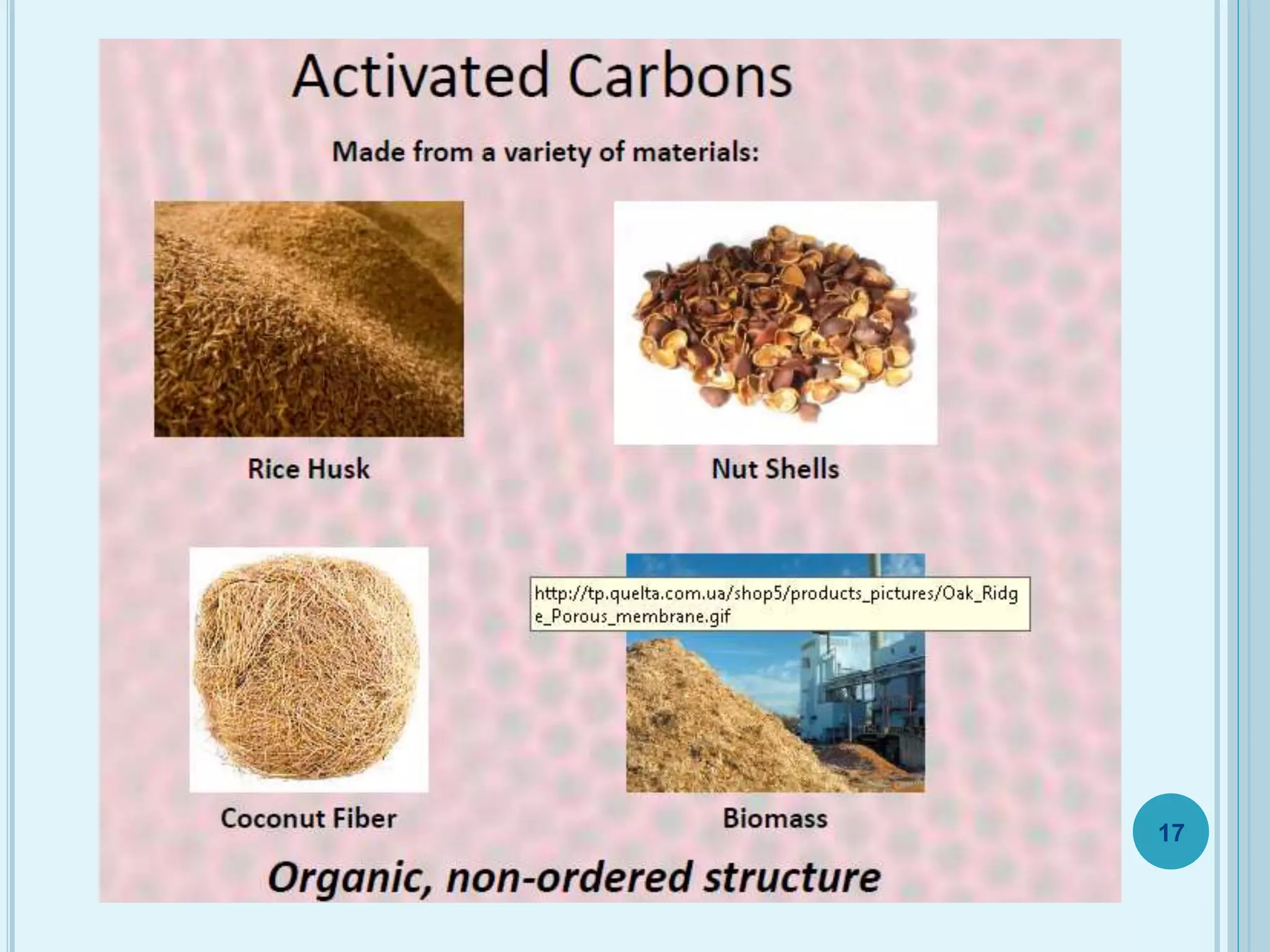
17
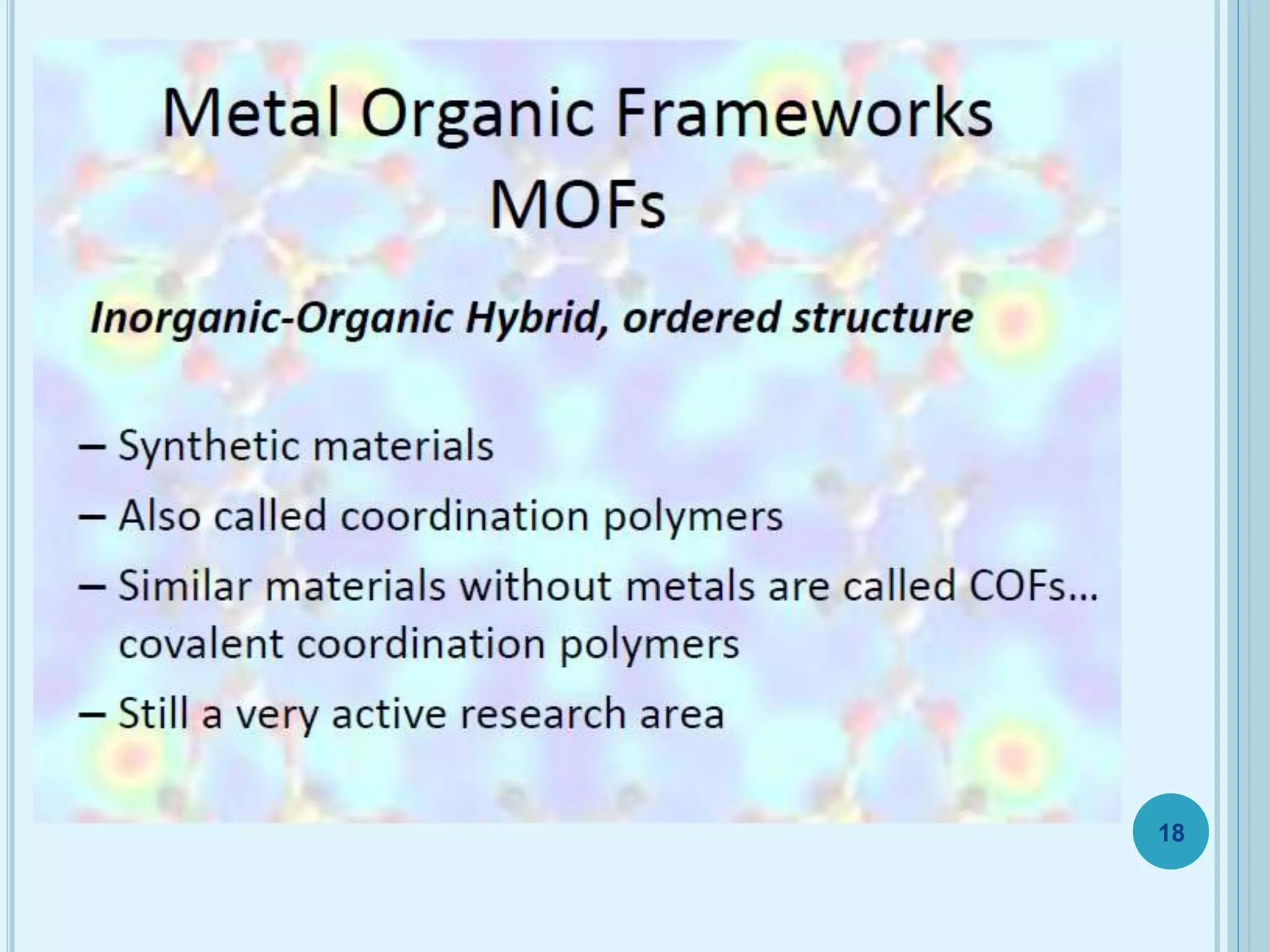
18
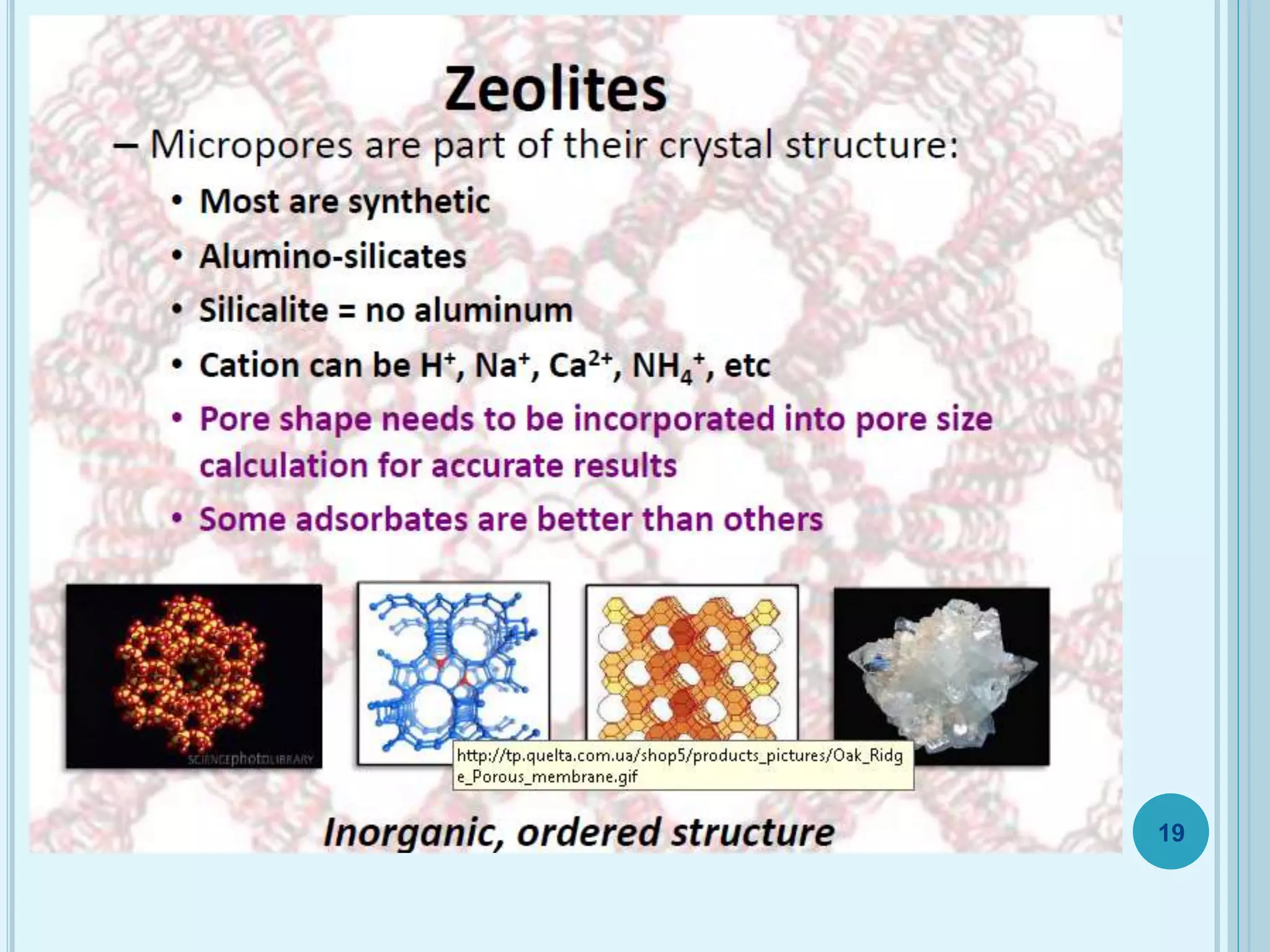
19
20
21
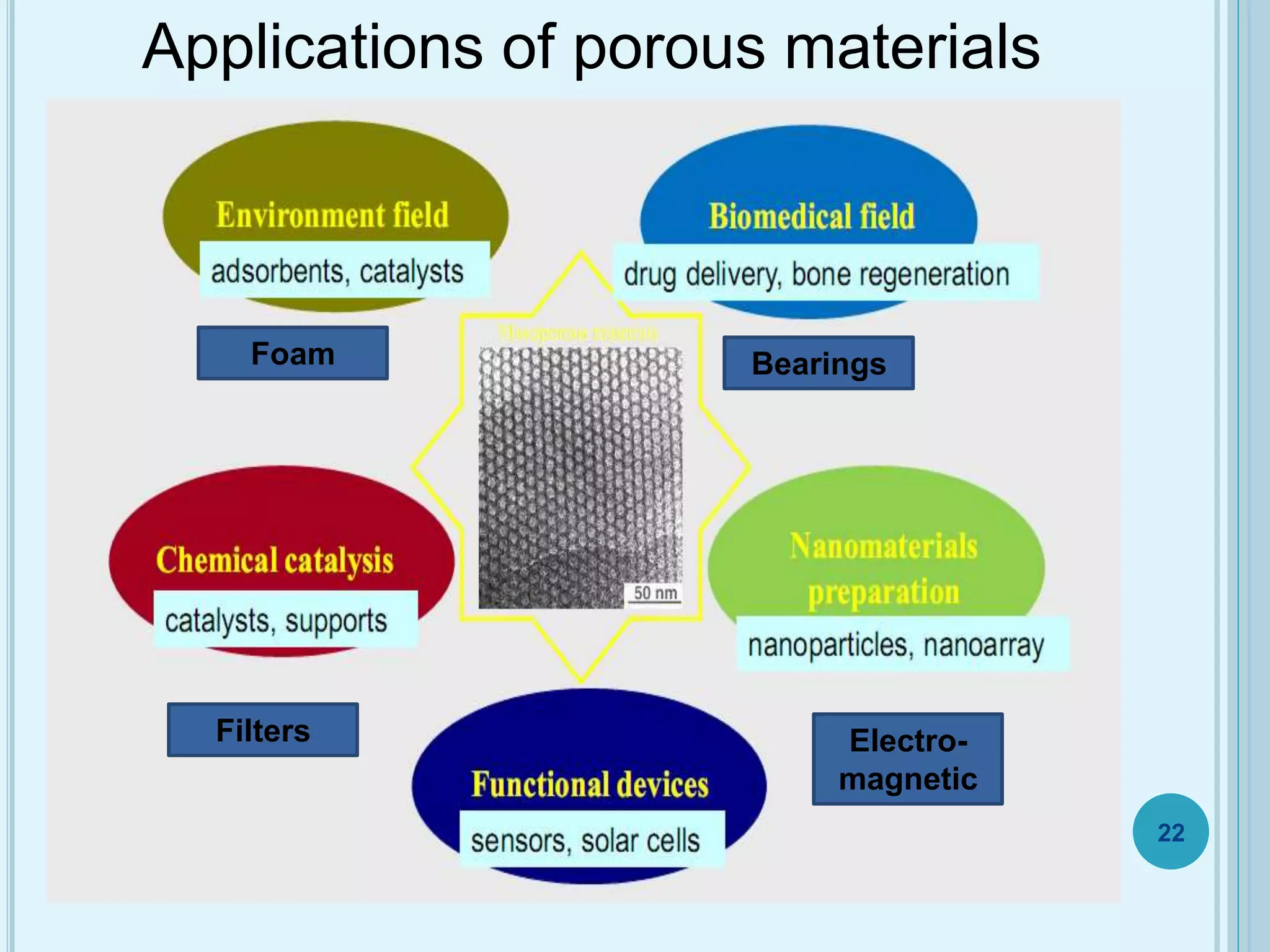
Applications of porous materials
BearingsFoam
Filters Electro-
magnetic
22
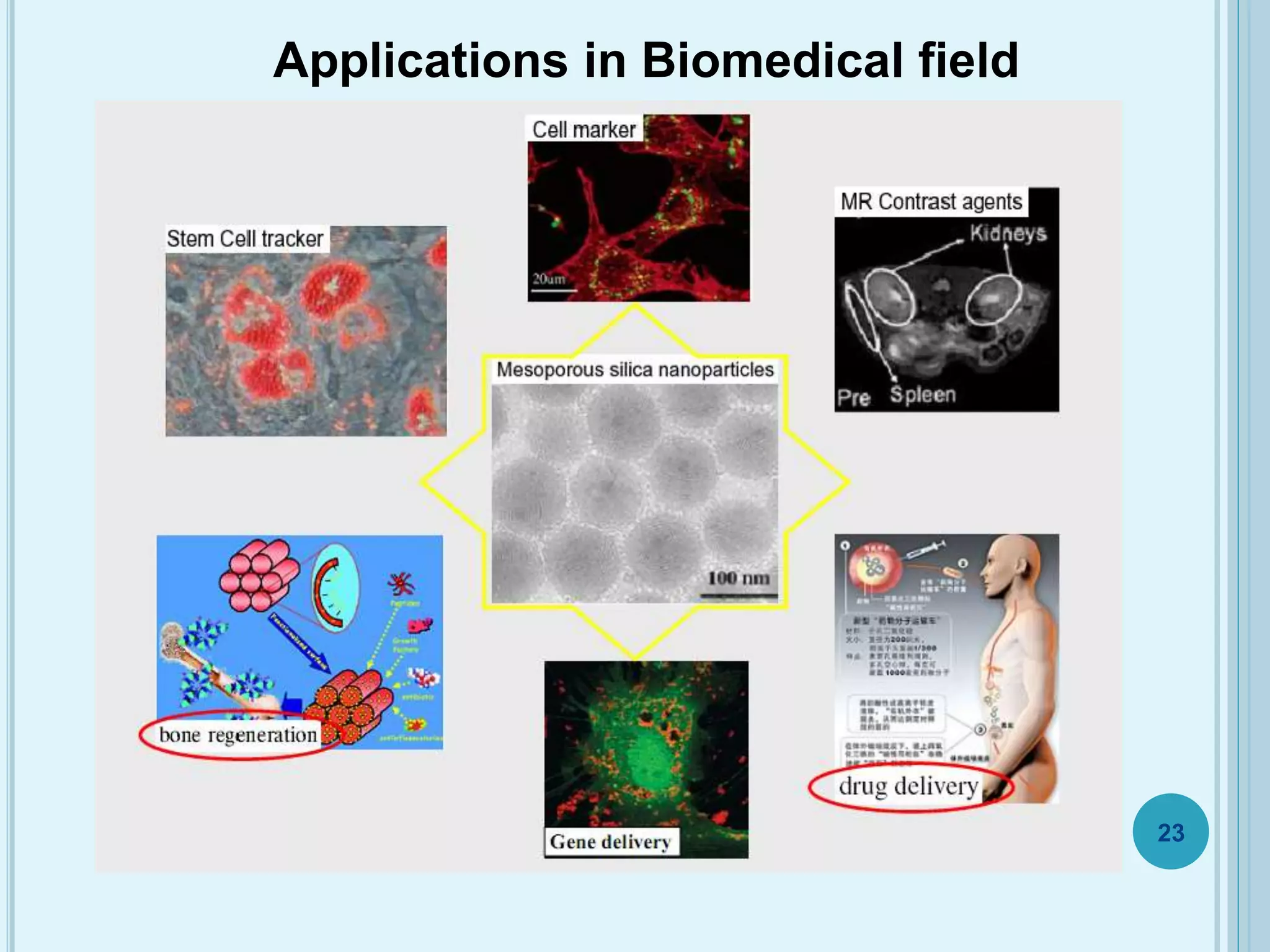
Applications in Biomedical field
23
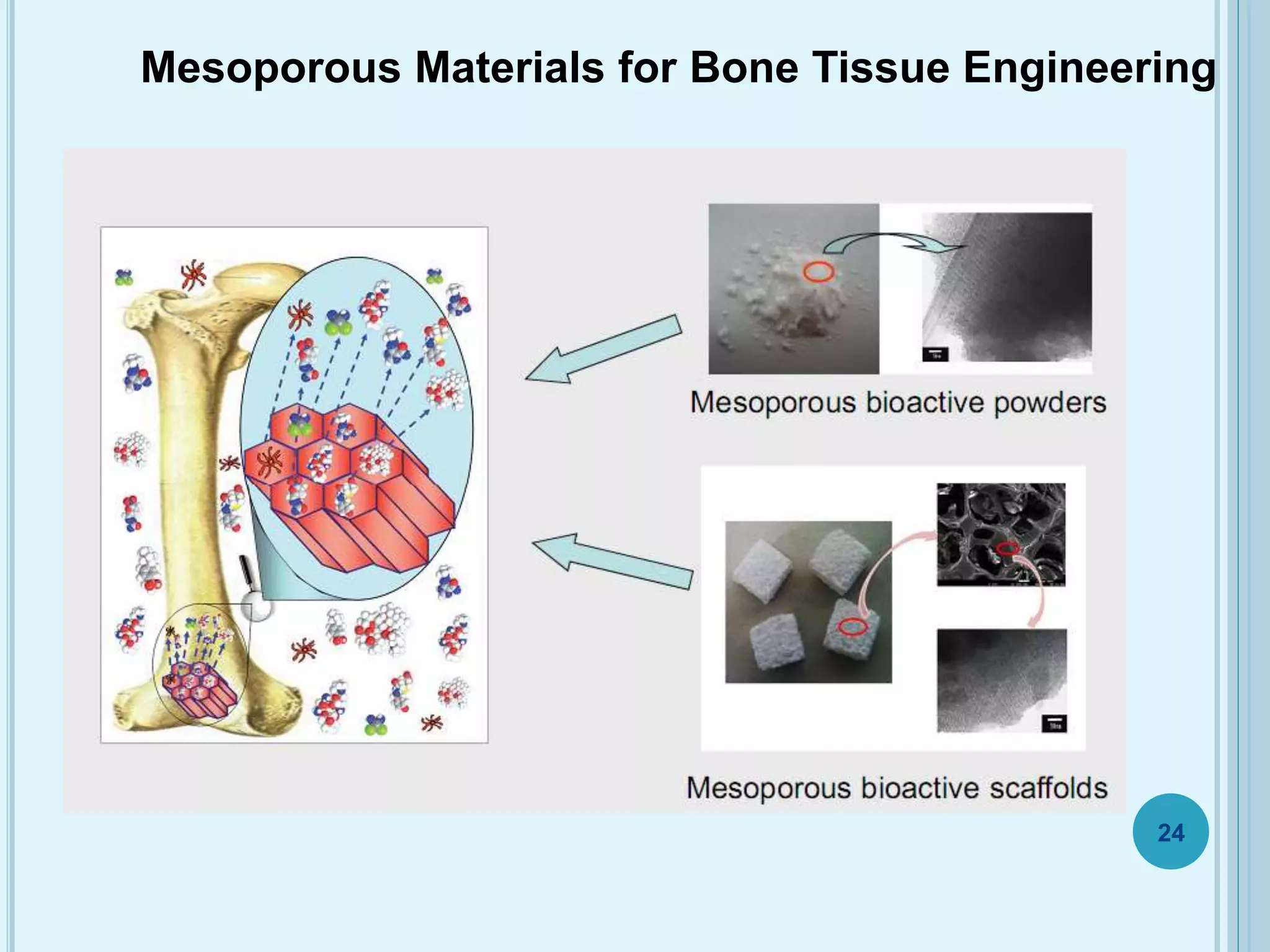
Mesoporous Materials for Bone Tissue Engineering
24
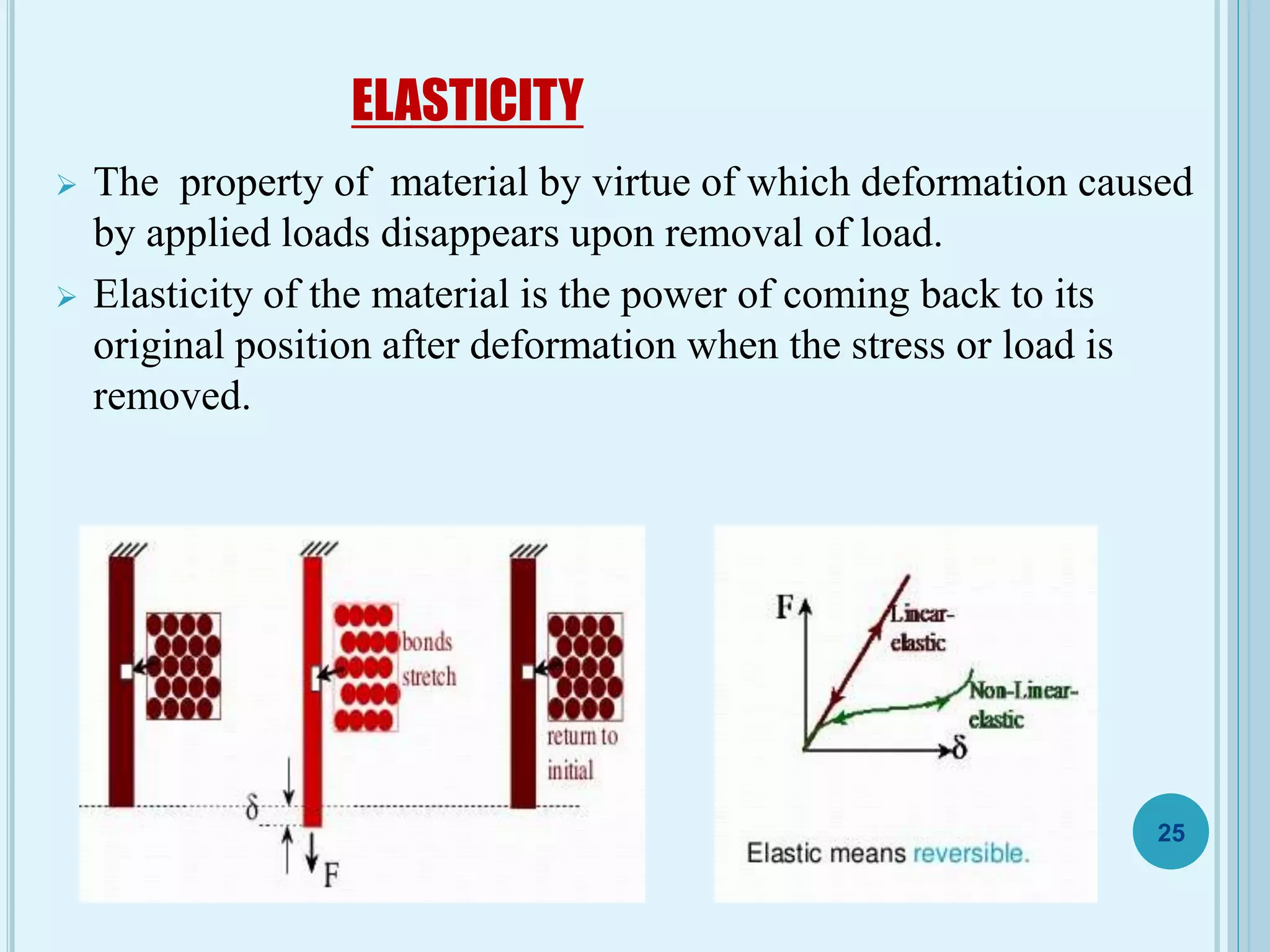
ELASTICITY
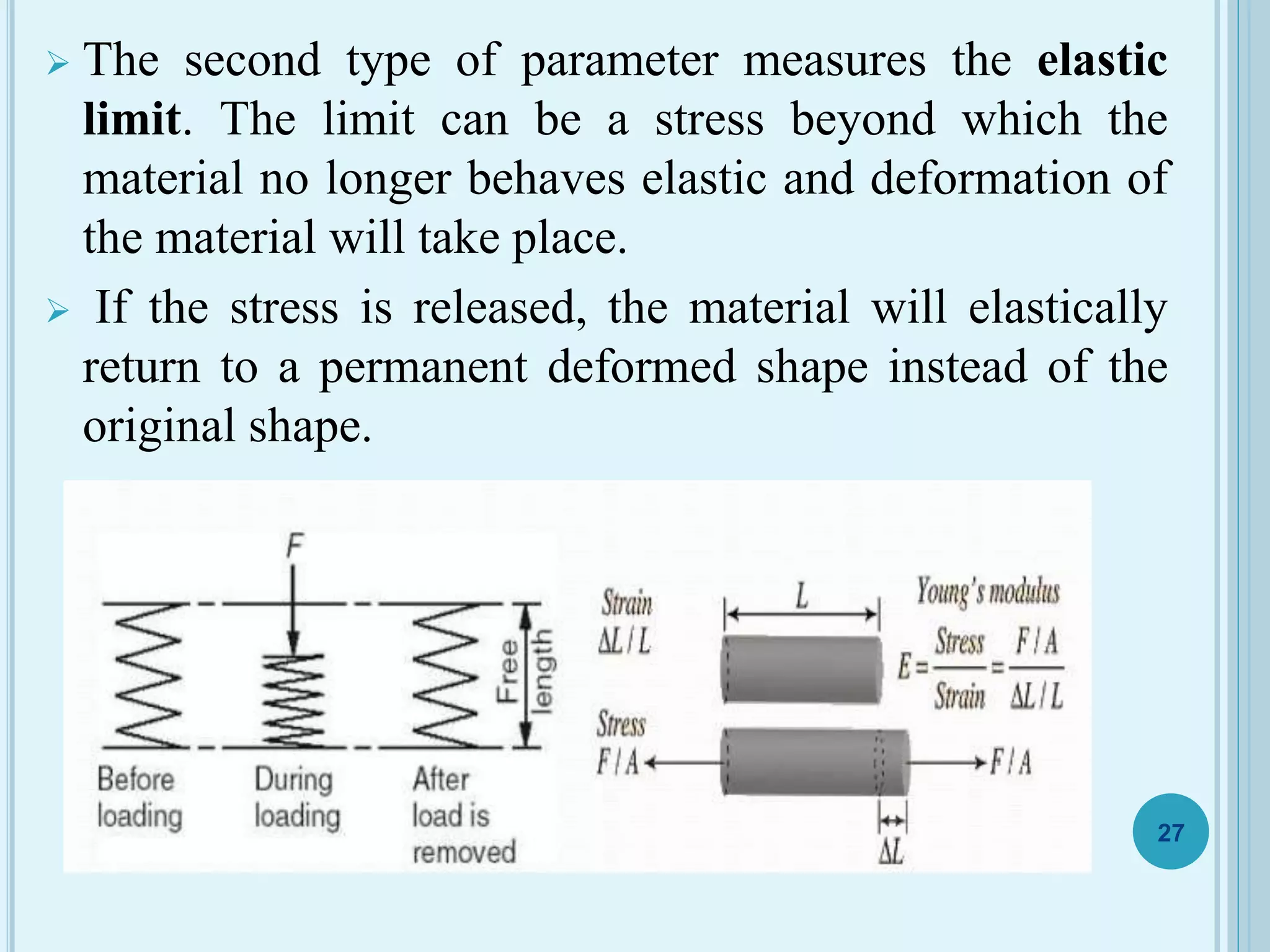
 The property of material by virtue of which deformation caused
by applied loads disappears upon removal of load.
 Elasticity of the material is the power of coming back to its
original position after deformation when the stress or load is
removed.
25
 The physical reasons for elastic behavior can be quite
different for different materials. In metals, the atomic
lattice changes size and shape when forces are applied
(energy is added to the system). When forces are
removed, the lattice goes back to the original lower
energy state.
 In engineering, the amount of elasticity of a material
is determined by two types of material parameter.
 The first type of material parameter is called
a modulus, which measures the amount of force per
unit area (stress) needed to achieve a given amount of
deformation. The units of modulus are pascals (Pa).
 A higher modulus typically indicates that the material
is harder to deform. 26
 The second type of parameter measures the elastic
limit. The limit can be a stress beyond which the
material no longer behaves elastic and deformation of
the material will take place.
 If the stress is released, the material will elastically
return to a permanent deformed shape instead of the
original shape.
27
PLASTICITY:
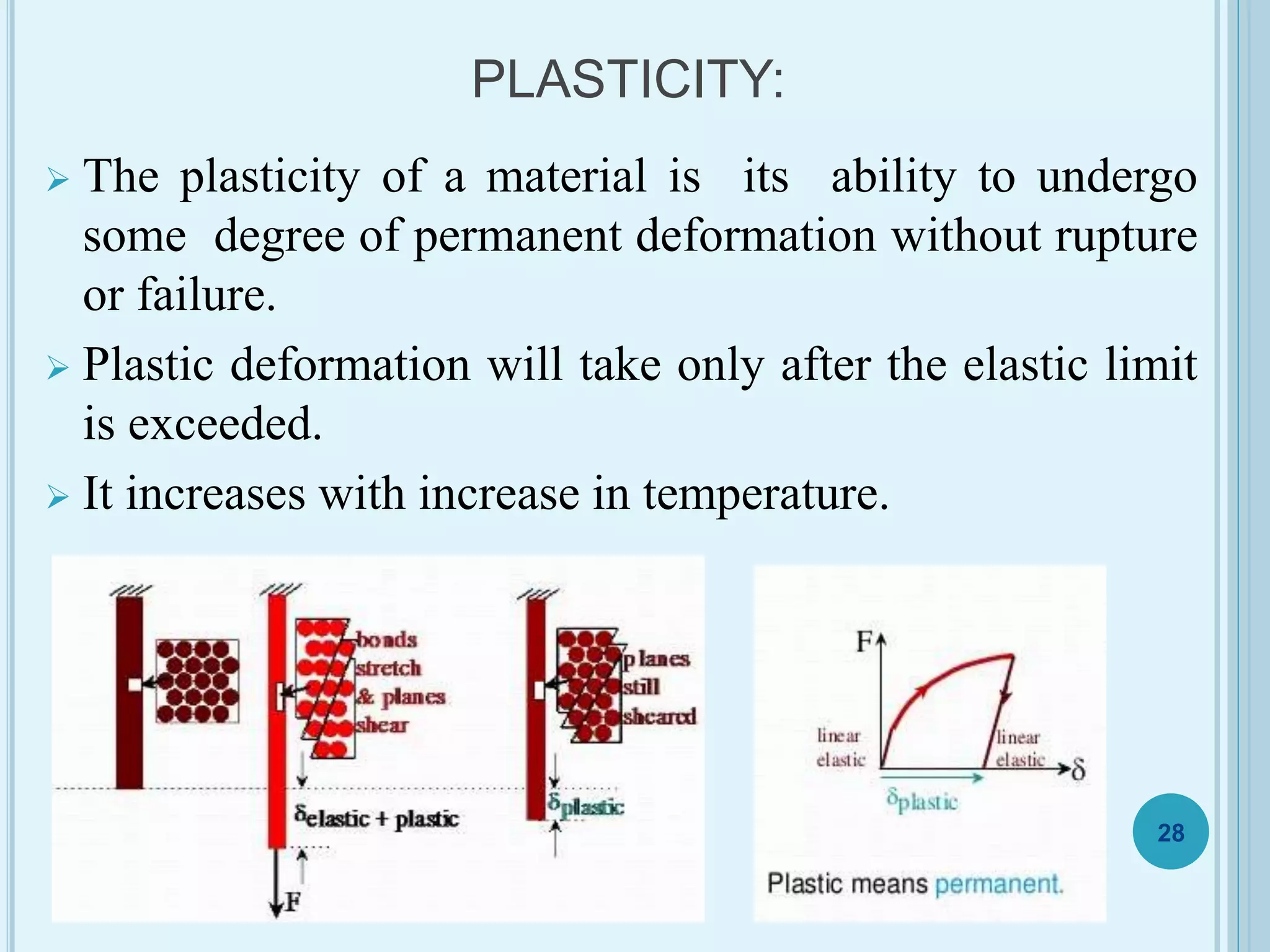
 The plasticity of a material is its ability to undergo
some degree of permanent deformation without rupture
or failure.
 Plastic deformation will take only after the elastic limit
is exceeded.
 It increases with increase in temperature.
28
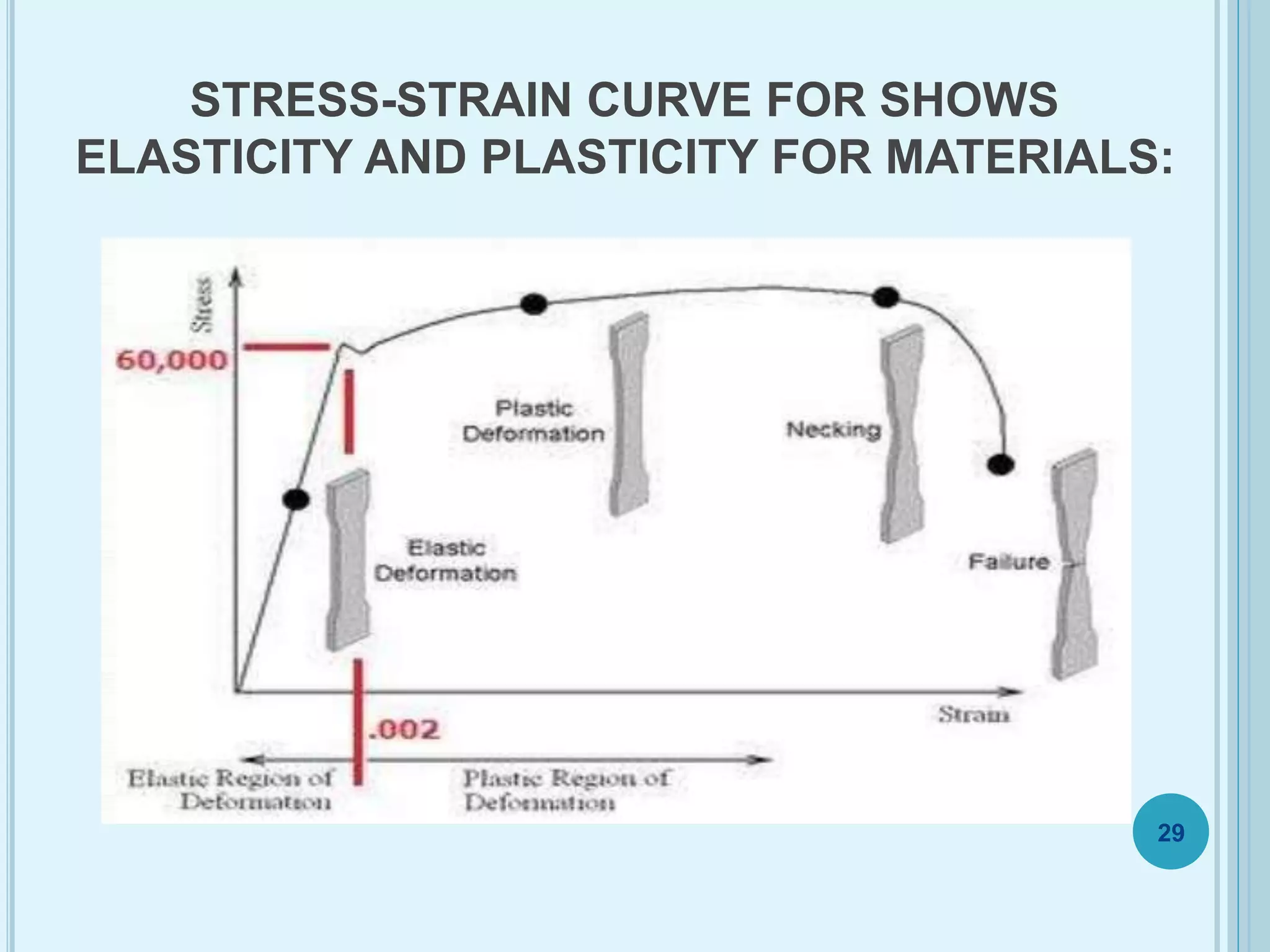
STRESS-STRAIN CURVE FOR SHOWS
ELASTICITY AND PLASTICITY FOR MATERIALS:
29
Porous metal plasticity
– The porous metal plasticity model is intended for
metals with relative densities greater than 90% (i.e.,
a dilute concentration of voids).
– The model is based on Gurson’s porous plasticity
model with void nucleation and failure.
– Inelastic flow is based on a potential function which
characterizes the porosity in terms of a single state
variable—the relative density.
– The model is well-tuned for tensile applications,
such as fracture studies with void coalescence, but
it is also useful for compressive cases where the
material densifies.
– The details of this material model are discussed in
the Metal Inelasticity in ABAQUS lecture notes.
30
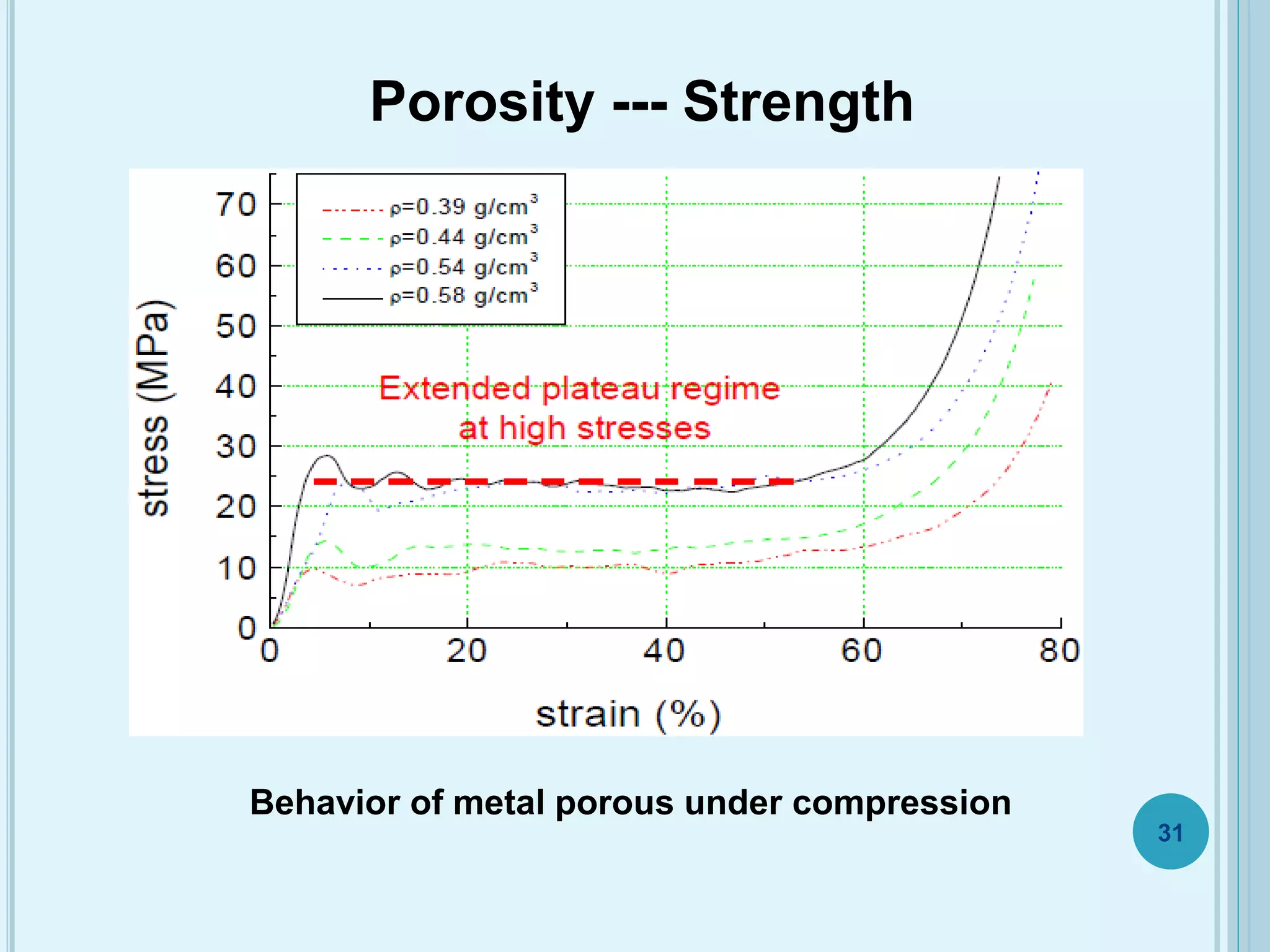
Porosity --- Strength
Behavior of metal porous under compression
31
32
33
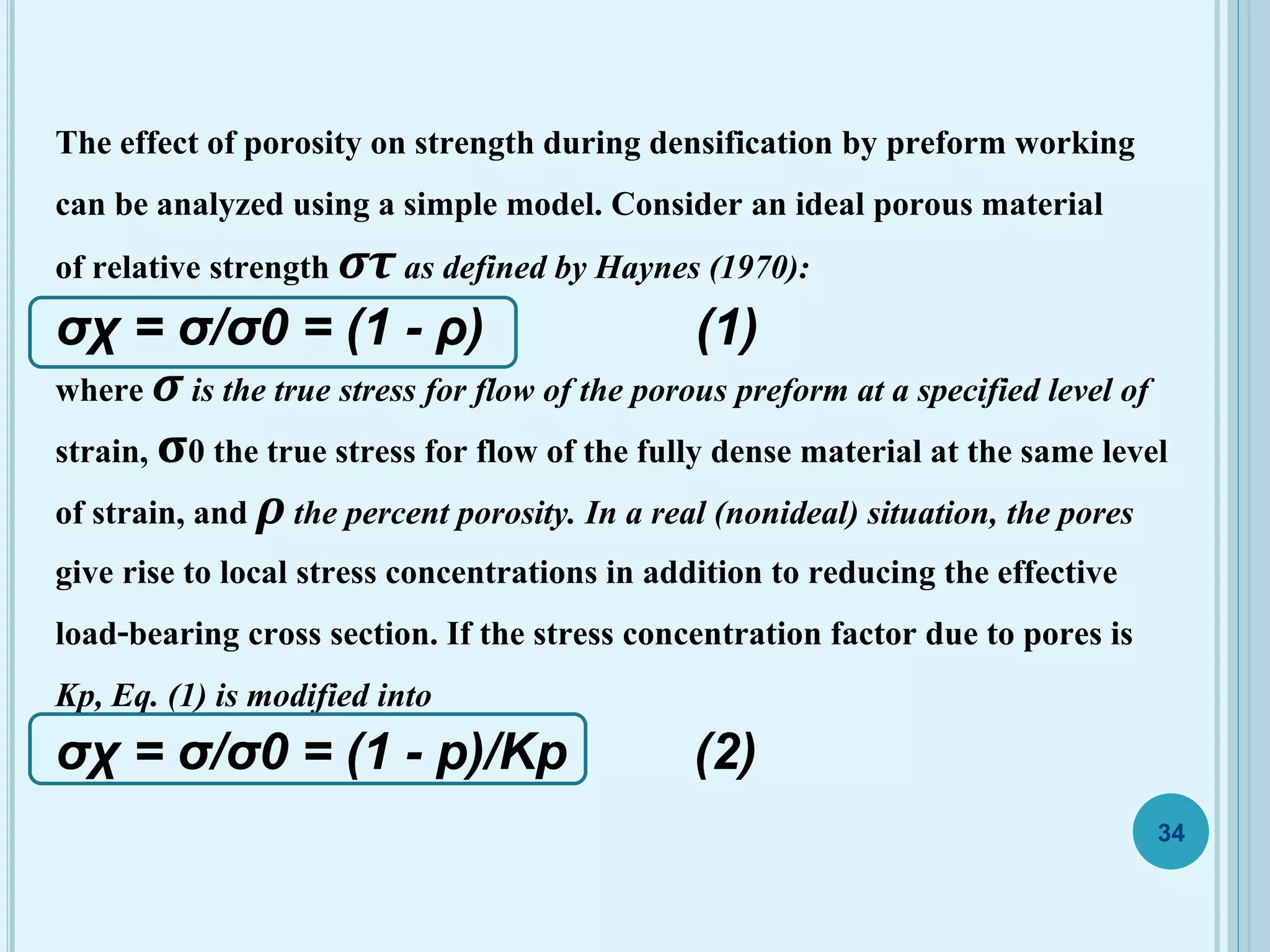
The effect of porosity on strength during densification by preform working
can be analyzed using a simple model. Consider an ideal porous material
of relative strength στ as defined by Haynes (1970):
σχ = σ/σ0 = (1 - ρ) (1)
where σ is the true stress for flow of the porous preform at a specified level of
strain, σ0 the true stress for flow of the fully dense material at the same level
of strain, and ρ the percent porosity. In a real (nonideal) situation, the pores
give rise to local stress concentrations in addition to reducing the effective
load-bearing cross section. If the stress concentration factor due to pores is
Kp, Eq. (1) is modified into
σχ = σ/σ0 = (1 - p)/Kp (2)
34
 II. PLASTİC DEFORMATION OF SINTERED POWDER
METAL
 1.Physical Model
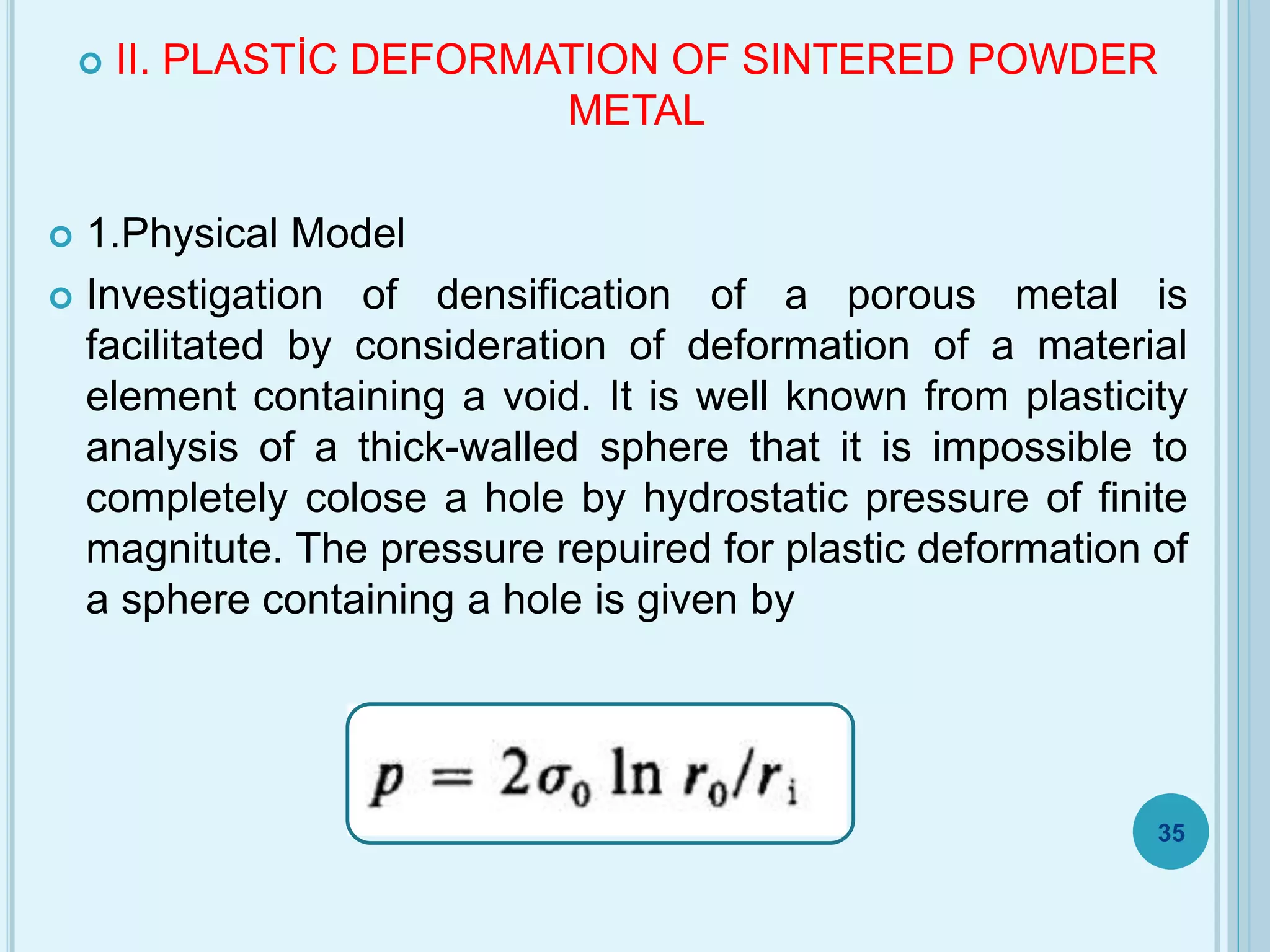
 Investigation of densification of a porous metal is
facilitated by consideration of deformation of a material
element containing a void. It is well known from plasticity
analysis of a thick-walled sphere that it is impossible to
completely colose a hole by hydrostatic pressure of finite
magnitute. The pressure repuired for plastic deformation of
a sphere containing a hole is given by
35
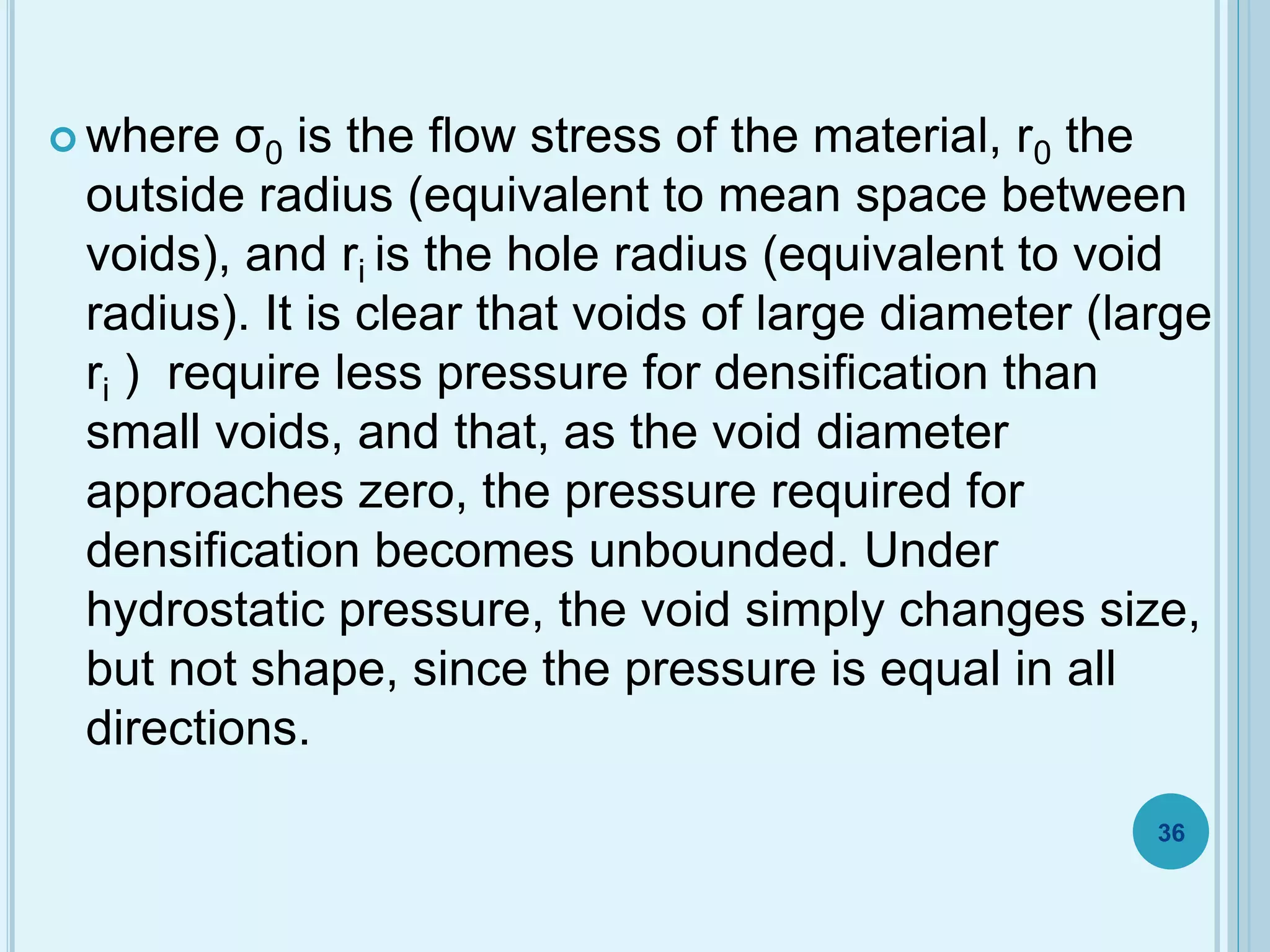
 where σ0 is the flow stress of the material, r0 the
outside radius (equivalent to mean space between
voids), and ri is the hole radius (equivalent to void
radius). It is clear that voids of large diameter (large
ri ) require less pressure for densification than
small voids, and that, as the void diameter
approaches zero, the pressure required for
densification becomes unbounded. Under
hydrostatic pressure, the void simply changes size,
but not shape, since the pressure is equal in all
directions.
36
37
38
000
39
40
THANK YOU FOR
YOUR ATTENTION
41

Plasticity theory related to porous materials

  • 1.
    Plasticity theory relatedto porous materials By Bashar Ridha Younos Al-ogaidi SUBMİTTED TO Assistant Prof. ABDULLAH AKPOLAT 1
  • 2.
  • 3.
    Introduction Research in plasticityof porous materials has, at least, a 40 year history. This research appears to have proceeded in two primary directions: (A) plasticity at small overall strains, in particular, determination of the macroscopic yield surface in stress space, accounting for porosity, in the cases when such a surface can be clearly identified and (B) void growth and coalescence at much larger overall strains 3
  • 4.
  • 5.
    F. Rouquerol, J.Rouquerol, K. S. W. Sing, Adsorption by Powders and Porous Solids, Academic Press, 1-25, 1999 WHAT ARE POROUS MATERIALS? Non-porous solid  Low specific surface area  Low specific pore volume Porous solid  High specific surface area  High specific pore volume Porous materials have highly developed internal surface area that can be used to perform specific function. Almost all solids are porous except for ceramics fired at extremely high temperatures 5
  • 6.
    MEASURE OF POROSITY Poresize and its distribution Specific Surface Area, m2/g = There are three parameters used as a measure of porosity; specific surface area, specific pore volume or porosity, and pore size and its distribution. Mass of the solid, g Total surface area, m2 Specific Pore volume, cm3/g Mass of the solid, g Total pore volume, cm3 = Porosity, % = Volume of solid (including pores) Volume of pores X 100 6
  • 7.
    Parameters that effectedon porousity :- 1- partical size 2- partical shape 3- partical ditripution 7
  • 8.
    PARTICLE SIZE void smaller, morenumerous voids voids filled by smaller particles, small voids remain Mixing particles of different sizes allows decreased porosity and a higher packing ratio 8
  • 9.
    PARTICLE SHAPES INMETAL POWDERS 9 Figure: Particle shapes in metal powders, and the processes by which they are produced. Iron powders are produced by many of these processes.
  • 10.
    CONCEPT OF POROSITY:OPEN VS. CLOSED PORES Dead end (open) Closed Inter-connected (open) Passing (open) F. Rouquerol, J. Rouquerol, K. S. W. Sing, Adsorption by Powders and Porous Solids, Academic Press, 1-25, 1999 Open pores are accessible whereas closed pores are inaccessible pores. Open pores can be inter-connected, passing or dead end. Type of porous 10
  • 11.
    SHAPES OF PORES Conical Interstices SlitsCylindrical Sphericalor Ink Bottle Pore Shapes F. Rouquerol, J. Rouquerol, K. S. W. Sing, Adsorption by Powders and Porous Solids, Academic Press, 1-25, 1999 11
  • 12.
    PROPERTIES OF POROUSMETALS  Lightweight structure  Energy absorber  High temperature resistant  Heat exchanger  Biomaterial  Filter 12
  • 13.
    ADVANTAGES OF FORMINGOF POROUS METALS  Forming to desired shape  Control of porosity and morphology  Work hardening of matrix  Improvements in properties  Unusual microstructure  Forming of complicated shapes 13
  • 14.
    SIZE OF PORES(IUPAC STANDARD) 2 nm 50 nm Micropores Mesopores Macropores Zeolite, Activated carbon, Metal organic framework Mesoporous silica, Activated carbon Sintered metals and ceramics Porous material are classified according to the size of pores: material with pores less than 2 nm are called micropores, materials with pores between 2 and 50 nm are called mesopores, and material with pores greater than 50 nm are macrospores Sing, K. S. W. et al. Reporting Physisorption Data for Gas/Solid Systems. Pure & Appl. Chem. 57, 603-619 (1985). 14
  • 15.
  • 16.
  • 17.
  • 18.
  • 19.
  • 20.
  • 21.
  • 22.
    Applications of porousmaterials BearingsFoam Filters Electro- magnetic 22
  • 23.
  • 24.
    Mesoporous Materials forBone Tissue Engineering 24
  • 25.
    ELASTICITY  The propertyof material by virtue of which deformation caused by applied loads disappears upon removal of load.  Elasticity of the material is the power of coming back to its original position after deformation when the stress or load is removed. 25
  • 26.
     The physicalreasons for elastic behavior can be quite different for different materials. In metals, the atomic lattice changes size and shape when forces are applied (energy is added to the system). When forces are removed, the lattice goes back to the original lower energy state.  In engineering, the amount of elasticity of a material is determined by two types of material parameter.  The first type of material parameter is called a modulus, which measures the amount of force per unit area (stress) needed to achieve a given amount of deformation. The units of modulus are pascals (Pa).  A higher modulus typically indicates that the material is harder to deform. 26
  • 27.
     The secondtype of parameter measures the elastic limit. The limit can be a stress beyond which the material no longer behaves elastic and deformation of the material will take place.  If the stress is released, the material will elastically return to a permanent deformed shape instead of the original shape. 27
  • 28.
    PLASTICITY:  The plasticityof a material is its ability to undergo some degree of permanent deformation without rupture or failure.  Plastic deformation will take only after the elastic limit is exceeded.  It increases with increase in temperature. 28
  • 29.
    STRESS-STRAIN CURVE FORSHOWS ELASTICITY AND PLASTICITY FOR MATERIALS: 29
  • 30.
    Porous metal plasticity –The porous metal plasticity model is intended for metals with relative densities greater than 90% (i.e., a dilute concentration of voids). – The model is based on Gurson’s porous plasticity model with void nucleation and failure. – Inelastic flow is based on a potential function which characterizes the porosity in terms of a single state variable—the relative density. – The model is well-tuned for tensile applications, such as fracture studies with void coalescence, but it is also useful for compressive cases where the material densifies. – The details of this material model are discussed in the Metal Inelasticity in ABAQUS lecture notes. 30
  • 31.
    Porosity --- Strength Behaviorof metal porous under compression 31
  • 32.
  • 33.
  • 34.
    The effect ofporosity on strength during densification by preform working can be analyzed using a simple model. Consider an ideal porous material of relative strength στ as defined by Haynes (1970): σχ = σ/σ0 = (1 - ρ) (1) where σ is the true stress for flow of the porous preform at a specified level of strain, σ0 the true stress for flow of the fully dense material at the same level of strain, and ρ the percent porosity. In a real (nonideal) situation, the pores give rise to local stress concentrations in addition to reducing the effective load-bearing cross section. If the stress concentration factor due to pores is Kp, Eq. (1) is modified into σχ = σ/σ0 = (1 - p)/Kp (2) 34
  • 35.
     II. PLASTİCDEFORMATION OF SINTERED POWDER METAL  1.Physical Model  Investigation of densification of a porous metal is facilitated by consideration of deformation of a material element containing a void. It is well known from plasticity analysis of a thick-walled sphere that it is impossible to completely colose a hole by hydrostatic pressure of finite magnitute. The pressure repuired for plastic deformation of a sphere containing a hole is given by 35
  • 36.
     where σ0is the flow stress of the material, r0 the outside radius (equivalent to mean space between voids), and ri is the hole radius (equivalent to void radius). It is clear that voids of large diameter (large ri ) require less pressure for densification than small voids, and that, as the void diameter approaches zero, the pressure required for densification becomes unbounded. Under hydrostatic pressure, the void simply changes size, but not shape, since the pressure is equal in all directions. 36
  • 37.
  • 38.
  • 39.
  • 40.
  • 41.
    THANK YOU FOR YOURATTENTION 41