Physical Properties
of dental materials
2nd Year theory
Thermal properties
Coefficient of thermal expansion
Thermal diffusivity
Thermal conductivity
Denture bases in contact with mucosal sufaces
Prevent thermal shock and trauma
Deep cavities
Thermal conductivity
Physical property that governs
heat transfer through a
material by conductive flow
Second law of thermodynamics
– higher temperature to lower
temperature
• Conductors
• Insulators
Thermal diffusivity
Measure of speed with
which a temperature
change will spread
through an object when
one surface is heated
Enamel and dentin –
effective thermal
insulators
Coefficient of thermal expansion
Change in length per unit of the
original length of a material when the
temperature is increased by 1 degree
Marginal microleakage or debond
Coefficient of thermal expansion
Inlay wax
Denture
teeth
Metal
ceramic
restorations
Porcelain
veneer
Electrochemical properties
Tarnish
and
corrosion
Surface
discoloration
on a metal
Slight loss or
alteration of
the suface
finish line or
luster
Oxides,
sulfides or
chlorides
Corrosion
Deterioration of
metal reaction
with its
environment
Severe and
catastrophic
disintegration
Mechanical
failure of a
structure
Phosphoric acid,
acetic acid lactic
acid
Fundamental basis of corrosion
Chemical
Electrochemical
process
First step – loss
of an electron
Chemical corrosion
Direct
combination
of metallic
and
nonmetallic
elements
Formation of
silver sulfide
Dental gold
alloys
containing
silver – dry
corrosion
Dental
amalgam
Electrochemical mechanism of
corrosion
Oxidation potential
Electrochemical cell –
anode, cathode,
electrolyte
Anode – amalgam
Cathode – gold alloy
Saliva – electrolyte
Anode –
positive ions
are formed
Cathode –
metal ions
are deposited
Electomotive
force
Electro motive or
galvanic series
More positive
potential – lower
tendency to dissolve
Dissimilar metals
Combinations
of dissimilar
metals –
direct physical
contact
Flow of
galvanic
currents –
continuous or
intermittent
Eg: Dental
amalgam
opposing gold
alloy
Sharp pain –
galvanic shock
Heterogenous surface composition
Nominally
pure metals
corrode slow
Impurities in
alloys
Solder joints
Homogenized
solid solution
Commercial
dental alloys
Dissimilar metals
Dental
amalgam
Opposing
gold inlay
Stress corrosion
Imposition of
stresses
increase the
internal
energy
Fatigue
or cyclic
loading
Cold
working
of an
alloy
Concentration cell corrosion
Variations in
electrolytes
Polishing –
prevent pitting
corrosion
Crevice
corrosion
Protection against corrosion
Coatings to
provide
corrosion
protection
Chromium
passivating
metal
Electroplated
with nickel
followed by
chromium
Titanium –
titanium
oxide film
Clinical significance of galvanic
currents
Varnish coating
on the surface
of metallic
restoration
Discomfort to
the patient
Electro
galvanism
Mechanical properties of dental
materials
Defined by the laws of mechanics –
physical science dealing with forces
that act on bodies and the resultant
motion, deformation or stresses
Mechanical properties
Brittleness
Compressive
strength
Ductlity
Elastic
modulus
Flexural
strength
Fracture
toughness
Mechanical properties
Hardness
Impact strength
Malleability
Percentage elongation
Proportional limit
Shear strenght
Tensile strength
Yield strength
Stresses and strains
Stress distribution
or stress gradient
Stress – force per
unit area
Tensile stress
Shear stress
Compressive
stress
Newtons third law of motion
External force
acts on a solid
Equal in
magnitude but
opposite in
direction
External force
or pressure
Deformation or
strain occurs
Strain
Change in length per
unit length
Relative deformation of
an object subjected to a
stress
• Elastic
• Plastic
• Elastic and plastic
• Viscoelastic
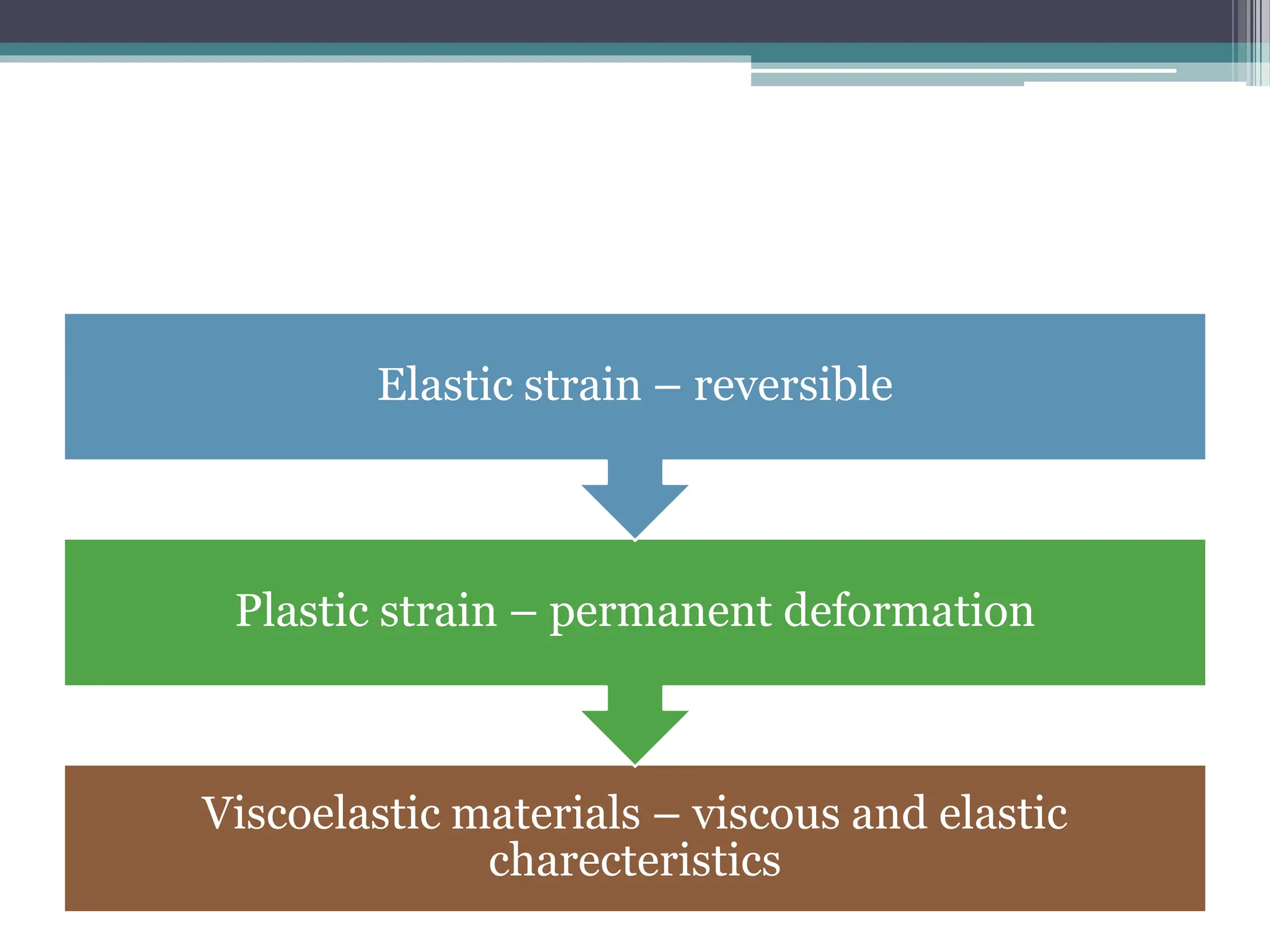
Viscoelastic materials – viscous and elastic
charecteristics
Plastic strain – permanent deformation
Elastic strain – reversible
Stress
Magnitude
and the type of
deformation
Simple
stresses
Tensile Compressive Shear
Tensile stress
Tensile strain – stretch or
elongate a body
• Deformation of a bridge
• Bending force
Compressive stress
Compress
Internal
resistance
Compressive
stress
Applied force
Cross
sectional
area
Shear stress
Resist the sliding
or twisting of one
portion of a body
over another
Twisting or
torsional action
• Rough curved
surfaces
• Chamfer or bevel
• Tensile failure is
more likely
Flexural stress- bending stress
Three unit FPD Two unit cantilever FPD
• Three point loading
• Load along the unsupported
section
Elastic properties
Elastic
modulus
Shear
modulus
Flexibility Resilience
Poisson’s
ratio
Elastic modulus –Young’s modulus or
modulus of elasticity
Stiffness or rigidity of a
material
Stiffness Increased by
increasing the thickness
–elastic modulus does
not change
Elastic modulus
Constant value that describes a materials relative stiffness as
determined from a stress strain graph, which compensates
for differences in cross sectional area and length by plotting
force per unit area by the relative change in dimension,
usually length, relative to its initial value.
Proportional limit,
elastic modulus,
ultimate
compressive
strength of enamel
are greater than
dentin
Unsupported
enamel is
susceptible to
fracture
Dentin – flexible
and tougher
Elastic modulus
Elastic modulus constant
• Unaffected by elastic or plastic stresses
• Independent of the ductility
• Not a measure of plasticity or strength
• High elastic modulus – low or high strength
Polyether
material –
greater
stiffness
Lower the
strain –
greater the
modulus
Ratio of
elastic stress
to strain
Dynamic Young’s modulus
Dynamic &
static
Velocity of
sound wave
and density
of material –
elastic
modulus and
Poisson’s
ratio
Flexibility
High value of elastic limit
High modulus of elasticity is desirable –
inlay or impression material
Maximum flexibility – flexural strain
that occurs
Material is stressed to its proptional
limit
Resilience
Interatomic
space
increases –
internal
energy
increses
Stress is not
greater than
the
proportional
limit –
resilience
Resilience
Amount of energy absorbed within a unit
volume of a structure when it is stressed to
its proportional limit
Poisson’s ratio
Tensile force
– longer and
thinner
Compressive
force- shorter
and thicker
Ratio is 0.5 –
0.25 and
0.30
Strength properties
Strength is equal to the degree of stress necessary to cause
either fracture or a specified amount of plastic deformation
• Proportional limit
• Elastic limit
• Yield strength
• Ultimate tensile strength, shear strength, compressive strength
Proportional limit
It represents the
maximum stress
above which stress
is no longer
proportional to
strain
Elastic limit
Defined as the greatest stress to which
the material can be subjected such that it
returns to it original dimension when the
force is released
Yield strength
Proportional limit cannot
be determined
Represents stress value at
which small amount of
plastic strain has occurred
Permanent(Plastic)deformation
The object does not return to its original
dimension when the force is removed
• Bent
• Stretched
• Compressed
• Plastically deformed
Cold working(Strain hardening or work
hardening)
Repeated plastic deformation
– embrittlement of the
deformed area of the wire
Deform in small increments
Diametral tensile strength
Tensile
loading
Diametral
compression
test
Flexural strength
Transverse strength and
modulus of rupture – strength
test of a bar supported at each
end
Biaxial flexural strength
Determined by subjecting a material to a cyclic stress of a maximum
known value and determining the no of cycles required to cause fracture
Fatigue failure – microscopic flaws
Biaxial flexural strength
Impact strength
Energy required to
fracture a material
under an impact
force
Reaction of a
stationary object
in collision with a
moving object
Toughness
Amount of elastic and
plastic deformation
energy required to
fracture a material
Measure of energy
required to propagate
critical flaws
Brittleness
Relative inability of the
material to sustain plastic
deformation before fracture
of material
Ductility
Ability of a material to sustain
a large permanent
deformation under a tensile
load upto the point of fracture
Metal – long thin
wire
Malleability
Gold– most ductile and
malleable pure metal
Silver – second
Platinum – third in
ductility
Copper – third in
malleability
Tests used for ductility
Percentage
elongation after
fracture
The reduction in
area of tensile test
specimens
The maximum no
of bends
performed in a
cold bend test
Hardness
Resistance to indentation
Related properties- Compressive strength,
proportional limit and ductility
Hardness
Ability of the surface of the material to resist penetration by a diamond point
or steel ball under a specific load
• Barcol
• Brinell
• Rockwell
• Shore
• Vickers
• Knoop
Brinell hardness test
Used extensively
Proportional limit
and ultimate
tensile strength of
dental gold alloys
Oldest tests
Rockwell hardness
test similar to Brinell
test
• Steel ball
Vickers hardness test
– same principle
used in brinell
• Square based pyramid
Knoop hardness test
Diamond tipped tool
Impression rhombic
Knoop and vickers –
microhardness test
Shapes of hardness indenter points
Properties of dental materials- Physical .pptx

Properties of dental materials- Physical .pptx