A Method for Purging and
                            Cleaning a Screw and Barrel
                                               By
                                    Timothy W. Womer, CTO
                                       Xaloy, Incorporated


Introduction
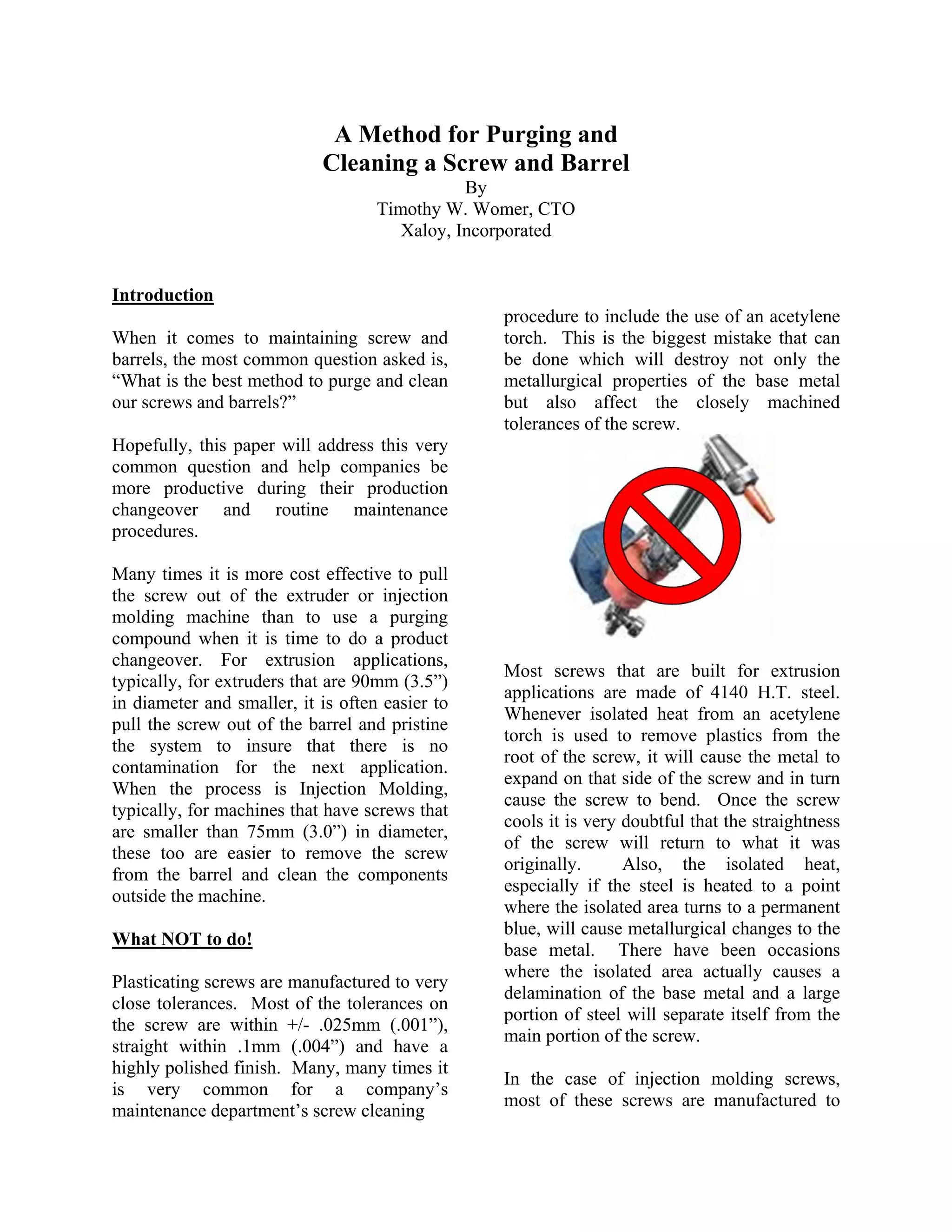
                                                  procedure to include the use of an acetylene
When it comes to maintaining screw and            torch. This is the biggest mistake that can
barrels, the most common question asked is,       be done which will destroy not only the
“What is the best method to purge and clean       metallurgical properties of the base metal
our screws and barrels?”                          but also affect the closely machined
                                                  tolerances of the screw.
Hopefully, this paper will address this very
common question and help companies be
more productive during their production
changeover and routine maintenance
procedures.

Many times it is more cost effective to pull
the screw out of the extruder or injection
molding machine than to use a purging
compound when it is time to do a product
changeover. For extrusion applications,
                                                  Most screws that are built for extrusion
typically, for extruders that are 90mm (3.5”)
                                                  applications are made of 4140 H.T. steel.
in diameter and smaller, it is often easier to
                                                  Whenever isolated heat from an acetylene
pull the screw out of the barrel and pristine
                                                  torch is used to remove plastics from the
the system to insure that there is no
                                                  root of the screw, it will cause the metal to
contamination for the next application.
                                                  expand on that side of the screw and in turn
When the process is Injection Molding,
                                                  cause the screw to bend. Once the screw
typically, for machines that have screws that
                                                  cools it is very doubtful that the straightness
are smaller than 75mm (3.0”) in diameter,
                                                  of the screw will return to what it was
these too are easier to remove the screw
                                                  originally.      Also, the isolated heat,
from the barrel and clean the components
                                                  especially if the steel is heated to a point
outside the machine.
                                                  where the isolated area turns to a permanent
                                                  blue, will cause metallurgical changes to the
What NOT to do!
                                                  base metal. There have been occasions
                                                  where the isolated area actually causes a
Plasticating screws are manufactured to very
                                                  delamination of the base metal and a large
close tolerances. Most of the tolerances on
                                                  portion of steel will separate itself from the
the screw are within +/- .025mm (.001”),
                                                  main portion of the screw.
straight within .1mm (.004”) and have a
highly polished finish. Many, many times it
                                                  In the case of injection molding screws,
is very common for a company’s
                                                  most of these screws are manufactured to
maintenance department’s screw cleaning
withstand abrasive wear from the resins that      system. For example, on a 50mm (2”)
are being processed. The types of steels          diameter screw it will require about 5 kg (10
used to combat the abrasive wear are              lb) of material, and on a 90mm (3.5”)
typically various types of tool steels. During    diameter screw it may require 15kg (33 lb)
the manufacturing stages of building tool         of HDPE material.
steel screws, the base metal has to be heat
treated to increase the hardness of the steel.
If isolated heat from an acetylene torch is
used to remove plastic from the root of the
screw, it will definitely anneal the base
metal and reduce the wear resistance in that
area of the screw. Also, annealing the tool
steel with the use of isolated heat will reduce
the yield strength of the steel, and this will
increase the likelihood of screw breakage
due to torque.         Therefore, the basic
statement here is:
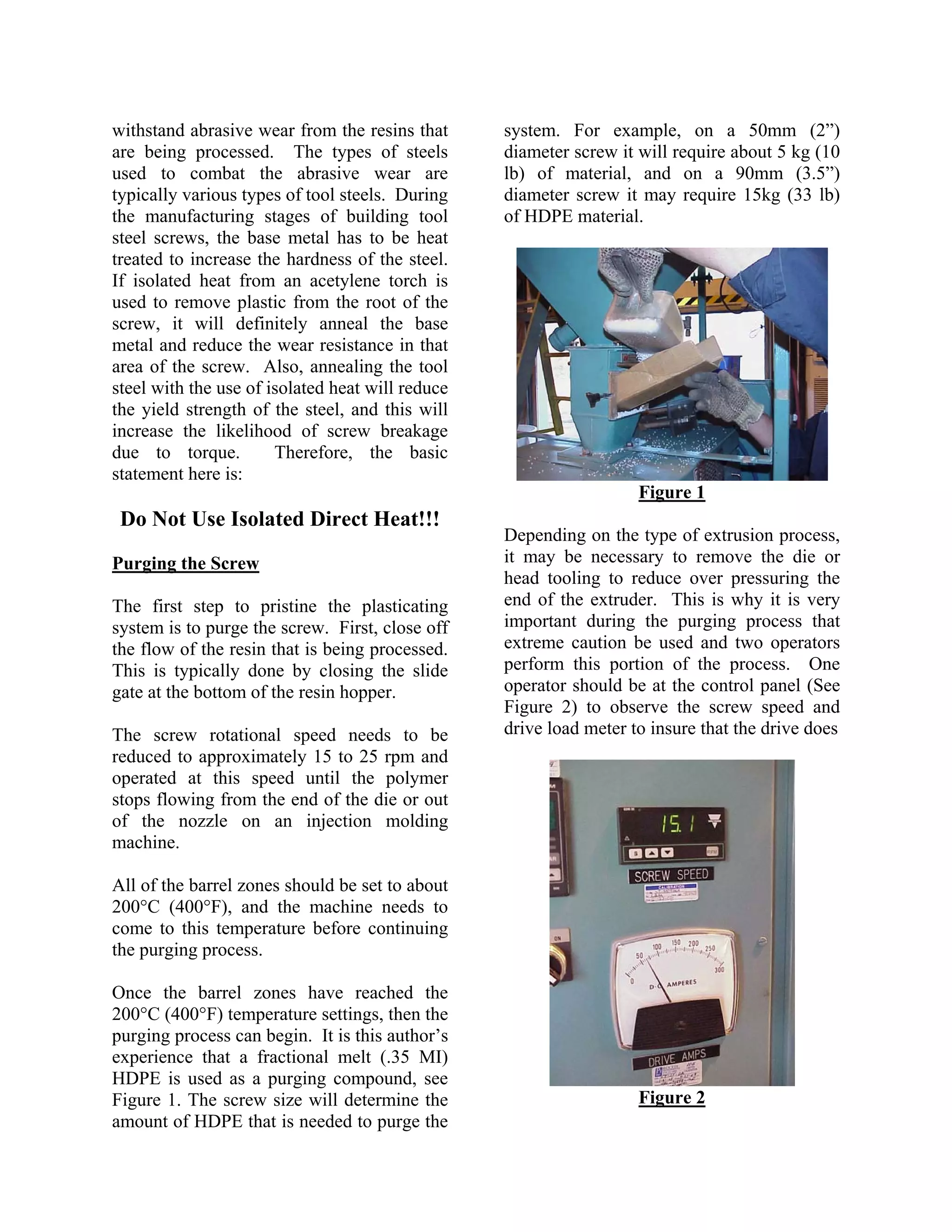
                                                                    Figure 1
 Do Not Use Isolated Direct Heat!!!
                                                  Depending on the type of extrusion process,
Purging the Screw                                 it may be necessary to remove the die or
                                                  head tooling to reduce over pressuring the
The first step to pristine the plasticating       end of the extruder. This is why it is very
system is to purge the screw. First, close off    important during the purging process that
the flow of the resin that is being processed.    extreme caution be used and two operators
This is typically done by closing the slide       perform this portion of the process. One
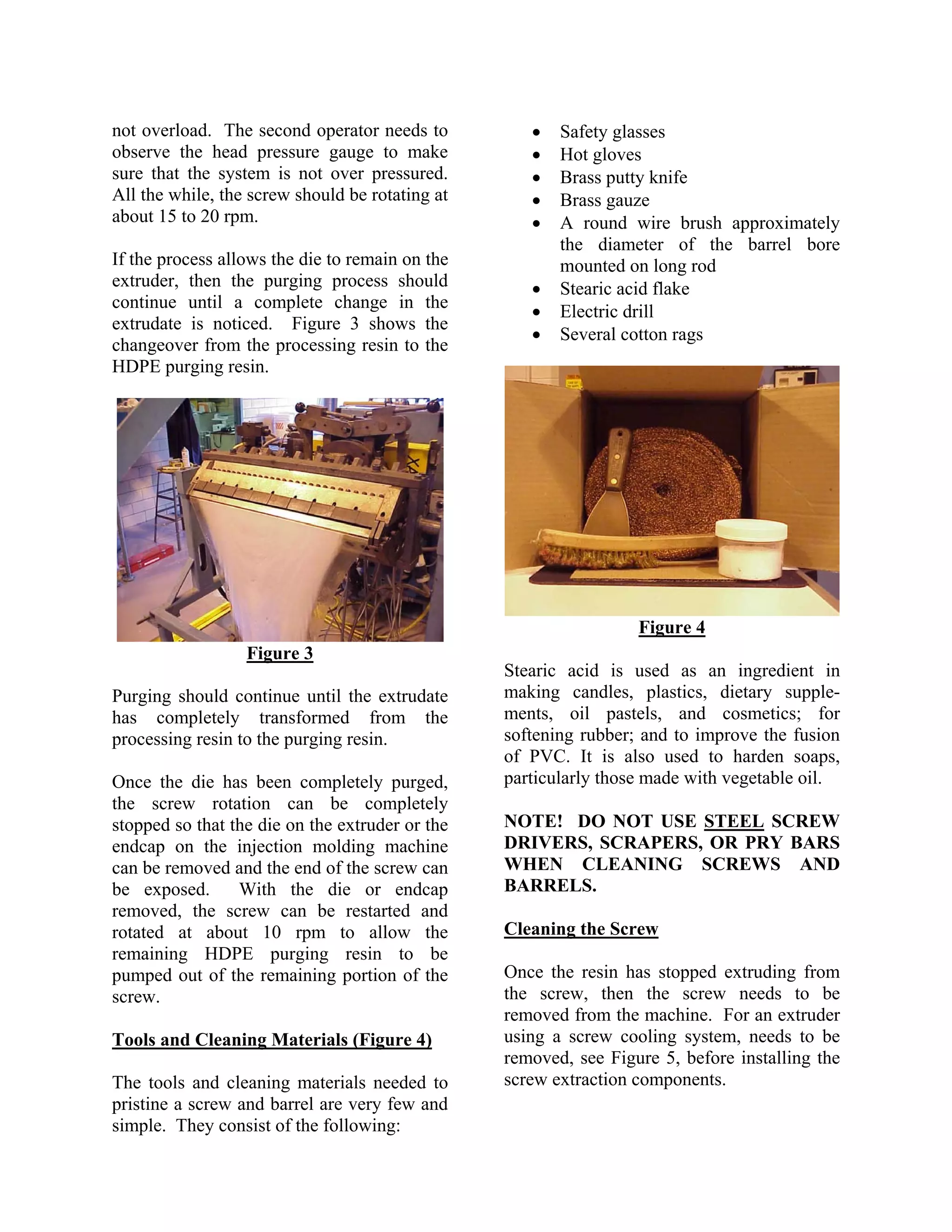
gate at the bottom of the resin hopper.           operator should be at the control panel (See
                                                  Figure 2) to observe the screw speed and
The screw rotational speed needs to be            drive load meter to insure that the drive does
reduced to approximately 15 to 25 rpm and
operated at this speed until the polymer
stops flowing from the end of the die or out
of the nozzle on an injection molding
machine.

All of the barrel zones should be set to about
200°C (400°F), and the machine needs to
come to this temperature before continuing
the purging process.

Once the barrel zones have reached the
200°C (400°F) temperature settings, then the
purging process can begin. It is this author’s
experience that a fractional melt (.35 MI)
HDPE is used as a purging compound, see
Figure 1. The screw size will determine the                         Figure 2
amount of HDPE that is needed to purge the
not overload. The second operator needs to          •   Safety glasses
observe the head pressure gauge to make             •   Hot gloves
sure that the system is not over pressured.         •   Brass putty knife
All the while, the screw should be rotating at      •   Brass gauze
about 15 to 20 rpm.                                 •   A round wire brush approximately
                                                        the diameter of the barrel bore
If the process allows the die to remain on the          mounted on long rod
extruder, then the purging process should           •   Stearic acid flake
continue until a complete change in the
                                                    •   Electric drill
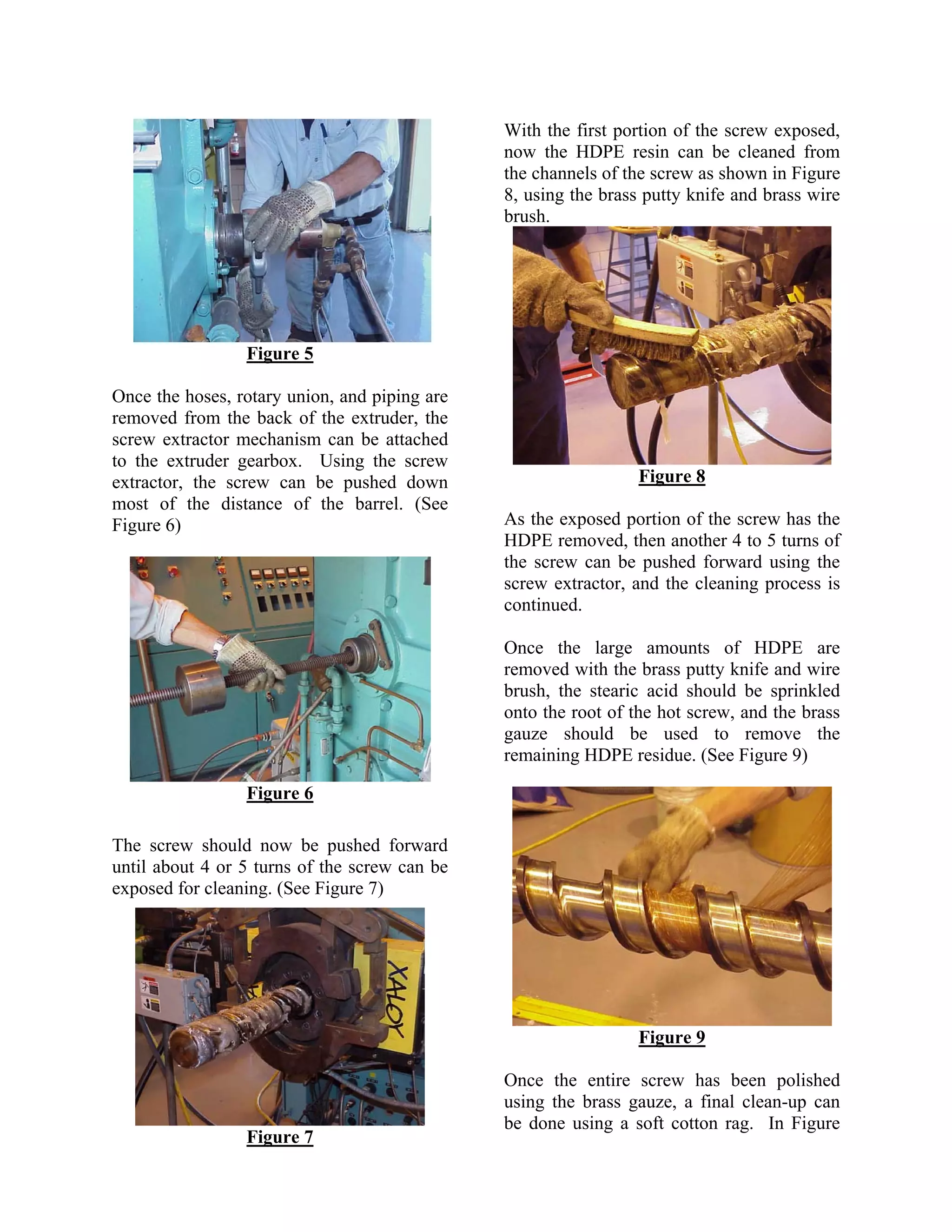
extrudate is noticed. Figure 3 shows the
                                                    •   Several cotton rags
changeover from the processing resin to the
HDPE purging resin.


                                                                  Figure 4
                  Figure 3
                                                 Stearic acid is used as an ingredient in
Purging should continue until the extrudate      making candles, plastics, dietary supple-
has completely transformed from the              ments, oil pastels, and cosmetics; for
processing resin to the purging resin.           softening rubber; and to improve the fusion
                                                 of PVC. It is also used to harden soaps,
Once the die has been completely purged,         particularly those made with vegetable oil.
the screw rotation can be completely
stopped so that the die on the extruder or the   NOTE! DO NOT USE STEEL SCREW
endcap on the injection molding machine          DRIVERS, SCRAPERS, OR PRY BARS
can be removed and the end of the screw can      WHEN CLEANING SCREWS AND
be exposed.      With the die or endcap          BARRELS.
removed, the screw can be restarted and
rotated at about 10 rpm to allow the             Cleaning the Screw
remaining HDPE purging resin to be
pumped out of the remaining portion of the       Once the resin has stopped extruding from
screw.                                           the screw, then the screw needs to be
                                                 removed from the machine. For an extruder
Tools and Cleaning Materials (Figure 4)          using a screw cooling system, needs to be
                                                 removed, see Figure 5, before installing the
The tools and cleaning materials needed to       screw extraction components.
pristine a screw and barrel are very few and
simple. They consist of the following:
With the first portion of the screw exposed,
                                               now the HDPE resin can be cleaned from
                                               the channels of the screw as shown in Figure
                                               8, using the brass putty knife and brass wire
                                               brush.


                 Figure 5

Once the hoses, rotary union, and piping are
removed from the back of the extruder, the
screw extractor mechanism can be attached
to the extruder gearbox. Using the screw
extractor, the screw can be pushed down                          Figure 8
most of the distance of the barrel. (See
Figure 6)                                      As the exposed portion of the screw has the
                                               HDPE removed, then another 4 to 5 turns of
                                               the screw can be pushed forward using the
                                               screw extractor, and the cleaning process is
                                               continued.

                                               Once the large amounts of HDPE are
                                               removed with the brass putty knife and wire
                                               brush, the stearic acid should be sprinkled
                                               onto the root of the hot screw, and the brass
                                               gauze should be used to remove the
                                               remaining HDPE residue. (See Figure 9)

                 Figure 6

The screw should now be pushed forward
until about 4 or 5 turns of the screw can be
exposed for cleaning. (See Figure 7)


                                                                 Figure 9

                                               Once the entire screw has been polished
                                               using the brass gauze, a final clean-up can
                                               be done using a soft cotton rag. In Figure
                 Figure 7
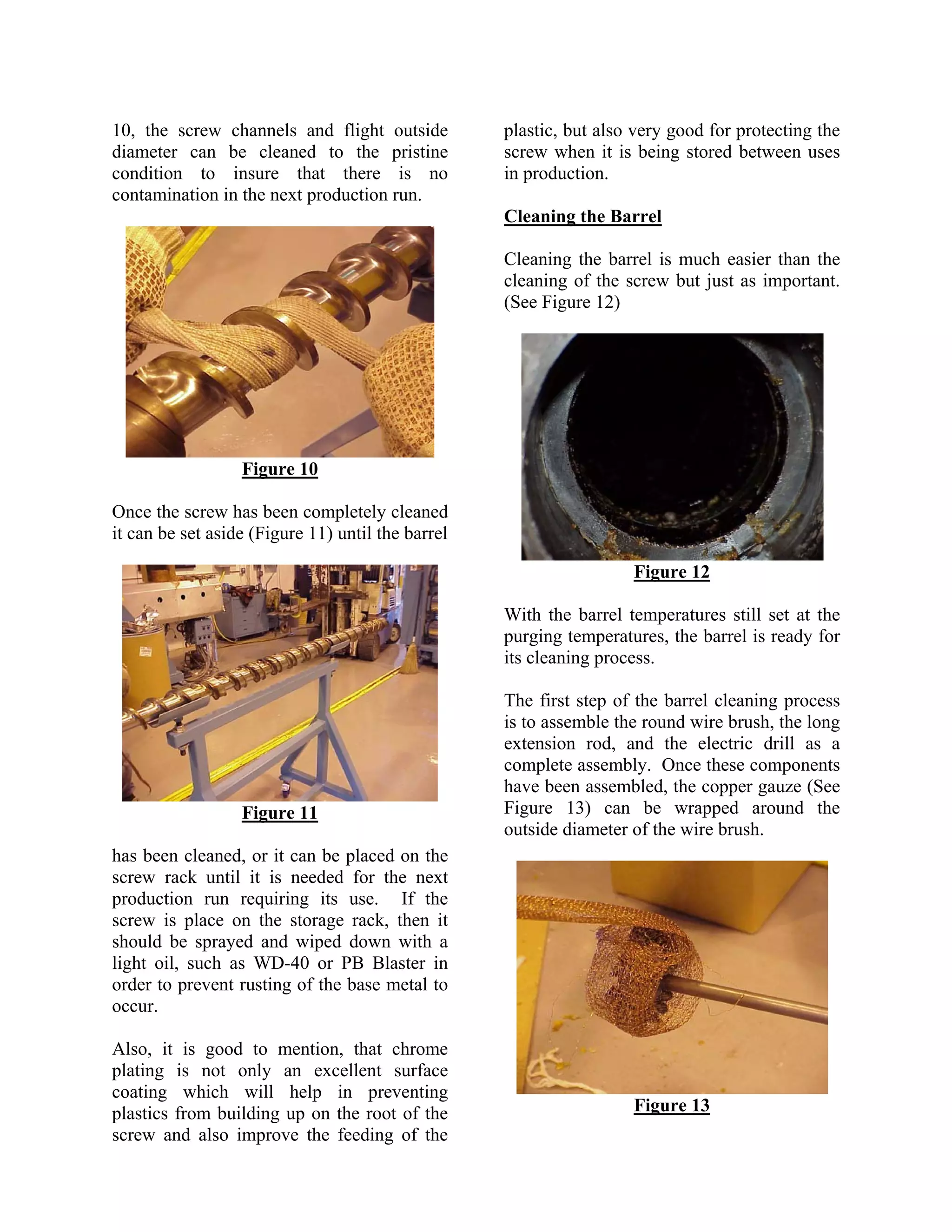
10, the screw channels and flight outside          plastic, but also very good for protecting the
diameter can be cleaned to the pristine            screw when it is being stored between uses
condition to insure that there is no               in production.
contamination in the next production run.
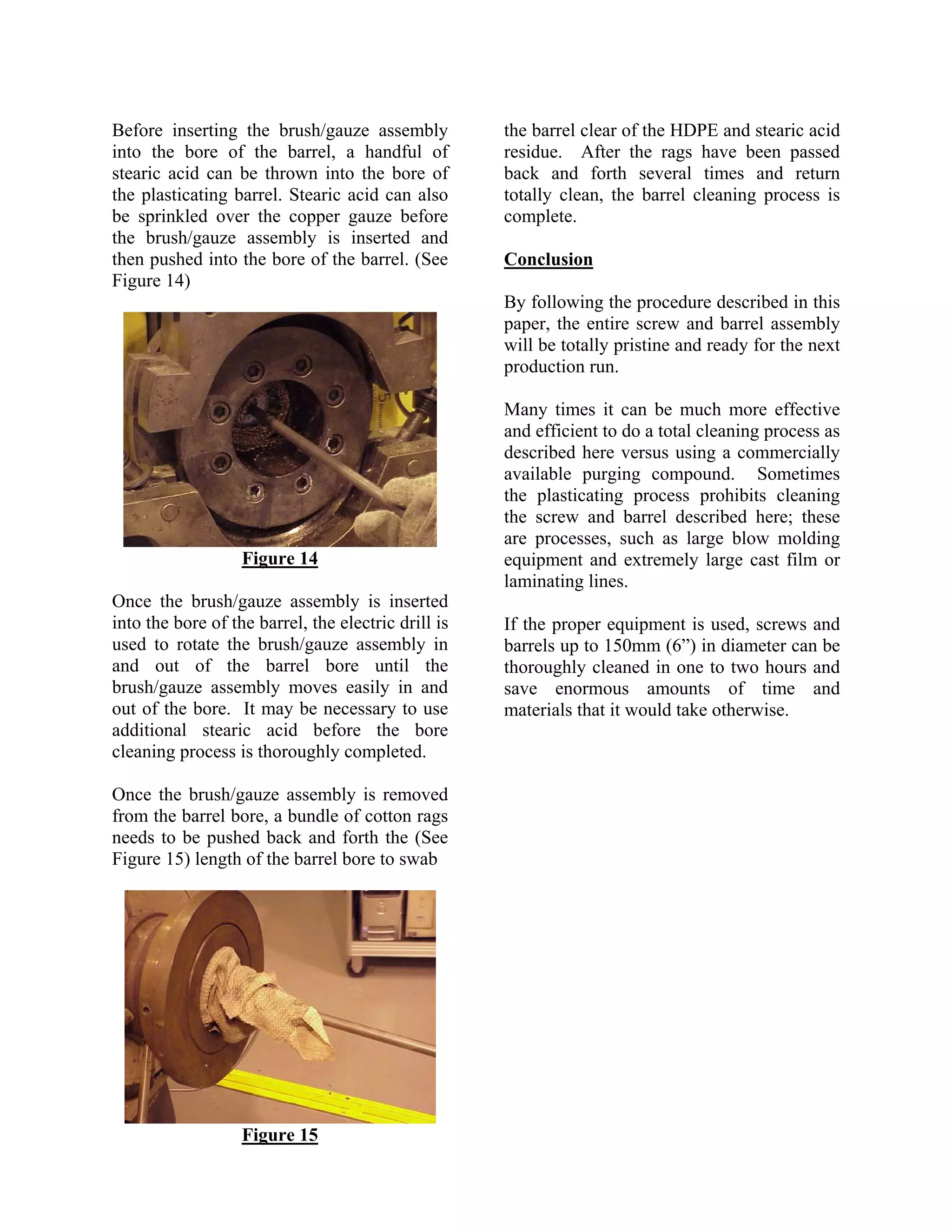
                                                   Cleaning the Barrel

                                                   Cleaning the barrel is much easier than the
                                                   cleaning of the screw but just as important.
                                                   (See Figure 12)


                  Figure 10

Once the screw has been completely cleaned
it can be set aside (Figure 11) until the barrel

                                                                    Figure 12

                                                   With the barrel temperatures still set at the
                                                   purging temperatures, the barrel is ready for
                                                   its cleaning process.

                                                   The first step of the barrel cleaning process
                                                   is to assemble the round wire brush, the long
                                                   extension rod, and the electric drill as a
                                                   complete assembly. Once these components
                                                   have been assembled, the copper gauze (See
                  Figure 11                        Figure 13) can be wrapped around the
                                                   outside diameter of the wire brush.
has been cleaned, or it can be placed on the
screw rack until it is needed for the next
production run requiring its use. If the
screw is place on the storage rack, then it
should be sprayed and wiped down with a
light oil, such as WD-40 or PB Blaster in
order to prevent rusting of the base metal to
occur.

Also, it is good to mention, that chrome
plating is not only an excellent surface
coating which will help in preventing
plastics from building up on the root of the                        Figure 13
screw and also improve the feeding of the
Before inserting the brush/gauze assembly            the barrel clear of the HDPE and stearic acid
into the bore of the barrel, a handful of            residue. After the rags have been passed
stearic acid can be thrown into the bore of          back and forth several times and return
the plasticating barrel. Stearic acid can also       totally clean, the barrel cleaning process is
be sprinkled over the copper gauze before            complete.
the brush/gauze assembly is inserted and
then pushed into the bore of the barrel. (See        Conclusion
Figure 14)
                                                     By following the procedure described in this
                                                     paper, the entire screw and barrel assembly
                                                     will be totally pristine and ready for the next
                                                     production run.

                                                     Many times it can be much more effective
                                                     and efficient to do a total cleaning process as
                                                     described here versus using a commercially
                                                     available purging compound. Sometimes
                                                     the plasticating process prohibits cleaning
                                                     the screw and barrel described here; these
                                                     are processes, such as large blow molding
                   Figure 14                         equipment and extremely large cast film or
                                                     laminating lines.
Once the brush/gauze assembly is inserted
into the bore of the barrel, the electric drill is   If the proper equipment is used, screws and
used to rotate the brush/gauze assembly in           barrels up to 150mm (6”) in diameter can be
and out of the barrel bore until the                 thoroughly cleaned in one to two hours and
brush/gauze assembly moves easily in and             save enormous amounts of time and
out of the bore. It may be necessary to use          materials that it would take otherwise.
additional stearic acid before the bore
cleaning process is thoroughly completed.

Once the brush/gauze assembly is removed
from the barrel bore, a bundle of cotton rags
needs to be pushed back and forth the (See
Figure 15) length of the barrel bore to swab


                   Figure 15

A method for purging and cleaning a screw and barrel

  • 1.
    A Method forPurging and Cleaning a Screw and Barrel By Timothy W. Womer, CTO Xaloy, Incorporated Introduction procedure to include the use of an acetylene When it comes to maintaining screw and torch. This is the biggest mistake that can barrels, the most common question asked is, be done which will destroy not only the “What is the best method to purge and clean metallurgical properties of the base metal our screws and barrels?” but also affect the closely machined tolerances of the screw. Hopefully, this paper will address this very common question and help companies be more productive during their production changeover and routine maintenance procedures. Many times it is more cost effective to pull the screw out of the extruder or injection molding machine than to use a purging compound when it is time to do a product changeover. For extrusion applications, Most screws that are built for extrusion typically, for extruders that are 90mm (3.5”) applications are made of 4140 H.T. steel. in diameter and smaller, it is often easier to Whenever isolated heat from an acetylene pull the screw out of the barrel and pristine torch is used to remove plastics from the the system to insure that there is no root of the screw, it will cause the metal to contamination for the next application. expand on that side of the screw and in turn When the process is Injection Molding, cause the screw to bend. Once the screw typically, for machines that have screws that cools it is very doubtful that the straightness are smaller than 75mm (3.0”) in diameter, of the screw will return to what it was these too are easier to remove the screw originally. Also, the isolated heat, from the barrel and clean the components especially if the steel is heated to a point outside the machine. where the isolated area turns to a permanent blue, will cause metallurgical changes to the What NOT to do! base metal. There have been occasions where the isolated area actually causes a Plasticating screws are manufactured to very delamination of the base metal and a large close tolerances. Most of the tolerances on portion of steel will separate itself from the the screw are within +/- .025mm (.001”), main portion of the screw. straight within .1mm (.004”) and have a highly polished finish. Many, many times it In the case of injection molding screws, is very common for a company’s most of these screws are manufactured to maintenance department’s screw cleaning
  • 2.
    withstand abrasive wearfrom the resins that system. For example, on a 50mm (2”) are being processed. The types of steels diameter screw it will require about 5 kg (10 used to combat the abrasive wear are lb) of material, and on a 90mm (3.5”) typically various types of tool steels. During diameter screw it may require 15kg (33 lb) the manufacturing stages of building tool of HDPE material. steel screws, the base metal has to be heat treated to increase the hardness of the steel. If isolated heat from an acetylene torch is used to remove plastic from the root of the screw, it will definitely anneal the base metal and reduce the wear resistance in that area of the screw. Also, annealing the tool steel with the use of isolated heat will reduce the yield strength of the steel, and this will increase the likelihood of screw breakage due to torque. Therefore, the basic statement here is: Figure 1 Do Not Use Isolated Direct Heat!!! Depending on the type of extrusion process, Purging the Screw it may be necessary to remove the die or head tooling to reduce over pressuring the The first step to pristine the plasticating end of the extruder. This is why it is very system is to purge the screw. First, close off important during the purging process that the flow of the resin that is being processed. extreme caution be used and two operators This is typically done by closing the slide perform this portion of the process. One gate at the bottom of the resin hopper. operator should be at the control panel (See Figure 2) to observe the screw speed and The screw rotational speed needs to be drive load meter to insure that the drive does reduced to approximately 15 to 25 rpm and operated at this speed until the polymer stops flowing from the end of the die or out of the nozzle on an injection molding machine. All of the barrel zones should be set to about 200°C (400°F), and the machine needs to come to this temperature before continuing the purging process. Once the barrel zones have reached the 200°C (400°F) temperature settings, then the purging process can begin. It is this author’s experience that a fractional melt (.35 MI) HDPE is used as a purging compound, see Figure 1. The screw size will determine the Figure 2 amount of HDPE that is needed to purge the
  • 3.
    not overload. Thesecond operator needs to • Safety glasses observe the head pressure gauge to make • Hot gloves sure that the system is not over pressured. • Brass putty knife All the while, the screw should be rotating at • Brass gauze about 15 to 20 rpm. • A round wire brush approximately the diameter of the barrel bore If the process allows the die to remain on the mounted on long rod extruder, then the purging process should • Stearic acid flake continue until a complete change in the • Electric drill extrudate is noticed. Figure 3 shows the • Several cotton rags changeover from the processing resin to the HDPE purging resin. Figure 4 Figure 3 Stearic acid is used as an ingredient in Purging should continue until the extrudate making candles, plastics, dietary supple- has completely transformed from the ments, oil pastels, and cosmetics; for processing resin to the purging resin. softening rubber; and to improve the fusion of PVC. It is also used to harden soaps, Once the die has been completely purged, particularly those made with vegetable oil. the screw rotation can be completely stopped so that the die on the extruder or the NOTE! DO NOT USE STEEL SCREW endcap on the injection molding machine DRIVERS, SCRAPERS, OR PRY BARS can be removed and the end of the screw can WHEN CLEANING SCREWS AND be exposed. With the die or endcap BARRELS. removed, the screw can be restarted and rotated at about 10 rpm to allow the Cleaning the Screw remaining HDPE purging resin to be pumped out of the remaining portion of the Once the resin has stopped extruding from screw. the screw, then the screw needs to be removed from the machine. For an extruder Tools and Cleaning Materials (Figure 4) using a screw cooling system, needs to be removed, see Figure 5, before installing the The tools and cleaning materials needed to screw extraction components. pristine a screw and barrel are very few and simple. They consist of the following:
  • 4.
    With the firstportion of the screw exposed, now the HDPE resin can be cleaned from the channels of the screw as shown in Figure 8, using the brass putty knife and brass wire brush. Figure 5 Once the hoses, rotary union, and piping are removed from the back of the extruder, the screw extractor mechanism can be attached to the extruder gearbox. Using the screw extractor, the screw can be pushed down Figure 8 most of the distance of the barrel. (See Figure 6) As the exposed portion of the screw has the HDPE removed, then another 4 to 5 turns of the screw can be pushed forward using the screw extractor, and the cleaning process is continued. Once the large amounts of HDPE are removed with the brass putty knife and wire brush, the stearic acid should be sprinkled onto the root of the hot screw, and the brass gauze should be used to remove the remaining HDPE residue. (See Figure 9) Figure 6 The screw should now be pushed forward until about 4 or 5 turns of the screw can be exposed for cleaning. (See Figure 7) Figure 9 Once the entire screw has been polished using the brass gauze, a final clean-up can be done using a soft cotton rag. In Figure Figure 7
  • 5.
    10, the screwchannels and flight outside plastic, but also very good for protecting the diameter can be cleaned to the pristine screw when it is being stored between uses condition to insure that there is no in production. contamination in the next production run. Cleaning the Barrel Cleaning the barrel is much easier than the cleaning of the screw but just as important. (See Figure 12) Figure 10 Once the screw has been completely cleaned it can be set aside (Figure 11) until the barrel Figure 12 With the barrel temperatures still set at the purging temperatures, the barrel is ready for its cleaning process. The first step of the barrel cleaning process is to assemble the round wire brush, the long extension rod, and the electric drill as a complete assembly. Once these components have been assembled, the copper gauze (See Figure 11 Figure 13) can be wrapped around the outside diameter of the wire brush. has been cleaned, or it can be placed on the screw rack until it is needed for the next production run requiring its use. If the screw is place on the storage rack, then it should be sprayed and wiped down with a light oil, such as WD-40 or PB Blaster in order to prevent rusting of the base metal to occur. Also, it is good to mention, that chrome plating is not only an excellent surface coating which will help in preventing plastics from building up on the root of the Figure 13 screw and also improve the feeding of the
  • 6.
    Before inserting thebrush/gauze assembly the barrel clear of the HDPE and stearic acid into the bore of the barrel, a handful of residue. After the rags have been passed stearic acid can be thrown into the bore of back and forth several times and return the plasticating barrel. Stearic acid can also totally clean, the barrel cleaning process is be sprinkled over the copper gauze before complete. the brush/gauze assembly is inserted and then pushed into the bore of the barrel. (See Conclusion Figure 14) By following the procedure described in this paper, the entire screw and barrel assembly will be totally pristine and ready for the next production run. Many times it can be much more effective and efficient to do a total cleaning process as described here versus using a commercially available purging compound. Sometimes the plasticating process prohibits cleaning the screw and barrel described here; these are processes, such as large blow molding Figure 14 equipment and extremely large cast film or laminating lines. Once the brush/gauze assembly is inserted into the bore of the barrel, the electric drill is If the proper equipment is used, screws and used to rotate the brush/gauze assembly in barrels up to 150mm (6”) in diameter can be and out of the barrel bore until the thoroughly cleaned in one to two hours and brush/gauze assembly moves easily in and save enormous amounts of time and out of the bore. It may be necessary to use materials that it would take otherwise. additional stearic acid before the bore cleaning process is thoroughly completed. Once the brush/gauze assembly is removed from the barrel bore, a bundle of cotton rags needs to be pushed back and forth the (See Figure 15) length of the barrel bore to swab Figure 15