16S rRNA SEQUENCING IN THE
  CLINICAL MICROBIOLOGY
       LABORATORY

         Richard C. Huard, Ph.D.
        Department of Pathology
      Clinical Microbiology Service
    New York-Presbyterian Hospital
   Columbia University Medical Center
            rchuard@nyp.org
16S rRNA SEQUENCING
• Gold standard for bacterial identification
• 16S rRNA gene
    ~ 1500 bp
    Small subunit of ribosome
    Common to all bacteria
    Present in 1 or more copies
    Critical to cell function
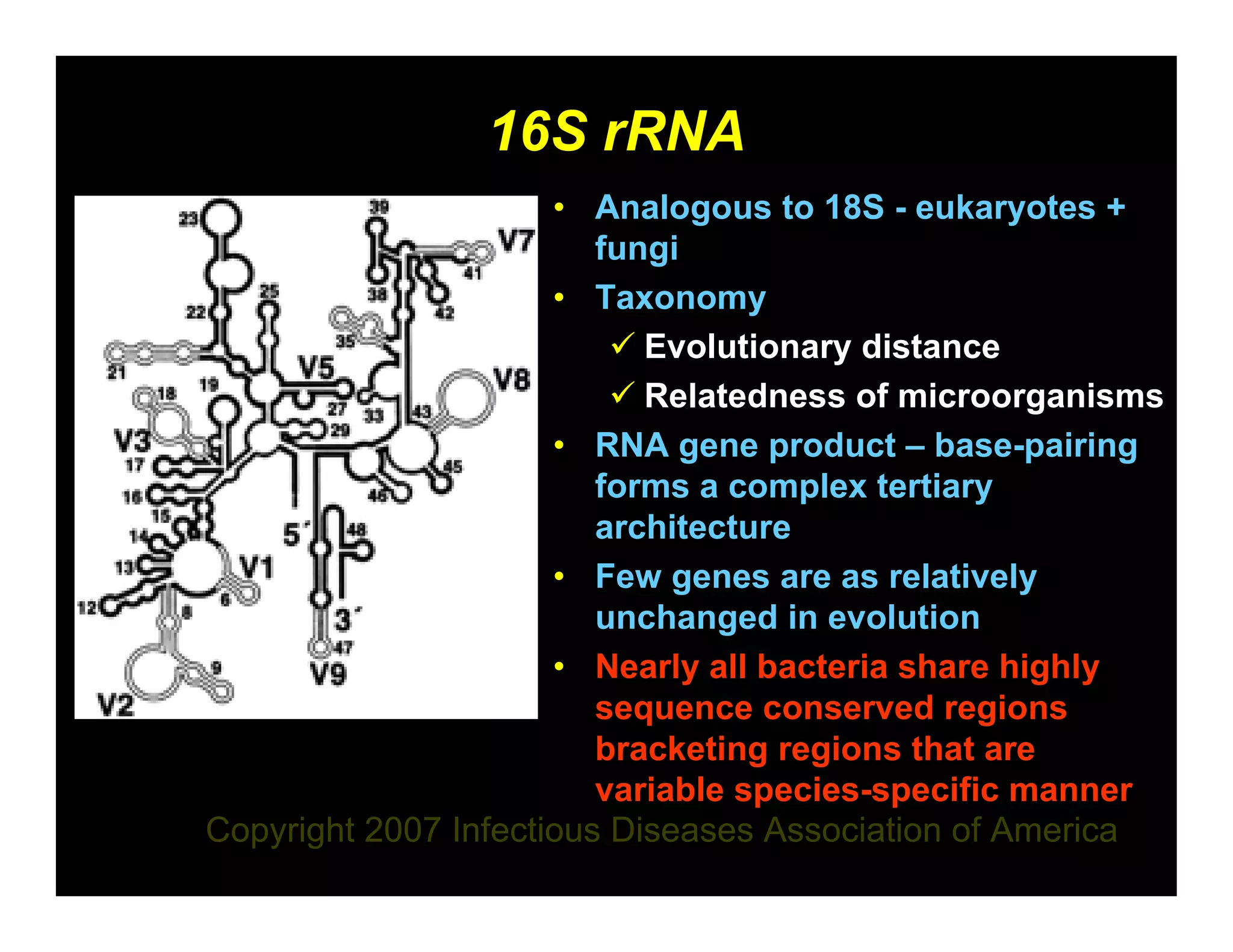
16S rRNA
  • Analogous to 18S - eukaryotes +
    fungi
  • Taxonomy
       Evolutionary distance
       Relatedness of microorganisms
  • RNA gene product – base-pairing
    forms a complex tertiary
    architecture
  • Few genes are as relatively
    unchanged in evolution
  • Nearly all bacteria share highly
    sequence conserved regions
    bracketing regions that are
    variable species-specific manner
16S rRNA Gene


• most sequencing efforts focus on the 5’ end of the gene
• target the entire gene for amplification - universal primers
• use a minimal set of universal internal primers to sequence


• C. Petti, 2007; CID 44:1108-14.
Protocol:


   1. Bacteria in pure culture   2. DNA isolation       3. PCR amplification
                                                    (standard program, universal primers)


4. Agarose gel electrophoresis    5. Purify PCR products           6. Sequence
Protocol:


Lasergene DNASTAR
   EditSeq
   MegAlign
   SeqMan
Protocol:
  • NCBI GenBank webpage: http://www.ncbi.nlm.nih.gov/BLAST/
  •       - an annotated collection of nucleotide sequences
  •       - short sequences to whole genomes
  •       - open access
  • Nucleotide-nucleotide BLAST
  •       - paste in the linear sequence data, submit
          - search is performed
  •       - list of matches is provided
Protocol:

 • Identification
      ~99-100% confirm species
      ~97-99% confirm genus, new species
      <97% new species, new genus
Our Data: 16S rRNA Sequencing
• Built a database of 16S rRNA sequences
    175 isolates of known identity
    QC strains, outside culture collections, internally
    validated
    Clinically relevant species
    Cross-referenced to GenBank
• Evaluated 300 clinical isolates
    200 BacT Section
    100 NTM / Nocardia
    Inclusion criteria:
      • Failed to give a definitive and/or rapid
        identification by routine methods
      • Potentially clinically relevant
      • Unique antibiogram
Our Data: 16S rRNA Sequencing
• Definitive identification:
    88% overall
    16S PCR worked 100% of the time

• 34 isolates were new species:
     Mycobacterium sp. (3)
     Nocardia sp. (1)
     Moraxella sp. (4)
     Acinetobacter sp. (5)
     Streptococcus sp. (6)

• 3 isolates were of new genera:
     Enterobacteriaceae Family (2)
     Rhizobiales Family (1)
Our Data: 16S rRNA Sequencing
• Difficult to Identify        • Rarely Reported Clinically
      NTM, Nocardia                 Francisella philomiragia
• Difficult to Differentiate        Tsukamurella tyrosinosolvens
      Burkholderia cepacia          Weissella confusa
      complex                  • Not Previously Reported USA
• Phenotypic Variants               Nocardia cyriacigeorgica
      GNR in CF patients            Shineria larvae
• Long Germination Time        • Not Previously Reported Clinically
      HACEK                         Rothia aeria
CAVEATS TO 16S SEQUENCING
• 16S rRNA Limitations
    Requires pure culture

    Different spp. can have an identical 16S
     • B. bronchoseptica + B. parapertussis, M. gastri + M.
       kansasii
    Different spp. can have minimally variable 16S
     • S. pneumoniae + S. mitis, M. abscessus + M. chelonae

    Genomovars of a single “species” may have relatively
    different 16S sequences (P. vulgaris, E. cloacae, B.
    fragilis)

     Multiple 16S alleles within a strain
Caveats to Using GenBank
• Issues of which to be aware
     Not a quality-controlled database
      • Many sequencing errors (N, misreads, gaps)
      • Many incorrect IDs
     Lots of junk sequences (anaerobes)
     Paucity of entries (Coaggulase-negative Staphylococci)
     Dated entries (Legionella micdadei vs. Tatlockia micdadei)
     Submitters assign names to new species that are not
     validly published
     Highest score is not necessarily the correct species

     Alternatives (RIDOM) lack the same breadth
SUMMARY: 16S SEQUENCING

• Can better discriminate bacterial isolates
  than many phenotypic methods
• ID novel, poorly described, rarely
  isolated, or phenotypically aberrant
  strains
• Clarify clinical importance, guide choice
  of treatment
• With slow-growers – can speed TAT and
  be cost-effective
• Unlikely to ever completely do away with
  culture
THANKS
• Clinical Microbiology Service
    Dr. Phyllis Della-Latta, Director
    Dr. Susan Whittier, Asst. Director
• IDSA Committee


           Richard C. Huard, Ph.D.
              rchuard@nyp.org
THANKS


Richard C. Huard, Ph.D.
   rchuard@nyp.org

16s

  • 1.
    16S rRNA SEQUENCINGIN THE CLINICAL MICROBIOLOGY LABORATORY Richard C. Huard, Ph.D. Department of Pathology Clinical Microbiology Service New York-Presbyterian Hospital Columbia University Medical Center rchuard@nyp.org
  • 2.
    16S rRNA SEQUENCING •Gold standard for bacterial identification • 16S rRNA gene ~ 1500 bp Small subunit of ribosome Common to all bacteria Present in 1 or more copies Critical to cell function
  • 3.
    16S rRNA • Analogous to 18S - eukaryotes + fungi • Taxonomy Evolutionary distance Relatedness of microorganisms • RNA gene product – base-pairing forms a complex tertiary architecture • Few genes are as relatively unchanged in evolution • Nearly all bacteria share highly sequence conserved regions bracketing regions that are variable species-specific manner
  • 4.
    16S rRNA Gene •most sequencing efforts focus on the 5’ end of the gene • target the entire gene for amplification - universal primers • use a minimal set of universal internal primers to sequence • C. Petti, 2007; CID 44:1108-14.
  • 5.
    Protocol: 1. Bacteria in pure culture 2. DNA isolation 3. PCR amplification (standard program, universal primers) 4. Agarose gel electrophoresis 5. Purify PCR products 6. Sequence
  • 6.
    Protocol: Lasergene DNASTAR EditSeq MegAlign SeqMan
  • 7.
    Protocol: •NCBI GenBank webpage: http://www.ncbi.nlm.nih.gov/BLAST/ • - an annotated collection of nucleotide sequences • - short sequences to whole genomes • - open access • Nucleotide-nucleotide BLAST • - paste in the linear sequence data, submit - search is performed • - list of matches is provided
  • 8.
    Protocol: • Identification ~99-100% confirm species ~97-99% confirm genus, new species <97% new species, new genus
  • 9.
    Our Data: 16SrRNA Sequencing • Built a database of 16S rRNA sequences 175 isolates of known identity QC strains, outside culture collections, internally validated Clinically relevant species Cross-referenced to GenBank • Evaluated 300 clinical isolates 200 BacT Section 100 NTM / Nocardia Inclusion criteria: • Failed to give a definitive and/or rapid identification by routine methods • Potentially clinically relevant • Unique antibiogram
  • 10.
    Our Data: 16SrRNA Sequencing • Definitive identification: 88% overall 16S PCR worked 100% of the time • 34 isolates were new species: Mycobacterium sp. (3) Nocardia sp. (1) Moraxella sp. (4) Acinetobacter sp. (5) Streptococcus sp. (6) • 3 isolates were of new genera: Enterobacteriaceae Family (2) Rhizobiales Family (1)
  • 11.
    Our Data: 16SrRNA Sequencing • Difficult to Identify • Rarely Reported Clinically NTM, Nocardia Francisella philomiragia • Difficult to Differentiate Tsukamurella tyrosinosolvens Burkholderia cepacia Weissella confusa complex • Not Previously Reported USA • Phenotypic Variants Nocardia cyriacigeorgica GNR in CF patients Shineria larvae • Long Germination Time • Not Previously Reported Clinically HACEK Rothia aeria
  • 12.
    CAVEATS TO 16SSEQUENCING • 16S rRNA Limitations Requires pure culture Different spp. can have an identical 16S • B. bronchoseptica + B. parapertussis, M. gastri + M. kansasii Different spp. can have minimally variable 16S • S. pneumoniae + S. mitis, M. abscessus + M. chelonae Genomovars of a single “species” may have relatively different 16S sequences (P. vulgaris, E. cloacae, B. fragilis) Multiple 16S alleles within a strain
  • 13.
    Caveats to UsingGenBank • Issues of which to be aware Not a quality-controlled database • Many sequencing errors (N, misreads, gaps) • Many incorrect IDs Lots of junk sequences (anaerobes) Paucity of entries (Coaggulase-negative Staphylococci) Dated entries (Legionella micdadei vs. Tatlockia micdadei) Submitters assign names to new species that are not validly published Highest score is not necessarily the correct species Alternatives (RIDOM) lack the same breadth
  • 14.
    SUMMARY: 16S SEQUENCING •Can better discriminate bacterial isolates than many phenotypic methods • ID novel, poorly described, rarely isolated, or phenotypically aberrant strains • Clarify clinical importance, guide choice of treatment • With slow-growers – can speed TAT and be cost-effective • Unlikely to ever completely do away with culture
  • 15.
    THANKS • Clinical MicrobiologyService Dr. Phyllis Della-Latta, Director Dr. Susan Whittier, Asst. Director • IDSA Committee Richard C. Huard, Ph.D. rchuard@nyp.org
  • 16.
    THANKS Richard C. Huard,Ph.D. rchuard@nyp.org