Lateralization & Language
Lateralization of Function Contralateral Control Corpus Callosum Set of axons which allow the 2 hemispheres to exchange information Cutting the corpus callosum prevents sharing of this information Some are born without a corpus callosum Lateralization Each hemisphere specializes in certain behavior & cognitive abilities E.g., language is mainly in the left hemisphere
Lateralization of Function Visual Input Light from the right visual field shines onto the left half of both retinas This is relayed to the left hemisphere The right half of each retina connects to the right hemisphere which sees the left visual field
Lateralization of Function Split-brain Responses With a severed corpus callosum can point to objects with the left hand, but not the right With visual information presented to the right visual field can name or describe what is seen Right hemisphere: is better than the left at perceiving emotions in gestures & tone of voice With right hemisphere damage can speak with less inflection & expression Right is more adept at compre-hending spatial relationships Also better at perceiving patterns instead of details
Lateralization of Function Planum Temporale A section of the temporal cortex larger in the left hemisphere in 65% of the population The difference in size is apparent at 3 months Children with the biggest ration of left to right planum temporale are better on language tests
Lateralization of Function Corpus Callosum Slowly develops over the first 5  to 10 years Neurons connected to the corpus callosum take years to develop their mature adult pattern Those born without a corpus callosum seem to have larger than normal hemispheric connections elsewhere Anterior Commisure Connects the hemispheres around the anterior parts of the cerebral cortex The hippocampal commisure connects the left hippocampus to the right hippocampus
Lateralization of Function Speech & Hemispheric Dominance 90% of people are right handed & left hemisphere dominance for speech Others are either right hemisphere dominant or mixed Corpus callosum is larger in left handers than right handers Recovery from Injury Recovery of speech after brain injury depends on the damaged hemisphere & how speech is lateralized Children with left-hemisphere damage recover more language than adults with similar damage, but the cause of the damage is more important with age
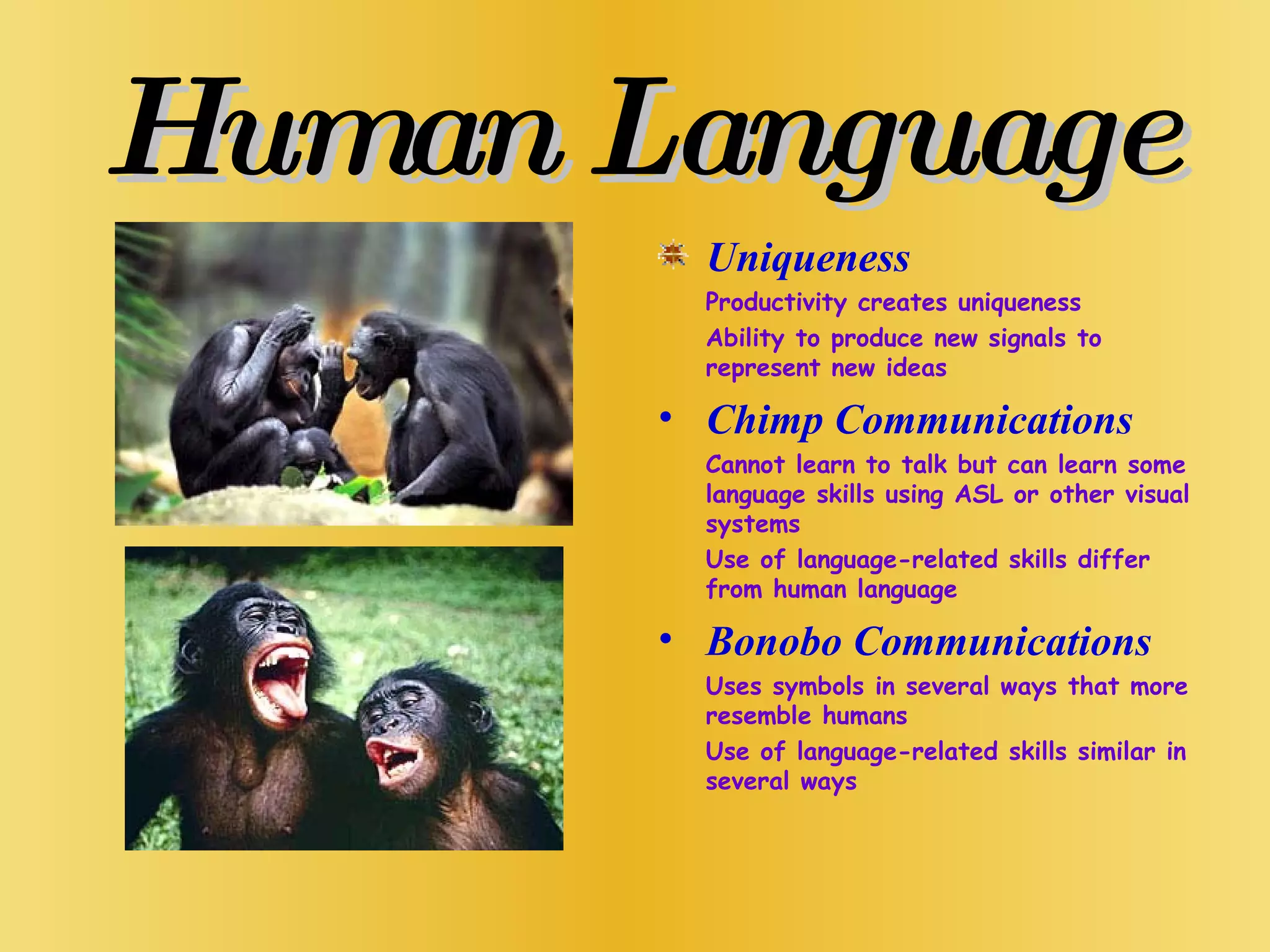
Human Language Uniqueness Productivity creates uniqueness Ability to produce new signals to represent new ideas Chimp Communications Cannot learn to talk but can learn some language skills using ASL or other visual systems Use of language-related skills differ from human language Bonobo Communications Uses symbols in several ways that more resemble humans Use of language-related skills similar in several ways
Evolution of Human Language A Product of Overall Intelligence Brain-to-body ratio relationship can’t explain language Is it a dominant gene? Language development is unclear Special Module Language Acquisition Device Language evolved as an extra brain module Language has a  critical period ; if language isn’t learned during childhood development it leads to disadvantages
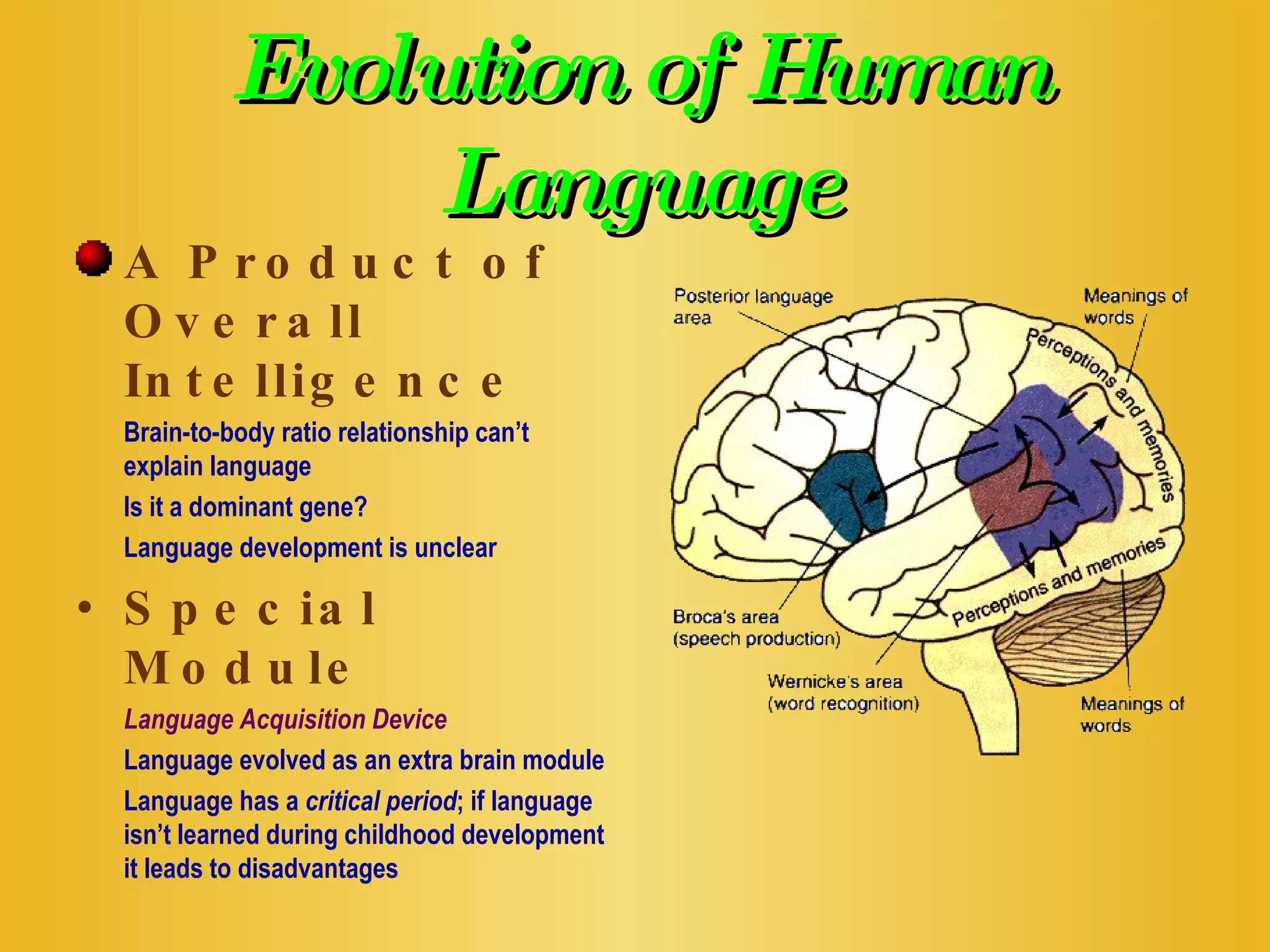
Brain Damage & Language Aphasia Severe language impairment Broca’s Area Small part of the left frontal cortex when damaged leads to language impairments Wernicke’s Area Near the auditory part of the left temporal lobe
Brain Damage & Language Broca’s Aphasia Nonfluent aphasia Most prominent symptom: deficit in language production Damage to Broca’s area Can speak meaningfully but omits pronouns, prepositions, conjunctions & qualifiers Some trouble understanding the same kinds of words
Brain Damage & Language Wernicke’s Aphasia Fluent aphasia Difficulty in understanding verbal & written communications, can speak smoothly but speech is often nonsensical Anomia:  difficulty recalling the names of objects Language Activation Language requires activation of many different areas of the frontal & temporal cortex
Dyslexia Inability to Read Properly Has adequate intelligence & vision Many underlying causes Bilateral Symmetrical Cerebral Cortex Have left & right hemisphere structures the same size Hypotheses Unresponsive magnocellular path to the visual system A subtle hearing impairment Problem converting vision to sound & vice-versa Function of attentional differences Problem communicating between hemispheres

Chapter 14: Lateralization & Language

  • 1.
  • 2.
    Lateralization of FunctionContralateral Control Corpus Callosum Set of axons which allow the 2 hemispheres to exchange information Cutting the corpus callosum prevents sharing of this information Some are born without a corpus callosum Lateralization Each hemisphere specializes in certain behavior & cognitive abilities E.g., language is mainly in the left hemisphere
  • 3.
    Lateralization of FunctionVisual Input Light from the right visual field shines onto the left half of both retinas This is relayed to the left hemisphere The right half of each retina connects to the right hemisphere which sees the left visual field
  • 4.
    Lateralization of FunctionSplit-brain Responses With a severed corpus callosum can point to objects with the left hand, but not the right With visual information presented to the right visual field can name or describe what is seen Right hemisphere: is better than the left at perceiving emotions in gestures & tone of voice With right hemisphere damage can speak with less inflection & expression Right is more adept at compre-hending spatial relationships Also better at perceiving patterns instead of details
  • 5.
    Lateralization of FunctionPlanum Temporale A section of the temporal cortex larger in the left hemisphere in 65% of the population The difference in size is apparent at 3 months Children with the biggest ration of left to right planum temporale are better on language tests
  • 6.
    Lateralization of FunctionCorpus Callosum Slowly develops over the first 5 to 10 years Neurons connected to the corpus callosum take years to develop their mature adult pattern Those born without a corpus callosum seem to have larger than normal hemispheric connections elsewhere Anterior Commisure Connects the hemispheres around the anterior parts of the cerebral cortex The hippocampal commisure connects the left hippocampus to the right hippocampus
  • 7.
    Lateralization of FunctionSpeech & Hemispheric Dominance 90% of people are right handed & left hemisphere dominance for speech Others are either right hemisphere dominant or mixed Corpus callosum is larger in left handers than right handers Recovery from Injury Recovery of speech after brain injury depends on the damaged hemisphere & how speech is lateralized Children with left-hemisphere damage recover more language than adults with similar damage, but the cause of the damage is more important with age
  • 8.
    Human Language UniquenessProductivity creates uniqueness Ability to produce new signals to represent new ideas Chimp Communications Cannot learn to talk but can learn some language skills using ASL or other visual systems Use of language-related skills differ from human language Bonobo Communications Uses symbols in several ways that more resemble humans Use of language-related skills similar in several ways
  • 9.
    Evolution of HumanLanguage A Product of Overall Intelligence Brain-to-body ratio relationship can’t explain language Is it a dominant gene? Language development is unclear Special Module Language Acquisition Device Language evolved as an extra brain module Language has a critical period ; if language isn’t learned during childhood development it leads to disadvantages
  • 10.
    Brain Damage &Language Aphasia Severe language impairment Broca’s Area Small part of the left frontal cortex when damaged leads to language impairments Wernicke’s Area Near the auditory part of the left temporal lobe
  • 11.
    Brain Damage &Language Broca’s Aphasia Nonfluent aphasia Most prominent symptom: deficit in language production Damage to Broca’s area Can speak meaningfully but omits pronouns, prepositions, conjunctions & qualifiers Some trouble understanding the same kinds of words
  • 12.
    Brain Damage &Language Wernicke’s Aphasia Fluent aphasia Difficulty in understanding verbal & written communications, can speak smoothly but speech is often nonsensical Anomia: difficulty recalling the names of objects Language Activation Language requires activation of many different areas of the frontal & temporal cortex
  • 13.
    Dyslexia Inability toRead Properly Has adequate intelligence & vision Many underlying causes Bilateral Symmetrical Cerebral Cortex Have left & right hemisphere structures the same size Hypotheses Unresponsive magnocellular path to the visual system A subtle hearing impairment Problem converting vision to sound & vice-versa Function of attentional differences Problem communicating between hemispheres