Outline
 Introduction
 MWD vs. LWD
 LWD vs. Wireline Decision Making
 MWD output
 Signal Transmission Methods
 MWD System Components
 Geosteering
 Conclusion
Introduction
What is MWD?
Measurement While Drilling (MWD) systems measure
formation properties (e.g. resistivity, natural gamma
ray, porosity), wellbore geometry (inclination, azimuth),
drilling system orientation (tool face), and mechanical
properties of the drilling process.
MWD vs LWD
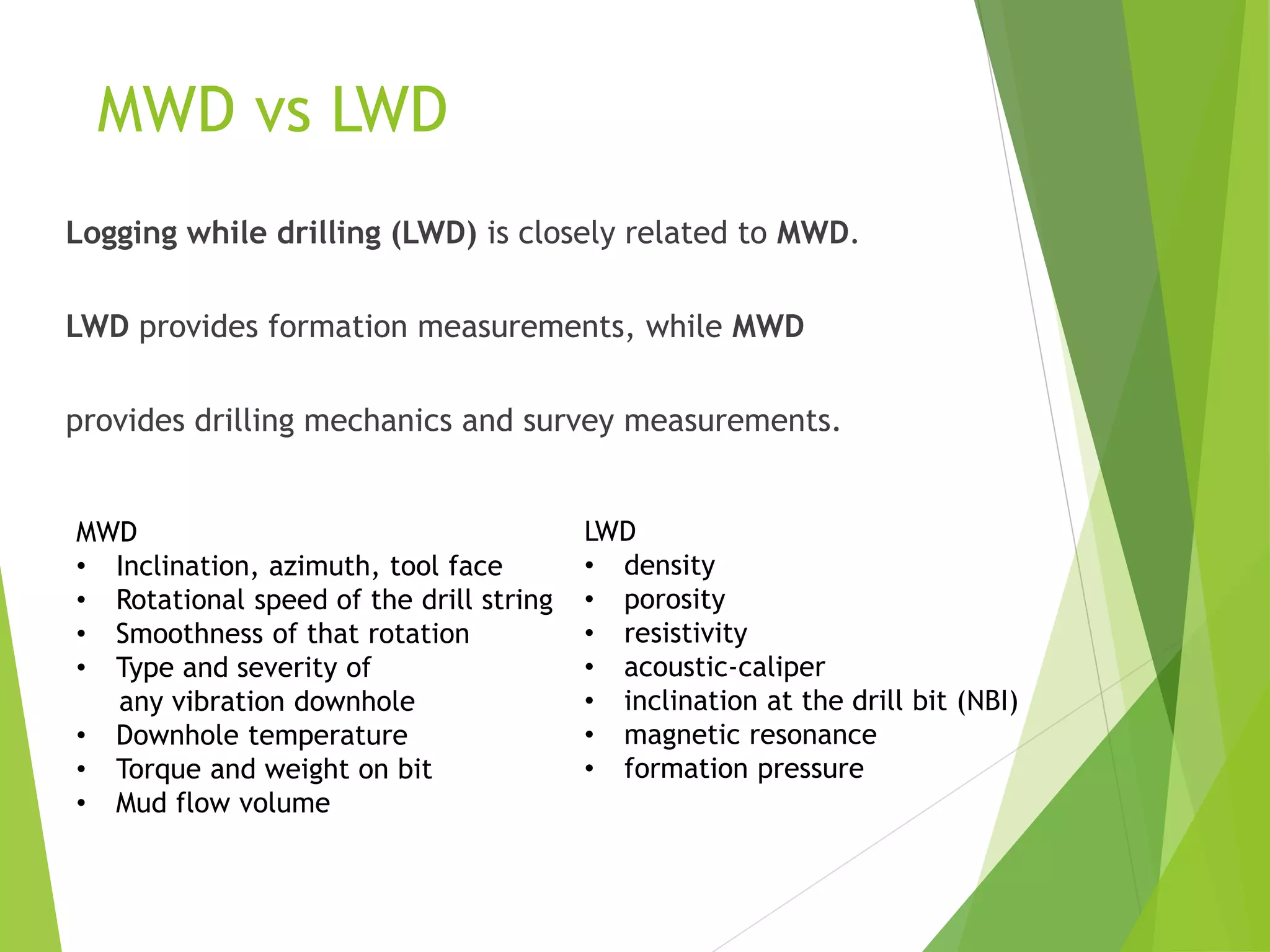
Logging while drilling (LWD) is closely related to MWD.
LWD provides formation measurements, while MWD
provides drilling mechanics and survey measurements.
MWD
• Inclination, azimuth, tool face
• Rotational speed of the drill string
• Smoothness of that rotation
• Type and severity of
any vibration downhole
• Downhole temperature
• Torque and weight on bit
• Mud flow volume
LWD
• density
• porosity
• resistivity
• acoustic-caliper
• inclination at the drill bit (NBI)
• magnetic resonance
• formation pressure
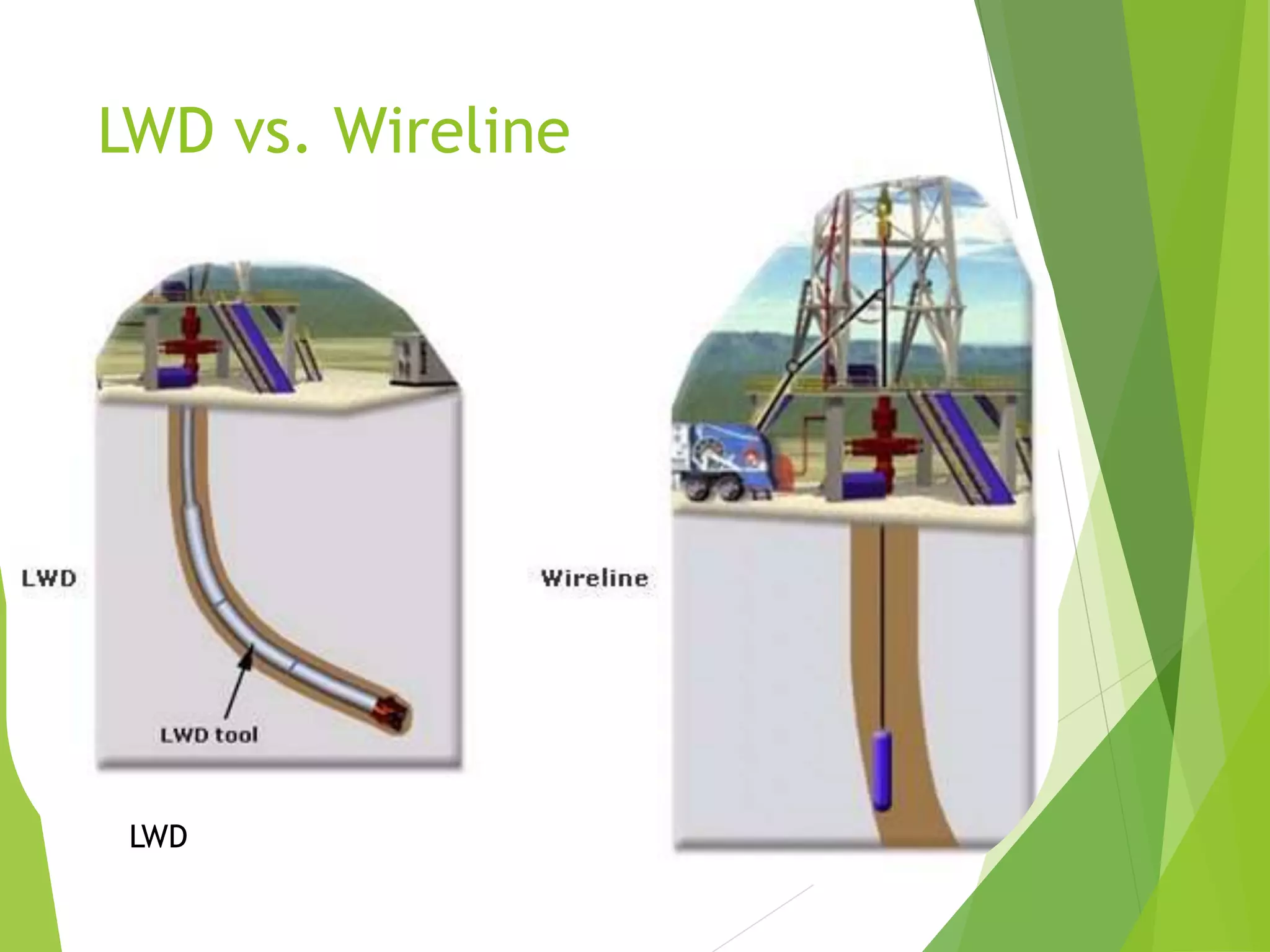
LWD vs. Wireline
LWD
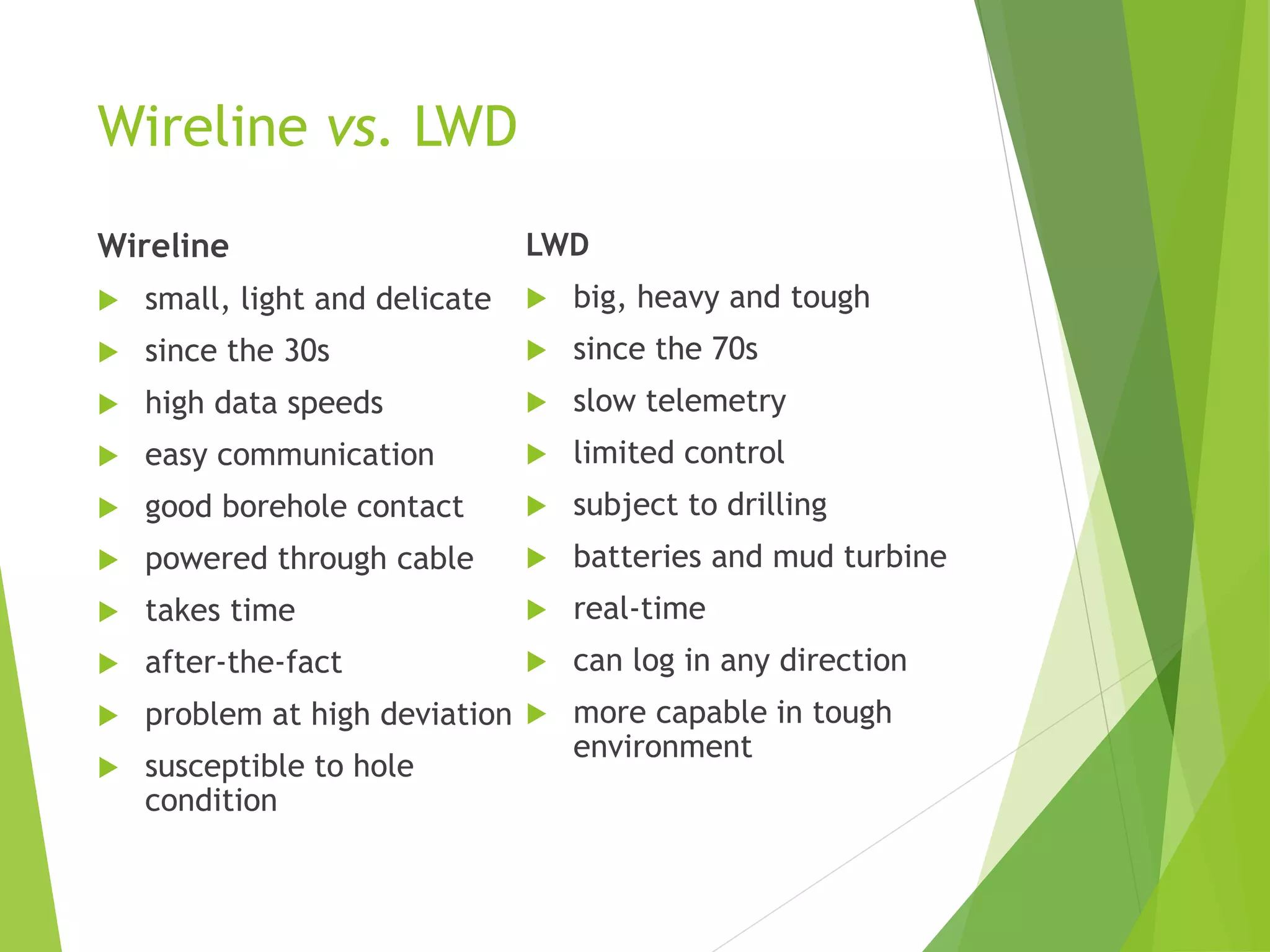
Wireline vs. LWD
Wireline
 small, light and delicate
 since the 30s
 high data speeds
 easy communication
 good borehole contact
 powered through cable
 takes time
 after-the-fact
 problem at high deviation
 susceptible to hole
condition
LWD
 big, heavy and tough
 since the 70s
 slow telemetry
 limited control
 subject to drilling
 batteries and mud turbine
 real-time
 can log in any direction
 more capable in tough
environment
Real-time Surveys for
Directional Control
 Inclination
 Azimuth
 Toolface
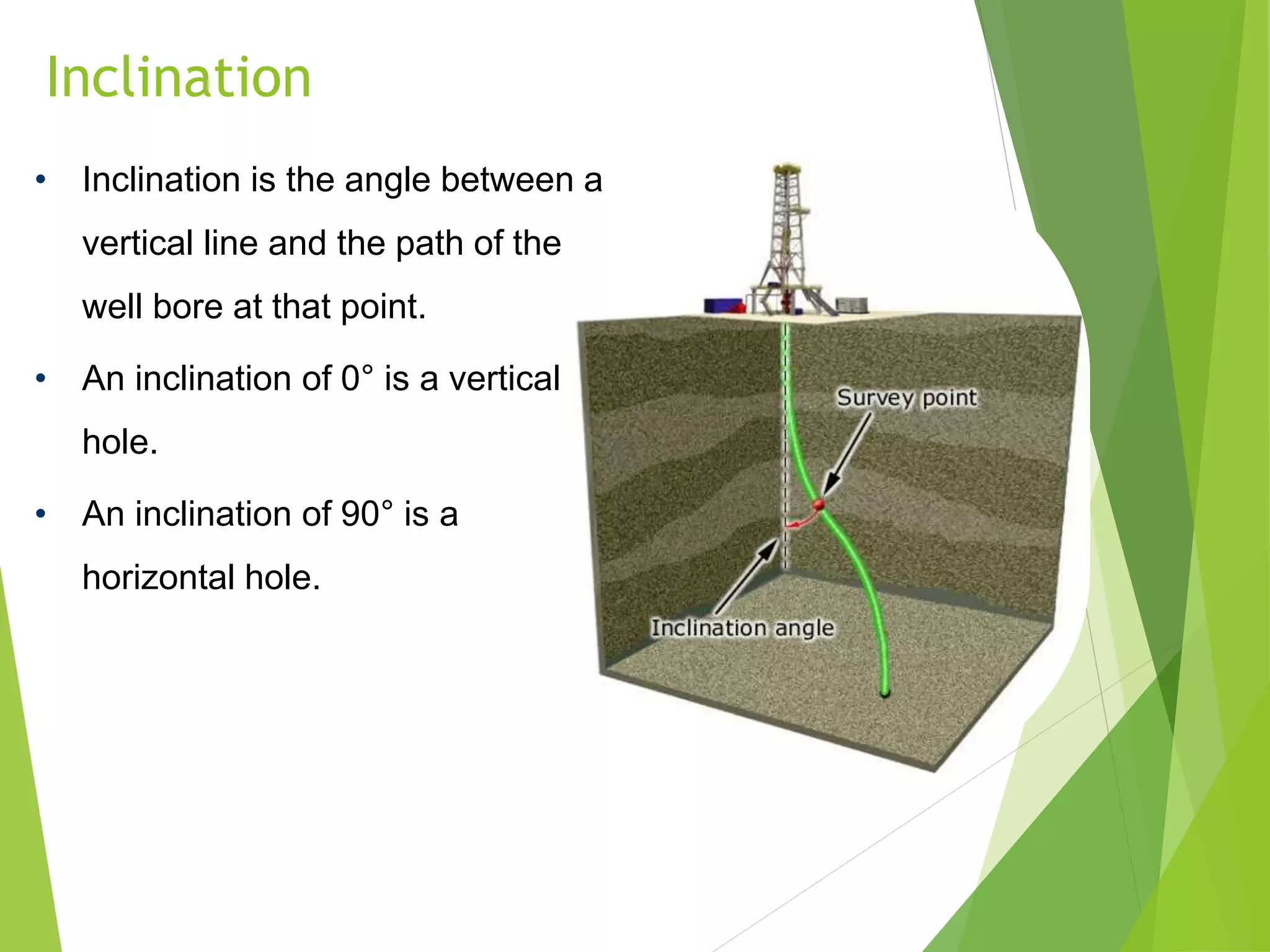
Inclination
• Inclination is the angle between a
vertical line and the path of the
well bore at that point.
• An inclination of 0° is a vertical
hole.
• An inclination of 90° is a
horizontal hole.
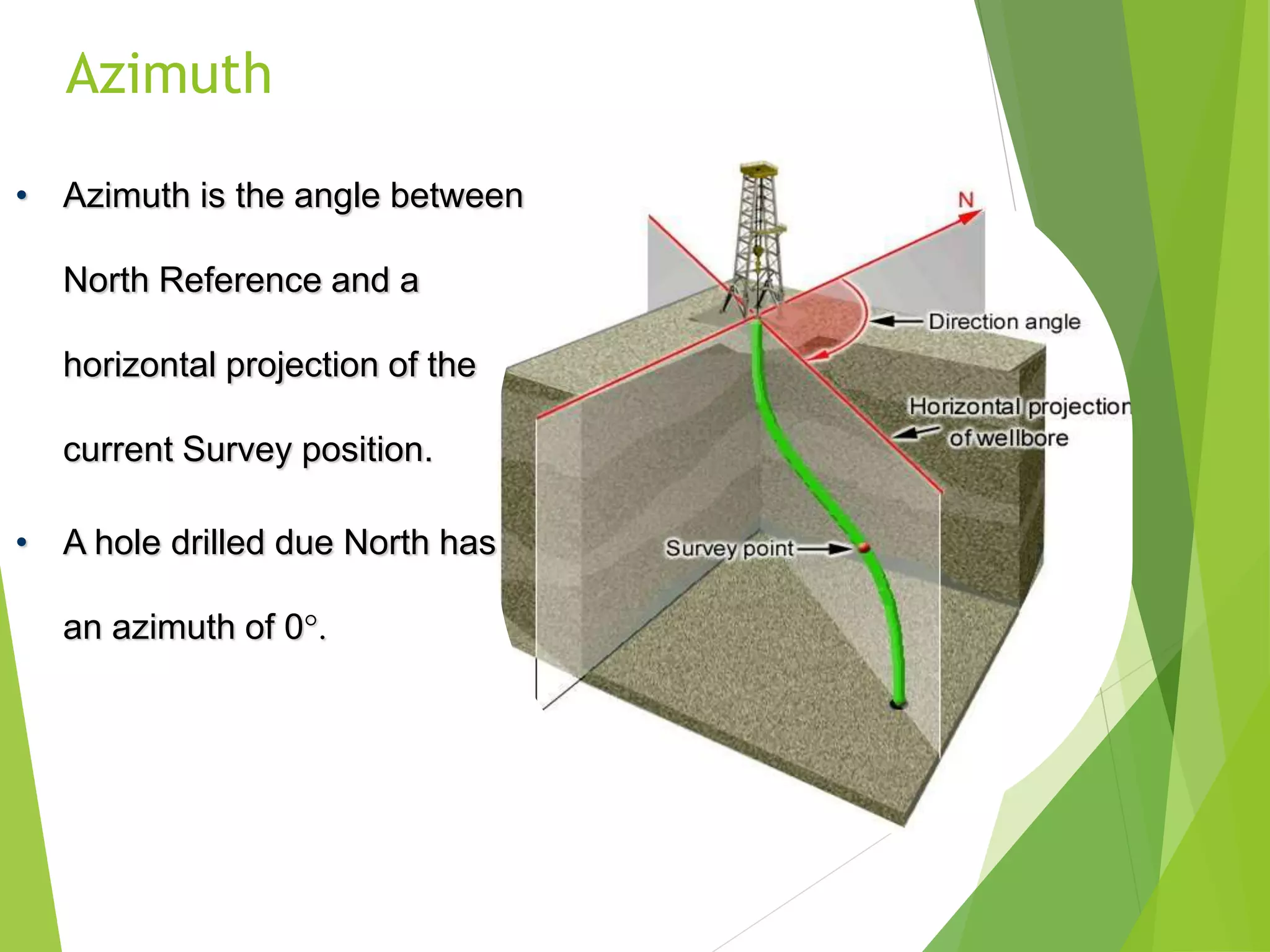
• Azimuth is the angle between
North Reference and a
horizontal projection of the
current Survey position.
• A hole drilled due North has
an azimuth of 0°.
Azimuth
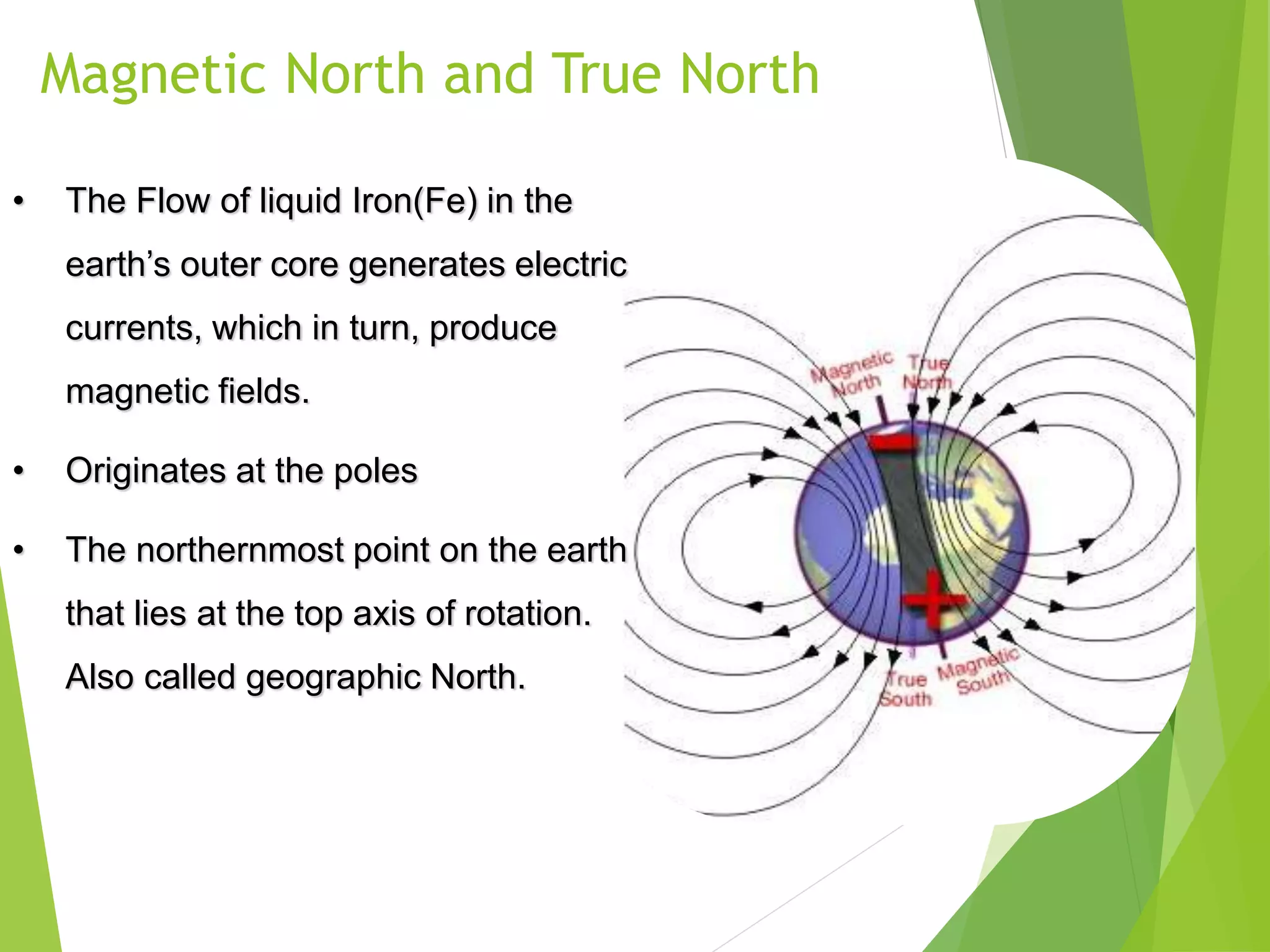
Magnetic North and True North
• The Flow of liquid Iron(Fe) in the
earth’s outer core generates electric
currents, which in turn, produce
magnetic fields.
• Originates at the poles
• The northernmost point on the earth
that lies at the top axis of rotation.
Also called geographic North.
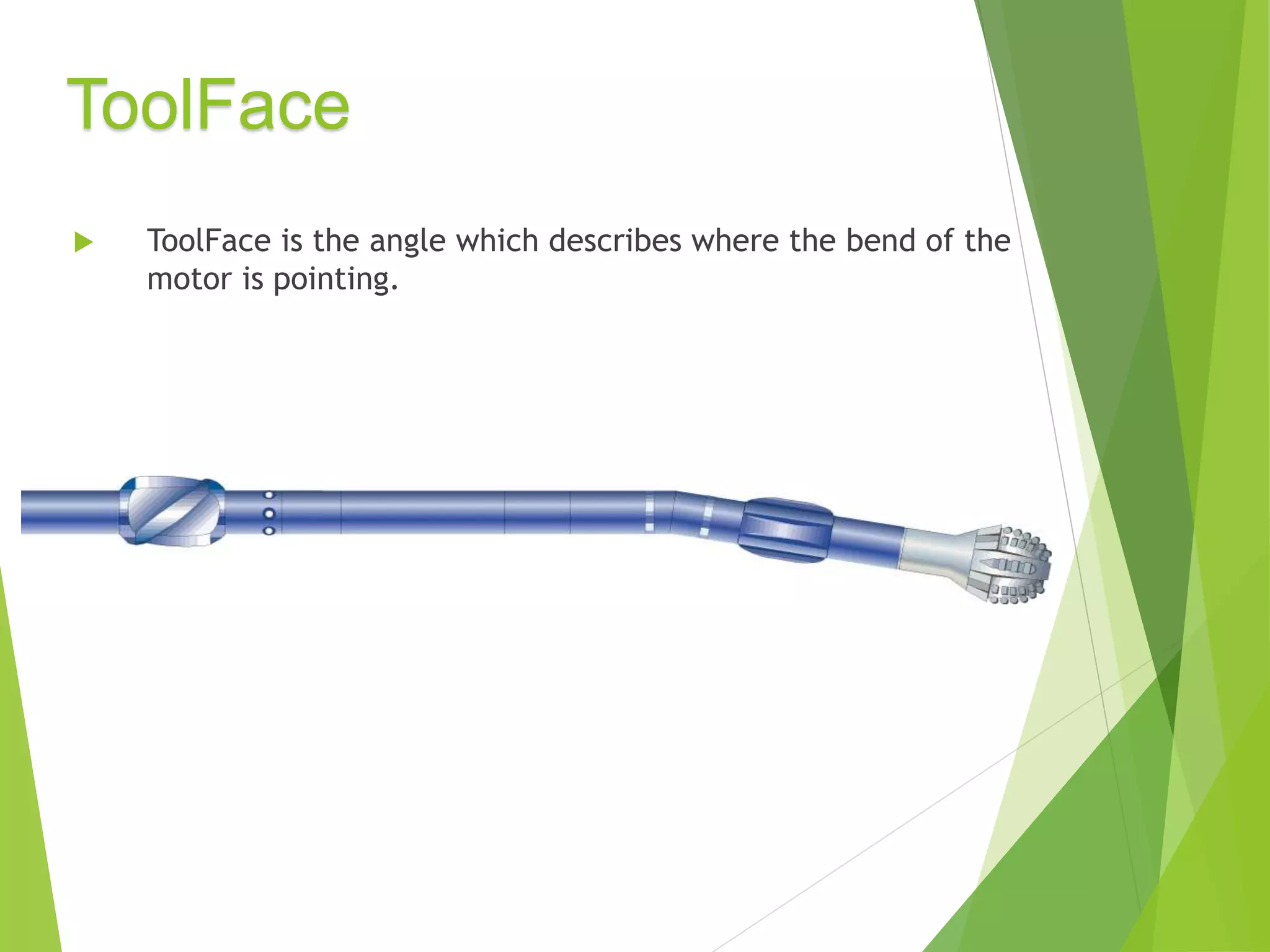
ToolFace
 ToolFace is the angle which describes where the bend of the
motor is pointing.
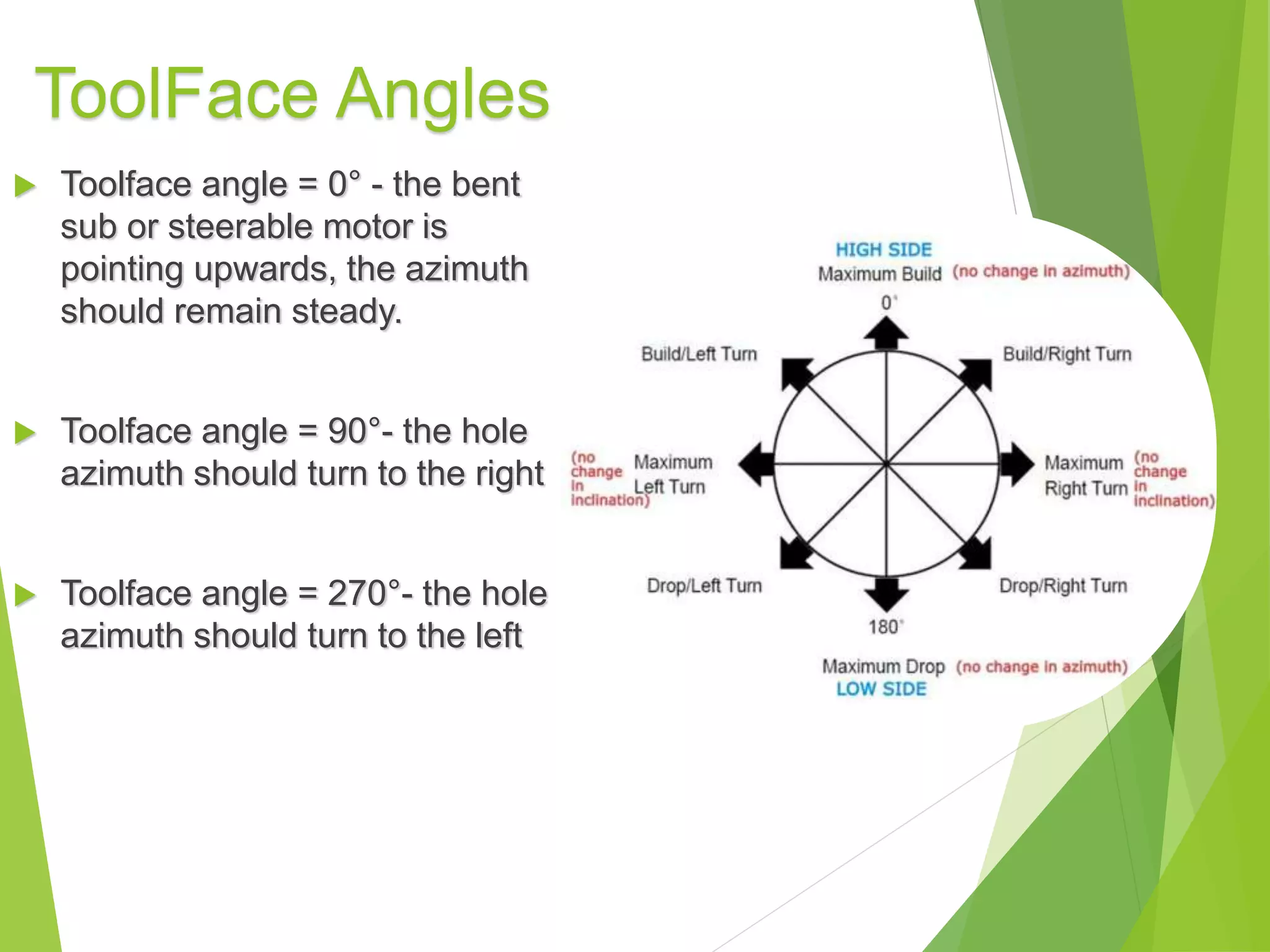
ToolFace Angles
 Toolface angle = 0° - the bent
sub or steerable motor is
pointing upwards, the azimuth
should remain steady.
 Toolface angle = 90°- the hole
azimuth should turn to the right
 Toolface angle = 270°- the hole
azimuth should turn to the left
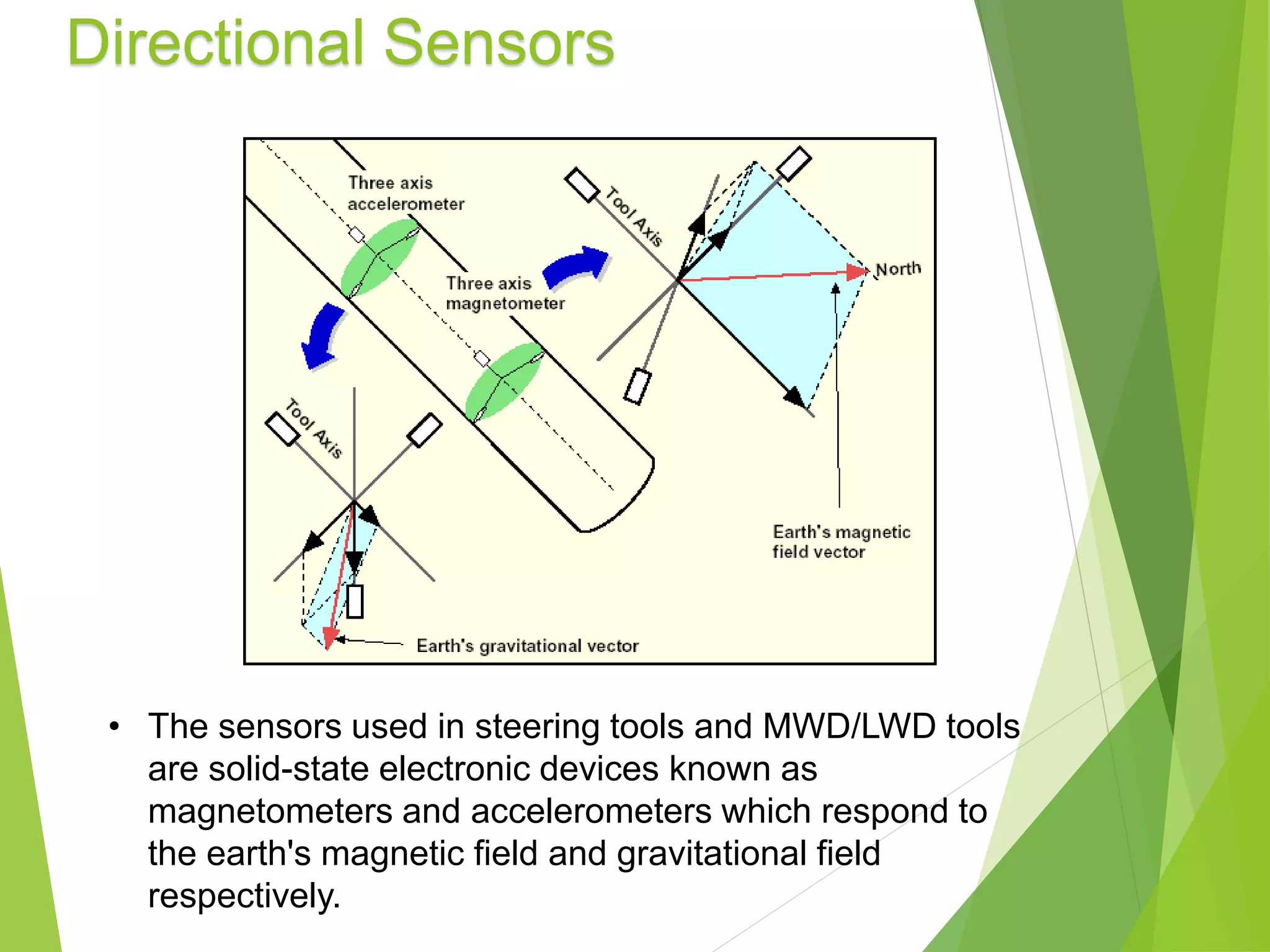
Directional Sensors
• The sensors used in steering tools and MWD/LWD tools
are solid-state electronic devices known as
magnetometers and accelerometers which respond to
the earth's magnetic field and gravitational field
respectively.
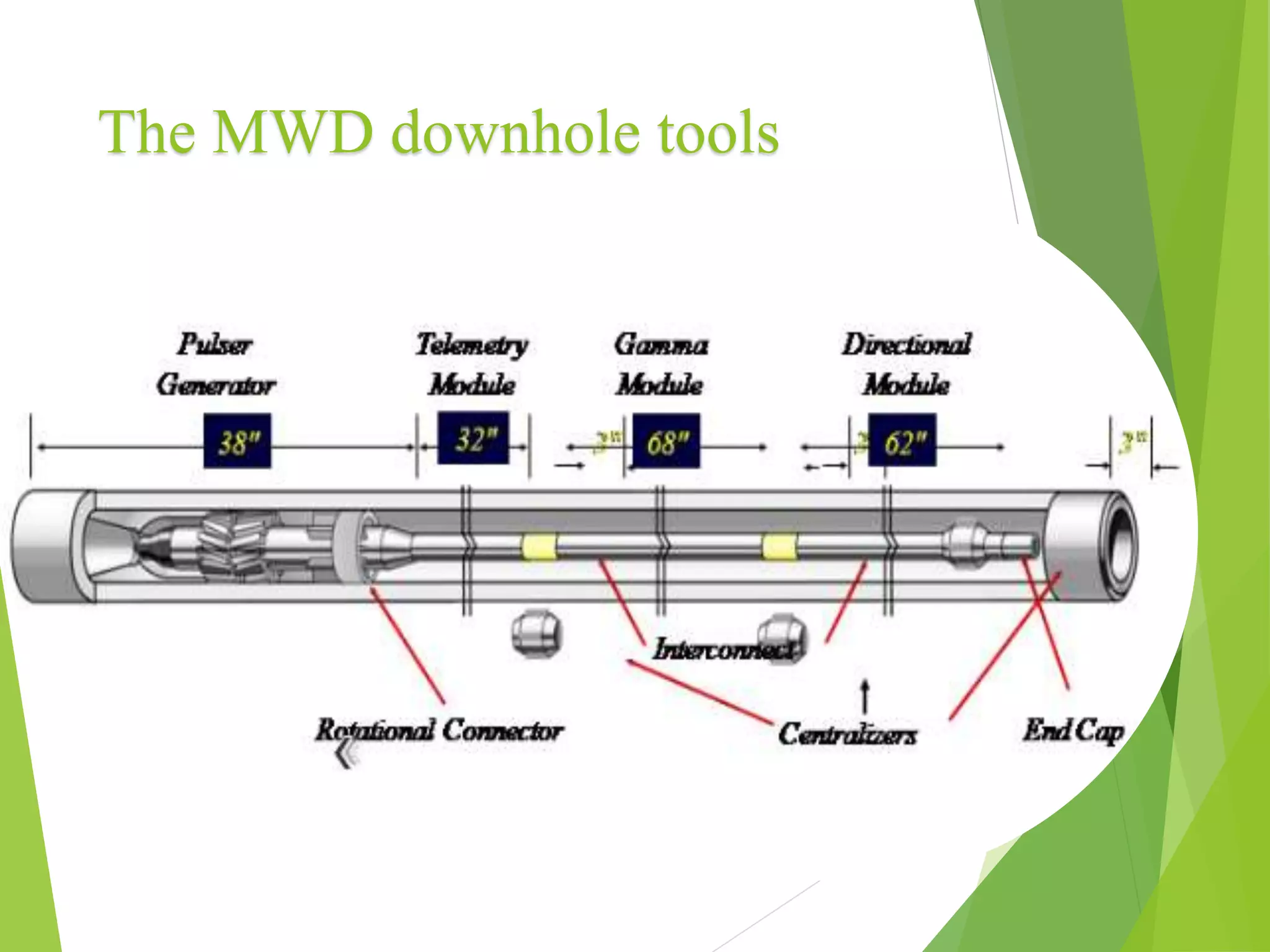
The MWD downhole tools
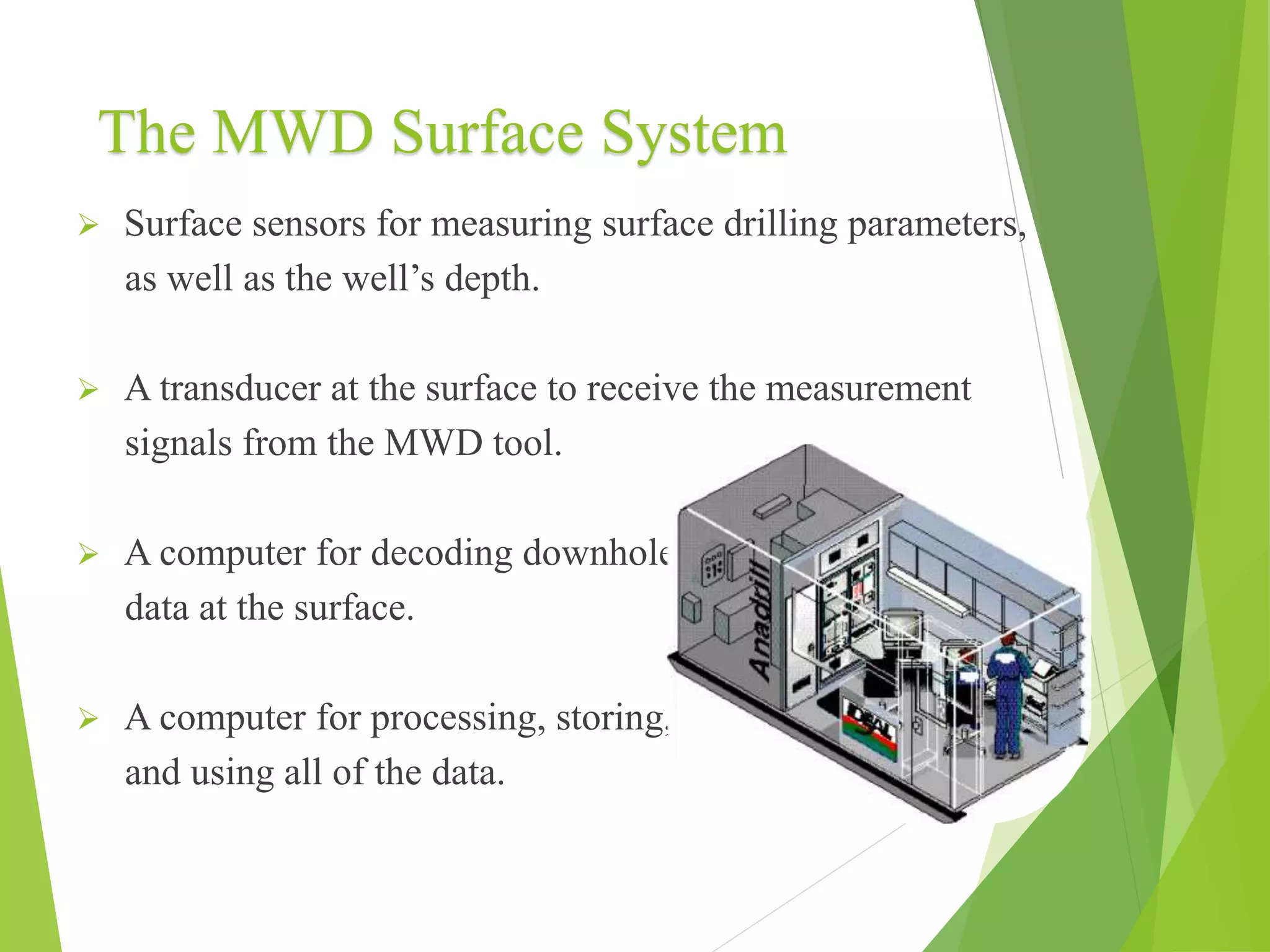
The MWD Surface System
 Surface sensors for measuring surface drilling parameters,
as well as the well’s depth.
 A transducer at the surface to receive the measurement
signals from the MWD tool.
 A computer for decoding downhole
data at the surface.
 A computer for processing, storing,
and using all of the data.
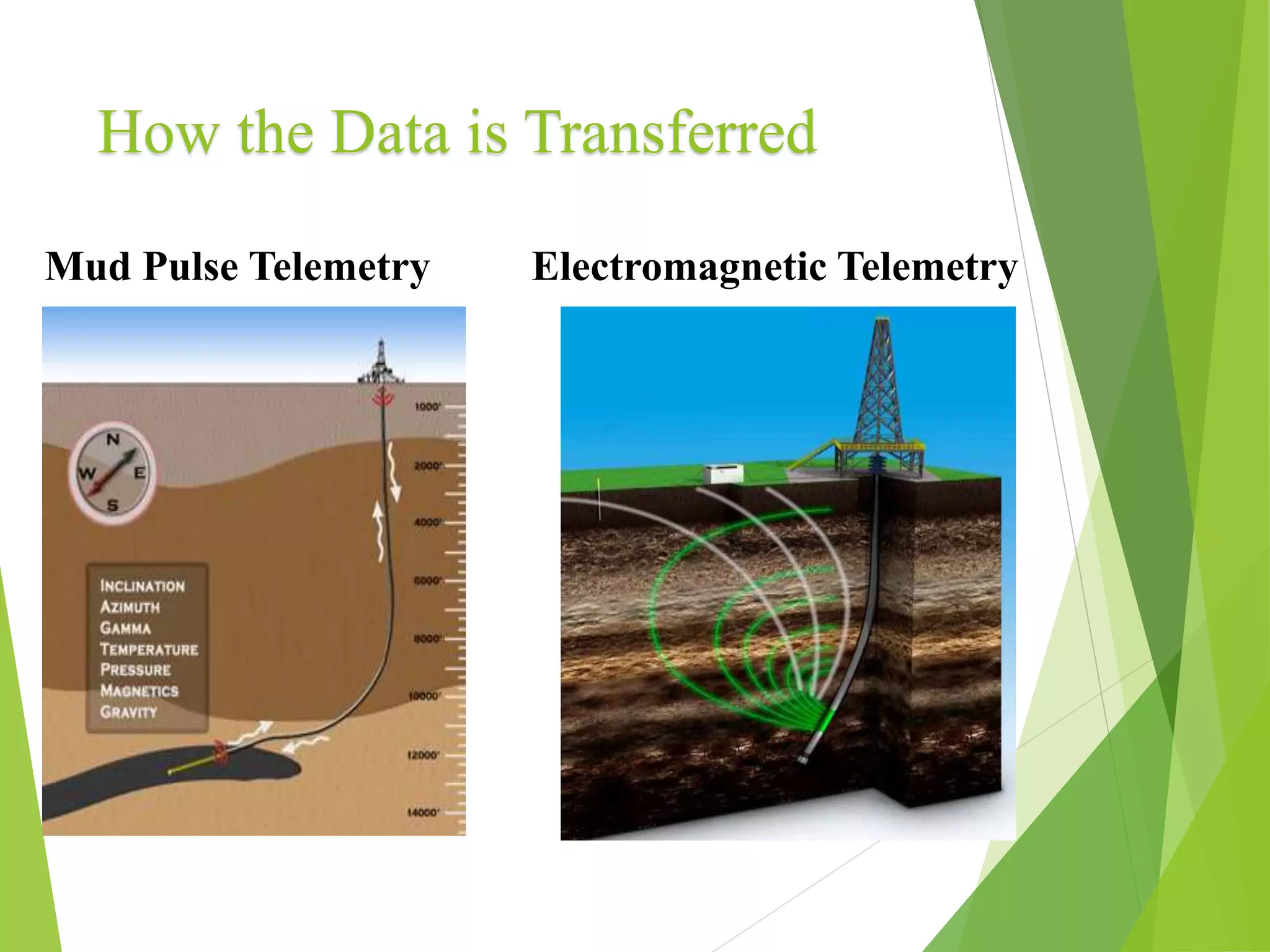
How the Data is Transferred
Mud Pulse Telemetry Electromagnetic Telemetry
Mud Pulse Telemetry
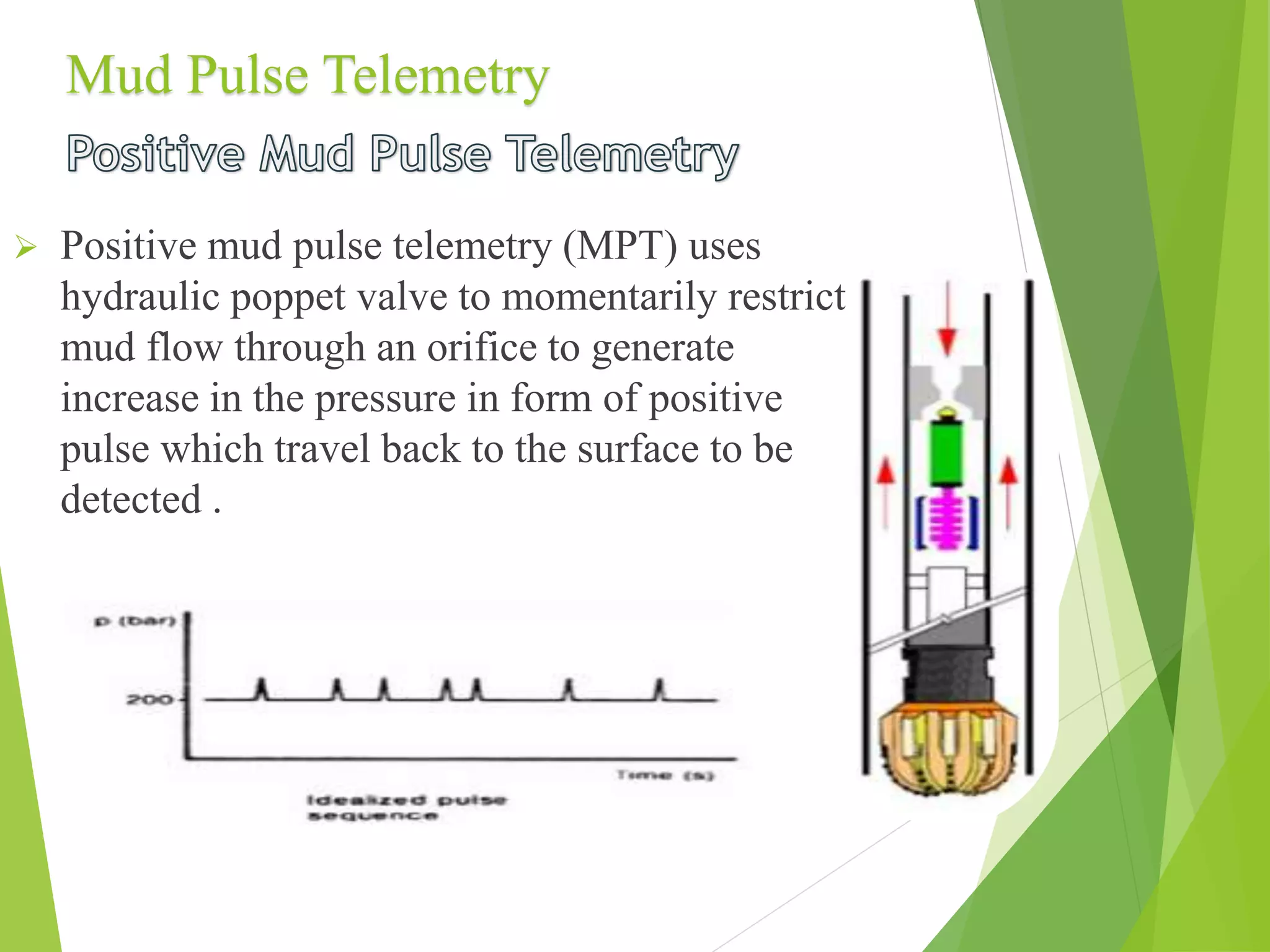
 Positive mud pulse telemetry (MPT) uses
hydraulic poppet valve to momentarily restrict
mud flow through an orifice to generate
increase in the pressure in form of positive
pulse which travel back to the surface to be
detected .
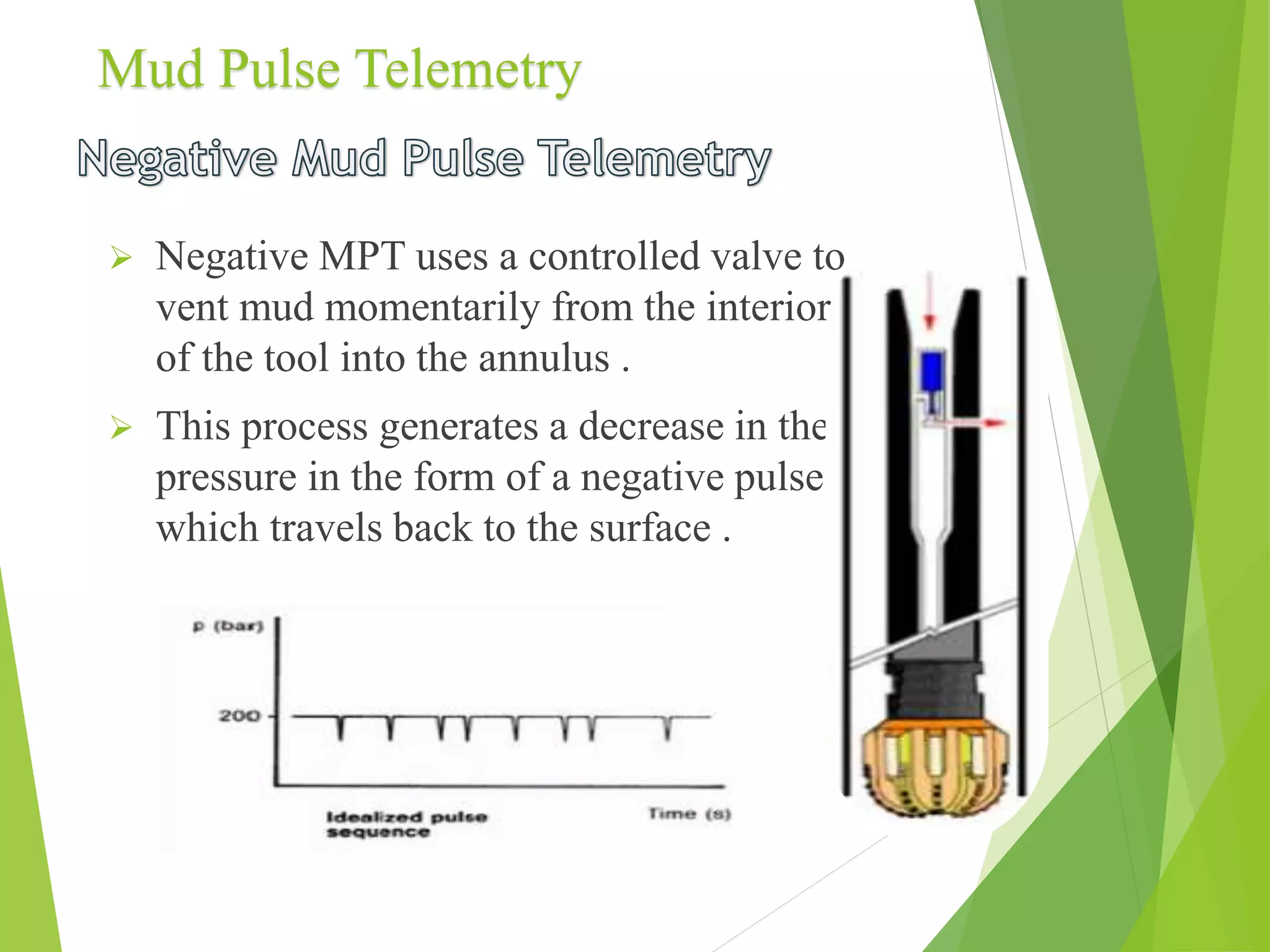
 Negative MPT uses a controlled valve to
vent mud momentarily from the interior
of the tool into the annulus .
 This process generates a decrease in the
pressure in the form of a negative pulse
which travels back to the surface .
Mud Pulse Telemetry
Electromagnetic Telemetry
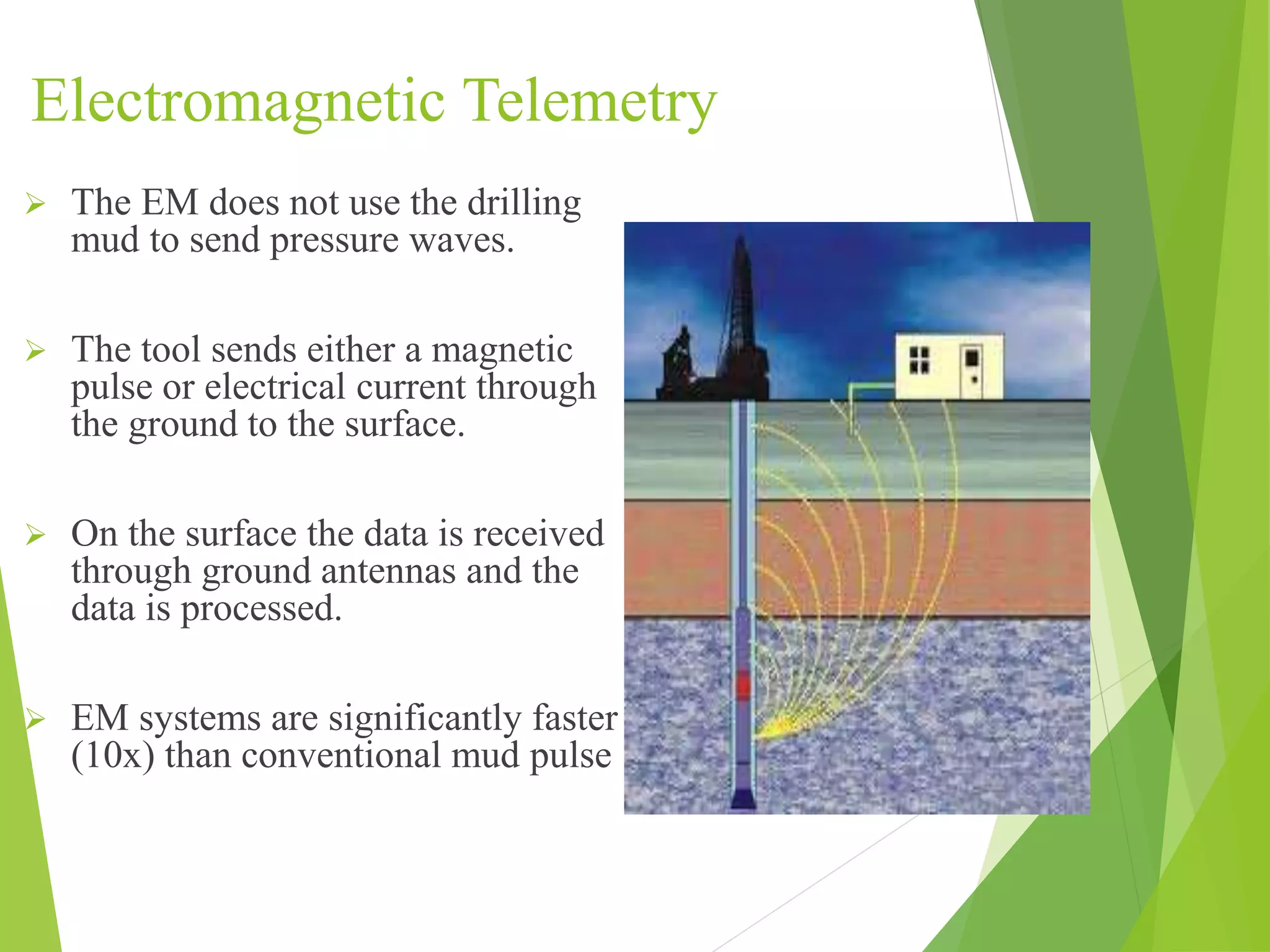
 The EM does not use the drilling
mud to send pressure waves.
 The tool sends either a magnetic
pulse or electrical current through
the ground to the surface.
 On the surface the data is received
through ground antennas and the
data is processed.
 EM systems are significantly faster
(10x) than conventional mud pulse
EM & MPT
 EM systems have no moving parts and does not create
significant restrictions in the drill string.
 As a result, it is more reliable and there is less damage
from erosion caused by drill solids.
 EM tools have depth limitations which are a function
of how much power can be supplied by batteries for the
duration of the drilling interval, and at higher power
settings the battery costs may be significant.
Geosteering
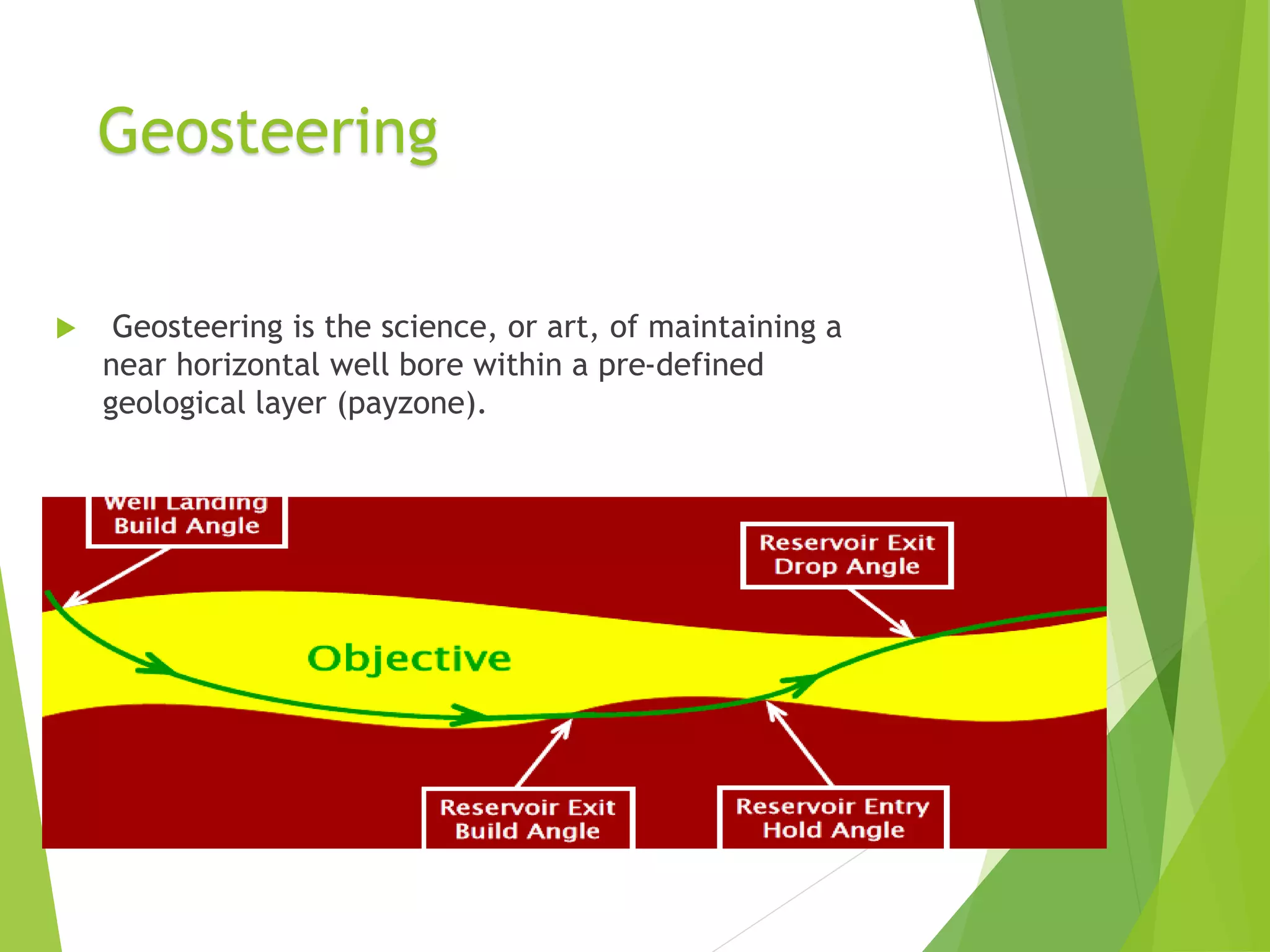
 Geosteering is the science, or art, of maintaining a
near horizontal well bore within a pre-defined
geological layer (payzone).
Geosteering
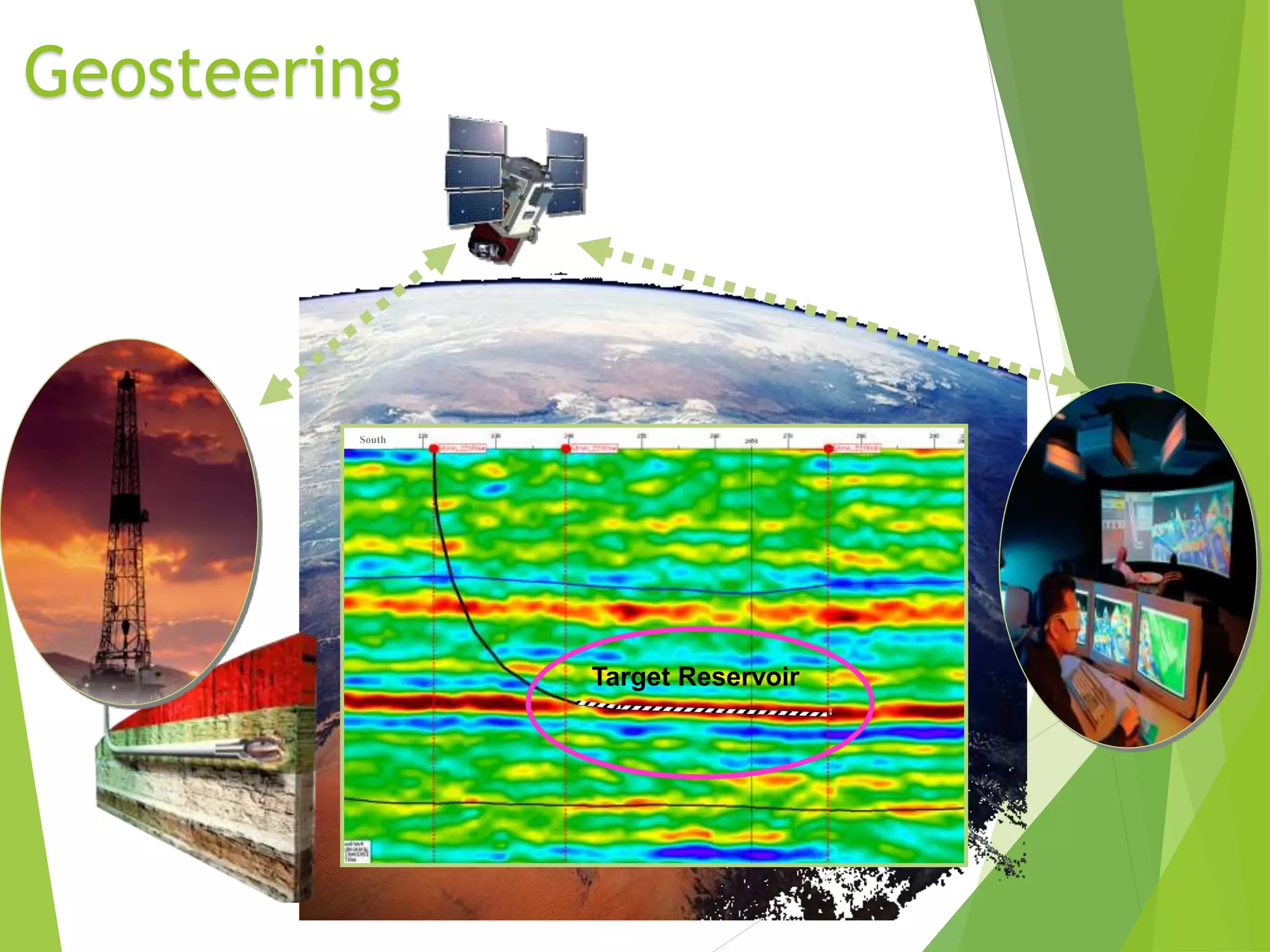
South
Target Reservoir
 Real-time decision making and well steering
 Effective placement of a well
 Maximize reservoir exposure
 Identify geohazards
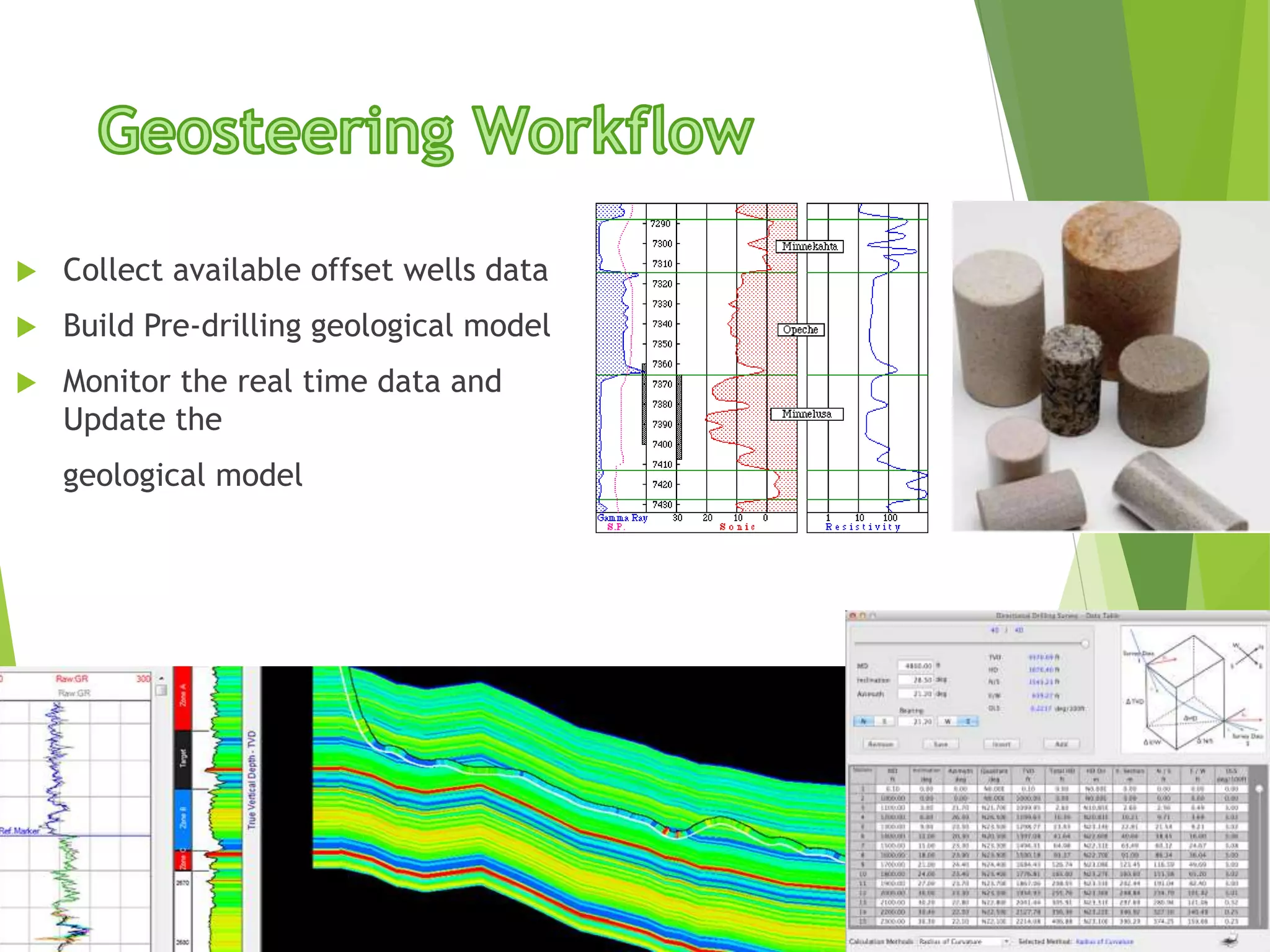
 Collect available offset wells data
 Build Pre-drilling geological model
 Monitor the real time data and
Update the
geological model
 MWD/LWD technology is showing tremendous potential
to replace open hole wireline logging
 The MWD/LWD will continue its growth by using
technology to increase the efficiency and decrease the
cost of drilling and evaluating wellbores.
 Geosteering enhances early production by maximizing
reservoir contact
 Geosteering is proved technology for successful drilling
References
 Baker Hughes. (1997). Baker Hughes INTEQ's Guide to Measurement While
Drilling. Information Guide, 1-142.
 Cathedral Energy Services. (2014, March 10). MWD, Electromagnetic.
 Choudhary, D. (2011, July 5). Directional Drilling Technology. Retrieved from
Basic Terminologies Related to Directional Drilling:
http://directionaldrilling.blogspot.com/2011/07/basic-terminologies-
related-to.html
 Crain, E. R. (2014). Geosteering With MWD Data. P. Eng.
 Lamont-Doherty Earth Observatory. (February 2008). An Introduction to
Logging While Drilling. Seminar to Marine Geophysics, 1-5.
 Middle East Technical University. (n.d.). Chapter 4, Measurement While
Drilling.
 Mottahedeh, R. (2014). Horizontal Well Geo-Navigation: Planning,
Monitoring, and Geosteering.
 Schlumberger. (2007). Schlumberger Logging School. Houston.
 Schlumberger. (2014, March 10). Oilfield Glossary. Retrieved from Gravity
Toolface:
http://www.glossary.oilfield.slb.com/en/Terms/g/gravity_toolface.aspx

Measurement While Drilling (MWD)

  • 2.
    Outline  Introduction  MWDvs. LWD  LWD vs. Wireline Decision Making  MWD output  Signal Transmission Methods  MWD System Components  Geosteering  Conclusion
  • 3.
    Introduction What is MWD? MeasurementWhile Drilling (MWD) systems measure formation properties (e.g. resistivity, natural gamma ray, porosity), wellbore geometry (inclination, azimuth), drilling system orientation (tool face), and mechanical properties of the drilling process.
  • 4.
    MWD vs LWD Loggingwhile drilling (LWD) is closely related to MWD. LWD provides formation measurements, while MWD provides drilling mechanics and survey measurements. MWD • Inclination, azimuth, tool face • Rotational speed of the drill string • Smoothness of that rotation • Type and severity of any vibration downhole • Downhole temperature • Torque and weight on bit • Mud flow volume LWD • density • porosity • resistivity • acoustic-caliper • inclination at the drill bit (NBI) • magnetic resonance • formation pressure
  • 5.
  • 6.
    Wireline vs. LWD Wireline small, light and delicate  since the 30s  high data speeds  easy communication  good borehole contact  powered through cable  takes time  after-the-fact  problem at high deviation  susceptible to hole condition LWD  big, heavy and tough  since the 70s  slow telemetry  limited control  subject to drilling  batteries and mud turbine  real-time  can log in any direction  more capable in tough environment
  • 7.
    Real-time Surveys for DirectionalControl  Inclination  Azimuth  Toolface
  • 8.
    Inclination • Inclination isthe angle between a vertical line and the path of the well bore at that point. • An inclination of 0° is a vertical hole. • An inclination of 90° is a horizontal hole.
  • 9.
    • Azimuth isthe angle between North Reference and a horizontal projection of the current Survey position. • A hole drilled due North has an azimuth of 0°. Azimuth
  • 10.
    Magnetic North andTrue North • The Flow of liquid Iron(Fe) in the earth’s outer core generates electric currents, which in turn, produce magnetic fields. • Originates at the poles • The northernmost point on the earth that lies at the top axis of rotation. Also called geographic North.
  • 11.
    ToolFace  ToolFace isthe angle which describes where the bend of the motor is pointing.
  • 12.
    ToolFace Angles  Toolfaceangle = 0° - the bent sub or steerable motor is pointing upwards, the azimuth should remain steady.  Toolface angle = 90°- the hole azimuth should turn to the right  Toolface angle = 270°- the hole azimuth should turn to the left
  • 13.
    Directional Sensors • Thesensors used in steering tools and MWD/LWD tools are solid-state electronic devices known as magnetometers and accelerometers which respond to the earth's magnetic field and gravitational field respectively.
  • 14.
  • 15.
    The MWD SurfaceSystem  Surface sensors for measuring surface drilling parameters, as well as the well’s depth.  A transducer at the surface to receive the measurement signals from the MWD tool.  A computer for decoding downhole data at the surface.  A computer for processing, storing, and using all of the data.
  • 16.
    How the Datais Transferred Mud Pulse Telemetry Electromagnetic Telemetry
  • 17.
    Mud Pulse Telemetry Positive mud pulse telemetry (MPT) uses hydraulic poppet valve to momentarily restrict mud flow through an orifice to generate increase in the pressure in form of positive pulse which travel back to the surface to be detected .
  • 18.
     Negative MPTuses a controlled valve to vent mud momentarily from the interior of the tool into the annulus .  This process generates a decrease in the pressure in the form of a negative pulse which travels back to the surface . Mud Pulse Telemetry
  • 19.
    Electromagnetic Telemetry  TheEM does not use the drilling mud to send pressure waves.  The tool sends either a magnetic pulse or electrical current through the ground to the surface.  On the surface the data is received through ground antennas and the data is processed.  EM systems are significantly faster (10x) than conventional mud pulse
  • 20.
    EM & MPT EM systems have no moving parts and does not create significant restrictions in the drill string.  As a result, it is more reliable and there is less damage from erosion caused by drill solids.  EM tools have depth limitations which are a function of how much power can be supplied by batteries for the duration of the drilling interval, and at higher power settings the battery costs may be significant.
  • 21.
    Geosteering  Geosteering isthe science, or art, of maintaining a near horizontal well bore within a pre-defined geological layer (payzone).
  • 22.
  • 23.
     Real-time decisionmaking and well steering  Effective placement of a well  Maximize reservoir exposure  Identify geohazards
  • 24.
     Collect availableoffset wells data  Build Pre-drilling geological model  Monitor the real time data and Update the geological model
  • 25.
     MWD/LWD technologyis showing tremendous potential to replace open hole wireline logging  The MWD/LWD will continue its growth by using technology to increase the efficiency and decrease the cost of drilling and evaluating wellbores.  Geosteering enhances early production by maximizing reservoir contact  Geosteering is proved technology for successful drilling
  • 26.
    References  Baker Hughes.(1997). Baker Hughes INTEQ's Guide to Measurement While Drilling. Information Guide, 1-142.  Cathedral Energy Services. (2014, March 10). MWD, Electromagnetic.  Choudhary, D. (2011, July 5). Directional Drilling Technology. Retrieved from Basic Terminologies Related to Directional Drilling: http://directionaldrilling.blogspot.com/2011/07/basic-terminologies- related-to.html  Crain, E. R. (2014). Geosteering With MWD Data. P. Eng.  Lamont-Doherty Earth Observatory. (February 2008). An Introduction to Logging While Drilling. Seminar to Marine Geophysics, 1-5.  Middle East Technical University. (n.d.). Chapter 4, Measurement While Drilling.  Mottahedeh, R. (2014). Horizontal Well Geo-Navigation: Planning, Monitoring, and Geosteering.  Schlumberger. (2007). Schlumberger Logging School. Houston.  Schlumberger. (2014, March 10). Oilfield Glossary. Retrieved from Gravity Toolface: http://www.glossary.oilfield.slb.com/en/Terms/g/gravity_toolface.aspx