EPRASHEED
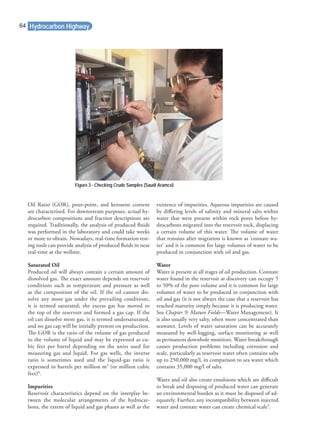
signature series
www.saudiarabiaoilandgas.com
2009 – Issue 10
Brazil Oil & Gas, tt_nrg and Norway Oil & Gas
100 km
Raven
Eastern Mediterranean Sea
Nile Delta
100 km
Raven
Eastern Mediterranean Sea
Nile Delta
Drillstem Testing for
Deepwater WellsManifa
KSA SPE Technical
Symposium Program
Inside
Baker Hughes Incorporated Advancing Reservoir Performance
Technology and Expertise
to Create More Value from
Your Reservoir
**
To
di
cu
al
at
di
©2009BakerHughesIncorporated.AllRightsReserved.25419
Every day, in oil and gas fields around the world, Baker Hughes experts evaluate customer needs, engineer
systems to match each application, and deliver advanced technologies that improve operating efficiency and
create more value.
Our reservoir consulting services help you understand how to exploit the economic potential of your
assets. Our drilling, evaluation, completion and production technologies consistently achieve superior results
that lower costs, reduce risk, improve productivity and increase ultimate recovery.
Whether you are exploiting existing reserves or exploring new fields, Baker Hughes award-winning
technologies can help you cut costs and advance the performance of your reservoir.
www.bakerhughes.com
** IMAGE AREA TIP **
To move image area up without
distorting curve design: group logo,
curves and image area, then move it
all up. Grab only the 2 anchor points
at the bottom of image area with the
direct selection tool and pull down.
EPRASHEED
signature series
2009 – Issue 10
Houston
n David Jones
david.jones@eprasheed.com
Tel: (1) 281 793 4314
n William Bart Goforth
william.goforth@eprasheed.com
Tel: (1) 713 304 6119
Brazil
n Ana Felix
afelix@braziloilandgas.com
Tel: (55) 21 9714 8690
n Fabio Jones
fabio.jones@braziloilandgas.com
Tel: (55) 21 9392 7821
n Roberto S. Zangrando
rzangrando@braziloilandgas.com
Tel: (55) 22 8818 8507
ADVERTISERS:
BAKER HUGHES - pages 2-3, SCHLUMBERGER - pages 4-5, BAKER HUGHES CENTRILIFT - page 7, SAC - page 9,
TAM - page 19, HALLIBURTON - page 99 and BAKER HUGHES ATLAS - page 100
Contents
n Head Office
Tel: (44) 207 193 1602
United Kingdom
n Brian Passey
brian@bspmedia.com
n Sally Cole
sally@bspmedia.com
Saudi Arabia
n Akram ul Haq
PO BOX 3260, Jeddah 21471
akram.ul.haq@saudiarabiaoilandgas.com
Tel: (966) 557 276 426
n Mohanned AlSagri
mohanned.alsagri@saudiarabiaoilandgas.com
Editors
Design
CEO and Founder
EPRasheed
Wajid Rasheed
wajid.rasheed@eprasheed.com
Sue Smith
JC Cunha (Technology)
Majid Rasheed
Mauro Martins
Contacts
www.saudiarabiaoilandgas.com
8
24
36
42
74
60
10
NOTE FROM KSA SPE TECHNICAL SYMPOSIUM AND EXHIBITION CHAIRMAN
FROM THE ARAMCO NEWSROOM
• CEO’s Advice – Chart Your Future - Page 10
• New Geoseismic Processing Method Patented - Page 11
• Nasser: People Bridge Gap to Future - Page 12
COVER STORY: INNOVATIVE E&P TECHNOLOGIES WORKSHOP HELD
IN AL-KHOBAR
Two-day workshop to discuss how recent advances in formation evaluation, drilling and completion
technologies can maximise performance and production
THE ROLE OF OPEN HOLE PACKERS FOR COMPLETION OPERATIONS
IN SAUDI ARABIA
By Paolo Gavioli, Baker Oil Tools
OPTIMIZING POWERED ROTARY STEERING THROUGH BETTER
UNDERSTANDING OF THE DOWNHOLE ENVIRONMENT
By F. Al-Bani, N.Galindez and P. Carpen, Saudi Aramco; F. Mounzer and D. Kent, Baker Hughes
DRILLSTEM TESTING FOR HIGH PRESSURE DEEPWATER WELLS:
A NONCEMENTED FLOATING TIEBACK LINER TECHNIQUE
By Sameh Hussein, Baker Hughes Inc - Baker Oil Tools;Tom Scoular and Yuejin Luo, BP Plc. - BP
Copyright 2008, Society of Petroleum Engineers
A STRUCTURED APPROACH TO BENCHMARKING BIT RUNS AND
INDENTIFYING GOOD PERFORMANCE FOR OPTIMIZATION OF
FUTURE APPLICATIONS
By C. Miller, Saudi Aramco, and R. Duerholt, A. Richards, and N. Briggs, Baker Hughes
WHAT’S IN A WET BARREL – AN EXCERPT FROM THE HYDROCARBON
HIGHWAY
By Wajid Rasheed
MANIFA FIELD, CAUSEWAY AND ISLANDS, SAUDI ARABIA
By Osamah A. Al-Dakhil and David A. Close
KSA SPE TECHNICAL SYMPOSIUM PROGRAM
EDITORIAL 2009 CALENDAR 98
H a ra d h 1 425 -0 (A W B ) W ellp ath
T 1
T 2
T 3
H a ra d h 1 425 -2 (P W B )
T ie O n 10,955 ft M D
9.625 inch
7 inch
TrueVerticalDepth(ft)
H a ra d h 1 425 -1 (P W B ) T D 1 5,94 9 ft M D
H a ra dh 1 425 -0 (A W B )
H a ra dh 1 425 -2 (P W B ) W ellpath
H a ra dh 1 42 5 -1 (P W B ) W ellpath
10
00
30
00
70
00
69
50
69
00
68
50
68
00
North
(ft)
20
00
10
00
0
East (ft)
0
20
00
30
00
40
00
50
00
60
00
70
00
80
00
90
00
10
00
0
H a ra d h 1 425 -0 (A W B ) W ellp ath
T 1
T 2
T 3
H a ra d h 1 425 -2 (P W B )
T ie O n 10,955 ft M D
9.625 inch
7 inch
TrueVerticalDepth(ft)
H a ra d h 1 425 -1 (P W B ) T D 1 5,94 9 ft M D
H a ra dh 1 425 -0 (A W B )
H a ra dh 1 425 -2 (P W B ) W ellpath
H a ra dh 1 42 5 -1 (P W B ) W ellpath
10
00
30
00
70
00
69
50
69
00
68
50
68
00
North
(ft)
20
00
10
00
0
East (ft)
0
20
00
30
00
40
00
50
00
60
00
70
00
80
00
90
00
10
00
0
20
14
84
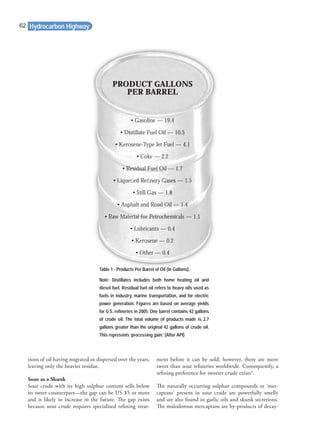
PRODUCT GALLONS
PER BARREL
• Gasoline — 19.4
• Distillate Fuel Oil — 10.5
• Kerosene-Type Jet Fuel — 4.1
• Coke — 2.2
• Residual Fuel Oil — 1.7
• Liquefied Refinery Gases — 1.5
• Still Gas — 1.8
• Asphalt and Road Oil — 1.4
CEN
Baker Hughes Incorporated Advancing Reservoir Performance
©2009 Baker Hughes Incorporated. All Rights Reserved. COR-09-25419.
Prolonglifeability
[pruh-lawng-lahyf-uh-bil-i-tee]
n. Skill or ability of Baker Hughes to extend ESP run life.
Baker Hughes delivers unmatched design, support and service to help you meet
your production performance objectives. And with the widest range of ESP
experience, technology and expertise, Baker Hughes can tailor solutions to meet
your financial objectives as well.
Our fit-for-purpose ESP technology is designed to deliver engineered expertise
that optimizes production at the lowest possible lifting costs.
Contact Baker Hughes today to learn how Centrilift Prolonglifeability can
advance the performance of your reservoir.
www.bakerhughes.com/centrilift
CEN-09-25457-Saudia.Arabia.O&G-Ad-rev.indd 1 4/17/2009 3:55:35 PM
NOTE FROM KSA SPE TECHNICAL SYMPOSIUM AND EXHIBITION CHAIRMAN8
Welcome to Issue 10
of Saudi Arabia Oil &
Gas and the 2009 SPE
Saudi Arabia Tech-
nical Symposium and
Exhibition
On behalf of the Society of Petroleum Engineers Saudi
Arabia Section, it gives me great pleasure to welcome you
to the 2009 SPE Technical Symposium and Exhibition
and Issue 10 of Saudi Arabia Oil & Gas Magazine. We
are aiming for the technical symposium to be one of
the most important events in Saudi Arabia’s petroleum
sector.
The Program Committee has worked hard to bring you
an exceptional Technical Symposium under the special
theme “Pushing the Technology Envelope for Higher
Recovery”. The theme was carefully selected to promote
the development and deployment of new technologies
for enhanced and cost-effective discovery and recovery
of hydrocarbon reserves. This correlates well with the
current situation, where higher levels of operational
efficiencies are more than ever needed to reduce overall
field development and production costs by deploying
latest technologies.
The program offers 15 technical sessions with recognized
keynote and invited speakers, technical presentations
and posters, and special technical sessions. The special
feature of this year’s event is the exhibition that has been
planned for the first time to showcase latest technologies
needed to boost the growth of the regional upstream
industry. The response to the request for abstracts for
papers and posters this year was beyond expectations.
After a thorough review the technical committee has
endeavored to bring the best concepts and case histories
to the technical symposium with an aim to share the best
practices that have been adopted in the various parts of
the world.
The symposium also features a panel discussion delivered
by renowned industry leaders onTight Gas reservoirs, an
area so vital to fuel the economic growth for the region
in general and the kingdom in particular. The rationale
is to unlock challenges involved in the regional Tight
Gas market and have a strategy in place to exploit these
reserves and be able to support the need for natural gas
supply in the future.
Thisyear’ssymposiumisparticularlyspecial,asitfallsafter
the SPE Saudi Arabia Section’s celebration of the 50th
anniversary. Please come and join us at what is certain to
be very successful symposium and Exhibition.
On behalf of SPE KSA, we would like to thank Saudi
Arabia Oil & Gas Magazine for its support in providing
full coverage of the event.
In this issue, you will find articles ranging from
Manifa Causeway and Islands, a host of innovative
formation evaluation, drilling and completions papers
as well as ‘What’s in a Wet Barrel – an excerpt from The
Hydrocarbon Highway, by Wajid Rasheed.
The magazine helps promote interaction between
petroleum experts within KSA and internationally, and
has proven to provide a valuable channel for technical
EP publishing.
Thank you all.
Dr. Ashraf Al-Tahini,
2009 Symposium and Exhibition Chairman
NOTE FROM THE
CONFERENCE CHAIRMAN
DHAHRAN, April 15,
2009 -- Saudi Aramco’s
president and CEO em-
phasized the importance
of self-initiative to a group of young employees during
the Society of Petroleum Engineers’ (SPE) 2009 Young
Professionals Technical Symposium.
“Just as the company is committed to a long-range
program, so should each of you commit to your own
agenda of planning and preparing for the future ahead,”
Khalid A. Al-Falih said. “You must realize the huge im-
portance of self-initiative to your career. Take a look at
your specialties and sub-specialties, and make your own
roadmap to build competencies and stay current with
innovation.”
He added that expanding knowledge beyond one
area of expertise is another key to success. “Petroleum
engineers need to know about multiple disciplines, in-
cluding drilling, completion and production, forma-
tion, evaluation and geology,” said Al-Falih. “Similarly, a
broad understanding of applicable fields and disci-
plines, such as economics, business, IT, project man-
agement and law, is needed as the industry gets more
complex.”
He stressed the significance of soft skills that might be
overlooked in technical and scientific fields. “While tech-
nical content is essential
to your development,
the person who also
develops critical-think-
ing, negotiating and problem-solving skills will be better
positioned not only to contribute optimally to a project
but to be more competitive in advancing to more senior
levels.”
He urged young engineers to take advantage of profes-
sional societies that provide opportunities for knowl-
edge-sharing and networking. “You have already taken
an important step in this particular arena by your par-
ticipation in SPE International. Here, I would encour-
age you to take an active role — don’t just be a member;
be a leader,” he said.
Al-Falih also noted the company’s commitment to hu-
man resources development. “Given our ambitious
project slate and the knowledge- and innovation-in-
tensive future of E&P, continuous, calculated human
resources development clearly is our first priority. Such
strategic investments in these precious natural resources
hinge on something even more crucial than oil — and
that is our human resources,” he said.
“Everything is possible,” said Al-Falih. “You can advance
quickly within your profession, your technical field as
well as your management career path.”
From the Aramco Newsroom
by Rahmah I. Nawwab
CEO’s advice –
Chart Your Future
10
www.saudiarabiaoilandgas.com | SA O&G Issue 10
Khalid A. Al-Falih gives the opening remarks at the SPE
Young ProfessionalsTechnical Symposium.
From the Aramco Newsroom
www.saudiarabiaoilandgas.com | SA O&G Issue 10
11
Several methods to compute dip and azimuth from
seismic records have been proposed in the past. Some
required relatively large areas of seismic data and suf-
fered a loss of resolution. Others tended to amplify high-
frequency noise.
“An additional ‘icing on the cake’ is that our technology
overcomes these problems and offers the smoothing ca-
pability that conventional industry practices lack,” said
Faraj, who now is chief geophysicist of the Geophysical
Technical Services Division.
This newly patented technology is applied routinely to
seismic data at Saudi Aramco and has yielded accurate
results.
A benefit of this method is that it contributes significantly
to increasing the company’s success rate in locating wild-
cat exploratory wells or in placing wells in existing fields
to produce known accumulations of hydrocarbons.
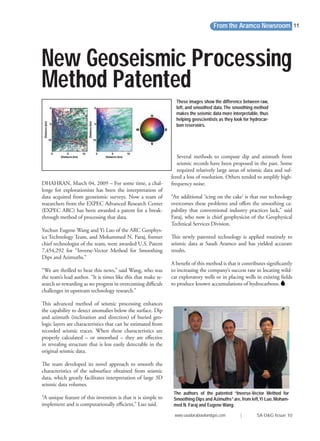
New Geoseismic Processing
Method Patented
DHAHRAN, March 04, 2009 – For some time, a chal-
lenge for explorationists has been the interpretation of
data acquired from geoseismic surveys. Now a team of
researchers from the EXPEC Advanced Research Center
(EXPEC ARC) has been awarded a patent for a break-
through method of processing that data.
Yuchun Eugene Wang and Yi Luo of the ARC Geophys-
ics Technology Team, and Mohammed N. Faraj, former
chief technologist of the team, were awarded U.S. Patent
7,454,292 for “Inverse-Vector Method for Smoothing
Dips and Azimuths.”
“We are thrilled to hear this news,” said Wang, who was
the team’s lead author. “It is times like this that make re-
search so rewarding as we progress in overcoming difficult
challenges in upstream technology research.”
This advanced method of seismic processing enhances
the capability to detect anomalies below the surface. Dip
and azimuth (inclination and direction) of buried geo-
logic layers are characteristics that can be estimated from
recorded seismic traces. When these characteristics are
properly calculated – or smoothed – they are effective
in revealing structure that is less easily detectable in the
original seismic data.
The team developed its novel approach to smooth the
characteristics of the subsurface obtained from seismic
data, which greatly facilitates interpretation of large 3D
seismic data volumes.
“A unique feature of this invention is that it is simple to
implement and is computationally efficient,” Luo said.
These images show the difference between raw,
left, and smoothed data.The smoothing method
makes the seismic data more interpretable, thus
helping geoscientists as they look for hydrocar-
bon reservoirs.
The authors of the patented “Inverse-Vector Method for
Smoothing Dips and Azimuths”are, from left,Yi Luo, Moham-
med N. Faraj and Eugene Wang.
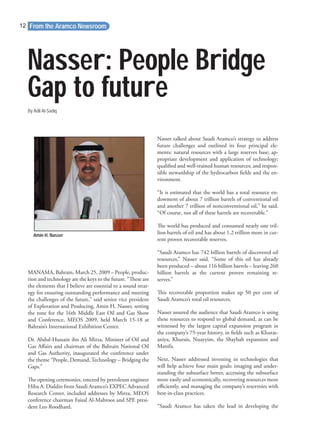
Nasser: People Bridge
Gap to future
MANAMA, Bahrain, March 25, 2009 – People, produc-
tion and technology are the keys to the future. “These are
the elements that I believe are essential to a sound strat-
egy for ensuring outstanding performance and meeting
the challenges of the future,” said senior vice president
of Exploration and Producing, Amin H. Nasser, setting
the tone for the 16th Middle East Oil and Gas Show
and Conference, MEOS 2009, held March 15-18 at
Bahrain’s International Exhibition Center.
Dr. Abdul-Hussain ibn Ali Mirza, Minister of Oil and
Gas Affairs and chairman of the Bahrain National Oil
and Gas Authority, inaugurated the conference under
the theme “People, Demand, Technology – Bridging the
Gaps.”
The opening ceremonies, emceed by petroleum engineer
Hiba A. Dialdin from Saudi Aramco’s EXPEC Advanced
Research Center, included addresses by Mirza, MEOS
conference chairman Faisal Al-Mahroos and SPE presi-
dent Leo Roodhard.
Nasser talked about Saudi Aramco’s strategy to address
future challenges and outlined its four principal ele-
ments: natural resources with a large reserves base; ap-
propriate development and application of technology;
qualified and well-trained human resources; and respon-
sible stewardship of the hydrocarbon fields and the en-
vironment.
“It is estimated that the world has a total resource en-
dowment of about 7 trillion barrels of conventional oil
and another 7 trillion of nonconventional oil,” he said.
“Of course, not all of these barrels are recoverable.”
The world has produced and consumed nearly one tril-
lion barrels of oil and has about 1.2 trillion more in cur-
rent proven recoverable reserves.
“Saudi Aramco has 742 billion barrels of discovered oil
resources,” Nasser said. “Some of this oil has already
been produced – about 116 billion barrels – leaving 260
billion barrels as the current proven remaining re-
serves.”
This recoverable proportion makes up 50 per cent of
Saudi Aramco’s total oil resources.
Nasser assured the audience that Saudi Aramco is using
these resources to respond to global demand, as can be
witnessed by the largest capital expansion program in
the company’s 75-year history, in fields such as Khuras-
aniya, Khurais, Nuayyim, the Shaybah expansion and
Manifa.
Next, Nasser addressed investing in technologies that
will help achieve four main goals: imaging and under-
standing the subsurface better, accessing the subsurface
more easily and economically, recovering resources more
efficiently, and managing the company’s reservoirs with
best-in-class practices.
“Saudi Aramco has taken the lead in developing the
By Adil Al-Sadiq
Amin H. Nasser
From the Aramco Newsroom12
most advanced reservoir simulator in the industry, which
has broken several industry records during its develop-
ment,” he said.
Resbots represent another technology that Saudi Ara-
mco is developing to better map these reservoirs.
“Resbots is the name we use for our invention of res-
ervoir robots, or reservoir nanorobots,” said Nasser. He
explained that large numbers of resbots will be sent into
the reservoir with injected water. They will move in the
reservoir, carried by the reservoir fluids, and record res-
ervoir pressure, temperature, fluid type and other prop-
erties. The resbots will continue their journey right up
through production, where they will be retrieved to
download all the information they have gathered.
Equally important is the human factor, he said. “Indeed,
the human capital is our most important asset.”
With the advent of new technologies, there is a growing
demand for competent people who are able to effectively
develop and deploy these technologies.
“We are moving into a digital, intelligent era, and up-
stream technology is becoming highly sophisticated,”
Nasser said. “We have to approach bridging the gap
between people and technology differently. … All dis-
ciplines have to understand each other and work in syn-
ergy.”
So, how do we bridge the gap?
“We are embarking on creating a world-class Upstream
Professional Development Center to be completed by
next year,” he said. “We expect around 500 fresh gradu-
ates and experienced professionals to participate in this
center, and we want them to hit the ground running.”
The Society of Petroleum Engineers held a dinner dur-
ing the conference to recognize and award members
that have contributed to their industry professionally
and technically.Among those honored were four Saudi
Aramco employees: Saeed M. Mubarak, Mohammed I.
Sowayigh, Abdulaziz A. AbdulKarim and Hilal H. Wa-
heed.
One highlight of the conference presentations was Na-
seem J. Dawood’s discussion about Saudi Aramco’s in-
novative development of its hydrocarbon wealth and
improving well performance. He emphasized the com-
pany’s use of advanced technologies to improve per-
formance, maintain production and reserves and lower
costs.
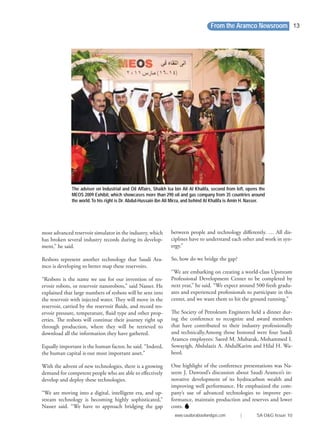
The adviser on Industrial and Oil Affairs, Shaikh Isa bin Ali Al Khalifa, second from left, opens the
MEOS 2009 Exhibit, which showcases more than 290 oil and gas company from 35 countries around
the world.To his right is Dr. Abdul-Hussain ibn Ali Mirza, and behind Al Khalifa is Amin H. Nasser.
From the Aramco Newsroom
www.saudiarabiaoilandgas.com | SA O&G Issue 10
13
Cover Story14
Managing Director, Baker Hugh-
es KSA John Prescott, welcomed
more than 120 participants
across various disciplines. Pres-
cott said, “Baker Hughes is com-
prised of eight product lines that
provide products and services for
drilling, formation evaluation
and production. This workshop
shows how our leading technologies and our effective
application of them creates added value for Saudi Ara-
mco. Marhaba.”
After making a series of 15 technical presentations
Baker Hughes product line experts were on hand to
discuss the day to day needs and specific challenges
faced by Saudi Aramco in its field development plans.
Here we consider each of the divisions and some of the
technologies presented at the workshop.
Baker Hughes INTEQ – delivers advanced drill-
ing technologies and services that deliver efficiency
and precise well placement. Major capabilities in-
clude directional drilling, Measurement-While-Drill-
ing (MWD), Logging-While-Drilling (LWD), and
InnovativeE&PTechnologies
Workshop Held in Al Khobar
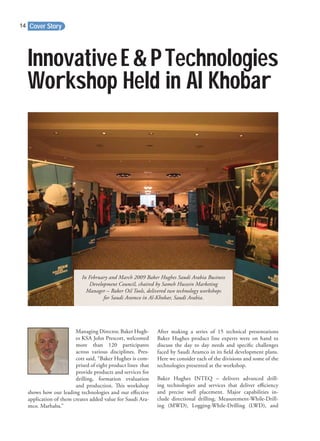
In February and March 2009 Baker Hughes Saudi Arabia Business
Development Council, chaired by Sameh Hussein Marketing
Manager – Baker Oil Tools, delivered two technology workshops
for Saudi Aramco in Al-Khobar, Saudi Arabia.
Cover Story
www.saudiarabiaoilandgas.com | SA O&G Issue 10
15
A presentation on Borehole Imaging Technologies and
Applications was made by Derick Zurcher, Geoscience
Manager, Baker Hughes KSA. This covered the different
types and scales of images through to optimised Well
Placement and fracture modeling in carbonates and
the latest geological software.
well-site information management services.
The AutoTrak™ rotary closed-loop drilling
system, automatically drills along a prepro-
grammed well path with higher penetration
rates and a smoother borehole than conven-
tional drilling systems.
Wael Darwish Business Development Man-
ager Baker Hughes – INTEQ began the tech-
nical workshop with a presentation entitled
“What is Reservoir Navigation?”.
Other presentations illustrated how real-time
utilization of LWD & Directional measure-
ments to land the well in the target horizon
and maintain the placement of the well bore
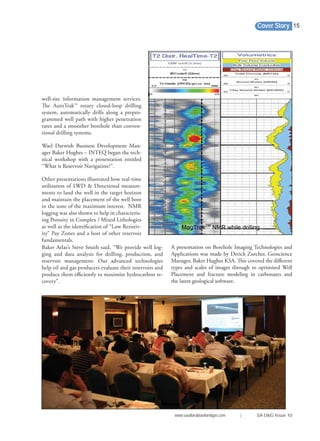
in the zone of the maximum interest. NMR
logging was also shown to help in characteris-
ing Porosity in Complex / Mixed Lithologies
as well as the identification of “Low Resistiv-
ity” Pay Zones and a host of other reservoir
fundamentals.
Baker Atlas’s Steve Smith said, “We provide well log-
ging and data analysis for drilling, production, and
reservoir management. Our advanced technologies
help oil and gas producers evaluate their reservoirs and
produce them efficiently to maximize hydrocarbon re-
covery”.
Cover Story
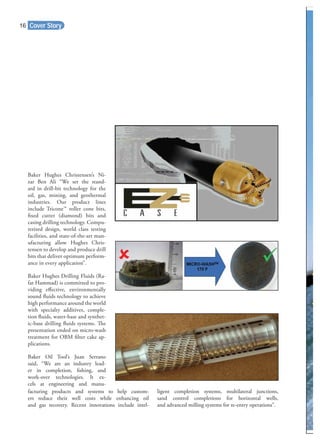
Baker Hughes Christensen’s Ni-
zar Ben Ali “We set the stand-
ard in drill-bit technology for the
oil, gas, mining, and geothermal
industries. Our product lines
include Tricone™ roller cone bits,
fixed cutter (diamond) bits and
casing drilling technology. Compu-
terized design, world class testing
facilities, and state-of-the-art man-
ufacturing allow Hughes Chris-
tensen to develop and produce drill
bits that deliver optimum perform-
ance in every application”.
Baker Hughes Drilling Fluids (Ra-
fat Hammad) is committed to pro-
viding effective, environmentally
sound fluids technology to achieve
high performance around the world
with specialty additives, comple-
tion fluids, water-base and synthet-
ic-base drilling fluids systems. The
presentation ended on micro-wash
treatment for OBM filter cake ap-
plications.
Baker Oil Tool’s Juan Serrano
said, “We are an industry lead-
er in completion, fishing, and
work-over technologies. It ex-
cels at engineering and manu-
facturing products and systems to help custom-
ers reduce their well costs while enhancing oil
and gas recovery. Recent innovations include intel-
ligent completion systems, multilateral junctions,
sand control completions for horizontal wells,
and advanced milling systems for re-entry operations”.
16
Cover Story
Cover Story
The presentation discussed the concept of Equalization
and the importance of Compartmentalization. It also
quantified the benefits from New EqualizerTM
Technol-
ogy. The presentation also considered the Gas and Wa-
ter Adaptive type Equalizers.
Baker Production Quest’s Ashraf Khateeb said “We pro-
vide Permanent Monitoring Systems Electronic Gauge
Systems & Components, Fibre Optic gauges, System
Flow meters, Chemical Automation, as well as Intelli-
gent Well Systems in order to optimise production”.
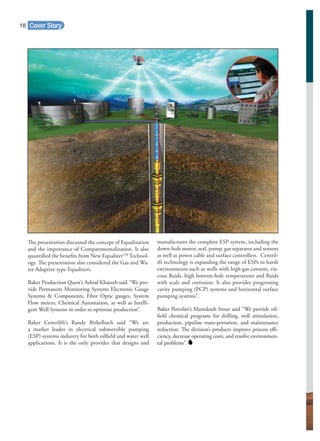
Baker Centrilift’s Randy Birkelbach said “We are
a market leader in electrical submersible pumping
(ESP) systems industry for both oilfield and water well
applications. It is the only provider that designs and
manufactures the complete ESP system, including the
down-hole motor, seal, pump, gas separator and sensors
as well as power cable and surface controllers. Centril-
ift technology is expanding the range of ESPs in harsh
environments such as wells with high gas content, vis-
cous fluids, high bottom-hole temperatures and fluids
with scale and corrosion. It also provides progressing
cavity pumping (PCP) systems and horizontal surface
pumping systems”.
Baker Petrolite’s Mamdouh Srour said “We provide oil-
field chemical programs for drilling, well stimulation,
production, pipeline trans-portation, and maintenance
reduction. The division’s products improve process effi-
ciency, decrease operating costs, and resolve environmen-
tal problems”.
18
Cover Story
Open hole (OH) packers are devices that create an an-
nular barrier between the wellbore and selected open
hole completions such as stand-alone screens or pre-per-
forated liners. In some completions, these packers are a
critical and unavoidable component. Current industry
technology offers many different types of OH packers
suitable for all possible applications. The most common
types currently in use are inflatable external casing pack-
ers, mechanical packers and swelling elastomer packers.
In a variety of customized assemblies, this technology
provides operators with economical solutions that can
isolate zones of high permeability, equalize production
rates, and control water and gas coning.
Before 2002, the only OH packers used in Saudi Ara-
bia were standard inflatable external casing packers
(ECP). At the end of 2002, a new system was run in the
Kingdom that included mechanical packers. After that
event, the mechanical packer became the preference in
non-cemented OH applications.
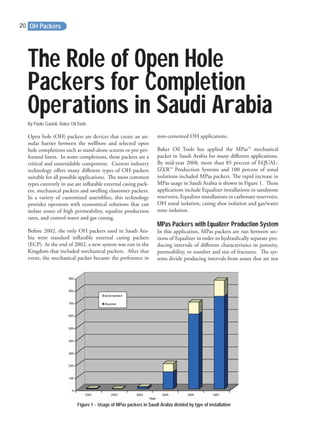
Baker Oil Tools has applied the MPas™ mechanical
packer in Saudi Arabia for many different applications.
By mid-year 2008, more than 85 percent of EQUAL-
IZER™ Production Systems and 100 percent of zonal
isolations included MPas packers. The rapid increase in
MPas usage in Saudi Arabia is shown in Figure 1. These
applications include Equalizer installations in sandstone
reservoirs, Equalizer installations in carbonate reservoirs,
OH zonal isolation, casing shoe isolation and gas/water
zone isolation.
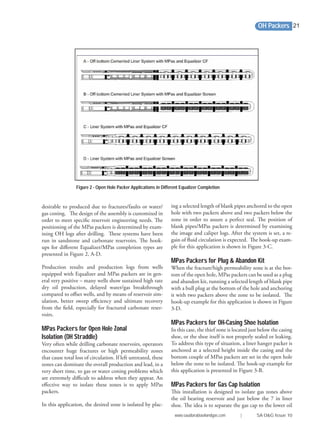
MPas Packers with Equalizer Production System
In this application, MPas packers are run between sec-
tions of Equalizer in order to hydraulically separate pro-
ducing intervals of different characteristics in porosity,
permeability, or number and size of fractures. The sys-
tems divide producing intervals from zones that are not
The Role of Open Hole
Packers for Completion
Operations in Saudi ArabiaBy Paolo Gavioli, Baker Oil Tools
Figure 1 - Usage of MPas packers in Saudi Arabia divided by type of installation
OH Packers20
desirable to produced due to fractures/faults or water/
gas coning. The design of the assembly is customized in
order to meet specific reservoir engineering needs. The
positioning of the MPas packers is determined by exam-
ining OH logs after drilling. These systems have been
run in sandstone and carbonate reservoirs. The hook-
ups for different Equalizer/MPas completion types are
presented in Figure 2, A-D.
Production results and production logs from wells
equipped with Equalizer and MPas packers are in gen-
eral very positive – many wells show sustained high rate
dry oil production, delayed water/gas breakthrough
compared to offset wells, and by means of reservoir sim-
ulation, better sweep efficiency and ultimate recovery
from the field, especially for fractured carbonate reser-
voirs.
MPas Packers for Open Hole Zonal
Isolation (OH Straddle)
Very often while drilling carbonate reservoirs, operators
encounter huge fractures or high permeability zones
that cause total loss of circulation. If left untreated, these
zones can dominate the overall production and lead, in a
very short time, to gas or water coning problems which
are extremely difficult to address when they appear. An
effective way to isolate these zones is to apply MPas
packers.
In this application, the desired zone is isolated by plac-
ing a selected length of blank pipes anchored to the open
hole with two packers above and two packers below the
zone in order to assure a perfect seal. The position of
blank pipes/MPas packers is determined by examining
the image and caliper logs. After the system is set, a re-
gain of fluid circulation is expected. The hook-up exam-
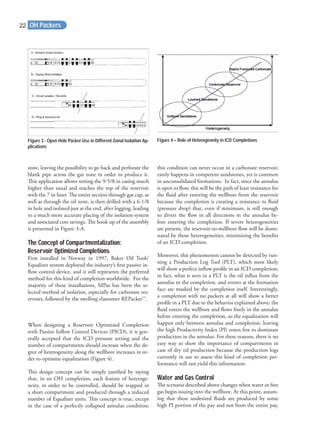
ple for this application is shown in Figure 3-C.
MPas Packers for Plug & Abandon Kit
When the fracture/high permeability zone is at the bot-
tom of the open hole, MPas packers can be used as a plug
and abandon kit, running a selected length of blank pipe
with a bull plug at the bottom of the hole and anchoring
it with two packers above the zone to be isolated. The
hook-up example for this application is shown in Figure
3-D.
MPas Packers for OH-Casing Shoe Isolation
In this case, the thief zone is located just below the casing
shoe, or the shoe itself is not properly sealed or leaking.
To address this type of situation, a liner hanger packer is
anchored at a selected height inside the casing and the
bottom couple of MPas packers are set in the open hole
below the zone to be isolated. The hook-up example for
this application is presented in Figure 3-B.
MPas Packers for Gas Cap Isolation
This installation is designed to isolate gas zones above
the oil bearing reservoir and just below the 7 in liner
shoe. The idea is to separate the gas cap to the lower oil
Figure 2 - Open Hole Packer Applications in Different Equalizer Completion
OH Packers
www.saudiarabiaoilandgas.com | SA O&G Issue 10
21
zone, leaving the possibility to go back and perforate the
blank pipe across the gas zone in order to produce it.
This application allows setting the 9-5/8 in casing much
higher than usual and reaches the top of the reservoir
with the 7 in liner. The entire section through gas cap, as
well as through the oil zone, is then drilled with a 6-1/8
in hole and isolated just at the end, after logging, leading
to a much more accurate placing of the isolation system
and associated cost savings. The hook up of the assembly
is presented in Figure 3-A.
The Concept of Compartmentalization:
Reservoir Optimized Completions
First installed in Norway in 1997, Baker Oil Tools’
Equalizer system deployed the industry’s first passive in-
flow control device, and it still represents the preferred
method for this kind of completion worldwide. For the
majority of these installations, MPas has been the se-
lected method of isolation, especially for carbonate res-
ervoirs, followed by the swelling elastomer REPacker™.
When designing a Reservoir Optimized Completion
with Passive Inflow Control Devices (PICD), it is gen-
erally accepted that the ICD pressure setting and the
number of compartments should increase when the de-
gree of heterogeneity along the wellbore increases in or-
der to optimize equalization (Figure 4).
This design concept can be simply justified by saying
that, in an OH completion, each feature of heteroge-
neity, in order to be controlled, should be trapped in
a short compartment and produced through a reduced
number of Equalizer units. This concept is true, except
in the case of a perfectly collapsed annulus condition;
this condition can never occur in a carbonate reservoir,
rarely happens in competent sandstones, yet is common
in unconsolidated formations. In fact, since the annulus
is open to flow, this will be the path of least resistance for
the fluid after entering the wellbore from the reservoir
because the completion is creating a resistance to fluid
(pressure drop) that, even if minimum, is still enough
to divert the flow in all directions in the annulus be-
fore entering the completion. If severe heterogeneities
are present, the reservoir-to-wellbore flow will be domi-
nated by those heterogeneities, minimizing the benefits
of an ICD completion.
Moreover, this phenomenon cannot be detected by run-
ning a Production Log Tool (PLT), which most likely
will show a perfect inflow profile in an ICD completion;
in fact, what is seen in a PLT is the oil influx from the
annulus to the completion, and events at the formation
face are masked by the completion itself. Interestingly,
a completion with no packers at all will show a better
profile in a PLT due to the behavior explained above: the
fluid enters the wellbore and flows freely in the annulus
before entering the completion, so the equalization will
happen only between annulus and completion, leaving
the high Productivity Index (PI) zones free to dominate
production in the annulus. For these reasons, there is no
easy way to show the importance of compartments in
case of dry oil production because the production logs
currently in use to assess this kind of completion per-
formance will not yield this information.
Water and Gas Control
The scenario described above changes when water or free
gas begin issuing into the wellbore. At this point, assum-
ing that these undesired fluids are produced by some
high PI portion of the pay and not from the entire pay,
Figure 3 - Open Hole Packer Use in Different Zonal Isolation Ap-
plications
Figure 4 – Role of Heterogeneity in ICD Completions
OH Packers22
the domination of high PI features will be detected even
by looking to the production data. In this case, the pres-
ence and number of compartments will play a critical
role.
Generally speaking, increasing the number of compart-
ments results in a better control of both water and free
gas production. This performance has been extensively
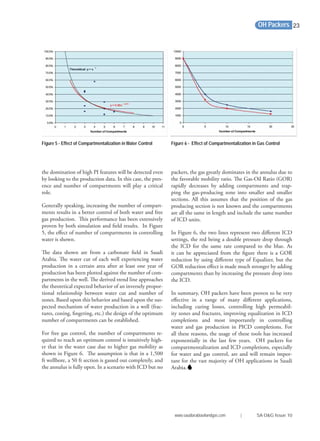
proven by both simulation and field results. In Figure
5, the effect of number of compartments in controlling
water is shown.
The data shown are from a carbonate field in Saudi
Arabia. The water cut of each well experiencing water
production in a certain area after at least one year of
production has been plotted against the number of com-
partments in the well. The derived trend line approaches
the theoretical expected behavior of an inversely propor-
tional relationship between water cut and number of
zones. Based upon this behavior and based upon the sus-
pected mechanism of water production in a well (frac-
tures, coning, fingering, etc.) the design of the optimum
number of compartments can be established.
For free gas control, the number of compartments re-
quired to reach an optimum control is intuitively high-
er that in the water case due to higher gas mobility as
shown in Figure 6. The assumption is that in a 1,500
ft wellbore, a 50 ft section is gassed out completely, and
the annulus is fully open. In a scenario with ICD but no
packers, the gas greatly dominates in the annulus due to
the favorable mobility ratio. The Gas-Oil Ratio (GOR)
rapidly decreases by adding compartments and trap-
ping the gas-producing zone into smaller and smaller
sections. All this assumes that the position of the gas
producing section is not known and the compartments
are all the same in length and include the same number
of ICD units.
In Figure 6, the two lines represent two different ICD
settings, the red being a double pressure drop through
the ICD for the same rate compared to the blue. As
it can be appreciated from the figure there is a GOR
reduction by using different type of Equalizer, but the
GOR reduction effect is made much stronger by adding
compartments than by increasing the pressure drop into
the ICD.
In summary, OH packers have been proven to be very
effective in a range of many different applications,
including curing losses, controlling high permeabil-
ity zones and fractures, improving equalization in ICD
completions and most importantly in controlling
water and gas production in PICD completions. For
all these reasons, the usage of these tools has increased
exponentially in the last few years. OH packers for
compartmentalization and ICD completions, especially
for water and gas control, are and will remain impor-
tant for the vast majority of OH applications in Saudi
Arabia.
Figure 5 - Effect of Compartmentalization in Water Control Figure 6 - Effect of Compartmentalization in Gas Control
OH Packers
www.saudiarabiaoilandgas.com | SA O&G Issue 10
23
Optimizing Powered Rotary
Steering through Better
Understanding of the
Downhole EnvironmentBy F. Al-Bani, N.Galindez and P. Carpen, Saudi Aramco; F. Mounzer and D. Kent, Baker Hughes
Copyright 2007, IADC/SPE Drilling Conference This paper was prepared for presentation at the 2007 !ADC/SPE Offshore Technical Confer-
ence held in Houston, Texas – April 30 – May 3, 2007.
Abstract
This paper discusses drilling optimization in two ma-
jor fields operated by Saudi Aramco. Both fields have
layered limestone reservoirs consisting of tight zones al-
ternating with porous zones and are drained using inno-
vative MRC (Maximum Reservoir Contact) techniques
along with real-time geosteering.
The well profiles produce difficult torque and drag envi-
ronments. While drilling rigs employed have upgraded
to top drive systems, traditional drilling practices still
rely primarily upon surface measurements provided by
the drilling contractor. Often these gauges are rudimen-
tary and their measurements unrepresentative of down-
hole conditions, particularly when operating at a great
depth in horizontal holes.
In the applications discussed in this paper, the situation
was greatly improved by introducing a new downhole
drilling sensor tool. Integrated into a high-speed rota-
ry closed-loop drilling system, powered by an integral
modular motor, a step change in drilling performance
has been achieved.
In most applications, the new tool has been placed be-
tween the modular motor and the steering head to give
the directional drilling crew a clear understanding of
the true environment being encountered by the steering
head and bit. Optimization of performance with such
advances has resulted in a 100% increase in overall rate
of penetration (ROP) in some applications.
Using real well examples, this paper discusses: measure-
ments the tool records and transmits; dramatic differ-
ences between downhole measurements and surface
indicators; how information is applied to optimize the
real-time drilling process, and how this continuous ap-
plication evolved from the original research initiative.
Introduction
In the last few years, rotary steerable drilling sys-
tems (RSS) have become the preferred tools for drill-
ing complex or lengthy drain holes, primarily because
the tools can negotiate the planned well path without
stopping to “steer” as with conventional steerable (mo-
tor) systems. The advantages of these tools has been ex-
haustively described in numerous papers and articles,
in trade journals and with the SPE since the intro-
duction of these systems began in the early 90s. One
hallmark of RSS has been the ability to average a sig-
nificantly higher overall ROP over a given section of
hole primarily for the same reasons as described above.
A feature of these tools that most interests the res-
ervoir department is the capability for geosteer-
ing to very precise tolerances. RSS tools can steer to
a true vertical depth (TVD) target or, if preferred,
hold an exact angle to intersect zones of interest.
Despite the large gains in applied technology in down-
hole drilling and measurement systems and widespread
upgrade of rig-rotary drive systems in the last decade,
drilling rig measurement gauges have seen compara-
tively little advancement. Used to monitor vital drill-
ing information, many drilling rigs still rely upon
dead-line weight indicators, surface rotary torque
gauges, and surface standpipe pressure gauges. These
gauges are typically of robust construction to withstand
Drilling24
Drilling
the rough handling often encountered during drill-
ing or while the rig is being moved (as in land rigs).
Calibration is typically fairly rudimentary (as com-
pared to scientific instruments), and sensitivity is poor.
In practical terms, for most operations the gauges and
measurements are more or less fit for purpose. The basic
measurements were never intended for use in the de-
signer wells on the boards or currently being executed.
For vertical or basic directional drilling applications with
large robust tool strings, these instruments can cope with
most string weight, pump pressure, and torque reading
requirements.
The environment where these measurement gauges are
found most lacking is in extended reach or complex
horizontal drilling applications. The problems seen with
inaccurate or non-responsive measurements can be ex-
acerbated even further when small tools are run in slim-
mer holes (<6.5˝). The inherent limber qualities of the
slim drill string coupled with the tortuous well path can
conspire to completely obscure the actual bottom hole
conditions as seen by the drilling tools.
RSS tools do provide, theoretically, some relief from the
problem by freeing up the drill string through continu-
ous rotation.
However, slim drill strings can be subject to extreme
vibration in three axes: lateral, axial, and stick/slip or
torsional. Rig instruments can provide almost no data
whatsoever on this aspect of the drilling process. For the
most part, these vibrations will exist completely unde-
tected, and the drilling crews are left to puzzle why drill-
ing progress is slow or why the tools do not perform
to specification or even fail to function after only short
operational times.
Driven by an initiative to better understand the down-
hole drilling environment, a new MWD-based drill-
ing dynamics tool was introduced. The tool is a short,
modular sub that can be placed anywhere in the RSS
drill string or conventional rotary drill string provided
it is paired with the correct MWD tool. The concept,
functionality and capability of this new tool have been
described in detail by Heisig et al. (1998)1
.
Tool Description
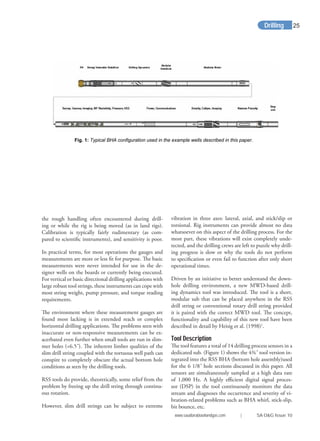
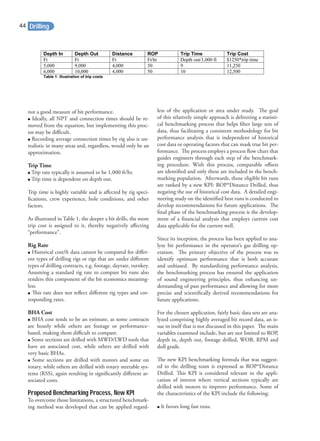
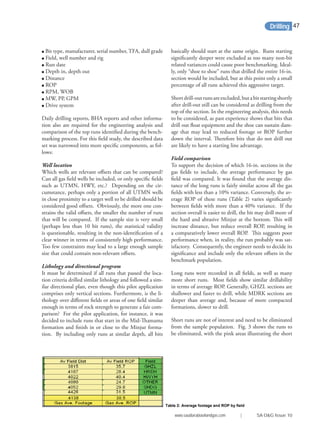
The tool features a total of 14 drilling process sensors in a
dedicated sub. (Figure 1) shows the 4¾˝ tool version in-
tegrated into the RSS BHA (bottom hole assembly)used
for the 6 1/8˝ hole sections discussed in this paper. All
sensors are simultaneously sampled at a high data rate
of 1,000 Hz. A highly efficient digital signal proces-
sor (DSP) in the tool continuously monitors the data
stream and diagnoses the occurrence and severity of vi-
bration-related problems such as BHA whirl, stick-slip,
bit bounce, etc.
Fig. 1: Typical BHA configuration used in the example wells described in this paper.
www.saudiarabiaoilandgas.com | SA O&G Issue 10
25
The dynamics diagnostics are transmitted to the surface
via mud-pulse telemetry along with static measurements
such as downhole weight, torque, bending moment, and
annulus pressure. The system operates on a five-second
loop and records all output parameters in the onboard
memory. In addition, the tool offers the unique capabil-
ity of storing high-frequency raw sensor data (e.g., 100
Hz data rate) onboard over periods of up to 15 minutes.
The data can be retrieved later at surface for detailed
evaluation.
Field Example #1
Well H-1 This is a multilateral oil producer. The well
was drilled as part of the subject field Increment 3 proj-
ect.
A Maximum Reservoir Contact (MRC) well can be ei-
ther a multilateral or an extended single leg. The H-1
well was drilled as a three-leg multilateral with a fish
bone design—an 8½˝ horizontal motherbore with 7˝
liner, then 3 x 6 1/8˝ laterals drilled through the target
pay zone.
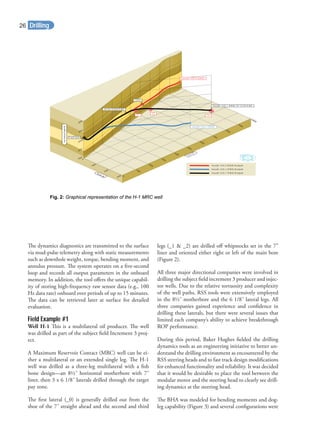
The first lateral (_0) is generally drilled out from the
shoe of the 7˝ straight ahead and the second and third
legs (_1 & _2) are drilled off whipstocks set in the 7”
liner and oriented either right or left of the main bore
(Figure 2).
All three major directional companies were involved in
drilling the subject field increment 3 producer and injec-
tor wells. Due to the relative tortuosity and complexity
of the well paths, RSS tools were extensively employed
in the 8½˝ motherbore and the 6 1/8˝ lateral legs. All
three companies gained experience and confidence in
drilling these laterals, but there were several issues that
limited each company’s ability to achieve breakthrough
ROP performance.
During this period, Baker Hughes fielded the drilling
dynamics tools as an engineering initiative to better un-
derstand the drilling environment as encountered by the
RSS steering heads and to fast track design modifications
for enhanced functionality and reliability. It was decided
that it would be desirable to place the tool between the
modular motor and the steering head to clearly see drill-
ing dynamics at the steering head.
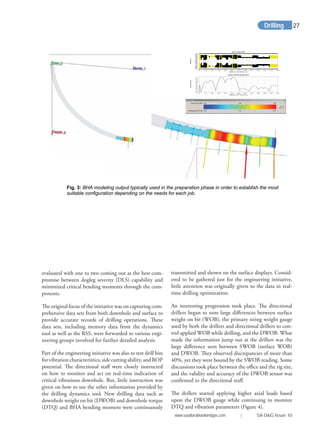
The BHA was modeled for bending moments and dog-
leg capability (Figure 3) and several configurations were
Fig. 2: Graphical representation of the H-1 MRC well
H a ra d h 1 425 -0 (A W B ) W ellp ath
T 1
T 2
T 3
H a ra d h 1 425 -2 (P W B )
T ie O n 10,955 ft M D
9.625 inch
7 inch
TrueVerticalDepth(ft)
H a ra d h 1 425 -1 (P W B ) T D 1 5,94 9 ft M D
H a ra dh 1 425 -0 (A W B )
H a ra dh 1 425 -2 (P W B ) W ellpath
H a ra dh 1 42 5 -1 (P W B ) W ellpath
1000
3000
7000
6950
6900
6850
6800
North (ft)
2000
1000
0
East (ft)
0
2000
3000
4000
5000
6000
7000
8000
9000
10000
H a ra d h 1 425 -0 (A W B ) W ellp ath
T 1
T 2
T 3
H a ra d h 1 425 -2 (P W B )
T ie O n 10,955 ft M D
9.625 inch
7 inch
TrueVerticalDepth(ft)
H a ra d h 1 425 -1 (P W B ) T D 1 5,94 9 ft M D
H a ra dh 1 425 -0 (A W B )
H a ra dh 1 425 -2 (P W B ) W ellpath
H a ra dh 1 42 5 -1 (P W B ) W ellpath
1000
3000
7000
6950
6900
6850
6800
North (ft)
2000
1000
0
East (ft)
0
2000
3000
4000
5000
6000
7000
8000
9000
10000
Drilling26
evaluated with one to two coming out as the best com-
promise between dogleg severity (DLS) capability and
minimized critical bending moments through the com-
ponents.
The original focus of the initiative was on capturing com-
prehensive data sets from both downhole and surface to
provide accurate records of drilling operations. These
data sets, including memory data from the dynamics
tool as well as the RSS, were forwarded to various engi-
neering groups involved for further detailed analysis.
Part of the engineering initiative was also to test drill bits
forvibrationcharacteristics,sidecuttingability,andROP
potential. The directional staff were closely instructed
on how to monitor and act on real-time indication of
critical vibrations downhole. But, little instruction was
given on how to use the other information provided by
the drilling dynamics tool. New drilling data such as
downhole weight on bit (DWOB) and downhole torque
(DTQ) and BHA bending moment were continuously
transmitted and shown on the surface displays. Consid-
ered to be gathered just for the engineering initiative,
little attention was originally given to the data in real-
time drilling optimization.
An interesting progression took place. The directional
drillers began to note large differences between surface
weight on bit (WOB), the primary string weight gauge
used by both the drillers and directional drillers to con-
trol applied WOB while drilling, and the DWOB. What
made the information jump out at the drillers was the
large difference seen between SWOB (surface WOB)
and DWOB. They observed discrepancies of more than
40%, yet they were bound by the SWOB reading. Some
discussions took place between the office and the rig site,
and the validity and accuracy of the DWOB sensor was
confirmed to the directional staff.
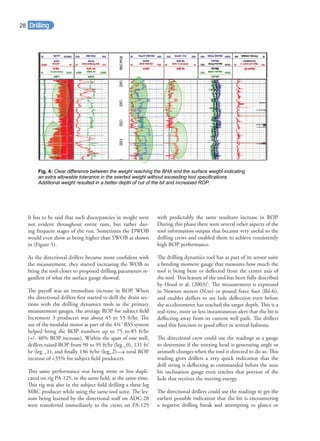
The drillers started applying higher axial loads based
upon the DWOB gauge while continuing to monitor
DTQ and vibration parameters (Figure 4).
Fig. 3: BHA modeling output typically used in the preparation phase in order to establish the most
suitable configuration depending on the needs for each job.
Input Geometry
Distance From Bottom (m)
Radius(in)
0.00 5.00 10.00 15.00 20.00 25.00 30.00 35.00 40.00 45.00 50.00 55.00 60.00
-3.000
-2.500
-2.000
-1.500
-1.000
-0.500
0.000
0.500
1.000
1.500
2.000
2.500
3.000
Static Bending Moment
Distance From Bottom (m)
Moment(kN-m)
0.00 5.00 10.00 15.00 20.00 25.00 30.00 35.00 40.00 45.00 50.00 55.00 60.00
0.00
1.00
2.00
3.00
4.00
5.00
6.00
7.00
8.00
9.00
Drilling
www.saudiarabiaoilandgas.com | SA O&G Issue 10
27
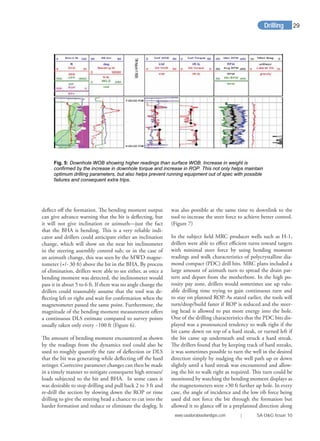
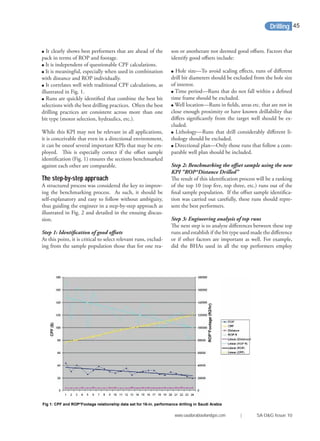
It has to be said that such discrepancies in weight were
not evident throughout entire runs, but rather dur-
ing frequent stages of the run. Sometimes the DWOB
would even show as being higher than SWOB as shown
in (Figure 5).
As the directional drillers became more confident with
the measurement, they started increasing the WOB to
bring the tool closer to proposed drilling parameters re-
gardless of what the surface gauge showed.
The payoff was an immediate increase in ROP. When
the directional drillers first started to drill the drain sec-
tions with the drilling dynamics tools as the primary
measurement gauges, the average ROP for subject field
Increment 3 producers was about 45 to 55 ft/hr. The
use of the modular motor as part of the 4¾˝ RSS system
helped bring the ROP numbers up to 75 to-85 ft/hr
(+/- 40% ROP increase). Within the span of one well,
drillers raised ROP from 90 to 95 ft/hr (leg _0), 131 ft/
hr (leg _1), and finally 136 ft/hr (leg_2)—a total ROP
increase of >35% for subject field producers.
This same performance was being more or less dupli-
cated on rig PA-125, in the same field, at the same time.
This rig was also in the subject field drilling a three leg
MRC producer while using the same tool suite. The les-
sons being learned by the directional staff on ADC-28
were transferred immediately to the crews on PA-125
with predictably the same resultant increase in ROP.
During this phase there were several other aspects of the
tool information output that became very useful to the
drilling crews and enabled them to achieve consistently
high ROP performance.
The drilling dynamics tool has as part of its sensor suite
a bending moment gauge that measures how much the
tool is being bent or deflected from the center axis of
the tool. This feature of the tool has been fully described
by Hood et al. (2003)5
. The measurement is expressed
in Newton meters (N.m) or pound force foot (lbf-ft),
and enables drillers to see hole deflection even before
the accelerometer has reached the target depth. This is a
real-time, more or less instantaneous alert that the bit is
deflecting away from its current well path. The drillers
used this function to good effect in several fashions.
The directional crew could use the readings as a gauge
to determine if the steering head is generating angle or
azimuth changes when the tool is directed to do so. This
reading gives drillers a very quick indication that the
drill string is deflecting as commanded before the near
bit inclination gauge even reaches that portion of the
hole that receives the steering energy.
The directional drillers could use the readings to get the
earliest possible indication that the bit is encountering
a negative drilling break and attempting to glance or
Fig. 4: Clear difference between the weight reaching the BHA and the surface weight indicating
an extra allowable tolerance in the exerted weight without exceeding tool specifications.
Additional weight resulted in a better depth of cut of the bit and increased ROP.
Drilling28
deflect off the formation. The bending moment output
can give advance warning that the bit is deflecting, but
it will not give inclination or azimuth—just the fact
that the BHA is bending. This is a very reliable indi-
cator and drillers could anticipate either an inclination
change, which will show on the near bit inclinometer
in the steering assembly control sub; or in the case of
an azimuth change, this was seen by the MWD magne-
tometer (+/- 30 ft) above the bit in the BHA. By process
of elimination, drillers were able to see either, as once a
bending moment was detected, the inclinometer would
pass it in about 5 to 6 ft. If there was no angle change the
drillers could reasonably assume that the tool was de-
flecting left or right and wait for confirmation when the
magnetometer passed the same point. Furthermore, the
magnitude of the bending moment measurement offers
a continuous DLS estimate compared to survey points
usually taken only every ~100 ft (Figure 6).
The amount of bending moment encountered as shown
by the readings from the dynamics tool could also be
used to roughly quantify the rate of deflection or DLS
that the bit was generating while deflecting off the hard
stringer. Corrective parameter changes can then be made
in a timely manner to mitigate consequent high stresses/
loads subjected to the bit and BHA. In some cases it
was desirable to stop drilling and pull back 2 to 3 ft and
re-drill the section by slowing down the ROP or time
drilling to give the steering head a chance to cut into the
harder formation and reduce or eliminate the dogleg. It
was also possible at the same time to downlink to the
tool to increase the steer force to achieve better control.
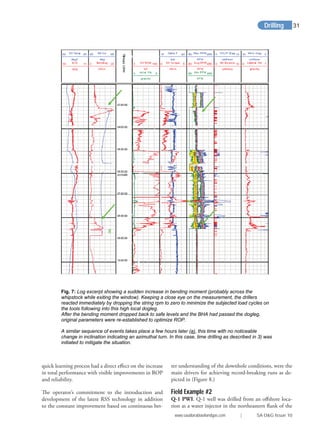
(Figure 7)
In the subject field MRC producer wells such as H-1,
drillers were able to effect efficient turns toward targets
with minimal steer force by using bending moment
readings and walk characteristics of polycrystalline dia-
mond compact (PDC) drill bits. MRC plans included a
large amount of azimuth turn to spread the drain pat-
tern and depart from the motherbore. In the high po-
rosity pay zone, drillers would sometimes use up valu-
able drilling time trying to gain continuous turn and
to stay on planned ROP. As stated earlier, the tools will
turn/drop/build faster if ROP is reduced and the steer-
ing head is allowed to put more energy into the hole.
One of the drilling characteristics that the PDC bits dis-
played was a pronounced tendency to walk right if the
bit came down on top of a hard steak, or turned left if
the bit came up underneath and struck a hard streak.
The drillers found that by keeping track of hard streaks,
it was sometimes possible to turn the well in the desired
direction simply by nudging the well path up or down
slightly until a hard streak was encountered and allow-
ing the bit to walk right as required. This turn could be
monitored by watching the bending moment displays as
the magnetometers were +30 ft further up hole. In every
case, the angle of incidence and the low rib force being
used did not force the bit through the formation but
allowed it to glance off in a preplanned direction along
Fig. 5: Downhole WOB showing higher readings than surface WOB. Increase in weight is
confirmed by the increase in downhole torque and increase in ROP. This not only helps maintain
optimum drilling parameters, but also helps prevent running equipment out of spec with possible
failures and consequent extra trips.
Drilling
www.saudiarabiaoilandgas.com | SA O&G Issue 10
29
the planned well path. This technique allowed drilling
crews to maintain a very high ROP performance while
staying on target with minimal input. This process took
some time to master, and not every crew was confident
enough to employ it; sometimes the reservoir sections
did not have hard streaks close enough to the planned
TVD to allow for this type of “geo-turning”. This use of
“geoturning” played a significant part in achieving the
very high ROP results in the latter part of the subject
field project.
The implementation of such an application and the
Fig. 6: Two charts with the near bit inclination plotted against the survey DLS (chart a) and
bending moment (chart b). Noticeably, these display a lot of deflections taking place in the
azimuthal plane that do not necessarily show up on the usual survey listing, but that are clearly
captured by the downhole bending moment measurement.
NBI vs Bending Moment
0
2000
4000
6000
8000
10000
12000
7900 8400 8900 9400 9900 10400 10900 11400 11900
Depth (ft)
BendingMoment(ft.lb)
85
86
87
88
89
90
91
92
93
94
95
NearBitInclination(deg)
DBMAM(ft-lb)
NBI
NBI vs Survey DLS
0
2
4
6
8
10
12
7900 8400 8900 9400 9900 10400 10900 11400 11900
Depth (ft)
DLS(deg/100ft)
85
86
87
88
89
90
91
92
93
94
95
NearBitInclination(deg)
Dogleg [deg/100ft]
NBI
Drilling30
quick learning process had a direct effect on the increase
in total performance with visible improvements in ROP
and reliability.
The operator’s commitment to the introduction and
development of the latest RSS technology in addition
to the constant improvement based on continuous bet-
ter understanding of the downhole conditions, were the
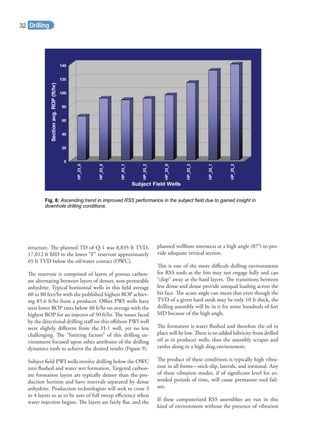
main drivers for achieving record-breaking runs as de-
picted in (Figure 8.)
Field Example #2
Q-1 PWI. Q-1 well was drilled from an offshore loca-
tion as a water injector in the northeastern flank of the
Fig. 7: Log excerpt showing a sudden increase in bending moment (probably across the
whipstock while exiting the window). Keeping a close eye on the measurement, the drillers
reacted immediately by dropping the string rpm to zero to minimize the subjected load cycles on
the tools following into this high local dogleg.
After the bending moment dropped back to safe levels and the BHA had passed the dogleg,
original parameters were re-established to optimize ROP.
A similar sequence of events takes place a few hours later (a), this time with no noticeable
change in inclination indicating an azimuthal turn. In this case, time drilling as described in 3) was
initiated to mitigate the situation.
a
Drilling
www.saudiarabiaoilandgas.com | SA O&G Issue 10
31
structure. The planned TD of Q-1 was 8,835 ft TVD,
17,012 ft MD in the lower “F” reservoir approximately
65 ft TVD below the oil/water contact (OWC).
The reservoir is comprised of layers of porous carbon-
ate alternating between layers of denser, non-permeable
anhydrite. Typical horizontal wells in this field average
60 to 80 feet/hr with the published highest ROP achiev-
ing 85.6 ft/hr from a producer. Offset PWI wells have
seen lower ROP rates below 40 ft/hr on average with the
highest ROP for an injector of 50 ft/hr. The issues faced
by the directional drilling staff on this offshore PWI well
were slightly different from the H-1 well, yet no less
challenging. The “limiting factors” of this drilling en-
vironment focused upon other attributes of the drilling
dynamics tools to achieve the desired results (Figure 9).
Subject field PWI wells involve drilling below the OWC
into flushed and water wet formation. Targeted carbon-
ate formation layers are typically denser than the pro-
duction horizon and have intervals separated by dense
anhydrite. Production technologists will seek to cross 3
to 4 layers so as to be sure of full sweep efficiency when
water injection begins. The layers are fairly flat, and the
planned wellbore intersects at a high angle (87°) to pro-
vide adequate vertical section.
This is one of the more difficult drilling environments
for RSS tools as the bits may not engage fully and can
“chip” away at the hard layers. The transitions between
less dense and dense provide unequal loading across the
bit face. The acute angle can mean that even though the
TVD of a given hard steak may be only 10 ft thick, the
drilling assembly will be in it for some hundreds of feet
MD because of the high angle.
The formation is water flushed and therefore the oil in
place will be low. There is no added lubricity from drilled
oil as in producer wells, thus the assembly scrapes and
rattles along in a high drag environment.
The product of these conditions is typically high vibra-
tion in all forms—stick-slip, laterals, and torsional. Any
of these vibration modes, if of significant level for ex-
tended periods of time, will cause premature tool fail-
ure.
If these computerized RSS assemblies are run in this
kind of environment without the presence of vibration
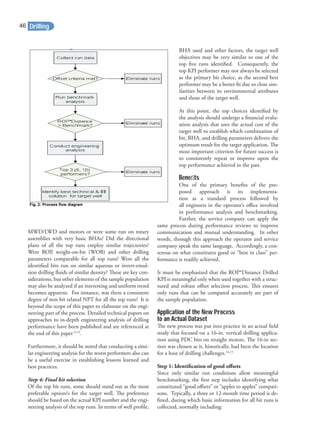
Fig. 8: Ascending trend in improved RSS performance in the subject field due to gained insight in
downhole drilling conditions.
0
20
40
60
80
100
120
140
Sectionavg.ROP(ft/hr)
HP_23_0
HP_03_0
HP_03_1
HP_03_2
HP_25_0
HP_03_3
HP_25_1
HP_25_2
Subject Field Wells
Drilling32
monitoring equipment, it can be largely left to chance
as to how long the tools will last. Due to reduced wall
thicknesses of all drill string components, 4¾˝ drilling
tools are particularly prone to borehole induced vibra-
tion. The drill string is can be either a tapered string
such as 5˝ x 3½˝ or 5˝ x 4˝. In this case, a single string
of 4˝ drill pipe to surface. The 6 1/8˝ hole is often the
terminal hole section with the greatest distance from the
surface.
By using the drilling dynamics tool on Q-1 well, drilling
crews were able to see exactly what the vibration levels
were at all times. This was of particular interest as the
bit crossed each layer or adjustments were made to rpm
and/or WOB to achieve maximum ROP.
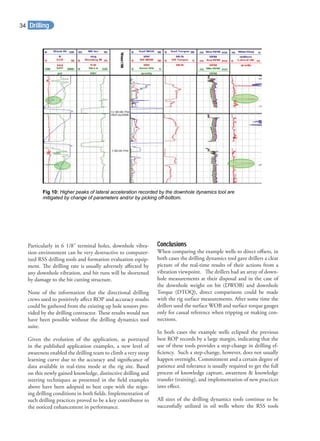
Drillers could see the onset of vibrations at the bit in real
time and make corrective actions to reduce or eliminate
vibrations and see the effect of their action in real time
(Figure 10). Drillers watched the dynamics output con-
tinuously and adjusted input parameters as required to
reduce vibrations to acceptable levels as well as maintain
high ROP.
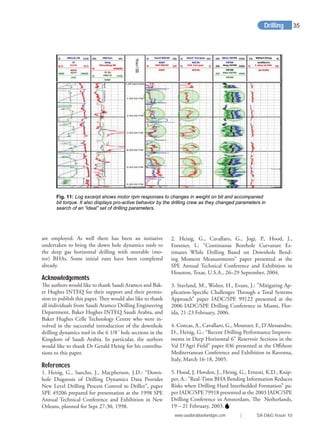
Moreover, the conscious placement of the dynamics tool
directly behind the steering unit and below the modular
motor also offered additional insight into how effective-
ly the motor was working. Such a BHA configuration
allows a direct measurement of motor rpm. The drilling
crew could then monitor how chosen drilling parameters
would affect motor performance and subsequently bal-
ance the set parameters and motor response to achieve
optimum ROP (Figure 11)
The very high overall ROP, together with the high ob-
tained reliability as reflected in zero number of failures`
on this run was a direct result of having a clear un-
derstanding of the drilling environment that the drill-
ing tools and bit were seeing as the well path crossed
through different densities of rock. Drillers had a clear
picture of the downhole dynamics and bending loads at
all times. This enabled them to react to vibration modes,
and then see the results in decreased vibration. As in
example 1, drillers could also chase the maximum ROP
with DWOB readings instead of relying entirely on in-
accurate surface readings while simultaneously ensuring
that subjected loads do not exceed operational specifica-
tions of the tools.
Discussion
Both of the well types used as examples in this paper
have been drilled by a number of drilling/evaluation
service companies in Saudi Arabia with varying results.
In both types the learning curve grew with experience
gained and advances in drill bit and drilling tool tech-
nology.
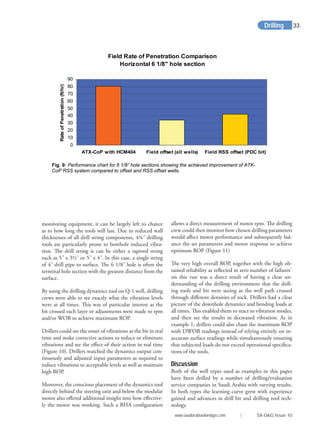
Field Rate of Penetration Comparison
Horizontal 6 1/8" hole section
0
10
20
30
40
50
60
70
80
90
ATX-CoP with HCM404 Field offset (all wells) Field RSS offset (PDC bit)
RateofPenetration(ft/hr)
Fig. 9: Performance chart for 6 1/8” hole sections showing the achieved improvement of ATK-
CoP RSS system compared to offset and RSS offset wells.
Drilling
www.saudiarabiaoilandgas.com | SA O&G Issue 10
33
Particularly in 6 1/8˝ terminal holes, downhole vibra-
tion environment can be very destructive to computer-
ized RSS drilling tools and formation evaluation equip-
ment. The drilling rate is usually adversely affected by
any downhole vibration, and bit runs will be shortened
by damage to the bit cutting structure.
None of the information that the directional drilling
crews used to positively affect ROP and accuracy results
could be gathered from the existing up hole sensors pro-
vided by the drilling contractor. These results would not
have been possible without the drilling dynamics tool
suite.
Given the evolution of the application, as portrayed
in the published application examples, a new level of
awareness enabled the drilling team to climb a very steep
learning curve due to the accuracy and significance of
data available in real-time mode at the rig site. Based
on this newly gained knowledge, distinctive drilling and
steering techniques as presented in the field examples
above have been adopted to best cope with the reign-
ing drilling conditions in both fields. Implementation of
such drilling practices proved to be a key contributor to
the noticed enhancement in performance.
Conclusions
When comparing the example wells to direct offsets, in
both cases the drilling dynamics tool gave drillers a clear
picture of the real-time results of their actions from a
vibration viewpoint. The drillers had an array of down-
hole measurements at their disposal and in the case of
the downhole weight on bit (DWOB) and downhole
Torque (DTOQ), direct comparisons could be made
with the rig surface measurements. After some time the
drillers used the surface WOB and surface torque gauges
only for casual reference when tripping or making con-
nections.
In both cases the example wells eclipsed the previous
best ROP records by a large margin, indicating that the
use of these tools provides a step-change in drilling ef-
ficiency. Such a step-change, however, does not usually
happen overnight. Commitment and a certain degree of
patience and tolerance is usually required to get the full
process of knowledge capture, awareness & knowledge
transfer (training), and implementation of new practices
into effect.
All sizes of the drilling dynamics tools continue to be
successfully utilized in oil wells where the RSS tools
Fig 10: Higher peaks of lateral acceleration recorded by the downhole dynamics tool are
mitigated by change of parameters and/or by picking off-bottom.
Drilling34
are employed. As well there has been an initiative
undertaken to bring the down hole dynamics tools to
the deep gas horizontal drilling with steerable (mo-
tor) BHAs. Some initial runs have been completed
already.
Acknowledgements
The authors would like to thank Saudi Aramco and Bak-
er Hughes INTEQ for their support and their permis-
sion to publish this paper. They would also like to thank
all individuals from Saudi Aramco Drilling Engineering
Department, Baker Hughes INTEQ Saudi Arabia, and
Baker Hughes Celle Technology Centre who were in-
volved in the successful introduction of the downhole
drilling dynamics tool in the 6 1/8˝ hole sections in the
Kingdom of Saudi Arabia. In particular, the authors
would like to thank Dr Gerald Heisig for his contribu-
tions to this paper.
References
1. Heisig, G., Sancho, J., Macpherson, J.D.: “Down-
hole Diagnosis of Drilling Dynamics Data Provides
New Level Drilling Process Control to Driller”, paper
SPE 49206 prepared for presentation at the 1998 SPE
Annual Technical Conference and Exhibition in New
Orleans, planned for Sept 27-30, 1998.
2. Heisig, G., Cavallaro, G., Jogi, P., Hood, J.,
Forstner, I.: “Continuous Borehole Curvature Es-
timates While Drilling Based on Downhole Bend-
ing Moment Measurements” paper presented at the
SPE Annual Technical Conference and Exhibition in
Houston, Texas, U.S.A., 26–29 September, 2004.
3. Stavland, M., Wolter, H., Evans, J.: ”Mitigating Ap-
plication-Specific Challenges Through a Total Systems
Approach” paper IADC/SPE 99122 presented at the
2006 IADC/SPE Drilling Conference in Miami, Flor-
ida, 21-23 February, 2006.
4. Concas, A., Cavallaro, G., Mounzer, F., D’Alessandro,
D., Heisig, G.: “Recent Drilling Performance Improve-
ments in Deep Horizontal 6” Reservoir Sections in the
Val D’Agri Field” paper 036 presented at the Offshore
Mediterranean Conference and Exhibition in Ravenna,
Italy, March 16-18, 2005.
5. Hood, J, Hovden, J., Heisig, G., Ernesti, K.D., Knip-
per, A.: ”Real-Time BHA Bending Information Reduces
Risks when Drilling Hard Interbedded Formation” pa-
per IADC/SPE 79918 presented at the 2003 IADC/SPE
Drilling Conference in Amsterdam, The Netherlands,
19 – 21 February, 2003.
Fig. 11: Log excerpt shows motor rpm responses to changes in weight on bit and accompanied
bit torque. It also displays pro-active behavior by the drilling crew as they changed parameters in
search of an “ideal” set of drilling parameters.
Drilling
www.saudiarabiaoilandgas.com | SA O&G Issue 10
35
Drillstem Testing for High
Pressure Deepwater Wells:
A Noncemented Floating Tieback
Liner Technique
By Sameh Hussein, Baker Hughes Inc - Baker Oil Tools;Tom Scoular and Yuejin Luo, BP Plc. - BP
Copyright 2008, Society of Petroleum Engineers
This paper was prepared for presentation at the 2008 SPE Annual Technical Conference and Exhibition held in Denver, Colorado, USA, 21–24
September 2008.
This paper was selected for presentation by an SPE program committee following review of information contained in an abstract submitted
by the author(s). Contents of the paper have not been reviewed by the Society of Petroleum Engineers and are subject to correction by the
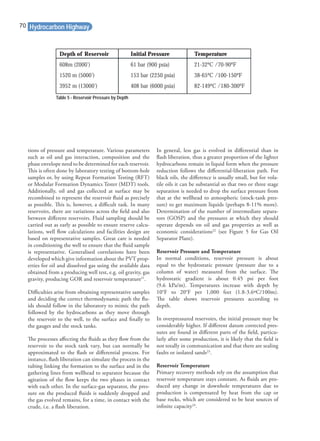
author(s). The material does not necessarily reflect any position of the Society of Petroleum Engineers, its officers, or members. Electronic
reproduction, distribution, or storage of any part of this paper without the written consent of the Society of Petroleum Engineers is prohibited.
Permission to reproduce in print is restricted to an abstract of not more than 300 words; illustrations may not be copied. The abstract must
contain conspicuous acknowledgment of SPE copyright.
Abstract
Current and future offshore exploration activity is
penetrating to deeper reservoirs, driving the need for
increased drillstem testing (DST) for high pressure
and high temperature wells. Typically, liners are tied
back to the surface to achieve reliable wellbore integrity
and flow. In the past, these tiebacks require expensive
cementing operations which also limit future wellbore
re-entry options.
An innovative non-cemented floating liner tieback
with reliable floating seals can improve the entire DST
process by eliminating the cost and risk of cementing
operations. In addition, the operator is able to retrieve
the casing tieback and have the option to use the same
well for appraisal or development phases.
The paper discusses the floating tieback system and
details a case history on a high pressure well in which
the operator completed the DST operation safely and
met all well objectives. Discussion of system reliability
includes casing design and modeling by both operator
and suppliers, plan changes based upon pressure data
obtained during the drilling phase, detailed operational
procedure in a deepwater environment, successful
tieback retrieval and future operations.
Introduction
The Egyptian deepwater Mediterranean Sea was a fitting
location for Raven 1 HPHT exploration well, one of
the first
HPHT wells to be drilled in the Mediterranean. With
a predicted 15,000 psi bottom hole pressure, the well
required a special casing design capable of handling such
a pressure and accordingly a fit-for-purpose liner hanger,
tieback, and drillstem testing equipment.
With the conditions mentioned above, one of the
challenges in the DST phase was the need to increase
the burst capacity of the exposed casing prior to flowing
the well. The conventional way was to run a liner tieback
and cement it into place prior to running the DST
completion and testing the desired zones.
During the drilling operation and with the data collected
during the different well phases, the decision was made
to use a new design approach employing a noncemented
floating tieback liner technique. This would enable the
DST operation to be carried safely without jeopardizing
the well test objectives, but maintain the ability to
retrieve the tieback string after the test as well as reduce
the time required to run the string. Retrieval of the
Drilling36
string after the test significantly increases the future well
re-entry and sidetracking options. A larger hole size can
be drilled for any future sidetrack, thus allowing a larger
diameter production liner and upper completion to be
run if the well is subsequently converted to a producer.
Description and Application of
Equipment and Processes
The original well plan was to run a 7-5/8 in cemented
liner across the target zone for DST testing operation,
run a 7-5/8 in liner tieback and cement back to surface
and run a 7-5/8 in DST completion but based on the
pressure data obtained during drilling operations the
original plan was changed to tie back back the 7 5/8˝
production liner with a 9-7/8˝ upper tieback string to
surface and study the possibility of achieving a seal in
the PBR – tieback stem with floating dynamic seals.
A 9-7/8˝ X 13-3/8˝ liner hanger with liner top packer
(rated 10,000 psi) was cemented in place with a 20
ft long PBR. The PBR had a burst pressure rating of
16,560 psi and collapse pressure rating of 12,549 psi. A
tieback seal assembly with 3 sets of seals rated for 15,000
psi was chosen taking in consideration that out of 20 ft
long PBR we will only have 14.5ft to accommodate the
tube movement during the DST operation before the
lower seals comes out of the PBR. Also it was confirmed
with engineering what the maximum load the liner top
packer could take in case the no go of the tieback seal
assembly landed out on the liner top PBR as the tieback
string increased in length due to thermal expansion
when the well was flowed. The limit was 150 K LBS
which was considered during the tube move simulation.
FIG 2
Detailed modeling of the tieback string loadings and
seal movements was performed and independently
reviewed. The entire tieback system integrity was verified
with suppliers and the operation procedure prepared
with great attention to detail so that the tieback seal
can be spaced out within inches of accuracy to ensure
the integrity of the seal during the subsequent pressure
FIG 1- RAVEN WELL LOCATION
100 km
Raven
Eastern Mediterranean Sea
Nile Delta
100 km
Raven
Eastern Mediterranean Sea
Nile Delta
Drilling
www.saudiarabiaoilandgas.com | SA O&G Issue 10
37
testing and DST operations.
Listed below are the major operation scenarios which
were included in the tube movement simulations:
1. Landing the floating tieback seal assembly including
the space out operation with the subsea well head.
This was defined as the neutral point for space out
considerations.
2. Pressure testing the floating tieback seal assembly from
inside & outside to verify sealing integrity and simulate
the pressure which will result in case of DST completion
equipment leak
3. DST operation. The downhole temperature will
increase as the well is flowed, resulting in an elongation
of the tieback string and movement of the tieback stem
further into the PBR, giving the maximum length design
condition..
4. Killing the well and retrieving the DST string. The well
will cool down and the tieback string will contract. The
tieback stem will move upwards in the PBR, resulting in
the minimum length design condition.
The liner tieback seal assembly seal type and redundancy
to withhold the required pressure under a dynamic DST
condition while maintaining its sealing integrity was a
major factor in the acceptance of the operation , The
bullet seal was recommended as it is designed for liner
tieback and production type seal assemblies to withstand
high pressure/high temperature (HP/HT) conditions.
Durability of the downhole seals in dynamic conditions
was increased with PEEK (Polyetheretherketone)
backup rings located within each seal. Inherent with
every tieback of a liner in a HP/HT environment is the
expansion of the seals due to temperature before they
are stabbed into the liner top polished bore receptacle
(PBR). The Bullet Seals have been extensively tested at
15,000 psi and have proven that they can be stabbed
into the liner top at high temperatures 400°F (204°C)
and suffer virtually no damage. The Bullet Seals have
also been rigorously tested in a dynamic mode and have
proven that they will seal at high pressures while being
stroked. These tests and numerous field runs have proven
that the Bullet Seals can be used for such a case FIG 3
With the equipment identified for this application,
modelingofthetiebackstringloadingandsealmovement
scenarios was undertaken. Operator and Service Provider
ran tubemove calculations independently to simulate
and compare results based on the above mentioned 4
scenarios.
MD CASING HOLE/CASING
(meters) SCHEMATIC SIZE
RKB
682 m
Hole: 26"
Casing: 20"
1280 m
Hole: 20"
Casing: 16"
2285 m
Hole: 17 1/2"
Casing: 13 5/8"
2800 m
Hole: 14"
11 3/4" Liner"
3455 m
Hole: 12 1/4"
Liner 9 7/8"
Intermediate
Liner
4000m
8 1/2"
Liner: 7 5/8"
4500m
6" Open Hole
TD
5125 m
Production
(set as liner
& tied-back
for DST)
Casing set
above
Primary O2
target
Fig 2: WELL PROFILE WITH DST
and TIEBACK STRING
Drilling38
In each of this stage it was necessary to discuss with the
operations team to confirm that such a space out could
be accomplished taking into consideration the challenge
of landing the 9 7/8˝ tieback string casing hanger in
the subsea wellhead and at the same time achieving the
correctspaceoutofthetiebackstemsealassemblyintothe
PBR to accommodate both expansion and contraction
length changes whilst keeping the seals within the PBR
movement. Clearly, the tubing tally measurement was a
critical factor in achieving the correct spaceout. FIG 4
Presentation of Data and Results
The outcomes of the simulation have been discussed
between the two companies intensively and below are the
results for the four cases of tube movement simulation.
Taking into consideration that the length of the PBR is
Drilling
www.saudiarabiaoilandgas.com | SA O&G Issue 10
39
FIG 3: TIEBACK STRING DWG
19.6 ft, the allowable length that the tieback can move
in and out without bringing the seals out of the PBR is
14.5 ft, and this is the length we will consider in the case
descriptions below – FIG 5 provides more details.
Case 1 – As landed space out
This is the base case where the tieback seal assembly will
be run in the hole and spaced out for accommodating
future DST operation , it was decided to sting in with
11.5 ft and leave 3 ft between the no-go of the seal
assembly and the top of the PBR.
Case 2 – 10,000 PSI testing pressure
In this case, a 10,000 psi testing pressure was used. The
tieback seals will move 8 ft up leaving 3.5 inside which
will simulate the case if we have a leak from the DST
packer.
Case 3 – DST operation
In this case, the DST completion was run and the well
was perforated and flowing, and a thermal expansion of
3.6 ft was calculated based on the temperature effect due
to the well heat during flow.
Case 4 – Well Kill
In this case, the well was killed through the DST
completion, causing a cooling effect which impacted the
tieback string by a shrinkage effect of 2.9 ft.
Conclusions
The tieback operation was conducted smoothly and the
well flow-tested successfully. When compared with the
original design, the benefit with the un-cemented 9-7/8”
tieback is substantial:
•Itresultedinseveraldays’rig-timesavingsbyeliminating
the need to cement the tieback string in place and the
associated clean up runs on slimhole 3-1/2” pipe. This
pipe would have had to be picked up especially for this
operation.
• It allowed for more efficient operations to recover the
tieback string and provide more flexible options for
future re- entry and sidetrack operations.
• It is estimated that the ultimate savings could be over
$1.5 million.
Bullet Seal StackBullet Seal Stack
FIG 4: BULLET SEAL STACK AND SEAL ASSEMBLY
Drilling40
No-Go
3.0 ft
11.5 ft
21.0 ft
9-7/8” PBR
14.5ft
19.6ft
9-7/8”
Tieback
3.5 ft
8.0 ft
AS LANDED
SPACE OUT
10,000psi
P-Test
14.5 ft
3.0 ft
DST
3.6 ft Thermal
No-Go
Land Out
On PBR
1.4 ft
8.6 ft
2.9 ft
Well Kill
Key Delivery
• Design for the 9-7/8˝ tieback string.
• Detailed analysis of tieback seal movement in the liner
top PBR to define the space-out requirement.
• Assistance in the preparation of the detailed procedures
for the tieback string running operation.
Acknowledgments
The authors thank their respective companies for
the opportunity to publish this paper. We also wish
to especially thank all the operating and support
personnel who contributed to the success of this
work.
References
Tube move program is based on S.P.E. paper #5143
(Entitled “Movements, Forces, and Stresses Associated
with Combination Tubing Strings Sealed In Packers”),
and, as such, is subject to the same assumptions and
limitations as said paper
Fig 5: TIEBACK OPERATION DURING DIFFERENT OPERATIONS PHASES
Drilling
www.saudiarabiaoilandgas.com | SA O&G Issue 10
41
By C. Miller, Saudi Aramco, and R. Duerholt, A. Richards, and N. Briggs, Baker Hughes
Copyright 2009, Society of Petroleum Engjneers.
This paper was prepared for presentation at the 2009 SPE Middle East Oil & Gas Show and Conference held in the Bahrain International
Exhibition Centre, Kingdom of Bahrain, 15–18 March 2009.
This paper was selected for presentation by an SPE program committee following review of information contained in an abstract submitted
by the author(s). Contents of the paper have not been reviewed by the Society of Petroleum Engineers and are subject to correction by the
author(s). The material does not necessarily reflect any position of the Society of Petroleum Engineers, its officers, or members. Electronic
reproduction, distribution, or storage of any part of this paper without the written consent of the Society of Petroleum Engineers is prohibited.
Permission to reproduce in print is restricted to an abstract of not more than 300 words; illustrations may not be copied. The abstract must
contain conspicuous acknowledgment of SPE copyright.
Abstract
Performance analysis of large numbers of bit runs is often
anecdotal and uses historical cost data. To this end, there
are numerous problems with this approach. There is no
uniform approach to identifying good performance. At
best, the analysis provides an imprecise picture of over-
all performance. Large datasets need to be condensed
into runs of interest. Difficulties arise when comparing
multiple runs through long intervals with variable thick-
nesses of hard stringers. Since BHA, rig, and other costs
change over time, it is problematic using historical cost
per foot (CPF) data for the current target well. Finally,
how does one determine if long slow runs or short fast
ones are better since both could have the same CPF?
In this paper, the authors discuss a structured bench-
marking method that can be applied regardless of the ap-
plication or area studied. The basic process is simple and
can be tailored to the requirements of different applica-
tions. The goal is to deliver a statistical benchmarking
process that helps filter large sets of data and facilitates
a consistent approach to bit performance analysis that is
independent of historical cost data. A process flow chart
is developed to guide engineers step-by-step through the
benchmarking method. Good offsets are identified and
included in the benchmarking population. Eligible bit
runs are then ranked by a new key performance indi-
cator (KPI): ROP*Distance Drilled. No historical cost
data is included in the analysis. A detailed engineering
study is then carried out on the identified best runs to
develop recommendations for future applications. As
the last step of the process, a financial analysis is carried
out using cost data for the current well.
The paper will describe the use of this process to ana-
lyze bit performance in the operator’s gas drilling opera-
tion and show how it allowed the identification of ‘true’
unbiased top performance. The benchmarking process
Drilling42
standardizes performance analysis and ensures sound
engineering principles are applied resulting in a better
understanding of past performance and better recom-
mendations for future applications.
Introduction
The complexity and variability inherent in the drilling
process magnify the difficulties in developing global
benchmarking approaches for evaluating performance.
Accordingly, performance comparisons primarily have
been undertaken on a well-by-well or actual-versus-plan
basis. 1, 2, 3
While a number of industry service-quality
programs have been implemented to address trends in-
volving multiple drilling projects, they have been only
marginally successful. Most of those initiatives have
sought to correlate drilling costs with key performance
indicators (KPIs), individual drilling metrics, and pa-
rameters that integrate several KPIs and metrics into
a single index. 4
For example, the Dodson Mechanical
Risk Index (MRI) is a de facto standard that considers
well depths, drilling fluid density, the number of casing
strings, and various key drilling factors (KDFs) weighted
by their projected impact on drilling difficulty.5
The Cambridge Online Dictionary defines bench-
marking as a method “to measure the quality or per-
formance of something by comparing it with something
else of an accepted standard.” In the exploration sector,
drilling engineers try to analyze the performance of bits
that drill more or less in the same application. Within
one operator’s drilling office, several different approach-
es can result in varying perceptions of bit performance,
thus leading to possible misunderstandings about how
performance should be measured.
More specifically, analyzing performance of a substan-
tial sampling of bit runs is particularly problematic on
a number of fronts. For one thing, the initiatives often
are subjective and rely on historical cost data. Further-
more, no uniform approach exists for identifying what
is satisfactory performance. Without some uniformity,
such an analysis, at best, delivers an imprecise picture of
overall performance. Consequently, these considerable
data sets must be condensed into specific runs of interest
as it is especially difficult, for instance, to compare mul-
tiple bit runs through long intervals with hard stringers
of variable thicknesses. Moreover, with BHA, rig rates,
and other costs changing constantly, depending solely on
CPF and other historical cost data to analyze perform-
ance on a current well is unreliable. For instance, using
historical cost data makes it very difficult to compare
with any degree of certainty the performance of a long,
slow run compared to a short fast run as both could have
the same CPF.
Limitations of Historical CPF Analysis
Historically, CPF has been a widely accepted KPI for
benchmarking different bit runs in a particular applica-
tion. The CPF formula is expressed as:
Cost Per Foot = Bit Cost + (Drilling Time + Trip Time)Rig Rate + BHA Cost
Footage Drilled
One of the key problems with this approach is that
its limitations always are not fully appreciated, mean-
ing benchmarking results easily can be misinterpreted.
Accordingly, the operator generally discourages bench-
marking of current bit runs using historical cost data.
Along with their overall irrelevance to a contemporary
operation, each individual element considered in the
CPF approach, such as bit cost, distance, and drilling
and trip time, also can distort the results of the analysis.
Bit Cost
● Bit prices occasionally are estimates only – sometimes
averaged – and often historical (not current).
● Trips due to non bit-related downhole tool failure
cause the first run to absorb all bit cost, while the second
run often is entered at zero bit cost. A “free” bit results in
an apparent – but false – improvement of economics.
● It is helpful to consolidate runs when the bit is pulled
out of hole (POOH) for non-bit issues and later rerun.
Often there is no clear procedure for this or it is dis-
puted whether the reason the bit was POOH was bit-
related.
Distance
● Short footage may be a result of the short distance to
TD and not bit related.
● In the target application discussed later, long runs from
the top of the Mid Thamama formation are more rel-
evant than runs starting in the mid-section or deeper.
● Bits that are not the first in a section start at varying
formations with varying drillability, thus making a com-
parison difficult.
Drilling Time
● Drilling time is defined as on-bottom drilling time
plus connection time plus some non-productive time
(NPT).
● Typically, the NPT included in the drilling time is
not well defined. It may include short repairs, downlink
times associated with communicating to certain BHAs,
and other times that are not properly identified on the
drilling reports. These times may be inconsistent from
well to well and rig to rig. In this form, drilling time is
Drilling
www.saudiarabiaoilandgas.com | SA O&G Issue 10
43
not a good measure of bit performance.
● Ideally, all NPT and connection times should be re-
moved from the equation, but implementing this proc-
ess may be difficult.
● Recording average connection times by rig also is un-
realistic in many areas and, regardless, would only be an
approximation.
Trip Time
● Trip rate typically is assumed to be 1,000 ft/hr.
● Trip time is dependent on depth out.
Trip time is highly variable and is affected by rig speci-
fications, crew experience, hole conditions, and other
factors.
As illustrated in Table 1, the deeper a bit drills, the more
trip cost is assigned to it, thereby negatively affecting
“performance”.
Rig Rate
● Historical cost/ft data cannot be compared for differ-
ent types of drilling rigs or rigs that are under different
types of drilling contracts, e.g. footage, dayrate, turnkey.
Assuming a standard rig rate to compare bit runs also
renders this component of the bit economics meaning-
less.
● This rate does not reflect different rig types and cor-
responding rates.
BHA Cost
● BHA cost tends to be an estimate, as some contracts
are hourly while others are footage or performance-
based, making them difficult to compare.
● Some sections are drilled with MWD/LWD tools that
have an associated cost, while others are drilled with
very basic BHAs.
● Some sections are drilled with motors and some on
rotary, while others are drilled with rotary steerable sys-
tems (RSS), again resulting in significantly different as-
sociated costs.
Proposed Benchmarking Process, New KPI
To overcome those limitations, a structured benchmark-
ing method was developed that can be applied regard-
less of the application or area under study. The goal
of this relatively simple approach is delivering a statisti-
cal benchmarking process that helps filter large sets of
data, thus facilitating a consistent methodology for bit
performance analysis that is independent of historical
cost data or operating factors that can mask true bit per-
formance. The process employs a process flow chart that
guides engineers through each step of the benchmark-
ing procedure. With this process, comparable offsets
are identified and only these are included in the bench-
marking population. Afterwards, those eligible bit runs
are ranked by a new KPI: ROP*Distance Drilled, thus
negating the use of historical cost data. A detailed engi-
neering study on the identified best runs is conducted to
develop recommendations for future applications. The
final phase of the benchmarking process is the develop-
ment of a financial analysis that employs current cost
data applicable for the current well.
Since its inception, the process has been applied to ana-
lyze bit performance in the operator’s gas drilling op-
eration. The primary objective of the process was to
identify optimum performance that is both accurate
and unbiased. By standardizing performance analysis,
the benchmarking process has ensured the application
of sound engineering principles, thus enhancing un-
derstanding of past performance and allowing for more
precise and scientifically derived recommendations for
future applications.
For the chosen application, fairly basic data sets are ana-
lyzed comprising highly averaged bit record data, an is-
sue in itself that is not discussed in this paper. The main
variables examined include, but are not limited to ROP,
depth in, depth out, footage drilled, WOB, RPM and
dull grade.
The new KPI benchmarking formula that was suggest-
ed to the drilling team is expressed as ROP*Distance
Drilled. This KPI is considered relevant in the appli-
cation of interest where vertical sections typically are
drilled with motors to improve performance. Some of
the characteristics of the KPI include the following:
● It favors long fast runs.
Drilling
Depth In Depth Out Distance ROP Trip Time Trip Cost
Ft Ft Ft Ft/hr Depth out/1,000 ft $1250*trip time
5,000 9,000 4,000 50 9 11,250
6,000 10,000 4,000 50 10 12,500
Table 1: Illustration of trip costs
44
● It clearly shows best performers that are ahead of the
pack in terms of ROP and footage.
● It is independent of questionable CPF calculations.
● It is meaningful, especially when used in combination
with distance and ROP individually.
● It correlates well with traditional CPF calculations, as
illustrated in Fig. 1.
● Runs are quickly identified that combine the best bit
selections with the best drilling practices. Often the best
drilling practices are consistent across more than one
bit type (motor selection, hydraulics, etc.).
While this KPI may not be relevant in all applications,
it is conceivable that even in a directional environment,
it can be oneof several important KPIs that may be em-
ployed. This is especially correct if the offset sample
identification (Fig. 1) ensures the sections benchmarked
against each other are comparable.
The step-by-step approach
A structured process was considered the key to improv-
ing the benchmarking process. As such, it should be
self-explanatory and easy to follow without ambiguity,
thus guiding the engineer in a step-by-step approach as
illustrated in Fig. 2 and detailed in the ensuing discus-
sion.
Step 1: Identification of good offsets
At this point, it is critical to select relevant runs, exclud-
ing from the sample population those that for one rea-
son or anotherare not deemed good offsets. Factors that
identify good offsets include:
● Hole size—To avoid scaling effects, runs of different
drill bit diameters should be excluded from the hole size
of interest.
● Time period—Runs that do not fall within a defined
time frame should be excluded.
● Well location—Runs in fields, areas etc. that are not in
close enough proximity or have known drillability that
differs significantly from the target well should be ex-
cluded.
● Lithology—Runs that drill considerably different li-
thology should be excluded.
● Directional plan—Only those runs that follow a com-
parable well plan should be included.
Step 2: Benchmarking the offset sample using the new
KPI “ROP*Distance Drilled”
The result of this identification process will be a ranking
of the top 10 (top five, top three, etc.) runs out of the
final sample population. If the offset sample identifica-
tion was carried out carefully, these runs should repre-
sent the best performers.
Step 3: Engineering analysis of top runs
The next step is to analyze differences between these top
runs and establish if the bit type used made the difference
or if other factors are important as well. For example,
did the BHAs used in all the top performers employ
Drilling
Fig 1: CPF and ROP*Footage relationship data set for 16-in. performance drilling in Saudi Arabia
www.saudiarabiaoilandgas.com | SA O&G Issue 10
45
MWD/LWD and motors or were some run on rotary
assemblies with very basic BHAs? Did the directional
plans of all the top runs employ similar trajectories?
Were ROP, weight-on-bit (WOB) and other drilling
parameters comparable for all top runs? Were all the
identified bits run on similar aqueous or invert-emul-
sion drilling fluids of similar density? These are key con-
siderations, but other elements of the sample population
may also be analyzed if an interesting and uniform trend
becomes apparent. For instance, was there a consistent
degree of non-bit related NPT for all the top runs? It is
beyond the scope of this paper to elaborate on the engi-
neering part of the process. Detailed technical papers on
approaches to in-depth engineering analysis of drilling
performance have been published and are referenced at
the end of this paper 6-13
.
Furthermore, it should be noted that conducting a simi-
lar engineering analysis for the worst performers also can
be a useful exercise in establishing lessons learned and
best practices.
Step 4: Final bit selection
Of the top bit runs, some should stand out as the most
preferable option/s for the target well. The preference
should be based on the actual KPI number and the engi-
neering analysis of the top runs. In terms of well profile,
BHA used and other factors, the target well
objectives may be very similar to one of the
top five runs identified. Consequently, the
top KPI performer may not always be selected
as the primary bit choice, as the second best
performer may be a better fit due to close sim-
ilarities between its environmental attributes
and those of the target well.
At this point, the top choices identified by
the analysis should undergo a financial evalu-
ation analysis that uses the actual cost of the
target well to establish which combination of
bit, BHA, and drilling parameters delivers the
optimum result for the target application. The
most important criterion for future success is
to consistently repeat or improve upon the
top performance achieved in the past.
Benefits
One of the primary benefits of the pro-
posed approach is its implementa-
tion as a standard process followed by
all engineers in the operator’s office involved
in performance analysis and benchmarking.
Further, the service company can apply the
same process during performance reviews to improve
communication and mutual understanding. In other
words, through this approach the operator and service
company speak the same language. Accordingly, a con-
sensus on what constitutes good or “best in class” per-
formance is readily achieved.
It must be emphasized that the ROP*Distance Drilled
KPI is meaningful only when used together with a struc-
tured and robust offset selection process. This ensures
only runs that can be compared accurately are part of
the sample population.
Application of the New Process
to an Actual Dataset
The new process was put into practice in an actual field
study that focused on a 16-in. vertical drilling applica-
tion using PDC bits on straight motors. The 16-in sec-
tion was chosen as it, historically, had been the location
for a host of drilling challenges.14,15
Step 1: Identification of good offsets
Since only similar run conditions allow meaningful
benchmarking, the first step includes identifying what
constituted “good offsets” or “apples to apples” compari-
sons. Typically, a three or 12-month time period is de-
fined, during which basic information for all bit runs is
collected, normally including:
Drilling
g
Fig. 2: Process flow diagram
46
● Bit type, manufacturer, serial number, TFA, dull grade
● Field, well number and rig
● Run date
● Depth in, depth out
● Distance
● ROP
● RPM, WOB
● MW, PP, GPM
● Drive system
Daily drilling reports, BHA reports and other informa-
tion also are required for the engineering analysis and
comparison of the top runs identified during the bench-
marking process. For this field study, the described data
set was narrowed into more specific components, as fol-
lows:
Well location
Which wells are relevant offsets that can be compared?
Can all gas field wells be included, or only specific fields
such as UTMN, HWY, etc.? Depending on the cir-
cumstance, perhaps only a portion of all UTMN wells
in close proximity to a target well to be drilled should be
considered good offsets. Obviously, the more one con-
strains the valid offsets, the smaller the number of runs
that will be compared. If the sample size is very small
(perhaps less than 10 bit runs), the statistical validity
is questionable, resulting in the non-identification of a
clear winner in terms of consistently high performance.
Too few constraints may lead to a large enough sample
size that could contain non-relevant offsets.
Lithology and directional program
It must be determined if all runs that passed the loca-
tion criteria drilled similar lithology and followed a sim-
ilar directional plan, even though this pilot application
comprises only vertical sections. Furthermore, is the li-
thology over different fields or areas of one field similar
enough in terms of rock strength to generate a fair com-
parison? For the pilot application, for instance, it was
decided to include runs that start in the Mid-Thamama
formation and finish in or close to the Minjur forma-
tion. By including only runs at similar depth, all bits
basically should start at the same origin. Runs starting
significantly deeper were excluded as too many non-bit
related variances could cause poor benchmarking. Ideal-
ly, only “shoe to shoe” runs that drilled the entire 16-in.
section would be included, but at this point only a small
percentage of all runs achieved this aggressive target.
Shortdrill-outrunsareexcluded,butabitstartingshortly
after drill-out still can be considered as drilling from the
top of the section. In the engineering analysis, this needs
to be considered, as past experience shows that bits that
drill out float equipment and the shoe can sustain dam-
age that may lead to reduced footage or ROP further
down the interval. Therefore bits that do not drill out
are likely to have a starting line advantage.
Field comparison
To support the decision of which 16-in. sections in the
gas fields to include, the average performance by gas
field was compared. It was found that the average dis-
tance of the long runs is fairly similar across all the gas
fields with less than a 10% variance. Conversely, the av-
erage ROP of these runs (Table 2) varies significantly
between fields with more than a 40% variance. If the
section overall is easier to drill, the bit may drill more of
the hard and abrasive Minjur at the bottom. This will
increase distance, but reduce overall ROP, resulting in
a comparatively lower overall ROP. This suggests poor
performance when, in reality, the run probably was sat-
isfactory. Consequently, the engineer needs to decide its
significance and include only the relevant offsets in the
benchmark population.
Long runs were recorded in all fields, as well as many
more short runs. Most fields show similar drillability
in terms of average ROP. Generally, GHZL sections are
shallower and faster to drill, while MDRK sections are
deeper than average and, because of more compacted
formations, slower to drill.
Short runs are not of interest and need to be eliminated
from the sample population. Fig. 3 shows the runs to
be eliminated, with the pink areas illustrating the short
Drilling
Table 2: Average footage and ROP by field
www.saudiarabiaoilandgas.com | SA O&G Issue 10
47
runs. The green area highlights the long (>3,500 ft) and
fast runs, which constitute the final sample population.
The determination of the sample population to be
benchmarked comprised:
● Deep, short/slow runs that just finish off a section
(lower pink circle on Figs. 4 & 5) were eliminated.
● Shallow, short runs that are mainly drill-out runs or
runs terminated early because tool failures (upper pink
circle on Figs. 4 & 5) were eliminated.
● Other runs pulled for tool failures or that did not drill
a significant part of the section for other reasons also
were eliminated.
● The remaining runs in the green area should be bench-
marked against each other.
Step 2: Benchmarking
The sample shown in Fig. 6 is color-coded by bit
manufacturer and reveals the dominance of one man-
ufacturer in terms of long and fast runs. This repre-
sentation does not identify clearly the true best runs
overall. If ROP and distance drilled are compared in-
dividually, it remains difficult or a personal preference
as to whether the long or the faster runs truly represent
Drilling
Fig. 3: All runs in all fields from the second quarter of 2007 to the first quarter of 2008
Fig.4: Filtered dataset categorized by field
48
best-in-class performance.
Considering the same sample population using the new
KPI benchmark of ROP*Distance Drilled shows 16 runs
meeting or exceeding an arbitrarily selected benchmark
of 120,000 ft2
/hr in the four quarters (Fig. 7).
Step 3: Engineering analysis
Examining the data in more detail revealed that one
motor type had a higher than average percentage of the
good runs. This was especially true when the motor was
combined with the new-generation PDC bit designed
by Bit Company A. In this case, the success rate was
71% of the runs, thus beating the benchmark and indi-
cating that optimizing the drilling system (motor plus
drill bit) leads to success.
Sorting the bit runs by the new KPI has revealed a con-
sistently superior combination of bit selection, motor
selection, and drilling parameters. These are the best
practices and lessons learned that should be emulated.
Ocasionally there could be a “one off” bit run that out-
ranks the crowd of best runs. This should peak the en-
gineer’s interest as it may represent a potential break-
through in any combination of factors that affect bit
performance. Finally this sorting of bit runs create a
clear benchmark against which future bit selection and
planning must be measured.
Step 4: Final bit selection
For the technical justification of bit selection for the
target well the conclusions, lessons learned, and best
practices from the engineering analysis should be
applied to the target well objectives. The focus should
be on the top three (or five, or 10, as appropriate) per-
formers. Many technical objectives already may be cov-
ered, depending on how strict the benchmark offset se-
lection criteria were in the first place. Care needs to be
Drilling
Fig. 5: Filtered dataset categorized by bit manufacturer
Fig. 6: Filtered dataset ranked by distance and associated ROP
12-month Period
www.saudiarabiaoilandgas.com | SA O&G Issue 10
49
taken that the bit selection meets the requirements of
the drilling system. For instance, a motor may require
a different bit type than an RSS, as not all RSS work ef-
fectively with the same bit type and the same applies for
different motors. This essentially is a system approach,
where the bit selection also must meet the directional
plan requirements. By way of illustration, a bit that
worked in a 4°/100-ft build section may not be ideal in
along tangent or vertical section. Once again, the focus
should be to repeat and beat the best performance. And
lastly, it is important not to merely look back, but con-
sider new technology developments that are promising
and backed up with sound engineering.
Only at this late stage of the final bit selection process
should an economical evaluation be conducted. Overall
drilling cost and CPF should be calculated for the tar-
get well using only actual drilling system and rig costs.
For the reasons outlined earlier, no attempt should be
made to compare these costs to those of older wells.
In most cases a bit run designed to repeat the highest
KPI historical runs will produce the lowest expected
cost per foot. When confronted with more than one
combination of bits and motors at the top of the KPI
ranking, the economic comparison becomes meaning-
ful.
Fig. 7: Same filtered dataset ranked by ROP*Distance KPI
12-month Period
The above performance can be used for calculating the
economics of a hypothetical target well section, detailed
as follows:
● Depth in 5,000 ft
● Depth out 10,000 ft
● Distance to be drilled: 5,000 ft
● Rig rate USD $35,000/day or $1,458/hr
Table 3 shows the economics for both bits on three dif-
ferently priced motors. This analysis assumes perform-
ance will be affected only by the bit and not by the mo-
tor type, which typically is not the case. The technical
justification needs to consider this aspect.
In this hypothetical example, the lowest expected
CPF would be Bit X on Motor A. The difference in
estimated section cost between these top performers is
fairly small. Therefore, it is important to always use
economic justification in combination with technical
justification to make a final decision. For the target
well, the expected ROP heavily influenced CPF as offset
ROP may have been low because a bit drilled more Min-
jur formation or because of hole problems (Table 3: Bit
Y, Motor B example). The technical analysis should al-
ways highlight such issues.
Table 3: Data for cost analysis example
Drilling50
Impact of New Bit/Motor Technologies
Actual performance achieved over the first six months
of 2008 is encouraging. The benefit of the introduction
of new bit technology and optimized performance of
the bit/motor combinations becomes readily measur-
able. For example, the technology introductions helped
surpass the benchmark in 78% of applicable runs that
afforded the fairest opportunity to perform, i.e., the first
PDC run in the vertical section. The achievement rate
of older bit designs run previously ranged from 0% (not
meeting the benchmark at all) to 50%.
Assuming all other factors remain constant, improving
the success rate from 33% (Bit 4) to 78% (Bit 5) should
not be attributed solely to a simple component change.
Contributing heavily to this recent performance im-
provement includes the following:
● A co-ordinated consultation process with the
operator and the drilling system provider – A unique
bit design process 16, 17
was instrumental in the devel-
opment of “Bit 5”. Local application knowledge was
integrated with global design and R&D expertise. Input
from both the operator and drilling system provider is
used to provide a “system solution” rather than focusing
exclusively on bit design. The latest motor technology
advances were considered and incorporated into the de-
sign process, including aligning increased motor torque
capabilities with managed bit aggressiveness through
depth-of-cut control technology. Details on the motor
technology 13, 22
and applied bit technology16 - 21
have
been well documented in the literature.
● Formation of a specific operating parameter guide-
line – Detailed analysis of foot- and time-based drill-
ing and vibration data identified such drilling dys-
functions as high torsional vibrations. Through Q3
& Q4 2007, a bit/motor operating guideline was devel-
oped combining theoretical and empirical criteria with
suggested lithology-specific RPM and motor differential
Bits
used
Run as 1st
PDC in
section
1st PDCs
achieve >
120K
benchmark
POOH for
other than
bit issue
Fair
opportunities
remaining
% >120K
benchmark as 1
st
PDC
Bit 1 15 5 0 2 3 0%
Bit 2 2 2 0 1 1 0%
Bit 3 14 5 2 1 4 50%
Bit 4 12 4 1 1 3 33%
Bit 5 13 11 7 2 9 78%
Table 4: Comparison table for success rate > 120,000 ft
2
/hr
Fig. 8: Graphical representation of Table 4
Drilling
www.saudiarabiaoilandgas.com | SA O&G Issue 10
51
pressure values. Successful field implementation aims
to improve vibration mitigation, prolong component
integrity, and ultimately improve drilling performance
and bit/BHA system reliability. Instantaneous ROP
peaks are sacrificed; however, it has been shown against
field offsets that the net benefit is improved overall per-
formance through sustaining a higher more consistent
average ROP for longer distances.
Conclusions and Recommendations
The operator has defined and implemented a new bench-
marking process in one specific application, that, when
combined with a new KPI ROP*Distance Drilled for-
mula, results in a better understanding of true perform-
ance. The new process has allowed for the identification
of consistently good performance, which is critical when
making bit selection decisions for future wells based on
past performance.
Compared to past performance analysis, the new process
for the first time introduces a consistent approach both
the operator and service company engineering groups
generally accept. Mutual understanding through a com-
mon language facilitates communication. Better and
more consistent bit selection decisions can be made us-
ing the new process. Doing so means less incidental or
anecdotal evidence is used to promote or demote certain
bit types.
The process and the KPI also introduce a common lan-
guage that can facilitate regular performance reviews
between the operator and the service company. As the
process has proven to be reliable, there is ample oppor-
tunity to expand its use into other applications in Saudi
Arabia.
Potential application candidates for the future expansion
of the process in the Gas Group include the following:
● 12-in. vertical
● 12-in. build
● 12-in. tangent
● 8 3/8-in. Sudair/Khuff build/tangent
● 8 3/8-in. Khuff C tangent only
● 5 7/8-in. Jauf horizontal
● 5 7/8-in. Unayzah horizontal
Acknowledgements
The authors wish to thank the management of Saudi Ar-
amco and Baker Hughes for permission to publish and
present this paper. Special thanks also to Erica Tucci of
Baker Hughes for her invaluable help in preparing this
manuscript.
References
1) Zamora, M. and McGlaughlin, J. 2006. Universal
Process for Benchmarking Drilling Fluid Performance.
SPE 103134 paper presented at the SPE Annual Techni-
cal Conference, 24–27 September, San Antonio TX.
2) Turner, E. 1997. Field Specific Analysis Reinforces
Role of Bit Technology in Improving Overall Drilling
Economics. SPE/IADC37642 paper presented at the
SPE/IADC Drilling Conference, 4-5, March, Amster-
dam, The Netherlands.
3) Perrin, V., Mensa-Wilmot, G., Alexander, W. 1997.
Drilling Index—A New Approach to Bit Performance
Evaluation. SPE/IADC 37595 paper presented at the
SPE/IADC Drilling Conference, 4-5 March, Amster-
dam, The Netherlands.
4) Oag, W.A., Williams, M. 2000. The Directional
Difficulty Index—A New Approach to Performance
Benchmarking. SPE/IADC 59196 paper presented at
SPE/IADC Drilling Conference, 23-25 Feb, New Or-
leans, Louisiana
5) Dodson, J.K. 2000. Benchmark Drilling Metrics
and the Mechanical Risk Index. Paper presented at the
AADE Drilling Conference, 10 May, Houston, TX.
6) Fear, M., Pessier, R. Quantifying Common Drilling
Problems with Mechanical Specific Energy and a Bit-
Specific Coefficient of Sliding Fiction, SPE 24584 paper
presented at the SPE Annual Technical Conference, 4-7
October, Washington D.C.
7) Kenner, J.V., Waughman, R.J., Moore, R.A. 2002.
Real-Time Specific Energy Monitoring Reveals Drilling
Inefficiency and Enhances the Understanding of When
to Pull Worn PDC Bits. SPE 74520 paper presented at
the IADC/SPE Drilling Conference, 26-28 February,
Dallas, Texas.
8) Dupriest, F.E., Koderitz, W.L. 2005. Maximizing
Drill Rates with Real Time Surveillance of Mechanical
Specific Energy. SPE 92194 paper presented at the SPE/
IADC Drilling Conference, 23-25 February, Amster-
dam, The Netherlands.
9) Curry, D., Fear, M., Govzitch, A., Aghazada, L.
2005. Technical Limit Specific Energy – An Index to
Facilitate Drilling Performance Evaluation. SPE 92318
paper presented at the SPE/IADC Drilling Conference,
23-25 February, Amsterdam, The Netherlands.
10) Calhoun, H.U., Caicedo, W.M., Ewy, R.T. 2005.
Drilling52
Unique ROP Predictor Using Bit-specific Coefficient of
Sliding Frictionand Mechanical Energy as a Function
of Confined Compressive Strength. SPE 92576 paper
presented at the SPE/IADC Drilling Conference, 23-25
February, Amsterdam, The Netherlands.
11) Janwadkar, S., Fortenberry, D., Roberts, G., Kramer,
M. Trichel, K., Rogers, T., Privott, S., Welch, B., Isbell,
M. 2008. BHA and Drillstring Modeling Maximizes
Drilling Performance in Lateral Wells of Barnett Shale
Gas Field in N. Texas. SPE 100589 paper presented
SPE Gas Technology Symposium, 15-17 May, Calgary,
Canada.
12) Redshaw, J., Scotchman, A., Laing, R., Dwyer, J.,
Trichel, K. 2007. Achieving Superior Application En-
gineering: Proven Holistic Approach Disseminated to
a Wider Community Key to Success. SPE 109839 pa-
per presented 11-14 November, SPE Annual Technical
Conference and Exhibition, 11-14 November, Anahe-
im, California.
13) Perry, P., Curry, D., Kerridge, J., Lawton, J., Bow-
den, D., Flett, A. 2004. A Case-Based Knowledge Re-
pository for Drilling Optimization, SPE 87994 paper
presented at the IADC/SPE Drilling Conference, 13-15
September, Kuala Lumpur, Malaysia.
14) Al Khamees, S., Klink, Z., Isbell, M., Ivers, C.,
Scott, D., Nawfal, N. 2003. Drilling Demanding
16” Hole Section in Deep Gas Fields, Saudi Arabia:
Challenges and Advances. SPE 85284 paper presented
at the SPE/IADC Middle East Drilling Technology
Conference & Exhibition, 20-22 October, Abu Dhabi,
UAE.
15) Thomas, S., Aljezany, M., Klink, Z., Scott, D. 2004.
Expanding Application of PDC into Harder, More
Abrasive Formations: Performance Step Change in Sau-
di Arabia. SPE 92435 paper presented at the SPE/IADC
Drilling Conference, 2–4 March, Dallas, Texas.
16) Jennings, D., Felderhoff, F., Isbell, M., Kramer, M.,
Pierce, E. Roberts, G., Paugh, W., Janwadkar, S. 2007.
Elevated Activity Levels Driving Technology Develop-
ment at Record Pace: Barnett Shale, North Texas. SPE
109636 paper presented at the SPE ATCE, Nov. 11-14,
Anaheim, California.
17) Al-Saeedi, M., Al-Mutairi, B., Al-Ajmi, H., Sharma,
M., Tyagi, S., Swadi, M. 2005. Kuwait Oil Company
Sets Drilling Record Completing the Zubair Section in
One Run. SPE 97364 paper presented at the SPE/IADC
Middle East Drilling Technology Conference and Exhi-
bition, 12-14 September, Dubai
18) Isbell, M., Al-Suwaidi, A., Soliman, A., Klink, Z.,
Dykstra, M., Jones, C. 2003. New PDC Design Proc-
ess Solves Challenging Directional Application in Abu
Dhabi Onshore. SPE/IADC 79796 paper presented at
the SPE/IADC Drilling Conference, 19–21 February,
Amsterdam, The Netherlands.
19) Pastusek, P., Brackin, V. 2003. A Model for Bore-
hole Oscillations, SPE 84448 paper presented at the
SPE ATCE, 5-8 October, Denver, Colorado.
20) Patusek, P., Brackin, V., Lutes, P. 2005. A Fund-
amental Model for Prediction of Hole Curvature and
Build Rates with Steerable BHAs. SPE 95546 paper pre-
sented at the SPE ATCE, 9-12 October, Dallas, Texas.
21) Ernst, S., Pastusek, P., Lutes, P. 2007. Effects of RPM
and ROP on PDC Bit Steerability. SPE/IADC 105594
paper presented at the SPE/IADC Drilling Conference,
20-22, February, Amsterdam, The Netherlands.
22) Reich, M., Oesterberg, M., Regener T, Kent, D.,
Nawfal, N., Khames, S.A. 2003. New Performance
Motors Set New Benchmarks In Drilling Performance.
SPE/IADC 85338 paper presented at the SPE/IADC
Middle East Drilling Technology Conference and Exhi-
bition, 20-22 October, Abu Dhabi, UAE.
Drilling
www.saudiarabiaoilandgas.com | SA O&G Issue 10
53
Saudi Aramco’s Research and
Development Center’s Upstream
R&D Program
Saudi Aramco’s Dominique Guérillot spoke to Saudi Arabia
Oil and Gas about the company’s Upstream R&D Program
operated at R&D Center
Q: Saudi Arabia Oil & Gas – How is the Upstream
R&D Program structured and what is its focus?
A: Guerillot
There is a Saudi Aramco’s wide-ranging up-
stream R&D program managed from its R&D
Research & Development
Dominique Guérillot.
... we want to
encourage projects to
develop competences in
areas where we believe
important field
applications exist in the
near future, such as fluid
flow modeling, biological
and corrosion
processes.
Center in Dhahran which complements the
Research done with EXPEC ARC and
which focuses on Oil Production from
the wellhead to the separators, and on scale and
corrosion related problems from down-hole to the
separators. This upstream R&D program conducted
in the R&D Center is organized into four main
By EPRasheed staff
54
ample, this should lead to better responding to the
actual needs of the company and an optimal resource
allocation (in house or partners). It should also lead
to better interactions with proponents, sister de-
part-ments inside the company and define a multi-
year strategy following the long term strategy of the
company.
It will also help define partnerships for each project to
speed up the output and reduce the risks inherent with
R&D projects depending on the skills and strengths
of Oil & Gas Companies, Service Companies, Public
R&D Centers or Universities.
Q: Saudi Arabia Oil & Gas – How important is Black
powder management and how has this shaped the re-
search?
A: Guérillot
Over the past few years black powder has gained increas-
ing relevance and attention throughout Saudi Aramco.
In 2006, important results were obtained by our team
and we can say that Saudi Aramco’s approach in manag-
ing the black powder problem is unique and proactive to
the rest of the industry in that it is pursuing the evalu-
ation and implementation of several removal methods
such as mechanical and chemical cleaning, installation
of filters and inertial separators, installation of high ero-
sion-resistant materials in control valves, and developing
Research & Development
projects: Crude oil stabilization; Pipeline integrity
Black powder management and Water Systems.
Each project is sub-divided into different activities which
aim to solve related problems.
Q: Saudi Arabia Oil & Gas – Can you expand on the
Upstream Program’ management and interaction with
partners?
A: Guérillot
To set up these projects, we have followed key manage-
ment principles. This includes ensuring a clear commit-
ment of our proponents is obtained before pursuing or
starting new projects as well as structuring the projects
according to groups of activities with the same business
aim. Additionally we want to encourage projects to de-
velop competences in areas where we believe important
field applications exist in the near future such as fluid
flow modeling, biological and corrosion processes. We
have also held back from projects that may develop com-
petences for which we do not have a clear understanding
of the possible impact on the company needs. Lastly, we
have made extensive use of ‘pre-project’ phases as the
first part of a staged, gate methodology. The goal of these
pre-projects is to prepare all the necessary elements to
launch a multi-year project.
This is expected to create several advantages. For ex-
www.saudiarabiaoilandgas.com | SA O&G Issue 10
55
basic understanding of black
powder formation mecha-
nisms in order to prevent it.
The latter analysis has shown
that the source of black pow-
der is internal corrosion of
gas pipelines. However, de-
spite all of these efforts sev-
eral fundamental unknowns
are critical for the successful
and cost-effective imple-
mentation of these management methods. This year, in
addition to the research done on the characterization of
the black powder, a three year project has been built in
close cooperation with the pipeline department to deal as
a first priority with the sales gas transmission pipelines.
The main research topics are:
Determination and prediction of black powder formation
rate: The formation rate of black powder will provide
means to estimating the quantities of black powder gen-
erated inside the gas lines. This information is essential
for proper selection and design of the various black pow-
der removal methods such as mechanical and chemical
cleaning, filtering, and separation as well as the handling
and disposal of black powder.
Characterization of the erosive behavior of black powder
and optimization of control valve design: This research
activity is essential for cost-effective selection of materi-
als for pipeline control
valves. The end result
is improved control
valve integrity with sig-
nificant cost savings
and enhanced safety of
operations by avoiding
catastrophic failures of
equipment due to ero-
sion.
Developmentofblackpowderinhibitionmethods:Whenbare
gas pipelines are used, as is the case in Saudi Aramco, pre-
ventionmeasuresotherthanreducingthecondensedmois-
ture content in pipelines need to be practiced. Changing
the electrochemical characteristics of the condensed
moisture will be investigated as a technique for the
prevention of internal corrosion and therefore black
powder formation. This is an innovative approach that
has never been tried before and has a high merit for
patenting.
Internal coatings technolo-
gies: Organic solvent coat-
ings primarily used for drag
reduction in bare pipelines
will be investigated as a pre-
vention method for black
powder formation in new
gas pipelines.
Saudi Aramco is leading the
Black Powder Project in the
framework of the NOC fo-
rum. This will allow us to
share our experience with, in particular, Petrobras and
StatoilHydro.
Q: Saudi Arabia Oil & Gas – What does the Crude oil
separation and stabilization program involve?
A: Guérillot
This focus area is composed of three applied R&D ac-
tivities:
First is the numerical modeling of separation flows. The
curent design methods for the internals of separators rely
mainly on empirical rules which fail to take into account
variable in-flow fluid characteristics due to water cut, ef-
fect of emulsion, chemical additives, inhibitors, etc.
The research ultimately aims to optimize GOSP per-
formance considering that advanced numerical tools
may improve fluid separation calculations. This will al-
low us address the issues of (1) gas/liquid separation and
(2) water/oil separation.
We will deliver a soft-
ware tool for optimizing
the design of new and
revamped production
fluids separation ves-
sels. There will also be
recommendations for
best operating practices
for existing GOSPs. The
work will focus initially on modeling the contributions
of gravity and demulsifier additives but other separation
enhancement techniques (electrostatic coalescers) will
also be investigated. R&D collaboration with Total and
IFP is running on this subject in addition to the spon-
sorship of two JIP projects.
Second is the separation test unit & field testing. We
need a better understanding of the physics and flow
dynamics in separation vessels to develop a simulation
Research & Development56
model for the assessment of separation vessels. Therefore
this activity is linked strongly with the activity described
above. A reduced size separation vessel for field use, the
Separation Test Unit (STU), is currently in the engi-
neering phase. This test facility equipped with several
types of instrumentation is planned to be field tested
during one full year in order to provide experimental
data on fluids separation in winter and summer produc-
tion conditions.
The STU could be used also for the evaluation of
some advanced separation technologies (cyclonic
vessel inlet device, electrocoalescers, mixer valves, degas-
ser and demister packings) during the field test period
of one year.
Therefore the targeted deliverables for this activity are:
• An experimental data bank from the field tests that will
be used for validating the numerical models for crude oil
separation.
• Field evaluation of some advanced separation technol-
ogies from vendors.
The third issue of interest is the online salt in crude ana-
lyzer. Saudi Aramco oilfields operators have been look-
ing for a reliable and accurate method for monitoring
the salt content in the crude oils exported from their
GOSPs. The commercial technology available so far for
online Salt-in-Crude measurement does not meet our
requirements. R&D Center has an innovative idea and
proposes to develop it in this research activity. Promising
laboratory results have been obtained in 2007 using an
innovative approach. A thorough literature review and
patent search on Salt in Crude measurement were also
conducted in 2007. A prototype online Salt in Crude
Analyzer will be developed in 2008 and tested. If the
measurement performances of the prototype are satisfac-
tory a field test will be conducted in 2009.
Q: Saudi Arabia Oil & Gas – How is the Pipeline in-
tegrity program being developed and what are its main
activities?
A: Guérillot
One of the main issues in production is to ensure con-
tinuous production of oil and gas. We have identified
several important operational concerns to study such as
Sulfur deposition prediction, prevention control of blis-
ter extension and prediction and control of sleeved pipe
collapse.
Sulfur deposition prediction: Because of the reoccurring
problem of sulfur deposition which all companies meet,
it is essential to understand better the mechanism of its
generation. The objective of this activity is to identify
the optimum condition where elemental sulfur can be
deposited. These conditions will be modeled and pro-
vided to plants to be able to predict sulfur deposition at
their operating conditions.
The thermodynamic behavior of sulfur considered as a
Research & Development
www.saudiarabiaoilandgas.com | SA O&G Issue 10
57
solid phase in a multiphase system is not documented in
the literature with the pressure and temperature corre-
sponding to the surface conditions. There are data and
Peng Robinson thermodynamic models are available for
subsurface conditions but these may not be applicable to
the pipeline operation conditions.
The plan is to study the parameters including critical
decomposition temperature and pressure of polysulfide
(H2
S2
), chemical reactivity with other species such as
water, glycol, and level of hydrogen sulfide (H2
S). In ad-
dition, the critical gas composition will be determined
as close as possible and will be used as a guideline to
plant operations along with parameters.
Field data and plant operation parameters will be col-
lected and compared to laboratory results so that an
optimum condition can be drawn out of this study im-
proving the accuracy of the software tool to be used by
the plant operation.
Prevention and control of blister extension of met-
al exposed to oilfield environments containing H2
S
was recognized as a materials failure problem by
1952. Laboratory data and field experience have
demonstrated that even extremely low concentra-
tions of H2
S may be sufficient to lead to Sulfide
Stress Cracking (SSC) failure of susceptible mate-
rials. This project aims at defining the role of the
water chemistry in the initiation and propagation of
SSC as well as Hydrogen Induced Cracking (HIC).
This study will permit to give guidelines to the
company to enhance the material selection for this
purpose. For example some process lines, where pH
is stable and approximately neutral, do not necessar-
ily require HIC resistant steel. On the opposite, severe
requirements shall be given for steel exposed to fluids
originator of HIC in sensitive steels. This would pro-
vide improved safety, reliability and economy.
This project for 2008 was elaborated after a pre-project
conducted in 2007. The aim is to improve the crack
resistant materials selection for sour service and the flu-
id parameters governing crack extension. Meanwhile a
field test will be deployed to assess the crack extension
detection.
Within the next 30 months, the proposed project will
complete the development work needed to improve the
materials selection for sour service, evaluate the fluid
composition influence on crack extension and assess new
instrumentation for blister extension measurement.
The field and laboratory activities in the project will
employ a variety of competencies related to sour service
already available within Saudi Aramco R&DC.
Q: Saudi Arabia Oil & Gas – How are water systems
incorporated in the research?
A: Guérillot
Nitrate treatment: In several water systems of the com-
pany, it was observed that the generation of hydrogen
sulfide was souring our oil. This biological generation
has a number of adverse effects. In 2006, a test of ni-
trate injection in Hawtah field gave very interesting re-
sults. The technology is based on the approach of stim-
ulating the activity of nitrate reducing bacteria (NRB)
who will compete with sulfate reducing bacteria (SRB).
Because the NRB which are not generating H2
S but
nitrogen are ‘better in eating’ this shared carbon source,
the SRB (which generates the H2
S) will not generate
further H2
S. But still a lot of aspects have to be stud-
ied to fully control this biological process. It allows
reducing (and it may suppress) the use of biocides and
the nitrogen is an inert gas without any chemical ef-
fects.
The proposed work will complete the development work
needed to extend the treatment to the oil trunklines as
part of an integrated treatment strategy. It will optimize
dosing regimes (concentration and squeeze, continuous
or pulse) and confirm the specific control mechanism. It
will also quantify beneficial and adverse side effects and
help us to understand the envelope of applicability of
the technology within Saudi Aramco.
The field and laboratory sub-projects utilize a variety
of competencies already available within Saudi Ara-
mco R&DC in collaboration with the Hawtah field
technical team. In addition, the project will enable the
expansion of the existing R&DC network of expertise
in the field and allow fast tracking of the technology
development by means of focused research projects
with research and professional institutions such as the
Calgary University.
REFERENCES
• Sherik, A. M.: “The Effects of Simulated Pipeline
Processes on Black Powder Formation in Sales Gas Pipe-
lines,” R&DC Project Report No. DR-002/05-COR,
April 2007
• Sherik, A. M.: “Composition, Source and Formation
Mechanisms of Black Powder in Sales Gas Transmission
Pipelines,” EUROCORR 2007 Conference. Freiburg,
Germany, September 9-13, 2007
Research & Development58
Research & Development
• Sherik, A. M.: “Black Powder in Sales Gas Transmis-
sion Pipelines,” Saudi Aramco Journal of Technology,
September 2007.
• Al-Taie, I.M. Faiz Al-Musalami, Bander F. Al-Daajani,
Abdullah Al-Bakhat,
Don Morison, and Thierry Cherpillod. January 1, 2007
“Mideast Site Tests Fiber-Optic Corrosion Monitoring
System”. Oil &Gas Journal 105.1, 50-55.
• S.A. Al-Mutairi, A.I. Abdulhadi, I.M. Al-Taie. March
2007 “Sour Gas Dehydration System: Corrosivity and
Selection in the Presence of Elemental Sulfur”. NACE,
International annual conference, Nashville, Tennessee,
USA
• Al-Taie, I.M. Al-Mutairi, S.A. March 2007 “Impact
of the Presence of Elemental Sulfur on Gas Processing
Plants”, CHEMNDIX, International Conference on
Chemistry in the Industry, Manama, Bahrain,
• Al-Taie, I.M. and Al-Mutairi, S.A. June
2007. Approach to Elemental Sulfur Dep-
osition in Oil & Gas Processing Facilities
“Causes and Solutions”, ORGANON Of-
ficial newsletter of the Saudi Arabian In-
ternational Chemical Sciences, Chapter of
American Chemical Society.
• Al-Taie, I.M., Al-Daajani, B.F. Septem-
ber, 2007 “ Non-intrusive continuous wall
thickness monitoring system” Innovation in
Corrosion Control, NACE, National Capi-
tal Section meeting, Ottawa, Canada.
• Al Fadhli, H., Al-Taie I., Yilbas B.S.,
and Osman O. November 2007 “The
Effect of Coating Spraying Parame-
ters on Reliability of Repaired Rotating
Equipment” 4th Middle East Mechanical
Engineering Conference (MEMEC), Man-
ama, Kingdom of Bahrain.
• Guérillot, D. “On some R&D Ar-
eas related to Crude Oil Produc-
tion” 2nd Annual Global Oil & Gas
Expansion Congress. May 21-22, 2007,
Dubai, UAE (invited speaker)
• Guérillot, D. “R&D topics for Water
Management in Saudi Aramco” II Interna-
tional Seminar on Oilfield Water Manage-
ment, October 16-19, 2007, Rio de Janeiro,
Brazil (invited speaker)
• Guérillot, D. “R&D Contributions to Production Fa-
cilities”, June, 2008, EAGE 2008, Rome, Italy, (invited
speaker).
• Wolny R. and Vilagines R., “Separator Test Unit –
Research Tool for Understanding and Improving
Separation Processes’, IPTC 2008, Kuala Lumpur,
Malaysia.
• Raju, K.U., Nasr-El-Din, H.A., Abduljabbar, J., Bu-
Hassan, S.: Commingling Produced Water Injection:
Case Studies, Presented at the Produced Water Manage-
ment Summit in Oil & Gas 2007, Muscat, Oman Dec
2-5, 2007.
Saudi Arabia Oil and Gas Magazine would like to ex-
press thanks to Saudi Aramco RDC Management for
permission to publish this article.
Mid America Engine is a global industry
leader offering fast track power solutions
worldwide with diesel, natural gas, and
turbine generator sets. A complete
power solutions provider. With vast
in-house experience in distributed
generation, prime power and stand-by
applications and a global network of
equipment suppliers, we can put your project or problem into “fast-forward” and
offer you a solution on-time and on-budget.
Mid America Engine has completed testing of four Solar Taurus T-60 gas turbine
generator sets ultimately shipped
to a major industrial user in Russia.
The units were originally built to 60
Hz standards by Solar Turbine Incorporated but Mid
America converted all four for 50 Hz operation.
The procedure was accomplished in just 60 days.
Mid America Engine built, shipped and delivered four new
Cummins 1500kVA generator sets in just six weeks. All four
units equaling 90 tons were loaded on
“The Worlds Largest Airplane” and flown
non-stop from Manchester England.
Mid America Engine has been
in business over 27 years. We
offer some of the highest quality power
generation equipment in the world,
both new and used. We maintain a large
inventory of units from 15kW to 15MW.
Give us a call or visit our web site.
205-590-3505
Greg Posey
Art Sigler
Harold Johnson
www.maegen.com
We have contributed to disaster relief, stopped tra c on wall street and braved ice roads in Canada
www.saudiarabiaoilandgas.com | SA O&G Issue 10
59
What’s In a Wet Barrel?
This chapter reveals how oil and gas asset production can
be maximised through an understanding of petroleum
and reservoir types.
When crude oil first came into large-scale commercial
use in the 19th century, it was stored and shipped in
wooden barrels with one barrel equal to 42 US gal-
lons or 159 litres. The term ‘wet’ barrel denotes a physi-
cal barrel of oil that is actually delivered or consumed
as opposed to a futures or other paper barrel that is
traded.
Asphalt, bitumen and crude are common terms de-
scribing different forms of petroleum that can be found
in a typical ‘barrel’ of oil1
.
The term comes from the Latin petra—“rock” and ole-
um—“oil”. For lay people, petroleum itself is a generic
term that covers all naturally occurring hydrocarbons
as well as refined products or derivatives.
For purists, however, petroleum refers to chemical
An Extract from The Hydrocarbon Highway,
by Wajid Rasheed
Hydrocarbon Highway
www.hydrocarbonhighway.com
www.eprasheed.com
“There have been many books concerning the oil industry. Most are technical, some
historical (e.g. the Prize) and some about the money side. There are few, if any, about
the oil industry that the non-technical person will appreciate and gain real insight
from. Wajid Rasheed in this book, The Hydrocarbon Highway, has made a lovely
pen sketch of the oil industry in its entirety. The book begins with the geology of oil
and gas formation and continues with the technical aspects of E & P, distribution,
refining and marketing which are written in clear language. In particular, the process
of oil recovery is outlined simply and with useful examples. There is a short history
of how the oil companies have got to where they are, and finally a discussion
concerning the exits—alternative energy. This is all neatly bundled into 14 chapters
with many beautiful photographs and a helpful glossary. The book is intended to give
an overture to the industry without bogging the reader down. I enjoyed the journey
along the highway.”
“I found the book excellent because it provides a balanced and realistic view of the
oil industry and oil as an important source of energy for the world. It also provides
accurate information which is required by the industry and the wider public. Recently,
I read several books about oil which portrayed it as a quickly vanishing energy source.
It seems that many existing books predict a doomsday scenario for the world as a
result of the misperceived energy shortage, which I believe is greatly exaggerated
and somewhat sensational. Therefore the book bridges the existing gap of accurate
information about oil as a necessary source of energy for the foreseeable future. The
Hydrocarbon Highway should also help inform public opinion about the oil industry
and our energy future. It looks at the oil industry in an up-to-date and integrated view
and considers the most important factors affecting it.”
Professor Richard Dawe of the University of West Indies, Trinidad and Tobago
Dr AbdulAziz Al Majed, the Director of the Centre for Petroleum and Minerals
at the Research Institute at King Fahd University of Petroleum and Minerals
ISBN 978-0-9561915-0-2
Price UK £29.95 US $39.95
“A crash course in Oil and Energy. The Hydrocarbon Highway is a much-needed
resource, outlining the real energy challenges we face and potential solutions.”
Steven A. Holditch, SPE, Department Head of Petroleum Engineering,
Texas A&M University
The Hydrocarbon Highway
By Wajid Rasheed
1
25/2/09 12:09:37
60
compounds made up of hydrogen and carbon atoms;
consequently, the classification hydrocarbon is more
appropriate. Definitions aside, hydrocarbons in their
‘un-produced’ state are found in underground accumu-
lations or reservoirs of oils, gases, water and impuri-
ties located at depths ranging from 2,000 ft (610 m) to
25,000 ft (7620 m). Petroleum naturally seeps to the
earth’s surface along faults and cracks in rocks gather-
ing in tar, asphalt, pitch or bitumen lakes. Shortly, we
will consider the make-up of reservoirs but first of all,
what’s in a barrel of oil?
Nature’s best orange juice is sweet and light, as is its
crude; however, not all of the 200 or so naturally oc-
curring varietals of crude oil are so blessed and this af-
fects their commercialisation. Sweet crude has less than
0.5% sulphur content—increase this figure and it turns
‘sour’. Light crude has a density of 20° or more using
the American Petroleum Institute’s (API) specific grav-
ity scale and has light hydrocarbon fractions. Heavy
crude has more complex fractions with higher densities
and lower API gravities2
.
The Colour of Oil
Generally speaking, the colour of crude oil intensifies
with its density and viscosity. While black oil is hard-
to-pour and has high density and viscosity, green to yel-
low oils are runny and have low density and viscosity.
The term ‘crude’ refers to petroleum straight from the
wellhead in its ‘unrefined’ state that can generally flow
in atmospheric conditions. Where petroleum is unable
to flow in atmospheric conditions, it is often referred to
as heavy oil, tar or bitumen3
.
Technologists quibble on when crude gets heavy; some
say this happens at 25°API or less and others say 20°API
or less. This is important because heavy oil trades below
its lighter counterpart. For our purposes, the definition
of heavy oil is 20° API or lower and further detail is
found in Chapter 8: Extreme E & P. Finding heavy or
light crude oil depends entirely on the presence of cap
rock and permeability, as these will prevent or permit
oil and gas to leak to the surface and be dispersed. In
Venezuela’s Orinoco Belt, for example, heavy oil depos-
its are found close to the surface with the lighter frac-
Hydrocarbon Highway
Figure 1 - Nature’s Best Is Sweet and Light
(EPRasheed)
Figure 2 - Heavy Oil Is Unable to Flow at Atmospheric Condi-
tions (EPRasheed)
HRH Prince Andrew looks throughThe
Hydrocarbon Highway at the MEOS
Conference, Bahrain.
www.saudiarabiaoilandgas.com | SA O&G Issue 10
61
tions of oil having migrated or dispersed over the years,
leaving only the heavier residue.
Sour as a Skunk
Sour crude with its high sulphur content sells below
its sweet counterpart—the gap can be US $5 or more
and is likely to increase in the future. The gap exists
because sour crude requires specialised refining treat-
ment before it can be sold; however, there are more
sweet than sour refineries worldwide. Consequently, a
refining preference for sweeter crude exists4
.
The naturally occurring sulphur compounds or ‘mer-
captans’ present in sour crude are powerfully smelly
and are also found in garlic oils and skunk secretions.
The malodorous mercaptans are by-products of decay-
Hydrocarbon Highway
PRODUCT GALLONS
PER BARREL
• Gasoline — 19.4
• Distillate Fuel Oil — 10.5
• Kerosene-Type Jet Fuel — 4.1
• Coke — 2.2
• Residual Fuel Oil — 1.7
• Liquefied Refinery Gases — 1.5
• Still Gas — 1.8
• Asphalt and Road Oil — 1.4
• Raw Material for Petrochemicals — 1.1
• Lubricants — 0.4
• Kerosene — 0.2
• Other — 0.4
Table 1 - Products Per Barrel of Oil (in Gallons).
Note: Distillates includes both home heating oil and
diesel fuel. Residual fuel oil refers to heavy oils used as
fuels in industry, marine transportation, and for electric
power generation. Figures are based on average yields
for U.S. refineries in 2005. One barrel contains 42 gallons
of crude oil. The total volume of products made is 2.7
gallons greater than the original 42 gallons of crude oil.
This represents ‘processing gain.’ (After API)
62
ing organic matter and they must be treated which adds
to refining costs; however, mercaptans have a market
value. They are used to imbue an odour to commercial
natural gas so the general public can easily be alerted
to a gas leak. Untreated natural gas is odourless, and
without the tell-tale smell of the mercaptan additive,
the public could be unaware of a gas leak until it was
too late and someone was asphyxiated or an explosion
occurred. Getting rid of sulphur, water, chlorides and
other such impurities improves quality, increases value
and stretches the world’s oil reserves but it also adds to
cost.
Table 2 shows a series of oil and gas compounds and
their respective molecular weights and common names
ranging from methane gas (CH4), petrol (C5H12 to
C7H16) to asphaltene (C80H160). Many character-
istics such as density, viscosity and flammability are
determined by molecular weights and greater detail is
available in Chapter 11: Refining.
The range of oil varietals is illustrated by extremely light
oil, which has a relative density and viscosity below that
of water, to extremely heavy oil which has a relative
density close to that of water and high viscosity that
can be 100 to 100,000 times that of water.
Molecular Weight
Typically, oil has a carbon content of 84 to 87% weight
and a hydrogen content of 11 to 14% by weight6
.
Table 2 shows that hydrocarbons exist with varying
densities and viscosities. Viscosity is a prime deter-
minant of the ability to produce and refine oil. It is
worth noting that the number of hydrocarbon com-
pounds increases dramatically due to isomers, differing
arrangements of the same number of atoms. In the case
of hexane (C6) there are five isomers, for decane (C10)
there are 75 and for C30 there are more than four bil-
lion. Although laboratory analyses of reservoir hydro-
carbons can profile all compounds containing as many
as 20 carbon atoms, it is usually sufficient to profile
compounds containing up to six or seven atoms, with
a general number being used to represent the total pro-
portion of heavier molecules that are present7
.
The general trends depend on the ratios of methane
(CH4) and the heavier components. The intermediates,
C2-C6, control the GOR and API grade. The percent-
ages shown are representative only and each category
can be considered as flexible. Additionally, once produc-
tion starts from a reservoir, the state of equilibrium that
has been established over geological time is destroyed.
Pressure gradients are created and the chemical com-
position and the physical properties of the fluids in the
reservoir change. This happens as the pressure exerted
on the fluids changes from the reservoir to the wellbore
to the surface and, over time, as the fluids constituting
the reservoir change.
Analysis is usually presented in terms of C1, C2, Cn+
with n often being 7, 12 or 20. Compounds that are
not expressed in this way are usually treated as a com-
posite fraction characterised by a molecular weight,
density and/or a boiling point.
For E & P purposes, physical properties such as col-
our, API grade, viscosity, bubble point pressure, Gas-
Hydrocarbon Highway
Table 2 - Crude Oil and Natural Gas Varietals, After Professor Richard A. Dawe
www.saudiarabiaoilandgas.com | SA O&G Issue 10
63
Oil Ratio (GOR), pour-point, and kerosene content
are characterised. For downstream purposes, actual hy-
drocarbon compositions and fraction descriptions are
required. Traditionally, the analysis of produced fluids
was performed in the laboratory and could take weeks
or more to obtain. Nowadays, real-time formation test-
ing tools can provide analysis of produced fluids in near
real-time at the wellsite.
Saturated Oil
Produced oil will always contain a certain amount of
dissolved gas. The exact amount depends on reservoir
conditions such as temperature and pressure as well
as the composition of the oil. If the oil cannot dis-
solve any more gas under the prevailing conditions,
it is termed saturated; the excess gas has moved to
the top of the reservoir and formed a gas cap. If the
oil can dissolve more gas, it is termed undersaturated,
and no gas cap will be initially present on production.
The GOR is the ratio of the volume of gas produced
to the volume of liquid and may be expressed as cu-
bic feet per barrel depending on the units used for
measuring gas and liquid. For gas wells, the inverse
ratio is sometimes used and the liquid-gas ratio is
expressed in barrels per million m3
(or million cubic
feet)8
.
Impurities
Reservoir characteristics depend on the interplay be-
tween the molecular arrangements of the hydrocar-
bons, the extent of liquid and gas phases as well as the
existence of impurities. Aqueous impurities are caused
by differing levels of salinity and mineral salts within
water that were present within rock pores before hy-
drocarbons migrated into the reservoir rock, displacing
a certain volume of this water. The volume of water
that remains after migration is known as ‘connate wa-
ter’ and it is common for large volumes of water to be
produced in conjunction with oil and gas.
Water
Water is present at all stages of oil production. Connate
water found in the reservoir at discovery can occupy 5
to 50% of the pore volume and it is common for large
volumes of water to be produced in conjunction with
oil and gas (it is not always the case that a reservoir has
reached maturity simply because it is producing water.
See Chapter 9: Mature Fields—Water Management). It
is also usually very salty, often more concentrated than
seawater. Levels of water saturation can be accurately
measured by well-logging, surface monitoring as well
as permanent downhole monitors. Water breakthrough
causes production problems including corrosion and
scale, particularly as reservoir water often contains salts
up to 250,000 mg/l, in comparison to sea water which
contains 35,000 mg/l of salts.
Water and oil also create emulsions which are difficult
to break and disposing of produced water can generate
an environmental burden as it must be disposed of ad-
equately. Further, any incompatibility between injected
water and connate water can create chemical scale9
.
Hydrocarbon Highway
Figure 3 - Checking Crude Samples (Saudi Aramco)
64
Water is nearly always present in gas reservoirs and res-
ervoir gas is often substantially saturated with water va-
pour at the temperature at which it enters the wellbore.
With the change in temperature and pressure from the
subsurface to surface, the gas will not be able to hold
as much water and it will condense both within the
well during the upward travel of the gas and in surface
equipment. Much of this condensed water is carried
in the flow lines into the separator as entrained drop-
lets. Water can form hydrates with natural gas, which
can create production difficulties, rendering metres
and valves inoperative and, on occasions, causing disas-
ters. Low temperature separators are needed to remove
the entrained water close to the wellhead before the
gas arrives at trouble points. In many cases, appreci-
able amounts of water will settle to the bottom of the
well and can, in time, saturate the zone surrounding
the wellbore so that the permeability to the flow of gas
may be materially reduced. This reduction can result
either from water blocking or clay swelling and can be
responsible for a gradual decrease in deliverability and
periodic remedial work-overs10
.
Other impurities can be metallic such as vanadium or
non-metallic such as hydrogen sulphide (H2S). If there
is any measurable sulphur content (more than one part
per million), then the sulphur components, H2S, can
cause considerable damage to the production facilities
unless they are designed to handle sulphur. The sul-
phur components are also poisonous to humans hence
lowering the commercial value of the oil or gas. They
therefore have to be extracted, but can be converted
to sulphur and sold on as a useful product. The pro-
duction equipment has to use special quality steels to
prevent rapid corrosion. Getting rid of sulphur, water,
chlorides and other such impurities improves quality,
increases value and stretches the world’s oil reserves but
it also adds to cost11
.
Releasing Hydrocarbons
The production of underground hydrocarbons is
based on the release of trapped and pressurised fluids.
Production involves a reduction in pressure and tem-
perature from downhole reservoir conditions to atmos-
pheric or surface conditions. As a result, hydrocarbons
originally present as only liquid underground will sepa-
rate into liquid and gas on their way to the surface,
as soon as well pressure declines below the ‘bubble
point’.
In a mixture of liquids, the bubble point occurs when
the first bubble of vapour is formed. For single compo-
nent mixtures, the bubble point and dew point are the
same and are referred to as the boiling point.
Hydrocarbons originally present as gas underground
will generally produce some liquid at the surface due
to condensation, which occurs when the pressure and
temperature are reduced. The point at which natural
gas components start to condense out of the gaseous
system is known as the hydrocarbon dew-point and re-
fers to the temperature (at a stated pressure) at which
this occurs. Both bubble point and dewpoint are useful
data when designing distillation refinery systems.
Surface facilities will mechanically separate gas from
liquid using gravity separators or de-gassing facilities
after which the volumes of liquid and gas are measured
separately.
Gas
Natural gas volumes are reported in standard cubic me-
tres [(s)m3
] or standard cubic feet (scf). Quantities of
natural gas are usually expressed in cubic feet; a cubic
foot is equivalent to approximately 0.028 m3
at stand-
ard conditions12
. For reserves valuation, gas is usually
expressed in thousands (103
) of cubic feet (Mcf), mil-
lions (106
) of cubic feet (MMcf), billions (109
) of cubic
feet (BCF) or trillions (1012
) of cubic feet (TCF).
Methane is the most abundant component of natural
gas and has numerous fuel applications. These range
from liquefaction, compression, and Gas to Liquids
(GTL). For further details, see Chapter 13: Renewable
Hydrocarbon Highway
Table 4 - A Rough Classification of Crude Oil Is Sometimes Used Based on API Gravity
°API = (141.5°/SG - 131.5 [SG = specific gravity at 60°F = 1.0])
API Gravity
(°API)
Classification Specific Gravity
(g/cc)
10° to 20° Heavy Oil 1.0 to 0.93
20° to 30° Medium Oil 0.93 to 0.87
>30° Light Oil less than 0.87
www.saudiarabiaoilandgas.com | SA O&G Issue 10
65
Energy. The second largest component is ethane which
can be liquefied and sold as fuel, but is mostly used as
a petrochemical feedstock. Propane and butane are also
found in natural gas, albeit in smaller amounts, and are
commonly separated and sold as Natural Gas Liquids
(NGLs). This commercial value stems from their com-
paratively high-energy content. On a cubic foot basis,
methane renders just over 1,000 Btu, while propane
renders 2,500 Btu and butane 3,250 Btu13
.
Gas Condensate
Gas condensate or ‘wet-gas’ reservoirs are an impor-
tant class of hydrocarbon accumulation and describe
hydrocarbons which are gaseous in the underground
reservoir. When the temperature and pressure of
gas condensate are reduced to dew point, however,
they partially condense to yield liquid condensate.
Condensates are often characterised by low-den-
sity and high-API gravity (45° and above) and co-
exist with natural gas.
Natural gas condensate is typically composed of pen-
tane, hexane, heptane and octane. Liquids that con-
dense are almost transparent or light yellow and can be
refined in a way similar to very light crude oil14
.
Condensate-bearing reservoirs pose further production
challenges due to the effect changes in reservoir pressure
have on the hydrocarbons. Gas may be converted to
liquid if its pressure drops below the dew point during
production. If gas is preferable to liquid production,
reservoir pressure can be maintained by fluid injection.
Reservoir fluid composition determines:
• Fluid type—dry gas, condensate gas, volatile oil,
black oil
• Method of fluid sampling, laboratory tests
• Surface equipment (type and size)
• Calculation procedures for determining oil and gas
in place
• Techniques for predicting oil and gas reserves
• Prediction methods for future production rates, and
• Depletion plan and secondary or enhanced oil recov-
ery methods.
Common Types of Petroleum
There are several common types of petroleum:
Associated Gas: Is the natural gas and NGLs, which
under reservoir conditions, are dissolved in the crude
oil or are present as a gas cap above the oil in the
reservoir.
Condensate or Distillate: Is the pale straw-coloured
liquid with an API of 45° to 75° produced at surface
from hydrocarbons which were originally gas or liquid
in the reservoir. The term is often loosely applied to any
liquid produced at the separator from light volatile oil
or gas fluids.15
Conventional Black Oils: Are the most common res-
ervoir liquids. They have: a viscosity low enough to flow
naturally into a well; gravities that are usually between
20° API to 45° API; GORs ranging from 100-2000 scf/
stb (20-360 m3
/m3
); specific gravity from 0.6 to 1.0;
viscosities ranging from below 1cp; and, liquids that
are about as thin as water to those that are >100 cp.
They are black to green-black in colour.
Crude Oil (Oil): Is the common liquid form of pe-
troleum produced from an oil reservoir when the gase-
ous constituents have been removed or have escaped
and ranges from heavy tarry substances to conventional
oil. Most petroleum liquid products and crude oils are
lighter than water and their weight is often expressed
in degrees (º) API.
The higher the number of API degrees, the lighter the
oil. An API rating of 46° for a crude would mean that
it is super light. Heavy oil would have an API of 18° to
20° degrees. The commercial value of oil varies accord-
ing to its specific gravity; heavy oil trades at a lower
value, i.e. less than 20° API trades at a lower value (US
$5-10) to lighter oils, i.e. from 20° API to 45° API.
Above 45° API, oil is considered superlight and has a
progressively higher value (US $15 or more).
Gas Condensates: Condensates that are straw coloured
and usually have a specific gravity above 45° API. The
distinction between gas condensate, volatile oil fields
and gas fields is important in practice as the reservoir
may require different production and commercialisa-
tion strategies as discussed in Chapter 11: Refining.
Heavy Oil: Is so viscous that it does not flow easily into
a well and has a gravity below 20° API and a viscosity
above 20 cp as well as extremely low (negligible) pro-
duction rates which often include large quantities of
loose sand.
Natural Gas: Is a mixture of hydrocarbons consisting
mainly of methane but also including ethane and mi-
nor quantities of NGLs.
Hydrocarbon Highway66
Natural Gas Liquids (NGLs): Light hydrocarbons
consisting mainly of propane and butane, which are
liquid under pressure at normal temperature.
Oil Sands: Refers to heavy black tar (similar to bitu-
men) which is frequently mixed with high volumes
of sand. They are found principally in Canada and
Venezuela. Oil Sands require mineral extraction pro-
duction akin to mining which is completely different
to oil and gas well production.
Volatile Oils: Oils that have low spe-
cific gravities and viscosities, 45°-70° API
and GORs in excess of 360/m3
(2000 scf/stb). They are
pale red to brown in colour16
.
Although the above nomenclature for hydrocarbon ac-
cumulations is useful, it should be appreciated that res-
ervoirs do not follow strict definitions and have been
found to produce hydrocarbons in almost every con-
ceivable ratio. Additionally, variations in pressure and
temperature mean that there are no clear divisions be-
tween the classes of reservoirs.
For our purposes, production mainly depends on the
physical properties and behaviour of the reservoir fluids
which change once production has commenced. Those
changes will depend on what is in the reservoir.
What’s In a Reservoir?
Reservoirs have been found to produce almost every
conceivable ratio of hydrocarbons. It is this diversity,
along with variations in pressure, temperature, depth,
thickness, sealing faults and potential links to adjacent
reservoirs, that leads to oil and gas accumulations be-
ing characterised as uniquely different or heterogene-
ous structures. Carbonate reservoirs are considered
highly heterogeneous. Calcium carbonate is much
more chemically active than the silica that constitutes
sandstones. It is easily dissolved in water, even more
so in acidic water. Mechanical properties are another
significant difference. Carbonate rocks tend to be
more prone to fractures than sandstones. For all these
reasons, carbonates form different rock types with a
heterogeneous distribution throughout the reservoir.
Moreover, the poor correlation between porosity and
permeability, and the presence of caverns and fractures,
create very complex paths for fluids making it difficult
to accurately model the distribution of permeability in
carbonate reservoirs17
.
Consequently, the challenge for the oil company is how
best to produce a particular oil and gas accumulation
considering all these factors and simulating their inter-
action over time.
Reservoir Fluid States
Reservoirs are found at depths varying from 2,000ft+
(610 m) to deeper than 25,000ft+ (7,620 m). As noted
in Chapter 1: The Origin of Oil—Migration, it is known
that heavy oil is usually found in shallow reservoirs
while lighter oil is found in deeper reservoirs, with gas
Figure 4 - Cricondentherm, After Professor Richard A. Dawe
www.saudiarabiaoilandgas.com | SA O&G Issue 10
67
alone found in the deepest reservoirs. Pressure and tem-
perature conditions vary between reservoirs. Shallow
reservoirs often have near standard conditions (15ºC
[59ºF] and 15 psi [1 bar]) while deep reservoirs may
have temperatures above 250°C (482°F) and pressures
that may exceed 20,000 psi (1378 bar). Reservoir fluid
states are held in a complex rock-gas-liquid system and
can exist as aqueous and non-aqueous states or multi-
phase immiscible fluids18
.
We have seen that hydrocarbons occur in unique ratios
and diverse states. The same can be said of reservoirs.
Reservoir engineers must have a thorough understand-
ing of this heterogeneity, as this plays an important
part in understanding how production should best be
engineered. Physical properties are needed to accurate-
ly describe fluid pressures up to 1,500 bar (22,000 psi),
the possibility of high temperatures (up to 250°C) and
corrosive fluids (waters that contain more salt than sea-
water i.e. approximately 35,000 mg/l). Empirical data
and laboratory modelling is often applied to field reser-
voir applications.
Depending on the oil and gas accumulation, and its
reservoir pressure and temperature, hydrocarbons un-
derground may be present initially as:
• Liquid only—oil reservoir
• Gas only—gas or gas/condensate reservoir, or
• Gas overlying liquid—oil reservoir with gas cap, or
gas reservoir with oil ring.
The comprehension of such complex natural fluids
comes from an understanding of simple and ideal sys-
tems, which are modelled in the laboratory. The data
required includes: density; compressibility; formation
volume factors and gas-oil ratios for determination of
recovery factors; viscosity and gas-oil ratios for produc-
tion rates; and interfacial tension for recovery efficiency,
as it has a major influence on oil trapping. See Chapter
1: Origin of Oil—Trapping Mechanisms.
The Phase Behaviour of Hydrocarbons
As reservoir pressure drops, the resultant behaviour of
the hydrocarbons depends upon the temperature and
differential pressure as well as the composition of the
hydrocarbons.
As pressure drops, gas expands and liquids tends to va-
porise to gas. This is because molecules can move apart
through their own kinetic energy breaking the weak
bonds that hold them. (See Chapter 11: Refining—Van
der Waals Forces). Conversely, if pressure is increased,
molecules are forced closer together so that gas is com-
pressed and forms a liquid. These changes from gas
to liquid and vice versa are known as phase changes
and are termed normal behaviour. Understanding this
Pressure-Volume-Temperature (PVT) behaviour is es-
sential because it controls the entire oil production
process, while the physical parameters are needed to
determine the process efficiency and sizing of facilities.
Multi-Component Mixtures
The behaviour of multi-component hydrocarbons
presents greater complexity due to the different vola-
tilities of the components involved. Consequently, va-
pour and liquid have different compositions when in
equilibrium. As the pressure drops, the compositions
of both the liquid and gas phases change continuously:
the first gas appears at the bubble point and only liq-
uid remains at the dew point. One consequence of this
behaviour is that the pressure-temperature plot is no
longer a simple curve as for the single component; in-
stead it is an ‘envelope’—see Figure 4.
The maximum pressure defined by this envelope is
known as the cricondenbar; above it, the liquid and
gas phases cannot co-exist. The maximum temperature
defined by the envelope (the cricondentherm) is, like-
wise, one above which the two phases cannot co-exist.
The critical point is the point in the envelope at which
the properties of the gaseous and liquid phases become
identical—it is not related in any simple way to the
cricondenbar or the cricondentherm.
The behaviour of the fluid as it leaves the reservoir
(essentially an isothermal environment) and travels
through the production tubing and wellbore to the
separation facilities requires more complex considera-
tions of the thermodynamic behaviour; however, sim-
ple laboratory measurements are sufficient for design
calculations19
.
If the reservoir pressure is at the bubble point, the oil
is said to be saturated. If the reservoir pressure is above
the bubble point, the oil is said to be undersaturated.
An oil reservoir which is discovered with a gas cap is at
its bubble point and is, therefore, saturated. An oil res-
ervoir that is unsaturated describes hydrocarbons above
their bubble point, where the reservoir temperature is
substantially below the critical point and surface GORs
are low to moderate. On production, as the reservoir
pressure drops, gas comes out of the solution (solution
gas drive). The first gas liberated is composed principally
of the lightest components (methane, ethane and pro-
Hydrocarbon Highway68
pane) as they possess the highest molecular energy and
the lowest molecular attraction for other molecules.
Vaporisation of the lighter components is usually fol-
lowed by quantities of heavier components until at low
pressures only a fraction of the original material remains
liquid. Gas has formed due to vaporisation of the light
components and, as a result, the remaining liquid is de-
scribed as having shrunk in volume. For a black oil, the
shrinkage is only a small amount (often less than 30%).
It increases rapidly, however, through the low pressure
range (separator pressures) and through volumetric loss
of intermediate and heavy material from the remaining
liquid. Shrinkage characteristics in this range of pres-
sures are extremely significant because surface separa-
tion of oil from gas occurs under these conditions.
Condensate Fields
A condensate field is where the reservoir temperature
lies between the cricondentherm and the critical tem-
perature. In this case, if the overall reservoir pressure is
allowed to drop, liquids condense out in the formation
and may be lost because their saturation is so low that
no liquid flow toward the well bore occurs (zero perme-
abil-ity to liquid). In order to prevent this valuable loss
by retrograde condensation and to extract the liquids,
reservoir pressure is often kept above the dew point by
recycling the gas that remains after surface processing.
A gas (wet or dry) field is one in where the reservoir
temperature is above the cricondentherm. Once the gas
starts to expand up the tubing to the surface, the tem-
perature as well as the pressure falls, and this continues
to the final surface conditions. Liquid hydrocarbons
may condense out in the tubing and surface lines and
are often recoverable. Low-temperature separation in-
creases the yield of these valuable light-end liquids. A
dry gas field is one in which the final point (normally
the separator) lies to the right of the envelope and no
liquids are formed.
Crude Oil Properties
The PVT characteristics of oilfield liquids are more
complicated than for gases and it is usual to distinguish
between saturated and unsaturated conditions. In the
former, gas starts to separate from the liquid as soon as
pressure begins to drop with production. In the latter,
the pressure at which gas begins to separate from the
liquid is some distance below the initial reservoir pres-
sure at the bubble point, (Pb). The rate of pressure drop
in an unsaturated depletion type field can be quite dra-
matic with a pressure drop of perhaps 1,000 psi for a
production of only one or two percent of the oil initially
in place. The reservoir fluids have pressure-dependent
properties. It is necessary to know how the crude will
behave as the reservoir pressure drops, or other reser-
voir conditions are altered to be able to determine how
best to: produce a particular crude-oil accumulation;
to forecast attainable production rates and the ultimate
cumulative production; and, to develop EOR plans for
a reservoir. These properties are measured in the labora-
tory using samples of crude taken from the field20
.
PVT Data for Oil
Oil and gas behaviour can be described by using func-
Hydrocarbon Highway
Figure 5 - GOSP InThe Shaybah Field Saudi Arabia (Saudi Aramco)
www.saudiarabiaoilandgas.com | SA O&G Issue 10
69
tions of pressure and temperature. Various parameters
such as oil and gas interaction, composition and the
phase envelope need to be determined for each reservoir.
This is often done by laboratory testing of bottom-hole
samples or, by using Repeat Formation Testing (RFT)
or Modular Formation Dynamics Tester (MDT) tools.
Additionally, oil and gas collected at surface may be
recombined to represent the reservoir fluid as precisely
as possible. This is, however, a difficult task. In many
reservoirs, there are variations across the field and also
between different reservoirs. Fluid sampling should be
carried out as early as possible to ensure reserve calcu-
lations, well flow calculations and facilities design are
based on representative samples. Great care is needed
in conditioning the well to ensure that the fluid sample
is representative. Generalised correlations have been
developed which give information about the PVT prop-
erties for oil and dissolved gas using the available data
obtained from a producing well test, e.g. oil gravity, gas
gravity, producing GOR and reservoir temperature21
.
Difficulties arise from obtaining representative samples
and deciding the correct thermodynamic path the flu-
ids should follow in the laboratory to mimic the path
followed by the hydrocarbons as they move through
the reservoir to the well, to the surface and finally to
the gauges and the stock tanks.
The processes affecting the fluids as they flow from the
reservoir to the stock tank vary, but can normally be
approximated to the flash or differential process. For
instance, flash liberation can simulate the process in the
tubing linking the formation to the surface and in the
gathering lines from wellhead to separator because the
agitation of the flow keeps the two phases in contact
with each other. In the surface-gas separator, the pres-
sure on the produced fluids is suddenly dropped and
the gas evolved remains, for a time, in contact with the
crude, i.e. a flash liberation.
In general, less gas is evolved in differential than in
flash liberation, thus a greater proportion of the lighter
hydrocarbons remain in liquid form when the pressure
reduction follows the differential-liberation path. For
black oils, the difference is usually small, but for vola-
tile oils it can be substantial so that two or three stage
separation is needed to drop the surface pressure from
that at the wellhead to atmospheric (stock-tank pres-
sure) to get maximum liquids (perhaps 8-11% more).
Determination of the number of intermediate separa-
tors (GOSP) and the pressures at which they should
operate depends on oil and gas properties as well as
economic considerations22
(see Figure 5 for Gas Oil
Separator Plant).
Reservoir Pressure and Temperature
In normal conditions, reservoir pressure is about
equal to the hydrostatic pressure (pressure due to a
column of water) measured from the surface. The
hydrostatic gradient is about 0.45 psi per foot
(9.6 kPa/m). Temperatures increase with depth by
10°F to 20°F per 1,000 feet (1.8-3.6ºC/100m).
The table shows reservoir pressures according to
depth.
In overpressured reservoirs, the initial pressure may be
considerably higher. If different datum corrected pres-
sures are found in different parts of the field, particu-
larly after some production, it is likely that the field is
not totally in communication and that there are sealing
faults or isolated sands23
.
Reservoir Temperature
Primary recovery methods rely on the assumption that
reservoir temperature stays constant. As fluids are pro-
duced any change in downhole temperatures due to
production is compensated by heat from the cap or
base rocks, which are considered to be heat sources of
infinite capacity24
.
Depth of Reservoir
608m (2000’)
1520 m (5000’)
3952 m (13000’)
Temperature
21-32ºC /70-90ºF
38-65ºC /100-150ºF
82-149ºC /180-300ºF
Initial Pressure
61 bar (900 psia)
153 bar (2250 psia)
408 bar (6000 psia)
Table 5 - Reservoir Pressure by Depth
Hydrocarbon Highway70
Average reservoir temperatures are therefore needed
for laboratory analyses reflecting reservoir conditions.
Reservoir temperatures are used to determine fluid
properties such as viscosity, density, formation volume
factor and gas in solution. Downhole gauges (during
drilling or permanent) are used to measure reservoir
temperature.
If a variation in temperature is detected across a reser-
voir after correcting for depth, an average value can be
calculated and used as a constant reservoir temperature.
For EOR, involving chemical and miscible processes,
changes in temperature affect both the phase behav-
iour of injected and produced fluids, and therefore will
affect recovery. The modelling of such processes must
be accompanied by laboratory tests carried out using
reservoir temperatures. In EOR processes that employ
heat injection, such as steam or in-situ combustion,
reservoir temperatures do not remain constant. In these
cases, the reservoir temperature needs to be monitored
all the time so as to detect the movement of the heat
front25
.
Development of an Oil or Gas Field
Once a discovery has been made, appraisal wells are
drilled to determine the extent of the accumulation.
The important reservoir calculations from the discovery
data are the minimum size of the accumulation and the
minimum size needed for commercial production. The
appraisal wells are then sited to attempt to answer the
question, ‘Is this economic?’ rather than ‘How large is
it?’ With each appraisal well comes a refinement of the
geological model of the accumulation, as represented
by maps and cross-sections, and a new economic as-
sessment. If it becomes obvious that the accumulation
contains sufficient oil or gas to be considered commer-
cial, development plans will be formulated. The sit-
ing of development wells is different from that of the
appraisal wells, as now the purpose is to produce the
petroleum as efficiently as possible at the lowest unit
cost. If the field is complex, with multiple reservoirs
and faulting, the most efficient well-spacing may be
initially difficult to decide as each fault block may have
to be regarded as separate accumulations. Over time
production of fluids from the reservoir will change
fluid pressure and flow rates. Production engineers will
critically examine these factors to ensure that produc-
tion can maximised over the life of the field.
Readers note; reservoir and reservoir fluid character-
istics are well covered in industry texts. Physical and
chemistry texts provide the background to PVT behav-
iour, single and multi phase fluid flow.
References
1. Crude oil volumes are still reported in barrels and
in some cases in tonnes. However, the number of bar-
rels contained in a tonne varies according to the type
and specific gravity of the crude involved. An average
number would be around 7.33 barrels per ton. Surface
oil is reported at stock-tank (st) conditions, with vol-
umes in cubic metres (m3) or barrels [stb, or (st)bbl].
2. API What a barrel of crude oil makes. API
Factsheet.
3. See Petrobras Technology Harts E & P, June 2003
p45 for heavy oil definition below 19ºAPI.
4. TTNRG Nature’s Best Wajid Rasheed.
5. Pricing differential is due to higher proportion of
heavier and sourer (high sulphur) crudes that relative
to light sweet production. More than half the world’s
produced oil is heavy and sour in quality and this pro-
portion is expected to increase. This depends on the
crude oil’s molecular structure and sulphur content.
The oil will be classified accordingly and priced us-
ing reference crudes. Some of the common reference
crudes are: West Texas Intermediate (WTI), Brent
blend from the East Shetland Basin of the North
Sea. Dubai-Oman, used as benchmark for Middle
East sour crude oil flowing to the Asia-Pacific region,
Tapis (from Malaysia, used as a reference for light
Far East oil), Minas (from Indonesia, used as a refer-
ence for heavy Far East oil), The OPEC Reference
Basket, a weighted average of oil blends from member
countries.
6. The compositions of different crudes are measured
and published in assays. Refining engineers use assays
to decide which crudes will be required to formulate
products.
7. API 5 RP 44 Sampling Petroleum Reservoir Fluids
Proper management of production from a natural gas
or petroleum reservoir can maximize the recovery of
the hydrocarbon fluids (gas and oil) originally in the
reservoir. Developing proper management strategies
requires accurate knowledge of the characteristics of
the reservoir fluid. Practices are recommended here-
in for obtaining samples of the reservoir fluid, from
which the pertinent properties can be determined by
subsequent laboratory tests.
8. For gas wells, the inverse ratio is sometimes used and
the liquid-gas ratio is expressed in barrels per million
m3
(or million cubic feet).
Hydrocarbon Highway
www.saudiarabiaoilandgas.com | SA O&G Issue 10
71
9. Formation, Removal, and Inhibition of Inorganic
Scale in the Oilfield Environment Author: Wayne W.
Frenier and Murtaza Ziauddin ISBN: 978-1-55563-
140-6. See also Scale formation RP 45 Analysis of
Oilfield Waters 3rd
Edition/August 1998.
10. Refining costs Sulphur Corrosion Control Author:
Charles Kirkley See also RP 49 Recommended Practice
for Drilling and Well Servicing Operations Involving
Hydrogen Sulphide Recommendations include well
drilling, completion, servicing, workover, downhole
maintenance, and plug and abandonment procedures
conducted with hydrogen sulphide present in the flu-
ids being handled. 2nd Edition / May 2001. Further
cost is added at the refining stage.
11. The Color of Oil Economides et al. Publisher:
Round Oak Publishing Company; (March 1, 2000)
220 pages ISBN: 0967724805.
12. EIA BTU fuel content.
13. See also API Manual of Petroleum Measurement
Standards. This manual is an ongoing project, as new
chapters and revisions of old chapters are released
periodically.
14. Condensates Energy supplies are often quoted in
barrel of oil equivalent (boe). The energy contained in
6000 scf (170 sm3) of gas is about equivalent to that
in one barrel of oil (0.16 sm3), so for an oil with a
gas-oil ratio of 1500 scf/bbl (266 m3/m3), 25% of the
energy from the reservoir is contained in the produced
gas. Thus for black oils about 10 % of the produced
energy is in the gas, whereas for the gas condensate
field about 75% of the energy is produced as gas. For
this reason condensate reservoirs are not produced for
the sake of the liquids only. A gas field of size 0.6 tril-
lion scf is equivalent to an oil field of around 100
mmbbls.
15. See Advanced Reservoir Engineering Author:
Tarek Ahmed and Paul McKinney ISBN: 0-7506-
7733-3.
16. Saudi Arabia Oil and Gas Issue 4 The Carbonate
Challenge (www.saudiarabioilandgas.com).
17. The behaviour of reservoir fluids is based on the
laws of physical chemistry for perfect gases and the
phase changes in gas-liquid systems.
18. The Flow of Complex Mixtures in Pipes, 2nd
Edition, G.W. Govier and K. Aziz. Thirty-five years
after its first publication, remains a fundamental re-
source, providing a unified approach to all types of
complex flow.
19. Lab Crude Samples McCabe, Warren L.; Smith,
Julian C.; Harriot, Peter (2005), Unit Operations
of Chemical Engineering (seventh ed.), New York:
McGraw-Hill, pp. 737-738, ISBN 0-07-284823-5.
20. API 5 RP 44 Sampling Petroleum Reservoir Fluids
Proper.
21. SPE 102854 Performance Appraisals of Gas/Oil
Separation Plants by S. Kokal, SPE, and A. Al-Ghamdi,
SPE, Saudi Aramco.
22. If the field is communication similar datum cor-
rected pressures will be found as average reservoir pres-
sure drops.
23. Fluid Flow & Heat Transfer In Wellbores A.R.
Hasan and C.S. Kabir.
24. The properties of crude oil and hydrocarbon gas-
es have been extensively studied over the past several
decades and many useful tables and correlations can
be found in prior work e.g. charts (Dawe and Bradley
1987, McCain 1990).
25 The compressibility of oil is not entirely pressure
dependent. The reported density of the oil is almost
always that of the stock-tank oil not the reservoir oil,
although reservoir oil density varies with pressure due
to the associated effect of the gas in solution, which
varies with pressure.
72
EPRASHEED
signature series
Purchase Now
The Hydrocarbon Highway
“I found the book excellent because it provides a
balanced and realistic view of the oil industry and
oil as an important source of energy for the world”
Please send me copies of The Hydrocarbon Highway
Name:
Title:
Company:
Mailing Address
Phone: Fax:
Please debit my credit card:
Visa/Mastercard Number
Name on Card Expiry
I enclose a cheque or banker's order in US Dollars, payable to EPRasheed Ltd
Charges Per Book:
The Hydrocarbon Highway: $39.95
Standard Delivery: $10.00 Express Delivery $30.00
Signature
Dr AbdulAziz Al Majed, the Director of the Centre for Petroleum and Minerals
at the Research Institute at King Fahd University of Petroleum and Minerals
Mail all Orders to:
68 Montague Road, Slough, Berkshire, SL1 3RW, England, UK
The Hydrocarbon Highway
By Wajid Rasheed
TheHydrocarbonHighwaybyWajidRasheed
Manifa Field, Causeway and
Islands, Saudi Arabia
By Osamah A. Al-Dakhil and David A. Close
Reprinted from Saudi Aramco Journal of Technology
ABSTRACT
With increasing world demand for oil, Saudi Aramco
contracted to bring its mothballed Manifa heavy oil field
back into production with an ultimate production ca-
pacity of 900,000 barrels of oil per day.
The Manifa oil field is situated just offshore of the
Eastern Province of Saudi Arabia in the shallow coast-
al waters of the Western Arabian Gulf, which gener-
ally have depths of less than 5 m. The extensive shoals
would require either extensive dredging to create access
channels for offshore jackets or the creation of drill-
ing islands and access causeways for road access for
land-based drilling rigs. Saudi Aramco commissioned
a fast track feasibility study followed immediately
by procurement of a Lump Sum Turn Key (LSTK)
contract for the design and construction of the preferred
option.
Construction commenced in early 2007 of 21 km of
main causeways and 21 km of lateral causeways con-
necting to the 27 drilling islands. The islands are each 9
hectare (about the size of 13 football pitches). The rock
armor revetments are approximately 120 km in extent
and the works require the dredging and land reclamation
of approximately 37 million m3
and the placement of 10
million tons of rock. To fulfill environmental require-
ments, openings have been introduced to the causeway
which are bridged by 4 km of bridges, including one 2.4
km long.
CONCEPT DESIGN
Saudi Aramco had undertaken its preliminary reservoir
engineering in 2005, had fixed the numbers and loca-
tions of the islands required for drilling and water injec-
tion and had made a preliminary assessment of causeway
alignments and widths.
The concept study evaluated three basic schemes being:
• Scheme A:
The construction of 27 drilling islands which are linked
by causeways to the land.
• Scheme B:
The construction of 27 drilling islands which are grouped
in isolated clusters by means of causeways. Access to
each cluster would be from the sea.
• Scheme C:
The construction of two water injection islands and as-
sociated minor causeway together with dredging works
for offshore platforms. This scheme would have full off-
shore production.
These schemes are described very briefly here to give a
flavor of the options available to Saudi Aramco at the
outset of the project, but the remainder of the article
focuses on the selected option.
The base case for the study was Scheme A, and Schemes
A and B were investigated further with sub-options hav-
ing smaller, higher islands using so-called deep cellars
for drilling activities.
The primary aim of the concept study was to develop
each of the above schemes, assess construction require-
ments (plant and materials), estimate construction
Manifa Field74
quantities and costs, and develop construction programs
for each scheme.
Overall, base case Scheme A was the most expensive
of the three main options studied in respect of its in-
frastructure capital cost, although this could have been
mitigated somewhat as the deep cellar sub-option did
offer commercial advantages. Although, these capital
and maintenance cost advantages were considered by
Saudi Aramco to be offset by operational considerations
and, above all, safety.
Scheme B was estimated to be about 10% cheaper than
the base case, as might be expected since less causeway
and fewer bridges would have been constructed, but
subsea pipeline costs obviously would be consequently
higher compared with Scheme A. Furthermore, the lo-
gistical problems of the supply of drilling equipment
and consumables posed significant operational costs and
risks – the annual Shamal, in particular, would cause oc-
casional downtime to supply vessels.
Scheme C was only about 20% of the cost of the first
two schemes, but offshore drilling rigs could not be
available on time owing both to increased international
demand for new platforms and the need for the industry
to replace the scores that had recently been destroyed in
the Gulf of Mexico by Hurricane Katrina.
Saudi Aramco evaluated whole life costs of the three
schemes (marine and civil engineering, and electrical,
communications and pipelines which were the subject
of separate parallel studies) and assessed program esti-
mates and construction risks in coming to its conclu-
sion. Scheme A was selected for the works.
DESIGN BASIS
Given the fast track nature of the works, Saudi Aramco
had already commissioned the King Fahd University of
Petroleum and Minerals (KFUPM) to undertake an En-
vironmental Impact Assessment (EIA). As part of the
EIA work, Danish Hydraulic Institute (DHI) had been
contracted by KFUPM to investigate water circulation
and had already established an offshore model for the
Manifa area, Fig. 1. DHI had also been nominated as a
sub-consultant for the concept design study.
The hydraulic study was tasked with providing:
• Design water level data for the perimeter structures
of the islands and the causeways including sea level rise
over the lifetime of the structure.
• Design waves for perimeter structures of the islands
and the causeway.
• Overtopping for design conditions.
• Operational wave and current conditions for the plan-
ning of dredging operations.
• Input to downtime statistics in terms of wave statistics
for three berthing locations.
Hydraulic parameters are considered in more detail be-
low.
Design Water Level
The existing water level prediction for the Manifa project
was not considered to be sufficiently accurate. DHI
undertook a study using a combination of water level
measurements recorded at Saudi Aramco’s Ras Tanajib
Pier (1985-2005) and the PERGOS database which in-
cludes numerical hindcast model results of more than
one hundred historical storms over the period 1983-
2002. The recommended values for extreme tides from
the study were:
• MSL is 1.0 m above LAT.
• HAT is 1.8 m above LAT.
• 100-year storm water level is 2.2 m above LAT.
An average sea level rise of 5 mm per year has been
assumed resulting in a water level increase of 0.25 m
over the next 50 years. This assumption was based on
the contemporary Intergovernmental Panel on Climate
Change (IPCC) predictions. The end of life (50 years)
prediction of the 100-year storm water level was there-
fore assumed to be 2.45 m above LAT, rounded up to
2.5 m above LAT.
Design Waves
For islands exposed to the most severe 100-year easterly
direction, the maximum significant wave height, Figs. 2
and 3, was 2.8 m with a peak period of 9.1 s. The vari-
Fig. 1. Mike 21 Mathematical Model of Manifa Causeways and Islands looking
from the South East.
Manifa Field
www.saudiarabiaoilandgas.com | SA O&G Issue 10
75
ation in significant wave height was from 2.4 m to 2.8
m. This situation remained the same for both Schemes
A and B, but the loss of the main causeway in Scheme B
caused a significant change to design wave conditions in
the westerly islands which is apparent when comparing
Figs. 2 and 3.
During the course of detailed design, much more de-
tailed investigation of the wave climate was undertaken
as indicated in Figs. 4 and 5.
Overtopping
An understanding of overtopping is critical to defin-
ing the crest level. The quantity of permissible over-
topping must first be defined. At the concept stage, a
figure of 2 l/m/s was selected from a consideration of
pub-lished overtopping damage1
having due regard to
the nature of the facilities on the causeway. There will
be occasional small buildings but in the main these
will be both substantial industrial structures and situ-
ated on the sheltered side of the causeway and so the
Fig. 2. Scheme A - Easterly Waves.
Fig. 3. Scheme B - Easterly Waves.
Fig. 4. Detailed Numerical Wave Modeling Islands 06-12 Northerly Waves. Fig. 5. Detailed Numerical Wave Modeling Islands 06-12 Easterly Waves.
Manifa Field76
facilities on the structure for consideration of overtop-
ping will be electrical supply cables, access roads and
pipelines.
The wave overtopping criterion is traditionally present-
ed as the volume of water per second per meter of re-
vetment which presents the non-coastal engineer with
a difficulty in comprehension as the overtopping figure
seems so small. It has to be realized that the overtopping
is caused by a few wave events during a storm, typically
less than 2% of waves, so that the actual volumes within
a single wave event can be considerable. As an illustra-
tion, assume that 1l/s/m is used as the criterion, the to-
tal volume per meter during a 3-hour storm would be
3,600 l/m. Most of this volume will be carried by, say,
the largest 10 waves, which then means that a volume of
approximately 3.6 m3
of water passes over a 10 m long
revetment section during such individual events.
Figure 6 was derived during the concept study as an aid
to defining the necessary freeboard to fix the rock armor
crest level. Overtopping is a stochastic and highly vary-
ing parameter which makes it difficult to produce em-
pirical relationships that will produce accurate results.
Different formulations can therefore produce results
with large differences. Overtopping was therefore stud-
ied by physical modeling during the design process to
set the crest elevation.
Wave Transmission
From early discussions with dredging and land reclama-
tion contractors active in the region, it was envisaged that
the cross-section of the causeways and islands would be
sand fill with or without quarry run shoulders. Together
with the rock armor, this form of construction repre-
sents a very porous structure and a major consideration
in setting fill levels was therefore the degree of damping
of waves by the structure and the consequent elevation
of the crest of transmitted waves or standing water levels
within the causeway or island body.
Empirical equations due to Barends2
exist for the defini-
tion of water levels within land reclamations but physi-
cal modeling was undertaken during the detailed design
phase to define fill levels as well as armor crest eleva-
tions.
Earthquake
The Eastern Province of Saudi Arabia is not seismical-
ly active, but, after the recent Iranian earthquake felt
in the United Arab Emirates some hundreds of kilo-
meters further south, the client imposed a cautious 5%
gravity acceleration earthquake requirement for this
structure.
ENVIRONMENTAL CONSIDERATIONS
Water Circulation
Scheme A represented the most potentially damag-
ing environmental proposal as it would have closed off
water circulation if constructed as a solid structure. It
was therefore always envisaged that the provision for
the maintenance of water circulation by the creation of
openings would have a high priority.
Fig. 6. Crest Freeboard as a Function of Slope under Overtopping
Discharge of 2 l/m/s.
Fig. 7. Water Circulation Modeling of Optimum Scheme A Layout.
Manifa Field
www.saudiarabiaoilandgas.com | SA O&G Issue 10
77
King Fahd University of Petroleum and Minerals un-
dertook the environmental assessment3
with DHI mod-
eling water circulations under KFUPM’s direction. A
variety of scenarios were investigated ranging from the
provision of 20% openings throughout the length of
the structure through to combinations of small open-
ings throughout the length of the causeway, and a larger
opening at the root of the main causeway. The optimum
Scheme A causeway layout, Fig. 7, has a 2.4 km long
bridge near the land connection of the main causeway
from the -3 m CD to the nearest drill island and open-
ings in the main causeway in the form of short bridges
(150 m long each) and culverts (50 m long each).
The time it takes for 50% of the water in the Mani-
fa- Tanajib bay system (or MTBS, the enclosed bays in
the modeled region shown in Fig. 7) to be exchanged
with the Gulf waters is 17 days in the existing situation,
which would increase to about 71 days if a solid cause-
way were created.
Introducing large scale openings amounting to 20% of
the length and distributed throughout the causeway
length would reduce the T50% to 20 days. The combi-
nation of a long bridge at the southeast and 5% open-
ings through the main causeway results in a residence
time of 15 days, which represents an improvement in
the current situation.
Overall, the potential hydrodynamic alterations are
expected to result in tidal pumping which will gener-
ally benefit the water exchange efficiency in the MTBS
and the coastal areas south of the causeway onshore ap-
proach. Tracer concentration simulation and salinity
modeling revealed that water conditions will improve in
these affected areas due to a higher rate of water renewal
resulting from the intensified flow regime.
In connection with the effects on local hydrodynamics,
changes in basic water quality conditions (water tem-
perature, salinity and dissolved oxygen) will not be of
serious concern.
The average increments in water quality parameters at
the local and regional scales are generally negligible and
perceived to within the tolerance limits of marine organ-
isms. All expected increases are also within the ranges of
natural variability in the MTBS and the Gulf area, in
general.
Coastal Morphology
The effect on coastal morphology caused by the cause-
way will be very small and undetectable from all other
natural changes except very locally where the causeways
are connected to the shore. The coastal water along the
entire stretch is very small, so larger waves which can
move significant quantities of sand cannot come close to
the coastline in the existing situation, so future shelter-
ing of the coastline by the planned causeway will not
have an effect.
Close to the two shore connections, some local accu-
mulation of sand and fines will develop on the north
side of the structures due to the dominant winds from
northerly directions.
At the southern shore connection a similar pattern will
develop on the south facing side of the structure due to
the rare but more powerful south-easterly winds. These
accumulations will be the result of local generated waves
in the near shore zone and this pattern will develop at all
sites on the coast where an obstacle across the shoreline
is made. Such small changes will not have any impact
on the quality of the existing coast nor will disrupt any
larger sediment circulation cells.
There will be localized areas of water stagnation behind
the main causeway, especially in between the projecting
branches (the lateral causeways leading to the islands),
which may lead to increased siltation. The same sedi-
mentation effect and the resulting sediment accumula-
tion are also expected to increase the extent of finer sub-
strates within the MTBS in the medium term.
CROSS SECTION DESIGN
General Considerations
An outline design of the causeway, Fig. 8, which was
to be developed and optimized, was presented to Jacobs
at the commencement of the study. This outline design
envisaged fill to 2 m above MSL (+3 m CD) and a rock
armor revetment with its crest at 5 m above MSL (+6
m CD). The outline design envisaged the revetment to
comprise 1-3 ton rock armor.
Owing to tight time constraints, the concept study
wave modeling derived wave heights for island groups
rather than individual islands. It did, however, derive
wave heights from different directions. It was therefore
possible to design rock armor for exposed and sheltered
sides of islands and causeways. Concept design armor
sizes were derived from the well-known van der Meer
equation4
and cross-checked using the older Hudson
formula.
A concern of the concept study, and one which the cli-
ent had recognized from his own studies, was the availa-
bility of rock for the works, given the very active state of
Manifa Field78
marine construction within the Arabian Gulf. Enquiries
with major contractors involved in these ongoing, very
large, prestigious projects confirmed that rock supply
was likely to be a major concern for tenderers for the
Manifa contract. This concern affected the manner in
which the concept study was conducted and the con-
cept designs were therefore optimized on 1-3 ton rock
by varying slopes instead of using steeper slopes with
heavier rock. It was considered that this grade of rock
would be more readily available.
The concept design, Fig. 9, for the revetment on the ex-
posed side was standardized on an average slope of 1
in 2.25 with rock armor of 1-3 tons. The crest of the
causeway was set at +5 m CD (4 m above MSL and 2.5
m above the 1 in 100-year storm water level) and the
crest of the armor set from overtopping considerations
at +5.5 m CD (3 m above the 1 in 100-year storm water
level). The sheltered side has a very limited exposure to
the northerly Shamal winds over a limited fetch and was
standardized at an average slope of 1 in 3 with a single
Fig. 9. Typical Cross-Section of Main Causeway looking North.
4.0m CABLE ZONE11.0m ROADWAY ZONE8.1m PIPELINE ZONE
7.5m
NOTE:
FOR ROAD MARKINGS TO EDGE LINE
AND CENTRE LINE SEE DRAWING R-900235
(TYPICAL)
NOTE:-
CABLE ZONE (4m) AND CONCRETE CHANNEL EXTEND
FROM LAND TO T JUNCTION 23 (EXCLUDING BRIDGE)
1 - 3t ARMOUR ROCK
LAT 0.00m CD
WEST
1 in 3
+4.00m CD
WL 1:100 YR (SLR)
+2.50m CD (REFER TO THE DHI STUDY)
+5.50m CD
LAT 0.00m CD
HAT +1.8m CD
60 - 300 kg ROCK
UNDERLAYER
EAST
1 in 2.25
SURFACED
CARRIAGEWAY
(11.0m)
GEOTEXTILE
BED LEVEL VARIES
(SHOWN AS -4.00m CD)
SAND FILL
CORE MATERIAL
SAND FILL
-2.30m CD
HAT +1.8m CD
ROCK SCOUR
PROTECTION
+2.00m CD
BED LEVEL VARIES
(SHOWN AS -4.00m CD)
GEOTEXTILE
+5.00m CD
INSTALLED
LIGHTING COLUMN
Wpz (F) (F)
CENTRELINE
EDGELINE
EDGELINE
BY OTHERS (BI-10-00453)
PIPELINES
BY OTHERS (BI-10-00453)
VEHICLE BARRIERS
BY OTHERS (BI-10-00453)
(QUARRY RUN)
150 - 500kg
ARMOUR ROCK
FALL
PRECAST CONCRETE CHANNEL TO
ACCOMMODATE FUTURE CABLES
AND LIGHTING COLUMN ALSO ACTS
AS VEHICLE BARRIER (FIXED)
(FIXED)
Fig. 8. Outline Causeway Design for Development.
Manifa Field
www.saudiarabiaoilandgas.com | SA O&G Issue 10
79
layer revetment of 150 kg - 500 kg rock. The crest of the
causeway was set at +4 m CD from considerations of
cross-fall and was not defined by overtopping require-
ments.
Figure 9 shows a cross-section of the main cause-
way with the pipelines set on the sheltered side and
electrical cables fixed on trays in a precast U-shaped
concrete channel. The concrete channel is set above
the level of the rock armor crest to provide shelter to
the cables from overtopping waves. The height of the
seaward side of the channel has been determined by
physical modeling to maintain the set overtopping
limit.
4
0.0 0.5 1.0 1.5 2.0 2.5 3.0 3.5 4.0
5
6
7
8
9
10
11
12
Armour Stone Mass, M50 (tonnes)
ArmourStoneLoss(%Mo)
Fig. 10. Large Scale Flume Test of Cable Channel.
Fig. 11. Predicted Rock Degradation Loss at End of Structure Life (50 Years).
Manifa Field80
Fig. 12. Impact of Proctor Compaction on Grain Size Distribution.
Armor Stability
Armor stability of many sections, armor sizes and ex-
posures were investigated during detailed design by
physical modeling in the small scale flume at the Uni-
versity of Gent, and the crest and cable channel design
was similarly investigated inthe university’s large scale
flume, Fig. 10. Owing to the strategic value of the in-
frastructure being designed, the design storm return pe-
riod was defined in collaboration with the client at 1 in
100 years. The majority of the offshore installations in
the region have also been designed for a 100-year return
period event. During detailed design, consideration was
given to increasing the return period to 1,000 years but
a cost/damage assessment confirmed the lifetime cost-
effectiveness of the 1 in 100 year specification.Owing
to the relative conservatism of the concept design which
limited damage in the design storm to a maximum dam-
age number of S = 2 (equating to 0% - 5% of stones
displaced from the active zone) over 3,000 waves (a
storm duration of about 7.5 hours in prototype), it was
not considered necessary to increase the return period
of the design storm. A close view, however, was kept
on the outcome of the flume tests which used waves up
to a return period of approximately 1 in 1,000 years.
While damage obviously increased markedly at return
periods above that of the design 1 in 100-year storm,
no breaches of the revetment appeared likely even under
the 1 in 1,000-year storm. The estimate of the cost of
damage repairs made by the concept designer (who was
the Contractor) also justified the selection of the lower
return period.
Rock Quality and Availability
One of the main concerns of the client before and dur-
ing procurement was the availability of rock armor of
sufficient quality and in sufficient quantities for the
works given that 10,000 tons per day of armor rock
would be required to meet his program. The tender
was written around “good quality”rock5
but with the
flexibility, except for limited areas around openings,
given to contractors to use “marginal quality” rock pro-
vided that provision was made for degradation in ac-
Manifa Field
www.saudiarabiaoilandgas.com | SA O&G Issue 10
81
cordance with recommendations from the Manual on
the Use of Rock in Coastal and Shoreline Engineering6
with the exception of the option of increased main-
tenance. That is, increased rock degradation of “mar-
ginal quality” rock could be compensated for by:
•Over-dimensioning of Armorstone.
•Gentler seaward design slopes and increased volumes
of material.
•Combinations of the above.
The shortcomings of the Manual on the Use of Rock in
Coastal and Shoreline Engineering were apparent once
the contract started owing to the lack of availability of
(Queen Mary & Westfield College) abrasion mill appa-
ratus used to define the mill abrasion index on which
the recommendations were based. Accordingly, the up-
dated test criteria were sought from the authors7
. The
rock degradation model referred to in the Manual on
the Use of Rock in Coastal and Shoreline Engineering
has been updated and is now based on the more read-
ily available micro-Deval test. These new conditions
and criteria were published shortly after contract award
in the updated 2007 Rock Manual8
. Marginal quality
rock meeting the contract specifications based on the
Manual on the Use of Rock in Coastal and Shoreline Engi-
neering is available within a relatively short distance in-
land of the site. A degradation allowance was made based
on curves derived from the rock degradation model de-
scribed by Latham et al.7, 8
, Fig. 11, using quarry-derived
material parameters.
Geotextile
The revetments of the causeway and island
structures were designed at concept using geotex-
tile below under layer and armorstone layers. This
system was adopted by the contractor in his detailed
design and trials of the proposed under layer were
undertaken before acceptance for incorporation into
the works. Full-scale trial embankments were construct-
Osamah A. Al-Dakhil is a Geotechnical Engineer
with 10 years experience in the Consulting Ser-
vices Department (CSD). He received his M.Sc.
in Geotechnical Engineering from the University
of Wisconsin, Madison, WI in 2003. Osamah’s
core experience is in design and installation of
deep foundation systems of the offshore platforms
and coastal structures. He has been assigned to
the Manifa Causeway Project as a Project Engi-
neer during development of the project tender, in
2006, and execution of the project. Osamah is in-
charge of the geotechnical aspects of the project
that include: design and construction of slopes,
geotextiles, bridge piles and sand fill.
David A. Closeis a port and coastal engineering
consultant with 30 years experience in civil en-
gineering. He has wide international experience
– most recently in the Arabian Gulf. David has
been responsible for managing design and feasi-
bility studies, including major coastal and recla-
mation developments, port expansion and capi-
Manifa Field82
ed on land and were subsequently carefully dismantled
to prove the sufficiency of the proposed geotextile.
Geotechnical
A comprehensive offshore geotechnical and geophysi-
cal investigation program was undertaken by the cli-
ent prior to tendering in order to assist the bidders in
evaluating the availability and suitability of locally won
soil for reclamation. Minimum criteria were set per-
taining to chemical properties, e.g., carbonate and or-
ganic content, physical properties, e.g., fines content,
gradation, specific gravity and bulk unit weight, and
in-situ properties, e.g., percentage of maximum dry
density. Placement and compaction criteria were speci-
fied for fill placed above mean sea level, i.e., in the dry.
Higher quality fill was specified behind or adjacent to
structures, within 1,000 mm below roads, pipe and ca-
ble zones and bridge approaches. Flexibility has been
given to the contractor on the placement and compac-
tion methods to achieve the set performance criteria
which included settlement limits at 5, 25 and 50 years.
The design provides compensation for any remaining
primary consolidation, elastic compression and any
future secondary settlement/consolidation. Long-term
stress-strain behavior has been studied to evaluate the
residual (creep) settlement. To address concerns about
the suitability of locally won sand, because of its high
carbonate content crushability of two sand samples
was tested by normal Proctor compaction and dynamic
oedometric loading. The material did not exhibit ma-
jor crushability at the above mentioned stress levels,
Fig. 12, and settlements were predicted to be within
the performance specification for the works.
ACKNOWLEDGEMENTS
The authors would like to thank Saudi Aramco manage-
ment for permission to publish this article. Figures 1, 2,
3, 6 and 7 are courtesy of DHI. Figures 4, 5 and 12 are
courtesy of Jande Nul. Figure 9 is courtesy of Jacobs UK
Ltd. Figure 10 is courtesy of David Close and Figures 8
and 11 are courtesy of Saudi Aramco.
REFERENCES
1. Coastal Engineering Manual, U.S. Army Corps of
Engineers, Figure VI-5-6, 2003.
2. Coastal Engineering Manual, U.S. Army Corps of
Engineers, Table VI-5-81, 2003.
3. Environmental Impact Assessment for Manifa Field
Development: Causeway Construction and Dredg-
ing, King Fahd University of Petroleum & Minerals
(KFUPM), September 2006.
4. The Rock Manual, CIRIA Report C683, 2007, pp.
567-577.
5. Manual on the Use of Rock in Coastal and Shore-
lineEngineering, CIRIA Special Publication SP83, Table
21, 1991.
6. Manual on the Use of Rock in Coastal and Shoreline
Engineering, CIRIA Special Publication SP83, Section
3.2.4, 1991.
7. Latham, J.P., Lienhart, D. and Dupray, S.: “Rock
Quality, Durability and Service Life Prediction of Ar-
morstone,” Engineering Geology, Vol. 87, 2006, pp.
122-140.
8.The Rock Manual, CIRIA Report C683, 2007, pp.
131-147.
tal projects, and he is also experienced in the
supervision of site works. In 2006 David was
employed by Jacobs, who were contracted by
Saudi Aramco to undertake the feasibility study
for the Manifa causeway. He was Project Man-
ager of the Jacobs team that subsequently draft-
ed the contract documents and undertook the
technical assessment of the Lump Sum Turn
Key (LSTK) bids. Following the appointment
of the Contractor, David was seconded to the
Saudi Aramco team who were resident in the
Contractor’s design offices in Belgium. He has
made several trips to Manifa during the early
stages of construction to assist the Saudi Aram-
co site supervision team. David received a BEng
(Hons) in Building Engineering from the Uni-
versity of Liverpool, Liverpool, UK in 1978, a
MEng in Maritime Civil Engineering from the
University of Liverpool in 1986, and a DMS
in Management Studies from Brunel Univer-
sity, London, UK in 1994. He is a member of
MICE, Member of the Institution of Civil En-
gineers and CEng, Chartered Engineer.
Manifa Field
www.saudiarabiaoilandgas.com | SA O&G Issue 10
83
84
www.saudiarabiaoilandgas.com | SA O&G Issue 10
85
86
Baker Hughes
Saudi AramcoShell International B.V.Schlumberger
www.saudiarabiaoilandgas.com | SA O&G Issue 10
87
Saturday, 9 May
Symposium Opening Ceremony
8:00 10:00 Al Dana Hall
7:00 8:00 Refreshments & Registration
8:00 8:10
Opening Remarks
Ashraf Al Tahini
SPE Technical Symposium and Exhibition Chairman
Saudi Aramco
Keynote Speakers
8:10 8:30
Leo Roodhart
2009 Society of Petroleum Engineers President
Shell Research B.V.
8:30 8:50
Chad Deaton
Chairman, President and CEO
Baker Hughes
8:50 9:10
Abdullatif Al Othman
Senior Vice President Finance
Saudi Aramco
9:10 9:30 Sponsors Recognition
9:30 10:00 Exhibition Tour & Break
Session 1
Saturday, May 9 Al Dana Hall
Drilling and Completions 10:00 11:45
Session Chairpersons: Mohammad H. Hattab, Saudi Aramco
Ajmal Wardak, Halliburton
10:00 10:25 The Role of Drilling Technologies in Meeting Global Energy Demand
Invited Speaker:
Ali Al Qarni
Manager Drilling and Completion
Saudi Aramco
10:25 10:45 126047
World First 3 7/8” Multi Lateral Short Radius Re entry Completed with Ultra Slim ICD
System
Adib A. Al Mumen, Ghassan A. Al Essa, Morry Infra, Sami Bu Zaid, Saudi Aramco; Giovanni
Salerno, FloTech Ltd.
10:45 11:05 126049
Innovative Progressive Cavity Pump Design for Brown Fields in South of Oman
Mahmoud S. AL Shukri, Abdel Monaim Abou ElKhair, Petroleum Development Oman
11:05 11:25 126058
Multi Stage Acid Stimulation improves Production Values in Carbonate Formations in
Western Canada
Dan Baumgarten, Breaker Energy Ltd.; Doug Bobrosky, Packers Plus Energy Services Inc.
11:25 11:45 126057
Evolution of Roller Cone Bit Design to Improve Performance in Carbonates
Jim Senger, Basil Al Ramahi, Islam Ahmed Taha, Halliburton Security DBS Drill Bits; Tamer
Waheed, ADCO
88
Session 2
Saturday, May 9 Al Mawad 5 Hall
Petrophysics and Formation Evaluation 10:00 11:45
Session Chairpersons: Nihal I. Wijeyesekera, Schlumberger
Maclean O. Amabeoku, Saudi Aramco
10:00 10:25 Petrophysics: 80 Years of Innovation
Invited Speaker:
Khalid A. Zainalabedin,
General Supervisor Reservoir Description
Saudi Aramco
10:25 10:45 126041
Collaborative Development of a Slim LWD NMR Tool: From Concept to Field Application
Ridvan X. Akkurt, Alberto F. Marsala, Douglas J. Seifert, Ahmed Al Harbi, Carlos Buenrostro,
Saudi Aramco; Thomas Kruspe, Holger F. Thern, Gerhard Kurz, Martin Blanz, Asbjorn Kroken,
Baker Hughes
10:45 11:05 126039
Advances in Micro CT Based Evaluation of Reservoir Rocks
Md. Rakibul Hashem Sarker and Shameem Siddiqui, Texas Tech University
11:05 11:25 126037
Real time Geology/Petrophysics in Complex Carbonate Reservoirs
Ramsin Y. Eyvazzadeh, Rami H. BinNasser, David G. Kersey; Saudi Aramco
11:25 11:45 126036
Improvements in Downhole Fluid Identification by Combining High Resolution Fluid
Density Sensor Measurements and a New Processing Method: Cases From a Saudi Aramco
Field
Richard G. Palmer, Andre S. Silva, George X. Saghiyyah, Saudi Aramco; Marvin Rourke, Bob
Engelman, Tony van Zuilekom, Mark Proett, Halliburton
Alternate
126042
Neural Network Prediction of Porosity and Permeability of Heterogeneous Gas Sand Reservoirs
Gharib M. Hamada, M.A. Elshafei, King Fahad University of Petroleum and Minerals
Lunch & Prayer Break Al Mawad Hall
11:45 13:00
Luncheon Generously Sponsored By
Session 3
Saturday, May 9 Al Dana Hall
Production Enhancement & Operations 13:00 14:45
Session Chairpersons: Randy Birkelbach, Baker Hughes
Nader D. Douhan, Saudi Aramco
13:00 13:25 Nasir Al Naimi
Invited Speaker
Saudi Aramco
13:25 13:45 126064
Differentiating Well Placement Expectations in Saudi Arabia with Production from
Stringer Sand Reservoirs
Phil Warran, Nidal Mishrafi, Saleh M. Dossari, Saudi Aramco; Parvez J. Butt, Mohan Javalagi,
Waleed Jawad, Schlumberger
13:45 14:05 126063
Successful Utilization of Fiber Optic Telemetry Enabled Coiled Tubing for Water Shut Off
on a Horizontal Oil Well in Ghawar Field
Ahmed K. Al Zain, Jorge Duarte, Surajit X. Haldar, Saad Driweesh, Ahmed A. Al Jandal, Faleh
Shammeri, Saudi Aramco; Vsevolod Bugrov, Tashfeen Sarfraz, Schlumberger
14:05 14:25 126062
Production Enhancement of Cased Hole Wells Using Mesophase Fluids
Chad F. Christian, Lirio Quintero, David E. Clark, Tom A. Jones, Baker Hughes
14:25 14:45 126061
Experimental and Numerical Study on Production Performance: Case of Horizontal and
Dual Lateral Wells
Mohammed M. Amro, Mohamed S. Benzagouta, King Saud University; Hazim A. Ayyad,
Schlumberger; Mofazzal Hussain, University of Adelaide.
Alternate
120939
First Regional Selective Packerless Acid Fracture Stimulation with Coiled Tubing: a Documented Case
History from Saudi Arabia
Leopoldo Sierra, Halliburton; Robert B. Bustin, Saudi Aramco
www.saudiarabiaoilandgas.com | SA O&G Issue 10
89
Session 4
Saturday, May 9 Al Mawad 5 Hall
Reservoir Geology and Geophysics 13:00 14:45
Session Chairpersons: Jamil A. Hajhog, Saudi Aramco
Michael A. Zinger, Saudi Aramco
13:00 13:25 Invited Speaker
Mesfir AzZahrani
Manager Reservoir Characterization
Saudi Aramco
13:25 13:45 126086
Electrofacies and Geological Facies for Petrophysical Rock Typing Khuff C
Edward. A. Clerke, Saudi Aramco
13:45 14:05 126083
Seismic Inversion Workflow for Sand Stringers Characterization in Offshore Saudi Arabia
Thierry Laurent D. Tonellot, Roy M. Burnstad, John C. Fitzmaurice, Saudi Aramco
14:05 14:25 126084
Prediction of Sand Body Trend Based on Stratigraphic Dip Pattern from Microresistivity
Images in Permian Sandstone Reservoir, Oman
Da Li Wang , Salim Al Busaidi, Schlumberger; Desmond N.H Lee, Petroleum Development Oman
14:25 14:45 126085
Practical application of CFP Technology to Resolve Complex Near Surface Problems and to
Estimate Velocity depth Model
Ali A. Momin, Bouchaib A. El Marhfoul, Saudi Aramco
Alternate
126087
Advanced Processing of Walkaway VSP Offshore India
Nidhi Jindal, Prativadi Jyothi, Sanjay Tiwari, Ajoy Biswal, Pranaya Sanghvai, Reliance Industries Limited;
Saleh Barakat, VSFusion
Session 5
Saturday, May 9 Al Dana Hall
Reservoir Engineering and Management 14:50 16:50
Session Chairpersons: Adnan A. Kanaan, Mubarak, Saudi Aramco
Ali A. Al Yousif, Saudi Aramco
14:50 15:15 The Importance of Critically Stressed Fractures and Faults on Reservoir Flow at Multiple Scales
Invited Speaker:
Mark Zoback
Professor of Geophysics
Stanford University
15:15 15:30 Prayer Break
15:30 15:50 126077
Sub Surface Drill Cutting Re Injection Evaluation in Manifa Field: The Safe and Cost
Effective Technology for Waste Management Case Study in the Manifa Field, Saudi Arabia
Kirk M. Bartko, Yousef Al Shobaili, Philip E. Gagnard, Lewis M. Warlick, Ahmed Ba Im, Saudi
Aramco
15:50 16:10 SPEKSA C6
New Completion Methodology to Improve Oil Recovery and Minimize Water Intrusion in
Reservoirs Subject to Water Injection
Leopoldo Sierra, Loyd East, David Kulakofsky, Halliburton
16:10 16:30 126079
Integrating Reservoir Characterization and Fracturing Analysis to Understand the Pressure
Transient Response of Frac Packed Wells
Khalid M. Al Naimi, Faisal M. Al Thawad, Saud BinAkresh, Kirk M. Bartko, Saudi Aramco
16:30 16:50 126078
Minimum Miscibility Pressure Determination for Systems Carbon Dioxide, Heavy
Hydrocarbon (N Eicosane), Light Gas (Ethane or Propane) Using Peng Robinson Equation
of State
Salem S. Al Marri, Kuwait Institute for Scientific Research
Alternate
126080
Productivity of Fractal Reservoirs
Tom A. Jelmert, Norwegian University of Science and Technology, NTNU
126081
Performance of Thermal Recovery Processes in a Middle Eastern Reservoir
Meshal K. Algharaib, Abdullah Alajmi, Ridha Gharbi, Kuwait University
90
Session 6
Saturday, May 9 Al Mawad 5 Hall
Reservoir Geomechanics 14:50 16:50
Session Chairpersons: Thomas Finkbeiner, Baker Hughes
Mohammed Ameen, Saudi Aramco
14:50 15:15 The Reservoir Geomechanics Branch of the Mechanical Earth Model
Invited Speaker:
Harvey Goodman
Chevron Fellow
Chevron Energy Technology Company
15:15 15:30 Prayer Break
15:30 15:50 126096
A Porothermoelastic Wellbore Model in Oil and Gas Saturated Naturally Fractured Rock
Formation
Rajesh Nair, Chevron; Younane Abousleiman, University of Oklahoma
15:50 16:10 SPEKSA E2
Evaluation of Wellbore Stability, during Drilling and Production, of Openhole Horizontal
Wells in Manifa Field
Lewis M. Warlick, Hazim H. Abass, Cesar H. Pardo Techa, Ashraf M. Al Tahini, Yousef M.
Shobaili, Dhafer A. Al Shehri, Hameed H. Badairy, Saudi Aramco; Thomas Finkbeiner,
Perumalla, S.N., Geomechanics International
16:10 16:30 126095
3D Reservoir Geomechanical Modeling in Oil/Gas Field Production
Nick Koutsabeloulis, Xing Zhang, SPE, Schlumberger Reservoir Geomechanics Centre of
Excellence
16:30 16:50 126094
Prediction of Rock Mechanical Parameters for Hydrocarbon Reservoirs Using Different
Artificial Intelligent Techniques
Abdulaziz A. Abdulraheem, King Fahad University of Petroleum and Minerals; Mujahed Ahmed,
A. Vantala, Schlumberger; Tanvir Parvez, King Fahad University of Petroleum and Minerals
Session 7
Sunday, May 10 Al Dana Hall
Production Intelligent Field Operations 8:00 9:45
Session Chairpersons: Suresh Jacob, Halliburton
Mohammed A. Abduldayem, Weatherford
7:00 8:00 Refreshments & Registration
8:00 8:25
Tight Gas Technology, Halliburton’s Path Forward
Invited Speaker:
Ron Hyden
Strategic Business Manager for Production Enhancement
Halliburton
8:25 8:45 126067
Revitalization of Old Asset Oil Fields into I Fields
Mohammed N. Al Khamis, Konstantin I. Zorbalas, Hassan M. Al Matouq, Saleh M. Almahamed,
Saudi Aramco
8:45 9:05 SPEKSA C17
High Speed Network for Intelligent Field Data Acquisition Systems
Soliman M. Almadi, Fouad Al Khabbaz, Soliman Al Walaie, Saudi Aramco
9:05 9:25 126066
Case Study: First Successful Offshore ESP Project in Saudi Arabia
Ahmed R. Al Zahrani, Redha H. Al Nasser, Timothy W. Collen, Saudi Aramco; Sudhakar Khade,
Schlumberger
9:25 9:45 126071
Automatic Diverting Valve, an imminent player in ESP Sand Management
Mohammad I. Sipra, Petroleum Development Oman; Paul Shotter, Pumptools Ltd Aberdeen
www.saudiarabiaoilandgas.com | SA O&G Issue 10
91
Session 8
Sunday, May 10 Al Mawad 5 Hall
Nanotechnology in the Oil & Gas Industry 8:00 9:45
Session Chairpersons: Zain H. Yamani, King Fahad University of Petroleum and Minerals
Rami A. Kamal, Saudi Aramco
7:00 8:00 Refreshments & Registration
8:00 8:25
Toward Micro/Nano Sensors for Subsurface Oilfield Applications
Invited Speaker:
John Ullo
Senior Management Advisor
Schlumberger
8:25 8:45 110120
Nanotechnology Advances in the Application to Rock Mechanical Characterization, the
Next Revolution in Rock Mechanics
Younane Abousleiman, Minh Tran, Son Hoang, The PoroMechanics Institute, University of
Oklahoma; and Christopher Bobko, Alberto Ortega, Franz Josef Ulm, Massachusetts Institute of
Technology
8:45 9:05 SPEKSA J9
Reservoir Nanoagents
Mazen Kanj, Saudi Aramco
9:05 9:25 126101
Priority Assessment of Investment in Development of Nanotechnology in Petroleum
Upstream Industry
Peyman Pourafshary, Institute of Petroleum Engineering, University of Tehran; S.S. Azimipour,
P. Motamedi, M. Samet, S.A. Taheri, H. Bargozin, S.S. Hendi, Research and Innovation Center,
Research Institute of Petroleum Industry
9:25 9:45 126102
Nano Technology Its Significance in Smart Fluid Development for Oil and Gas Field
Application
Md. Amanullah, Ashraf M. Tahini, Saudi Aramco
9:45 10:00 Posters Session & Break
Session 9
Sunday, May 10 Al Dana Hall
Drilling and Completions 10:00 11:45
Session Chairpersons: Fahad Intisar, Baker Hughes
Hani K. Mokhtar, Saudi Aramco
10:00 10:25 Advancing Reservoir Performance Using Advanced Drilling Technologies
Invited Speaker:
Friedhelm Makohl
Vice President of Technology
Baker Hughes
10:25 10:45 126054
Technology and Team Based Approach Yields Saudi Arabia's Longest Fully Cemented
Horizontal Liner
Marlio Campos Ramos, Saudi Aramco; Sameh Hussein, Kirby Wedewer, Baker Hughes; Ansgar
Dieker, BJ Services Arabia Ltd.
10:45 11:05 126050
Utilizing Expandable Casing Clad Enabled Short Radius Sidetrack in Wells with Casing Leaks
Ali N. Al BinAli, Zaki A. Al Baggal, Adib A. Al Mumen, Saudi Aramco; Yaser Aubed, Baker Hughes
11:05 11:25 126051
A Window of Opportunity: Using Real Time Data During Casing Exits
Lambertus C. Joppe, Steve B. Wilson III, Raj Fernandez; Baker Hughes
11:25 11:45 126048
Changes in Shale Strength Resulting from Interaction with Invert Emulsion Drilling Fluids
Terry A. Hemphill, Halliburton; William Duran, Saudi Aramco; Younane N. Abousleiman, Minh
Tran, Son Hoang, Vihn Nguyen, University of Oklahoma
Alternate
126057
Evolution of Roller Cone Bit Design to Improve Performance in Carbonates
Jim Senger, Basil Al Ramahi, Islam Ahmed Taha, Halliburton Security DBS Drill Bits; Tamer Waheed, ADCO
92
Session 10
Sunday, May 10 Al Mawad 5 Hall
Unconventional Resources; Tight Gas and Heavy Oil 10:00 11:45
Session Chairpersons: Emad A. Elrafie, Saudi Aramco
Lee Ramsey, Schlumberger
10:00 10:25 Making Tight Gas Work
Invited Speaker:
Hans Milatz
E&P Difficult Gas Theme Leader
Shell International B.V.
10:25 10:45 SPEKSA G5
Application of Hybrid Fracture Treatment to Tight Gas Sands in East Texas Cotton Valley
Sands
Abu M. Sani, Sergey V. Nadezhdin, Ruben Villarreal, Thierry Chabernaud, Schlumberger; James
McKenzie, Terry Sarniak, Chevron
10:45 11:05 SPEKSA G2
Optimizing Proppant Conductivity and Number of Hydraulic Fractures in Tight Gas Sand
Wells
Hazim H. Abass, Saudi Aramco; Leopoldo Sierra, Halliburton; Ashraf M. Al Tahini, Saudi Aramco
11:05 11:25 126099
Tight Oil Reservoir Development Feasibility Using Finite Difference Simulation and
Streamlines
Khalid M. Al Salem, Mansour A. MohammedAli, Chung Lin, Saudi Aramco
11:25 11:45 126098
Applications of a Multi Domain Integrated Tight Gas Field Development Process in North
America & how to adapt it to the Middle East Reservoirs
Ahmed Aly, Schlumberger, Raid Bukhamseen, LUKOIL Saudi Arabia, Lee Ramsey, Rabah
Mesdour, Schlumberger
Alternate
SPEKSA G4
Log Based Tar / Heavy Oil Characterization and its Impact on Manifa Field Development
Parvez J. Butt, Schlumberger; Yousef Shobaili, Arun Garg, Saudi Aramco; Sandeep Chakravorty, Vikas Agrawal,
Schlumberger
Lunch & Prayer Break Al Mawad Hall
11:45 13:00
Luncheon Generously Sponsored By
www.saudiarabiaoilandgas.com | SA O&G Issue 10
93
Session 11
Sunday, May 10 Al Dana Hall
Panel Discussion 13:00 15:00
13:00 15:00 Tight Gas Sands Unlocking their Potential: Vision, Strategy and
Opportunities
Moderator: Mohammed Al Qahtani
Executive Director Petroleum Engineering and Development
Saudi Aramco
Panelists:
Abdulla Al Naim
Vice President Exploration
Saudi Aramco
Stuart Ferguson
Vice President and Chief Technology Officer
Weatherford
Nathan Meehan
Vice President Reservoir Technology and Consulting
Baker Hughes
Don Conkle
Vice President Well Production Services
Schlumberger
Hans Milatz
E&P Difficult Gas Theme Leader
Shell International B.V.
15:00 15:30 Break and Prayer Time
15:30 16:30 Exhibition and Posters Session
94
8
Session 12
Monday, May 11 Al Dana Hall
Petrophysics and Formation Evaluation 8:00 9:45
Session Chairpersons: Ismail M. Buhidma, Saudi Aramco
Derick Zurcher, Baker Hughes
7:00 8:00 Refreshments & Registration
8:00 8:25
Advanced Formation Evaluation Measurements Changed the Role of the Petrophysics Community
Invited Speaker:
Moustafa Oraby
Global Petrophysics Developments Manager
Halliburton
8:25 8:45 126040
New Techniques in Formation Pressure Testing Enable Real Time Reservoir Evaluation in
Ever More Challenging Environments
Ulrich Hahne, Jos Pragt, Matthias Meister, Marco Lallemand, Baker Hughes
8:45 9:05 SPEKSA A30
Modeling Complex Dispersive Capacitance in Carbonates using Partitioned NMR T2
Distributions
James J. Funk, Ahmad M. Al Harbi, Saudi Aramco
9:05 9:25 126038
Reservoir Saturation Monitoring in Saudi Aramco; Benefits, Challenges and Opportunities
Izu Ariwodo, Ali H. AL Hasan, Ali R. AL Belowi, Saudi Aramco
9:25 9:45 126043
Pore Network Modeling Of Saudi Aramco Rocks: A Comparative Study
Mustafa Touati, Sander Suicmez, James Funk,Saudi Aramco; Yildiray Cinar, (University of New
South Wales; Mark Knackstedt, Australian National University
Alternate
126044
From Issues to Solutions – Introducing the Multi Function Logging While Drilling Tool for Reservoir
Characterization in the Greater Burgan Field of Kuwait Oil Company
Khalid H. Al Azmi, Hamdah Al Enezi, Rohitkumar Kotecha, Salem Al Sabea, Kuwait Oil Company; Ekpo
Archibong, Ahmed Al Khaledi, Oluwafemi Oyeyemi, Schlumberger
Session 13
Monday, May 11 Al Mawad 5 Hall
Intelligent Completions and Downhole Well Monitoring 8:00 9:45
Session Chairpersons: Abdullah Al Qahtani, Saudi Aramco
Steve Dyer, Schlumberger
7:00 8:00 Refreshments & Registration
8:00 8:25
Intelligent Completions The way forward!
Invited Speaker:
Ismail Nawaz
Global Business Development Manager Intelligent Completions
Schlumberger
8:25 8:45 126089
Lessons Learned from 100 Intelligent Wells Equipped with Multiple Downhole Valves
Saeed M. Mubarak, Naseem J. Dawood, Salam P. Salamy, Saudi Aramco
8:45 9:05 126090
Materials Selection for Smart Well Completions in Conjunction With Expandable Casing
Technology
Ho Choi, Saudi Aramco
9:05 9:25 126091
Designing & Constructing a Pilot of Artificial Intelligent Well
Turaj, Behrouz, Sayyed S. Hendi, Iran Research Institute of Petroleum Industry
9:25 9:45 SPEKSA F7
First Digital Electric Quartz System with Intellitite Welded Permanent Down Hole
Monitoring System for Observation Well
Abdullatif A. Omair, Orji O. Ukaegu, Mohammed Shafei, Saudi Aramco; Abdullah Al Marri,
Mohammed Shafiq, Schlumberger
Alternate
126092
First Saudi Aramco Use of Retrievable Downhole Pressure And Temperature Gauges Monitoring System:
A Cost Effective Technology Solution To Manage Maturing Oil And Gas Fields
Shaizad A. Chatriwala, Fehaed M. Al Subaie , Dhafer A. Al Shehri, Adeyinka X. Soremi, , Saudi Aramco, James
Reaux, SPARTEK Systems
www.saudiarabiaoilandgas.com | SA O&G Issue 10
95
Session 14
Monday, May 11 Al Dana Hall
Drilling and Completions 10:00 11:20
Session Chairpersons: Qamar Sharif, Saudi Aramco
Tim Ramsey, BJ Services
10:00 10:25
Drilling and Completion Pushing Recovery Factors and Adding New Reserves
Invited Speaker:
Wajid Rasheed
CEO and Founder
EPRasheed
10:25 10:45 126055
Open Hole Sidetrack: A Transformation in Drilling Dual Lateral Khuff Reservoir Gas Wells in
Kingdom of Saudi Aramco
Khalid Nawaz, Omar A. Al Faraj, Naser A. Ajmi, Saudi Aramco; A.H. Awan, Jaywant Verma,
Sukesh Ganda, Schlumberger
10:45 11:05 126053
Design of New, Fit For Purpose, Downhole Positive Displacement Motor Improves
Reliability and Enhances Performance in 16 in. Vertical Sections
Azar Azizov, Baker Hughes; Karl Hilthon, Saudi Aramco; Fadi Mounzer, David Kent, Baker
Hughes
11:05 11:25 126052
Successful Mitigation of Time Dependent Shale Instability in Khafji Field Through Drilling
Fluid Design Optimization
Chee P. Tan, Schlumberger; Marwan A. Qadmani, Al Khafji Joint Operations; Magdalena
Povstyanova, Mohammed A. Mohiuddin, Mohd Helmi AbdRahim, Schlumberger
11:25 11:45 126056
Minimize Wellbore Damage in a Sandstone Reservoir Using Effective Mud Management
Practice
Ali S. Rabaa, James E Phillips, Saleh M. Al Ammari, Saudi Aramco; Monir Mohamed, Halliburton
Fluid System
Session 15
Monday, May 11 Al Mawad 5 Hall
Reservoir Simulation 10:00 11:45
Session Chairpersons: Dean Oliver, University of Oklahoma
Fatema H. Awami, Saudi Aramco
10:00 10:25
Invited Speech: Resolution or Realisations: Where has increasing Computer power really brought us?
Garf Bowen
Reservoir Engineering Advisor
Schlumberger
10:25 10:45 126072
Smart Well Production Optimization Using An Ensemble Based Method
Su J. Ho, Saudi Aramco
10:45 11:05 126073
Development of Generalized Porosity Permeability Transforms by Hydraulic Units for
Carbonate Oil Reservoirs in Saudi Arabia
Shamsuddin H. Shenawi, Hisham H. Mohammadi, Muteb H. Faqehy, Saudi Aramco
11:05 11:25 126075
Fracture Lineament Validation using Streamline Simulation in a Giant Middle East Field: an
Innovative Approach
Abdullah A. Al Najem, Jamil S. Al Thuwaini, Abdulatif Al Omair, Saudi Aramco; Syed Z. Jilani,
Schlumberger
11:25 11:45 126074
Model Ranking and Optimization of Fractured Reservoir Using Streamline Simulation, in
One of the Iranian Gas Condensate Reservoir
Amir Abbas Askari, Golamreza Bashiri, Mohammad Reza Kamali, Research Institute of
Petroleum Industry
Alternate
126076
The Use of Capacitance Resistive Model for Estimation of Fracture Distribution in the Hydrocarbon
Reservoir
M. Delshad, A. Bastami, P. Pourafshary, Institute of Petroleum Engineering, University of Tehran
Lunch & Prayer Break Al Mawad Hall
11:45 13:00
Luncheon Sponsored By
96
Session 16
Monday, May 11 Al Dana Hall
Production Enhancement & Operations 13:00 14:45
Session Chairpersons: Hazim Abass ,Saudi Aramco
Abdulaziz Al Amoudi, Shoaibi Group, Oil & Gas Services & Solutions
13:00 13:20 SPEKSA C12
Long Term Evaluation of a New Liquid Resin Additives used for Fracture Conductivity
Enhancement in a Gas Producer Screen Less Completion, Jauf Reservoir, Saudi Arabia
Jairo A. Leal Jauregui, Saudi Aramco; Leopoldo Sierra, Halliburton; Fadel A. Ghurairi, Ricardo R.
Solares, Saudi Aramco
13:20 13:40 120651
Horizontal wells best clean up practices for an offshore sandstone reservoir with ICD
completions
Ali M. Shahri, Khalid Kilany, Drew Hembling, J. Eric Lauritzen, Saudi Aramco; Varma
Gottumukkala, Olusegun Ogunyemi, Schlumberger; Oscar Becerra Moreno, Baker Hughes
13:40 14:00 126065
Clean Up of Oil Based Mud Filter Cake Using an In Situ Acid Generator System by a Single
Stage Treatment
Khalid Bin Moqbil, Msalli A. Al Otaibi, Mohammad G. Al Faifi, Waleed S. Al Khudair, Ali D. Al
Aamri, Saudi Aramco
14:00 14:20 SPEKSA C15
Droplet Size Analysis of Emulsified Acid
Saleh H. Al Mutairi, Saudi Aramco; Hisham A. Nasr El Din, A. Dan Hill, Texas A&M University
Alternate
126068
Gel under Dynamic Stress in Porous Media: New insights Using Computed Tomography
Ghaithan A. Al Muntasheri, Saudi Aramco; Pacelli L. Zitha, Delft University
126069
R&D Role for Sustainable Production Operations
Dominique R. Guerillot, Ihsan Al Taie, Vincent Pauchard, Krishnam Raju, Peter Sanders, Abdelmounam Sherik,
Regis Vilagines, Saudi Aramco
Poster Session
*Presenters will be available at the poster sessions during the Breaks on the first and second day
126045
Pressure and Temperature Effect on Petrophysical Characteristics: Carbonate Reservoirs Case
Mohammed S. Benzagouta, Mohammed Amro, King Saud University
126046
Advances in Sampling Methods Using a New Dual Port Straddle Packer Pumpout Tester in one of Saudi
Aramco's Oilfield
Andre Silva, Richard Palmer, A.A. Hajari, Saudi Aramco; Tony Von Zuleikom, Bob Engleman, Ashraf Rabatt,
Halliburton
126059
Minimizing Dynamic Dysfunctions Sets New Drilling Performance Benchmark in Saudi Gas Application
Van J. Brackin, Mike Doster, Fadi Mounzer, Baker Hughes; Luani Alfonzo, Saudi Aramco
SPEKSA C9
Innovative Approach for Water Injection Trees Integrity
Yousef A. Al Rufaie, Hassen I. Al Tammr, Alaa A. Kady, Saudi Aramco
SPEKSA C25
Chemical Optimization in NGPD GOSPS
Bandar J. Al Qahtani, Saudi Aramco
126070
Horizontal Open Hole Dual Lateral Stimulation Using Multi Laterals Entry with High Jetting Tool.
Jose R. Amorocho, J. Ricardo Solares, Abdulmohsin Al Mulhim, Ali Al Saihati, Saudi Aramco; Wassim Kharrat,
Schlumberger
126082
Optimal Transformations for Multiple Regression: Application to Oil Viscosity Correlation Above and
Below Bubble Point Pressures
Salem S. Al Marri, Kuwait Institute for Scientific Research
126088
Wettability Studies at the Pore Level of Saudi Aramco Reservoirs
Mansour A. Al Shafei, Taha M. Okasha, Saudi Aramco
126097
Drilling and Completing Horizontal Wells in Unconsolidated Sandstone Reservoir in Saudi Arabia; A Rock
Mechanics View
Rabba S. Ali S, Hazim H. Abass, Talal S. Mousa, Saudi Aramco
126093
Smart well Benefits, Types of Sensors, Challenges, Economic Consideration, and Application in Fractured
Reservoir
Mahdi Nadri Pari, Iran Petroleum University of Technology, A.H.Kabir, Curtin University of Technology, S.
Mahdia Motahhari, Turaj Behrouz, Research Institute of Petroleum Industry (RIPI)
126100
Performance of Hot Water Injection in Heterogonous Reservoirs using Multilateral Wells
Abdullah Alajmi, Ridha Gharbi, Meshal Algharaib, Kuwait University
www.saudiarabiaoilandgas.com | SA O&G Issue 10
97
Jan/Feb Mar/Apr May/Jun Jul/Aug Sep/Oct Nov/Dec
Saudi Aramco Supplement
Middle East Oil & Gas
Show and Conference
March, 15-18, 2009
Kingdom of Bahrain
OTC - Offshore
Technology Conference
May, 4-7, 2009
Houston, Texas
Offshore Europe Oil
& Gas Conference &
Exhibition
Sept, 8-11, 2009
Aberdeen, UK
International Petroleum
Technology Conference
Dec, 7-9, 2009
Doha, Qatar
ATCE - SPE Annual
Technical Conference and
Exhibition
Oct, 4-7, 2009
New Orleans, Louisiana,
USA
SPE/IADC Middle East
DrillingTechnology
Conference & Exhibition
Oct, 26-28 , 2009
Manama, Bahrain
SPE EUROPEC/EAGE
Conference and Exhibition
June, 8-11, 2009
Amsterdam,
The Netherlands
IADC/SPE Drilling
Conference & Exhibition
March, 17-19, 2009
Amsterdam,
The Netherlands
Editorial 2009 Calendar
Contribute to Saudi Arabia Oil
& Gas during 2009
BONUS CIRCULATION
SPECIAL PUBLICATIONS
www.saudiarabiaoilandgas.com
• Saudi Aramco
RTOC
• Digitalization
• While Drilling
Technology
• Telemetry
• Production
• Extended Seismic
Feature (4D, OBC,
Wide Azimuth)
• Khurais
• Near Surface
Modelling
• Rotary Steerable &
Motor Systems
• Drill Bits and
Underreamers
• Complex Wells
• Geophysical
• Manifa
• Remote Operation
Centres
• Drill-Bit Technology
• Advances in Drill-
Pipe
• Zonal Isolation
(incl. Packers, Multi-
Zone Completions)
• Carbonate Reservoir
Heterogenity
• Exploration Rub Al
Khali
• Shaybah
• Drilling Optimization
• Formation Evalu-
ation
• Wellbore Interven-
tion
• Casing While Drilling
• Multi-Laterals
• Tubulars
• Khursaniyah
• Passive Seismic
• Expandable Com-
pletions
• Tubulars
• Logging and
Measurement WD
• Environmental
Stewardship
• Refining
• Hawiyah
• Smart Comple-
tions
• I field
• Geosteering
• GOSP
EPRasheed is looking for editorial submissions on the topics outlined in the editorial calendar.This can pro-
vide your company with the opportunity to communicate EP technology to the wider oil and gas community.
Please send abstracts or ideas for editorial to wajid.rasheed@eprasheed.com
Preference is given to articles that are Oil Company co-authored, peer reviewed or those based on Academic
research.
98
www.saudiarabiaoilandgas.com | SA O&G Issue 10
Engineered
solutions for
tight-gas reservoirs
in the Middle East.
Middle East operators face significant challenges to
economic tight-gas production. From reservoir to wellhead,
Halliburton—the leader in tight-gas experience and technology
— has the answers. Focused on maximizing the productivity
of resource plays, our engineers model, design and execute
drilling and completions strategies. We also help deliver
superior results via an extensive line of proven services,
tools and technologies.
Learn more about our unconventional-gas answers
at www.halliburton.com. Or please contact us at
tightgasmiddleeast@halliburton.com.
Tight-Gas Challenges:
Deep wells
Reservoir characterization
HPHT, H2S and Co2
Low permeabilities and porosities
More precise wellbore and
fracture placements
Economic production
Maximum ultimate recovery
HALLIBURTON© 2009 Halliburton. All rights reserved.
©2009BakerHughesIncorporated.AllRightsReserved.ATL-09-25403
Baker Hughes Incorporated Advancing Reservoir Performance
The latest 3DVSP technology from Baker Hughes and
VSFusion focuses on providing you with the best structural
image of your reservoir.
The industry’s most experienced seismic experts focus on designing surveys that
deliver the results you must have.
Our patented Deep Penetrating Focused ArraySM
source, tuned specifically for
high-resolution VSP surveys, when combined with the latest 100-level digital
receiver arrays produce the best survey data.
In addition, our VS3 processing package optimizes the velocity model, while
our 3C-3D Vector Migration focuses precisely on the location of each reflection
point, ensuring you receive the most accurate structural image possible.
Why wouldn’t you want the best structural image available?…for planning your
next well, for greater confidence in your reserve calculations, for reducing your
risk, for the accuracy of your reservoir characterization, for…
www.bakerhughes.com
Bring Your Reservoir Into Focus
VSFusion is a joint venture between Baker Hughes and CGGVeritas that
builds upon the two companies’ expertise in VSP processing services.

saudi_arabia_baixa

  • 1.
    EPRASHEED signature series www.saudiarabiaoilandgas.com 2009 –Issue 10 Brazil Oil & Gas, tt_nrg and Norway Oil & Gas 100 km Raven Eastern Mediterranean Sea Nile Delta 100 km Raven Eastern Mediterranean Sea Nile Delta Drillstem Testing for Deepwater WellsManifa KSA SPE Technical Symposium Program Inside
  • 2.
    Baker Hughes IncorporatedAdvancing Reservoir Performance Technology and Expertise to Create More Value from Your Reservoir ** To di cu al at di ©2009BakerHughesIncorporated.AllRightsReserved.25419
  • 3.
    Every day, inoil and gas fields around the world, Baker Hughes experts evaluate customer needs, engineer systems to match each application, and deliver advanced technologies that improve operating efficiency and create more value. Our reservoir consulting services help you understand how to exploit the economic potential of your assets. Our drilling, evaluation, completion and production technologies consistently achieve superior results that lower costs, reduce risk, improve productivity and increase ultimate recovery. Whether you are exploiting existing reserves or exploring new fields, Baker Hughes award-winning technologies can help you cut costs and advance the performance of your reservoir. www.bakerhughes.com ** IMAGE AREA TIP ** To move image area up without distorting curve design: group logo, curves and image area, then move it all up. Grab only the 2 anchor points at the bottom of image area with the direct selection tool and pull down.
  • 6.
    EPRASHEED signature series 2009 –Issue 10 Houston n David Jones david.jones@eprasheed.com Tel: (1) 281 793 4314 n William Bart Goforth william.goforth@eprasheed.com Tel: (1) 713 304 6119 Brazil n Ana Felix afelix@braziloilandgas.com Tel: (55) 21 9714 8690 n Fabio Jones fabio.jones@braziloilandgas.com Tel: (55) 21 9392 7821 n Roberto S. Zangrando rzangrando@braziloilandgas.com Tel: (55) 22 8818 8507 ADVERTISERS: BAKER HUGHES - pages 2-3, SCHLUMBERGER - pages 4-5, BAKER HUGHES CENTRILIFT - page 7, SAC - page 9, TAM - page 19, HALLIBURTON - page 99 and BAKER HUGHES ATLAS - page 100 Contents n Head Office Tel: (44) 207 193 1602 United Kingdom n Brian Passey brian@bspmedia.com n Sally Cole sally@bspmedia.com Saudi Arabia n Akram ul Haq PO BOX 3260, Jeddah 21471 akram.ul.haq@saudiarabiaoilandgas.com Tel: (966) 557 276 426 n Mohanned AlSagri mohanned.alsagri@saudiarabiaoilandgas.com Editors Design CEO and Founder EPRasheed Wajid Rasheed wajid.rasheed@eprasheed.com Sue Smith JC Cunha (Technology) Majid Rasheed Mauro Martins Contacts www.saudiarabiaoilandgas.com 8 24 36 42 74 60 10 NOTE FROM KSA SPE TECHNICAL SYMPOSIUM AND EXHIBITION CHAIRMAN FROM THE ARAMCO NEWSROOM • CEO’s Advice – Chart Your Future - Page 10 • New Geoseismic Processing Method Patented - Page 11 • Nasser: People Bridge Gap to Future - Page 12 COVER STORY: INNOVATIVE E&P TECHNOLOGIES WORKSHOP HELD IN AL-KHOBAR Two-day workshop to discuss how recent advances in formation evaluation, drilling and completion technologies can maximise performance and production THE ROLE OF OPEN HOLE PACKERS FOR COMPLETION OPERATIONS IN SAUDI ARABIA By Paolo Gavioli, Baker Oil Tools OPTIMIZING POWERED ROTARY STEERING THROUGH BETTER UNDERSTANDING OF THE DOWNHOLE ENVIRONMENT By F. Al-Bani, N.Galindez and P. Carpen, Saudi Aramco; F. Mounzer and D. Kent, Baker Hughes DRILLSTEM TESTING FOR HIGH PRESSURE DEEPWATER WELLS: A NONCEMENTED FLOATING TIEBACK LINER TECHNIQUE By Sameh Hussein, Baker Hughes Inc - Baker Oil Tools;Tom Scoular and Yuejin Luo, BP Plc. - BP Copyright 2008, Society of Petroleum Engineers A STRUCTURED APPROACH TO BENCHMARKING BIT RUNS AND INDENTIFYING GOOD PERFORMANCE FOR OPTIMIZATION OF FUTURE APPLICATIONS By C. Miller, Saudi Aramco, and R. Duerholt, A. Richards, and N. Briggs, Baker Hughes WHAT’S IN A WET BARREL – AN EXCERPT FROM THE HYDROCARBON HIGHWAY By Wajid Rasheed MANIFA FIELD, CAUSEWAY AND ISLANDS, SAUDI ARABIA By Osamah A. Al-Dakhil and David A. Close KSA SPE TECHNICAL SYMPOSIUM PROGRAM EDITORIAL 2009 CALENDAR 98 H a ra d h 1 425 -0 (A W B ) W ellp ath T 1 T 2 T 3 H a ra d h 1 425 -2 (P W B ) T ie O n 10,955 ft M D 9.625 inch 7 inch TrueVerticalDepth(ft) H a ra d h 1 425 -1 (P W B ) T D 1 5,94 9 ft M D H a ra dh 1 425 -0 (A W B ) H a ra dh 1 425 -2 (P W B ) W ellpath H a ra dh 1 42 5 -1 (P W B ) W ellpath 10 00 30 00 70 00 69 50 69 00 68 50 68 00 North (ft) 20 00 10 00 0 East (ft) 0 20 00 30 00 40 00 50 00 60 00 70 00 80 00 90 00 10 00 0 H a ra d h 1 425 -0 (A W B ) W ellp ath T 1 T 2 T 3 H a ra d h 1 425 -2 (P W B ) T ie O n 10,955 ft M D 9.625 inch 7 inch TrueVerticalDepth(ft) H a ra d h 1 425 -1 (P W B ) T D 1 5,94 9 ft M D H a ra dh 1 425 -0 (A W B ) H a ra dh 1 425 -2 (P W B ) W ellpath H a ra dh 1 42 5 -1 (P W B ) W ellpath 10 00 30 00 70 00 69 50 69 00 68 50 68 00 North (ft) 20 00 10 00 0 East (ft) 0 20 00 30 00 40 00 50 00 60 00 70 00 80 00 90 00 10 00 0 20 14 84 PRODUCT GALLONS PER BARREL • Gasoline — 19.4 • Distillate Fuel Oil — 10.5 • Kerosene-Type Jet Fuel — 4.1 • Coke — 2.2 • Residual Fuel Oil — 1.7 • Liquefied Refinery Gases — 1.5 • Still Gas — 1.8 • Asphalt and Road Oil — 1.4 CEN
  • 7.
    Baker Hughes IncorporatedAdvancing Reservoir Performance ©2009 Baker Hughes Incorporated. All Rights Reserved. COR-09-25419. Prolonglifeability [pruh-lawng-lahyf-uh-bil-i-tee] n. Skill or ability of Baker Hughes to extend ESP run life. Baker Hughes delivers unmatched design, support and service to help you meet your production performance objectives. And with the widest range of ESP experience, technology and expertise, Baker Hughes can tailor solutions to meet your financial objectives as well. Our fit-for-purpose ESP technology is designed to deliver engineered expertise that optimizes production at the lowest possible lifting costs. Contact Baker Hughes today to learn how Centrilift Prolonglifeability can advance the performance of your reservoir. www.bakerhughes.com/centrilift CEN-09-25457-Saudia.Arabia.O&G-Ad-rev.indd 1 4/17/2009 3:55:35 PM
  • 8.
    NOTE FROM KSASPE TECHNICAL SYMPOSIUM AND EXHIBITION CHAIRMAN8 Welcome to Issue 10 of Saudi Arabia Oil & Gas and the 2009 SPE Saudi Arabia Tech- nical Symposium and Exhibition On behalf of the Society of Petroleum Engineers Saudi Arabia Section, it gives me great pleasure to welcome you to the 2009 SPE Technical Symposium and Exhibition and Issue 10 of Saudi Arabia Oil & Gas Magazine. We are aiming for the technical symposium to be one of the most important events in Saudi Arabia’s petroleum sector. The Program Committee has worked hard to bring you an exceptional Technical Symposium under the special theme “Pushing the Technology Envelope for Higher Recovery”. The theme was carefully selected to promote the development and deployment of new technologies for enhanced and cost-effective discovery and recovery of hydrocarbon reserves. This correlates well with the current situation, where higher levels of operational efficiencies are more than ever needed to reduce overall field development and production costs by deploying latest technologies. The program offers 15 technical sessions with recognized keynote and invited speakers, technical presentations and posters, and special technical sessions. The special feature of this year’s event is the exhibition that has been planned for the first time to showcase latest technologies needed to boost the growth of the regional upstream industry. The response to the request for abstracts for papers and posters this year was beyond expectations. After a thorough review the technical committee has endeavored to bring the best concepts and case histories to the technical symposium with an aim to share the best practices that have been adopted in the various parts of the world. The symposium also features a panel discussion delivered by renowned industry leaders onTight Gas reservoirs, an area so vital to fuel the economic growth for the region in general and the kingdom in particular. The rationale is to unlock challenges involved in the regional Tight Gas market and have a strategy in place to exploit these reserves and be able to support the need for natural gas supply in the future. Thisyear’ssymposiumisparticularlyspecial,asitfallsafter the SPE Saudi Arabia Section’s celebration of the 50th anniversary. Please come and join us at what is certain to be very successful symposium and Exhibition. On behalf of SPE KSA, we would like to thank Saudi Arabia Oil & Gas Magazine for its support in providing full coverage of the event. In this issue, you will find articles ranging from Manifa Causeway and Islands, a host of innovative formation evaluation, drilling and completions papers as well as ‘What’s in a Wet Barrel – an excerpt from The Hydrocarbon Highway, by Wajid Rasheed. The magazine helps promote interaction between petroleum experts within KSA and internationally, and has proven to provide a valuable channel for technical EP publishing. Thank you all. Dr. Ashraf Al-Tahini, 2009 Symposium and Exhibition Chairman NOTE FROM THE CONFERENCE CHAIRMAN
  • 10.
    DHAHRAN, April 15, 2009-- Saudi Aramco’s president and CEO em- phasized the importance of self-initiative to a group of young employees during the Society of Petroleum Engineers’ (SPE) 2009 Young Professionals Technical Symposium. “Just as the company is committed to a long-range program, so should each of you commit to your own agenda of planning and preparing for the future ahead,” Khalid A. Al-Falih said. “You must realize the huge im- portance of self-initiative to your career. Take a look at your specialties and sub-specialties, and make your own roadmap to build competencies and stay current with innovation.” He added that expanding knowledge beyond one area of expertise is another key to success. “Petroleum engineers need to know about multiple disciplines, in- cluding drilling, completion and production, forma- tion, evaluation and geology,” said Al-Falih. “Similarly, a broad understanding of applicable fields and disci- plines, such as economics, business, IT, project man- agement and law, is needed as the industry gets more complex.” He stressed the significance of soft skills that might be overlooked in technical and scientific fields. “While tech- nical content is essential to your development, the person who also develops critical-think- ing, negotiating and problem-solving skills will be better positioned not only to contribute optimally to a project but to be more competitive in advancing to more senior levels.” He urged young engineers to take advantage of profes- sional societies that provide opportunities for knowl- edge-sharing and networking. “You have already taken an important step in this particular arena by your par- ticipation in SPE International. Here, I would encour- age you to take an active role — don’t just be a member; be a leader,” he said. Al-Falih also noted the company’s commitment to hu- man resources development. “Given our ambitious project slate and the knowledge- and innovation-in- tensive future of E&P, continuous, calculated human resources development clearly is our first priority. Such strategic investments in these precious natural resources hinge on something even more crucial than oil — and that is our human resources,” he said. “Everything is possible,” said Al-Falih. “You can advance quickly within your profession, your technical field as well as your management career path.” From the Aramco Newsroom by Rahmah I. Nawwab CEO’s advice – Chart Your Future 10 www.saudiarabiaoilandgas.com | SA O&G Issue 10 Khalid A. Al-Falih gives the opening remarks at the SPE Young ProfessionalsTechnical Symposium.
  • 11.
    From the AramcoNewsroom www.saudiarabiaoilandgas.com | SA O&G Issue 10 11 Several methods to compute dip and azimuth from seismic records have been proposed in the past. Some required relatively large areas of seismic data and suf- fered a loss of resolution. Others tended to amplify high- frequency noise. “An additional ‘icing on the cake’ is that our technology overcomes these problems and offers the smoothing ca- pability that conventional industry practices lack,” said Faraj, who now is chief geophysicist of the Geophysical Technical Services Division. This newly patented technology is applied routinely to seismic data at Saudi Aramco and has yielded accurate results. A benefit of this method is that it contributes significantly to increasing the company’s success rate in locating wild- cat exploratory wells or in placing wells in existing fields to produce known accumulations of hydrocarbons. New Geoseismic Processing Method Patented DHAHRAN, March 04, 2009 – For some time, a chal- lenge for explorationists has been the interpretation of data acquired from geoseismic surveys. Now a team of researchers from the EXPEC Advanced Research Center (EXPEC ARC) has been awarded a patent for a break- through method of processing that data. Yuchun Eugene Wang and Yi Luo of the ARC Geophys- ics Technology Team, and Mohammed N. Faraj, former chief technologist of the team, were awarded U.S. Patent 7,454,292 for “Inverse-Vector Method for Smoothing Dips and Azimuths.” “We are thrilled to hear this news,” said Wang, who was the team’s lead author. “It is times like this that make re- search so rewarding as we progress in overcoming difficult challenges in upstream technology research.” This advanced method of seismic processing enhances the capability to detect anomalies below the surface. Dip and azimuth (inclination and direction) of buried geo- logic layers are characteristics that can be estimated from recorded seismic traces. When these characteristics are properly calculated – or smoothed – they are effective in revealing structure that is less easily detectable in the original seismic data. The team developed its novel approach to smooth the characteristics of the subsurface obtained from seismic data, which greatly facilitates interpretation of large 3D seismic data volumes. “A unique feature of this invention is that it is simple to implement and is computationally efficient,” Luo said. These images show the difference between raw, left, and smoothed data.The smoothing method makes the seismic data more interpretable, thus helping geoscientists as they look for hydrocar- bon reservoirs. The authors of the patented “Inverse-Vector Method for Smoothing Dips and Azimuths”are, from left,Yi Luo, Moham- med N. Faraj and Eugene Wang.
  • 12.
    Nasser: People Bridge Gapto future MANAMA, Bahrain, March 25, 2009 – People, produc- tion and technology are the keys to the future. “These are the elements that I believe are essential to a sound strat- egy for ensuring outstanding performance and meeting the challenges of the future,” said senior vice president of Exploration and Producing, Amin H. Nasser, setting the tone for the 16th Middle East Oil and Gas Show and Conference, MEOS 2009, held March 15-18 at Bahrain’s International Exhibition Center. Dr. Abdul-Hussain ibn Ali Mirza, Minister of Oil and Gas Affairs and chairman of the Bahrain National Oil and Gas Authority, inaugurated the conference under the theme “People, Demand, Technology – Bridging the Gaps.” The opening ceremonies, emceed by petroleum engineer Hiba A. Dialdin from Saudi Aramco’s EXPEC Advanced Research Center, included addresses by Mirza, MEOS conference chairman Faisal Al-Mahroos and SPE presi- dent Leo Roodhard. Nasser talked about Saudi Aramco’s strategy to address future challenges and outlined its four principal ele- ments: natural resources with a large reserves base; ap- propriate development and application of technology; qualified and well-trained human resources; and respon- sible stewardship of the hydrocarbon fields and the en- vironment. “It is estimated that the world has a total resource en- dowment of about 7 trillion barrels of conventional oil and another 7 trillion of nonconventional oil,” he said. “Of course, not all of these barrels are recoverable.” The world has produced and consumed nearly one tril- lion barrels of oil and has about 1.2 trillion more in cur- rent proven recoverable reserves. “Saudi Aramco has 742 billion barrels of discovered oil resources,” Nasser said. “Some of this oil has already been produced – about 116 billion barrels – leaving 260 billion barrels as the current proven remaining re- serves.” This recoverable proportion makes up 50 per cent of Saudi Aramco’s total oil resources. Nasser assured the audience that Saudi Aramco is using these resources to respond to global demand, as can be witnessed by the largest capital expansion program in the company’s 75-year history, in fields such as Khuras- aniya, Khurais, Nuayyim, the Shaybah expansion and Manifa. Next, Nasser addressed investing in technologies that will help achieve four main goals: imaging and under- standing the subsurface better, accessing the subsurface more easily and economically, recovering resources more efficiently, and managing the company’s reservoirs with best-in-class practices. “Saudi Aramco has taken the lead in developing the By Adil Al-Sadiq Amin H. Nasser From the Aramco Newsroom12
  • 13.
    most advanced reservoirsimulator in the industry, which has broken several industry records during its develop- ment,” he said. Resbots represent another technology that Saudi Ara- mco is developing to better map these reservoirs. “Resbots is the name we use for our invention of res- ervoir robots, or reservoir nanorobots,” said Nasser. He explained that large numbers of resbots will be sent into the reservoir with injected water. They will move in the reservoir, carried by the reservoir fluids, and record res- ervoir pressure, temperature, fluid type and other prop- erties. The resbots will continue their journey right up through production, where they will be retrieved to download all the information they have gathered. Equally important is the human factor, he said. “Indeed, the human capital is our most important asset.” With the advent of new technologies, there is a growing demand for competent people who are able to effectively develop and deploy these technologies. “We are moving into a digital, intelligent era, and up- stream technology is becoming highly sophisticated,” Nasser said. “We have to approach bridging the gap between people and technology differently. … All dis- ciplines have to understand each other and work in syn- ergy.” So, how do we bridge the gap? “We are embarking on creating a world-class Upstream Professional Development Center to be completed by next year,” he said. “We expect around 500 fresh gradu- ates and experienced professionals to participate in this center, and we want them to hit the ground running.” The Society of Petroleum Engineers held a dinner dur- ing the conference to recognize and award members that have contributed to their industry professionally and technically.Among those honored were four Saudi Aramco employees: Saeed M. Mubarak, Mohammed I. Sowayigh, Abdulaziz A. AbdulKarim and Hilal H. Wa- heed. One highlight of the conference presentations was Na- seem J. Dawood’s discussion about Saudi Aramco’s in- novative development of its hydrocarbon wealth and improving well performance. He emphasized the com- pany’s use of advanced technologies to improve per- formance, maintain production and reserves and lower costs. The adviser on Industrial and Oil Affairs, Shaikh Isa bin Ali Al Khalifa, second from left, opens the MEOS 2009 Exhibit, which showcases more than 290 oil and gas company from 35 countries around the world.To his right is Dr. Abdul-Hussain ibn Ali Mirza, and behind Al Khalifa is Amin H. Nasser. From the Aramco Newsroom www.saudiarabiaoilandgas.com | SA O&G Issue 10 13
  • 14.
    Cover Story14 Managing Director,Baker Hugh- es KSA John Prescott, welcomed more than 120 participants across various disciplines. Pres- cott said, “Baker Hughes is com- prised of eight product lines that provide products and services for drilling, formation evaluation and production. This workshop shows how our leading technologies and our effective application of them creates added value for Saudi Ara- mco. Marhaba.” After making a series of 15 technical presentations Baker Hughes product line experts were on hand to discuss the day to day needs and specific challenges faced by Saudi Aramco in its field development plans. Here we consider each of the divisions and some of the technologies presented at the workshop. Baker Hughes INTEQ – delivers advanced drill- ing technologies and services that deliver efficiency and precise well placement. Major capabilities in- clude directional drilling, Measurement-While-Drill- ing (MWD), Logging-While-Drilling (LWD), and InnovativeE&PTechnologies Workshop Held in Al Khobar In February and March 2009 Baker Hughes Saudi Arabia Business Development Council, chaired by Sameh Hussein Marketing Manager – Baker Oil Tools, delivered two technology workshops for Saudi Aramco in Al-Khobar, Saudi Arabia.
  • 15.
    Cover Story www.saudiarabiaoilandgas.com |SA O&G Issue 10 15 A presentation on Borehole Imaging Technologies and Applications was made by Derick Zurcher, Geoscience Manager, Baker Hughes KSA. This covered the different types and scales of images through to optimised Well Placement and fracture modeling in carbonates and the latest geological software. well-site information management services. The AutoTrak™ rotary closed-loop drilling system, automatically drills along a prepro- grammed well path with higher penetration rates and a smoother borehole than conven- tional drilling systems. Wael Darwish Business Development Man- ager Baker Hughes – INTEQ began the tech- nical workshop with a presentation entitled “What is Reservoir Navigation?”. Other presentations illustrated how real-time utilization of LWD & Directional measure- ments to land the well in the target horizon and maintain the placement of the well bore in the zone of the maximum interest. NMR logging was also shown to help in characteris- ing Porosity in Complex / Mixed Lithologies as well as the identification of “Low Resistiv- ity” Pay Zones and a host of other reservoir fundamentals. Baker Atlas’s Steve Smith said, “We provide well log- ging and data analysis for drilling, production, and reservoir management. Our advanced technologies help oil and gas producers evaluate their reservoirs and produce them efficiently to maximize hydrocarbon re- covery”.
  • 16.
    Cover Story Baker HughesChristensen’s Ni- zar Ben Ali “We set the stand- ard in drill-bit technology for the oil, gas, mining, and geothermal industries. Our product lines include Tricone™ roller cone bits, fixed cutter (diamond) bits and casing drilling technology. Compu- terized design, world class testing facilities, and state-of-the-art man- ufacturing allow Hughes Chris- tensen to develop and produce drill bits that deliver optimum perform- ance in every application”. Baker Hughes Drilling Fluids (Ra- fat Hammad) is committed to pro- viding effective, environmentally sound fluids technology to achieve high performance around the world with specialty additives, comple- tion fluids, water-base and synthet- ic-base drilling fluids systems. The presentation ended on micro-wash treatment for OBM filter cake ap- plications. Baker Oil Tool’s Juan Serrano said, “We are an industry lead- er in completion, fishing, and work-over technologies. It ex- cels at engineering and manu- facturing products and systems to help custom- ers reduce their well costs while enhancing oil and gas recovery. Recent innovations include intel- ligent completion systems, multilateral junctions, sand control completions for horizontal wells, and advanced milling systems for re-entry operations”. 16
  • 17.
  • 18.
    Cover Story The presentationdiscussed the concept of Equalization and the importance of Compartmentalization. It also quantified the benefits from New EqualizerTM Technol- ogy. The presentation also considered the Gas and Wa- ter Adaptive type Equalizers. Baker Production Quest’s Ashraf Khateeb said “We pro- vide Permanent Monitoring Systems Electronic Gauge Systems & Components, Fibre Optic gauges, System Flow meters, Chemical Automation, as well as Intelli- gent Well Systems in order to optimise production”. Baker Centrilift’s Randy Birkelbach said “We are a market leader in electrical submersible pumping (ESP) systems industry for both oilfield and water well applications. It is the only provider that designs and manufactures the complete ESP system, including the down-hole motor, seal, pump, gas separator and sensors as well as power cable and surface controllers. Centril- ift technology is expanding the range of ESPs in harsh environments such as wells with high gas content, vis- cous fluids, high bottom-hole temperatures and fluids with scale and corrosion. It also provides progressing cavity pumping (PCP) systems and horizontal surface pumping systems”. Baker Petrolite’s Mamdouh Srour said “We provide oil- field chemical programs for drilling, well stimulation, production, pipeline trans-portation, and maintenance reduction. The division’s products improve process effi- ciency, decrease operating costs, and resolve environmen- tal problems”. 18
  • 19.
  • 20.
    Open hole (OH)packers are devices that create an an- nular barrier between the wellbore and selected open hole completions such as stand-alone screens or pre-per- forated liners. In some completions, these packers are a critical and unavoidable component. Current industry technology offers many different types of OH packers suitable for all possible applications. The most common types currently in use are inflatable external casing pack- ers, mechanical packers and swelling elastomer packers. In a variety of customized assemblies, this technology provides operators with economical solutions that can isolate zones of high permeability, equalize production rates, and control water and gas coning. Before 2002, the only OH packers used in Saudi Ara- bia were standard inflatable external casing packers (ECP). At the end of 2002, a new system was run in the Kingdom that included mechanical packers. After that event, the mechanical packer became the preference in non-cemented OH applications. Baker Oil Tools has applied the MPas™ mechanical packer in Saudi Arabia for many different applications. By mid-year 2008, more than 85 percent of EQUAL- IZER™ Production Systems and 100 percent of zonal isolations included MPas packers. The rapid increase in MPas usage in Saudi Arabia is shown in Figure 1. These applications include Equalizer installations in sandstone reservoirs, Equalizer installations in carbonate reservoirs, OH zonal isolation, casing shoe isolation and gas/water zone isolation. MPas Packers with Equalizer Production System In this application, MPas packers are run between sec- tions of Equalizer in order to hydraulically separate pro- ducing intervals of different characteristics in porosity, permeability, or number and size of fractures. The sys- tems divide producing intervals from zones that are not The Role of Open Hole Packers for Completion Operations in Saudi ArabiaBy Paolo Gavioli, Baker Oil Tools Figure 1 - Usage of MPas packers in Saudi Arabia divided by type of installation OH Packers20
  • 21.
    desirable to produceddue to fractures/faults or water/ gas coning. The design of the assembly is customized in order to meet specific reservoir engineering needs. The positioning of the MPas packers is determined by exam- ining OH logs after drilling. These systems have been run in sandstone and carbonate reservoirs. The hook- ups for different Equalizer/MPas completion types are presented in Figure 2, A-D. Production results and production logs from wells equipped with Equalizer and MPas packers are in gen- eral very positive – many wells show sustained high rate dry oil production, delayed water/gas breakthrough compared to offset wells, and by means of reservoir sim- ulation, better sweep efficiency and ultimate recovery from the field, especially for fractured carbonate reser- voirs. MPas Packers for Open Hole Zonal Isolation (OH Straddle) Very often while drilling carbonate reservoirs, operators encounter huge fractures or high permeability zones that cause total loss of circulation. If left untreated, these zones can dominate the overall production and lead, in a very short time, to gas or water coning problems which are extremely difficult to address when they appear. An effective way to isolate these zones is to apply MPas packers. In this application, the desired zone is isolated by plac- ing a selected length of blank pipes anchored to the open hole with two packers above and two packers below the zone in order to assure a perfect seal. The position of blank pipes/MPas packers is determined by examining the image and caliper logs. After the system is set, a re- gain of fluid circulation is expected. The hook-up exam- ple for this application is shown in Figure 3-C. MPas Packers for Plug & Abandon Kit When the fracture/high permeability zone is at the bot- tom of the open hole, MPas packers can be used as a plug and abandon kit, running a selected length of blank pipe with a bull plug at the bottom of the hole and anchoring it with two packers above the zone to be isolated. The hook-up example for this application is shown in Figure 3-D. MPas Packers for OH-Casing Shoe Isolation In this case, the thief zone is located just below the casing shoe, or the shoe itself is not properly sealed or leaking. To address this type of situation, a liner hanger packer is anchored at a selected height inside the casing and the bottom couple of MPas packers are set in the open hole below the zone to be isolated. The hook-up example for this application is presented in Figure 3-B. MPas Packers for Gas Cap Isolation This installation is designed to isolate gas zones above the oil bearing reservoir and just below the 7 in liner shoe. The idea is to separate the gas cap to the lower oil Figure 2 - Open Hole Packer Applications in Different Equalizer Completion OH Packers www.saudiarabiaoilandgas.com | SA O&G Issue 10 21
  • 22.
    zone, leaving thepossibility to go back and perforate the blank pipe across the gas zone in order to produce it. This application allows setting the 9-5/8 in casing much higher than usual and reaches the top of the reservoir with the 7 in liner. The entire section through gas cap, as well as through the oil zone, is then drilled with a 6-1/8 in hole and isolated just at the end, after logging, leading to a much more accurate placing of the isolation system and associated cost savings. The hook up of the assembly is presented in Figure 3-A. The Concept of Compartmentalization: Reservoir Optimized Completions First installed in Norway in 1997, Baker Oil Tools’ Equalizer system deployed the industry’s first passive in- flow control device, and it still represents the preferred method for this kind of completion worldwide. For the majority of these installations, MPas has been the se- lected method of isolation, especially for carbonate res- ervoirs, followed by the swelling elastomer REPacker™. When designing a Reservoir Optimized Completion with Passive Inflow Control Devices (PICD), it is gen- erally accepted that the ICD pressure setting and the number of compartments should increase when the de- gree of heterogeneity along the wellbore increases in or- der to optimize equalization (Figure 4). This design concept can be simply justified by saying that, in an OH completion, each feature of heteroge- neity, in order to be controlled, should be trapped in a short compartment and produced through a reduced number of Equalizer units. This concept is true, except in the case of a perfectly collapsed annulus condition; this condition can never occur in a carbonate reservoir, rarely happens in competent sandstones, yet is common in unconsolidated formations. In fact, since the annulus is open to flow, this will be the path of least resistance for the fluid after entering the wellbore from the reservoir because the completion is creating a resistance to fluid (pressure drop) that, even if minimum, is still enough to divert the flow in all directions in the annulus be- fore entering the completion. If severe heterogeneities are present, the reservoir-to-wellbore flow will be domi- nated by those heterogeneities, minimizing the benefits of an ICD completion. Moreover, this phenomenon cannot be detected by run- ning a Production Log Tool (PLT), which most likely will show a perfect inflow profile in an ICD completion; in fact, what is seen in a PLT is the oil influx from the annulus to the completion, and events at the formation face are masked by the completion itself. Interestingly, a completion with no packers at all will show a better profile in a PLT due to the behavior explained above: the fluid enters the wellbore and flows freely in the annulus before entering the completion, so the equalization will happen only between annulus and completion, leaving the high Productivity Index (PI) zones free to dominate production in the annulus. For these reasons, there is no easy way to show the importance of compartments in case of dry oil production because the production logs currently in use to assess this kind of completion per- formance will not yield this information. Water and Gas Control The scenario described above changes when water or free gas begin issuing into the wellbore. At this point, assum- ing that these undesired fluids are produced by some high PI portion of the pay and not from the entire pay, Figure 3 - Open Hole Packer Use in Different Zonal Isolation Ap- plications Figure 4 – Role of Heterogeneity in ICD Completions OH Packers22
  • 23.
    the domination ofhigh PI features will be detected even by looking to the production data. In this case, the pres- ence and number of compartments will play a critical role. Generally speaking, increasing the number of compart- ments results in a better control of both water and free gas production. This performance has been extensively proven by both simulation and field results. In Figure 5, the effect of number of compartments in controlling water is shown. The data shown are from a carbonate field in Saudi Arabia. The water cut of each well experiencing water production in a certain area after at least one year of production has been plotted against the number of com- partments in the well. The derived trend line approaches the theoretical expected behavior of an inversely propor- tional relationship between water cut and number of zones. Based upon this behavior and based upon the sus- pected mechanism of water production in a well (frac- tures, coning, fingering, etc.) the design of the optimum number of compartments can be established. For free gas control, the number of compartments re- quired to reach an optimum control is intuitively high- er that in the water case due to higher gas mobility as shown in Figure 6. The assumption is that in a 1,500 ft wellbore, a 50 ft section is gassed out completely, and the annulus is fully open. In a scenario with ICD but no packers, the gas greatly dominates in the annulus due to the favorable mobility ratio. The Gas-Oil Ratio (GOR) rapidly decreases by adding compartments and trap- ping the gas-producing zone into smaller and smaller sections. All this assumes that the position of the gas producing section is not known and the compartments are all the same in length and include the same number of ICD units. In Figure 6, the two lines represent two different ICD settings, the red being a double pressure drop through the ICD for the same rate compared to the blue. As it can be appreciated from the figure there is a GOR reduction by using different type of Equalizer, but the GOR reduction effect is made much stronger by adding compartments than by increasing the pressure drop into the ICD. In summary, OH packers have been proven to be very effective in a range of many different applications, including curing losses, controlling high permeabil- ity zones and fractures, improving equalization in ICD completions and most importantly in controlling water and gas production in PICD completions. For all these reasons, the usage of these tools has increased exponentially in the last few years. OH packers for compartmentalization and ICD completions, especially for water and gas control, are and will remain impor- tant for the vast majority of OH applications in Saudi Arabia. Figure 5 - Effect of Compartmentalization in Water Control Figure 6 - Effect of Compartmentalization in Gas Control OH Packers www.saudiarabiaoilandgas.com | SA O&G Issue 10 23
  • 24.
    Optimizing Powered Rotary Steeringthrough Better Understanding of the Downhole EnvironmentBy F. Al-Bani, N.Galindez and P. Carpen, Saudi Aramco; F. Mounzer and D. Kent, Baker Hughes Copyright 2007, IADC/SPE Drilling Conference This paper was prepared for presentation at the 2007 !ADC/SPE Offshore Technical Confer- ence held in Houston, Texas – April 30 – May 3, 2007. Abstract This paper discusses drilling optimization in two ma- jor fields operated by Saudi Aramco. Both fields have layered limestone reservoirs consisting of tight zones al- ternating with porous zones and are drained using inno- vative MRC (Maximum Reservoir Contact) techniques along with real-time geosteering. The well profiles produce difficult torque and drag envi- ronments. While drilling rigs employed have upgraded to top drive systems, traditional drilling practices still rely primarily upon surface measurements provided by the drilling contractor. Often these gauges are rudimen- tary and their measurements unrepresentative of down- hole conditions, particularly when operating at a great depth in horizontal holes. In the applications discussed in this paper, the situation was greatly improved by introducing a new downhole drilling sensor tool. Integrated into a high-speed rota- ry closed-loop drilling system, powered by an integral modular motor, a step change in drilling performance has been achieved. In most applications, the new tool has been placed be- tween the modular motor and the steering head to give the directional drilling crew a clear understanding of the true environment being encountered by the steering head and bit. Optimization of performance with such advances has resulted in a 100% increase in overall rate of penetration (ROP) in some applications. Using real well examples, this paper discusses: measure- ments the tool records and transmits; dramatic differ- ences between downhole measurements and surface indicators; how information is applied to optimize the real-time drilling process, and how this continuous ap- plication evolved from the original research initiative. Introduction In the last few years, rotary steerable drilling sys- tems (RSS) have become the preferred tools for drill- ing complex or lengthy drain holes, primarily because the tools can negotiate the planned well path without stopping to “steer” as with conventional steerable (mo- tor) systems. The advantages of these tools has been ex- haustively described in numerous papers and articles, in trade journals and with the SPE since the intro- duction of these systems began in the early 90s. One hallmark of RSS has been the ability to average a sig- nificantly higher overall ROP over a given section of hole primarily for the same reasons as described above. A feature of these tools that most interests the res- ervoir department is the capability for geosteer- ing to very precise tolerances. RSS tools can steer to a true vertical depth (TVD) target or, if preferred, hold an exact angle to intersect zones of interest. Despite the large gains in applied technology in down- hole drilling and measurement systems and widespread upgrade of rig-rotary drive systems in the last decade, drilling rig measurement gauges have seen compara- tively little advancement. Used to monitor vital drill- ing information, many drilling rigs still rely upon dead-line weight indicators, surface rotary torque gauges, and surface standpipe pressure gauges. These gauges are typically of robust construction to withstand Drilling24
  • 25.
    Drilling the rough handlingoften encountered during drill- ing or while the rig is being moved (as in land rigs). Calibration is typically fairly rudimentary (as com- pared to scientific instruments), and sensitivity is poor. In practical terms, for most operations the gauges and measurements are more or less fit for purpose. The basic measurements were never intended for use in the de- signer wells on the boards or currently being executed. For vertical or basic directional drilling applications with large robust tool strings, these instruments can cope with most string weight, pump pressure, and torque reading requirements. The environment where these measurement gauges are found most lacking is in extended reach or complex horizontal drilling applications. The problems seen with inaccurate or non-responsive measurements can be ex- acerbated even further when small tools are run in slim- mer holes (<6.5˝). The inherent limber qualities of the slim drill string coupled with the tortuous well path can conspire to completely obscure the actual bottom hole conditions as seen by the drilling tools. RSS tools do provide, theoretically, some relief from the problem by freeing up the drill string through continu- ous rotation. However, slim drill strings can be subject to extreme vibration in three axes: lateral, axial, and stick/slip or torsional. Rig instruments can provide almost no data whatsoever on this aspect of the drilling process. For the most part, these vibrations will exist completely unde- tected, and the drilling crews are left to puzzle why drill- ing progress is slow or why the tools do not perform to specification or even fail to function after only short operational times. Driven by an initiative to better understand the down- hole drilling environment, a new MWD-based drill- ing dynamics tool was introduced. The tool is a short, modular sub that can be placed anywhere in the RSS drill string or conventional rotary drill string provided it is paired with the correct MWD tool. The concept, functionality and capability of this new tool have been described in detail by Heisig et al. (1998)1 . Tool Description The tool features a total of 14 drilling process sensors in a dedicated sub. (Figure 1) shows the 4¾˝ tool version in- tegrated into the RSS BHA (bottom hole assembly)used for the 6 1/8˝ hole sections discussed in this paper. All sensors are simultaneously sampled at a high data rate of 1,000 Hz. A highly efficient digital signal proces- sor (DSP) in the tool continuously monitors the data stream and diagnoses the occurrence and severity of vi- bration-related problems such as BHA whirl, stick-slip, bit bounce, etc. Fig. 1: Typical BHA configuration used in the example wells described in this paper. www.saudiarabiaoilandgas.com | SA O&G Issue 10 25
  • 26.
    The dynamics diagnosticsare transmitted to the surface via mud-pulse telemetry along with static measurements such as downhole weight, torque, bending moment, and annulus pressure. The system operates on a five-second loop and records all output parameters in the onboard memory. In addition, the tool offers the unique capabil- ity of storing high-frequency raw sensor data (e.g., 100 Hz data rate) onboard over periods of up to 15 minutes. The data can be retrieved later at surface for detailed evaluation. Field Example #1 Well H-1 This is a multilateral oil producer. The well was drilled as part of the subject field Increment 3 proj- ect. A Maximum Reservoir Contact (MRC) well can be ei- ther a multilateral or an extended single leg. The H-1 well was drilled as a three-leg multilateral with a fish bone design—an 8½˝ horizontal motherbore with 7˝ liner, then 3 x 6 1/8˝ laterals drilled through the target pay zone. The first lateral (_0) is generally drilled out from the shoe of the 7˝ straight ahead and the second and third legs (_1 & _2) are drilled off whipstocks set in the 7” liner and oriented either right or left of the main bore (Figure 2). All three major directional companies were involved in drilling the subject field increment 3 producer and injec- tor wells. Due to the relative tortuosity and complexity of the well paths, RSS tools were extensively employed in the 8½˝ motherbore and the 6 1/8˝ lateral legs. All three companies gained experience and confidence in drilling these laterals, but there were several issues that limited each company’s ability to achieve breakthrough ROP performance. During this period, Baker Hughes fielded the drilling dynamics tools as an engineering initiative to better un- derstand the drilling environment as encountered by the RSS steering heads and to fast track design modifications for enhanced functionality and reliability. It was decided that it would be desirable to place the tool between the modular motor and the steering head to clearly see drill- ing dynamics at the steering head. The BHA was modeled for bending moments and dog- leg capability (Figure 3) and several configurations were Fig. 2: Graphical representation of the H-1 MRC well H a ra d h 1 425 -0 (A W B ) W ellp ath T 1 T 2 T 3 H a ra d h 1 425 -2 (P W B ) T ie O n 10,955 ft M D 9.625 inch 7 inch TrueVerticalDepth(ft) H a ra d h 1 425 -1 (P W B ) T D 1 5,94 9 ft M D H a ra dh 1 425 -0 (A W B ) H a ra dh 1 425 -2 (P W B ) W ellpath H a ra dh 1 42 5 -1 (P W B ) W ellpath 1000 3000 7000 6950 6900 6850 6800 North (ft) 2000 1000 0 East (ft) 0 2000 3000 4000 5000 6000 7000 8000 9000 10000 H a ra d h 1 425 -0 (A W B ) W ellp ath T 1 T 2 T 3 H a ra d h 1 425 -2 (P W B ) T ie O n 10,955 ft M D 9.625 inch 7 inch TrueVerticalDepth(ft) H a ra d h 1 425 -1 (P W B ) T D 1 5,94 9 ft M D H a ra dh 1 425 -0 (A W B ) H a ra dh 1 425 -2 (P W B ) W ellpath H a ra dh 1 42 5 -1 (P W B ) W ellpath 1000 3000 7000 6950 6900 6850 6800 North (ft) 2000 1000 0 East (ft) 0 2000 3000 4000 5000 6000 7000 8000 9000 10000 Drilling26
  • 27.
    evaluated with oneto two coming out as the best com- promise between dogleg severity (DLS) capability and minimized critical bending moments through the com- ponents. The original focus of the initiative was on capturing com- prehensive data sets from both downhole and surface to provide accurate records of drilling operations. These data sets, including memory data from the dynamics tool as well as the RSS, were forwarded to various engi- neering groups involved for further detailed analysis. Part of the engineering initiative was also to test drill bits forvibrationcharacteristics,sidecuttingability,andROP potential. The directional staff were closely instructed on how to monitor and act on real-time indication of critical vibrations downhole. But, little instruction was given on how to use the other information provided by the drilling dynamics tool. New drilling data such as downhole weight on bit (DWOB) and downhole torque (DTQ) and BHA bending moment were continuously transmitted and shown on the surface displays. Consid- ered to be gathered just for the engineering initiative, little attention was originally given to the data in real- time drilling optimization. An interesting progression took place. The directional drillers began to note large differences between surface weight on bit (WOB), the primary string weight gauge used by both the drillers and directional drillers to con- trol applied WOB while drilling, and the DWOB. What made the information jump out at the drillers was the large difference seen between SWOB (surface WOB) and DWOB. They observed discrepancies of more than 40%, yet they were bound by the SWOB reading. Some discussions took place between the office and the rig site, and the validity and accuracy of the DWOB sensor was confirmed to the directional staff. The drillers started applying higher axial loads based upon the DWOB gauge while continuing to monitor DTQ and vibration parameters (Figure 4). Fig. 3: BHA modeling output typically used in the preparation phase in order to establish the most suitable configuration depending on the needs for each job. Input Geometry Distance From Bottom (m) Radius(in) 0.00 5.00 10.00 15.00 20.00 25.00 30.00 35.00 40.00 45.00 50.00 55.00 60.00 -3.000 -2.500 -2.000 -1.500 -1.000 -0.500 0.000 0.500 1.000 1.500 2.000 2.500 3.000 Static Bending Moment Distance From Bottom (m) Moment(kN-m) 0.00 5.00 10.00 15.00 20.00 25.00 30.00 35.00 40.00 45.00 50.00 55.00 60.00 0.00 1.00 2.00 3.00 4.00 5.00 6.00 7.00 8.00 9.00 Drilling www.saudiarabiaoilandgas.com | SA O&G Issue 10 27
  • 28.
    It has tobe said that such discrepancies in weight were not evident throughout entire runs, but rather dur- ing frequent stages of the run. Sometimes the DWOB would even show as being higher than SWOB as shown in (Figure 5). As the directional drillers became more confident with the measurement, they started increasing the WOB to bring the tool closer to proposed drilling parameters re- gardless of what the surface gauge showed. The payoff was an immediate increase in ROP. When the directional drillers first started to drill the drain sec- tions with the drilling dynamics tools as the primary measurement gauges, the average ROP for subject field Increment 3 producers was about 45 to 55 ft/hr. The use of the modular motor as part of the 4¾˝ RSS system helped bring the ROP numbers up to 75 to-85 ft/hr (+/- 40% ROP increase). Within the span of one well, drillers raised ROP from 90 to 95 ft/hr (leg _0), 131 ft/ hr (leg _1), and finally 136 ft/hr (leg_2)—a total ROP increase of >35% for subject field producers. This same performance was being more or less dupli- cated on rig PA-125, in the same field, at the same time. This rig was also in the subject field drilling a three leg MRC producer while using the same tool suite. The les- sons being learned by the directional staff on ADC-28 were transferred immediately to the crews on PA-125 with predictably the same resultant increase in ROP. During this phase there were several other aspects of the tool information output that became very useful to the drilling crews and enabled them to achieve consistently high ROP performance. The drilling dynamics tool has as part of its sensor suite a bending moment gauge that measures how much the tool is being bent or deflected from the center axis of the tool. This feature of the tool has been fully described by Hood et al. (2003)5 . The measurement is expressed in Newton meters (N.m) or pound force foot (lbf-ft), and enables drillers to see hole deflection even before the accelerometer has reached the target depth. This is a real-time, more or less instantaneous alert that the bit is deflecting away from its current well path. The drillers used this function to good effect in several fashions. The directional crew could use the readings as a gauge to determine if the steering head is generating angle or azimuth changes when the tool is directed to do so. This reading gives drillers a very quick indication that the drill string is deflecting as commanded before the near bit inclination gauge even reaches that portion of the hole that receives the steering energy. The directional drillers could use the readings to get the earliest possible indication that the bit is encountering a negative drilling break and attempting to glance or Fig. 4: Clear difference between the weight reaching the BHA and the surface weight indicating an extra allowable tolerance in the exerted weight without exceeding tool specifications. Additional weight resulted in a better depth of cut of the bit and increased ROP. Drilling28
  • 29.
    deflect off theformation. The bending moment output can give advance warning that the bit is deflecting, but it will not give inclination or azimuth—just the fact that the BHA is bending. This is a very reliable indi- cator and drillers could anticipate either an inclination change, which will show on the near bit inclinometer in the steering assembly control sub; or in the case of an azimuth change, this was seen by the MWD magne- tometer (+/- 30 ft) above the bit in the BHA. By process of elimination, drillers were able to see either, as once a bending moment was detected, the inclinometer would pass it in about 5 to 6 ft. If there was no angle change the drillers could reasonably assume that the tool was de- flecting left or right and wait for confirmation when the magnetometer passed the same point. Furthermore, the magnitude of the bending moment measurement offers a continuous DLS estimate compared to survey points usually taken only every ~100 ft (Figure 6). The amount of bending moment encountered as shown by the readings from the dynamics tool could also be used to roughly quantify the rate of deflection or DLS that the bit was generating while deflecting off the hard stringer. Corrective parameter changes can then be made in a timely manner to mitigate consequent high stresses/ loads subjected to the bit and BHA. In some cases it was desirable to stop drilling and pull back 2 to 3 ft and re-drill the section by slowing down the ROP or time drilling to give the steering head a chance to cut into the harder formation and reduce or eliminate the dogleg. It was also possible at the same time to downlink to the tool to increase the steer force to achieve better control. (Figure 7) In the subject field MRC producer wells such as H-1, drillers were able to effect efficient turns toward targets with minimal steer force by using bending moment readings and walk characteristics of polycrystalline dia- mond compact (PDC) drill bits. MRC plans included a large amount of azimuth turn to spread the drain pat- tern and depart from the motherbore. In the high po- rosity pay zone, drillers would sometimes use up valu- able drilling time trying to gain continuous turn and to stay on planned ROP. As stated earlier, the tools will turn/drop/build faster if ROP is reduced and the steer- ing head is allowed to put more energy into the hole. One of the drilling characteristics that the PDC bits dis- played was a pronounced tendency to walk right if the bit came down on top of a hard steak, or turned left if the bit came up underneath and struck a hard streak. The drillers found that by keeping track of hard streaks, it was sometimes possible to turn the well in the desired direction simply by nudging the well path up or down slightly until a hard streak was encountered and allow- ing the bit to walk right as required. This turn could be monitored by watching the bending moment displays as the magnetometers were +30 ft further up hole. In every case, the angle of incidence and the low rib force being used did not force the bit through the formation but allowed it to glance off in a preplanned direction along Fig. 5: Downhole WOB showing higher readings than surface WOB. Increase in weight is confirmed by the increase in downhole torque and increase in ROP. This not only helps maintain optimum drilling parameters, but also helps prevent running equipment out of spec with possible failures and consequent extra trips. Drilling www.saudiarabiaoilandgas.com | SA O&G Issue 10 29
  • 30.
    the planned wellpath. This technique allowed drilling crews to maintain a very high ROP performance while staying on target with minimal input. This process took some time to master, and not every crew was confident enough to employ it; sometimes the reservoir sections did not have hard streaks close enough to the planned TVD to allow for this type of “geo-turning”. This use of “geoturning” played a significant part in achieving the very high ROP results in the latter part of the subject field project. The implementation of such an application and the Fig. 6: Two charts with the near bit inclination plotted against the survey DLS (chart a) and bending moment (chart b). Noticeably, these display a lot of deflections taking place in the azimuthal plane that do not necessarily show up on the usual survey listing, but that are clearly captured by the downhole bending moment measurement. NBI vs Bending Moment 0 2000 4000 6000 8000 10000 12000 7900 8400 8900 9400 9900 10400 10900 11400 11900 Depth (ft) BendingMoment(ft.lb) 85 86 87 88 89 90 91 92 93 94 95 NearBitInclination(deg) DBMAM(ft-lb) NBI NBI vs Survey DLS 0 2 4 6 8 10 12 7900 8400 8900 9400 9900 10400 10900 11400 11900 Depth (ft) DLS(deg/100ft) 85 86 87 88 89 90 91 92 93 94 95 NearBitInclination(deg) Dogleg [deg/100ft] NBI Drilling30
  • 31.
    quick learning processhad a direct effect on the increase in total performance with visible improvements in ROP and reliability. The operator’s commitment to the introduction and development of the latest RSS technology in addition to the constant improvement based on continuous bet- ter understanding of the downhole conditions, were the main drivers for achieving record-breaking runs as de- picted in (Figure 8.) Field Example #2 Q-1 PWI. Q-1 well was drilled from an offshore loca- tion as a water injector in the northeastern flank of the Fig. 7: Log excerpt showing a sudden increase in bending moment (probably across the whipstock while exiting the window). Keeping a close eye on the measurement, the drillers reacted immediately by dropping the string rpm to zero to minimize the subjected load cycles on the tools following into this high local dogleg. After the bending moment dropped back to safe levels and the BHA had passed the dogleg, original parameters were re-established to optimize ROP. A similar sequence of events takes place a few hours later (a), this time with no noticeable change in inclination indicating an azimuthal turn. In this case, time drilling as described in 3) was initiated to mitigate the situation. a Drilling www.saudiarabiaoilandgas.com | SA O&G Issue 10 31
  • 32.
    structure. The plannedTD of Q-1 was 8,835 ft TVD, 17,012 ft MD in the lower “F” reservoir approximately 65 ft TVD below the oil/water contact (OWC). The reservoir is comprised of layers of porous carbon- ate alternating between layers of denser, non-permeable anhydrite. Typical horizontal wells in this field average 60 to 80 feet/hr with the published highest ROP achiev- ing 85.6 ft/hr from a producer. Offset PWI wells have seen lower ROP rates below 40 ft/hr on average with the highest ROP for an injector of 50 ft/hr. The issues faced by the directional drilling staff on this offshore PWI well were slightly different from the H-1 well, yet no less challenging. The “limiting factors” of this drilling en- vironment focused upon other attributes of the drilling dynamics tools to achieve the desired results (Figure 9). Subject field PWI wells involve drilling below the OWC into flushed and water wet formation. Targeted carbon- ate formation layers are typically denser than the pro- duction horizon and have intervals separated by dense anhydrite. Production technologists will seek to cross 3 to 4 layers so as to be sure of full sweep efficiency when water injection begins. The layers are fairly flat, and the planned wellbore intersects at a high angle (87°) to pro- vide adequate vertical section. This is one of the more difficult drilling environments for RSS tools as the bits may not engage fully and can “chip” away at the hard layers. The transitions between less dense and dense provide unequal loading across the bit face. The acute angle can mean that even though the TVD of a given hard steak may be only 10 ft thick, the drilling assembly will be in it for some hundreds of feet MD because of the high angle. The formation is water flushed and therefore the oil in place will be low. There is no added lubricity from drilled oil as in producer wells, thus the assembly scrapes and rattles along in a high drag environment. The product of these conditions is typically high vibra- tion in all forms—stick-slip, laterals, and torsional. Any of these vibration modes, if of significant level for ex- tended periods of time, will cause premature tool fail- ure. If these computerized RSS assemblies are run in this kind of environment without the presence of vibration Fig. 8: Ascending trend in improved RSS performance in the subject field due to gained insight in downhole drilling conditions. 0 20 40 60 80 100 120 140 Sectionavg.ROP(ft/hr) HP_23_0 HP_03_0 HP_03_1 HP_03_2 HP_25_0 HP_03_3 HP_25_1 HP_25_2 Subject Field Wells Drilling32
  • 33.
    monitoring equipment, itcan be largely left to chance as to how long the tools will last. Due to reduced wall thicknesses of all drill string components, 4¾˝ drilling tools are particularly prone to borehole induced vibra- tion. The drill string is can be either a tapered string such as 5˝ x 3½˝ or 5˝ x 4˝. In this case, a single string of 4˝ drill pipe to surface. The 6 1/8˝ hole is often the terminal hole section with the greatest distance from the surface. By using the drilling dynamics tool on Q-1 well, drilling crews were able to see exactly what the vibration levels were at all times. This was of particular interest as the bit crossed each layer or adjustments were made to rpm and/or WOB to achieve maximum ROP. Drillers could see the onset of vibrations at the bit in real time and make corrective actions to reduce or eliminate vibrations and see the effect of their action in real time (Figure 10). Drillers watched the dynamics output con- tinuously and adjusted input parameters as required to reduce vibrations to acceptable levels as well as maintain high ROP. Moreover, the conscious placement of the dynamics tool directly behind the steering unit and below the modular motor also offered additional insight into how effective- ly the motor was working. Such a BHA configuration allows a direct measurement of motor rpm. The drilling crew could then monitor how chosen drilling parameters would affect motor performance and subsequently bal- ance the set parameters and motor response to achieve optimum ROP (Figure 11) The very high overall ROP, together with the high ob- tained reliability as reflected in zero number of failures` on this run was a direct result of having a clear un- derstanding of the drilling environment that the drill- ing tools and bit were seeing as the well path crossed through different densities of rock. Drillers had a clear picture of the downhole dynamics and bending loads at all times. This enabled them to react to vibration modes, and then see the results in decreased vibration. As in example 1, drillers could also chase the maximum ROP with DWOB readings instead of relying entirely on in- accurate surface readings while simultaneously ensuring that subjected loads do not exceed operational specifica- tions of the tools. Discussion Both of the well types used as examples in this paper have been drilled by a number of drilling/evaluation service companies in Saudi Arabia with varying results. In both types the learning curve grew with experience gained and advances in drill bit and drilling tool tech- nology. Field Rate of Penetration Comparison Horizontal 6 1/8" hole section 0 10 20 30 40 50 60 70 80 90 ATX-CoP with HCM404 Field offset (all wells) Field RSS offset (PDC bit) RateofPenetration(ft/hr) Fig. 9: Performance chart for 6 1/8” hole sections showing the achieved improvement of ATK- CoP RSS system compared to offset and RSS offset wells. Drilling www.saudiarabiaoilandgas.com | SA O&G Issue 10 33
  • 34.
    Particularly in 61/8˝ terminal holes, downhole vibra- tion environment can be very destructive to computer- ized RSS drilling tools and formation evaluation equip- ment. The drilling rate is usually adversely affected by any downhole vibration, and bit runs will be shortened by damage to the bit cutting structure. None of the information that the directional drilling crews used to positively affect ROP and accuracy results could be gathered from the existing up hole sensors pro- vided by the drilling contractor. These results would not have been possible without the drilling dynamics tool suite. Given the evolution of the application, as portrayed in the published application examples, a new level of awareness enabled the drilling team to climb a very steep learning curve due to the accuracy and significance of data available in real-time mode at the rig site. Based on this newly gained knowledge, distinctive drilling and steering techniques as presented in the field examples above have been adopted to best cope with the reign- ing drilling conditions in both fields. Implementation of such drilling practices proved to be a key contributor to the noticed enhancement in performance. Conclusions When comparing the example wells to direct offsets, in both cases the drilling dynamics tool gave drillers a clear picture of the real-time results of their actions from a vibration viewpoint. The drillers had an array of down- hole measurements at their disposal and in the case of the downhole weight on bit (DWOB) and downhole Torque (DTOQ), direct comparisons could be made with the rig surface measurements. After some time the drillers used the surface WOB and surface torque gauges only for casual reference when tripping or making con- nections. In both cases the example wells eclipsed the previous best ROP records by a large margin, indicating that the use of these tools provides a step-change in drilling ef- ficiency. Such a step-change, however, does not usually happen overnight. Commitment and a certain degree of patience and tolerance is usually required to get the full process of knowledge capture, awareness & knowledge transfer (training), and implementation of new practices into effect. All sizes of the drilling dynamics tools continue to be successfully utilized in oil wells where the RSS tools Fig 10: Higher peaks of lateral acceleration recorded by the downhole dynamics tool are mitigated by change of parameters and/or by picking off-bottom. Drilling34
  • 35.
    are employed. Aswell there has been an initiative undertaken to bring the down hole dynamics tools to the deep gas horizontal drilling with steerable (mo- tor) BHAs. Some initial runs have been completed already. Acknowledgements The authors would like to thank Saudi Aramco and Bak- er Hughes INTEQ for their support and their permis- sion to publish this paper. They would also like to thank all individuals from Saudi Aramco Drilling Engineering Department, Baker Hughes INTEQ Saudi Arabia, and Baker Hughes Celle Technology Centre who were in- volved in the successful introduction of the downhole drilling dynamics tool in the 6 1/8˝ hole sections in the Kingdom of Saudi Arabia. In particular, the authors would like to thank Dr Gerald Heisig for his contribu- tions to this paper. References 1. Heisig, G., Sancho, J., Macpherson, J.D.: “Down- hole Diagnosis of Drilling Dynamics Data Provides New Level Drilling Process Control to Driller”, paper SPE 49206 prepared for presentation at the 1998 SPE Annual Technical Conference and Exhibition in New Orleans, planned for Sept 27-30, 1998. 2. Heisig, G., Cavallaro, G., Jogi, P., Hood, J., Forstner, I.: “Continuous Borehole Curvature Es- timates While Drilling Based on Downhole Bend- ing Moment Measurements” paper presented at the SPE Annual Technical Conference and Exhibition in Houston, Texas, U.S.A., 26–29 September, 2004. 3. Stavland, M., Wolter, H., Evans, J.: ”Mitigating Ap- plication-Specific Challenges Through a Total Systems Approach” paper IADC/SPE 99122 presented at the 2006 IADC/SPE Drilling Conference in Miami, Flor- ida, 21-23 February, 2006. 4. Concas, A., Cavallaro, G., Mounzer, F., D’Alessandro, D., Heisig, G.: “Recent Drilling Performance Improve- ments in Deep Horizontal 6” Reservoir Sections in the Val D’Agri Field” paper 036 presented at the Offshore Mediterranean Conference and Exhibition in Ravenna, Italy, March 16-18, 2005. 5. Hood, J, Hovden, J., Heisig, G., Ernesti, K.D., Knip- per, A.: ”Real-Time BHA Bending Information Reduces Risks when Drilling Hard Interbedded Formation” pa- per IADC/SPE 79918 presented at the 2003 IADC/SPE Drilling Conference in Amsterdam, The Netherlands, 19 – 21 February, 2003. Fig. 11: Log excerpt shows motor rpm responses to changes in weight on bit and accompanied bit torque. It also displays pro-active behavior by the drilling crew as they changed parameters in search of an “ideal” set of drilling parameters. Drilling www.saudiarabiaoilandgas.com | SA O&G Issue 10 35
  • 36.
    Drillstem Testing forHigh Pressure Deepwater Wells: A Noncemented Floating Tieback Liner Technique By Sameh Hussein, Baker Hughes Inc - Baker Oil Tools;Tom Scoular and Yuejin Luo, BP Plc. - BP Copyright 2008, Society of Petroleum Engineers This paper was prepared for presentation at the 2008 SPE Annual Technical Conference and Exhibition held in Denver, Colorado, USA, 21–24 September 2008. This paper was selected for presentation by an SPE program committee following review of information contained in an abstract submitted by the author(s). Contents of the paper have not been reviewed by the Society of Petroleum Engineers and are subject to correction by the author(s). The material does not necessarily reflect any position of the Society of Petroleum Engineers, its officers, or members. Electronic reproduction, distribution, or storage of any part of this paper without the written consent of the Society of Petroleum Engineers is prohibited. Permission to reproduce in print is restricted to an abstract of not more than 300 words; illustrations may not be copied. The abstract must contain conspicuous acknowledgment of SPE copyright. Abstract Current and future offshore exploration activity is penetrating to deeper reservoirs, driving the need for increased drillstem testing (DST) for high pressure and high temperature wells. Typically, liners are tied back to the surface to achieve reliable wellbore integrity and flow. In the past, these tiebacks require expensive cementing operations which also limit future wellbore re-entry options. An innovative non-cemented floating liner tieback with reliable floating seals can improve the entire DST process by eliminating the cost and risk of cementing operations. In addition, the operator is able to retrieve the casing tieback and have the option to use the same well for appraisal or development phases. The paper discusses the floating tieback system and details a case history on a high pressure well in which the operator completed the DST operation safely and met all well objectives. Discussion of system reliability includes casing design and modeling by both operator and suppliers, plan changes based upon pressure data obtained during the drilling phase, detailed operational procedure in a deepwater environment, successful tieback retrieval and future operations. Introduction The Egyptian deepwater Mediterranean Sea was a fitting location for Raven 1 HPHT exploration well, one of the first HPHT wells to be drilled in the Mediterranean. With a predicted 15,000 psi bottom hole pressure, the well required a special casing design capable of handling such a pressure and accordingly a fit-for-purpose liner hanger, tieback, and drillstem testing equipment. With the conditions mentioned above, one of the challenges in the DST phase was the need to increase the burst capacity of the exposed casing prior to flowing the well. The conventional way was to run a liner tieback and cement it into place prior to running the DST completion and testing the desired zones. During the drilling operation and with the data collected during the different well phases, the decision was made to use a new design approach employing a noncemented floating tieback liner technique. This would enable the DST operation to be carried safely without jeopardizing the well test objectives, but maintain the ability to retrieve the tieback string after the test as well as reduce the time required to run the string. Retrieval of the Drilling36
  • 37.
    string after thetest significantly increases the future well re-entry and sidetracking options. A larger hole size can be drilled for any future sidetrack, thus allowing a larger diameter production liner and upper completion to be run if the well is subsequently converted to a producer. Description and Application of Equipment and Processes The original well plan was to run a 7-5/8 in cemented liner across the target zone for DST testing operation, run a 7-5/8 in liner tieback and cement back to surface and run a 7-5/8 in DST completion but based on the pressure data obtained during drilling operations the original plan was changed to tie back back the 7 5/8˝ production liner with a 9-7/8˝ upper tieback string to surface and study the possibility of achieving a seal in the PBR – tieback stem with floating dynamic seals. A 9-7/8˝ X 13-3/8˝ liner hanger with liner top packer (rated 10,000 psi) was cemented in place with a 20 ft long PBR. The PBR had a burst pressure rating of 16,560 psi and collapse pressure rating of 12,549 psi. A tieback seal assembly with 3 sets of seals rated for 15,000 psi was chosen taking in consideration that out of 20 ft long PBR we will only have 14.5ft to accommodate the tube movement during the DST operation before the lower seals comes out of the PBR. Also it was confirmed with engineering what the maximum load the liner top packer could take in case the no go of the tieback seal assembly landed out on the liner top PBR as the tieback string increased in length due to thermal expansion when the well was flowed. The limit was 150 K LBS which was considered during the tube move simulation. FIG 2 Detailed modeling of the tieback string loadings and seal movements was performed and independently reviewed. The entire tieback system integrity was verified with suppliers and the operation procedure prepared with great attention to detail so that the tieback seal can be spaced out within inches of accuracy to ensure the integrity of the seal during the subsequent pressure FIG 1- RAVEN WELL LOCATION 100 km Raven Eastern Mediterranean Sea Nile Delta 100 km Raven Eastern Mediterranean Sea Nile Delta Drilling www.saudiarabiaoilandgas.com | SA O&G Issue 10 37
  • 38.
    testing and DSToperations. Listed below are the major operation scenarios which were included in the tube movement simulations: 1. Landing the floating tieback seal assembly including the space out operation with the subsea well head. This was defined as the neutral point for space out considerations. 2. Pressure testing the floating tieback seal assembly from inside & outside to verify sealing integrity and simulate the pressure which will result in case of DST completion equipment leak 3. DST operation. The downhole temperature will increase as the well is flowed, resulting in an elongation of the tieback string and movement of the tieback stem further into the PBR, giving the maximum length design condition.. 4. Killing the well and retrieving the DST string. The well will cool down and the tieback string will contract. The tieback stem will move upwards in the PBR, resulting in the minimum length design condition. The liner tieback seal assembly seal type and redundancy to withhold the required pressure under a dynamic DST condition while maintaining its sealing integrity was a major factor in the acceptance of the operation , The bullet seal was recommended as it is designed for liner tieback and production type seal assemblies to withstand high pressure/high temperature (HP/HT) conditions. Durability of the downhole seals in dynamic conditions was increased with PEEK (Polyetheretherketone) backup rings located within each seal. Inherent with every tieback of a liner in a HP/HT environment is the expansion of the seals due to temperature before they are stabbed into the liner top polished bore receptacle (PBR). The Bullet Seals have been extensively tested at 15,000 psi and have proven that they can be stabbed into the liner top at high temperatures 400°F (204°C) and suffer virtually no damage. The Bullet Seals have also been rigorously tested in a dynamic mode and have proven that they will seal at high pressures while being stroked. These tests and numerous field runs have proven that the Bullet Seals can be used for such a case FIG 3 With the equipment identified for this application, modelingofthetiebackstringloadingandsealmovement scenarios was undertaken. Operator and Service Provider ran tubemove calculations independently to simulate and compare results based on the above mentioned 4 scenarios. MD CASING HOLE/CASING (meters) SCHEMATIC SIZE RKB 682 m Hole: 26" Casing: 20" 1280 m Hole: 20" Casing: 16" 2285 m Hole: 17 1/2" Casing: 13 5/8" 2800 m Hole: 14" 11 3/4" Liner" 3455 m Hole: 12 1/4" Liner 9 7/8" Intermediate Liner 4000m 8 1/2" Liner: 7 5/8" 4500m 6" Open Hole TD 5125 m Production (set as liner & tied-back for DST) Casing set above Primary O2 target Fig 2: WELL PROFILE WITH DST and TIEBACK STRING Drilling38
  • 39.
    In each ofthis stage it was necessary to discuss with the operations team to confirm that such a space out could be accomplished taking into consideration the challenge of landing the 9 7/8˝ tieback string casing hanger in the subsea wellhead and at the same time achieving the correctspaceoutofthetiebackstemsealassemblyintothe PBR to accommodate both expansion and contraction length changes whilst keeping the seals within the PBR movement. Clearly, the tubing tally measurement was a critical factor in achieving the correct spaceout. FIG 4 Presentation of Data and Results The outcomes of the simulation have been discussed between the two companies intensively and below are the results for the four cases of tube movement simulation. Taking into consideration that the length of the PBR is Drilling www.saudiarabiaoilandgas.com | SA O&G Issue 10 39 FIG 3: TIEBACK STRING DWG
  • 40.
    19.6 ft, theallowable length that the tieback can move in and out without bringing the seals out of the PBR is 14.5 ft, and this is the length we will consider in the case descriptions below – FIG 5 provides more details. Case 1 – As landed space out This is the base case where the tieback seal assembly will be run in the hole and spaced out for accommodating future DST operation , it was decided to sting in with 11.5 ft and leave 3 ft between the no-go of the seal assembly and the top of the PBR. Case 2 – 10,000 PSI testing pressure In this case, a 10,000 psi testing pressure was used. The tieback seals will move 8 ft up leaving 3.5 inside which will simulate the case if we have a leak from the DST packer. Case 3 – DST operation In this case, the DST completion was run and the well was perforated and flowing, and a thermal expansion of 3.6 ft was calculated based on the temperature effect due to the well heat during flow. Case 4 – Well Kill In this case, the well was killed through the DST completion, causing a cooling effect which impacted the tieback string by a shrinkage effect of 2.9 ft. Conclusions The tieback operation was conducted smoothly and the well flow-tested successfully. When compared with the original design, the benefit with the un-cemented 9-7/8” tieback is substantial: •Itresultedinseveraldays’rig-timesavingsbyeliminating the need to cement the tieback string in place and the associated clean up runs on slimhole 3-1/2” pipe. This pipe would have had to be picked up especially for this operation. • It allowed for more efficient operations to recover the tieback string and provide more flexible options for future re- entry and sidetrack operations. • It is estimated that the ultimate savings could be over $1.5 million. Bullet Seal StackBullet Seal Stack FIG 4: BULLET SEAL STACK AND SEAL ASSEMBLY Drilling40
  • 41.
    No-Go 3.0 ft 11.5 ft 21.0ft 9-7/8” PBR 14.5ft 19.6ft 9-7/8” Tieback 3.5 ft 8.0 ft AS LANDED SPACE OUT 10,000psi P-Test 14.5 ft 3.0 ft DST 3.6 ft Thermal No-Go Land Out On PBR 1.4 ft 8.6 ft 2.9 ft Well Kill Key Delivery • Design for the 9-7/8˝ tieback string. • Detailed analysis of tieback seal movement in the liner top PBR to define the space-out requirement. • Assistance in the preparation of the detailed procedures for the tieback string running operation. Acknowledgments The authors thank their respective companies for the opportunity to publish this paper. We also wish to especially thank all the operating and support personnel who contributed to the success of this work. References Tube move program is based on S.P.E. paper #5143 (Entitled “Movements, Forces, and Stresses Associated with Combination Tubing Strings Sealed In Packers”), and, as such, is subject to the same assumptions and limitations as said paper Fig 5: TIEBACK OPERATION DURING DIFFERENT OPERATIONS PHASES Drilling www.saudiarabiaoilandgas.com | SA O&G Issue 10 41
  • 42.
    By C. Miller,Saudi Aramco, and R. Duerholt, A. Richards, and N. Briggs, Baker Hughes Copyright 2009, Society of Petroleum Engjneers. This paper was prepared for presentation at the 2009 SPE Middle East Oil & Gas Show and Conference held in the Bahrain International Exhibition Centre, Kingdom of Bahrain, 15–18 March 2009. This paper was selected for presentation by an SPE program committee following review of information contained in an abstract submitted by the author(s). Contents of the paper have not been reviewed by the Society of Petroleum Engineers and are subject to correction by the author(s). The material does not necessarily reflect any position of the Society of Petroleum Engineers, its officers, or members. Electronic reproduction, distribution, or storage of any part of this paper without the written consent of the Society of Petroleum Engineers is prohibited. Permission to reproduce in print is restricted to an abstract of not more than 300 words; illustrations may not be copied. The abstract must contain conspicuous acknowledgment of SPE copyright. Abstract Performance analysis of large numbers of bit runs is often anecdotal and uses historical cost data. To this end, there are numerous problems with this approach. There is no uniform approach to identifying good performance. At best, the analysis provides an imprecise picture of over- all performance. Large datasets need to be condensed into runs of interest. Difficulties arise when comparing multiple runs through long intervals with variable thick- nesses of hard stringers. Since BHA, rig, and other costs change over time, it is problematic using historical cost per foot (CPF) data for the current target well. Finally, how does one determine if long slow runs or short fast ones are better since both could have the same CPF? In this paper, the authors discuss a structured bench- marking method that can be applied regardless of the ap- plication or area studied. The basic process is simple and can be tailored to the requirements of different applica- tions. The goal is to deliver a statistical benchmarking process that helps filter large sets of data and facilitates a consistent approach to bit performance analysis that is independent of historical cost data. A process flow chart is developed to guide engineers step-by-step through the benchmarking method. Good offsets are identified and included in the benchmarking population. Eligible bit runs are then ranked by a new key performance indi- cator (KPI): ROP*Distance Drilled. No historical cost data is included in the analysis. A detailed engineering study is then carried out on the identified best runs to develop recommendations for future applications. As the last step of the process, a financial analysis is carried out using cost data for the current well. The paper will describe the use of this process to ana- lyze bit performance in the operator’s gas drilling opera- tion and show how it allowed the identification of ‘true’ unbiased top performance. The benchmarking process Drilling42
  • 43.
    standardizes performance analysisand ensures sound engineering principles are applied resulting in a better understanding of past performance and better recom- mendations for future applications. Introduction The complexity and variability inherent in the drilling process magnify the difficulties in developing global benchmarking approaches for evaluating performance. Accordingly, performance comparisons primarily have been undertaken on a well-by-well or actual-versus-plan basis. 1, 2, 3 While a number of industry service-quality programs have been implemented to address trends in- volving multiple drilling projects, they have been only marginally successful. Most of those initiatives have sought to correlate drilling costs with key performance indicators (KPIs), individual drilling metrics, and pa- rameters that integrate several KPIs and metrics into a single index. 4 For example, the Dodson Mechanical Risk Index (MRI) is a de facto standard that considers well depths, drilling fluid density, the number of casing strings, and various key drilling factors (KDFs) weighted by their projected impact on drilling difficulty.5 The Cambridge Online Dictionary defines bench- marking as a method “to measure the quality or per- formance of something by comparing it with something else of an accepted standard.” In the exploration sector, drilling engineers try to analyze the performance of bits that drill more or less in the same application. Within one operator’s drilling office, several different approach- es can result in varying perceptions of bit performance, thus leading to possible misunderstandings about how performance should be measured. More specifically, analyzing performance of a substan- tial sampling of bit runs is particularly problematic on a number of fronts. For one thing, the initiatives often are subjective and rely on historical cost data. Further- more, no uniform approach exists for identifying what is satisfactory performance. Without some uniformity, such an analysis, at best, delivers an imprecise picture of overall performance. Consequently, these considerable data sets must be condensed into specific runs of interest as it is especially difficult, for instance, to compare mul- tiple bit runs through long intervals with hard stringers of variable thicknesses. Moreover, with BHA, rig rates, and other costs changing constantly, depending solely on CPF and other historical cost data to analyze perform- ance on a current well is unreliable. For instance, using historical cost data makes it very difficult to compare with any degree of certainty the performance of a long, slow run compared to a short fast run as both could have the same CPF. Limitations of Historical CPF Analysis Historically, CPF has been a widely accepted KPI for benchmarking different bit runs in a particular applica- tion. The CPF formula is expressed as: Cost Per Foot = Bit Cost + (Drilling Time + Trip Time)Rig Rate + BHA Cost Footage Drilled One of the key problems with this approach is that its limitations always are not fully appreciated, mean- ing benchmarking results easily can be misinterpreted. Accordingly, the operator generally discourages bench- marking of current bit runs using historical cost data. Along with their overall irrelevance to a contemporary operation, each individual element considered in the CPF approach, such as bit cost, distance, and drilling and trip time, also can distort the results of the analysis. Bit Cost ● Bit prices occasionally are estimates only – sometimes averaged – and often historical (not current). ● Trips due to non bit-related downhole tool failure cause the first run to absorb all bit cost, while the second run often is entered at zero bit cost. A “free” bit results in an apparent – but false – improvement of economics. ● It is helpful to consolidate runs when the bit is pulled out of hole (POOH) for non-bit issues and later rerun. Often there is no clear procedure for this or it is dis- puted whether the reason the bit was POOH was bit- related. Distance ● Short footage may be a result of the short distance to TD and not bit related. ● In the target application discussed later, long runs from the top of the Mid Thamama formation are more rel- evant than runs starting in the mid-section or deeper. ● Bits that are not the first in a section start at varying formations with varying drillability, thus making a com- parison difficult. Drilling Time ● Drilling time is defined as on-bottom drilling time plus connection time plus some non-productive time (NPT). ● Typically, the NPT included in the drilling time is not well defined. It may include short repairs, downlink times associated with communicating to certain BHAs, and other times that are not properly identified on the drilling reports. These times may be inconsistent from well to well and rig to rig. In this form, drilling time is Drilling www.saudiarabiaoilandgas.com | SA O&G Issue 10 43
  • 44.
    not a goodmeasure of bit performance. ● Ideally, all NPT and connection times should be re- moved from the equation, but implementing this proc- ess may be difficult. ● Recording average connection times by rig also is un- realistic in many areas and, regardless, would only be an approximation. Trip Time ● Trip rate typically is assumed to be 1,000 ft/hr. ● Trip time is dependent on depth out. Trip time is highly variable and is affected by rig speci- fications, crew experience, hole conditions, and other factors. As illustrated in Table 1, the deeper a bit drills, the more trip cost is assigned to it, thereby negatively affecting “performance”. Rig Rate ● Historical cost/ft data cannot be compared for differ- ent types of drilling rigs or rigs that are under different types of drilling contracts, e.g. footage, dayrate, turnkey. Assuming a standard rig rate to compare bit runs also renders this component of the bit economics meaning- less. ● This rate does not reflect different rig types and cor- responding rates. BHA Cost ● BHA cost tends to be an estimate, as some contracts are hourly while others are footage or performance- based, making them difficult to compare. ● Some sections are drilled with MWD/LWD tools that have an associated cost, while others are drilled with very basic BHAs. ● Some sections are drilled with motors and some on rotary, while others are drilled with rotary steerable sys- tems (RSS), again resulting in significantly different as- sociated costs. Proposed Benchmarking Process, New KPI To overcome those limitations, a structured benchmark- ing method was developed that can be applied regard- less of the application or area under study. The goal of this relatively simple approach is delivering a statisti- cal benchmarking process that helps filter large sets of data, thus facilitating a consistent methodology for bit performance analysis that is independent of historical cost data or operating factors that can mask true bit per- formance. The process employs a process flow chart that guides engineers through each step of the benchmark- ing procedure. With this process, comparable offsets are identified and only these are included in the bench- marking population. Afterwards, those eligible bit runs are ranked by a new KPI: ROP*Distance Drilled, thus negating the use of historical cost data. A detailed engi- neering study on the identified best runs is conducted to develop recommendations for future applications. The final phase of the benchmarking process is the develop- ment of a financial analysis that employs current cost data applicable for the current well. Since its inception, the process has been applied to ana- lyze bit performance in the operator’s gas drilling op- eration. The primary objective of the process was to identify optimum performance that is both accurate and unbiased. By standardizing performance analysis, the benchmarking process has ensured the application of sound engineering principles, thus enhancing un- derstanding of past performance and allowing for more precise and scientifically derived recommendations for future applications. For the chosen application, fairly basic data sets are ana- lyzed comprising highly averaged bit record data, an is- sue in itself that is not discussed in this paper. The main variables examined include, but are not limited to ROP, depth in, depth out, footage drilled, WOB, RPM and dull grade. The new KPI benchmarking formula that was suggest- ed to the drilling team is expressed as ROP*Distance Drilled. This KPI is considered relevant in the appli- cation of interest where vertical sections typically are drilled with motors to improve performance. Some of the characteristics of the KPI include the following: ● It favors long fast runs. Drilling Depth In Depth Out Distance ROP Trip Time Trip Cost Ft Ft Ft Ft/hr Depth out/1,000 ft $1250*trip time 5,000 9,000 4,000 50 9 11,250 6,000 10,000 4,000 50 10 12,500 Table 1: Illustration of trip costs 44
  • 45.
    ● It clearlyshows best performers that are ahead of the pack in terms of ROP and footage. ● It is independent of questionable CPF calculations. ● It is meaningful, especially when used in combination with distance and ROP individually. ● It correlates well with traditional CPF calculations, as illustrated in Fig. 1. ● Runs are quickly identified that combine the best bit selections with the best drilling practices. Often the best drilling practices are consistent across more than one bit type (motor selection, hydraulics, etc.). While this KPI may not be relevant in all applications, it is conceivable that even in a directional environment, it can be oneof several important KPIs that may be em- ployed. This is especially correct if the offset sample identification (Fig. 1) ensures the sections benchmarked against each other are comparable. The step-by-step approach A structured process was considered the key to improv- ing the benchmarking process. As such, it should be self-explanatory and easy to follow without ambiguity, thus guiding the engineer in a step-by-step approach as illustrated in Fig. 2 and detailed in the ensuing discus- sion. Step 1: Identification of good offsets At this point, it is critical to select relevant runs, exclud- ing from the sample population those that for one rea- son or anotherare not deemed good offsets. Factors that identify good offsets include: ● Hole size—To avoid scaling effects, runs of different drill bit diameters should be excluded from the hole size of interest. ● Time period—Runs that do not fall within a defined time frame should be excluded. ● Well location—Runs in fields, areas etc. that are not in close enough proximity or have known drillability that differs significantly from the target well should be ex- cluded. ● Lithology—Runs that drill considerably different li- thology should be excluded. ● Directional plan—Only those runs that follow a com- parable well plan should be included. Step 2: Benchmarking the offset sample using the new KPI “ROP*Distance Drilled” The result of this identification process will be a ranking of the top 10 (top five, top three, etc.) runs out of the final sample population. If the offset sample identifica- tion was carried out carefully, these runs should repre- sent the best performers. Step 3: Engineering analysis of top runs The next step is to analyze differences between these top runs and establish if the bit type used made the difference or if other factors are important as well. For example, did the BHAs used in all the top performers employ Drilling Fig 1: CPF and ROP*Footage relationship data set for 16-in. performance drilling in Saudi Arabia www.saudiarabiaoilandgas.com | SA O&G Issue 10 45
  • 46.
    MWD/LWD and motorsor were some run on rotary assemblies with very basic BHAs? Did the directional plans of all the top runs employ similar trajectories? Were ROP, weight-on-bit (WOB) and other drilling parameters comparable for all top runs? Were all the identified bits run on similar aqueous or invert-emul- sion drilling fluids of similar density? These are key con- siderations, but other elements of the sample population may also be analyzed if an interesting and uniform trend becomes apparent. For instance, was there a consistent degree of non-bit related NPT for all the top runs? It is beyond the scope of this paper to elaborate on the engi- neering part of the process. Detailed technical papers on approaches to in-depth engineering analysis of drilling performance have been published and are referenced at the end of this paper 6-13 . Furthermore, it should be noted that conducting a simi- lar engineering analysis for the worst performers also can be a useful exercise in establishing lessons learned and best practices. Step 4: Final bit selection Of the top bit runs, some should stand out as the most preferable option/s for the target well. The preference should be based on the actual KPI number and the engi- neering analysis of the top runs. In terms of well profile, BHA used and other factors, the target well objectives may be very similar to one of the top five runs identified. Consequently, the top KPI performer may not always be selected as the primary bit choice, as the second best performer may be a better fit due to close sim- ilarities between its environmental attributes and those of the target well. At this point, the top choices identified by the analysis should undergo a financial evalu- ation analysis that uses the actual cost of the target well to establish which combination of bit, BHA, and drilling parameters delivers the optimum result for the target application. The most important criterion for future success is to consistently repeat or improve upon the top performance achieved in the past. Benefits One of the primary benefits of the pro- posed approach is its implementa- tion as a standard process followed by all engineers in the operator’s office involved in performance analysis and benchmarking. Further, the service company can apply the same process during performance reviews to improve communication and mutual understanding. In other words, through this approach the operator and service company speak the same language. Accordingly, a con- sensus on what constitutes good or “best in class” per- formance is readily achieved. It must be emphasized that the ROP*Distance Drilled KPI is meaningful only when used together with a struc- tured and robust offset selection process. This ensures only runs that can be compared accurately are part of the sample population. Application of the New Process to an Actual Dataset The new process was put into practice in an actual field study that focused on a 16-in. vertical drilling applica- tion using PDC bits on straight motors. The 16-in sec- tion was chosen as it, historically, had been the location for a host of drilling challenges.14,15 Step 1: Identification of good offsets Since only similar run conditions allow meaningful benchmarking, the first step includes identifying what constituted “good offsets” or “apples to apples” compari- sons. Typically, a three or 12-month time period is de- fined, during which basic information for all bit runs is collected, normally including: Drilling g Fig. 2: Process flow diagram 46
  • 47.
    ● Bit type,manufacturer, serial number, TFA, dull grade ● Field, well number and rig ● Run date ● Depth in, depth out ● Distance ● ROP ● RPM, WOB ● MW, PP, GPM ● Drive system Daily drilling reports, BHA reports and other informa- tion also are required for the engineering analysis and comparison of the top runs identified during the bench- marking process. For this field study, the described data set was narrowed into more specific components, as fol- lows: Well location Which wells are relevant offsets that can be compared? Can all gas field wells be included, or only specific fields such as UTMN, HWY, etc.? Depending on the cir- cumstance, perhaps only a portion of all UTMN wells in close proximity to a target well to be drilled should be considered good offsets. Obviously, the more one con- strains the valid offsets, the smaller the number of runs that will be compared. If the sample size is very small (perhaps less than 10 bit runs), the statistical validity is questionable, resulting in the non-identification of a clear winner in terms of consistently high performance. Too few constraints may lead to a large enough sample size that could contain non-relevant offsets. Lithology and directional program It must be determined if all runs that passed the loca- tion criteria drilled similar lithology and followed a sim- ilar directional plan, even though this pilot application comprises only vertical sections. Furthermore, is the li- thology over different fields or areas of one field similar enough in terms of rock strength to generate a fair com- parison? For the pilot application, for instance, it was decided to include runs that start in the Mid-Thamama formation and finish in or close to the Minjur forma- tion. By including only runs at similar depth, all bits basically should start at the same origin. Runs starting significantly deeper were excluded as too many non-bit related variances could cause poor benchmarking. Ideal- ly, only “shoe to shoe” runs that drilled the entire 16-in. section would be included, but at this point only a small percentage of all runs achieved this aggressive target. Shortdrill-outrunsareexcluded,butabitstartingshortly after drill-out still can be considered as drilling from the top of the section. In the engineering analysis, this needs to be considered, as past experience shows that bits that drill out float equipment and the shoe can sustain dam- age that may lead to reduced footage or ROP further down the interval. Therefore bits that do not drill out are likely to have a starting line advantage. Field comparison To support the decision of which 16-in. sections in the gas fields to include, the average performance by gas field was compared. It was found that the average dis- tance of the long runs is fairly similar across all the gas fields with less than a 10% variance. Conversely, the av- erage ROP of these runs (Table 2) varies significantly between fields with more than a 40% variance. If the section overall is easier to drill, the bit may drill more of the hard and abrasive Minjur at the bottom. This will increase distance, but reduce overall ROP, resulting in a comparatively lower overall ROP. This suggests poor performance when, in reality, the run probably was sat- isfactory. Consequently, the engineer needs to decide its significance and include only the relevant offsets in the benchmark population. Long runs were recorded in all fields, as well as many more short runs. Most fields show similar drillability in terms of average ROP. Generally, GHZL sections are shallower and faster to drill, while MDRK sections are deeper than average and, because of more compacted formations, slower to drill. Short runs are not of interest and need to be eliminated from the sample population. Fig. 3 shows the runs to be eliminated, with the pink areas illustrating the short Drilling Table 2: Average footage and ROP by field www.saudiarabiaoilandgas.com | SA O&G Issue 10 47
  • 48.
    runs. The greenarea highlights the long (>3,500 ft) and fast runs, which constitute the final sample population. The determination of the sample population to be benchmarked comprised: ● Deep, short/slow runs that just finish off a section (lower pink circle on Figs. 4 & 5) were eliminated. ● Shallow, short runs that are mainly drill-out runs or runs terminated early because tool failures (upper pink circle on Figs. 4 & 5) were eliminated. ● Other runs pulled for tool failures or that did not drill a significant part of the section for other reasons also were eliminated. ● The remaining runs in the green area should be bench- marked against each other. Step 2: Benchmarking The sample shown in Fig. 6 is color-coded by bit manufacturer and reveals the dominance of one man- ufacturer in terms of long and fast runs. This repre- sentation does not identify clearly the true best runs overall. If ROP and distance drilled are compared in- dividually, it remains difficult or a personal preference as to whether the long or the faster runs truly represent Drilling Fig. 3: All runs in all fields from the second quarter of 2007 to the first quarter of 2008 Fig.4: Filtered dataset categorized by field 48
  • 49.
    best-in-class performance. Considering thesame sample population using the new KPI benchmark of ROP*Distance Drilled shows 16 runs meeting or exceeding an arbitrarily selected benchmark of 120,000 ft2 /hr in the four quarters (Fig. 7). Step 3: Engineering analysis Examining the data in more detail revealed that one motor type had a higher than average percentage of the good runs. This was especially true when the motor was combined with the new-generation PDC bit designed by Bit Company A. In this case, the success rate was 71% of the runs, thus beating the benchmark and indi- cating that optimizing the drilling system (motor plus drill bit) leads to success. Sorting the bit runs by the new KPI has revealed a con- sistently superior combination of bit selection, motor selection, and drilling parameters. These are the best practices and lessons learned that should be emulated. Ocasionally there could be a “one off” bit run that out- ranks the crowd of best runs. This should peak the en- gineer’s interest as it may represent a potential break- through in any combination of factors that affect bit performance. Finally this sorting of bit runs create a clear benchmark against which future bit selection and planning must be measured. Step 4: Final bit selection For the technical justification of bit selection for the target well the conclusions, lessons learned, and best practices from the engineering analysis should be applied to the target well objectives. The focus should be on the top three (or five, or 10, as appropriate) per- formers. Many technical objectives already may be cov- ered, depending on how strict the benchmark offset se- lection criteria were in the first place. Care needs to be Drilling Fig. 5: Filtered dataset categorized by bit manufacturer Fig. 6: Filtered dataset ranked by distance and associated ROP 12-month Period www.saudiarabiaoilandgas.com | SA O&G Issue 10 49
  • 50.
    taken that thebit selection meets the requirements of the drilling system. For instance, a motor may require a different bit type than an RSS, as not all RSS work ef- fectively with the same bit type and the same applies for different motors. This essentially is a system approach, where the bit selection also must meet the directional plan requirements. By way of illustration, a bit that worked in a 4°/100-ft build section may not be ideal in along tangent or vertical section. Once again, the focus should be to repeat and beat the best performance. And lastly, it is important not to merely look back, but con- sider new technology developments that are promising and backed up with sound engineering. Only at this late stage of the final bit selection process should an economical evaluation be conducted. Overall drilling cost and CPF should be calculated for the tar- get well using only actual drilling system and rig costs. For the reasons outlined earlier, no attempt should be made to compare these costs to those of older wells. In most cases a bit run designed to repeat the highest KPI historical runs will produce the lowest expected cost per foot. When confronted with more than one combination of bits and motors at the top of the KPI ranking, the economic comparison becomes meaning- ful. Fig. 7: Same filtered dataset ranked by ROP*Distance KPI 12-month Period The above performance can be used for calculating the economics of a hypothetical target well section, detailed as follows: ● Depth in 5,000 ft ● Depth out 10,000 ft ● Distance to be drilled: 5,000 ft ● Rig rate USD $35,000/day or $1,458/hr Table 3 shows the economics for both bits on three dif- ferently priced motors. This analysis assumes perform- ance will be affected only by the bit and not by the mo- tor type, which typically is not the case. The technical justification needs to consider this aspect. In this hypothetical example, the lowest expected CPF would be Bit X on Motor A. The difference in estimated section cost between these top performers is fairly small. Therefore, it is important to always use economic justification in combination with technical justification to make a final decision. For the target well, the expected ROP heavily influenced CPF as offset ROP may have been low because a bit drilled more Min- jur formation or because of hole problems (Table 3: Bit Y, Motor B example). The technical analysis should al- ways highlight such issues. Table 3: Data for cost analysis example Drilling50
  • 51.
    Impact of NewBit/Motor Technologies Actual performance achieved over the first six months of 2008 is encouraging. The benefit of the introduction of new bit technology and optimized performance of the bit/motor combinations becomes readily measur- able. For example, the technology introductions helped surpass the benchmark in 78% of applicable runs that afforded the fairest opportunity to perform, i.e., the first PDC run in the vertical section. The achievement rate of older bit designs run previously ranged from 0% (not meeting the benchmark at all) to 50%. Assuming all other factors remain constant, improving the success rate from 33% (Bit 4) to 78% (Bit 5) should not be attributed solely to a simple component change. Contributing heavily to this recent performance im- provement includes the following: ● A co-ordinated consultation process with the operator and the drilling system provider – A unique bit design process 16, 17 was instrumental in the devel- opment of “Bit 5”. Local application knowledge was integrated with global design and R&D expertise. Input from both the operator and drilling system provider is used to provide a “system solution” rather than focusing exclusively on bit design. The latest motor technology advances were considered and incorporated into the de- sign process, including aligning increased motor torque capabilities with managed bit aggressiveness through depth-of-cut control technology. Details on the motor technology 13, 22 and applied bit technology16 - 21 have been well documented in the literature. ● Formation of a specific operating parameter guide- line – Detailed analysis of foot- and time-based drill- ing and vibration data identified such drilling dys- functions as high torsional vibrations. Through Q3 & Q4 2007, a bit/motor operating guideline was devel- oped combining theoretical and empirical criteria with suggested lithology-specific RPM and motor differential Bits used Run as 1st PDC in section 1st PDCs achieve > 120K benchmark POOH for other than bit issue Fair opportunities remaining % >120K benchmark as 1 st PDC Bit 1 15 5 0 2 3 0% Bit 2 2 2 0 1 1 0% Bit 3 14 5 2 1 4 50% Bit 4 12 4 1 1 3 33% Bit 5 13 11 7 2 9 78% Table 4: Comparison table for success rate > 120,000 ft 2 /hr Fig. 8: Graphical representation of Table 4 Drilling www.saudiarabiaoilandgas.com | SA O&G Issue 10 51
  • 52.
    pressure values. Successfulfield implementation aims to improve vibration mitigation, prolong component integrity, and ultimately improve drilling performance and bit/BHA system reliability. Instantaneous ROP peaks are sacrificed; however, it has been shown against field offsets that the net benefit is improved overall per- formance through sustaining a higher more consistent average ROP for longer distances. Conclusions and Recommendations The operator has defined and implemented a new bench- marking process in one specific application, that, when combined with a new KPI ROP*Distance Drilled for- mula, results in a better understanding of true perform- ance. The new process has allowed for the identification of consistently good performance, which is critical when making bit selection decisions for future wells based on past performance. Compared to past performance analysis, the new process for the first time introduces a consistent approach both the operator and service company engineering groups generally accept. Mutual understanding through a com- mon language facilitates communication. Better and more consistent bit selection decisions can be made us- ing the new process. Doing so means less incidental or anecdotal evidence is used to promote or demote certain bit types. The process and the KPI also introduce a common lan- guage that can facilitate regular performance reviews between the operator and the service company. As the process has proven to be reliable, there is ample oppor- tunity to expand its use into other applications in Saudi Arabia. Potential application candidates for the future expansion of the process in the Gas Group include the following: ● 12-in. vertical ● 12-in. build ● 12-in. tangent ● 8 3/8-in. Sudair/Khuff build/tangent ● 8 3/8-in. Khuff C tangent only ● 5 7/8-in. Jauf horizontal ● 5 7/8-in. Unayzah horizontal Acknowledgements The authors wish to thank the management of Saudi Ar- amco and Baker Hughes for permission to publish and present this paper. Special thanks also to Erica Tucci of Baker Hughes for her invaluable help in preparing this manuscript. References 1) Zamora, M. and McGlaughlin, J. 2006. Universal Process for Benchmarking Drilling Fluid Performance. SPE 103134 paper presented at the SPE Annual Techni- cal Conference, 24–27 September, San Antonio TX. 2) Turner, E. 1997. Field Specific Analysis Reinforces Role of Bit Technology in Improving Overall Drilling Economics. SPE/IADC37642 paper presented at the SPE/IADC Drilling Conference, 4-5, March, Amster- dam, The Netherlands. 3) Perrin, V., Mensa-Wilmot, G., Alexander, W. 1997. Drilling Index—A New Approach to Bit Performance Evaluation. SPE/IADC 37595 paper presented at the SPE/IADC Drilling Conference, 4-5 March, Amster- dam, The Netherlands. 4) Oag, W.A., Williams, M. 2000. The Directional Difficulty Index—A New Approach to Performance Benchmarking. SPE/IADC 59196 paper presented at SPE/IADC Drilling Conference, 23-25 Feb, New Or- leans, Louisiana 5) Dodson, J.K. 2000. Benchmark Drilling Metrics and the Mechanical Risk Index. Paper presented at the AADE Drilling Conference, 10 May, Houston, TX. 6) Fear, M., Pessier, R. Quantifying Common Drilling Problems with Mechanical Specific Energy and a Bit- Specific Coefficient of Sliding Fiction, SPE 24584 paper presented at the SPE Annual Technical Conference, 4-7 October, Washington D.C. 7) Kenner, J.V., Waughman, R.J., Moore, R.A. 2002. Real-Time Specific Energy Monitoring Reveals Drilling Inefficiency and Enhances the Understanding of When to Pull Worn PDC Bits. SPE 74520 paper presented at the IADC/SPE Drilling Conference, 26-28 February, Dallas, Texas. 8) Dupriest, F.E., Koderitz, W.L. 2005. Maximizing Drill Rates with Real Time Surveillance of Mechanical Specific Energy. SPE 92194 paper presented at the SPE/ IADC Drilling Conference, 23-25 February, Amster- dam, The Netherlands. 9) Curry, D., Fear, M., Govzitch, A., Aghazada, L. 2005. Technical Limit Specific Energy – An Index to Facilitate Drilling Performance Evaluation. SPE 92318 paper presented at the SPE/IADC Drilling Conference, 23-25 February, Amsterdam, The Netherlands. 10) Calhoun, H.U., Caicedo, W.M., Ewy, R.T. 2005. Drilling52
  • 53.
    Unique ROP PredictorUsing Bit-specific Coefficient of Sliding Frictionand Mechanical Energy as a Function of Confined Compressive Strength. SPE 92576 paper presented at the SPE/IADC Drilling Conference, 23-25 February, Amsterdam, The Netherlands. 11) Janwadkar, S., Fortenberry, D., Roberts, G., Kramer, M. Trichel, K., Rogers, T., Privott, S., Welch, B., Isbell, M. 2008. BHA and Drillstring Modeling Maximizes Drilling Performance in Lateral Wells of Barnett Shale Gas Field in N. Texas. SPE 100589 paper presented SPE Gas Technology Symposium, 15-17 May, Calgary, Canada. 12) Redshaw, J., Scotchman, A., Laing, R., Dwyer, J., Trichel, K. 2007. Achieving Superior Application En- gineering: Proven Holistic Approach Disseminated to a Wider Community Key to Success. SPE 109839 pa- per presented 11-14 November, SPE Annual Technical Conference and Exhibition, 11-14 November, Anahe- im, California. 13) Perry, P., Curry, D., Kerridge, J., Lawton, J., Bow- den, D., Flett, A. 2004. A Case-Based Knowledge Re- pository for Drilling Optimization, SPE 87994 paper presented at the IADC/SPE Drilling Conference, 13-15 September, Kuala Lumpur, Malaysia. 14) Al Khamees, S., Klink, Z., Isbell, M., Ivers, C., Scott, D., Nawfal, N. 2003. Drilling Demanding 16” Hole Section in Deep Gas Fields, Saudi Arabia: Challenges and Advances. SPE 85284 paper presented at the SPE/IADC Middle East Drilling Technology Conference & Exhibition, 20-22 October, Abu Dhabi, UAE. 15) Thomas, S., Aljezany, M., Klink, Z., Scott, D. 2004. Expanding Application of PDC into Harder, More Abrasive Formations: Performance Step Change in Sau- di Arabia. SPE 92435 paper presented at the SPE/IADC Drilling Conference, 2–4 March, Dallas, Texas. 16) Jennings, D., Felderhoff, F., Isbell, M., Kramer, M., Pierce, E. Roberts, G., Paugh, W., Janwadkar, S. 2007. Elevated Activity Levels Driving Technology Develop- ment at Record Pace: Barnett Shale, North Texas. SPE 109636 paper presented at the SPE ATCE, Nov. 11-14, Anaheim, California. 17) Al-Saeedi, M., Al-Mutairi, B., Al-Ajmi, H., Sharma, M., Tyagi, S., Swadi, M. 2005. Kuwait Oil Company Sets Drilling Record Completing the Zubair Section in One Run. SPE 97364 paper presented at the SPE/IADC Middle East Drilling Technology Conference and Exhi- bition, 12-14 September, Dubai 18) Isbell, M., Al-Suwaidi, A., Soliman, A., Klink, Z., Dykstra, M., Jones, C. 2003. New PDC Design Proc- ess Solves Challenging Directional Application in Abu Dhabi Onshore. SPE/IADC 79796 paper presented at the SPE/IADC Drilling Conference, 19–21 February, Amsterdam, The Netherlands. 19) Pastusek, P., Brackin, V. 2003. A Model for Bore- hole Oscillations, SPE 84448 paper presented at the SPE ATCE, 5-8 October, Denver, Colorado. 20) Patusek, P., Brackin, V., Lutes, P. 2005. A Fund- amental Model for Prediction of Hole Curvature and Build Rates with Steerable BHAs. SPE 95546 paper pre- sented at the SPE ATCE, 9-12 October, Dallas, Texas. 21) Ernst, S., Pastusek, P., Lutes, P. 2007. Effects of RPM and ROP on PDC Bit Steerability. SPE/IADC 105594 paper presented at the SPE/IADC Drilling Conference, 20-22, February, Amsterdam, The Netherlands. 22) Reich, M., Oesterberg, M., Regener T, Kent, D., Nawfal, N., Khames, S.A. 2003. New Performance Motors Set New Benchmarks In Drilling Performance. SPE/IADC 85338 paper presented at the SPE/IADC Middle East Drilling Technology Conference and Exhi- bition, 20-22 October, Abu Dhabi, UAE. Drilling www.saudiarabiaoilandgas.com | SA O&G Issue 10 53
  • 54.
    Saudi Aramco’s Researchand Development Center’s Upstream R&D Program Saudi Aramco’s Dominique Guérillot spoke to Saudi Arabia Oil and Gas about the company’s Upstream R&D Program operated at R&D Center Q: Saudi Arabia Oil & Gas – How is the Upstream R&D Program structured and what is its focus? A: Guerillot There is a Saudi Aramco’s wide-ranging up- stream R&D program managed from its R&D Research & Development Dominique Guérillot. ... we want to encourage projects to develop competences in areas where we believe important field applications exist in the near future, such as fluid flow modeling, biological and corrosion processes. Center in Dhahran which complements the Research done with EXPEC ARC and which focuses on Oil Production from the wellhead to the separators, and on scale and corrosion related problems from down-hole to the separators. This upstream R&D program conducted in the R&D Center is organized into four main By EPRasheed staff 54
  • 55.
    ample, this shouldlead to better responding to the actual needs of the company and an optimal resource allocation (in house or partners). It should also lead to better interactions with proponents, sister de- part-ments inside the company and define a multi- year strategy following the long term strategy of the company. It will also help define partnerships for each project to speed up the output and reduce the risks inherent with R&D projects depending on the skills and strengths of Oil & Gas Companies, Service Companies, Public R&D Centers or Universities. Q: Saudi Arabia Oil & Gas – How important is Black powder management and how has this shaped the re- search? A: Guérillot Over the past few years black powder has gained increas- ing relevance and attention throughout Saudi Aramco. In 2006, important results were obtained by our team and we can say that Saudi Aramco’s approach in manag- ing the black powder problem is unique and proactive to the rest of the industry in that it is pursuing the evalu- ation and implementation of several removal methods such as mechanical and chemical cleaning, installation of filters and inertial separators, installation of high ero- sion-resistant materials in control valves, and developing Research & Development projects: Crude oil stabilization; Pipeline integrity Black powder management and Water Systems. Each project is sub-divided into different activities which aim to solve related problems. Q: Saudi Arabia Oil & Gas – Can you expand on the Upstream Program’ management and interaction with partners? A: Guérillot To set up these projects, we have followed key manage- ment principles. This includes ensuring a clear commit- ment of our proponents is obtained before pursuing or starting new projects as well as structuring the projects according to groups of activities with the same business aim. Additionally we want to encourage projects to de- velop competences in areas where we believe important field applications exist in the near future such as fluid flow modeling, biological and corrosion processes. We have also held back from projects that may develop com- petences for which we do not have a clear understanding of the possible impact on the company needs. Lastly, we have made extensive use of ‘pre-project’ phases as the first part of a staged, gate methodology. The goal of these pre-projects is to prepare all the necessary elements to launch a multi-year project. This is expected to create several advantages. For ex- www.saudiarabiaoilandgas.com | SA O&G Issue 10 55
  • 56.
    basic understanding ofblack powder formation mecha- nisms in order to prevent it. The latter analysis has shown that the source of black pow- der is internal corrosion of gas pipelines. However, de- spite all of these efforts sev- eral fundamental unknowns are critical for the successful and cost-effective imple- mentation of these management methods. This year, in addition to the research done on the characterization of the black powder, a three year project has been built in close cooperation with the pipeline department to deal as a first priority with the sales gas transmission pipelines. The main research topics are: Determination and prediction of black powder formation rate: The formation rate of black powder will provide means to estimating the quantities of black powder gen- erated inside the gas lines. This information is essential for proper selection and design of the various black pow- der removal methods such as mechanical and chemical cleaning, filtering, and separation as well as the handling and disposal of black powder. Characterization of the erosive behavior of black powder and optimization of control valve design: This research activity is essential for cost-effective selection of materi- als for pipeline control valves. The end result is improved control valve integrity with sig- nificant cost savings and enhanced safety of operations by avoiding catastrophic failures of equipment due to ero- sion. Developmentofblackpowderinhibitionmethods:Whenbare gas pipelines are used, as is the case in Saudi Aramco, pre- ventionmeasuresotherthanreducingthecondensedmois- ture content in pipelines need to be practiced. Changing the electrochemical characteristics of the condensed moisture will be investigated as a technique for the prevention of internal corrosion and therefore black powder formation. This is an innovative approach that has never been tried before and has a high merit for patenting. Internal coatings technolo- gies: Organic solvent coat- ings primarily used for drag reduction in bare pipelines will be investigated as a pre- vention method for black powder formation in new gas pipelines. Saudi Aramco is leading the Black Powder Project in the framework of the NOC fo- rum. This will allow us to share our experience with, in particular, Petrobras and StatoilHydro. Q: Saudi Arabia Oil & Gas – What does the Crude oil separation and stabilization program involve? A: Guérillot This focus area is composed of three applied R&D ac- tivities: First is the numerical modeling of separation flows. The curent design methods for the internals of separators rely mainly on empirical rules which fail to take into account variable in-flow fluid characteristics due to water cut, ef- fect of emulsion, chemical additives, inhibitors, etc. The research ultimately aims to optimize GOSP per- formance considering that advanced numerical tools may improve fluid separation calculations. This will al- low us address the issues of (1) gas/liquid separation and (2) water/oil separation. We will deliver a soft- ware tool for optimizing the design of new and revamped production fluids separation ves- sels. There will also be recommendations for best operating practices for existing GOSPs. The work will focus initially on modeling the contributions of gravity and demulsifier additives but other separation enhancement techniques (electrostatic coalescers) will also be investigated. R&D collaboration with Total and IFP is running on this subject in addition to the spon- sorship of two JIP projects. Second is the separation test unit & field testing. We need a better understanding of the physics and flow dynamics in separation vessels to develop a simulation Research & Development56
  • 57.
    model for theassessment of separation vessels. Therefore this activity is linked strongly with the activity described above. A reduced size separation vessel for field use, the Separation Test Unit (STU), is currently in the engi- neering phase. This test facility equipped with several types of instrumentation is planned to be field tested during one full year in order to provide experimental data on fluids separation in winter and summer produc- tion conditions. The STU could be used also for the evaluation of some advanced separation technologies (cyclonic vessel inlet device, electrocoalescers, mixer valves, degas- ser and demister packings) during the field test period of one year. Therefore the targeted deliverables for this activity are: • An experimental data bank from the field tests that will be used for validating the numerical models for crude oil separation. • Field evaluation of some advanced separation technol- ogies from vendors. The third issue of interest is the online salt in crude ana- lyzer. Saudi Aramco oilfields operators have been look- ing for a reliable and accurate method for monitoring the salt content in the crude oils exported from their GOSPs. The commercial technology available so far for online Salt-in-Crude measurement does not meet our requirements. R&D Center has an innovative idea and proposes to develop it in this research activity. Promising laboratory results have been obtained in 2007 using an innovative approach. A thorough literature review and patent search on Salt in Crude measurement were also conducted in 2007. A prototype online Salt in Crude Analyzer will be developed in 2008 and tested. If the measurement performances of the prototype are satisfac- tory a field test will be conducted in 2009. Q: Saudi Arabia Oil & Gas – How is the Pipeline in- tegrity program being developed and what are its main activities? A: Guérillot One of the main issues in production is to ensure con- tinuous production of oil and gas. We have identified several important operational concerns to study such as Sulfur deposition prediction, prevention control of blis- ter extension and prediction and control of sleeved pipe collapse. Sulfur deposition prediction: Because of the reoccurring problem of sulfur deposition which all companies meet, it is essential to understand better the mechanism of its generation. The objective of this activity is to identify the optimum condition where elemental sulfur can be deposited. These conditions will be modeled and pro- vided to plants to be able to predict sulfur deposition at their operating conditions. The thermodynamic behavior of sulfur considered as a Research & Development www.saudiarabiaoilandgas.com | SA O&G Issue 10 57
  • 58.
    solid phase ina multiphase system is not documented in the literature with the pressure and temperature corre- sponding to the surface conditions. There are data and Peng Robinson thermodynamic models are available for subsurface conditions but these may not be applicable to the pipeline operation conditions. The plan is to study the parameters including critical decomposition temperature and pressure of polysulfide (H2 S2 ), chemical reactivity with other species such as water, glycol, and level of hydrogen sulfide (H2 S). In ad- dition, the critical gas composition will be determined as close as possible and will be used as a guideline to plant operations along with parameters. Field data and plant operation parameters will be col- lected and compared to laboratory results so that an optimum condition can be drawn out of this study im- proving the accuracy of the software tool to be used by the plant operation. Prevention and control of blister extension of met- al exposed to oilfield environments containing H2 S was recognized as a materials failure problem by 1952. Laboratory data and field experience have demonstrated that even extremely low concentra- tions of H2 S may be sufficient to lead to Sulfide Stress Cracking (SSC) failure of susceptible mate- rials. This project aims at defining the role of the water chemistry in the initiation and propagation of SSC as well as Hydrogen Induced Cracking (HIC). This study will permit to give guidelines to the company to enhance the material selection for this purpose. For example some process lines, where pH is stable and approximately neutral, do not necessar- ily require HIC resistant steel. On the opposite, severe requirements shall be given for steel exposed to fluids originator of HIC in sensitive steels. This would pro- vide improved safety, reliability and economy. This project for 2008 was elaborated after a pre-project conducted in 2007. The aim is to improve the crack resistant materials selection for sour service and the flu- id parameters governing crack extension. Meanwhile a field test will be deployed to assess the crack extension detection. Within the next 30 months, the proposed project will complete the development work needed to improve the materials selection for sour service, evaluate the fluid composition influence on crack extension and assess new instrumentation for blister extension measurement. The field and laboratory activities in the project will employ a variety of competencies related to sour service already available within Saudi Aramco R&DC. Q: Saudi Arabia Oil & Gas – How are water systems incorporated in the research? A: Guérillot Nitrate treatment: In several water systems of the com- pany, it was observed that the generation of hydrogen sulfide was souring our oil. This biological generation has a number of adverse effects. In 2006, a test of ni- trate injection in Hawtah field gave very interesting re- sults. The technology is based on the approach of stim- ulating the activity of nitrate reducing bacteria (NRB) who will compete with sulfate reducing bacteria (SRB). Because the NRB which are not generating H2 S but nitrogen are ‘better in eating’ this shared carbon source, the SRB (which generates the H2 S) will not generate further H2 S. But still a lot of aspects have to be stud- ied to fully control this biological process. It allows reducing (and it may suppress) the use of biocides and the nitrogen is an inert gas without any chemical ef- fects. The proposed work will complete the development work needed to extend the treatment to the oil trunklines as part of an integrated treatment strategy. It will optimize dosing regimes (concentration and squeeze, continuous or pulse) and confirm the specific control mechanism. It will also quantify beneficial and adverse side effects and help us to understand the envelope of applicability of the technology within Saudi Aramco. The field and laboratory sub-projects utilize a variety of competencies already available within Saudi Ara- mco R&DC in collaboration with the Hawtah field technical team. In addition, the project will enable the expansion of the existing R&DC network of expertise in the field and allow fast tracking of the technology development by means of focused research projects with research and professional institutions such as the Calgary University. REFERENCES • Sherik, A. M.: “The Effects of Simulated Pipeline Processes on Black Powder Formation in Sales Gas Pipe- lines,” R&DC Project Report No. DR-002/05-COR, April 2007 • Sherik, A. M.: “Composition, Source and Formation Mechanisms of Black Powder in Sales Gas Transmission Pipelines,” EUROCORR 2007 Conference. Freiburg, Germany, September 9-13, 2007 Research & Development58
  • 59.
    Research & Development •Sherik, A. M.: “Black Powder in Sales Gas Transmis- sion Pipelines,” Saudi Aramco Journal of Technology, September 2007. • Al-Taie, I.M. Faiz Al-Musalami, Bander F. Al-Daajani, Abdullah Al-Bakhat, Don Morison, and Thierry Cherpillod. January 1, 2007 “Mideast Site Tests Fiber-Optic Corrosion Monitoring System”. Oil &Gas Journal 105.1, 50-55. • S.A. Al-Mutairi, A.I. Abdulhadi, I.M. Al-Taie. March 2007 “Sour Gas Dehydration System: Corrosivity and Selection in the Presence of Elemental Sulfur”. NACE, International annual conference, Nashville, Tennessee, USA • Al-Taie, I.M. Al-Mutairi, S.A. March 2007 “Impact of the Presence of Elemental Sulfur on Gas Processing Plants”, CHEMNDIX, International Conference on Chemistry in the Industry, Manama, Bahrain, • Al-Taie, I.M. and Al-Mutairi, S.A. June 2007. Approach to Elemental Sulfur Dep- osition in Oil & Gas Processing Facilities “Causes and Solutions”, ORGANON Of- ficial newsletter of the Saudi Arabian In- ternational Chemical Sciences, Chapter of American Chemical Society. • Al-Taie, I.M., Al-Daajani, B.F. Septem- ber, 2007 “ Non-intrusive continuous wall thickness monitoring system” Innovation in Corrosion Control, NACE, National Capi- tal Section meeting, Ottawa, Canada. • Al Fadhli, H., Al-Taie I., Yilbas B.S., and Osman O. November 2007 “The Effect of Coating Spraying Parame- ters on Reliability of Repaired Rotating Equipment” 4th Middle East Mechanical Engineering Conference (MEMEC), Man- ama, Kingdom of Bahrain. • Guérillot, D. “On some R&D Ar- eas related to Crude Oil Produc- tion” 2nd Annual Global Oil & Gas Expansion Congress. May 21-22, 2007, Dubai, UAE (invited speaker) • Guérillot, D. “R&D topics for Water Management in Saudi Aramco” II Interna- tional Seminar on Oilfield Water Manage- ment, October 16-19, 2007, Rio de Janeiro, Brazil (invited speaker) • Guérillot, D. “R&D Contributions to Production Fa- cilities”, June, 2008, EAGE 2008, Rome, Italy, (invited speaker). • Wolny R. and Vilagines R., “Separator Test Unit – Research Tool for Understanding and Improving Separation Processes’, IPTC 2008, Kuala Lumpur, Malaysia. • Raju, K.U., Nasr-El-Din, H.A., Abduljabbar, J., Bu- Hassan, S.: Commingling Produced Water Injection: Case Studies, Presented at the Produced Water Manage- ment Summit in Oil & Gas 2007, Muscat, Oman Dec 2-5, 2007. Saudi Arabia Oil and Gas Magazine would like to ex- press thanks to Saudi Aramco RDC Management for permission to publish this article. Mid America Engine is a global industry leader offering fast track power solutions worldwide with diesel, natural gas, and turbine generator sets. A complete power solutions provider. With vast in-house experience in distributed generation, prime power and stand-by applications and a global network of equipment suppliers, we can put your project or problem into “fast-forward” and offer you a solution on-time and on-budget. Mid America Engine has completed testing of four Solar Taurus T-60 gas turbine generator sets ultimately shipped to a major industrial user in Russia. The units were originally built to 60 Hz standards by Solar Turbine Incorporated but Mid America converted all four for 50 Hz operation. The procedure was accomplished in just 60 days. Mid America Engine built, shipped and delivered four new Cummins 1500kVA generator sets in just six weeks. All four units equaling 90 tons were loaded on “The Worlds Largest Airplane” and flown non-stop from Manchester England. Mid America Engine has been in business over 27 years. We offer some of the highest quality power generation equipment in the world, both new and used. We maintain a large inventory of units from 15kW to 15MW. Give us a call or visit our web site. 205-590-3505 Greg Posey Art Sigler Harold Johnson www.maegen.com We have contributed to disaster relief, stopped tra c on wall street and braved ice roads in Canada www.saudiarabiaoilandgas.com | SA O&G Issue 10 59
  • 60.
    What’s In aWet Barrel? This chapter reveals how oil and gas asset production can be maximised through an understanding of petroleum and reservoir types. When crude oil first came into large-scale commercial use in the 19th century, it was stored and shipped in wooden barrels with one barrel equal to 42 US gal- lons or 159 litres. The term ‘wet’ barrel denotes a physi- cal barrel of oil that is actually delivered or consumed as opposed to a futures or other paper barrel that is traded. Asphalt, bitumen and crude are common terms de- scribing different forms of petroleum that can be found in a typical ‘barrel’ of oil1 . The term comes from the Latin petra—“rock” and ole- um—“oil”. For lay people, petroleum itself is a generic term that covers all naturally occurring hydrocarbons as well as refined products or derivatives. For purists, however, petroleum refers to chemical An Extract from The Hydrocarbon Highway, by Wajid Rasheed Hydrocarbon Highway www.hydrocarbonhighway.com www.eprasheed.com “There have been many books concerning the oil industry. Most are technical, some historical (e.g. the Prize) and some about the money side. There are few, if any, about the oil industry that the non-technical person will appreciate and gain real insight from. Wajid Rasheed in this book, The Hydrocarbon Highway, has made a lovely pen sketch of the oil industry in its entirety. The book begins with the geology of oil and gas formation and continues with the technical aspects of E & P, distribution, refining and marketing which are written in clear language. In particular, the process of oil recovery is outlined simply and with useful examples. There is a short history of how the oil companies have got to where they are, and finally a discussion concerning the exits—alternative energy. This is all neatly bundled into 14 chapters with many beautiful photographs and a helpful glossary. The book is intended to give an overture to the industry without bogging the reader down. I enjoyed the journey along the highway.” “I found the book excellent because it provides a balanced and realistic view of the oil industry and oil as an important source of energy for the world. It also provides accurate information which is required by the industry and the wider public. Recently, I read several books about oil which portrayed it as a quickly vanishing energy source. It seems that many existing books predict a doomsday scenario for the world as a result of the misperceived energy shortage, which I believe is greatly exaggerated and somewhat sensational. Therefore the book bridges the existing gap of accurate information about oil as a necessary source of energy for the foreseeable future. The Hydrocarbon Highway should also help inform public opinion about the oil industry and our energy future. It looks at the oil industry in an up-to-date and integrated view and considers the most important factors affecting it.” Professor Richard Dawe of the University of West Indies, Trinidad and Tobago Dr AbdulAziz Al Majed, the Director of the Centre for Petroleum and Minerals at the Research Institute at King Fahd University of Petroleum and Minerals ISBN 978-0-9561915-0-2 Price UK £29.95 US $39.95 “A crash course in Oil and Energy. The Hydrocarbon Highway is a much-needed resource, outlining the real energy challenges we face and potential solutions.” Steven A. Holditch, SPE, Department Head of Petroleum Engineering, Texas A&M University The Hydrocarbon Highway By Wajid Rasheed 1 25/2/09 12:09:37 60
  • 61.
    compounds made upof hydrogen and carbon atoms; consequently, the classification hydrocarbon is more appropriate. Definitions aside, hydrocarbons in their ‘un-produced’ state are found in underground accumu- lations or reservoirs of oils, gases, water and impuri- ties located at depths ranging from 2,000 ft (610 m) to 25,000 ft (7620 m). Petroleum naturally seeps to the earth’s surface along faults and cracks in rocks gather- ing in tar, asphalt, pitch or bitumen lakes. Shortly, we will consider the make-up of reservoirs but first of all, what’s in a barrel of oil? Nature’s best orange juice is sweet and light, as is its crude; however, not all of the 200 or so naturally oc- curring varietals of crude oil are so blessed and this af- fects their commercialisation. Sweet crude has less than 0.5% sulphur content—increase this figure and it turns ‘sour’. Light crude has a density of 20° or more using the American Petroleum Institute’s (API) specific grav- ity scale and has light hydrocarbon fractions. Heavy crude has more complex fractions with higher densities and lower API gravities2 . The Colour of Oil Generally speaking, the colour of crude oil intensifies with its density and viscosity. While black oil is hard- to-pour and has high density and viscosity, green to yel- low oils are runny and have low density and viscosity. The term ‘crude’ refers to petroleum straight from the wellhead in its ‘unrefined’ state that can generally flow in atmospheric conditions. Where petroleum is unable to flow in atmospheric conditions, it is often referred to as heavy oil, tar or bitumen3 . Technologists quibble on when crude gets heavy; some say this happens at 25°API or less and others say 20°API or less. This is important because heavy oil trades below its lighter counterpart. For our purposes, the definition of heavy oil is 20° API or lower and further detail is found in Chapter 8: Extreme E & P. Finding heavy or light crude oil depends entirely on the presence of cap rock and permeability, as these will prevent or permit oil and gas to leak to the surface and be dispersed. In Venezuela’s Orinoco Belt, for example, heavy oil depos- its are found close to the surface with the lighter frac- Hydrocarbon Highway Figure 1 - Nature’s Best Is Sweet and Light (EPRasheed) Figure 2 - Heavy Oil Is Unable to Flow at Atmospheric Condi- tions (EPRasheed) HRH Prince Andrew looks throughThe Hydrocarbon Highway at the MEOS Conference, Bahrain. www.saudiarabiaoilandgas.com | SA O&G Issue 10 61
  • 62.
    tions of oilhaving migrated or dispersed over the years, leaving only the heavier residue. Sour as a Skunk Sour crude with its high sulphur content sells below its sweet counterpart—the gap can be US $5 or more and is likely to increase in the future. The gap exists because sour crude requires specialised refining treat- ment before it can be sold; however, there are more sweet than sour refineries worldwide. Consequently, a refining preference for sweeter crude exists4 . The naturally occurring sulphur compounds or ‘mer- captans’ present in sour crude are powerfully smelly and are also found in garlic oils and skunk secretions. The malodorous mercaptans are by-products of decay- Hydrocarbon Highway PRODUCT GALLONS PER BARREL • Gasoline — 19.4 • Distillate Fuel Oil — 10.5 • Kerosene-Type Jet Fuel — 4.1 • Coke — 2.2 • Residual Fuel Oil — 1.7 • Liquefied Refinery Gases — 1.5 • Still Gas — 1.8 • Asphalt and Road Oil — 1.4 • Raw Material for Petrochemicals — 1.1 • Lubricants — 0.4 • Kerosene — 0.2 • Other — 0.4 Table 1 - Products Per Barrel of Oil (in Gallons). Note: Distillates includes both home heating oil and diesel fuel. Residual fuel oil refers to heavy oils used as fuels in industry, marine transportation, and for electric power generation. Figures are based on average yields for U.S. refineries in 2005. One barrel contains 42 gallons of crude oil. The total volume of products made is 2.7 gallons greater than the original 42 gallons of crude oil. This represents ‘processing gain.’ (After API) 62
  • 63.
    ing organic matterand they must be treated which adds to refining costs; however, mercaptans have a market value. They are used to imbue an odour to commercial natural gas so the general public can easily be alerted to a gas leak. Untreated natural gas is odourless, and without the tell-tale smell of the mercaptan additive, the public could be unaware of a gas leak until it was too late and someone was asphyxiated or an explosion occurred. Getting rid of sulphur, water, chlorides and other such impurities improves quality, increases value and stretches the world’s oil reserves but it also adds to cost. Table 2 shows a series of oil and gas compounds and their respective molecular weights and common names ranging from methane gas (CH4), petrol (C5H12 to C7H16) to asphaltene (C80H160). Many character- istics such as density, viscosity and flammability are determined by molecular weights and greater detail is available in Chapter 11: Refining. The range of oil varietals is illustrated by extremely light oil, which has a relative density and viscosity below that of water, to extremely heavy oil which has a relative density close to that of water and high viscosity that can be 100 to 100,000 times that of water. Molecular Weight Typically, oil has a carbon content of 84 to 87% weight and a hydrogen content of 11 to 14% by weight6 . Table 2 shows that hydrocarbons exist with varying densities and viscosities. Viscosity is a prime deter- minant of the ability to produce and refine oil. It is worth noting that the number of hydrocarbon com- pounds increases dramatically due to isomers, differing arrangements of the same number of atoms. In the case of hexane (C6) there are five isomers, for decane (C10) there are 75 and for C30 there are more than four bil- lion. Although laboratory analyses of reservoir hydro- carbons can profile all compounds containing as many as 20 carbon atoms, it is usually sufficient to profile compounds containing up to six or seven atoms, with a general number being used to represent the total pro- portion of heavier molecules that are present7 . The general trends depend on the ratios of methane (CH4) and the heavier components. The intermediates, C2-C6, control the GOR and API grade. The percent- ages shown are representative only and each category can be considered as flexible. Additionally, once produc- tion starts from a reservoir, the state of equilibrium that has been established over geological time is destroyed. Pressure gradients are created and the chemical com- position and the physical properties of the fluids in the reservoir change. This happens as the pressure exerted on the fluids changes from the reservoir to the wellbore to the surface and, over time, as the fluids constituting the reservoir change. Analysis is usually presented in terms of C1, C2, Cn+ with n often being 7, 12 or 20. Compounds that are not expressed in this way are usually treated as a com- posite fraction characterised by a molecular weight, density and/or a boiling point. For E & P purposes, physical properties such as col- our, API grade, viscosity, bubble point pressure, Gas- Hydrocarbon Highway Table 2 - Crude Oil and Natural Gas Varietals, After Professor Richard A. Dawe www.saudiarabiaoilandgas.com | SA O&G Issue 10 63
  • 64.
    Oil Ratio (GOR),pour-point, and kerosene content are characterised. For downstream purposes, actual hy- drocarbon compositions and fraction descriptions are required. Traditionally, the analysis of produced fluids was performed in the laboratory and could take weeks or more to obtain. Nowadays, real-time formation test- ing tools can provide analysis of produced fluids in near real-time at the wellsite. Saturated Oil Produced oil will always contain a certain amount of dissolved gas. The exact amount depends on reservoir conditions such as temperature and pressure as well as the composition of the oil. If the oil cannot dis- solve any more gas under the prevailing conditions, it is termed saturated; the excess gas has moved to the top of the reservoir and formed a gas cap. If the oil can dissolve more gas, it is termed undersaturated, and no gas cap will be initially present on production. The GOR is the ratio of the volume of gas produced to the volume of liquid and may be expressed as cu- bic feet per barrel depending on the units used for measuring gas and liquid. For gas wells, the inverse ratio is sometimes used and the liquid-gas ratio is expressed in barrels per million m3 (or million cubic feet)8 . Impurities Reservoir characteristics depend on the interplay be- tween the molecular arrangements of the hydrocar- bons, the extent of liquid and gas phases as well as the existence of impurities. Aqueous impurities are caused by differing levels of salinity and mineral salts within water that were present within rock pores before hy- drocarbons migrated into the reservoir rock, displacing a certain volume of this water. The volume of water that remains after migration is known as ‘connate wa- ter’ and it is common for large volumes of water to be produced in conjunction with oil and gas. Water Water is present at all stages of oil production. Connate water found in the reservoir at discovery can occupy 5 to 50% of the pore volume and it is common for large volumes of water to be produced in conjunction with oil and gas (it is not always the case that a reservoir has reached maturity simply because it is producing water. See Chapter 9: Mature Fields—Water Management). It is also usually very salty, often more concentrated than seawater. Levels of water saturation can be accurately measured by well-logging, surface monitoring as well as permanent downhole monitors. Water breakthrough causes production problems including corrosion and scale, particularly as reservoir water often contains salts up to 250,000 mg/l, in comparison to sea water which contains 35,000 mg/l of salts. Water and oil also create emulsions which are difficult to break and disposing of produced water can generate an environmental burden as it must be disposed of ad- equately. Further, any incompatibility between injected water and connate water can create chemical scale9 . Hydrocarbon Highway Figure 3 - Checking Crude Samples (Saudi Aramco) 64
  • 65.
    Water is nearlyalways present in gas reservoirs and res- ervoir gas is often substantially saturated with water va- pour at the temperature at which it enters the wellbore. With the change in temperature and pressure from the subsurface to surface, the gas will not be able to hold as much water and it will condense both within the well during the upward travel of the gas and in surface equipment. Much of this condensed water is carried in the flow lines into the separator as entrained drop- lets. Water can form hydrates with natural gas, which can create production difficulties, rendering metres and valves inoperative and, on occasions, causing disas- ters. Low temperature separators are needed to remove the entrained water close to the wellhead before the gas arrives at trouble points. In many cases, appreci- able amounts of water will settle to the bottom of the well and can, in time, saturate the zone surrounding the wellbore so that the permeability to the flow of gas may be materially reduced. This reduction can result either from water blocking or clay swelling and can be responsible for a gradual decrease in deliverability and periodic remedial work-overs10 . Other impurities can be metallic such as vanadium or non-metallic such as hydrogen sulphide (H2S). If there is any measurable sulphur content (more than one part per million), then the sulphur components, H2S, can cause considerable damage to the production facilities unless they are designed to handle sulphur. The sul- phur components are also poisonous to humans hence lowering the commercial value of the oil or gas. They therefore have to be extracted, but can be converted to sulphur and sold on as a useful product. The pro- duction equipment has to use special quality steels to prevent rapid corrosion. Getting rid of sulphur, water, chlorides and other such impurities improves quality, increases value and stretches the world’s oil reserves but it also adds to cost11 . Releasing Hydrocarbons The production of underground hydrocarbons is based on the release of trapped and pressurised fluids. Production involves a reduction in pressure and tem- perature from downhole reservoir conditions to atmos- pheric or surface conditions. As a result, hydrocarbons originally present as only liquid underground will sepa- rate into liquid and gas on their way to the surface, as soon as well pressure declines below the ‘bubble point’. In a mixture of liquids, the bubble point occurs when the first bubble of vapour is formed. For single compo- nent mixtures, the bubble point and dew point are the same and are referred to as the boiling point. Hydrocarbons originally present as gas underground will generally produce some liquid at the surface due to condensation, which occurs when the pressure and temperature are reduced. The point at which natural gas components start to condense out of the gaseous system is known as the hydrocarbon dew-point and re- fers to the temperature (at a stated pressure) at which this occurs. Both bubble point and dewpoint are useful data when designing distillation refinery systems. Surface facilities will mechanically separate gas from liquid using gravity separators or de-gassing facilities after which the volumes of liquid and gas are measured separately. Gas Natural gas volumes are reported in standard cubic me- tres [(s)m3 ] or standard cubic feet (scf). Quantities of natural gas are usually expressed in cubic feet; a cubic foot is equivalent to approximately 0.028 m3 at stand- ard conditions12 . For reserves valuation, gas is usually expressed in thousands (103 ) of cubic feet (Mcf), mil- lions (106 ) of cubic feet (MMcf), billions (109 ) of cubic feet (BCF) or trillions (1012 ) of cubic feet (TCF). Methane is the most abundant component of natural gas and has numerous fuel applications. These range from liquefaction, compression, and Gas to Liquids (GTL). For further details, see Chapter 13: Renewable Hydrocarbon Highway Table 4 - A Rough Classification of Crude Oil Is Sometimes Used Based on API Gravity °API = (141.5°/SG - 131.5 [SG = specific gravity at 60°F = 1.0]) API Gravity (°API) Classification Specific Gravity (g/cc) 10° to 20° Heavy Oil 1.0 to 0.93 20° to 30° Medium Oil 0.93 to 0.87 >30° Light Oil less than 0.87 www.saudiarabiaoilandgas.com | SA O&G Issue 10 65
  • 66.
    Energy. The secondlargest component is ethane which can be liquefied and sold as fuel, but is mostly used as a petrochemical feedstock. Propane and butane are also found in natural gas, albeit in smaller amounts, and are commonly separated and sold as Natural Gas Liquids (NGLs). This commercial value stems from their com- paratively high-energy content. On a cubic foot basis, methane renders just over 1,000 Btu, while propane renders 2,500 Btu and butane 3,250 Btu13 . Gas Condensate Gas condensate or ‘wet-gas’ reservoirs are an impor- tant class of hydrocarbon accumulation and describe hydrocarbons which are gaseous in the underground reservoir. When the temperature and pressure of gas condensate are reduced to dew point, however, they partially condense to yield liquid condensate. Condensates are often characterised by low-den- sity and high-API gravity (45° and above) and co- exist with natural gas. Natural gas condensate is typically composed of pen- tane, hexane, heptane and octane. Liquids that con- dense are almost transparent or light yellow and can be refined in a way similar to very light crude oil14 . Condensate-bearing reservoirs pose further production challenges due to the effect changes in reservoir pressure have on the hydrocarbons. Gas may be converted to liquid if its pressure drops below the dew point during production. If gas is preferable to liquid production, reservoir pressure can be maintained by fluid injection. Reservoir fluid composition determines: • Fluid type—dry gas, condensate gas, volatile oil, black oil • Method of fluid sampling, laboratory tests • Surface equipment (type and size) • Calculation procedures for determining oil and gas in place • Techniques for predicting oil and gas reserves • Prediction methods for future production rates, and • Depletion plan and secondary or enhanced oil recov- ery methods. Common Types of Petroleum There are several common types of petroleum: Associated Gas: Is the natural gas and NGLs, which under reservoir conditions, are dissolved in the crude oil or are present as a gas cap above the oil in the reservoir. Condensate or Distillate: Is the pale straw-coloured liquid with an API of 45° to 75° produced at surface from hydrocarbons which were originally gas or liquid in the reservoir. The term is often loosely applied to any liquid produced at the separator from light volatile oil or gas fluids.15 Conventional Black Oils: Are the most common res- ervoir liquids. They have: a viscosity low enough to flow naturally into a well; gravities that are usually between 20° API to 45° API; GORs ranging from 100-2000 scf/ stb (20-360 m3 /m3 ); specific gravity from 0.6 to 1.0; viscosities ranging from below 1cp; and, liquids that are about as thin as water to those that are >100 cp. They are black to green-black in colour. Crude Oil (Oil): Is the common liquid form of pe- troleum produced from an oil reservoir when the gase- ous constituents have been removed or have escaped and ranges from heavy tarry substances to conventional oil. Most petroleum liquid products and crude oils are lighter than water and their weight is often expressed in degrees (º) API. The higher the number of API degrees, the lighter the oil. An API rating of 46° for a crude would mean that it is super light. Heavy oil would have an API of 18° to 20° degrees. The commercial value of oil varies accord- ing to its specific gravity; heavy oil trades at a lower value, i.e. less than 20° API trades at a lower value (US $5-10) to lighter oils, i.e. from 20° API to 45° API. Above 45° API, oil is considered superlight and has a progressively higher value (US $15 or more). Gas Condensates: Condensates that are straw coloured and usually have a specific gravity above 45° API. The distinction between gas condensate, volatile oil fields and gas fields is important in practice as the reservoir may require different production and commercialisa- tion strategies as discussed in Chapter 11: Refining. Heavy Oil: Is so viscous that it does not flow easily into a well and has a gravity below 20° API and a viscosity above 20 cp as well as extremely low (negligible) pro- duction rates which often include large quantities of loose sand. Natural Gas: Is a mixture of hydrocarbons consisting mainly of methane but also including ethane and mi- nor quantities of NGLs. Hydrocarbon Highway66
  • 67.
    Natural Gas Liquids(NGLs): Light hydrocarbons consisting mainly of propane and butane, which are liquid under pressure at normal temperature. Oil Sands: Refers to heavy black tar (similar to bitu- men) which is frequently mixed with high volumes of sand. They are found principally in Canada and Venezuela. Oil Sands require mineral extraction pro- duction akin to mining which is completely different to oil and gas well production. Volatile Oils: Oils that have low spe- cific gravities and viscosities, 45°-70° API and GORs in excess of 360/m3 (2000 scf/stb). They are pale red to brown in colour16 . Although the above nomenclature for hydrocarbon ac- cumulations is useful, it should be appreciated that res- ervoirs do not follow strict definitions and have been found to produce hydrocarbons in almost every con- ceivable ratio. Additionally, variations in pressure and temperature mean that there are no clear divisions be- tween the classes of reservoirs. For our purposes, production mainly depends on the physical properties and behaviour of the reservoir fluids which change once production has commenced. Those changes will depend on what is in the reservoir. What’s In a Reservoir? Reservoirs have been found to produce almost every conceivable ratio of hydrocarbons. It is this diversity, along with variations in pressure, temperature, depth, thickness, sealing faults and potential links to adjacent reservoirs, that leads to oil and gas accumulations be- ing characterised as uniquely different or heterogene- ous structures. Carbonate reservoirs are considered highly heterogeneous. Calcium carbonate is much more chemically active than the silica that constitutes sandstones. It is easily dissolved in water, even more so in acidic water. Mechanical properties are another significant difference. Carbonate rocks tend to be more prone to fractures than sandstones. For all these reasons, carbonates form different rock types with a heterogeneous distribution throughout the reservoir. Moreover, the poor correlation between porosity and permeability, and the presence of caverns and fractures, create very complex paths for fluids making it difficult to accurately model the distribution of permeability in carbonate reservoirs17 . Consequently, the challenge for the oil company is how best to produce a particular oil and gas accumulation considering all these factors and simulating their inter- action over time. Reservoir Fluid States Reservoirs are found at depths varying from 2,000ft+ (610 m) to deeper than 25,000ft+ (7,620 m). As noted in Chapter 1: The Origin of Oil—Migration, it is known that heavy oil is usually found in shallow reservoirs while lighter oil is found in deeper reservoirs, with gas Figure 4 - Cricondentherm, After Professor Richard A. Dawe www.saudiarabiaoilandgas.com | SA O&G Issue 10 67
  • 68.
    alone found inthe deepest reservoirs. Pressure and tem- perature conditions vary between reservoirs. Shallow reservoirs often have near standard conditions (15ºC [59ºF] and 15 psi [1 bar]) while deep reservoirs may have temperatures above 250°C (482°F) and pressures that may exceed 20,000 psi (1378 bar). Reservoir fluid states are held in a complex rock-gas-liquid system and can exist as aqueous and non-aqueous states or multi- phase immiscible fluids18 . We have seen that hydrocarbons occur in unique ratios and diverse states. The same can be said of reservoirs. Reservoir engineers must have a thorough understand- ing of this heterogeneity, as this plays an important part in understanding how production should best be engineered. Physical properties are needed to accurate- ly describe fluid pressures up to 1,500 bar (22,000 psi), the possibility of high temperatures (up to 250°C) and corrosive fluids (waters that contain more salt than sea- water i.e. approximately 35,000 mg/l). Empirical data and laboratory modelling is often applied to field reser- voir applications. Depending on the oil and gas accumulation, and its reservoir pressure and temperature, hydrocarbons un- derground may be present initially as: • Liquid only—oil reservoir • Gas only—gas or gas/condensate reservoir, or • Gas overlying liquid—oil reservoir with gas cap, or gas reservoir with oil ring. The comprehension of such complex natural fluids comes from an understanding of simple and ideal sys- tems, which are modelled in the laboratory. The data required includes: density; compressibility; formation volume factors and gas-oil ratios for determination of recovery factors; viscosity and gas-oil ratios for produc- tion rates; and interfacial tension for recovery efficiency, as it has a major influence on oil trapping. See Chapter 1: Origin of Oil—Trapping Mechanisms. The Phase Behaviour of Hydrocarbons As reservoir pressure drops, the resultant behaviour of the hydrocarbons depends upon the temperature and differential pressure as well as the composition of the hydrocarbons. As pressure drops, gas expands and liquids tends to va- porise to gas. This is because molecules can move apart through their own kinetic energy breaking the weak bonds that hold them. (See Chapter 11: Refining—Van der Waals Forces). Conversely, if pressure is increased, molecules are forced closer together so that gas is com- pressed and forms a liquid. These changes from gas to liquid and vice versa are known as phase changes and are termed normal behaviour. Understanding this Pressure-Volume-Temperature (PVT) behaviour is es- sential because it controls the entire oil production process, while the physical parameters are needed to determine the process efficiency and sizing of facilities. Multi-Component Mixtures The behaviour of multi-component hydrocarbons presents greater complexity due to the different vola- tilities of the components involved. Consequently, va- pour and liquid have different compositions when in equilibrium. As the pressure drops, the compositions of both the liquid and gas phases change continuously: the first gas appears at the bubble point and only liq- uid remains at the dew point. One consequence of this behaviour is that the pressure-temperature plot is no longer a simple curve as for the single component; in- stead it is an ‘envelope’—see Figure 4. The maximum pressure defined by this envelope is known as the cricondenbar; above it, the liquid and gas phases cannot co-exist. The maximum temperature defined by the envelope (the cricondentherm) is, like- wise, one above which the two phases cannot co-exist. The critical point is the point in the envelope at which the properties of the gaseous and liquid phases become identical—it is not related in any simple way to the cricondenbar or the cricondentherm. The behaviour of the fluid as it leaves the reservoir (essentially an isothermal environment) and travels through the production tubing and wellbore to the separation facilities requires more complex considera- tions of the thermodynamic behaviour; however, sim- ple laboratory measurements are sufficient for design calculations19 . If the reservoir pressure is at the bubble point, the oil is said to be saturated. If the reservoir pressure is above the bubble point, the oil is said to be undersaturated. An oil reservoir which is discovered with a gas cap is at its bubble point and is, therefore, saturated. An oil res- ervoir that is unsaturated describes hydrocarbons above their bubble point, where the reservoir temperature is substantially below the critical point and surface GORs are low to moderate. On production, as the reservoir pressure drops, gas comes out of the solution (solution gas drive). The first gas liberated is composed principally of the lightest components (methane, ethane and pro- Hydrocarbon Highway68
  • 69.
    pane) as theypossess the highest molecular energy and the lowest molecular attraction for other molecules. Vaporisation of the lighter components is usually fol- lowed by quantities of heavier components until at low pressures only a fraction of the original material remains liquid. Gas has formed due to vaporisation of the light components and, as a result, the remaining liquid is de- scribed as having shrunk in volume. For a black oil, the shrinkage is only a small amount (often less than 30%). It increases rapidly, however, through the low pressure range (separator pressures) and through volumetric loss of intermediate and heavy material from the remaining liquid. Shrinkage characteristics in this range of pres- sures are extremely significant because surface separa- tion of oil from gas occurs under these conditions. Condensate Fields A condensate field is where the reservoir temperature lies between the cricondentherm and the critical tem- perature. In this case, if the overall reservoir pressure is allowed to drop, liquids condense out in the formation and may be lost because their saturation is so low that no liquid flow toward the well bore occurs (zero perme- abil-ity to liquid). In order to prevent this valuable loss by retrograde condensation and to extract the liquids, reservoir pressure is often kept above the dew point by recycling the gas that remains after surface processing. A gas (wet or dry) field is one in where the reservoir temperature is above the cricondentherm. Once the gas starts to expand up the tubing to the surface, the tem- perature as well as the pressure falls, and this continues to the final surface conditions. Liquid hydrocarbons may condense out in the tubing and surface lines and are often recoverable. Low-temperature separation in- creases the yield of these valuable light-end liquids. A dry gas field is one in which the final point (normally the separator) lies to the right of the envelope and no liquids are formed. Crude Oil Properties The PVT characteristics of oilfield liquids are more complicated than for gases and it is usual to distinguish between saturated and unsaturated conditions. In the former, gas starts to separate from the liquid as soon as pressure begins to drop with production. In the latter, the pressure at which gas begins to separate from the liquid is some distance below the initial reservoir pres- sure at the bubble point, (Pb). The rate of pressure drop in an unsaturated depletion type field can be quite dra- matic with a pressure drop of perhaps 1,000 psi for a production of only one or two percent of the oil initially in place. The reservoir fluids have pressure-dependent properties. It is necessary to know how the crude will behave as the reservoir pressure drops, or other reser- voir conditions are altered to be able to determine how best to: produce a particular crude-oil accumulation; to forecast attainable production rates and the ultimate cumulative production; and, to develop EOR plans for a reservoir. These properties are measured in the labora- tory using samples of crude taken from the field20 . PVT Data for Oil Oil and gas behaviour can be described by using func- Hydrocarbon Highway Figure 5 - GOSP InThe Shaybah Field Saudi Arabia (Saudi Aramco) www.saudiarabiaoilandgas.com | SA O&G Issue 10 69
  • 70.
    tions of pressureand temperature. Various parameters such as oil and gas interaction, composition and the phase envelope need to be determined for each reservoir. This is often done by laboratory testing of bottom-hole samples or, by using Repeat Formation Testing (RFT) or Modular Formation Dynamics Tester (MDT) tools. Additionally, oil and gas collected at surface may be recombined to represent the reservoir fluid as precisely as possible. This is, however, a difficult task. In many reservoirs, there are variations across the field and also between different reservoirs. Fluid sampling should be carried out as early as possible to ensure reserve calcu- lations, well flow calculations and facilities design are based on representative samples. Great care is needed in conditioning the well to ensure that the fluid sample is representative. Generalised correlations have been developed which give information about the PVT prop- erties for oil and dissolved gas using the available data obtained from a producing well test, e.g. oil gravity, gas gravity, producing GOR and reservoir temperature21 . Difficulties arise from obtaining representative samples and deciding the correct thermodynamic path the flu- ids should follow in the laboratory to mimic the path followed by the hydrocarbons as they move through the reservoir to the well, to the surface and finally to the gauges and the stock tanks. The processes affecting the fluids as they flow from the reservoir to the stock tank vary, but can normally be approximated to the flash or differential process. For instance, flash liberation can simulate the process in the tubing linking the formation to the surface and in the gathering lines from wellhead to separator because the agitation of the flow keeps the two phases in contact with each other. In the surface-gas separator, the pres- sure on the produced fluids is suddenly dropped and the gas evolved remains, for a time, in contact with the crude, i.e. a flash liberation. In general, less gas is evolved in differential than in flash liberation, thus a greater proportion of the lighter hydrocarbons remain in liquid form when the pressure reduction follows the differential-liberation path. For black oils, the difference is usually small, but for vola- tile oils it can be substantial so that two or three stage separation is needed to drop the surface pressure from that at the wellhead to atmospheric (stock-tank pres- sure) to get maximum liquids (perhaps 8-11% more). Determination of the number of intermediate separa- tors (GOSP) and the pressures at which they should operate depends on oil and gas properties as well as economic considerations22 (see Figure 5 for Gas Oil Separator Plant). Reservoir Pressure and Temperature In normal conditions, reservoir pressure is about equal to the hydrostatic pressure (pressure due to a column of water) measured from the surface. The hydrostatic gradient is about 0.45 psi per foot (9.6 kPa/m). Temperatures increase with depth by 10°F to 20°F per 1,000 feet (1.8-3.6ºC/100m). The table shows reservoir pressures according to depth. In overpressured reservoirs, the initial pressure may be considerably higher. If different datum corrected pres- sures are found in different parts of the field, particu- larly after some production, it is likely that the field is not totally in communication and that there are sealing faults or isolated sands23 . Reservoir Temperature Primary recovery methods rely on the assumption that reservoir temperature stays constant. As fluids are pro- duced any change in downhole temperatures due to production is compensated by heat from the cap or base rocks, which are considered to be heat sources of infinite capacity24 . Depth of Reservoir 608m (2000’) 1520 m (5000’) 3952 m (13000’) Temperature 21-32ºC /70-90ºF 38-65ºC /100-150ºF 82-149ºC /180-300ºF Initial Pressure 61 bar (900 psia) 153 bar (2250 psia) 408 bar (6000 psia) Table 5 - Reservoir Pressure by Depth Hydrocarbon Highway70
  • 71.
    Average reservoir temperaturesare therefore needed for laboratory analyses reflecting reservoir conditions. Reservoir temperatures are used to determine fluid properties such as viscosity, density, formation volume factor and gas in solution. Downhole gauges (during drilling or permanent) are used to measure reservoir temperature. If a variation in temperature is detected across a reser- voir after correcting for depth, an average value can be calculated and used as a constant reservoir temperature. For EOR, involving chemical and miscible processes, changes in temperature affect both the phase behav- iour of injected and produced fluids, and therefore will affect recovery. The modelling of such processes must be accompanied by laboratory tests carried out using reservoir temperatures. In EOR processes that employ heat injection, such as steam or in-situ combustion, reservoir temperatures do not remain constant. In these cases, the reservoir temperature needs to be monitored all the time so as to detect the movement of the heat front25 . Development of an Oil or Gas Field Once a discovery has been made, appraisal wells are drilled to determine the extent of the accumulation. The important reservoir calculations from the discovery data are the minimum size of the accumulation and the minimum size needed for commercial production. The appraisal wells are then sited to attempt to answer the question, ‘Is this economic?’ rather than ‘How large is it?’ With each appraisal well comes a refinement of the geological model of the accumulation, as represented by maps and cross-sections, and a new economic as- sessment. If it becomes obvious that the accumulation contains sufficient oil or gas to be considered commer- cial, development plans will be formulated. The sit- ing of development wells is different from that of the appraisal wells, as now the purpose is to produce the petroleum as efficiently as possible at the lowest unit cost. If the field is complex, with multiple reservoirs and faulting, the most efficient well-spacing may be initially difficult to decide as each fault block may have to be regarded as separate accumulations. Over time production of fluids from the reservoir will change fluid pressure and flow rates. Production engineers will critically examine these factors to ensure that produc- tion can maximised over the life of the field. Readers note; reservoir and reservoir fluid character- istics are well covered in industry texts. Physical and chemistry texts provide the background to PVT behav- iour, single and multi phase fluid flow. References 1. Crude oil volumes are still reported in barrels and in some cases in tonnes. However, the number of bar- rels contained in a tonne varies according to the type and specific gravity of the crude involved. An average number would be around 7.33 barrels per ton. Surface oil is reported at stock-tank (st) conditions, with vol- umes in cubic metres (m3) or barrels [stb, or (st)bbl]. 2. API What a barrel of crude oil makes. API Factsheet. 3. See Petrobras Technology Harts E & P, June 2003 p45 for heavy oil definition below 19ºAPI. 4. TTNRG Nature’s Best Wajid Rasheed. 5. Pricing differential is due to higher proportion of heavier and sourer (high sulphur) crudes that relative to light sweet production. More than half the world’s produced oil is heavy and sour in quality and this pro- portion is expected to increase. This depends on the crude oil’s molecular structure and sulphur content. The oil will be classified accordingly and priced us- ing reference crudes. Some of the common reference crudes are: West Texas Intermediate (WTI), Brent blend from the East Shetland Basin of the North Sea. Dubai-Oman, used as benchmark for Middle East sour crude oil flowing to the Asia-Pacific region, Tapis (from Malaysia, used as a reference for light Far East oil), Minas (from Indonesia, used as a refer- ence for heavy Far East oil), The OPEC Reference Basket, a weighted average of oil blends from member countries. 6. The compositions of different crudes are measured and published in assays. Refining engineers use assays to decide which crudes will be required to formulate products. 7. API 5 RP 44 Sampling Petroleum Reservoir Fluids Proper management of production from a natural gas or petroleum reservoir can maximize the recovery of the hydrocarbon fluids (gas and oil) originally in the reservoir. Developing proper management strategies requires accurate knowledge of the characteristics of the reservoir fluid. Practices are recommended here- in for obtaining samples of the reservoir fluid, from which the pertinent properties can be determined by subsequent laboratory tests. 8. For gas wells, the inverse ratio is sometimes used and the liquid-gas ratio is expressed in barrels per million m3 (or million cubic feet). Hydrocarbon Highway www.saudiarabiaoilandgas.com | SA O&G Issue 10 71
  • 72.
    9. Formation, Removal,and Inhibition of Inorganic Scale in the Oilfield Environment Author: Wayne W. Frenier and Murtaza Ziauddin ISBN: 978-1-55563- 140-6. See also Scale formation RP 45 Analysis of Oilfield Waters 3rd Edition/August 1998. 10. Refining costs Sulphur Corrosion Control Author: Charles Kirkley See also RP 49 Recommended Practice for Drilling and Well Servicing Operations Involving Hydrogen Sulphide Recommendations include well drilling, completion, servicing, workover, downhole maintenance, and plug and abandonment procedures conducted with hydrogen sulphide present in the flu- ids being handled. 2nd Edition / May 2001. Further cost is added at the refining stage. 11. The Color of Oil Economides et al. Publisher: Round Oak Publishing Company; (March 1, 2000) 220 pages ISBN: 0967724805. 12. EIA BTU fuel content. 13. See also API Manual of Petroleum Measurement Standards. This manual is an ongoing project, as new chapters and revisions of old chapters are released periodically. 14. Condensates Energy supplies are often quoted in barrel of oil equivalent (boe). The energy contained in 6000 scf (170 sm3) of gas is about equivalent to that in one barrel of oil (0.16 sm3), so for an oil with a gas-oil ratio of 1500 scf/bbl (266 m3/m3), 25% of the energy from the reservoir is contained in the produced gas. Thus for black oils about 10 % of the produced energy is in the gas, whereas for the gas condensate field about 75% of the energy is produced as gas. For this reason condensate reservoirs are not produced for the sake of the liquids only. A gas field of size 0.6 tril- lion scf is equivalent to an oil field of around 100 mmbbls. 15. See Advanced Reservoir Engineering Author: Tarek Ahmed and Paul McKinney ISBN: 0-7506- 7733-3. 16. Saudi Arabia Oil and Gas Issue 4 The Carbonate Challenge (www.saudiarabioilandgas.com). 17. The behaviour of reservoir fluids is based on the laws of physical chemistry for perfect gases and the phase changes in gas-liquid systems. 18. The Flow of Complex Mixtures in Pipes, 2nd Edition, G.W. Govier and K. Aziz. Thirty-five years after its first publication, remains a fundamental re- source, providing a unified approach to all types of complex flow. 19. Lab Crude Samples McCabe, Warren L.; Smith, Julian C.; Harriot, Peter (2005), Unit Operations of Chemical Engineering (seventh ed.), New York: McGraw-Hill, pp. 737-738, ISBN 0-07-284823-5. 20. API 5 RP 44 Sampling Petroleum Reservoir Fluids Proper. 21. SPE 102854 Performance Appraisals of Gas/Oil Separation Plants by S. Kokal, SPE, and A. Al-Ghamdi, SPE, Saudi Aramco. 22. If the field is communication similar datum cor- rected pressures will be found as average reservoir pres- sure drops. 23. Fluid Flow & Heat Transfer In Wellbores A.R. Hasan and C.S. Kabir. 24. The properties of crude oil and hydrocarbon gas- es have been extensively studied over the past several decades and many useful tables and correlations can be found in prior work e.g. charts (Dawe and Bradley 1987, McCain 1990). 25 The compressibility of oil is not entirely pressure dependent. The reported density of the oil is almost always that of the stock-tank oil not the reservoir oil, although reservoir oil density varies with pressure due to the associated effect of the gas in solution, which varies with pressure. 72
  • 73.
    EPRASHEED signature series Purchase Now TheHydrocarbon Highway “I found the book excellent because it provides a balanced and realistic view of the oil industry and oil as an important source of energy for the world” Please send me copies of The Hydrocarbon Highway Name: Title: Company: Mailing Address Phone: Fax: Please debit my credit card: Visa/Mastercard Number Name on Card Expiry I enclose a cheque or banker's order in US Dollars, payable to EPRasheed Ltd Charges Per Book: The Hydrocarbon Highway: $39.95 Standard Delivery: $10.00 Express Delivery $30.00 Signature Dr AbdulAziz Al Majed, the Director of the Centre for Petroleum and Minerals at the Research Institute at King Fahd University of Petroleum and Minerals Mail all Orders to: 68 Montague Road, Slough, Berkshire, SL1 3RW, England, UK The Hydrocarbon Highway By Wajid Rasheed TheHydrocarbonHighwaybyWajidRasheed
  • 74.
    Manifa Field, Causewayand Islands, Saudi Arabia By Osamah A. Al-Dakhil and David A. Close Reprinted from Saudi Aramco Journal of Technology ABSTRACT With increasing world demand for oil, Saudi Aramco contracted to bring its mothballed Manifa heavy oil field back into production with an ultimate production ca- pacity of 900,000 barrels of oil per day. The Manifa oil field is situated just offshore of the Eastern Province of Saudi Arabia in the shallow coast- al waters of the Western Arabian Gulf, which gener- ally have depths of less than 5 m. The extensive shoals would require either extensive dredging to create access channels for offshore jackets or the creation of drill- ing islands and access causeways for road access for land-based drilling rigs. Saudi Aramco commissioned a fast track feasibility study followed immediately by procurement of a Lump Sum Turn Key (LSTK) contract for the design and construction of the preferred option. Construction commenced in early 2007 of 21 km of main causeways and 21 km of lateral causeways con- necting to the 27 drilling islands. The islands are each 9 hectare (about the size of 13 football pitches). The rock armor revetments are approximately 120 km in extent and the works require the dredging and land reclamation of approximately 37 million m3 and the placement of 10 million tons of rock. To fulfill environmental require- ments, openings have been introduced to the causeway which are bridged by 4 km of bridges, including one 2.4 km long. CONCEPT DESIGN Saudi Aramco had undertaken its preliminary reservoir engineering in 2005, had fixed the numbers and loca- tions of the islands required for drilling and water injec- tion and had made a preliminary assessment of causeway alignments and widths. The concept study evaluated three basic schemes being: • Scheme A: The construction of 27 drilling islands which are linked by causeways to the land. • Scheme B: The construction of 27 drilling islands which are grouped in isolated clusters by means of causeways. Access to each cluster would be from the sea. • Scheme C: The construction of two water injection islands and as- sociated minor causeway together with dredging works for offshore platforms. This scheme would have full off- shore production. These schemes are described very briefly here to give a flavor of the options available to Saudi Aramco at the outset of the project, but the remainder of the article focuses on the selected option. The base case for the study was Scheme A, and Schemes A and B were investigated further with sub-options hav- ing smaller, higher islands using so-called deep cellars for drilling activities. The primary aim of the concept study was to develop each of the above schemes, assess construction require- ments (plant and materials), estimate construction Manifa Field74
  • 75.
    quantities and costs,and develop construction programs for each scheme. Overall, base case Scheme A was the most expensive of the three main options studied in respect of its in- frastructure capital cost, although this could have been mitigated somewhat as the deep cellar sub-option did offer commercial advantages. Although, these capital and maintenance cost advantages were considered by Saudi Aramco to be offset by operational considerations and, above all, safety. Scheme B was estimated to be about 10% cheaper than the base case, as might be expected since less causeway and fewer bridges would have been constructed, but subsea pipeline costs obviously would be consequently higher compared with Scheme A. Furthermore, the lo- gistical problems of the supply of drilling equipment and consumables posed significant operational costs and risks – the annual Shamal, in particular, would cause oc- casional downtime to supply vessels. Scheme C was only about 20% of the cost of the first two schemes, but offshore drilling rigs could not be available on time owing both to increased international demand for new platforms and the need for the industry to replace the scores that had recently been destroyed in the Gulf of Mexico by Hurricane Katrina. Saudi Aramco evaluated whole life costs of the three schemes (marine and civil engineering, and electrical, communications and pipelines which were the subject of separate parallel studies) and assessed program esti- mates and construction risks in coming to its conclu- sion. Scheme A was selected for the works. DESIGN BASIS Given the fast track nature of the works, Saudi Aramco had already commissioned the King Fahd University of Petroleum and Minerals (KFUPM) to undertake an En- vironmental Impact Assessment (EIA). As part of the EIA work, Danish Hydraulic Institute (DHI) had been contracted by KFUPM to investigate water circulation and had already established an offshore model for the Manifa area, Fig. 1. DHI had also been nominated as a sub-consultant for the concept design study. The hydraulic study was tasked with providing: • Design water level data for the perimeter structures of the islands and the causeways including sea level rise over the lifetime of the structure. • Design waves for perimeter structures of the islands and the causeway. • Overtopping for design conditions. • Operational wave and current conditions for the plan- ning of dredging operations. • Input to downtime statistics in terms of wave statistics for three berthing locations. Hydraulic parameters are considered in more detail be- low. Design Water Level The existing water level prediction for the Manifa project was not considered to be sufficiently accurate. DHI undertook a study using a combination of water level measurements recorded at Saudi Aramco’s Ras Tanajib Pier (1985-2005) and the PERGOS database which in- cludes numerical hindcast model results of more than one hundred historical storms over the period 1983- 2002. The recommended values for extreme tides from the study were: • MSL is 1.0 m above LAT. • HAT is 1.8 m above LAT. • 100-year storm water level is 2.2 m above LAT. An average sea level rise of 5 mm per year has been assumed resulting in a water level increase of 0.25 m over the next 50 years. This assumption was based on the contemporary Intergovernmental Panel on Climate Change (IPCC) predictions. The end of life (50 years) prediction of the 100-year storm water level was there- fore assumed to be 2.45 m above LAT, rounded up to 2.5 m above LAT. Design Waves For islands exposed to the most severe 100-year easterly direction, the maximum significant wave height, Figs. 2 and 3, was 2.8 m with a peak period of 9.1 s. The vari- Fig. 1. Mike 21 Mathematical Model of Manifa Causeways and Islands looking from the South East. Manifa Field www.saudiarabiaoilandgas.com | SA O&G Issue 10 75
  • 76.
    ation in significantwave height was from 2.4 m to 2.8 m. This situation remained the same for both Schemes A and B, but the loss of the main causeway in Scheme B caused a significant change to design wave conditions in the westerly islands which is apparent when comparing Figs. 2 and 3. During the course of detailed design, much more de- tailed investigation of the wave climate was undertaken as indicated in Figs. 4 and 5. Overtopping An understanding of overtopping is critical to defin- ing the crest level. The quantity of permissible over- topping must first be defined. At the concept stage, a figure of 2 l/m/s was selected from a consideration of pub-lished overtopping damage1 having due regard to the nature of the facilities on the causeway. There will be occasional small buildings but in the main these will be both substantial industrial structures and situ- ated on the sheltered side of the causeway and so the Fig. 2. Scheme A - Easterly Waves. Fig. 3. Scheme B - Easterly Waves. Fig. 4. Detailed Numerical Wave Modeling Islands 06-12 Northerly Waves. Fig. 5. Detailed Numerical Wave Modeling Islands 06-12 Easterly Waves. Manifa Field76
  • 77.
    facilities on thestructure for consideration of overtop- ping will be electrical supply cables, access roads and pipelines. The wave overtopping criterion is traditionally present- ed as the volume of water per second per meter of re- vetment which presents the non-coastal engineer with a difficulty in comprehension as the overtopping figure seems so small. It has to be realized that the overtopping is caused by a few wave events during a storm, typically less than 2% of waves, so that the actual volumes within a single wave event can be considerable. As an illustra- tion, assume that 1l/s/m is used as the criterion, the to- tal volume per meter during a 3-hour storm would be 3,600 l/m. Most of this volume will be carried by, say, the largest 10 waves, which then means that a volume of approximately 3.6 m3 of water passes over a 10 m long revetment section during such individual events. Figure 6 was derived during the concept study as an aid to defining the necessary freeboard to fix the rock armor crest level. Overtopping is a stochastic and highly vary- ing parameter which makes it difficult to produce em- pirical relationships that will produce accurate results. Different formulations can therefore produce results with large differences. Overtopping was therefore stud- ied by physical modeling during the design process to set the crest elevation. Wave Transmission From early discussions with dredging and land reclama- tion contractors active in the region, it was envisaged that the cross-section of the causeways and islands would be sand fill with or without quarry run shoulders. Together with the rock armor, this form of construction repre- sents a very porous structure and a major consideration in setting fill levels was therefore the degree of damping of waves by the structure and the consequent elevation of the crest of transmitted waves or standing water levels within the causeway or island body. Empirical equations due to Barends2 exist for the defini- tion of water levels within land reclamations but physi- cal modeling was undertaken during the detailed design phase to define fill levels as well as armor crest eleva- tions. Earthquake The Eastern Province of Saudi Arabia is not seismical- ly active, but, after the recent Iranian earthquake felt in the United Arab Emirates some hundreds of kilo- meters further south, the client imposed a cautious 5% gravity acceleration earthquake requirement for this structure. ENVIRONMENTAL CONSIDERATIONS Water Circulation Scheme A represented the most potentially damag- ing environmental proposal as it would have closed off water circulation if constructed as a solid structure. It was therefore always envisaged that the provision for the maintenance of water circulation by the creation of openings would have a high priority. Fig. 6. Crest Freeboard as a Function of Slope under Overtopping Discharge of 2 l/m/s. Fig. 7. Water Circulation Modeling of Optimum Scheme A Layout. Manifa Field www.saudiarabiaoilandgas.com | SA O&G Issue 10 77
  • 78.
    King Fahd Universityof Petroleum and Minerals un- dertook the environmental assessment3 with DHI mod- eling water circulations under KFUPM’s direction. A variety of scenarios were investigated ranging from the provision of 20% openings throughout the length of the structure through to combinations of small open- ings throughout the length of the causeway, and a larger opening at the root of the main causeway. The optimum Scheme A causeway layout, Fig. 7, has a 2.4 km long bridge near the land connection of the main causeway from the -3 m CD to the nearest drill island and open- ings in the main causeway in the form of short bridges (150 m long each) and culverts (50 m long each). The time it takes for 50% of the water in the Mani- fa- Tanajib bay system (or MTBS, the enclosed bays in the modeled region shown in Fig. 7) to be exchanged with the Gulf waters is 17 days in the existing situation, which would increase to about 71 days if a solid cause- way were created. Introducing large scale openings amounting to 20% of the length and distributed throughout the causeway length would reduce the T50% to 20 days. The combi- nation of a long bridge at the southeast and 5% open- ings through the main causeway results in a residence time of 15 days, which represents an improvement in the current situation. Overall, the potential hydrodynamic alterations are expected to result in tidal pumping which will gener- ally benefit the water exchange efficiency in the MTBS and the coastal areas south of the causeway onshore ap- proach. Tracer concentration simulation and salinity modeling revealed that water conditions will improve in these affected areas due to a higher rate of water renewal resulting from the intensified flow regime. In connection with the effects on local hydrodynamics, changes in basic water quality conditions (water tem- perature, salinity and dissolved oxygen) will not be of serious concern. The average increments in water quality parameters at the local and regional scales are generally negligible and perceived to within the tolerance limits of marine organ- isms. All expected increases are also within the ranges of natural variability in the MTBS and the Gulf area, in general. Coastal Morphology The effect on coastal morphology caused by the cause- way will be very small and undetectable from all other natural changes except very locally where the causeways are connected to the shore. The coastal water along the entire stretch is very small, so larger waves which can move significant quantities of sand cannot come close to the coastline in the existing situation, so future shelter- ing of the coastline by the planned causeway will not have an effect. Close to the two shore connections, some local accu- mulation of sand and fines will develop on the north side of the structures due to the dominant winds from northerly directions. At the southern shore connection a similar pattern will develop on the south facing side of the structure due to the rare but more powerful south-easterly winds. These accumulations will be the result of local generated waves in the near shore zone and this pattern will develop at all sites on the coast where an obstacle across the shoreline is made. Such small changes will not have any impact on the quality of the existing coast nor will disrupt any larger sediment circulation cells. There will be localized areas of water stagnation behind the main causeway, especially in between the projecting branches (the lateral causeways leading to the islands), which may lead to increased siltation. The same sedi- mentation effect and the resulting sediment accumula- tion are also expected to increase the extent of finer sub- strates within the MTBS in the medium term. CROSS SECTION DESIGN General Considerations An outline design of the causeway, Fig. 8, which was to be developed and optimized, was presented to Jacobs at the commencement of the study. This outline design envisaged fill to 2 m above MSL (+3 m CD) and a rock armor revetment with its crest at 5 m above MSL (+6 m CD). The outline design envisaged the revetment to comprise 1-3 ton rock armor. Owing to tight time constraints, the concept study wave modeling derived wave heights for island groups rather than individual islands. It did, however, derive wave heights from different directions. It was therefore possible to design rock armor for exposed and sheltered sides of islands and causeways. Concept design armor sizes were derived from the well-known van der Meer equation4 and cross-checked using the older Hudson formula. A concern of the concept study, and one which the cli- ent had recognized from his own studies, was the availa- bility of rock for the works, given the very active state of Manifa Field78
  • 79.
    marine construction withinthe Arabian Gulf. Enquiries with major contractors involved in these ongoing, very large, prestigious projects confirmed that rock supply was likely to be a major concern for tenderers for the Manifa contract. This concern affected the manner in which the concept study was conducted and the con- cept designs were therefore optimized on 1-3 ton rock by varying slopes instead of using steeper slopes with heavier rock. It was considered that this grade of rock would be more readily available. The concept design, Fig. 9, for the revetment on the ex- posed side was standardized on an average slope of 1 in 2.25 with rock armor of 1-3 tons. The crest of the causeway was set at +5 m CD (4 m above MSL and 2.5 m above the 1 in 100-year storm water level) and the crest of the armor set from overtopping considerations at +5.5 m CD (3 m above the 1 in 100-year storm water level). The sheltered side has a very limited exposure to the northerly Shamal winds over a limited fetch and was standardized at an average slope of 1 in 3 with a single Fig. 9. Typical Cross-Section of Main Causeway looking North. 4.0m CABLE ZONE11.0m ROADWAY ZONE8.1m PIPELINE ZONE 7.5m NOTE: FOR ROAD MARKINGS TO EDGE LINE AND CENTRE LINE SEE DRAWING R-900235 (TYPICAL) NOTE:- CABLE ZONE (4m) AND CONCRETE CHANNEL EXTEND FROM LAND TO T JUNCTION 23 (EXCLUDING BRIDGE) 1 - 3t ARMOUR ROCK LAT 0.00m CD WEST 1 in 3 +4.00m CD WL 1:100 YR (SLR) +2.50m CD (REFER TO THE DHI STUDY) +5.50m CD LAT 0.00m CD HAT +1.8m CD 60 - 300 kg ROCK UNDERLAYER EAST 1 in 2.25 SURFACED CARRIAGEWAY (11.0m) GEOTEXTILE BED LEVEL VARIES (SHOWN AS -4.00m CD) SAND FILL CORE MATERIAL SAND FILL -2.30m CD HAT +1.8m CD ROCK SCOUR PROTECTION +2.00m CD BED LEVEL VARIES (SHOWN AS -4.00m CD) GEOTEXTILE +5.00m CD INSTALLED LIGHTING COLUMN Wpz (F) (F) CENTRELINE EDGELINE EDGELINE BY OTHERS (BI-10-00453) PIPELINES BY OTHERS (BI-10-00453) VEHICLE BARRIERS BY OTHERS (BI-10-00453) (QUARRY RUN) 150 - 500kg ARMOUR ROCK FALL PRECAST CONCRETE CHANNEL TO ACCOMMODATE FUTURE CABLES AND LIGHTING COLUMN ALSO ACTS AS VEHICLE BARRIER (FIXED) (FIXED) Fig. 8. Outline Causeway Design for Development. Manifa Field www.saudiarabiaoilandgas.com | SA O&G Issue 10 79
  • 80.
    layer revetment of150 kg - 500 kg rock. The crest of the causeway was set at +4 m CD from considerations of cross-fall and was not defined by overtopping require- ments. Figure 9 shows a cross-section of the main cause- way with the pipelines set on the sheltered side and electrical cables fixed on trays in a precast U-shaped concrete channel. The concrete channel is set above the level of the rock armor crest to provide shelter to the cables from overtopping waves. The height of the seaward side of the channel has been determined by physical modeling to maintain the set overtopping limit. 4 0.0 0.5 1.0 1.5 2.0 2.5 3.0 3.5 4.0 5 6 7 8 9 10 11 12 Armour Stone Mass, M50 (tonnes) ArmourStoneLoss(%Mo) Fig. 10. Large Scale Flume Test of Cable Channel. Fig. 11. Predicted Rock Degradation Loss at End of Structure Life (50 Years). Manifa Field80
  • 81.
    Fig. 12. Impactof Proctor Compaction on Grain Size Distribution. Armor Stability Armor stability of many sections, armor sizes and ex- posures were investigated during detailed design by physical modeling in the small scale flume at the Uni- versity of Gent, and the crest and cable channel design was similarly investigated inthe university’s large scale flume, Fig. 10. Owing to the strategic value of the in- frastructure being designed, the design storm return pe- riod was defined in collaboration with the client at 1 in 100 years. The majority of the offshore installations in the region have also been designed for a 100-year return period event. During detailed design, consideration was given to increasing the return period to 1,000 years but a cost/damage assessment confirmed the lifetime cost- effectiveness of the 1 in 100 year specification.Owing to the relative conservatism of the concept design which limited damage in the design storm to a maximum dam- age number of S = 2 (equating to 0% - 5% of stones displaced from the active zone) over 3,000 waves (a storm duration of about 7.5 hours in prototype), it was not considered necessary to increase the return period of the design storm. A close view, however, was kept on the outcome of the flume tests which used waves up to a return period of approximately 1 in 1,000 years. While damage obviously increased markedly at return periods above that of the design 1 in 100-year storm, no breaches of the revetment appeared likely even under the 1 in 1,000-year storm. The estimate of the cost of damage repairs made by the concept designer (who was the Contractor) also justified the selection of the lower return period. Rock Quality and Availability One of the main concerns of the client before and dur- ing procurement was the availability of rock armor of sufficient quality and in sufficient quantities for the works given that 10,000 tons per day of armor rock would be required to meet his program. The tender was written around “good quality”rock5 but with the flexibility, except for limited areas around openings, given to contractors to use “marginal quality” rock pro- vided that provision was made for degradation in ac- Manifa Field www.saudiarabiaoilandgas.com | SA O&G Issue 10 81
  • 82.
    cordance with recommendationsfrom the Manual on the Use of Rock in Coastal and Shoreline Engineering6 with the exception of the option of increased main- tenance. That is, increased rock degradation of “mar- ginal quality” rock could be compensated for by: •Over-dimensioning of Armorstone. •Gentler seaward design slopes and increased volumes of material. •Combinations of the above. The shortcomings of the Manual on the Use of Rock in Coastal and Shoreline Engineering were apparent once the contract started owing to the lack of availability of (Queen Mary & Westfield College) abrasion mill appa- ratus used to define the mill abrasion index on which the recommendations were based. Accordingly, the up- dated test criteria were sought from the authors7 . The rock degradation model referred to in the Manual on the Use of Rock in Coastal and Shoreline Engineering has been updated and is now based on the more read- ily available micro-Deval test. These new conditions and criteria were published shortly after contract award in the updated 2007 Rock Manual8 . Marginal quality rock meeting the contract specifications based on the Manual on the Use of Rock in Coastal and Shoreline Engi- neering is available within a relatively short distance in- land of the site. A degradation allowance was made based on curves derived from the rock degradation model de- scribed by Latham et al.7, 8 , Fig. 11, using quarry-derived material parameters. Geotextile The revetments of the causeway and island structures were designed at concept using geotex- tile below under layer and armorstone layers. This system was adopted by the contractor in his detailed design and trials of the proposed under layer were undertaken before acceptance for incorporation into the works. Full-scale trial embankments were construct- Osamah A. Al-Dakhil is a Geotechnical Engineer with 10 years experience in the Consulting Ser- vices Department (CSD). He received his M.Sc. in Geotechnical Engineering from the University of Wisconsin, Madison, WI in 2003. Osamah’s core experience is in design and installation of deep foundation systems of the offshore platforms and coastal structures. He has been assigned to the Manifa Causeway Project as a Project Engi- neer during development of the project tender, in 2006, and execution of the project. Osamah is in- charge of the geotechnical aspects of the project that include: design and construction of slopes, geotextiles, bridge piles and sand fill. David A. Closeis a port and coastal engineering consultant with 30 years experience in civil en- gineering. He has wide international experience – most recently in the Arabian Gulf. David has been responsible for managing design and feasi- bility studies, including major coastal and recla- mation developments, port expansion and capi- Manifa Field82
  • 83.
    ed on landand were subsequently carefully dismantled to prove the sufficiency of the proposed geotextile. Geotechnical A comprehensive offshore geotechnical and geophysi- cal investigation program was undertaken by the cli- ent prior to tendering in order to assist the bidders in evaluating the availability and suitability of locally won soil for reclamation. Minimum criteria were set per- taining to chemical properties, e.g., carbonate and or- ganic content, physical properties, e.g., fines content, gradation, specific gravity and bulk unit weight, and in-situ properties, e.g., percentage of maximum dry density. Placement and compaction criteria were speci- fied for fill placed above mean sea level, i.e., in the dry. Higher quality fill was specified behind or adjacent to structures, within 1,000 mm below roads, pipe and ca- ble zones and bridge approaches. Flexibility has been given to the contractor on the placement and compac- tion methods to achieve the set performance criteria which included settlement limits at 5, 25 and 50 years. The design provides compensation for any remaining primary consolidation, elastic compression and any future secondary settlement/consolidation. Long-term stress-strain behavior has been studied to evaluate the residual (creep) settlement. To address concerns about the suitability of locally won sand, because of its high carbonate content crushability of two sand samples was tested by normal Proctor compaction and dynamic oedometric loading. The material did not exhibit ma- jor crushability at the above mentioned stress levels, Fig. 12, and settlements were predicted to be within the performance specification for the works. ACKNOWLEDGEMENTS The authors would like to thank Saudi Aramco manage- ment for permission to publish this article. Figures 1, 2, 3, 6 and 7 are courtesy of DHI. Figures 4, 5 and 12 are courtesy of Jande Nul. Figure 9 is courtesy of Jacobs UK Ltd. Figure 10 is courtesy of David Close and Figures 8 and 11 are courtesy of Saudi Aramco. REFERENCES 1. Coastal Engineering Manual, U.S. Army Corps of Engineers, Figure VI-5-6, 2003. 2. Coastal Engineering Manual, U.S. Army Corps of Engineers, Table VI-5-81, 2003. 3. Environmental Impact Assessment for Manifa Field Development: Causeway Construction and Dredg- ing, King Fahd University of Petroleum & Minerals (KFUPM), September 2006. 4. The Rock Manual, CIRIA Report C683, 2007, pp. 567-577. 5. Manual on the Use of Rock in Coastal and Shore- lineEngineering, CIRIA Special Publication SP83, Table 21, 1991. 6. Manual on the Use of Rock in Coastal and Shoreline Engineering, CIRIA Special Publication SP83, Section 3.2.4, 1991. 7. Latham, J.P., Lienhart, D. and Dupray, S.: “Rock Quality, Durability and Service Life Prediction of Ar- morstone,” Engineering Geology, Vol. 87, 2006, pp. 122-140. 8.The Rock Manual, CIRIA Report C683, 2007, pp. 131-147. tal projects, and he is also experienced in the supervision of site works. In 2006 David was employed by Jacobs, who were contracted by Saudi Aramco to undertake the feasibility study for the Manifa causeway. He was Project Man- ager of the Jacobs team that subsequently draft- ed the contract documents and undertook the technical assessment of the Lump Sum Turn Key (LSTK) bids. Following the appointment of the Contractor, David was seconded to the Saudi Aramco team who were resident in the Contractor’s design offices in Belgium. He has made several trips to Manifa during the early stages of construction to assist the Saudi Aram- co site supervision team. David received a BEng (Hons) in Building Engineering from the Uni- versity of Liverpool, Liverpool, UK in 1978, a MEng in Maritime Civil Engineering from the University of Liverpool in 1986, and a DMS in Management Studies from Brunel Univer- sity, London, UK in 1994. He is a member of MICE, Member of the Institution of Civil En- gineers and CEng, Chartered Engineer. Manifa Field www.saudiarabiaoilandgas.com | SA O&G Issue 10 83
  • 84.
  • 85.
  • 86.
  • 87.
    Baker Hughes Saudi AramcoShellInternational B.V.Schlumberger www.saudiarabiaoilandgas.com | SA O&G Issue 10 87
  • 88.
    Saturday, 9 May SymposiumOpening Ceremony 8:00 10:00 Al Dana Hall 7:00 8:00 Refreshments & Registration 8:00 8:10 Opening Remarks Ashraf Al Tahini SPE Technical Symposium and Exhibition Chairman Saudi Aramco Keynote Speakers 8:10 8:30 Leo Roodhart 2009 Society of Petroleum Engineers President Shell Research B.V. 8:30 8:50 Chad Deaton Chairman, President and CEO Baker Hughes 8:50 9:10 Abdullatif Al Othman Senior Vice President Finance Saudi Aramco 9:10 9:30 Sponsors Recognition 9:30 10:00 Exhibition Tour & Break Session 1 Saturday, May 9 Al Dana Hall Drilling and Completions 10:00 11:45 Session Chairpersons: Mohammad H. Hattab, Saudi Aramco Ajmal Wardak, Halliburton 10:00 10:25 The Role of Drilling Technologies in Meeting Global Energy Demand Invited Speaker: Ali Al Qarni Manager Drilling and Completion Saudi Aramco 10:25 10:45 126047 World First 3 7/8” Multi Lateral Short Radius Re entry Completed with Ultra Slim ICD System Adib A. Al Mumen, Ghassan A. Al Essa, Morry Infra, Sami Bu Zaid, Saudi Aramco; Giovanni Salerno, FloTech Ltd. 10:45 11:05 126049 Innovative Progressive Cavity Pump Design for Brown Fields in South of Oman Mahmoud S. AL Shukri, Abdel Monaim Abou ElKhair, Petroleum Development Oman 11:05 11:25 126058 Multi Stage Acid Stimulation improves Production Values in Carbonate Formations in Western Canada Dan Baumgarten, Breaker Energy Ltd.; Doug Bobrosky, Packers Plus Energy Services Inc. 11:25 11:45 126057 Evolution of Roller Cone Bit Design to Improve Performance in Carbonates Jim Senger, Basil Al Ramahi, Islam Ahmed Taha, Halliburton Security DBS Drill Bits; Tamer Waheed, ADCO 88
  • 89.
    Session 2 Saturday, May9 Al Mawad 5 Hall Petrophysics and Formation Evaluation 10:00 11:45 Session Chairpersons: Nihal I. Wijeyesekera, Schlumberger Maclean O. Amabeoku, Saudi Aramco 10:00 10:25 Petrophysics: 80 Years of Innovation Invited Speaker: Khalid A. Zainalabedin, General Supervisor Reservoir Description Saudi Aramco 10:25 10:45 126041 Collaborative Development of a Slim LWD NMR Tool: From Concept to Field Application Ridvan X. Akkurt, Alberto F. Marsala, Douglas J. Seifert, Ahmed Al Harbi, Carlos Buenrostro, Saudi Aramco; Thomas Kruspe, Holger F. Thern, Gerhard Kurz, Martin Blanz, Asbjorn Kroken, Baker Hughes 10:45 11:05 126039 Advances in Micro CT Based Evaluation of Reservoir Rocks Md. Rakibul Hashem Sarker and Shameem Siddiqui, Texas Tech University 11:05 11:25 126037 Real time Geology/Petrophysics in Complex Carbonate Reservoirs Ramsin Y. Eyvazzadeh, Rami H. BinNasser, David G. Kersey; Saudi Aramco 11:25 11:45 126036 Improvements in Downhole Fluid Identification by Combining High Resolution Fluid Density Sensor Measurements and a New Processing Method: Cases From a Saudi Aramco Field Richard G. Palmer, Andre S. Silva, George X. Saghiyyah, Saudi Aramco; Marvin Rourke, Bob Engelman, Tony van Zuilekom, Mark Proett, Halliburton Alternate 126042 Neural Network Prediction of Porosity and Permeability of Heterogeneous Gas Sand Reservoirs Gharib M. Hamada, M.A. Elshafei, King Fahad University of Petroleum and Minerals Lunch & Prayer Break Al Mawad Hall 11:45 13:00 Luncheon Generously Sponsored By Session 3 Saturday, May 9 Al Dana Hall Production Enhancement & Operations 13:00 14:45 Session Chairpersons: Randy Birkelbach, Baker Hughes Nader D. Douhan, Saudi Aramco 13:00 13:25 Nasir Al Naimi Invited Speaker Saudi Aramco 13:25 13:45 126064 Differentiating Well Placement Expectations in Saudi Arabia with Production from Stringer Sand Reservoirs Phil Warran, Nidal Mishrafi, Saleh M. Dossari, Saudi Aramco; Parvez J. Butt, Mohan Javalagi, Waleed Jawad, Schlumberger 13:45 14:05 126063 Successful Utilization of Fiber Optic Telemetry Enabled Coiled Tubing for Water Shut Off on a Horizontal Oil Well in Ghawar Field Ahmed K. Al Zain, Jorge Duarte, Surajit X. Haldar, Saad Driweesh, Ahmed A. Al Jandal, Faleh Shammeri, Saudi Aramco; Vsevolod Bugrov, Tashfeen Sarfraz, Schlumberger 14:05 14:25 126062 Production Enhancement of Cased Hole Wells Using Mesophase Fluids Chad F. Christian, Lirio Quintero, David E. Clark, Tom A. Jones, Baker Hughes 14:25 14:45 126061 Experimental and Numerical Study on Production Performance: Case of Horizontal and Dual Lateral Wells Mohammed M. Amro, Mohamed S. Benzagouta, King Saud University; Hazim A. Ayyad, Schlumberger; Mofazzal Hussain, University of Adelaide. Alternate 120939 First Regional Selective Packerless Acid Fracture Stimulation with Coiled Tubing: a Documented Case History from Saudi Arabia Leopoldo Sierra, Halliburton; Robert B. Bustin, Saudi Aramco www.saudiarabiaoilandgas.com | SA O&G Issue 10 89
  • 90.
    Session 4 Saturday, May9 Al Mawad 5 Hall Reservoir Geology and Geophysics 13:00 14:45 Session Chairpersons: Jamil A. Hajhog, Saudi Aramco Michael A. Zinger, Saudi Aramco 13:00 13:25 Invited Speaker Mesfir AzZahrani Manager Reservoir Characterization Saudi Aramco 13:25 13:45 126086 Electrofacies and Geological Facies for Petrophysical Rock Typing Khuff C Edward. A. Clerke, Saudi Aramco 13:45 14:05 126083 Seismic Inversion Workflow for Sand Stringers Characterization in Offshore Saudi Arabia Thierry Laurent D. Tonellot, Roy M. Burnstad, John C. Fitzmaurice, Saudi Aramco 14:05 14:25 126084 Prediction of Sand Body Trend Based on Stratigraphic Dip Pattern from Microresistivity Images in Permian Sandstone Reservoir, Oman Da Li Wang , Salim Al Busaidi, Schlumberger; Desmond N.H Lee, Petroleum Development Oman 14:25 14:45 126085 Practical application of CFP Technology to Resolve Complex Near Surface Problems and to Estimate Velocity depth Model Ali A. Momin, Bouchaib A. El Marhfoul, Saudi Aramco Alternate 126087 Advanced Processing of Walkaway VSP Offshore India Nidhi Jindal, Prativadi Jyothi, Sanjay Tiwari, Ajoy Biswal, Pranaya Sanghvai, Reliance Industries Limited; Saleh Barakat, VSFusion Session 5 Saturday, May 9 Al Dana Hall Reservoir Engineering and Management 14:50 16:50 Session Chairpersons: Adnan A. Kanaan, Mubarak, Saudi Aramco Ali A. Al Yousif, Saudi Aramco 14:50 15:15 The Importance of Critically Stressed Fractures and Faults on Reservoir Flow at Multiple Scales Invited Speaker: Mark Zoback Professor of Geophysics Stanford University 15:15 15:30 Prayer Break 15:30 15:50 126077 Sub Surface Drill Cutting Re Injection Evaluation in Manifa Field: The Safe and Cost Effective Technology for Waste Management Case Study in the Manifa Field, Saudi Arabia Kirk M. Bartko, Yousef Al Shobaili, Philip E. Gagnard, Lewis M. Warlick, Ahmed Ba Im, Saudi Aramco 15:50 16:10 SPEKSA C6 New Completion Methodology to Improve Oil Recovery and Minimize Water Intrusion in Reservoirs Subject to Water Injection Leopoldo Sierra, Loyd East, David Kulakofsky, Halliburton 16:10 16:30 126079 Integrating Reservoir Characterization and Fracturing Analysis to Understand the Pressure Transient Response of Frac Packed Wells Khalid M. Al Naimi, Faisal M. Al Thawad, Saud BinAkresh, Kirk M. Bartko, Saudi Aramco 16:30 16:50 126078 Minimum Miscibility Pressure Determination for Systems Carbon Dioxide, Heavy Hydrocarbon (N Eicosane), Light Gas (Ethane or Propane) Using Peng Robinson Equation of State Salem S. Al Marri, Kuwait Institute for Scientific Research Alternate 126080 Productivity of Fractal Reservoirs Tom A. Jelmert, Norwegian University of Science and Technology, NTNU 126081 Performance of Thermal Recovery Processes in a Middle Eastern Reservoir Meshal K. Algharaib, Abdullah Alajmi, Ridha Gharbi, Kuwait University 90
  • 91.
    Session 6 Saturday, May9 Al Mawad 5 Hall Reservoir Geomechanics 14:50 16:50 Session Chairpersons: Thomas Finkbeiner, Baker Hughes Mohammed Ameen, Saudi Aramco 14:50 15:15 The Reservoir Geomechanics Branch of the Mechanical Earth Model Invited Speaker: Harvey Goodman Chevron Fellow Chevron Energy Technology Company 15:15 15:30 Prayer Break 15:30 15:50 126096 A Porothermoelastic Wellbore Model in Oil and Gas Saturated Naturally Fractured Rock Formation Rajesh Nair, Chevron; Younane Abousleiman, University of Oklahoma 15:50 16:10 SPEKSA E2 Evaluation of Wellbore Stability, during Drilling and Production, of Openhole Horizontal Wells in Manifa Field Lewis M. Warlick, Hazim H. Abass, Cesar H. Pardo Techa, Ashraf M. Al Tahini, Yousef M. Shobaili, Dhafer A. Al Shehri, Hameed H. Badairy, Saudi Aramco; Thomas Finkbeiner, Perumalla, S.N., Geomechanics International 16:10 16:30 126095 3D Reservoir Geomechanical Modeling in Oil/Gas Field Production Nick Koutsabeloulis, Xing Zhang, SPE, Schlumberger Reservoir Geomechanics Centre of Excellence 16:30 16:50 126094 Prediction of Rock Mechanical Parameters for Hydrocarbon Reservoirs Using Different Artificial Intelligent Techniques Abdulaziz A. Abdulraheem, King Fahad University of Petroleum and Minerals; Mujahed Ahmed, A. Vantala, Schlumberger; Tanvir Parvez, King Fahad University of Petroleum and Minerals Session 7 Sunday, May 10 Al Dana Hall Production Intelligent Field Operations 8:00 9:45 Session Chairpersons: Suresh Jacob, Halliburton Mohammed A. Abduldayem, Weatherford 7:00 8:00 Refreshments & Registration 8:00 8:25 Tight Gas Technology, Halliburton’s Path Forward Invited Speaker: Ron Hyden Strategic Business Manager for Production Enhancement Halliburton 8:25 8:45 126067 Revitalization of Old Asset Oil Fields into I Fields Mohammed N. Al Khamis, Konstantin I. Zorbalas, Hassan M. Al Matouq, Saleh M. Almahamed, Saudi Aramco 8:45 9:05 SPEKSA C17 High Speed Network for Intelligent Field Data Acquisition Systems Soliman M. Almadi, Fouad Al Khabbaz, Soliman Al Walaie, Saudi Aramco 9:05 9:25 126066 Case Study: First Successful Offshore ESP Project in Saudi Arabia Ahmed R. Al Zahrani, Redha H. Al Nasser, Timothy W. Collen, Saudi Aramco; Sudhakar Khade, Schlumberger 9:25 9:45 126071 Automatic Diverting Valve, an imminent player in ESP Sand Management Mohammad I. Sipra, Petroleum Development Oman; Paul Shotter, Pumptools Ltd Aberdeen www.saudiarabiaoilandgas.com | SA O&G Issue 10 91
  • 92.
    Session 8 Sunday, May10 Al Mawad 5 Hall Nanotechnology in the Oil & Gas Industry 8:00 9:45 Session Chairpersons: Zain H. Yamani, King Fahad University of Petroleum and Minerals Rami A. Kamal, Saudi Aramco 7:00 8:00 Refreshments & Registration 8:00 8:25 Toward Micro/Nano Sensors for Subsurface Oilfield Applications Invited Speaker: John Ullo Senior Management Advisor Schlumberger 8:25 8:45 110120 Nanotechnology Advances in the Application to Rock Mechanical Characterization, the Next Revolution in Rock Mechanics Younane Abousleiman, Minh Tran, Son Hoang, The PoroMechanics Institute, University of Oklahoma; and Christopher Bobko, Alberto Ortega, Franz Josef Ulm, Massachusetts Institute of Technology 8:45 9:05 SPEKSA J9 Reservoir Nanoagents Mazen Kanj, Saudi Aramco 9:05 9:25 126101 Priority Assessment of Investment in Development of Nanotechnology in Petroleum Upstream Industry Peyman Pourafshary, Institute of Petroleum Engineering, University of Tehran; S.S. Azimipour, P. Motamedi, M. Samet, S.A. Taheri, H. Bargozin, S.S. Hendi, Research and Innovation Center, Research Institute of Petroleum Industry 9:25 9:45 126102 Nano Technology Its Significance in Smart Fluid Development for Oil and Gas Field Application Md. Amanullah, Ashraf M. Tahini, Saudi Aramco 9:45 10:00 Posters Session & Break Session 9 Sunday, May 10 Al Dana Hall Drilling and Completions 10:00 11:45 Session Chairpersons: Fahad Intisar, Baker Hughes Hani K. Mokhtar, Saudi Aramco 10:00 10:25 Advancing Reservoir Performance Using Advanced Drilling Technologies Invited Speaker: Friedhelm Makohl Vice President of Technology Baker Hughes 10:25 10:45 126054 Technology and Team Based Approach Yields Saudi Arabia's Longest Fully Cemented Horizontal Liner Marlio Campos Ramos, Saudi Aramco; Sameh Hussein, Kirby Wedewer, Baker Hughes; Ansgar Dieker, BJ Services Arabia Ltd. 10:45 11:05 126050 Utilizing Expandable Casing Clad Enabled Short Radius Sidetrack in Wells with Casing Leaks Ali N. Al BinAli, Zaki A. Al Baggal, Adib A. Al Mumen, Saudi Aramco; Yaser Aubed, Baker Hughes 11:05 11:25 126051 A Window of Opportunity: Using Real Time Data During Casing Exits Lambertus C. Joppe, Steve B. Wilson III, Raj Fernandez; Baker Hughes 11:25 11:45 126048 Changes in Shale Strength Resulting from Interaction with Invert Emulsion Drilling Fluids Terry A. Hemphill, Halliburton; William Duran, Saudi Aramco; Younane N. Abousleiman, Minh Tran, Son Hoang, Vihn Nguyen, University of Oklahoma Alternate 126057 Evolution of Roller Cone Bit Design to Improve Performance in Carbonates Jim Senger, Basil Al Ramahi, Islam Ahmed Taha, Halliburton Security DBS Drill Bits; Tamer Waheed, ADCO 92
  • 93.
    Session 10 Sunday, May10 Al Mawad 5 Hall Unconventional Resources; Tight Gas and Heavy Oil 10:00 11:45 Session Chairpersons: Emad A. Elrafie, Saudi Aramco Lee Ramsey, Schlumberger 10:00 10:25 Making Tight Gas Work Invited Speaker: Hans Milatz E&P Difficult Gas Theme Leader Shell International B.V. 10:25 10:45 SPEKSA G5 Application of Hybrid Fracture Treatment to Tight Gas Sands in East Texas Cotton Valley Sands Abu M. Sani, Sergey V. Nadezhdin, Ruben Villarreal, Thierry Chabernaud, Schlumberger; James McKenzie, Terry Sarniak, Chevron 10:45 11:05 SPEKSA G2 Optimizing Proppant Conductivity and Number of Hydraulic Fractures in Tight Gas Sand Wells Hazim H. Abass, Saudi Aramco; Leopoldo Sierra, Halliburton; Ashraf M. Al Tahini, Saudi Aramco 11:05 11:25 126099 Tight Oil Reservoir Development Feasibility Using Finite Difference Simulation and Streamlines Khalid M. Al Salem, Mansour A. MohammedAli, Chung Lin, Saudi Aramco 11:25 11:45 126098 Applications of a Multi Domain Integrated Tight Gas Field Development Process in North America & how to adapt it to the Middle East Reservoirs Ahmed Aly, Schlumberger, Raid Bukhamseen, LUKOIL Saudi Arabia, Lee Ramsey, Rabah Mesdour, Schlumberger Alternate SPEKSA G4 Log Based Tar / Heavy Oil Characterization and its Impact on Manifa Field Development Parvez J. Butt, Schlumberger; Yousef Shobaili, Arun Garg, Saudi Aramco; Sandeep Chakravorty, Vikas Agrawal, Schlumberger Lunch & Prayer Break Al Mawad Hall 11:45 13:00 Luncheon Generously Sponsored By www.saudiarabiaoilandgas.com | SA O&G Issue 10 93
  • 94.
    Session 11 Sunday, May10 Al Dana Hall Panel Discussion 13:00 15:00 13:00 15:00 Tight Gas Sands Unlocking their Potential: Vision, Strategy and Opportunities Moderator: Mohammed Al Qahtani Executive Director Petroleum Engineering and Development Saudi Aramco Panelists: Abdulla Al Naim Vice President Exploration Saudi Aramco Stuart Ferguson Vice President and Chief Technology Officer Weatherford Nathan Meehan Vice President Reservoir Technology and Consulting Baker Hughes Don Conkle Vice President Well Production Services Schlumberger Hans Milatz E&P Difficult Gas Theme Leader Shell International B.V. 15:00 15:30 Break and Prayer Time 15:30 16:30 Exhibition and Posters Session 94
  • 95.
    8 Session 12 Monday, May11 Al Dana Hall Petrophysics and Formation Evaluation 8:00 9:45 Session Chairpersons: Ismail M. Buhidma, Saudi Aramco Derick Zurcher, Baker Hughes 7:00 8:00 Refreshments & Registration 8:00 8:25 Advanced Formation Evaluation Measurements Changed the Role of the Petrophysics Community Invited Speaker: Moustafa Oraby Global Petrophysics Developments Manager Halliburton 8:25 8:45 126040 New Techniques in Formation Pressure Testing Enable Real Time Reservoir Evaluation in Ever More Challenging Environments Ulrich Hahne, Jos Pragt, Matthias Meister, Marco Lallemand, Baker Hughes 8:45 9:05 SPEKSA A30 Modeling Complex Dispersive Capacitance in Carbonates using Partitioned NMR T2 Distributions James J. Funk, Ahmad M. Al Harbi, Saudi Aramco 9:05 9:25 126038 Reservoir Saturation Monitoring in Saudi Aramco; Benefits, Challenges and Opportunities Izu Ariwodo, Ali H. AL Hasan, Ali R. AL Belowi, Saudi Aramco 9:25 9:45 126043 Pore Network Modeling Of Saudi Aramco Rocks: A Comparative Study Mustafa Touati, Sander Suicmez, James Funk,Saudi Aramco; Yildiray Cinar, (University of New South Wales; Mark Knackstedt, Australian National University Alternate 126044 From Issues to Solutions – Introducing the Multi Function Logging While Drilling Tool for Reservoir Characterization in the Greater Burgan Field of Kuwait Oil Company Khalid H. Al Azmi, Hamdah Al Enezi, Rohitkumar Kotecha, Salem Al Sabea, Kuwait Oil Company; Ekpo Archibong, Ahmed Al Khaledi, Oluwafemi Oyeyemi, Schlumberger Session 13 Monday, May 11 Al Mawad 5 Hall Intelligent Completions and Downhole Well Monitoring 8:00 9:45 Session Chairpersons: Abdullah Al Qahtani, Saudi Aramco Steve Dyer, Schlumberger 7:00 8:00 Refreshments & Registration 8:00 8:25 Intelligent Completions The way forward! Invited Speaker: Ismail Nawaz Global Business Development Manager Intelligent Completions Schlumberger 8:25 8:45 126089 Lessons Learned from 100 Intelligent Wells Equipped with Multiple Downhole Valves Saeed M. Mubarak, Naseem J. Dawood, Salam P. Salamy, Saudi Aramco 8:45 9:05 126090 Materials Selection for Smart Well Completions in Conjunction With Expandable Casing Technology Ho Choi, Saudi Aramco 9:05 9:25 126091 Designing & Constructing a Pilot of Artificial Intelligent Well Turaj, Behrouz, Sayyed S. Hendi, Iran Research Institute of Petroleum Industry 9:25 9:45 SPEKSA F7 First Digital Electric Quartz System with Intellitite Welded Permanent Down Hole Monitoring System for Observation Well Abdullatif A. Omair, Orji O. Ukaegu, Mohammed Shafei, Saudi Aramco; Abdullah Al Marri, Mohammed Shafiq, Schlumberger Alternate 126092 First Saudi Aramco Use of Retrievable Downhole Pressure And Temperature Gauges Monitoring System: A Cost Effective Technology Solution To Manage Maturing Oil And Gas Fields Shaizad A. Chatriwala, Fehaed M. Al Subaie , Dhafer A. Al Shehri, Adeyinka X. Soremi, , Saudi Aramco, James Reaux, SPARTEK Systems www.saudiarabiaoilandgas.com | SA O&G Issue 10 95
  • 96.
    Session 14 Monday, May11 Al Dana Hall Drilling and Completions 10:00 11:20 Session Chairpersons: Qamar Sharif, Saudi Aramco Tim Ramsey, BJ Services 10:00 10:25 Drilling and Completion Pushing Recovery Factors and Adding New Reserves Invited Speaker: Wajid Rasheed CEO and Founder EPRasheed 10:25 10:45 126055 Open Hole Sidetrack: A Transformation in Drilling Dual Lateral Khuff Reservoir Gas Wells in Kingdom of Saudi Aramco Khalid Nawaz, Omar A. Al Faraj, Naser A. Ajmi, Saudi Aramco; A.H. Awan, Jaywant Verma, Sukesh Ganda, Schlumberger 10:45 11:05 126053 Design of New, Fit For Purpose, Downhole Positive Displacement Motor Improves Reliability and Enhances Performance in 16 in. Vertical Sections Azar Azizov, Baker Hughes; Karl Hilthon, Saudi Aramco; Fadi Mounzer, David Kent, Baker Hughes 11:05 11:25 126052 Successful Mitigation of Time Dependent Shale Instability in Khafji Field Through Drilling Fluid Design Optimization Chee P. Tan, Schlumberger; Marwan A. Qadmani, Al Khafji Joint Operations; Magdalena Povstyanova, Mohammed A. Mohiuddin, Mohd Helmi AbdRahim, Schlumberger 11:25 11:45 126056 Minimize Wellbore Damage in a Sandstone Reservoir Using Effective Mud Management Practice Ali S. Rabaa, James E Phillips, Saleh M. Al Ammari, Saudi Aramco; Monir Mohamed, Halliburton Fluid System Session 15 Monday, May 11 Al Mawad 5 Hall Reservoir Simulation 10:00 11:45 Session Chairpersons: Dean Oliver, University of Oklahoma Fatema H. Awami, Saudi Aramco 10:00 10:25 Invited Speech: Resolution or Realisations: Where has increasing Computer power really brought us? Garf Bowen Reservoir Engineering Advisor Schlumberger 10:25 10:45 126072 Smart Well Production Optimization Using An Ensemble Based Method Su J. Ho, Saudi Aramco 10:45 11:05 126073 Development of Generalized Porosity Permeability Transforms by Hydraulic Units for Carbonate Oil Reservoirs in Saudi Arabia Shamsuddin H. Shenawi, Hisham H. Mohammadi, Muteb H. Faqehy, Saudi Aramco 11:05 11:25 126075 Fracture Lineament Validation using Streamline Simulation in a Giant Middle East Field: an Innovative Approach Abdullah A. Al Najem, Jamil S. Al Thuwaini, Abdulatif Al Omair, Saudi Aramco; Syed Z. Jilani, Schlumberger 11:25 11:45 126074 Model Ranking and Optimization of Fractured Reservoir Using Streamline Simulation, in One of the Iranian Gas Condensate Reservoir Amir Abbas Askari, Golamreza Bashiri, Mohammad Reza Kamali, Research Institute of Petroleum Industry Alternate 126076 The Use of Capacitance Resistive Model for Estimation of Fracture Distribution in the Hydrocarbon Reservoir M. Delshad, A. Bastami, P. Pourafshary, Institute of Petroleum Engineering, University of Tehran Lunch & Prayer Break Al Mawad Hall 11:45 13:00 Luncheon Sponsored By 96
  • 97.
    Session 16 Monday, May11 Al Dana Hall Production Enhancement & Operations 13:00 14:45 Session Chairpersons: Hazim Abass ,Saudi Aramco Abdulaziz Al Amoudi, Shoaibi Group, Oil & Gas Services & Solutions 13:00 13:20 SPEKSA C12 Long Term Evaluation of a New Liquid Resin Additives used for Fracture Conductivity Enhancement in a Gas Producer Screen Less Completion, Jauf Reservoir, Saudi Arabia Jairo A. Leal Jauregui, Saudi Aramco; Leopoldo Sierra, Halliburton; Fadel A. Ghurairi, Ricardo R. Solares, Saudi Aramco 13:20 13:40 120651 Horizontal wells best clean up practices for an offshore sandstone reservoir with ICD completions Ali M. Shahri, Khalid Kilany, Drew Hembling, J. Eric Lauritzen, Saudi Aramco; Varma Gottumukkala, Olusegun Ogunyemi, Schlumberger; Oscar Becerra Moreno, Baker Hughes 13:40 14:00 126065 Clean Up of Oil Based Mud Filter Cake Using an In Situ Acid Generator System by a Single Stage Treatment Khalid Bin Moqbil, Msalli A. Al Otaibi, Mohammad G. Al Faifi, Waleed S. Al Khudair, Ali D. Al Aamri, Saudi Aramco 14:00 14:20 SPEKSA C15 Droplet Size Analysis of Emulsified Acid Saleh H. Al Mutairi, Saudi Aramco; Hisham A. Nasr El Din, A. Dan Hill, Texas A&M University Alternate 126068 Gel under Dynamic Stress in Porous Media: New insights Using Computed Tomography Ghaithan A. Al Muntasheri, Saudi Aramco; Pacelli L. Zitha, Delft University 126069 R&D Role for Sustainable Production Operations Dominique R. Guerillot, Ihsan Al Taie, Vincent Pauchard, Krishnam Raju, Peter Sanders, Abdelmounam Sherik, Regis Vilagines, Saudi Aramco Poster Session *Presenters will be available at the poster sessions during the Breaks on the first and second day 126045 Pressure and Temperature Effect on Petrophysical Characteristics: Carbonate Reservoirs Case Mohammed S. Benzagouta, Mohammed Amro, King Saud University 126046 Advances in Sampling Methods Using a New Dual Port Straddle Packer Pumpout Tester in one of Saudi Aramco's Oilfield Andre Silva, Richard Palmer, A.A. Hajari, Saudi Aramco; Tony Von Zuleikom, Bob Engleman, Ashraf Rabatt, Halliburton 126059 Minimizing Dynamic Dysfunctions Sets New Drilling Performance Benchmark in Saudi Gas Application Van J. Brackin, Mike Doster, Fadi Mounzer, Baker Hughes; Luani Alfonzo, Saudi Aramco SPEKSA C9 Innovative Approach for Water Injection Trees Integrity Yousef A. Al Rufaie, Hassen I. Al Tammr, Alaa A. Kady, Saudi Aramco SPEKSA C25 Chemical Optimization in NGPD GOSPS Bandar J. Al Qahtani, Saudi Aramco 126070 Horizontal Open Hole Dual Lateral Stimulation Using Multi Laterals Entry with High Jetting Tool. Jose R. Amorocho, J. Ricardo Solares, Abdulmohsin Al Mulhim, Ali Al Saihati, Saudi Aramco; Wassim Kharrat, Schlumberger 126082 Optimal Transformations for Multiple Regression: Application to Oil Viscosity Correlation Above and Below Bubble Point Pressures Salem S. Al Marri, Kuwait Institute for Scientific Research 126088 Wettability Studies at the Pore Level of Saudi Aramco Reservoirs Mansour A. Al Shafei, Taha M. Okasha, Saudi Aramco 126097 Drilling and Completing Horizontal Wells in Unconsolidated Sandstone Reservoir in Saudi Arabia; A Rock Mechanics View Rabba S. Ali S, Hazim H. Abass, Talal S. Mousa, Saudi Aramco 126093 Smart well Benefits, Types of Sensors, Challenges, Economic Consideration, and Application in Fractured Reservoir Mahdi Nadri Pari, Iran Petroleum University of Technology, A.H.Kabir, Curtin University of Technology, S. Mahdia Motahhari, Turaj Behrouz, Research Institute of Petroleum Industry (RIPI) 126100 Performance of Hot Water Injection in Heterogonous Reservoirs using Multilateral Wells Abdullah Alajmi, Ridha Gharbi, Meshal Algharaib, Kuwait University www.saudiarabiaoilandgas.com | SA O&G Issue 10 97
  • 98.
    Jan/Feb Mar/Apr May/JunJul/Aug Sep/Oct Nov/Dec Saudi Aramco Supplement Middle East Oil & Gas Show and Conference March, 15-18, 2009 Kingdom of Bahrain OTC - Offshore Technology Conference May, 4-7, 2009 Houston, Texas Offshore Europe Oil & Gas Conference & Exhibition Sept, 8-11, 2009 Aberdeen, UK International Petroleum Technology Conference Dec, 7-9, 2009 Doha, Qatar ATCE - SPE Annual Technical Conference and Exhibition Oct, 4-7, 2009 New Orleans, Louisiana, USA SPE/IADC Middle East DrillingTechnology Conference & Exhibition Oct, 26-28 , 2009 Manama, Bahrain SPE EUROPEC/EAGE Conference and Exhibition June, 8-11, 2009 Amsterdam, The Netherlands IADC/SPE Drilling Conference & Exhibition March, 17-19, 2009 Amsterdam, The Netherlands Editorial 2009 Calendar Contribute to Saudi Arabia Oil & Gas during 2009 BONUS CIRCULATION SPECIAL PUBLICATIONS www.saudiarabiaoilandgas.com • Saudi Aramco RTOC • Digitalization • While Drilling Technology • Telemetry • Production • Extended Seismic Feature (4D, OBC, Wide Azimuth) • Khurais • Near Surface Modelling • Rotary Steerable & Motor Systems • Drill Bits and Underreamers • Complex Wells • Geophysical • Manifa • Remote Operation Centres • Drill-Bit Technology • Advances in Drill- Pipe • Zonal Isolation (incl. Packers, Multi- Zone Completions) • Carbonate Reservoir Heterogenity • Exploration Rub Al Khali • Shaybah • Drilling Optimization • Formation Evalu- ation • Wellbore Interven- tion • Casing While Drilling • Multi-Laterals • Tubulars • Khursaniyah • Passive Seismic • Expandable Com- pletions • Tubulars • Logging and Measurement WD • Environmental Stewardship • Refining • Hawiyah • Smart Comple- tions • I field • Geosteering • GOSP EPRasheed is looking for editorial submissions on the topics outlined in the editorial calendar.This can pro- vide your company with the opportunity to communicate EP technology to the wider oil and gas community. Please send abstracts or ideas for editorial to wajid.rasheed@eprasheed.com Preference is given to articles that are Oil Company co-authored, peer reviewed or those based on Academic research. 98 www.saudiarabiaoilandgas.com | SA O&G Issue 10
  • 99.
    Engineered solutions for tight-gas reservoirs inthe Middle East. Middle East operators face significant challenges to economic tight-gas production. From reservoir to wellhead, Halliburton—the leader in tight-gas experience and technology — has the answers. Focused on maximizing the productivity of resource plays, our engineers model, design and execute drilling and completions strategies. We also help deliver superior results via an extensive line of proven services, tools and technologies. Learn more about our unconventional-gas answers at www.halliburton.com. Or please contact us at tightgasmiddleeast@halliburton.com. Tight-Gas Challenges: Deep wells Reservoir characterization HPHT, H2S and Co2 Low permeabilities and porosities More precise wellbore and fracture placements Economic production Maximum ultimate recovery HALLIBURTON© 2009 Halliburton. All rights reserved.
  • 100.
    ©2009BakerHughesIncorporated.AllRightsReserved.ATL-09-25403 Baker Hughes IncorporatedAdvancing Reservoir Performance The latest 3DVSP technology from Baker Hughes and VSFusion focuses on providing you with the best structural image of your reservoir. The industry’s most experienced seismic experts focus on designing surveys that deliver the results you must have. Our patented Deep Penetrating Focused ArraySM source, tuned specifically for high-resolution VSP surveys, when combined with the latest 100-level digital receiver arrays produce the best survey data. In addition, our VS3 processing package optimizes the velocity model, while our 3C-3D Vector Migration focuses precisely on the location of each reflection point, ensuring you receive the most accurate structural image possible. Why wouldn’t you want the best structural image available?…for planning your next well, for greater confidence in your reserve calculations, for reducing your risk, for the accuracy of your reservoir characterization, for… www.bakerhughes.com Bring Your Reservoir Into Focus VSFusion is a joint venture between Baker Hughes and CGGVeritas that builds upon the two companies’ expertise in VSP processing services.