The document discusses Tyler's Objective Model, emphasizing its role in curriculum planning by establishing clear educational objectives, selecting relevant learning experiences, organizing these experiences effectively, and evaluating their success. Key principles include defining objectives based on students' needs, creating engaging learning opportunities, and assessing curriculum effectiveness through systematic evaluation. While the model is praised for its straightforward approach and student involvement, it faces criticism for its limited scope and challenges in formulating behavioral objectives.
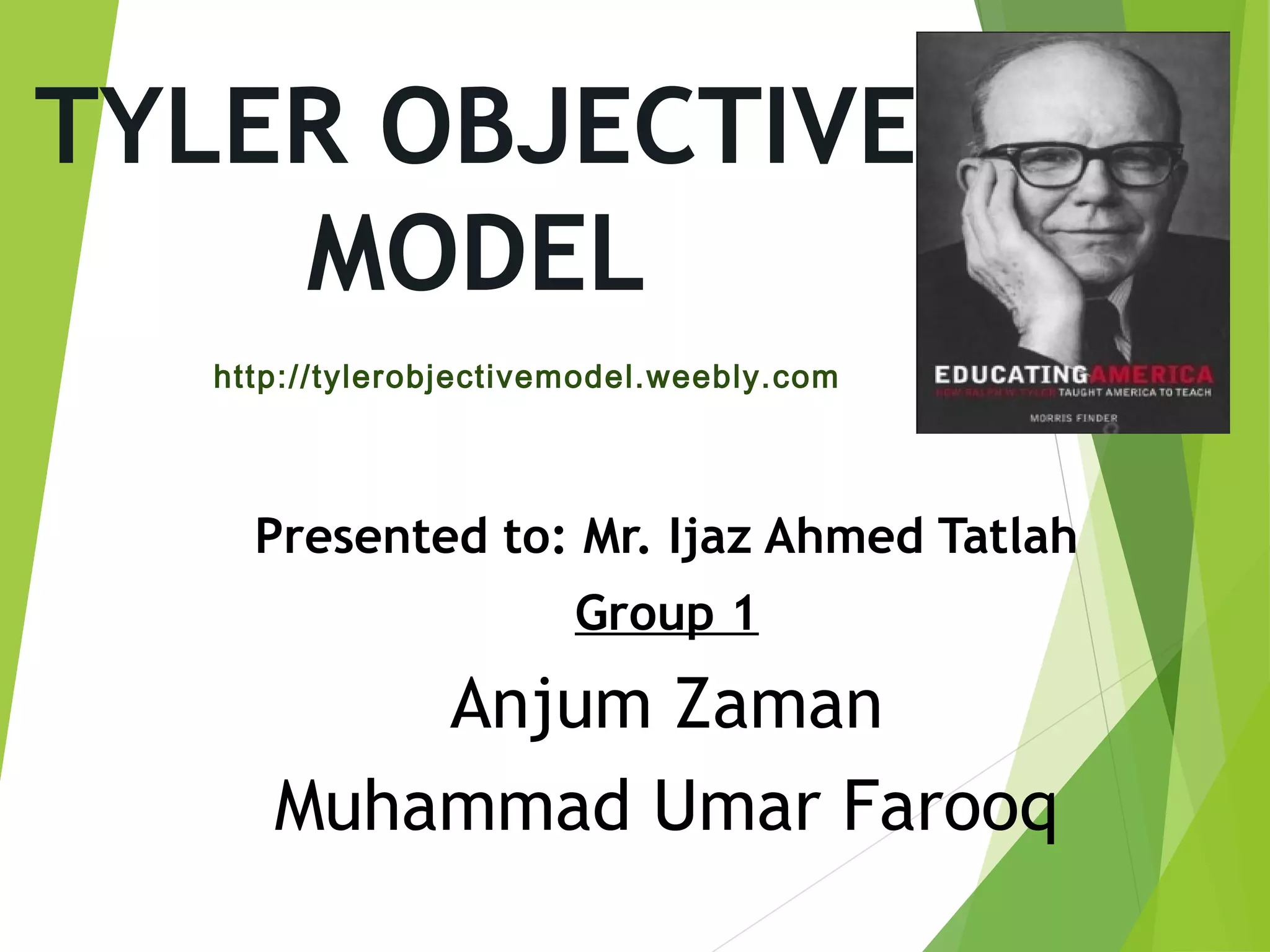
An introduction to the Tyler Objective Model presented by Group 1, including a prompt for audience engagement.
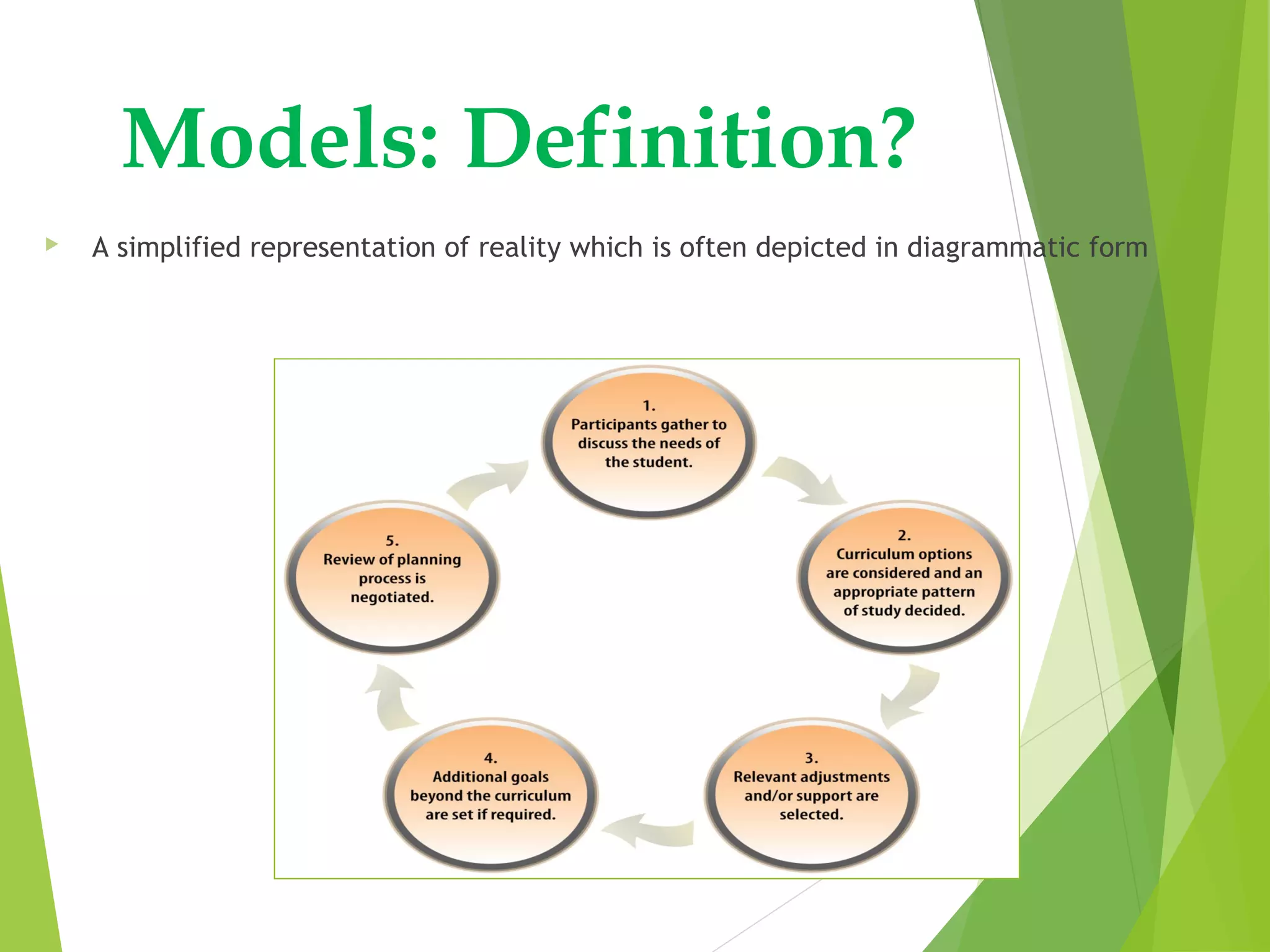
A model is a simplified representation of reality used in curriculum planning, providing a structured approach to examine curriculum elements and their interrelations.
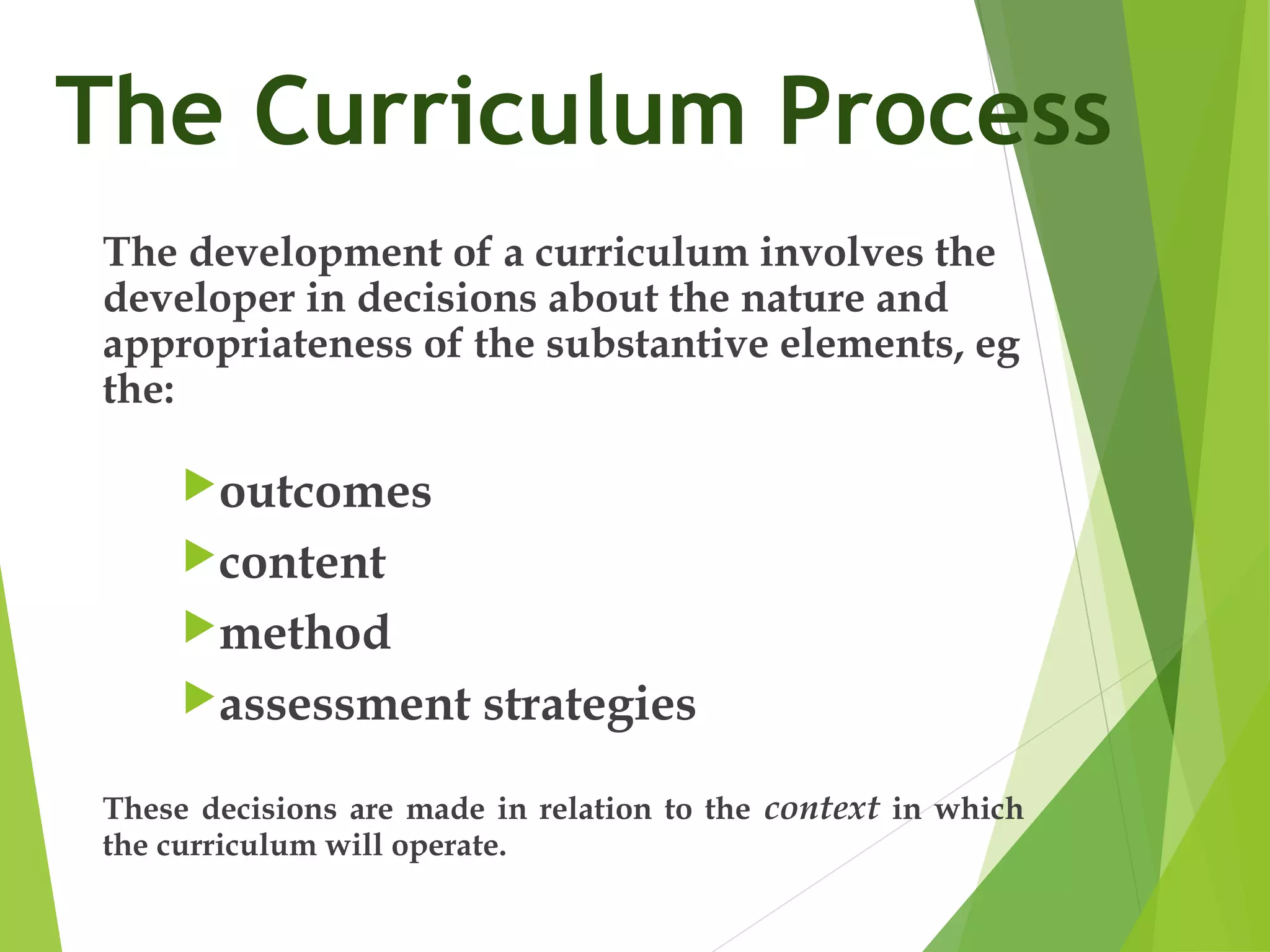
The curriculum process involves decisions on outcomes, content, methods, and assessment strategies based on the context of implementation.
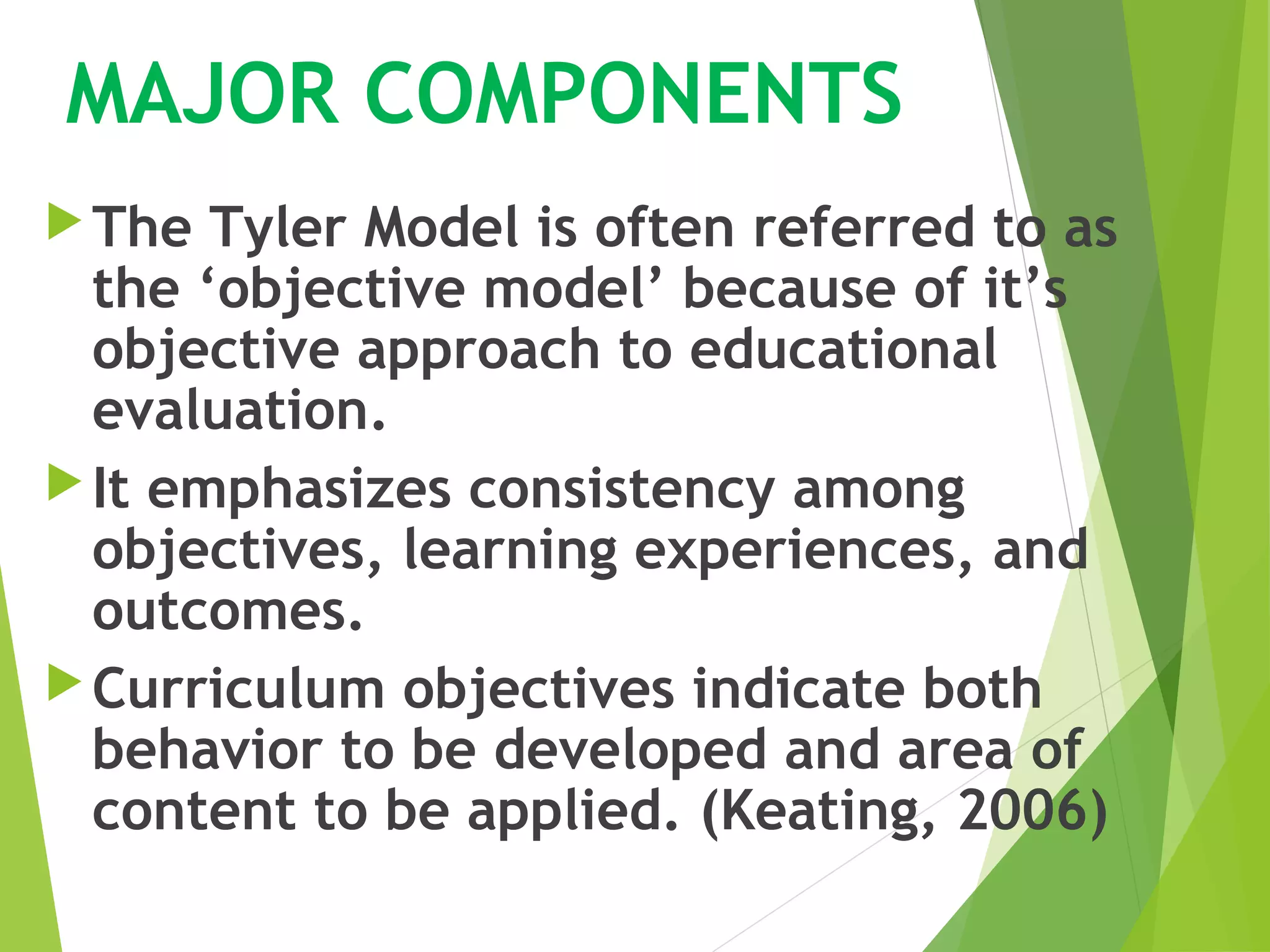
Introduction to Tyler’s Objective Model, emphasizing its focus on objectives, learning experiences, outcomes, and educational evaluation consistency.
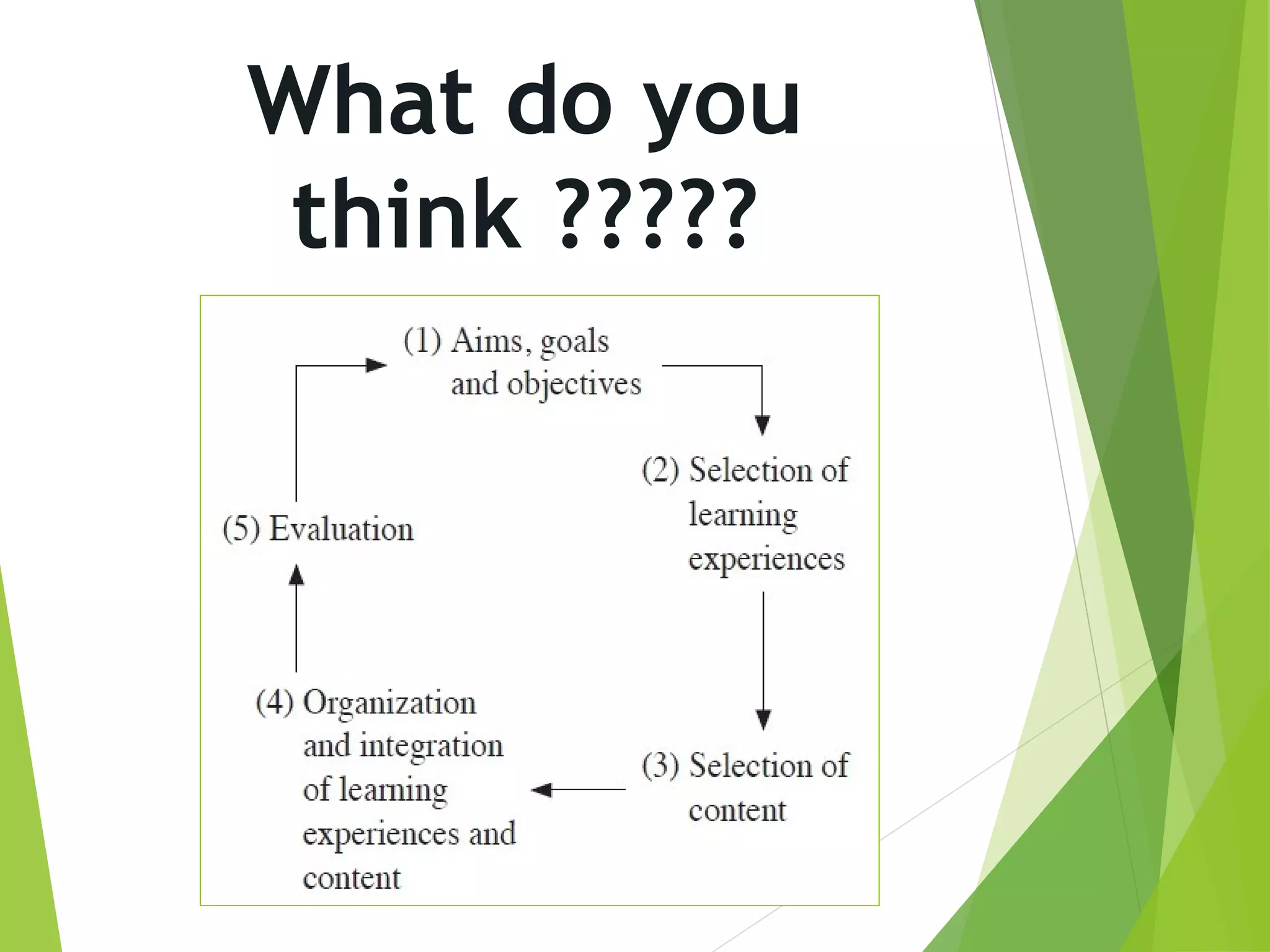
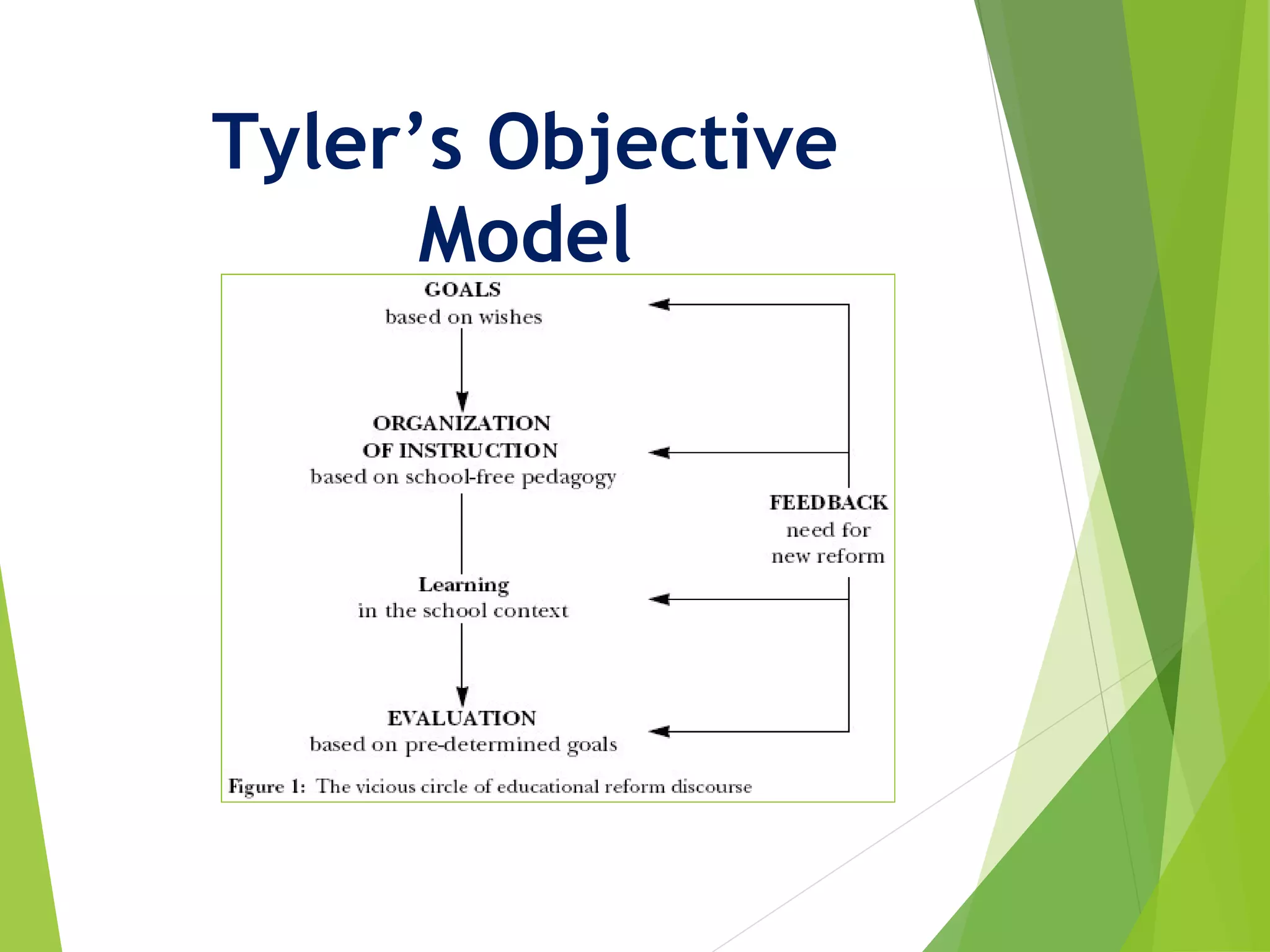
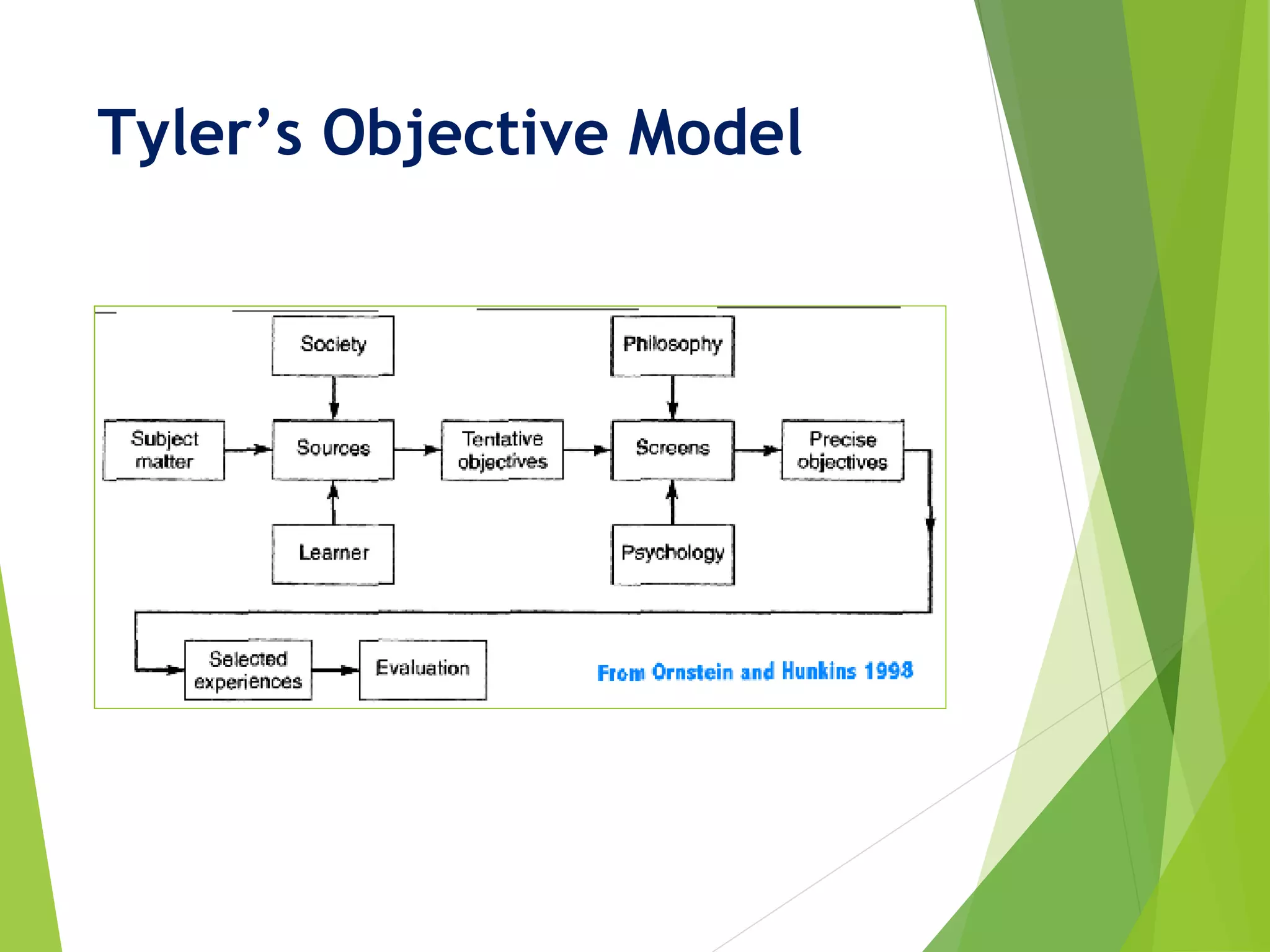
Tyler’s rationale includes defining educational purposes, selecting learning experiences, organizing instruction, and evaluating effectiveness.
The four principles involve defining learning objectives, establishing learning experiences, organizing them for impact, and evaluating curriculum effectiveness.
Focus on four primary terms: stating objectives, selecting learning experiences, organizing them effectively, and evaluating the curriculum's realization of objectives.
Highlights strengths such as learner participation, clear objectives, and a straightforward development approach for behavioral objectives.
Criticism includes overly narrow objectives, time-consuming processes for creating behavioral objectives, and limitations in addressing critical thinking and problem-solving.
List of references supporting information on Tyler’s Objective Model and its evaluation in the context of curriculum design.
Models: Definition?
Asimplified representation of reality which is often depicted in diagrammatic form
4.
Model: Purpose?
To providea structure
for examining the
elements that go to make
up curriculum planning,
and how these elements
interrelate.
5.
The Curriculum Process
Thedevelopment of a curriculum involves the
developer in decisions about the nature and
appropriateness of the substantive elements, eg
the:
outcomes
content
method
assessment strategies
These decisions are made in relation to the context in which
the curriculum will operate.
MAJOR COMPONENTS
The TylerModel is often referred to as
the ‘objective model’ because of it’s
objective approach to educational
evaluation.
It emphasizes consistency among
objectives, learning experiences, and
outcomes.
Curriculum objectives indicate both
behavior to be developed and area of
content to be applied. (Keating, 2006)
9.
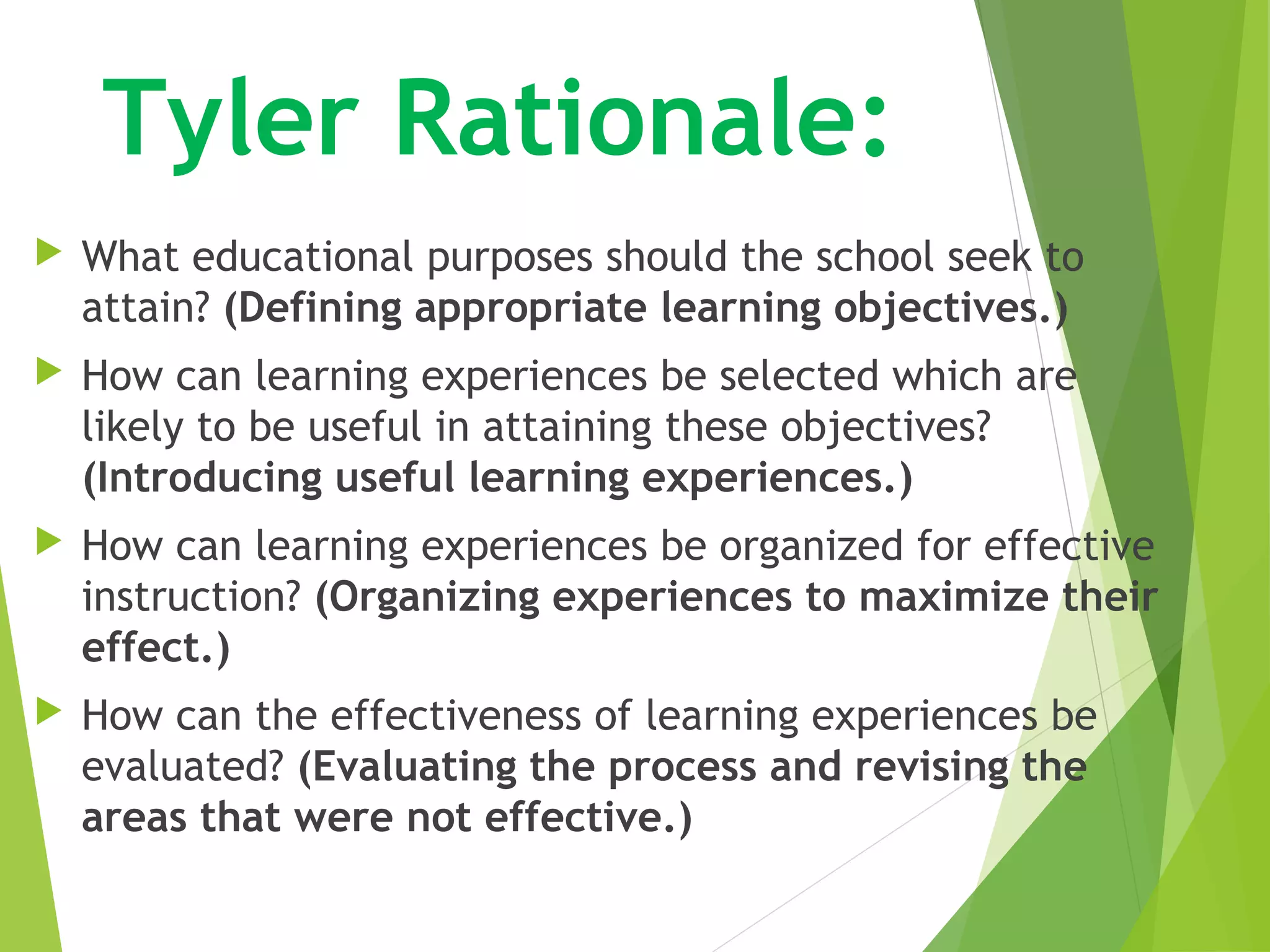
Tyler Rationale:
Whateducational purposes should the school seek to
attain? (Defining appropriate learning objectives.)
How can learning experiences be selected which are
likely to be useful in attaining these objectives?
(Introducing useful learning experiences.)
How can learning experiences be organized for effective
instruction? (Organizing experiences to maximize their
effect.)
How can the effectiveness of learning experiences be
evaluated? (Evaluating the process and revising the
areas that were not effective.)
10.
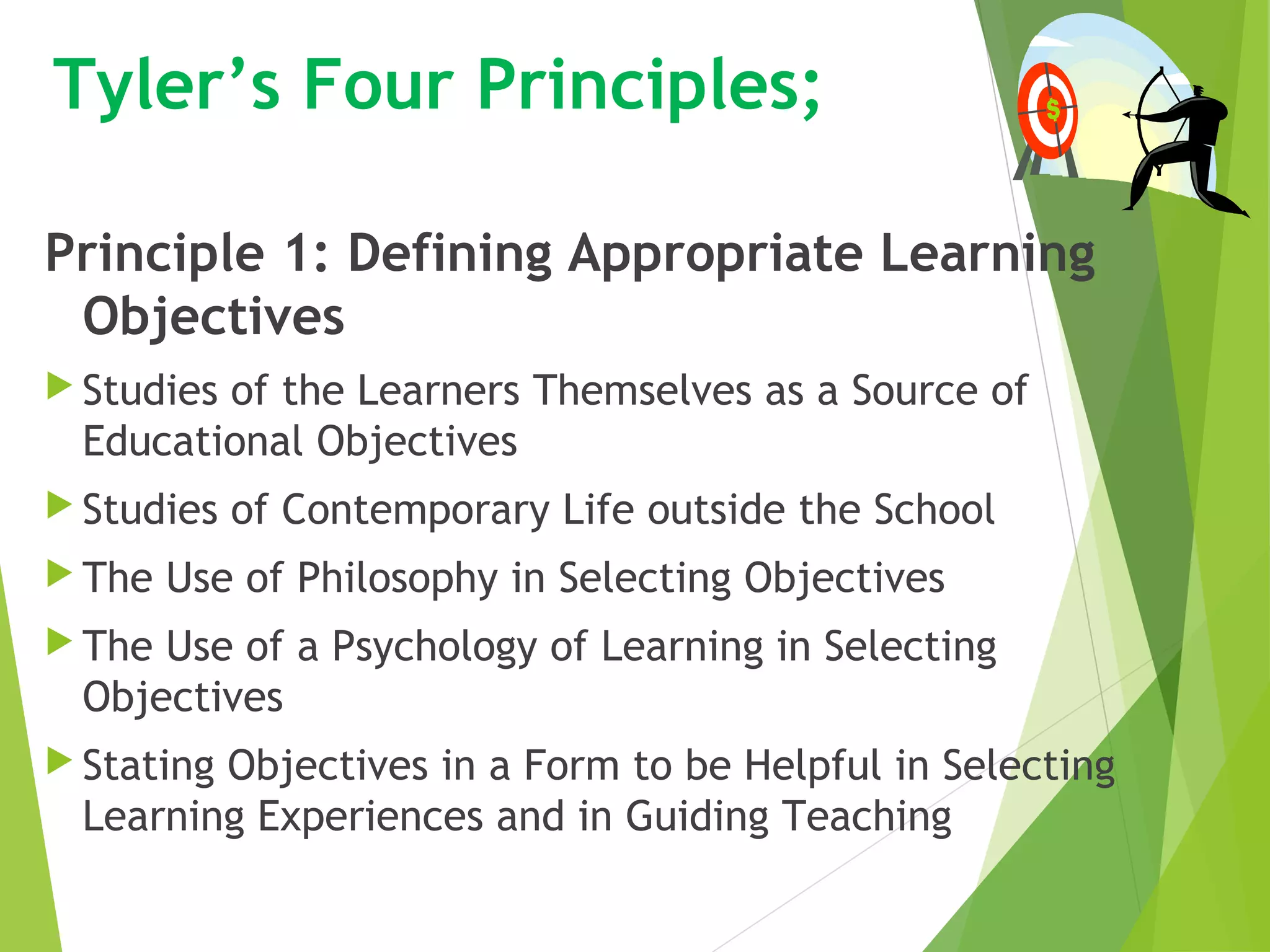
Tyler’s Four Principles;
Principle1: Defining Appropriate Learning
Objectives
Studies of the Learners Themselves as a Source of
Educational Objectives
Studies of Contemporary Life outside the School
The Use of Philosophy in Selecting Objectives
The Use of a Psychology of Learning in Selecting
Objectives
Stating Objectives in a Form to be Helpful in Selecting
Learning Experiences and in Guiding Teaching
11.
Tyler’s Teaching
Principles cont’d…..
Principle2: Establishing Useful
Learning Experiences
Meaning of the Term “Learning
Experience”
General Principles in Selecting Learning
Experiences
Illustrations of the Characteristics of
Learning Experiences Useful in Attaining
Various Types of Objectives
12.
Tyler’s Teaching Principles
cont’d…..
Principle3: Organizing Learning Experiences
to Have a Maximum Cumulative Effect
What is meant by “Organization?”
Criteria for Effective Organization
Elements to be organized
Organizing Principles
The Organizing Structure
The Process of Planning a Unit of
Organization
13.
Tyler’s Teaching Principles
cont’d…..
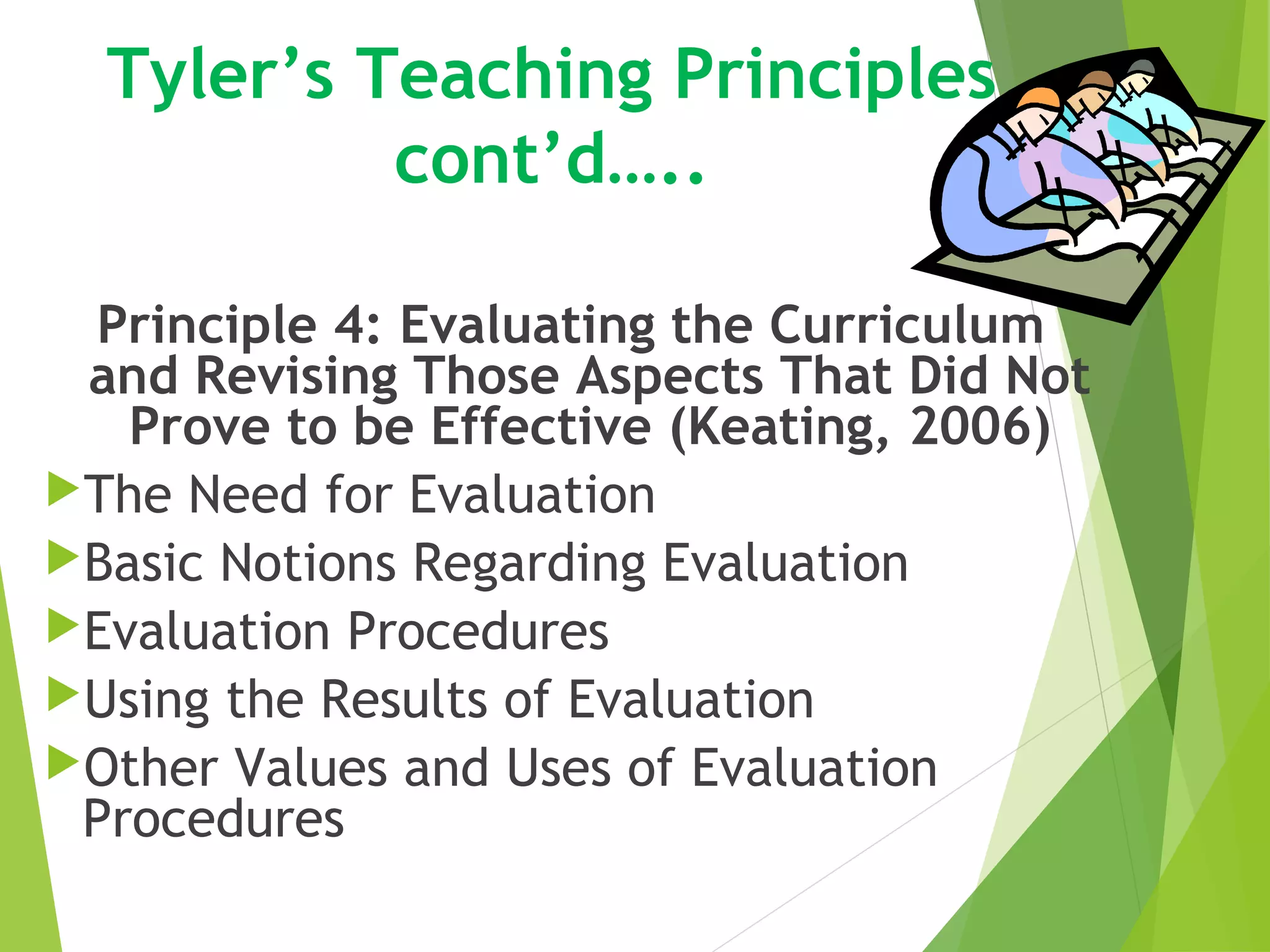
Principle4: Evaluating the Curriculum
and Revising Those Aspects That Did Not
Prove to be Effective (Keating, 2006)
The Need for Evaluation
Basic Notions Regarding Evaluation
Evaluation Procedures
Using the Results of Evaluation
Other Values and Uses of Evaluation
Procedures
14.
PRIMARY TERMS
OF THETHEORY
Stating Objectives (Denham, 2002)
The progressive emphasizes the
importance of studying the child to
find out what kinds of interests he
has, what problems he encounters,
what purposes he has in mind. The
progressive sees this information as
providing the basic source for
selecting objectives
15.
PRIMARY TERMS OF
THETHEORY
Selecting Learning Experiences
(Denham, 2002)
Tyler believes that students learn
through exploration
Like his mentor, John Dewey, Tyler
believes teachers should encourage
children to become actively engaged
in discovering what the world is like
16.
PRIMARY TERMS
OF THETHEORY
Organizing Learning Experiences
(Denham, 2002)
Central to Tyler’s Model is effectively
organizing the learning activities
Students need concrete experiences to
which the readings are meaningfully
connected
Three major criteria are required in
building organized learning experiences:
continuity, sequence and integration
17.
PRIMARY TERMS
OF THETHEORY
Evaluating the Curriculum (Denham,
2002)
The process of assessment is critical to
Tyler’s Model and begins with the
objectives of the educational program
The process of evaluation is essentially
the process of determining to what
extent the educational objectives are
actually being realized by the program of
curriculum and instruction
18.
STRENGTHS OF
MODEL
Involvesthe active participation of the learner
(Prideaux, 2003)
Objectives are clearly defined in the purposes.
These purposes are translated into educational
objectives.
(www.coedu.usf.edu/agents/dlewis/publications/
tyler.htm)
Simple linear approach to development of
behavioral objectives (Billings & Halstead, 2009)
CRITICISMS OF THETYLER MODEL
(CONT.)
Critical thinking, problem solving and value acquiring
processes cannot be plainly declared in behavioral
objectives (Prideaux, 2003)
(CONT.)
Learning experiences are individual and are not totally
within the power of the teacher to select
The teacher can control the learning experience
through the manipulation of the environment, which
results in stimulating situations sufficient to evoke the
kind of learning outcomes desired
(www.neiu.edu/~aserafin/New%20Folder/TYLER.html)
21.
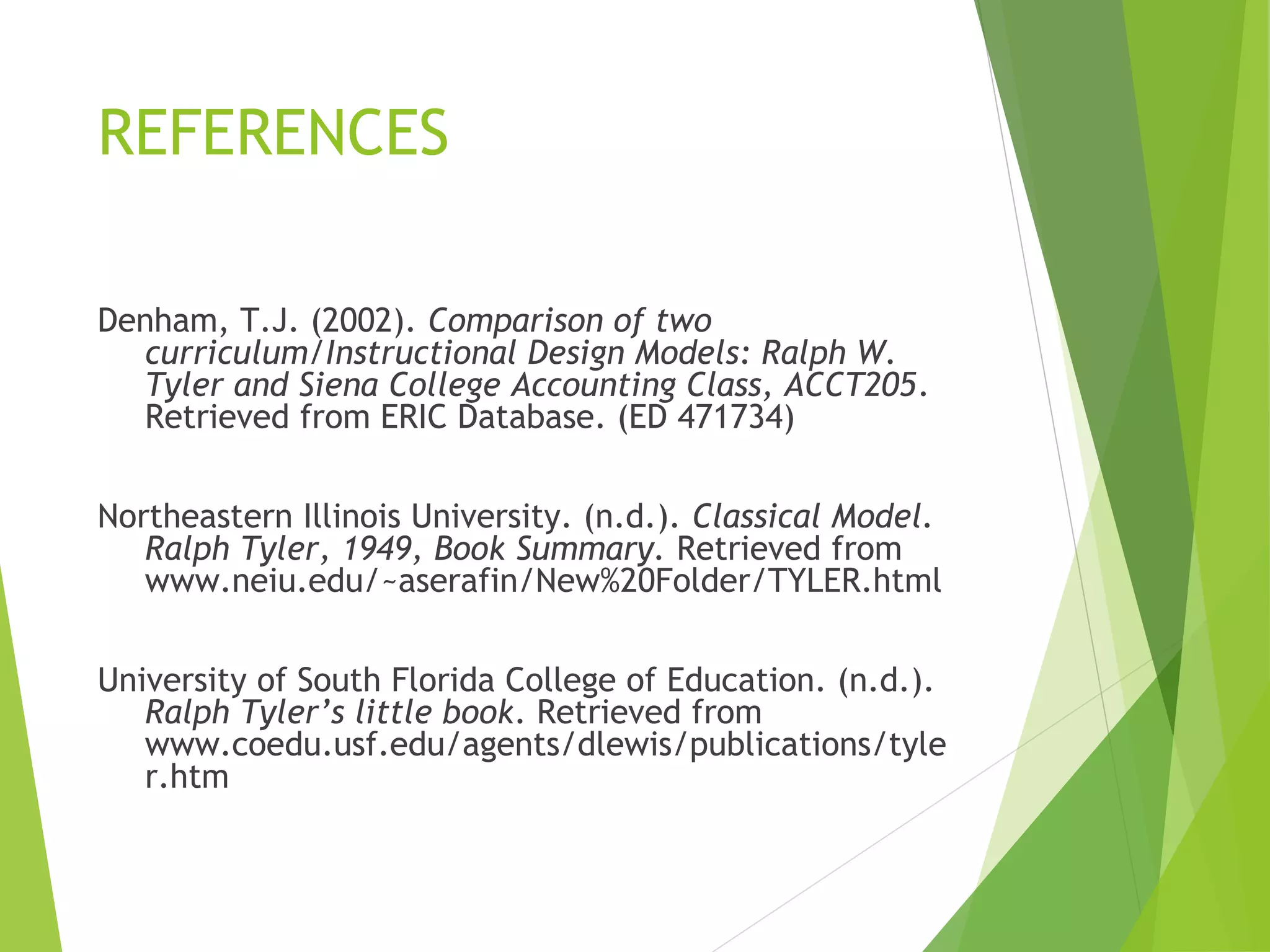
REFERENCES
Denham, T.J. (2002).Comparison of two
curriculum/Instructional Design Models: Ralph W.
Tyler and Siena College Accounting Class, ACCT205.
Retrieved from ERIC Database. (ED 471734)
Northeastern Illinois University. (n.d.). Classical Model.
Ralph Tyler, 1949, Book Summary. Retrieved from
www.neiu.edu/~aserafin/New%20Folder/TYLER.html
University of South Florida College of Education. (n.d.).
Ralph Tyler’s little book. Retrieved from
www.coedu.usf.edu/agents/dlewis/publications/tyle
r.htm
22.
REFERENCES
(CONT.)
Billings, D. M.& Halstead, J.A. (2009).Teaching in
nursing: A guide for faculty. St. Louis, Missouri:
Saunder Elsevier
Keating, S. (2006). Curriculum development and
evaluation in nursing. Philadelphia, Pennsylvania:
Lippincott Williams & Wilkins.
Prideaux, D. (2003). Curriculum design: ABC of learning
and teaching in medicine. British Medical Journal,
326(7383), 268-270. Retrieved from
http://www.ncbi.nlm.nih.gov/pmc/articles/PMC112
5124/?tool=pubmed
Editor's Notes
#14 The four step can be defined as 1) stating the objectives, 2) selecting learning experiences, 3) organizing learning experiences and 4) evaluating the curriculum.