SCHOOL MANAGEMENT
Staff Meeting
In the context of School Management
Submitted to; Dr. Muhammad Amin
Submitted By; Muhammad Umar Farooq(Roll No.142219)
Program;M.A Education (Leadership & Management)
Submission Date;20/01/2015
DIVISION OF EDUCATION
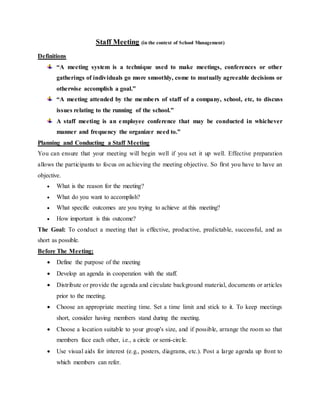
Staff Meeting (in the context of School Management)
Definitions
“A meeting system is a technique used to make meetings, conferences or other
gatherings of individuals go more smoothly, come to mutually agreeable decisions or
otherwise accomplish a goal.”
“A meeting attended by the members of staff of a company, school, etc, to discuss
issues relating to the running of the school.”
A staff meeting is an employee conference that may be conducted in whichever
manner and frequency the organizer need to.”
Planning and Conducting a Staff Meeting
You can ensure that your meeting will begin well if you set it up well. Effective preparation
allows the participants to focus on achieving the meeting objective. So first you have to have an
objective.
 What is the reason for the meeting?
 What do you want to accomplish?
 What specific outcomes are you trying to achieve at this meeting?
 How important is this outcome?
The Goal: To conduct a meeting that is effective, productive, predictable, successful, and as
short as possible.
Before The Meeting;
 Define the purpose of the meeting
 Develop an agenda in cooperation with the staff.
 Distribute or provide the agenda and circulate background material, documents or articles
prior to the meeting.
 Choose an appropriate meeting time. Set a time limit and stick to it. To keep meetings
short, consider having members stand during the meeting.
 Choose a location suitable to your group's size, and if possible, arrange the room so that
members face each other, i.e., a circle or semi-circle.
 Use visual aids for interest (e.g., posters, diagrams, etc.). Post a large agenda up front to
which members can refer.
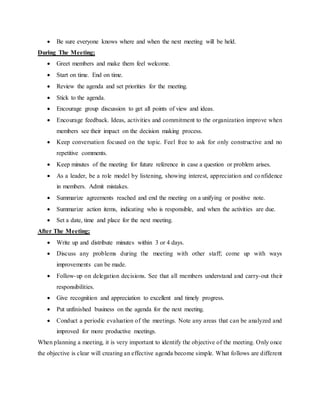
 Be sure everyone knows where and when the next meeting will be held.
During The Meeting;
 Greet members and make them feel welcome.
 Start on time. End on time.
 Review the agenda and set priorities for the meeting.
 Stick to the agenda.
 Encourage group discussion to get all points of view and ideas.
 Encourage feedback. Ideas, activities and commitment to the organization improve when
members see their impact on the decision making process.
 Keep conversation focused on the topic. Feel free to ask for only constructive and no
repetitive comments.
 Keep minutes of the meeting for future reference in case a question or problem arises.
 As a leader, be a role model by listening, showing interest, appreciation and confidence
in members. Admit mistakes.
 Summarize agreements reached and end the meeting on a unifying or positive note.
 Summarize action items, indicating who is responsible, and when the activities are due.
 Set a date, time and place for the next meeting.
After The Meeting;
 Write up and distribute minutes within 3 or 4 days.
 Discuss any problems during the meeting with other staff; come up with ways
improvements can be made.
 Follow-up on delegation decisions. See that all members understand and carry-out their
responsibilities.
 Give recognition and appreciation to excellent and timely progress.
 Put unfinished business on the agenda for the next meeting.
 Conduct a periodic evaluation of the meetings. Note any areas that can be analyzed and
improved for more productive meetings.
When planning a meeting, it is very important to identify the objective of the meeting. Only once
the objective is clear will creating an effective agenda become simple. What follows are different
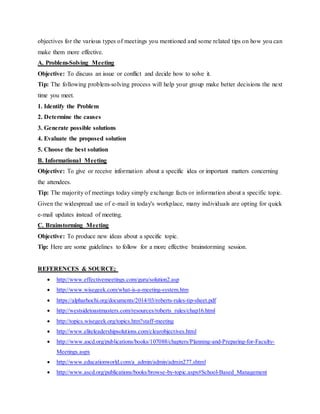
objectives for the various types of meetings you mentioned and some related tips on how you can
make them more effective.
A. Problem-Solving Meeting
Objective: To discuss an issue or conflict and decide how to solve it.
Tip: The following problem-solving process will help your group make better decisions the next
time you meet.
1. Identify the Problem
2. Determine the causes
3. Generate possible solutions
4. Evaluate the proposed solution
5. Choose the best solution
B. Informational Meeting
Objective: To give or receive information about a specific idea or important matters concerning
the attendees.
Tip: The majority of meetings today simply exchange facts or information about a specific topic.
Given the widespread use of e-mail in today's workplace, many individuals are opting for quick
e-mail updates instead of meeting.
C. Brainstorming Meeting
Objective: To produce new ideas about a specific topic.
Tip: Here are some guidelines to follow for a more effective brainstorming session.
REFERENCES & SOURCE;
 http://www.effectivemeetings.com/guru/solution2.asp
 http://www.wisegeek.com/what-is-a-meeting-system.htm
 https://alpharhochi.org/documents/2014/03/roberts-rules-tip-sheet.pdf
 http://westsidetoastmasters.com/resources/roberts_rules/chap16.html
 http://topics.wisegeek.org/topics.htm?staff-meeting
 http://www.eliteleadershipsolutions.com/clearobjectives.html
 http://www.ascd.org/publications/books/107088/chapters/Planning-and-Preparing-for-Faculty-
Meetings.aspx
 http://www.educationworld.com/a_admin/admin/admin277.shtml
 http://www.ascd.org/publications/books/browse-by-topic.aspx#School-Based_Management

Assignment.docx; staff meeting (school management)

  • 1.
    SCHOOL MANAGEMENT Staff Meeting Inthe context of School Management Submitted to; Dr. Muhammad Amin Submitted By; Muhammad Umar Farooq(Roll No.142219) Program;M.A Education (Leadership & Management) Submission Date;20/01/2015 DIVISION OF EDUCATION
  • 2.
    Staff Meeting (inthe context of School Management) Definitions “A meeting system is a technique used to make meetings, conferences or other gatherings of individuals go more smoothly, come to mutually agreeable decisions or otherwise accomplish a goal.” “A meeting attended by the members of staff of a company, school, etc, to discuss issues relating to the running of the school.” A staff meeting is an employee conference that may be conducted in whichever manner and frequency the organizer need to.” Planning and Conducting a Staff Meeting You can ensure that your meeting will begin well if you set it up well. Effective preparation allows the participants to focus on achieving the meeting objective. So first you have to have an objective.  What is the reason for the meeting?  What do you want to accomplish?  What specific outcomes are you trying to achieve at this meeting?  How important is this outcome? The Goal: To conduct a meeting that is effective, productive, predictable, successful, and as short as possible. Before The Meeting;  Define the purpose of the meeting  Develop an agenda in cooperation with the staff.  Distribute or provide the agenda and circulate background material, documents or articles prior to the meeting.  Choose an appropriate meeting time. Set a time limit and stick to it. To keep meetings short, consider having members stand during the meeting.  Choose a location suitable to your group's size, and if possible, arrange the room so that members face each other, i.e., a circle or semi-circle.  Use visual aids for interest (e.g., posters, diagrams, etc.). Post a large agenda up front to which members can refer.
  • 3.
     Be sureeveryone knows where and when the next meeting will be held. During The Meeting;  Greet members and make them feel welcome.  Start on time. End on time.  Review the agenda and set priorities for the meeting.  Stick to the agenda.  Encourage group discussion to get all points of view and ideas.  Encourage feedback. Ideas, activities and commitment to the organization improve when members see their impact on the decision making process.  Keep conversation focused on the topic. Feel free to ask for only constructive and no repetitive comments.  Keep minutes of the meeting for future reference in case a question or problem arises.  As a leader, be a role model by listening, showing interest, appreciation and confidence in members. Admit mistakes.  Summarize agreements reached and end the meeting on a unifying or positive note.  Summarize action items, indicating who is responsible, and when the activities are due.  Set a date, time and place for the next meeting. After The Meeting;  Write up and distribute minutes within 3 or 4 days.  Discuss any problems during the meeting with other staff; come up with ways improvements can be made.  Follow-up on delegation decisions. See that all members understand and carry-out their responsibilities.  Give recognition and appreciation to excellent and timely progress.  Put unfinished business on the agenda for the next meeting.  Conduct a periodic evaluation of the meetings. Note any areas that can be analyzed and improved for more productive meetings. When planning a meeting, it is very important to identify the objective of the meeting. Only once the objective is clear will creating an effective agenda become simple. What follows are different
  • 4.
    objectives for thevarious types of meetings you mentioned and some related tips on how you can make them more effective. A. Problem-Solving Meeting Objective: To discuss an issue or conflict and decide how to solve it. Tip: The following problem-solving process will help your group make better decisions the next time you meet. 1. Identify the Problem 2. Determine the causes 3. Generate possible solutions 4. Evaluate the proposed solution 5. Choose the best solution B. Informational Meeting Objective: To give or receive information about a specific idea or important matters concerning the attendees. Tip: The majority of meetings today simply exchange facts or information about a specific topic. Given the widespread use of e-mail in today's workplace, many individuals are opting for quick e-mail updates instead of meeting. C. Brainstorming Meeting Objective: To produce new ideas about a specific topic. Tip: Here are some guidelines to follow for a more effective brainstorming session. REFERENCES & SOURCE;  http://www.effectivemeetings.com/guru/solution2.asp  http://www.wisegeek.com/what-is-a-meeting-system.htm  https://alpharhochi.org/documents/2014/03/roberts-rules-tip-sheet.pdf  http://westsidetoastmasters.com/resources/roberts_rules/chap16.html  http://topics.wisegeek.org/topics.htm?staff-meeting  http://www.eliteleadershipsolutions.com/clearobjectives.html  http://www.ascd.org/publications/books/107088/chapters/Planning-and-Preparing-for-Faculty- Meetings.aspx  http://www.educationworld.com/a_admin/admin/admin277.shtml  http://www.ascd.org/publications/books/browse-by-topic.aspx#School-Based_Management