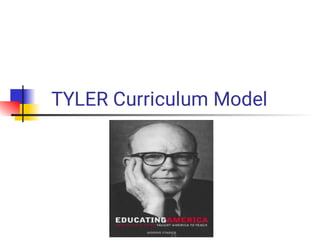
TYLER Curriculum Model
OBJECTIVES





Explore the evolution of the Tyler Curriculum
Model
Describe the model and its major components
Define the primary terms that are used
Discuss the primary strengths and drawbacks of
the model
Describe how this model can be applied in
(nursing) education
Tyler’s Four Principles of Teaching
Principle 1: Defining Appropriate Learning
Objectives


Stating Objectives (Denham, 2002)
This progressive design emphasizes the
importance of studying the student to find
out what kinds of interests he has, what
problems he encounters, what purposes he
has in mind. The progressive sees this
information as providing the basic source
for selecting objectives
Principle 2: Establishing Useful Learning
Experiences



Selecting Learning Experiences
(Denham, 2002)
Tyler believes that students learn through
exploration
Like his mentor, John Dewey, Tyler believes
teachers should encourage students to
appreciate how their learning can be
applied to the real world.
Principle 3: Organizing Learning
Experiences to Have a Maximum
Cumulative Effect




Organizing Learning Experiences
(Denham, 2002)
Central to Tyler’s Model is effectively
organizing the learning activities
Students need concrete experiences in
which the lessons are meaningfully
connected
Three major criteria are required in building
organized learning experiences: continuity,
sequence and integration
Principle 4: Evaluating the Curriculum
and Revising Those Aspects That Do
Not Prove to be Effective



Evaluating the Curriculum (Denham,
2002)
The process of assessment is critical to
Tyler’s Model and begins with the
objectives of the educational program
The process of evaluation is essentially the
process of determining to what extent the
educational objectives are actually being
realized by the program of curriculum and
instruction
STRENGTHS OF MODEL



The active participation of the learner
(Prideaux, 2003)
Class objectives are clearly defined in the
purposes. These purposes are then translated
into educational objectives.
The simple linear approach to development
of behavioral objectives is applied (Billings &
Halstead, 2009)
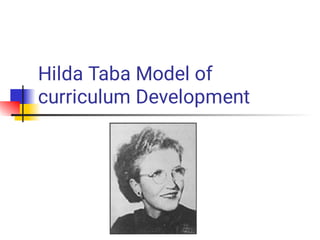
Hilda Taba Model of
curriculum Development
-
-
-
-
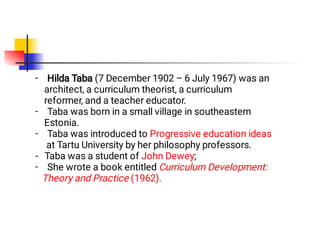
Hilda Taba (7 December 1902 – 6 July 1967) was an
architect, a curriculum theorist, a curriculum
reformer, and a teacher educator.
Taba was born in a small village in southeastern
Estonia.
Taba was introduced to Progressive education ideas
at Tartu University by her philosophy professors.
- Taba was a student of John Dewey;
She wrote a book entitled Curriculum Development:
Theory and Practice (1962).
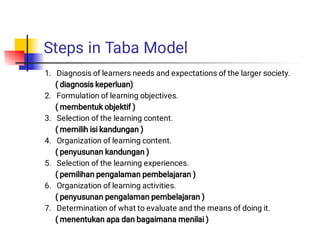
Steps in Taba Model
1. Diagnosis of learners needs and expectations of the larger society.
( diagnosis keperluan)
2. Formulation of learning objectives.
( membentuk objektif )
3. Selection of the learning content.
( memilih isi kandungan )
4. Organization of learning content.
( penyusunan kandungan )
5. Selection of the learning experiences.
( pemilihan pengalaman pembelajaran )
6. Organization of learning activities.
( penyusunan pengalaman pembelajaran )
7. Determination of what to evaluate and the means of doing it.
( menentukan apa dan bagaimana menilai )
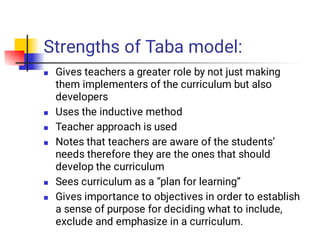
Strengths of Taba model:






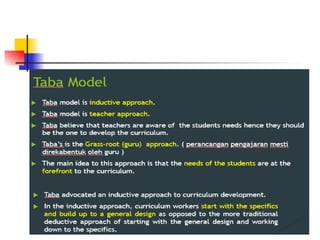
Gives teachers a greater role by not just making
them implementers of the curriculum but also
developers
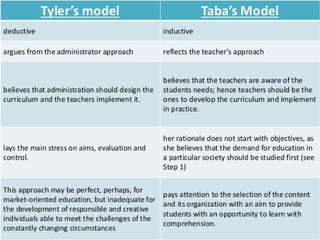
Uses the inductive method
Teacher approach is used
Notes that teachers are aware of the students’
needs therefore they are the ones that should
develop the curriculum
Sees curriculum as a “plan for learning”
Gives importance to objectives in order to establish
a sense of purpose for deciding what to include,
exclude and emphasize in a curriculum.
Similaritie
s of Tylers
& Taba”s
Model
Very
systematic
Content of
learning must
align the
educational
aims
This
model
more
emphasiz
e on the
aim of
education
(learning
outcome
Everything must be
organize in order to
achieved the objective/
learning
They
determine
whether the
objectives
are achieved
by having a
evaluation
model Kurikulum tyler. model Kurikulum tyler.

model Kurikulum tyler. model Kurikulum tyler.

  • 1.
  • 2.
    OBJECTIVES      Explore the evolutionof the Tyler Curriculum Model Describe the model and its major components Define the primary terms that are used Discuss the primary strengths and drawbacks of the model Describe how this model can be applied in (nursing) education
  • 3.
  • 4.
    Principle 1: DefiningAppropriate Learning Objectives   Stating Objectives (Denham, 2002) This progressive design emphasizes the importance of studying the student to find out what kinds of interests he has, what problems he encounters, what purposes he has in mind. The progressive sees this information as providing the basic source for selecting objectives
  • 5.
    Principle 2: EstablishingUseful Learning Experiences    Selecting Learning Experiences (Denham, 2002) Tyler believes that students learn through exploration Like his mentor, John Dewey, Tyler believes teachers should encourage students to appreciate how their learning can be applied to the real world.
  • 6.
    Principle 3: OrganizingLearning Experiences to Have a Maximum Cumulative Effect     Organizing Learning Experiences (Denham, 2002) Central to Tyler’s Model is effectively organizing the learning activities Students need concrete experiences in which the lessons are meaningfully connected Three major criteria are required in building organized learning experiences: continuity, sequence and integration
  • 7.
    Principle 4: Evaluatingthe Curriculum and Revising Those Aspects That Do Not Prove to be Effective    Evaluating the Curriculum (Denham, 2002) The process of assessment is critical to Tyler’s Model and begins with the objectives of the educational program The process of evaluation is essentially the process of determining to what extent the educational objectives are actually being realized by the program of curriculum and instruction
  • 8.
    STRENGTHS OF MODEL    Theactive participation of the learner (Prideaux, 2003) Class objectives are clearly defined in the purposes. These purposes are then translated into educational objectives. The simple linear approach to development of behavioral objectives is applied (Billings & Halstead, 2009)
  • 9.
    Hilda Taba Modelof curriculum Development
  • 10.
    - - - - Hilda Taba (7December 1902 – 6 July 1967) was an architect, a curriculum theorist, a curriculum reformer, and a teacher educator. Taba was born in a small village in southeastern Estonia. Taba was introduced to Progressive education ideas at Tartu University by her philosophy professors. - Taba was a student of John Dewey; She wrote a book entitled Curriculum Development: Theory and Practice (1962).
  • 13.
    Steps in TabaModel 1. Diagnosis of learners needs and expectations of the larger society. ( diagnosis keperluan) 2. Formulation of learning objectives. ( membentuk objektif ) 3. Selection of the learning content. ( memilih isi kandungan ) 4. Organization of learning content. ( penyusunan kandungan ) 5. Selection of the learning experiences. ( pemilihan pengalaman pembelajaran ) 6. Organization of learning activities. ( penyusunan pengalaman pembelajaran ) 7. Determination of what to evaluate and the means of doing it. ( menentukan apa dan bagaimana menilai )
  • 14.
    Strengths of Tabamodel:       Gives teachers a greater role by not just making them implementers of the curriculum but also developers Uses the inductive method Teacher approach is used Notes that teachers are aware of the students’ needs therefore they are the ones that should develop the curriculum Sees curriculum as a “plan for learning” Gives importance to objectives in order to establish a sense of purpose for deciding what to include, exclude and emphasize in a curriculum.
  • 15.
    Similaritie s of Tylers &Taba”s Model Very systematic Content of learning must align the educational aims This model more emphasiz e on the aim of education (learning outcome Everything must be organize in order to achieved the objective/ learning They determine whether the objectives are achieved by having a evaluation