Page 1
Magellan: Geospatial Analytics on Spark
Ram Sriharsha
Spark and Data Science Architect,
Hortonworks
Page 2
What is geospatial context?
•Given a point = (-122.412651, 37.777748) which
city is it in?
•Does shape X intersect shape Y?
–Compute the intersection
•Given a sequence of points and a system of roads
–Compute best path representing points
Page 3
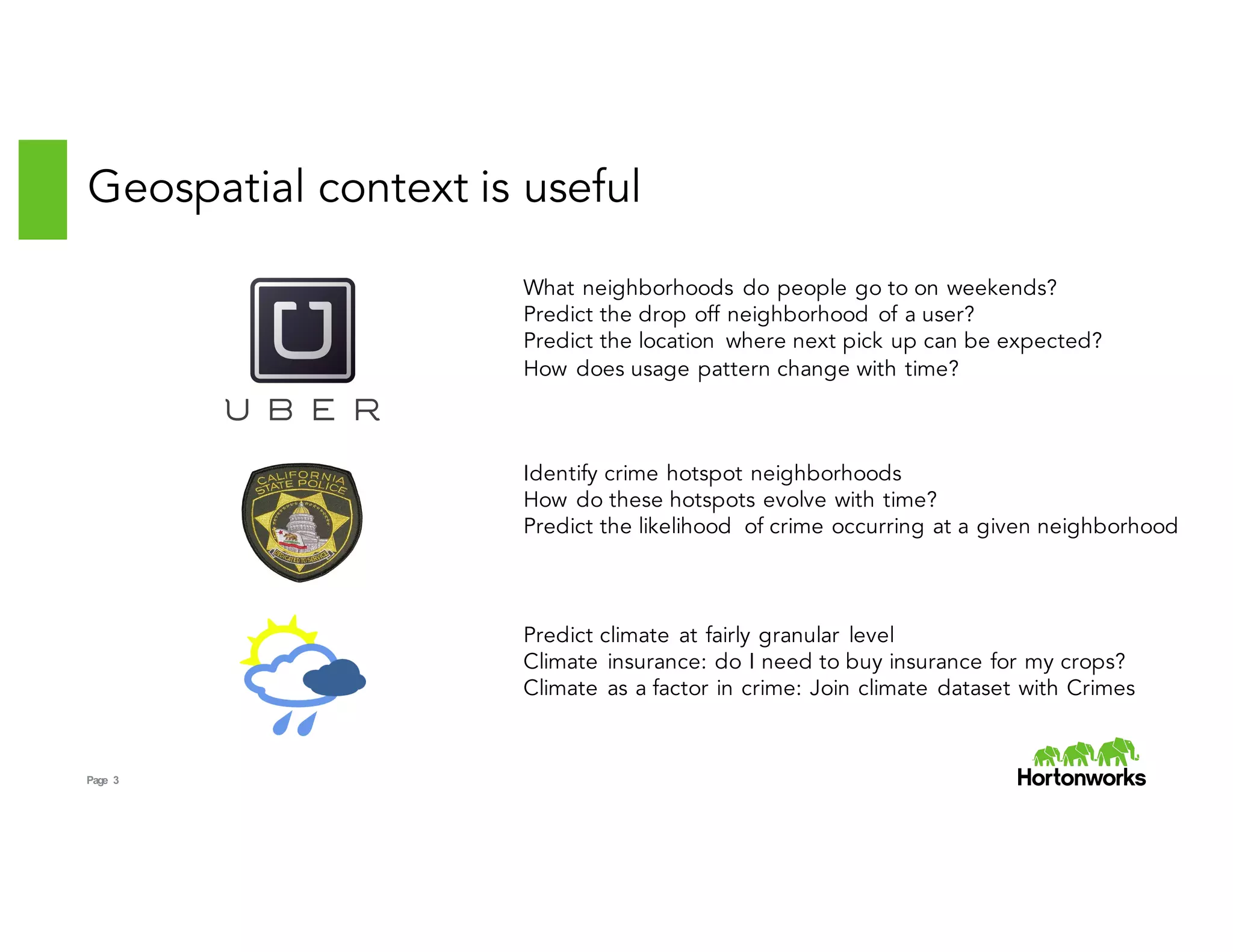
Geospatial context is useful
What neighborhoods do people go to on weekends?
Predict the drop off neighborhood of a user?
Predict the location where next pick up can be expected?
How does usage pattern change with time?
Identify crime hotspot neighborhoods
How do these hotspots evolve with time?
Predict the likelihood of crime occurring at a given neighborhood
Predict climate at fairly granular level
Climate insurance: do I need to buy insurance for my crops?
Climate as a factor in crime: Join climate dataset with Crimes
Page 4
Geospatial data is pervasive
Page 5
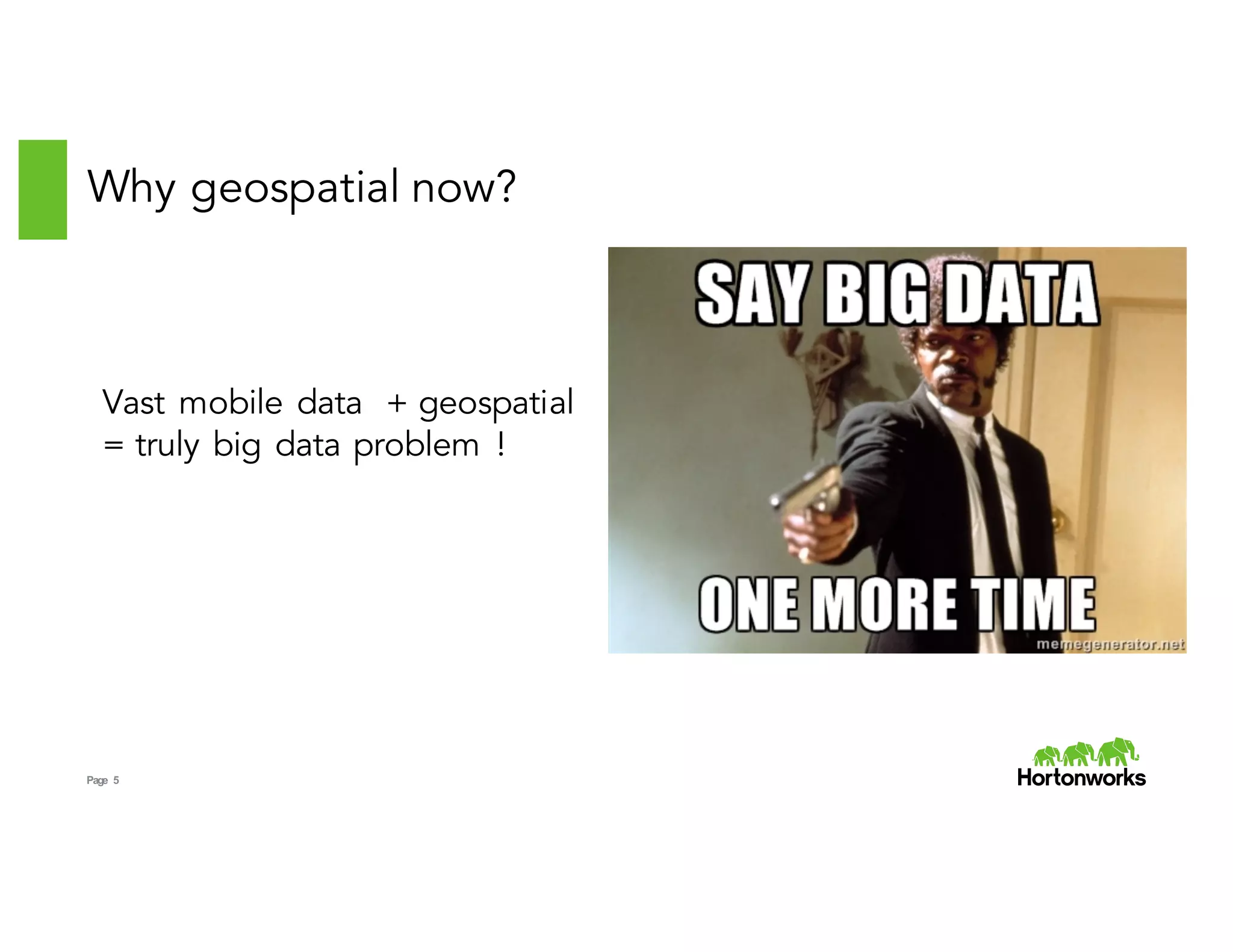
Why geospatial now?
Vast mobile data + geospatial
= truly big data problem !
Page 6
Do you think we need one more geospatial library?
Page 7
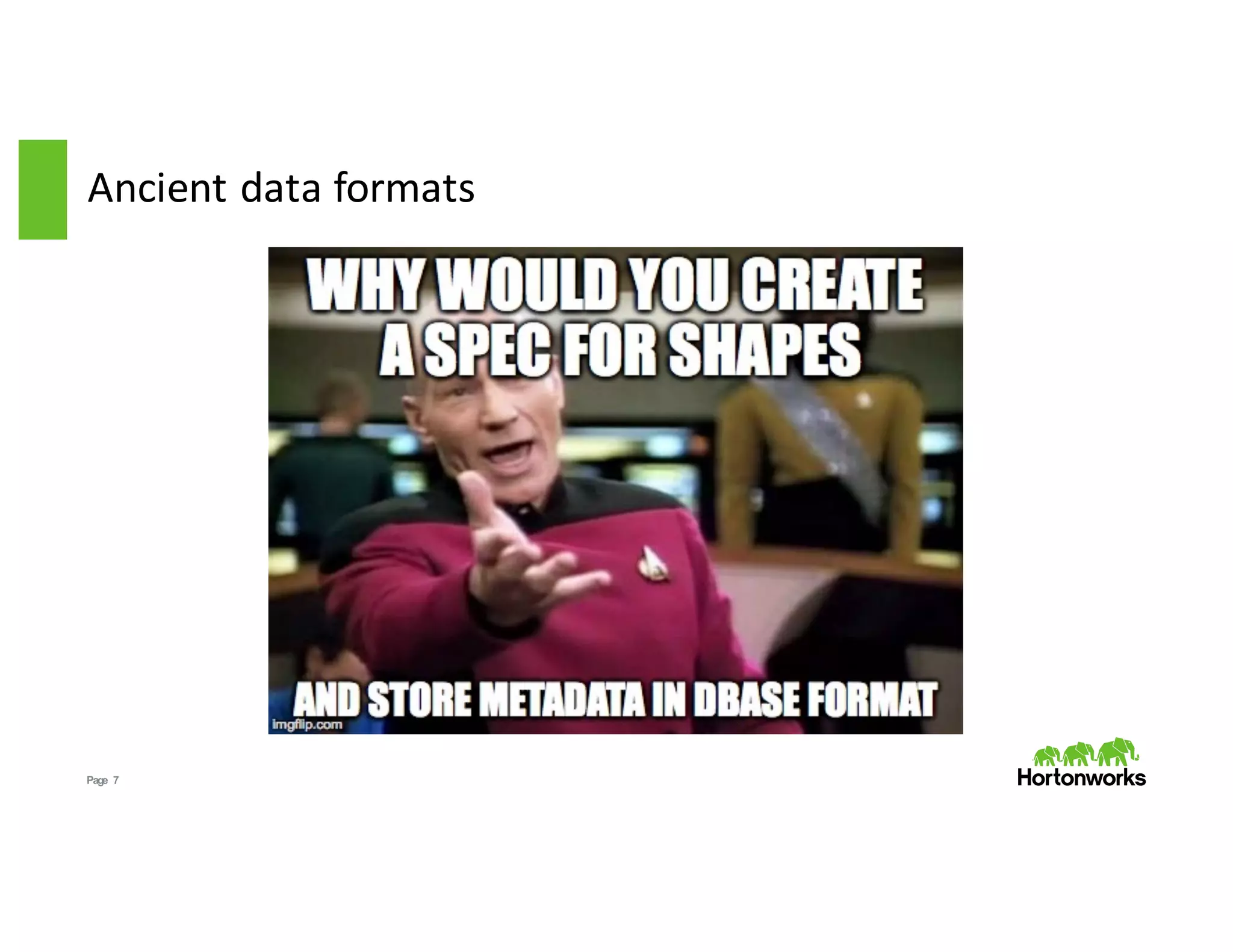
Ancient data formats
Page 8
Coordinate System Hell!
Mobile data = GPS coordinates
Map coordinate systems optimized for precision
⇒Transform from one to another
No good transformation libraries
Page 9
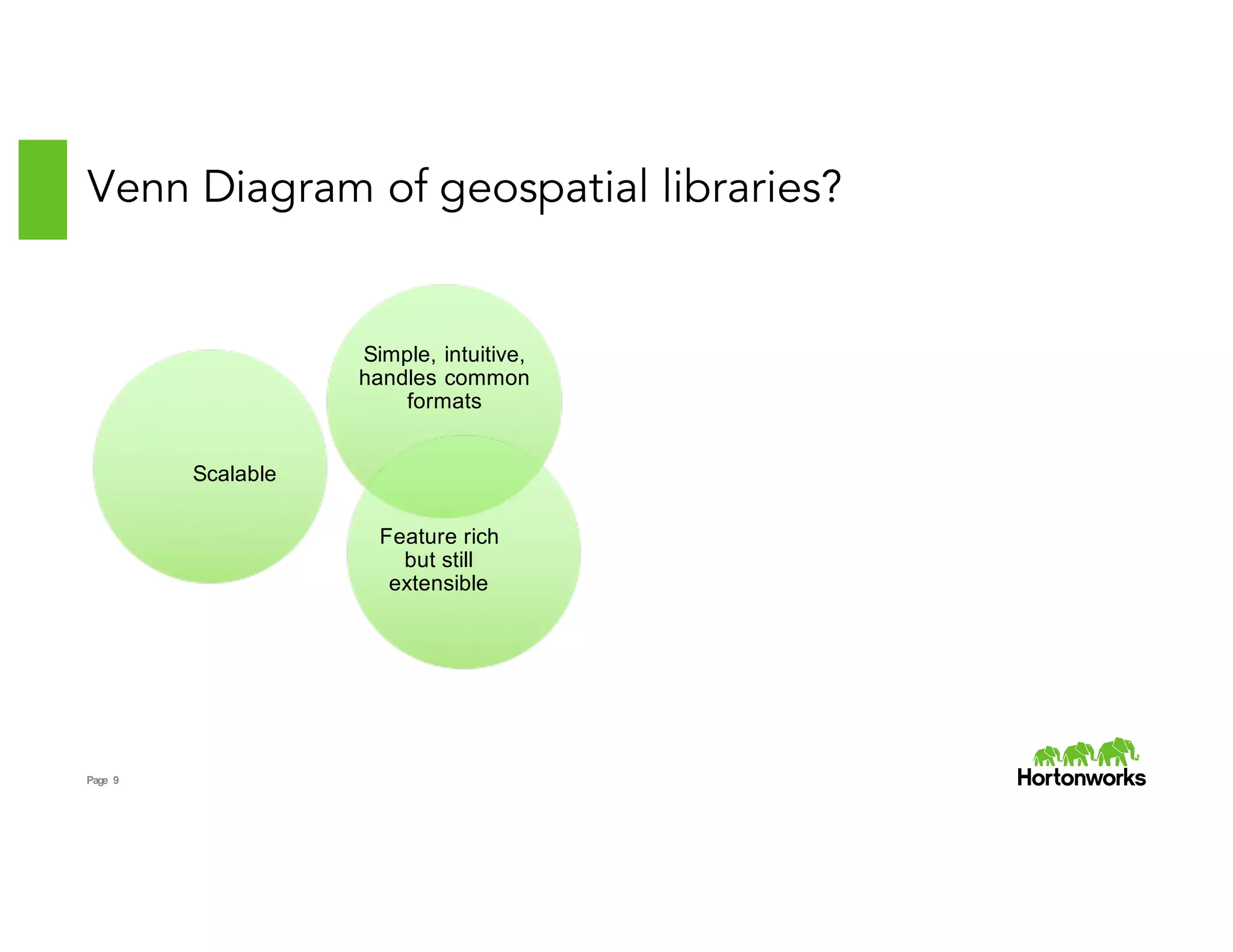
Simple, intuitive,
handles common
formats
Scalable
Feature rich
but still
extensible
Venn Diagram of geospatial libraries?
Page 10
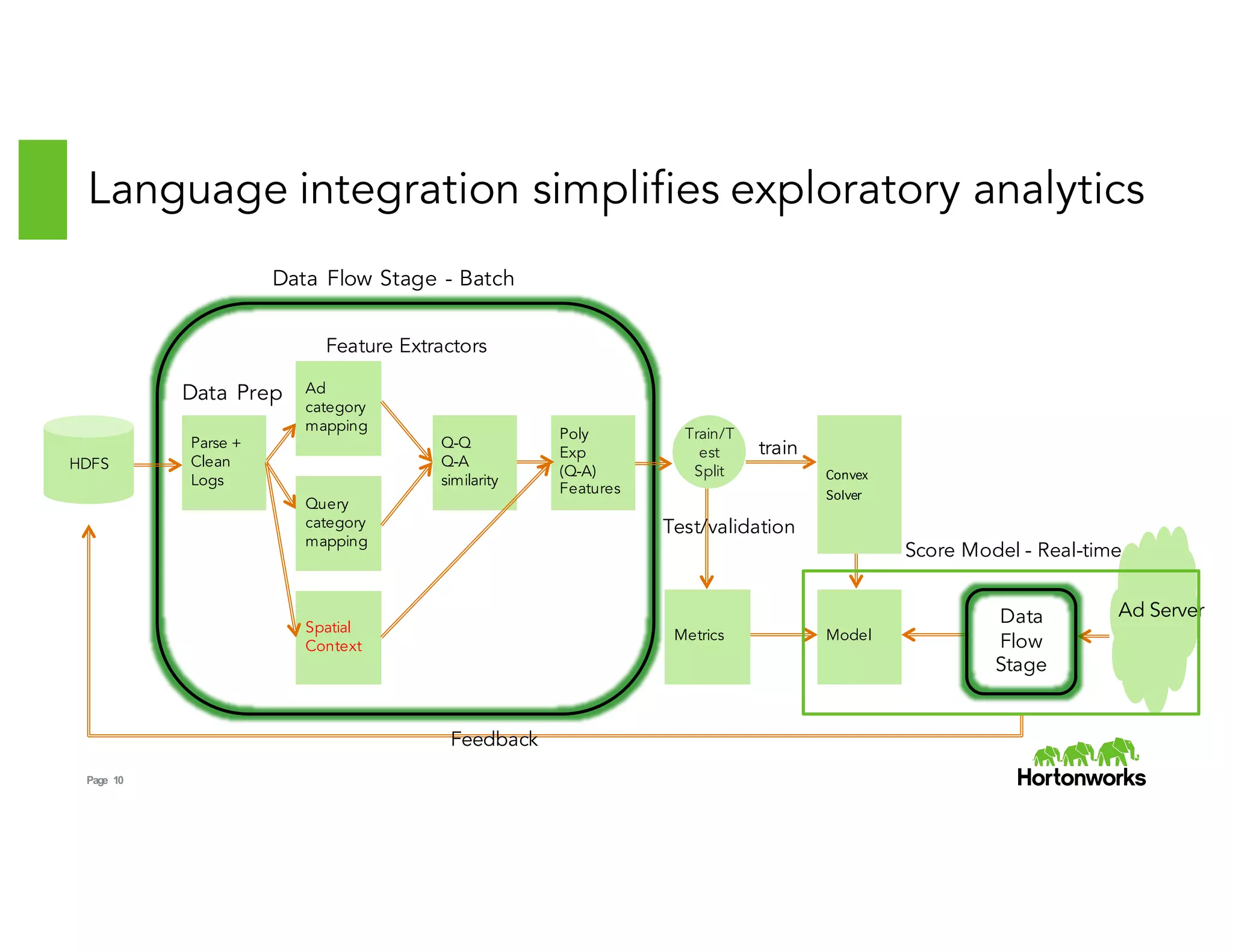
Feature Extractors
Language integration simplifies exploratory analytics
Q-Q
Q-A
similarity
Parse +
Clean
Logs
Ad
category
mapping
Query
category
mapping
Poly
Exp
(Q-A)
Features
Model
Convex
Solver
Train/T
est
Split
train
Test/validation
Metrics
Ad Server
HDFS
Data Prep
Score Model - Real-time
Data
Flow
Stage
Data Flow Stage - Batch
Feedback
Spatial
Context
Page 11
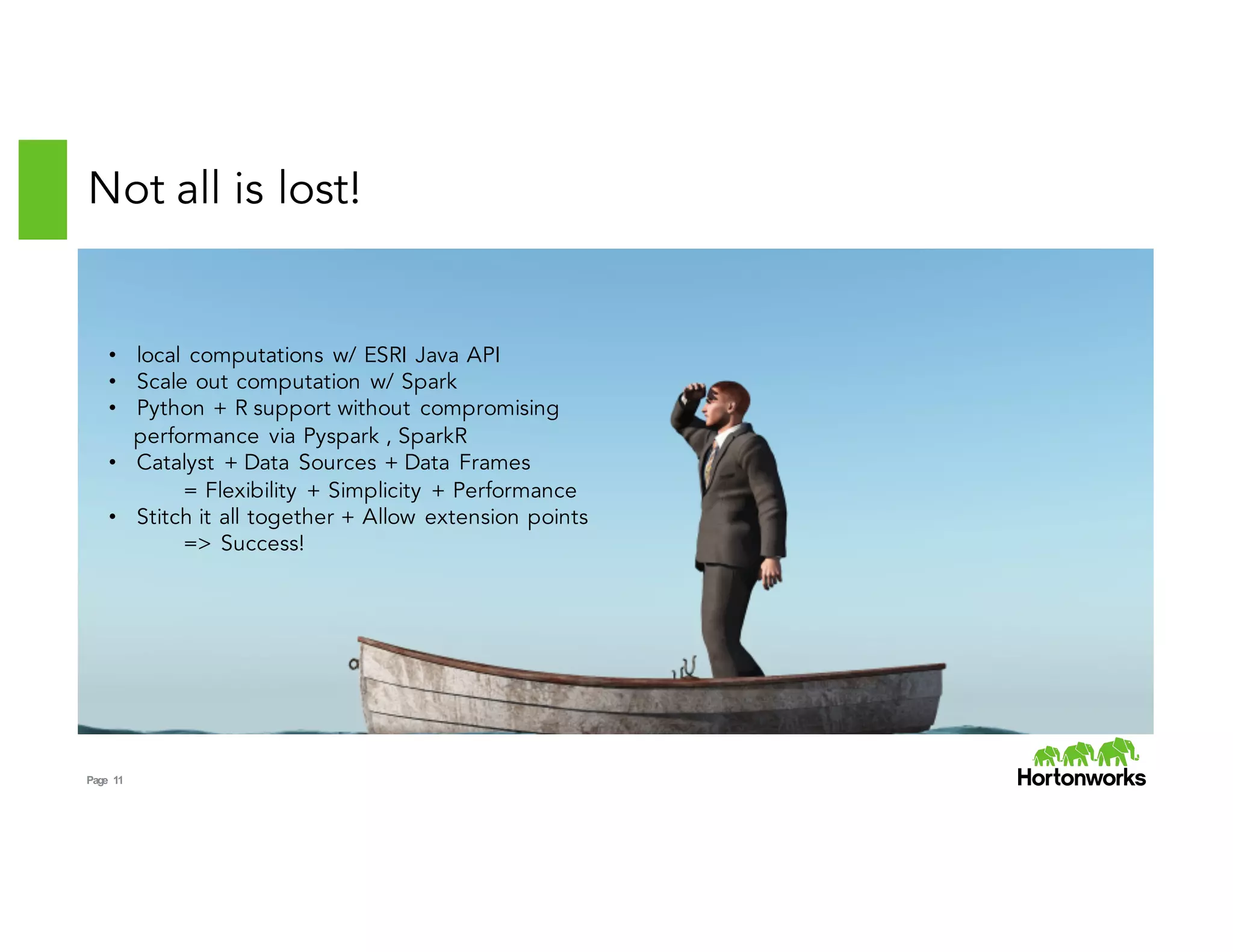
Not all is lost!
• local computations w/ ESRI Java API
• Scale out computation w/ Spark
• Python + R support without compromising
performance via Pyspark , SparkR
• Catalyst + Data Sources + Data Frames
= Flexibility + Simplicity + Performance
• Stitch it all together + Allow extension points
=> Success!
Page 12
Magellan: a complete story for geospatial?
Create geospatial analytics applications
faster:
• Use your favorite language (Python/ Scala), even R
• Get best in class algorithms for common spatial analytics
• Write less code
• Read data efficiently
• Let the optimizer do the heavy lifting
Page 13
How does it work?
Custom Data Types for Shapes:
• Point, Line, PolyLine, Polygon extend Shape
• Local Computations using ESRI Java API
• No need for Scala -> SQL serialization
Expressions for Operators:
• Literals e.g point(-122.4, 37.6)
• Boolean Expressions e.g Intersects, Contains
• Binary Expressions e.g Intersection
Custom Data Sources:
• Schema = [point, polyline, polygon, metadata]
• Metadata = Map[String, String]
• GeoJSON and Shapefile implementations
Custom Strategies for Spatial Join:
• Broadcast Cartesian Join
• Geohash Join (in progress)
• Plug into Catalyst as experimental strategies
Page 14
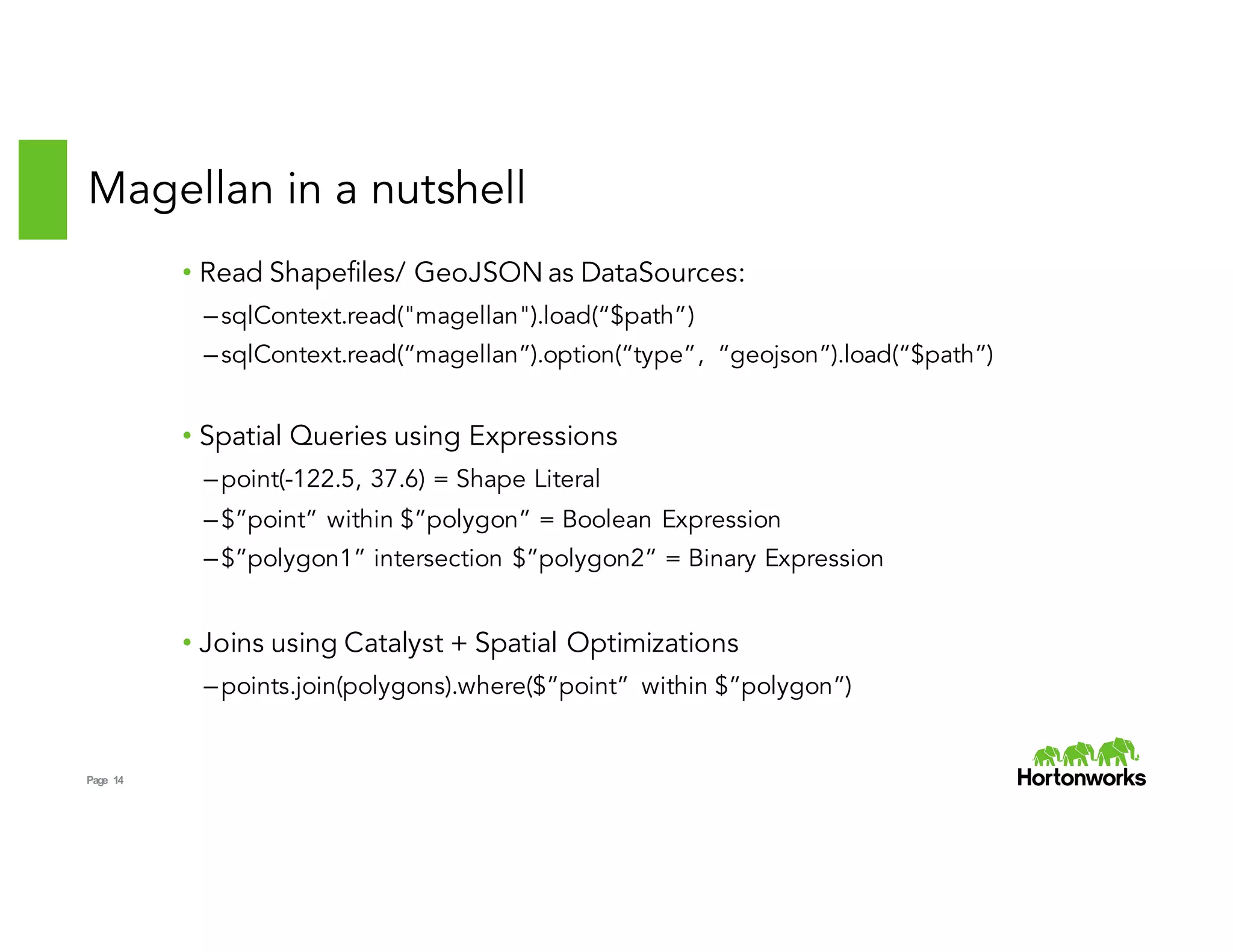
Magellan in a nutshell
• Read Shapefiles/ GeoJSON as DataSources:
–sqlContext.read("magellan").load(“$path”)
–sqlContext.read(“magellan”).option(“type”, “geojson”).load(“$path”)
• Spatial Queries using Expressions
–point(-122.5, 37.6) = Shape Literal
–$”point” within $”polygon” = Boolean Expression
–$”polygon1” intersection $”polygon2” = Binary Expression
• Joins using Catalyst + Spatial Optimizations
–points.join(polygons).where($”point” within $”polygon”)
Page 15
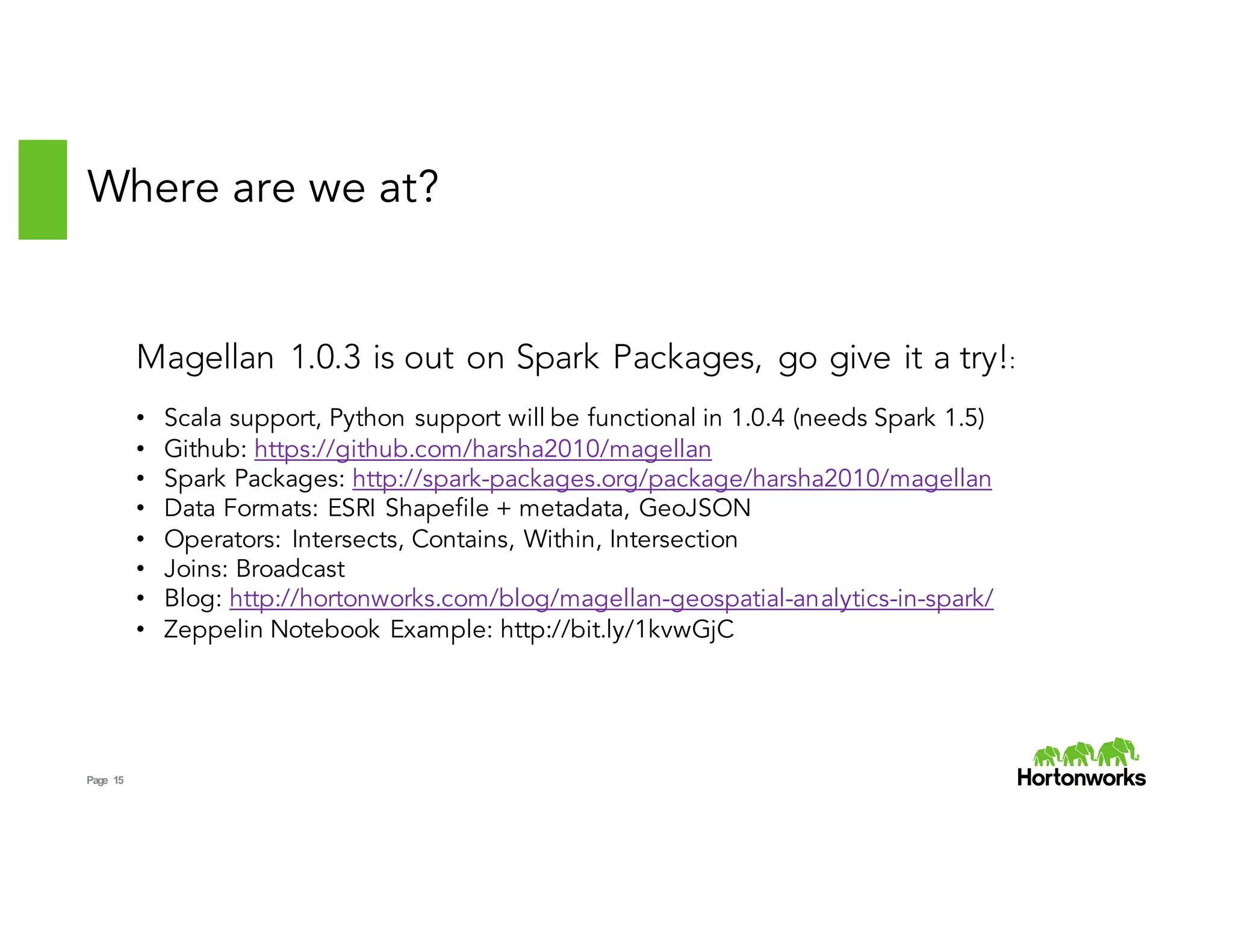
Where are we at?
Magellan 1.0.3 is out on Spark Packages, go give it a try!:
• Scala support, Python support will be functional in 1.0.4 (needs Spark 1.5)
• Github: https://github.com/harsha2010/magellan
• Spark Packages: http://spark-packages.org/package/harsha2010/magellan
• Data Formats: ESRI Shapefile + metadata, GeoJSON
• Operators: Intersects, Contains, Within, Intersection
• Joins: Broadcast
• Blog: http://hortonworks.com/blog/magellan-geospatial-analytics-in-spark/
• Zeppelin Notebook Example: http://bit.ly/1kvwGjC
Page 16
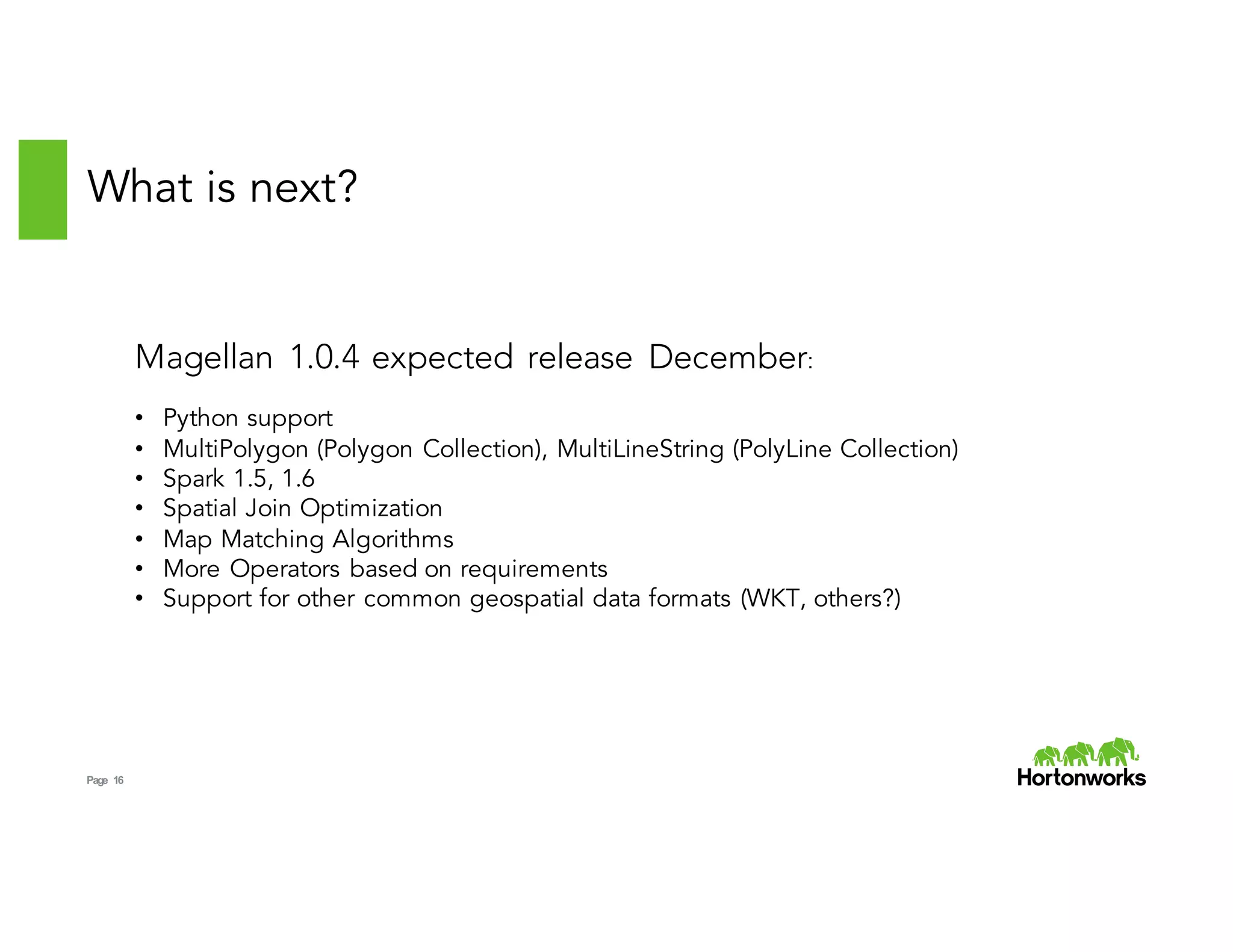
What is next?
Magellan 1.0.4 expected release December:
• Python support
• MultiPolygon (Polygon Collection), MultiLineString (PolyLine Collection)
• Spark 1.5, 1.6
• Spatial Join Optimization
• Map Matching Algorithms
• More Operators based on requirements
• Support for other common geospatial data formats (WKT, others?)
Page 17
Demo
Reading Geospatial Formats
Uber queries

Magellen: Geospatial Analytics on Spark by Ram Sriharsha

  • 1.
    Page 1 Magellan: GeospatialAnalytics on Spark Ram Sriharsha Spark and Data Science Architect, Hortonworks
  • 2.
    Page 2 What isgeospatial context? •Given a point = (-122.412651, 37.777748) which city is it in? •Does shape X intersect shape Y? –Compute the intersection •Given a sequence of points and a system of roads –Compute best path representing points
  • 3.
    Page 3 Geospatial contextis useful What neighborhoods do people go to on weekends? Predict the drop off neighborhood of a user? Predict the location where next pick up can be expected? How does usage pattern change with time? Identify crime hotspot neighborhoods How do these hotspots evolve with time? Predict the likelihood of crime occurring at a given neighborhood Predict climate at fairly granular level Climate insurance: do I need to buy insurance for my crops? Climate as a factor in crime: Join climate dataset with Crimes
  • 4.
  • 5.
    Page 5 Why geospatialnow? Vast mobile data + geospatial = truly big data problem !
  • 6.
    Page 6 Do youthink we need one more geospatial library?
  • 7.
  • 8.
    Page 8 Coordinate SystemHell! Mobile data = GPS coordinates Map coordinate systems optimized for precision ⇒Transform from one to another No good transformation libraries
  • 9.
    Page 9 Simple, intuitive, handlescommon formats Scalable Feature rich but still extensible Venn Diagram of geospatial libraries?
  • 10.
    Page 10 Feature Extractors Languageintegration simplifies exploratory analytics Q-Q Q-A similarity Parse + Clean Logs Ad category mapping Query category mapping Poly Exp (Q-A) Features Model Convex Solver Train/T est Split train Test/validation Metrics Ad Server HDFS Data Prep Score Model - Real-time Data Flow Stage Data Flow Stage - Batch Feedback Spatial Context
  • 11.
    Page 11 Not allis lost! • local computations w/ ESRI Java API • Scale out computation w/ Spark • Python + R support without compromising performance via Pyspark , SparkR • Catalyst + Data Sources + Data Frames = Flexibility + Simplicity + Performance • Stitch it all together + Allow extension points => Success!
  • 12.
    Page 12 Magellan: acomplete story for geospatial? Create geospatial analytics applications faster: • Use your favorite language (Python/ Scala), even R • Get best in class algorithms for common spatial analytics • Write less code • Read data efficiently • Let the optimizer do the heavy lifting
  • 13.
    Page 13 How doesit work? Custom Data Types for Shapes: • Point, Line, PolyLine, Polygon extend Shape • Local Computations using ESRI Java API • No need for Scala -> SQL serialization Expressions for Operators: • Literals e.g point(-122.4, 37.6) • Boolean Expressions e.g Intersects, Contains • Binary Expressions e.g Intersection Custom Data Sources: • Schema = [point, polyline, polygon, metadata] • Metadata = Map[String, String] • GeoJSON and Shapefile implementations Custom Strategies for Spatial Join: • Broadcast Cartesian Join • Geohash Join (in progress) • Plug into Catalyst as experimental strategies
  • 14.
    Page 14 Magellan ina nutshell • Read Shapefiles/ GeoJSON as DataSources: –sqlContext.read("magellan").load(“$path”) –sqlContext.read(“magellan”).option(“type”, “geojson”).load(“$path”) • Spatial Queries using Expressions –point(-122.5, 37.6) = Shape Literal –$”point” within $”polygon” = Boolean Expression –$”polygon1” intersection $”polygon2” = Binary Expression • Joins using Catalyst + Spatial Optimizations –points.join(polygons).where($”point” within $”polygon”)
  • 15.
    Page 15 Where arewe at? Magellan 1.0.3 is out on Spark Packages, go give it a try!: • Scala support, Python support will be functional in 1.0.4 (needs Spark 1.5) • Github: https://github.com/harsha2010/magellan • Spark Packages: http://spark-packages.org/package/harsha2010/magellan • Data Formats: ESRI Shapefile + metadata, GeoJSON • Operators: Intersects, Contains, Within, Intersection • Joins: Broadcast • Blog: http://hortonworks.com/blog/magellan-geospatial-analytics-in-spark/ • Zeppelin Notebook Example: http://bit.ly/1kvwGjC
  • 16.
    Page 16 What isnext? Magellan 1.0.4 expected release December: • Python support • MultiPolygon (Polygon Collection), MultiLineString (PolyLine Collection) • Spark 1.5, 1.6 • Spatial Join Optimization • Map Matching Algorithms • More Operators based on requirements • Support for other common geospatial data formats (WKT, others?)
  • 17.
    Page 17 Demo Reading GeospatialFormats Uber queries