See the Earth as it could be.
Enabling Global-Scale Geospatial Machine Learning
FOSS4G NA 2018
Simeon Fitch
Co-Founder & VP of R&D
Astraea, Inc.
See the Earth as it could be. 2
Overview
• Context
• Problem Statement
• Introducing RasterFrames
• Example Problem
• Numerical and Performance Results
• Take-Aways
See the Earth as it could be. 3
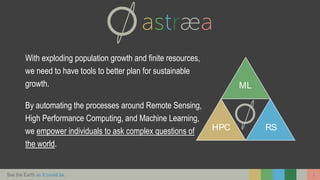
With exploding population growth and finite resources,
we need to have tools to better plan for sustainable
growth.
By automating the processes around Remote Sensing,
High Performance Computing, and Machine Learning,
we empower individuals to ask complex questions of
the world.
HPC
ML
RS
See the Earth as it could be. 4
Think Locally, Compute Globally
• Model development is a creative, iterative, and
interactive process. How do we do this on a global
scale?
• Good tools minimize cognitive friction; attentive to good
ergonomics
• At a minimum, we need:
Solve for local → Scale to global
• Global-scale remote sensing data provide particular
challenges
5
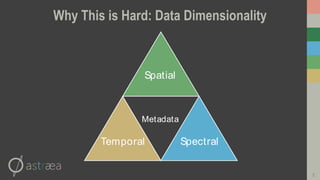
Why This is Hard: Data Dimensionality
Temporal
Spatial
Spectral
Metadata
6
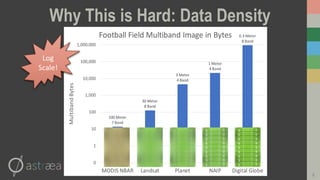
Why This is Hard: Data Density
500 Meter
7 Band
30 Meter
8 Band
3 Meter
4 Band
1 Meter
4 Band
0.3 Meter
8 Band
0
1
10
100
1,000
10,000
100,000
1,000,000
MODIS NBAR Landsat Planet NAIP Digital Globe
MultibandBytes
Football Field Multiband Image in Bytes
Log
Scale!
7
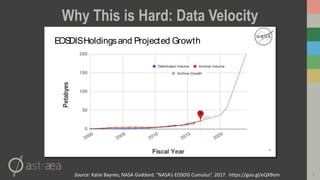
Why This is Hard: Data Velocity
EOSDISHoldingsand Projected Growth
4
Source: Katie Baynes, NASA Goddard. “NASA’s EOSDIS Cumulus”. 2017. https://goo.gl/eQX9om
See the Earth as it could be. 8
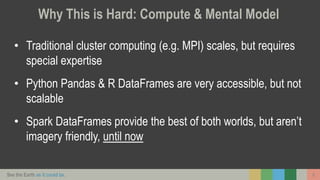
Why This is Hard: Compute & Mental Model
• Traditional cluster computing (e.g. MPI) scales, but requires
special expertise
• Python Pandas & R DataFrames are very accessible, but not
scalable
• Spark DataFrames provide the best of both worlds, but aren’t
imagery friendly, until now
See the Earth as it could be.
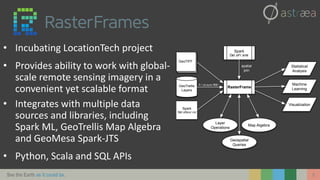
• Incubating LocationTech project
• Provides ability to work with global-
scale remote sensing imagery in a
convenient yet scalable format
• Integrates with multiple data
sources and libraries, including
Spark ML, GeoTrellis Map Algebra
and GeoMesa Spark-JTS
• Python, Scala and SQL APIs
GeoTrellis
Layers
Map Algebra
Layer
Operations
Statistical
Analysis
Ti l eLayer RDD Machine
Learning
Visualization
GeoTIFF
RasterFrame
Spark
Dat aSour ce
Spark
Dat aFr ame
spatial
join
Geospatial
Queries
9
See the Earth as it could be.
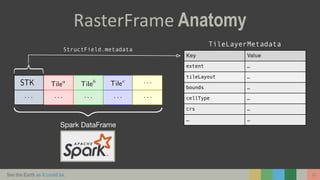
RasterFrame Anatomy
10
See the Earth as it could be.
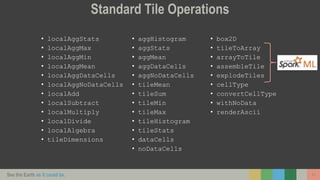
Standard Tile Operations
• localAggStats
• localAggMax
• localAggMin
• localAggMean
• localAggDataCells
• localAggNoDataCells
• localAdd
• localSubtract
• localMultiply
• localDivide
• localAlgebra
• tileDimensions
• aggHistogram
• aggStats
• aggMean
• aggDataCells
• aggNoDataCells
• tileMean
• tileSum
• tileMin
• tileMax
• tileHistogram
• tileStats
• dataCells
• noDataCells
• box2D
• tileToArray
• arrayToTile
• assembleTile
• explodeTiles
• cellType
• convertCellType
• withNoData
• renderAscii
11
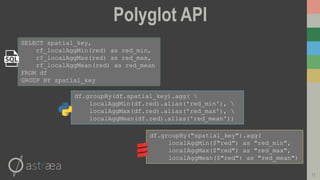
Polyglot API
12
SELECT spatial_key,
rf_localAggMin(red) as red_min,
rf_localAggMax(red) as red_max,
rf_localAggMean(red) as red_mean
FROM df
GROUP BY spatial_key
df.groupBy("spatial_key").agg(
localAggMin($"red") as "red_min",
localAggMax($"red") as "red_max",
localAggMean($"red") as "red_mean")
df.groupBy(df.spatial_key).agg( 
localAggMin(df.red).alias('red_min'), 
localAggMax(df.red).alias('red_max'), 
localAggMean(df.red).alias('red_mean'))
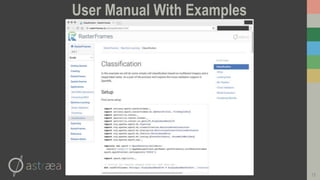
User Manual With Examples
13
14
Motivating Example: Global Ranking NDVI
On any given day, where in the world should we look for
high NDVI value(s)?
Real goal: Compute something on global imagery to
present RasterFrames and explore its scalability
Isn’t NDVI the
“Hello World”
of FOSS4G?
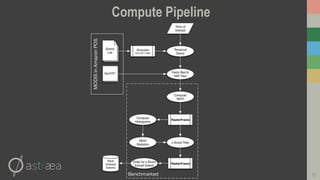
Compute Pipeline
15
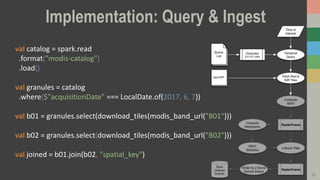
Implementation: Query & Ingest
16
val catalog = spark.read
.format("modis-catalog")
.load()
val granules = catalog
.where($"acquisitionDate" === LocalDate.of(2017, 6, 7))
val b01 = granules.select(download_tiles(modis_band_url("B01")))
val b02 = granules.select(download_tiles(modis_band_url("B02")))
val joined = b01.join(b02, "spatial_key")
Implementation: Computing NDVI
17
val ndvi = udf((b2: Tile, b1: Tile) ⇒ {
val nir = b2.convert(FloatConstantNoDataCellType)
val red = b1.convert(FloatConstantNoDataCellType)
(nir - red) / (nir + red)
})
val withNDVI = joined
.withColumn("ndvi", ndvi($"B02_tile", $"B01_tile"))
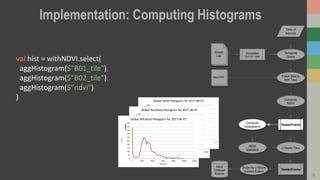
Implementation: Computing Histograms
18
-50
0
50
100
150
200
250
300
350
400
-1.5 -1 -0.5 0 0.5 1 1.5Count
x100000 Red Band
Global NDVI Histogram for 2017-06-07
0
100
200
300
400
500
600
700
0 2000 4000 6000 8000 10000 12000
Count
x100000
Red Band
Global Red Band Histogram for 2017-06-07
0
50
100
150
200
250
300
350
400
450
500
0 2000 4000 6000 8000 10000 12000
Count
x100000
Red Band
Global NIR Band Histogram for 2017-06-07
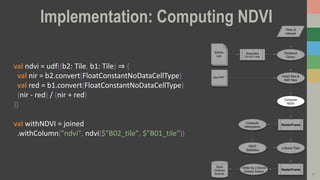
val hist = withNDVI.select(
aggHistogram($"B01_tile"),
aggHistogram($"B02_tile"),
aggHistogram($"ndvi")
)
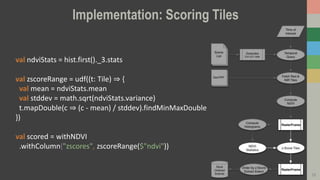
Implementation: Scoring Tiles
19
val ndviStats = hist.first()._3.stats
val zscoreRange = udf((t: Tile) ⇒ {
val mean = ndviStats.mean
val stddev = math.sqrt(ndviStats.variance)
t.mapDouble(c ⇒ (c - mean) / stddev).findMinMaxDouble
})
val scored = withNDVI
.withColumn("zscores", zscoreRange($"ndvi"))
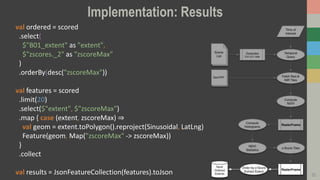
Implementation: Results
20
val ordered = scored
.select(
$"B01_extent" as "extent",
$"zscores._2" as "zscoreMax"
)
.orderBy(desc("zscoreMax"))
val features = scored
.limit(20)
.select($"extent", $"zscoreMax")
.map { case (extent, zscoreMax) ⇒
val geom = extent.toPolygon().reproject(Sinusoidal, LatLng)
Feature(geom, Map("zscoreMax" -> zscoreMax))
}
.collect
val results = JsonFeatureCollection(features).toJson
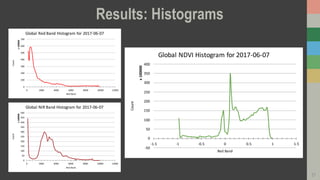
Results: Histograms
0
100
200
300
400
500
600
700
0 2000 4000 6000 8000 10000 12000
Count
x100000
Red Band
Global Red Band Histogram for 2017-06-07
-50
0
50
100
150
200
250
300
350
400
-1.5 -1 -0.5 0 0.5 1 1.5
Count
x100000
Red Band
Global NDVI Histogram for 2017-06-07
0
50
100
150
200
250
300
350
400
450
500
0 2000 4000 6000 8000 10000 12000
Count
x100000
Red Band
Global NIR Band Histogram for 2017-06-07
21
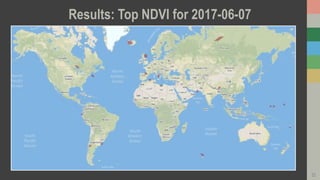
Results: Top NDVI for 2017-06-07
22
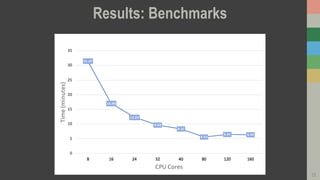
Results: Benchmarks
23
31.47
16.99
12.23
9.64
8.31
5.53
6.41 6.33
0
5
10
15
20
25
30
35
8 16 24 32 40 80 120 160
Time(minutes)
CPU Cores
See the Earth as it could be. 24
RasterFrame Take-Aways
• DataFrames lower cognitive friction when modeling. Good
Ergonomics!
• Rich set of raster processing primitives
• Support for descriptive and predictive analysis
• Via spark-shell, Jupyter Notebook, Zeppelin, etc. can
interact with data and iterate over solution
• It scales!
• Many more examples at http://rasterframes.io
See the Earth as it could be. 25
Getting Started
• Try it out via Jupyter Notebooks:
docker pull s22s/rasterframes-notebooks
• Documentation: http://rasterframes.io
• Code: https://github.com/locationtech/rasterframes
• Chat: https://gitter.im/s22s/raster-frames
• Social: @metasim on GitHub & Twitter
• Company: http://www.astraea.earth
See the Earth as it could be. 26
Shout Outs
• Thanks to LocationTech
• For Incubating RasterFrames; mentoring by Jim Hughes & Rob Emanuele
• The teams behind GeoTrellis, GeoMesa, JTS, & SFCurve
• Thanks to NASA, USGS, & NOAA
• Supporting public access to massive curated data sets is not easy!
• Upcoming Astraea Presentations
• Machine Learning, FOSS, and open data to map deforestation trends in the Brazilian Amazon
Courtney Whalen & Jason Brown
Tuesday, May 15, 2018 - 4:30 to 5:05 (right after this presentation)
Gateway 1
• Using Deep Learning to Derive 3D Cities from Satellite Imagery
Eric Culbertson
Wednesday, May 16, 2018 - 2:00 to 2:35
Gateway 2
• Please visit Astraea
• Booth #14

RasterFrames - FOSS4G NA 2018

  • 1.
    See the Earthas it could be. Enabling Global-Scale Geospatial Machine Learning FOSS4G NA 2018 Simeon Fitch Co-Founder & VP of R&D Astraea, Inc.
  • 2.
    See the Earthas it could be. 2 Overview • Context • Problem Statement • Introducing RasterFrames • Example Problem • Numerical and Performance Results • Take-Aways
  • 3.
    See the Earthas it could be. 3 With exploding population growth and finite resources, we need to have tools to better plan for sustainable growth. By automating the processes around Remote Sensing, High Performance Computing, and Machine Learning, we empower individuals to ask complex questions of the world. HPC ML RS
  • 4.
    See the Earthas it could be. 4 Think Locally, Compute Globally • Model development is a creative, iterative, and interactive process. How do we do this on a global scale? • Good tools minimize cognitive friction; attentive to good ergonomics • At a minimum, we need: Solve for local → Scale to global • Global-scale remote sensing data provide particular challenges
  • 5.
    5 Why This isHard: Data Dimensionality Temporal Spatial Spectral Metadata
  • 6.
    6 Why This isHard: Data Density 500 Meter 7 Band 30 Meter 8 Band 3 Meter 4 Band 1 Meter 4 Band 0.3 Meter 8 Band 0 1 10 100 1,000 10,000 100,000 1,000,000 MODIS NBAR Landsat Planet NAIP Digital Globe MultibandBytes Football Field Multiband Image in Bytes Log Scale!
  • 7.
    7 Why This isHard: Data Velocity EOSDISHoldingsand Projected Growth 4 Source: Katie Baynes, NASA Goddard. “NASA’s EOSDIS Cumulus”. 2017. https://goo.gl/eQX9om
  • 8.
    See the Earthas it could be. 8 Why This is Hard: Compute & Mental Model • Traditional cluster computing (e.g. MPI) scales, but requires special expertise • Python Pandas & R DataFrames are very accessible, but not scalable • Spark DataFrames provide the best of both worlds, but aren’t imagery friendly, until now
  • 9.
    See the Earthas it could be. • Incubating LocationTech project • Provides ability to work with global- scale remote sensing imagery in a convenient yet scalable format • Integrates with multiple data sources and libraries, including Spark ML, GeoTrellis Map Algebra and GeoMesa Spark-JTS • Python, Scala and SQL APIs GeoTrellis Layers Map Algebra Layer Operations Statistical Analysis Ti l eLayer RDD Machine Learning Visualization GeoTIFF RasterFrame Spark Dat aSour ce Spark Dat aFr ame spatial join Geospatial Queries 9
  • 10.
    See the Earthas it could be. RasterFrame Anatomy 10
  • 11.
    See the Earthas it could be. Standard Tile Operations • localAggStats • localAggMax • localAggMin • localAggMean • localAggDataCells • localAggNoDataCells • localAdd • localSubtract • localMultiply • localDivide • localAlgebra • tileDimensions • aggHistogram • aggStats • aggMean • aggDataCells • aggNoDataCells • tileMean • tileSum • tileMin • tileMax • tileHistogram • tileStats • dataCells • noDataCells • box2D • tileToArray • arrayToTile • assembleTile • explodeTiles • cellType • convertCellType • withNoData • renderAscii 11
  • 12.
    Polyglot API 12 SELECT spatial_key, rf_localAggMin(red)as red_min, rf_localAggMax(red) as red_max, rf_localAggMean(red) as red_mean FROM df GROUP BY spatial_key df.groupBy("spatial_key").agg( localAggMin($"red") as "red_min", localAggMax($"red") as "red_max", localAggMean($"red") as "red_mean") df.groupBy(df.spatial_key).agg( localAggMin(df.red).alias('red_min'), localAggMax(df.red).alias('red_max'), localAggMean(df.red).alias('red_mean'))
  • 13.
    User Manual WithExamples 13
  • 14.
    14 Motivating Example: GlobalRanking NDVI On any given day, where in the world should we look for high NDVI value(s)? Real goal: Compute something on global imagery to present RasterFrames and explore its scalability Isn’t NDVI the “Hello World” of FOSS4G?
  • 15.
  • 16.
    Implementation: Query &Ingest 16 val catalog = spark.read .format("modis-catalog") .load() val granules = catalog .where($"acquisitionDate" === LocalDate.of(2017, 6, 7)) val b01 = granules.select(download_tiles(modis_band_url("B01"))) val b02 = granules.select(download_tiles(modis_band_url("B02"))) val joined = b01.join(b02, "spatial_key")
  • 17.
    Implementation: Computing NDVI 17 valndvi = udf((b2: Tile, b1: Tile) ⇒ { val nir = b2.convert(FloatConstantNoDataCellType) val red = b1.convert(FloatConstantNoDataCellType) (nir - red) / (nir + red) }) val withNDVI = joined .withColumn("ndvi", ndvi($"B02_tile", $"B01_tile"))
  • 18.
    Implementation: Computing Histograms 18 -50 0 50 100 150 200 250 300 350 400 -1.5-1 -0.5 0 0.5 1 1.5Count x100000 Red Band Global NDVI Histogram for 2017-06-07 0 100 200 300 400 500 600 700 0 2000 4000 6000 8000 10000 12000 Count x100000 Red Band Global Red Band Histogram for 2017-06-07 0 50 100 150 200 250 300 350 400 450 500 0 2000 4000 6000 8000 10000 12000 Count x100000 Red Band Global NIR Band Histogram for 2017-06-07 val hist = withNDVI.select( aggHistogram($"B01_tile"), aggHistogram($"B02_tile"), aggHistogram($"ndvi") )
  • 19.
    Implementation: Scoring Tiles 19 valndviStats = hist.first()._3.stats val zscoreRange = udf((t: Tile) ⇒ { val mean = ndviStats.mean val stddev = math.sqrt(ndviStats.variance) t.mapDouble(c ⇒ (c - mean) / stddev).findMinMaxDouble }) val scored = withNDVI .withColumn("zscores", zscoreRange($"ndvi"))
  • 20.
    Implementation: Results 20 val ordered= scored .select( $"B01_extent" as "extent", $"zscores._2" as "zscoreMax" ) .orderBy(desc("zscoreMax")) val features = scored .limit(20) .select($"extent", $"zscoreMax") .map { case (extent, zscoreMax) ⇒ val geom = extent.toPolygon().reproject(Sinusoidal, LatLng) Feature(geom, Map("zscoreMax" -> zscoreMax)) } .collect val results = JsonFeatureCollection(features).toJson
  • 21.
    Results: Histograms 0 100 200 300 400 500 600 700 0 20004000 6000 8000 10000 12000 Count x100000 Red Band Global Red Band Histogram for 2017-06-07 -50 0 50 100 150 200 250 300 350 400 -1.5 -1 -0.5 0 0.5 1 1.5 Count x100000 Red Band Global NDVI Histogram for 2017-06-07 0 50 100 150 200 250 300 350 400 450 500 0 2000 4000 6000 8000 10000 12000 Count x100000 Red Band Global NIR Band Histogram for 2017-06-07 21
  • 22.
    Results: Top NDVIfor 2017-06-07 22
  • 23.
  • 24.
    See the Earthas it could be. 24 RasterFrame Take-Aways • DataFrames lower cognitive friction when modeling. Good Ergonomics! • Rich set of raster processing primitives • Support for descriptive and predictive analysis • Via spark-shell, Jupyter Notebook, Zeppelin, etc. can interact with data and iterate over solution • It scales! • Many more examples at http://rasterframes.io
  • 25.
    See the Earthas it could be. 25 Getting Started • Try it out via Jupyter Notebooks: docker pull s22s/rasterframes-notebooks • Documentation: http://rasterframes.io • Code: https://github.com/locationtech/rasterframes • Chat: https://gitter.im/s22s/raster-frames • Social: @metasim on GitHub & Twitter • Company: http://www.astraea.earth
  • 26.
    See the Earthas it could be. 26 Shout Outs • Thanks to LocationTech • For Incubating RasterFrames; mentoring by Jim Hughes & Rob Emanuele • The teams behind GeoTrellis, GeoMesa, JTS, & SFCurve • Thanks to NASA, USGS, & NOAA • Supporting public access to massive curated data sets is not easy! • Upcoming Astraea Presentations • Machine Learning, FOSS, and open data to map deforestation trends in the Brazilian Amazon Courtney Whalen & Jason Brown Tuesday, May 15, 2018 - 4:30 to 5:05 (right after this presentation) Gateway 1 • Using Deep Learning to Derive 3D Cities from Satellite Imagery Eric Culbertson Wednesday, May 16, 2018 - 2:00 to 2:35 Gateway 2 • Please visit Astraea • Booth #14

Editor's Notes

  • #4 Unlock the wealth of information in global remote sensing data Do we all agree that geospatial raster data has a wealth of potential information that can be gleaned from it? My role at Astræa is to apply the art and discipline of software engineering to make data scientists efficient and effective in solving these problems
  • #5 To empower, think about how people approach problems Let’s think about the context for solving problems We want our models to make a big impact; you must aim for global impact Hard for reasons that are both obvious and not so obvious
  • #6 Spatial: 500m, 30m, 1m, 0.3m Temporal: Weeks, Days, Hours Spectral: 4 bands, 7 bands, 34 bands, 200+ bands Active sensors (SAR, LiDAR) Metadata: Coordinate Reference System, Temporal/Spatial Extent, QA Flags, Calibration parameters
  • #8 The dreaded hockey stick Thanks to Baynes and the EOSDIS team
  • #9 The prior challenges are kind of obvious This is what adds the friction Need better ergonomics Who likes DataFrames? Who’s familiar with Spark? Spark as a frontrunner in compute over industry data.
  • #10 To effectively and efficiently deliver the power of high-performance computing, advanced machine learning, and remote sensing to our users RasterFrames provides the ability to work with global EO data in a data frame format, familiar to most data scientists
  • #11 Just a Spark DataFrame, but with special components. “Tile” and “TileLayerMetadata” are types from the GeoTrellis library. STK is “Space Time Key” Conceptually you can also think of it as a map layer.
  • #12 Regularly growing API
  • #15 Explain NDVI?: Normalied difference vegetative index Somewhat contrived example for the purposes of highlighting some of RF features I’m not a data scientist... The results haven’t been validated, this is just a computational proxy for real analyis
  • #16  We are not specifying a region of interest…. We are computing this for the whole world.
  • #17 Code examples are in Scala (my native language). Look very similar in Python This front-end section is currently data source (MODIS on PDS) specific RasterFrames readers integrate directly with Spark DataSource API. Aim: nice ergonomics
  • #18 “Tile” and associated operations come from the GeoTrellis library UDF == User Defined Function Also a gateway to scoring by CNN
  • #20 Another example of a UDF
  • #23 Top 20 tiles with highest NDVI z-score Not validated, but some interesting points of note for further investigation
  • #24 r3.xlarge (8 cores, 30GB RAM)
  • #27 Please thank your civil servants