Layered Process Audits (LPA) by the Apprentiice
Objectives
• Concept of Layered Process Audit (LPA)
• How manufacturing organizations can benefit by
implementing LPA
• How to implement LPA
WWW.THEAPPRENTIICE.COM
• Introduction to LPA
• Benefits
• Why organizations should implement LPA
• Suggested Road Map
• Methodology employed for Key Steps
• Conclusion
Contents
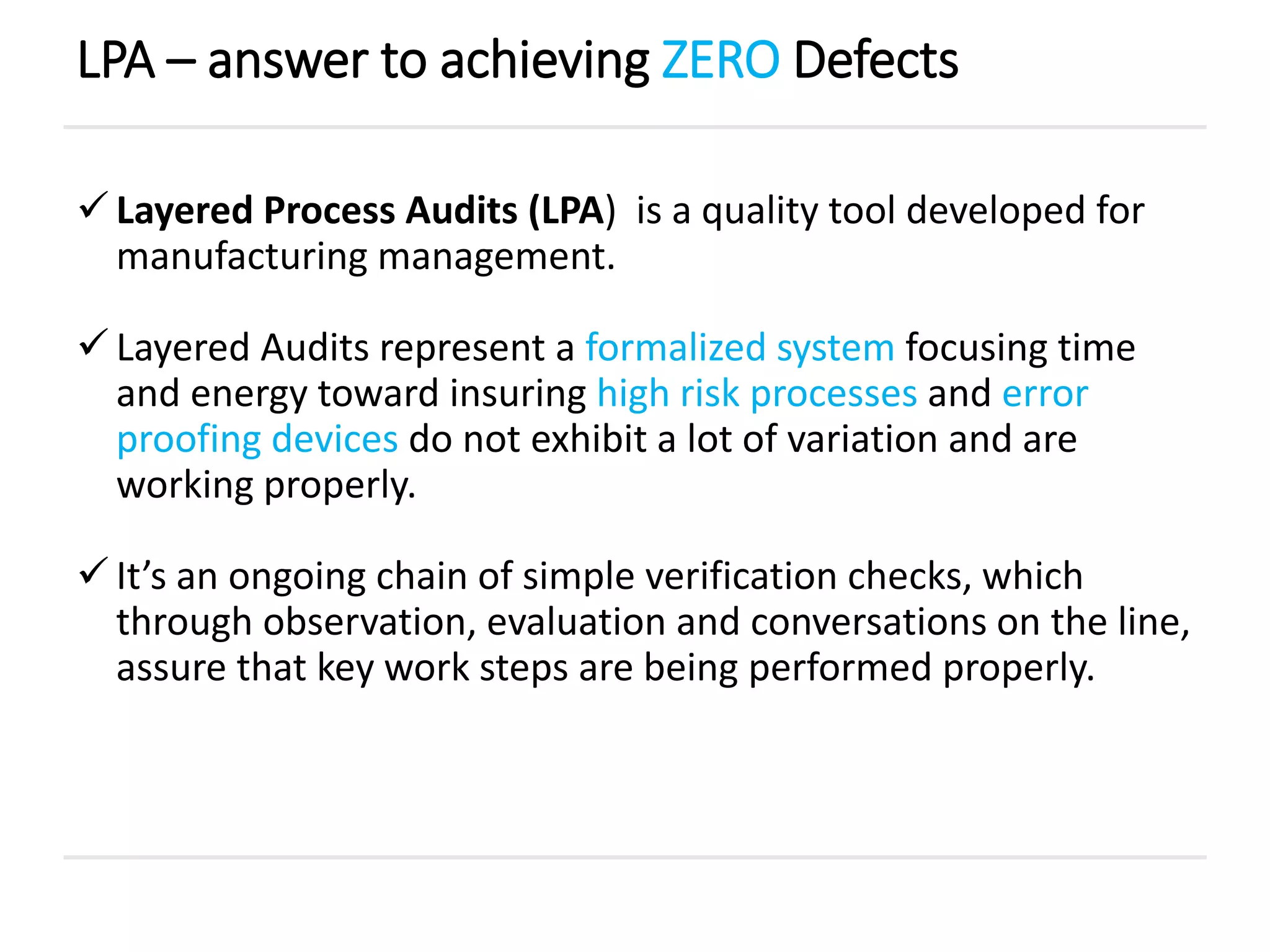
 Layered Process Audits (LPA) is a quality tool developed for
manufacturing management.
 Layered Audits represent a formalized system focusing time
and energy toward insuring high risk processes and error
proofing devices do not exhibit a lot of variation and are
working properly.
 It’s an ongoing chain of simple verification checks, which
through observation, evaluation and conversations on the line,
assure that key work steps are being performed properly.
LPA – answer to achieving ZERO Defects
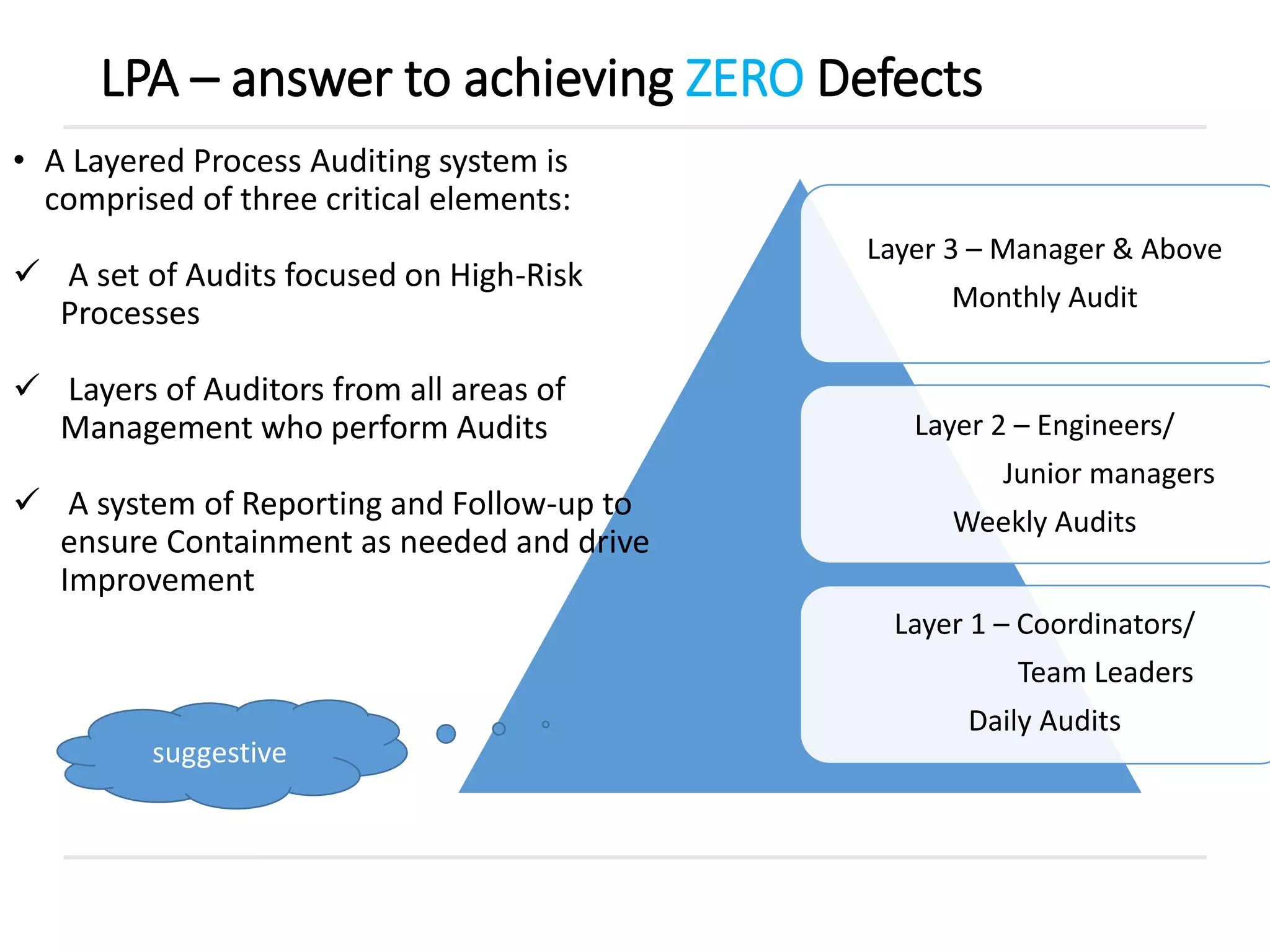
Layer 3 – Manager & Above
Monthly Audit
Layer 2 – Engineers/
Junior managers
Weekly Audits
Layer 1 – Coordinators/
Team Leaders
Daily Audits
LPA – answer to achieving ZERO Defects
suggestive
• A Layered Process Auditing system is
comprised of three critical elements:
 A set of Audits focused on High-Risk
Processes
 Layers of Auditors from all areas of
Management who perform Audits
 A system of Reporting and Follow-up to
ensure Containment as needed and drive
Improvement
Benefits
• Provides opportunities for CI & initiates actions for CI
• Prevents process errors and operator mistakes
• Lower Rework & Repair
• Reduces scrap and eliminates waste
• Improves communication
• Early detection & prevention
• Reduce customer rejects
• Improves FTC ( First time correct)
• Improves overall Quality and thus, Customer satisfaction
Primarily being used in big auto industries like GM, Ford and Chrysler etc.
• It’s not a check on people; but on process.
• Each critical process to be audited daily, weekly and monthly
• Diff check sheet at each level
• Involvement from the top is a pre-requisite
• Immediate containment, reporting and follow-up is a must
• Audit analysis and improvement actions is a must
• Non-compliance to be shared in daily meetings
• Benchmarking of Process Compliance after a Quarter of Audits
• Primarily follows PDCA, where NC & observations form basis of
improvement
Principles
 Customer expectations are increasing day by day
 Redirects resources from reactionary efforts to prevention activities
because LPA monitors the process, rather than the output
 It will bring a step change in the organization’s Quality performance
Why Should organizations adopt LPA ?
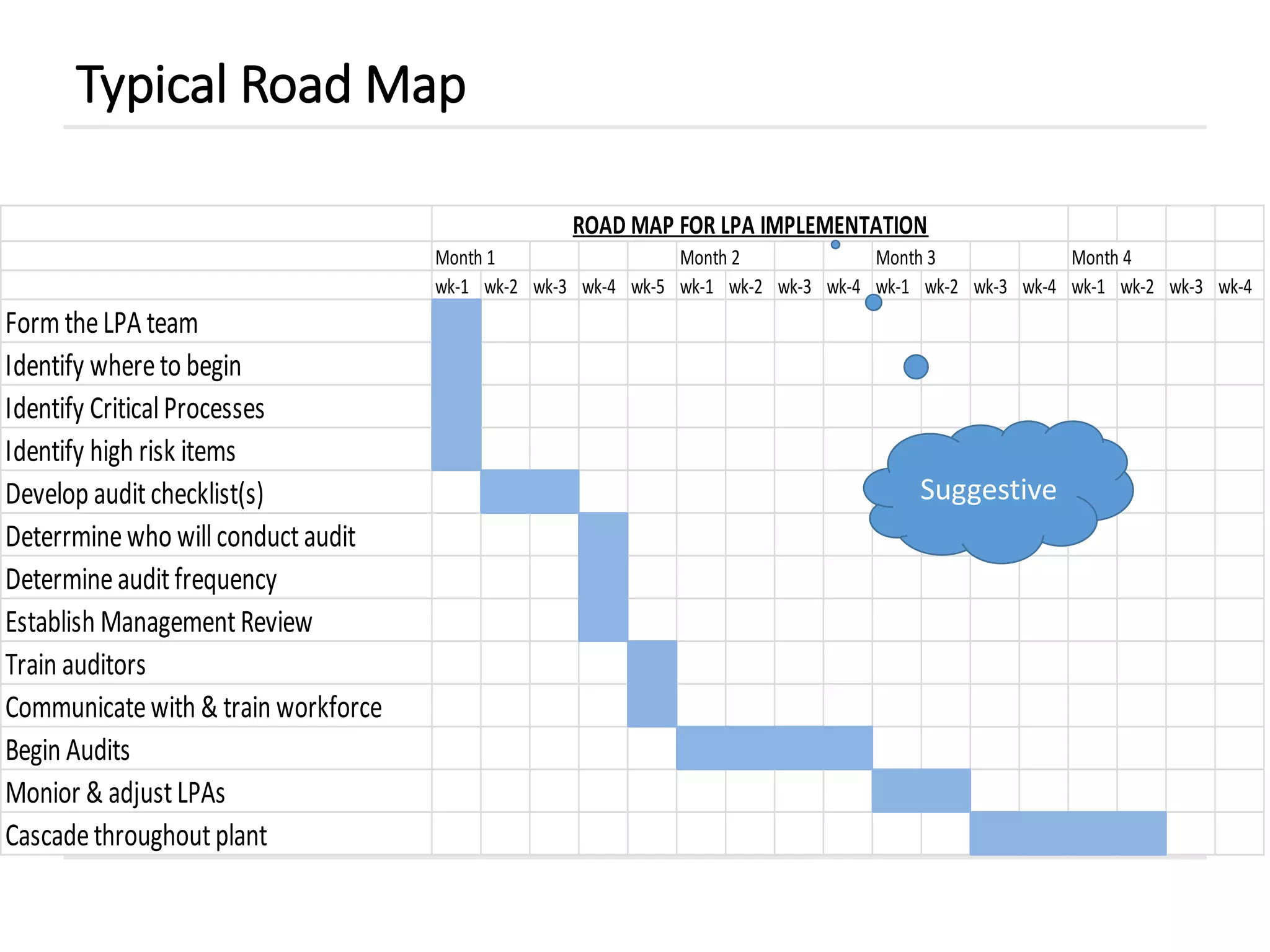
Typical Road Map
Month 1 Month 2 Month 3 Month 4
wk-1 wk-2 wk-3 wk-4 wk-5 wk-1 wk-2 wk-3 wk-4 wk-1 wk-2 wk-3 wk-4 wk-1 wk-2 wk-3 wk-4
Form theLPA team
Identify whereto begin
Identify CriticalProcesses
Identify high risk items
Develop auditchecklist(s)
Deterrminewho willconductaudit
Determineauditfrequency
Establish ManagementReview
Train auditors
Communicatewith & train workforce
Begin Audits
Monior & adjustLPAs
Cascadethroughoutplant
ROAD MAP FOR LPA IMPLEMENTATION
Suggestive
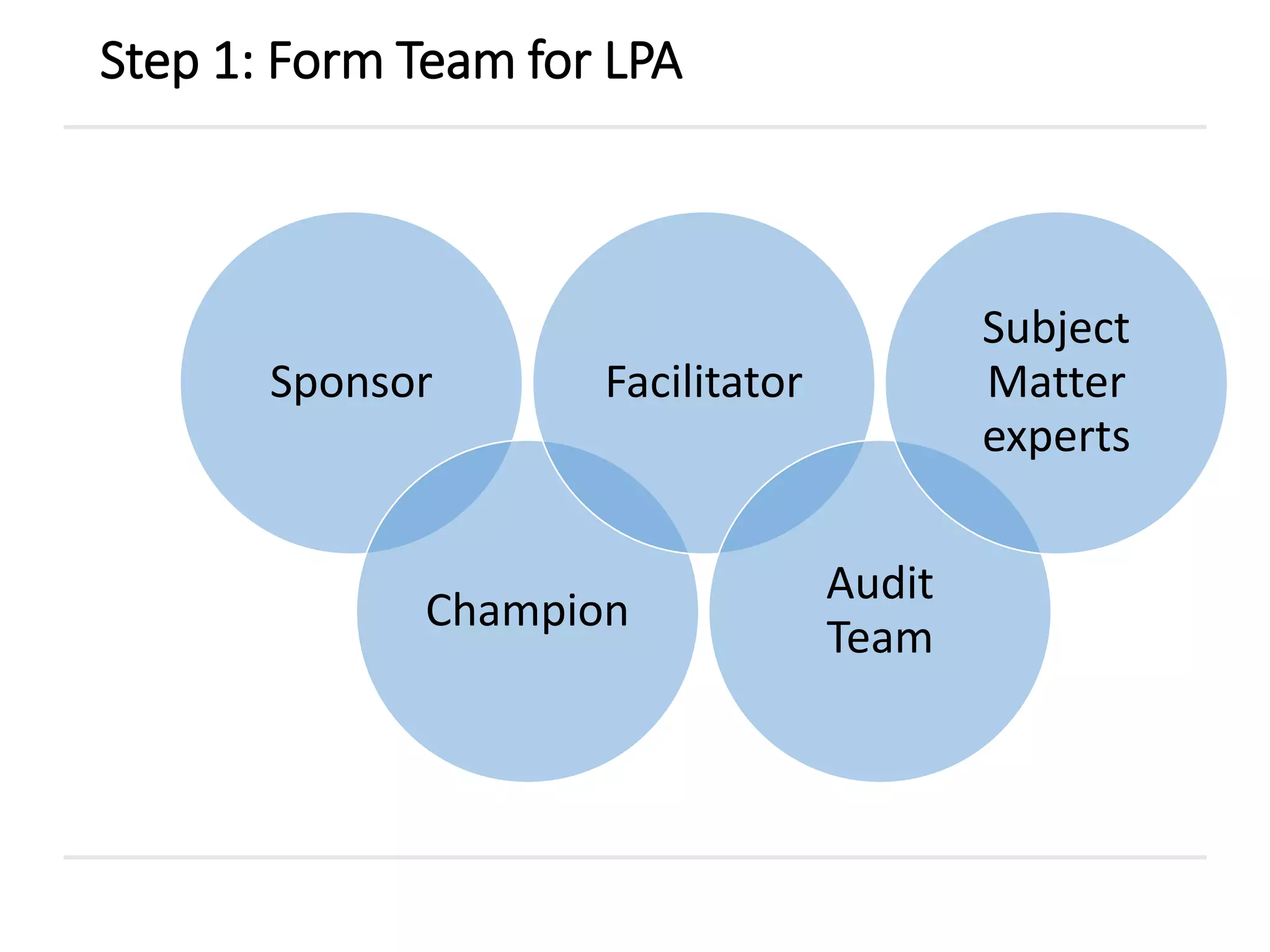
Step 1: Form Team for LPA
Sponsor
Champion
Facilitator
Audit
Team
Subject
Matter
experts
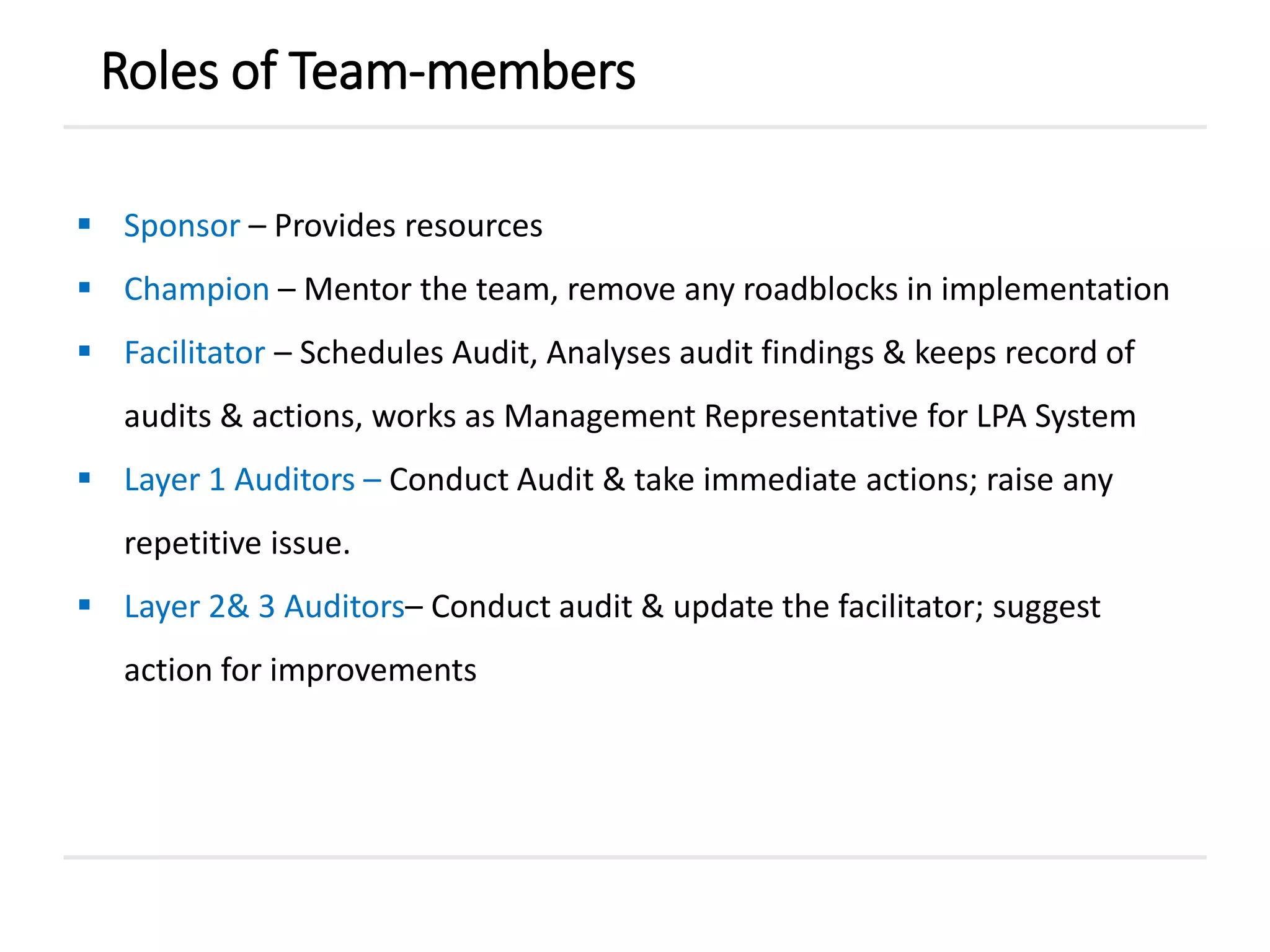
 Sponsor – Provides resources
 Champion – Mentor the team, remove any roadblocks in implementation
 Facilitator – Schedules Audit, Analyses audit findings & keeps record of
audits & actions, works as Management Representative for LPA System
 Layer 1 Auditors – Conduct Audit & take immediate actions; raise any
repetitive issue.
 Layer 2& 3 Auditors– Conduct audit & update the facilitator; suggest
action for improvements
Roles of Team-members
• Typical layer 1 auditors are supervisors, maintenance
and/or technicians.
• Layer 2 auditors are often Engineers or area
managers.
• Layer 3 auditors might include the plant manager, and
other top organization such as Engineering Manager,
Quality Manager, HR Manager to name a few.
A note about auditors
• Identify where to begin
• Identify Critical Processes
• Identify High Risk Items
Step 2 to 4
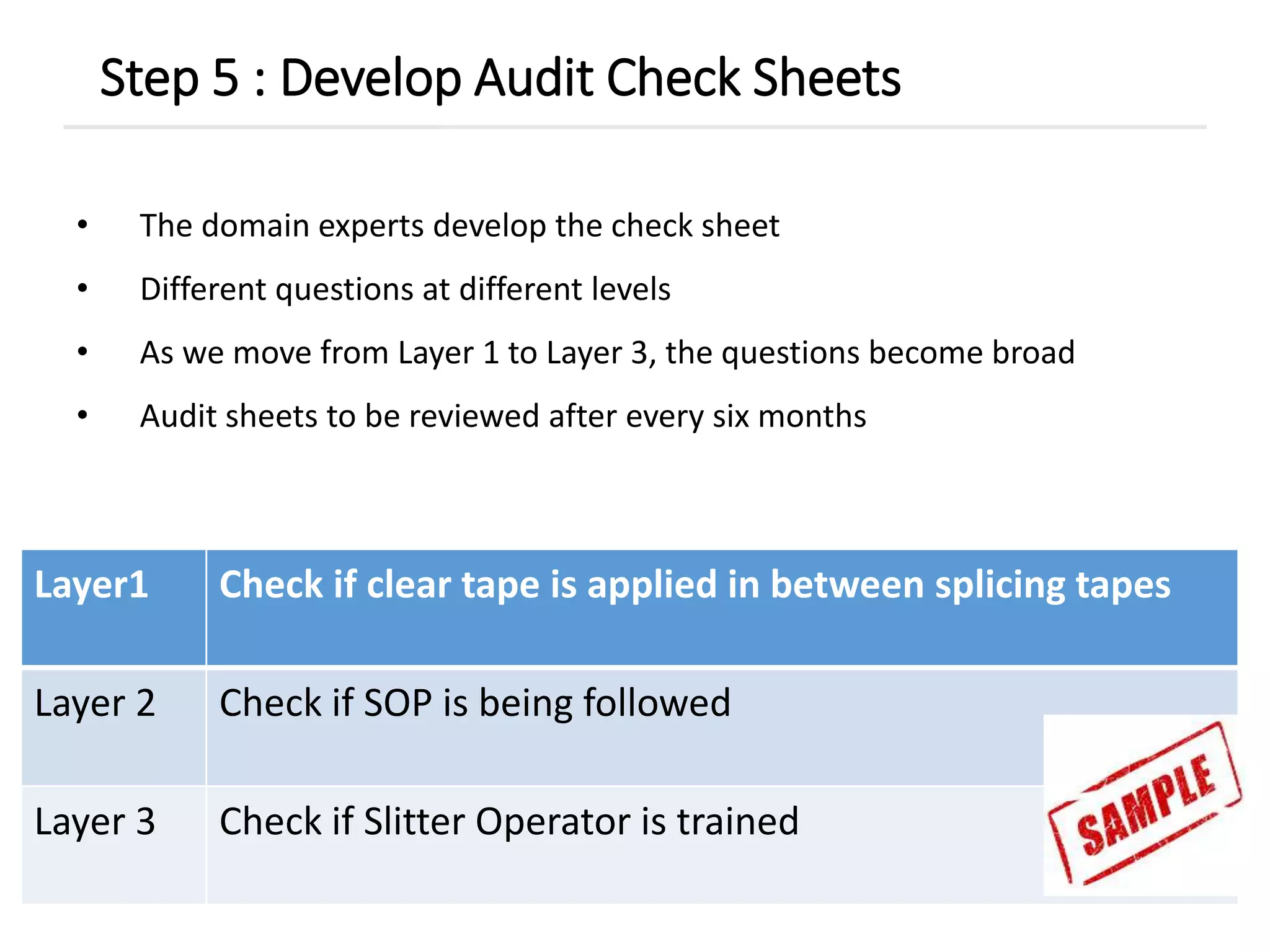
• The domain experts develop the check sheet
• Different questions at different levels
• As we move from Layer 1 to Layer 3, the questions become broad
• Audit sheets to be reviewed after every six months
Step 5 : Develop Audit Check Sheets
Layer1 Check if clear tape is applied in between splicing tapes
Layer 2 Check if SOP is being followed
Layer 3 Check if Slitter Operator is trained
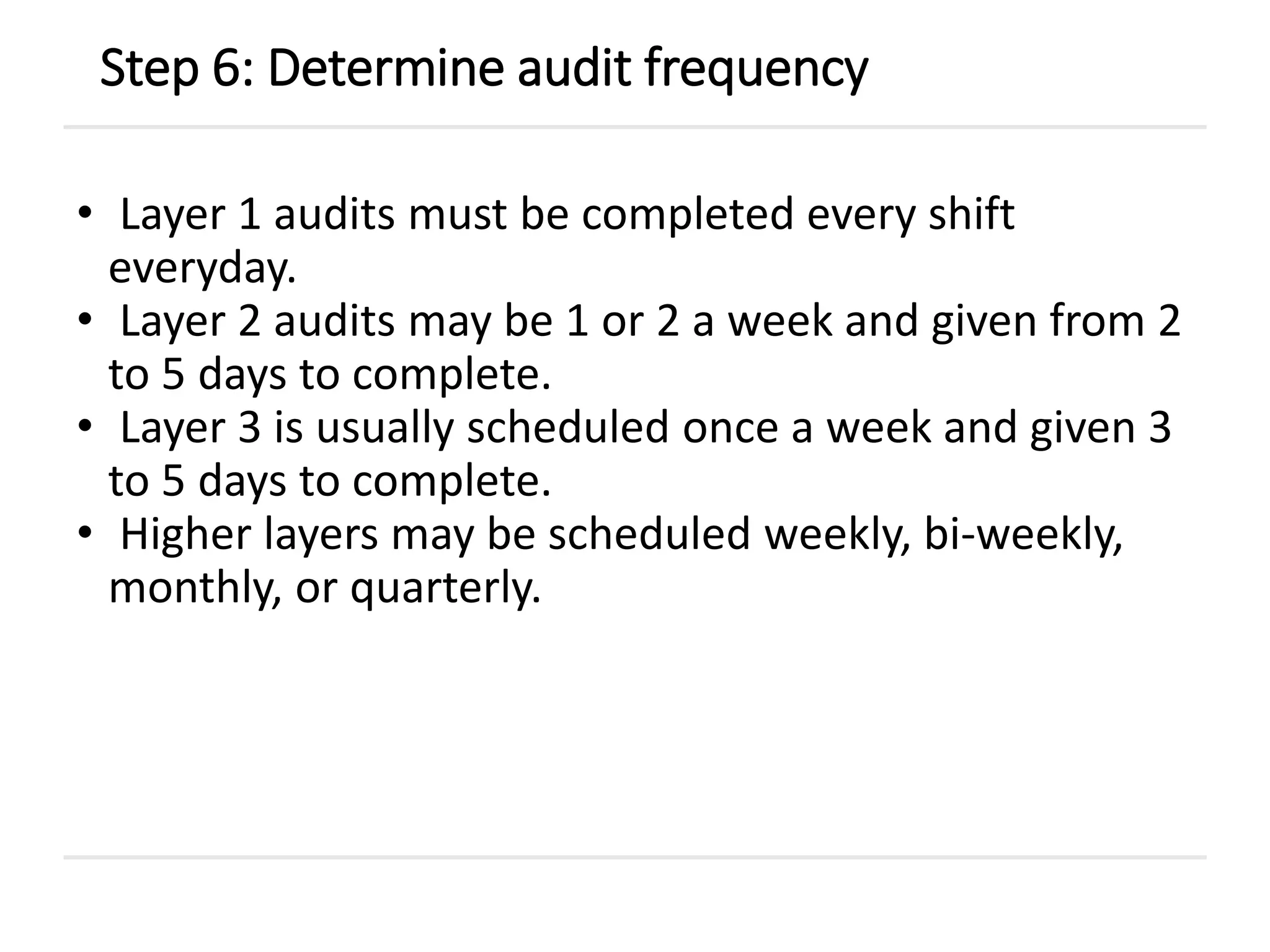
• Layer 1 audits must be completed every shift
everyday.
• Layer 2 audits may be 1 or 2 a week and given from 2
to 5 days to complete.
• Layer 3 is usually scheduled once a week and given 3
to 5 days to complete.
• Higher layers may be scheduled weekly, bi-weekly,
monthly, or quarterly.
Step 6: Determine audit frequency
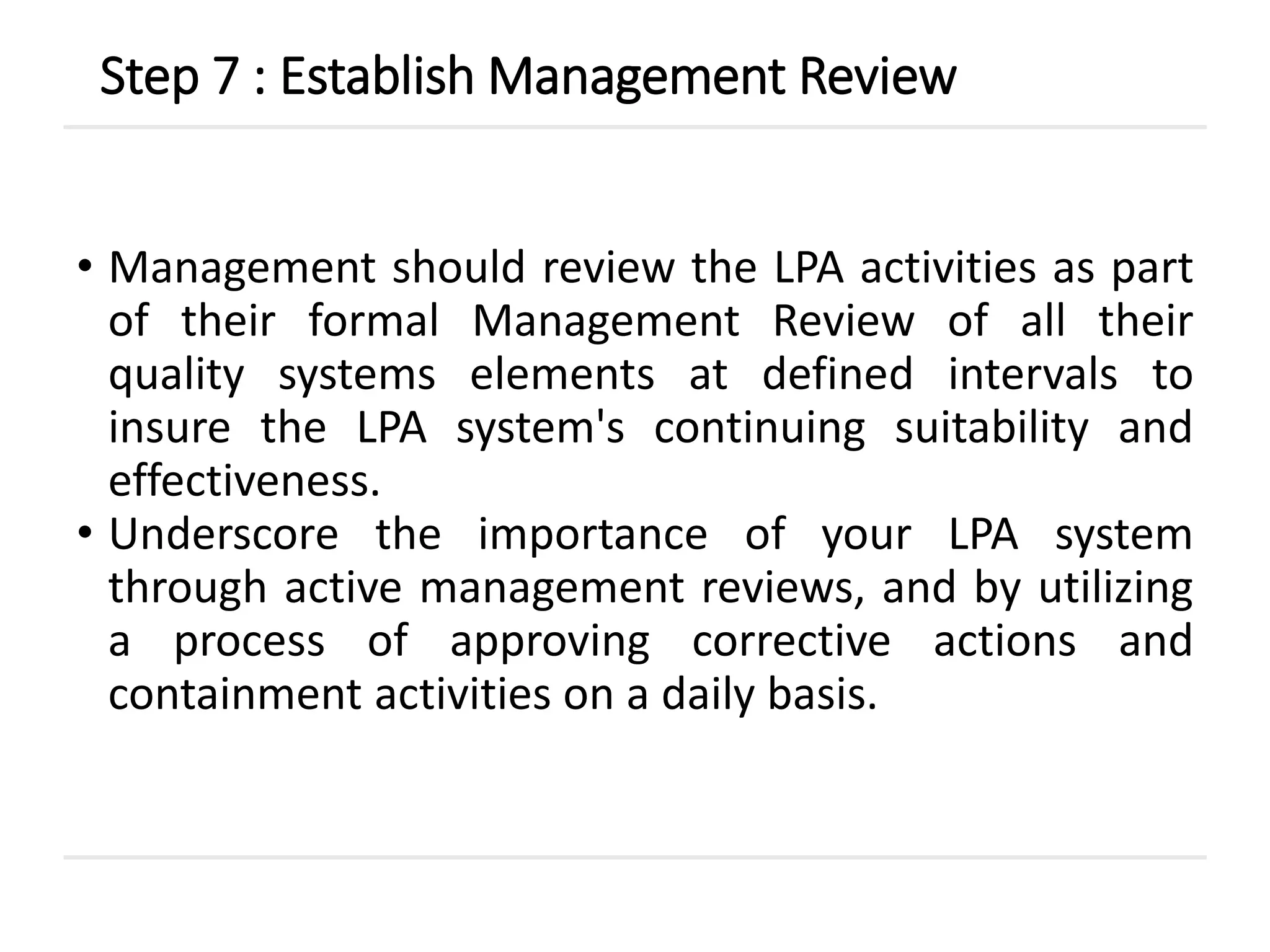
• Management should review the LPA activities as part
of their formal Management Review of all their
quality systems elements at defined intervals to
insure the LPA system's continuing suitability and
effectiveness.
• Underscore the importance of your LPA system
through active management reviews, and by utilizing
a process of approving corrective actions and
containment activities on a daily basis.
Step 7 : Establish Management Review
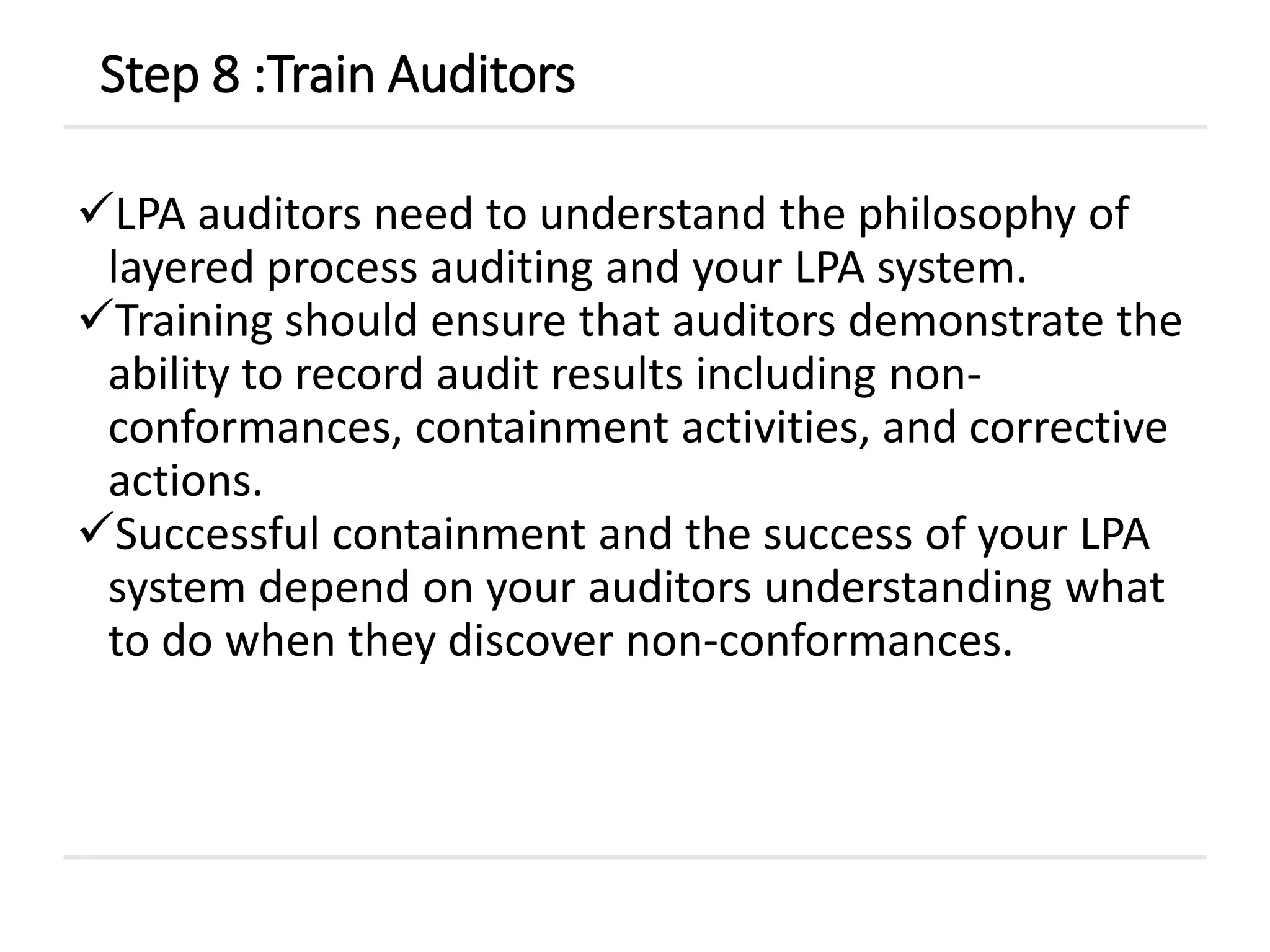
LPA auditors need to understand the philosophy of
layered process auditing and your LPA system.
Training should ensure that auditors demonstrate the
ability to record audit results including non-
conformances, containment activities, and corrective
actions.
Successful containment and the success of your LPA
system depend on your auditors understanding what
to do when they discover non-conformances.
Step 8 :Train Auditors
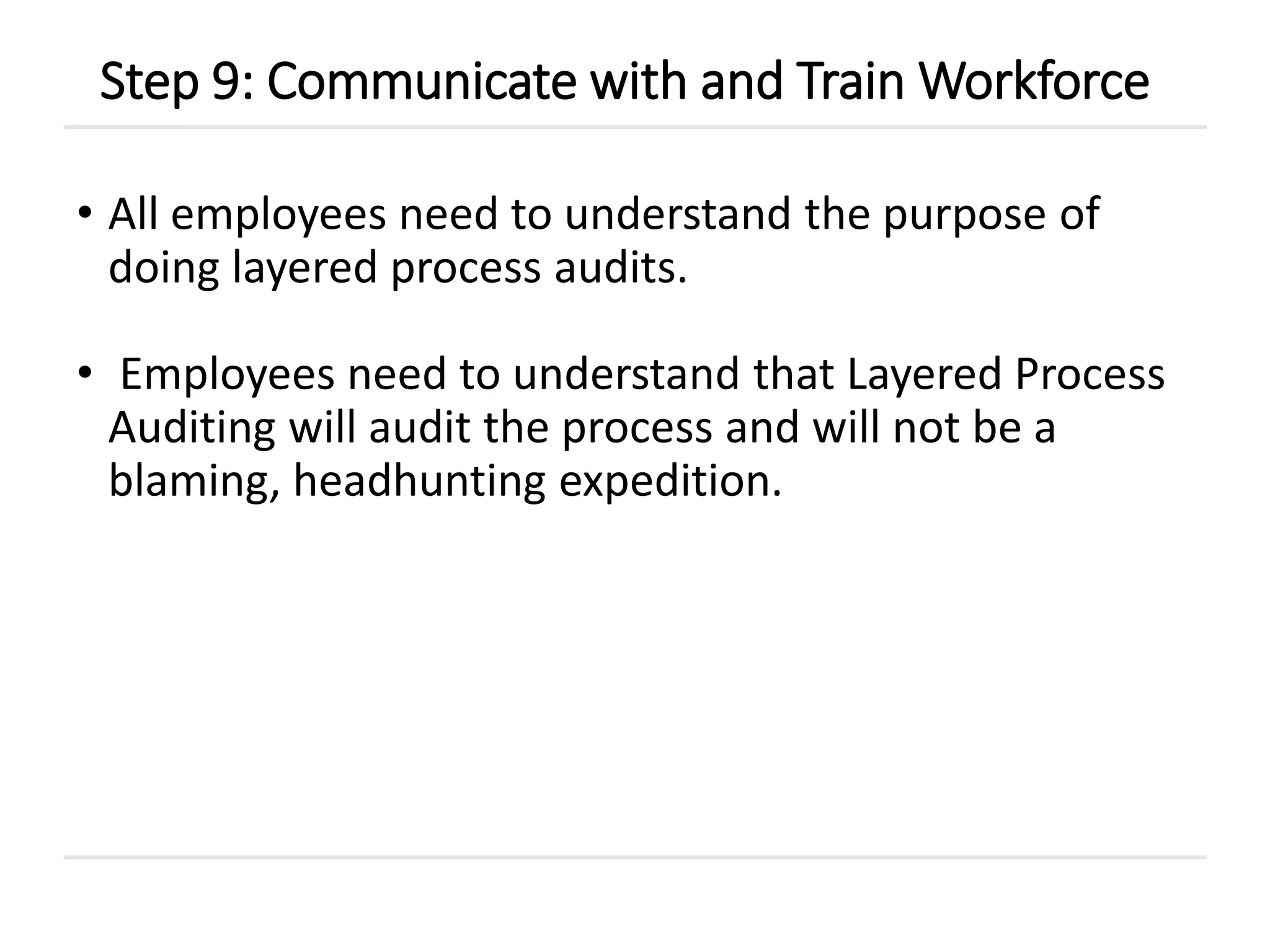
• All employees need to understand the purpose of
doing layered process audits.
• Employees need to understand that Layered Process
Auditing will audit the process and will not be a
blaming, headhunting expedition.
Step 9: Communicate with and Train Workforce
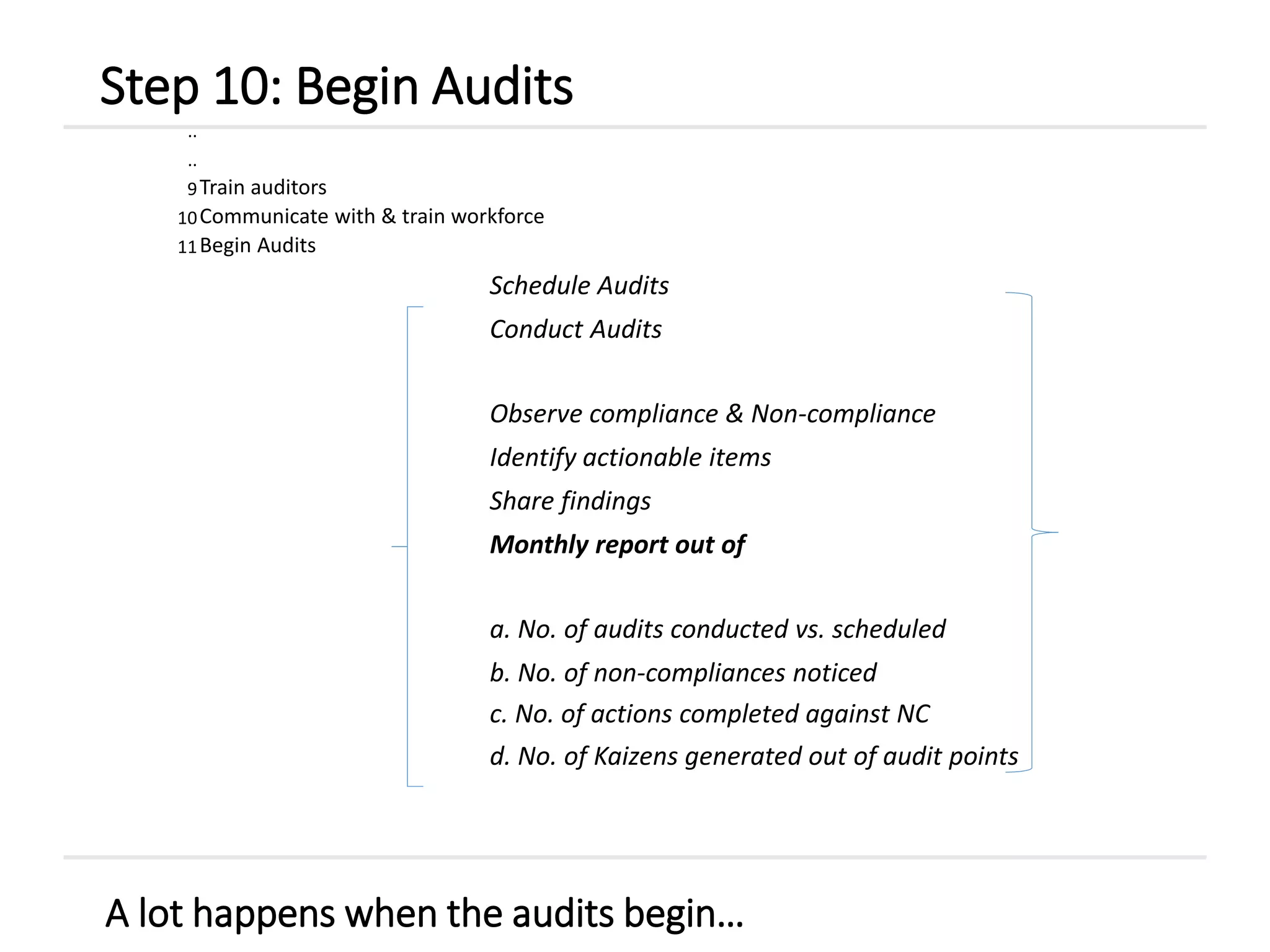
A lot happens when the audits begin…
..
..
9Train auditors
10Communicate with & train workforce
11Begin Audits
Schedule Audits
Conduct Audits
Observe compliance & Non-compliance
Identify actionable items
Share findings
Monthly report out of
a. No. of audits conducted vs. scheduled
b. No. of non-compliances noticed
c. No. of actions completed against NC
d. No. of Kaizens generated out of audit points
Step 10: Begin Audits
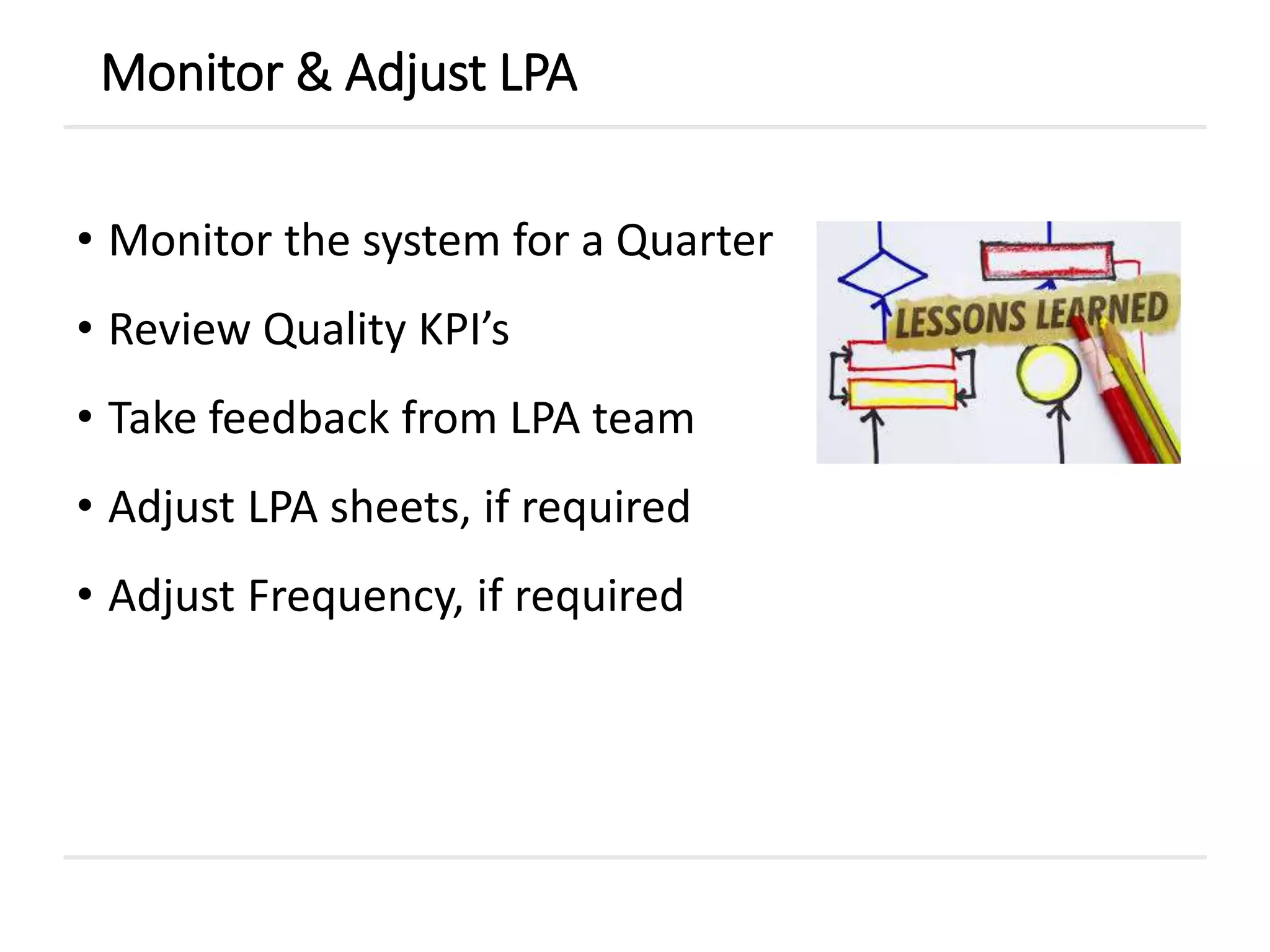
• Monitor the system for a Quarter
• Review Quality KPI’s
• Take feedback from LPA team
• Adjust LPA sheets, if required
• Adjust Frequency, if required
Monitor & Adjust LPA
• After making relevant changes, roll out in other parts
of the plant
Cascade thru out the plant(s)
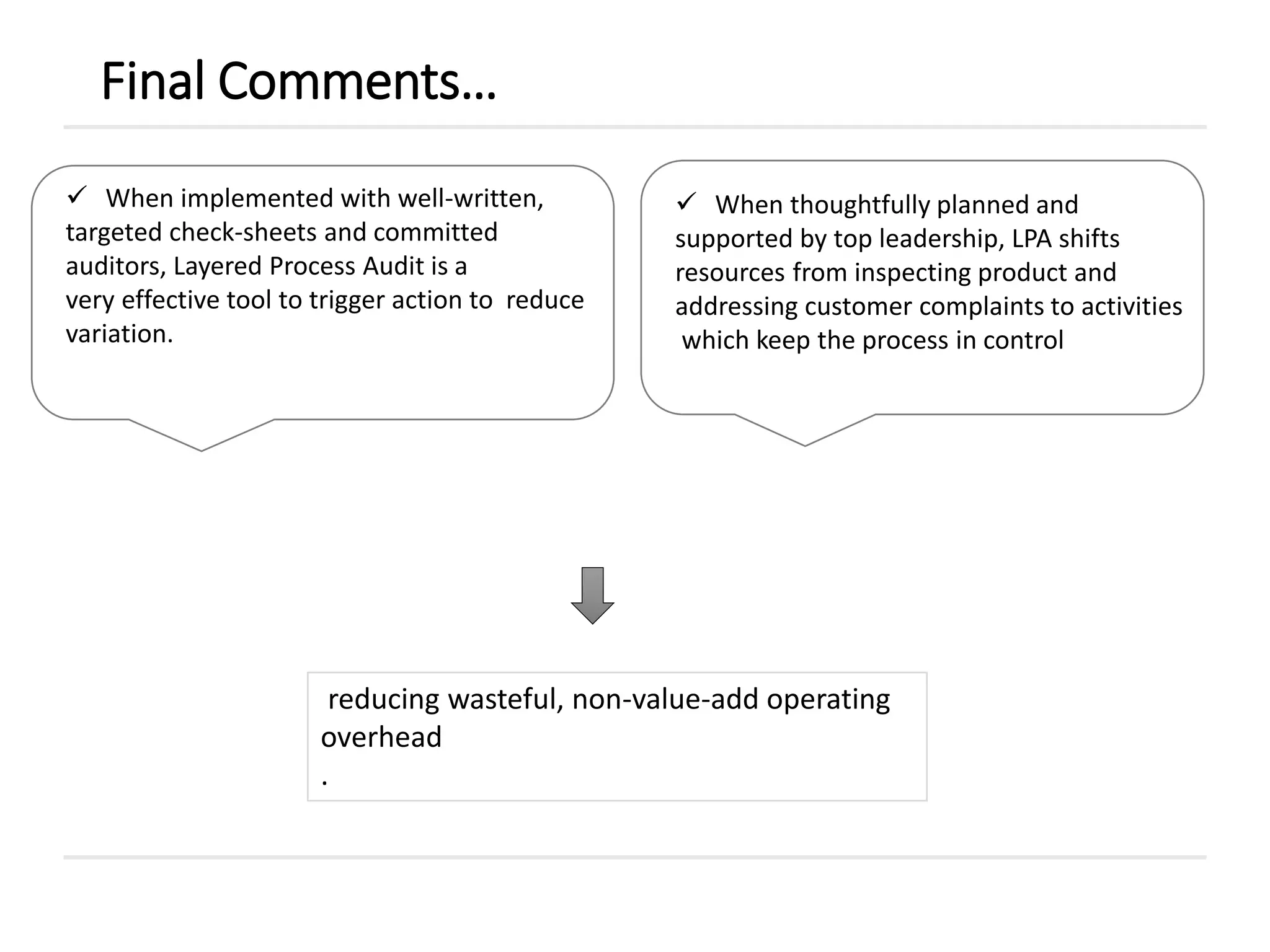
Final Comments…
reducing wasteful, non-value-add operating
overhead
.
 When implemented with well-written,
targeted check-sheets and committed
auditors, Layered Process Audit is a
very effective tool to trigger action to reduce
variation.
 When thoughtfully planned and
supported by top leadership, LPA shifts
resources from inspecting product and
addressing customer complaints to activities
which keep the process in control
For a free online course on LPA,
please visit
www.theapprentiice.com
Copyright, 2016 by “The Apprentiice” . This presentation, including the information contained herein
and any associated commentary, ("Materials") is provided as a service of The Apprentiice.
These Materials are based on publicly available information as well as the knowledge and experience
of The Apprentiice’s employees at time of drafting; however future accuracy cannot be guaranteed. As
such, these Materials should not be solely relied upon without, or used as a substitute for, future
consultation with The Apprentiice. Any further use of these Materials requires the express written
consent of The Apprentiice.

Layered process audit

  • 1.
    Layered Process Audits(LPA) by the Apprentiice
  • 2.
    Objectives • Concept ofLayered Process Audit (LPA) • How manufacturing organizations can benefit by implementing LPA • How to implement LPA WWW.THEAPPRENTIICE.COM
  • 3.
    • Introduction toLPA • Benefits • Why organizations should implement LPA • Suggested Road Map • Methodology employed for Key Steps • Conclusion Contents
  • 4.
     Layered ProcessAudits (LPA) is a quality tool developed for manufacturing management.  Layered Audits represent a formalized system focusing time and energy toward insuring high risk processes and error proofing devices do not exhibit a lot of variation and are working properly.  It’s an ongoing chain of simple verification checks, which through observation, evaluation and conversations on the line, assure that key work steps are being performed properly. LPA – answer to achieving ZERO Defects
  • 5.
    Layer 3 –Manager & Above Monthly Audit Layer 2 – Engineers/ Junior managers Weekly Audits Layer 1 – Coordinators/ Team Leaders Daily Audits LPA – answer to achieving ZERO Defects suggestive • A Layered Process Auditing system is comprised of three critical elements:  A set of Audits focused on High-Risk Processes  Layers of Auditors from all areas of Management who perform Audits  A system of Reporting and Follow-up to ensure Containment as needed and drive Improvement
  • 6.
    Benefits • Provides opportunitiesfor CI & initiates actions for CI • Prevents process errors and operator mistakes • Lower Rework & Repair • Reduces scrap and eliminates waste • Improves communication • Early detection & prevention • Reduce customer rejects • Improves FTC ( First time correct) • Improves overall Quality and thus, Customer satisfaction Primarily being used in big auto industries like GM, Ford and Chrysler etc.
  • 7.
    • It’s nota check on people; but on process. • Each critical process to be audited daily, weekly and monthly • Diff check sheet at each level • Involvement from the top is a pre-requisite • Immediate containment, reporting and follow-up is a must • Audit analysis and improvement actions is a must • Non-compliance to be shared in daily meetings • Benchmarking of Process Compliance after a Quarter of Audits • Primarily follows PDCA, where NC & observations form basis of improvement Principles
  • 8.
     Customer expectationsare increasing day by day  Redirects resources from reactionary efforts to prevention activities because LPA monitors the process, rather than the output  It will bring a step change in the organization’s Quality performance Why Should organizations adopt LPA ?
  • 9.
    Typical Road Map Month1 Month 2 Month 3 Month 4 wk-1 wk-2 wk-3 wk-4 wk-5 wk-1 wk-2 wk-3 wk-4 wk-1 wk-2 wk-3 wk-4 wk-1 wk-2 wk-3 wk-4 Form theLPA team Identify whereto begin Identify CriticalProcesses Identify high risk items Develop auditchecklist(s) Deterrminewho willconductaudit Determineauditfrequency Establish ManagementReview Train auditors Communicatewith & train workforce Begin Audits Monior & adjustLPAs Cascadethroughoutplant ROAD MAP FOR LPA IMPLEMENTATION Suggestive
  • 10.
    Step 1: FormTeam for LPA Sponsor Champion Facilitator Audit Team Subject Matter experts
  • 11.
     Sponsor –Provides resources  Champion – Mentor the team, remove any roadblocks in implementation  Facilitator – Schedules Audit, Analyses audit findings & keeps record of audits & actions, works as Management Representative for LPA System  Layer 1 Auditors – Conduct Audit & take immediate actions; raise any repetitive issue.  Layer 2& 3 Auditors– Conduct audit & update the facilitator; suggest action for improvements Roles of Team-members
  • 12.
    • Typical layer1 auditors are supervisors, maintenance and/or technicians. • Layer 2 auditors are often Engineers or area managers. • Layer 3 auditors might include the plant manager, and other top organization such as Engineering Manager, Quality Manager, HR Manager to name a few. A note about auditors
  • 13.
    • Identify whereto begin • Identify Critical Processes • Identify High Risk Items Step 2 to 4
  • 14.
    • The domainexperts develop the check sheet • Different questions at different levels • As we move from Layer 1 to Layer 3, the questions become broad • Audit sheets to be reviewed after every six months Step 5 : Develop Audit Check Sheets Layer1 Check if clear tape is applied in between splicing tapes Layer 2 Check if SOP is being followed Layer 3 Check if Slitter Operator is trained
  • 15.
    • Layer 1audits must be completed every shift everyday. • Layer 2 audits may be 1 or 2 a week and given from 2 to 5 days to complete. • Layer 3 is usually scheduled once a week and given 3 to 5 days to complete. • Higher layers may be scheduled weekly, bi-weekly, monthly, or quarterly. Step 6: Determine audit frequency
  • 16.
    • Management shouldreview the LPA activities as part of their formal Management Review of all their quality systems elements at defined intervals to insure the LPA system's continuing suitability and effectiveness. • Underscore the importance of your LPA system through active management reviews, and by utilizing a process of approving corrective actions and containment activities on a daily basis. Step 7 : Establish Management Review
  • 17.
    LPA auditors needto understand the philosophy of layered process auditing and your LPA system. Training should ensure that auditors demonstrate the ability to record audit results including non- conformances, containment activities, and corrective actions. Successful containment and the success of your LPA system depend on your auditors understanding what to do when they discover non-conformances. Step 8 :Train Auditors
  • 18.
    • All employeesneed to understand the purpose of doing layered process audits. • Employees need to understand that Layered Process Auditing will audit the process and will not be a blaming, headhunting expedition. Step 9: Communicate with and Train Workforce
  • 19.
    A lot happenswhen the audits begin… .. .. 9Train auditors 10Communicate with & train workforce 11Begin Audits Schedule Audits Conduct Audits Observe compliance & Non-compliance Identify actionable items Share findings Monthly report out of a. No. of audits conducted vs. scheduled b. No. of non-compliances noticed c. No. of actions completed against NC d. No. of Kaizens generated out of audit points Step 10: Begin Audits
  • 20.
    • Monitor thesystem for a Quarter • Review Quality KPI’s • Take feedback from LPA team • Adjust LPA sheets, if required • Adjust Frequency, if required Monitor & Adjust LPA
  • 21.
    • After makingrelevant changes, roll out in other parts of the plant Cascade thru out the plant(s)
  • 22.
    Final Comments… reducing wasteful,non-value-add operating overhead .  When implemented with well-written, targeted check-sheets and committed auditors, Layered Process Audit is a very effective tool to trigger action to reduce variation.  When thoughtfully planned and supported by top leadership, LPA shifts resources from inspecting product and addressing customer complaints to activities which keep the process in control
  • 23.
    For a freeonline course on LPA, please visit www.theapprentiice.com
  • 25.
    Copyright, 2016 by“The Apprentiice” . This presentation, including the information contained herein and any associated commentary, ("Materials") is provided as a service of The Apprentiice. These Materials are based on publicly available information as well as the knowledge and experience of The Apprentiice’s employees at time of drafting; however future accuracy cannot be guaranteed. As such, these Materials should not be solely relied upon without, or used as a substitute for, future consultation with The Apprentiice. Any further use of these Materials requires the express written consent of The Apprentiice.

Editor's Notes

  • #3 The Objectives of this module are: Introduce the participant to the concept of Layered Process Audit How manufacturing organizations can benefit by implementing LPA ? How to implement LPA ?
  • #4 The contents that will be covered in this module are : Introduction to L P A or Layered Process Audits Benefits Why organizations should implement L P A Suggested Road Map Methodology employed for Key Steps Conclusion
  • #5 The Layered Process Audits is a quality tool developed for manufacturing management. When utilized properly, it drives cultural change throughout an organization to improve quality, reduce scrap and re-work and reduce customer rejections. Layered Audits represent a formalized system focusing time and energy toward insuring high risk processes and error proofing devices do not exhibit a lot of variation and are working properly. It’s an ongoing chain of simple verification checks, which through observation, evaluation and conversations on the line, assure that key work steps are being performed properly. Error proofing - Also called: poka-yoke, fail–safing Mistake proofing, or its Japanese equivalent poka-yoke (pronounced PO-ka yo-KAY), is the use of any automatic device or method that either makes it impossible for an error to occur or makes the error immediately obvious once it has occurred.
  • #6 A Layered Process Auditing system is comprised of three critical elements: 1. A set of Audits focused on High-Risk Processes 2. Layers of Auditors from all areas of Management who perform Audits 3. A system of Reporting and Follow-up to ensure Containment as needed and drive Improvement. Simply put, it’s the audit of the process by successive layers of manufacturing management with a system in place to monitor & correct non-conformities. A suggestive illustration is provided in the slide for a 3 layer system.
  • #7 Here are the benefits of using LPA : Provides opportunities for Continual Improvement & initiates actions for the same. Prevents process errors and operator mistakes Lower Rework & Repair Reduces scrap and eliminates waste Improves communication Early detection & prevention Reduce customer rejects Improves FTC ( First time correct) Improves overall Quality and thus, Customer satisfaction
  • #8 Here are some of the principles that one should consider, while implementing LPA: It’s not a check on people; but on process. Each critical process to be audited daily, weekly and monthly Different check sheet at each level Involvement from the top is a pre-requisite Immediate containment, reporting and follow-up is a must Audit analysis and improvement actions is a must Non-compliance to be shared in daily meetings Benchmarking of Process Compliance after a Quarter of Audits Primarily follows PDCA, that is, Plan Do Check and adjust; where Non Conformities & observations form basis of improvement
  • #9 Why Should organizations adopt LPA ? Customer expectations are increasing day by day Redirects resources from reactionary efforts to prevention activities because LPA monitors the process, rather than the output It will bring a step change in the organization’s Quality performance
  • #10 Shown in the slide, is a typical road map for implementing Layered Process Audit System. Let’s look at each step in detail in the next few slides.
  • #11 The team for LPA should consist of a Sponsor , a facilitator, a champion. There should be some subject matter experts on board. Of course, the auditors are a must !! Let’s look at the roles they would play in the scheme of activities.
  • #12 Sponsor – Provides resources Champion – Mentor the team, remove any roadblocks in implementation Facilitator – Schedules Audit, Analyses audit findings & keeps record of audits & actions, works as Management Representative for LPA System Layer 1 Auditors – Conduct Audit & take immediate actions; raise any repetitive issue. Layer 2 and 3 Auditors– Conduct audit & update the facilitator; suggest action for improvements
  • #13 Here is a small note to consider about who the auditors should be. Typical layer 1 auditors are supervisors, maintenance and/or technicians. Layer 2 auditors are often Engineers or area managers. Layer 3 auditors might include the plant manager, and other top organization such as Engineering Manager, Quality Manager, HR Manager to name a few.
  • #14 Instead of concentrating of the whole pie, the suggestion here is to take a bite at a time. If the company has multiple plants, choose one pilot site to begin with. Once the site is chosen, next step is to identify Critical Processes. In the context of LPA, critical processes could be those, whose output affects the product Quality the most or those processes whose output goes to the customer. The organization could decide on what are the critical processes that it should begib with. Post this, the organization should identify high risk items in the identified processes. . Choose processes known by supervision, technicians, maintenance, and operators that have continual variation.
  • #15 The domain experts develop the check sheet Different questions at different levels As we move from Layer 1 to Layer 3, the questions become broad Audit sheets to be reviewed after every six months Look at the sample in the slide. At Layer 1, ask operational questions . Any deviation found in Layer 1 should be addressed immediately. Layer 2 questions should identify process deviations or discrepancies. Layer 3 audit ideally should be able to identify system-failure.
  • #16 Here are some of the options to consider while deciding the frequency of audits . Layer 1 audits must be completed every shift everyday. Layer 2 audits may be 1 or 2 a week and given from 2 to 5 days to complete. Layer 3 is usually scheduled once a week and given 3 to 5 days to complete. Higher layers may be scheduled weekly, bi-weekly, monthly, or quarterly.
  • #17 The next step is to establish Management Review. Management should review the LPA activities as part of their formal Management Review of all their quality systems elements at defined intervals to insure the LPA system's continuing suitability and effectiveness. Underscore the importance of your LPA system through active management reviews, and by utilizing a process of approving corrective actions and containment activities on a daily basis
  • #18 LPA auditors need to understand the philosophy of layered process auditing and your LPA system. Knowing when, where, and how to complete an audit is critical to the system. • Training should ensure that auditors demonstrate the ability to record audit results including non-conformances, containment activities, and corrective actions. • Successful containment and the success of your LPA system depend on your auditors understanding what to do when they discover non-conformances.
  • #19 All employees need to understand the purpose of doing layered process audits. Training for non-auditing employees is done in groups small enough that everyone feels comfortable enough to ask questions. Employees need to understand that Layered Process Auditing will audit the process and will not be a blaming, headhunting expedition. Emphasize that LPA is designed to improve quality by reducing variation in the processes. Employee training should take about 30 minutes.
  • #20 Now, you are ready to begin your audits. Go on & make a schedule . Then conduct audits and observe compliance and non-compliance. Share findings with the team. Some organizations have the culture of daily morning meeting or stand-up meetings. The auditors can share their finding in the same. It will be good to maintain a log of all such findings and actions. The Facilitator can consolidate the same. A monthly report out of : a. No. of audits conducted vs. scheduled; b. No. of non-compliances noticed; c. No. of actions completed against Non Conformity. d. No. of Kaizens generated out of audit points; Can tell about the health of LPA. Further , the organization should also monitor if there is improvement in the Quality KPI’s like no. of customer complaints and returns and allowances paid to customer due to Quality issues. So, a lot happens when the audits begin.
  • #21 Though, you may decide what suits your organization best, it will be good to monitor the pilot for a Quarter and make changes as required. Post implementation, review your Quality KPI. Observe for some positive changes. Take feedback from LPA team. Adjust LPA sheets, if required. Adjust Frequency of audits, if required.
  • #22 After making relevant changes, roll out in other parts of the plant. If your organization has plants in multiple locations, you may choose to roll out simultaneously or roll in one plant and then utilize learning for implementation in other plants.
  • #23 LPA , When implemented with well-written, targeted check-sheets and committed auditors, Layered Process Audit is a very effective tool to trigger action to reduce variation. {{Pause=0.5}}When thoughtfully planned and supported by top leadership, LPA shifts resources from inspecting product and addressing customer complaints to activities which keep the process in control.