Control Plan Training
Page 2
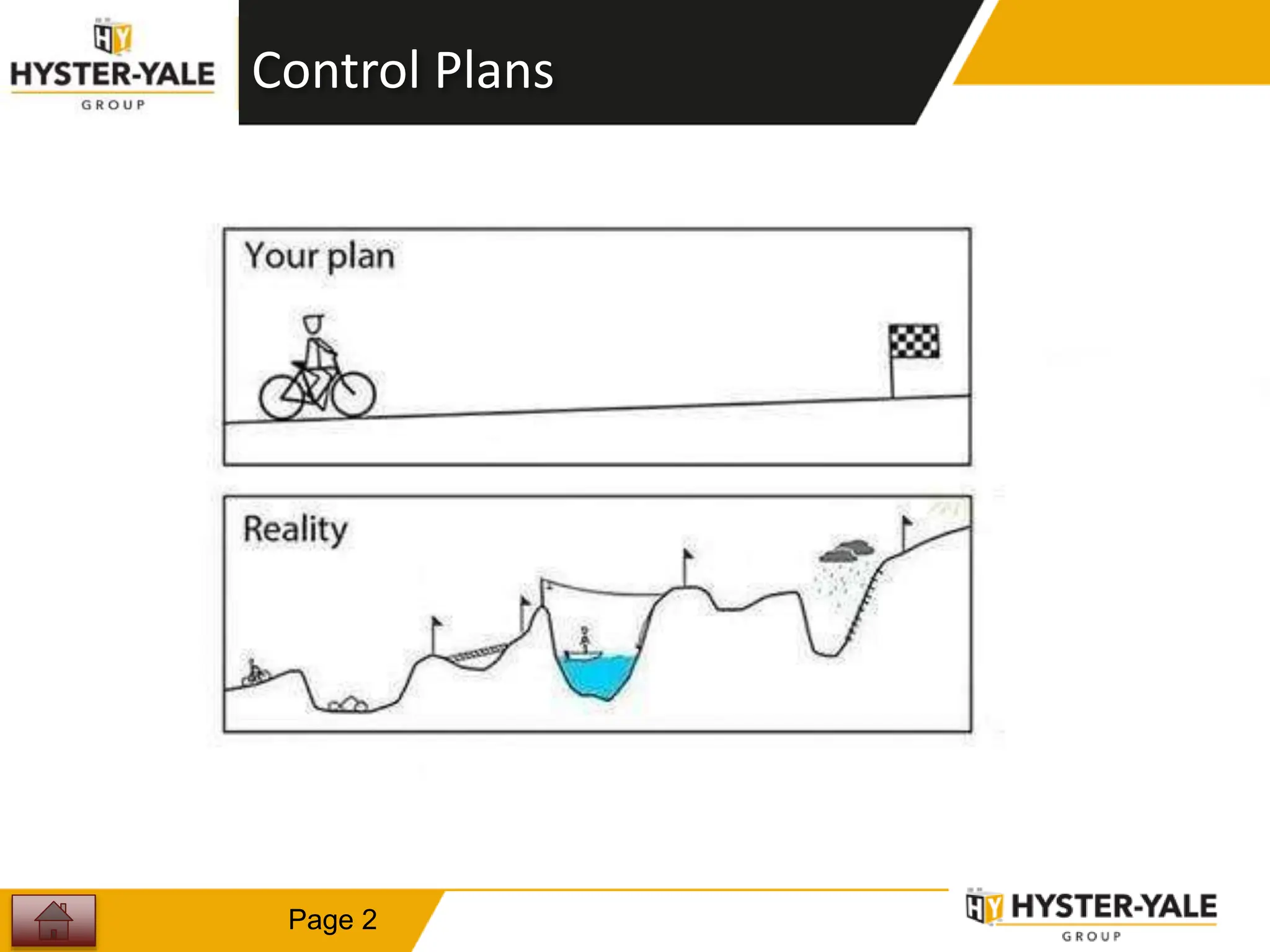
Control Plans
Control Plan
3
Page 3
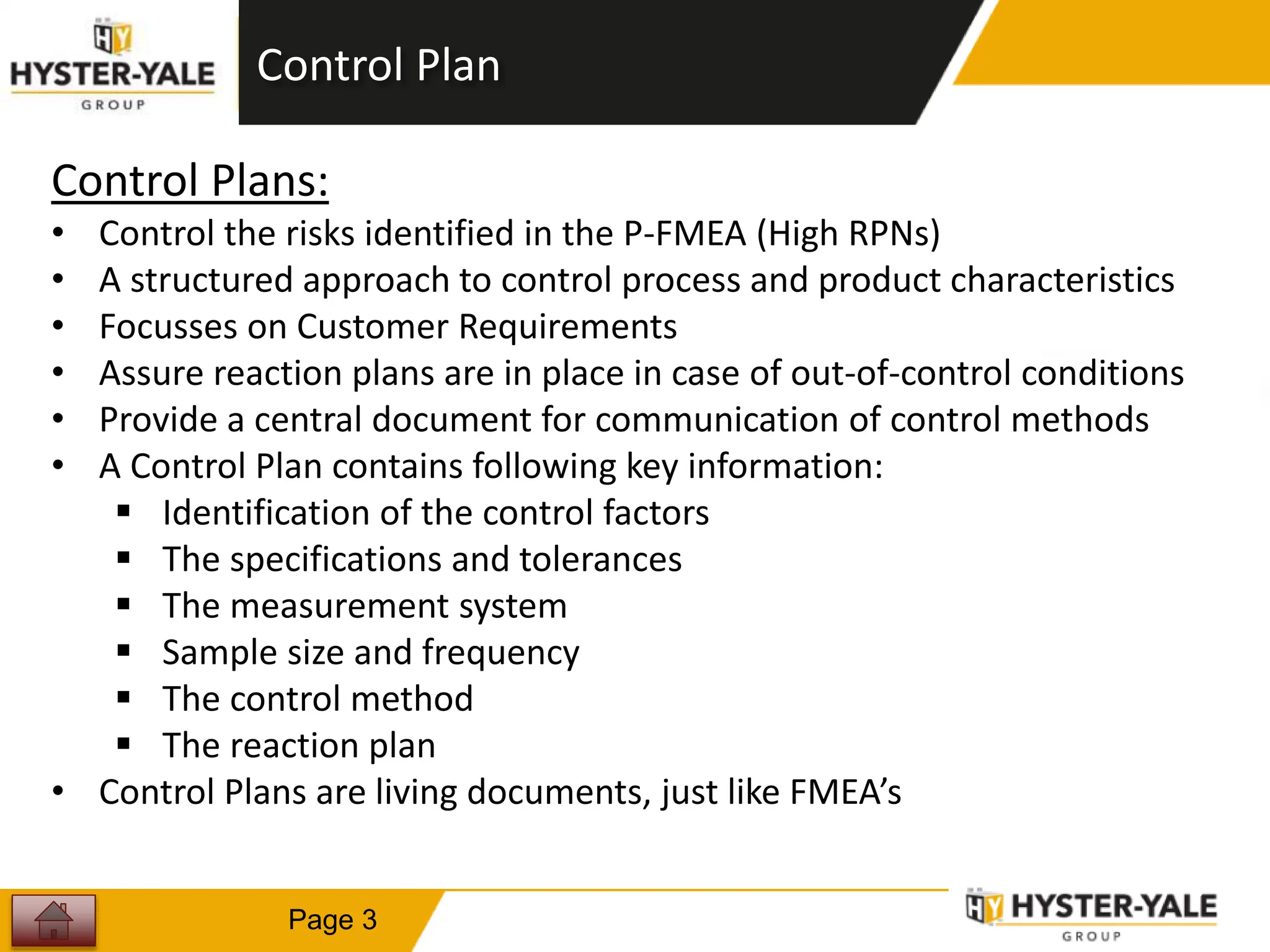
Control Plans:
• Control the risks identified in the P-FMEA (High RPNs)
• A structured approach to control process and product characteristics
• Focusses on Customer Requirements
• Assure reaction plans are in place in case of out-of-control conditions
• Provide a central document for communication of control methods
• A Control Plan contains following key information:
 Identification of the control factors
 The specifications and tolerances
 The measurement system
 Sample size and frequency
 The control method
 The reaction plan
• Control Plans are living documents, just like FMEA’s
Control Plan, Objectives
Objectives of the training:
• To understand the use of a Control Plan
• To learn the steps to develop a Control Plan
• To learn how to link each step in the Control Plan
to the FMEA
4
Page 4
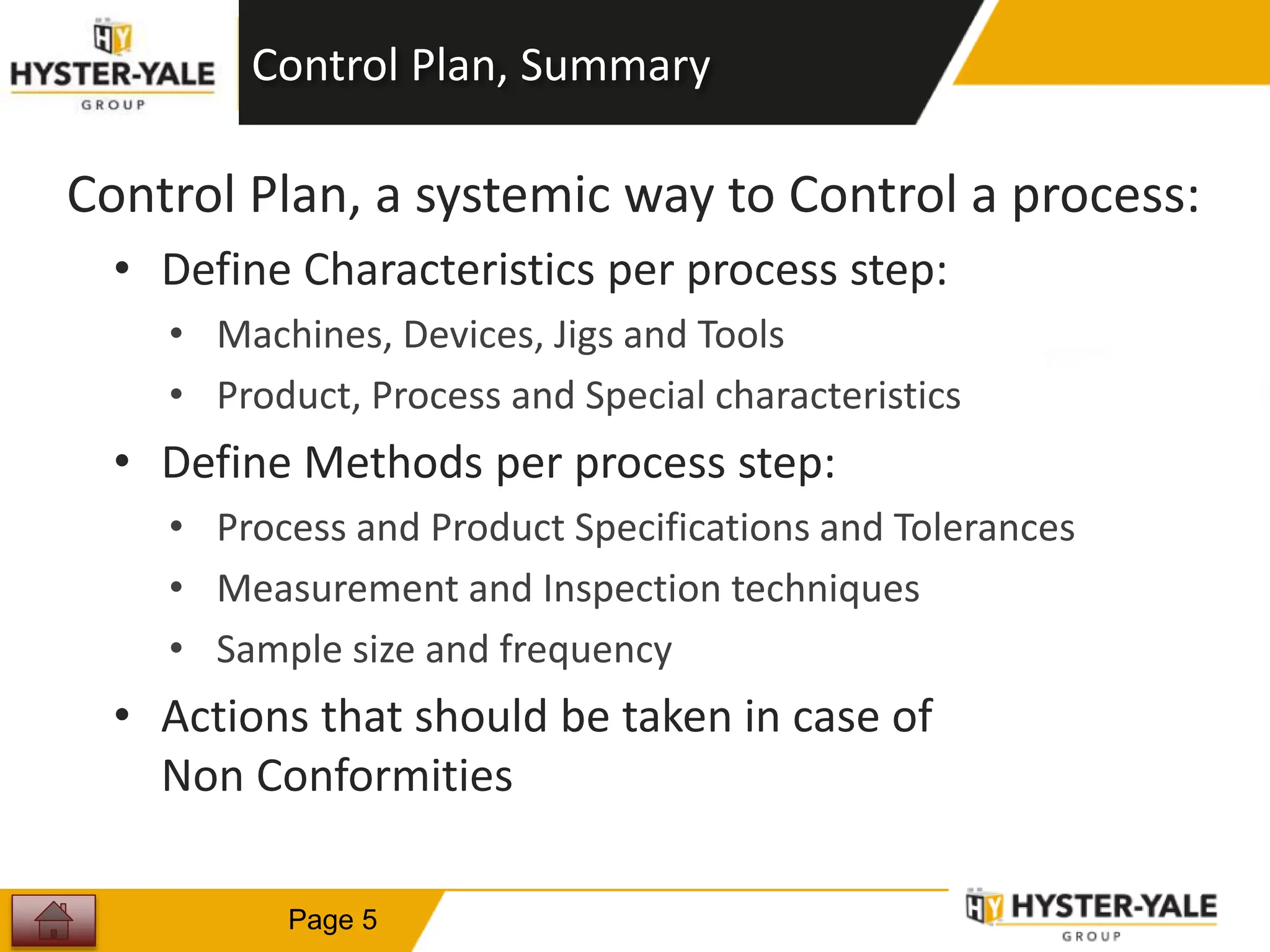
Control Plan, Summary
Control Plan, a systemic way to Control a process:
• Define Characteristics per process step:
• Machines, Devices, Jigs and Tools
• Product, Process and Special characteristics
• Define Methods per process step:
• Process and Product Specifications and Tolerances
• Measurement and Inspection techniques
• Sample size and frequency
• Actions that should be taken in case of
Non Conformities
5
Page 5
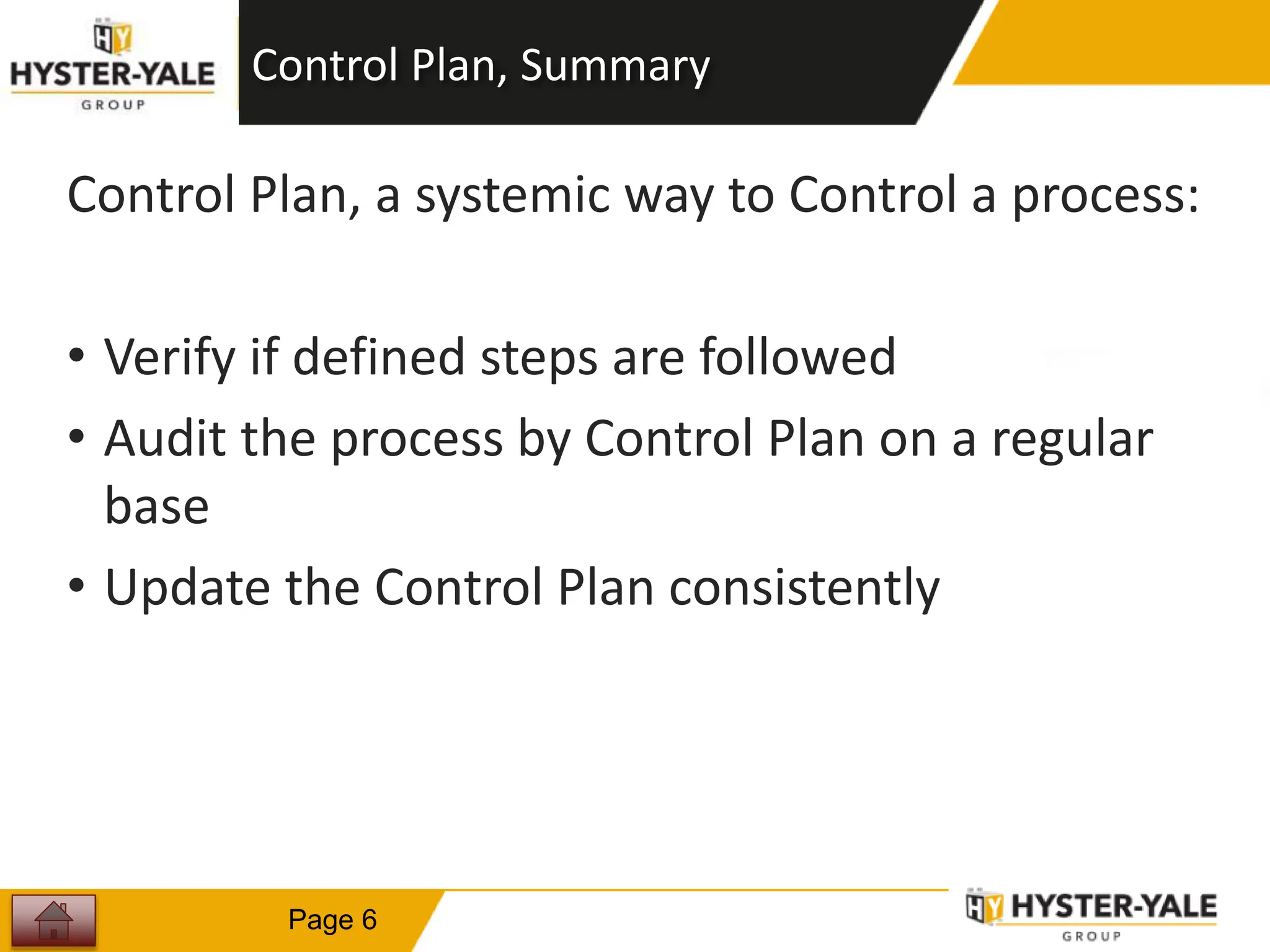
Control Plan, Summary
Control Plan, a systemic way to Control a process:
• Verify if defined steps are followed
• Audit the process by Control Plan on a regular
base
• Update the Control Plan consistently
6
Page 6
Benefits
7
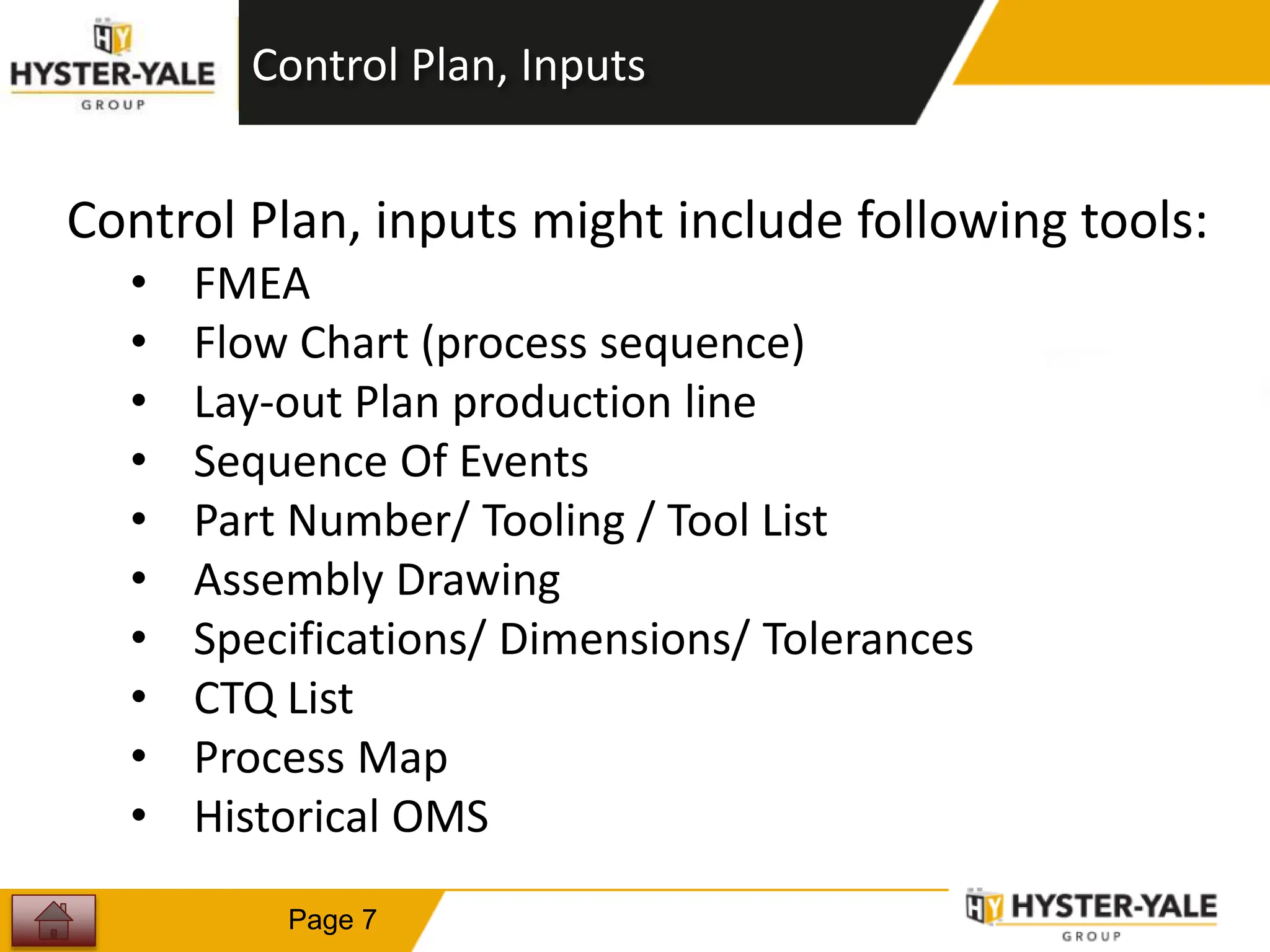
Control Plan, Inputs
Page 7
Control Plan, inputs might include following tools:
• FMEA
• Flow Chart (process sequence)
• Lay-out Plan production line
• Sequence Of Events
• Part Number/ Tooling / Tool List
• Assembly Drawing
• Specifications/ Dimensions/ Tolerances
• CTQ List
• Process Map
• Historical OMS
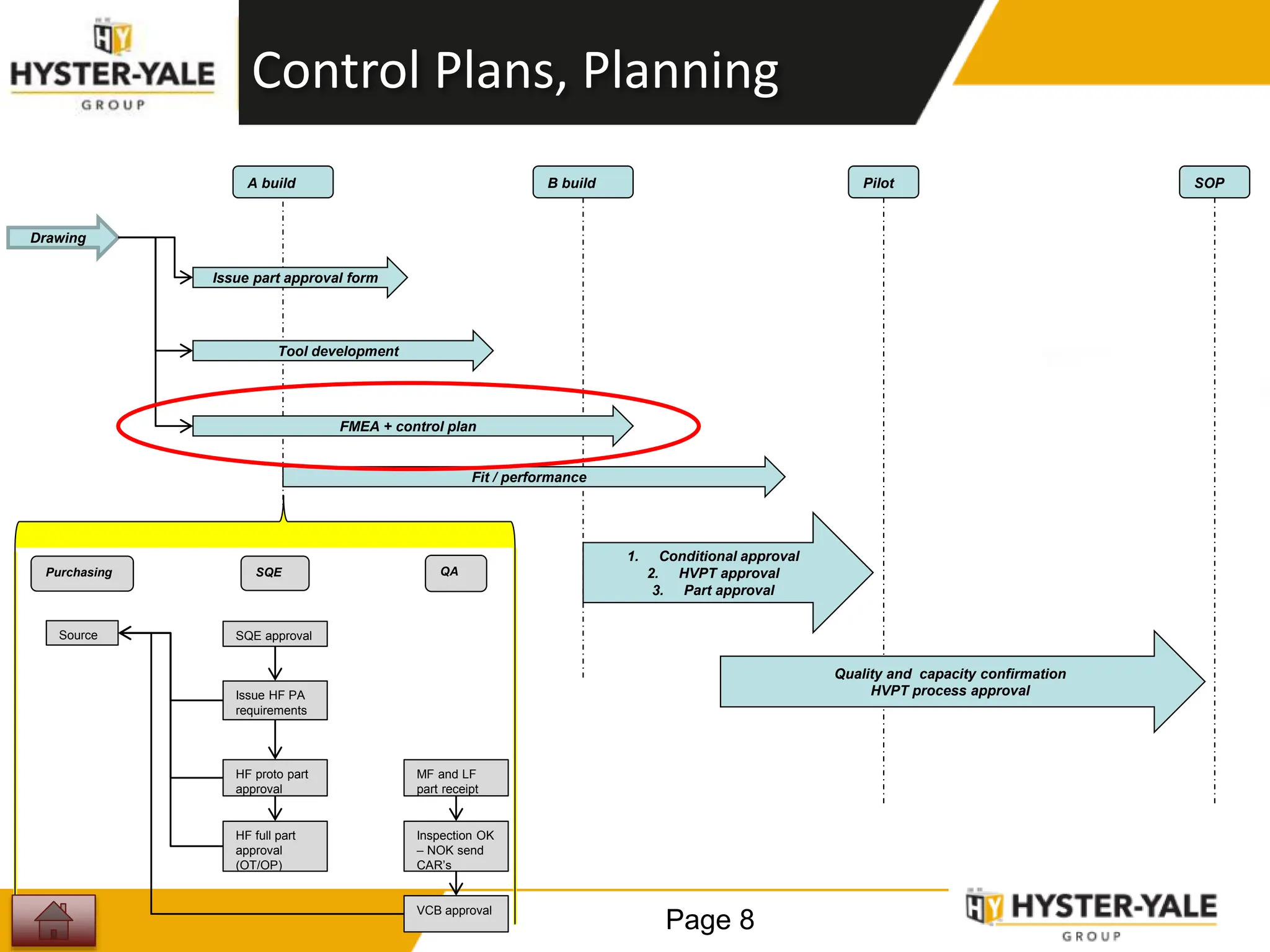
A build B build Pilot
Drawing
Issue part approval form
Tool development
FMEA + control plan
1. Conditional approval
2. HVPT approval
3. Part approval
Quality and capacity confirmation
HVPT process approval
Fit / performance
Purchasing SQE QA
Source SQE approval
Issue HF PA
requirements
HF proto part
approval
HF full part
approval
(OT/OP)
MF and LF
part receipt
Inspection OK
– NOK send
CAR’s
VCB approval
SOP
Page 8
Control Plans, Planning
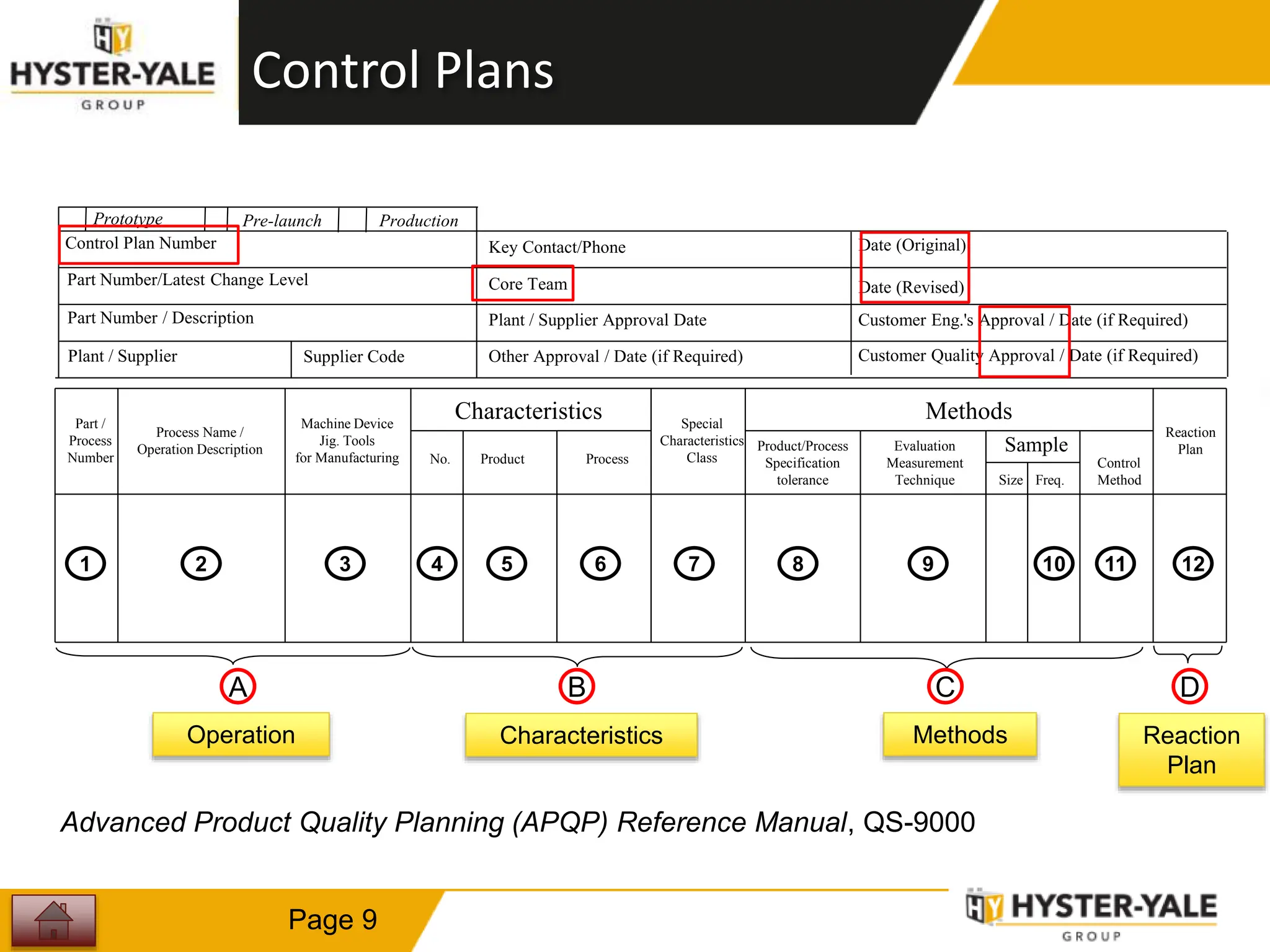
A B C D
Part /
Process
Number
Process Name /
Operation Description
Machine Device
Jig. Tools
for Manufacturing No.
Evaluation
Measurement
Technique
Product Process
Product/Process
Specification
tolerance
Special
Characteristics
Class
Size
Control
Method
Freq.
Reaction
Plan
Sample
Methods
Characteristics
Prototype Pre-launch Production
Control Plan Number Key Contact/Phone Date (Original)
Date (Revised)
Part Number/Latest Change Level
Part Number / Description
Plant / Supplier Supplier Code
Core Team
Plant / Supplier Approval Date Customer Eng.'s Approval / Date (if Required)
Customer Quality Approval / Date (if Required)
Other Approval / Date (if Required)
1 2 5 6 7 8 9 10 11 12
3 4
Advanced Product Quality Planning (APQP) Reference Manual, QS-9000
Page 9
Control Plans
Operation Characteristics Methods Reaction
Plan
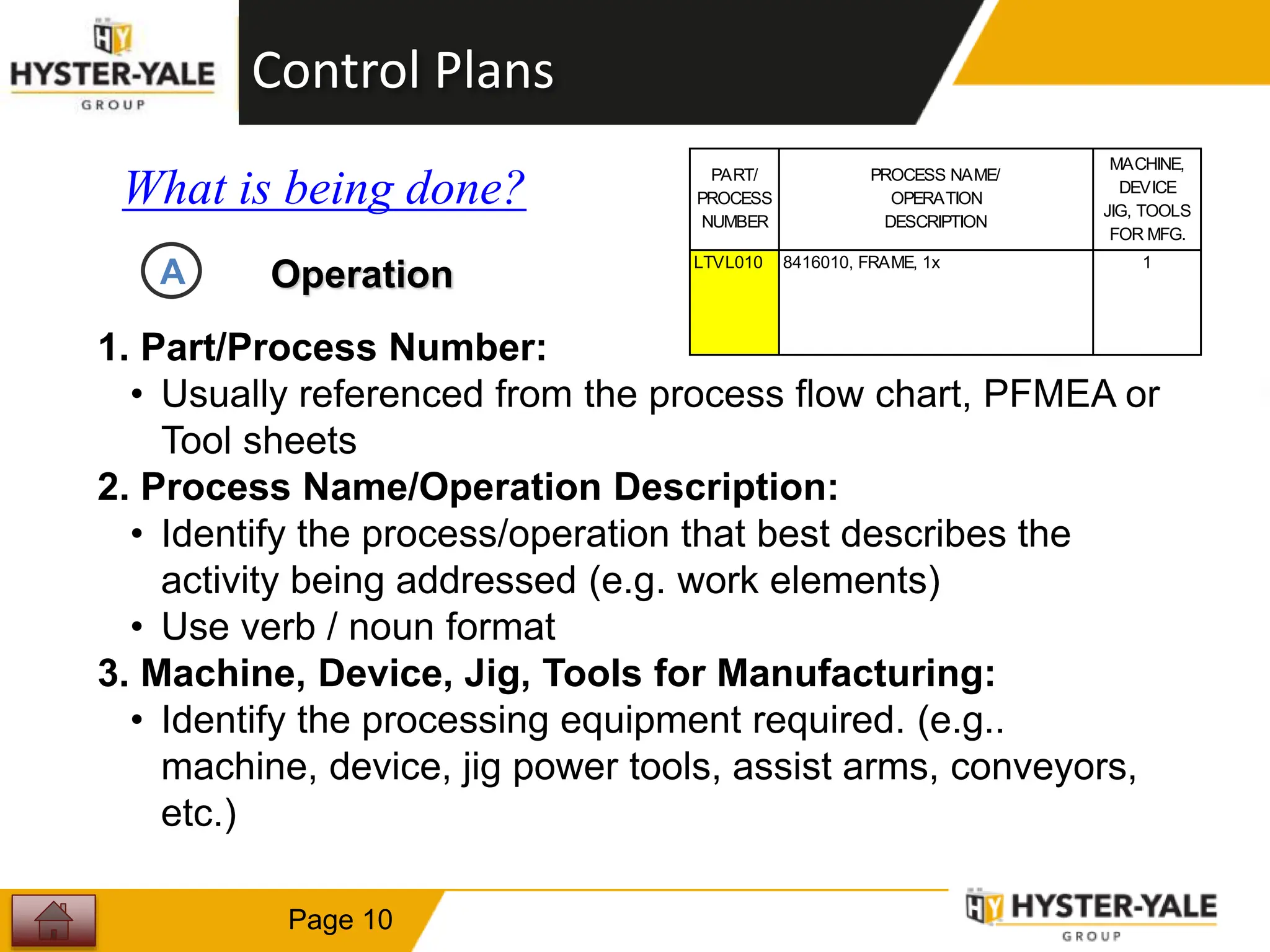
1. Part/Process Number:
• Usually referenced from the process flow chart, PFMEA or
Tool sheets
2. Process Name/Operation Description:
• Identify the process/operation that best describes the
activity being addressed (e.g. work elements)
• Use verb / noun format
3. Machine, Device, Jig, Tools for Manufacturing:
• Identify the processing equipment required. (e.g..
machine, device, jig power tools, assist arms, conveyors,
etc.)
What is being done?
A Operation
Page 10
Control Plans
LTVL010 8416010, FRAME, 1x 1
PART/
PROCESS
NUMBER
PROCESS NAME/
OPERATION
DESCRIPTION
MACHINE,
DEVICE
JIG, TOOLS
FOR MFG.
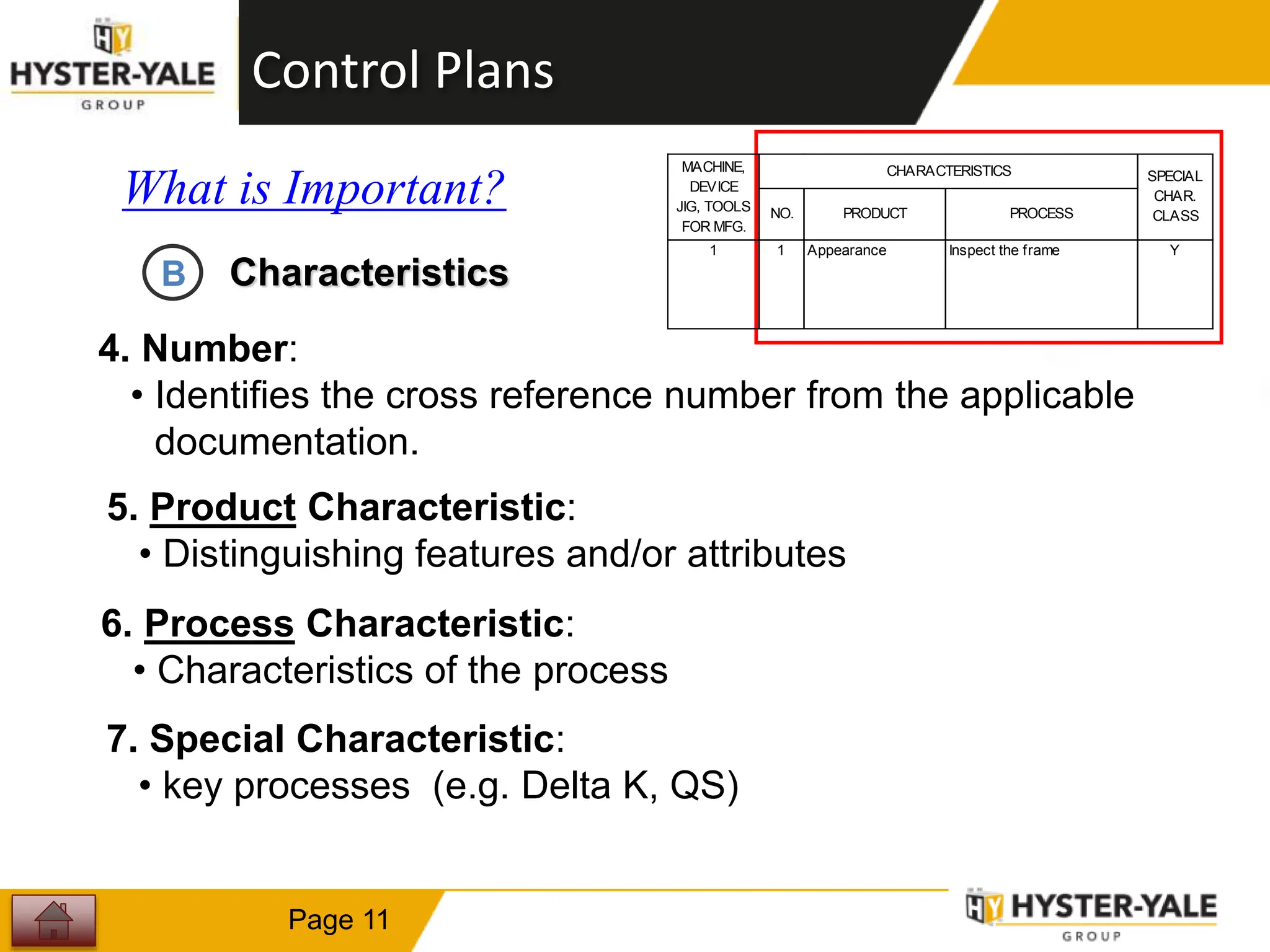
4. Number:
• Identifies the cross reference number from the applicable
documentation.
7. Special Characteristic:
• key processes (e.g. Delta K, QS)
5. Product Characteristic:
• Distinguishing features and/or attributes
6. Process Characteristic:
• Characteristics of the process
What is Important?
B Characteristics
Page 11
Control Plans
1 1 Appearance Inspect the frame Y
CHARACTERISTICS
MACHINE,
DEVICE
JIG, TOOLS
FOR MFG.
NO. PRODUCT PROCESS
SPECIAL
CHAR.
CLASS
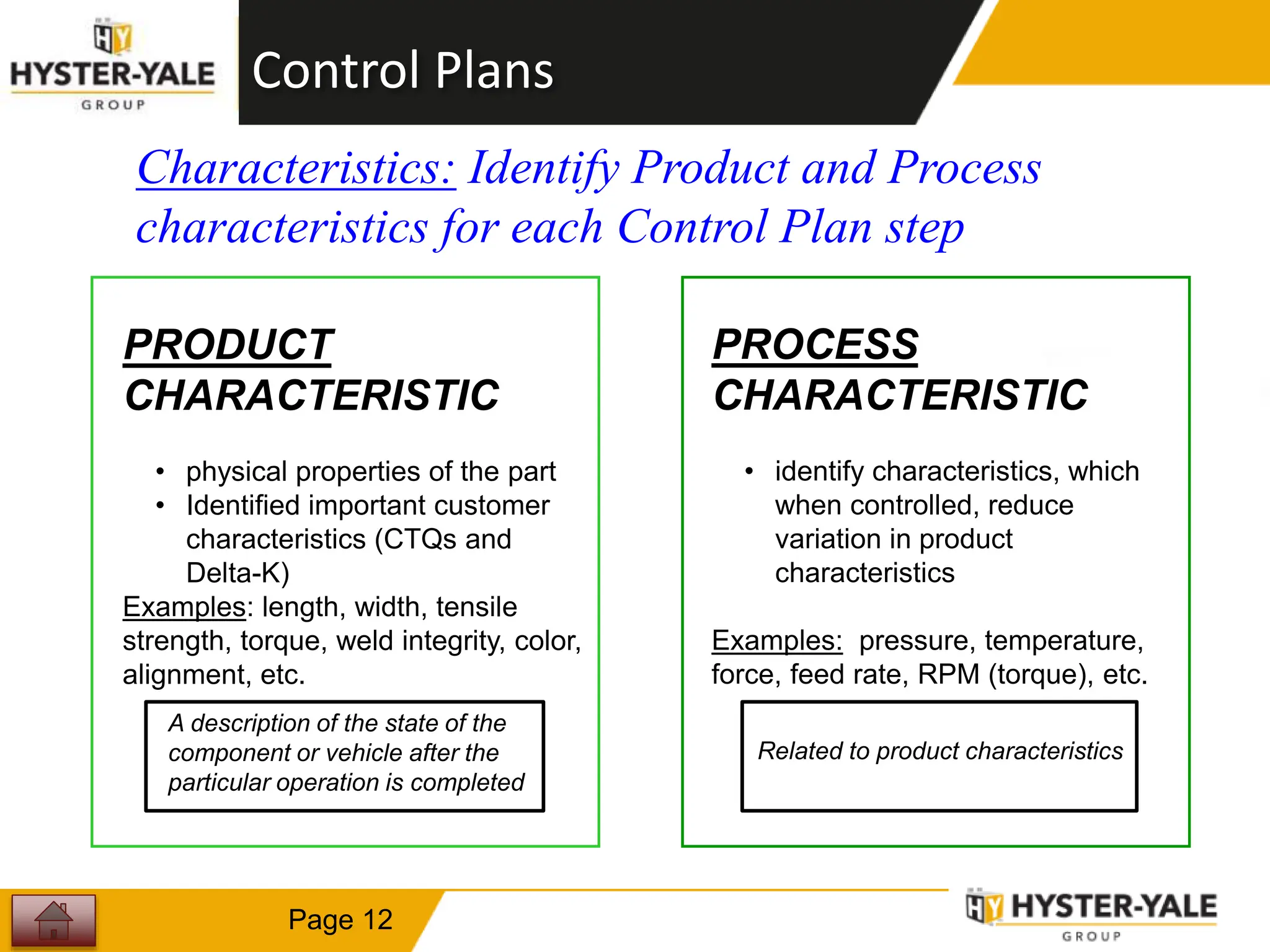
PRODUCT
CHARACTERISTIC
• physical properties of the part
• Identified important customer
characteristics (CTQs and
Delta-K)
Examples: length, width, tensile
strength, torque, weld integrity, color,
alignment, etc.
A description of the state of the
component or vehicle after the
particular operation is completed
PROCESS
CHARACTERISTIC
• identify characteristics, which
when controlled, reduce
variation in product
characteristics
Examples: pressure, temperature,
force, feed rate, RPM (torque), etc.
Related to product characteristics
Characteristics: Identify Product and Process
characteristics for each Control Plan step
Page 12
Control Plans
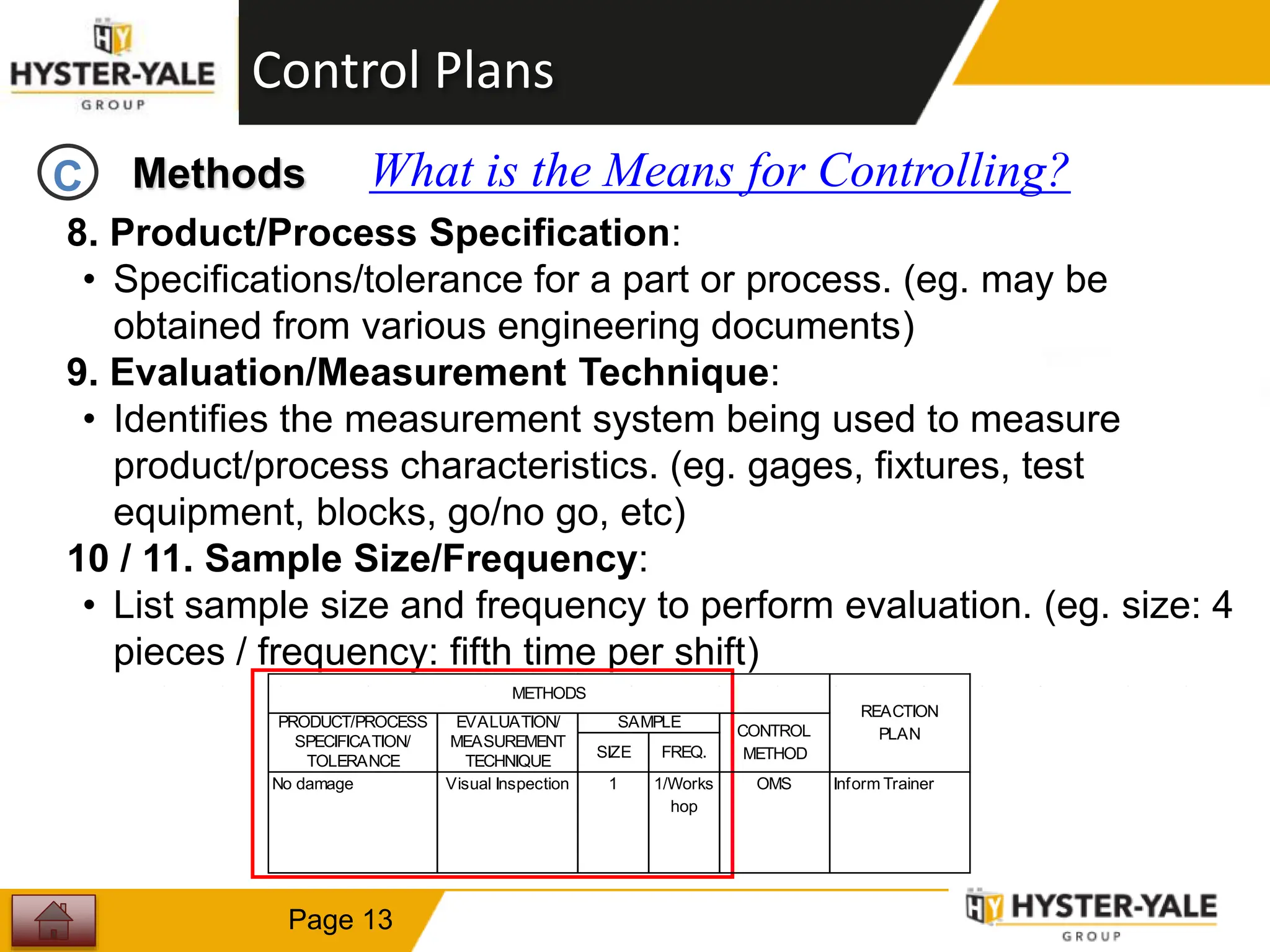
8. Product/Process Specification:
• Specifications/tolerance for a part or process. (eg. may be
obtained from various engineering documents)
9. Evaluation/Measurement Technique:
• Identifies the measurement system being used to measure
product/process characteristics. (eg. gages, fixtures, test
equipment, blocks, go/no go, etc)
10 / 11. Sample Size/Frequency:
• List sample size and frequency to perform evaluation. (eg. size: 4
pieces / frequency: fifth time per shift)
What is the Means for Controlling?
Methods
Control Plans
Page 13
C
PRODUCT/PROCESS EVALUATION/ SAMPLE
SPECIFICATION/ MEASUREMENT
TOLERANCE TECHNIQUE
No damage Visual Inspection 1 1/Works
hop
OMS Inform Trainer
FREQ.
CONTROL
METHOD
METHODS
REACTION
PLAN
SIZE
Benefits
1
4
Control Plan,
Sample size and frequency
Page 14
Station:
1-nov-08
2-nov-08
3-nov-08
4-nov-08
5-nov-08
6-nov-08
7-nov-08
8-nov-08
9-nov-08
10-nov-08
Install O-ring Mee-1247 1
C/R into C/C Mee-1248
S/R assy Mee-1250
S/R height Mee-1251
V-coupling assy Mee-1253
Act assy Mee-1255 1
Lever welding Mee-1288 1 2 3 1
Lever welding Mee-1289
Act measurement Mee-1291 2 2 1 3
Engraving Mee-1256 1
Rev & K-ring check Mee-1257
Weld-assy-act Mee-1258
C/C angle check Mee-1259 1 4
V-coupl-lever-act Mee-1260 2
Total NOK 3 2 1247 0 0 7 1 2 0 4
OK 220 450 300 350 455 275 400 430
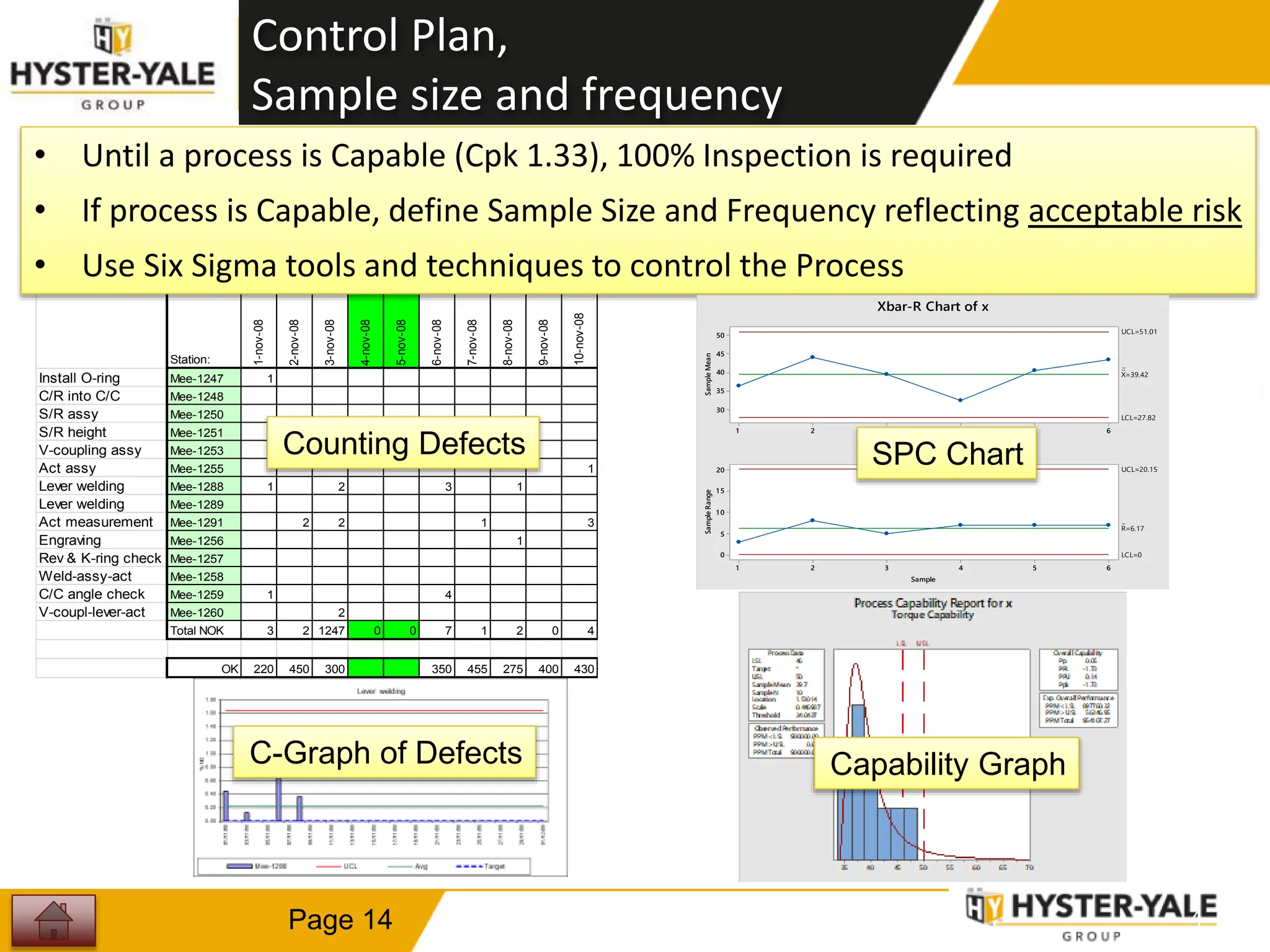
• Until a process is Capable (Cpk 1.33), 100% Inspection is required
• If process is Capable, define Sample Size and Frequency reflecting acceptable risk
• Use Six Sigma tools and techniques to control the Process
6
5
4
3
2
1
50
45
40
35
30
Sample
Sample
Mean
_
_
X=39.42
UCL=51.01
LCL=27.82
6
5
4
3
2
1
20
1 5
1 0
5
0
Sample
Sample
Range
_
R=6.17
UCL=20.15
LCL=0
Xbar-R Chart of x
Counting Defects
C-Graph of Defects
SPC Chart
Capability Graph
PRODUCT/PROCESS EVALUATION/ SAMPLE
SPECIFICATION/ MEASUREMENT
TOLERANCE TECHNIQUE
No damage Visual Inspection 1 1/Works
hop
OMS Inform Trainer
FREQ.
CONTROL
METHOD
METHODS
REACTION
PLAN
SIZE
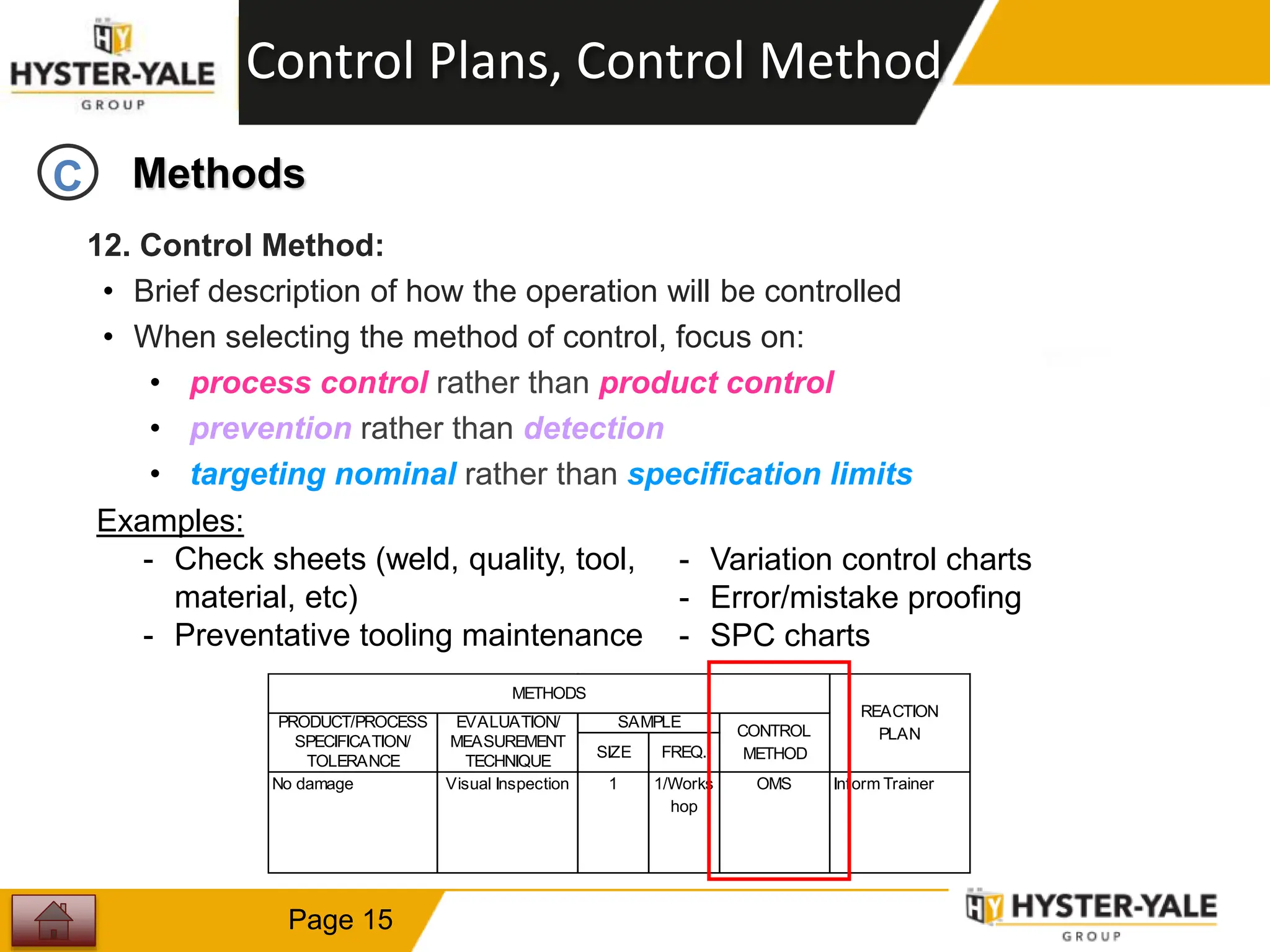
12. Control Method:
• Brief description of how the operation will be controlled
• When selecting the method of control, focus on:
• process control rather than product control
• prevention rather than detection
• targeting nominal rather than specification limits
Examples:
- Check sheets (weld, quality, tool,
material, etc)
- Preventative tooling maintenance
- Variation control charts
- Error/mistake proofing
- SPC charts
Methods
Control Plans, Control Method
C
Page 15
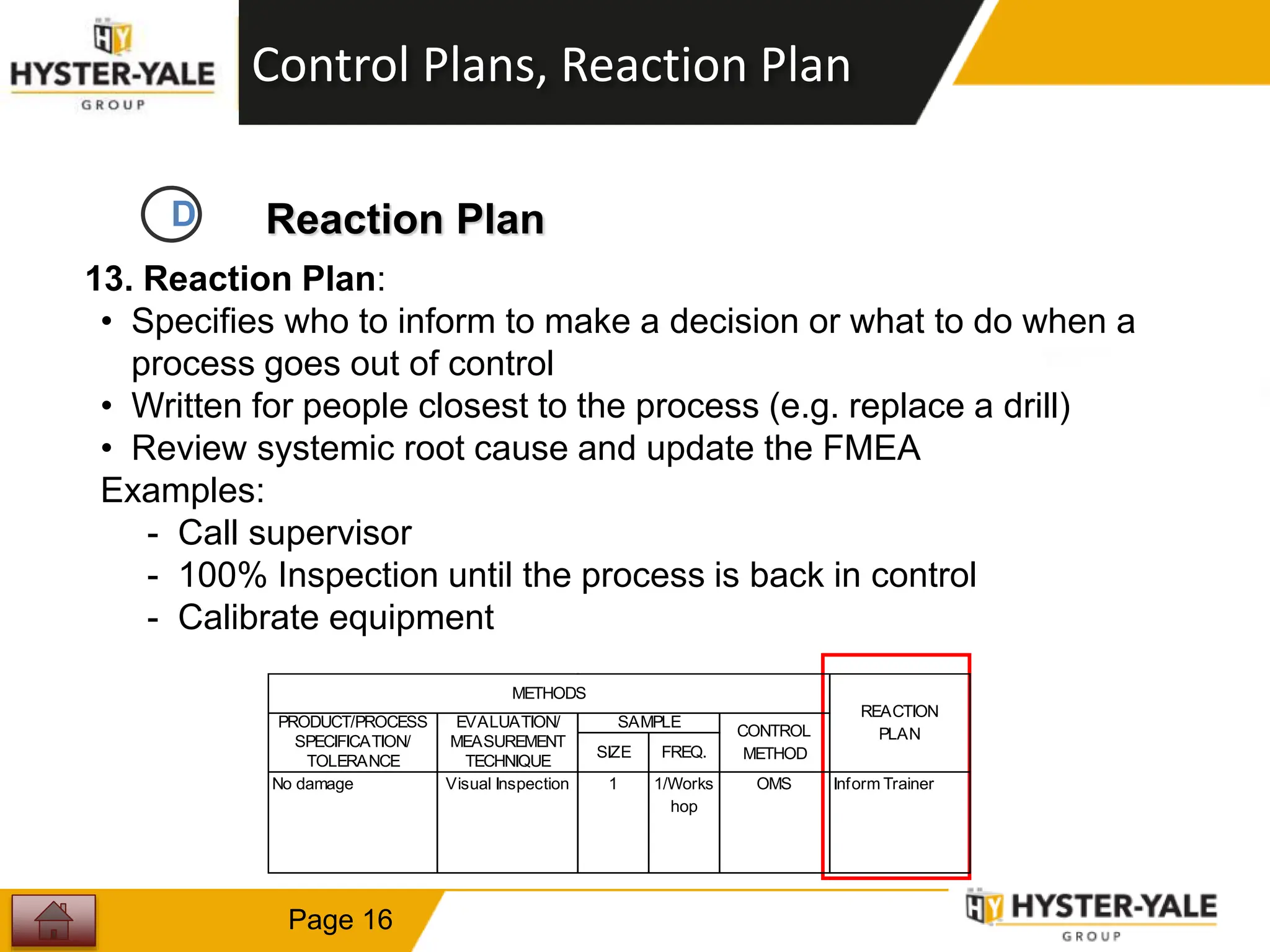
13. Reaction Plan:
• Specifies who to inform to make a decision or what to do when a
process goes out of control
• Written for people closest to the process (e.g. replace a drill)
• Review systemic root cause and update the FMEA
Examples:
- Call supervisor
- 100% Inspection until the process is back in control
- Calibrate equipment
D Reaction Plan
Control Plans, Reaction Plan
Page 16
PRODUCT/PROCESS EVALUATION/ SAMPLE
SPECIFICATION/ MEASUREMENT
TOLERANCE TECHNIQUE
No damage Visual Inspection 1 1/Works
hop
OMS Inform Trainer
FREQ.
CONTROL
METHOD
METHODS
REACTION
PLAN
SIZE
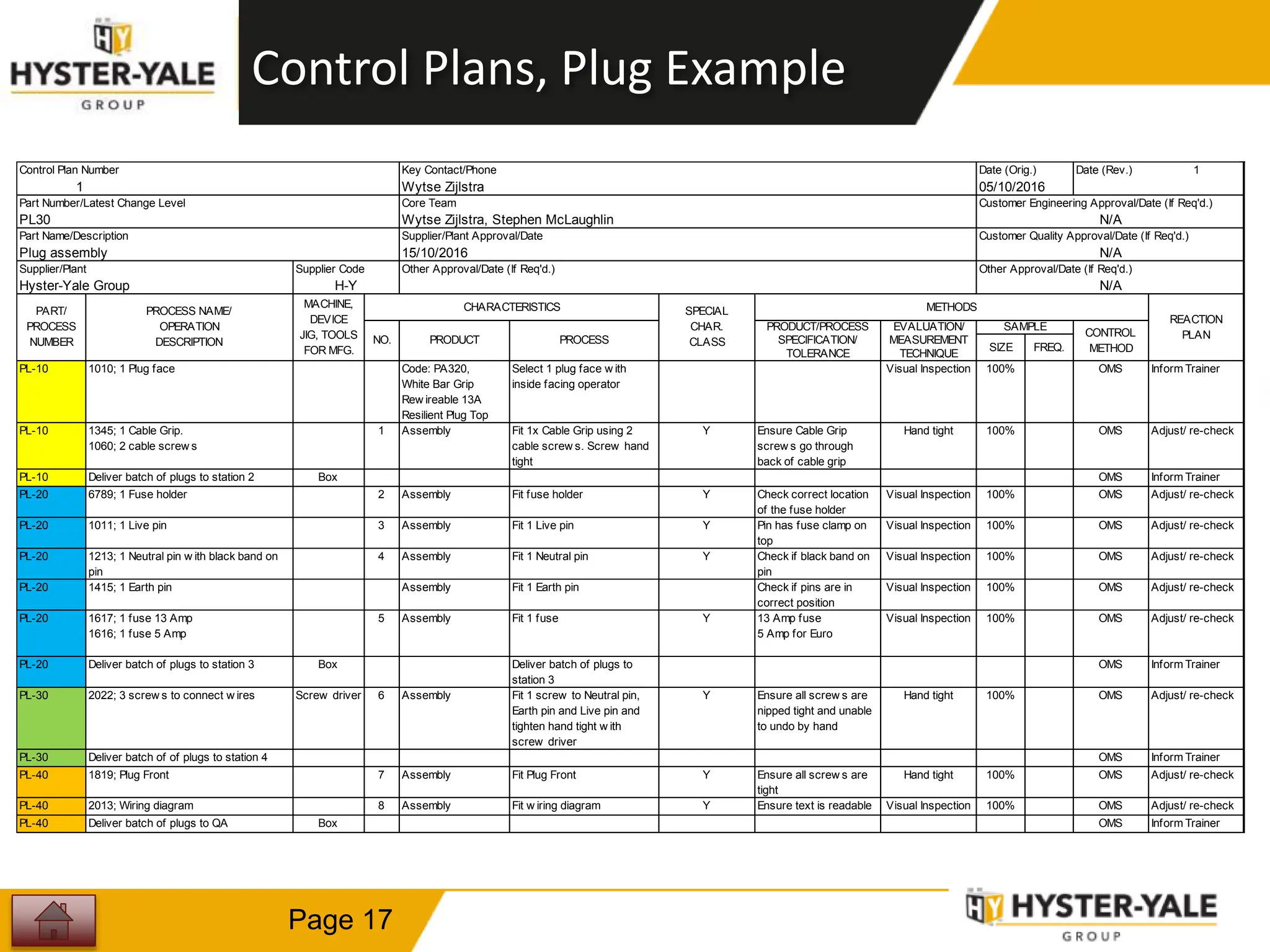
Control Plans, Plug Example
Page 17
Control Plan Number Key Contact/Phone Date (Orig.) Date (Rev.) 1
1 Wytse Zijlstra
Part Number/Latest Change Level Core Team Customer Engineering Approval/Date (If Req'd.)
PL30 Wytse Zijlstra, Stephen McLaughlin N/A
Part Name/Description Supplier/Plant Approval/Date Customer Quality Approval/Date (If Req'd.)
Plug assembly 15/10/2016 N/A
Supplier/Plant Supplier Code Other Approval/Date (If Req'd.) Other Approval/Date (If Req'd.)
Hyster-Yale Group N/A
PRODUCT/PROCESS EVALUATION/ SAMPLE
SPECIFICATION/ MEASUREMENT
TOLERANCE TECHNIQUE
PL-10 1010; 1 Plug face Code: PA320,
White Bar Grip
Rew ireable 13A
Resilient Plug Top
Select 1 plug face w ith
inside facing operator
Visual Inspection 100% OMS Inform Trainer
PL-10 1345; 1 Cable Grip.
1060; 2 cable screw s
1 Assembly Fit 1x Cable Grip using 2
cable screw s. Screw hand
tight
Y Ensure Cable Grip
screw s go through
back of cable grip
Hand tight 100% OMS Adjust/ re-check
PL-10 Deliver batch of plugs to station 2 Box OMS Inform Trainer
PL-20 6789; 1 Fuse holder 2 Assembly Fit fuse holder Y Check correct location
of the fuse holder
Visual Inspection 100% OMS Adjust/ re-check
PL-20 1011; 1 Live pin 3 Assembly Fit 1 Live pin Y Pin has fuse clamp on
top
Visual Inspection 100% OMS Adjust/ re-check
PL-20 1213; 1 Neutral pin w ith black band on
pin
4 Assembly Fit 1 Neutral pin Y Check if black band on
pin
Visual Inspection 100% OMS Adjust/ re-check
PL-20 1415; 1 Earth pin Assembly Fit 1 Earth pin Check if pins are in
correct position
Visual Inspection 100% OMS Adjust/ re-check
PL-20 1617; 1 fuse 13 Amp
1616; 1 fuse 5 Amp
5 Assembly Fit 1 fuse Y 13 Amp fuse
5 Amp for Euro
Visual Inspection 100% OMS Adjust/ re-check
PL-20 Deliver batch of plugs to station 3 Box Deliver batch of plugs to
station 3
OMS Inform Trainer
PL-30 2022; 3 screw s to connect w ires Screw driver 6 Assembly Fit 1 screw to Neutral pin,
Earth pin and Live pin and
tighten hand tight w ith
screw driver
Y Ensure all screw s are
nipped tight and unable
to undo by hand
Hand tight 100% OMS Adjust/ re-check
PL-30 Deliver batch of of plugs to station 4 OMS Inform Trainer
PL-40 1819; Plug Front 7 Assembly Fit Plug Front Y Ensure all screw s are
tight
Hand tight 100% OMS Adjust/ re-check
PL-40 2013; Wiring diagram 8 Assembly Fit w iring diagram Y Ensure text is readable Visual Inspection 100% OMS Adjust/ re-check
PL-40 Deliver batch of plugs to QA Box OMS Inform Trainer
PART/
PROCESS
NUMBER
PROCESS NAME/
OPERATION
DESCRIPTION FREQ.
CONTROL
METHOD
CHARACTERISTICS METHODS
H-Y
REACTION
PLAN
05/10/2016
MACHINE,
DEVICE
JIG, TOOLS
FOR MFG.
NO. PRODUCT PROCESS
SPECIAL
CHAR.
CLASS SIZE
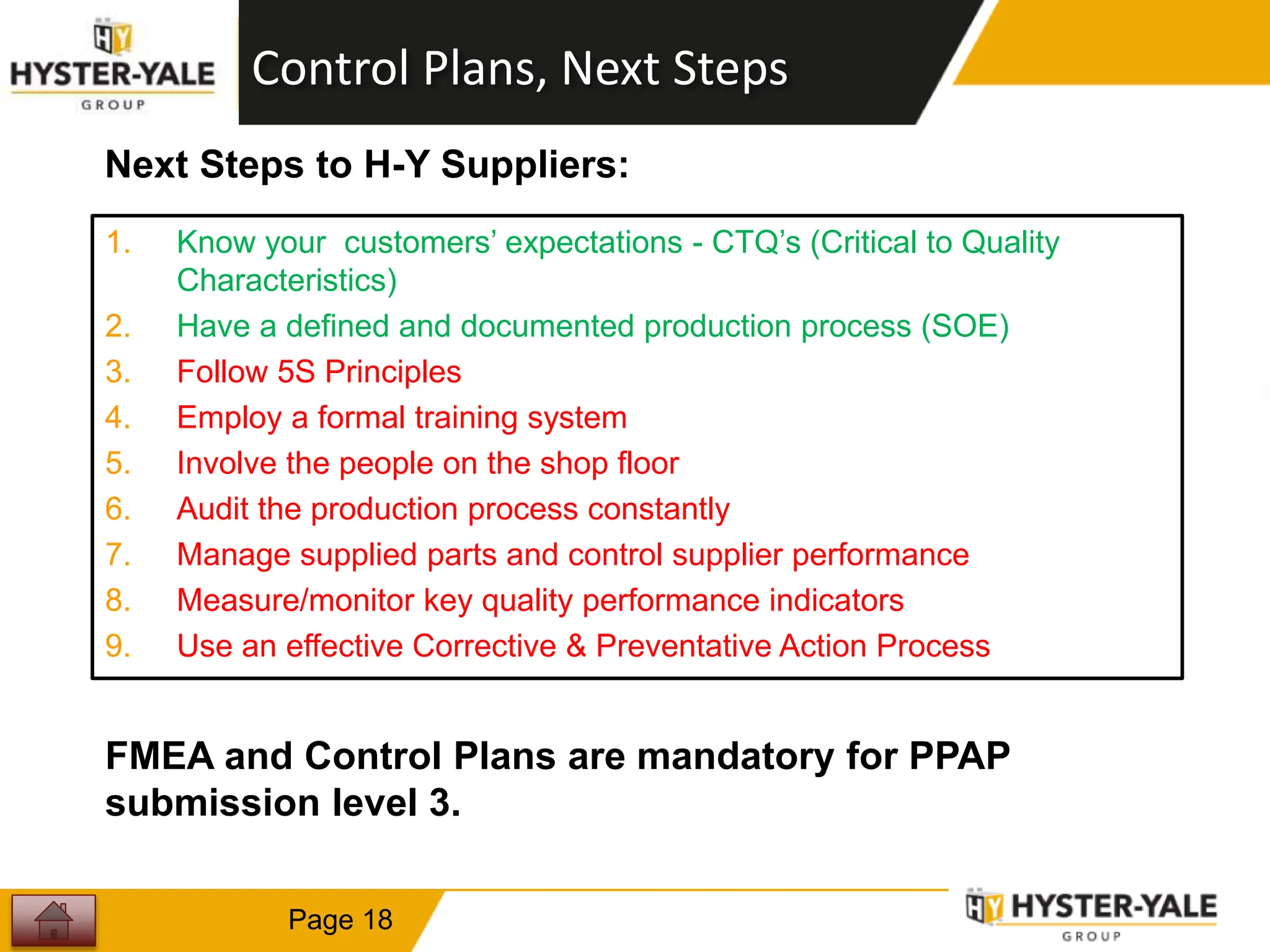
Control Plans, Next Steps
Page 18
Next Steps to H-Y Suppliers:
1. Know your customers’ expectations - CTQ’s (Critical to Quality
Characteristics)
2. Have a defined and documented production process (SOE)
3. Follow 5S Principles
4. Employ a formal training system
5. Involve the people on the shop floor
6. Audit the production process constantly
7. Manage supplied parts and control supplier performance
8. Measure/monitor key quality performance indicators
9. Use an effective Corrective & Preventative Action Process
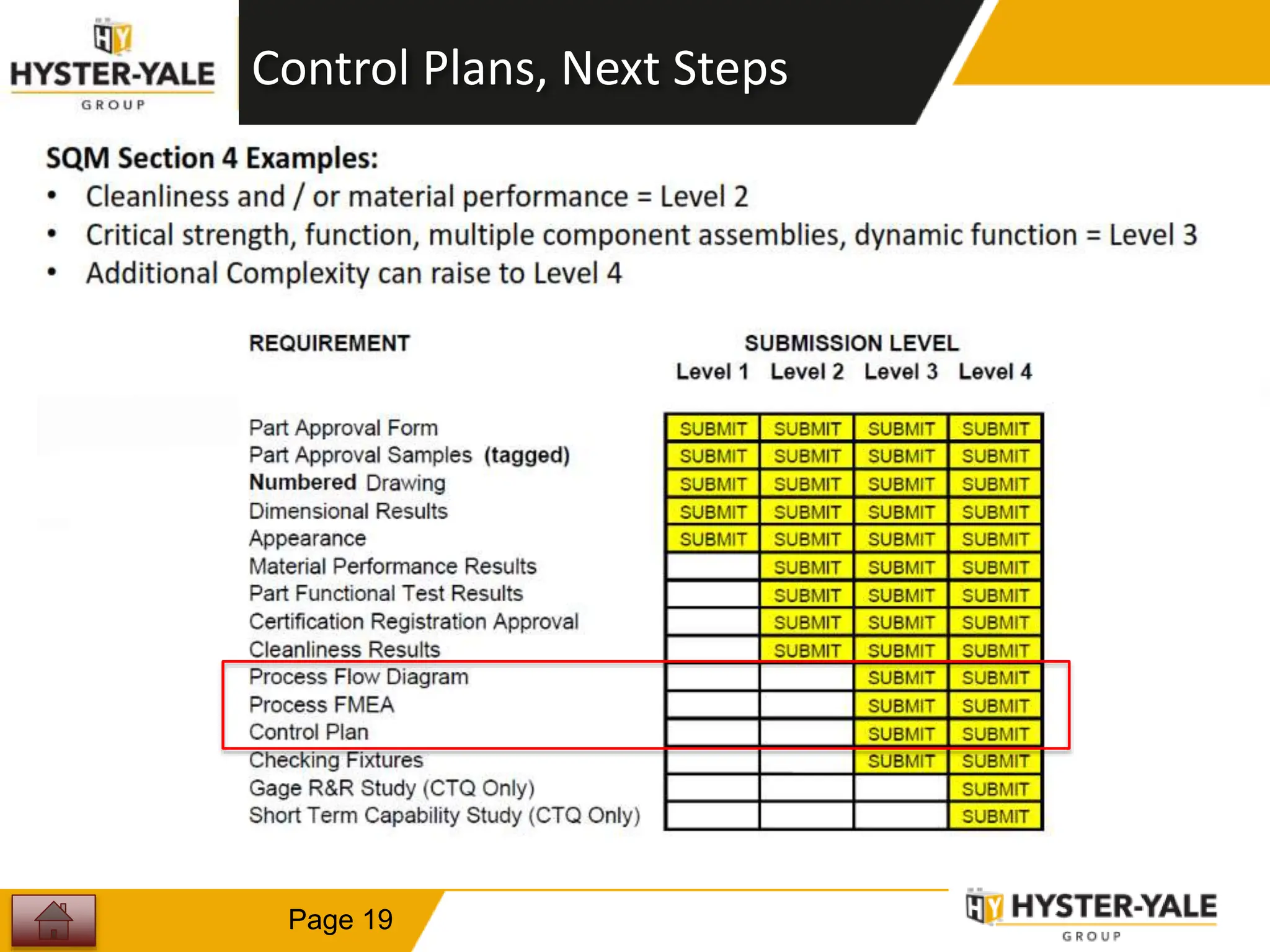
FMEA and Control Plans are mandatory for PPAP
submission level 3.
Control Plans, Next Steps
Page 19
Quality Focus Day Workshop
Page 20
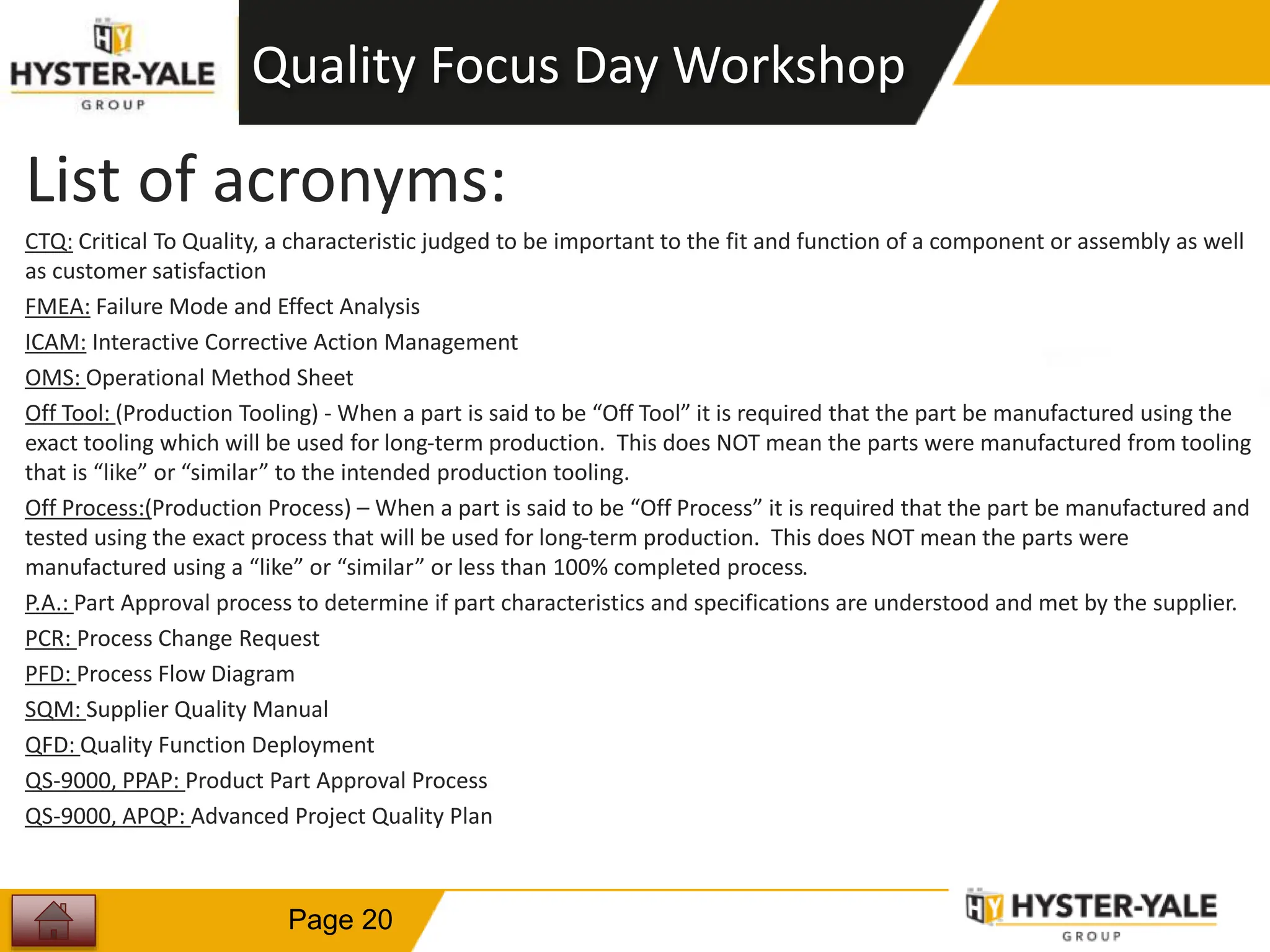
List of acronyms:
CTQ: Critical To Quality, a characteristic judged to be important to the fit and function of a component or assembly as well
as customer satisfaction
FMEA: Failure Mode and Effect Analysis
ICAM: Interactive Corrective Action Management
OMS: Operational Method Sheet
Off Tool: (Production Tooling) - When a part is said to be “Off Tool” it is required that the part be manufactured using the
exact tooling which will be used for long-term production. This does NOT mean the parts were manufactured from tooling
that is “like” or “similar” to the intended production tooling.
Off Process:(Production Process) – When a part is said to be “Off Process” it is required that the part be manufactured and
tested using the exact process that will be used for long-term production. This does NOT mean the parts were
manufactured using a “like” or “similar” or less than 100% completed process.
P.A.: Part Approval process to determine if part characteristics and specifications are understood and met by the supplier.
PCR: Process Change Request
PFD: Process Flow Diagram
SQM: Supplier Quality Manual
QFD: Quality Function Deployment
QS-9000, PPAP: Product Part Approval Process
QS-9000, APQP: Advanced Project Quality Plan

Control-Plan-Training.pptx for the Automotive standard AIAG

  • 1.
  • 2.
  • 3.
    Control Plan 3 Page 3 ControlPlans: • Control the risks identified in the P-FMEA (High RPNs) • A structured approach to control process and product characteristics • Focusses on Customer Requirements • Assure reaction plans are in place in case of out-of-control conditions • Provide a central document for communication of control methods • A Control Plan contains following key information:  Identification of the control factors  The specifications and tolerances  The measurement system  Sample size and frequency  The control method  The reaction plan • Control Plans are living documents, just like FMEA’s
  • 4.
    Control Plan, Objectives Objectivesof the training: • To understand the use of a Control Plan • To learn the steps to develop a Control Plan • To learn how to link each step in the Control Plan to the FMEA 4 Page 4
  • 5.
    Control Plan, Summary ControlPlan, a systemic way to Control a process: • Define Characteristics per process step: • Machines, Devices, Jigs and Tools • Product, Process and Special characteristics • Define Methods per process step: • Process and Product Specifications and Tolerances • Measurement and Inspection techniques • Sample size and frequency • Actions that should be taken in case of Non Conformities 5 Page 5
  • 6.
    Control Plan, Summary ControlPlan, a systemic way to Control a process: • Verify if defined steps are followed • Audit the process by Control Plan on a regular base • Update the Control Plan consistently 6 Page 6
  • 7.
    Benefits 7 Control Plan, Inputs Page7 Control Plan, inputs might include following tools: • FMEA • Flow Chart (process sequence) • Lay-out Plan production line • Sequence Of Events • Part Number/ Tooling / Tool List • Assembly Drawing • Specifications/ Dimensions/ Tolerances • CTQ List • Process Map • Historical OMS
  • 8.
    A build Bbuild Pilot Drawing Issue part approval form Tool development FMEA + control plan 1. Conditional approval 2. HVPT approval 3. Part approval Quality and capacity confirmation HVPT process approval Fit / performance Purchasing SQE QA Source SQE approval Issue HF PA requirements HF proto part approval HF full part approval (OT/OP) MF and LF part receipt Inspection OK – NOK send CAR’s VCB approval SOP Page 8 Control Plans, Planning
  • 9.
    A B CD Part / Process Number Process Name / Operation Description Machine Device Jig. Tools for Manufacturing No. Evaluation Measurement Technique Product Process Product/Process Specification tolerance Special Characteristics Class Size Control Method Freq. Reaction Plan Sample Methods Characteristics Prototype Pre-launch Production Control Plan Number Key Contact/Phone Date (Original) Date (Revised) Part Number/Latest Change Level Part Number / Description Plant / Supplier Supplier Code Core Team Plant / Supplier Approval Date Customer Eng.'s Approval / Date (if Required) Customer Quality Approval / Date (if Required) Other Approval / Date (if Required) 1 2 5 6 7 8 9 10 11 12 3 4 Advanced Product Quality Planning (APQP) Reference Manual, QS-9000 Page 9 Control Plans Operation Characteristics Methods Reaction Plan
  • 10.
    1. Part/Process Number: •Usually referenced from the process flow chart, PFMEA or Tool sheets 2. Process Name/Operation Description: • Identify the process/operation that best describes the activity being addressed (e.g. work elements) • Use verb / noun format 3. Machine, Device, Jig, Tools for Manufacturing: • Identify the processing equipment required. (e.g.. machine, device, jig power tools, assist arms, conveyors, etc.) What is being done? A Operation Page 10 Control Plans LTVL010 8416010, FRAME, 1x 1 PART/ PROCESS NUMBER PROCESS NAME/ OPERATION DESCRIPTION MACHINE, DEVICE JIG, TOOLS FOR MFG.
  • 11.
    4. Number: • Identifiesthe cross reference number from the applicable documentation. 7. Special Characteristic: • key processes (e.g. Delta K, QS) 5. Product Characteristic: • Distinguishing features and/or attributes 6. Process Characteristic: • Characteristics of the process What is Important? B Characteristics Page 11 Control Plans 1 1 Appearance Inspect the frame Y CHARACTERISTICS MACHINE, DEVICE JIG, TOOLS FOR MFG. NO. PRODUCT PROCESS SPECIAL CHAR. CLASS
  • 12.
    PRODUCT CHARACTERISTIC • physical propertiesof the part • Identified important customer characteristics (CTQs and Delta-K) Examples: length, width, tensile strength, torque, weld integrity, color, alignment, etc. A description of the state of the component or vehicle after the particular operation is completed PROCESS CHARACTERISTIC • identify characteristics, which when controlled, reduce variation in product characteristics Examples: pressure, temperature, force, feed rate, RPM (torque), etc. Related to product characteristics Characteristics: Identify Product and Process characteristics for each Control Plan step Page 12 Control Plans
  • 13.
    8. Product/Process Specification: •Specifications/tolerance for a part or process. (eg. may be obtained from various engineering documents) 9. Evaluation/Measurement Technique: • Identifies the measurement system being used to measure product/process characteristics. (eg. gages, fixtures, test equipment, blocks, go/no go, etc) 10 / 11. Sample Size/Frequency: • List sample size and frequency to perform evaluation. (eg. size: 4 pieces / frequency: fifth time per shift) What is the Means for Controlling? Methods Control Plans Page 13 C PRODUCT/PROCESS EVALUATION/ SAMPLE SPECIFICATION/ MEASUREMENT TOLERANCE TECHNIQUE No damage Visual Inspection 1 1/Works hop OMS Inform Trainer FREQ. CONTROL METHOD METHODS REACTION PLAN SIZE
  • 14.
    Benefits 1 4 Control Plan, Sample sizeand frequency Page 14 Station: 1-nov-08 2-nov-08 3-nov-08 4-nov-08 5-nov-08 6-nov-08 7-nov-08 8-nov-08 9-nov-08 10-nov-08 Install O-ring Mee-1247 1 C/R into C/C Mee-1248 S/R assy Mee-1250 S/R height Mee-1251 V-coupling assy Mee-1253 Act assy Mee-1255 1 Lever welding Mee-1288 1 2 3 1 Lever welding Mee-1289 Act measurement Mee-1291 2 2 1 3 Engraving Mee-1256 1 Rev & K-ring check Mee-1257 Weld-assy-act Mee-1258 C/C angle check Mee-1259 1 4 V-coupl-lever-act Mee-1260 2 Total NOK 3 2 1247 0 0 7 1 2 0 4 OK 220 450 300 350 455 275 400 430 • Until a process is Capable (Cpk 1.33), 100% Inspection is required • If process is Capable, define Sample Size and Frequency reflecting acceptable risk • Use Six Sigma tools and techniques to control the Process 6 5 4 3 2 1 50 45 40 35 30 Sample Sample Mean _ _ X=39.42 UCL=51.01 LCL=27.82 6 5 4 3 2 1 20 1 5 1 0 5 0 Sample Sample Range _ R=6.17 UCL=20.15 LCL=0 Xbar-R Chart of x Counting Defects C-Graph of Defects SPC Chart Capability Graph
  • 15.
    PRODUCT/PROCESS EVALUATION/ SAMPLE SPECIFICATION/MEASUREMENT TOLERANCE TECHNIQUE No damage Visual Inspection 1 1/Works hop OMS Inform Trainer FREQ. CONTROL METHOD METHODS REACTION PLAN SIZE 12. Control Method: • Brief description of how the operation will be controlled • When selecting the method of control, focus on: • process control rather than product control • prevention rather than detection • targeting nominal rather than specification limits Examples: - Check sheets (weld, quality, tool, material, etc) - Preventative tooling maintenance - Variation control charts - Error/mistake proofing - SPC charts Methods Control Plans, Control Method C Page 15
  • 16.
    13. Reaction Plan: •Specifies who to inform to make a decision or what to do when a process goes out of control • Written for people closest to the process (e.g. replace a drill) • Review systemic root cause and update the FMEA Examples: - Call supervisor - 100% Inspection until the process is back in control - Calibrate equipment D Reaction Plan Control Plans, Reaction Plan Page 16 PRODUCT/PROCESS EVALUATION/ SAMPLE SPECIFICATION/ MEASUREMENT TOLERANCE TECHNIQUE No damage Visual Inspection 1 1/Works hop OMS Inform Trainer FREQ. CONTROL METHOD METHODS REACTION PLAN SIZE
  • 17.
    Control Plans, PlugExample Page 17 Control Plan Number Key Contact/Phone Date (Orig.) Date (Rev.) 1 1 Wytse Zijlstra Part Number/Latest Change Level Core Team Customer Engineering Approval/Date (If Req'd.) PL30 Wytse Zijlstra, Stephen McLaughlin N/A Part Name/Description Supplier/Plant Approval/Date Customer Quality Approval/Date (If Req'd.) Plug assembly 15/10/2016 N/A Supplier/Plant Supplier Code Other Approval/Date (If Req'd.) Other Approval/Date (If Req'd.) Hyster-Yale Group N/A PRODUCT/PROCESS EVALUATION/ SAMPLE SPECIFICATION/ MEASUREMENT TOLERANCE TECHNIQUE PL-10 1010; 1 Plug face Code: PA320, White Bar Grip Rew ireable 13A Resilient Plug Top Select 1 plug face w ith inside facing operator Visual Inspection 100% OMS Inform Trainer PL-10 1345; 1 Cable Grip. 1060; 2 cable screw s 1 Assembly Fit 1x Cable Grip using 2 cable screw s. Screw hand tight Y Ensure Cable Grip screw s go through back of cable grip Hand tight 100% OMS Adjust/ re-check PL-10 Deliver batch of plugs to station 2 Box OMS Inform Trainer PL-20 6789; 1 Fuse holder 2 Assembly Fit fuse holder Y Check correct location of the fuse holder Visual Inspection 100% OMS Adjust/ re-check PL-20 1011; 1 Live pin 3 Assembly Fit 1 Live pin Y Pin has fuse clamp on top Visual Inspection 100% OMS Adjust/ re-check PL-20 1213; 1 Neutral pin w ith black band on pin 4 Assembly Fit 1 Neutral pin Y Check if black band on pin Visual Inspection 100% OMS Adjust/ re-check PL-20 1415; 1 Earth pin Assembly Fit 1 Earth pin Check if pins are in correct position Visual Inspection 100% OMS Adjust/ re-check PL-20 1617; 1 fuse 13 Amp 1616; 1 fuse 5 Amp 5 Assembly Fit 1 fuse Y 13 Amp fuse 5 Amp for Euro Visual Inspection 100% OMS Adjust/ re-check PL-20 Deliver batch of plugs to station 3 Box Deliver batch of plugs to station 3 OMS Inform Trainer PL-30 2022; 3 screw s to connect w ires Screw driver 6 Assembly Fit 1 screw to Neutral pin, Earth pin and Live pin and tighten hand tight w ith screw driver Y Ensure all screw s are nipped tight and unable to undo by hand Hand tight 100% OMS Adjust/ re-check PL-30 Deliver batch of of plugs to station 4 OMS Inform Trainer PL-40 1819; Plug Front 7 Assembly Fit Plug Front Y Ensure all screw s are tight Hand tight 100% OMS Adjust/ re-check PL-40 2013; Wiring diagram 8 Assembly Fit w iring diagram Y Ensure text is readable Visual Inspection 100% OMS Adjust/ re-check PL-40 Deliver batch of plugs to QA Box OMS Inform Trainer PART/ PROCESS NUMBER PROCESS NAME/ OPERATION DESCRIPTION FREQ. CONTROL METHOD CHARACTERISTICS METHODS H-Y REACTION PLAN 05/10/2016 MACHINE, DEVICE JIG, TOOLS FOR MFG. NO. PRODUCT PROCESS SPECIAL CHAR. CLASS SIZE
  • 18.
    Control Plans, NextSteps Page 18 Next Steps to H-Y Suppliers: 1. Know your customers’ expectations - CTQ’s (Critical to Quality Characteristics) 2. Have a defined and documented production process (SOE) 3. Follow 5S Principles 4. Employ a formal training system 5. Involve the people on the shop floor 6. Audit the production process constantly 7. Manage supplied parts and control supplier performance 8. Measure/monitor key quality performance indicators 9. Use an effective Corrective & Preventative Action Process FMEA and Control Plans are mandatory for PPAP submission level 3.
  • 19.
    Control Plans, NextSteps Page 19
  • 20.
    Quality Focus DayWorkshop Page 20 List of acronyms: CTQ: Critical To Quality, a characteristic judged to be important to the fit and function of a component or assembly as well as customer satisfaction FMEA: Failure Mode and Effect Analysis ICAM: Interactive Corrective Action Management OMS: Operational Method Sheet Off Tool: (Production Tooling) - When a part is said to be “Off Tool” it is required that the part be manufactured using the exact tooling which will be used for long-term production. This does NOT mean the parts were manufactured from tooling that is “like” or “similar” to the intended production tooling. Off Process:(Production Process) – When a part is said to be “Off Process” it is required that the part be manufactured and tested using the exact process that will be used for long-term production. This does NOT mean the parts were manufactured using a “like” or “similar” or less than 100% completed process. P.A.: Part Approval process to determine if part characteristics and specifications are understood and met by the supplier. PCR: Process Change Request PFD: Process Flow Diagram SQM: Supplier Quality Manual QFD: Quality Function Deployment QS-9000, PPAP: Product Part Approval Process QS-9000, APQP: Advanced Project Quality Plan