Layered Process Audits (LPA)
The Compelling and Immediate ROI of LPA Systems
2easeinc.com
The Problem
“GM agrees to pay $900M in ignition-switch scandal…”
“Takata air-bag recalls will cost the company $2.5B. ...”
“Boeing 787 battery fires cost company more than $600M…”
“Chipotle sales drop $53M in one quarter on E. coli fears…”
Manufacturers and service providers are failing to
meet demands for better, faster, cheaper in an
increasingly connected world.
Defects and errors are more expensive
and more likely than ever.
easeinc.com 3
A Problem That Spans Industries
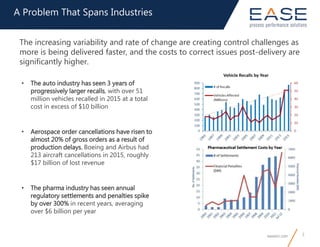
• The auto industry has seen 3 years of
progressively larger recalls, with over 51
million vehicles recalled in 2015 at a total
cost in excess of $10 billion
• Aerospace order cancellations have risen to
almost 20% of gross orders as a result of
production delays. Boeing and Airbus had
213 aircraft cancellations in 2015, roughly
$17 billion of lost revenue
• The pharma industry has seen annual
regulatory settlements and penalties spike
by over 300% in recent years, averaging
over $6 billion per year
The increasing variability and rate of change are creating control challenges as
more is being delivered faster, and the costs to correct issues post-delivery are
significantly higher.
4easeinc.com
The Underlying Cause – Process Failure
“GM’s CEO Mary Barra pledged to ‘hold ourselves accountable
and improve our processes…’”
“Takata’s public report focused on the broken safety culture and
identified multiple process weaknesses…”
“Boeing’s battery supplier needed to review its cell
manufacturing process and ensure that employees were
properly trained…”
“Chipotle announced a new rigorous restaurant inspection
program to address the process failures at the chain…”
Process deviations are a primary cause of quality failures, as
traditional systems are often reactive and blind to process
breakdowns until it’s too late.
easeinc.com 5
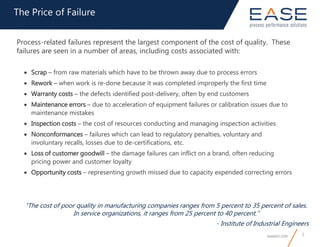
The Price of Failure
“The cost of poor quality in manufacturing companies ranges from 5 percent to 35 percent of sales.
In service organizations, it ranges from 25 percent to 40 percent.”
- Institute of Industrial Engineers
Process-related failures represent the largest component of the cost of quality. These
failures are seen in a number of areas, including costs associated with:
 Scrap – from raw materials which have to be thrown away due to process errors
 Rework – when work is re-done because it was completed improperly the first time
 Warranty costs – the defects identified post-delivery, often by end customers
 Maintenance errors – due to acceleration of equipment failures or calibration issues due to
maintenance mistakes
 Inspection costs – the cost of resources conducting and managing inspection activities
 Nonconformances – failures which can lead to regulatory penalties, voluntary and
involuntary recalls, losses due to de-certifications, etc.
 Loss of customer goodwill – the damage failures can inflict on a brand, often reducing
pricing power and customer loyalty
 Opportunity costs – representing growth missed due to capacity expended correcting errors
easeinc.com 6
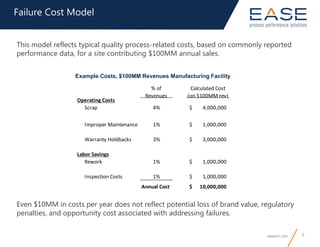
Failure Cost Model
Example Costs, $100MM Revenues Manufacturing Facility
% of
Revenues
Calculated Cost
(on $100MM rev)
Operating Costs
Scrap 4% 4,000,000$
Improper Maintenance 1% 1,000,000$
Warranty Holdbacks 3% 3,000,000$
Labor Savings
Rework 1% 1,000,000$
Inspection Costs 1% 1,000,000$
Annual Cost 10,000,000$
This model reflects typical quality process-related costs, based on commonly reported
performance data, for a site contributing $100MM annual sales.
Even $10MM in costs per year does not reflect potential loss of brand value, regulatory
penalties, and opportunity cost associated with addressing failures.
easeinc.com 7
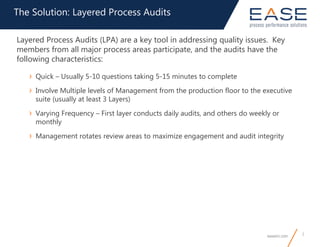
The Solution: Layered Process Audits
Layered Process Audits (LPA) are a key tool in addressing quality issues. Key
members from all major process areas participate, and the audits have the
following characteristics:
› Quick – Usually 5-10 questions taking 5-15 minutes to complete
› Involve Multiple levels of Management from the production floor to the executive
suite (usually at least 3 Layers)
› Varying Frequency – First layer conducts daily audits, and others do weekly or
monthly
› Management rotates review areas to maximize engagement and audit integrity
easeinc.com 8
“Companies with superior quality can outperform companies with poor quality by two to three times
based on return on sales, and by up to five times based on sales growth.”– Boston Consulting Group
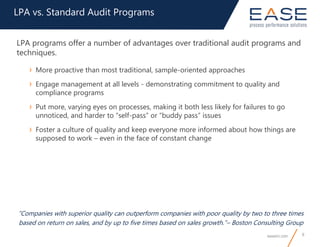
LPA vs. Standard Audit Programs
LPA programs offer a number of advantages over traditional audit programs and
techniques.
› More proactive than most traditional, sample-oriented approaches
› Engage management at all levels - demonstrating commitment to quality and
compliance programs
› Put more, varying eyes on processes, making it both less likely for failures to go
unnoticed, and harder to “self-pass” or “buddy pass” issues
› Foster a culture of quality and keep everyone more informed about how things are
supposed to work – even in the face of constant change
easeinc.com 9
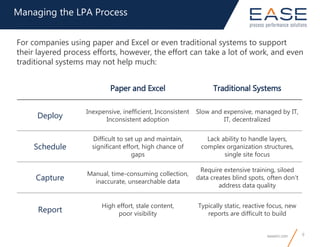
Paper and Excel Traditional Systems
Deploy
Inexpensive, inefficient, Inconsistent
Inconsistent adoption
Slow and expensive, managed by IT,
IT, decentralized
Schedule
Difficult to set up and maintain,
significant effort, high chance of
gaps
Lack ability to handle layers,
complex organization structures,
single site focus
Capture
Manual, time-consuming collection,
inaccurate, unsearchable data
Require extensive training, siloed
data creates blind spots, often don’t
address data quality
Report
High effort, stale content,
poor visibility
Typically static, reactive focus, new
reports are difficult to build
Managing the LPA Process
For companies using paper and Excel or even traditional systems to support
their layered process efforts, however, the effort can take a lot of work, and even
traditional systems may not help much:
easeinc.com 10
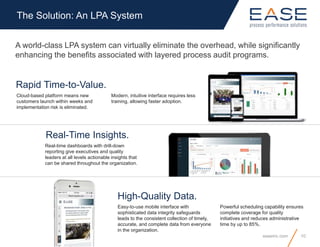
Cloud-based platform means new
customers launch within weeks and
implementation risk is eliminated.
Modern, intuitive interface requires less
training, allowing faster adoption.
Rapid Time-to-Value.
Real-time dashboards with drill-down
reporting give executives and quality
leaders at all levels actionable insights that
can be shared throughout the organization.
Real-Time Insights.
Easy-to-use mobile interface with
sophisticated data integrity safeguards
leads to the consistent collection of timely,
accurate, and complete data from everyone
in the organization.
Powerful scheduling capability ensures
complete coverage for quality
initiatives and reduces administrative
time by up to 85%.
High-Quality Data.
A world-class LPA system can virtually eliminate the overhead, while significantly
enhancing the benefits associated with layered process audit programs.
The Solution: An LPA System
easeinc.com 11
LPA Benefit Case
“Best-in-Class manufacturers...produce products at a higher quality, and ...(spend) 38% less (of their)
annual revenue on their total cost of quality when compared to their peers.”
- Aberdeen Research
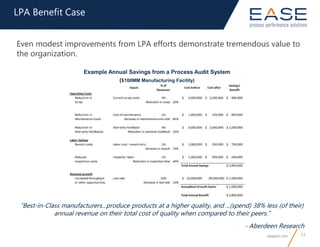
Example Annual Savings from a Process Audit System
($100MM Manufacturing Facility)
Even modest improvements from LPA efforts demonstrate tremendous value to
the organization.
easeinc.com 12
Summary - Key Takeaways
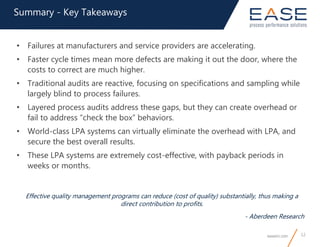
• Failures at manufacturers and service providers are accelerating.
• Faster cycle times mean more defects are making it out the door, where the
costs to correct are much higher.
• Traditional audits are reactive, focusing on specifications and sampling while
largely blind to process failures.
• Layered process audits address these gaps, but they can create overhead or
fail to address “check the box” behaviors.
• World-class LPA systems can virtually eliminate the overhead with LPA, and
secure the best overall results.
• These LPA systems are extremely cost-effective, with payback periods in
weeks or months.
Effective quality management programs can reduce (cost of quality) substantially, thus making a
direct contribution to profits.
- Aberdeen Research
13easeinc.com
About Ease
Ease software has been successfully deployed
across a wide range of enterprise environments
worldwide – wherever customer satisfaction and
high product quality are critical to brand strength.
2015 Gartner Cool Vendor
for Manufacturing
Operations
To download the full whitepaper or for more
information about LPA programs or Beacon,
visit us at www.easeinc.com or email
sales@easeinc.com.

Layered Process Audits - The Compelling and Immediate ROI

  • 1.
    Layered Process Audits(LPA) The Compelling and Immediate ROI of LPA Systems
  • 2.
    2easeinc.com The Problem “GM agreesto pay $900M in ignition-switch scandal…” “Takata air-bag recalls will cost the company $2.5B. ...” “Boeing 787 battery fires cost company more than $600M…” “Chipotle sales drop $53M in one quarter on E. coli fears…” Manufacturers and service providers are failing to meet demands for better, faster, cheaper in an increasingly connected world. Defects and errors are more expensive and more likely than ever.
  • 3.
    easeinc.com 3 A ProblemThat Spans Industries • The auto industry has seen 3 years of progressively larger recalls, with over 51 million vehicles recalled in 2015 at a total cost in excess of $10 billion • Aerospace order cancellations have risen to almost 20% of gross orders as a result of production delays. Boeing and Airbus had 213 aircraft cancellations in 2015, roughly $17 billion of lost revenue • The pharma industry has seen annual regulatory settlements and penalties spike by over 300% in recent years, averaging over $6 billion per year The increasing variability and rate of change are creating control challenges as more is being delivered faster, and the costs to correct issues post-delivery are significantly higher.
  • 4.
    4easeinc.com The Underlying Cause– Process Failure “GM’s CEO Mary Barra pledged to ‘hold ourselves accountable and improve our processes…’” “Takata’s public report focused on the broken safety culture and identified multiple process weaknesses…” “Boeing’s battery supplier needed to review its cell manufacturing process and ensure that employees were properly trained…” “Chipotle announced a new rigorous restaurant inspection program to address the process failures at the chain…” Process deviations are a primary cause of quality failures, as traditional systems are often reactive and blind to process breakdowns until it’s too late.
  • 5.
    easeinc.com 5 The Priceof Failure “The cost of poor quality in manufacturing companies ranges from 5 percent to 35 percent of sales. In service organizations, it ranges from 25 percent to 40 percent.” - Institute of Industrial Engineers Process-related failures represent the largest component of the cost of quality. These failures are seen in a number of areas, including costs associated with:  Scrap – from raw materials which have to be thrown away due to process errors  Rework – when work is re-done because it was completed improperly the first time  Warranty costs – the defects identified post-delivery, often by end customers  Maintenance errors – due to acceleration of equipment failures or calibration issues due to maintenance mistakes  Inspection costs – the cost of resources conducting and managing inspection activities  Nonconformances – failures which can lead to regulatory penalties, voluntary and involuntary recalls, losses due to de-certifications, etc.  Loss of customer goodwill – the damage failures can inflict on a brand, often reducing pricing power and customer loyalty  Opportunity costs – representing growth missed due to capacity expended correcting errors
  • 6.
    easeinc.com 6 Failure CostModel Example Costs, $100MM Revenues Manufacturing Facility % of Revenues Calculated Cost (on $100MM rev) Operating Costs Scrap 4% 4,000,000$ Improper Maintenance 1% 1,000,000$ Warranty Holdbacks 3% 3,000,000$ Labor Savings Rework 1% 1,000,000$ Inspection Costs 1% 1,000,000$ Annual Cost 10,000,000$ This model reflects typical quality process-related costs, based on commonly reported performance data, for a site contributing $100MM annual sales. Even $10MM in costs per year does not reflect potential loss of brand value, regulatory penalties, and opportunity cost associated with addressing failures.
  • 7.
    easeinc.com 7 The Solution:Layered Process Audits Layered Process Audits (LPA) are a key tool in addressing quality issues. Key members from all major process areas participate, and the audits have the following characteristics: › Quick – Usually 5-10 questions taking 5-15 minutes to complete › Involve Multiple levels of Management from the production floor to the executive suite (usually at least 3 Layers) › Varying Frequency – First layer conducts daily audits, and others do weekly or monthly › Management rotates review areas to maximize engagement and audit integrity
  • 8.
    easeinc.com 8 “Companies withsuperior quality can outperform companies with poor quality by two to three times based on return on sales, and by up to five times based on sales growth.”– Boston Consulting Group LPA vs. Standard Audit Programs LPA programs offer a number of advantages over traditional audit programs and techniques. › More proactive than most traditional, sample-oriented approaches › Engage management at all levels - demonstrating commitment to quality and compliance programs › Put more, varying eyes on processes, making it both less likely for failures to go unnoticed, and harder to “self-pass” or “buddy pass” issues › Foster a culture of quality and keep everyone more informed about how things are supposed to work – even in the face of constant change
  • 9.
    easeinc.com 9 Paper andExcel Traditional Systems Deploy Inexpensive, inefficient, Inconsistent Inconsistent adoption Slow and expensive, managed by IT, IT, decentralized Schedule Difficult to set up and maintain, significant effort, high chance of gaps Lack ability to handle layers, complex organization structures, single site focus Capture Manual, time-consuming collection, inaccurate, unsearchable data Require extensive training, siloed data creates blind spots, often don’t address data quality Report High effort, stale content, poor visibility Typically static, reactive focus, new reports are difficult to build Managing the LPA Process For companies using paper and Excel or even traditional systems to support their layered process efforts, however, the effort can take a lot of work, and even traditional systems may not help much:
  • 10.
    easeinc.com 10 Cloud-based platformmeans new customers launch within weeks and implementation risk is eliminated. Modern, intuitive interface requires less training, allowing faster adoption. Rapid Time-to-Value. Real-time dashboards with drill-down reporting give executives and quality leaders at all levels actionable insights that can be shared throughout the organization. Real-Time Insights. Easy-to-use mobile interface with sophisticated data integrity safeguards leads to the consistent collection of timely, accurate, and complete data from everyone in the organization. Powerful scheduling capability ensures complete coverage for quality initiatives and reduces administrative time by up to 85%. High-Quality Data. A world-class LPA system can virtually eliminate the overhead, while significantly enhancing the benefits associated with layered process audit programs. The Solution: An LPA System
  • 11.
    easeinc.com 11 LPA BenefitCase “Best-in-Class manufacturers...produce products at a higher quality, and ...(spend) 38% less (of their) annual revenue on their total cost of quality when compared to their peers.” - Aberdeen Research Example Annual Savings from a Process Audit System ($100MM Manufacturing Facility) Even modest improvements from LPA efforts demonstrate tremendous value to the organization.
  • 12.
    easeinc.com 12 Summary -Key Takeaways • Failures at manufacturers and service providers are accelerating. • Faster cycle times mean more defects are making it out the door, where the costs to correct are much higher. • Traditional audits are reactive, focusing on specifications and sampling while largely blind to process failures. • Layered process audits address these gaps, but they can create overhead or fail to address “check the box” behaviors. • World-class LPA systems can virtually eliminate the overhead with LPA, and secure the best overall results. • These LPA systems are extremely cost-effective, with payback periods in weeks or months. Effective quality management programs can reduce (cost of quality) substantially, thus making a direct contribution to profits. - Aberdeen Research
  • 13.
    13easeinc.com About Ease Ease softwarehas been successfully deployed across a wide range of enterprise environments worldwide – wherever customer satisfaction and high product quality are critical to brand strength. 2015 Gartner Cool Vendor for Manufacturing Operations
  • 14.
    To download thefull whitepaper or for more information about LPA programs or Beacon, visit us at www.easeinc.com or email sales@easeinc.com.