Indian Culture by The Apprentiice
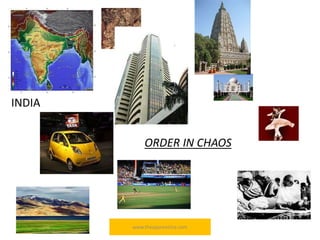
INDIA
ORDER IN CHAOS
www.theapprentiice.com
Culture
• Way of living, doing
things & reacting
• Set of shared attitudes,
values, thoughts, goals,
practices and actions
• An integrated pattern of
human knowledge,
belief and behavior
www.theapprentiice.com
Language
• 14 major and 300 minor
languages spoken
• National – Hindi, Official –
Hindi, English
• English : widely used in
business, politics and
education
www.theapprentiice.com
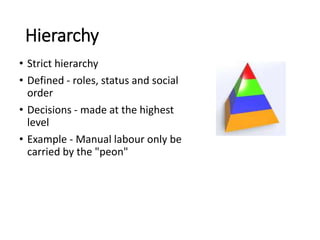
Hierarchy
• Strict hierarchy
• Defined - roles, status and social
order
• Decisions - made at the highest
level
• Example - Manual labour only be
carried by the "peon"
Doing Business - Meeting and Greeting
• Titles are very important.
Always use professional titles
• Handshake. Sometimes
‘Namaste’
• Suffix "-jee" is a sign of a
high caste
• Business cards should be
exchanged at the first
meeting
• Business lunches are
preferred to dinners
www.theapprentiice.com
Doing Business - Meetings and Negotiations
• Meetings - arrange in advance, no
holiday clashing
• Punctuality -10 minutes late
permitted
• Family responsibilities - take
priority over business
• Approach and greet the most
senior figure first
• Negotiations – can be slow
• Show patience and trust
• Guides - Intuition, feeling and faith
www.theapprentiice.com
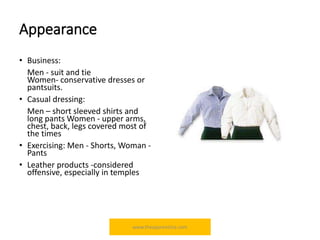
Appearance
• Business:
Men - suit and tie
Women- conservative dresses or
pantsuits.
• Casual dressing:
Men – short sleeved shirts and
long pants Women - upper arms,
chest, back, legs covered most of
the times
• Exercising: Men - Shorts, Woman -
Pants
• Leather products -considered
offensive, especially in temples
www.theapprentiice.com
Behavior
• (Never) Touch someone else’s head - not
even to pat the hair of a child
• Standing with hands on your hips - angry,
aggressive posture
• Whistling - is impolite
• Winking - may be as either an insult or a
sexual proposition
• Shoes or feet touch another person-
apologize
• Gifts are not opened in the presence of the
giver
Communications
• Word ‘NO’- harsh
implications
• More polite, Evasive refusals
are common
• Never directly refuse an
invitation. Acceptable refusal
- "I’ll try"
• Do not thank your hosts at
the end of a meal. "Thank
you“- form of payment and
therefore insulting
Geert Hofstede analysis (k)
• a high level of inequality of power and wealth within the
society as accepted by population as cultural norm.
• gap between values of men and women is higher
• the culture may be more open to unstructured ideas and
situations
• the culture may be more open to unstructured ideas and
situations
www.theapprentiice.com
Edward T Hall
• High context refers to societies or groups where people
have close connections over a long period of time.
• Low context refers to societies where people tend to have
many connections but of shorter duration or for some
specific reason
www.theapprentiice.com
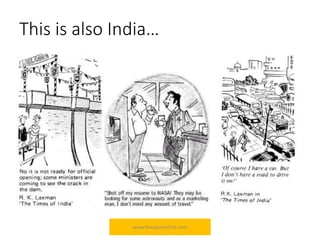
This is also India…
www.theapprentiice.com
References
• http://en.wikipedia.org/wiki/Culture
• http://www.crossculturecommunication.org
• http://www.cyborlink.com/besite/india.htm
For a course on Global Culture,
please visit
www.theapprentiice.com

Indian culture

  • 1.
    Indian Culture byThe Apprentiice
  • 2.
  • 3.
    Culture • Way ofliving, doing things & reacting • Set of shared attitudes, values, thoughts, goals, practices and actions • An integrated pattern of human knowledge, belief and behavior www.theapprentiice.com
  • 4.
    Language • 14 majorand 300 minor languages spoken • National – Hindi, Official – Hindi, English • English : widely used in business, politics and education www.theapprentiice.com
  • 5.
    Hierarchy • Strict hierarchy •Defined - roles, status and social order • Decisions - made at the highest level • Example - Manual labour only be carried by the "peon"
  • 6.
    Doing Business -Meeting and Greeting • Titles are very important. Always use professional titles • Handshake. Sometimes ‘Namaste’ • Suffix "-jee" is a sign of a high caste • Business cards should be exchanged at the first meeting • Business lunches are preferred to dinners www.theapprentiice.com
  • 7.
    Doing Business -Meetings and Negotiations • Meetings - arrange in advance, no holiday clashing • Punctuality -10 minutes late permitted • Family responsibilities - take priority over business • Approach and greet the most senior figure first • Negotiations – can be slow • Show patience and trust • Guides - Intuition, feeling and faith www.theapprentiice.com
  • 8.
    Appearance • Business: Men -suit and tie Women- conservative dresses or pantsuits. • Casual dressing: Men – short sleeved shirts and long pants Women - upper arms, chest, back, legs covered most of the times • Exercising: Men - Shorts, Woman - Pants • Leather products -considered offensive, especially in temples www.theapprentiice.com
  • 9.
    Behavior • (Never) Touchsomeone else’s head - not even to pat the hair of a child • Standing with hands on your hips - angry, aggressive posture • Whistling - is impolite • Winking - may be as either an insult or a sexual proposition • Shoes or feet touch another person- apologize • Gifts are not opened in the presence of the giver
  • 10.
    Communications • Word ‘NO’-harsh implications • More polite, Evasive refusals are common • Never directly refuse an invitation. Acceptable refusal - "I’ll try" • Do not thank your hosts at the end of a meal. "Thank you“- form of payment and therefore insulting
  • 11.
    Geert Hofstede analysis(k) • a high level of inequality of power and wealth within the society as accepted by population as cultural norm. • gap between values of men and women is higher • the culture may be more open to unstructured ideas and situations • the culture may be more open to unstructured ideas and situations www.theapprentiice.com
  • 12.
    Edward T Hall •High context refers to societies or groups where people have close connections over a long period of time. • Low context refers to societies where people tend to have many connections but of shorter duration or for some specific reason www.theapprentiice.com
  • 13.
    This is alsoIndia… www.theapprentiice.com
  • 15.
  • 16.
    For a courseon Global Culture, please visit www.theapprentiice.com