What you will learn in this eBook:
What makes layered process audits unique
How to implement layered process audits
Best practices for writing audit questions
 
How to get more from layered process
audits and overcome common challenges
The role of digital transformation
A valuable resource for companies seeking to get the
most out of their layered process audits”
–Daniel Perez-Castilla, Global Quality
Systems Manager, Tenneco Powertrain
The Ultimate Guide
to Layered Process
Audits
CHAPTER #: Chapter Title
2 ease.io
Acknowledgments
Ease would like to thank Murray Sittsamer and Richard Nave
of The Luminous Group for generously sharing their expertise
throughout the creation of this guide. You can find out more about
The Luminous Group and their services to help drive process
improvement on their website.
Many thanks also to Daniel Perez Castilla of Tenneco Inc. for his
valuable input on layered process audits and plant maturity, and to
John Rose of Jacobs Vehicle Systems for his thoughtful feedback.
Finally, we’d like to thank the many other customers whose helpful
contributions went into to the development and review of this
industry guide.
Executive Summary
It’s another Tuesday, and Joe is at his station processing parts.
He notices a small tab sticking out that doesn’t belong there.
Joe doesn’t notify his supervisor of the problem, realizing that he
can just make the part fit better by bending the tab back in place
with his thumb.
Months later, he’s still taking this extra step, and has become
accustomed to it as part of his routine.
But then Joe gets sick. He’s out of work for two weeks. A new
operator named Steve takes over his position. That small step Joe
had been taking isn’t part of any job instruction or standard, and
since that step had helped avoid major problems, nobody has a
clue that it’s preventing problems down the line.
3
ease.io
The result upon Joe’s absence is a weeks-long stream of thousands
of defective parts shipped from the plant to the company’s most
important customers. Only once the complaints start rolling in does
anyone realize the extent of the problem, costing the company millions
in terms of scrap, rework, warranty costs and future business.
In this scenario, at first look it appears Joe is doing a great service
to the company in resolving this issue. However, by adding an extra
step without documentation—a prime example of what’s called the
hidden factory—he’s simply temporarily avoiding a quality issue that
will happen whenever Joe isn’t present. A product inspection alone
isn’t likely to find this type of problem, highlighting the need for
ongoing process verification.
In another example, twice weekly maintenance is not being carried out
on a new multi-million-dollar robotic laser welding machine. Within a few
weeks, parts are being produced with microscopic cracks, leading to
huge downstream quality issues and costs. The machine itself has also
been damaged as a result of the lack of maintenance. Again, a product
inspection may not catch the issue until it’s too late.
The result is millions of dollars in additional costs from scrap, rework
and returns, not to mention the cost of repairing the welding machine
itself.
Without essential process checks, manufacturers leave themselves
open to a wide range of quality problems and costs—including the loss
of key business contracts, declining brand value and legal liabilities.
The solution, for many manufacturers, is to implement layered process
audits (LPAs). Using high-frequency plant floor checks, LPAs reduce
process variation, resulting in fewer production defects and costs while
creating daily habits that build a culture of quality.
In this guide, we explore:
• What makes these audits different and why companies conduct them
• How to implement a successful LPA program, including the pivotal
role of management
• How to write LPA questions that work—a critical challenge for most
manufacturers
• Best practices for conducting audits and creating reaction plans
• The role of digital transformation in addressing the traditional barriers
to LPA success
4 ease.io
Chapters
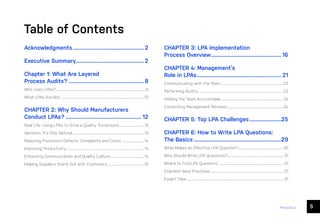
Acknowledgments.........................................................................................................2
Executive Summary.....................................................................................................2
Chapter 1: What Are Layered Process Audits?.............................................8
Chapter 2: Why Should Manufacturers Conduct LPAs?....................... 12
Chapter 3: LPA Implementation Process Overview.................................. 16
Chapter 4: Management’s Role in LPAs........................................................... 21
Chapter 5: Top LPA Challenges...........................................................................25
Chapter 6: How to Write LPA Questions: The Basics.............................29
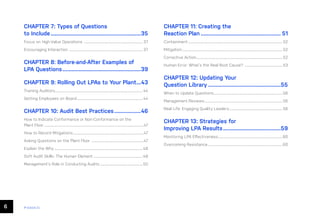
Chapter 7: Types of Questions to Include.....................................................35
Chapter 8: Before-and-After Examples of LPA Questions...................39
Chapter 9: Rolling Out LPAs to Your Plant....................................................43
Chapter 10: Audit Best Practices.......................................................................46
Chapter 11: Creating the Reaction Plan........................................................... 51
Chapter 12: Updating Your Question Library...............................................55
Chapter 13: Strategies for Improving LPA Results...................................59
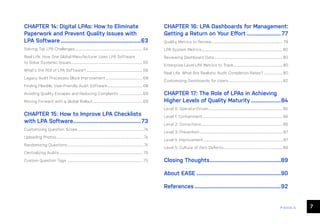
Chapter 14: Digital LPAs: How to Eliminate Paperwork and
Prevent Quality Issues with LPA Software.................................................63
Chapter 15: How to Improve LPA Checklists with LPA Software.... 73
Chapter 16: LPA Dashboards for Management:
Getting a Return on Your Effort...........................................................................77
Chapter 17: The Role of LPAs in Achieving Higher Levels of
Quality Maturity...........................................................................................................84
Closing Thoughts........................................................................................................89
About EASE....................................................................................................................90
References.....................................................................................................................92
5
ease.io
Table of Contents
Acknowledgments.................................................2
Executive Summary...............................................2
Chapter 1: What Are Layered
Process Audits?....................................................8
Who Uses LPAs?............................................................................................................9
What LPAs Are Not.....................................................................................................10
CHAPTER 2: Why Should Manufacturers
Conduct LPAs?.................................................... 12
Real Life: Using LPAs to Drive a Quality Turnaround............................... 13
Variation: It’s Only Natural...................................................................................... 13
Reducing Production Defects, Complaints and Costs .......................... 14
Improving Productivity.............................................................................................. 14
Enhancing Communication and Quality Culture......................................... 14
Helping Suppliers Stand Out with Customers............................................ 15
CHAPTER 3: LPA Implementation
Process Overview................................................ 16
CHAPTER 4: Management’s
Role in LPAs.......................................................... 21
Communicating with the Team...........................................................................22
Performing Audits.......................................................................................................22
Holding the Team Accountable............................................................................ 24
Conducting Management Reviews.................................................................... 24
CHAPTER 5: Top LPA Challenges......................25
CHAPTER 6: How to Write LPA Questions:
The Basics............................................................29
What Makes an Effective LPA Question?......................................................30
Who Should Write LPA Questions?.................................................................... 31
Where to Find LPA Questions .............................................................................. 31
Checklist Best Practices......................................................................................... 31
Expert Take..................................................................................................................... 31
6 ease.io
CHAPTER 7: Types of Questions
to Include..............................................................35
Focus on High-Value Operations ....................................................................... 37
Encouraging Interaction ......................................................................................... 37
CHAPTER 8: Before-and-After Examples of
LPA Questions......................................................39
CHAPTER 9: Rolling Out LPAs to Your Plant....43
Training Auditors......................................................................................................... 44
Getting Employees on Board................................................................................ 44
CHAPTER 10: Audit Best Practices...................46
How to Indicate Conformance or Non-Conformance on the
Plant Floor........................................................................................................................47
How to Record Mitigations.....................................................................................47
Asking Questions on the Plant Floor ...............................................................47
Explain the Why...........................................................................................................48
Soft Audit Skills: The Human Element............................................................48
Management’s Role in Conducting Audits....................................................50
CHAPTER 11: Creating the
Reaction Plan....................................................... 51
Containment.................................................................................................................. 52
Mitigation......................................................................................................................... 52
Corrective Action........................................................................................................ 52
Human Error: What’s the Real Root Cause? ..............................................53
CHAPTER 12: Updating Your
Question Library..................................................55
When to Update Questions...................................................................................56
Management Reviews..............................................................................................56
Real Life: Engaging Quality Leaders.................................................................56
CHAPTER 13: Strategies for
Improving LPA Results........................................59
Monitoring LPA Effectiveness..............................................................................60
Overcoming Resistance..........................................................................................60
7
ease.io
CHAPTER 14: Digital LPAs: How to Eliminate
Paperwork and Prevent Quality Issues with
LPA Software.......................................................63
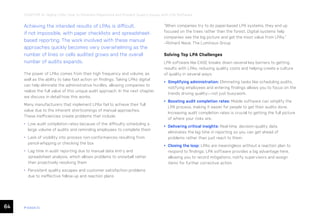
Solving Top LPA Challenges..................................................................................64
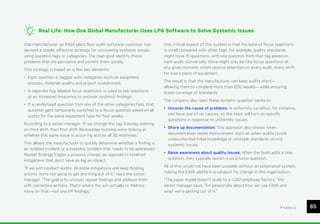
Real Life: How One Global Manufacturer Uses LPA Software
to Solve Systemic Issues.......................................................................................65
What’s the ROI of LPA Software?.....................................................................66
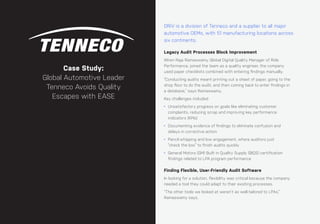
Legacy Audit Processes Block Improvement..............................................68
Finding Flexible, User-Friendly Audit Software...........................................68
Avoiding Quality Escapes and Reducing Complaints ............................69
Moving Forward with a Global Rollout.............................................................69
CHAPTER 15: How to Improve LPA Checklists
with LPA Software..............................................73
Customizing Question Scope................................................................................74
Uploading Photos.........................................................................................................74
Randomizing Questions............................................................................................74
Centralizing Audits..................................................................................................... 75
Custom Question Tags ........................................................................................... 75
CHAPTER 16: LPA Dashboards for Management:
Getting a Return on Your Effort........................77
Quality Metrics to Review...................................................................................... 78
LPA System Metrics..................................................................................................80
Reviewing Dashboard Data...................................................................................80
Enterprise-Level LPA Metrics to Track............................................................80
Real Life: What Are Realistic Audit Completion Rates?........................80
Customizing Dashboards for Users..................................................................82
CHAPTER 17: The Role of LPAs in Achieving
Higher Levels of Quality Maturity.....................84
Level 0: Operator-Driven.........................................................................................85
Level 1: Containment.................................................................................................86
Level 2: Corrections..................................................................................................86
Level 3: Prevention.................................................................................................... 87
Level 4: Improvement................................................................................................ 87
Level 5: Culture of Zero Defects........................................................................88
Closing Thoughts.................................................89
About EASE..........................................................90
References...........................................................92
What Are Layered
Process Audits?
CHAPTER 1
CHAPTER 1: What Are Layered Process Audits?
9
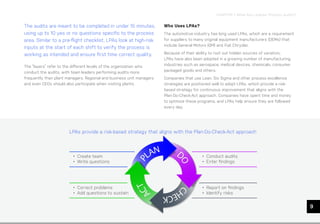
The audits are meant to be completed in under 15 minutes,
using up to 10 yes or no questions specific to the process
area. Similar to a pre-flight checklist, LPAs look at high-risk
inputs at the start of each shift to verify the process is
working as intended and ensure first time correct quality.
The “layers” refer to the different levels of the organization who
conduct the audits, with team leaders performing audits more
frequently than plant managers. Regional and business unit managers
and even CEOs should also participate when visiting plants.
Who Uses LPAs?
The automotive industry has long used LPAs, which are a requirement
for suppliers to many original equipment manufacturers (OEMs) that
include General Motors (GM) and Fiat Chrysler.
Because of their ability to root out hidden sources of variation,
LPAs have also been adopted in a growing number of manufacturing
industries such as aerospace, medical devices, chemicals, consumer
packaged goods and others.
Companies that use Lean, Six Sigma and other process excellence
strategies are positioned well to adopt LPAs, which provide a risk-
based strategy for continuous improvement that aligns with the
Plan-Do-Check-Act approach. Companies have spent time and money
to optimize these programs, and LPAs help ensure they are followed
every day.
• Create team
• Write questions
• Correct problems
• Add questions to sustain
• Conduct audits
• Enter findings
• Report on findings
• Identify risks
LPAs provide a risk-based strategy that aligns with the Plan-Do-Check-Act approach
10 ease.io
CHAPTER 1: What Are Layered Process Audits?
What LPAs Are Not
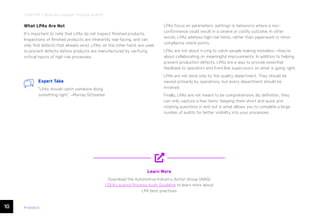
It’s important to note that LPAs do not inspect finished products.
Inspections of finished products are inherently rear-facing, and can
only find defects that already exist. LPAs, on the other hand, are used
to prevent defects before products are manufactured by verifying
critical inputs of high-risk processes.
LPAs focus on parameters, settings or behaviors where a non-
conformance could result in a severe or costly outcome. In other
words, LPAs address high-risk items, rather than paperwork or minor
compliance check points.
LPAs are not about trying to catch people making mistakes—they’re
about collaborating on meaningful improvements. In addition to helping
prevent production defects, LPAs are a way to provide essential
feedback to operators and front-line supervisors on what is going right.
LPAs are not done only by the quality department. They should be
owned primarily by operations, but every department should be
involved.
Finally, LPAs are not meant to be comprehensive. By definition, they
can only capture a few items. Keeping them short and quick and
rotating questions in and out is what allows you to complete a large
number of audits for better visibility into your processes.
Learn More
Download the Automotive Industry Action Group (AIAG)
CQI-8 Layered Process Audit Guideline to learn more about
LPA best practices
Expert Take
“LPAs should catch someone doing
something right.” –Murray Sittsamer
CHAPTER #: Chapter Title
ease.io 11
Key Takeaways:
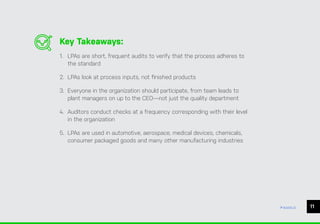
1. LPAs are short, frequent audits to verify that the process adheres to
the standard
2. LPAs look at process inputs, not finished products
3. Everyone in the organization should participate, from team leads to
plant managers on up to the CEO—not just the quality department
4. Auditors conduct checks at a frequency corresponding with their level
in the organization
5. LPAs are used in automotive, aerospace, medical devices, chemicals,
consumer packaged goods and many other manufacturing industries
CHAPTER 2
Why Should Manufacturers
Conduct LPAs?
13
ease.io
CHAPTER 2: Why Should Manufacturers Conduct LPAs?
A robust LPA program can transform quality, driving
improvements such as:
• Fewer production defects and complaints
• Lower scrap rates and quality costs
• Higher productivity
• Improved culture of quality and communication
• Increased customer satisfaction
• Fewer findings on key certification audits
Companies that execute LPAs correctly can achieve significant
improvements in quality, safety and costs in as little as a few
months’ time.1
Real Life: Using LPAs to Drive a Quality Turnaround
A Fortune 500 aerospace supplier adopted LPAs to address pervasive
quality issues impacting one of its plants. The problem was that,
while LPAs had the potential to deliver huge value to the organization,
it was impossible to complete a large volume of audits without
overwhelming the quality team.
The plant implemented EASE to automate LPA scheduling, follow-up
and reporting, allowing them to achieve results such as:
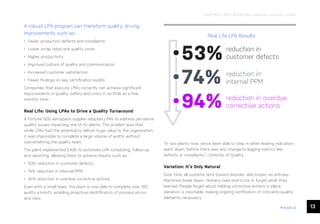
• 53% reduction in customer defects
• 74% reduction in internal PPM
• 94% reduction in overdue corrective actions
Even with a small team, the plant is now able to complete over 100
audits a month, enabling proactive identification of process errors
and risks.
“In two plants now, we’ve been able to step in when leading indicators
went down, before there was any change to lagging metrics like
defects or complaints.” –Director of Quality
Variation: It’s Only Natural
Over time, all systems tend toward disorder, also known as entropy.
Machines break down. Humans take shortcuts or forget what they
learned. People forget about holding corrective actions in place.
Variation is inevitable, making ongoing verification of critical-to-quality
elements necessary.
53%
74%
94%
reduction in
customer defects
reduction in
internal PPM
reduction in overdue
corrective actions
Real Life LPA Results
14 ease.io
CHAPTER 2: Why Should Manufacturers Conduct LPAs?
It’s only natural for people to inevitably make mistakes or create
workarounds when performing the same tasks over a long period.
LPAs help proactively identify when this occurs and needs to be fixed,
before it affects quality and productivity. In certain situations, they
can also help identify when these shortcuts should be incorporated
into the process.
When you conduct regular checks, people have more respect for what
you’re asking them to do. LPAs also show respect to operators and
provide critical recognition of their efforts.
Reducing Production Defects, Complaints and Costs
There’s no question that it costs less to manufacture products right
the first time. By verifying process inputs, LPAs help ensure first-time
correct quality. Checking process adherence close to the point of
manufacture is what enables teams to find and fix problems days or
weeks before they impact customers.
For example, if a temperature setting on an injection molding process
is too low, catching it early is a much smaller problem when discovered
internally. If the problem reaches the customer, it could mean tens of
thousands of dollars (or more) in containment and correction costs.
Product development involves large amounts of time, energy and
money spent to develop the optimum process. LPAs help ensure
companies adhere to that process, delivering more value for
investment in advanced product quality planning (APQP).
Improving Productivity
Reacting to problems diverts critical resources from productive
workflow, affecting metrics like throughput and overall equipment
effectiveness (OEE).
It’s also less expensive, more efficient and more productive to
manufacture products right the first time. Compare this with having
to spend extra time meeting with customers, paying for sorting,
line stoppage fees and other costs, and it’s clear that process
standardization more than pays for itself.
Enhancing Communication and Quality Culture
One big benefit of LPAs is that they provide a framework for creating
a culture of quality. This process works in several ways:
• Verifying process adherence: LPAs determine whether operators
are following standard work instructions, also checking that controls
and corrective actions are in place.
• Promoting communication and engagement: LPAs provide regular
opportunities for management and operators to interact face-to-
face. This helps familiarize leadership with plant floor processes,
build trust with employees and spark conversations about quality.
• Getting more eyes on the process: LPAs ensure many people are
seeing processes up close, making it easier to uncover problems
while bringing fresh perspectives to solving them. This brings the
concept of cross-functional teams to life.
• Closing the loop on problems: LPAs help monitor previous issues
and corrective actions to ensure you’re holding gains and minimize
the chance of recurrence.
Expert Take
“People don’t do what you expect but
what you inspect.” – Louis V. Gerstner Jr.,
Former chairman of IBM
CHAPTER #: Chapter Title
ease.io 15
• Making quality an organization-wide goal: LPAs make quality part
of everyone’s job description—an essential pillar of building a culture
of quality.
• Recognizing quality: LPAs show respect and provide recognition
for front-line operators, promoting personal ownership of quality.
• Raising the profile of quality: LPAs make management a visible
presence on the plant floor, fostering conversations about quality
that contribute to a culture of excellence.
More than any “Quality First” slogan, LPAs shift a company to a
proactive stance on quality and away from simply firefighting or
reacting to problems.
Helping Suppliers Stand Out with Customers
OEMs across all industries expect zero defects and 100% on-time
delivery, with stiff consequences for suppliers who fail to achieve this
standard.
LPAs make good suppliers better, and can help a great supplier prevent
metrics from slipping. Done correctly, LPAs can help manufacturers
differentiate themselves in a crowded landscape of suppliers.
Demonstrating a well-run LPA program to customers—during a
supplier audit, for example—can pay dividends in terms of boosting
customer satisfaction, increasing confidence and showing a true
commitment to quality.
Key Takeaways:
1. LPAs reduce defects, complaints
and costs
2. LPAs minimize quality risk
3. LPAs lead to higher productivity
and improved quality culture
4. LPAs make quality part of
everyone’s job description
Learn More
Read what Richard Nave of The Luminous Group has to say
about Why Plant Managers Should Care About LPAs
CHAPTER 3
LPA Implementation
Process Overview
17
ease.io
CHAPTER 3: LPA Implementation Process Overview
Plan
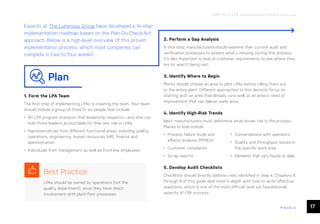
Experts at The Luminous Group have developed a 14-step
implementation roadmap based on the Plan-Do-Check-Act
approach. Below is a high-level overview of this proven
implementation process, which most companies can
complete in two to four weeks2
.
1. Form the LPA Team
The first step of implementing LPAs is creating the team. Your team
should include a group of three to six people that include:
• An LPA program champion that leadership respects—and who can
hold those leaders accountable for their key role in LPAs
• Representatives from different functional areas, including quality,
operations, engineering, human resources (HR), finance and
administration
• Individuals from management as well as front-line employees
2. Perform a Gap Analysis
In this step, manufacturers should examine their current audit and
verification processes to assess what’s missing. During this process,
it’s also important to look at customer requirements to see where they
are (or aren’t) being met.
3. Identify Where to Begin
Plants should choose an area to pilot LPAs before rolling them out
to the entire plant. Different approaches to this decision focus on
starting with an area that already runs well, or an area in need of
improvement that can deliver early wins.
4. Identify High-Risk Trends
Next, manufacturers must determine what drives risk in the process.
Places to look include:
• Process failure mode and
effects analysis (PFMEA)
• Customer complaints
• Scrap reports
• Conversations with operators
• Quality and throughput issues in
the specific work area
• Elements that vary hourly or daily
5. Develop Audit Checklists
Checklists should directly address risks identified in step 4. Chapters 6
through 8 of this guide deal more in-depth with how to write effective
questions, which is one of the most difficult (and yet foundational)
aspects of LPA success.
Best Practice
LPAs should be owned by operations (not the
quality department), since they have direct
involvement with plant floor processes.
18 ease.io
CHAPTER 3: LPA Implementation Process Overview
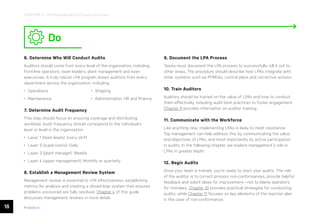
Do
6. Determine Who Will Conduct Audits
Auditors should come from every level of the organization, including
front-line operators, team leaders, plant management and even
executives. A truly robust LPA program draws auditors from every
department across the organization, including:
• Operations
• Maintenance
• Shipping
• Administration, HR and finance
7. Determine Audit Frequency
This step should focus on ensuring coverage and distributing
workload. Audit frequency should correspond to the individual’s
layer or level in the organization:
• Layer 1 (team leads): Every shift
• Layer 2 (supervisors): Daily
• Layer 3 (plant manager): Weekly
• Layer 4 (upper management): Monthly or quarterly
8. Establish a Management Review System
Management review is essential to LPA effectiveness, establishing
metrics for analysis and creating a closed-loop system that ensures
problems uncovered are fully resolved. Chapter 4 of this guide
discusses management reviews in more detail.
9. Document the LPA Process
Teams must document the LPA process to successfully roll it out to
other areas. The procedure should describe how LPAs integrate with
other systems such as PFMEAs, control plans and corrective actions.
10. Train Auditors
Auditors should be trained on the value of LPAs and how to conduct
them effectively, including audit best practices to foster engagement.
Chapter 9 provides information on auditor training.
11. Communicate with the Workforce
Like anything new, implementing LPAs is likely to meet resistance.
Top management can help address this by communicating the value
and objectives of LPAs, and most importantly by active participation
in audits. In the following chapter, we explore management’s role in
LPAs in greater depth.
12. Begin Audits
Once your team is trained, you’re ready to start your audits. The role
of the auditor is to correct process non-conformances, provide helpful
feedback and solicit ideas for improvement—not to blame operators
for mistakes. Chapter 10 provides practical strategies for conducting
audits, while Chapter 11 focuses on key elements of the reaction plan
in the case of non-conformance.
ease.io
CHAPTER 3: LPA Implementation Process Overview
19
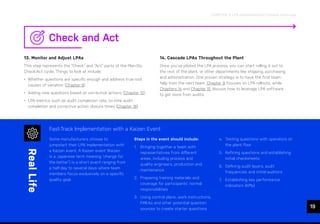
Check and Act
13. Monitor and Adjust LPAs
This step represents the “Check” and “Act” parts of the Plan-Do-
Check-Act cycle. Things to look at include:
• Whether questions are specific enough and address true root
causes of variation (Chapter 8)
• Adding new questions based on corrective actions (Chapter 12)
• LPA metrics such as audit completion rate, on-time audit
completion and corrective action closure times (Chapter 16)
14. Cascade LPAs Throughout the Plant
Once you’ve piloted the LPA process, you can start rolling it out to
the rest of the plant, or other departments like shipping, purchasing
and administration. One proven strategy is to have the first team
help train the next team. Chapter 9 focuses on LPA rollouts, while
Chapters 14 and Chapter 15 discuss how to leverage LPA software
to get more from audits.
Fast-Track Implementation with a Kaizen Event
Some manufacturers choose to
jumpstart their LPA implementation with
a Kaizen event. A Kaizen event (Kaizen
is a Japanese term meaning ‘change for
the better’) is a short event ranging from
a half-day to several days where team
members focus exclusively on a specific
quality goal.
Steps in the event should include:
1. Bringing together a team with
representatives from different
areas, including process and
quality engineers, production and
maintenance
2. Preparing training materials and
coverage for participants’ normal
responsibilities
3. Using control plans, work instructions,
FMEAs and other potential question
sources to create starter questions
4. Testing questions with operators on
the plant floor
5. Refining questions and establishing
initial checksheets
6. Defining audit layers, audit
frequencies and initial auditors
7. Establishing key performance
indicators (KPIs)
Real
Life
CHAPTER #: Chapter Title
20
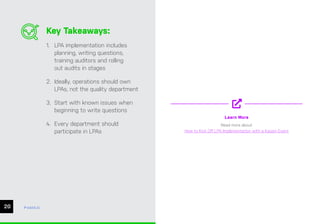
Key Takeaways:
1. LPA implementation includes
planning, writing questions,
training auditors and rolling
out audits in stages
2. Ideally, operations should own
LPAs, not the quality department
3. Start with known issues when
beginning to write questions
4. Every department should
participate in LPAs
Learn More
Read more about
How to Kick Off LPA Implementation with a Kaizen Event
ease.io
Management’s
Role in LPAs
CHAPTER 4
22 ease.io
CHAPTER 4: Management’s Role in LPAs
It would be difficult to overstate the role of management
in the success of LPAs. Leadership sets the tone, and
without their active participation, LPAs are likely to fail.
In addition to creating the implementation team, top leadership is
responsible for:
• Allocating resources for the audits themselves
• Communicating LPA value, objectives and results with the team
• Actively participating in scheduled audits
• Holding people accountable for audit and mitigation completion
• Conducting management reviews
These activities are crucial to demonstrating management’s
commitment to LPAs, which team members need to see before
they’re willing to buy into the process.
LPAs require an investment of time, effort and new responsibilities
for already busy employees. When management doesn’t engage in
the process, it sends a clear message that LPAs—and quality as a
whole—aren’t actually valued by leadership. That’s because employees
pay more attention to what their leaders do than what they say.
Communicating with the Team
Communicating the value of LPAs is important during implementation,
when employees will look to management to see whether the new
initiative will stick, as well as on a sustained basis. Strategies include:
• Keeping line-side visual management systems updated with LPA
metrics
• Sharing specific problems solved with the team
• Discussing the value of LPAs regularly
• Recognizing individuals for doing things right
Performing Audits
All levels of management and even company executives should
conduct LPAs periodically. Plant managers should audit one process
weekly, while a CEO might conduct an audit during a quarterly or
annual visit. If plant managers conduct audits late or skip them, the
team will follow their example, and LPAs as a whole will be seen as
unimportant and eventually will fail.
One reason it’s so important that management conduct audits is
that they bring unique perspective and insights to the process. For
example, a plant manager might notice a problem or non-conformance
similar to one in another process area, sharing a solution that might
not otherwise have been considered.
Real Life
One manufacturer we spoke to
underscored the importance of
communicating the improvements
made to the team until LPAs are
ingrained as company practice—
usually at least one year.
23
ease.io
CHAPTER #: Chapter Title
People see leaders out there
doing audits daily, and when
someone points out an issue,
management makes sure it’s
fixed. Seeing their feedback
matters and that we’re
solving problems they bring
up makes all the difference.
–Quality Leader, Automotive Manufacturer
24 ease.io
CHAPTER 4: Management’s Role in LPAs
Coaching and feedback are also key benefits of management
participation. When management and operators have the chance to
speak one-on-one, employees feel their concerns and ideas are heard.
It also gives leaders the opportunity to coach front-line employees.
Ultimately, this enhanced communication is crucial to quality culture.
Holding the Team Accountable
Conducting audits on time sets the tone for the team, but
management must also hold employees accountable for their
LPA responsibilities. That means directly questioning those who
do not complete their audits (or implementing other appropriate
consequences) so that employees know they can’t just skip audits.
Conducting Management Reviews
Management reviews are a key part of closing the loop on LPA
findings. These review meetings should take place monthly, and
even more frequently in the early phases of implementation.
Management reviews should look at elements such as:
• Whether solutions to non-conformances are effective
• Ensuring problems are not recurring
• Metrics that show the health of the LPA system, including audit
completion rates
• High frequency and high severity issues
Key Takeaways:
1. Management must actively
participate in LPAs and
communicate wins
2. Leadership must allocate
resources for launching LPAs
3. Data should be reviewed monthly
to assess findings and
LPA health
CHAPTER 5
Top LPA Challenges
ease.io
CHAPTER 5: Top LPA Challenges
26
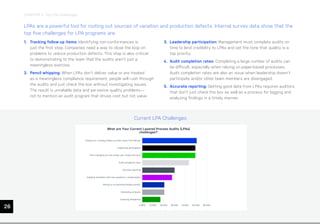
LPAs are a powerful tool for rooting out sources of variation and production defects. Internal survey data show that the
top five challenges for LPA programs are:
1. Tracking follow-up items: Identifying non-conformances is
just the first step. Companies need a way to close the loop on
problems to reduce production defects. This step is also critical
to demonstrating to the team that the audits aren’t just a
meaningless exercise.
2. Pencil whipping: When LPAs don’t deliver value or are treated
as a meaningless compliance requirement, people will rush through
the audits and just check the box without investigating issues.
The result is unreliable data and pervasive quality problems—
not to mention an audit program that drives cost but not value.
3. Leadership participation: Management must complete audits on
time to lend credibility to LPAs and set the tone that quality is a
top priority.
4. Audit completion rates: Completing a large number of audits can
be difficult, especially when relying on paper-based processes.
Audit completion rates are also an issue when leadership doesn’t
participate and/or other team members are disengaged.
5. Accurate reporting: Getting good data from LPAs requires auditors
that don’t just check the box as well as a process for logging and
analyzing findings in a timely manner.
0.00% 10.00% 20.00% 30.00% 40.00% 50.00% 60.00%
Capturing mitigations
Scheduling all layers
Moving to an electronic/mobile solution
Updating checklists with new questions / randomization
Accurate reporting
Audit completion rates
Pencil whipping (no real review, just ‘ticking the box’)
Leadership participation
Closing out / tracking follow up action items from failures
What are Your Current Layered Process Audits (LPAs)
challenges?
Current LPA Challenges
27
ease.io
CHAPTER #: Chapter Title
It’s a staggering comparison
going from seven [audits]
per year to 100 every month.
Of all our indicators, auditing
is one of the metrics that
correlates most strongly
with quality.
–Director of Quality, Aerospace Manufacturer
28 ease.io
CHAPTER 5: Top LPA Challenges
Key Takeaways:
1. Paper-based LPAs present
challenges around administration
and tracking
2. Audit completion rates are a top
issue that impacts the ability to
find problems
3. Preventing pencil-whipping is
essential to data quality and
value
4. Taking LPAs digital can help
address many of these
challenges
Other common struggles include problems like:
• Resources required to manage a paper-based or spreadsheet-based
LPA program
• Questions that are low-value and related to minor compliance items
like paperwork
• Checklists that aren’t specific enough to the process to deliver real
value
In the following chapters, we discuss these challenges and discuss
how manufacturers can effectively address them to get better results
with LPAs.
How to Write LPA Questions:
The Basics
CHAPTER 6
ease.io
CHAPTER 6: How to Write LPA Questions: The Basics
30
Writing LPA questions and developing checklists are
undoubtedly one of the most difficult—yet important—
aspects of a successful LPA program. They are so
important because they are used every shift, every day.
If questions don’t focus on work elements that matter most,
auditors and employees will be frustrated, and the entire program
will be viewed as a waste of time. To leverage the effort in a positive
way, it’s essential to take time to learn and develop meaningful
questions.
The most important thing to know about writing effective LPA
questions is that they must be laser-focused on process inputs, not
supporting systems, paperwork or end product. It’s also critical that
checklists be tailored to the individual area, rather than using the same
questions at every work area across the plant.
What Makes an Effective LPA Question?
Questions should be targeted as close as possible to the potential
point of failure. LPA questions should:
1. Identify process lines and steps within those lines that have the
most risk (risk being defined as both severity and probability of
occurrence)
2. Focus on inputs rather than finished product specifications
3. Be in yes/no format, where a “no” triggers the reaction plan
4. Be specific to the process, rather than a generic question meant to
be used across the plant
5. Be objective rather than relying on interpretation
6. Specify what evidence should be observed to verify conformance
7. Encourage interaction between auditors and operators
Anatomy of a Good LPA Question
An effective LPA question has 4 parts:
1. The question itself: Questions should be in yes/no format, with a
“no” answer triggering follow-up. Avoid vague terms like “properly”
or “correctly.”
2. An explanation of the question: This step helps auditors from
other areas of the plant understand the reason why asking
the question is important, such as if it came out of a previous
customer complaint.
3. The reaction plan for identified non-conformances: Each question
needs a pre-established set of steps to follow to correct any non-
conformance.
4. Countermeasures: The question should also specify any immediate
countermeasures (part of the reaction plan), for example if
containment is needed for suspected non-conforming parts.
ease.io
31
ease.io
Who Should Write LPA Questions?
One common mistake is making the quality department responsible
for LPAs. Instead, operations should own them and be closely involved
with creating the questions, since they have first-hand knowledge of
how process inputs affect quality.
With deep understanding of products and key steps impacting
reliability, the engineering department should also play a role in
developing LPA questions.
Where to Find LPA Questions
LPAs look at inputs that can vary on an hourly or daily basis, causing
waste or avoidable cost. Rather than measuring finished products,
for example, LPAs look at process inputs such as the order in which
an operator tightens a series of bolts.
Manufacturers should review a number of inputs to identify aspects of
the manufacturing process that require ongoing verification, including:
• Verified root causes from problem solving reports (e.g. 8D) related
to high-cost issues
• Customer-specific requirements
• PFMEAs and process control plans
• Work instructions
• Customer complaints
• Warranty claims
• Corrective actions
• Functionality of error-proofing devices or procedures
In addition to these high-priority areas, companies should also look
at key documents such as:
• Scrap, rework and downtime reports
• Preventative maintenance plans
• Job setup and tool change procedures
• Training materials
Finally, it’s important to consult operators about what to ask. Experts
at The Luminous Group recommend getting this information by asking
questions like:
• If leadership had only a few minutes each day to review the process,
which items should they check?
• If you were to train someone on this process, what would you watch
for?
• What is the most important part of your job?
• How can you tell if the previous shift was doing a good job?
Checklist Best Practices
Another common mistake to avoid is using generic checklists across
the plant. Checklists should be specific to each process area, digging
into specific process elements that address the root causes of
variation and defects.
Expert Take
“Questions are the core of the LPA
system.” –EASE customer, global
automotive supplier
CHAPTER 6: How to Write LPA Questions: The Basics
32 ease.io
CHAPTER 6: How to Write LPA Questions: The Basics
Companies should make sure questions are:
• Value-added: Questions like “Are work instructions posted?”
do nothing to improve the process. A better question would be
“Is the operator loading parts as specified in the work instructions?”
• Objective: Avoid vague terms that are open to interpretation,
since auditors won’t necessarily be experts in the process.
• Targeted: Don’t ask unbounded questions like “Are all setup
parameters in spec?” Considering that an injection molding press
can have up to 500 parameters, this type of question could easily
take an hour to fully answer.
• Clear: There must be clear evidence that the process is or is not
in conformance. For example, “Is the hose on the rack?” Questions
should be so easy to understand that anyone in the company could
do the audit. Photos of right and wrong conditions can help clarify
expectations for the auditor (see Chapter 15 for more on adding
photos).
When compiling your checklist, it’s important not to make it too long.
Audits should take no more than 10 to 15 minutes. Checklists that are
too long make it impossible to complete a large volume of audits, also
preventing teams from focusing on what is most important.
Instead of including a wide-ranging list of loose ends, LPAs are for the
few high-value items you haven’t nailed down. In addition to facilitating
audit completion, keeping checklists short and focused on high-risk
issues means people are less likely to question the value of LPAs.
LPA Questions 10-Point
Checklist
All LPA questions should have the
following:
1. Yes/no format, where “no” triggers
the reaction plan
2. Explanation included
3. Reaction plan defined
4. Countermeasures specified
5. Verifies a process input
6. Specific, avoiding terms like
“properly” or “correctly”
7. Non-technical (anyone can quickly
answer)
8. Addresses a work element that
has a high risk of causing severe or
costly problems
9. Includes a clear statement of
what evidence to observe in order
to decide if the process is conforming
or non-conforming
10. Encourages interaction
Tip
CHAPTER #: Chapter Title
33
ease.io
Key Takeaways:
1. An effective LPA question includes an explanation, reaction plan and
countermeasures
2. Questions should be specific to the area
3. Questions should avoid vague words like “correctly” and “properly”
4. Standards, complaints and other key documents are all potential
question sources
34 ease.io
CHAPTER #: Chapter Title
Imagine if you had only 30
seconds to verify the conditions
on a manufacturing line at the
start of a shift… what one or
two things would you check?
Those elements are the start
of effective LPA questions.”
–Murray Sittsamer, The Luminous Group
CHAPTER 7
Types of Questions
to Include
ease.io
CHAPTER 7: Types of Questions to Include
36
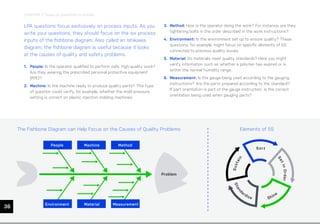
LPA questions focus exclusively on process inputs. As you
write your questions, they should focus on the six process
inputs of the fishbone diagram. Also called an Ishikawa
diagram, the fishbone diagram is useful because it looks
at the causes of quality and safety problems.
1. People: Is the operator qualified to perform safe, high-quality work?
Are they wearing the prescribed personal protective equipment
(PPE)?
2. Machine: Is the machine ready to produce quality parts? This type
of question could verify, for example, whether the mold pressure
setting is correct on plastic injection molding machines.
3. Method: How is the operator doing the work? For instance, are they
tightening bolts in the order described in the work instructions?
4. Environment: Is the environment set up to ensure quality? These
questions, for example, might focus on specific elements of 5S
connected to previous quality issues.
5. Material: Do materials meet quality standards? Here you might
verify information such as whether a polymer has expired or is
within the normal humidity range.
6. Measurement: Is the gauge being used according to the gauging
instructions? Are the parts prepared according to the standard?
If part orientation is part of the gauge instruction, is the correct
orientation being used when gauging parts?
The Fishbone Diagram can Help Focus on the Causes of Quality Problems Elements of 5S
People
Environment
Machine
Material
Method
Problem
Measurement
S
t
a
n
d
ardize
S
u
s
t
a
i
n
Sort
S
e
t
i
n
O
r
d
e
r
Shine
37
ease.io
CHAPTER 7: Types of Questions to Include
Focus on High-Value Operations
Questions should address the top causes of problems, focusing on
high-value operations. It’s easy to ask, “Is the scrap bin inside the red
square?” Even though this falls under the umbrella of 5S, it provides
no value to the operation. However, if mixing of good and bad parts is
an issue, this would be an area to check.
Encouraging Interaction
Good LPA questions encourage interaction with the operator. A bad
question might ask, “Is the check gauge form filled out?” This question
doesn’t tell you whether the check gauge is working—only that
someone filled out a form saying it is.
A better option would be to ask, “Can the operator demonstrate
the procedure for checking the part?” This type of question is what
sparks a conversation. The associate might point out how hard it is
to load the part, leading you to rework the process.
One of the biggest benefits of LPAs is creating opportunities
for coaching and feedback. If management can conduct the audit
standing 20 yards back from the press, that won’t happen. Write
your questions so that auditors and operators have to interact.
Best Practice
Many manufacturers struggle to write effective
LPA questions. At the same time, questions are the
foundation of LPAs as a whole.
Mistakes to be sure to avoid include:
• Overly general or subjective questions
• Not involving operators in writing questions
• Using the same questions everywhere in the plant
• Looking at finished product specs
• Checking paperwork
• Assessing low-value items that frustrate
auditors and operators
• Questions that require technical knowledge
to answer
Learn More
Download our free
LPA Checklist Template for starter ideas and questions
38 ease.io
Key Takeaways:
1. Design questions around process inputs, not products or outputs
2. Focus on high-value operations
3. Questions should encourage interaction
4. Avoid generic questions and checklists
5. Involve operators in writing questions
CHAPTER 8
Before-and-After
Examples of LPA Questions
40 ease.io
CHAPTER 8: Before-and-After Examples of LPA Questions
In this section, we look at examples of common LPA
questions used by manufacturers and how to improve on
them.
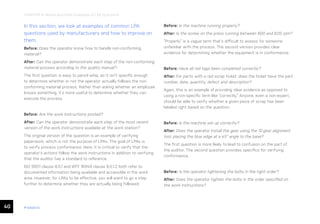
Before: Does the operator know how to handle non-conforming
material?
After: Can the operator demonstrate each step of the non-conforming
material process according to the quality manual?
The first question is easy to pencil whip, as it isn’t specific enough
to determine whether or not the operator actually follows the non-
conforming material process. Rather than asking whether an employee
knows something, it’s more useful to determine whether they can
execute the process.
Before: Are the work instructions posted?
After: Can the operator demonstrate each step of the most recent
version of the work instructions available at the work station?
The original version of the question is an example of verifying
paperwork, which is not the purpose of LPAs. The goal of LPAs is
to verify process conformance. Here, it is critical to verify that the
operator’s actions follow the work instructions in addition to verifying
that the auditor has a standard to reference.
ISO 9001 clause 8.5.1 and IATF 16949 clause 8.5.1.2 both refer to
documented information being available and accessible in the work
area. However, for LPAs to be effective, you will want to go a step
further to determine whether they are actually being followed.
Before: Is the machine running properly?
After: Is the screw on the press running between 600 and 620 rpm?
“Properly” is a vague term that’s difficult to assess for someone
unfamiliar with the process. The second version provides clear
evidence for determining whether the equipment is in conformance.
Before: Have all red tags been completed correctly?
After: For parts with a red scrap ticket, does the ticket have the part
number, date, quantity, defect and description?
Again, this is an example of providing clear evidence as opposed to
using a non-specific term like “correctly.” Anyone, even a non-expert,
should be able to verify whether a given piece of scrap has been
labeled right based on the question.
Before: Is the machine set up correctly?
After: Does the operator install the gear using the 12-gear alignment
tool, placing the blue edge at a 45° angle to the base?
The first question is more likely to lead to confusion on the part of
the auditor. The second question provides specifics for verifying
conformance.
Before: Is the operator tightening the bolts in the right order?
After: Does the operator tighten the bolts in the order specified on
the work instructions?
41
ease.io
CHAPTER 8: Before-and-After Examples of LPA Questions
If you don’t specify the order in which the operator should be
tightening the bolts, many auditors won’t be able to tell whether
they’re doing it right. The result is they’re more likely to just check
“yes,” providing no visibility into whether the operator is following work
instructions.
Before: Is the employee wearing personal protective equipment (PPE)?
After: Is the employee wearing a hard hat, hearing protection and
safety glasses?
The second question provides verifiable criteria to determine whether
the operator has the necessary PPE to do their job safely. By using
the blanket “PPE” term, the first question is not specific enough to
determine conformance vs. non-conformance with safety procedures.
Before: Does the poka-yoke device work?
After: Does the error-proofing device indicate a defective part as
failed?
In this example, the first question is too vague to verify whether error-
proofing device is in working order. The second version gives clear
instructions on how to actually verify this.
Before: Was the voltage meter calibrated at the frequency specified in
the work instruction?
After: Can the operator perform the calibration, including the
documentation of the recording of the calibration being completed?
Someone unfamiliar with the process won’t know what the right
frequency is. The second question will be more helpful for determining
if the voltage meter is out of calibration.
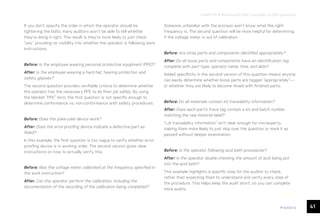
Before: Are stray parts and components identified appropriately?
After: Do all loose parts and components have an identification tag
complete with part type, operator name, time, and date?
Added specificity in the second version of this question means anyone
can easily determine whether loose parts are tagged “appropriately”—
or whether they are likely to become mixed with finished parts.
Before: Do all materials contain lot traceability information?
After: Does each part’s trace tag contain a lot and batch number
matching the raw material label?
“Lot traceability information” isn’t clear enough for non-experts,
making them more likely to just skip over the question or mark it as
passed without deeper examination.
Before: Is the operator following acid bath procedures?
After: Is the operator double-checking the amount of acid being put
into the acid bath?
This example highlights a specific step for the auditor to check,
rather than expecting them to understand and verify every step of
the procedure. This helps keep the audit short, so you can complete
more audits.
42 ease.io
CHAPTER 8: Before-and-After Examples of LPA Questions
Key Takeaways:
1. Avoid terms like “properly” or
“correctly”
2. Make questions simple enough
for anyone to understand
3. Don’t check paperwork or
finished product
4. Be specific about criteria
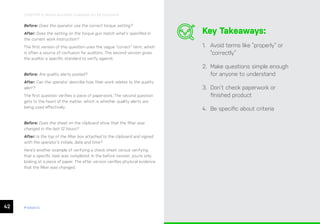
Before: Does the operator use the correct torque setting?
After: Does the setting on the torque gun match what’s specified in
the current work instruction?
The first version of this question uses the vague “correct” term, which
is often a source of confusion for auditors. The second version gives
the auditor a specific standard to verify against.
Before: Are quality alerts posted?
After: Can the operator describe how their work relates to the quality
alert?
The first question verifies a piece of paperwork. The second question
gets to the heart of the matter, which is whether quality alerts are
being used effectively.
Before: Does the sheet on the clipboard show that the filter was
changed in the last 12 hours?
After: Is the top of the filter box attached to the clipboard and signed
with the operator’s initials, date and time?
Here’s another example of verifying a check sheet versus verifying
that a specific task was completed. In the before version, you’re only
looking at a piece of paper. The after version verifies physical evidence
that the filter was changed.
Rolling Out LPAs to
Your Plant
CHAPTER 9
44 ease.io
CHAPTER 9: Rolling Out LPAs to Your Plant
Once you’ve got key planning elements in place such
as your starter checklists, audit schedule and process
documentation, it’s time to start rolling out LPAs to
the plant.
Training Auditors
Auditors in an LPA program should cover a wide cross-section of
employees, including operations staff as well as functions like shipping,
finance, human resources and administration. Training doesn’t need to
be extensive, but you should cover:
• The philosophy behind LPAs: It’s important to discuss why your
organization is implementing LPAs and what you intend to achieve.
• Checklist overview: You’ll want to spend time going over the types
of questions auditors will see, showing how to mark responses
correctly on the paper checklist or software.
• The audit process: What do employees need to do when it’s time
for their audit? For paper-based systems, you’ll want to cover where
people can find checklists and where to enter findings when they’re
finished. For automated systems, you’ll want to provide an overview
of how to use the software.
• Mock audit: Training should include a mock plant floor audit to
determine whether individuals are ready to jump into their scheduled
audits.
Auditors should be trained to show respect and initiate conversation
with the person being audited. More information on audit skills can be
found in the next chapter.
Getting Employees on Board
Operators and others being audited should be notified of the upcoming
changes, explaining:
• How LPAs work
• What to expect during an audit
• The reason for conducting LPAs
• How LPAs help all operations run more smoothly
While you don’t necessarily need to sit operators down for a formal
presentation, it’s important that your team understands why you’re
implementing LPAs and what you hope to achieve with them.
Employees should be invited to give feedback and ideas for continuous
improvement during the audits. Be sure to make it clear that LPAs are
meant to be a two-way conversation to improve processes—not to
blame operators.
As with any major change, you can expect resistance, both from those
who now have new responsibilities as well as those being audited.
Sticking to the plan can help notch some early wins, which ultimately
is one of the best ways to get your team’s buy-in.
45
ease.io
CHAPTER 9: Rolling Out LPAs to Your Plant
Key Takeaways:
1. Team buy-in is critical to LPA
success
2. Give auditors a chance to
practice with mock audits
3. Focus on LPA value to get people
on board
4. Encourage feedback from
operators being audited
Learn More
Overwhelmed about where to begin? Download our free
LPAs 101 eBook for three simple steps to getting started
with LPAs
Audit Best Practices
CHAPTER 10
47
ease.io
CHAPTER 10: Audit Best Practices
In this chapter, we explore best practices around how to
conduct audits themselves, including how to record non-
conformances and mitigations as well as best practices
and soft skills for performing audits.
How to Indicate Conformance or Non-Conformance on the
Plant Floor
During the audits, auditors must be sure to:
• Ask and listen: Similar to the popular “management by walking
around” approach, auditors should listen 80% of the time and talk
no more than 20%.
• Look for evidence: Auditors must document any evidence of non-
conformance and should also look for evidence of people doing
things right.
• Pay attention: Management should look for and ask about other
issues that seem different or problematic.
If you’re using mobile audit software, you might consider requiring
auditors to upload a photo to document evidence of the conditions
found in the audit (both good and bad). Photo evidence of a non-
conformance is particularly helpful when investigating the issue and
determining corrective action steps (see Chapter 15).
How to Record Mitigations
When a problem is rectified on the spot, auditors must still mark the
answer to the original LPA question as “no.” It’s common for auditors
to want to answer “yes” because the issue was fixed, but the original
non-conformance must still be recorded so the team can learn from
it and it can be rechecked in the future. The mitigation should also be
noted.
Asking Questions on the Plant Floor
Getting good information from audits isn’t just about running through
a checklist. How auditors interact with operators has a huge impact
on the ultimate success or failure of LPAs. Following a few basic
best practices can help you get much more from these audits, while
fostering communication, coaching and a sense of team ownership
over quality.
Making LPAs a Visible Presence
One EASE customer has auditors wear a high-
visibility vest marked “LPA” when conducting
audits. This sends the message that leadership
is behind LPAs and values quality, while reminding
everyone to pay closer attention to compliance
with standards.
Tip
48 ease.io
CHAPTER 10: Audit Best Practices
Consider, for example, an auditor that stands off at a distance from
the machine ticking off questions silently. Now compare that to a
supervisor asking questions, having a conversation, asking them to
explain how something works, noting that something was different and
asking why, soliciting ideas and suggestions.
Which one is more likely to work? Clearly, it’s the second audit.
Explain the Why
As you conduct your audit, be sure to explain the why behind each
question, which should be included on the checklist. Discussing the
reason for the question goes a long way towards improving buy-in to
LPAs, helping operators and auditors see that the audits aren’t just
another box to check.
For instance, rather than saying “Is the gauge set to 120 psi?”
Auditors should add that an incorrect setting had led to a customer
complaint last quarter, and that the team needs to verify that the
equipment is running correctly.
Sharing improvements made as a result of LPAs can also help earn
the cooperation of operators whose processes are being audited.
Ask open-ended, leading questions like:
• What’s changed in your process recently?
• What are you struggling with?
• What’s getting in your way?
• What’s the one problem that you need fixed that you just can’t
get done?
At times, you may get a five-minute lecture on everything going wrong
for the operator. However, there are golden nuggets in that discussion
if you’re willing to sift through it.
The key is to capture this information in a notes section, whether on a
paper checklist or in a custom software field. It’s also key that training
focus on bringing these issues to LPA reviews, since they are often
larger and may need to be addressed outside of the LPA system.
Soft Audit Skills: The Human Element
Audits are ultimately about one human talking to another. The way
auditors interact with operators makes a difference in terms of the
results you see. Rather than pointing fingers—something many people
associate with audits—an approach based on respect will help keep
the lines of communication open.
Ask Leading Questions
At the end of the audit, you should ask leading
questions that encourage the operator to share
concerns or ideas. While not a formal checklist
item, these discussions are often the catalyst
for big improvements, fostering openness and a
culture of quality.
Tip
CHAPTER #: Chapter Title
ease.io 49
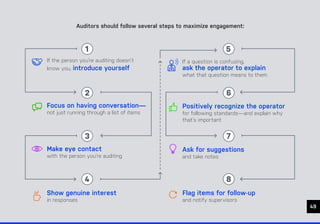
Auditors should follow several steps to maximize engagement:
If the person you’re auditing doesn’t
know you, introduce yourself
If a question is confusing,
ask the operator to explain
what that question means to them
Focus on having conversation—
not just running through a list of items
Positively recognize the operator
for following standards—and explain why
that’s important
Make eye contact
with the person you’re auditing
Ask for suggestions
and take notes
Show genuine interest
in responses
Flag items for follow-up
and notify supervisors
1 5
2 6
3 7
4 8
50 ease.io
CHAPTER 10: Audit Best Practices
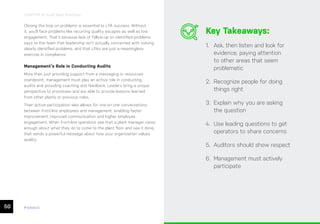
Closing the loop on problems is essential to LPA success. Without
it, you’ll face problems like recurring quality escapes as well as low
engagement. That’s because lack of follow-up on identified problems
says to the team that leadership isn’t actually concerned with solving
clearly identified problems, and that LPAs are just a meaningless
exercise in compliance.
Management’s Role in Conducting Audits
More than just providing support from a messaging or resources
standpoint, management must play an active role in conducting
audits and providing coaching and feedback. Leaders bring a unique
perspective to processes and are able to provide lessons learned
from other plants or previous roles.
Their active participation also allows for one-on-one conversations
between front-line employees and management, enabling faster
improvement, improved communication and higher employee
engagement. When front-line operators see that a plant manager cares
enough about what they do to come to the plant floor and see it done,
that sends a powerful message about how your organization values
quality.
Key Takeaways:
1. Ask, then listen and look for
evidence, paying attention
to other areas that seem
problematic
2. Recognize people for doing
things right
3. Explain why you are asking
the question
4. Use leading questions to get
operators to share concerns
5. Auditors should show respect
6. Management must actively
participate
CHAPTER 11
Creating the
Reaction Plan
52 ease.io
CHAPTER 11: Creating the Reaction Plan
Developing an effective reaction plan for LPA questions
gets to the heart of what these high-frequency audits
are all about—solving problems. Without a reaction plan,
problems will fall through the cracks, impacting customers
while reducing buy-in for LPAs as a whole. What’s more,
not solving problems sends the message that quality
isn’t important, which can undo all of your efforts at
establishing a culture of quality.
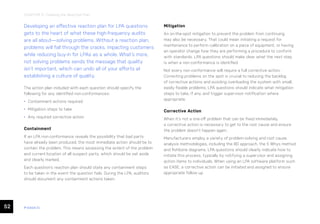
The action plan included with each question should specify the
following for any identified non-conformances:
• Containment actions required
• Mitigation steps to take
• Any required corrective action
Containment
If an LPA non-conformance reveals the possibility that bad parts
have already been produced, the most immediate action should be to
contain the problem. This means assessing the extent of the problem
and current location of all suspect parts, which should be set aside
and clearly marked.
Each question’s reaction plan should state any containment steps
to be taken in the event the question fails. During the LPA, auditors
should document any containment actions taken.
Mitigation
An on-the-spot mitigation to prevent the problem from continuing
may also be necessary. That could mean initiating a request for
maintenance to perform calibration on a piece of equipment, or having
an operator change how they are performing a procedure to conform
with standards. LPA questions should make clear what the next step
is when a non-conformance is identified.
Not every non-conformance will require a full corrective action.
Correcting problems on the spot is crucial to reducing the backlog
of corrective actions and avoiding overloading the system with small,
easily fixable problems. LPA questions should indicate what mitigation
steps to take, if any, and trigger supervisor notification where
appropriate.
Corrective Action
When it’s not a one-off problem that can be fixed immediately,
a corrective action is necessary to get to the root cause and ensure
the problem doesn’t happen again.
Manufacturers employ a variety of problem-solving and root cause
analysis methodologies, including the 8D approach, the 5 Whys method
and fishbone diagrams. LPA questions should clearly indicate how to
initiate this process, typically by notifying a supervisor and assigning
action items to individuals. When using an LPA software platform such
as EASE, a corrective action can be initiated and assigned to ensure
appropriate follow up.
CHAPTER 11: Creating the Reaction Plan
53
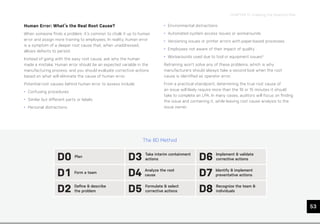
Human Error: What’s the Real Root Cause?
When someone finds a problem, it’s common to chalk it up to human
error and assign more training to employees. In reality, human error
is a symptom of a deeper root cause that, when unaddressed,
allows defects to persist.
Instead of going with the easy root cause, ask why the human
made a mistake. Human error should be an expected variable in the
manufacturing process, and you should evaluate corrective actions
based on what will eliminate the cause of human error.
Potential root causes behind human error to assess include:
• Confusing procedures
• Similar but different parts or labels
• Personal distractions
• Environmental distractions
• Automated system access issues or workarounds
• Versioning issues or printer errors with paper-based processes
• Employees not aware of their impact of quality
• Workarounds used due to tool or equipment issues3
Retraining won’t solve any of these problems, which is why
manufacturers should always take a second look when the root
cause is identified as operator error.
From a practical standpoint, determining the true root cause of
an issue will likely require more than the 10 or 15 minutes it should
take to complete an LPA. In many cases, auditors will focus on finding
the issue and containing it, while leaving root cause analysis to the
issue owner.
The 8D Method
D0 Plan
D3 Take interim containment
actions D6 Implement  validate
corrective actions
D1 Form a team
D4 Analyze the root
cause D7 Identify  implement
preventative actions
D2 Define  describe
the problem D5 Formulate  select
corrective actions D8 Recognize the team 
individuals
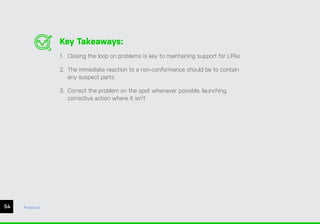
Key Takeaways:
1. Closing the loop on problems is key to maintaining support for LPAs
2. The immediate reaction to a non-conformance should be to contain
any suspect parts
3. Correct the problem on the spot whenever possible, launching
corrective action where it isn’t
54 ease.io
Updating Your
Question Library
CHAPTER 12
56 ease.io
CHAPTER 12: Updating Your Question Library
Continuous improvement isn’t possible when
manufacturers take a “set it and forget it” approach
to LPA questions. Instead, you should be updating your
question library regularly to ensure you’re accounting
for emerging risks and challenges—and not allowing
problems to repeat themselves.
When to Update Questions
Manufacturers should update questions:
• That are confusing or frequently misread
• After a customer complaint or corrective action to verify the
solution is still in place and stays in place
• When questions don’t follow best practices in terms of being
specific, objective and clear
• When PFMEAs are updated
An example of when to add a question would be after implementing
a solution to a customer complaint. Maybe the new procedure has
the operator loading the part left to right, rather than right to left.
Adding a question allows you to verify that the operator is still
following the new procedure in a week’s time, rather than just
assuming that they are.
If you’re using paper checklists, this will require devoting time and
resources to editing and redistributing checklists, as well as making
sure old ones aren’t still in circulation. If you use a software solution
for your LPA program, one best practice is to update questions where
possible rather than replacing them. This way, you can still view the
entire compliance history associated with the question, rather than
losing it by creating an entirely new question.
Management Reviews
LPA questions should be discussed during monthly management
reviews, identifying any recent problems, risks or corrective actions
that warrant adding new questions to checklists.
When reviewing performance results, LPAs should be an agenda item.
Ask questions like:
• Are all auditors completing their scheduled audits?
• Is there a correlation between LPAs completed and downward
trends in scrap costs, complaints or other KPIs? If not, why not?
• Is the LPA system working as intended?
• If not, why? Do questions need to be reassessed?
Real Life:
Engaging Quality Leaders
One manufacturer we spoke with has
Six Sigma black belts or Lean leaders
review a set of questions every month.
57
ease.io
CHAPTER 12: Updating Your Question Library
Expert Take
Should You Remove Questions from Your Question Library?
You may be tempted to delete questions if it passes 99% of
the time. However, according to Sittsamer, a better option is to
simply reduce its frequency. Rather than asking a question that
passes every time on every audit, which can frustrate auditors
and operators, you might instead have that question appear
only monthly or quarterly.
“Maybe the reason it always passes is because someone is
always checking it,” he says, adding that you might consider
removing a question if you’ve eliminated the cause with error-
proofing devices.
“It’s the second law of thermodynamics,” says Richard Nave, a
consultant with The Luminous Group. “Systems tend towards
disorder, so you have to check back once in a while.”
58 ease.io
Key Takeaways:
1. Add new questions after complaints, corrective actions and
other quality events
2. Update questions that are confusing or easily misread
3. Instead of removing questions, reduce their frequency
4. Use management reviews to identify new questions
Strategies for
Improving LPA Results
CHAPTER 13
60 ease.io
CHAPTER 13: Strategies for Improving LPA Results
Many organizations struggle to get the full value from
LPAs, which is due to several factors:
• Poor monitoring and follow-up processes
• Management participation issues
• Lack of team buy-in
• Generic, confusing or otherwise ineffective questions
• Not completing enough audits
• Difficulty extracting insights from audit findings
Monitoring LPA Effectiveness
For LPAs to work, companies must have metrics and processes in
place to monitor the health of the LPA system itself. This means
tracking metrics such as:
• Audit completion rates
• Pass rates
• On-time audit completion
• Number of audits completed
• Mitigation closure rates
Organizations should also conduct management reviews of LPAs
at least monthly to discuss metrics, open action items and trends
in findings.
Overcoming Resistance
Management and team buy-in are key elements of LPAs that
companies often have difficulty with. Without your team on your side,
it’s very hard to achieve the volume of audits needed to drive results,
also presenting a key barrier to creating a culture of quality.
Don’t be surprised if you encounter resistance as you try to implement
LPAs. Overcoming this resistance should focus on:
• Communicating the value of LPAs to management and the team
• Giving people the chance to observe before participating
• Making sure that employees know the point is to improve processes
and help people do their jobs better—not to blame operators
• Sharing any early wins to help build momentum
Management must also be willing to hold people accountable for their
scheduled audits. It’s especially important for those employees waiting
to see if LPAs are just another one-off initiative that will eventually be
forgotten about.
Reducing Frustration
Asking a question that passes (or fails) every single
time will frustrate auditors and operators. Consider
reducing the frequency of questions that always
pass and determining why certain questions
always fail.
Tip
61
When you need to manage
thousands of these audits—
and feel confident that you
can effectively harness the
data—you can’t reasonably
expect to do that in a paper
system. When you schedule,
conduct and report on them
electronically, all of those
constraints disappear.
–Director of Quality, Aerospace Manufacturer
62 ease.io
Key Takeaways:
1. Monitoring LPA effectiveness is key to success
2. Conduct reviews at least monthly
3. Leadership sets the tone
4. Overcoming resistance requires communicating the value
Digital LPAs: How to Eliminate Paperwork and
Prevent Quality Issues with LPA Software
CHAPTER 14
64 ease.io
CHAPTER 14: Digital LPAs: How to Eliminate Paperwork and Prevent Quality Issues with LPA Software
Achieving the intended results of LPAs is difficult,
if not impossible, with paper checklists and spreadsheet-
based reporting. The work involved with these manual
approaches quickly becomes very overwhelming as the
number of lines or cells audited grows and the overall
number of audits expands.
The power of LPAs comes from their high frequency and volume, as
well as the ability to take fast action on findings. Taking LPAs digital
can help eliminate the administrative hurdles, allowing companies to
realize the full value of this unique audit approach. In the next chapter,
we discuss in detail how this works.
Many manufacturers that implement LPAs fail to achieve their full
value due to the inherent shortcomings of manual approaches.
These inefficiencies create problems that include:
• Low audit completion rates because of the difficulty scheduling a
large volume of audits and reminding employees to complete them
• Lack of visibility into process non-conformances resulting from
pencil-whipping or checking the box
• Lag time in audit reporting due to manual data entry and
spreadsheet analysis, which allows problems to snowball rather
than proactively resolving them
• Persistent quality escapes and customer satisfaction problems
due to ineffective follow-up and reaction plans
“When companies try to do paper-based LPA systems, they end up
focused on the trees rather than the forest. Digital systems help
companies see the big picture and get the most value from LPAs.”
–Richard Nave, The Luminous Group
Solving Top LPA Challenges
LPA software like EASE breaks down several key barriers to getting
results with LPAs, reducing quality costs and helping create a culture
of quality in several ways:
• Simplifying administration: Eliminating tasks like scheduling audits,
notifying employees and entering findings allows you to focus on the
trends driving quality—not just busywork.
• Boosting audit completion rates: Mobile software can simplify the
LPA process, making it easier for people to get their audits done.
Increasing audit completion rates is crucial to getting the full picture
of where your risks are.
• Delivering critical insights: Real-time, decision-quality data
eliminates the lag time in reporting so you can get ahead of
problems rather than just react to them.
• Closing the loop: LPAs are meaningless without a reaction plan to
respond to findings. LPA software provides a big advantage here,
allowing you to record mitigations, notify supervisors and assign
items for further corrective action.
CHAPTER #: Chapter Title
65
ease.io
One manufacturer, an EASE plant floor audit software customer, has
devised a simple, effective strategy for uncovering systemic issues
using question tags or categories. The main goal: identify those
problems that are pervasive and correct them quickly.
This strategy is based on a few key elements:
• Each question is tagged with categories such as equipment,
process, material, quality and project sustainment.
• A separate tag, labeled focus questions, is used to ask questions
at an increased frequency to uncover systemic findings.
• If a randomized question from one of the other categories fails, that
question gets temporarily switched to a focus question asked on all
audits for the same equipment type for four weeks.
According to a senior manager, “If we change the tag Tuesday evening
on third shift, then first shift Wednesday morning we’re looking at
whether this same issue is occurring across all 30 machines.”
This allows the manufacturer to quickly determine whether a finding is
an isolated incident or a systemic problem that needs to be addressed.
Repeat findings trigger a process change, as opposed to localized
mitigations that don’t have as big an impact.
“If we just conduct audits, do some mitigations and keep floating
around, we’re not going to get anything out of it,” says the senior
manager. “The goal is to uncover repeat findings and address them
with corrective actions. That’s where the win actually is. Metrics
move on that—not one-off findings.”
One critical aspect of this system is that the bank of focus questions
is small compared with other tags. For example, quality standards
might have 15 questions, with one question from that tag asked on
each audit. Conversely, there might only be two focus questions at
any given moment, which receive attention on every audit, every shift,
for every piece of equipment.
The result is that the manufacturer can keep audits short—
allowing them to complete more than 200 weekly—while ensuring
broad coverage of standards.
The company also uses these dynamic question banks to:
• Uncover the cause of problems: A uniformity condition, for instance,
can have one of six causes, so the team will turn on specific
questions in response to uniformity issues.
• Shore up documentation: This approach also shows when
documentation needs improvement, such as when audits reveal
undocumented tribal knowledge or unstable standards driving
systemic issues.
• Raise awareness about quality issues: When the team adds a new
question, they typically launch it as a focus question.
All of this would not have been possible without an automated system,
making the EASE platform a catalyst for change in this organization.
“The paper model doesn’t scale to a 1,000-employee factory,” the
senior manager says. “I’m passionate about how we use EASE and
what we’re getting out of it.”
Real Life: How One Global Manufacturer Uses LPA Software to Solve Systemic Issues
66 ease.io
CHAPTER 14: Digital LPAs: How to Eliminate Paperwork and Prevent Quality Issues with LPA Software
What’s the ROI of LPA Software?
LPA software delivers value to manufacturers in a number of ways,
including:
1. Helping avoid quality escapes
2. Reducing production defects and associated costs and waste
3. Improving customer satisfaction
4. Improving productivity by getting more things right the first time
5. Streamlining certification and compliance
ROI Factor #1: Avoiding Quality Escapes
When it comes to the ROI of LPA software, the answer is clear:
if a system prevents even one quality escape, the platform can easily
pay for itself.
That’s because of the potentially astronomical costs associated with
defective products reaching customers. In the automotive industry,
for example, OEM line stoppages due to defective parts costs suppliers
$10,000 per minute, plus the cost to sort out bad parts and correct
the problem. In fact, the total cost of downtime can be up to $50,000
per minute, according to a survey of automakers4
.
Suppliers may also be responsible for items such as:
• Shipping replacement parts at expedited speed
• Inspection and sorting costs
• Yard-hold costs
• Product recall costs5
ROI Factor #2: Reducing Production Defects
Within the larger context of cost of quality, LPA software delivers
ROI by helping reduce production defects and inefficiency. Consider:
• Cost of quality is 15-20% of revenue for most companies.6
• Scrap and rework alone total up to 2.2% of sales,7
with warranty
claims up to 2.7% of sales8
.
• That means a company with $100 million in annual revenue loses
roughly $5 million in scrap, rework and warranty claims (in addition
to hidden productivity and efficiency costs).
• In this scenario, reducing production defects by just 10% adds
$500,000 to the bottom line, also adding revenue by reducing waste
while increasing productivity, production capacity and sales.
Clearly, even small improvements in key metrics like scrap and
customer complaints can have an outsized impact on a company’s
bottom line.
ROI Factor #3: Improving Customer Satisfaction
During a customer audit, demonstrating effective use of an automated
LPA platform can make a big impression. In any industry, customers
want to see that you are proactively identifying problems, regularly
checking processes and responding to any issues.
An LPA platform does just that, showing customers that you take
quality seriously, and you’re committed to preventing quality issues
from falling through the cracks.
67
ease.io
CHAPTER 14: Digital LPAs: How to Eliminate Paperwork and Prevent Quality Issues with LPA Software
ROI Factor #4: Improving Productivity
When you get more things right the first time, you increase
productivity. That’s because scrap and rework mean wasted money,
inefficiency and overall loss of productivity.
Spending time verifying process inputs allows manufacturers to use
fewer resources creating defective products, so they can shift those
resources to making products that actually turn a profit. The result is
higher productivity and increased production capacity, which in turn
help boost sales and revenue.
ROI Factor #5: Streamlining Certification and Compliance
LPA software helps simplify the certification process for standards
like ISO 9001 for quality management, IATF 16949, VDA 6.3 for
automotive quality management and AS 9100 for aerospace quality
management.
This type of platform helps manufacturers demonstrate compliance
with common requirements of management system standards such
as:
• Documenting audit findings and follow-up activities
• Implementing a system of checks
• Proactively identifying and assessing risks, not just with rear-facing
product inspections but also by looking at process inputs
• Verifying and validating corrective actions
• Improving employee engagement and awareness of their roles in
ensuring quality
Conducting digital LPAs can also help manufacturers make a positive
impression on auditors, demonstrating a system for proactively
preventing quality issues that’s more reliable than pen and paper.
68 ease.io
CHAPTER #: Chapter Title
DRiV is a division of Tenneco and a supplier to all major
automotive OEMs, with 51 manufacturing locations across
six continents.
Legacy Audit Processes Block Improvement
When Raja Ramaswamy, Global Digital Quality Manager of Ride
Performance, joined the team as a quality engineer, the company
used paper checklists combined with entering findings manually.
“Conducting audits meant printing out a sheet of paper, going to the
shop floor to do the audit, and then coming back to enter findings in
a database,” says Ramaswamy.
Key challenges included:
• Unsatisfactory progress on goals like eliminating customer
complaints, reducing scrap and improving key performance
indicators (KPIs)
• Documenting evidence of findings to eliminate confusion and
delays in corrective action
• Pencil-whipping and low engagement, where auditors just
“check the box” to finish audits quickly
• General Motors (GM) Built in Quality Supply (BIQS) certification
findings related to LPA program performance
Finding Flexible, User-Friendly Audit Software
In looking for a solution, flexibility was critical because the company
needed a tool they could adapt to their existing processes.
“The other tools we looked at weren’t as well-tailored to LPAs,”
Ramaswamy says.
Case Study:
Global Automotive Leader
Tenneco Avoids Quality
Escapes with EASE
CHAPTER #: Chapter Title
69
ease.io
“We could tell that someone who actually knew the LPA process was
involved in developing EASE, and that it had the built-in flexibility to fit
our needs so we could get started quickly.”
Ease of use was also a top consideration for the team. Not everyone
in the plant is comfortable with technology, points out Ramaswamy,
making a user-friendly interface essential to a successful rollout. He
says the EASE platform stood out from the competition here as well.
“Even users who aren’t tech-savvy are able to learn how to use EASE
quickly,” Ramaswamy says.
Avoiding Quality Escapes and Reducing Complaints
The biggest improvements DRiV saw as a result of implementing EASE
were:
• Several quality escapes avoided
• Reduced customer complaints
• Increased customer satisfaction
• Reduced audit administration time by 94%
• Higher on-time audit completion rates for a large volume of audits
• Ability to close the loop on problems immediately due to instant
visibility of findings
The first plant that implemented the software saw significantly
fewer customer complaints, which also played a role in helping reduce
costs and inefficiency in terms of scrap and rework. What’s more, the
system helped eliminate difficulties with the GM BIQS certification
process.
“GM was happy that we implemented EASE, which was a huge win
for us,” Ramaswamy says. Locker agrees that the software has been
helpful for keeping customers satisfied.
“Using EASE has allowed us to mitigate issues that could have
become customer problems,” says Jeff Locker, quality manager for
the company’s Kettering, Ohio plant. “If it’s prevented even one quality
issue—and it has—it’s paid for itself.”
Moving Forward with a Global Rollout
After the success of the initial pilot program, DRiV decided to
implement EASE at six more North American plants. From there, DRiV
began rolling out the software across all sites globally. Widespread
user acceptance was a major factor in the decision, as well as smooth
change management and increased visibility of data.
“With EASE, leadership was able to drill down and actually understand
issues on the shop floor remotely,” Ramaswamy says. “The data is
available everywhere, and everyone can understand it and use it to
make decisions.”
As for whether he recommends other manufacturers implement EASE,
the answer is yes.
“The benefits outweigh the costs in truly building the fundamentals,”
says Ramaswamy, adding that the software has paid for itself. “It’s not
just about the short-term benefits—investing in EASE brings long-term
strategic benefits for any business.”
“
If it’s prevented even one quality issue—
and it has—it’s paid for itself.”
CHAPTER #: Chapter Title
70
How to Gamify LPAs to Boost
Participation
Gamification makes work more engaging by incorporating
elements of games, leveraging proven principles of
motivation to boost performance.
Manufacturers that use a mobile LPA platform can gamify
audits to boost audit participation—a key challenge with
these high-frequency audits. Gamification strategies to
consider include:
• Having different teams compete against each other
• Awarding badges for consistency
• Challenging individuals to beat company goals and/or
industry benchmarks
• Updating line-side visual management systems with
rankings, resetting them periodically so the same people
aren’t always at the top of the leaderboard
• Creating a recognition program, whether it’s a gift card,
company swag or just giving kudos in team meetings
As an example, the EASE platform lets users earn
achievement badges based on the number of audits the
employee completes. Monitoring audit duration is key to
ensure people aren’t just pencil-whipping audits.
Tip
71
ease.io
Key Takeaways:
1. LPA software addresses the main challenges of audit administration
and reporting
2. Key ROI factors include reducing quality escapes, defects and costs
3. Manufacturers use LPA software to improve quality metrics and
customer satisfaction
4. Cloud-based platforms provide security and reliability, while mobile
device management (MDM) tools protect plant floor data
72 ease.io
With the paper cards, we’d have
to go to the spreadsheet, type
in the words, take a picture and
scan it, print it and laminate it.
Maintaining the card decks was
cumbersome, and the process
didn’t make it easy to clarify
confusing questions.
–
John Rose, Quality Systems Manager, Jacobs Vehicle Systems
CHAPTER 15
How to Improve LPA Checklists
with LPA Software
74 ease.io
CHAPTER 15: How to Improve LPA Checklists with LPA Software
Checklists and questions are essential to getting results
with LPAs, and an area where mobile software can provide
a distinct advantage over paper-based processes.
Customizing Question Scope
A key function of LPA software is the ability to customize question
scope, allowing you to create questions that are specific to a group or
set of equipment.
For instance, an injection molder might have 80% of presses using the
same method for rejecting bad parts, while the remaining 20% use a
different method. This manufacturer could create separate questions
for each type of press, enabling them to better detect potential
process errors that cause production defects.
Uploading Photos
When it comes to conducting audits, pictures can provide added
clarity compared with lengthy descriptions that are confusing and
time-consuming to understand. Steps where uploading photos to the
audit system can help include:
• Audit questions: Adding a photo to show what represents “good”
versus “acceptable” and “unacceptable” allows auditors to more
quickly determine whether a process conforms to standards.
• Audit findings: Taking a photo of existing conditions helps those
responsible for correcting problems see exactly what the issue
is, rather than trying to figure it out from an auditor’s written
description. Annotating these photos during the audit to further call
out what the viewer should be looking at can provide more clarity.
• Mitigation and corrective action: Taking a photo of a completed
mitigation or conditions after a corrective action helps supervisors
verify that the correction was completed correctly.
Randomizing Questions
Pencil-whipping or checking the box is a top problem with LPAs,
especially when manufacturers use a generic checklist for every area
of the plant. It’s only natural for people to run on autopilot after seeing
the same checklist multiple times, which is why randomizing questions
can help reduce pencil-whipping.
Photo Verification
One manufacturer
requires auditors to
include a photo with
each audit to verify that
the audit took place
Tip
75
ease.io
CHAPTER 15: How to Improve LPA Checklists with LPA Software
Use a Dummy Question
Some manufacturers incorporate a dummy
question with each audit to make sure auditors
are paying attention and not just rushing through
audits marking every question as passed. This
question might ask something like, “Is Daisy
Duck Mickey Mouse’s girlfriend?” The result is a
quick way to identify when someone isn’t paying
attention.
Tip
Question randomization also allows you to ask questions at differing
frequencies. This helps ensure you have adequate coverage of your
entire question library. It can also be helpful in terms of customizing
checklists by layer. For instance, you might have Layer 1 team leads
check more routine items while Layer 3 plant managers check high-
risk items from recent complaints.
Centralizing Audits
Depending on the organization, a manufacturer may need to complete
a variety of different audit types, from LPAs to safety audits to 5S
audits. Being able to house all of your questions in a single centralized
library can help you uncover larger trends, such as if a particular
department or work area has multiple high-risk findings.
Custom Question Tags
Creating customized question tags or categories can improve
quality of reporting, calling attention to systemic weaknesses where
management needs to take action.
Create Questions for Different Layers
One strategy used by some manufacturers is to
have different layers ask different questions.
Tip
“If something gets tedious, and it’s right most of the time, let the
supervisor worry about verifying it, or randomize it in layer 2,” says
Murray Sittsamer of The Luminous Group. “Don’t have the plant
manager look at that every time he or she is going out. Keep it fresh.”
He urges people to remember that LPAs won’t catch everything—
it’s a strategy to make sure people on the front line are paying
attention to what’s most important.
Best Practice
A centralized audit platform allows you to
incorporate different types of questions in a
single audit, improving efficiency while ensuring
greater coverage for required audits.
CHAPTER #: Chapter Title
76 ease.io
Key Takeaways:
1. Customize question scope to
target questions to a specific
equipment piece or type
2. Require auditors to upload
a photo to document non-
conformances or corrective
action items
3. Question randomization can help
prevent pencil-whipped audits
4. Store safety and 5S questions
in your library to keep tabs on all
your audits
5. Use focus question tags at
increased frequency to help
identify systemic risks
Learn More
For more detail on what to look for in an audit platform,
read our Buyer’s Guide Checklist for Mobile LPA Software
LPA Dashboards for Management:
Getting a Return on Your Effort
CHAPTER 16
78 ease.io
CHAPTER 16: LPA Dashboards for Management: Getting a Return on Your Effort
Dashboarding is a widely accepted best practice in
quality management for making measurable progress
in key performance indicators (KPIs). In this chapter,
we look at best practices around:
• What types of metrics plants should review
• How to measure LPA effectiveness
• How often to monitor dashboards
• What dashboards look like for different levels of the organization
Effective use of dashboard metrics allows you to better allocate
resources where they are most needed.
Quality Metrics to Review
First and foremost, management should pay special attention to work
areas or processes with a high number of audit findings. You’ll also
want to assess whether there are repeat issues that could point to
systemic problems.
Metrics to consider adding to your dashboard here include:
• Findings by location
• Top 10 findings
• Question pass rate
Using Pareto Charts
A Pareto chart is a bar chart that
plots the cost or frequency of different
problems according to their relative
significance. The bars show the
frequency of issues, while the line
shows the cumulative percentage
moving from left to right.
In the below example, process
documentation errors are the most
frequent, followed by people and
equipment issues, respectively. Using
this type of chart output allows
software users to quickly identify areas
with frequent problems that are most
likely to be driving defects, complaints
and costs.
Tip
37
35
21
18
13
11
4
13%
26%
34%
45%
49% 51%
0
0.1
0.2
0.3
0.4
0.5
0.6
0.7
0.8
0.9
1
0
5
10
15
20
25
30
35
40
Process Doc Error People Equipment Process Error Safety Cleanliness Quality
Total
Category
Failures by Category
79
In two plants now, we’ve
been able to step in when
leading indicators went
down, before there was any
change to lagging metrics
like defects or complaints.
–Senior Manager, Global Tire Manufacturer
80 ease.io
CHAPTER 16: LPA Dashboards for Management: Getting a Return on Your Effort
LPA System Metrics
It’s important also to use dashboards to monitor the health of your
LPA program as a whole. You know it’s time to go back to the beginning
and figure out where the problem is when these types of metrics
begin to slip:
• Audit completion rates
• On-time audit completion
• Audit pass rates
• Overdue corrective actions
Ultimately, the goal is to measure if people are doing their audits and
follow-up action items. If not, the health of the LPA system as a whole
is at risk and needs to be assessed.
Reviewing Dashboard Data
The frequency of monitoring LPA dashboard data, as well as the data
points monitored, should correspond with the individual’s level in the
organization.
For example, Layer 1 team leads need to be concerned with failed
items in their process area, as well as whether their team members
have completed their scheduled audits. With more audits to stay
on top of, Layer 1 should look at the local area data and team
conformance on a daily basis.
A Layer 2 quality manager, should look at data related to specific
issues and develop action plans for continuous improvement on a daily
to weekly basis.
Finally, a Layer 3 plant manager should look at key trend data and LPA
system data on a weekly basis at a cross-functional team meeting.
Enterprise-Level LPA Metrics to Track
A recent LNS Research survey shows a full 37% of quality leaders
have trouble achieving quality goals due to an inability to effectively
measure quality metrics.9
In the context of LPAs, one important aspect to consider is that it’s
not just plant managers who should be tracking plant level metrics.
Directors and those at the VP level should also be looking at LPA data
from an enterprise level.
Below we discuss four enterprise-level LPA metrics to track, and what
they can tell leaders about how to improve quality.
Real Life:
What Are Realistic Audit Completion Rates?
One manufacturer we spoke with suggests a 90%
audit completion rate is preferable to 100%, which
may only happen when people are pencil-whipping
their audits.
“The only thing worse than no data is bad data. If
we’re above 95% completion, I’m not as confident
in the quality of the audits,” he says. “But if people
are emailing about having to miss audits, then that
means they’re engaged in the process.”
81
ease.io
CHAPTER 16: LPA Dashboards for Management: Getting a Return on Your Effort
Audit Completion and Pass Rates
Leaders should look to see where audit completion rates are high
versus ones that are struggling with low completion. A high number
of defects alongside high audit pass rates may indicate pencil-whipped
audits that require further investigation. Conversely, minimal defects
with high audit completion and pass rates may indicate a plant with
best practices that are useful elsewhere in the organization.
Number of Non-conformances by Category
Companies should consider tracking non-conformances by categories
that include:
• Process or work area
• Types of questions failed
• Type of non-conformance such as documentation, scrap or
tool calibration
• Common corrective actions
• Quality vs. safety findings
Non-conformance Rate
Non-conformance rate is the number of audits completed that lead to
non-conformances or corrective actions. This metric will tell you how
effectively plants utilize LPA data, since a plant having a high non-
conformance rate may indicate systemic quality issues.
Predictive Analytics
Manufacturers can use time-series analysis to predict what metrics
such as audit completion rate, pass rate and non-conformance rate will
look like in the future. Applying this to leading metrics that correlate
with KPIs is a good way to identify emerging risks that require
intervention.
Lagging metrics are outcome-focused numbers like defect rates, scrap
and quality costs. In essence, these numbers tell you how you have
already performed.
Leading metrics are input-focused numbers like audit completion rates
and number of overdue corrective actions. These numbers tell you
where you might have a problem in the future, such as when falling
completion rates predict a corresponding drop in yield.
Counteracting Pencil-Whipping
If you’re worried about people ignoring non-
conformances to make pass rates look better,
consider just reporting this metric at a high level
rather than making it part of a plant’s official
targets.
Tip
Best Practice
Becoming truly proactive about quality rather
than just reacting to problems demands that
manufacturers develop leading indicators that
highlight emerging risks.
82 ease.io
CHAPTER 16: LPA Dashboards for Management: Getting a Return on Your Effort
The key is to analyze your own specific metrics and identify which
indicators are predictive of problems for your organization.
Customizing Dashboards for Users
Each individual will have their own spin on metrics to watch that
corresponds to the responsibilities and goals in their production lines
or work areas. Leadership should also utilize a multi-plant view for a
high-level look at risks and quality performance.
Different departments will also have different metrics on their
dashboards, including areas like:
• Safety
• Quality
• Production
• Maintenance
Real Life:
“The way you manage a single tread
line isn’t how you do audits on
hundreds of curing presses. Each
department manager has their own
spin on how they look at the data.”
–EASE customer, global automotive
supplier
83
ease.io
CHAPTER 16: LPA Dashboards for Management: Getting a Return on Your Effort
Learn More
For more information, read our blog post on
Quick Guide to Leading Indicators
Key Takeaways:
1. Use LPA dashboards to track
findings and LPA health
2. Pareto charts help assess top
sources of problems
3. Develop leading indicators to
proactively identify problems
The Role of LPAs in Achieving
Higher Levels of Quality Maturity
CHAPTER 17
85
ease.io
CHAPTER 17: The Role of LPAs in Achieving Higher Levels of Quality Maturity
Maturity models are a framework for assessing where
your organization stands in terms of performance and
where to make changes to significantly improve quality.
Here we present a maturity model that highlights the role
of LPAs in achieving progressively higher levels of quality.
Companies just starting out with LPAs will typically be on the lower
end of the spectrum, while those with more experience may be at
a higher level. No matter where you are, there is always room for
improvement, and your goal should be to refine your process and
move up the scale.
It’s important to remember that maturity is a journey, not an event.
Nor is it a policy or corporate project-of-the-month, and just setting
a goal to become best-in-class isn’t enough to get there. Achieving
higher levels of maturity—and the benefits to quality and profitability
that come with it—require sustained effort and commitment of
resources.
Level 0: Operator-Driven
The most basic link in the manufacturing chain is
operator behavior. When an operator makes the
right decision, they protect the company. When they
don’t, the organization is at risk of a quality escape.
Characteristics of companies at this level:
• Operator behavior drives quality performance
• Lack of protections like audits for customers and the company
• Frequent quality issues, including repeat problems
86 ease.io
CHAPTER 17: The Role of LPAs in Achieving Higher Levels of Quality Maturity
Level 1: Containment
Containment is the second level of maturity, and
one that companies reach when they begin to
implement basic measures to protect customers.
For example, organizations may inspect final
products, or periodically verify that people are
operating machinery correctly. In the context
of audits, this level represents the earliest
signs of LPAs.
Manufacturers at this level usually don’t have strict requirements
around audits, or may be suppliers at the Tier II level and deeper
within the supply chain.
Characteristics of companies at this level:
• Basic level of protections for customers and the company
• Identified problems are addressed to limit their impact and extent
• Organic development of shop floor audits to verify key quality
measures
Level 2: Corrections
The second maturity level, focused on correcting
problems, is the minimum required for serial
production. For example, an organization might start
looking at how they set up manufacturing lines or
how they train operators, seeking to address repeat
issues that impact quality.
At this level, companies are moving towards process
audits, even if they do not yet involve multiple layers
of the organization. Where LPAs are in place, they
are typically limited to specific areas and manual
tracking methods like spreadsheets and paper
checklists.
Characteristics of companies at this level:
• Identification of repeat or systemic issues
• Development of methods to prevent problems, including process
audits and error-proofing devices
• Paper-based auditing systems most prevalent, with generic
checklists for all areas
• LPAs are viewed as a waste of time
87
ease.io
CHAPTER 17: The Role of LPAs in Achieving Higher Levels of Quality Maturity
Level 3: Prevention
Organizations reach the Prevention level when
they understand that most of the problems they
experience originate with product and process
design. From this perspective, companies recognize
that problems are caused by something more
fundamental than operator error or random
accidents.
This level is also associated with a realization that
paper-based tracking systems can’t deliver the
information needed to make permanent corrections.
They may be collecting a lot of data, but the volume
of unstructured information distributed across so
many files makes it impossible to fully use it.
Characteristics of companies at this level:
• Focused on design and process inputs
• Prevention tools like control plans and FMEAs aligned with audits
• Moving toward automated systems and specialized LPA software
• LPAs are connected to problem-solving, which is becoming more
effective
Level 4: Improvement
The next level is Improvement, where companies
start to recognize commonalities among quality
issues across different plants or work areas. Here
organizations start to do the work it takes to design
products and processes without failures from the
outset.
Most companies that have reached this level will
have at least two plants and one to two technology
centers. Those organizations with an LPA system
are typically using it across the board to spot
patterns among locations and products to pinpoint
underlying quality issues they need to design out of
their setup.
Characteristics of companies at this level:
• Standardization exists not just across plants,
but also across product lines
• All plants are collecting LPA data
• Focus on processing LPA data in a way to enable
decision-making and root cause analysis
• LPAs are used by design team to make sure
products are manufactured correctly, rather than
just for operations to check their own work
88 ease.io
CHAPTER 17: The Role of LPAs in Achieving Higher Levels of Quality Maturity
Level 5: Culture of Zero Defects
This level is the pinnacle of quality maturity, and
what companies should ultimately strive for. More
than just looking at current operations, these
organizations are looking at products they might
have in the future (for example, electric vehicles
and components) and designing products with zero
failure in mind. Many industries haven’t reached
this level yet, but it is a possibility that should be
everyone’s end goal.
Characteristics of companies at this level:
• Products have zero failures from the outset
• Focus is on information-sharing across the
industry rather than hiding information
• Critical when failure is not an option (such as
building the International Space Station)
• LPAs sustain excellence
89
ease.io
CHAPTER #: Chapter Title
Global manufacturing leaders have proven that
LPAs can significantly reduce production defects,
including ones that can’t be identified by product
inspections. By focusing on process inputs—
rather than downstream in the manufacturing
process—organizations can identify and eliminate
process errors that drive up complaints and
quality costs.
Writing LPA questions, managing findings, completing a high volume
of audits and accessing data are all critical challenges for companies
that conduct LPAs. Digital transformation and Industry 4.0 hold the
key to solving these challenges, helping manufacturers achieve the
full potential of LPAs without the intensive resources required for
paper and spreadsheet systems.
Implementing LPAs is a multi-step process, and it’s a decision that
requires buy-in from multiple levels of an organization. Done right,
however, these audits can have a transformative impact on quality,
brand reputation and profitability—all while making products better
and safer for customers.
Closing Thoughts
According to an Applied Logistics study, a full 75% of manufacturing defects
result from non-conformance with processes, which is why LPA programs are
so effective at reducing quality costs.”
–Eric Stoop, CEO, Ease Inc.
90 ease.io
About EASE
EASE is the innovative mobile platform leading
manufacturers use to simplify how they administer,
conduct and respond to plant floor audits.
With best-in-class support for layered process audits, plus audits
for safety, 5S and more – you can drastically reduce labor costs and
drive higher performance while increasing audit value.
Leading automotive, aerospace and manufacturing organizations
around the globe depend on Ease’s enterprise scale, expertise and
customer-centricity. Ease is a privately held company based in
Mission Viejo, California. To learn more, please visit www.​
ease.​
io.​
EASE Delivers:
• Significant reduction in audit labor time and cost
• Early risk identification leading to reduced scrap, rework, returns and
increased safety and performance
• Unparalleled purpose-built user experience for plant floor audits
• Innovative mobile app (iOS and Android) with robust offline support
• Issue tracking and management
• Recurring multi-layer audit scheduling and reminders
• And much more...
Cool
Vendor
91
ease.io
CHAPTER #: Chapter Title
EASE – Insights that Drive Performance™
To learn more or request a free trial of EASE visit ease.io
Looking for engaged employees, satisfied customers and
audit programs that drive real business value?
It’s time for EASE.
• Native Support for
Layered Process Audits,
Safety, 5S and More
• Mobile Auditing Apps (iOS
and Android)
• Advanced Offline Mobile
Audit Support
• Smart Audit Scheduling
(Including by Layer)
• Question Library and
Document Management
• Real-time Reporting
and Customizable
Dashboards
• Attach and Annotate
Pictures
• Question Reference
Images and Documents
• Track Open Mitigations
and Corrective Actions
• Localization in 20+
Languages and Growing
92 ease.io
References
1 
Sittsamer, M.J., Oxley, M.R. and O’Hara, W., Quality Progress,
Turbocharge Your Preventive Action System
2 
Sittsamer, M.J, and Leslie, L., Best Practices to Make Layered
Process Audits Meaningful
3 McElroy, D.I., Quality Progress, Get at the Core
4 
Thomasnet, Downtime Costs Automotive Industry $22k/Minute:
https://news.thomasnet.com/companystory/downtime-costs-auto-
industry-22k-minute-survey-481017#register
5 
American Society for Quality (ASQ), The Audit Report: Layered
Process Audits Drive a Culture of Excellence
6 American Society for Quality (ASQ), Cost of Quality
7 
Supply and Demand Chain Executive, Metric of the Month: Reduce
Scrap and Rework Costs
8 Warranty Week, Warranty Claims Rates by Industry
9 
LNS Research, 7 Reasons to Insist on Accurate, Real-Time Reporting:
https://blog.lnsresearch.com/7-reasons-to-insist-on-accurate-real-
time-quality-data
93
ease.io
CHAPTER #: Chapter Title
27271 Las Ramblas #250, Mission Viejo, CA. 92691 USA
Copyright © 2020 EASE, Inc. All rights reserved.
EB-UGLPA20

LPAs.pdf

  • 1.
    What you willlearn in this eBook: What makes layered process audits unique How to implement layered process audits Best practices for writing audit questions   How to get more from layered process audits and overcome common challenges The role of digital transformation A valuable resource for companies seeking to get the most out of their layered process audits” –Daniel Perez-Castilla, Global Quality Systems Manager, Tenneco Powertrain The Ultimate Guide to Layered Process Audits
  • 2.
    CHAPTER #: ChapterTitle 2 ease.io Acknowledgments Ease would like to thank Murray Sittsamer and Richard Nave of The Luminous Group for generously sharing their expertise throughout the creation of this guide. You can find out more about The Luminous Group and their services to help drive process improvement on their website. Many thanks also to Daniel Perez Castilla of Tenneco Inc. for his valuable input on layered process audits and plant maturity, and to John Rose of Jacobs Vehicle Systems for his thoughtful feedback. Finally, we’d like to thank the many other customers whose helpful contributions went into to the development and review of this industry guide. Executive Summary It’s another Tuesday, and Joe is at his station processing parts. He notices a small tab sticking out that doesn’t belong there. Joe doesn’t notify his supervisor of the problem, realizing that he can just make the part fit better by bending the tab back in place with his thumb. Months later, he’s still taking this extra step, and has become accustomed to it as part of his routine. But then Joe gets sick. He’s out of work for two weeks. A new operator named Steve takes over his position. That small step Joe had been taking isn’t part of any job instruction or standard, and since that step had helped avoid major problems, nobody has a clue that it’s preventing problems down the line.
  • 3.
    3 ease.io The result uponJoe’s absence is a weeks-long stream of thousands of defective parts shipped from the plant to the company’s most important customers. Only once the complaints start rolling in does anyone realize the extent of the problem, costing the company millions in terms of scrap, rework, warranty costs and future business. In this scenario, at first look it appears Joe is doing a great service to the company in resolving this issue. However, by adding an extra step without documentation—a prime example of what’s called the hidden factory—he’s simply temporarily avoiding a quality issue that will happen whenever Joe isn’t present. A product inspection alone isn’t likely to find this type of problem, highlighting the need for ongoing process verification. In another example, twice weekly maintenance is not being carried out on a new multi-million-dollar robotic laser welding machine. Within a few weeks, parts are being produced with microscopic cracks, leading to huge downstream quality issues and costs. The machine itself has also been damaged as a result of the lack of maintenance. Again, a product inspection may not catch the issue until it’s too late. The result is millions of dollars in additional costs from scrap, rework and returns, not to mention the cost of repairing the welding machine itself. Without essential process checks, manufacturers leave themselves open to a wide range of quality problems and costs—including the loss of key business contracts, declining brand value and legal liabilities. The solution, for many manufacturers, is to implement layered process audits (LPAs). Using high-frequency plant floor checks, LPAs reduce process variation, resulting in fewer production defects and costs while creating daily habits that build a culture of quality. In this guide, we explore: • What makes these audits different and why companies conduct them • How to implement a successful LPA program, including the pivotal role of management • How to write LPA questions that work—a critical challenge for most manufacturers • Best practices for conducting audits and creating reaction plans • The role of digital transformation in addressing the traditional barriers to LPA success
  • 4.
    4 ease.io Chapters Acknowledgments.........................................................................................................2 Executive Summary.....................................................................................................2 Chapter1: What Are Layered Process Audits?.............................................8 Chapter 2: Why Should Manufacturers Conduct LPAs?....................... 12 Chapter 3: LPA Implementation Process Overview.................................. 16 Chapter 4: Management’s Role in LPAs........................................................... 21 Chapter 5: Top LPA Challenges...........................................................................25 Chapter 6: How to Write LPA Questions: The Basics.............................29 Chapter 7: Types of Questions to Include.....................................................35 Chapter 8: Before-and-After Examples of LPA Questions...................39 Chapter 9: Rolling Out LPAs to Your Plant....................................................43 Chapter 10: Audit Best Practices.......................................................................46 Chapter 11: Creating the Reaction Plan........................................................... 51 Chapter 12: Updating Your Question Library...............................................55 Chapter 13: Strategies for Improving LPA Results...................................59 Chapter 14: Digital LPAs: How to Eliminate Paperwork and Prevent Quality Issues with LPA Software.................................................63 Chapter 15: How to Improve LPA Checklists with LPA Software.... 73 Chapter 16: LPA Dashboards for Management: Getting a Return on Your Effort...........................................................................77 Chapter 17: The Role of LPAs in Achieving Higher Levels of Quality Maturity...........................................................................................................84 Closing Thoughts........................................................................................................89 About EASE....................................................................................................................90 References.....................................................................................................................92
  • 5.
    5 ease.io Table of Contents Acknowledgments.................................................2 ExecutiveSummary...............................................2 Chapter 1: What Are Layered Process Audits?....................................................8 Who Uses LPAs?............................................................................................................9 What LPAs Are Not.....................................................................................................10 CHAPTER 2: Why Should Manufacturers Conduct LPAs?.................................................... 12 Real Life: Using LPAs to Drive a Quality Turnaround............................... 13 Variation: It’s Only Natural...................................................................................... 13 Reducing Production Defects, Complaints and Costs .......................... 14 Improving Productivity.............................................................................................. 14 Enhancing Communication and Quality Culture......................................... 14 Helping Suppliers Stand Out with Customers............................................ 15 CHAPTER 3: LPA Implementation Process Overview................................................ 16 CHAPTER 4: Management’s Role in LPAs.......................................................... 21 Communicating with the Team...........................................................................22 Performing Audits.......................................................................................................22 Holding the Team Accountable............................................................................ 24 Conducting Management Reviews.................................................................... 24 CHAPTER 5: Top LPA Challenges......................25 CHAPTER 6: How to Write LPA Questions: The Basics............................................................29 What Makes an Effective LPA Question?......................................................30 Who Should Write LPA Questions?.................................................................... 31 Where to Find LPA Questions .............................................................................. 31 Checklist Best Practices......................................................................................... 31 Expert Take..................................................................................................................... 31
  • 6.
    6 ease.io CHAPTER 7:Types of Questions to Include..............................................................35 Focus on High-Value Operations ....................................................................... 37 Encouraging Interaction ......................................................................................... 37 CHAPTER 8: Before-and-After Examples of LPA Questions......................................................39 CHAPTER 9: Rolling Out LPAs to Your Plant....43 Training Auditors......................................................................................................... 44 Getting Employees on Board................................................................................ 44 CHAPTER 10: Audit Best Practices...................46 How to Indicate Conformance or Non-Conformance on the Plant Floor........................................................................................................................47 How to Record Mitigations.....................................................................................47 Asking Questions on the Plant Floor ...............................................................47 Explain the Why...........................................................................................................48 Soft Audit Skills: The Human Element............................................................48 Management’s Role in Conducting Audits....................................................50 CHAPTER 11: Creating the Reaction Plan....................................................... 51 Containment.................................................................................................................. 52 Mitigation......................................................................................................................... 52 Corrective Action........................................................................................................ 52 Human Error: What’s the Real Root Cause? ..............................................53 CHAPTER 12: Updating Your Question Library..................................................55 When to Update Questions...................................................................................56 Management Reviews..............................................................................................56 Real Life: Engaging Quality Leaders.................................................................56 CHAPTER 13: Strategies for Improving LPA Results........................................59 Monitoring LPA Effectiveness..............................................................................60 Overcoming Resistance..........................................................................................60
  • 7.
    7 ease.io CHAPTER 14: DigitalLPAs: How to Eliminate Paperwork and Prevent Quality Issues with LPA Software.......................................................63 Solving Top LPA Challenges..................................................................................64 Real Life: How One Global Manufacturer Uses LPA Software to Solve Systemic Issues.......................................................................................65 What’s the ROI of LPA Software?.....................................................................66 Legacy Audit Processes Block Improvement..............................................68 Finding Flexible, User-Friendly Audit Software...........................................68 Avoiding Quality Escapes and Reducing Complaints ............................69 Moving Forward with a Global Rollout.............................................................69 CHAPTER 15: How to Improve LPA Checklists with LPA Software..............................................73 Customizing Question Scope................................................................................74 Uploading Photos.........................................................................................................74 Randomizing Questions............................................................................................74 Centralizing Audits..................................................................................................... 75 Custom Question Tags ........................................................................................... 75 CHAPTER 16: LPA Dashboards for Management: Getting a Return on Your Effort........................77 Quality Metrics to Review...................................................................................... 78 LPA System Metrics..................................................................................................80 Reviewing Dashboard Data...................................................................................80 Enterprise-Level LPA Metrics to Track............................................................80 Real Life: What Are Realistic Audit Completion Rates?........................80 Customizing Dashboards for Users..................................................................82 CHAPTER 17: The Role of LPAs in Achieving Higher Levels of Quality Maturity.....................84 Level 0: Operator-Driven.........................................................................................85 Level 1: Containment.................................................................................................86 Level 2: Corrections..................................................................................................86 Level 3: Prevention.................................................................................................... 87 Level 4: Improvement................................................................................................ 87 Level 5: Culture of Zero Defects........................................................................88 Closing Thoughts.................................................89 About EASE..........................................................90 References...........................................................92
  • 8.
    What Are Layered ProcessAudits? CHAPTER 1
  • 9.
    CHAPTER 1: WhatAre Layered Process Audits? 9 The audits are meant to be completed in under 15 minutes, using up to 10 yes or no questions specific to the process area. Similar to a pre-flight checklist, LPAs look at high-risk inputs at the start of each shift to verify the process is working as intended and ensure first time correct quality. The “layers” refer to the different levels of the organization who conduct the audits, with team leaders performing audits more frequently than plant managers. Regional and business unit managers and even CEOs should also participate when visiting plants. Who Uses LPAs? The automotive industry has long used LPAs, which are a requirement for suppliers to many original equipment manufacturers (OEMs) that include General Motors (GM) and Fiat Chrysler. Because of their ability to root out hidden sources of variation, LPAs have also been adopted in a growing number of manufacturing industries such as aerospace, medical devices, chemicals, consumer packaged goods and others. Companies that use Lean, Six Sigma and other process excellence strategies are positioned well to adopt LPAs, which provide a risk- based strategy for continuous improvement that aligns with the Plan-Do-Check-Act approach. Companies have spent time and money to optimize these programs, and LPAs help ensure they are followed every day. • Create team • Write questions • Correct problems • Add questions to sustain • Conduct audits • Enter findings • Report on findings • Identify risks LPAs provide a risk-based strategy that aligns with the Plan-Do-Check-Act approach
  • 10.
    10 ease.io CHAPTER 1:What Are Layered Process Audits? What LPAs Are Not It’s important to note that LPAs do not inspect finished products. Inspections of finished products are inherently rear-facing, and can only find defects that already exist. LPAs, on the other hand, are used to prevent defects before products are manufactured by verifying critical inputs of high-risk processes. LPAs focus on parameters, settings or behaviors where a non- conformance could result in a severe or costly outcome. In other words, LPAs address high-risk items, rather than paperwork or minor compliance check points. LPAs are not about trying to catch people making mistakes—they’re about collaborating on meaningful improvements. In addition to helping prevent production defects, LPAs are a way to provide essential feedback to operators and front-line supervisors on what is going right. LPAs are not done only by the quality department. They should be owned primarily by operations, but every department should be involved. Finally, LPAs are not meant to be comprehensive. By definition, they can only capture a few items. Keeping them short and quick and rotating questions in and out is what allows you to complete a large number of audits for better visibility into your processes. Learn More Download the Automotive Industry Action Group (AIAG) CQI-8 Layered Process Audit Guideline to learn more about LPA best practices Expert Take “LPAs should catch someone doing something right.” –Murray Sittsamer
  • 11.
    CHAPTER #: ChapterTitle ease.io 11 Key Takeaways: 1. LPAs are short, frequent audits to verify that the process adheres to the standard 2. LPAs look at process inputs, not finished products 3. Everyone in the organization should participate, from team leads to plant managers on up to the CEO—not just the quality department 4. Auditors conduct checks at a frequency corresponding with their level in the organization 5. LPAs are used in automotive, aerospace, medical devices, chemicals, consumer packaged goods and many other manufacturing industries
  • 12.
    CHAPTER 2 Why ShouldManufacturers Conduct LPAs?
  • 13.
    13 ease.io CHAPTER 2: WhyShould Manufacturers Conduct LPAs? A robust LPA program can transform quality, driving improvements such as: • Fewer production defects and complaints • Lower scrap rates and quality costs • Higher productivity • Improved culture of quality and communication • Increased customer satisfaction • Fewer findings on key certification audits Companies that execute LPAs correctly can achieve significant improvements in quality, safety and costs in as little as a few months’ time.1 Real Life: Using LPAs to Drive a Quality Turnaround A Fortune 500 aerospace supplier adopted LPAs to address pervasive quality issues impacting one of its plants. The problem was that, while LPAs had the potential to deliver huge value to the organization, it was impossible to complete a large volume of audits without overwhelming the quality team. The plant implemented EASE to automate LPA scheduling, follow-up and reporting, allowing them to achieve results such as: • 53% reduction in customer defects • 74% reduction in internal PPM • 94% reduction in overdue corrective actions Even with a small team, the plant is now able to complete over 100 audits a month, enabling proactive identification of process errors and risks. “In two plants now, we’ve been able to step in when leading indicators went down, before there was any change to lagging metrics like defects or complaints.” –Director of Quality Variation: It’s Only Natural Over time, all systems tend toward disorder, also known as entropy. Machines break down. Humans take shortcuts or forget what they learned. People forget about holding corrective actions in place. Variation is inevitable, making ongoing verification of critical-to-quality elements necessary. 53% 74% 94% reduction in customer defects reduction in internal PPM reduction in overdue corrective actions Real Life LPA Results
  • 14.
    14 ease.io CHAPTER 2:Why Should Manufacturers Conduct LPAs? It’s only natural for people to inevitably make mistakes or create workarounds when performing the same tasks over a long period. LPAs help proactively identify when this occurs and needs to be fixed, before it affects quality and productivity. In certain situations, they can also help identify when these shortcuts should be incorporated into the process. When you conduct regular checks, people have more respect for what you’re asking them to do. LPAs also show respect to operators and provide critical recognition of their efforts. Reducing Production Defects, Complaints and Costs There’s no question that it costs less to manufacture products right the first time. By verifying process inputs, LPAs help ensure first-time correct quality. Checking process adherence close to the point of manufacture is what enables teams to find and fix problems days or weeks before they impact customers. For example, if a temperature setting on an injection molding process is too low, catching it early is a much smaller problem when discovered internally. If the problem reaches the customer, it could mean tens of thousands of dollars (or more) in containment and correction costs. Product development involves large amounts of time, energy and money spent to develop the optimum process. LPAs help ensure companies adhere to that process, delivering more value for investment in advanced product quality planning (APQP). Improving Productivity Reacting to problems diverts critical resources from productive workflow, affecting metrics like throughput and overall equipment effectiveness (OEE). It’s also less expensive, more efficient and more productive to manufacture products right the first time. Compare this with having to spend extra time meeting with customers, paying for sorting, line stoppage fees and other costs, and it’s clear that process standardization more than pays for itself. Enhancing Communication and Quality Culture One big benefit of LPAs is that they provide a framework for creating a culture of quality. This process works in several ways: • Verifying process adherence: LPAs determine whether operators are following standard work instructions, also checking that controls and corrective actions are in place. • Promoting communication and engagement: LPAs provide regular opportunities for management and operators to interact face-to- face. This helps familiarize leadership with plant floor processes, build trust with employees and spark conversations about quality. • Getting more eyes on the process: LPAs ensure many people are seeing processes up close, making it easier to uncover problems while bringing fresh perspectives to solving them. This brings the concept of cross-functional teams to life. • Closing the loop on problems: LPAs help monitor previous issues and corrective actions to ensure you’re holding gains and minimize the chance of recurrence. Expert Take “People don’t do what you expect but what you inspect.” – Louis V. Gerstner Jr., Former chairman of IBM
  • 15.
    CHAPTER #: ChapterTitle ease.io 15 • Making quality an organization-wide goal: LPAs make quality part of everyone’s job description—an essential pillar of building a culture of quality. • Recognizing quality: LPAs show respect and provide recognition for front-line operators, promoting personal ownership of quality. • Raising the profile of quality: LPAs make management a visible presence on the plant floor, fostering conversations about quality that contribute to a culture of excellence. More than any “Quality First” slogan, LPAs shift a company to a proactive stance on quality and away from simply firefighting or reacting to problems. Helping Suppliers Stand Out with Customers OEMs across all industries expect zero defects and 100% on-time delivery, with stiff consequences for suppliers who fail to achieve this standard. LPAs make good suppliers better, and can help a great supplier prevent metrics from slipping. Done correctly, LPAs can help manufacturers differentiate themselves in a crowded landscape of suppliers. Demonstrating a well-run LPA program to customers—during a supplier audit, for example—can pay dividends in terms of boosting customer satisfaction, increasing confidence and showing a true commitment to quality. Key Takeaways: 1. LPAs reduce defects, complaints and costs 2. LPAs minimize quality risk 3. LPAs lead to higher productivity and improved quality culture 4. LPAs make quality part of everyone’s job description Learn More Read what Richard Nave of The Luminous Group has to say about Why Plant Managers Should Care About LPAs
  • 16.
  • 17.
    17 ease.io CHAPTER 3: LPAImplementation Process Overview Plan Experts at The Luminous Group have developed a 14-step implementation roadmap based on the Plan-Do-Check-Act approach. Below is a high-level overview of this proven implementation process, which most companies can complete in two to four weeks2 . 1. Form the LPA Team The first step of implementing LPAs is creating the team. Your team should include a group of three to six people that include: • An LPA program champion that leadership respects—and who can hold those leaders accountable for their key role in LPAs • Representatives from different functional areas, including quality, operations, engineering, human resources (HR), finance and administration • Individuals from management as well as front-line employees 2. Perform a Gap Analysis In this step, manufacturers should examine their current audit and verification processes to assess what’s missing. During this process, it’s also important to look at customer requirements to see where they are (or aren’t) being met. 3. Identify Where to Begin Plants should choose an area to pilot LPAs before rolling them out to the entire plant. Different approaches to this decision focus on starting with an area that already runs well, or an area in need of improvement that can deliver early wins. 4. Identify High-Risk Trends Next, manufacturers must determine what drives risk in the process. Places to look include: • Process failure mode and effects analysis (PFMEA) • Customer complaints • Scrap reports • Conversations with operators • Quality and throughput issues in the specific work area • Elements that vary hourly or daily 5. Develop Audit Checklists Checklists should directly address risks identified in step 4. Chapters 6 through 8 of this guide deal more in-depth with how to write effective questions, which is one of the most difficult (and yet foundational) aspects of LPA success. Best Practice LPAs should be owned by operations (not the quality department), since they have direct involvement with plant floor processes.
  • 18.
    18 ease.io CHAPTER 3:LPA Implementation Process Overview Do 6. Determine Who Will Conduct Audits Auditors should come from every level of the organization, including front-line operators, team leaders, plant management and even executives. A truly robust LPA program draws auditors from every department across the organization, including: • Operations • Maintenance • Shipping • Administration, HR and finance 7. Determine Audit Frequency This step should focus on ensuring coverage and distributing workload. Audit frequency should correspond to the individual’s layer or level in the organization: • Layer 1 (team leads): Every shift • Layer 2 (supervisors): Daily • Layer 3 (plant manager): Weekly • Layer 4 (upper management): Monthly or quarterly 8. Establish a Management Review System Management review is essential to LPA effectiveness, establishing metrics for analysis and creating a closed-loop system that ensures problems uncovered are fully resolved. Chapter 4 of this guide discusses management reviews in more detail. 9. Document the LPA Process Teams must document the LPA process to successfully roll it out to other areas. The procedure should describe how LPAs integrate with other systems such as PFMEAs, control plans and corrective actions. 10. Train Auditors Auditors should be trained on the value of LPAs and how to conduct them effectively, including audit best practices to foster engagement. Chapter 9 provides information on auditor training. 11. Communicate with the Workforce Like anything new, implementing LPAs is likely to meet resistance. Top management can help address this by communicating the value and objectives of LPAs, and most importantly by active participation in audits. In the following chapter, we explore management’s role in LPAs in greater depth. 12. Begin Audits Once your team is trained, you’re ready to start your audits. The role of the auditor is to correct process non-conformances, provide helpful feedback and solicit ideas for improvement—not to blame operators for mistakes. Chapter 10 provides practical strategies for conducting audits, while Chapter 11 focuses on key elements of the reaction plan in the case of non-conformance.
  • 19.
    ease.io CHAPTER 3: LPAImplementation Process Overview 19 Check and Act 13. Monitor and Adjust LPAs This step represents the “Check” and “Act” parts of the Plan-Do- Check-Act cycle. Things to look at include: • Whether questions are specific enough and address true root causes of variation (Chapter 8) • Adding new questions based on corrective actions (Chapter 12) • LPA metrics such as audit completion rate, on-time audit completion and corrective action closure times (Chapter 16) 14. Cascade LPAs Throughout the Plant Once you’ve piloted the LPA process, you can start rolling it out to the rest of the plant, or other departments like shipping, purchasing and administration. One proven strategy is to have the first team help train the next team. Chapter 9 focuses on LPA rollouts, while Chapters 14 and Chapter 15 discuss how to leverage LPA software to get more from audits. Fast-Track Implementation with a Kaizen Event Some manufacturers choose to jumpstart their LPA implementation with a Kaizen event. A Kaizen event (Kaizen is a Japanese term meaning ‘change for the better’) is a short event ranging from a half-day to several days where team members focus exclusively on a specific quality goal. Steps in the event should include: 1. Bringing together a team with representatives from different areas, including process and quality engineers, production and maintenance 2. Preparing training materials and coverage for participants’ normal responsibilities 3. Using control plans, work instructions, FMEAs and other potential question sources to create starter questions 4. Testing questions with operators on the plant floor 5. Refining questions and establishing initial checksheets 6. Defining audit layers, audit frequencies and initial auditors 7. Establishing key performance indicators (KPIs) Real Life
  • 20.
    CHAPTER #: ChapterTitle 20 Key Takeaways: 1. LPA implementation includes planning, writing questions, training auditors and rolling out audits in stages 2. Ideally, operations should own LPAs, not the quality department 3. Start with known issues when beginning to write questions 4. Every department should participate in LPAs Learn More Read more about How to Kick Off LPA Implementation with a Kaizen Event ease.io
  • 21.
  • 22.
    22 ease.io CHAPTER 4:Management’s Role in LPAs It would be difficult to overstate the role of management in the success of LPAs. Leadership sets the tone, and without their active participation, LPAs are likely to fail. In addition to creating the implementation team, top leadership is responsible for: • Allocating resources for the audits themselves • Communicating LPA value, objectives and results with the team • Actively participating in scheduled audits • Holding people accountable for audit and mitigation completion • Conducting management reviews These activities are crucial to demonstrating management’s commitment to LPAs, which team members need to see before they’re willing to buy into the process. LPAs require an investment of time, effort and new responsibilities for already busy employees. When management doesn’t engage in the process, it sends a clear message that LPAs—and quality as a whole—aren’t actually valued by leadership. That’s because employees pay more attention to what their leaders do than what they say. Communicating with the Team Communicating the value of LPAs is important during implementation, when employees will look to management to see whether the new initiative will stick, as well as on a sustained basis. Strategies include: • Keeping line-side visual management systems updated with LPA metrics • Sharing specific problems solved with the team • Discussing the value of LPAs regularly • Recognizing individuals for doing things right Performing Audits All levels of management and even company executives should conduct LPAs periodically. Plant managers should audit one process weekly, while a CEO might conduct an audit during a quarterly or annual visit. If plant managers conduct audits late or skip them, the team will follow their example, and LPAs as a whole will be seen as unimportant and eventually will fail. One reason it’s so important that management conduct audits is that they bring unique perspective and insights to the process. For example, a plant manager might notice a problem or non-conformance similar to one in another process area, sharing a solution that might not otherwise have been considered. Real Life One manufacturer we spoke to underscored the importance of communicating the improvements made to the team until LPAs are ingrained as company practice— usually at least one year.
  • 23.
    23 ease.io CHAPTER #: ChapterTitle People see leaders out there doing audits daily, and when someone points out an issue, management makes sure it’s fixed. Seeing their feedback matters and that we’re solving problems they bring up makes all the difference. –Quality Leader, Automotive Manufacturer
  • 24.
    24 ease.io CHAPTER 4:Management’s Role in LPAs Coaching and feedback are also key benefits of management participation. When management and operators have the chance to speak one-on-one, employees feel their concerns and ideas are heard. It also gives leaders the opportunity to coach front-line employees. Ultimately, this enhanced communication is crucial to quality culture. Holding the Team Accountable Conducting audits on time sets the tone for the team, but management must also hold employees accountable for their LPA responsibilities. That means directly questioning those who do not complete their audits (or implementing other appropriate consequences) so that employees know they can’t just skip audits. Conducting Management Reviews Management reviews are a key part of closing the loop on LPA findings. These review meetings should take place monthly, and even more frequently in the early phases of implementation. Management reviews should look at elements such as: • Whether solutions to non-conformances are effective • Ensuring problems are not recurring • Metrics that show the health of the LPA system, including audit completion rates • High frequency and high severity issues Key Takeaways: 1. Management must actively participate in LPAs and communicate wins 2. Leadership must allocate resources for launching LPAs 3. Data should be reviewed monthly to assess findings and LPA health
  • 25.
  • 26.
    ease.io CHAPTER 5: TopLPA Challenges 26 LPAs are a powerful tool for rooting out sources of variation and production defects. Internal survey data show that the top five challenges for LPA programs are: 1. Tracking follow-up items: Identifying non-conformances is just the first step. Companies need a way to close the loop on problems to reduce production defects. This step is also critical to demonstrating to the team that the audits aren’t just a meaningless exercise. 2. Pencil whipping: When LPAs don’t deliver value or are treated as a meaningless compliance requirement, people will rush through the audits and just check the box without investigating issues. The result is unreliable data and pervasive quality problems— not to mention an audit program that drives cost but not value. 3. Leadership participation: Management must complete audits on time to lend credibility to LPAs and set the tone that quality is a top priority. 4. Audit completion rates: Completing a large number of audits can be difficult, especially when relying on paper-based processes. Audit completion rates are also an issue when leadership doesn’t participate and/or other team members are disengaged. 5. Accurate reporting: Getting good data from LPAs requires auditors that don’t just check the box as well as a process for logging and analyzing findings in a timely manner. 0.00% 10.00% 20.00% 30.00% 40.00% 50.00% 60.00% Capturing mitigations Scheduling all layers Moving to an electronic/mobile solution Updating checklists with new questions / randomization Accurate reporting Audit completion rates Pencil whipping (no real review, just ‘ticking the box’) Leadership participation Closing out / tracking follow up action items from failures What are Your Current Layered Process Audits (LPAs) challenges? Current LPA Challenges
  • 27.
    27 ease.io CHAPTER #: ChapterTitle It’s a staggering comparison going from seven [audits] per year to 100 every month. Of all our indicators, auditing is one of the metrics that correlates most strongly with quality. –Director of Quality, Aerospace Manufacturer
  • 28.
    28 ease.io CHAPTER 5:Top LPA Challenges Key Takeaways: 1. Paper-based LPAs present challenges around administration and tracking 2. Audit completion rates are a top issue that impacts the ability to find problems 3. Preventing pencil-whipping is essential to data quality and value 4. Taking LPAs digital can help address many of these challenges Other common struggles include problems like: • Resources required to manage a paper-based or spreadsheet-based LPA program • Questions that are low-value and related to minor compliance items like paperwork • Checklists that aren’t specific enough to the process to deliver real value In the following chapters, we discuss these challenges and discuss how manufacturers can effectively address them to get better results with LPAs.
  • 29.
    How to WriteLPA Questions: The Basics CHAPTER 6
  • 30.
    ease.io CHAPTER 6: Howto Write LPA Questions: The Basics 30 Writing LPA questions and developing checklists are undoubtedly one of the most difficult—yet important— aspects of a successful LPA program. They are so important because they are used every shift, every day. If questions don’t focus on work elements that matter most, auditors and employees will be frustrated, and the entire program will be viewed as a waste of time. To leverage the effort in a positive way, it’s essential to take time to learn and develop meaningful questions. The most important thing to know about writing effective LPA questions is that they must be laser-focused on process inputs, not supporting systems, paperwork or end product. It’s also critical that checklists be tailored to the individual area, rather than using the same questions at every work area across the plant. What Makes an Effective LPA Question? Questions should be targeted as close as possible to the potential point of failure. LPA questions should: 1. Identify process lines and steps within those lines that have the most risk (risk being defined as both severity and probability of occurrence) 2. Focus on inputs rather than finished product specifications 3. Be in yes/no format, where a “no” triggers the reaction plan 4. Be specific to the process, rather than a generic question meant to be used across the plant 5. Be objective rather than relying on interpretation 6. Specify what evidence should be observed to verify conformance 7. Encourage interaction between auditors and operators Anatomy of a Good LPA Question An effective LPA question has 4 parts: 1. The question itself: Questions should be in yes/no format, with a “no” answer triggering follow-up. Avoid vague terms like “properly” or “correctly.” 2. An explanation of the question: This step helps auditors from other areas of the plant understand the reason why asking the question is important, such as if it came out of a previous customer complaint. 3. The reaction plan for identified non-conformances: Each question needs a pre-established set of steps to follow to correct any non- conformance. 4. Countermeasures: The question should also specify any immediate countermeasures (part of the reaction plan), for example if containment is needed for suspected non-conforming parts. ease.io
  • 31.
    31 ease.io Who Should WriteLPA Questions? One common mistake is making the quality department responsible for LPAs. Instead, operations should own them and be closely involved with creating the questions, since they have first-hand knowledge of how process inputs affect quality. With deep understanding of products and key steps impacting reliability, the engineering department should also play a role in developing LPA questions. Where to Find LPA Questions LPAs look at inputs that can vary on an hourly or daily basis, causing waste or avoidable cost. Rather than measuring finished products, for example, LPAs look at process inputs such as the order in which an operator tightens a series of bolts. Manufacturers should review a number of inputs to identify aspects of the manufacturing process that require ongoing verification, including: • Verified root causes from problem solving reports (e.g. 8D) related to high-cost issues • Customer-specific requirements • PFMEAs and process control plans • Work instructions • Customer complaints • Warranty claims • Corrective actions • Functionality of error-proofing devices or procedures In addition to these high-priority areas, companies should also look at key documents such as: • Scrap, rework and downtime reports • Preventative maintenance plans • Job setup and tool change procedures • Training materials Finally, it’s important to consult operators about what to ask. Experts at The Luminous Group recommend getting this information by asking questions like: • If leadership had only a few minutes each day to review the process, which items should they check? • If you were to train someone on this process, what would you watch for? • What is the most important part of your job? • How can you tell if the previous shift was doing a good job? Checklist Best Practices Another common mistake to avoid is using generic checklists across the plant. Checklists should be specific to each process area, digging into specific process elements that address the root causes of variation and defects. Expert Take “Questions are the core of the LPA system.” –EASE customer, global automotive supplier CHAPTER 6: How to Write LPA Questions: The Basics
  • 32.
    32 ease.io CHAPTER 6:How to Write LPA Questions: The Basics Companies should make sure questions are: • Value-added: Questions like “Are work instructions posted?” do nothing to improve the process. A better question would be “Is the operator loading parts as specified in the work instructions?” • Objective: Avoid vague terms that are open to interpretation, since auditors won’t necessarily be experts in the process. • Targeted: Don’t ask unbounded questions like “Are all setup parameters in spec?” Considering that an injection molding press can have up to 500 parameters, this type of question could easily take an hour to fully answer. • Clear: There must be clear evidence that the process is or is not in conformance. For example, “Is the hose on the rack?” Questions should be so easy to understand that anyone in the company could do the audit. Photos of right and wrong conditions can help clarify expectations for the auditor (see Chapter 15 for more on adding photos). When compiling your checklist, it’s important not to make it too long. Audits should take no more than 10 to 15 minutes. Checklists that are too long make it impossible to complete a large volume of audits, also preventing teams from focusing on what is most important. Instead of including a wide-ranging list of loose ends, LPAs are for the few high-value items you haven’t nailed down. In addition to facilitating audit completion, keeping checklists short and focused on high-risk issues means people are less likely to question the value of LPAs. LPA Questions 10-Point Checklist All LPA questions should have the following: 1. Yes/no format, where “no” triggers the reaction plan 2. Explanation included 3. Reaction plan defined 4. Countermeasures specified 5. Verifies a process input 6. Specific, avoiding terms like “properly” or “correctly” 7. Non-technical (anyone can quickly answer) 8. Addresses a work element that has a high risk of causing severe or costly problems 9. Includes a clear statement of what evidence to observe in order to decide if the process is conforming or non-conforming 10. Encourages interaction Tip
  • 33.
    CHAPTER #: ChapterTitle 33 ease.io Key Takeaways: 1. An effective LPA question includes an explanation, reaction plan and countermeasures 2. Questions should be specific to the area 3. Questions should avoid vague words like “correctly” and “properly” 4. Standards, complaints and other key documents are all potential question sources
  • 34.
    34 ease.io CHAPTER #:Chapter Title Imagine if you had only 30 seconds to verify the conditions on a manufacturing line at the start of a shift… what one or two things would you check? Those elements are the start of effective LPA questions.” –Murray Sittsamer, The Luminous Group
  • 35.
    CHAPTER 7 Types ofQuestions to Include
  • 36.
    ease.io CHAPTER 7: Typesof Questions to Include 36 LPA questions focus exclusively on process inputs. As you write your questions, they should focus on the six process inputs of the fishbone diagram. Also called an Ishikawa diagram, the fishbone diagram is useful because it looks at the causes of quality and safety problems. 1. People: Is the operator qualified to perform safe, high-quality work? Are they wearing the prescribed personal protective equipment (PPE)? 2. Machine: Is the machine ready to produce quality parts? This type of question could verify, for example, whether the mold pressure setting is correct on plastic injection molding machines. 3. Method: How is the operator doing the work? For instance, are they tightening bolts in the order described in the work instructions? 4. Environment: Is the environment set up to ensure quality? These questions, for example, might focus on specific elements of 5S connected to previous quality issues. 5. Material: Do materials meet quality standards? Here you might verify information such as whether a polymer has expired or is within the normal humidity range. 6. Measurement: Is the gauge being used according to the gauging instructions? Are the parts prepared according to the standard? If part orientation is part of the gauge instruction, is the correct orientation being used when gauging parts? The Fishbone Diagram can Help Focus on the Causes of Quality Problems Elements of 5S People Environment Machine Material Method Problem Measurement S t a n d ardize S u s t a i n Sort S e t i n O r d e r Shine
  • 37.
    37 ease.io CHAPTER 7: Typesof Questions to Include Focus on High-Value Operations Questions should address the top causes of problems, focusing on high-value operations. It’s easy to ask, “Is the scrap bin inside the red square?” Even though this falls under the umbrella of 5S, it provides no value to the operation. However, if mixing of good and bad parts is an issue, this would be an area to check. Encouraging Interaction Good LPA questions encourage interaction with the operator. A bad question might ask, “Is the check gauge form filled out?” This question doesn’t tell you whether the check gauge is working—only that someone filled out a form saying it is. A better option would be to ask, “Can the operator demonstrate the procedure for checking the part?” This type of question is what sparks a conversation. The associate might point out how hard it is to load the part, leading you to rework the process. One of the biggest benefits of LPAs is creating opportunities for coaching and feedback. If management can conduct the audit standing 20 yards back from the press, that won’t happen. Write your questions so that auditors and operators have to interact. Best Practice Many manufacturers struggle to write effective LPA questions. At the same time, questions are the foundation of LPAs as a whole. Mistakes to be sure to avoid include: • Overly general or subjective questions • Not involving operators in writing questions • Using the same questions everywhere in the plant • Looking at finished product specs • Checking paperwork • Assessing low-value items that frustrate auditors and operators • Questions that require technical knowledge to answer Learn More Download our free LPA Checklist Template for starter ideas and questions
  • 38.
    38 ease.io Key Takeaways: 1.Design questions around process inputs, not products or outputs 2. Focus on high-value operations 3. Questions should encourage interaction 4. Avoid generic questions and checklists 5. Involve operators in writing questions
  • 39.
  • 40.
    40 ease.io CHAPTER 8:Before-and-After Examples of LPA Questions In this section, we look at examples of common LPA questions used by manufacturers and how to improve on them. Before: Does the operator know how to handle non-conforming material? After: Can the operator demonstrate each step of the non-conforming material process according to the quality manual? The first question is easy to pencil whip, as it isn’t specific enough to determine whether or not the operator actually follows the non- conforming material process. Rather than asking whether an employee knows something, it’s more useful to determine whether they can execute the process. Before: Are the work instructions posted? After: Can the operator demonstrate each step of the most recent version of the work instructions available at the work station? The original version of the question is an example of verifying paperwork, which is not the purpose of LPAs. The goal of LPAs is to verify process conformance. Here, it is critical to verify that the operator’s actions follow the work instructions in addition to verifying that the auditor has a standard to reference. ISO 9001 clause 8.5.1 and IATF 16949 clause 8.5.1.2 both refer to documented information being available and accessible in the work area. However, for LPAs to be effective, you will want to go a step further to determine whether they are actually being followed. Before: Is the machine running properly? After: Is the screw on the press running between 600 and 620 rpm? “Properly” is a vague term that’s difficult to assess for someone unfamiliar with the process. The second version provides clear evidence for determining whether the equipment is in conformance. Before: Have all red tags been completed correctly? After: For parts with a red scrap ticket, does the ticket have the part number, date, quantity, defect and description? Again, this is an example of providing clear evidence as opposed to using a non-specific term like “correctly.” Anyone, even a non-expert, should be able to verify whether a given piece of scrap has been labeled right based on the question. Before: Is the machine set up correctly? After: Does the operator install the gear using the 12-gear alignment tool, placing the blue edge at a 45° angle to the base? The first question is more likely to lead to confusion on the part of the auditor. The second question provides specifics for verifying conformance. Before: Is the operator tightening the bolts in the right order? After: Does the operator tighten the bolts in the order specified on the work instructions?
  • 41.
    41 ease.io CHAPTER 8: Before-and-AfterExamples of LPA Questions If you don’t specify the order in which the operator should be tightening the bolts, many auditors won’t be able to tell whether they’re doing it right. The result is they’re more likely to just check “yes,” providing no visibility into whether the operator is following work instructions. Before: Is the employee wearing personal protective equipment (PPE)? After: Is the employee wearing a hard hat, hearing protection and safety glasses? The second question provides verifiable criteria to determine whether the operator has the necessary PPE to do their job safely. By using the blanket “PPE” term, the first question is not specific enough to determine conformance vs. non-conformance with safety procedures. Before: Does the poka-yoke device work? After: Does the error-proofing device indicate a defective part as failed? In this example, the first question is too vague to verify whether error- proofing device is in working order. The second version gives clear instructions on how to actually verify this. Before: Was the voltage meter calibrated at the frequency specified in the work instruction? After: Can the operator perform the calibration, including the documentation of the recording of the calibration being completed? Someone unfamiliar with the process won’t know what the right frequency is. The second question will be more helpful for determining if the voltage meter is out of calibration. Before: Are stray parts and components identified appropriately? After: Do all loose parts and components have an identification tag complete with part type, operator name, time, and date? Added specificity in the second version of this question means anyone can easily determine whether loose parts are tagged “appropriately”— or whether they are likely to become mixed with finished parts. Before: Do all materials contain lot traceability information? After: Does each part’s trace tag contain a lot and batch number matching the raw material label? “Lot traceability information” isn’t clear enough for non-experts, making them more likely to just skip over the question or mark it as passed without deeper examination. Before: Is the operator following acid bath procedures? After: Is the operator double-checking the amount of acid being put into the acid bath? This example highlights a specific step for the auditor to check, rather than expecting them to understand and verify every step of the procedure. This helps keep the audit short, so you can complete more audits.
  • 42.
    42 ease.io CHAPTER 8:Before-and-After Examples of LPA Questions Key Takeaways: 1. Avoid terms like “properly” or “correctly” 2. Make questions simple enough for anyone to understand 3. Don’t check paperwork or finished product 4. Be specific about criteria Before: Does the operator use the correct torque setting? After: Does the setting on the torque gun match what’s specified in the current work instruction? The first version of this question uses the vague “correct” term, which is often a source of confusion for auditors. The second version gives the auditor a specific standard to verify against. Before: Are quality alerts posted? After: Can the operator describe how their work relates to the quality alert? The first question verifies a piece of paperwork. The second question gets to the heart of the matter, which is whether quality alerts are being used effectively. Before: Does the sheet on the clipboard show that the filter was changed in the last 12 hours? After: Is the top of the filter box attached to the clipboard and signed with the operator’s initials, date and time? Here’s another example of verifying a check sheet versus verifying that a specific task was completed. In the before version, you’re only looking at a piece of paper. The after version verifies physical evidence that the filter was changed.
  • 43.
    Rolling Out LPAsto Your Plant CHAPTER 9
  • 44.
    44 ease.io CHAPTER 9:Rolling Out LPAs to Your Plant Once you’ve got key planning elements in place such as your starter checklists, audit schedule and process documentation, it’s time to start rolling out LPAs to the plant. Training Auditors Auditors in an LPA program should cover a wide cross-section of employees, including operations staff as well as functions like shipping, finance, human resources and administration. Training doesn’t need to be extensive, but you should cover: • The philosophy behind LPAs: It’s important to discuss why your organization is implementing LPAs and what you intend to achieve. • Checklist overview: You’ll want to spend time going over the types of questions auditors will see, showing how to mark responses correctly on the paper checklist or software. • The audit process: What do employees need to do when it’s time for their audit? For paper-based systems, you’ll want to cover where people can find checklists and where to enter findings when they’re finished. For automated systems, you’ll want to provide an overview of how to use the software. • Mock audit: Training should include a mock plant floor audit to determine whether individuals are ready to jump into their scheduled audits. Auditors should be trained to show respect and initiate conversation with the person being audited. More information on audit skills can be found in the next chapter. Getting Employees on Board Operators and others being audited should be notified of the upcoming changes, explaining: • How LPAs work • What to expect during an audit • The reason for conducting LPAs • How LPAs help all operations run more smoothly While you don’t necessarily need to sit operators down for a formal presentation, it’s important that your team understands why you’re implementing LPAs and what you hope to achieve with them. Employees should be invited to give feedback and ideas for continuous improvement during the audits. Be sure to make it clear that LPAs are meant to be a two-way conversation to improve processes—not to blame operators. As with any major change, you can expect resistance, both from those who now have new responsibilities as well as those being audited. Sticking to the plan can help notch some early wins, which ultimately is one of the best ways to get your team’s buy-in.
  • 45.
    45 ease.io CHAPTER 9: RollingOut LPAs to Your Plant Key Takeaways: 1. Team buy-in is critical to LPA success 2. Give auditors a chance to practice with mock audits 3. Focus on LPA value to get people on board 4. Encourage feedback from operators being audited Learn More Overwhelmed about where to begin? Download our free LPAs 101 eBook for three simple steps to getting started with LPAs
  • 46.
  • 47.
    47 ease.io CHAPTER 10: AuditBest Practices In this chapter, we explore best practices around how to conduct audits themselves, including how to record non- conformances and mitigations as well as best practices and soft skills for performing audits. How to Indicate Conformance or Non-Conformance on the Plant Floor During the audits, auditors must be sure to: • Ask and listen: Similar to the popular “management by walking around” approach, auditors should listen 80% of the time and talk no more than 20%. • Look for evidence: Auditors must document any evidence of non- conformance and should also look for evidence of people doing things right. • Pay attention: Management should look for and ask about other issues that seem different or problematic. If you’re using mobile audit software, you might consider requiring auditors to upload a photo to document evidence of the conditions found in the audit (both good and bad). Photo evidence of a non- conformance is particularly helpful when investigating the issue and determining corrective action steps (see Chapter 15). How to Record Mitigations When a problem is rectified on the spot, auditors must still mark the answer to the original LPA question as “no.” It’s common for auditors to want to answer “yes” because the issue was fixed, but the original non-conformance must still be recorded so the team can learn from it and it can be rechecked in the future. The mitigation should also be noted. Asking Questions on the Plant Floor Getting good information from audits isn’t just about running through a checklist. How auditors interact with operators has a huge impact on the ultimate success or failure of LPAs. Following a few basic best practices can help you get much more from these audits, while fostering communication, coaching and a sense of team ownership over quality. Making LPAs a Visible Presence One EASE customer has auditors wear a high- visibility vest marked “LPA” when conducting audits. This sends the message that leadership is behind LPAs and values quality, while reminding everyone to pay closer attention to compliance with standards. Tip
  • 48.
    48 ease.io CHAPTER 10:Audit Best Practices Consider, for example, an auditor that stands off at a distance from the machine ticking off questions silently. Now compare that to a supervisor asking questions, having a conversation, asking them to explain how something works, noting that something was different and asking why, soliciting ideas and suggestions. Which one is more likely to work? Clearly, it’s the second audit. Explain the Why As you conduct your audit, be sure to explain the why behind each question, which should be included on the checklist. Discussing the reason for the question goes a long way towards improving buy-in to LPAs, helping operators and auditors see that the audits aren’t just another box to check. For instance, rather than saying “Is the gauge set to 120 psi?” Auditors should add that an incorrect setting had led to a customer complaint last quarter, and that the team needs to verify that the equipment is running correctly. Sharing improvements made as a result of LPAs can also help earn the cooperation of operators whose processes are being audited. Ask open-ended, leading questions like: • What’s changed in your process recently? • What are you struggling with? • What’s getting in your way? • What’s the one problem that you need fixed that you just can’t get done? At times, you may get a five-minute lecture on everything going wrong for the operator. However, there are golden nuggets in that discussion if you’re willing to sift through it. The key is to capture this information in a notes section, whether on a paper checklist or in a custom software field. It’s also key that training focus on bringing these issues to LPA reviews, since they are often larger and may need to be addressed outside of the LPA system. Soft Audit Skills: The Human Element Audits are ultimately about one human talking to another. The way auditors interact with operators makes a difference in terms of the results you see. Rather than pointing fingers—something many people associate with audits—an approach based on respect will help keep the lines of communication open. Ask Leading Questions At the end of the audit, you should ask leading questions that encourage the operator to share concerns or ideas. While not a formal checklist item, these discussions are often the catalyst for big improvements, fostering openness and a culture of quality. Tip
  • 49.
    CHAPTER #: ChapterTitle ease.io 49 Auditors should follow several steps to maximize engagement: If the person you’re auditing doesn’t know you, introduce yourself If a question is confusing, ask the operator to explain what that question means to them Focus on having conversation— not just running through a list of items Positively recognize the operator for following standards—and explain why that’s important Make eye contact with the person you’re auditing Ask for suggestions and take notes Show genuine interest in responses Flag items for follow-up and notify supervisors 1 5 2 6 3 7 4 8
  • 50.
    50 ease.io CHAPTER 10:Audit Best Practices Closing the loop on problems is essential to LPA success. Without it, you’ll face problems like recurring quality escapes as well as low engagement. That’s because lack of follow-up on identified problems says to the team that leadership isn’t actually concerned with solving clearly identified problems, and that LPAs are just a meaningless exercise in compliance. Management’s Role in Conducting Audits More than just providing support from a messaging or resources standpoint, management must play an active role in conducting audits and providing coaching and feedback. Leaders bring a unique perspective to processes and are able to provide lessons learned from other plants or previous roles. Their active participation also allows for one-on-one conversations between front-line employees and management, enabling faster improvement, improved communication and higher employee engagement. When front-line operators see that a plant manager cares enough about what they do to come to the plant floor and see it done, that sends a powerful message about how your organization values quality. Key Takeaways: 1. Ask, then listen and look for evidence, paying attention to other areas that seem problematic 2. Recognize people for doing things right 3. Explain why you are asking the question 4. Use leading questions to get operators to share concerns 5. Auditors should show respect 6. Management must actively participate
  • 51.
  • 52.
    52 ease.io CHAPTER 11:Creating the Reaction Plan Developing an effective reaction plan for LPA questions gets to the heart of what these high-frequency audits are all about—solving problems. Without a reaction plan, problems will fall through the cracks, impacting customers while reducing buy-in for LPAs as a whole. What’s more, not solving problems sends the message that quality isn’t important, which can undo all of your efforts at establishing a culture of quality. The action plan included with each question should specify the following for any identified non-conformances: • Containment actions required • Mitigation steps to take • Any required corrective action Containment If an LPA non-conformance reveals the possibility that bad parts have already been produced, the most immediate action should be to contain the problem. This means assessing the extent of the problem and current location of all suspect parts, which should be set aside and clearly marked. Each question’s reaction plan should state any containment steps to be taken in the event the question fails. During the LPA, auditors should document any containment actions taken. Mitigation An on-the-spot mitigation to prevent the problem from continuing may also be necessary. That could mean initiating a request for maintenance to perform calibration on a piece of equipment, or having an operator change how they are performing a procedure to conform with standards. LPA questions should make clear what the next step is when a non-conformance is identified. Not every non-conformance will require a full corrective action. Correcting problems on the spot is crucial to reducing the backlog of corrective actions and avoiding overloading the system with small, easily fixable problems. LPA questions should indicate what mitigation steps to take, if any, and trigger supervisor notification where appropriate. Corrective Action When it’s not a one-off problem that can be fixed immediately, a corrective action is necessary to get to the root cause and ensure the problem doesn’t happen again. Manufacturers employ a variety of problem-solving and root cause analysis methodologies, including the 8D approach, the 5 Whys method and fishbone diagrams. LPA questions should clearly indicate how to initiate this process, typically by notifying a supervisor and assigning action items to individuals. When using an LPA software platform such as EASE, a corrective action can be initiated and assigned to ensure appropriate follow up.
  • 53.
    CHAPTER 11: Creatingthe Reaction Plan 53 Human Error: What’s the Real Root Cause? When someone finds a problem, it’s common to chalk it up to human error and assign more training to employees. In reality, human error is a symptom of a deeper root cause that, when unaddressed, allows defects to persist. Instead of going with the easy root cause, ask why the human made a mistake. Human error should be an expected variable in the manufacturing process, and you should evaluate corrective actions based on what will eliminate the cause of human error. Potential root causes behind human error to assess include: • Confusing procedures • Similar but different parts or labels • Personal distractions • Environmental distractions • Automated system access issues or workarounds • Versioning issues or printer errors with paper-based processes • Employees not aware of their impact of quality • Workarounds used due to tool or equipment issues3 Retraining won’t solve any of these problems, which is why manufacturers should always take a second look when the root cause is identified as operator error. From a practical standpoint, determining the true root cause of an issue will likely require more than the 10 or 15 minutes it should take to complete an LPA. In many cases, auditors will focus on finding the issue and containing it, while leaving root cause analysis to the issue owner. The 8D Method D0 Plan D3 Take interim containment actions D6 Implement validate corrective actions D1 Form a team D4 Analyze the root cause D7 Identify implement preventative actions D2 Define describe the problem D5 Formulate select corrective actions D8 Recognize the team individuals
  • 54.
    Key Takeaways: 1. Closingthe loop on problems is key to maintaining support for LPAs 2. The immediate reaction to a non-conformance should be to contain any suspect parts 3. Correct the problem on the spot whenever possible, launching corrective action where it isn’t 54 ease.io
  • 55.
  • 56.
    56 ease.io CHAPTER 12:Updating Your Question Library Continuous improvement isn’t possible when manufacturers take a “set it and forget it” approach to LPA questions. Instead, you should be updating your question library regularly to ensure you’re accounting for emerging risks and challenges—and not allowing problems to repeat themselves. When to Update Questions Manufacturers should update questions: • That are confusing or frequently misread • After a customer complaint or corrective action to verify the solution is still in place and stays in place • When questions don’t follow best practices in terms of being specific, objective and clear • When PFMEAs are updated An example of when to add a question would be after implementing a solution to a customer complaint. Maybe the new procedure has the operator loading the part left to right, rather than right to left. Adding a question allows you to verify that the operator is still following the new procedure in a week’s time, rather than just assuming that they are. If you’re using paper checklists, this will require devoting time and resources to editing and redistributing checklists, as well as making sure old ones aren’t still in circulation. If you use a software solution for your LPA program, one best practice is to update questions where possible rather than replacing them. This way, you can still view the entire compliance history associated with the question, rather than losing it by creating an entirely new question. Management Reviews LPA questions should be discussed during monthly management reviews, identifying any recent problems, risks or corrective actions that warrant adding new questions to checklists. When reviewing performance results, LPAs should be an agenda item. Ask questions like: • Are all auditors completing their scheduled audits? • Is there a correlation between LPAs completed and downward trends in scrap costs, complaints or other KPIs? If not, why not? • Is the LPA system working as intended? • If not, why? Do questions need to be reassessed? Real Life: Engaging Quality Leaders One manufacturer we spoke with has Six Sigma black belts or Lean leaders review a set of questions every month.
  • 57.
    57 ease.io CHAPTER 12: UpdatingYour Question Library Expert Take Should You Remove Questions from Your Question Library? You may be tempted to delete questions if it passes 99% of the time. However, according to Sittsamer, a better option is to simply reduce its frequency. Rather than asking a question that passes every time on every audit, which can frustrate auditors and operators, you might instead have that question appear only monthly or quarterly. “Maybe the reason it always passes is because someone is always checking it,” he says, adding that you might consider removing a question if you’ve eliminated the cause with error- proofing devices. “It’s the second law of thermodynamics,” says Richard Nave, a consultant with The Luminous Group. “Systems tend towards disorder, so you have to check back once in a while.”
  • 58.
    58 ease.io Key Takeaways: 1.Add new questions after complaints, corrective actions and other quality events 2. Update questions that are confusing or easily misread 3. Instead of removing questions, reduce their frequency 4. Use management reviews to identify new questions
  • 59.
    Strategies for Improving LPAResults CHAPTER 13
  • 60.
    60 ease.io CHAPTER 13:Strategies for Improving LPA Results Many organizations struggle to get the full value from LPAs, which is due to several factors: • Poor monitoring and follow-up processes • Management participation issues • Lack of team buy-in • Generic, confusing or otherwise ineffective questions • Not completing enough audits • Difficulty extracting insights from audit findings Monitoring LPA Effectiveness For LPAs to work, companies must have metrics and processes in place to monitor the health of the LPA system itself. This means tracking metrics such as: • Audit completion rates • Pass rates • On-time audit completion • Number of audits completed • Mitigation closure rates Organizations should also conduct management reviews of LPAs at least monthly to discuss metrics, open action items and trends in findings. Overcoming Resistance Management and team buy-in are key elements of LPAs that companies often have difficulty with. Without your team on your side, it’s very hard to achieve the volume of audits needed to drive results, also presenting a key barrier to creating a culture of quality. Don’t be surprised if you encounter resistance as you try to implement LPAs. Overcoming this resistance should focus on: • Communicating the value of LPAs to management and the team • Giving people the chance to observe before participating • Making sure that employees know the point is to improve processes and help people do their jobs better—not to blame operators • Sharing any early wins to help build momentum Management must also be willing to hold people accountable for their scheduled audits. It’s especially important for those employees waiting to see if LPAs are just another one-off initiative that will eventually be forgotten about. Reducing Frustration Asking a question that passes (or fails) every single time will frustrate auditors and operators. Consider reducing the frequency of questions that always pass and determining why certain questions always fail. Tip
  • 61.
    61 When you needto manage thousands of these audits— and feel confident that you can effectively harness the data—you can’t reasonably expect to do that in a paper system. When you schedule, conduct and report on them electronically, all of those constraints disappear. –Director of Quality, Aerospace Manufacturer
  • 62.
    62 ease.io Key Takeaways: 1.Monitoring LPA effectiveness is key to success 2. Conduct reviews at least monthly 3. Leadership sets the tone 4. Overcoming resistance requires communicating the value
  • 63.
    Digital LPAs: Howto Eliminate Paperwork and Prevent Quality Issues with LPA Software CHAPTER 14
  • 64.
    64 ease.io CHAPTER 14:Digital LPAs: How to Eliminate Paperwork and Prevent Quality Issues with LPA Software Achieving the intended results of LPAs is difficult, if not impossible, with paper checklists and spreadsheet- based reporting. The work involved with these manual approaches quickly becomes very overwhelming as the number of lines or cells audited grows and the overall number of audits expands. The power of LPAs comes from their high frequency and volume, as well as the ability to take fast action on findings. Taking LPAs digital can help eliminate the administrative hurdles, allowing companies to realize the full value of this unique audit approach. In the next chapter, we discuss in detail how this works. Many manufacturers that implement LPAs fail to achieve their full value due to the inherent shortcomings of manual approaches. These inefficiencies create problems that include: • Low audit completion rates because of the difficulty scheduling a large volume of audits and reminding employees to complete them • Lack of visibility into process non-conformances resulting from pencil-whipping or checking the box • Lag time in audit reporting due to manual data entry and spreadsheet analysis, which allows problems to snowball rather than proactively resolving them • Persistent quality escapes and customer satisfaction problems due to ineffective follow-up and reaction plans “When companies try to do paper-based LPA systems, they end up focused on the trees rather than the forest. Digital systems help companies see the big picture and get the most value from LPAs.” –Richard Nave, The Luminous Group Solving Top LPA Challenges LPA software like EASE breaks down several key barriers to getting results with LPAs, reducing quality costs and helping create a culture of quality in several ways: • Simplifying administration: Eliminating tasks like scheduling audits, notifying employees and entering findings allows you to focus on the trends driving quality—not just busywork. • Boosting audit completion rates: Mobile software can simplify the LPA process, making it easier for people to get their audits done. Increasing audit completion rates is crucial to getting the full picture of where your risks are. • Delivering critical insights: Real-time, decision-quality data eliminates the lag time in reporting so you can get ahead of problems rather than just react to them. • Closing the loop: LPAs are meaningless without a reaction plan to respond to findings. LPA software provides a big advantage here, allowing you to record mitigations, notify supervisors and assign items for further corrective action.
  • 65.
    CHAPTER #: ChapterTitle 65 ease.io One manufacturer, an EASE plant floor audit software customer, has devised a simple, effective strategy for uncovering systemic issues using question tags or categories. The main goal: identify those problems that are pervasive and correct them quickly. This strategy is based on a few key elements: • Each question is tagged with categories such as equipment, process, material, quality and project sustainment. • A separate tag, labeled focus questions, is used to ask questions at an increased frequency to uncover systemic findings. • If a randomized question from one of the other categories fails, that question gets temporarily switched to a focus question asked on all audits for the same equipment type for four weeks. According to a senior manager, “If we change the tag Tuesday evening on third shift, then first shift Wednesday morning we’re looking at whether this same issue is occurring across all 30 machines.” This allows the manufacturer to quickly determine whether a finding is an isolated incident or a systemic problem that needs to be addressed. Repeat findings trigger a process change, as opposed to localized mitigations that don’t have as big an impact. “If we just conduct audits, do some mitigations and keep floating around, we’re not going to get anything out of it,” says the senior manager. “The goal is to uncover repeat findings and address them with corrective actions. That’s where the win actually is. Metrics move on that—not one-off findings.” One critical aspect of this system is that the bank of focus questions is small compared with other tags. For example, quality standards might have 15 questions, with one question from that tag asked on each audit. Conversely, there might only be two focus questions at any given moment, which receive attention on every audit, every shift, for every piece of equipment. The result is that the manufacturer can keep audits short— allowing them to complete more than 200 weekly—while ensuring broad coverage of standards. The company also uses these dynamic question banks to: • Uncover the cause of problems: A uniformity condition, for instance, can have one of six causes, so the team will turn on specific questions in response to uniformity issues. • Shore up documentation: This approach also shows when documentation needs improvement, such as when audits reveal undocumented tribal knowledge or unstable standards driving systemic issues. • Raise awareness about quality issues: When the team adds a new question, they typically launch it as a focus question. All of this would not have been possible without an automated system, making the EASE platform a catalyst for change in this organization. “The paper model doesn’t scale to a 1,000-employee factory,” the senior manager says. “I’m passionate about how we use EASE and what we’re getting out of it.” Real Life: How One Global Manufacturer Uses LPA Software to Solve Systemic Issues
  • 66.
    66 ease.io CHAPTER 14:Digital LPAs: How to Eliminate Paperwork and Prevent Quality Issues with LPA Software What’s the ROI of LPA Software? LPA software delivers value to manufacturers in a number of ways, including: 1. Helping avoid quality escapes 2. Reducing production defects and associated costs and waste 3. Improving customer satisfaction 4. Improving productivity by getting more things right the first time 5. Streamlining certification and compliance ROI Factor #1: Avoiding Quality Escapes When it comes to the ROI of LPA software, the answer is clear: if a system prevents even one quality escape, the platform can easily pay for itself. That’s because of the potentially astronomical costs associated with defective products reaching customers. In the automotive industry, for example, OEM line stoppages due to defective parts costs suppliers $10,000 per minute, plus the cost to sort out bad parts and correct the problem. In fact, the total cost of downtime can be up to $50,000 per minute, according to a survey of automakers4 . Suppliers may also be responsible for items such as: • Shipping replacement parts at expedited speed • Inspection and sorting costs • Yard-hold costs • Product recall costs5 ROI Factor #2: Reducing Production Defects Within the larger context of cost of quality, LPA software delivers ROI by helping reduce production defects and inefficiency. Consider: • Cost of quality is 15-20% of revenue for most companies.6 • Scrap and rework alone total up to 2.2% of sales,7 with warranty claims up to 2.7% of sales8 . • That means a company with $100 million in annual revenue loses roughly $5 million in scrap, rework and warranty claims (in addition to hidden productivity and efficiency costs). • In this scenario, reducing production defects by just 10% adds $500,000 to the bottom line, also adding revenue by reducing waste while increasing productivity, production capacity and sales. Clearly, even small improvements in key metrics like scrap and customer complaints can have an outsized impact on a company’s bottom line. ROI Factor #3: Improving Customer Satisfaction During a customer audit, demonstrating effective use of an automated LPA platform can make a big impression. In any industry, customers want to see that you are proactively identifying problems, regularly checking processes and responding to any issues. An LPA platform does just that, showing customers that you take quality seriously, and you’re committed to preventing quality issues from falling through the cracks.
  • 67.
    67 ease.io CHAPTER 14: DigitalLPAs: How to Eliminate Paperwork and Prevent Quality Issues with LPA Software ROI Factor #4: Improving Productivity When you get more things right the first time, you increase productivity. That’s because scrap and rework mean wasted money, inefficiency and overall loss of productivity. Spending time verifying process inputs allows manufacturers to use fewer resources creating defective products, so they can shift those resources to making products that actually turn a profit. The result is higher productivity and increased production capacity, which in turn help boost sales and revenue. ROI Factor #5: Streamlining Certification and Compliance LPA software helps simplify the certification process for standards like ISO 9001 for quality management, IATF 16949, VDA 6.3 for automotive quality management and AS 9100 for aerospace quality management. This type of platform helps manufacturers demonstrate compliance with common requirements of management system standards such as: • Documenting audit findings and follow-up activities • Implementing a system of checks • Proactively identifying and assessing risks, not just with rear-facing product inspections but also by looking at process inputs • Verifying and validating corrective actions • Improving employee engagement and awareness of their roles in ensuring quality Conducting digital LPAs can also help manufacturers make a positive impression on auditors, demonstrating a system for proactively preventing quality issues that’s more reliable than pen and paper.
  • 68.
    68 ease.io CHAPTER #:Chapter Title DRiV is a division of Tenneco and a supplier to all major automotive OEMs, with 51 manufacturing locations across six continents. Legacy Audit Processes Block Improvement When Raja Ramaswamy, Global Digital Quality Manager of Ride Performance, joined the team as a quality engineer, the company used paper checklists combined with entering findings manually. “Conducting audits meant printing out a sheet of paper, going to the shop floor to do the audit, and then coming back to enter findings in a database,” says Ramaswamy. Key challenges included: • Unsatisfactory progress on goals like eliminating customer complaints, reducing scrap and improving key performance indicators (KPIs) • Documenting evidence of findings to eliminate confusion and delays in corrective action • Pencil-whipping and low engagement, where auditors just “check the box” to finish audits quickly • General Motors (GM) Built in Quality Supply (BIQS) certification findings related to LPA program performance Finding Flexible, User-Friendly Audit Software In looking for a solution, flexibility was critical because the company needed a tool they could adapt to their existing processes. “The other tools we looked at weren’t as well-tailored to LPAs,” Ramaswamy says. Case Study: Global Automotive Leader Tenneco Avoids Quality Escapes with EASE
  • 69.
    CHAPTER #: ChapterTitle 69 ease.io “We could tell that someone who actually knew the LPA process was involved in developing EASE, and that it had the built-in flexibility to fit our needs so we could get started quickly.” Ease of use was also a top consideration for the team. Not everyone in the plant is comfortable with technology, points out Ramaswamy, making a user-friendly interface essential to a successful rollout. He says the EASE platform stood out from the competition here as well. “Even users who aren’t tech-savvy are able to learn how to use EASE quickly,” Ramaswamy says. Avoiding Quality Escapes and Reducing Complaints The biggest improvements DRiV saw as a result of implementing EASE were: • Several quality escapes avoided • Reduced customer complaints • Increased customer satisfaction • Reduced audit administration time by 94% • Higher on-time audit completion rates for a large volume of audits • Ability to close the loop on problems immediately due to instant visibility of findings The first plant that implemented the software saw significantly fewer customer complaints, which also played a role in helping reduce costs and inefficiency in terms of scrap and rework. What’s more, the system helped eliminate difficulties with the GM BIQS certification process. “GM was happy that we implemented EASE, which was a huge win for us,” Ramaswamy says. Locker agrees that the software has been helpful for keeping customers satisfied. “Using EASE has allowed us to mitigate issues that could have become customer problems,” says Jeff Locker, quality manager for the company’s Kettering, Ohio plant. “If it’s prevented even one quality issue—and it has—it’s paid for itself.” Moving Forward with a Global Rollout After the success of the initial pilot program, DRiV decided to implement EASE at six more North American plants. From there, DRiV began rolling out the software across all sites globally. Widespread user acceptance was a major factor in the decision, as well as smooth change management and increased visibility of data. “With EASE, leadership was able to drill down and actually understand issues on the shop floor remotely,” Ramaswamy says. “The data is available everywhere, and everyone can understand it and use it to make decisions.” As for whether he recommends other manufacturers implement EASE, the answer is yes. “The benefits outweigh the costs in truly building the fundamentals,” says Ramaswamy, adding that the software has paid for itself. “It’s not just about the short-term benefits—investing in EASE brings long-term strategic benefits for any business.” “ If it’s prevented even one quality issue— and it has—it’s paid for itself.”
  • 70.
    CHAPTER #: ChapterTitle 70 How to Gamify LPAs to Boost Participation Gamification makes work more engaging by incorporating elements of games, leveraging proven principles of motivation to boost performance. Manufacturers that use a mobile LPA platform can gamify audits to boost audit participation—a key challenge with these high-frequency audits. Gamification strategies to consider include: • Having different teams compete against each other • Awarding badges for consistency • Challenging individuals to beat company goals and/or industry benchmarks • Updating line-side visual management systems with rankings, resetting them periodically so the same people aren’t always at the top of the leaderboard • Creating a recognition program, whether it’s a gift card, company swag or just giving kudos in team meetings As an example, the EASE platform lets users earn achievement badges based on the number of audits the employee completes. Monitoring audit duration is key to ensure people aren’t just pencil-whipping audits. Tip
  • 71.
    71 ease.io Key Takeaways: 1. LPAsoftware addresses the main challenges of audit administration and reporting 2. Key ROI factors include reducing quality escapes, defects and costs 3. Manufacturers use LPA software to improve quality metrics and customer satisfaction 4. Cloud-based platforms provide security and reliability, while mobile device management (MDM) tools protect plant floor data
  • 72.
    72 ease.io With thepaper cards, we’d have to go to the spreadsheet, type in the words, take a picture and scan it, print it and laminate it. Maintaining the card decks was cumbersome, and the process didn’t make it easy to clarify confusing questions. – John Rose, Quality Systems Manager, Jacobs Vehicle Systems
  • 73.
    CHAPTER 15 How toImprove LPA Checklists with LPA Software
  • 74.
    74 ease.io CHAPTER 15:How to Improve LPA Checklists with LPA Software Checklists and questions are essential to getting results with LPAs, and an area where mobile software can provide a distinct advantage over paper-based processes. Customizing Question Scope A key function of LPA software is the ability to customize question scope, allowing you to create questions that are specific to a group or set of equipment. For instance, an injection molder might have 80% of presses using the same method for rejecting bad parts, while the remaining 20% use a different method. This manufacturer could create separate questions for each type of press, enabling them to better detect potential process errors that cause production defects. Uploading Photos When it comes to conducting audits, pictures can provide added clarity compared with lengthy descriptions that are confusing and time-consuming to understand. Steps where uploading photos to the audit system can help include: • Audit questions: Adding a photo to show what represents “good” versus “acceptable” and “unacceptable” allows auditors to more quickly determine whether a process conforms to standards. • Audit findings: Taking a photo of existing conditions helps those responsible for correcting problems see exactly what the issue is, rather than trying to figure it out from an auditor’s written description. Annotating these photos during the audit to further call out what the viewer should be looking at can provide more clarity. • Mitigation and corrective action: Taking a photo of a completed mitigation or conditions after a corrective action helps supervisors verify that the correction was completed correctly. Randomizing Questions Pencil-whipping or checking the box is a top problem with LPAs, especially when manufacturers use a generic checklist for every area of the plant. It’s only natural for people to run on autopilot after seeing the same checklist multiple times, which is why randomizing questions can help reduce pencil-whipping. Photo Verification One manufacturer requires auditors to include a photo with each audit to verify that the audit took place Tip
  • 75.
    75 ease.io CHAPTER 15: Howto Improve LPA Checklists with LPA Software Use a Dummy Question Some manufacturers incorporate a dummy question with each audit to make sure auditors are paying attention and not just rushing through audits marking every question as passed. This question might ask something like, “Is Daisy Duck Mickey Mouse’s girlfriend?” The result is a quick way to identify when someone isn’t paying attention. Tip Question randomization also allows you to ask questions at differing frequencies. This helps ensure you have adequate coverage of your entire question library. It can also be helpful in terms of customizing checklists by layer. For instance, you might have Layer 1 team leads check more routine items while Layer 3 plant managers check high- risk items from recent complaints. Centralizing Audits Depending on the organization, a manufacturer may need to complete a variety of different audit types, from LPAs to safety audits to 5S audits. Being able to house all of your questions in a single centralized library can help you uncover larger trends, such as if a particular department or work area has multiple high-risk findings. Custom Question Tags Creating customized question tags or categories can improve quality of reporting, calling attention to systemic weaknesses where management needs to take action. Create Questions for Different Layers One strategy used by some manufacturers is to have different layers ask different questions. Tip “If something gets tedious, and it’s right most of the time, let the supervisor worry about verifying it, or randomize it in layer 2,” says Murray Sittsamer of The Luminous Group. “Don’t have the plant manager look at that every time he or she is going out. Keep it fresh.” He urges people to remember that LPAs won’t catch everything— it’s a strategy to make sure people on the front line are paying attention to what’s most important. Best Practice A centralized audit platform allows you to incorporate different types of questions in a single audit, improving efficiency while ensuring greater coverage for required audits.
  • 76.
    CHAPTER #: ChapterTitle 76 ease.io Key Takeaways: 1. Customize question scope to target questions to a specific equipment piece or type 2. Require auditors to upload a photo to document non- conformances or corrective action items 3. Question randomization can help prevent pencil-whipped audits 4. Store safety and 5S questions in your library to keep tabs on all your audits 5. Use focus question tags at increased frequency to help identify systemic risks Learn More For more detail on what to look for in an audit platform, read our Buyer’s Guide Checklist for Mobile LPA Software
  • 77.
    LPA Dashboards forManagement: Getting a Return on Your Effort CHAPTER 16
  • 78.
    78 ease.io CHAPTER 16:LPA Dashboards for Management: Getting a Return on Your Effort Dashboarding is a widely accepted best practice in quality management for making measurable progress in key performance indicators (KPIs). In this chapter, we look at best practices around: • What types of metrics plants should review • How to measure LPA effectiveness • How often to monitor dashboards • What dashboards look like for different levels of the organization Effective use of dashboard metrics allows you to better allocate resources where they are most needed. Quality Metrics to Review First and foremost, management should pay special attention to work areas or processes with a high number of audit findings. You’ll also want to assess whether there are repeat issues that could point to systemic problems. Metrics to consider adding to your dashboard here include: • Findings by location • Top 10 findings • Question pass rate Using Pareto Charts A Pareto chart is a bar chart that plots the cost or frequency of different problems according to their relative significance. The bars show the frequency of issues, while the line shows the cumulative percentage moving from left to right. In the below example, process documentation errors are the most frequent, followed by people and equipment issues, respectively. Using this type of chart output allows software users to quickly identify areas with frequent problems that are most likely to be driving defects, complaints and costs. Tip 37 35 21 18 13 11 4 13% 26% 34% 45% 49% 51% 0 0.1 0.2 0.3 0.4 0.5 0.6 0.7 0.8 0.9 1 0 5 10 15 20 25 30 35 40 Process Doc Error People Equipment Process Error Safety Cleanliness Quality Total Category Failures by Category
  • 79.
    79 In two plantsnow, we’ve been able to step in when leading indicators went down, before there was any change to lagging metrics like defects or complaints. –Senior Manager, Global Tire Manufacturer
  • 80.
    80 ease.io CHAPTER 16:LPA Dashboards for Management: Getting a Return on Your Effort LPA System Metrics It’s important also to use dashboards to monitor the health of your LPA program as a whole. You know it’s time to go back to the beginning and figure out where the problem is when these types of metrics begin to slip: • Audit completion rates • On-time audit completion • Audit pass rates • Overdue corrective actions Ultimately, the goal is to measure if people are doing their audits and follow-up action items. If not, the health of the LPA system as a whole is at risk and needs to be assessed. Reviewing Dashboard Data The frequency of monitoring LPA dashboard data, as well as the data points monitored, should correspond with the individual’s level in the organization. For example, Layer 1 team leads need to be concerned with failed items in their process area, as well as whether their team members have completed their scheduled audits. With more audits to stay on top of, Layer 1 should look at the local area data and team conformance on a daily basis. A Layer 2 quality manager, should look at data related to specific issues and develop action plans for continuous improvement on a daily to weekly basis. Finally, a Layer 3 plant manager should look at key trend data and LPA system data on a weekly basis at a cross-functional team meeting. Enterprise-Level LPA Metrics to Track A recent LNS Research survey shows a full 37% of quality leaders have trouble achieving quality goals due to an inability to effectively measure quality metrics.9 In the context of LPAs, one important aspect to consider is that it’s not just plant managers who should be tracking plant level metrics. Directors and those at the VP level should also be looking at LPA data from an enterprise level. Below we discuss four enterprise-level LPA metrics to track, and what they can tell leaders about how to improve quality. Real Life: What Are Realistic Audit Completion Rates? One manufacturer we spoke with suggests a 90% audit completion rate is preferable to 100%, which may only happen when people are pencil-whipping their audits. “The only thing worse than no data is bad data. If we’re above 95% completion, I’m not as confident in the quality of the audits,” he says. “But if people are emailing about having to miss audits, then that means they’re engaged in the process.”
  • 81.
    81 ease.io CHAPTER 16: LPADashboards for Management: Getting a Return on Your Effort Audit Completion and Pass Rates Leaders should look to see where audit completion rates are high versus ones that are struggling with low completion. A high number of defects alongside high audit pass rates may indicate pencil-whipped audits that require further investigation. Conversely, minimal defects with high audit completion and pass rates may indicate a plant with best practices that are useful elsewhere in the organization. Number of Non-conformances by Category Companies should consider tracking non-conformances by categories that include: • Process or work area • Types of questions failed • Type of non-conformance such as documentation, scrap or tool calibration • Common corrective actions • Quality vs. safety findings Non-conformance Rate Non-conformance rate is the number of audits completed that lead to non-conformances or corrective actions. This metric will tell you how effectively plants utilize LPA data, since a plant having a high non- conformance rate may indicate systemic quality issues. Predictive Analytics Manufacturers can use time-series analysis to predict what metrics such as audit completion rate, pass rate and non-conformance rate will look like in the future. Applying this to leading metrics that correlate with KPIs is a good way to identify emerging risks that require intervention. Lagging metrics are outcome-focused numbers like defect rates, scrap and quality costs. In essence, these numbers tell you how you have already performed. Leading metrics are input-focused numbers like audit completion rates and number of overdue corrective actions. These numbers tell you where you might have a problem in the future, such as when falling completion rates predict a corresponding drop in yield. Counteracting Pencil-Whipping If you’re worried about people ignoring non- conformances to make pass rates look better, consider just reporting this metric at a high level rather than making it part of a plant’s official targets. Tip Best Practice Becoming truly proactive about quality rather than just reacting to problems demands that manufacturers develop leading indicators that highlight emerging risks.
  • 82.
    82 ease.io CHAPTER 16:LPA Dashboards for Management: Getting a Return on Your Effort The key is to analyze your own specific metrics and identify which indicators are predictive of problems for your organization. Customizing Dashboards for Users Each individual will have their own spin on metrics to watch that corresponds to the responsibilities and goals in their production lines or work areas. Leadership should also utilize a multi-plant view for a high-level look at risks and quality performance. Different departments will also have different metrics on their dashboards, including areas like: • Safety • Quality • Production • Maintenance Real Life: “The way you manage a single tread line isn’t how you do audits on hundreds of curing presses. Each department manager has their own spin on how they look at the data.” –EASE customer, global automotive supplier
  • 83.
    83 ease.io CHAPTER 16: LPADashboards for Management: Getting a Return on Your Effort Learn More For more information, read our blog post on Quick Guide to Leading Indicators Key Takeaways: 1. Use LPA dashboards to track findings and LPA health 2. Pareto charts help assess top sources of problems 3. Develop leading indicators to proactively identify problems
  • 84.
    The Role ofLPAs in Achieving Higher Levels of Quality Maturity CHAPTER 17
  • 85.
    85 ease.io CHAPTER 17: TheRole of LPAs in Achieving Higher Levels of Quality Maturity Maturity models are a framework for assessing where your organization stands in terms of performance and where to make changes to significantly improve quality. Here we present a maturity model that highlights the role of LPAs in achieving progressively higher levels of quality. Companies just starting out with LPAs will typically be on the lower end of the spectrum, while those with more experience may be at a higher level. No matter where you are, there is always room for improvement, and your goal should be to refine your process and move up the scale. It’s important to remember that maturity is a journey, not an event. Nor is it a policy or corporate project-of-the-month, and just setting a goal to become best-in-class isn’t enough to get there. Achieving higher levels of maturity—and the benefits to quality and profitability that come with it—require sustained effort and commitment of resources. Level 0: Operator-Driven The most basic link in the manufacturing chain is operator behavior. When an operator makes the right decision, they protect the company. When they don’t, the organization is at risk of a quality escape. Characteristics of companies at this level: • Operator behavior drives quality performance • Lack of protections like audits for customers and the company • Frequent quality issues, including repeat problems
  • 86.
    86 ease.io CHAPTER 17:The Role of LPAs in Achieving Higher Levels of Quality Maturity Level 1: Containment Containment is the second level of maturity, and one that companies reach when they begin to implement basic measures to protect customers. For example, organizations may inspect final products, or periodically verify that people are operating machinery correctly. In the context of audits, this level represents the earliest signs of LPAs. Manufacturers at this level usually don’t have strict requirements around audits, or may be suppliers at the Tier II level and deeper within the supply chain. Characteristics of companies at this level: • Basic level of protections for customers and the company • Identified problems are addressed to limit their impact and extent • Organic development of shop floor audits to verify key quality measures Level 2: Corrections The second maturity level, focused on correcting problems, is the minimum required for serial production. For example, an organization might start looking at how they set up manufacturing lines or how they train operators, seeking to address repeat issues that impact quality. At this level, companies are moving towards process audits, even if they do not yet involve multiple layers of the organization. Where LPAs are in place, they are typically limited to specific areas and manual tracking methods like spreadsheets and paper checklists. Characteristics of companies at this level: • Identification of repeat or systemic issues • Development of methods to prevent problems, including process audits and error-proofing devices • Paper-based auditing systems most prevalent, with generic checklists for all areas • LPAs are viewed as a waste of time
  • 87.
    87 ease.io CHAPTER 17: TheRole of LPAs in Achieving Higher Levels of Quality Maturity Level 3: Prevention Organizations reach the Prevention level when they understand that most of the problems they experience originate with product and process design. From this perspective, companies recognize that problems are caused by something more fundamental than operator error or random accidents. This level is also associated with a realization that paper-based tracking systems can’t deliver the information needed to make permanent corrections. They may be collecting a lot of data, but the volume of unstructured information distributed across so many files makes it impossible to fully use it. Characteristics of companies at this level: • Focused on design and process inputs • Prevention tools like control plans and FMEAs aligned with audits • Moving toward automated systems and specialized LPA software • LPAs are connected to problem-solving, which is becoming more effective Level 4: Improvement The next level is Improvement, where companies start to recognize commonalities among quality issues across different plants or work areas. Here organizations start to do the work it takes to design products and processes without failures from the outset. Most companies that have reached this level will have at least two plants and one to two technology centers. Those organizations with an LPA system are typically using it across the board to spot patterns among locations and products to pinpoint underlying quality issues they need to design out of their setup. Characteristics of companies at this level: • Standardization exists not just across plants, but also across product lines • All plants are collecting LPA data • Focus on processing LPA data in a way to enable decision-making and root cause analysis • LPAs are used by design team to make sure products are manufactured correctly, rather than just for operations to check their own work
  • 88.
    88 ease.io CHAPTER 17:The Role of LPAs in Achieving Higher Levels of Quality Maturity Level 5: Culture of Zero Defects This level is the pinnacle of quality maturity, and what companies should ultimately strive for. More than just looking at current operations, these organizations are looking at products they might have in the future (for example, electric vehicles and components) and designing products with zero failure in mind. Many industries haven’t reached this level yet, but it is a possibility that should be everyone’s end goal. Characteristics of companies at this level: • Products have zero failures from the outset • Focus is on information-sharing across the industry rather than hiding information • Critical when failure is not an option (such as building the International Space Station) • LPAs sustain excellence
  • 89.
    89 ease.io CHAPTER #: ChapterTitle Global manufacturing leaders have proven that LPAs can significantly reduce production defects, including ones that can’t be identified by product inspections. By focusing on process inputs— rather than downstream in the manufacturing process—organizations can identify and eliminate process errors that drive up complaints and quality costs. Writing LPA questions, managing findings, completing a high volume of audits and accessing data are all critical challenges for companies that conduct LPAs. Digital transformation and Industry 4.0 hold the key to solving these challenges, helping manufacturers achieve the full potential of LPAs without the intensive resources required for paper and spreadsheet systems. Implementing LPAs is a multi-step process, and it’s a decision that requires buy-in from multiple levels of an organization. Done right, however, these audits can have a transformative impact on quality, brand reputation and profitability—all while making products better and safer for customers. Closing Thoughts According to an Applied Logistics study, a full 75% of manufacturing defects result from non-conformance with processes, which is why LPA programs are so effective at reducing quality costs.” –Eric Stoop, CEO, Ease Inc.
  • 90.
    90 ease.io About EASE EASEis the innovative mobile platform leading manufacturers use to simplify how they administer, conduct and respond to plant floor audits. With best-in-class support for layered process audits, plus audits for safety, 5S and more – you can drastically reduce labor costs and drive higher performance while increasing audit value. Leading automotive, aerospace and manufacturing organizations around the globe depend on Ease’s enterprise scale, expertise and customer-centricity. Ease is a privately held company based in Mission Viejo, California. To learn more, please visit www.​ ease.​ io.​ EASE Delivers: • Significant reduction in audit labor time and cost • Early risk identification leading to reduced scrap, rework, returns and increased safety and performance • Unparalleled purpose-built user experience for plant floor audits • Innovative mobile app (iOS and Android) with robust offline support • Issue tracking and management • Recurring multi-layer audit scheduling and reminders • And much more... Cool Vendor
  • 91.
    91 ease.io CHAPTER #: ChapterTitle EASE – Insights that Drive Performance™ To learn more or request a free trial of EASE visit ease.io Looking for engaged employees, satisfied customers and audit programs that drive real business value? It’s time for EASE. • Native Support for Layered Process Audits, Safety, 5S and More • Mobile Auditing Apps (iOS and Android) • Advanced Offline Mobile Audit Support • Smart Audit Scheduling (Including by Layer) • Question Library and Document Management • Real-time Reporting and Customizable Dashboards • Attach and Annotate Pictures • Question Reference Images and Documents • Track Open Mitigations and Corrective Actions • Localization in 20+ Languages and Growing
  • 92.
    92 ease.io References 1  Sittsamer, M.J.,Oxley, M.R. and O’Hara, W., Quality Progress, Turbocharge Your Preventive Action System 2  Sittsamer, M.J, and Leslie, L., Best Practices to Make Layered Process Audits Meaningful 3 McElroy, D.I., Quality Progress, Get at the Core 4  Thomasnet, Downtime Costs Automotive Industry $22k/Minute: https://news.thomasnet.com/companystory/downtime-costs-auto- industry-22k-minute-survey-481017#register 5  American Society for Quality (ASQ), The Audit Report: Layered Process Audits Drive a Culture of Excellence 6 American Society for Quality (ASQ), Cost of Quality 7  Supply and Demand Chain Executive, Metric of the Month: Reduce Scrap and Rework Costs 8 Warranty Week, Warranty Claims Rates by Industry 9  LNS Research, 7 Reasons to Insist on Accurate, Real-Time Reporting: https://blog.lnsresearch.com/7-reasons-to-insist-on-accurate-real- time-quality-data
  • 93.
    93 ease.io CHAPTER #: ChapterTitle 27271 Las Ramblas #250, Mission Viejo, CA. 92691 USA Copyright © 2020 EASE, Inc. All rights reserved. EB-UGLPA20