Enterprise Resource Planning(ERP)
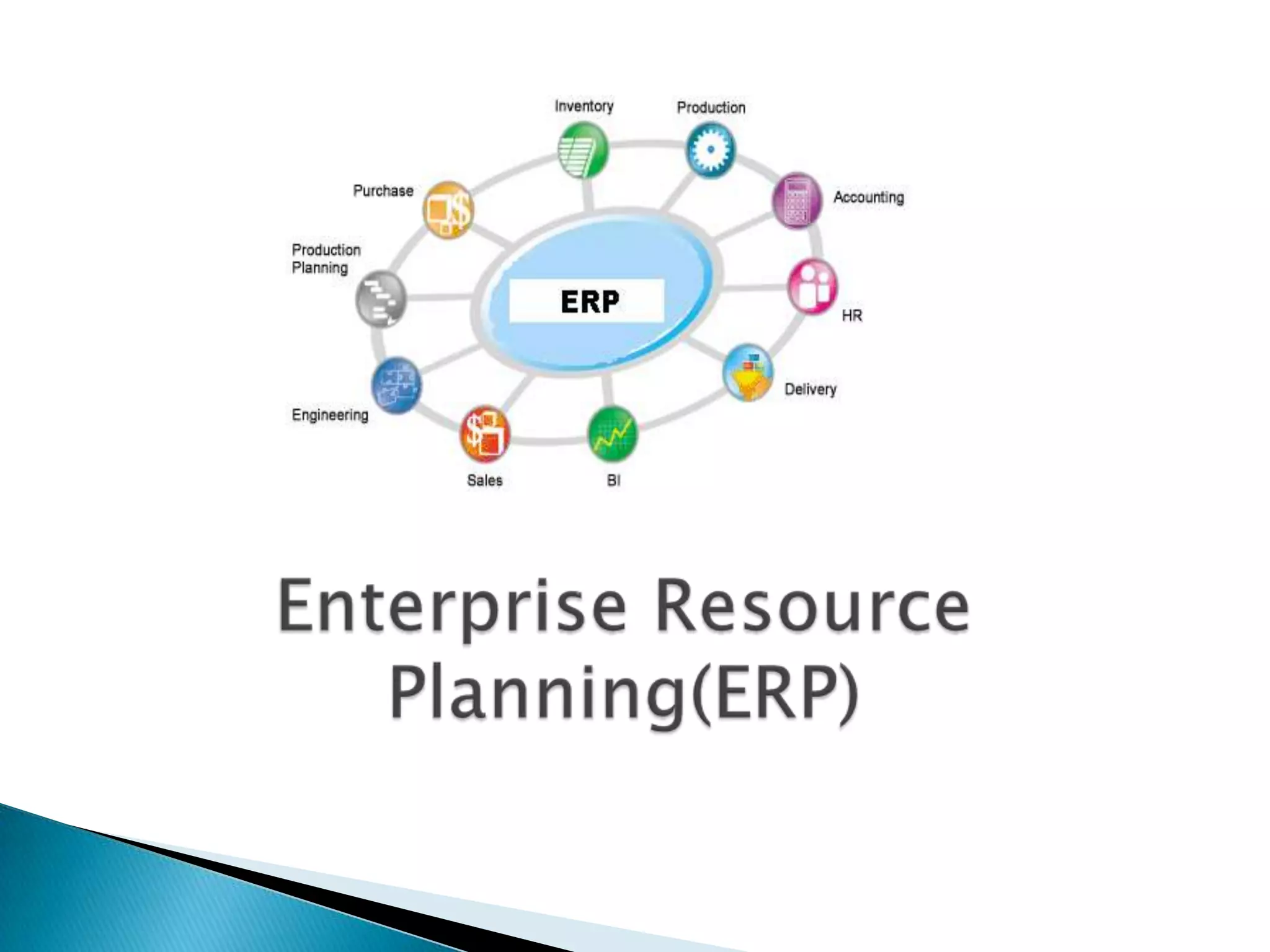
ERP is an integrated information system that serves all departments within an enterprise. Evolving out of the manufacturing industry, ERP implies the use of packaged software rather than proprietary software written by or for one customer.It is a software solution that addresses the Enterprise needs, taking a process view of the overall organization to meet the goals, by tightly integrating all functions and under a common software platformAn ERP system can include software for manufacturing, order entry, accounts receivable and payable, general ledger, purchasing, warehousing, transportation and human resources.The major ERP vendors are SAP, Oracle (PeopleSoft and J.D. Edwards), SSA Global (Baan) and Microsoft.What is ERP?
Evolution in ERP1960’s - Systems Just for Inventory control1970’s - MRP – Material Requirement Planning (Inventory with material planning & procurement)1980’s - MRP II – Manufacturing Resource Planning (Extended MRP to shop floor & distribution Mgnt.)Mid1990’s - ERP – Enterprise Resource Planning (Covering all the activities of an Enterprise)2000 onwards – ERP II – Collaborative Commerce (Extending ERP to external business entities)
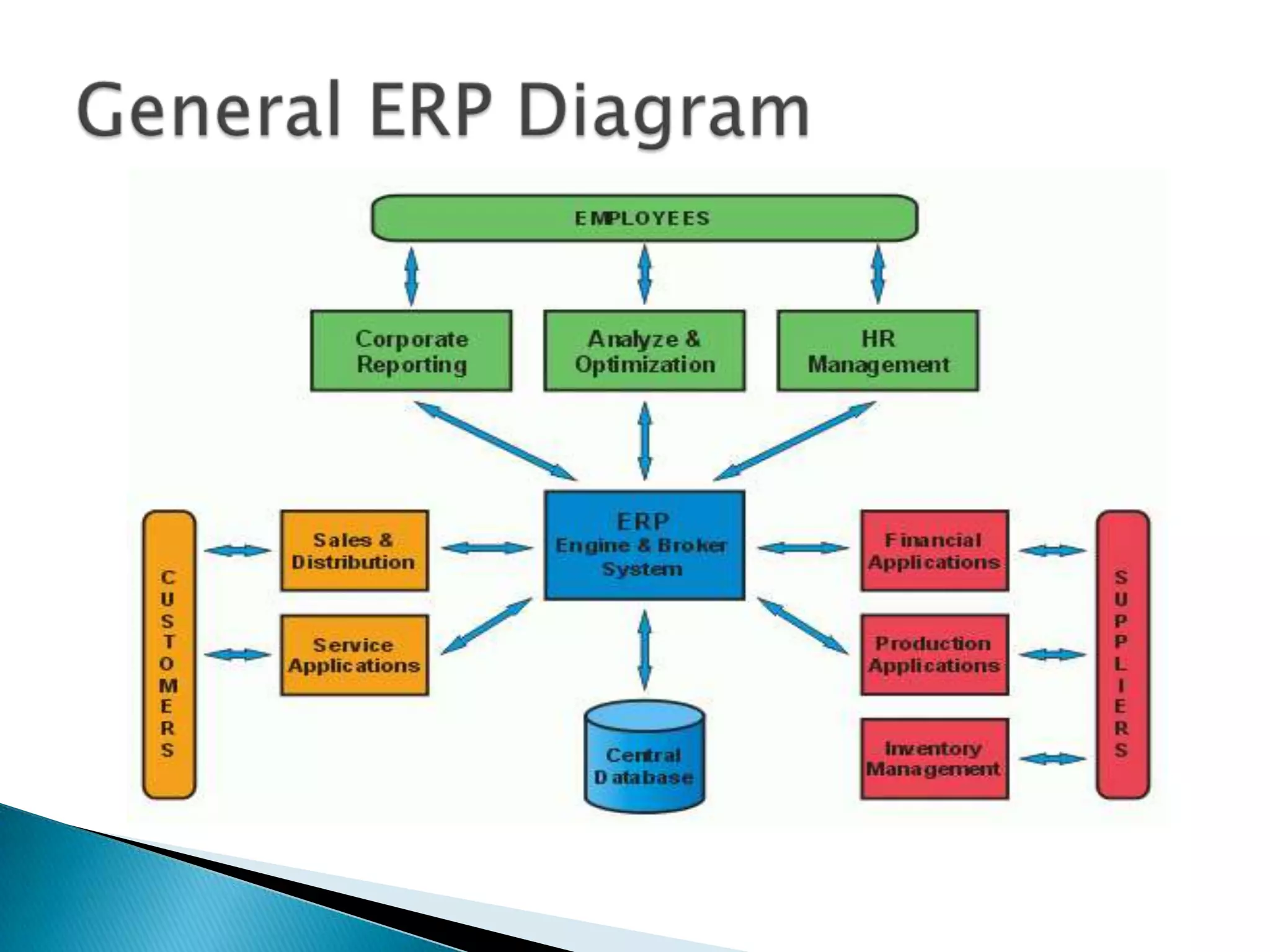
General ERP Diagram
HR DepartmentReservation (online, offline) Ticket cancellationTrain schedulingPayroll systemTenderWarehouse managementPantry cart managementCleaning and maintenance department (station and train)ERP System for Railway System
ERP's scope usually implies significant changes to staff work processes and practices.Generally, three types of services are available to help implement such changes ConsultingCustomization Support.Implementation time depends on business size, number of modules, customization, the scope of process changes, and the readiness of the customer to take ownership for the project.Modular ERP systems can be implemented in stages. As Railway system is large project for a large enterprise so it  consumes about 14 months and requires around 150 consultants.Customization can substantially increase implementation times.Implementation of ERP for Railway System
Reliable information access: Common DBMS, consistent and accurate data, improved reports.Avoid data and operations redundancy: Modules access same data from the central database, avoids multiple data input and update operations.Delivery and cycle time reduction: Minimizes retrieving and reporting delays.Cost reduction: Time savings, improved process and organizational decisions control.Easy adaptability: Changes in business processes easy to adapt and restructure. Improved scalability: Structured and modular design easy to extend.Global outreach: Extended modules allow remote process supervision and information tracking.E-Commerce, e-business: Internet commerce effectively reaching global customers. Benefits of ERP
Customization is problematic.Re–engineering business processes to fit the ERP system may damage competitiveness and/or divert focus from other critical activitiesERP can cost more than less integrated and/or less comprehensive solutions.High switching costs increase vendor negotiating power support, maintenance and upgrade expenses.Overcoming resistance to sharing sensitive information between departments can divert management attention.Integration of truly independent businesses can create unnecessary dependencies.Extensive training requirements take resources from daily operations.Disadvantages of ERP
ConclusionThe growing information needs of an enterprise make it imperative to improve or replace old systems. Especially under the present business environment, where the globalization has been initiated, full convertibility is coined.Infrastructure Projects are nearing completion, and it is expected that the whole business system will undergo a major shift.Implementation of ERP solutions is one of the largest drivers of growth in the consultancy business. The introduction of such a large and complex software like     ERP,  enables an organization to integrate their manufacturing, finance and marketing operations at all levels, is in itself a challenge, since it calls for technical and functional skills and a change in user mindsets.
Thank you..

Erp

  • 1.
  • 2.
    ERP is anintegrated information system that serves all departments within an enterprise. Evolving out of the manufacturing industry, ERP implies the use of packaged software rather than proprietary software written by or for one customer.It is a software solution that addresses the Enterprise needs, taking a process view of the overall organization to meet the goals, by tightly integrating all functions and under a common software platformAn ERP system can include software for manufacturing, order entry, accounts receivable and payable, general ledger, purchasing, warehousing, transportation and human resources.The major ERP vendors are SAP, Oracle (PeopleSoft and J.D. Edwards), SSA Global (Baan) and Microsoft.What is ERP?
  • 3.
    Evolution in ERP1960’s- Systems Just for Inventory control1970’s - MRP – Material Requirement Planning (Inventory with material planning & procurement)1980’s - MRP II – Manufacturing Resource Planning (Extended MRP to shop floor & distribution Mgnt.)Mid1990’s - ERP – Enterprise Resource Planning (Covering all the activities of an Enterprise)2000 onwards – ERP II – Collaborative Commerce (Extending ERP to external business entities)
  • 4.
  • 5.
    HR DepartmentReservation (online,offline) Ticket cancellationTrain schedulingPayroll systemTenderWarehouse managementPantry cart managementCleaning and maintenance department (station and train)ERP System for Railway System
  • 6.
    ERP's scope usuallyimplies significant changes to staff work processes and practices.Generally, three types of services are available to help implement such changes ConsultingCustomization Support.Implementation time depends on business size, number of modules, customization, the scope of process changes, and the readiness of the customer to take ownership for the project.Modular ERP systems can be implemented in stages. As Railway system is large project for a large enterprise so it consumes about 14 months and requires around 150 consultants.Customization can substantially increase implementation times.Implementation of ERP for Railway System
  • 7.
    Reliable information access:Common DBMS, consistent and accurate data, improved reports.Avoid data and operations redundancy: Modules access same data from the central database, avoids multiple data input and update operations.Delivery and cycle time reduction: Minimizes retrieving and reporting delays.Cost reduction: Time savings, improved process and organizational decisions control.Easy adaptability: Changes in business processes easy to adapt and restructure. Improved scalability: Structured and modular design easy to extend.Global outreach: Extended modules allow remote process supervision and information tracking.E-Commerce, e-business: Internet commerce effectively reaching global customers. Benefits of ERP
  • 8.
    Customization is problematic.Re–engineeringbusiness processes to fit the ERP system may damage competitiveness and/or divert focus from other critical activitiesERP can cost more than less integrated and/or less comprehensive solutions.High switching costs increase vendor negotiating power support, maintenance and upgrade expenses.Overcoming resistance to sharing sensitive information between departments can divert management attention.Integration of truly independent businesses can create unnecessary dependencies.Extensive training requirements take resources from daily operations.Disadvantages of ERP
  • 9.
    ConclusionThe growing informationneeds of an enterprise make it imperative to improve or replace old systems. Especially under the present business environment, where the globalization has been initiated, full convertibility is coined.Infrastructure Projects are nearing completion, and it is expected that the whole business system will undergo a major shift.Implementation of ERP solutions is one of the largest drivers of growth in the consultancy business. The introduction of such a large and complex software like ERP, enables an organization to integrate their manufacturing, finance and marketing operations at all levels, is in itself a challenge, since it calls for technical and functional skills and a change in user mindsets.
  • 10.