OUTSOURCING
IT OUTSOURCING

APPLICATION DEVELOPMENT


IT OUTSOURCING
GOVERNANCE
Learning Objectives


• At the completion of this
  session you will be able to:
   – Describe what outsourcing
     Governance means and why it
     is important
   – Explain the different aspects of
     Governance
   – List some best practices used
     in implementing Governance


                       Learning Objectives
Topics Index


1
    Governance Defined


2
    Different Aspects of Governance         In this session we are going
                                            to:
    Governance Best Practices
                                            • Understand the role and
3                                           importance of Governance
                                            in Outsourcing
4
    Summary


                                  Topics Index
Topics Index


1
    Governance Defined


2
    Different Aspects of Governance
                                            In this topic we are going to:
    Governance Best Practices
                                            • Understand the definition
3                                           of Governance

4
    Summary


                                  Topics Index
What is Public Governance?
Public Governance


• A government runs programs for the benefit of the
  citizens of a country
• The funding for the programs comes from taxes, loans
  and aid
• The funds are deployed by the government to benefit
  the citizens
• The purpose of public governance is
   – To ensure that the governments use the capital in the best
     possible manner for the benefit of its citizens


                                Governance
What is Corporate Governance?
Corporate Governance


• A business deploys capital in the best
  possible manner to generate the best
  returns
• The capital is supplied by “Principals”
• The business is run by “Agents”
• The purpose of corporate governance
  is
   – To ensure that the “Agents” use the capital
     in the best possible manner on behalf of
     the “Principals”
   – The stakeholders’ interests are protected


                                Governance
DISCUSSION


Think about what you have learnt about
outsourcing and what role Governance
is likely to play
Industry Definition of Outsourcing


   Outsourcing is a long-term, results-oriented
   business relationship with a specialized service
                      provider


Source: International Association of Outsourcing Professionals (IAOP)


                                Governance
Outsourcing for Cost Advantage


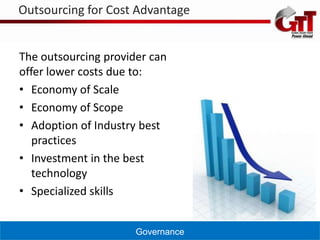
The outsourcing provider can
offer lower costs due to:
• Economy of Scale
• Economy of Scope
• Adoption of Industry best
   practices
• Investment in the best
   technology
• Specialized skills


                      Governance
Outsourcing to Free-Up time and capital


Outsourcing frees up executive time by:
• Moving accountability of results to
  the provider
• Reducing staff engaged in support
  activities

Outsourcing frees up capital by:
• Moving some of the capital
  investment to the provider


                       Governance
Outsourcing to Improve Results


An Outsourcing provider is able to
improve outcomes from business
processes because:
• Of investments in industry best
   practices
• Specialized pool of human resources
• Experience and track record in
   providing the service
• A commitment to continuous
   improvement


                         Governance
Outsourcing Governance


• A business outsources in anticipation of
  benefits like cost savings, and improvement
  of business results
• Outsourcing Governance is the set of
  processes for ensuring that these benefits
  are actually obtained and the relationship is
  successful in the long term
• Governance helps to:
   –   Make outsourcing successful
   –   Reduce risk of failure
   –   Measure actual results
   –   Take corrective action if required


                                   Governance
Topics Index


1
    Governance Defined


2
    Different Aspects of Governance
                                            In this topic we are going to:
    Governance Best Practices
                                            • Understand the different
3                                           aspects of Governance

4
    Summary


                                  Topics Index
Aspects of Governance


• Relationship Management
• Service Request Management
• Performance Management
• Change Management
• Security, Business Continuity,
  Disaster Recovery
• Operations Management
• Financial Management
• Contract Management

                        Governance
Relationship Management


• People do business with other people
• Trust is the basis of good working
  relationships
• Outsourcing Relationship Management
  is done through a disciplined process
  which includes:
  – Creation of an organization structure that mirrors
    that of the customer
  – Implementation of practices like regular customer
    meetings, operations reviews etc
  – A framework to measure the progress of
    relationships at all levels of the organization

                                 Governance
Service Request Management


Outsourcing is about getting work done based on
contractual commitments and delivering the
promised benefits.

The actual flow of work is managed through “Service
Requests”. The elements of Service Request Management
are:
• A process for clear hand-offs to and from the vendor
• A protocol to agree on when a piece of work has been
   finished
• Management of the “workflow”
• Tools and infrastructure required to enable the handoffs


                                 Governance
Performance Management


The goal of Performance Management is to
ensure that the performance of the vendor
is measured, and compared against agreed
targets.

• Establish Service Level Agreements
• Measure performance against SLAs
• Implement process for analyzing shortcomings
  and taking corrective action


                           Governance
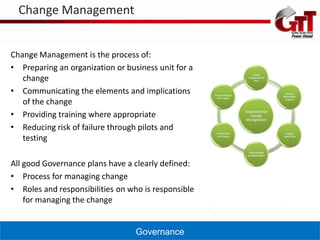
Change Management


Change Management is the process of:
• Preparing an organization or business unit for a
   change
• Communicating the elements and implications
   of the change
• Providing training where appropriate
• Reducing risk of failure through pilots and
   testing

All good Governance plans have a clearly defined:
• Process for managing change
• Roles and responsibilities on who is responsible
    for managing the change


                                  Governance
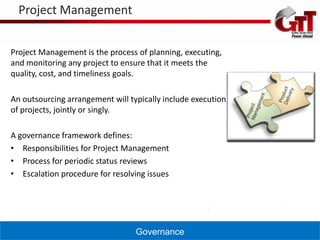
Project Management


Project Management is the process of planning, executing,
and monitoring any project to ensure that it meets the
quality, cost, and timeliness goals.

An outsourcing arrangement will typically include execution
of projects, jointly or singly.

A governance framework defines:
• Responsibilities for Project Management
• Process for periodic status reviews
• Escalation procedure for resolving issues


                                  Governance
Security, Business Continuity, Disaster Recovery


Since an outsourcing arrangement causes work to be
carried out outside the enterprise, it is important that
key risks are formally addressed.

Therefore a Governance framework defines:
• How the premises, assets, and information is
   secured from unauthorized use
• How work will be carried out in case of temporary
   disruption of information systems, unavailability of
   people etc.
• The backup plans in case of a natural or man-made
   disaster like flood, earthquake, or terrorist attack


                                    Governance
Operations Management


Operations Management is the process of
managing the people, process, and tools used
to delivery the contracted work.

A Governance framework defines:
• How people will be managed, the process
   for moving people in and out of the
   engagement
• Knowledge Management
• Organization structure for managing the
   operations
• Management of the tools and infrastructure
   used for delivering the work
• Status reporting

                                Governance
Financial Management


An outsourcing contract lays out when, how, and how much a vendor
is to be paid for services. It also lays out penalties and incentives for
performance.

A Governance framework defines:
• A process for billing and payments
• A process for meeting statutory obligations
• A process for resolving any conflicts
• A process for making new investments


                                    Governance
Contract Management

An outsourcing contract lays out the terms of how the customer and
   vendor will exchange services. A contract defines:
• Nature of work to be delivered
• Acceptance criteria
• Payment terms
• Responsibilities of the customer
• Responsibilities of the vendor
• Conflict resolution mechanism
• Any other agreed terms like confidentiality etc.

Part of Governance is monitoring the performance against the
   contract, and taking correcting action where required. This work is
   usually done the a group called “Vendor Management”


                                  Governance
Topics Index


1
    Governance Defined


    Different Aspects of Governance
2                                           In this topic we are going to:
                                            • Understand some best
3
    Governance Best Practices               practices used in
                                            implementing Governance

4
    Summary


                                  Topics Index
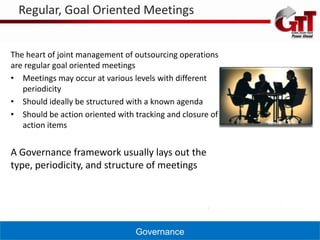
Regular, Goal Oriented Meetings


The heart of joint management of outsourcing operations
are regular goal oriented meetings
• Meetings may occur at various levels with different
   periodicity
• Should ideally be structured with a known agenda
• Should be action oriented with tracking and closure of
   action items


A Governance framework usually lays out the
type, periodicity, and structure of meetings


                                 Governance
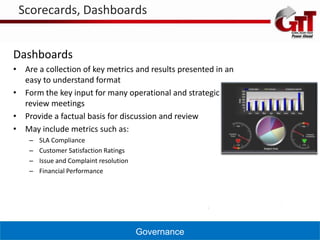
Scorecards, Dashboards


Dashboards
• Are a collection of key metrics and results presented in an
  easy to understand format
• Form the key input for many operational and strategic
  review meetings
• Provide a factual basis for discussion and review
• May include metrics such as:
    –   SLA Compliance
    –   Customer Satisfaction Ratings
    –   Issue and Complaint resolution
    –   Financial Performance


                                         Governance
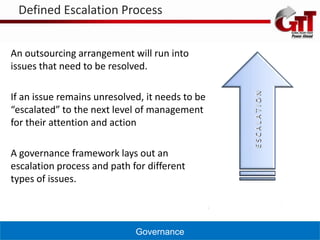
Defined Escalation Process


An outsourcing arrangement will run into
issues that need to be resolved.


                                                 ESCALATION
If an issue remains unresolved, it needs to be
“escalated” to the next level of management
for their attention and action

A governance framework lays out an
escalation process and path for different
types of issues.


                             Governance
Topics Index


1
    Governance Defined


2
    Different Aspects of Governance
                                            In this topic we are going to:
    Governance Best Practices
                                            • Summarize our discussion
3                                           regarding Governance

4
    Summary


                                  Topics Index
Summing Up


• An outsourcing arrangement is started with a clear
  understanding of expected benefits
• Outsourcing carries some risks which may derail the expected
  benefits, or even put the customer’s business at risk
• Governance is necessary to ensure that the risks to success
  are systematically reduced, and expected benefits are
  obtained
• Governance is a set of processes around relationship,
  operations, contract, and performance management
• Good Governance is critical for the success of outsourcing


                         Governance
Thank You

. Managing the Outsourcing _Governance final

  • 1.
  • 2.
    Learning Objectives • Atthe completion of this session you will be able to: – Describe what outsourcing Governance means and why it is important – Explain the different aspects of Governance – List some best practices used in implementing Governance Learning Objectives
  • 3.
    Topics Index 1 Governance Defined 2 Different Aspects of Governance In this session we are going to: Governance Best Practices • Understand the role and 3 importance of Governance in Outsourcing 4 Summary Topics Index
  • 4.
    Topics Index 1 Governance Defined 2 Different Aspects of Governance In this topic we are going to: Governance Best Practices • Understand the definition 3 of Governance 4 Summary Topics Index
  • 5.
    What is PublicGovernance?
  • 6.
    Public Governance • Agovernment runs programs for the benefit of the citizens of a country • The funding for the programs comes from taxes, loans and aid • The funds are deployed by the government to benefit the citizens • The purpose of public governance is – To ensure that the governments use the capital in the best possible manner for the benefit of its citizens Governance
  • 7.
    What is CorporateGovernance?
  • 8.
    Corporate Governance • Abusiness deploys capital in the best possible manner to generate the best returns • The capital is supplied by “Principals” • The business is run by “Agents” • The purpose of corporate governance is – To ensure that the “Agents” use the capital in the best possible manner on behalf of the “Principals” – The stakeholders’ interests are protected Governance
  • 9.
    DISCUSSION Think about whatyou have learnt about outsourcing and what role Governance is likely to play
  • 10.
    Industry Definition ofOutsourcing Outsourcing is a long-term, results-oriented business relationship with a specialized service provider Source: International Association of Outsourcing Professionals (IAOP) Governance
  • 11.
    Outsourcing for CostAdvantage The outsourcing provider can offer lower costs due to: • Economy of Scale • Economy of Scope • Adoption of Industry best practices • Investment in the best technology • Specialized skills Governance
  • 12.
    Outsourcing to Free-Uptime and capital Outsourcing frees up executive time by: • Moving accountability of results to the provider • Reducing staff engaged in support activities Outsourcing frees up capital by: • Moving some of the capital investment to the provider Governance
  • 13.
    Outsourcing to ImproveResults An Outsourcing provider is able to improve outcomes from business processes because: • Of investments in industry best practices • Specialized pool of human resources • Experience and track record in providing the service • A commitment to continuous improvement Governance
  • 14.
    Outsourcing Governance • Abusiness outsources in anticipation of benefits like cost savings, and improvement of business results • Outsourcing Governance is the set of processes for ensuring that these benefits are actually obtained and the relationship is successful in the long term • Governance helps to: – Make outsourcing successful – Reduce risk of failure – Measure actual results – Take corrective action if required Governance
  • 15.
    Topics Index 1 Governance Defined 2 Different Aspects of Governance In this topic we are going to: Governance Best Practices • Understand the different 3 aspects of Governance 4 Summary Topics Index
  • 16.
    Aspects of Governance •Relationship Management • Service Request Management • Performance Management • Change Management • Security, Business Continuity, Disaster Recovery • Operations Management • Financial Management • Contract Management Governance
  • 17.
    Relationship Management • Peopledo business with other people • Trust is the basis of good working relationships • Outsourcing Relationship Management is done through a disciplined process which includes: – Creation of an organization structure that mirrors that of the customer – Implementation of practices like regular customer meetings, operations reviews etc – A framework to measure the progress of relationships at all levels of the organization Governance
  • 18.
    Service Request Management Outsourcingis about getting work done based on contractual commitments and delivering the promised benefits. The actual flow of work is managed through “Service Requests”. The elements of Service Request Management are: • A process for clear hand-offs to and from the vendor • A protocol to agree on when a piece of work has been finished • Management of the “workflow” • Tools and infrastructure required to enable the handoffs Governance
  • 19.
    Performance Management The goalof Performance Management is to ensure that the performance of the vendor is measured, and compared against agreed targets. • Establish Service Level Agreements • Measure performance against SLAs • Implement process for analyzing shortcomings and taking corrective action Governance
  • 20.
    Change Management Change Managementis the process of: • Preparing an organization or business unit for a change • Communicating the elements and implications of the change • Providing training where appropriate • Reducing risk of failure through pilots and testing All good Governance plans have a clearly defined: • Process for managing change • Roles and responsibilities on who is responsible for managing the change Governance
  • 21.
    Project Management Project Managementis the process of planning, executing, and monitoring any project to ensure that it meets the quality, cost, and timeliness goals. An outsourcing arrangement will typically include execution of projects, jointly or singly. A governance framework defines: • Responsibilities for Project Management • Process for periodic status reviews • Escalation procedure for resolving issues Governance
  • 22.
    Security, Business Continuity,Disaster Recovery Since an outsourcing arrangement causes work to be carried out outside the enterprise, it is important that key risks are formally addressed. Therefore a Governance framework defines: • How the premises, assets, and information is secured from unauthorized use • How work will be carried out in case of temporary disruption of information systems, unavailability of people etc. • The backup plans in case of a natural or man-made disaster like flood, earthquake, or terrorist attack Governance
  • 23.
    Operations Management Operations Managementis the process of managing the people, process, and tools used to delivery the contracted work. A Governance framework defines: • How people will be managed, the process for moving people in and out of the engagement • Knowledge Management • Organization structure for managing the operations • Management of the tools and infrastructure used for delivering the work • Status reporting Governance
  • 24.
    Financial Management An outsourcingcontract lays out when, how, and how much a vendor is to be paid for services. It also lays out penalties and incentives for performance. A Governance framework defines: • A process for billing and payments • A process for meeting statutory obligations • A process for resolving any conflicts • A process for making new investments Governance
  • 25.
    Contract Management An outsourcingcontract lays out the terms of how the customer and vendor will exchange services. A contract defines: • Nature of work to be delivered • Acceptance criteria • Payment terms • Responsibilities of the customer • Responsibilities of the vendor • Conflict resolution mechanism • Any other agreed terms like confidentiality etc. Part of Governance is monitoring the performance against the contract, and taking correcting action where required. This work is usually done the a group called “Vendor Management” Governance
  • 26.
    Topics Index 1 Governance Defined Different Aspects of Governance 2 In this topic we are going to: • Understand some best 3 Governance Best Practices practices used in implementing Governance 4 Summary Topics Index
  • 27.
    Regular, Goal OrientedMeetings The heart of joint management of outsourcing operations are regular goal oriented meetings • Meetings may occur at various levels with different periodicity • Should ideally be structured with a known agenda • Should be action oriented with tracking and closure of action items A Governance framework usually lays out the type, periodicity, and structure of meetings Governance
  • 28.
    Scorecards, Dashboards Dashboards • Area collection of key metrics and results presented in an easy to understand format • Form the key input for many operational and strategic review meetings • Provide a factual basis for discussion and review • May include metrics such as: – SLA Compliance – Customer Satisfaction Ratings – Issue and Complaint resolution – Financial Performance Governance
  • 29.
    Defined Escalation Process Anoutsourcing arrangement will run into issues that need to be resolved. ESCALATION If an issue remains unresolved, it needs to be “escalated” to the next level of management for their attention and action A governance framework lays out an escalation process and path for different types of issues. Governance
  • 30.
    Topics Index 1 Governance Defined 2 Different Aspects of Governance In this topic we are going to: Governance Best Practices • Summarize our discussion 3 regarding Governance 4 Summary Topics Index
  • 31.
    Summing Up • Anoutsourcing arrangement is started with a clear understanding of expected benefits • Outsourcing carries some risks which may derail the expected benefits, or even put the customer’s business at risk • Governance is necessary to ensure that the risks to success are systematically reduced, and expected benefits are obtained • Governance is a set of processes around relationship, operations, contract, and performance management • Good Governance is critical for the success of outsourcing Governance
  • 32.

Editor's Notes

  • #6 The facilitator should introduce this video by saying – Let us look at some general concepts around governance. As an example let us look at what Public Governance means. We will extend these principles to Outsourcing Governance.http://www.youtube.com/watch?v=KXd70r75V2w
  • #8 The facilitator should introduce this video by saying – Let us look at what Governance means in some commonly used contexts. After understanding the meaning of governance in some common situations, we will apply the same principle to Outsourcing Governance.http://www.youtube.com/watch?v=KXd70r75V2w
  • #10 Facilitator should engage the class in a discussion on their thinking about what Governance may mean in the outsourcing context. (Limit the discussion to about 5 minutes)Key Points:Governance is about ensuring investments are deployed in the right areasGovernance is about reducing the risk of failure (or increasing chances of delivering the desired results)Interests of stakeholders are protected – customer, vendor,
  • #11 This has been covered in a previous module.The services contracted for (including manufacturing services) may encompass a single activity, a set of activities or a complete business process.Long Term implies the INTENT of the customer to essentially divest itself of the capacity to perform the work itself, choosing instead to acquire the services from the marketplace of available providers.Results Oriented means that the service provider is assuming responsibility for the people, processes, and technologies employed along with responsibility to ensure that those resources deliver the results for which the customer has contracted. Responsibility for results is what differentiates outsourcing from the more traditional supplier, supplemental staffing and task-level contracting relationshipsSpecialized Service Provider means that the service provider specializes in performing the services that are being outsourced
  • #12 Economy of Scale – since the provider does the same thing for a lot of customers, they can invest in expensive but productive equipment for economy of scale. For example investment in automation only makes sense for volumes beyond a thresholdEconomy of Scope – since the provider does only a few things, they can do it well by focusing all their attention and resources on those things.Adoption of Industry Best practices – Since the vendor only focuses on the few things they are doing, they can scout for and adopt the industry best practices. In fact they have to do this to remain competitive of the provider of the outsourced services in that areaInvestment in best technology – Related to point#1Specialized Skills – The vendor can attract the best talent in that area due to their ability to provide challenging opportunities to the staff
  • #13 Executives in the customer organization do not have to be concerned with the details of the process, they only need to focus on the resultsStaff for support activities is reduced – for example if IT infrastructure is outsourced, the customer organization does not have to worry about managing the staff, paying their salaries, seating space for them etc.Freeing up capital – if we take the example of outsourcing the Financial Accounting process, the customer organization need not invest in any ERP software for this process. This investment is moved to the vendor.
  • #14 The outsourcing provider provides services to multiple customers and invests in learning the industry best practices. This enables them to service their customers betterThe outsourcing provider maintains a pool of specialized and trained people to meet the needs of their customers. The provider is able to retain this pool of talent because they are able to offer challenging and diverse assignments to this staffDue to their diverse client base, providers are able to gather experience in different industries, countries etc. For example a BPO specializing in customer service, is able to learn the nuances of customer service in different industries and use this experience for new customersSince the outsourcing provider provides these services as a business, they have to invest in continuous improvement so that they stay ahead of THEIR competitors and grab more business on the basis of their capability.
  • #15 Governance is practiced by a customer as well as the vendor to ensure that the outsourcing engagement is successful, and the results improve over time. Therefore governance has short term as well as long term objectives.Governance is not just about measuring and ensuring benefits. It is also about softer aspects like relationship building which ensures long term success of the engagement. Thus it is not just about the end, but also about the means.
  • #17 There are many different aspects of governance, and a robust governance framework incorporates all of these aspects. All of these are covered in more detail later in the presentation.
  • #18 The discipline of Relationship management is important to build lasting relationships between the people in the two organizations. This helps build trust, and remove any roadblocks to the success of the relationship. Building relationships also helps identify opportunities for greater collaboration.
  • #19 Good service request management ensures that accountability for results is clear. Let us look at an example where a customer has outsourced the maintenance for a software application. All upgrades to the application are performed by the vendor at the request of the customer. Service Request management would include: A process step for documenting the requirements and handing over the requirements to the vendor in a formal manner. This may happen through an email or by uploading the request in a tool The vendor would be expected to acknowledge that the request has been received and to provide feedback on the estimated time it will take to complete it When the agreed work has been completed, the Service Request Management process will specify how to ensure that it is finally closed. For example, the testing manager, and the customer manager may have to acknowledge the completion through an email, or through a workflow tool The routing of the work to different people is accomplished through a “workflow” which may be manual or managed through a tool Workflow tools are usually used to manage the Service Requests
  • #20 Disciplined Performance Management ensures that the anticipated benefits from the outsourcing arrangement are obtained. For example in an Application Support outsourcing agreement, the following SLA’s may be put in place.Response Time: Within 15 minutes of logging a callResolution Time: Level-1: 1 hour, Level-2: 16 hours, Level-3: one weekThe actual performance of the vendor is measured for all the service requests, and then tracked against the SLAs. If the vendor does not perform to the SLAs, shortcomings are analyzed and corrective actions taken.
  • #21 The Governance plan for an Application Development outsourcing engagement will include Change Management plans including: Communication of implementation timelines Migration of users from existing systems to the new one Training of end-users on the new system A plan for systematic redressal of any issues after implementation
  • #22 Outsourced projects may be completely managed by the vendor, or there may be shared responsibility. It is important to be clear about who is responsible for managing the project to completion, so that accountability for results can be established.
  • #23 Examples:Security: Non Disclosure Agreements, implementation of physical and information securityBCP: Documented and tested plans for alternative way of working in case of system downtimeDR: Alternative sites preparation for switch over in case of disaster, periodic Disaster Recovery testing
  • #24 Day to day running of the outsourced work.Some aspects of people management may be: A defined process for moving people in and out of the project Moving someone out may require consent of the customer Moving someone in may require approval of the customer Such movement may require a working overlap of a few weeks or more in order to complete knowledge transfer Skill development of staff to ensure that their productivity improves over timeKnowledge Management refers to storing information is a structured manner so that it can be retrieved when required, and dependence on specific people is reduced.
  • #25 New investments could be in people, tools or infrastructure. For example the vendor may add one more location from where services will be provided in the interest of DR. Governance would include a process for determining who will make this investment
  • #26 In large organizations Contract Management is done by a specialized group called the Vendor Management group. They review and negotiate contracts, update contracts based on new requirements, and work with the legal team to enforce contracts when there is a disagreement.As an example, if the vendor’s company is acquired by a larger company, the customer may have to reevaluate if they want to continued to do business with the new company, and if the contract needs to be changed suitably to work with the new company.Similarly, when a customer’s company is acquired by another company, the vendor development group may need to evaluate if the outsourcing relationship should continue. This is because the acquiring company may already have a set of vendor that they want to do business with.
  • #28 For example, the operational managers from both sides may meet once a week to review day to day issues and progressThe Senior Managers from both sides may meet once a month to deal with any escalations, and to assess SLA complianceVice Presidents or Business Unit heads may meet once a quarter to review financials, people issues, and SLA complianceCEO’s may meet once a year to take a strategic view of the engagement, identify new opportunities for collaboration, and to discuss any systemic problems
  • #29 Scorecards make discussions about performance and status objective. These data based discussion can then focus on resolving issues and continuous improvement rather than assigning blame
  • #30 A defined escalation path and process ensures that the right attention is paid to issues. For example a project manager will know that the issue will get escalated to a VP in case it is not resolved within the required timeframe