Reema[ M110007MS]
 Vivek[ M110009MS]
Meethu [M110016MS]
Prabhu [M110017MS]
 Kalyan[ M110021MS]
Present Scenario
 Realization of benefits
        ROI follows W pattern
 Time overrun
 Managing the gap
        Difficulty in managing the change
        Reengineering
 Difficulty in maintenance
        stop supporting early versions and products –JDE
        Eg: Siemens
 No proper metric for measuring the performance at the
  checkpoints
 Availability of best of breed and open source software
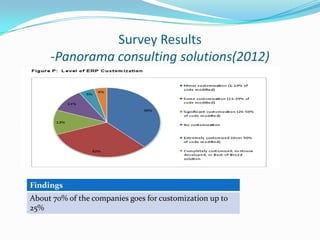
Survey Results
     -Panorama consulting solutions(2012)


Findings
About 70% of the companies goes for customization up to
25%
Survey Results
-Panorama consulting solutions(2012)
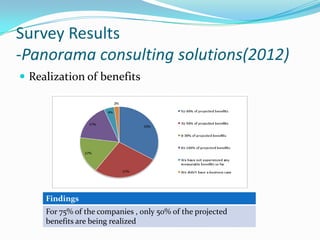
 Realization of benefits


     Findings
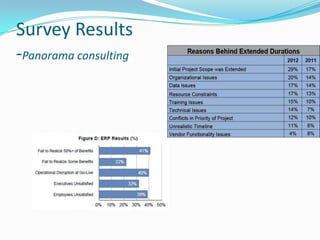
     For 75% of the companies , only 50% of the projected
     benefits are being realized
Survey Results
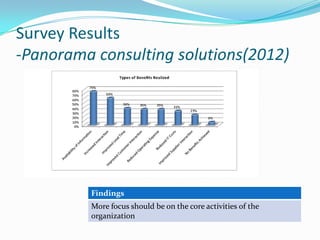
-Panorama consulting solutions(2012)


         Findings
         More focus should be on the core activities of the
         organization
Current situation
 Majority of the fortune 500 & 1000companies have
  implemented ERP
 ERP implemented companies need less support from
  the vendor
       Internal IT support
 Potential for ERP – SME
 More number of people (SME) switching to open
 source ERP
Survey Results
-Panorama consulting
Survey Results
-Panorama consulting
Comparison in the SME segment-SaaS Vs On Premise

                      SaaS[Software as a   On Premise
                      Service]

 Months               11.6                 18.4
 Cost[% of annual     6.2                  6.9
 revenue]

 Executive level of   52.6%                50%
 satisfaction
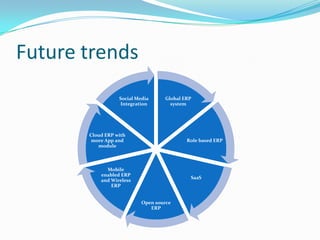
Future trends
                  Social Media     Global ERP
                   Integration       system


       Cloud ERP with
        more App and                       Role based ERP
          module


             Mobile
           enabled ERP
                                            SaaS
           and Wireless
               ERP


                           Open source
                              ERP
Future trends in ERP

 The rapid consumerization of technology over the past
  few years has lead enterprises to move on to cloud and
  new trends viz wireless technology
 ERP systems will become easier to use, while the
  cloud, mobile devices and social media will have
  an impact on products on offer to manufacturers.
 The ERP of the future promises to be simplified, more
  accessible and easier to use, shaped by trends that
  began taking hold this year.
 “What you’re seeing now is the beginnings of major
  trends — cloud computing, mobility and analytics
  — that will get fleshed out in the years beyond.”
Cloud Computing
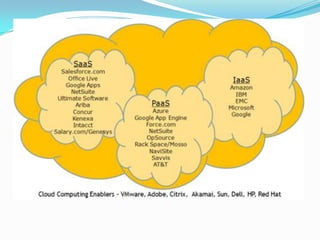
 Cloud computing, which enables companies to access
  ERP software over the Internet, has already shown
  vendors that companies value ERP that can be more
  easily installed and rapidly consumed
 Cloud-based ERP services will also evolve in the future
  to become more integrated both with other clouds and
  with installed ERP systems
 First, ERP must become more simplified, both in
  terms of the deployment of the system and aligning it
  with an organization’s business processes.
The Future of ERP
  Lines between SCM, CRM, and ERP will continue to
  blur
 Internet – continue to help organizations integrate
  data and process across functional departments
 Interface – customizable employee browsers
 Wireless technology – support a mobile workforce


                                                        14
ERP INfor ERP are arising where clients can opt for pay-
 New models
             CLOUD COMPUTING
 per-use or application hosting services, switching capacity and
 functionality on and off as required.

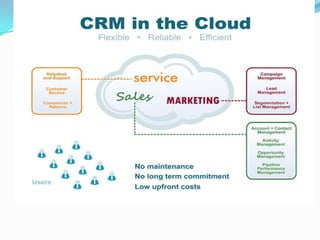
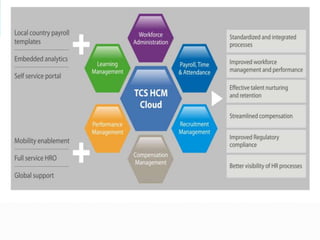
 ERP venders already started CRM,HCM(Human Capital
 Management) and PLM(Product Lifecycle Management) for
 the industry needs.

 The runaway popularity of mobile devices such as
 smartphones and tablet computers is further driving a trend
 towards improved availability of enterprise information
 though Web services
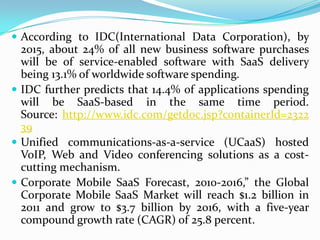
 According to IDC(International Data Corporation), by
  2015, about 24% of all new business software purchases
  will be of service-enabled software with SaaS delivery
  being 13.1% of worldwide software spending.
 IDC further predicts that 14.4% of applications spending
  will be SaaS-based in the same time period.
  Source: http://www.idc.com/getdoc.jsp?containerId=2322
  39
 Unified communications-as-a-service (UCaaS) hosted
  VoIP, Web and Video conferencing solutions as a cost-
  cutting mechanism.
 Corporate Mobile SaaS Forecast, 2010-2016,” the Global
  Corporate Mobile SaaS Market will reach $1.2 billion in
  2011 and grow to $3.7 billion by 2016, with a five-year
  compound growth rate (CAGR) of 25.8 percent.
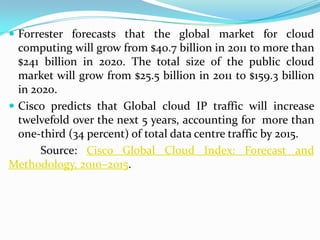
 Forrester forecasts that the global market for cloud
  computing will grow from $40.7 billion in 2011 to more than
  $241 billion in 2020. The total size of the public cloud
  market will grow from $25.5 billion in 2011 to $159.3 billion
  in 2020.
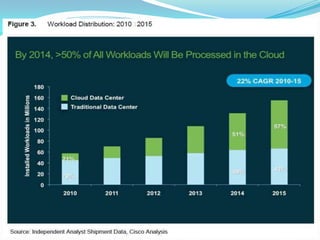
 Cisco predicts that Global cloud IP traffic will increase
  twelvefold over the next 5 years, accounting for more than
  one-third (34 percent) of total data centre traffic by 2015.
       Source: Cisco Global Cloud Index: Forecast and
Methodology, 2010–2015.
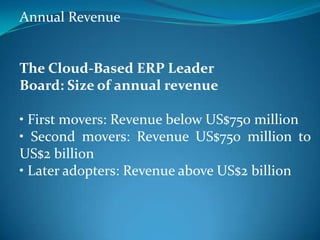
Annual Revenue


The Cloud-Based ERP Leader
Board: Size of annual revenue

• First movers: Revenue below US$750 million
• Second movers: Revenue US$750 million to
US$2 billion
• Later adopters: Revenue above US$2 billion
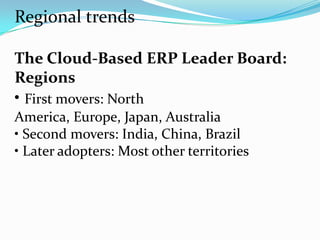
Regional trends

The Cloud-Based ERP Leader Board:
Regions
• First movers: North
America, Europe, Japan, Australia
• Second movers: India, China, Brazil
• Later adopters: Most other territories
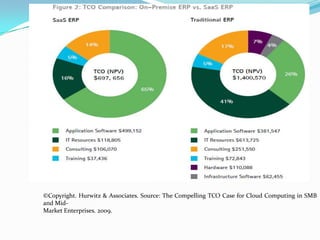
©Copyright. Hurwitz & Associates. Source: The Compelling TCO Case for Cloud Computing in SMB
and Mid-
Market Enterprises. 2009.
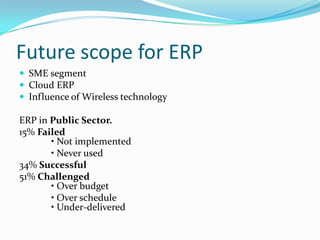
Future scope for ERP
 SME segment
 Cloud ERP
 Influence of Wireless technology

ERP in Public Sector.
15% Failed
       • Not implemented
       • Never used
34% Successful
51% Challenged
       • Over budget
       • Over schedule
       • Under-delivered
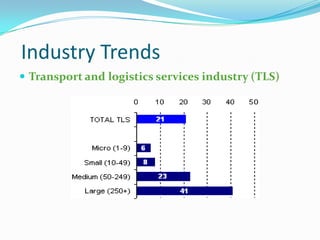
Industry Trends
 Transport and logistics services industry (TLS)
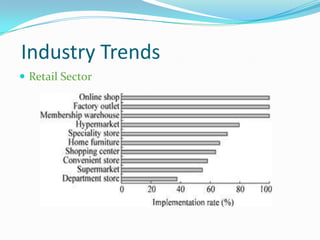
Industry Trends
 Retail Sector
Industry Trends
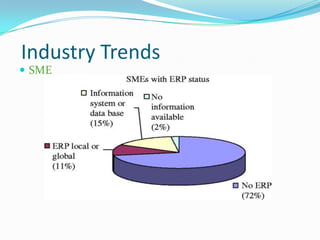
 SME
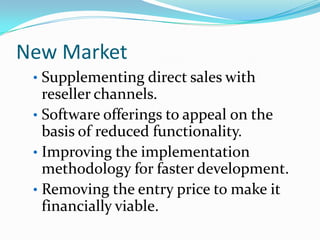
New Market
 • Supplementing direct sales with
   reseller channels.
 • Software offerings to appeal on the
   basis of reduced functionality.
 • Improving the implementation
   methodology for faster development.
 • Removing the entry price to make it
   financially viable.
New channels
•    As all the vendors being forced to market their product in
    the world of small business, they should make their
    software products more affordable by lowering the prices
    for each module and by ramping up the total costs by
    basing price on user licenses.
Conclusion
 Market- Focus should be on the SME
 Process based ERP to role based ERP
 Technological advancement-
    Focus should be on cloud ERP and Wireless enabled
     ERP apps
 Thank You...

Erp future

  • 1.
    Reema[ M110007MS] Vivek[M110009MS] Meethu [M110016MS] Prabhu [M110017MS] Kalyan[ M110021MS]
  • 2.
    Present Scenario  Realizationof benefits  ROI follows W pattern  Time overrun  Managing the gap  Difficulty in managing the change  Reengineering  Difficulty in maintenance  stop supporting early versions and products –JDE  Eg: Siemens  No proper metric for measuring the performance at the checkpoints  Availability of best of breed and open source software
  • 3.
    Survey Results -Panorama consulting solutions(2012) Findings About 70% of the companies goes for customization up to 25%
  • 4.
    Survey Results -Panorama consultingsolutions(2012)  Realization of benefits Findings For 75% of the companies , only 50% of the projected benefits are being realized
  • 5.
    Survey Results -Panorama consultingsolutions(2012) Findings More focus should be on the core activities of the organization
  • 6.
    Current situation  Majorityof the fortune 500 & 1000companies have implemented ERP  ERP implemented companies need less support from the vendor  Internal IT support  Potential for ERP – SME  More number of people (SME) switching to open source ERP
  • 7.
  • 8.
    Survey Results -Panorama consulting Comparisonin the SME segment-SaaS Vs On Premise SaaS[Software as a On Premise Service] Months 11.6 18.4 Cost[% of annual 6.2 6.9 revenue] Executive level of 52.6% 50% satisfaction
  • 9.
    Future trends Social Media Global ERP Integration system Cloud ERP with more App and Role based ERP module Mobile enabled ERP SaaS and Wireless ERP Open source ERP
  • 10.
    Future trends inERP  The rapid consumerization of technology over the past few years has lead enterprises to move on to cloud and new trends viz wireless technology  ERP systems will become easier to use, while the cloud, mobile devices and social media will have an impact on products on offer to manufacturers.
  • 11.
     The ERPof the future promises to be simplified, more accessible and easier to use, shaped by trends that began taking hold this year.  “What you’re seeing now is the beginnings of major trends — cloud computing, mobility and analytics — that will get fleshed out in the years beyond.”
  • 12.
    Cloud Computing  Cloudcomputing, which enables companies to access ERP software over the Internet, has already shown vendors that companies value ERP that can be more easily installed and rapidly consumed  Cloud-based ERP services will also evolve in the future to become more integrated both with other clouds and with installed ERP systems  First, ERP must become more simplified, both in terms of the deployment of the system and aligning it with an organization’s business processes.
  • 14.
    The Future ofERP Lines between SCM, CRM, and ERP will continue to blur  Internet – continue to help organizations integrate data and process across functional departments  Interface – customizable employee browsers  Wireless technology – support a mobile workforce 14
  • 15.
    ERP INfor ERPare arising where clients can opt for pay-  New models CLOUD COMPUTING per-use or application hosting services, switching capacity and functionality on and off as required.  ERP venders already started CRM,HCM(Human Capital Management) and PLM(Product Lifecycle Management) for the industry needs.  The runaway popularity of mobile devices such as smartphones and tablet computers is further driving a trend towards improved availability of enterprise information though Web services
  • 18.
     According toIDC(International Data Corporation), by 2015, about 24% of all new business software purchases will be of service-enabled software with SaaS delivery being 13.1% of worldwide software spending.  IDC further predicts that 14.4% of applications spending will be SaaS-based in the same time period. Source: http://www.idc.com/getdoc.jsp?containerId=2322 39  Unified communications-as-a-service (UCaaS) hosted VoIP, Web and Video conferencing solutions as a cost- cutting mechanism.  Corporate Mobile SaaS Forecast, 2010-2016,” the Global Corporate Mobile SaaS Market will reach $1.2 billion in 2011 and grow to $3.7 billion by 2016, with a five-year compound growth rate (CAGR) of 25.8 percent.
  • 19.
     Forrester forecaststhat the global market for cloud computing will grow from $40.7 billion in 2011 to more than $241 billion in 2020. The total size of the public cloud market will grow from $25.5 billion in 2011 to $159.3 billion in 2020.  Cisco predicts that Global cloud IP traffic will increase twelvefold over the next 5 years, accounting for more than one-third (34 percent) of total data centre traffic by 2015. Source: Cisco Global Cloud Index: Forecast and Methodology, 2010–2015.
  • 21.
    Annual Revenue The Cloud-BasedERP Leader Board: Size of annual revenue • First movers: Revenue below US$750 million • Second movers: Revenue US$750 million to US$2 billion • Later adopters: Revenue above US$2 billion
  • 22.
    Regional trends The Cloud-BasedERP Leader Board: Regions • First movers: North America, Europe, Japan, Australia • Second movers: India, China, Brazil • Later adopters: Most other territories
  • 23.
    ©Copyright. Hurwitz &Associates. Source: The Compelling TCO Case for Cloud Computing in SMB and Mid- Market Enterprises. 2009.
  • 24.
    Future scope forERP  SME segment  Cloud ERP  Influence of Wireless technology ERP in Public Sector. 15% Failed • Not implemented • Never used 34% Successful 51% Challenged • Over budget • Over schedule • Under-delivered
  • 25.
    Industry Trends  Transportand logistics services industry (TLS)
  • 26.
  • 27.
  • 28.
    New Market •Supplementing direct sales with reseller channels. • Software offerings to appeal on the basis of reduced functionality. • Improving the implementation methodology for faster development. • Removing the entry price to make it financially viable.
  • 29.
    New channels • As all the vendors being forced to market their product in the world of small business, they should make their software products more affordable by lowering the prices for each module and by ramping up the total costs by basing price on user licenses.
  • 30.
    Conclusion  Market- Focusshould be on the SME  Process based ERP to role based ERP  Technological advancement-  Focus should be on cloud ERP and Wireless enabled ERP apps
  • 31.