BASIC ELECTRONICS
Voltage, Current, Resistance and Ohm’s Law
www.sf-innovations.co.uk
This presentation is an introduction to electrical theory and will help
the reader understand some of the terminology used when we discuss
controlling external devices using the GPIO port of the Raspberry Pi.
We look at Voltage, Current & Resistance and the relationship between
the three known as Ohm’s Law.
www.sf-innovations.co.uk
Voltage
Voltage is the electric pressure that causes current to flow in a circuit. For a
given circuit, the higher the pressure, the higher the current is that will flow.
The basic unit of Voltage is the Volt (V) and the symbol V is used to
represent this.
One can draw an analogy between the Voltage in a battery and water
stored in a tank, high above the ground. This constantly wants to flow down
due to gravity. However one needs to open the tap to allow it to flow. In the
same way, the Voltage in a battery wants to push a current round a circuit.
Current flows as soon as the switch is closed.
Some typical voltages are:
AAA & AA battery: 1.5V DC
PP3 battery: 9V DC
Car battery: 12V DC
Mains in the UK 230V AC
Mains in the US 110V AC
Note: DC stands for Direct Current and AC stands for Alternating Current.
www.sf-innovations.co.uk
Current
Current is the flow of electrons in a circuit. The basic unit of current is the
Ampere (A) and the symbol I is used to represent this.
In the water analogy, current is like the water that flows once the tap is
opened. Current can only flow once the switch is closed and a circuit is
made.
Some typical currents taken by common devices are:
100W bulb 0.44A 440mA
2kW kettle 8.7A
Note: 1000mA = 1A
www.sf-innovations.co.uk
Resistance
The resistance of a device is a measure of how much it opposes the flow of
current. The basic unit of resistance is the Ohm (Ω) and the symbol R is used
to represent this.
In the water analogy, the resistance is like the width of a pipe. A narrower
pipe would present a higher resistance to the flow of water, and less water
would flow. A wider pipe would result in a larger flow of water as the
resistance is lower. In the same way the higher the resistance, the lower the
current would be as it would find it difficult to flow. The current flow would be
a lot higher in a circuit where the resistance was low.
Some typical resistances are:
100W bulb 529Ohm
2kW kettle 26.5Ohm
www.sf-innovations.co.uk
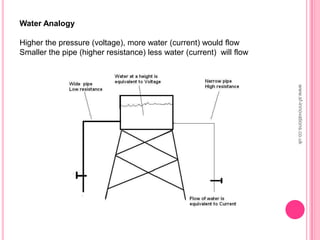
Water Analogy
Higher the pressure (voltage), more water (current) would flow
Smaller the pipe (higher resistance) less water (current) will flow
www.sf-innovations.co.uk
Ohm’s Law
From the water analogy one can see that:
Voltage is directly proportional to current
Resistance is inversely proportional to current
This is known as Ohm’s Law and can be used as follows.
Voltage (V) = Current (I) x Resistance (R)
Resistance (R) = Voltage (V) / Current (I)
Current (I) = Voltage (V) / Resistance (R)
www.sf-innovations.co.uk
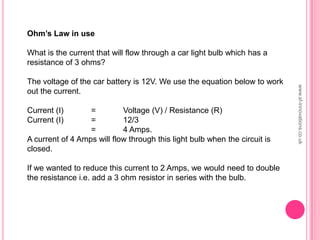
Ohm’s Law in use
What is the current that will flow through a car light bulb which has a
resistance of 3 ohms?
The voltage of the car battery is 12V. We use the equation below to work
out the current.
Current (I) = Voltage (V) / Resistance (R)
Current (I) = 12/3
= 4 Amps.
A current of 4 Amps will flow through this light bulb when the circuit is
closed.
If we wanted to reduce this current to 2 Amps, we would need to double
the resistance i.e. add a 3 ohm resistor in series with the bulb.
www.sf-innovations.co.uk
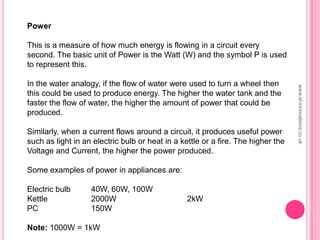
Power
This is a measure of how much energy is flowing in a circuit every
second. The basic unit of Power is the Watt (W) and the symbol P is used
to represent this.
In the water analogy, if the flow of water were used to turn a wheel then
this could be used to produce energy. The higher the water tank and the
faster the flow of water, the higher the amount of power that could be
produced.
Similarly, when a current flows around a circuit, it produces useful power
such as light in an electric bulb or heat in a kettle or a fire. The higher the
Voltage and Current, the higher the power produced.
Some examples of power in appliances are:
Electric bulb 40W, 60W, 100W
Kettle 2000W 2kW
PC 150W
Note: 1000W = 1kW
www.sf-innovations.co.uk
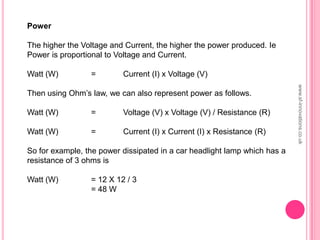
Power
The higher the Voltage and Current, the higher the power produced. Ie
Power is proportional to Voltage and Current.
Watt (W) = Current (I) x Voltage (V)
Then using Ohm’s law, we can also represent power as follows.
Watt (W) = Voltage (V) x Voltage (V) / Resistance (R)
Watt (W) = Current (I) x Current (I) x Resistance (R)
So for example, the power dissipated in a car headlight lamp which has a
resistance of 3 ohms is
Watt (W) = 12 X 12 / 3
= 48 W
www.sf-innovations.co.uk
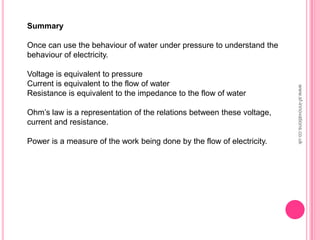
Summary
Once can use the behaviour of water under pressure to understand the
behaviour of electricity.
Voltage is equivalent to pressure
Current is equivalent to the flow of water
Resistance is equivalent to the impedance to the flow of water
Ohm’s law is a representation of the relations between these voltage,
current and resistance.
Power is a measure of the work being done by the flow of electricity.

Basic Electronics - Ohm's Law

  • 1.
    BASIC ELECTRONICS Voltage, Current,Resistance and Ohm’s Law www.sf-innovations.co.uk
  • 2.
    This presentation isan introduction to electrical theory and will help the reader understand some of the terminology used when we discuss controlling external devices using the GPIO port of the Raspberry Pi. We look at Voltage, Current & Resistance and the relationship between the three known as Ohm’s Law. www.sf-innovations.co.uk
  • 3.
    Voltage Voltage is theelectric pressure that causes current to flow in a circuit. For a given circuit, the higher the pressure, the higher the current is that will flow. The basic unit of Voltage is the Volt (V) and the symbol V is used to represent this. One can draw an analogy between the Voltage in a battery and water stored in a tank, high above the ground. This constantly wants to flow down due to gravity. However one needs to open the tap to allow it to flow. In the same way, the Voltage in a battery wants to push a current round a circuit. Current flows as soon as the switch is closed. Some typical voltages are: AAA & AA battery: 1.5V DC PP3 battery: 9V DC Car battery: 12V DC Mains in the UK 230V AC Mains in the US 110V AC Note: DC stands for Direct Current and AC stands for Alternating Current. www.sf-innovations.co.uk
  • 4.
    Current Current is theflow of electrons in a circuit. The basic unit of current is the Ampere (A) and the symbol I is used to represent this. In the water analogy, current is like the water that flows once the tap is opened. Current can only flow once the switch is closed and a circuit is made. Some typical currents taken by common devices are: 100W bulb 0.44A 440mA 2kW kettle 8.7A Note: 1000mA = 1A www.sf-innovations.co.uk
  • 5.
    Resistance The resistance ofa device is a measure of how much it opposes the flow of current. The basic unit of resistance is the Ohm (Ω) and the symbol R is used to represent this. In the water analogy, the resistance is like the width of a pipe. A narrower pipe would present a higher resistance to the flow of water, and less water would flow. A wider pipe would result in a larger flow of water as the resistance is lower. In the same way the higher the resistance, the lower the current would be as it would find it difficult to flow. The current flow would be a lot higher in a circuit where the resistance was low. Some typical resistances are: 100W bulb 529Ohm 2kW kettle 26.5Ohm www.sf-innovations.co.uk
  • 6.
    Water Analogy Higher thepressure (voltage), more water (current) would flow Smaller the pipe (higher resistance) less water (current) will flow www.sf-innovations.co.uk
  • 7.
    Ohm’s Law From thewater analogy one can see that: Voltage is directly proportional to current Resistance is inversely proportional to current This is known as Ohm’s Law and can be used as follows. Voltage (V) = Current (I) x Resistance (R) Resistance (R) = Voltage (V) / Current (I) Current (I) = Voltage (V) / Resistance (R) www.sf-innovations.co.uk
  • 8.
    Ohm’s Law inuse What is the current that will flow through a car light bulb which has a resistance of 3 ohms? The voltage of the car battery is 12V. We use the equation below to work out the current. Current (I) = Voltage (V) / Resistance (R) Current (I) = 12/3 = 4 Amps. A current of 4 Amps will flow through this light bulb when the circuit is closed. If we wanted to reduce this current to 2 Amps, we would need to double the resistance i.e. add a 3 ohm resistor in series with the bulb. www.sf-innovations.co.uk
  • 9.
    www.sf-innovations.co.uk Power This is ameasure of how much energy is flowing in a circuit every second. The basic unit of Power is the Watt (W) and the symbol P is used to represent this. In the water analogy, if the flow of water were used to turn a wheel then this could be used to produce energy. The higher the water tank and the faster the flow of water, the higher the amount of power that could be produced. Similarly, when a current flows around a circuit, it produces useful power such as light in an electric bulb or heat in a kettle or a fire. The higher the Voltage and Current, the higher the power produced. Some examples of power in appliances are: Electric bulb 40W, 60W, 100W Kettle 2000W 2kW PC 150W Note: 1000W = 1kW
  • 10.
    www.sf-innovations.co.uk Power The higher theVoltage and Current, the higher the power produced. Ie Power is proportional to Voltage and Current. Watt (W) = Current (I) x Voltage (V) Then using Ohm’s law, we can also represent power as follows. Watt (W) = Voltage (V) x Voltage (V) / Resistance (R) Watt (W) = Current (I) x Current (I) x Resistance (R) So for example, the power dissipated in a car headlight lamp which has a resistance of 3 ohms is Watt (W) = 12 X 12 / 3 = 48 W
  • 11.
    www.sf-innovations.co.uk Summary Once can usethe behaviour of water under pressure to understand the behaviour of electricity. Voltage is equivalent to pressure Current is equivalent to the flow of water Resistance is equivalent to the impedance to the flow of water Ohm’s law is a representation of the relations between these voltage, current and resistance. Power is a measure of the work being done by the flow of electricity.