How
to Transform
Sentences.
Change to Negative or Interrogative Sentence

Presented BY:
The English Academy
91 88666 80407
englishacademybaroda@gmail.com
Visit us at: http://indiamart.com/english-academy/
Corporate Training

│ Personality Development │ Mentoring │ Hand Holding
There are 3 types of Sentences:
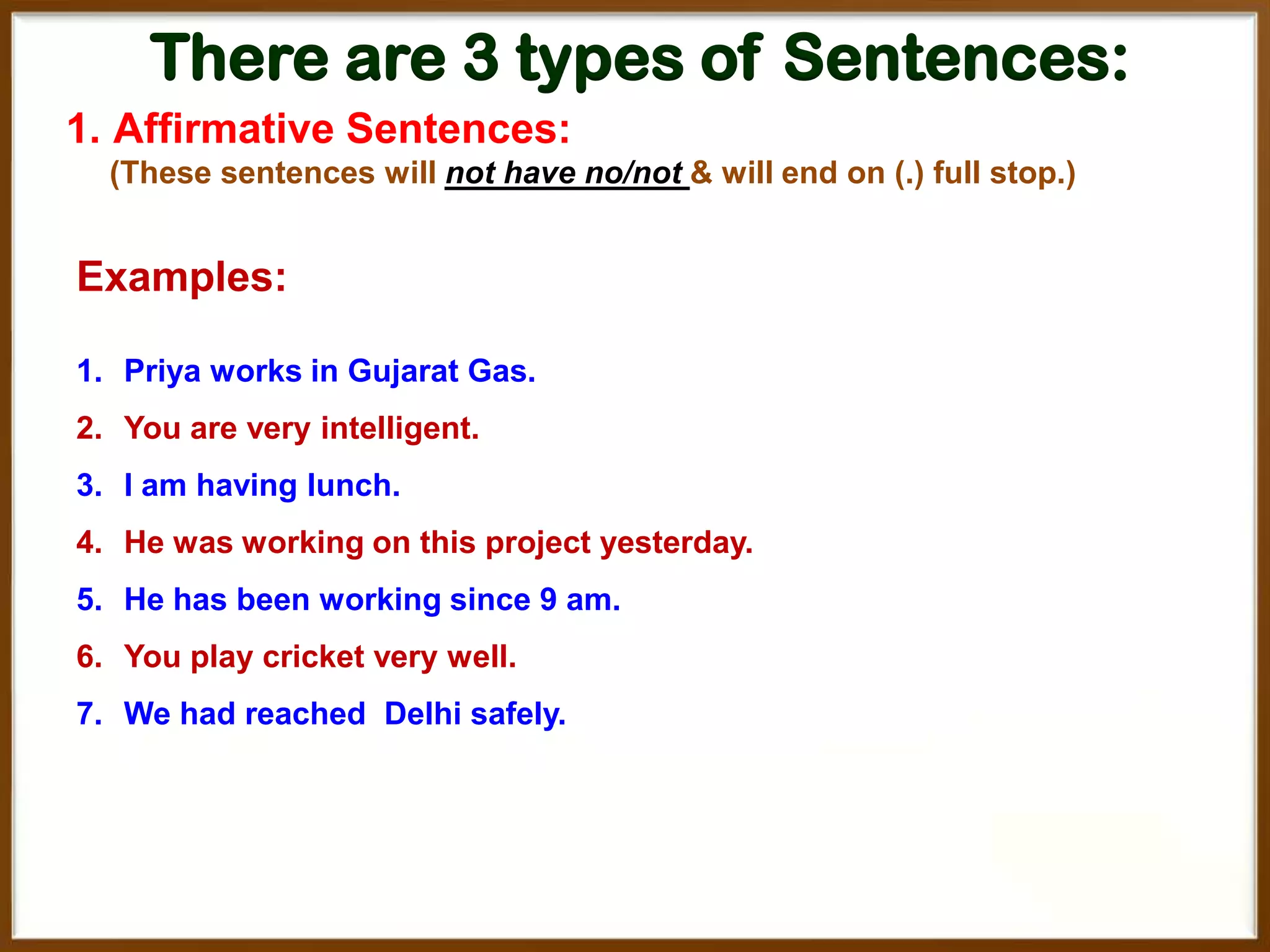
1. Affirmative Sentences:
(These sentences will not have no/not & will end on (.) full stop.)

Examples:
1. Priya works in Gujarat Gas.
2. You are very intelligent.
3. I am having lunch.

4. He was working on this project yesterday.
5. He has been working since 9 am.
6. You play cricket very well.
7. We had reached Delhi safely.
There are 3 types of Sentences:
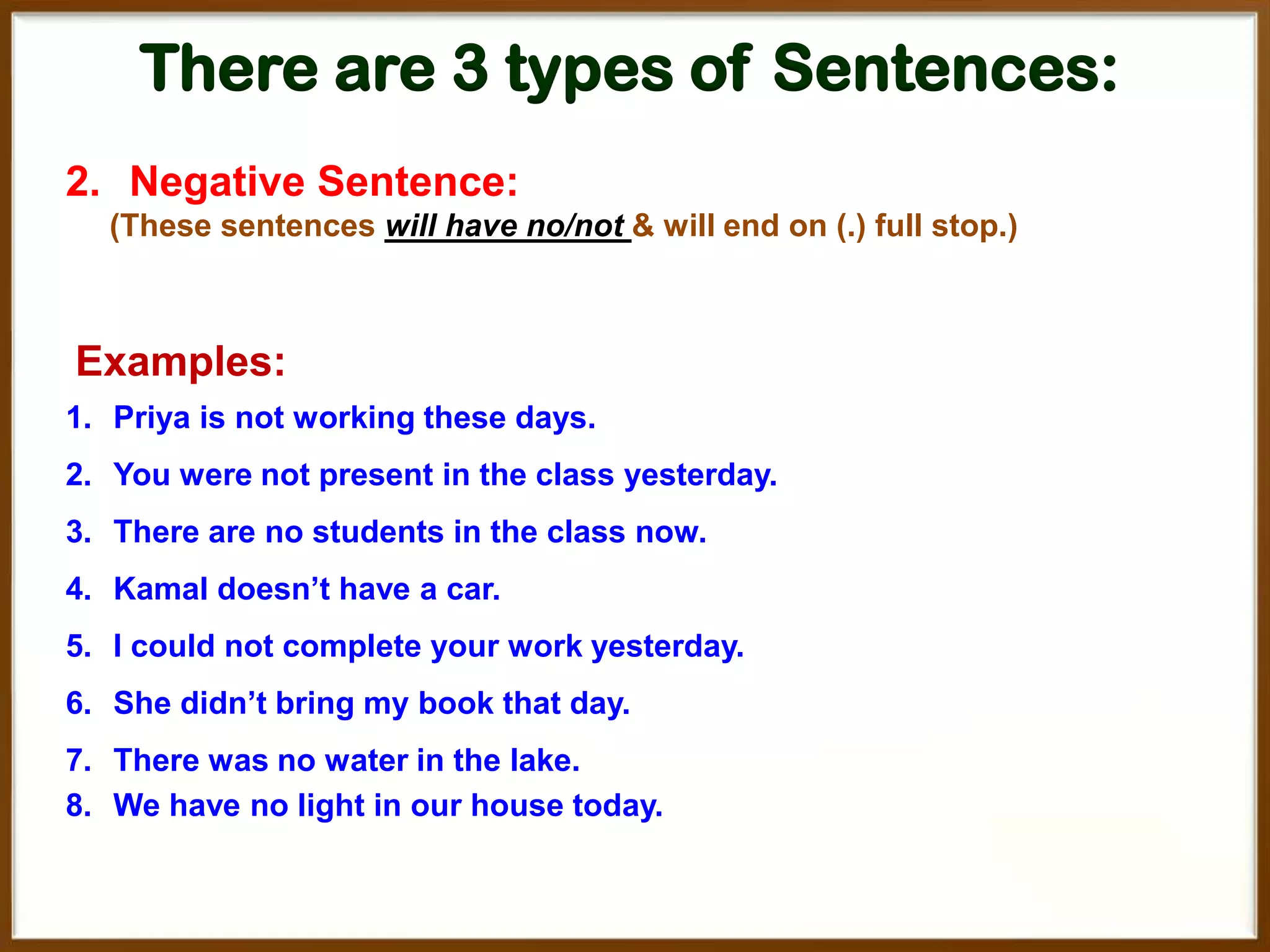
2. Negative Sentence:
(These sentences will have no/not & will end on (.) full stop.)

Examples:
1. Priya is not working these days.
2. You were not present in the class yesterday.
3. There are no students in the class now.
4. Kamal doesn’t have a car.
5. I could not complete your work yesterday.
6. She didn’t bring my book that day.

7. There was no water in the lake.
8. We have no light in our house today.
There are 3 types of Sentences:
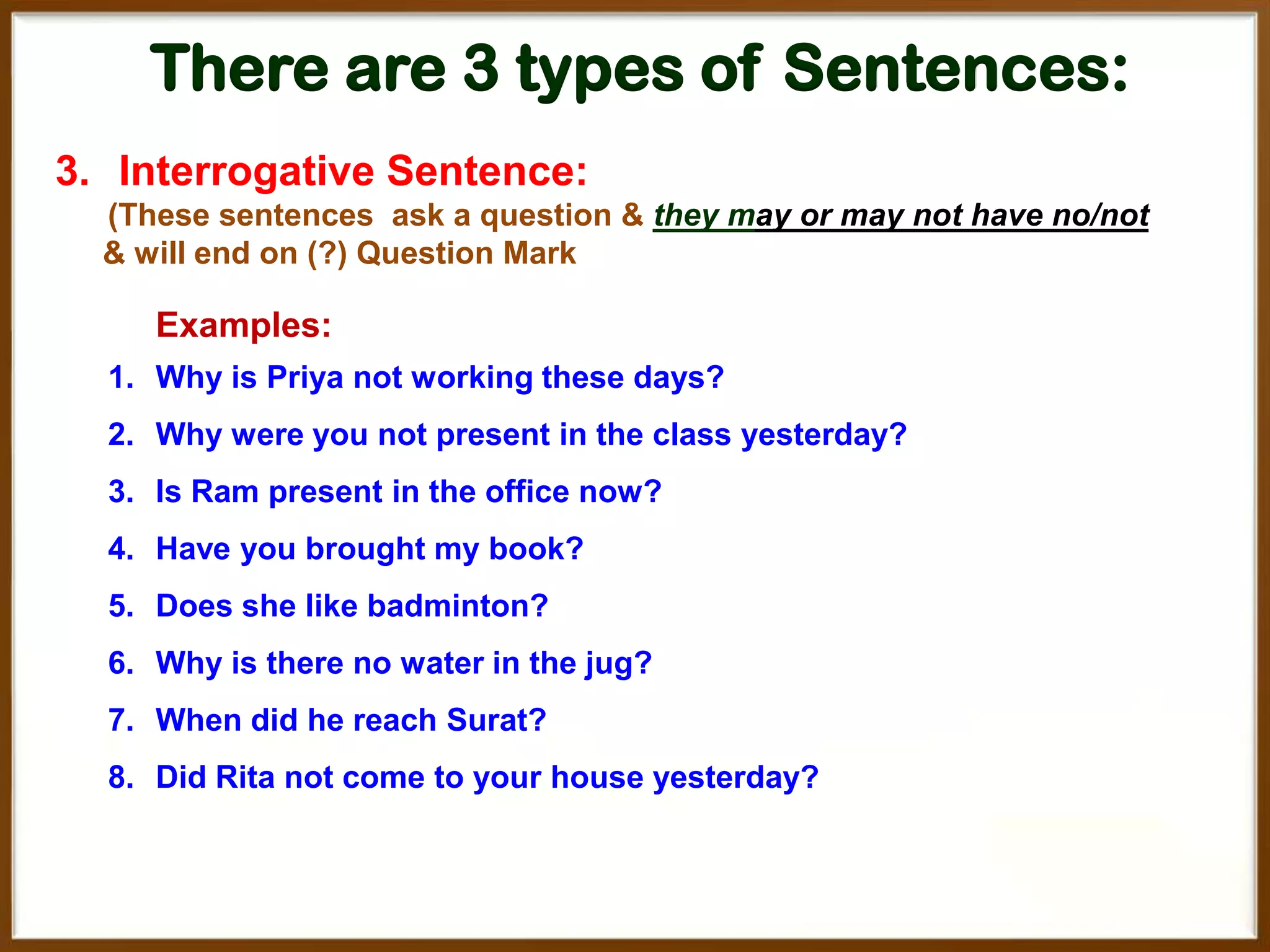
3. Interrogative Sentence:
(These sentences ask a question & they may or may not have no/not
& will end on (?) Question Mark

Examples:
1. Why is Priya not working these days?
2. Why were you not present in the class yesterday?
3. Is Ram present in the office now?

4. Have you brought my book?
5. Does she like badminton?
6. Why is there no water in the jug?
7. When did he reach Surat?

8. Did Rita not come to your house yesterday?
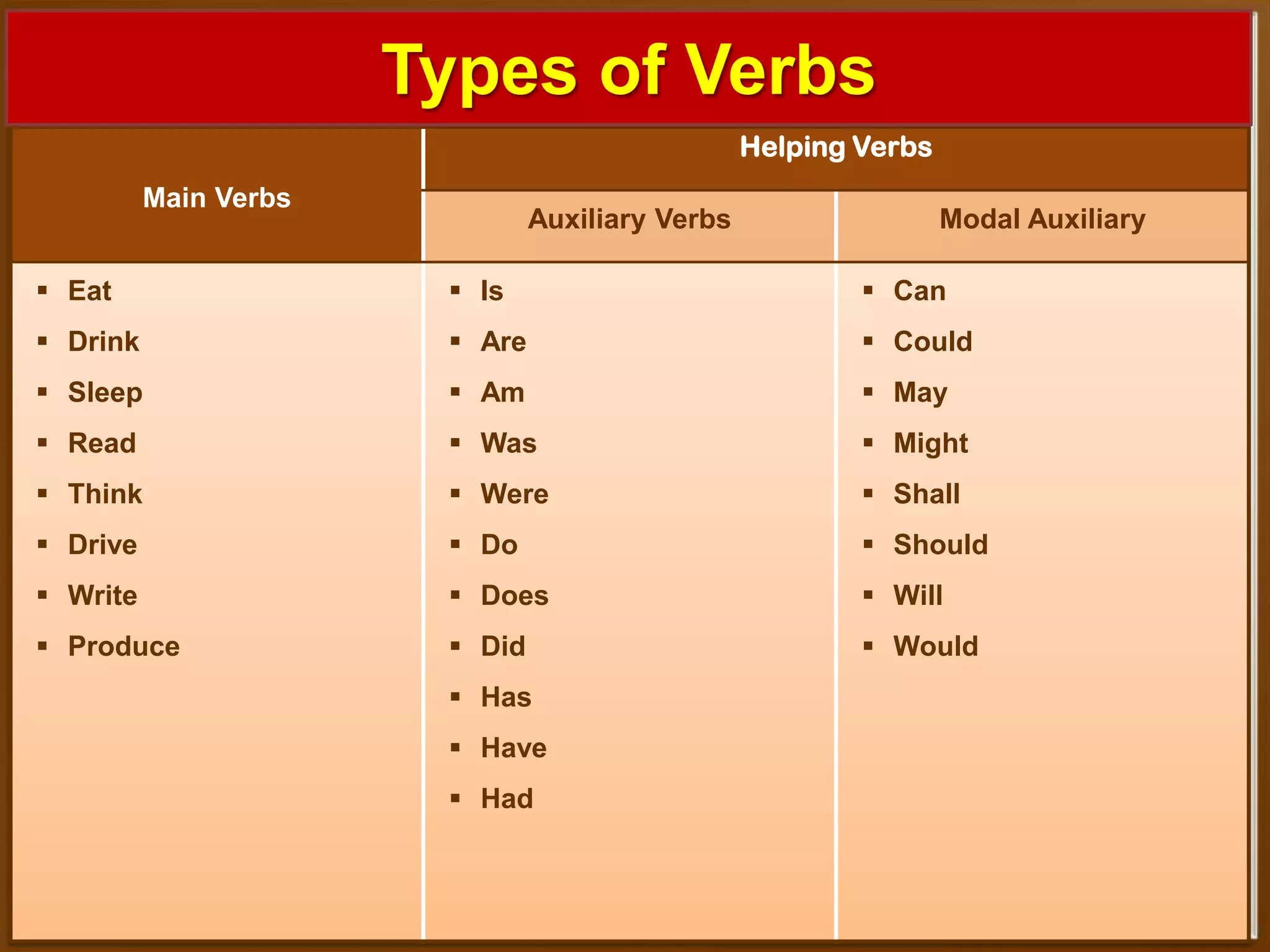
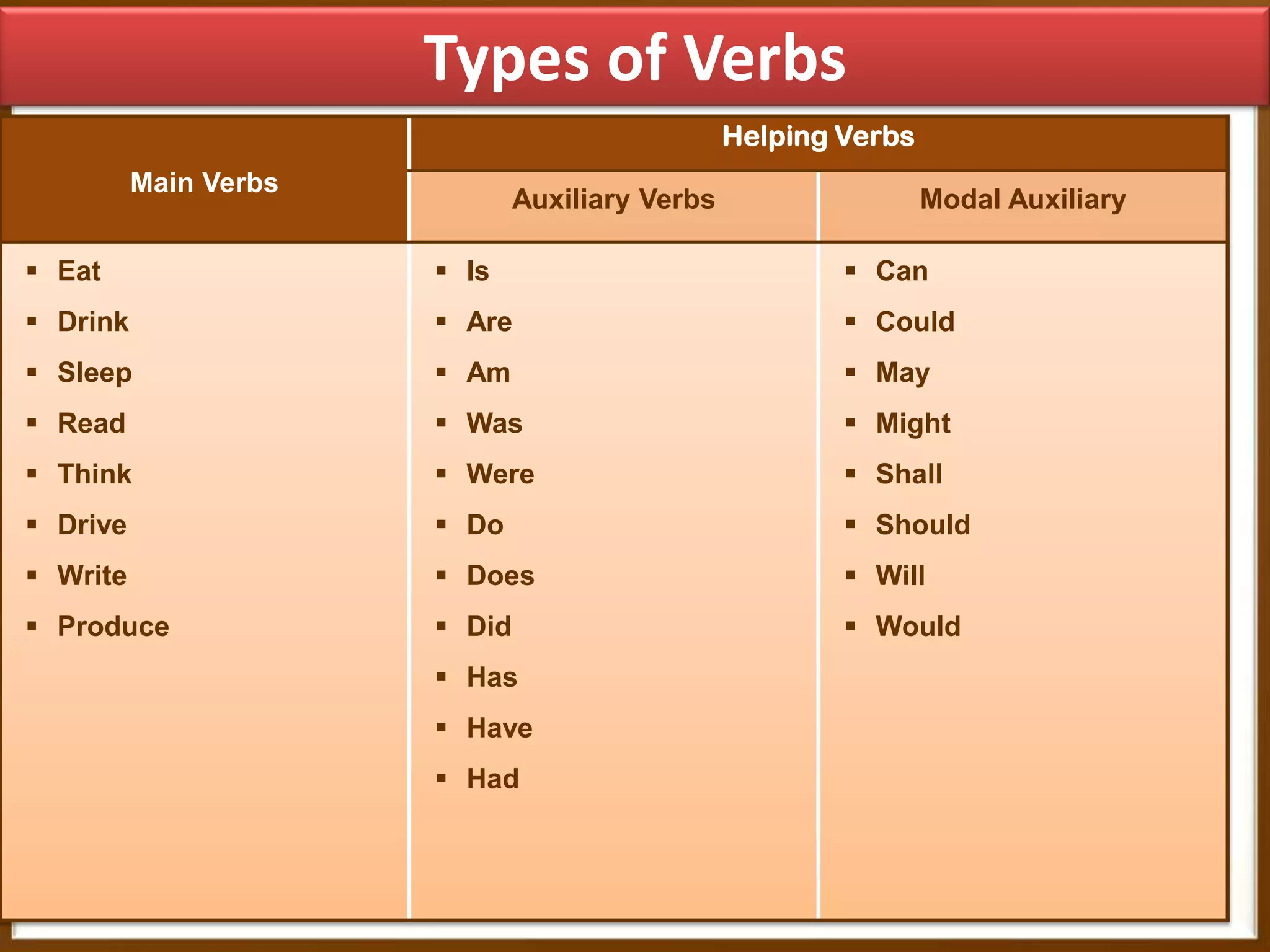
Types of Verbs
Helping Verbs
Main Verbs

Auxiliary Verbs

Modal Auxiliary

 Eat

 Is

 Can

 Drink

 Are

 Could

 Sleep

 Am

 May

 Read

 Was

 Might

 Think

 Were

 Shall

 Drive

 Do

 Should

 Write

 Does

 Will

 Produce

 Did

 Would

 Has
 Have
 Had
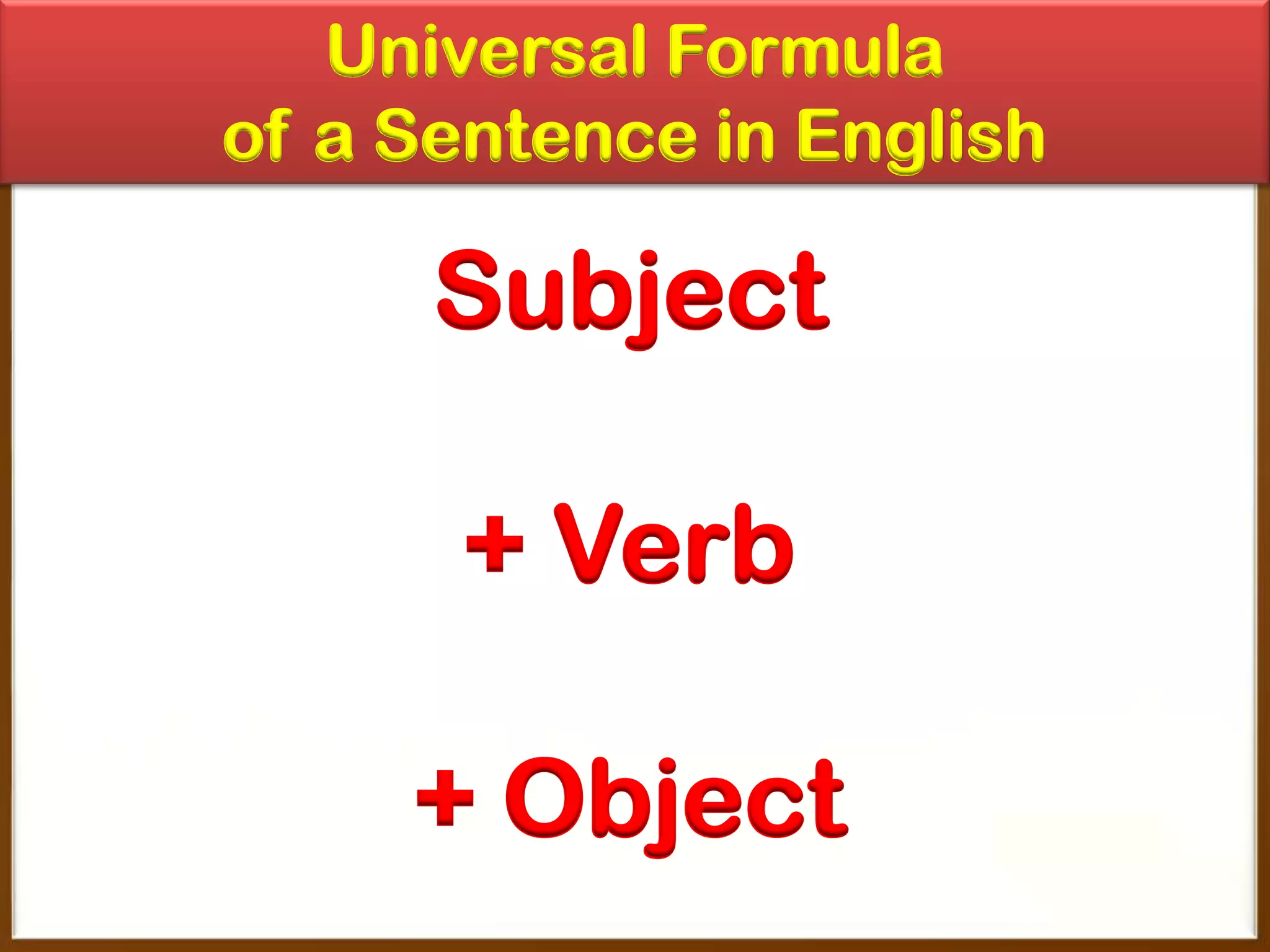
Universal Formula
of a Sentence in English

Subject

+ Verb
+ Object
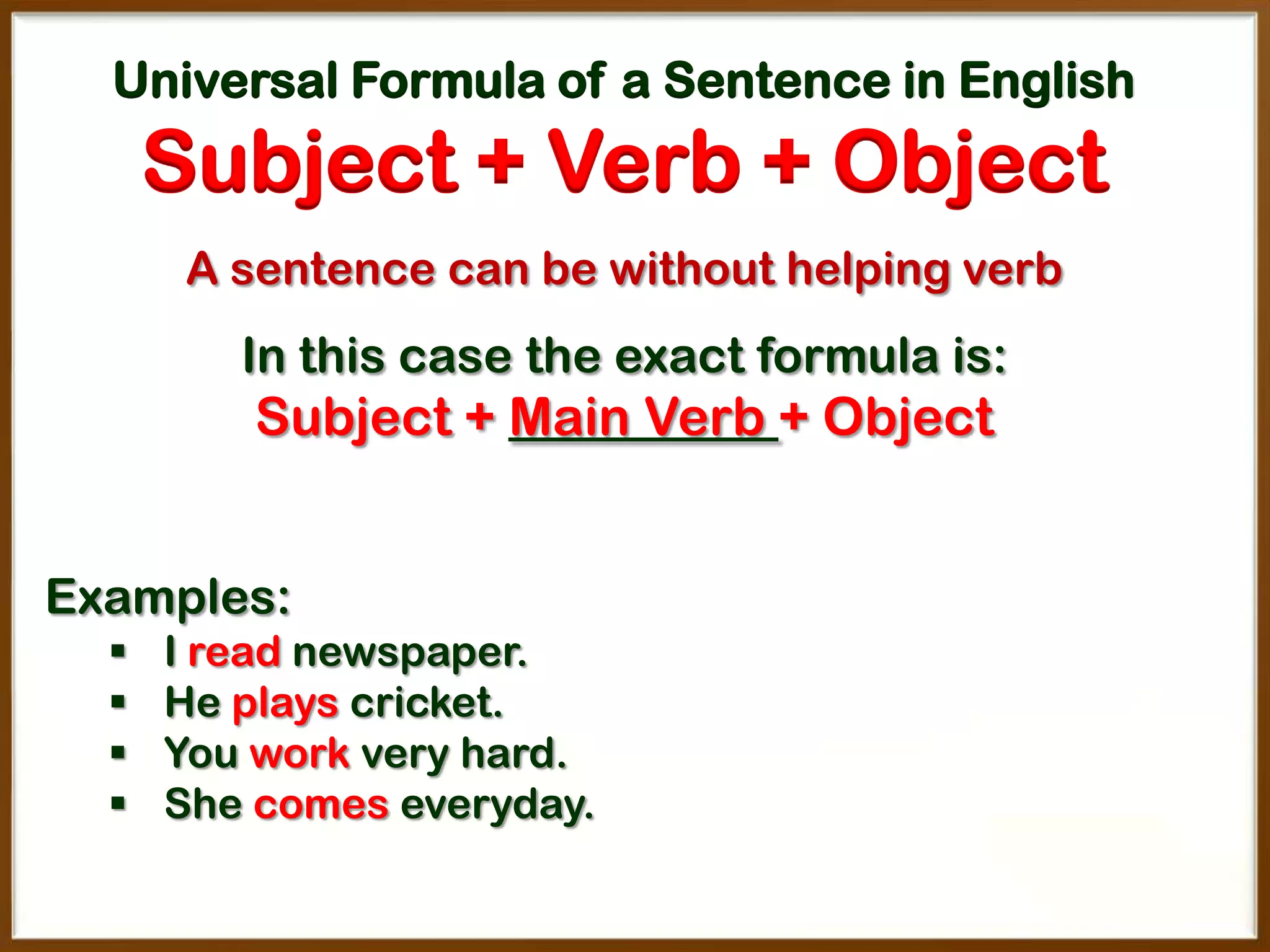
Universal Formula of a Sentence in English

Subject + Verb + Object
A sentence can be without helping verb

In this case the exact formula is:

Subject + Main Verb + Object
Examples:





I read newspaper.
He plays cricket.
You work very hard.
She comes everyday.
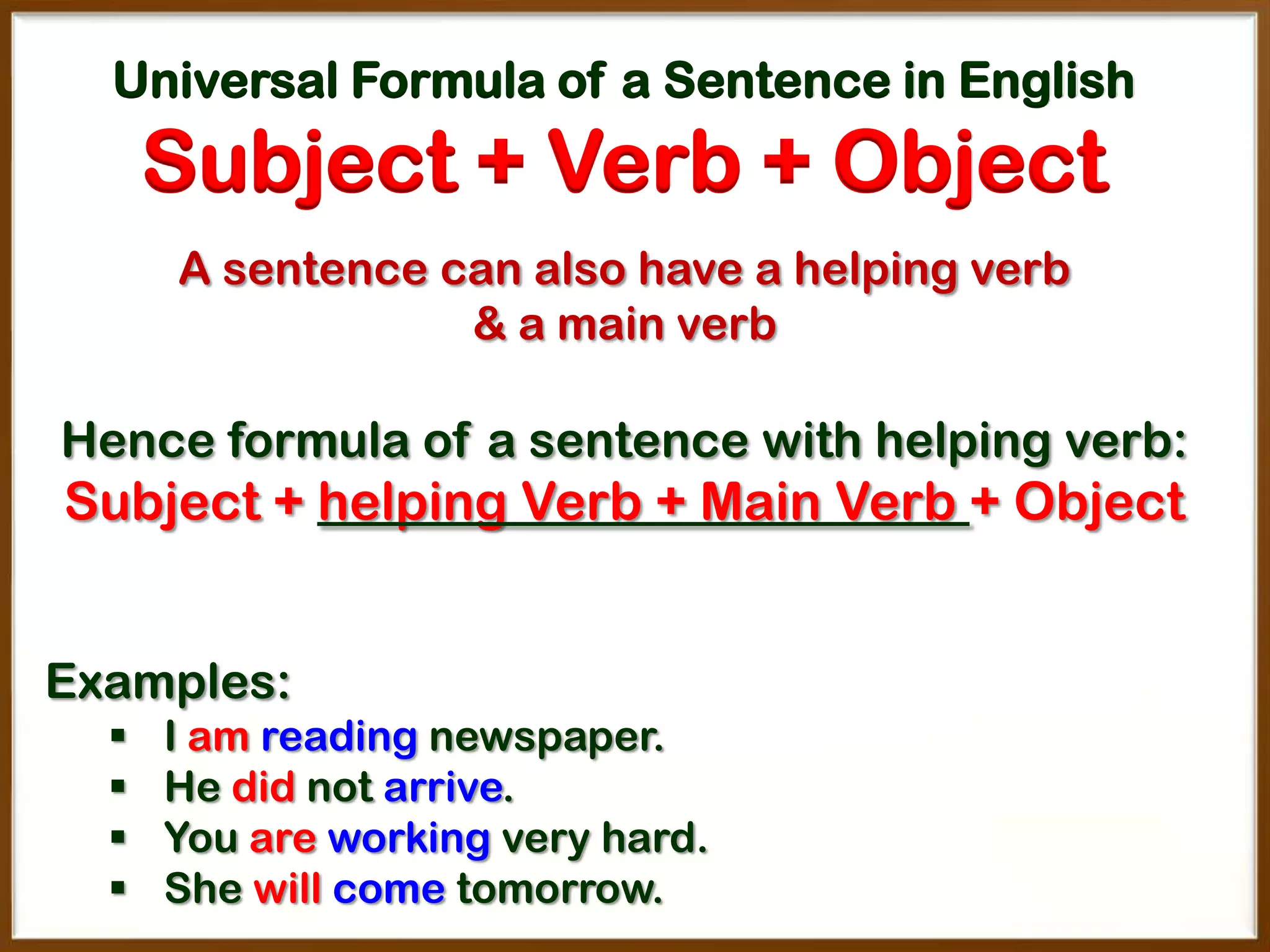
Universal Formula of a Sentence in English

Subject + Verb + Object
A sentence can also have a helping verb
& a main verb

Hence formula of a sentence with helping verb:

Subject + helping Verb + Main Verb + Object
Examples:





I am reading newspaper.
He did not arrive.
You are working very hard.
She will come tomorrow.
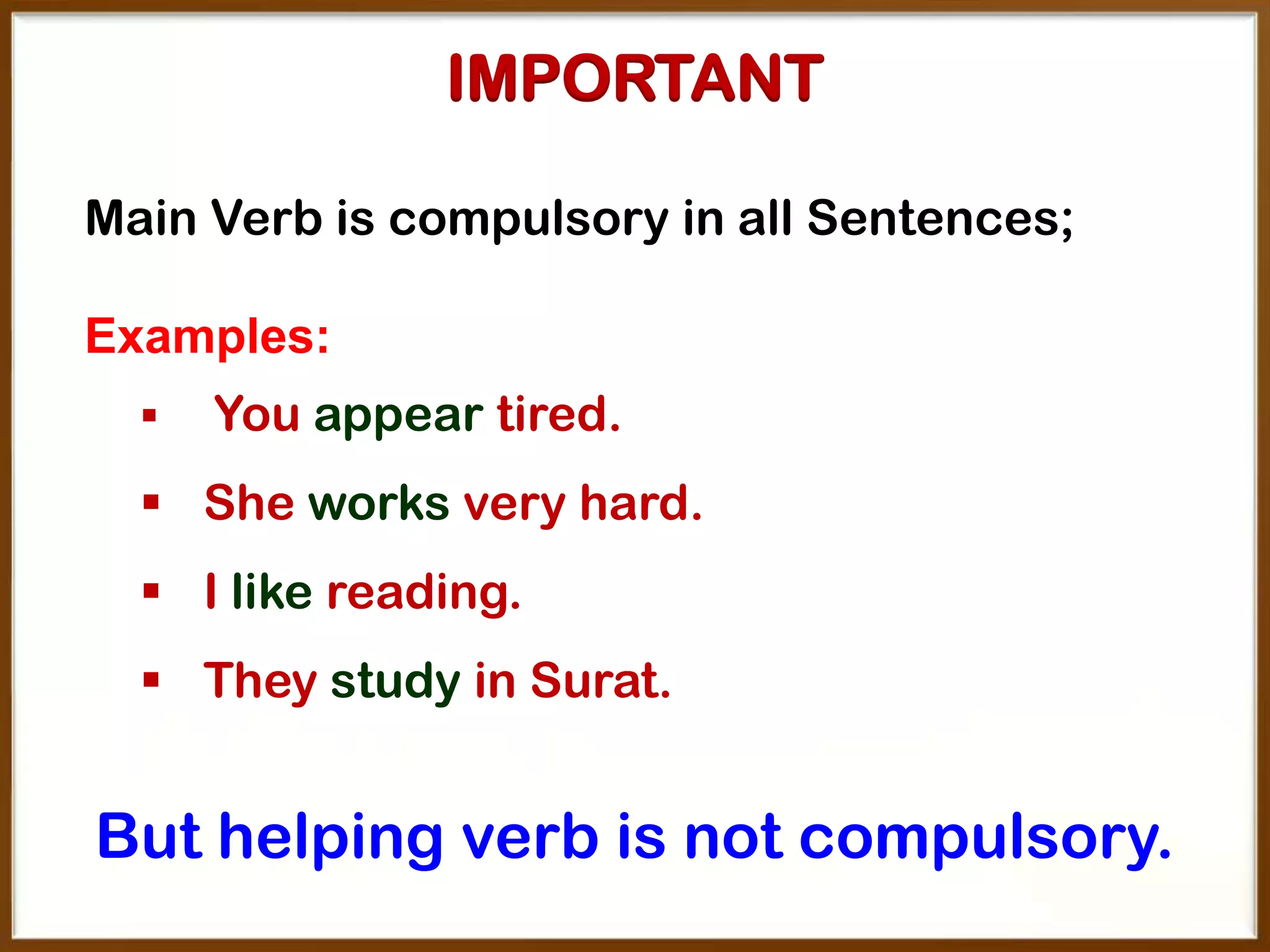
IMPORTANT
Main Verb is compulsory in all Sentences;

Examples:


You appear tired.

 She works very hard.
 I like reading.
 They study in Surat.

But helping verb is not compulsory.
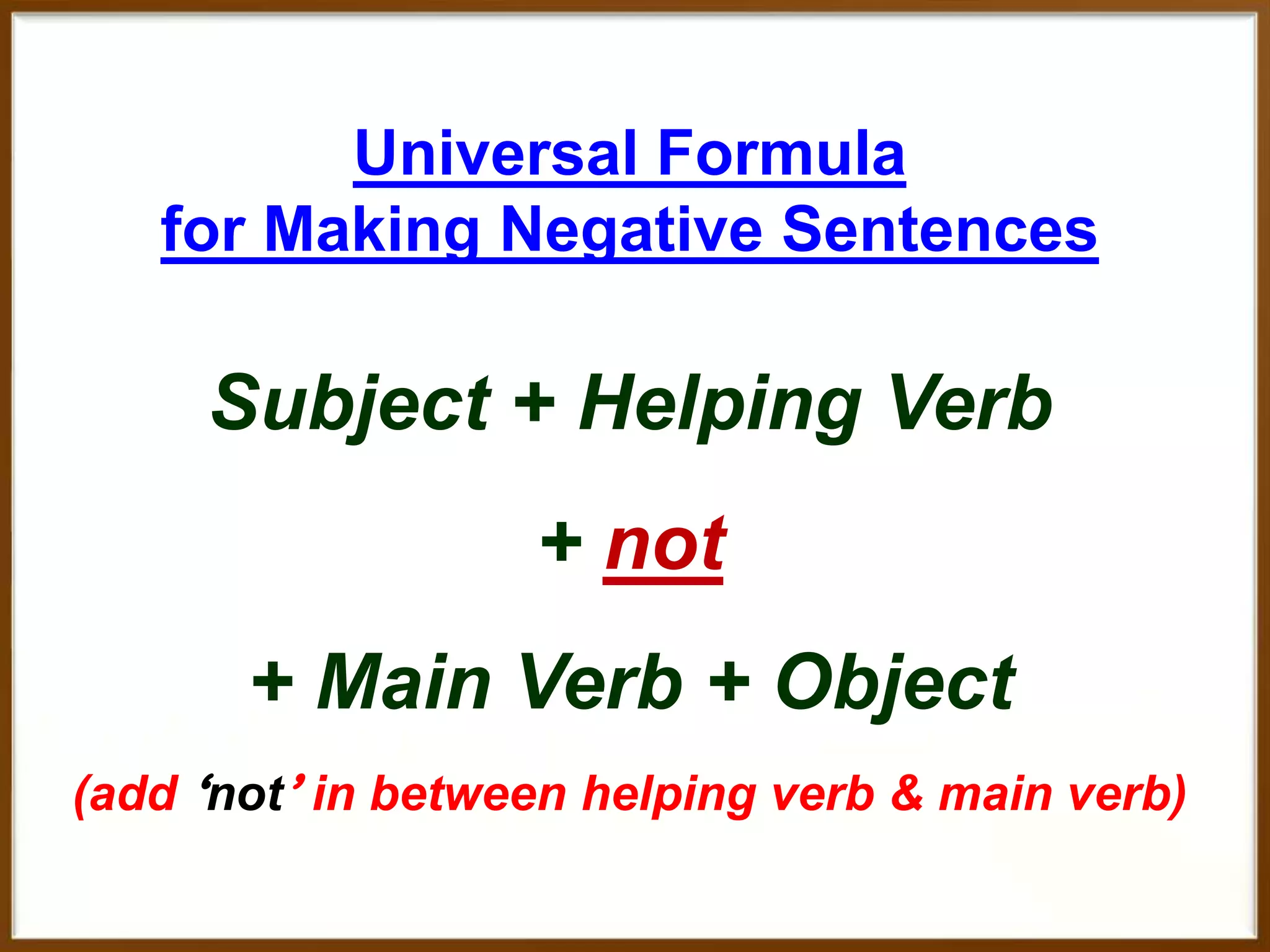
Universal Formula
for Making Negative Sentences

Subject + Helping Verb
+ not

+ Main Verb + Object
(add ‘not’ in between helping verb & main verb)
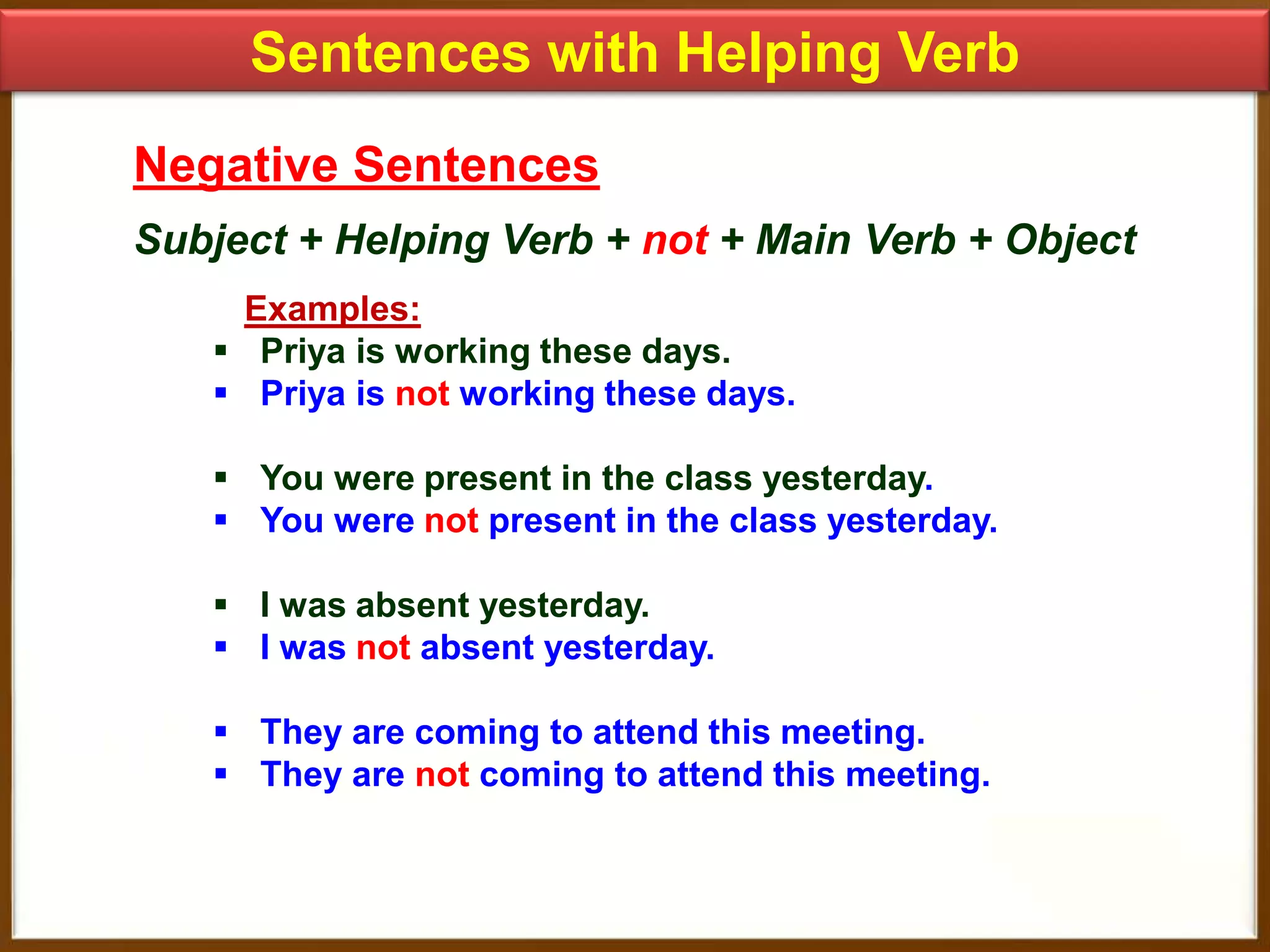
Sentences with Helping Verb
Negative Sentences
Subject + Helping Verb + not + Main Verb + Object
Examples:
 Priya is working these days.
 Priya is not working these days.
 You were present in the class yesterday.
 You were not present in the class yesterday.
 I was absent yesterday.
 I was not absent yesterday.
 They are coming to attend this meeting.
 They are not coming to attend this meeting.
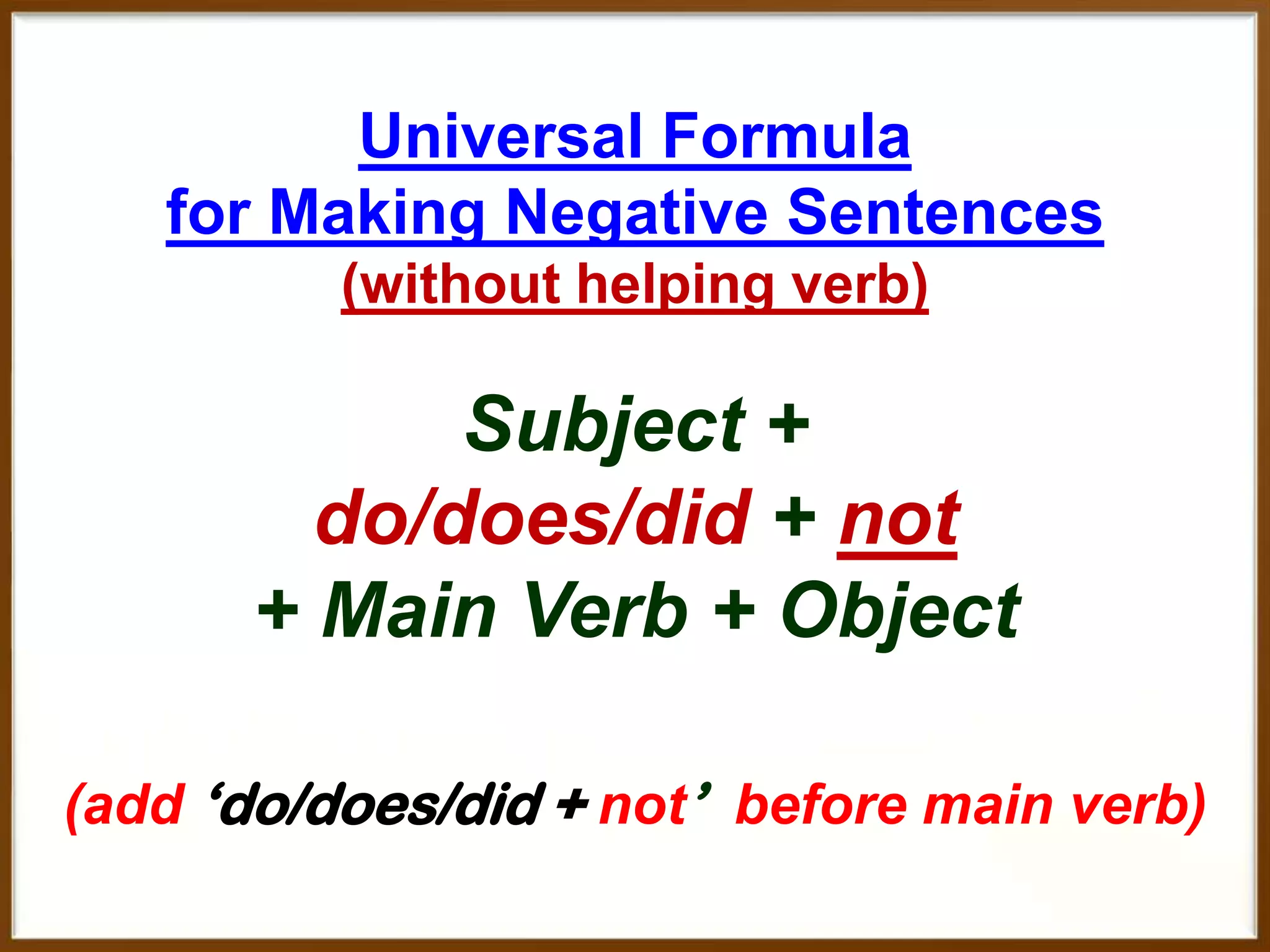
Universal Formula
for Making Negative Sentences
(without helping verb)

Subject +
do/does/did + not
+ Main Verb + Object
(add ‘do/does/did + not’ before main verb)
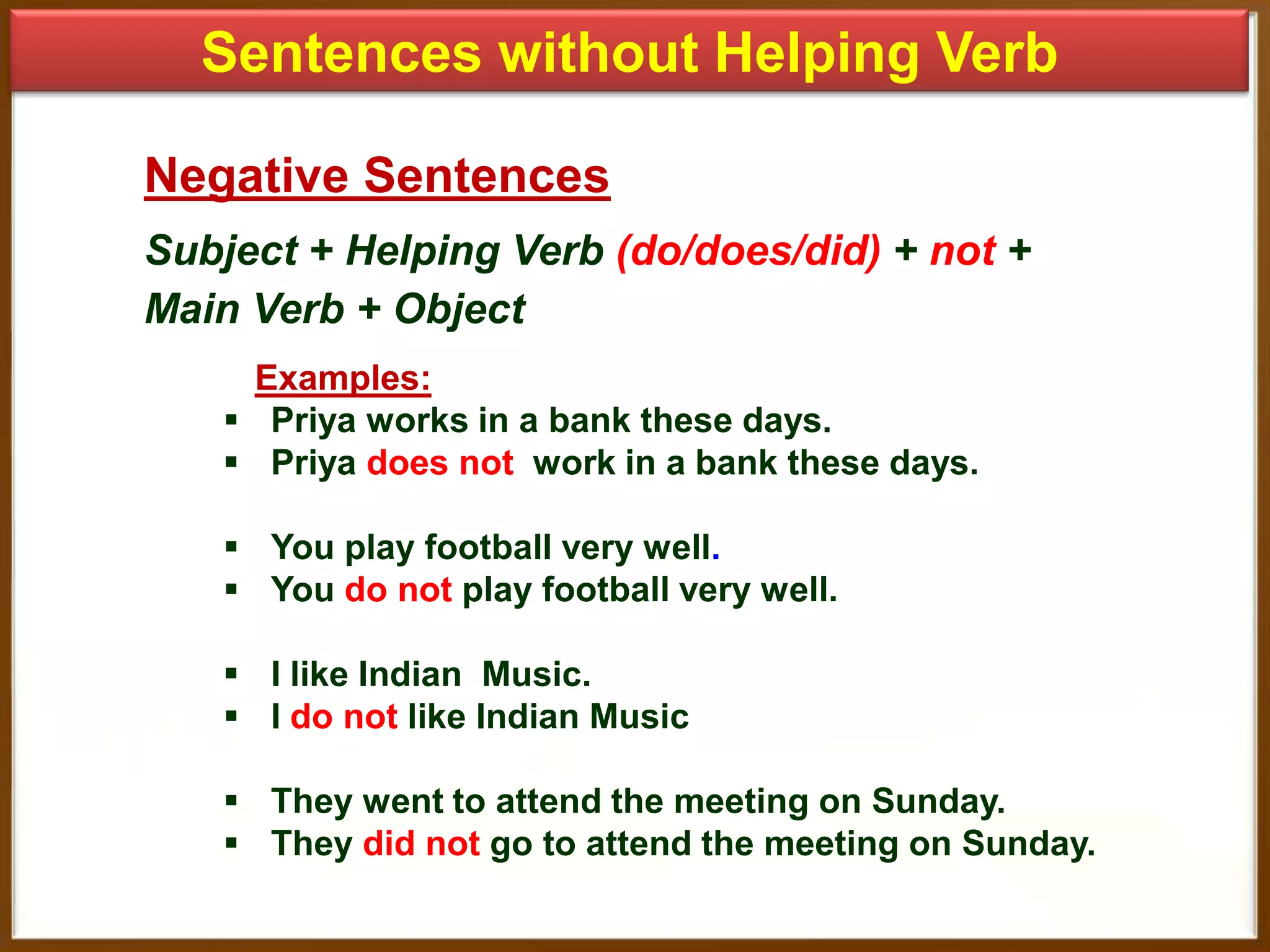
Sentences without Helping Verb
Negative Sentences
Subject + Helping Verb (do/does/did) + not +
Main Verb + Object
Examples:
 Priya works in a bank these days.
 Priya does not work in a bank these days.
 You play football very well.
 You do not play football very well.

 I like Indian Music.
 I do not like Indian Music
 They went to attend the meeting on Sunday.
 They did not go to attend the meeting on Sunday.
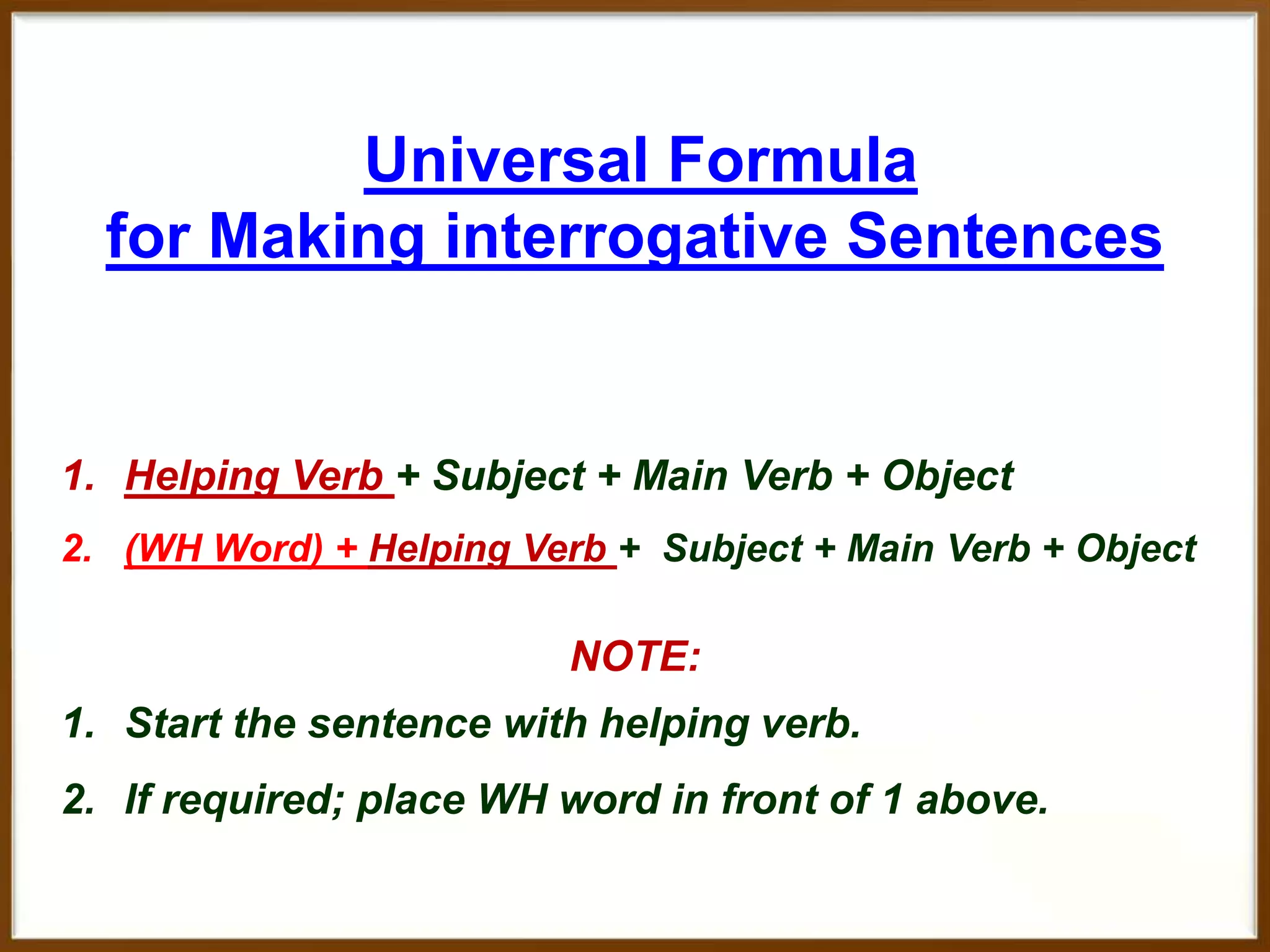
Universal Formula
for Making interrogative Sentences

1. Helping Verb + Subject + Main Verb + Object
2. (WH Word) + Helping Verb + Subject + Main Verb + Object

NOTE:
1. Start the sentence with helping verb.
2. If required; place WH word in front of 1 above.
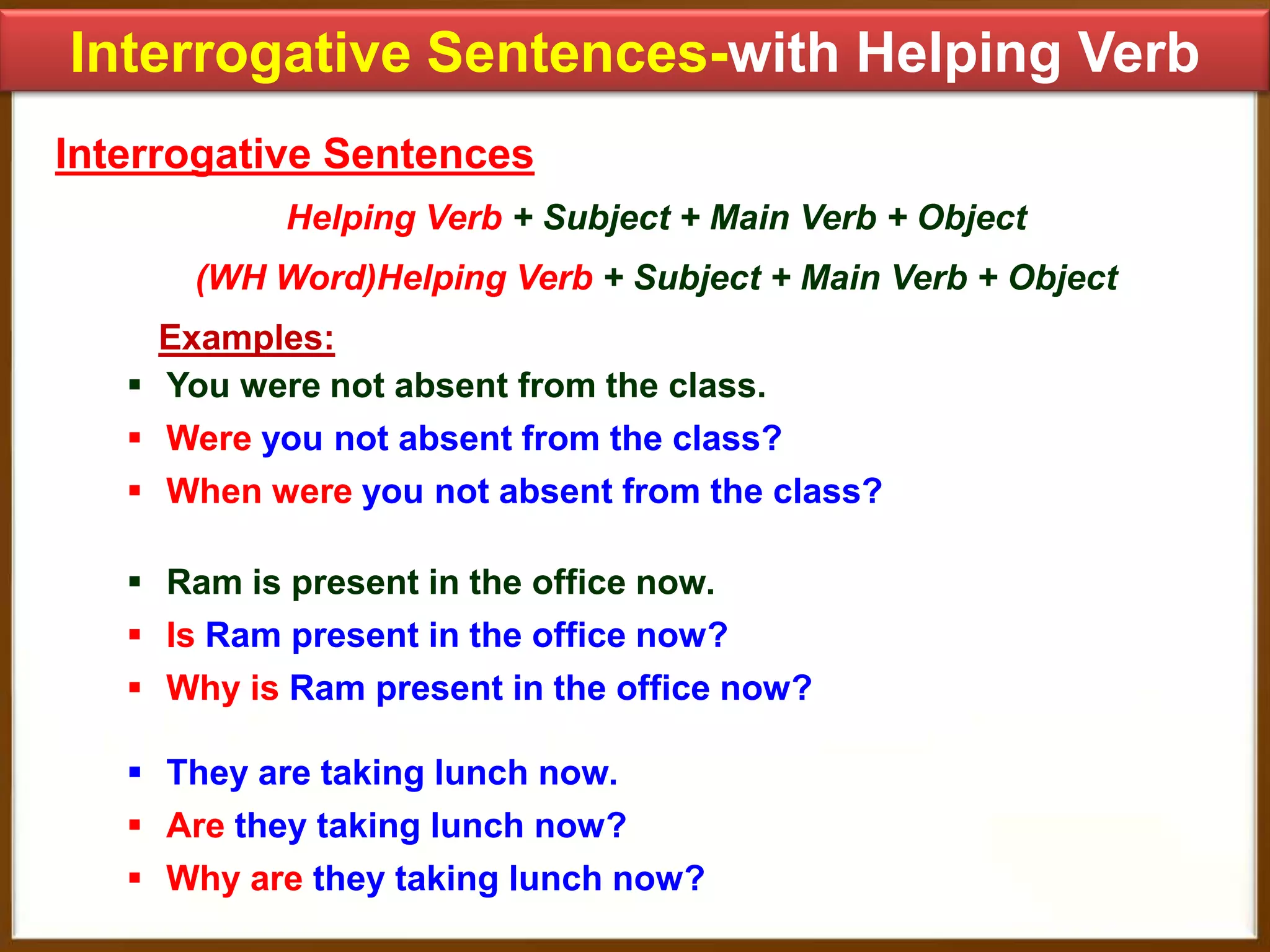
Interrogative Sentences-with Helping Verb
Interrogative Sentences
Helping Verb + Subject + Main Verb + Object
(WH Word)Helping Verb + Subject + Main Verb + Object

Examples:
 You were not absent from the class.
 Were you not absent from the class?
 When were you not absent from the class?
 Ram is present in the office now.
 Is Ram present in the office now?
 Why is Ram present in the office now?

 They are taking lunch now.
 Are they taking lunch now?
 Why are they taking lunch now?
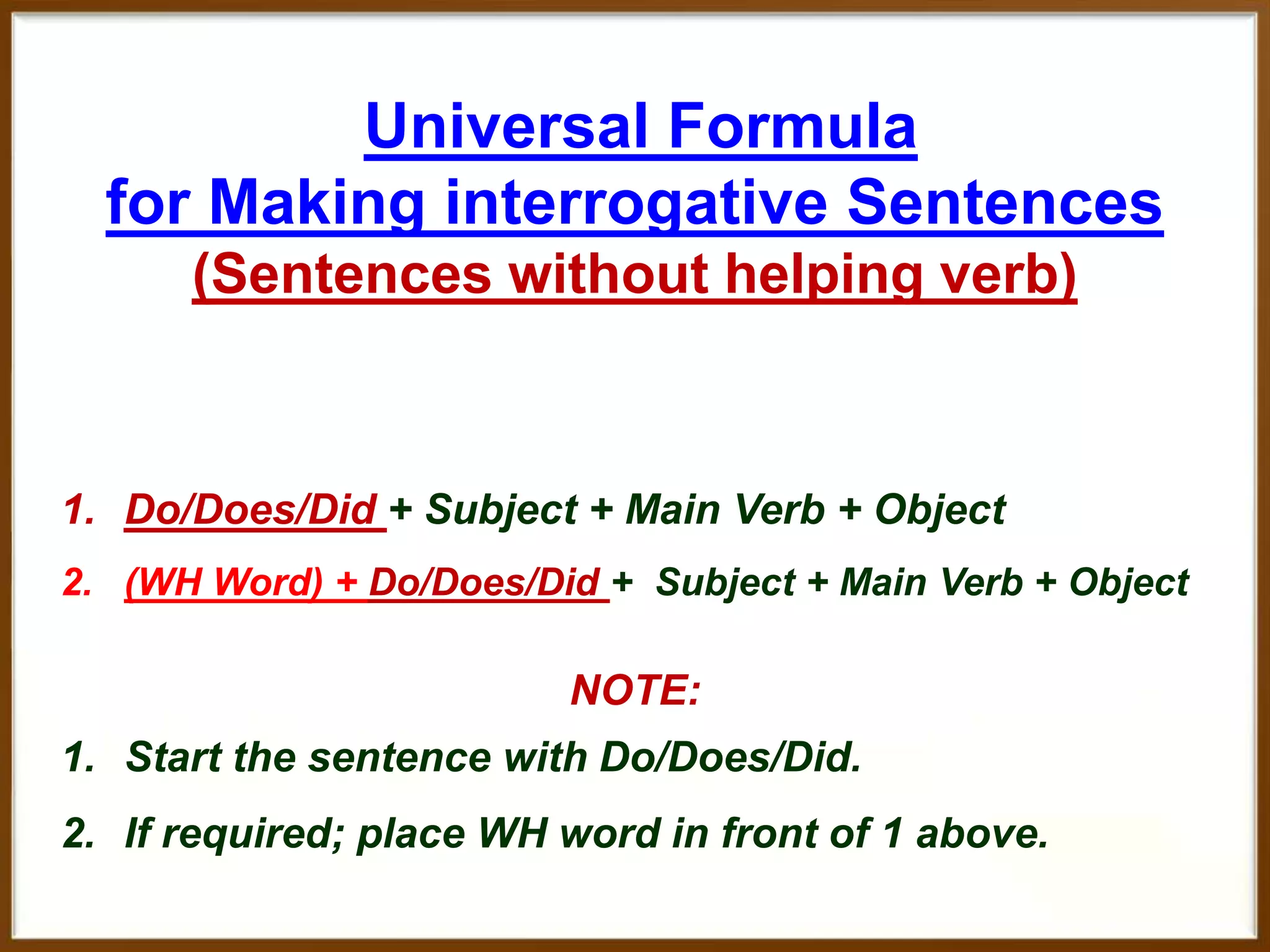
Universal Formula
for Making interrogative Sentences
(Sentences without helping verb)

1. Do/Does/Did + Subject + Main Verb + Object
2. (WH Word) + Do/Does/Did + Subject + Main Verb + Object

NOTE:

1. Start the sentence with Do/Does/Did.
2. If required; place WH word in front of 1 above.
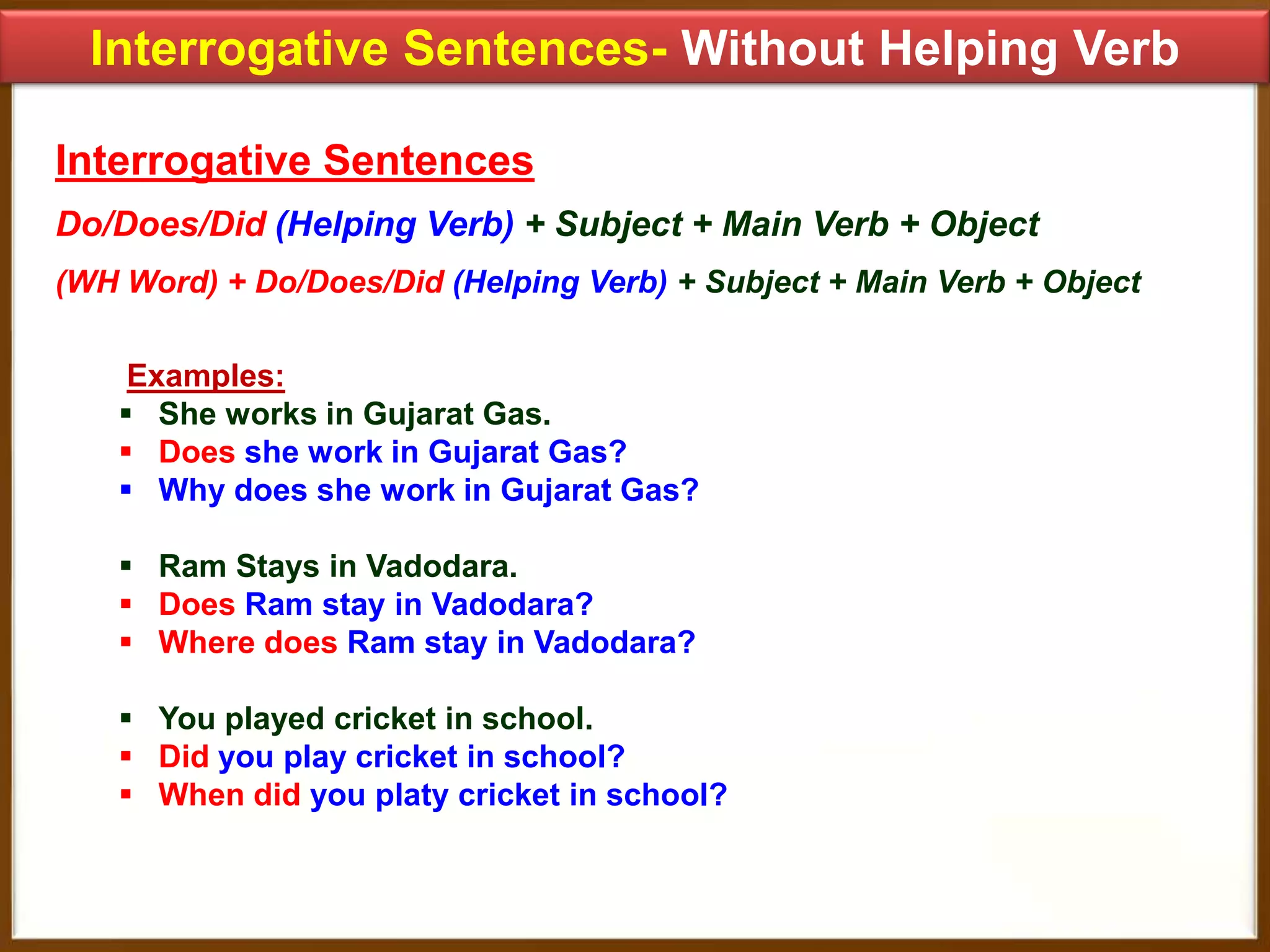
Interrogative Sentences- Without Helping Verb
Interrogative Sentences
Do/Does/Did (Helping Verb) + Subject + Main Verb + Object
(WH Word) + Do/Does/Did (Helping Verb) + Subject + Main Verb + Object
Examples:
 She works in Gujarat Gas.
 Does she work in Gujarat Gas?
 Why does she work in Gujarat Gas?
 Ram Stays in Vadodara.
 Does Ram stay in Vadodara?
 Where does Ram stay in Vadodara?
 You played cricket in school.
 Did you play cricket in school?
 When did you platy cricket in school?
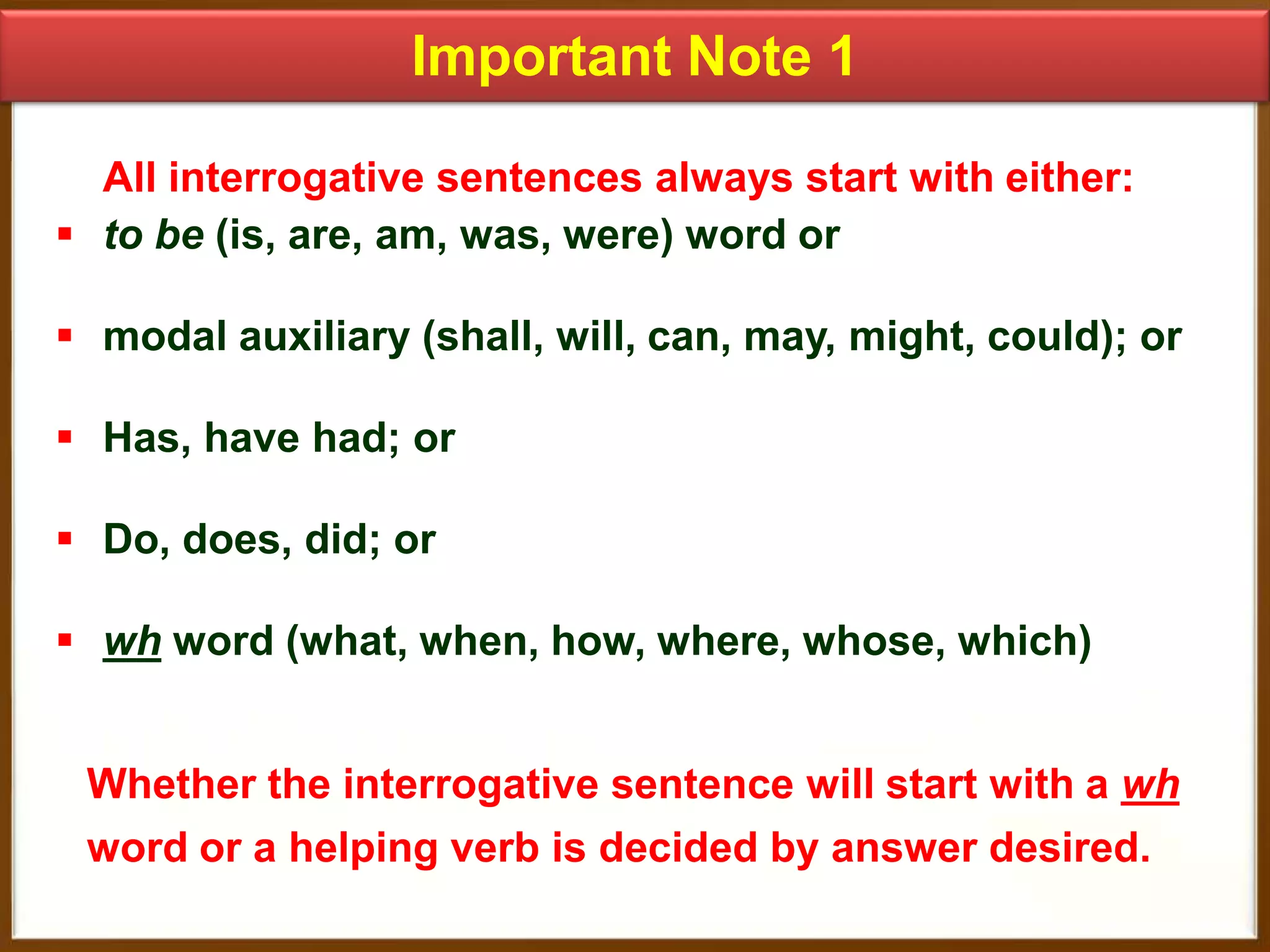
Important Note 1
All interrogative sentences always start with either:
 to be (is, are, am, was, were) word or

 modal auxiliary (shall, will, can, may, might, could); or
 Has, have had; or

 Do, does, did; or
 wh word (what, when, how, where, whose, which)
Whether the interrogative sentence will start with a wh
word or a helping verb is decided by answer desired.
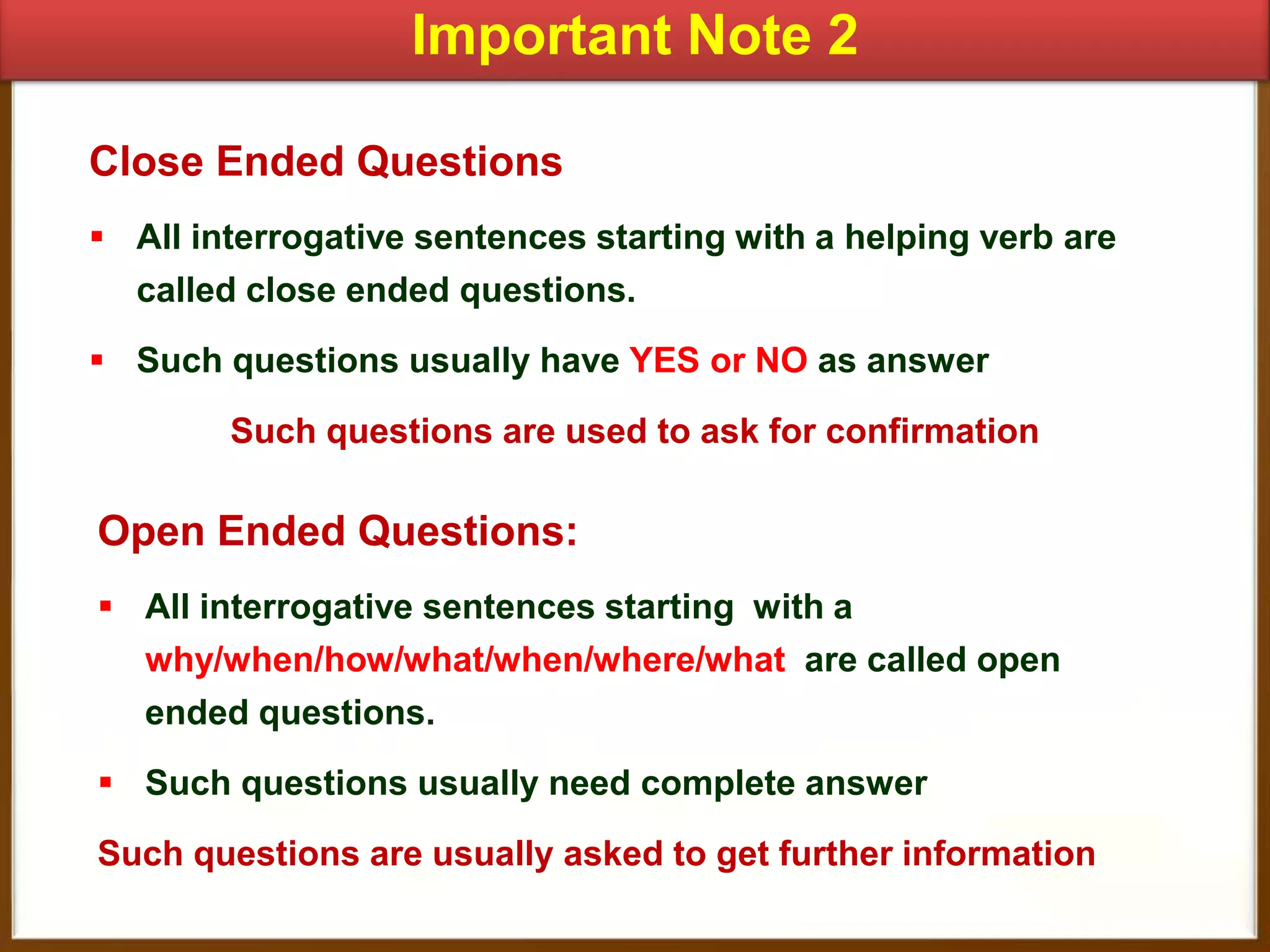
Important Note 2
Close Ended Questions
 All interrogative sentences starting with a helping verb are
called close ended questions.
 Such questions usually have YES or NO as answer
Such questions are used to ask for confirmation

Open Ended Questions:
 All interrogative sentences starting with a
why/when/how/what/when/where/what are called open
ended questions.
 Such questions usually need complete answer
Such questions are usually asked to get further information
When
to use
s, es or ies
with verbs
Types of Verbs
Helping Verbs
Main Verbs

Auxiliary Verbs

Modal Auxiliary

 Eat

 Is

 Can

 Drink

 Are

 Could

 Sleep

 Am

 May

 Read

 Was

 Might

 Think

 Were

 Shall

 Drive

 Do

 Should

 Write

 Does

 Will

 Produce

 Did

 Would

 Has
 Have
 Had
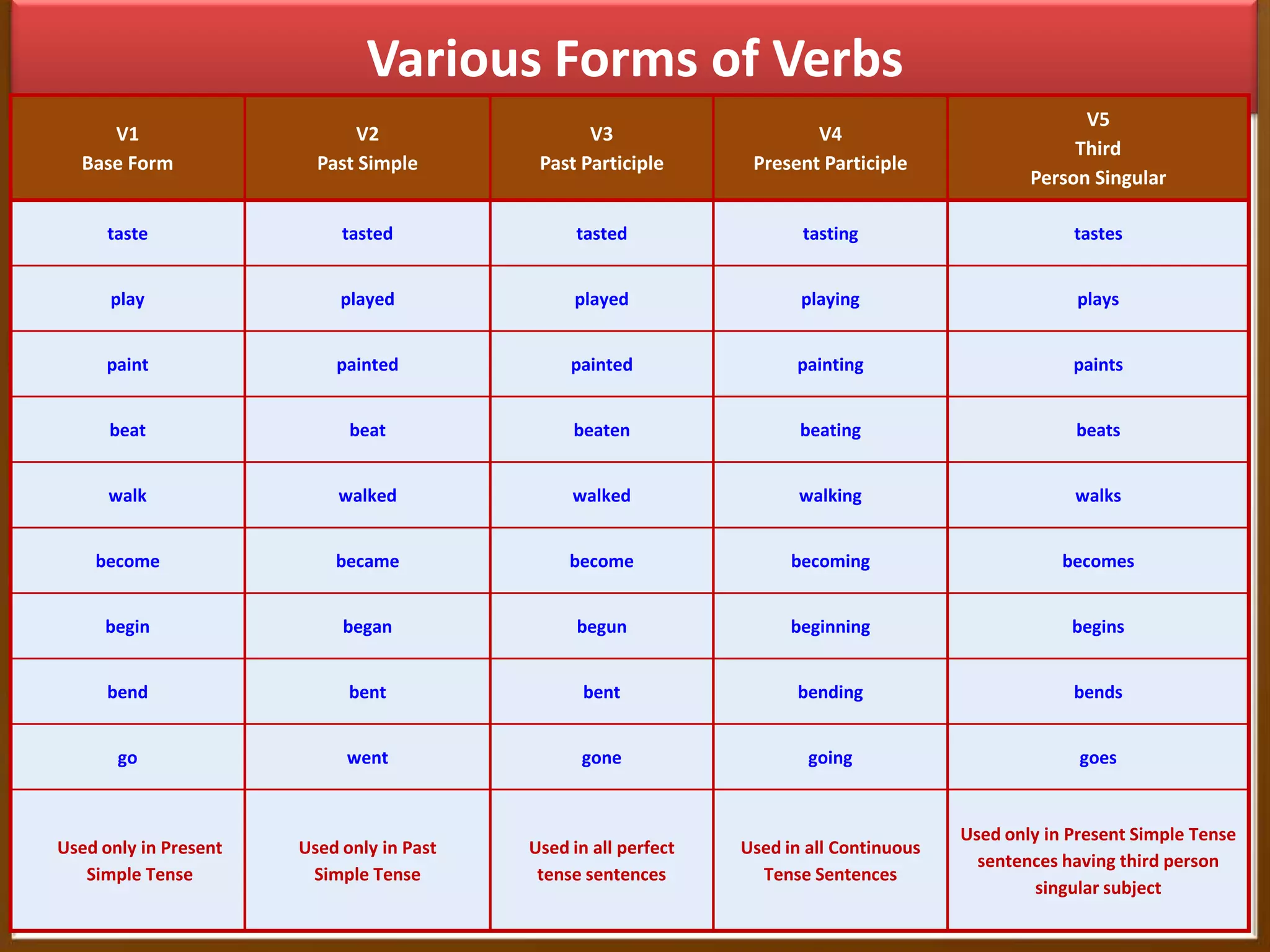
Various Forms of Verbs
V1
Base Form

V2
Past Simple

V3
Past Participle

V4
Present Participle

V5
Third
Person Singular

taste

tasted

tasted

tasting

tastes

play

played

played

playing

plays

paint

painted

painted

painting

paints

beat

beat

beaten

beating

beats

walk

walked

walked

walking

walks

become

became

become

becoming

becomes

begin

began

begun

beginning

begins

bend

bent

bent

bending

bends

go

went

gone

going

goes

Used only in Past
Simple Tense

Used in all perfect
tense sentences

Used in all Continuous
Tense Sentences

Used only in Present Simple Tense
sentences having third person
singular subject

Used only in Present
Simple Tense
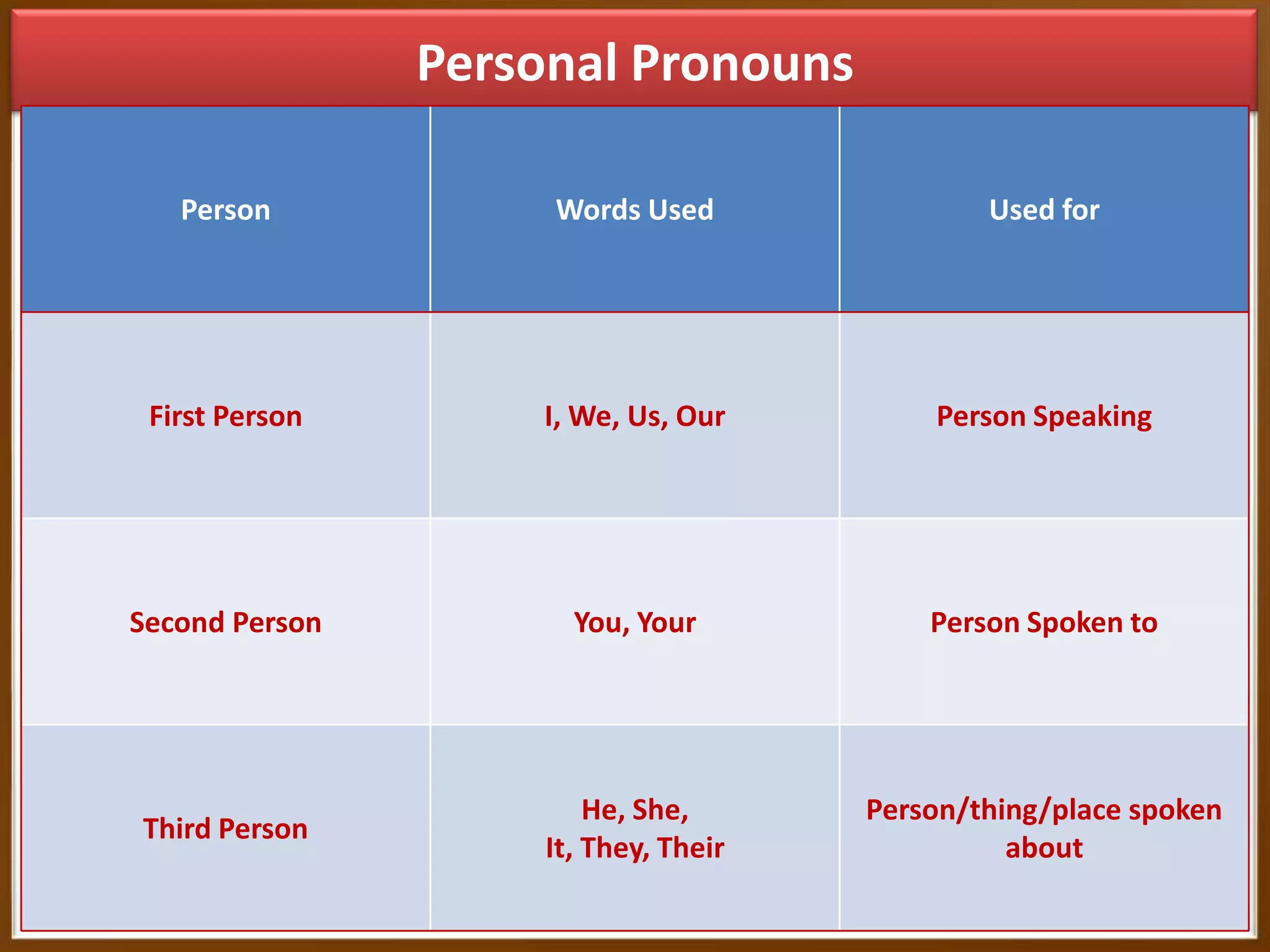
Personal Pronouns
Person

Words Used

Used for

First Person

I, We, Us, Our

Person Speaking

Second Person

You, Your

Person Spoken to

Third Person

He, She,
It, They, Their

Person/thing/place spoken
about
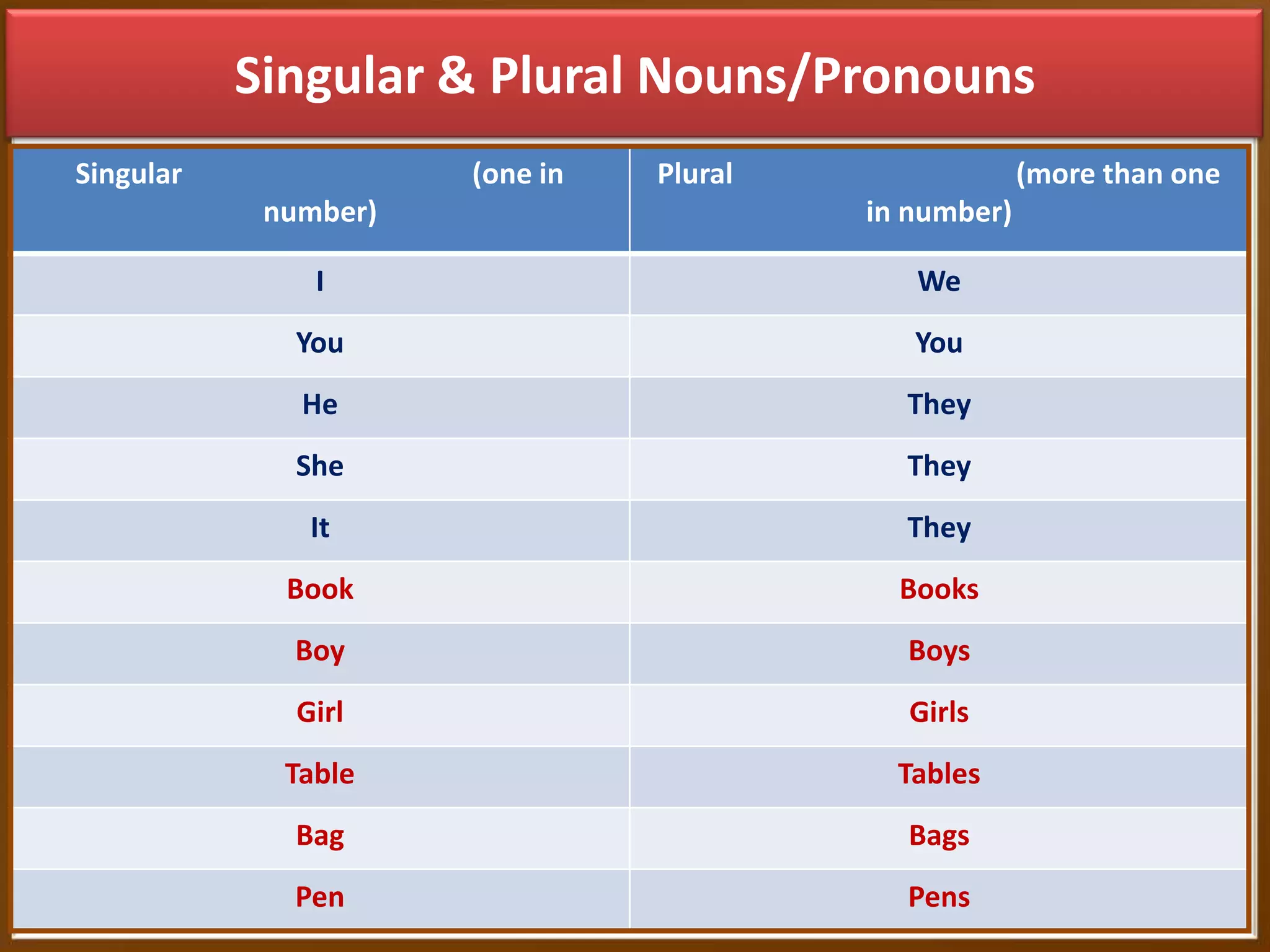
Singular & Plural Nouns/Pronouns
Singular

(one in

Plural

(more than one

number)

in number)

I

We

You

You

He

They

She

They

It

They

Book

Books

Boy

Boys

Girl

Girls

Table

Tables

Bag

Bags

Pen

Pens
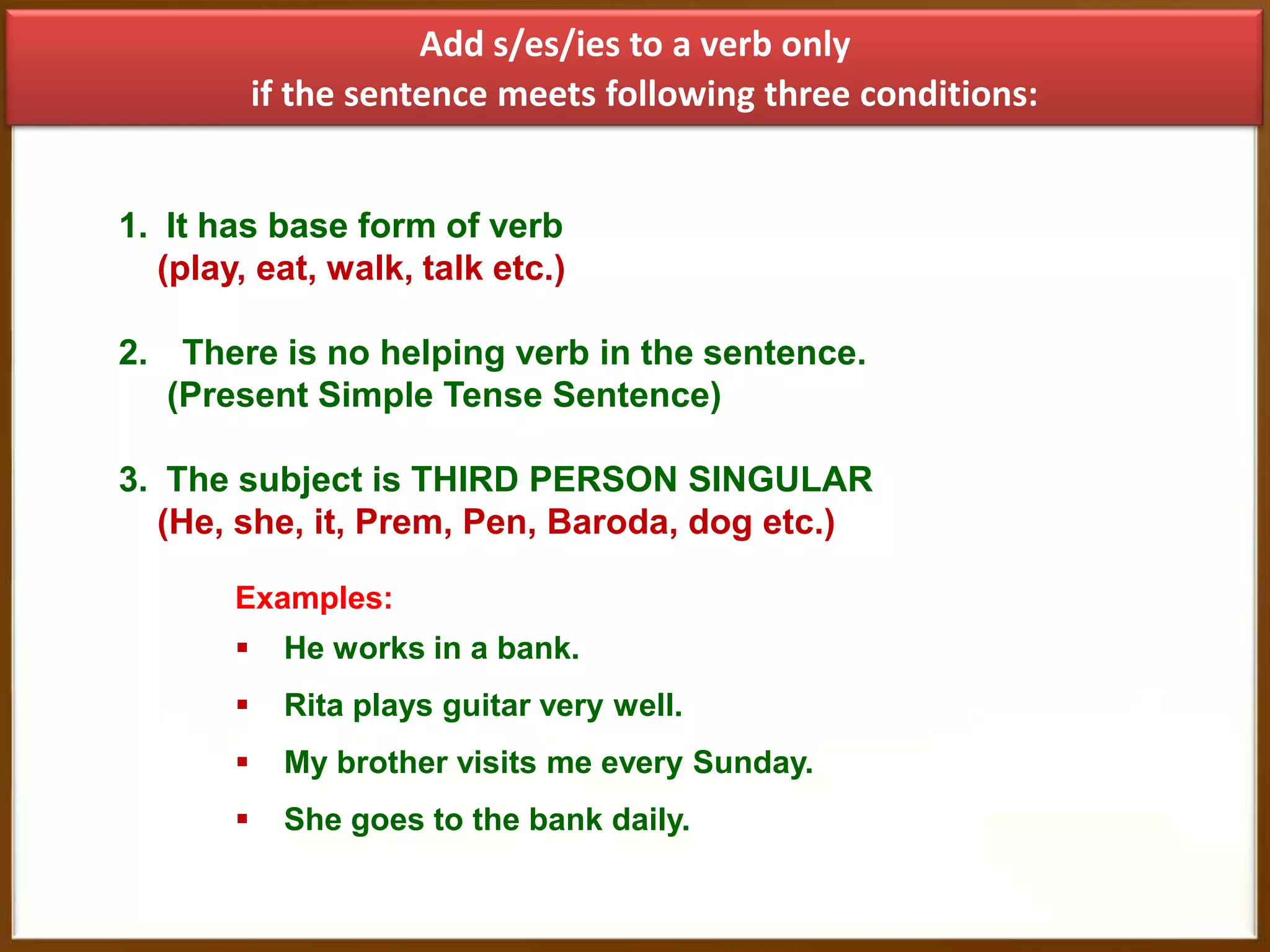
Add s/es/ies to a verb only
if the sentence meets following three conditions:
1. It has base form of verb
(play, eat, walk, talk etc.)
2. There is no helping verb in the sentence.
(Present Simple Tense Sentence)
3. The subject is THIRD PERSON SINGULAR
(He, she, it, Prem, Pen, Baroda, dog etc.)
Examples:


He works in a bank.



Rita plays guitar very well.



My brother visits me every Sunday.



She goes to the bank daily.
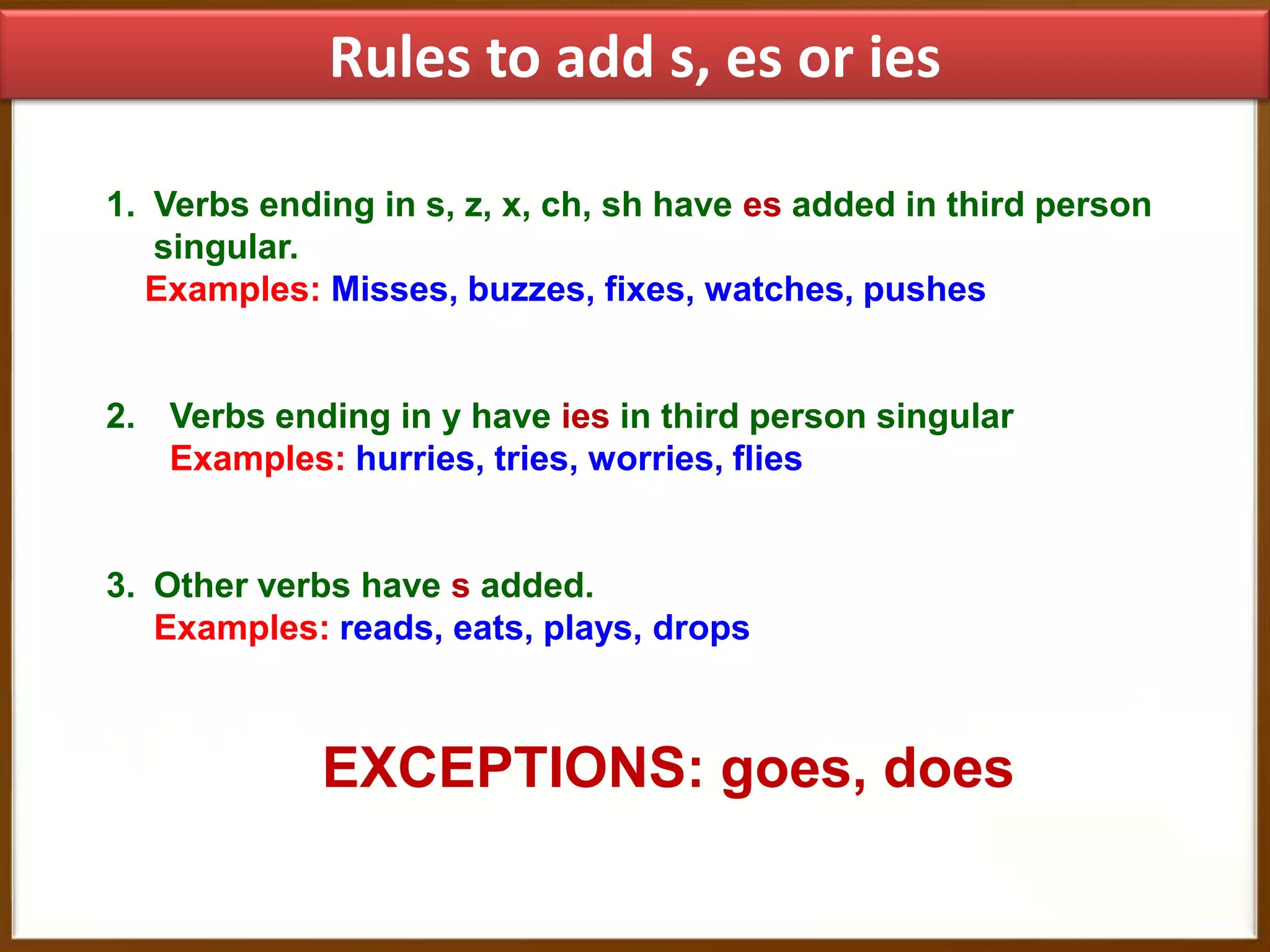
Rules to add s, es or ies
1. Verbs ending in s, z, x, ch, sh have es added in third person
singular.
Examples: Misses, buzzes, fixes, watches, pushes

2. Verbs ending in y have ies in third person singular
Examples: hurries, tries, worries, flies

3. Other verbs have s added.
Examples: reads, eats, plays, drops

EXCEPTIONS: goes, does
How
to Transform
Sentences.
Change to Negative or Interrogative Sentence

Presented BY:
The English Academy
91 88666 80407
englishacademybaroda@gmail.com
Visit us at: http://indiamart.com/english-academy/
Corporate Training

│ Personality Development │ Mentoring │ Hand Holding

How to transform sentences

  • 1.
    How to Transform Sentences. Change toNegative or Interrogative Sentence Presented BY: The English Academy 91 88666 80407 englishacademybaroda@gmail.com Visit us at: http://indiamart.com/english-academy/ Corporate Training │ Personality Development │ Mentoring │ Hand Holding
  • 2.
    There are 3types of Sentences: 1. Affirmative Sentences: (These sentences will not have no/not & will end on (.) full stop.) Examples: 1. Priya works in Gujarat Gas. 2. You are very intelligent. 3. I am having lunch. 4. He was working on this project yesterday. 5. He has been working since 9 am. 6. You play cricket very well. 7. We had reached Delhi safely.
  • 3.
    There are 3types of Sentences: 2. Negative Sentence: (These sentences will have no/not & will end on (.) full stop.) Examples: 1. Priya is not working these days. 2. You were not present in the class yesterday. 3. There are no students in the class now. 4. Kamal doesn’t have a car. 5. I could not complete your work yesterday. 6. She didn’t bring my book that day. 7. There was no water in the lake. 8. We have no light in our house today.
  • 4.
    There are 3types of Sentences: 3. Interrogative Sentence: (These sentences ask a question & they may or may not have no/not & will end on (?) Question Mark Examples: 1. Why is Priya not working these days? 2. Why were you not present in the class yesterday? 3. Is Ram present in the office now? 4. Have you brought my book? 5. Does she like badminton? 6. Why is there no water in the jug? 7. When did he reach Surat? 8. Did Rita not come to your house yesterday?
  • 5.
    Types of Verbs HelpingVerbs Main Verbs Auxiliary Verbs Modal Auxiliary  Eat  Is  Can  Drink  Are  Could  Sleep  Am  May  Read  Was  Might  Think  Were  Shall  Drive  Do  Should  Write  Does  Will  Produce  Did  Would  Has  Have  Had
  • 6.
    Universal Formula of aSentence in English Subject + Verb + Object
  • 7.
    Universal Formula ofa Sentence in English Subject + Verb + Object A sentence can be without helping verb In this case the exact formula is: Subject + Main Verb + Object Examples:     I read newspaper. He plays cricket. You work very hard. She comes everyday.
  • 8.
    Universal Formula ofa Sentence in English Subject + Verb + Object A sentence can also have a helping verb & a main verb Hence formula of a sentence with helping verb: Subject + helping Verb + Main Verb + Object Examples:     I am reading newspaper. He did not arrive. You are working very hard. She will come tomorrow.
  • 9.
    IMPORTANT Main Verb iscompulsory in all Sentences; Examples:  You appear tired.  She works very hard.  I like reading.  They study in Surat. But helping verb is not compulsory.
  • 10.
    Universal Formula for MakingNegative Sentences Subject + Helping Verb + not + Main Verb + Object (add ‘not’ in between helping verb & main verb)
  • 11.
    Sentences with HelpingVerb Negative Sentences Subject + Helping Verb + not + Main Verb + Object Examples:  Priya is working these days.  Priya is not working these days.  You were present in the class yesterday.  You were not present in the class yesterday.  I was absent yesterday.  I was not absent yesterday.  They are coming to attend this meeting.  They are not coming to attend this meeting.
  • 12.
    Universal Formula for MakingNegative Sentences (without helping verb) Subject + do/does/did + not + Main Verb + Object (add ‘do/does/did + not’ before main verb)
  • 13.
    Sentences without HelpingVerb Negative Sentences Subject + Helping Verb (do/does/did) + not + Main Verb + Object Examples:  Priya works in a bank these days.  Priya does not work in a bank these days.  You play football very well.  You do not play football very well.  I like Indian Music.  I do not like Indian Music  They went to attend the meeting on Sunday.  They did not go to attend the meeting on Sunday.
  • 14.
    Universal Formula for Makinginterrogative Sentences 1. Helping Verb + Subject + Main Verb + Object 2. (WH Word) + Helping Verb + Subject + Main Verb + Object NOTE: 1. Start the sentence with helping verb. 2. If required; place WH word in front of 1 above.
  • 15.
    Interrogative Sentences-with HelpingVerb Interrogative Sentences Helping Verb + Subject + Main Verb + Object (WH Word)Helping Verb + Subject + Main Verb + Object Examples:  You were not absent from the class.  Were you not absent from the class?  When were you not absent from the class?  Ram is present in the office now.  Is Ram present in the office now?  Why is Ram present in the office now?  They are taking lunch now.  Are they taking lunch now?  Why are they taking lunch now?
  • 16.
    Universal Formula for Makinginterrogative Sentences (Sentences without helping verb) 1. Do/Does/Did + Subject + Main Verb + Object 2. (WH Word) + Do/Does/Did + Subject + Main Verb + Object NOTE: 1. Start the sentence with Do/Does/Did. 2. If required; place WH word in front of 1 above.
  • 17.
    Interrogative Sentences- WithoutHelping Verb Interrogative Sentences Do/Does/Did (Helping Verb) + Subject + Main Verb + Object (WH Word) + Do/Does/Did (Helping Verb) + Subject + Main Verb + Object Examples:  She works in Gujarat Gas.  Does she work in Gujarat Gas?  Why does she work in Gujarat Gas?  Ram Stays in Vadodara.  Does Ram stay in Vadodara?  Where does Ram stay in Vadodara?  You played cricket in school.  Did you play cricket in school?  When did you platy cricket in school?
  • 18.
    Important Note 1 Allinterrogative sentences always start with either:  to be (is, are, am, was, were) word or  modal auxiliary (shall, will, can, may, might, could); or  Has, have had; or  Do, does, did; or  wh word (what, when, how, where, whose, which) Whether the interrogative sentence will start with a wh word or a helping verb is decided by answer desired.
  • 19.
    Important Note 2 CloseEnded Questions  All interrogative sentences starting with a helping verb are called close ended questions.  Such questions usually have YES or NO as answer Such questions are used to ask for confirmation Open Ended Questions:  All interrogative sentences starting with a why/when/how/what/when/where/what are called open ended questions.  Such questions usually need complete answer Such questions are usually asked to get further information
  • 20.
    When to use s, esor ies with verbs
  • 21.
    Types of Verbs HelpingVerbs Main Verbs Auxiliary Verbs Modal Auxiliary  Eat  Is  Can  Drink  Are  Could  Sleep  Am  May  Read  Was  Might  Think  Were  Shall  Drive  Do  Should  Write  Does  Will  Produce  Did  Would  Has  Have  Had
  • 22.
    Various Forms ofVerbs V1 Base Form V2 Past Simple V3 Past Participle V4 Present Participle V5 Third Person Singular taste tasted tasted tasting tastes play played played playing plays paint painted painted painting paints beat beat beaten beating beats walk walked walked walking walks become became become becoming becomes begin began begun beginning begins bend bent bent bending bends go went gone going goes Used only in Past Simple Tense Used in all perfect tense sentences Used in all Continuous Tense Sentences Used only in Present Simple Tense sentences having third person singular subject Used only in Present Simple Tense
  • 23.
    Personal Pronouns Person Words Used Usedfor First Person I, We, Us, Our Person Speaking Second Person You, Your Person Spoken to Third Person He, She, It, They, Their Person/thing/place spoken about
  • 24.
    Singular & PluralNouns/Pronouns Singular (one in Plural (more than one number) in number) I We You You He They She They It They Book Books Boy Boys Girl Girls Table Tables Bag Bags Pen Pens
  • 25.
    Add s/es/ies toa verb only if the sentence meets following three conditions: 1. It has base form of verb (play, eat, walk, talk etc.) 2. There is no helping verb in the sentence. (Present Simple Tense Sentence) 3. The subject is THIRD PERSON SINGULAR (He, she, it, Prem, Pen, Baroda, dog etc.) Examples:  He works in a bank.  Rita plays guitar very well.  My brother visits me every Sunday.  She goes to the bank daily.
  • 26.
    Rules to adds, es or ies 1. Verbs ending in s, z, x, ch, sh have es added in third person singular. Examples: Misses, buzzes, fixes, watches, pushes 2. Verbs ending in y have ies in third person singular Examples: hurries, tries, worries, flies 3. Other verbs have s added. Examples: reads, eats, plays, drops EXCEPTIONS: goes, does
  • 27.
    How to Transform Sentences. Change toNegative or Interrogative Sentence Presented BY: The English Academy 91 88666 80407 englishacademybaroda@gmail.com Visit us at: http://indiamart.com/english-academy/ Corporate Training │ Personality Development │ Mentoring │ Hand Holding