Presented By:
Rushda Ashraf
English Language Instructor
Determiners, Articles and
Quantifiers
Definition
• Articles, determiners and quantifiers are those
little words that modifies noun.
(The student, a college, that car, those people,
whatever idea, your choice)
• Sometimes these words will tell us whether we
are referring to a specific or general thing( The
book, A horse! My kingdom); sometimes they
will tell how much and how many( lots of
sweets, many chairs, a great deal of
confusion).
Determiners
• A word or a group of words that introduces a
noun. Determiners includes articles,
demonstratives, quantifiers and possessive
determiners. Determiners are functional classes
not formal word classes.
• Determiner is a word that introduces a noun
such as a/an, the, every, this those or many( as
a car, the car, this car, those cars, every
car, many cars).
(Determiner the is definite article and a/an
are indefinite articles).
Articles
• The three articles- a, an, the- are a kind of
adjective. “ The” is called the definite article
because it usually precedes a specific or
previously mentioned noun. It is required when
the noun it refers to represents something that is
one of a kind: The moon circles the earth.
Cont…
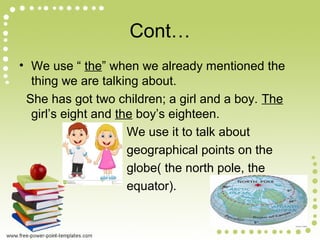
• We use “ the” when we already mentioned the
thing we are talking about.
She has got two children; a girl and a boy. The
girl’s eight and the boy’s eighteen.
We use it to talk about
geographical points on the
globe( the north pole, the
equator).
Cont…
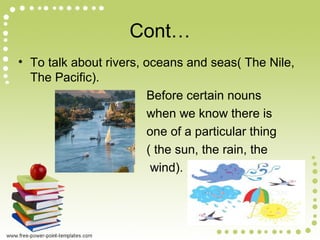
• To talk about rivers, oceans and seas( The Nile,
The Pacific).
Before certain nouns
when we know there is
one of a particular thing
( the sun, the rain, the
wind).
Cont…
• “The is also used to say that a particular thing or
person being mentioned is the best, most
famous etc( Ahmar’s house is the place to go).
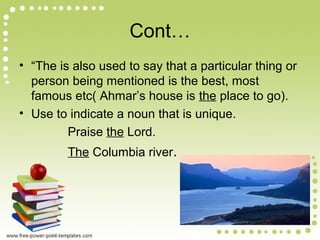
• Use to indicate a noun that is unique.
Praise the Lord.
The Columbia river.
Cont…
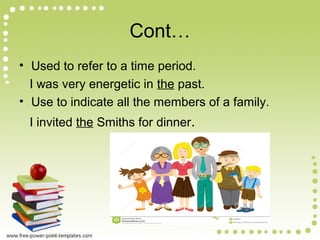
• Used to refer to a time period.
I was very energetic in the past.
• Use to indicate all the members of a family.
I invited the Smiths for dinner.
Indefinite Articles
• “a” and “an” are the indefinite articles. They refer
to something not specifically known to the
person we are communicating with.
• a and an are used before nouns that introduce
something or someone you have not mentioned
before:
I saw an elephant in the morning.
I buy a pen from a shop.
Cont…
• an- used before singular count noun beginning
with a vowel( a, e, I ,o ,u ) or vowel sound:
an apple, an honest man, an issue
• a- used before singular count nouns beginning
with consonants( other than a, e, I, o, u).
a cup, a book, a pencil, a ball, a letter
Indefinite Article(a-an)
• Used before singular nouns that are unspecified:
• A pencil
• An orange
• Used before number collectives and numbers:
• a dozen
• A gallon
Cont…
Possessive Determiners
• Words like my, our, your, his, her, it and there
are known as possessive determiners. They
come before nouns and indicate ownership of
the noun in question, as their names suggest:
My leg hurts.
Moiz sold his house.
Bring your books with you.
These are our pencils.
She took her cake.
Demonstratives
• The demonstratives this, that, these, those,
show where an object or person is in relation to
the speaker.
• This( singular) and these( plural) refer to an
object or person near the speaker.
That( singular) and those( plural) refer to an
object or person away from the speaker. It can
be a
physical closeness or distance as in:
Who owns that house? (distant)
Is this Tashfeen’s house? (close)
Cont…
• Or it can be a psychological distance as in:
• That’s nothing to do with me. ( distant)
• This is a nice surprise. ( close)
• The position of demonstratives is:
Before the noun
Before the word ‘one’
Before an adjective + noun
Alone when the noun is ‘understood’
Quantifiers
• A quantifier is a word(or phrase) which indicates
a number or amount being referred to. It
generally comes before noun( or noun phrase).
• Some, many, a lot of, a few are the examples of
quantifiers.
• Quantifiers can be used with both countable and
uncountable nouns.
There are some books on the desk.
He has got only a few books.
How much money have you got.
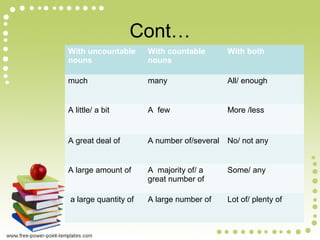
Cont…
With uncountable
nouns
With countable
nouns
With both
much many All/ enough
A little/ a bit A few More /less
A great deal of A number of/several No/ not any
A large amount of A majority of/ a
great number of
Some/ any
a large quantity of A large number of Lot of/ plenty of
The End

Determiners, articles and quantifiers

  • 1.
    Presented By: Rushda Ashraf EnglishLanguage Instructor Determiners, Articles and Quantifiers
  • 2.
    Definition • Articles, determinersand quantifiers are those little words that modifies noun. (The student, a college, that car, those people, whatever idea, your choice) • Sometimes these words will tell us whether we are referring to a specific or general thing( The book, A horse! My kingdom); sometimes they will tell how much and how many( lots of sweets, many chairs, a great deal of confusion).
  • 3.
    Determiners • A wordor a group of words that introduces a noun. Determiners includes articles, demonstratives, quantifiers and possessive determiners. Determiners are functional classes not formal word classes. • Determiner is a word that introduces a noun such as a/an, the, every, this those or many( as a car, the car, this car, those cars, every car, many cars). (Determiner the is definite article and a/an are indefinite articles).
  • 4.
    Articles • The threearticles- a, an, the- are a kind of adjective. “ The” is called the definite article because it usually precedes a specific or previously mentioned noun. It is required when the noun it refers to represents something that is one of a kind: The moon circles the earth.
  • 5.
    Cont… • We use“ the” when we already mentioned the thing we are talking about. She has got two children; a girl and a boy. The girl’s eight and the boy’s eighteen. We use it to talk about geographical points on the globe( the north pole, the equator).
  • 6.
    Cont… • To talkabout rivers, oceans and seas( The Nile, The Pacific). Before certain nouns when we know there is one of a particular thing ( the sun, the rain, the wind).
  • 7.
    Cont… • “The isalso used to say that a particular thing or person being mentioned is the best, most famous etc( Ahmar’s house is the place to go). • Use to indicate a noun that is unique. Praise the Lord. The Columbia river.
  • 8.
    Cont… • Used torefer to a time period. I was very energetic in the past. • Use to indicate all the members of a family. I invited the Smiths for dinner.
  • 9.
    Indefinite Articles • “a”and “an” are the indefinite articles. They refer to something not specifically known to the person we are communicating with. • a and an are used before nouns that introduce something or someone you have not mentioned before: I saw an elephant in the morning. I buy a pen from a shop.
  • 10.
    Cont… • an- usedbefore singular count noun beginning with a vowel( a, e, I ,o ,u ) or vowel sound: an apple, an honest man, an issue • a- used before singular count nouns beginning with consonants( other than a, e, I, o, u). a cup, a book, a pencil, a ball, a letter
  • 11.
    Indefinite Article(a-an) • Usedbefore singular nouns that are unspecified: • A pencil • An orange • Used before number collectives and numbers: • a dozen • A gallon
  • 12.
  • 13.
    Possessive Determiners • Wordslike my, our, your, his, her, it and there are known as possessive determiners. They come before nouns and indicate ownership of the noun in question, as their names suggest: My leg hurts. Moiz sold his house. Bring your books with you. These are our pencils. She took her cake.
  • 14.
    Demonstratives • The demonstrativesthis, that, these, those, show where an object or person is in relation to the speaker. • This( singular) and these( plural) refer to an object or person near the speaker. That( singular) and those( plural) refer to an object or person away from the speaker. It can be a physical closeness or distance as in: Who owns that house? (distant) Is this Tashfeen’s house? (close)
  • 15.
    Cont… • Or itcan be a psychological distance as in: • That’s nothing to do with me. ( distant) • This is a nice surprise. ( close) • The position of demonstratives is: Before the noun Before the word ‘one’ Before an adjective + noun Alone when the noun is ‘understood’
  • 16.
    Quantifiers • A quantifieris a word(or phrase) which indicates a number or amount being referred to. It generally comes before noun( or noun phrase). • Some, many, a lot of, a few are the examples of quantifiers. • Quantifiers can be used with both countable and uncountable nouns. There are some books on the desk. He has got only a few books. How much money have you got.
  • 17.
    Cont… With uncountable nouns With countable nouns Withboth much many All/ enough A little/ a bit A few More /less A great deal of A number of/several No/ not any A large amount of A majority of/ a great number of Some/ any a large quantity of A large number of Lot of/ plenty of
  • 18.