GLOBAL 8D
Welcome  to this overview session on Global 8D….. The session will provide you, Necessary analytical and procedural description about G8D Necessary inputs to participate in the concern resolution process using G8D  BACK
A primary responsibility of every level of an Organisation is to solve problems. Rarely easy, this has been recognised as essential but challenging work. Disciplined and rigorous use of the G8D process within a robust Quality Operating System manages  the overall problem solving efforts of an Organisation.  - QP&L, FAO BACK
Problems in Problem Solving : Management Impatient leading to Quick fixes are appreciated Incorrect description of the problem Illogical prioritisation Poor team participation Possible causes become root causes Corrective actions are not permanent No / incomplete documentation and storage, hence Corporate Memory starves BACK
BACK Global 8D  is a Standardised Problem Solving Technique used by FAO that provides an effective framework through step-by-step disciplines and integration of different skills, to resolve concerns and prevent their recurrence.
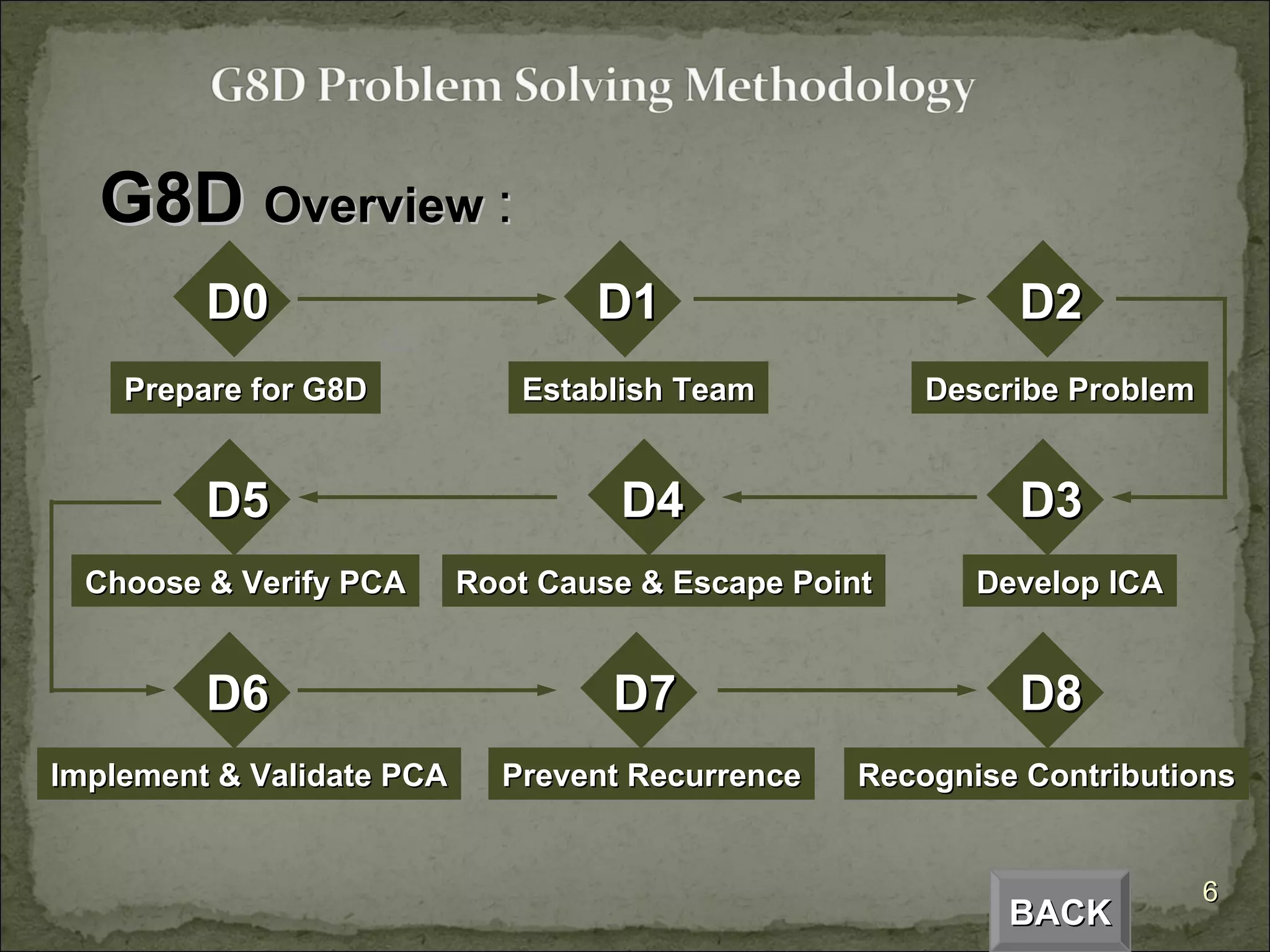
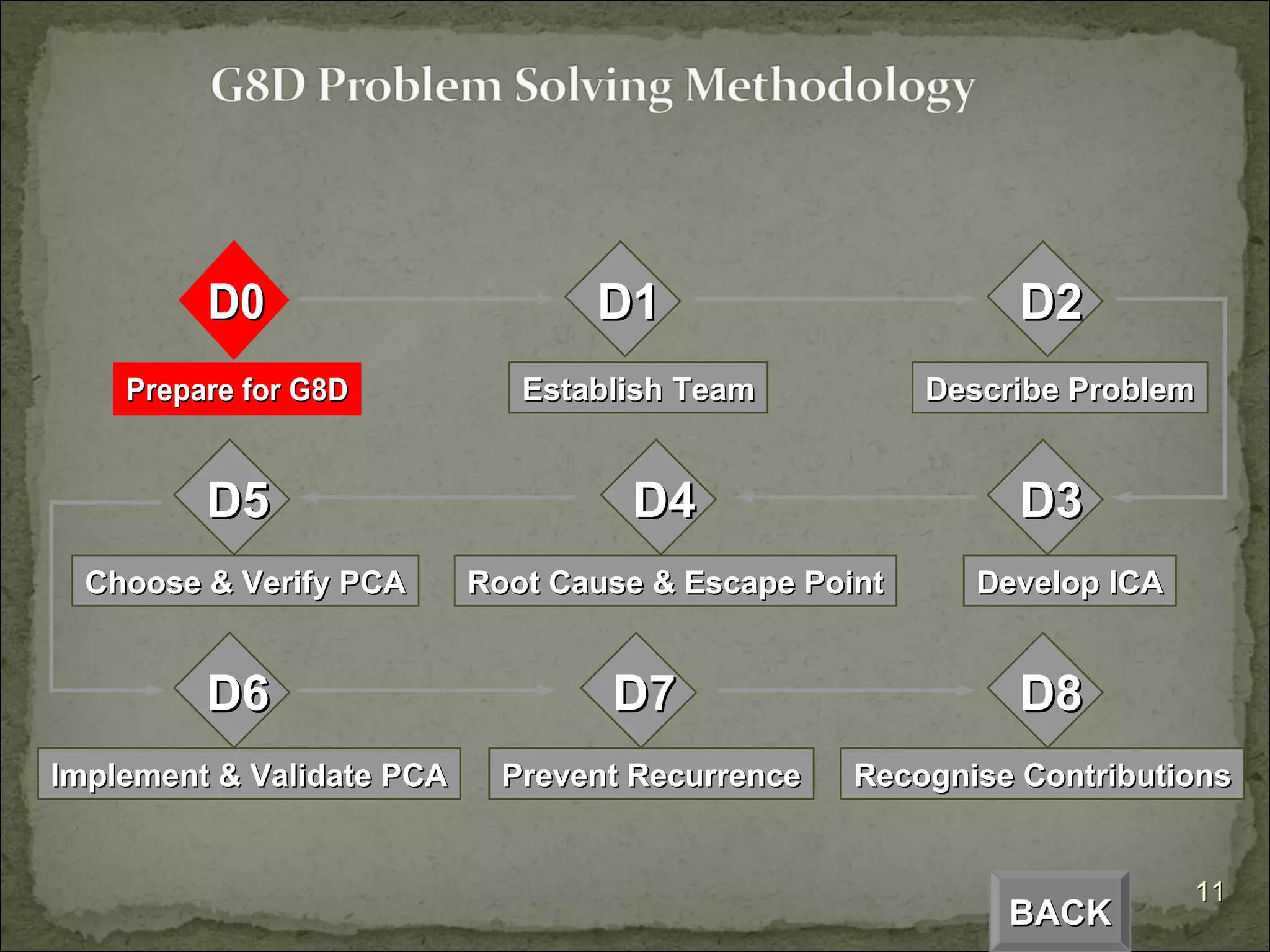
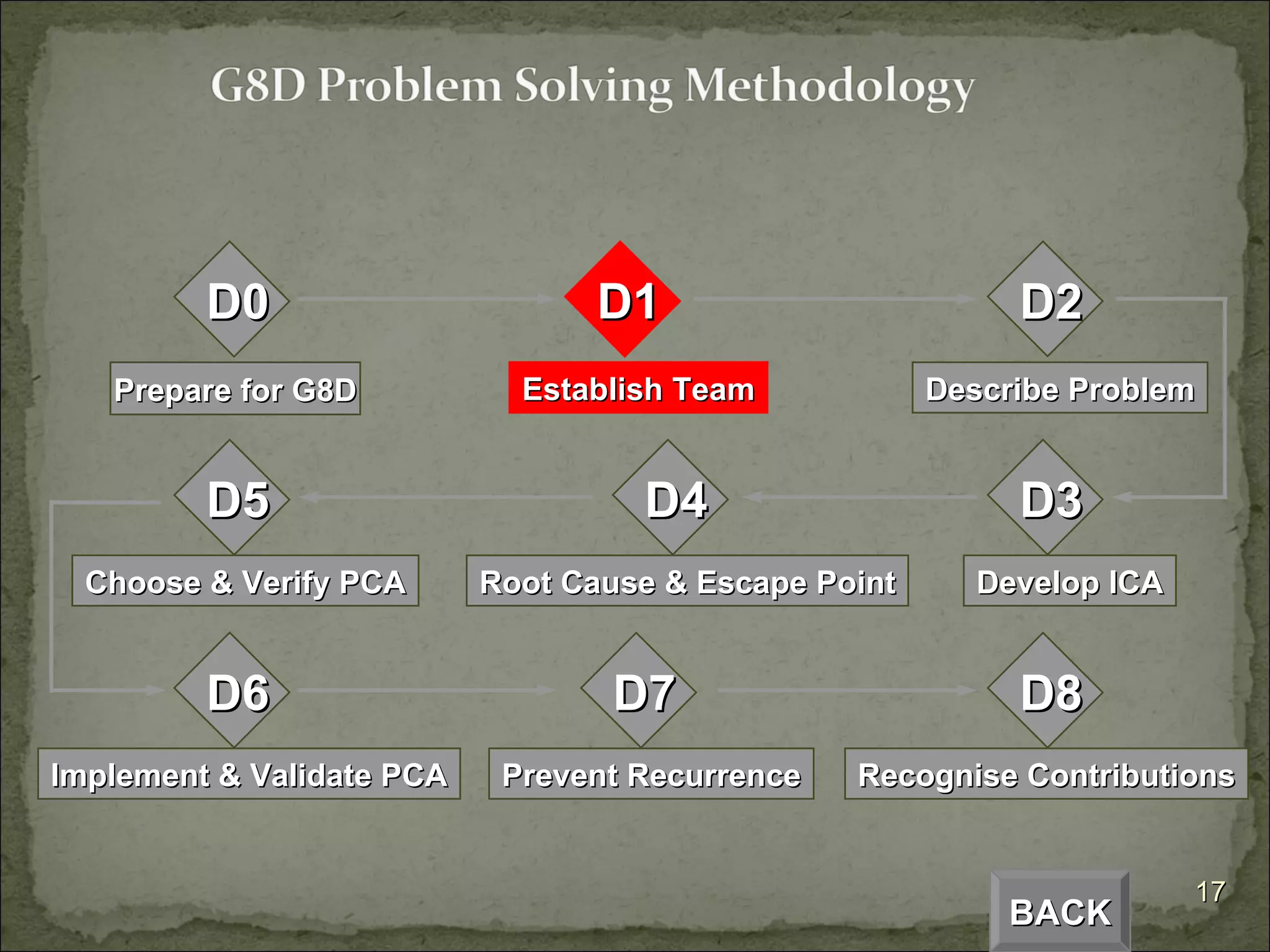
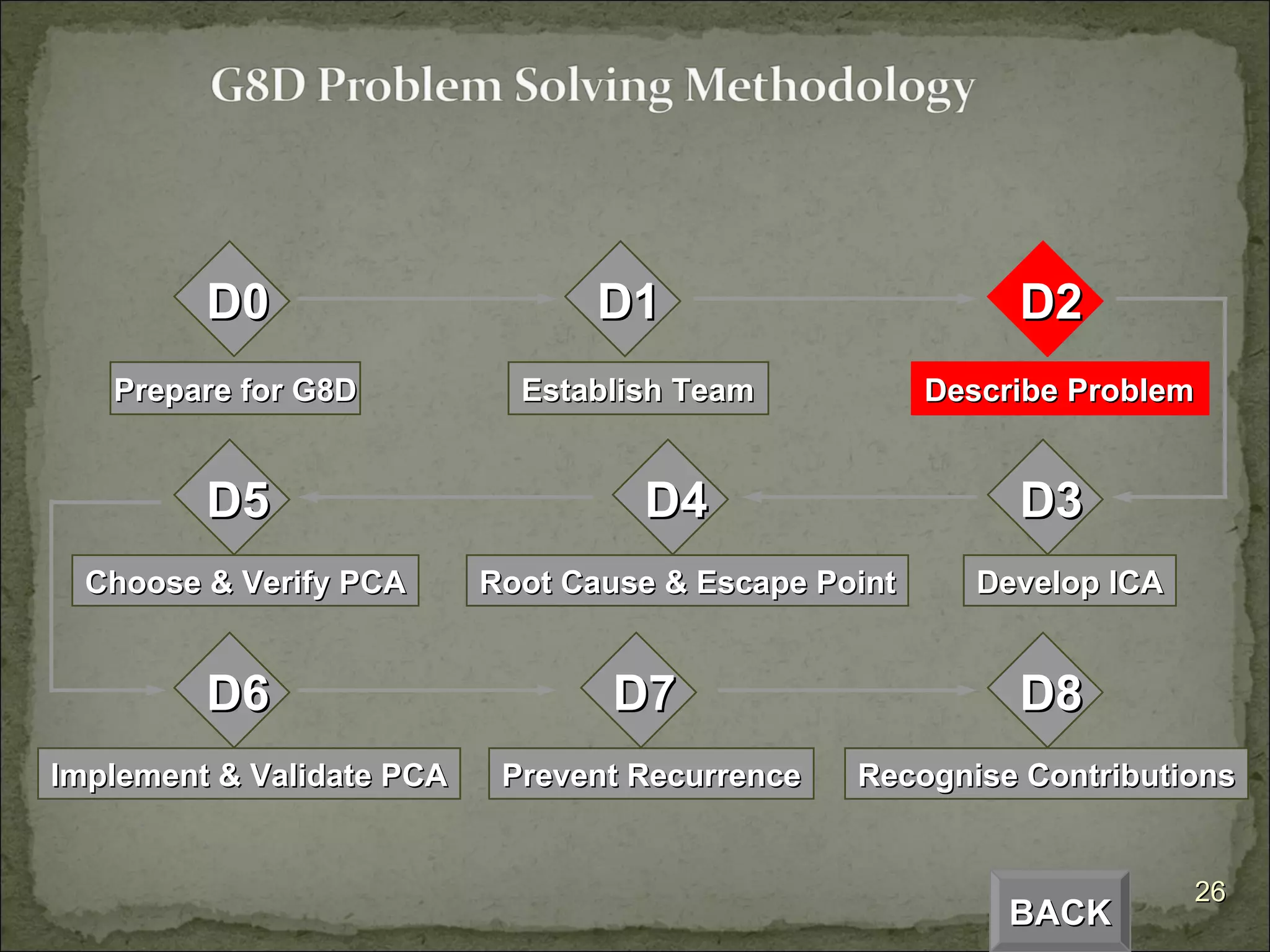
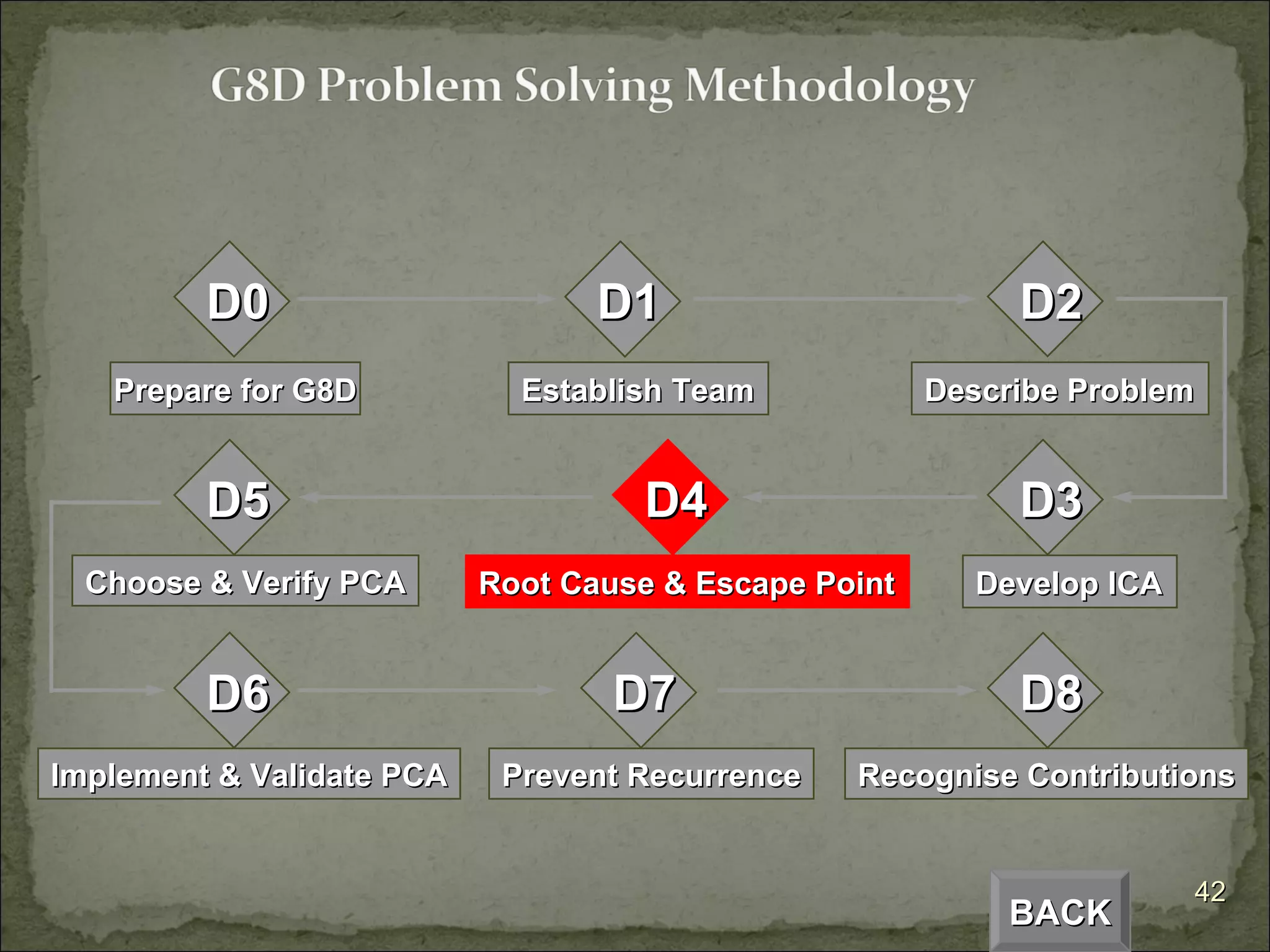
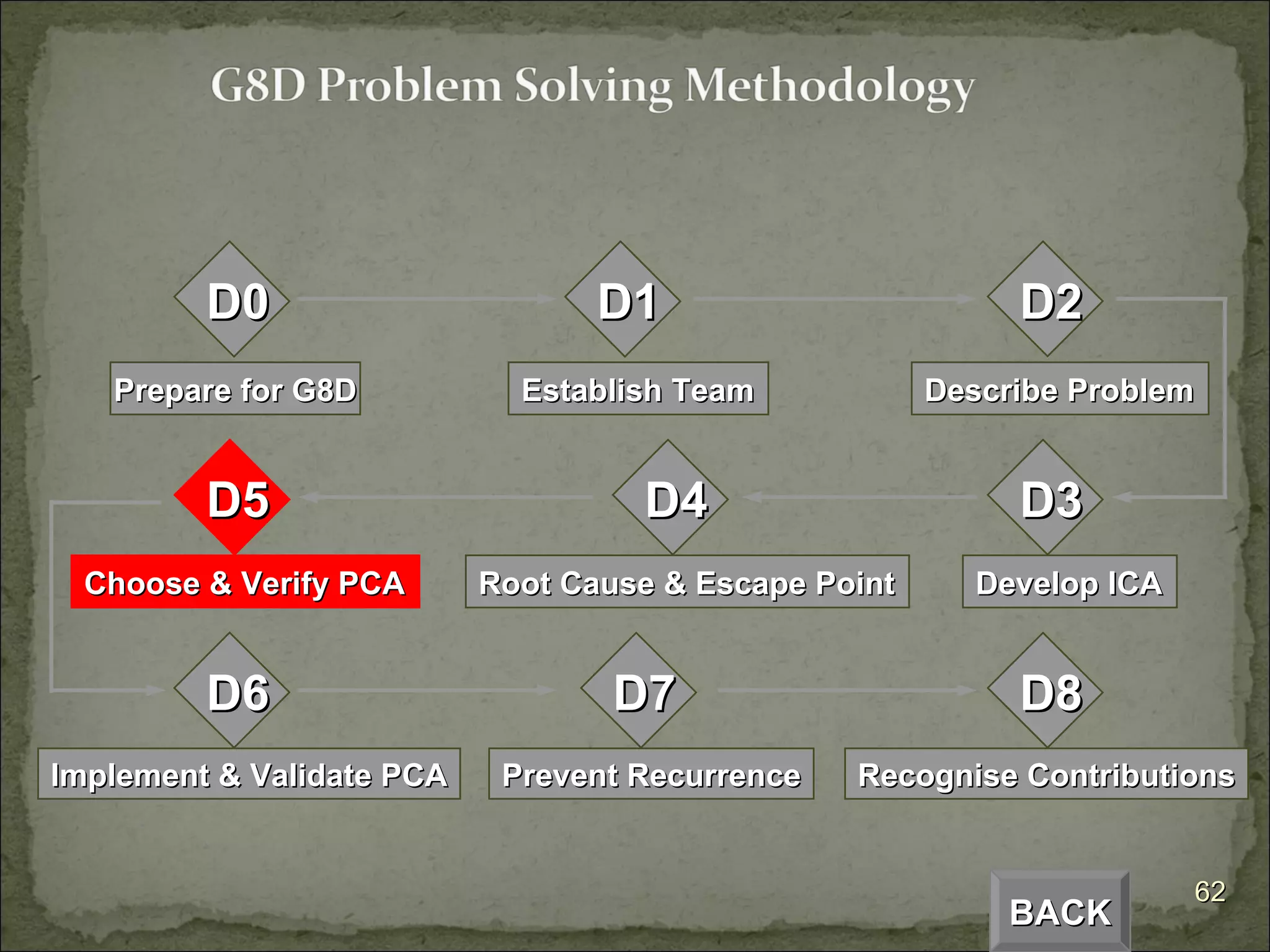
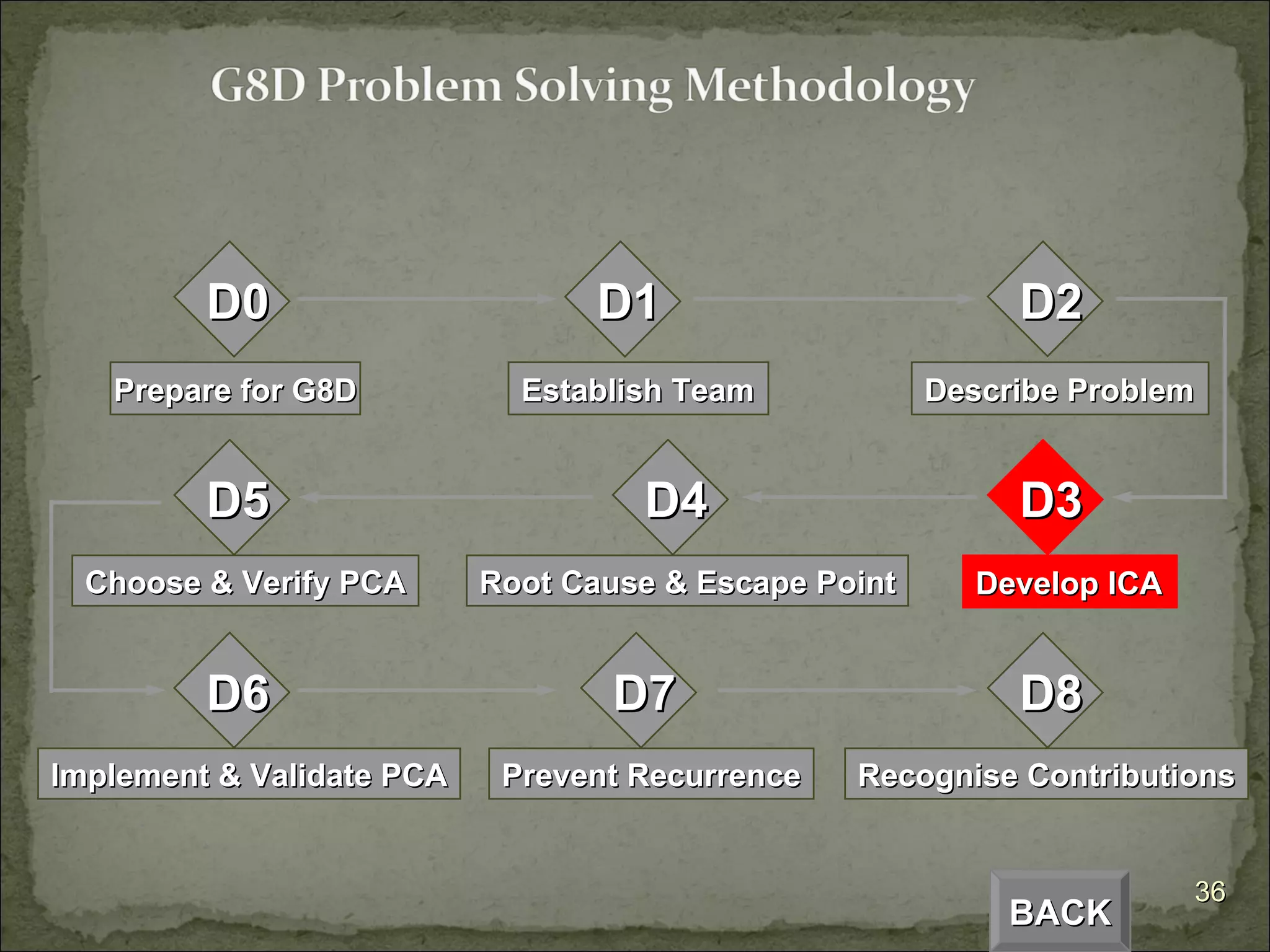
G8D  Overview  : Prepare for G8D Establish Team Describe Problem Choose & Verify PCA Root Cause & Escape Point Develop ICA Implement & Validate PCA Prevent Recurrence Recognise Contributions BACK D0 D1 D2 D5 D4 D3 D6 D7 D8
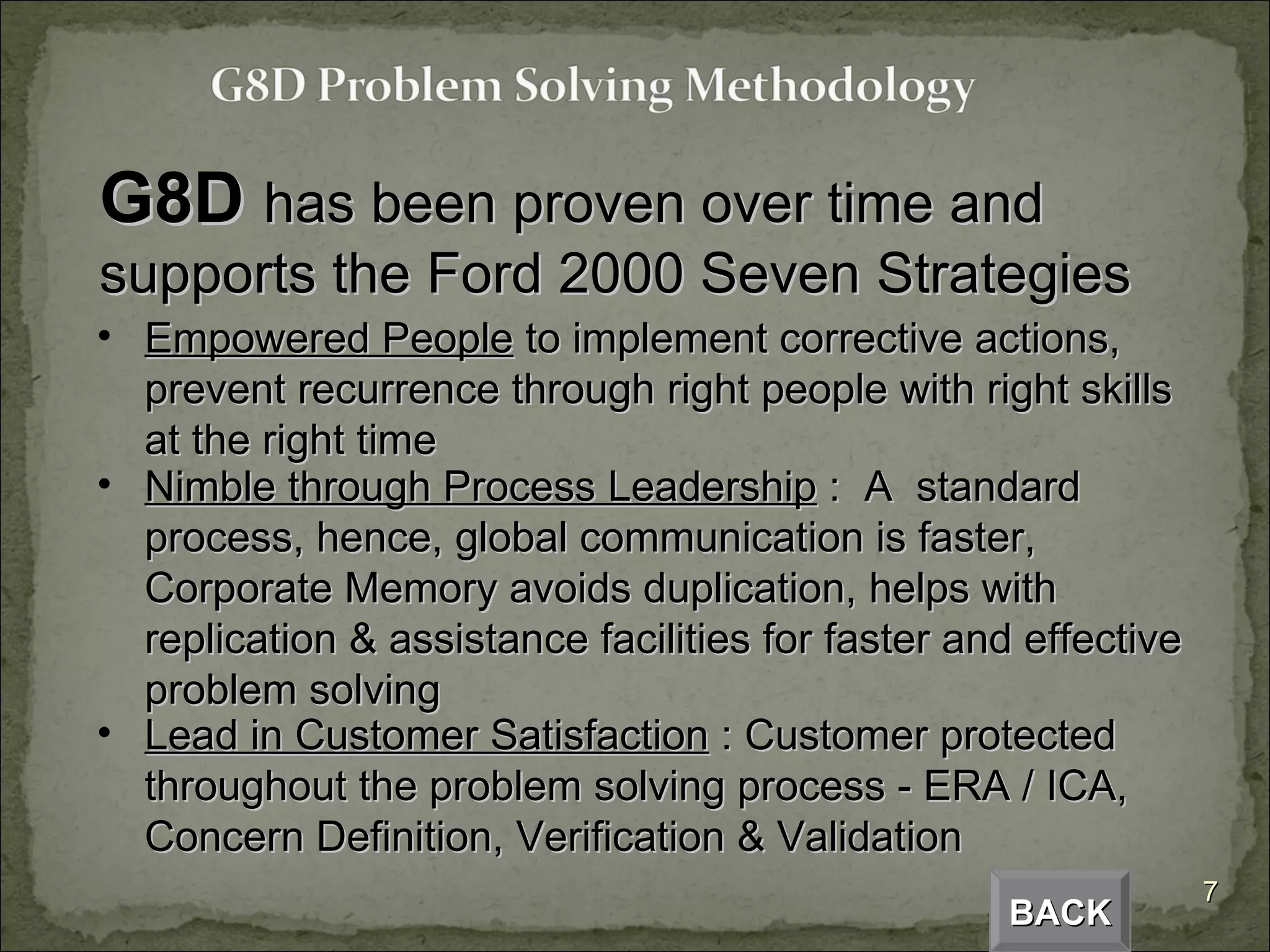
G8D  has been proven over time and supports the Ford 2000 Seven Strategies Empowered People  to implement corrective actions, prevent recurrence through right people with right skills at the right time Nimble through Process Leadership  :  A  standard process, hence, global communication is faster, Corporate Memory avoids duplication, helps with replication & assistance facilities for faster and effective problem solving Lead in Customer Satisfaction  : Customer protected throughout the problem solving process - ERA / ICA, Concern Definition, Verification & Validation  BACK
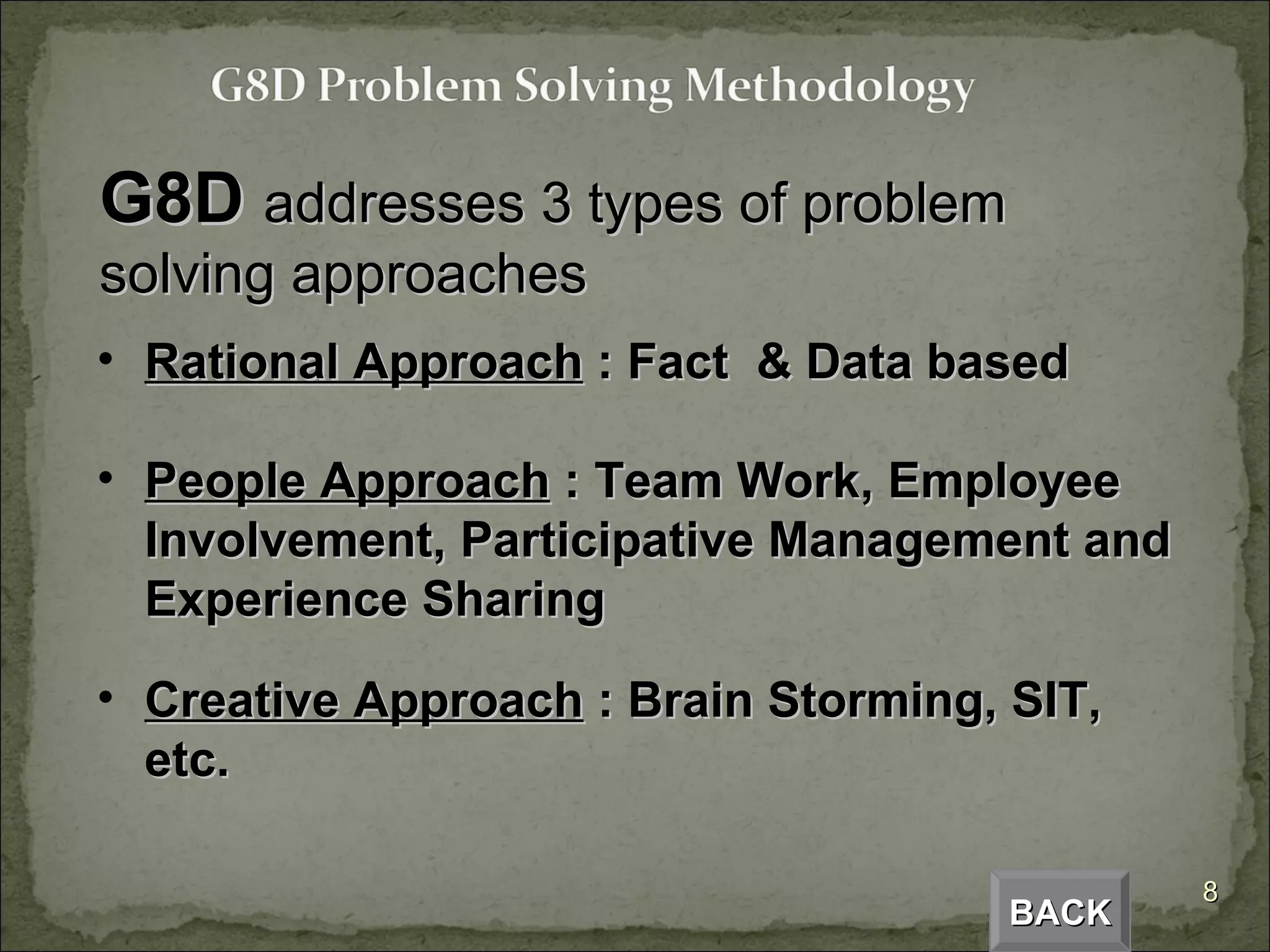
G8D  addresses 3 types of problem solving approaches Rational Approach  : Fact  & Data based People Approach  : Team Work, Employee Involvement, Participative Management and Experience Sharing Creative Approach  : Brain Storming, SIT, etc. BACK
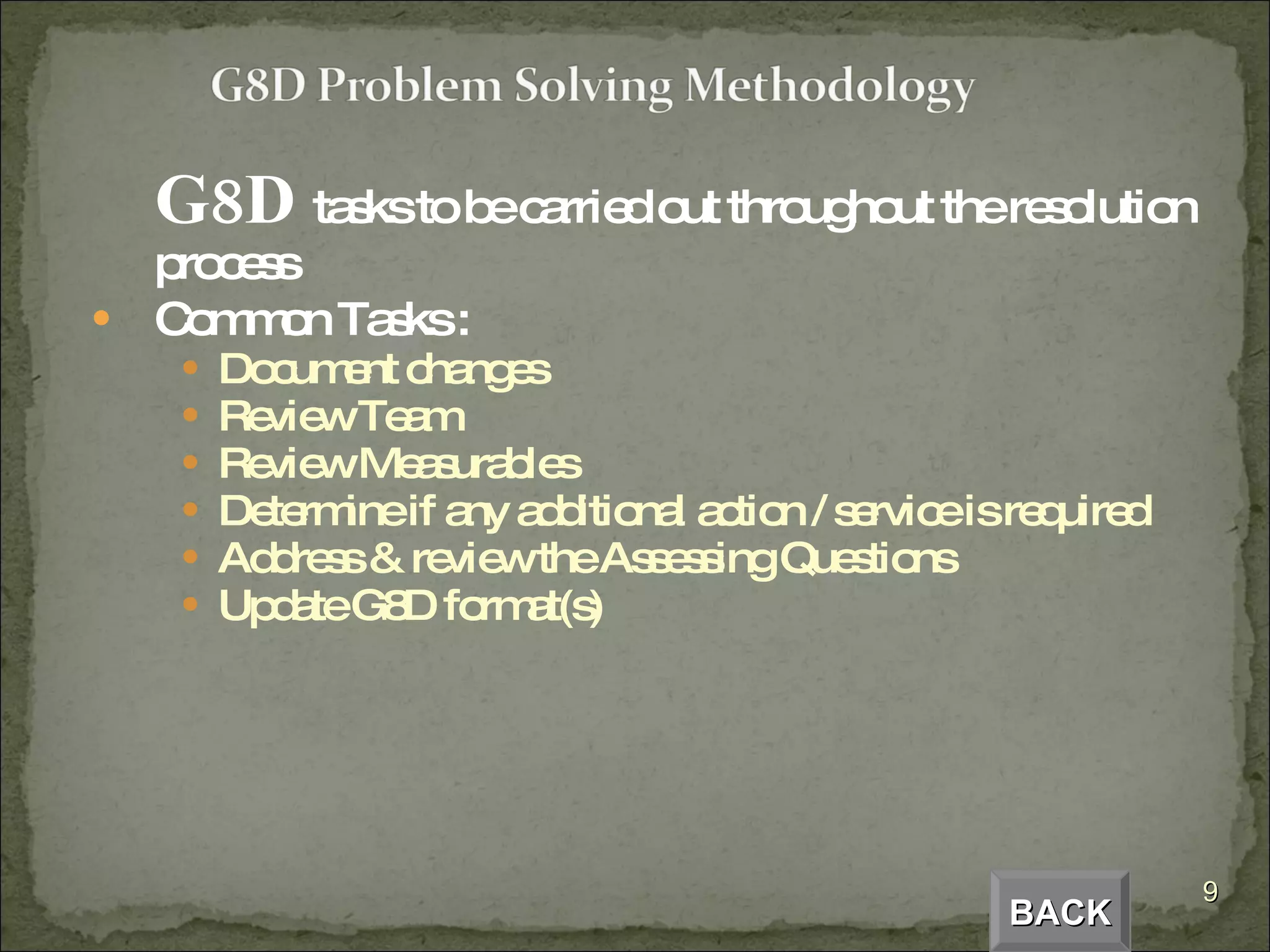
G8D  tasks to be carried out throughout the resolution process Common Tasks : Document changes Review Team Review Measurables Determine if any additional action / service is required Address & review the Assessing Questions Update G8D format(s) BACK
Assessing   Questions - Purpose Keep the team and the champion linked, on task and in agreement Provide Quality Assurance Check for each discipline Serve as an advance organiser for planning activities and resources Trigger actions that need to be taking place in the organisation outside the G8D process BACK
BACK D1 Establish Team D2 Describe Problem D5 Choose & Verify PCA D4 Root Cause & Escape Point D3 Develop ICA D6 Implement & Validate PCA D7 Prevent Recurrence D8 Recognise Contributions
BACK
D0  :   PURPOSE : Prepare for G8D   In response to a Symptom, evaluate the need for the G8D process If necessary, provide Emergency Response Action to protect the Customer and initiate the G8D process BACK
D0  :  G8D Application Criteria The Symptom has been identified and quantified Customers / Affected Parties who experienced the symptom(s) have been identified Performance gaps exist between the symptoms and the desired and / or the priority of the symptom warrants initiation of G8D The Root Cause of the Concern is not known BACK
D0  :  G8D Application Criteria   contd…. Symptom complexity exceeds the ability of one person to resolve the Problem The Concern (same or similar in nature) was not resolved in the past  The Management is committed to dedicate the necessary resources to fix the problem at the root-cause level and prevent its recurrence BACK
D0  :  G8D Application Criteria   contd…. G8D can be applied to  ‘Change Induced Situation’  as well as to  ‘Never Been There Situation’ BACK
BACK D1 Establish Team D2 Describe Problem D5 Choose & Verify PCA D4 Root Cause & Escape Point D3 Develop ICA D6 Implement & Validate PCA D7 Prevent Recurrence D8 Recognise Contributions D0 Prepare for G8D
BACK
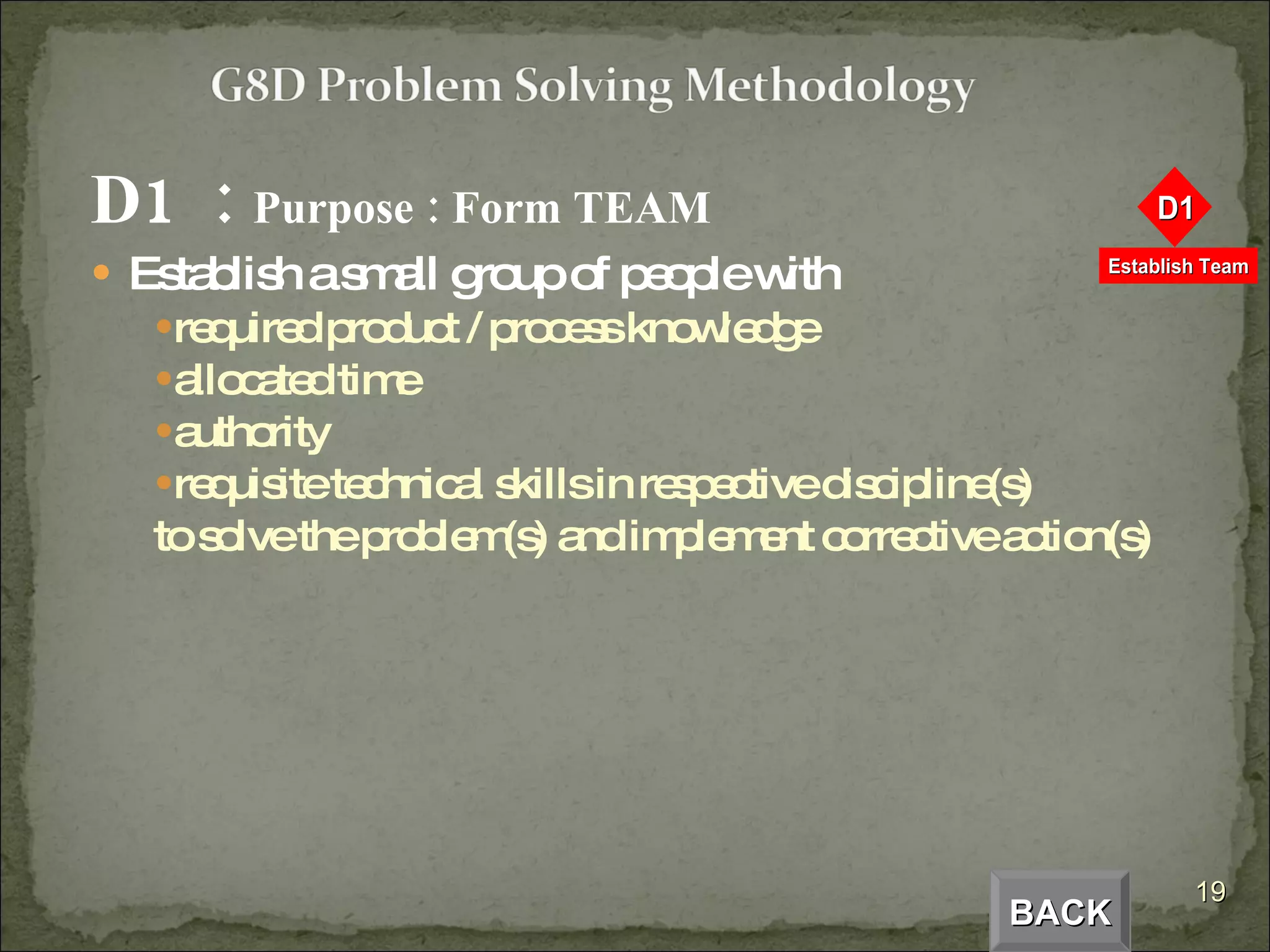
D1  :  Purpose : Form TEAM Establish a small group of people with required product / process knowledge allocated time authority requisite technical skills in respective discipline(s) to solve the problem(s) and implement corrective action(s) BACK
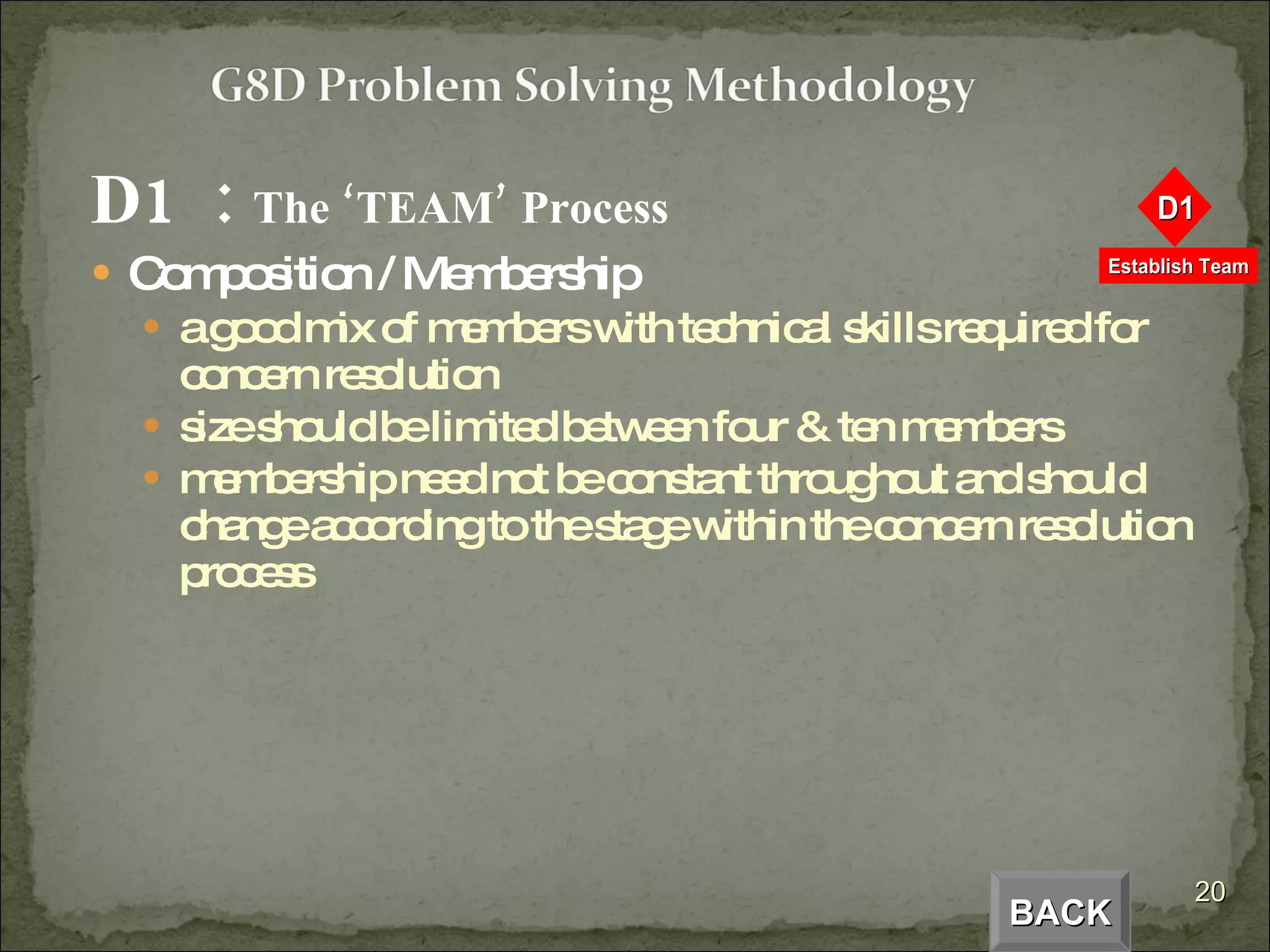
D1  :  The ‘TEAM’ Process Composition / Membership a good mix of members with technical skills required for concern resolution size should be limited between four & ten members membership need not be constant throughout and should change according to the stage within the concern resolution process BACK
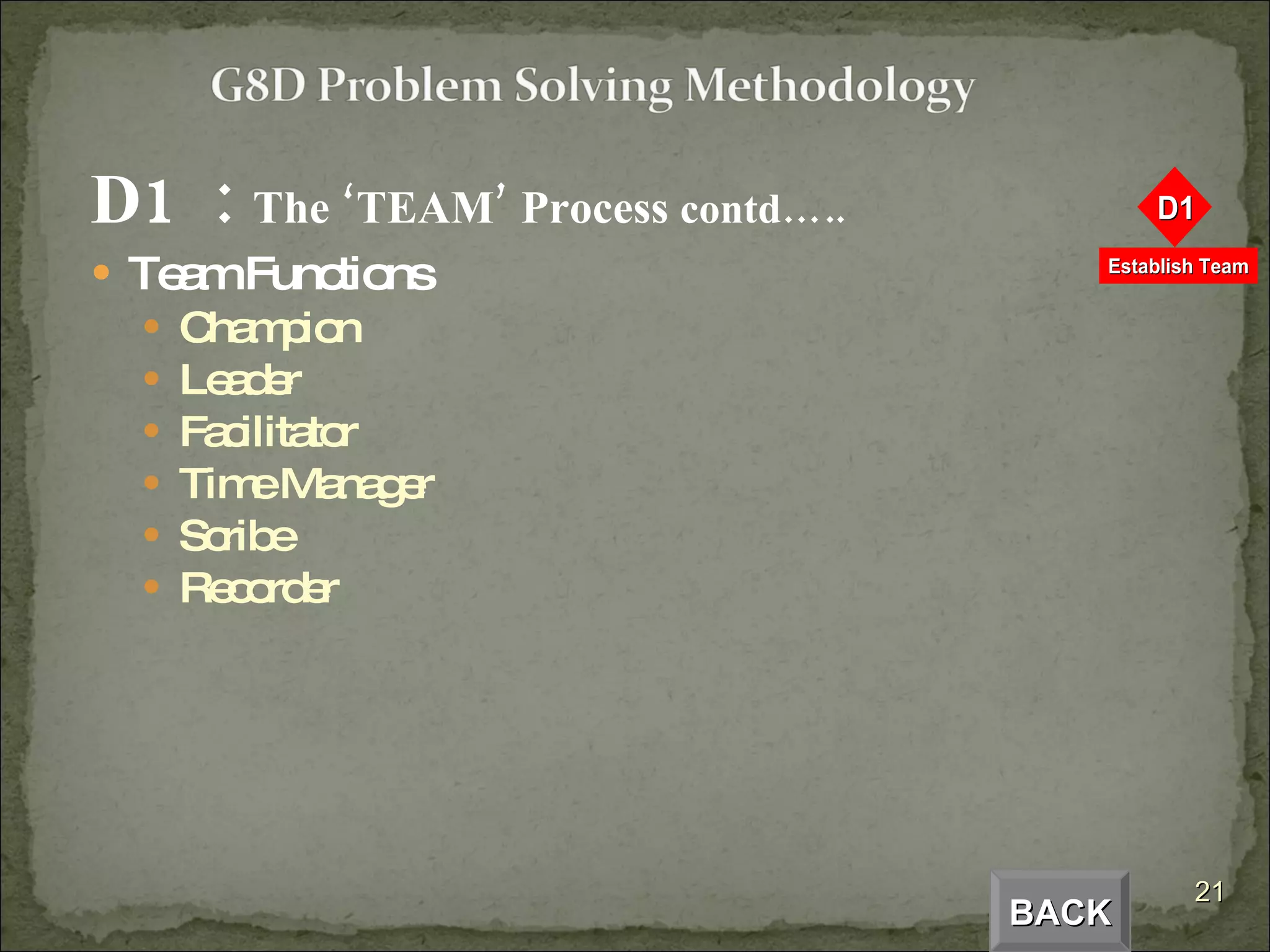
D1  :  The ‘TEAM’ Process  contd….. Team Functions Champion Leader Facilitator Time Manager Scribe Recorder BACK
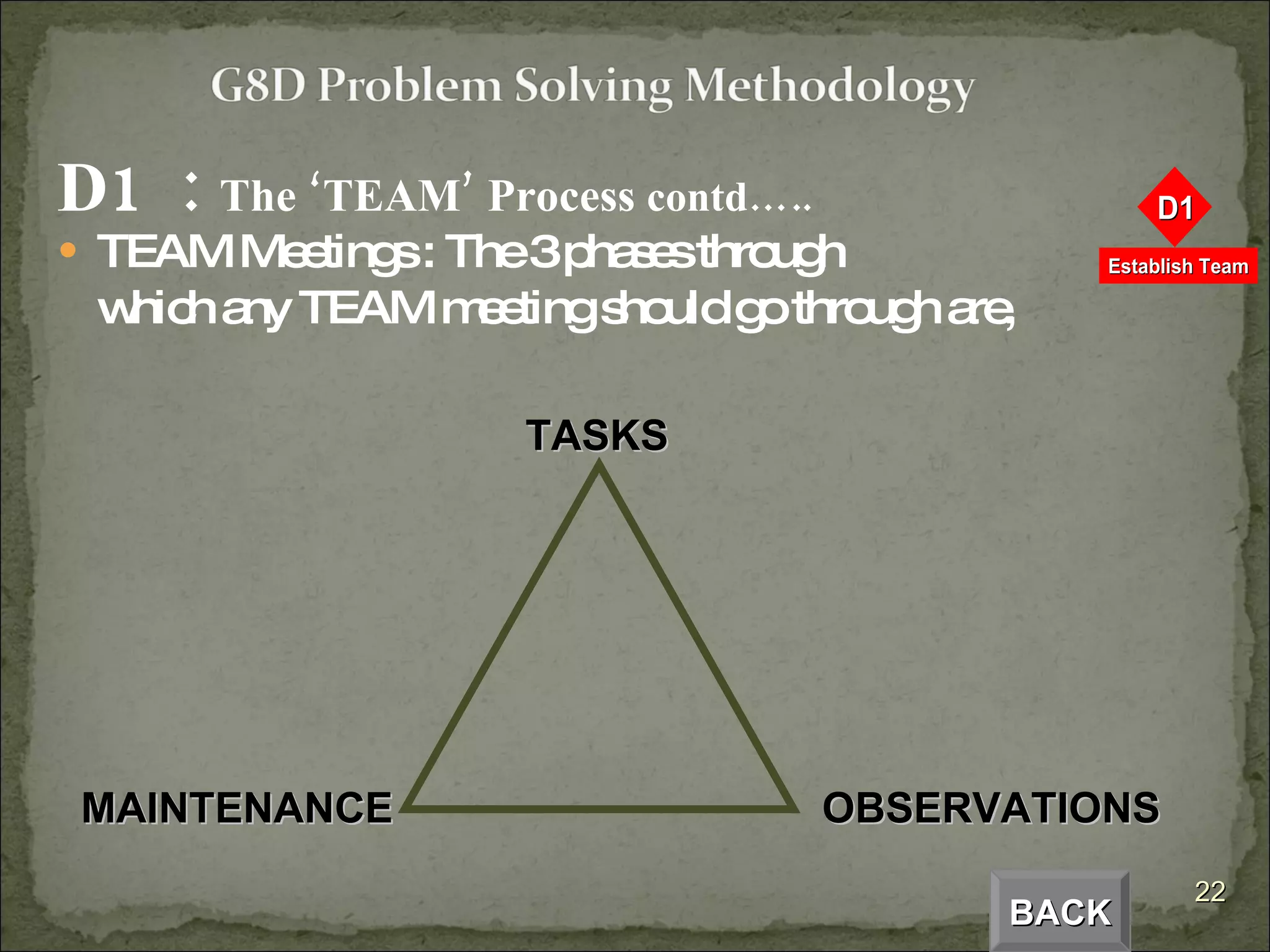
D1  :  The ‘TEAM’ Process  contd….. TEAM Meetings : The 3 phases through which any TEAM meeting should go through are, TASKS OBSERVATIONS MAINTENANCE BACK
D1  :  The ‘TEAM’ Process  contd….. TEAM Meetings  (contd…)  :  Task  is the Business Plan. Any agenda item that addresses business occurs in the Task phase. e.g. information, decision, solution, etc. Maintenance  involves recognition of feelings that affect TEAM process and addressing them. e.g. attention, respect, sense of belonging, etc. Observation  relates to dynamics of the meeting & guiding back into the Meeting Process Phase. e.g. cautioning about ‘time’, ‘one at a time’, 'your attention please’, etc.  BACK
D1  :  The ‘TEAM’ Process  contd….. TEAM Operating Procedures : Adopting roles assists the TEAM making guidelines for any TEAM meeting follow meeting time disciplines, meet agenda requirements perform roles - share process oriented roles (Facilitator, Time Manager) complete homework - come prepared and do tasks between meetings BACK
D1  :  The ‘TEAM’ Process  contd….. TEAM Operating Procedures  (contd…)  :  do not offer opinions, trace them to observations restate and build on proposals BACK
BACK D2 Describe Problem D1 Establish Team D5 Choose & Verify PCA D4 Root Cause & Escape Point D3 Develop ICA D6 Implement & Validate PCA D7 Prevent Recurrence D8 Recognise Contributions D0 Prepare for G8D
BACK
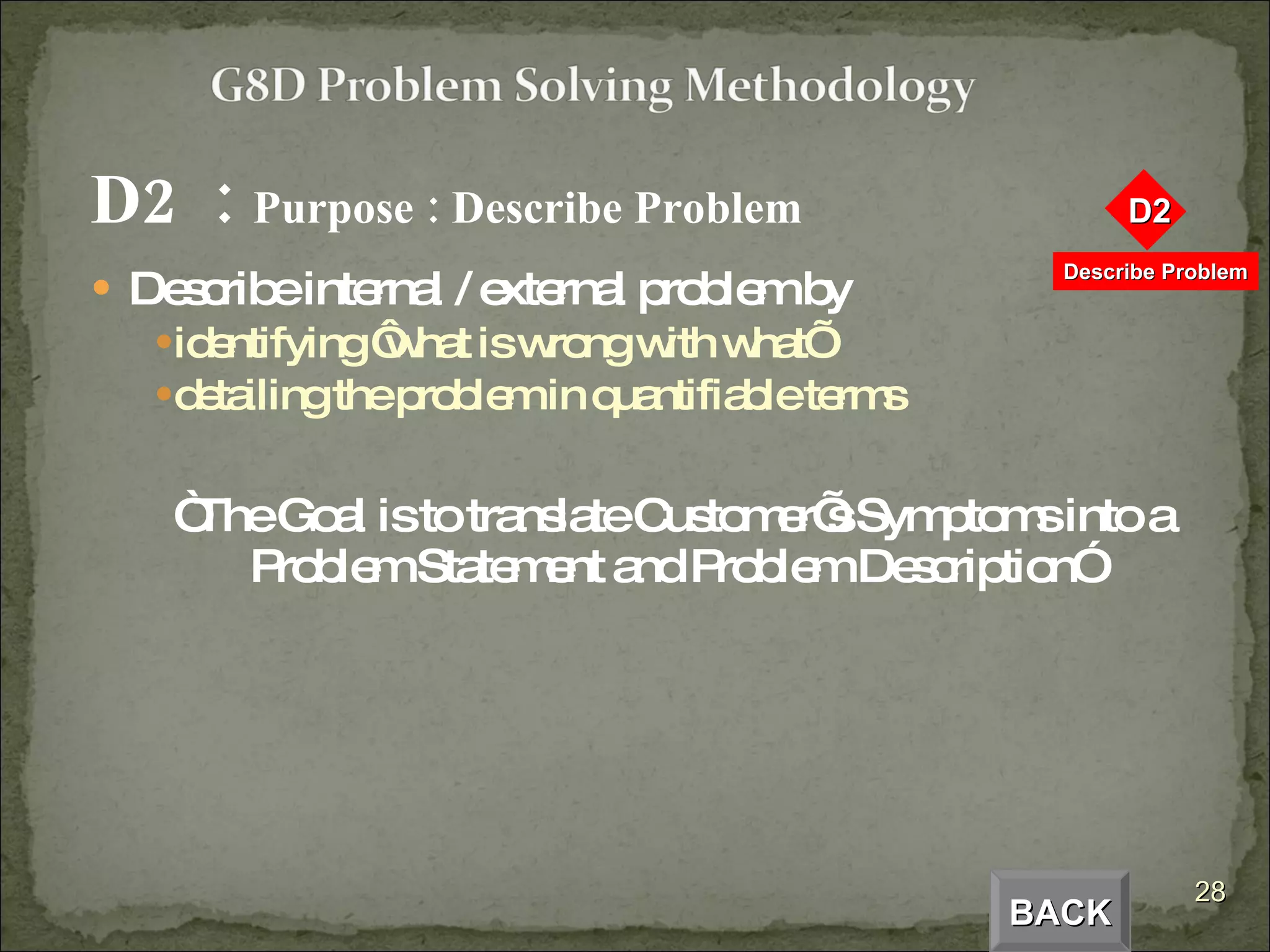
D2  :  Purpose : Describe Problem Describe internal / external problem by identifying ‘what is wrong with what’ detailing the problem in quantifiable terms “ The Goal is to translate Customer’s Symptoms into a Problem Statement and Problem Description” BACK
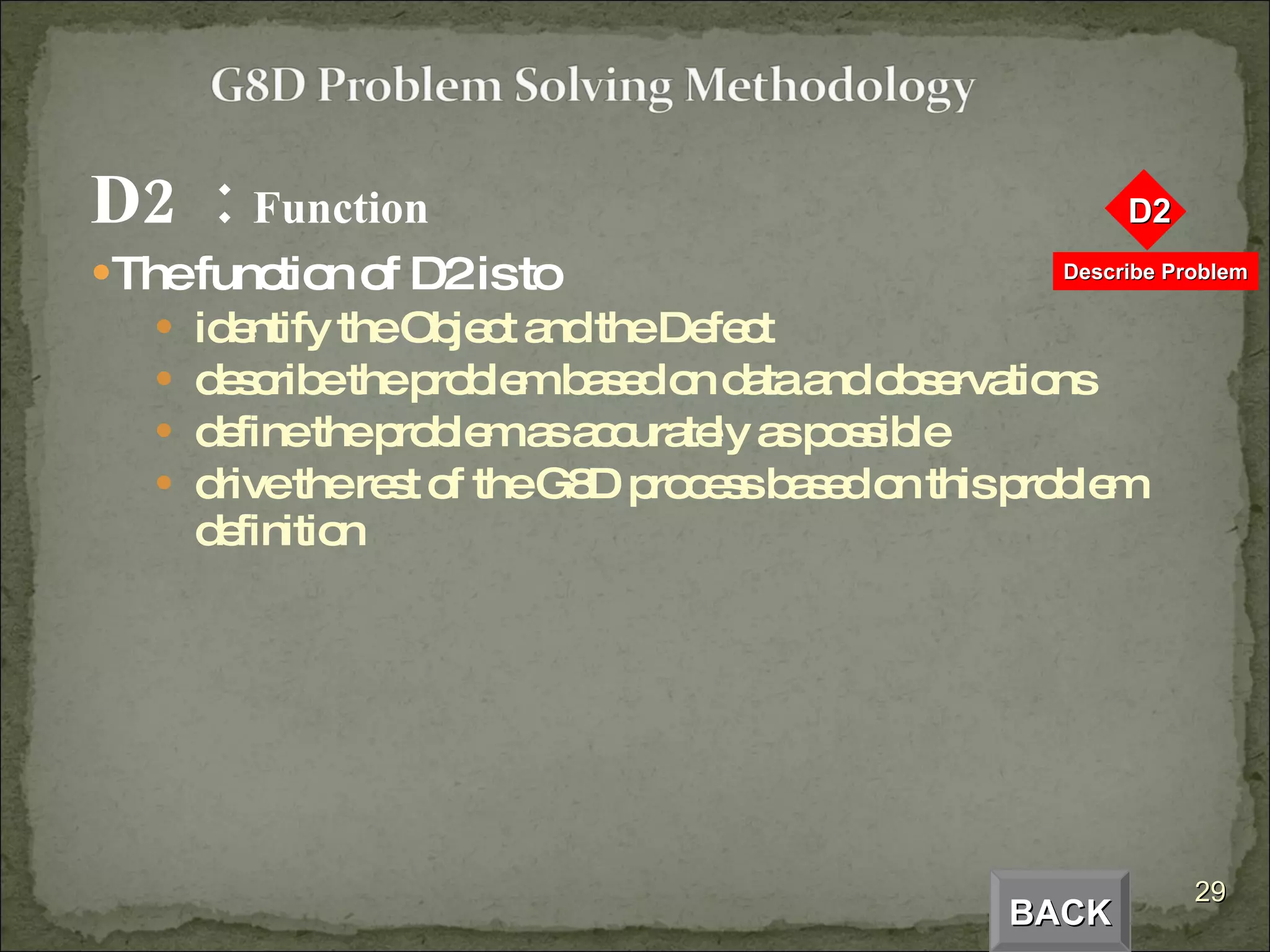
D2  :  Function The function of D2 is to identify the Object and the Defect describe the problem based on data and observations define the problem as accurately as possible drive the rest of the G8D process based on this problem definition BACK
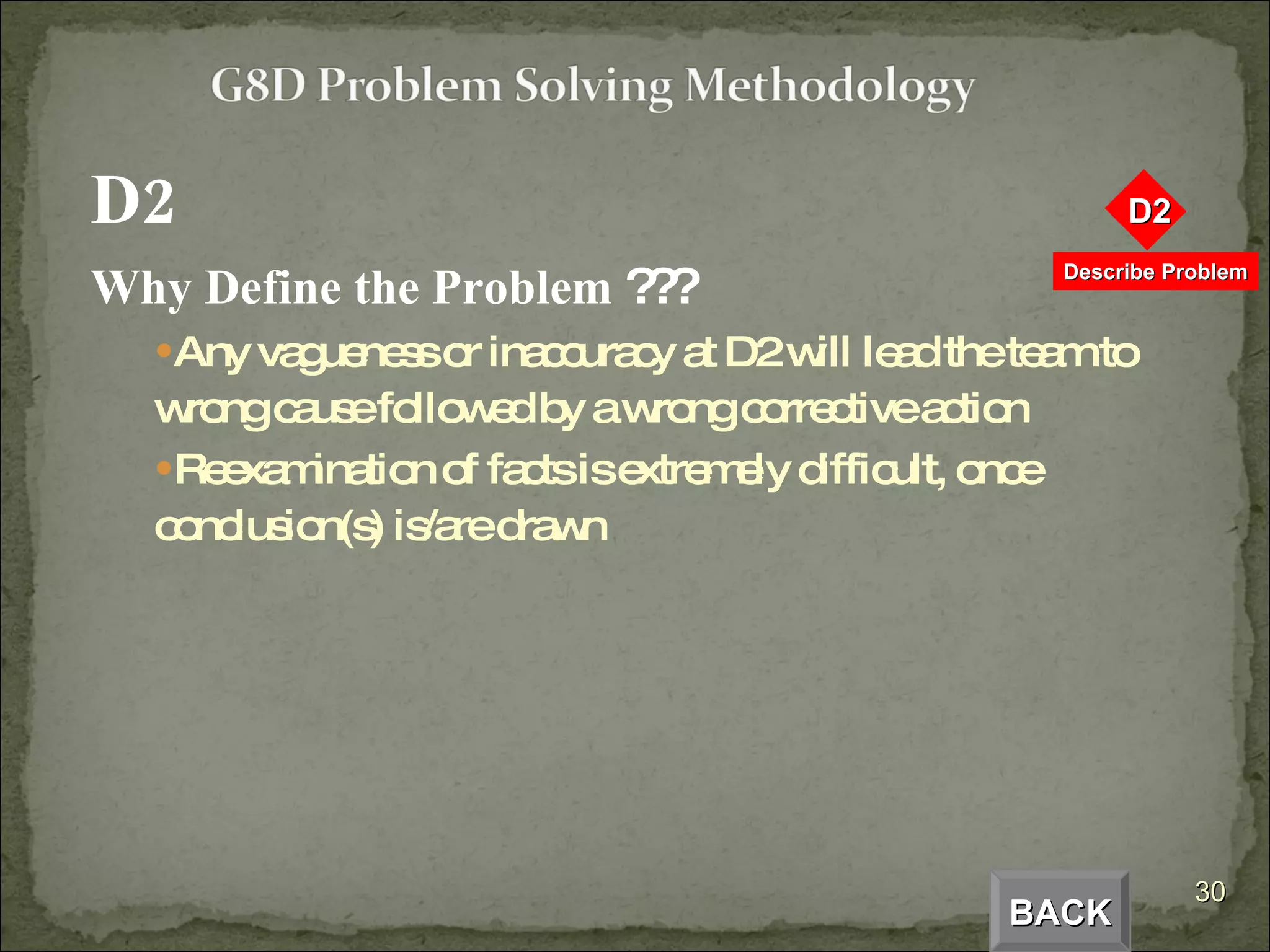
D2  Why Define the Problem  ???   Any vagueness or inaccuracy at D2 will lead the team to wrong cause followed by a wrong corrective action Reexamination of facts is extremely difficult, once conclusion(s) is/are drawn BACK
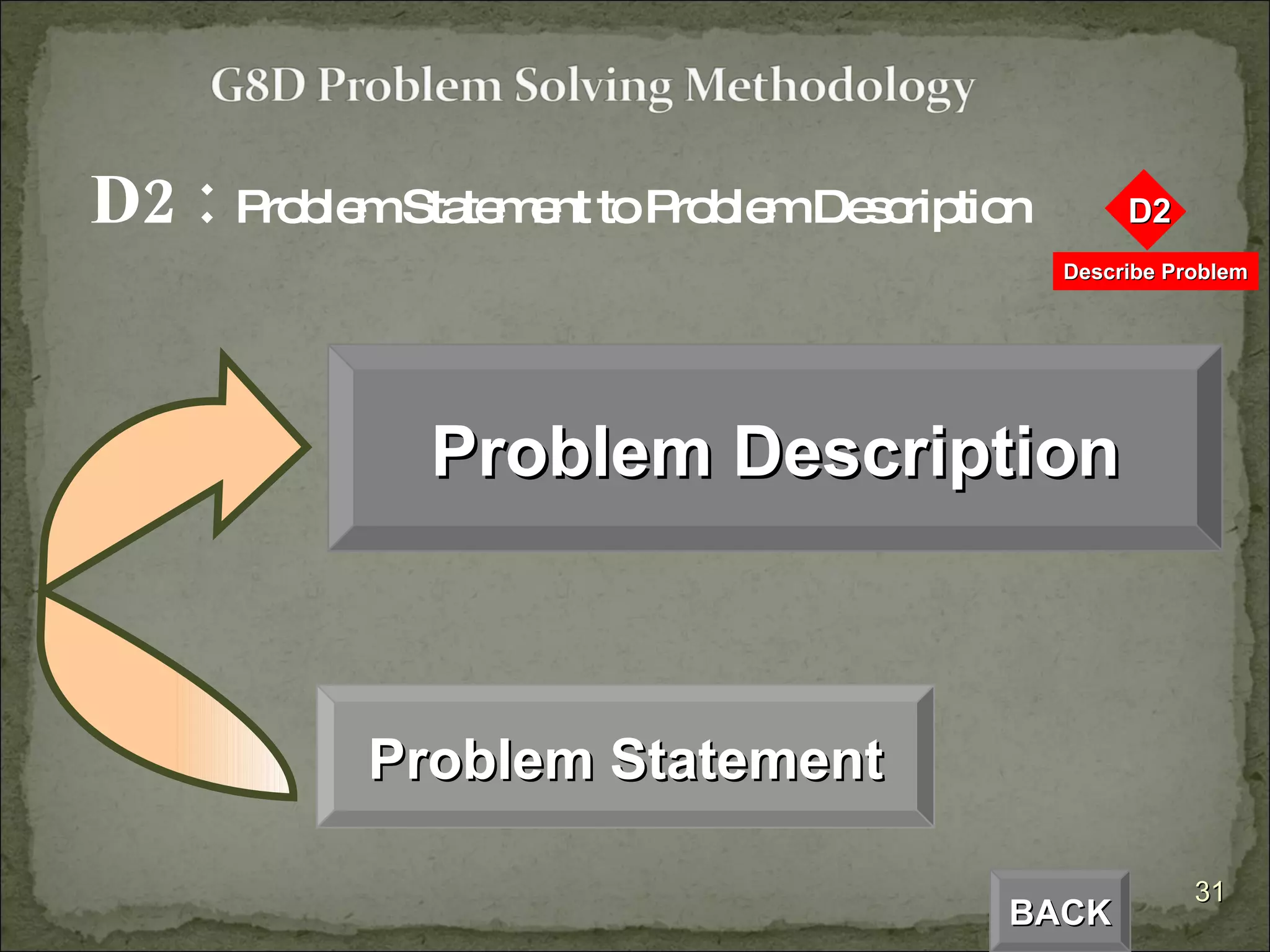
D2 :  Problem Statement to Problem Description   Problem Statement Problem Description BACK
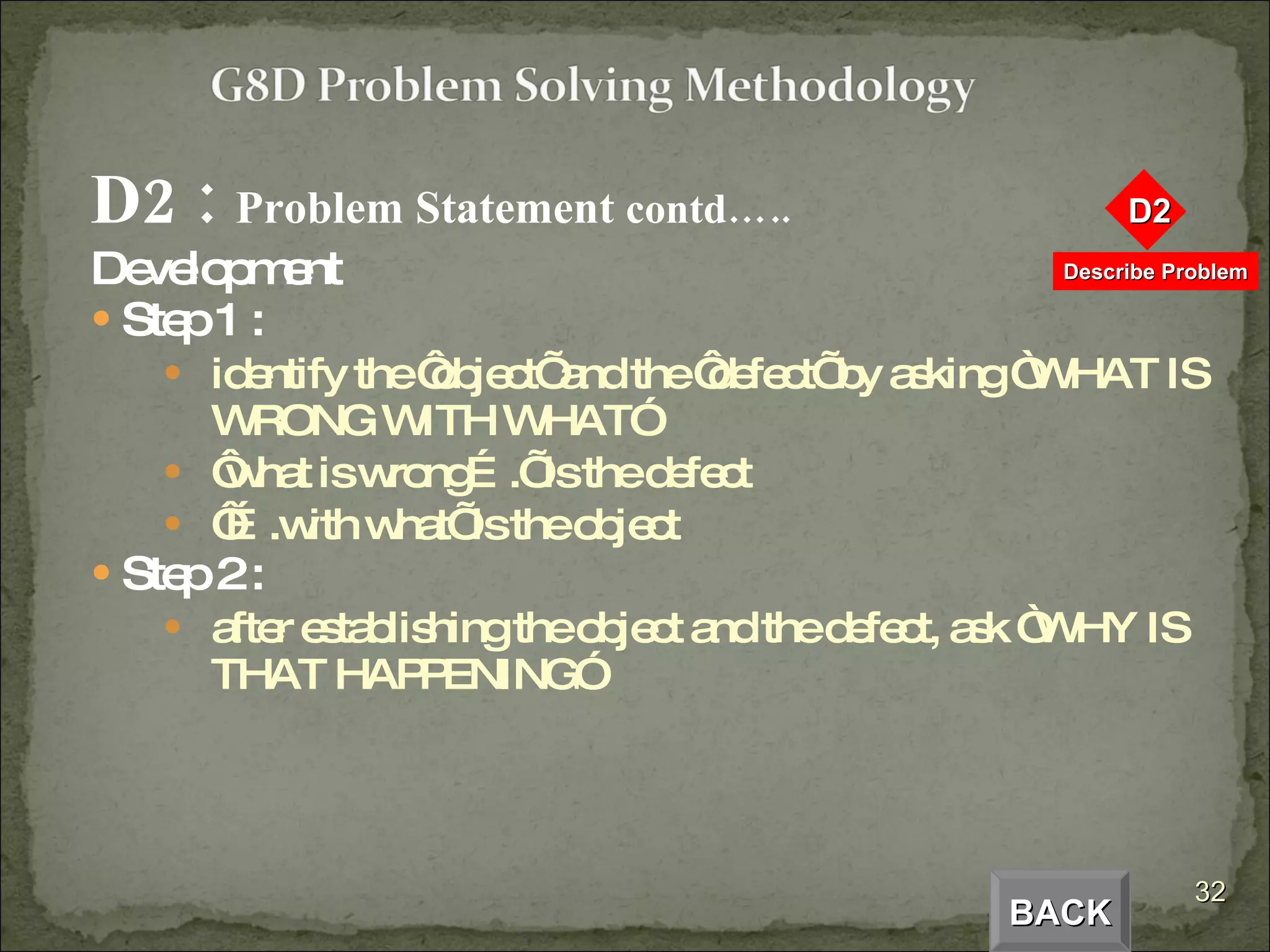
D2 :  Problem Statement  contd….. Development Step 1 : identify the ‘object’ and the ‘defect’ by asking “WHAT IS WRONG WITH WHAT” ‘ what is wrong….’ is the defect ‘… .with what’ is the object Step 2 : after establishing the object and the defect, ask “WHY IS THAT HAPPENING” BACK
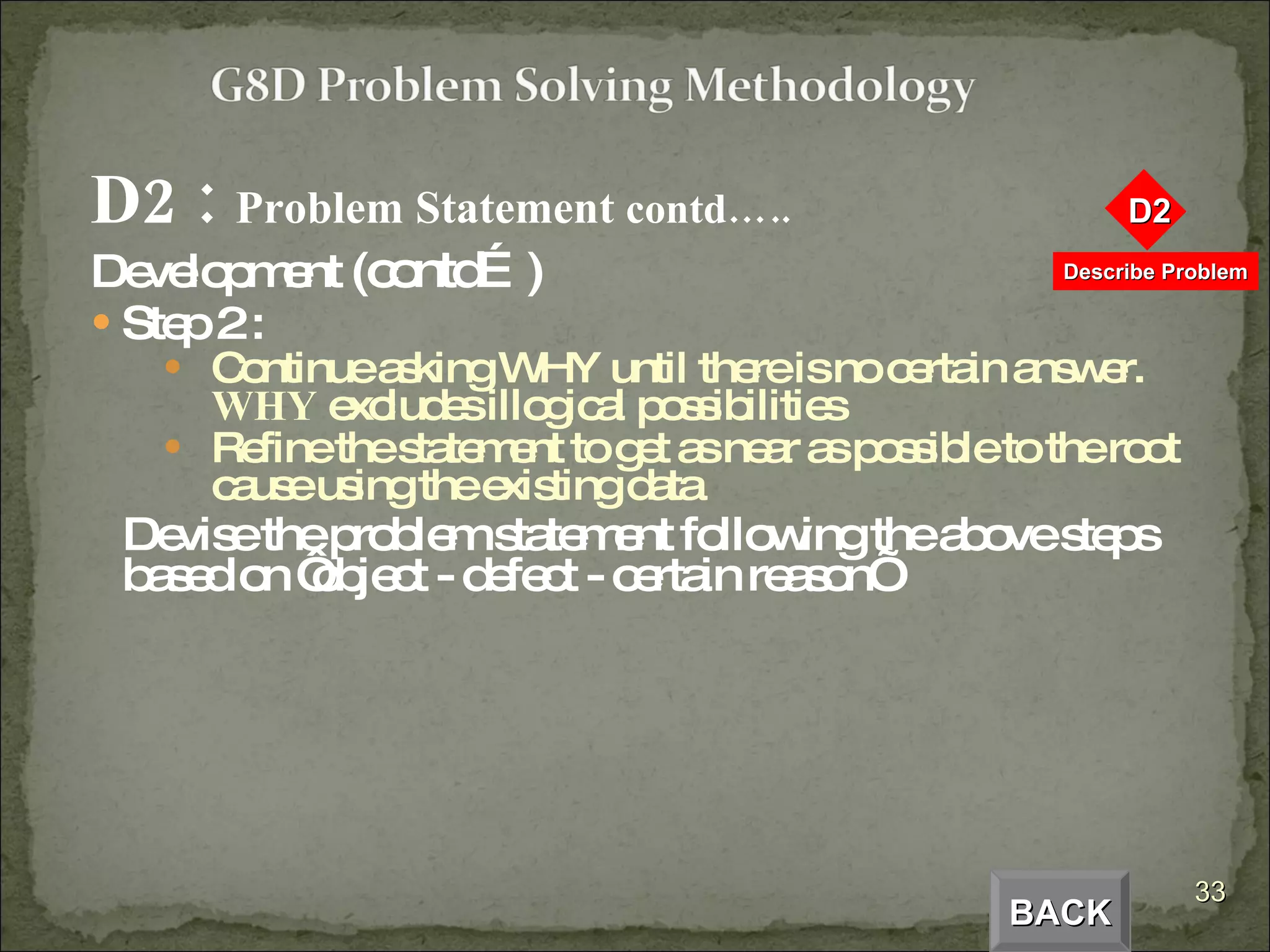
D2 :  Problem Statement  contd….. Development  (contd…) Step 2 : Continue asking WHY until there is no certain answer.  WHY  excludes illogical possibilities Refine the statement to get as near as possible to the root cause using the existing data Devise the problem statement following the above steps based on ‘object - defect - certain reason’ BACK
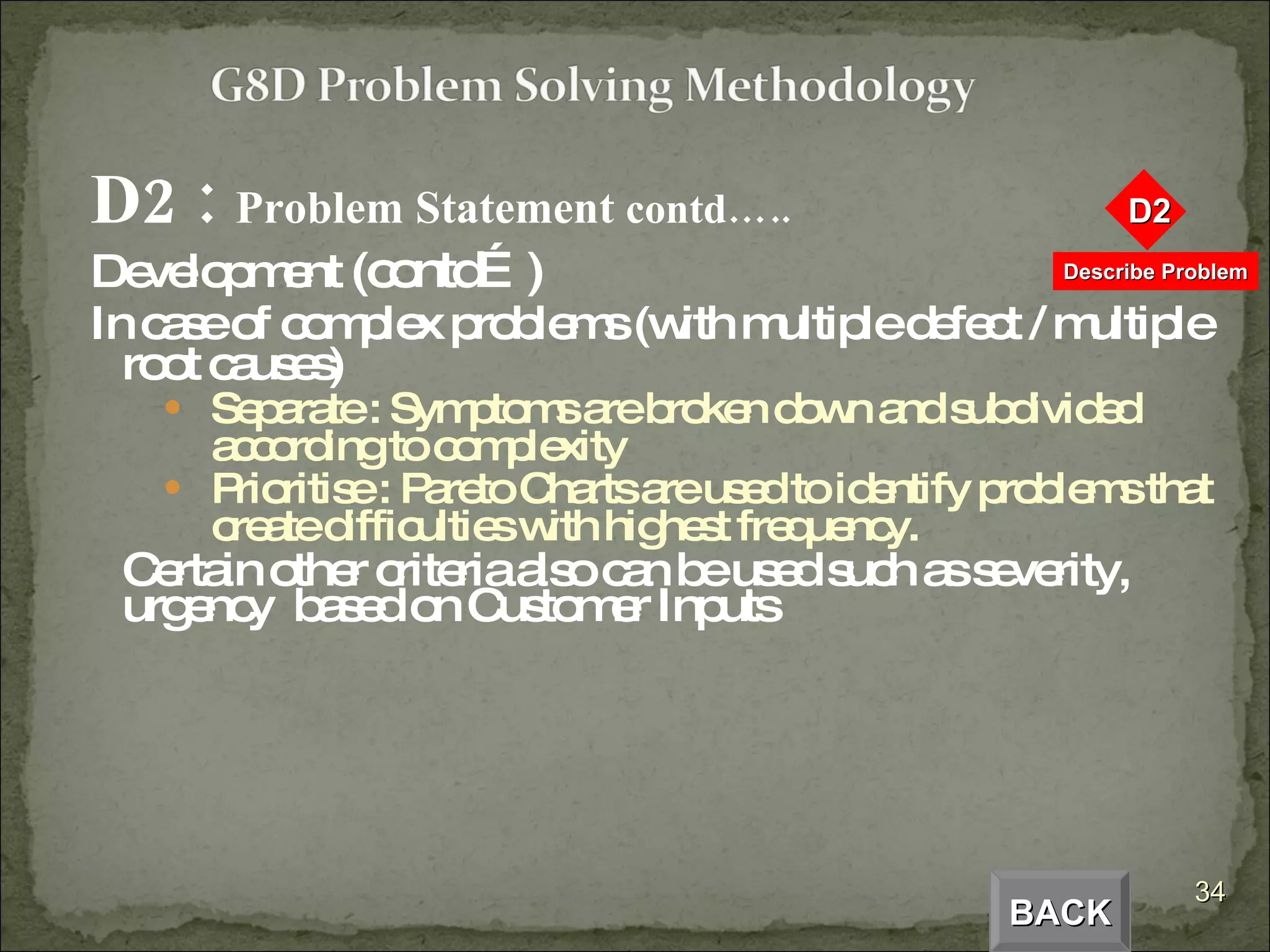
D2 :  Problem Statement  contd….. Development  (contd…) In case of complex problems (with multiple defect / multiple root causes) Separate : Symptoms are broken down and subdivided according to complexity Prioritise : Pareto Charts are used to identify problems that create difficulties with highest frequency. Certain other criteria also can be used such as severity, urgency  based on Customer Inputs BACK
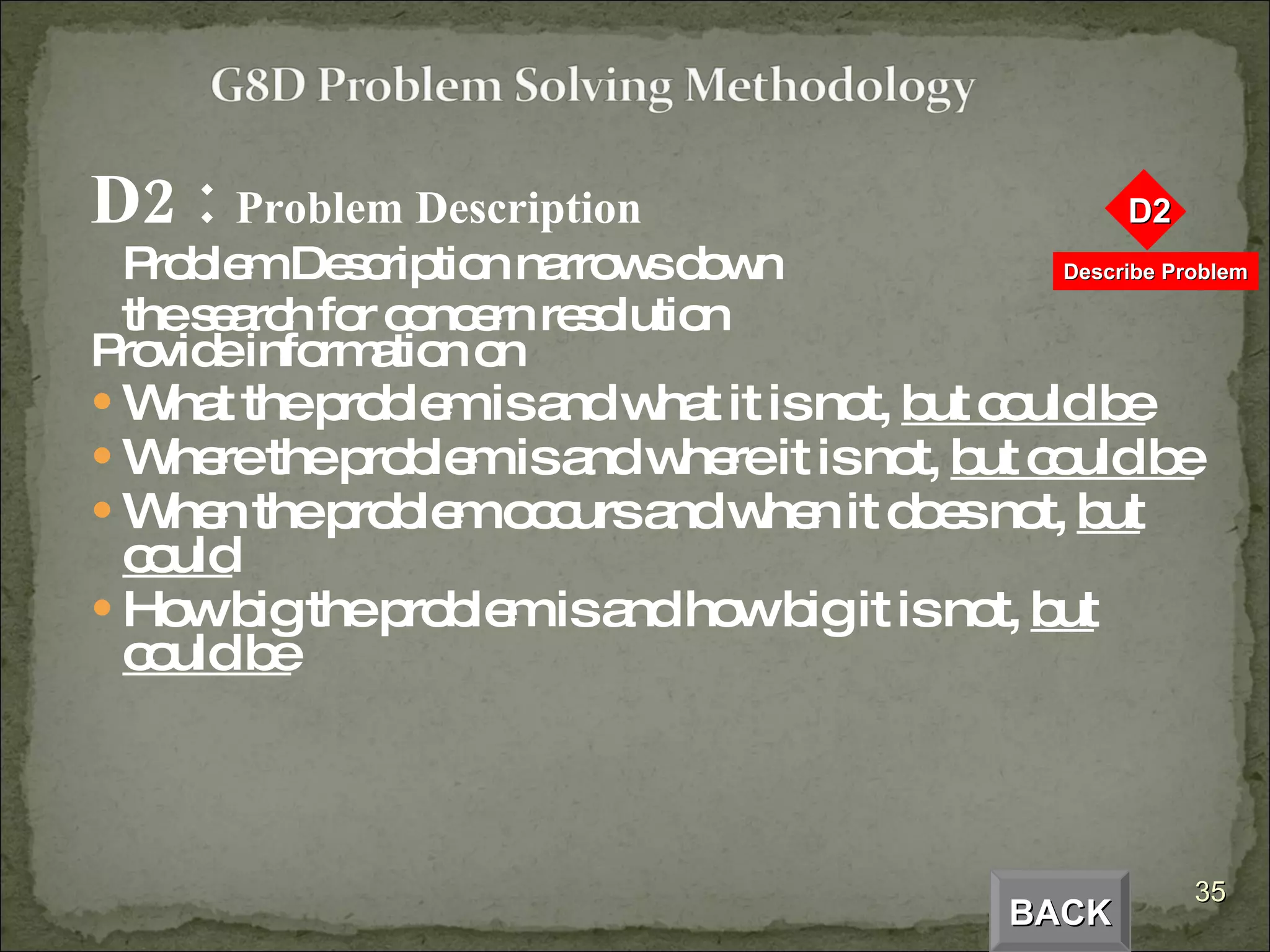
D2 :  Problem Description Problem Description narrows down the search for concern resolution Provide information on What the problem is and what it is not,  but could be Where the problem is and where it is not,  but could be When the problem occurs and when it does not,  but could How big the problem is and how big it is not,  but could be BACK
BACK D3 Develop ICA D2 Describe Problem D1 Establish Team D5 Choose & Verify PCA D4 Root Cause & Escape Point D6 Implement & Validate PCA D7 Prevent Recurrence D8 Recognise Contributions D0 Prepare for G8D
BACK
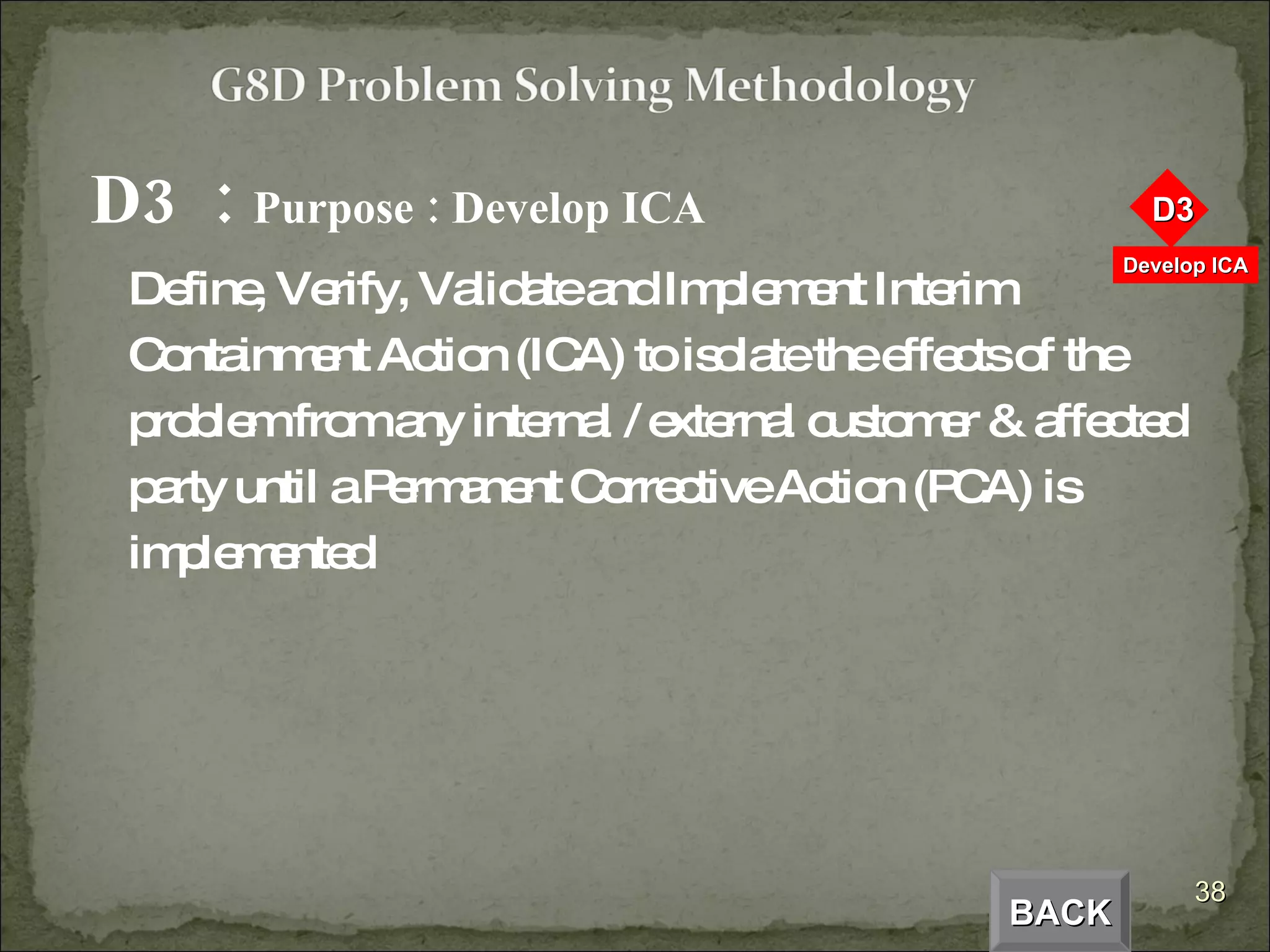
D3  :  Purpose : Develop ICA Define, Verify, Validate and Implement Interim Containment Action (ICA) to isolate the effects of the problem from any internal / external customer & affected party until a Permanent Corrective Action (PCA) is implemented BACK
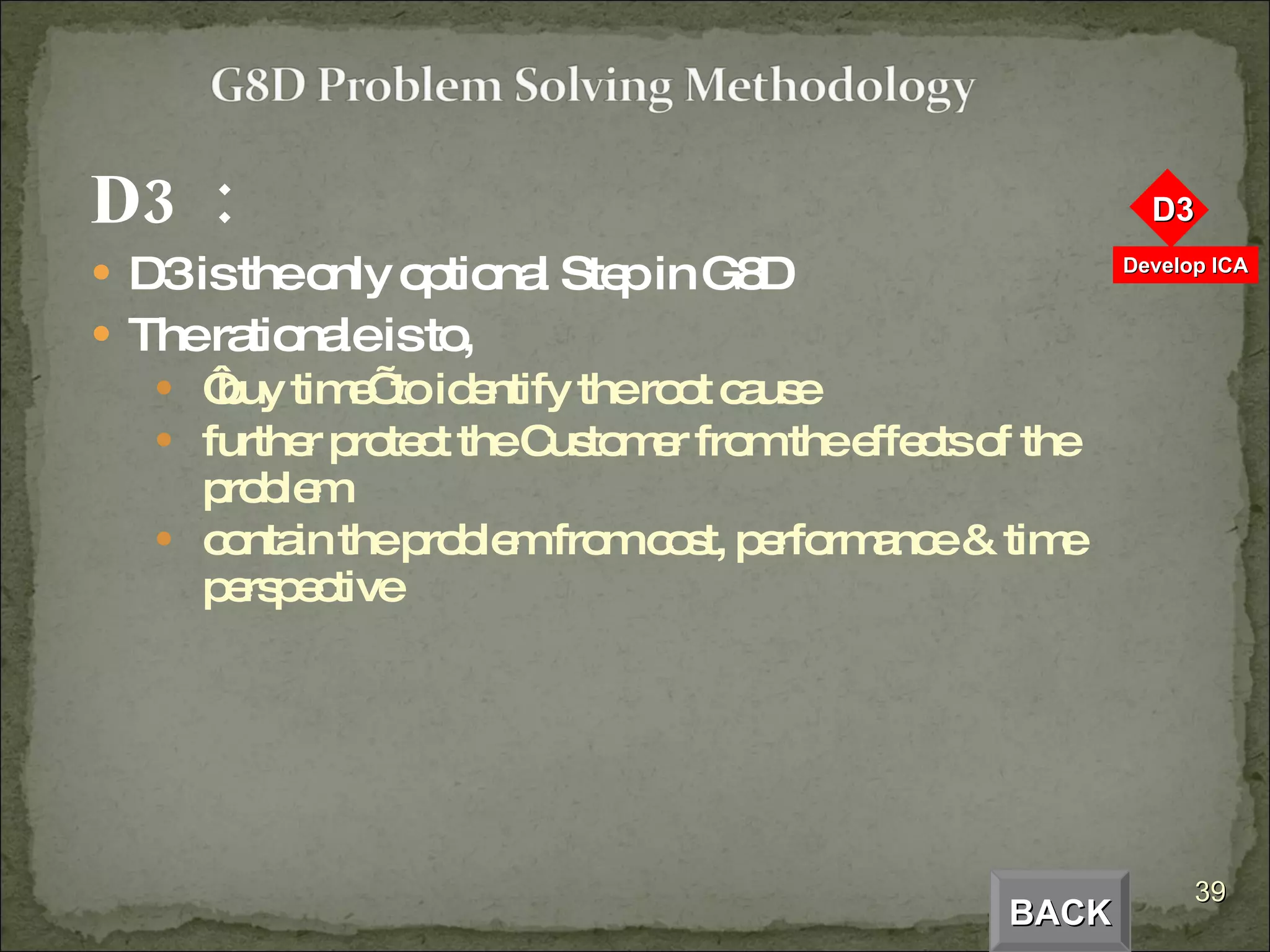
D3  :  D3 is the only optional Step in G8D The rationale is to,  ‘ buy time’ to identify the root cause further protect the Customer from the effects of the problem contain the problem from cost, performance & time perspective BACK
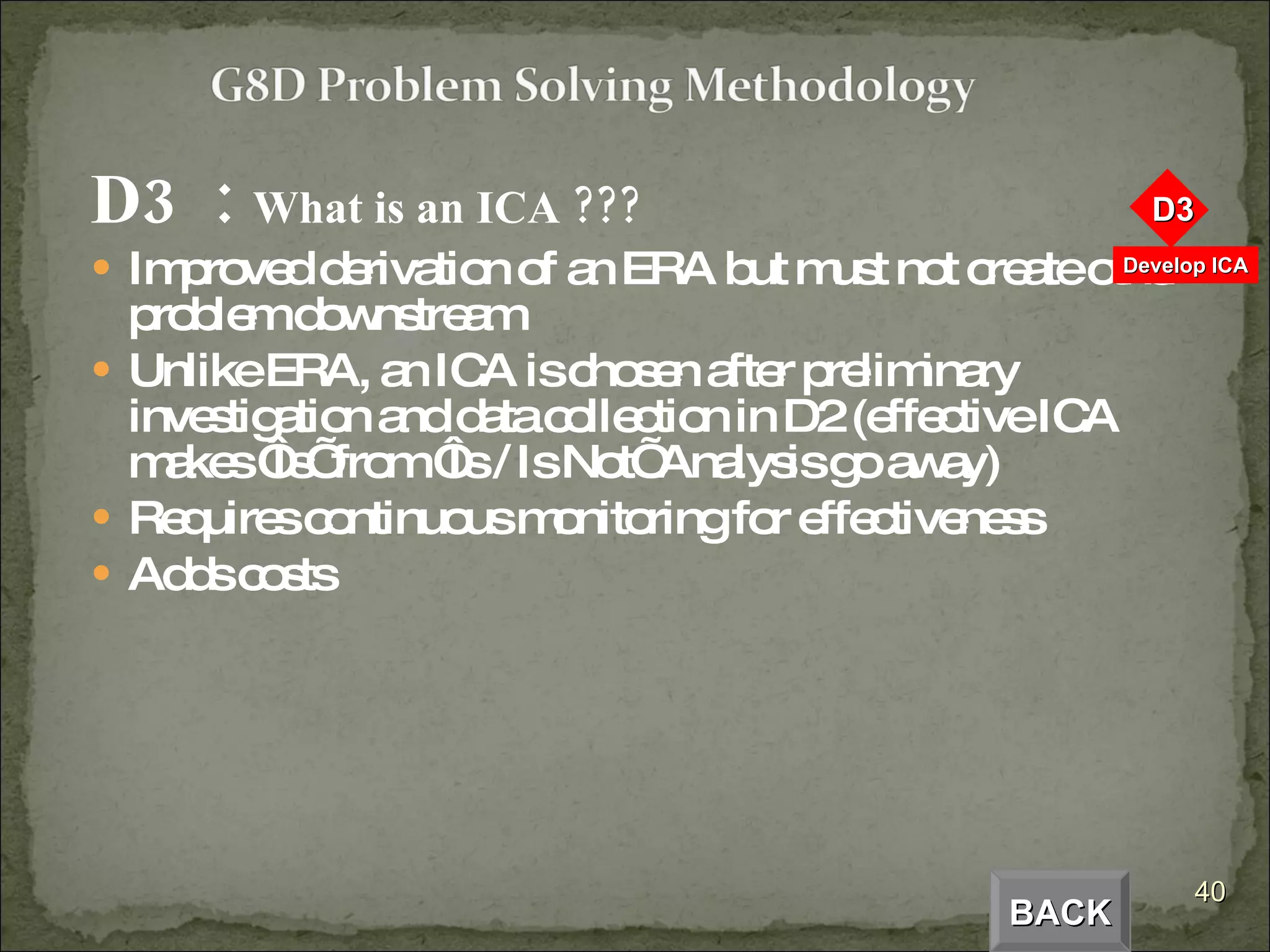
D3  :  What is an ICA ??? Improved derivation of an ERA but must not create other problem downstream Unlike ERA, an ICA is chosen after preliminary investigation and data collection in D2 (effective ICA makes ‘Is’ from ‘Is / Is Not’ Analysis go away) Requires continuous monitoring for effectiveness Adds costs BACK
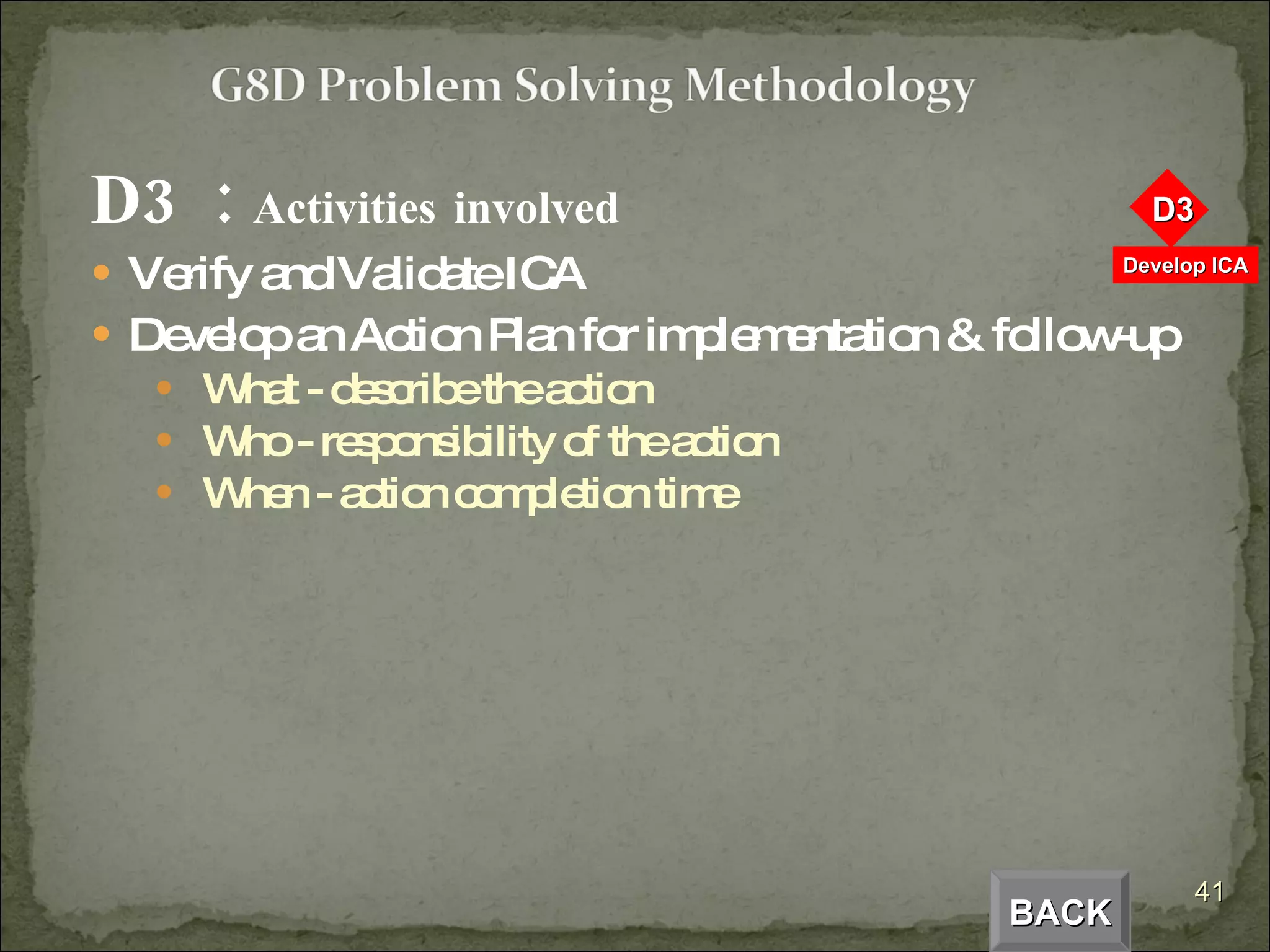
D3  :  Activities   involved   Verify and Validate ICA Develop an Action Plan for implementation & follow-up What - describe the action Who - responsibility of the action When - action completion time BACK
BACK D4 Root Cause & Escape Point D3 Develop ICA D2 Describe Problem D1 Establish Team D5 Choose & Verify PCA D6 Implement & Validate PCA D7 Prevent Recurrence D8 Recognise Contributions D0 Prepare for G8D
BACK
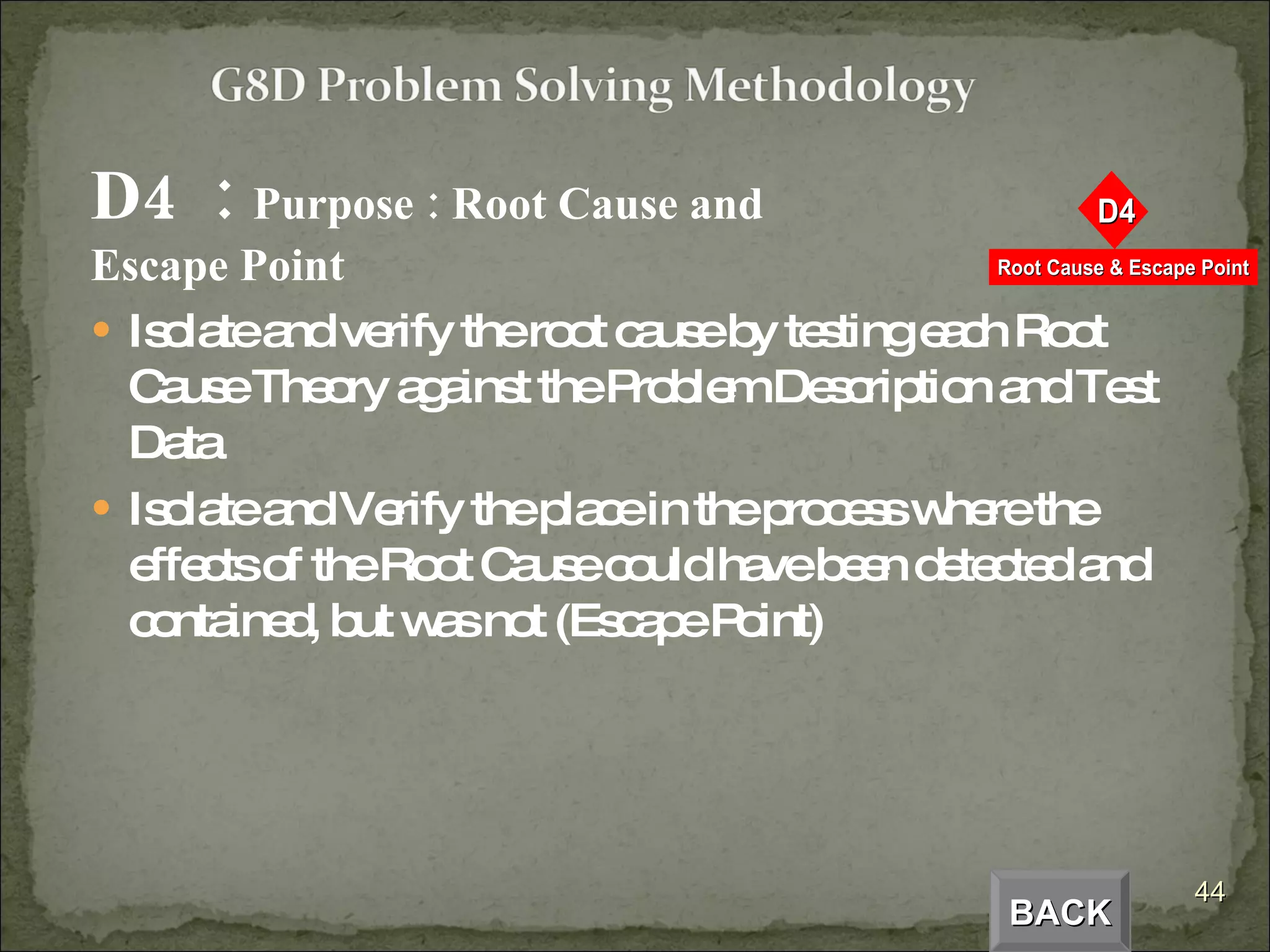
D4  :  Purpose : Root Cause and Escape Point Isolate and verify the root cause by testing each Root Cause Theory against the Problem Description and Test Data Isolate and Verify the place in the process where the effects of the Root Cause could have been detected and contained, but was not (Escape Point) BACK
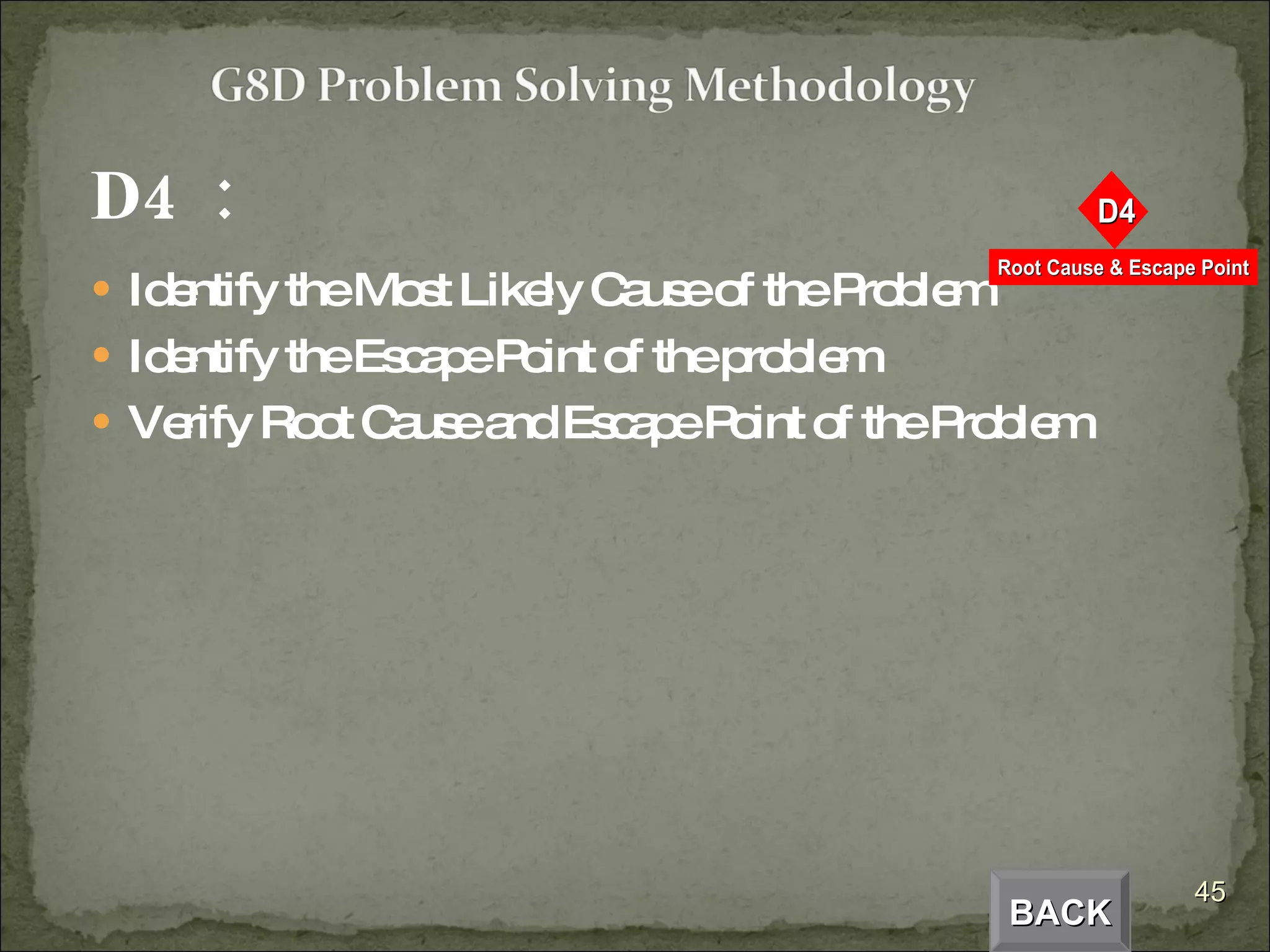
D4  : Identify the Most Likely Cause of the Problem Identify the Escape Point of the problem Verify Root Cause and Escape Point of the Problem BACK
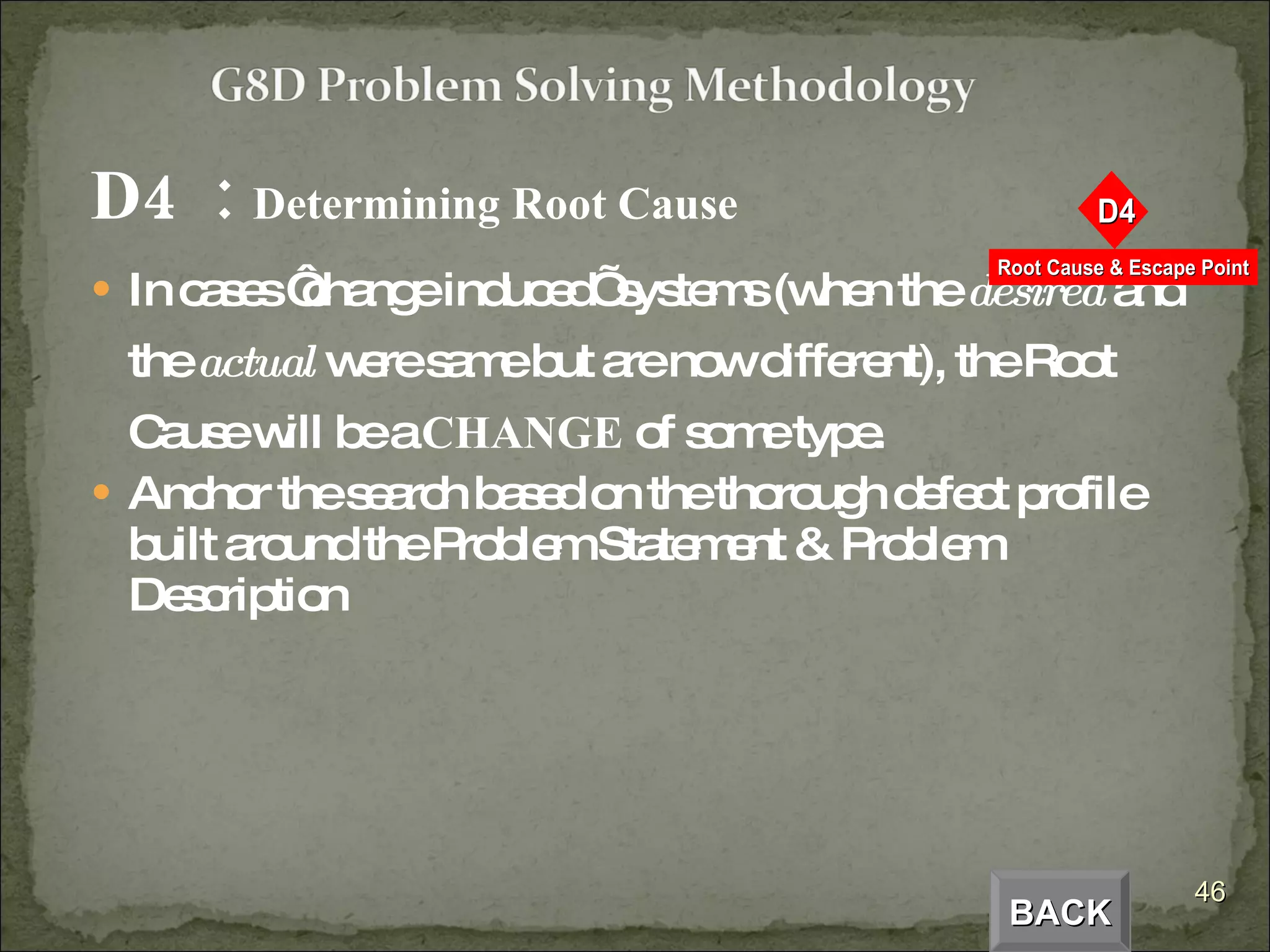
D4  :  Determining Root Cause In cases ‘change induced’ systems (when the  desired  and the  actual  were same but are now different), the Root Cause will be a  CHANGE  of some type. Anchor the search based on the thorough defect profile built around the Problem Statement & Problem Description BACK
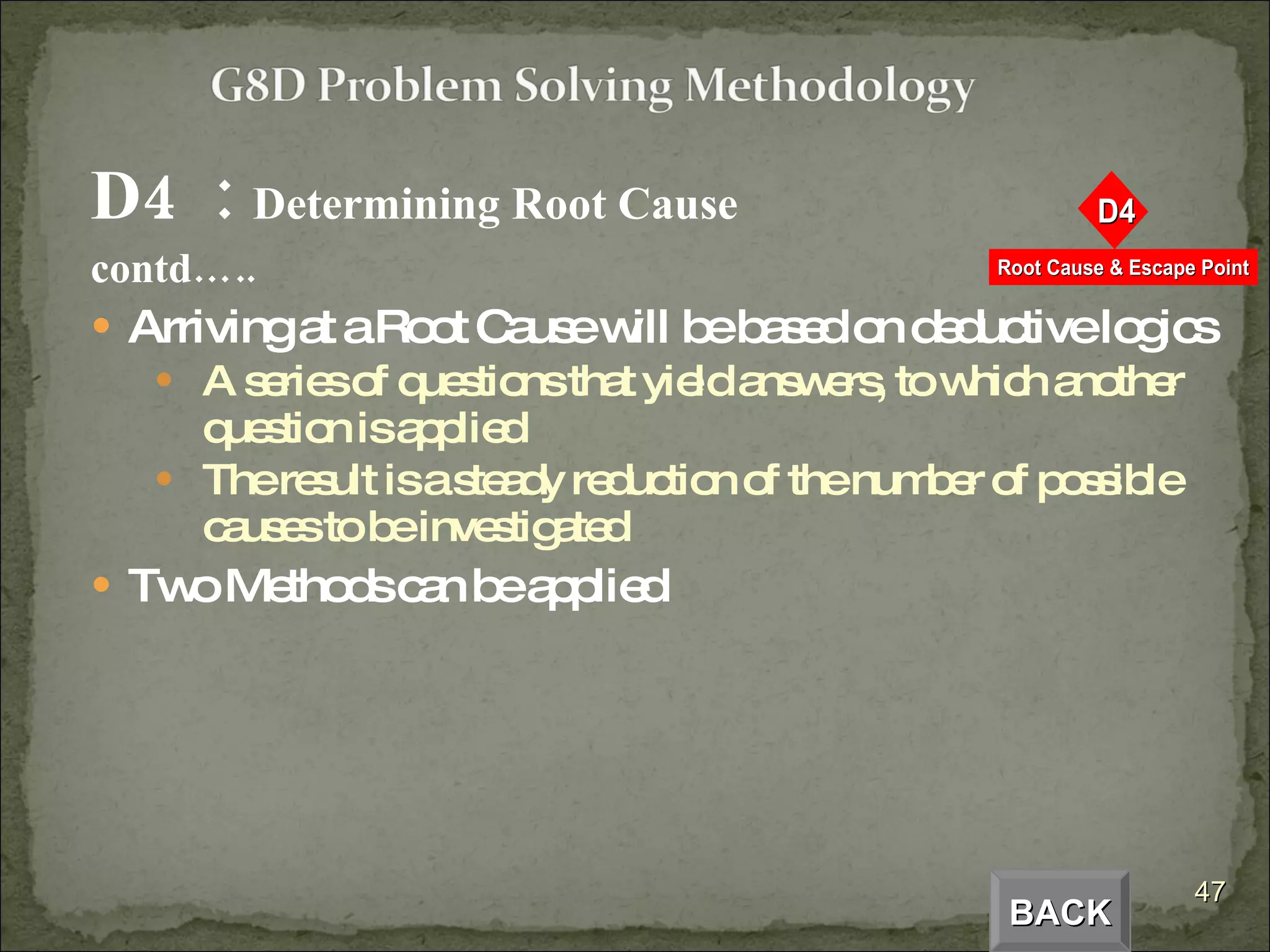
D4  :  Determining Root Cause  contd….. Arriving at a Root Cause will be based on deductive logics A series of questions that yield answers, to which another question is applied The result is a steady reduction of the number of possible causes to be investigated Two Methods can be applied BACK
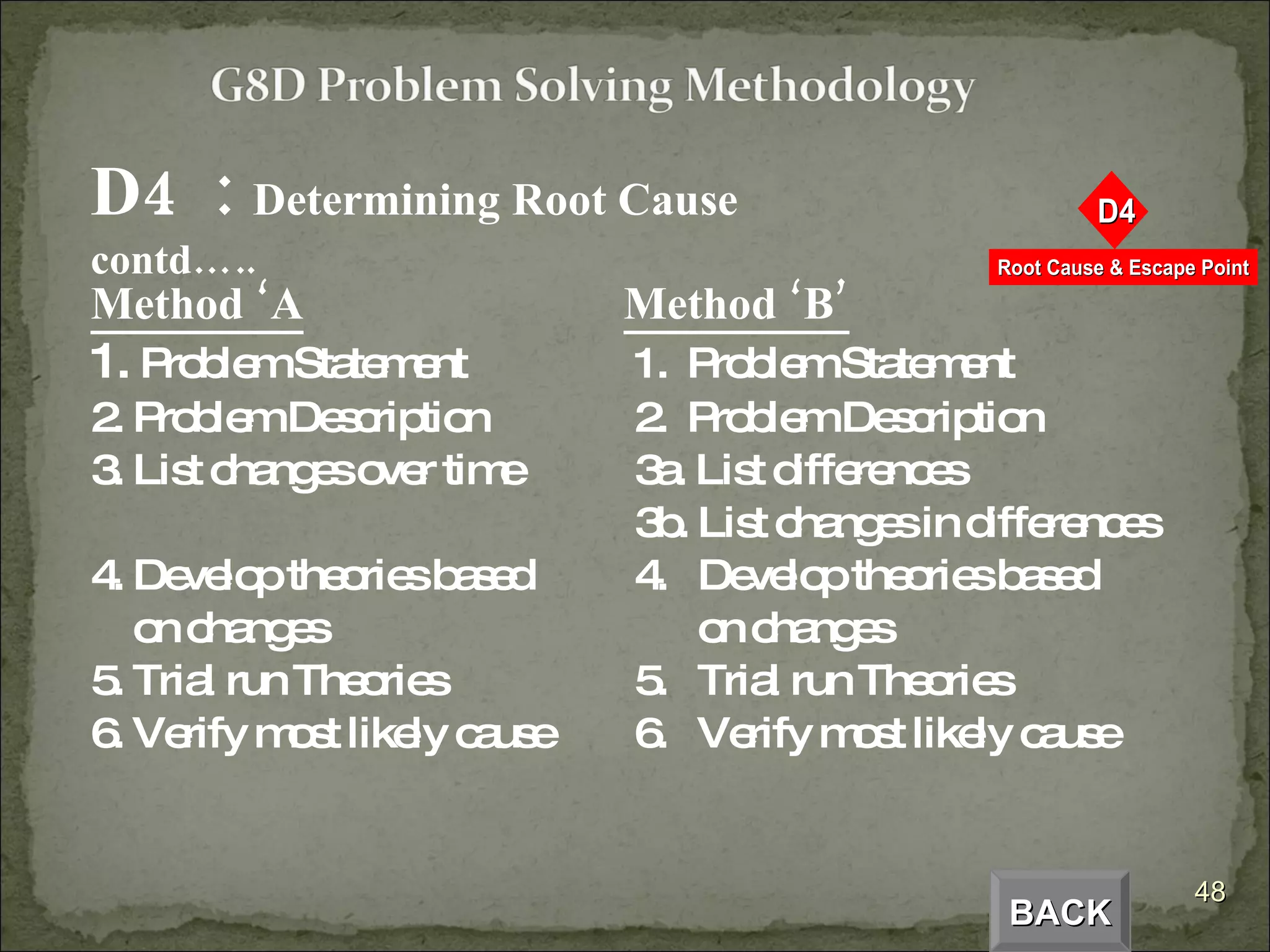
D4  :  Determining Root Cause  contd….. Method ‘A Method ‘B’ 1.  Problem Statement  1.  Problem Statement 2. Problem Description  2.  Problem Description 3. List changes over time  3a. List differences   3b. List changes in differences 4. Develop theories based   4.  Develop theories based  on changes   on changes 5. Trial run Theories  5.  Trial run Theories 6. Verify most likely cause  6.  Verify most likely cause BACK
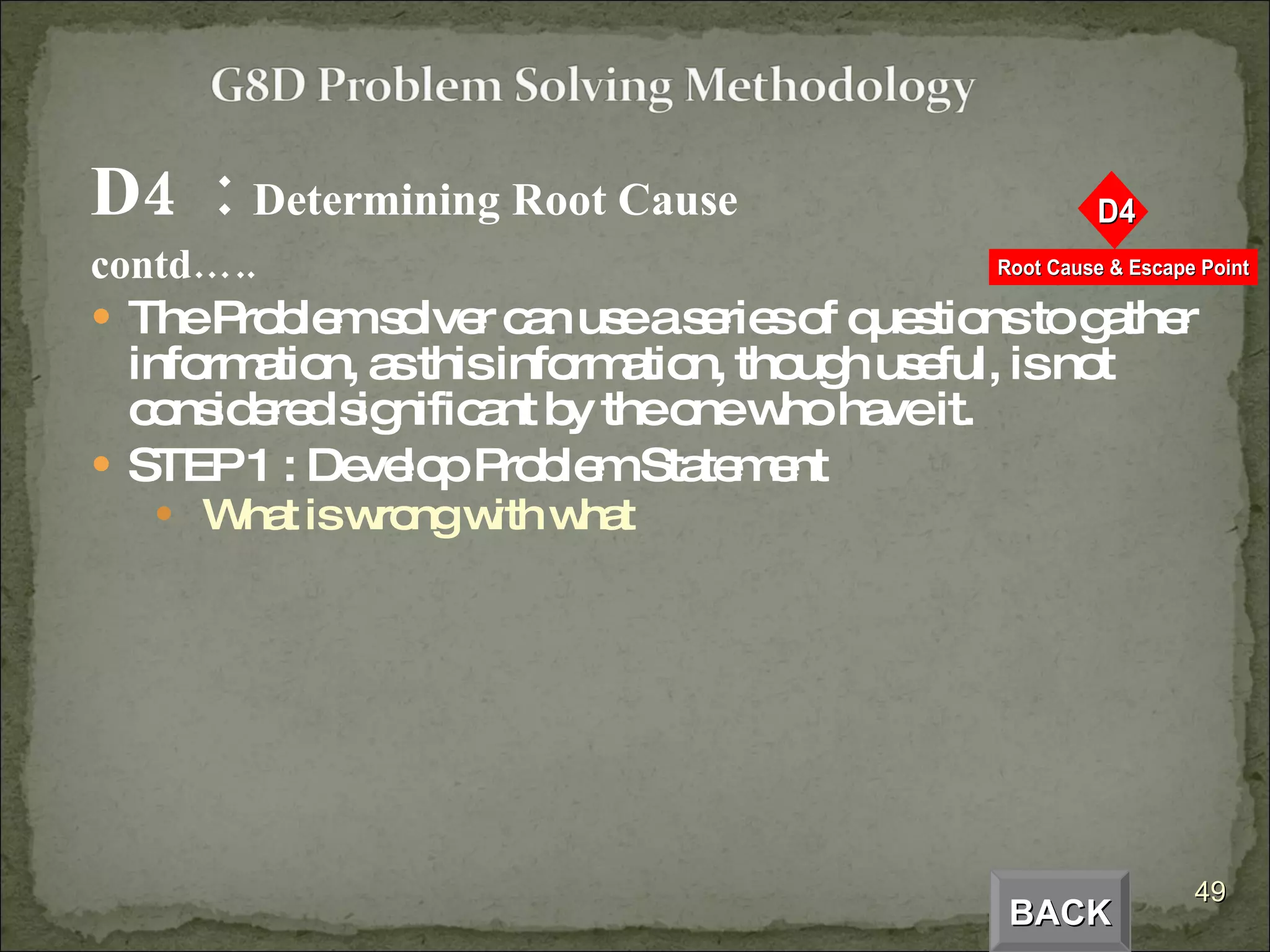
D4  :  Determining Root Cause  contd….. The Problem solver can use a series of questions to gather information, as this information, though useful, is not considered significant by the one who have it. STEP 1 : Develop Problem Statement What is wrong with what BACK
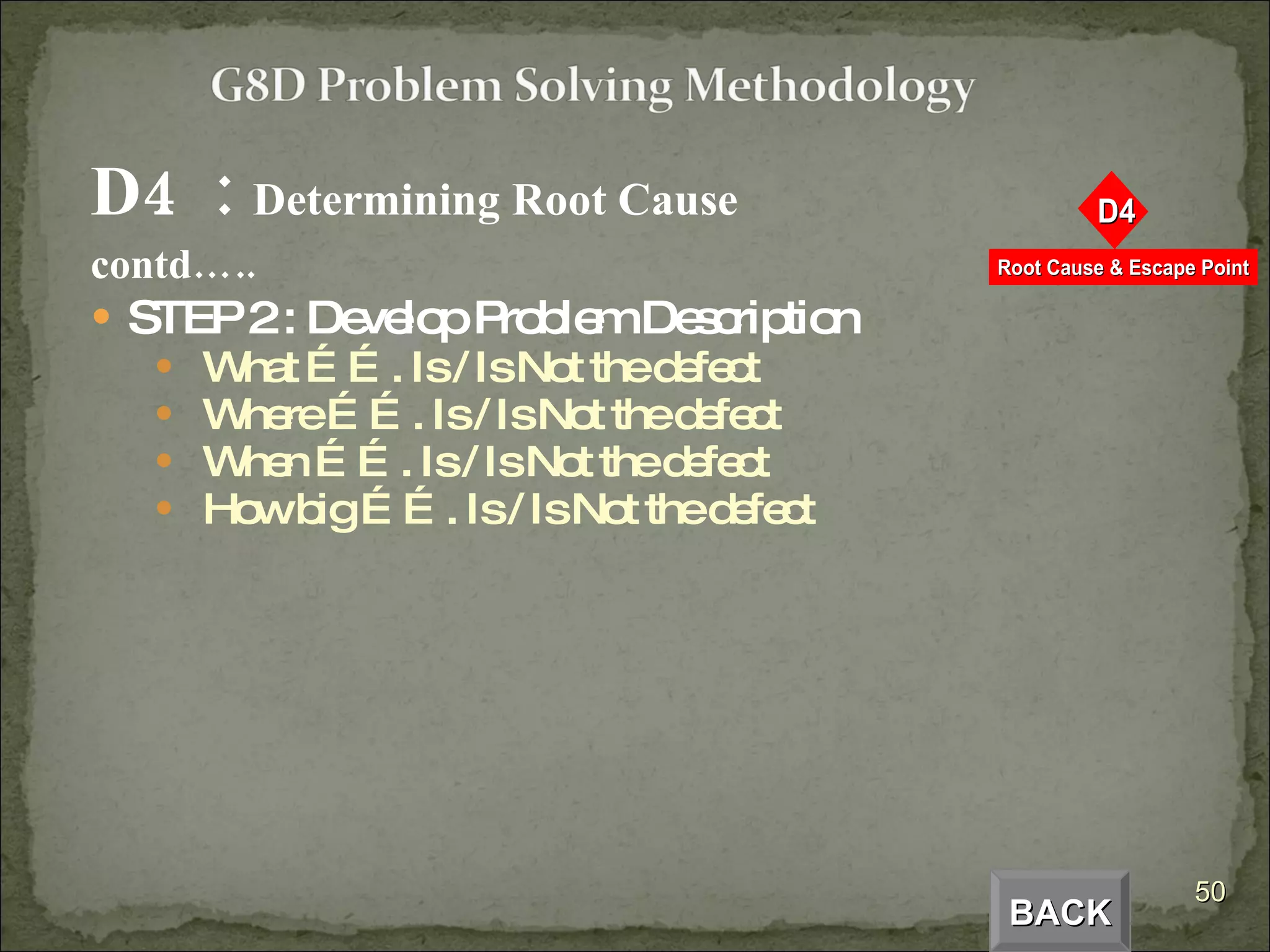
D4  :  Determining Root Cause  contd….. STEP 2 : Develop Problem Description What ……. Is / Is Not the defect Where ……. Is / Is Not the defect When ……. Is / Is Not the defect How big ……. Is / Is Not the defect BACK
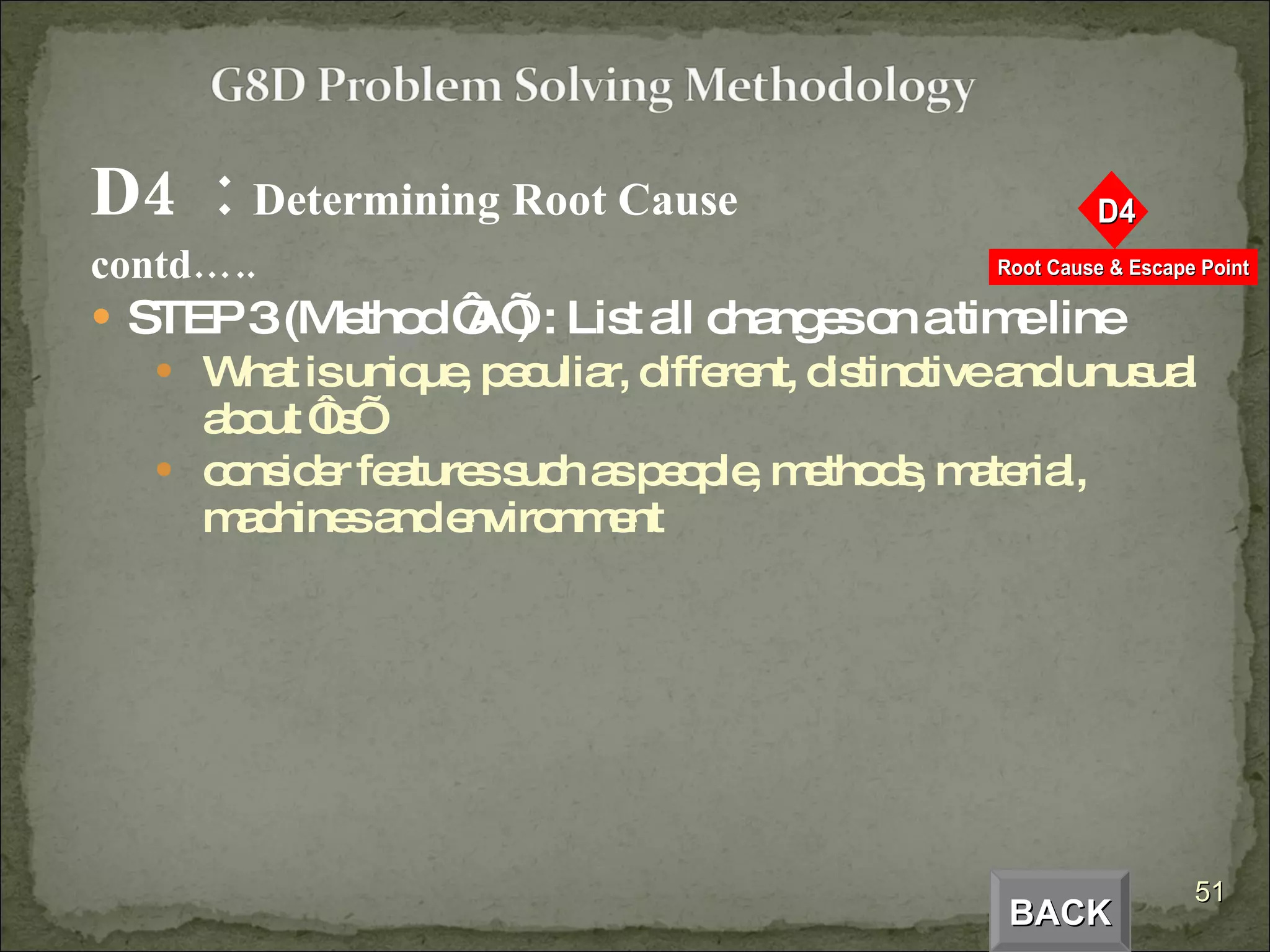
D4  :  Determining Root Cause  contd….. STEP 3 (Method ‘A’) : List all changes on a time line What is unique, peculiar, different, distinctive and unusual about ‘Is’ consider features such as people, methods, material, machines and environment BACK
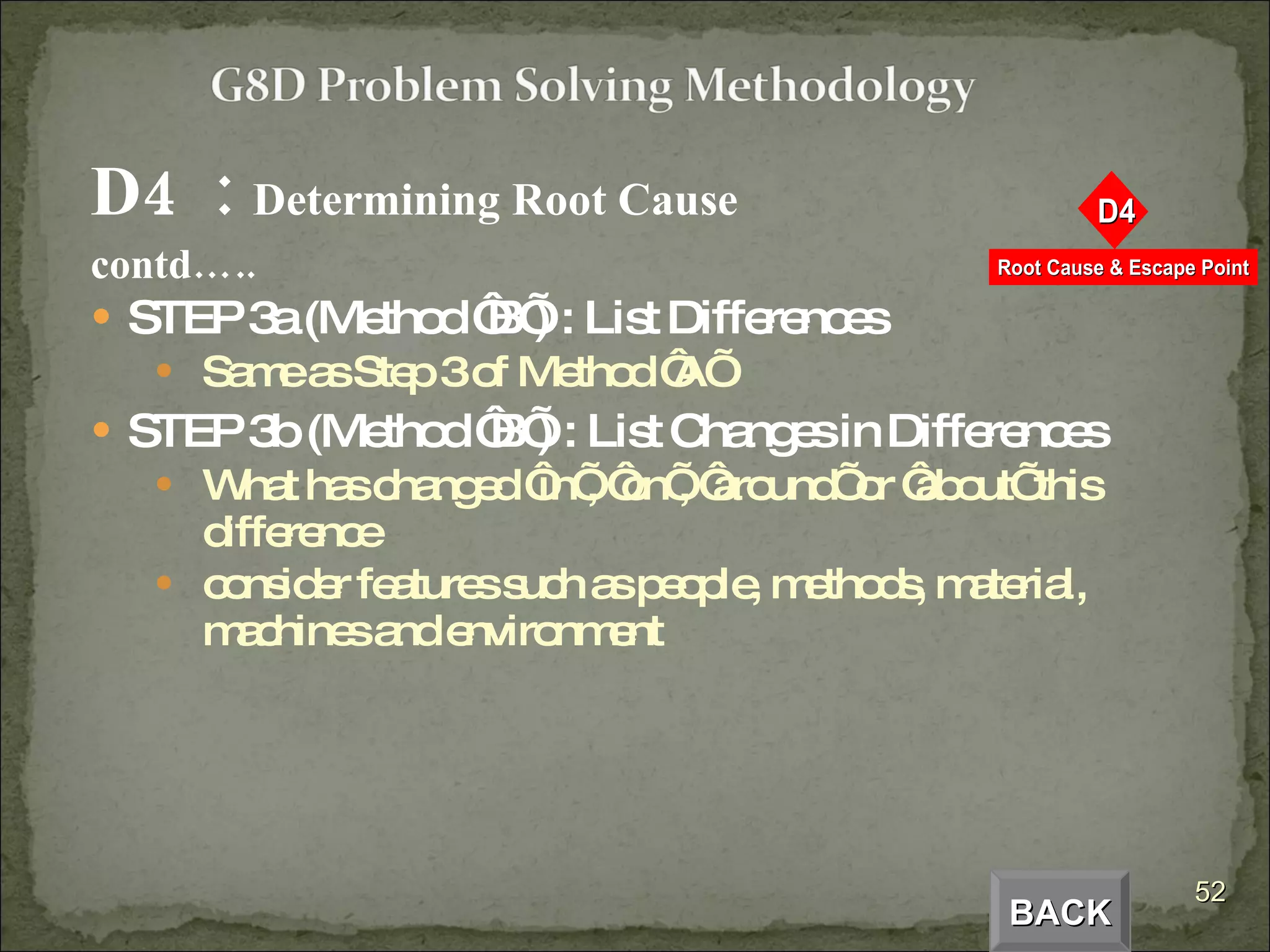
D4  :  Determining Root Cause  contd….. STEP 3a (Method ‘B’) : List Differences Same as Step 3 of Method ‘A’ STEP 3b (Method ‘B’) : List Changes in Differences What has changed ‘in’, ‘on’, ‘around’ or ‘about’ this difference consider features such as people, methods, material, machines and environment BACK
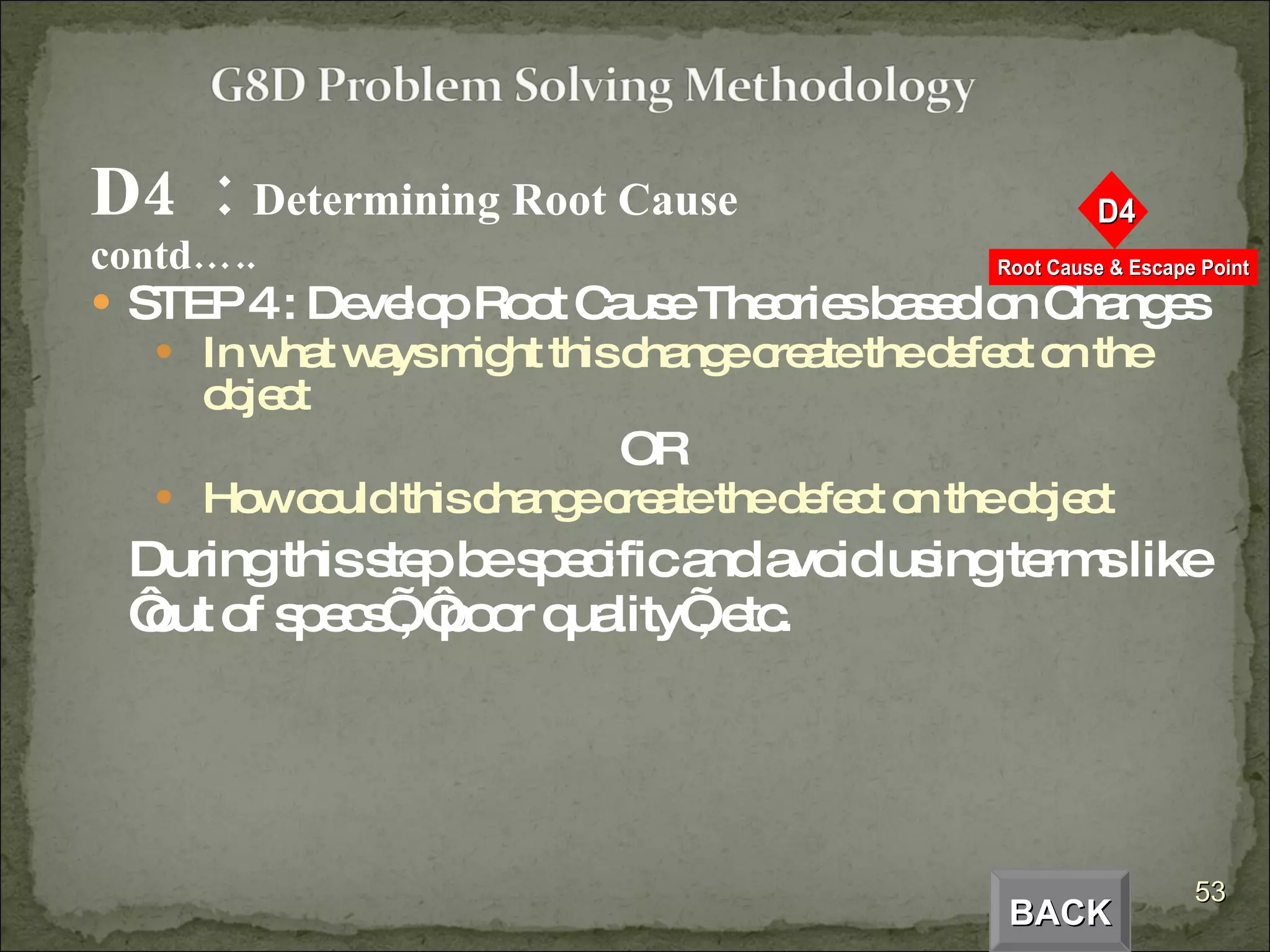
D4  :  Determining Root Cause  contd….. STEP 4 : Develop Root Cause Theories based on Changes In what ways might this change create the defect on the object OR How could this change create the defect on the object During this step be specific and avoid using terms like ‘out of specs’, ‘poor quality’, etc. BACK
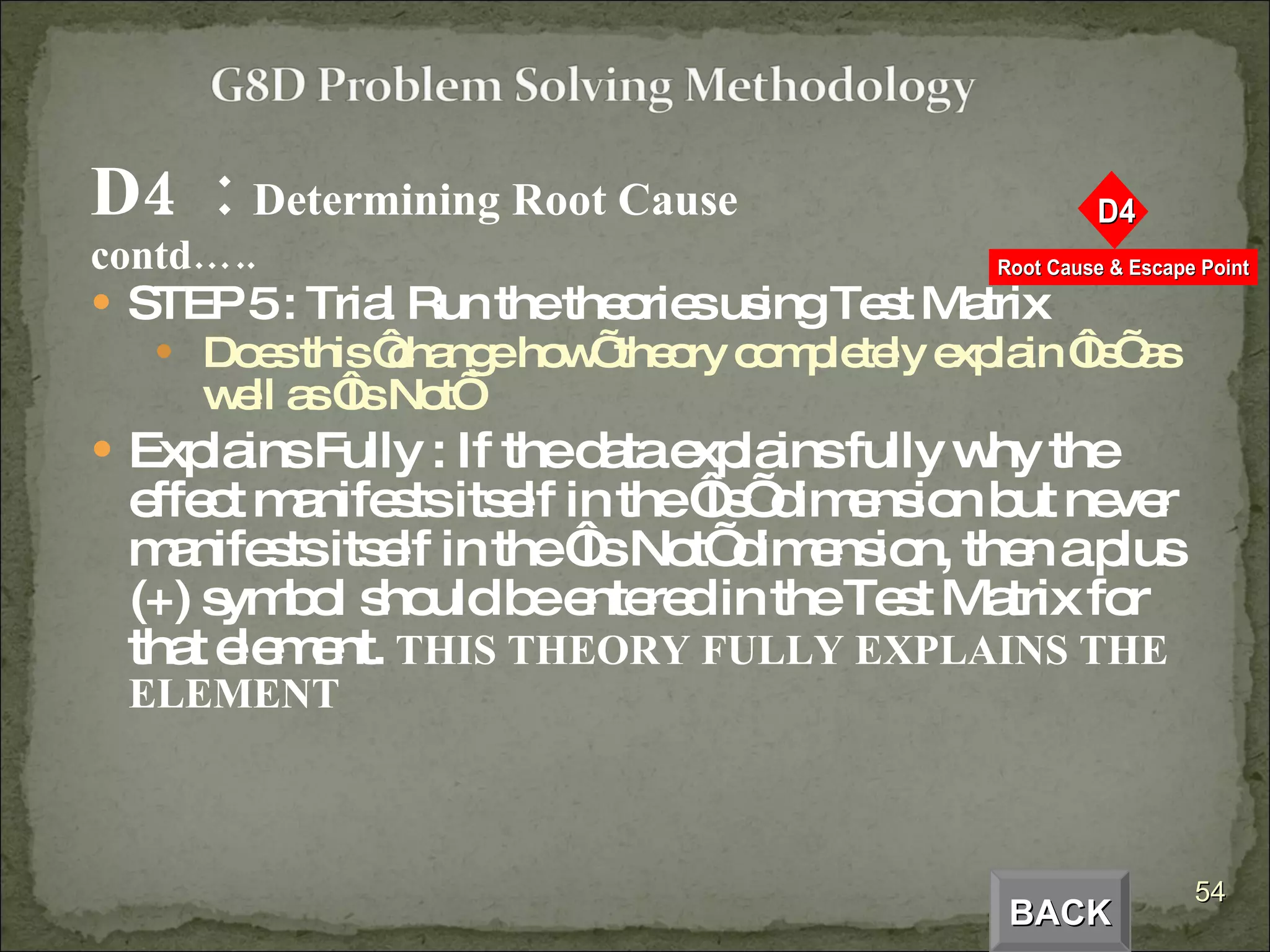
D4  :  Determining Root Cause  contd….. STEP 5 : Trial Run the theories using Test Matrix  Does this ‘change how’ theory completely explain ‘Is’ as well as ‘Is Not’ Explains Fully : If the data explains fully why the effect manifests itself in the ‘Is’ dimension but never manifests itself in the ‘Is Not’ dimension, then a plus (+) symbol should be entered in the Test Matrix for that element.  THIS THEORY FULLY EXPLAINS THE ELEMENT BACK
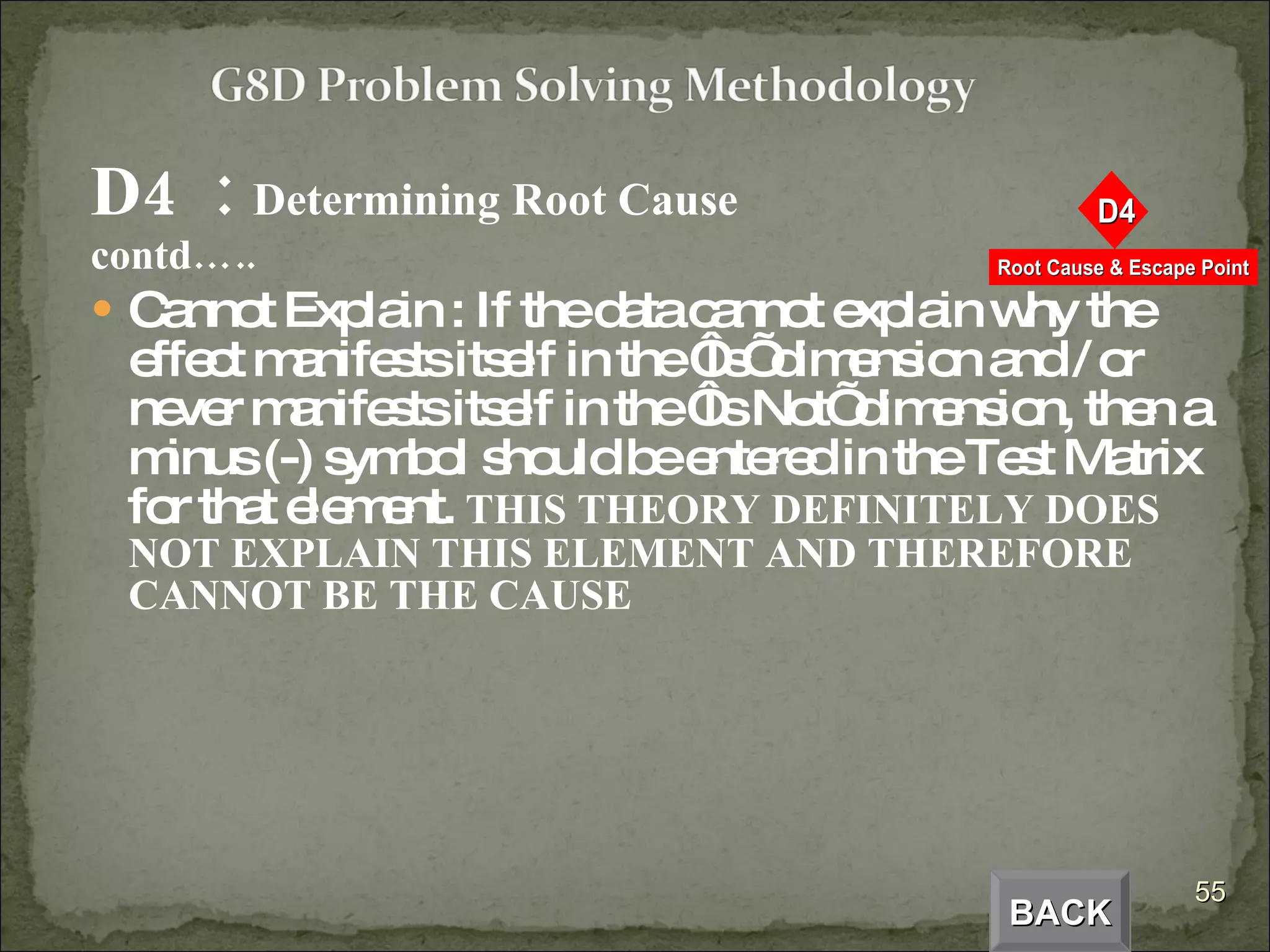
D4  :  Determining Root Cause  contd….. Cannot Explain : If the data cannot explain why the effect manifests itself in the ‘Is’ dimension and / or never manifests itself in the ‘Is Not’ dimension, then a minus (-) symbol should be entered in the Test Matrix for that element.  THIS THEORY DEFINITELY DOES NOT EXPLAIN THIS ELEMENT AND THEREFORE CANNOT BE THE CAUSE BACK
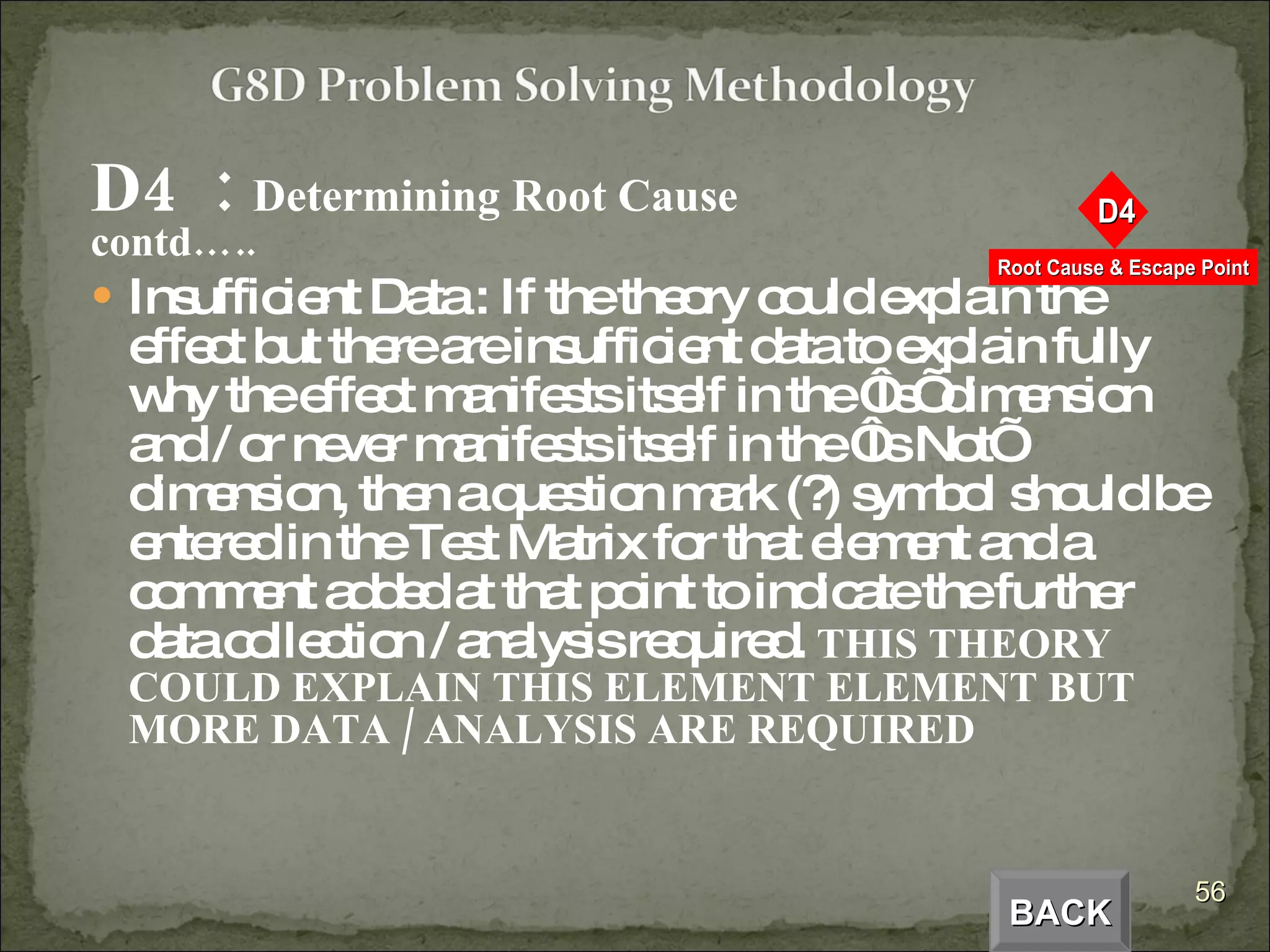
D4  :  Determining Root Cause  contd….. Insufficient Data : If the theory could explain the  effect but there are insufficient data to explain fully why the effect manifests itself in the ‘Is’ dimension and / or never manifests itself in the ‘Is Not’ dimension, then a question mark (?) symbol should be entered in the Test Matrix for that element and a comment added at that point to indicate the further data collection / analysis required.  THIS THEORY COULD EXPLAIN THIS ELEMENT ELEMENT BUT MORE DATA / ANALYSIS ARE REQUIRED BACK
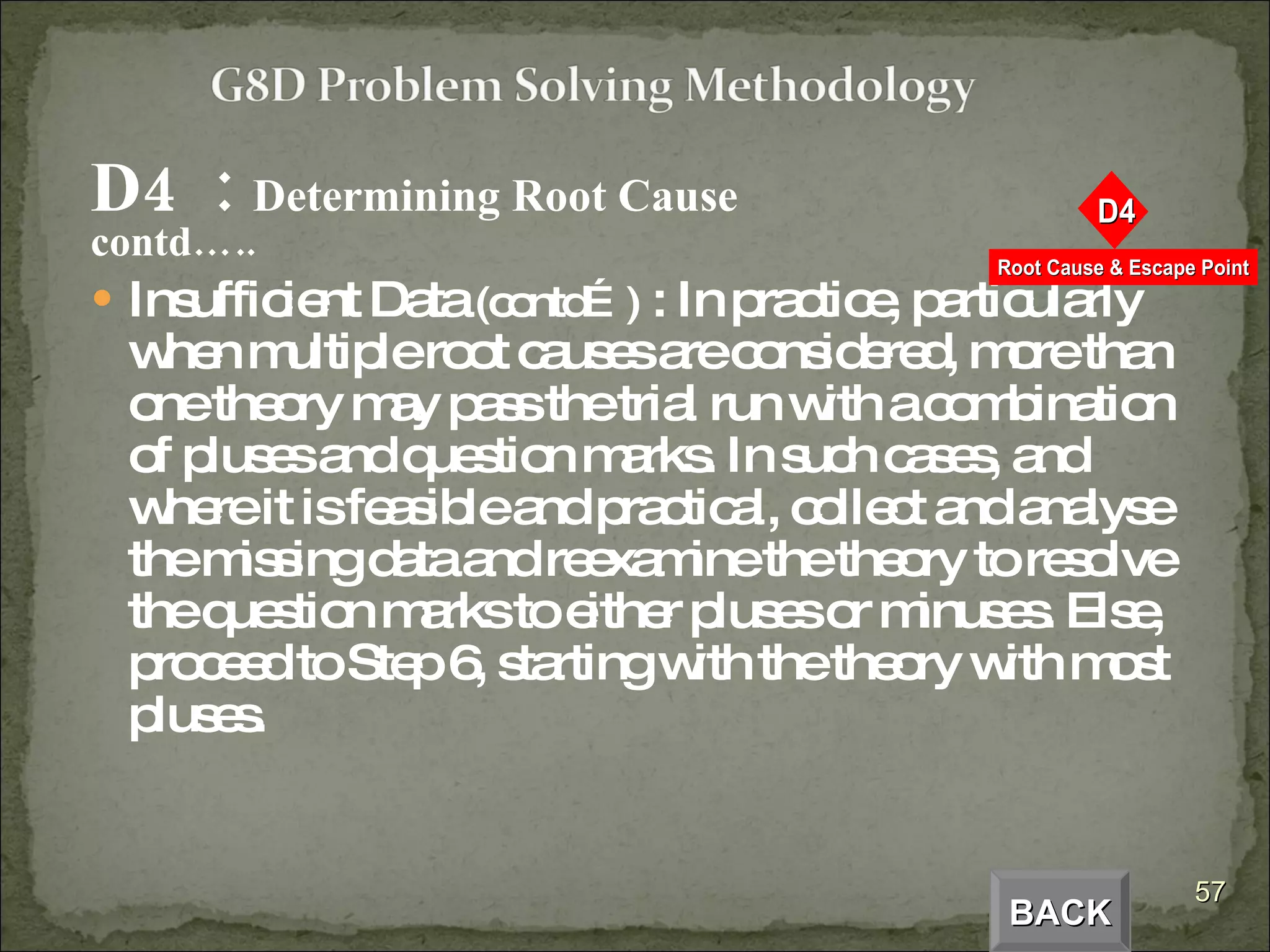
D4  :  Determining Root Cause  contd….. Insufficient Data  (contd…)  : In practice, particularly when multiple root causes are considered, more than one theory may pass the trial run with a combination of pluses and question marks. In such cases, and where it is feasible and practical, collect and analyse the missing data and reexamine the theory to resolve the question marks to either pluses or minuses. Else, proceed to Step 6, starting with the theory with most pluses.  BACK
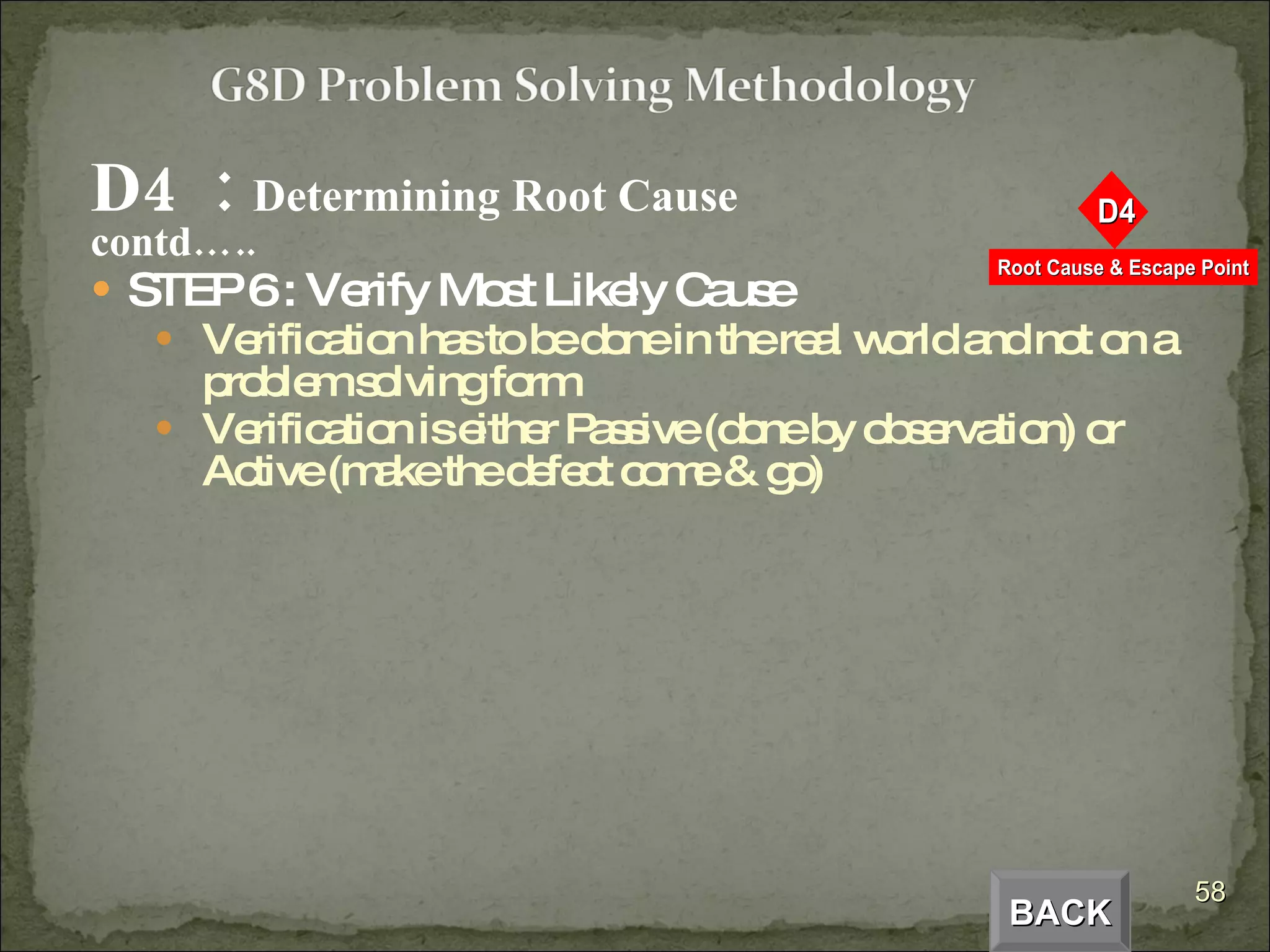
D4  :  Determining Root Cause  contd….. STEP 6 : Verify Most Likely Cause Verification has to be done in the real world and not on a problem solving form Verification is either Passive (done by observation) or Active (make the defect come & go) BACK
D4  :  Determining Root Cause  contd….. STEP 7 : Acknowledge the Root Cause Confirmed root cause is then acknowledged as the as the Root Cause  BACK
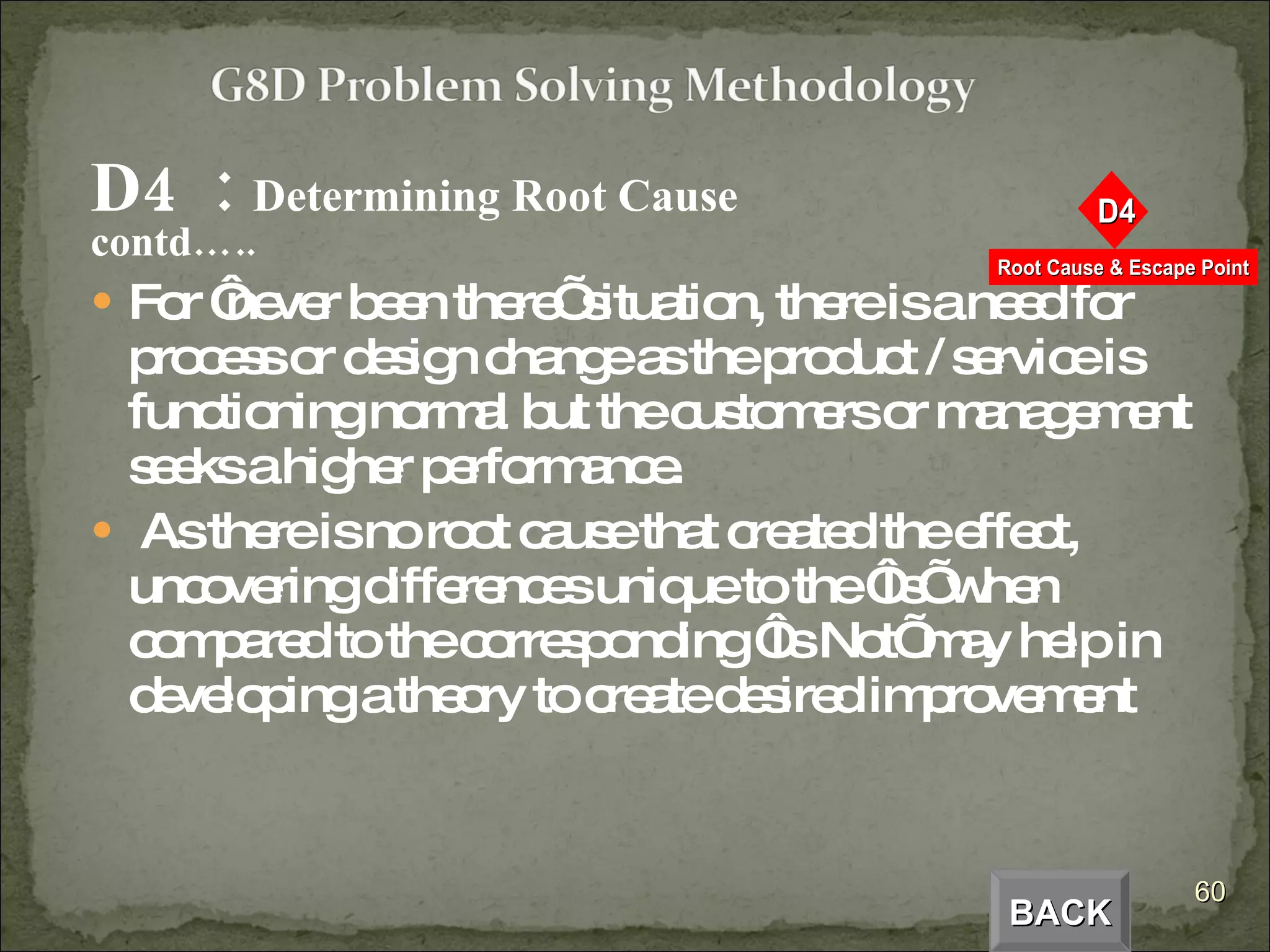
D4  :  Determining Root Cause  contd….. For ‘never been there’ situation, there is a need for process or design change as the product / service is functioning normal but the customers or management seeks a higher performance. As there is no root cause that created the effect, uncovering differences unique to the ‘Is’ when compared to the corresponding ‘Is Not’ may help in developing a theory to create desired improvement  BACK
D4  :  Escape Point Concepts Determine where in the process the root cause could have been detected, but was not. Review the Control System and the Control Point BACK
BACK D5 Choose & Verify PCA D4 Root Cause & Escape Point D3 Develop ICA D2 Describe Problem D1 Establish Team D6 Implement & Validate PCA D7 Prevent Recurrence D8 Recognise Contributions D0 Prepare for G8D
BACK
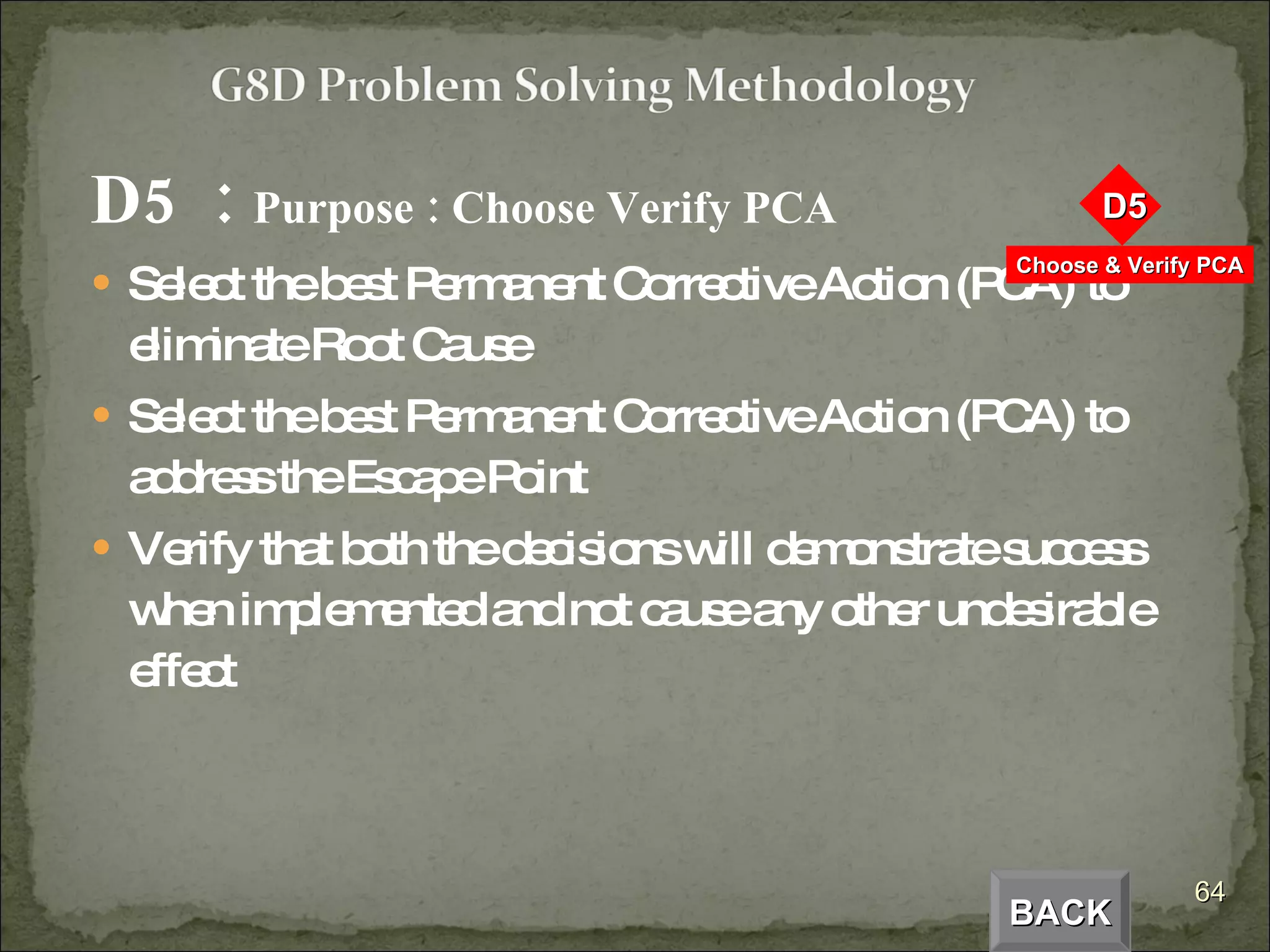
D5  :  Purpose : Choose Verify PCA Select the best Permanent Corrective Action (PCA) to eliminate Root Cause Select the best Permanent Corrective Action (PCA) to address the Escape Point Verify that both the decisions will demonstrate success when implemented and not cause any other undesirable effect BACK
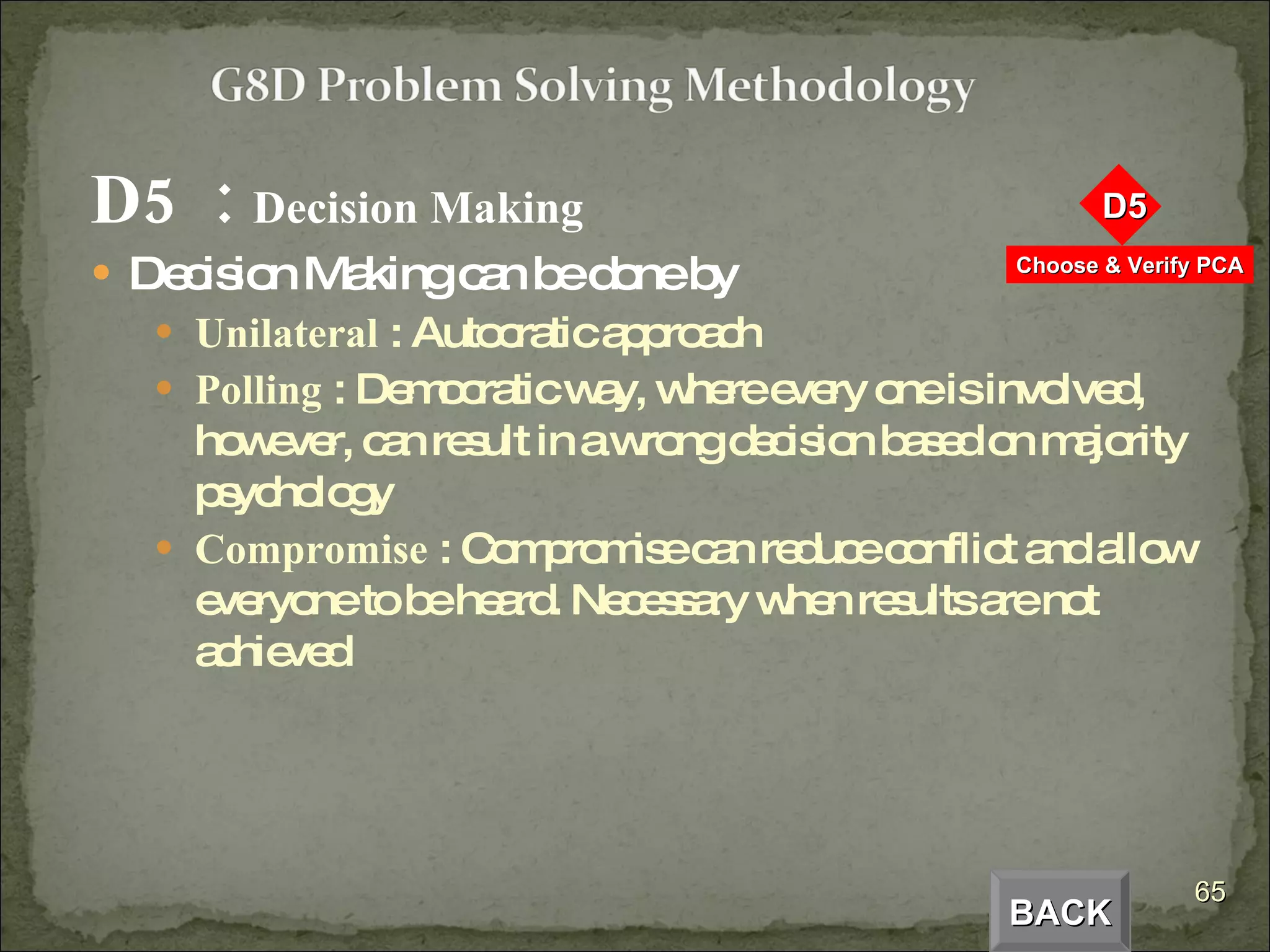
D5  :  Decision Making Decision Making can be done by Unilateral  : Autocratic approach Polling  : Democratic way, where every one is involved, however, can result in a wrong decision based on majority psychology Compromise  : Compromise can reduce conflict and allow everyone to be heard. Necessary when results are not achieved BACK
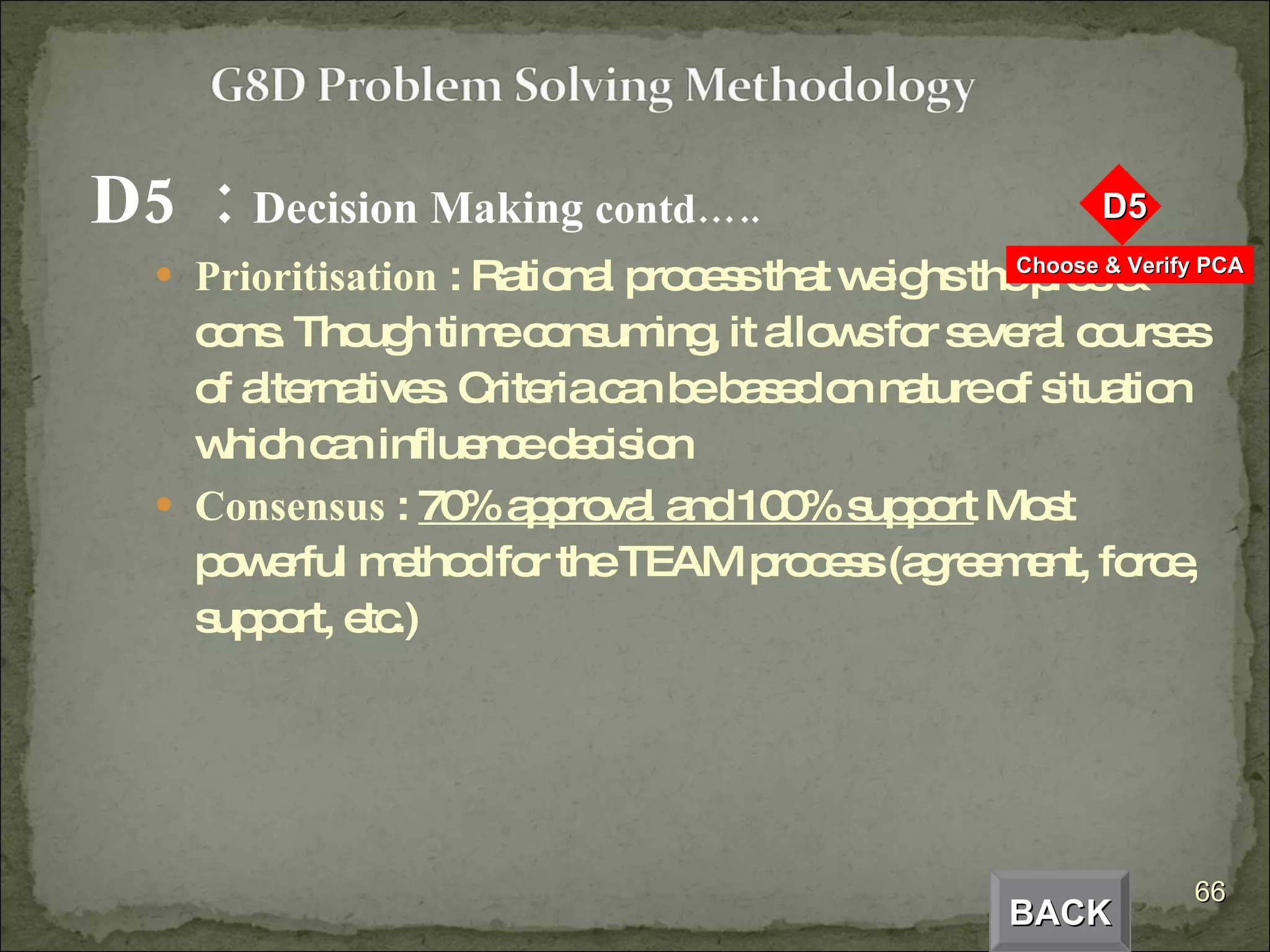
D5  :  Decision Making  contd….. Prioritisation  : Rational process that weighs the pros & cons. Though time consuming, it allows for several courses of alternatives. Criteria can be based on nature of situation which can influence decision Consensus  :  70% approval and 100% support  Most powerful method for the TEAM process (agreement, force, support, etc.) BACK
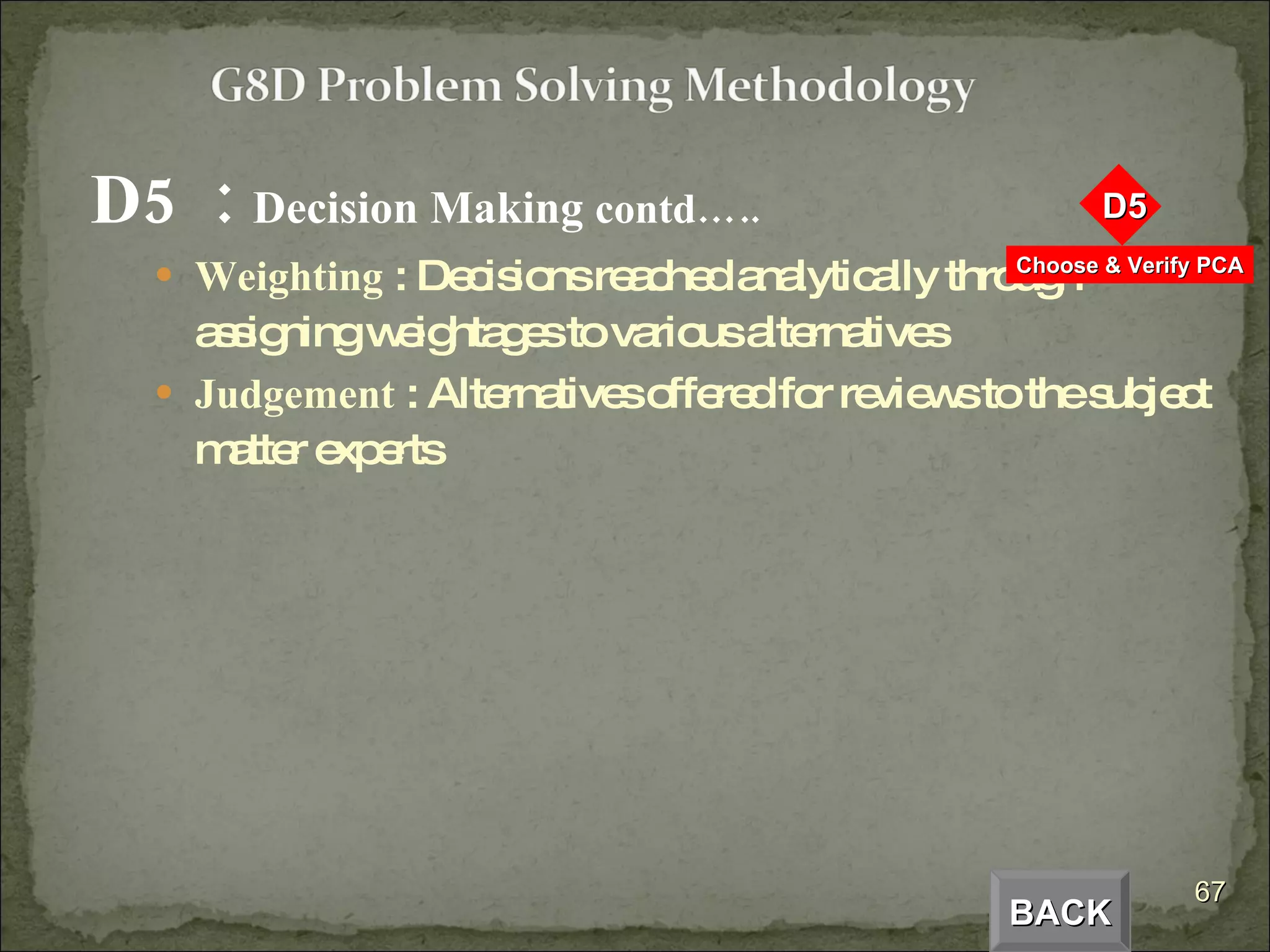
D5  :  Decision Making  contd….. Weighting  : Decisions reached analytically through assigning weightages to various alternatives Judgement  : Alternatives offered for reviews to the subject matter experts BACK
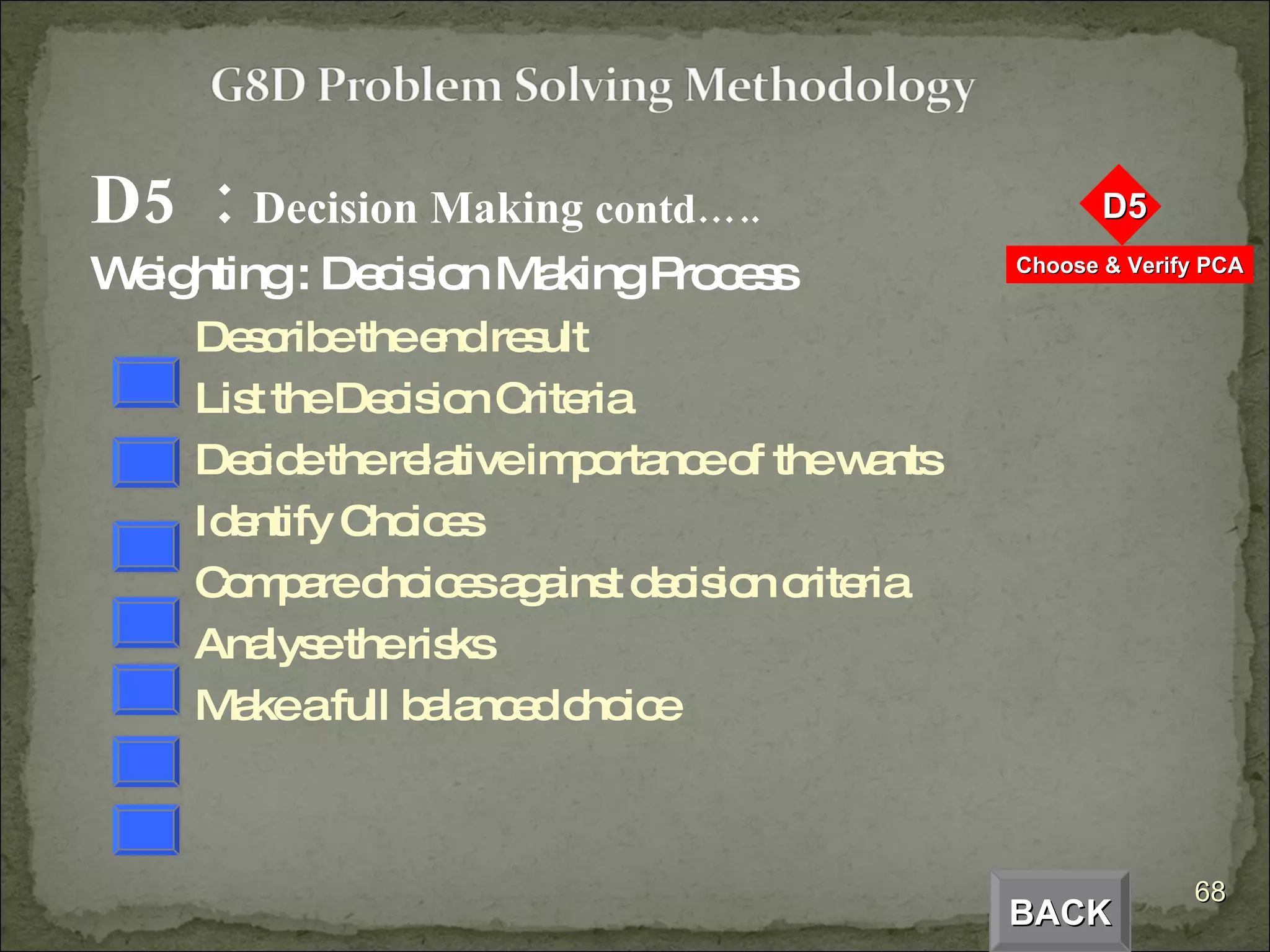
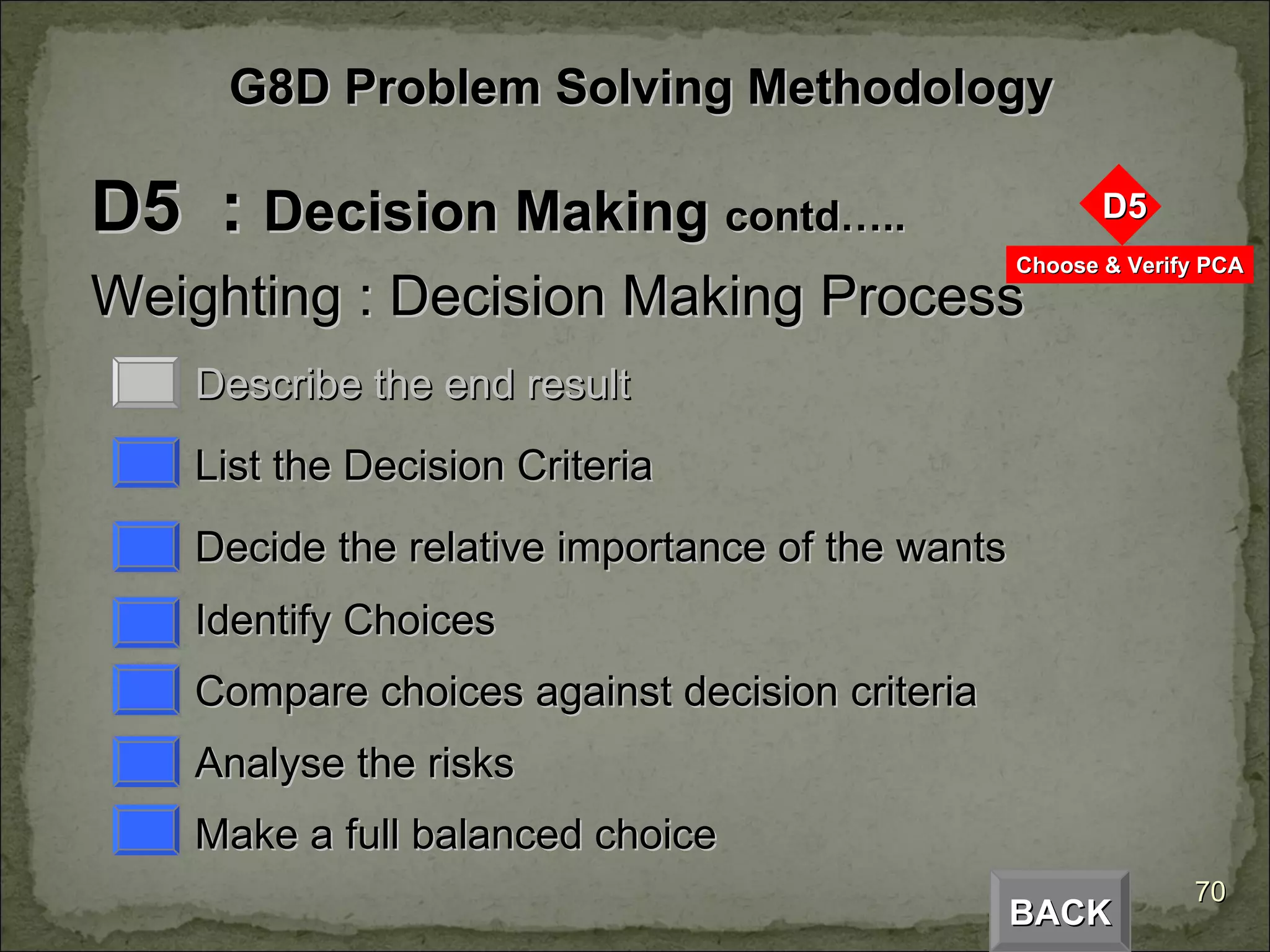
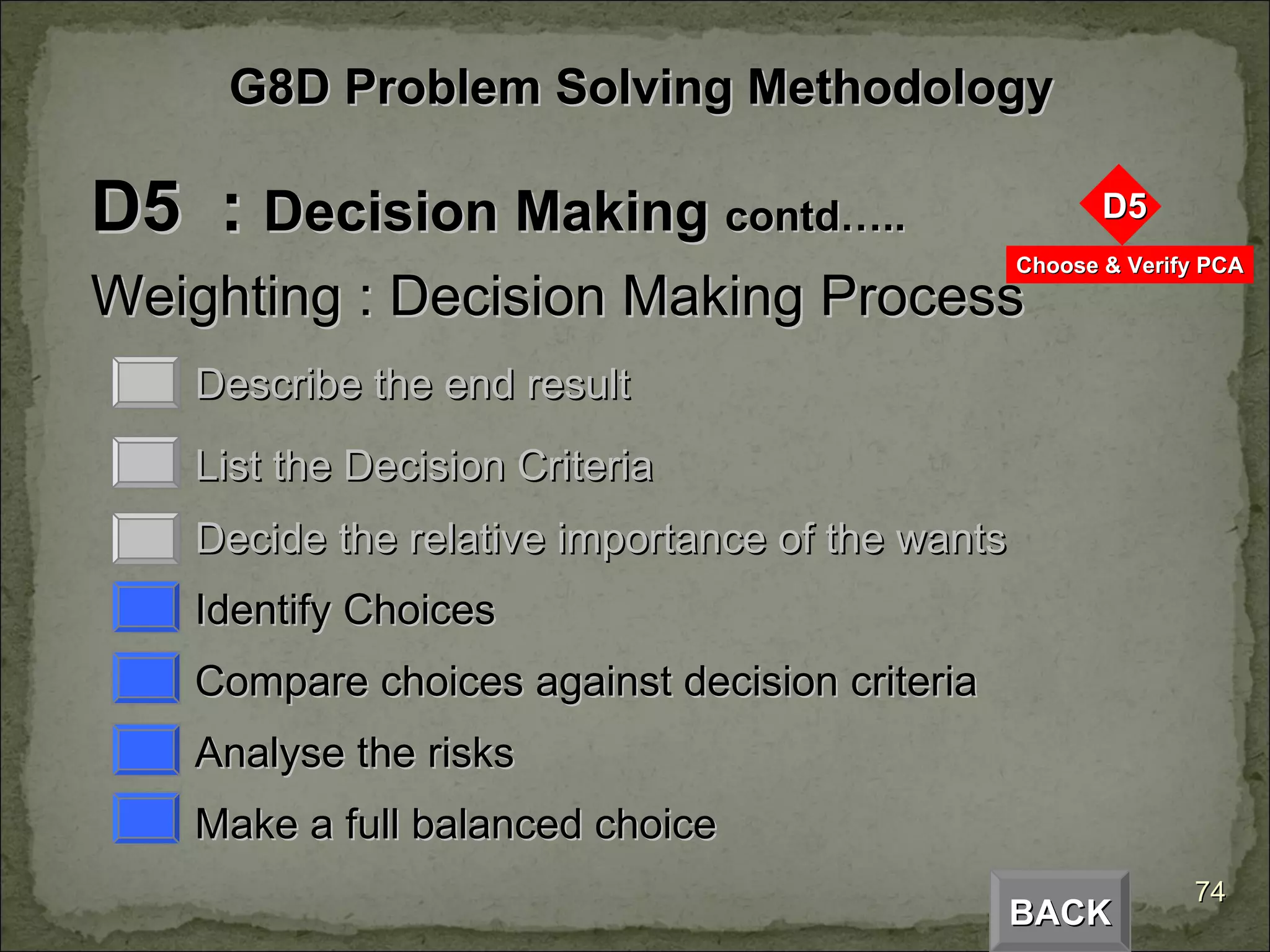
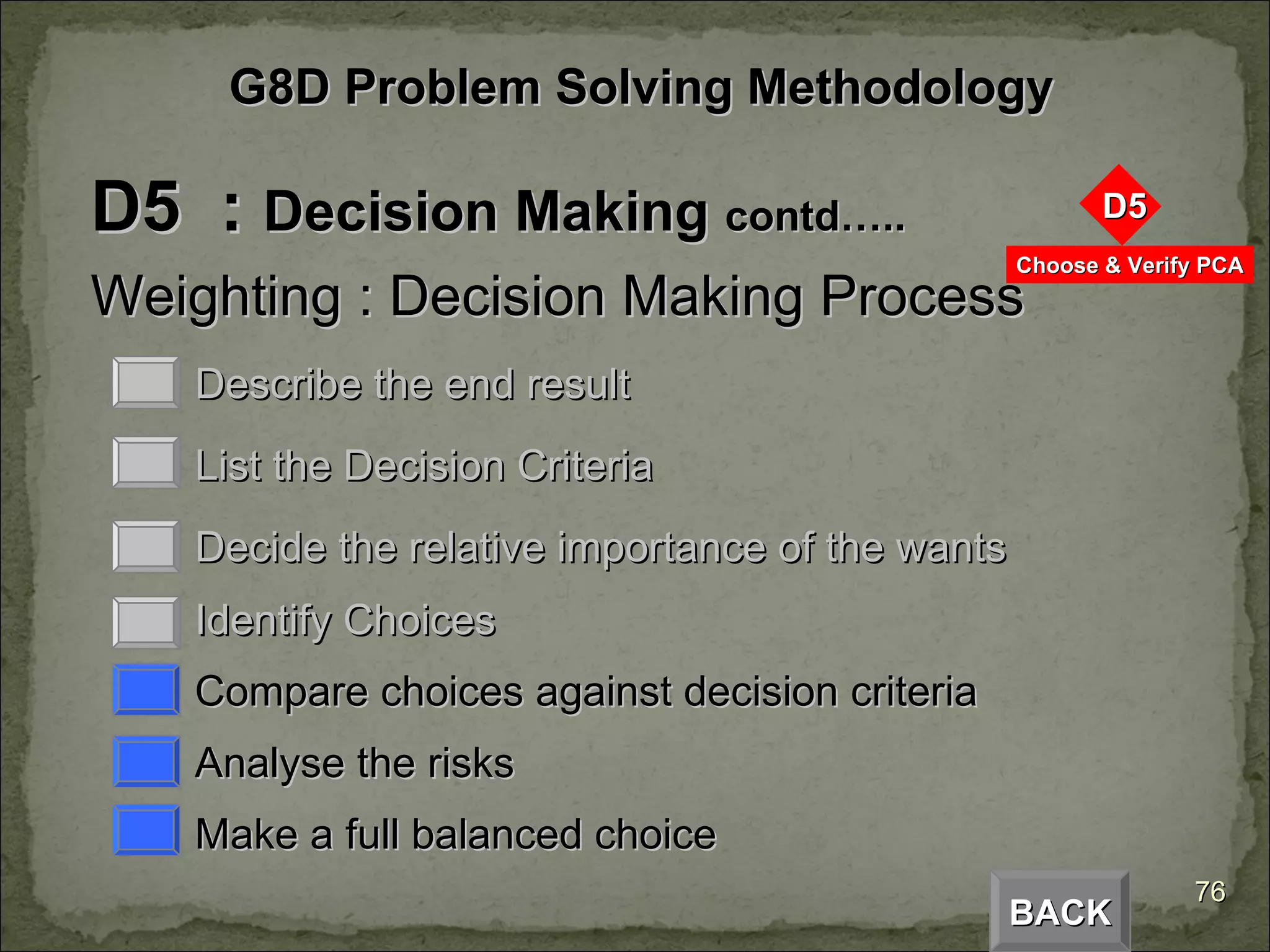
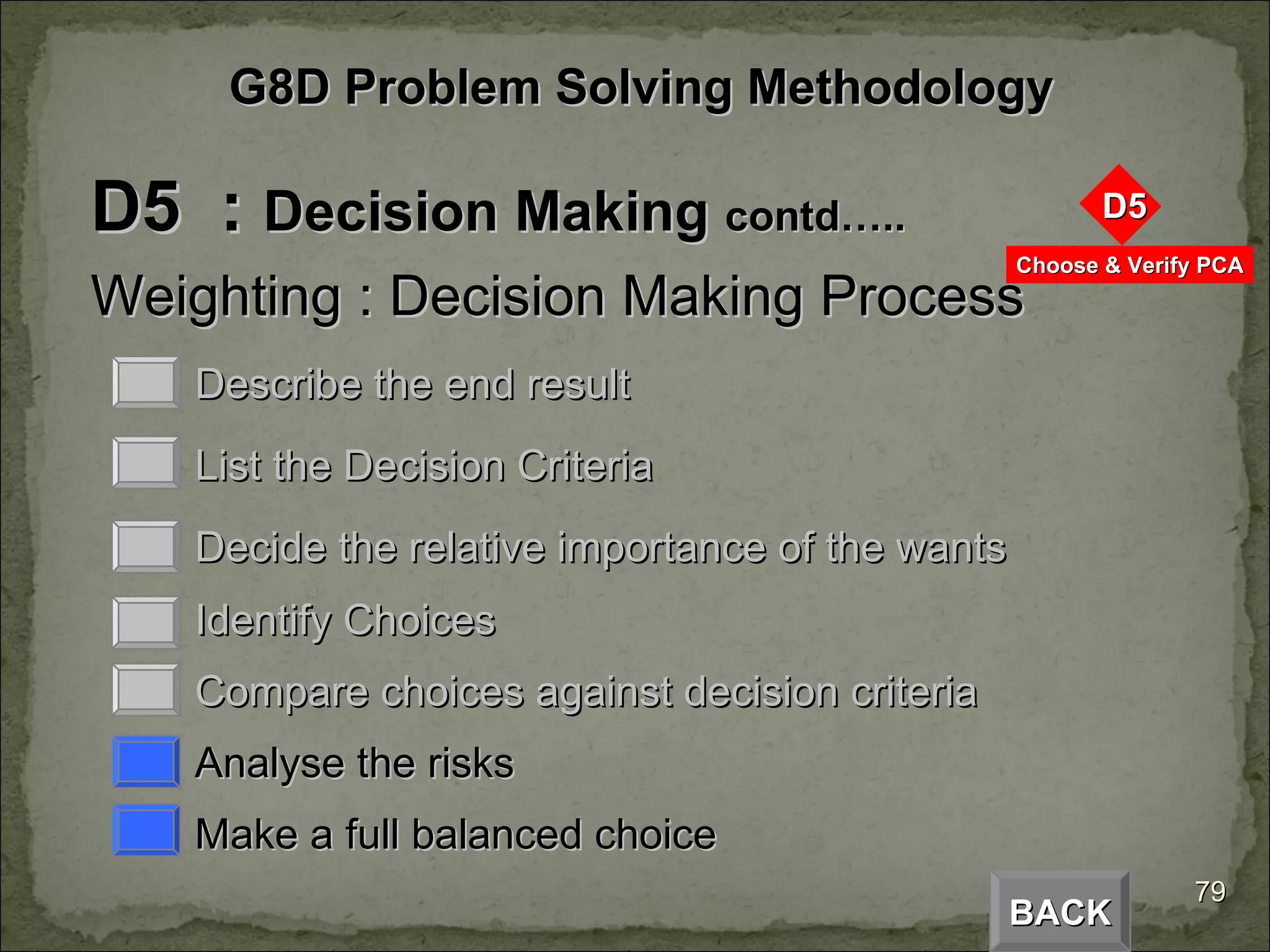
D5  :  Decision Making  contd….. Weighting : Decision Making Process Describe the end result List the Decision Criteria Decide the relative importance of the wants Identify Choices Compare choices against decision criteria Analyse the risks Make a full balanced choice BACK
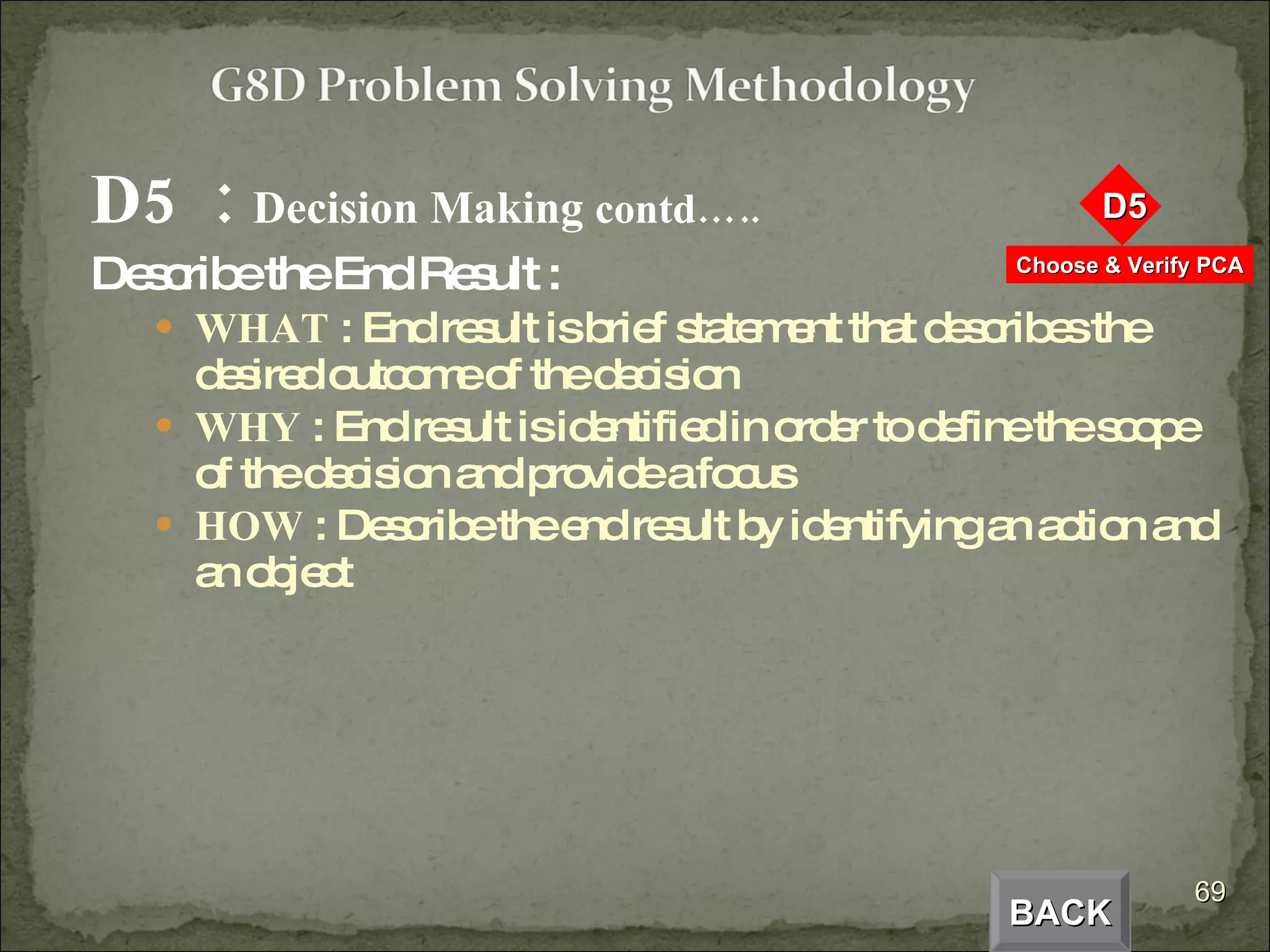
D5  :  Decision Making  contd….. Describe the End Result : WHAT  : End result is brief statement that describes the desired outcome of the decision WHY  : End result is identified in order to define the scope of the decision and provide a focus HOW  : Describe the end result by identifying an action and an object BACK
D5  :  Decision Making  contd….. Weighting : Decision Making Process Describe the end result List the Decision Criteria Decide the relative importance of the wants Identify Choices Compare choices against decision criteria Analyse the risks Make a full balanced choice BACK G8D Problem Solving Methodology
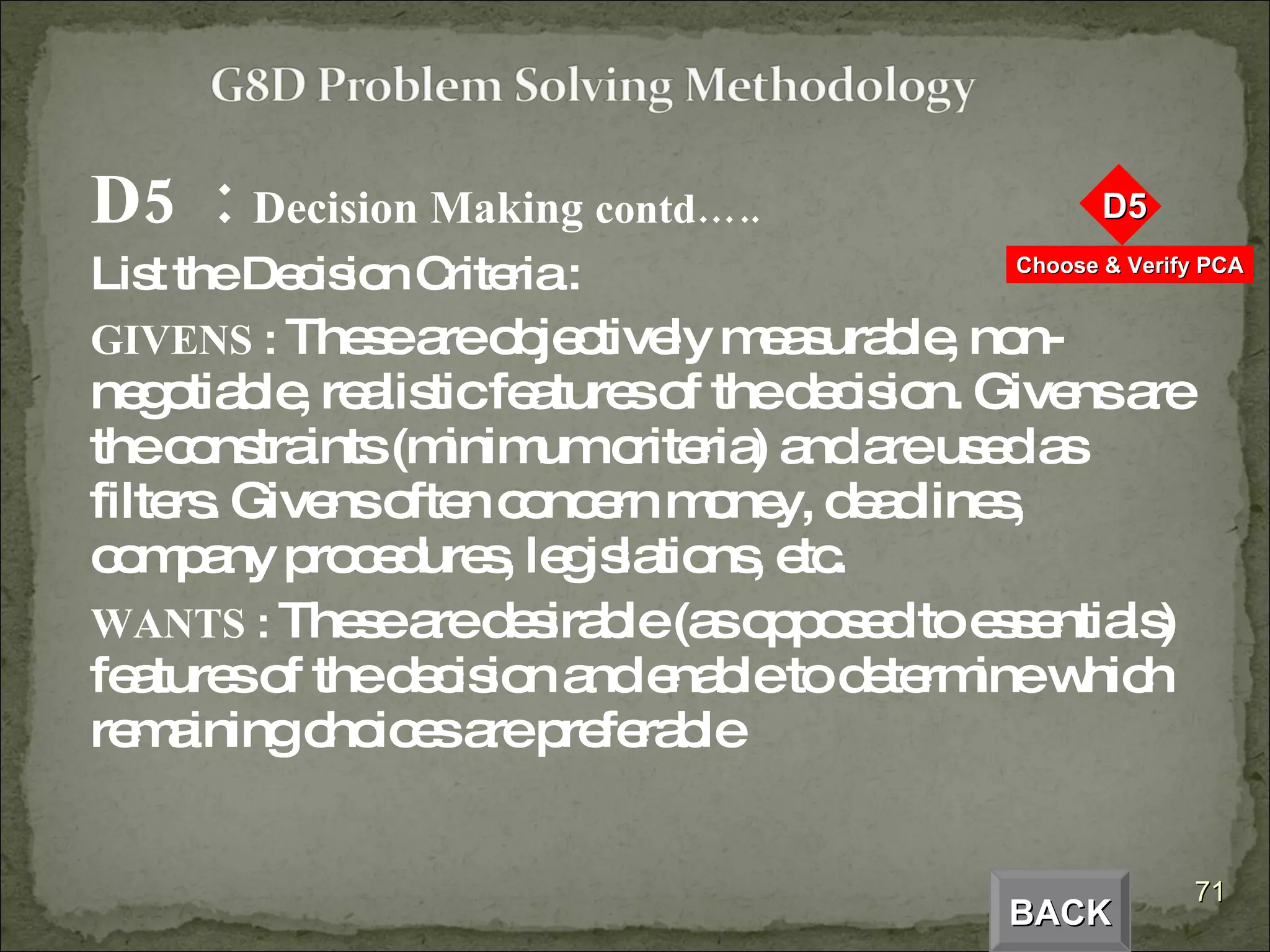
D5  :  Decision Making  contd….. List the Decision Criteria : GIVENS  :  These are objectively measurable, non-negotiable, realistic features of the decision. Givens are the constraints (minimum criteria) and are used as filters. Givens often concern money, deadlines, company procedures, legislations, etc. WANTS  :  These are desirable (as opposed to essentials) features of the decision and enable to determine which remaining choices are preferable BACK
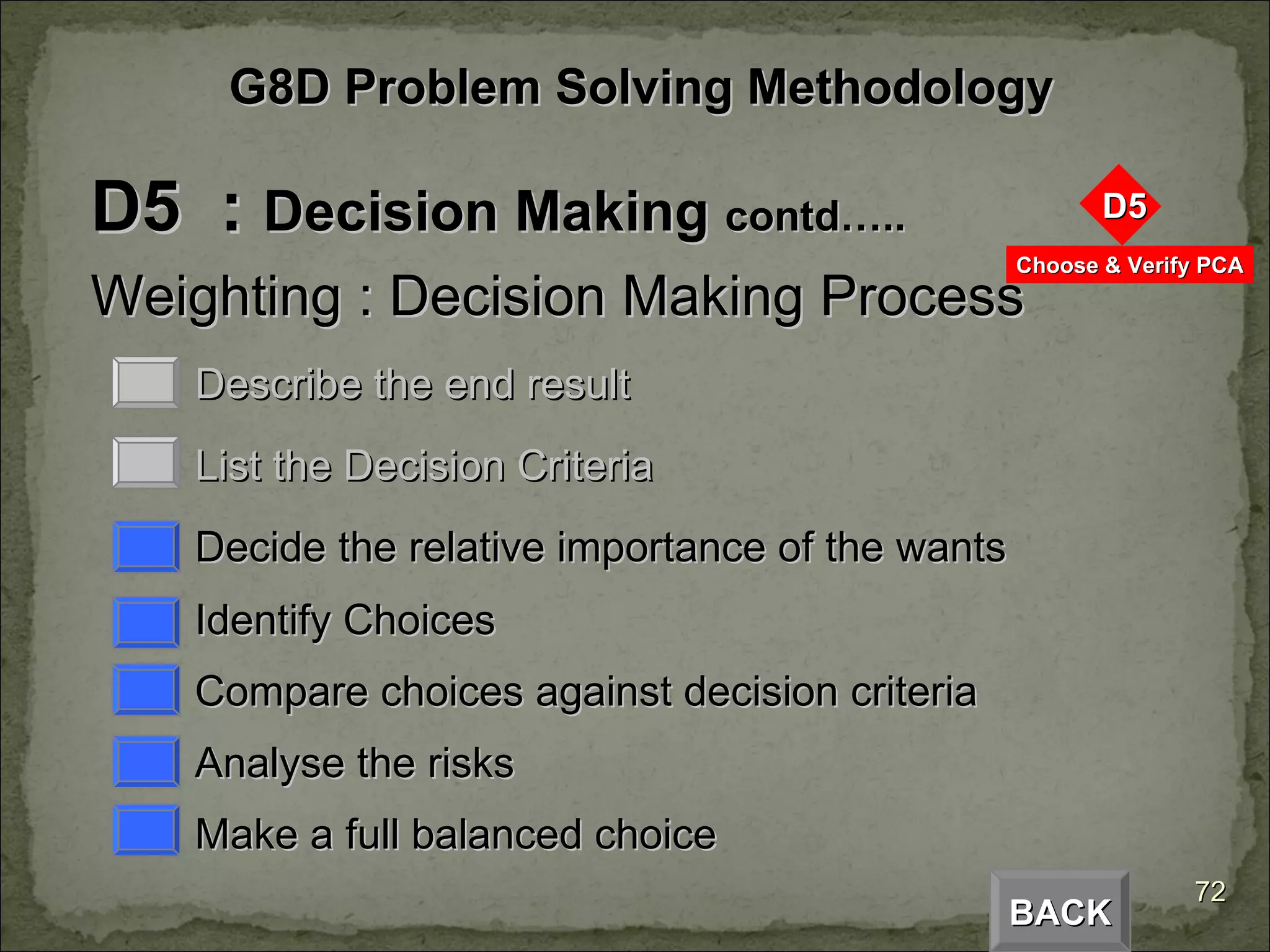
D5  :  Decision Making  contd….. Weighting : Decision Making Process Describe the end result List the Decision Criteria Decide the relative importance of the wants Identify Choices Compare choices against decision criteria Analyse the risks Make a full balanced choice BACK G8D Problem Solving Methodology
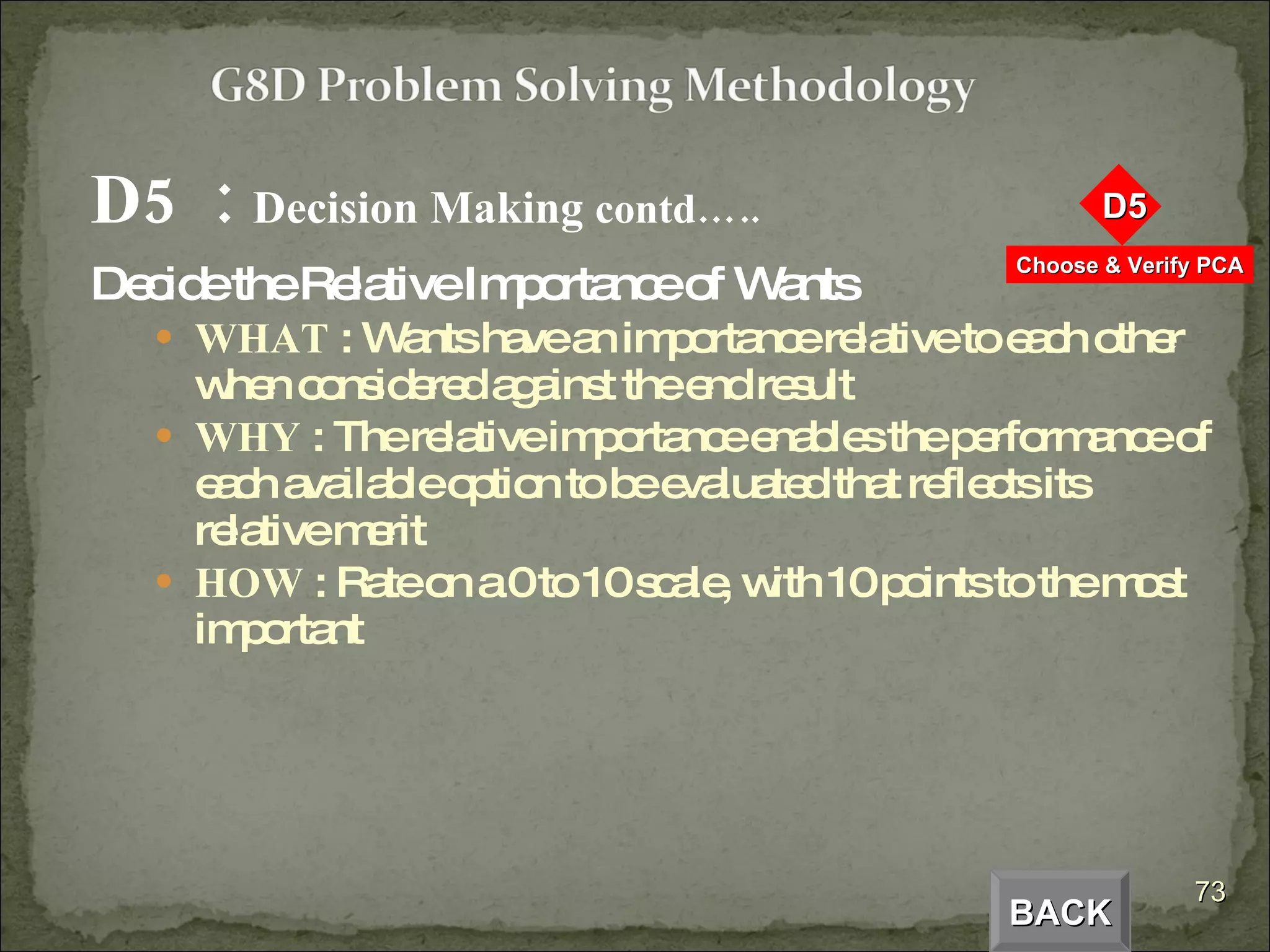
D5  :  Decision Making  contd….. Decide the Relative Importance of Wants WHAT  : Wants have an importance relative to each other when considered against the end result WHY  : The relative importance enables the performance of each available option to be evaluated that reflects its relative merit HOW  : Rate on a 0 to 10 scale, with 10 points to the most important BACK
D5  :  Decision Making  contd….. Weighting : Decision Making Process Describe the end result List the Decision Criteria Decide the relative importance of the wants Identify Choices Compare choices against decision criteria Analyse the risks Make a full balanced choice BACK G8D Problem Solving Methodology
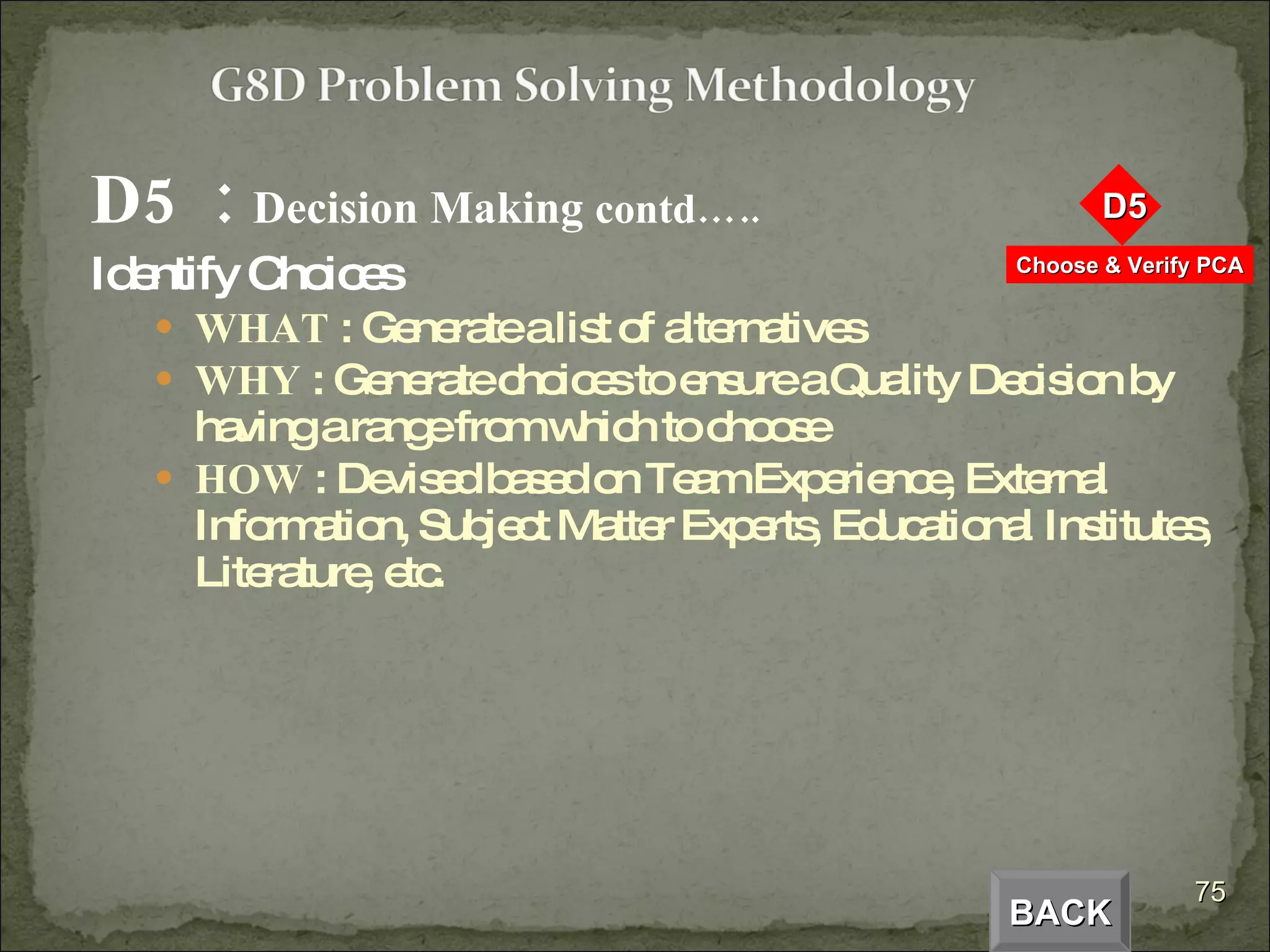
D5  :  Decision Making  contd….. Identify Choices WHAT  : Generate a list of alternatives WHY  : Generate choices to ensure a Quality Decision by having a range from which to choose HOW  : Devised based on Team Experience, External Information, Subject Matter Experts, Educational Institutes, Literature, etc. BACK
D5  :  Decision Making  contd….. Weighting : Decision Making Process Describe the end result List the Decision Criteria Decide the relative importance of the wants Identify Choices Compare choices against decision criteria Analyse the risks Make a full balanced choice BACK G8D Problem Solving Methodology
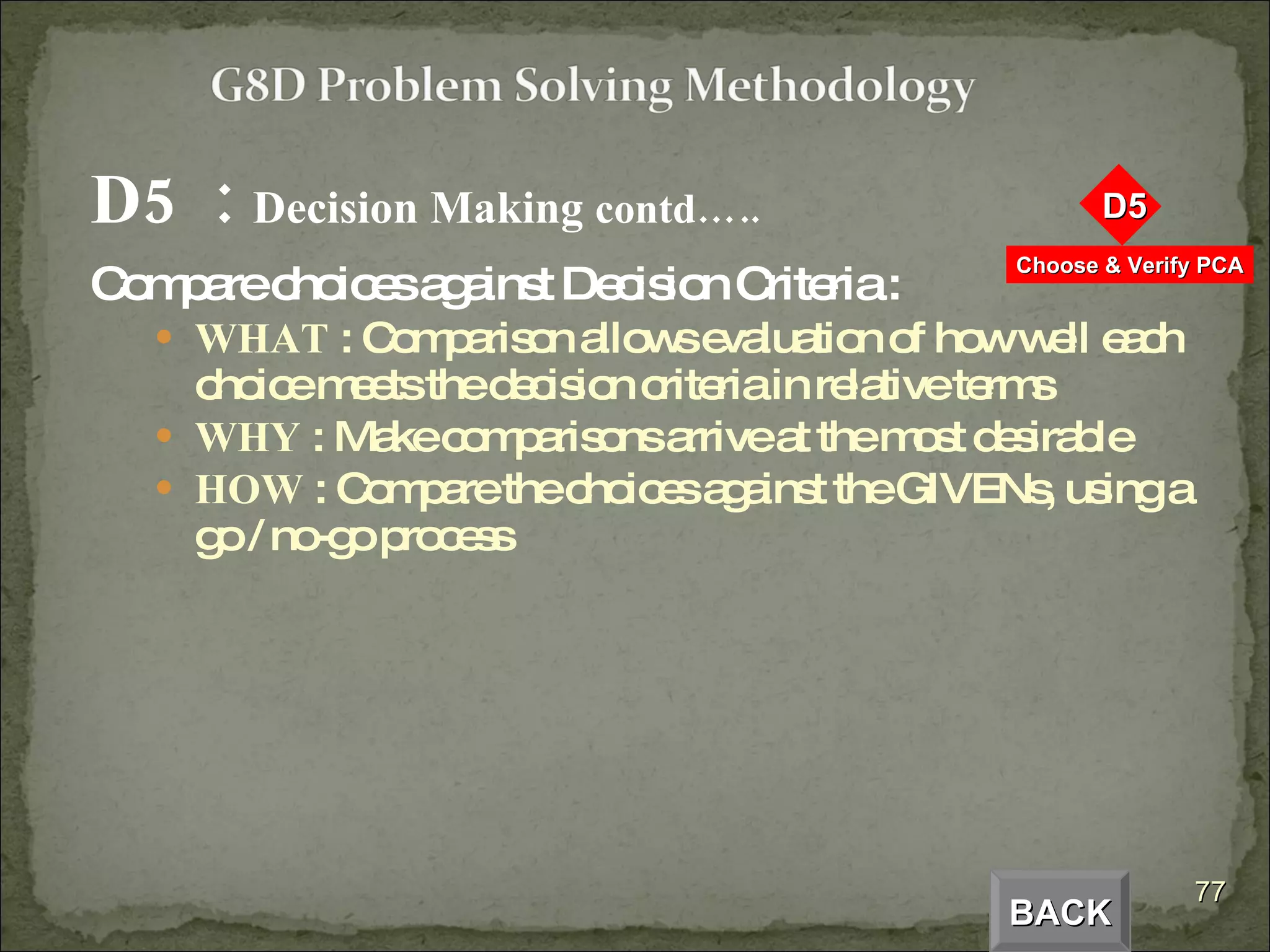
D5  :  Decision Making  contd….. Compare choices against Decision Criteria : WHAT  : Comparison allows evaluation of how well each choice meets the decision criteria in relative terms WHY  : Make comparisons arrive at the most desirable HOW  : Compare the choices against the GIVENs, using a go / no-go process BACK
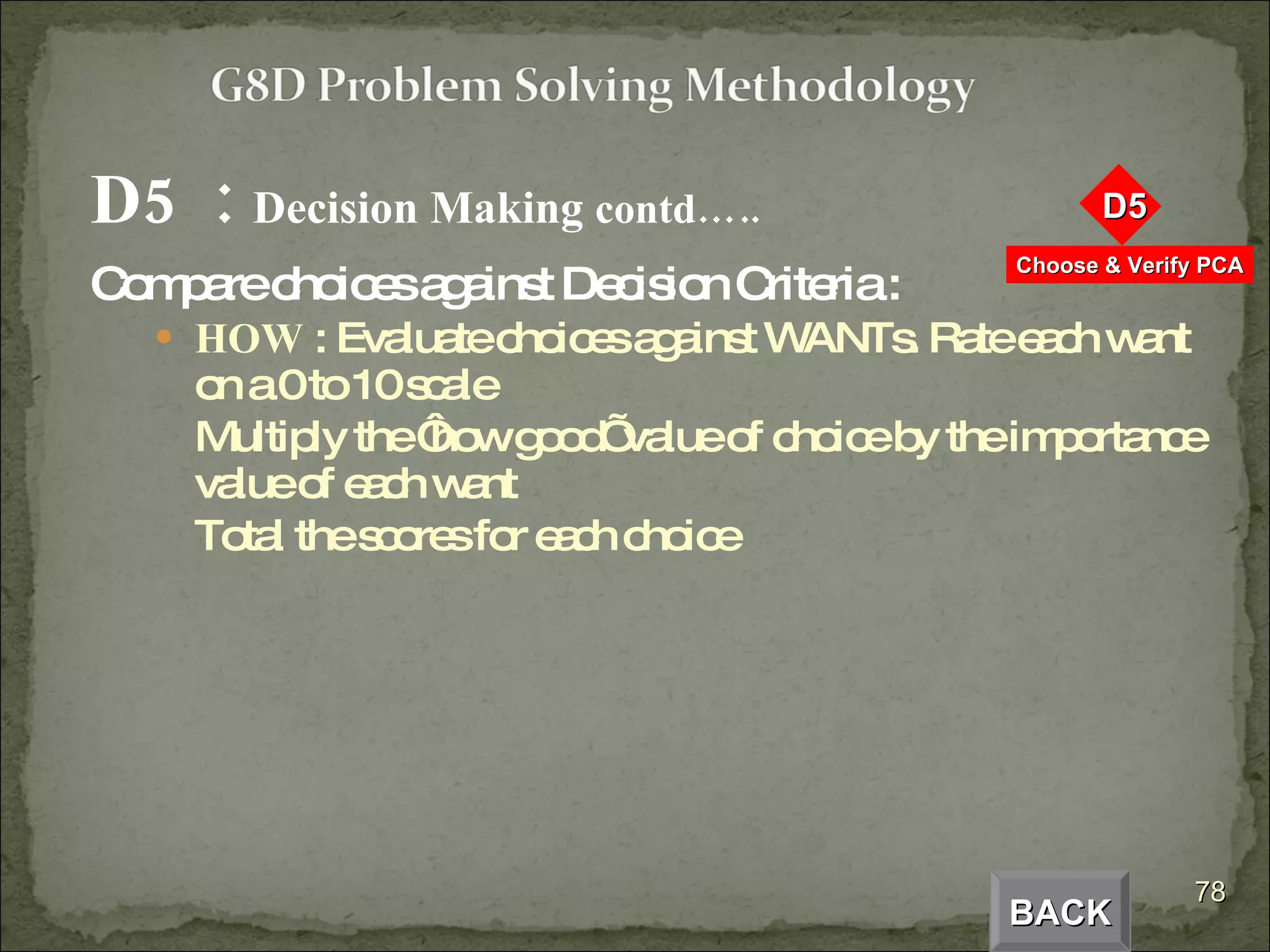
D5  :  Decision Making  contd….. Compare choices against Decision Criteria : HOW  : Evaluate choices against WANTs. Rate each want on a 0 to 10 scale Multiply the ‘how good’ value of choice by the importance value of each want Total the scores for each choice BACK
D5  :  Decision Making  contd….. Weighting : Decision Making Process Describe the end result List the Decision Criteria Decide the relative importance of the wants Identify Choices Compare choices against decision criteria Analyse the risks Make a full balanced choice BACK G8D Problem Solving Methodology
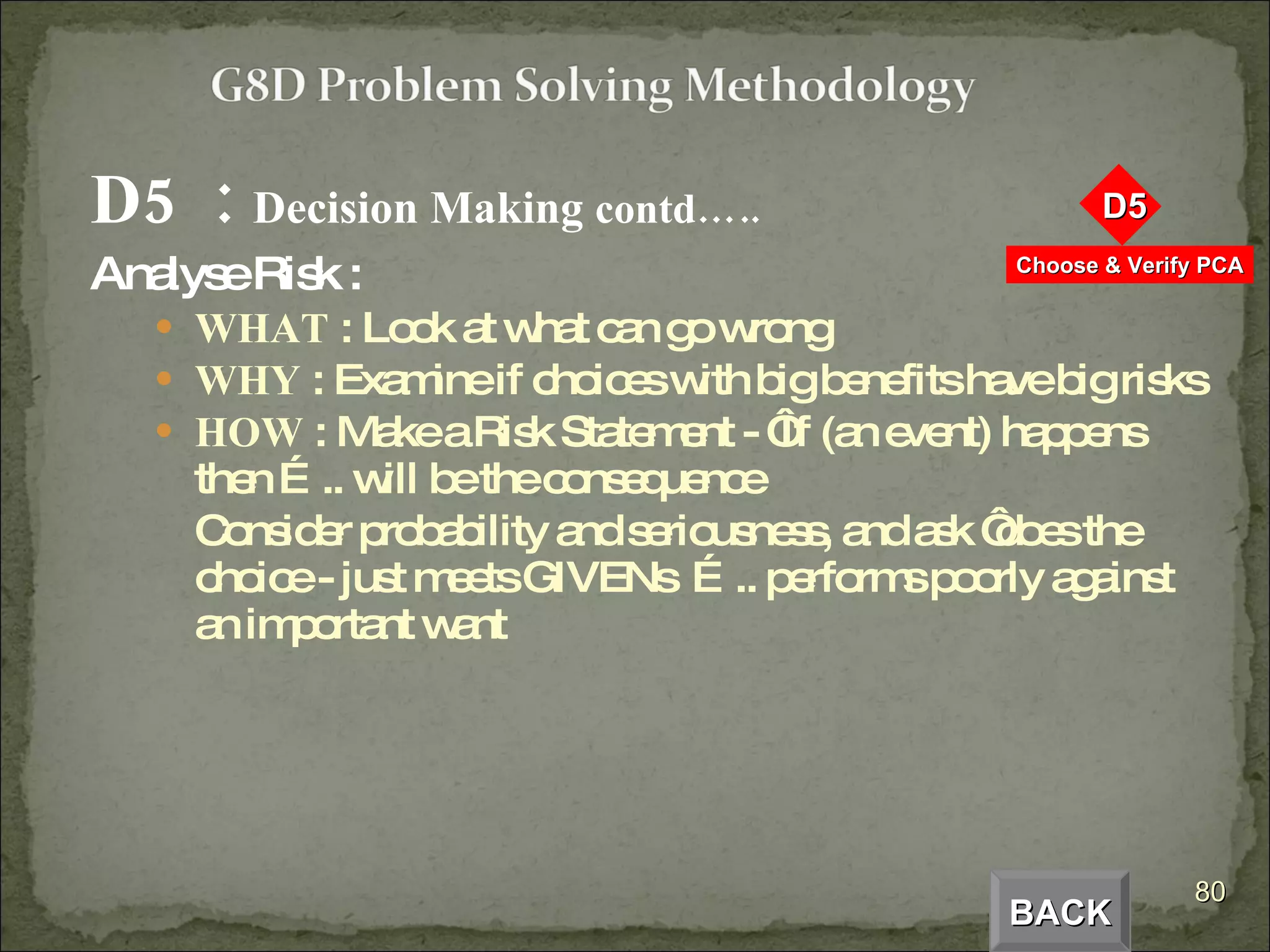
D5  :  Decision Making  contd….. Analyse Risk : WHAT  : Look at what can go wrong WHY  : Examine if choices with big benefits have big risks HOW  : Make a Risk Statement - ‘If (an event) happens then ….. will be the consequence Consider probability and seriousness, and ask ‘does the choice - just meets GIVENs  ….. performs poorly against an important want BACK
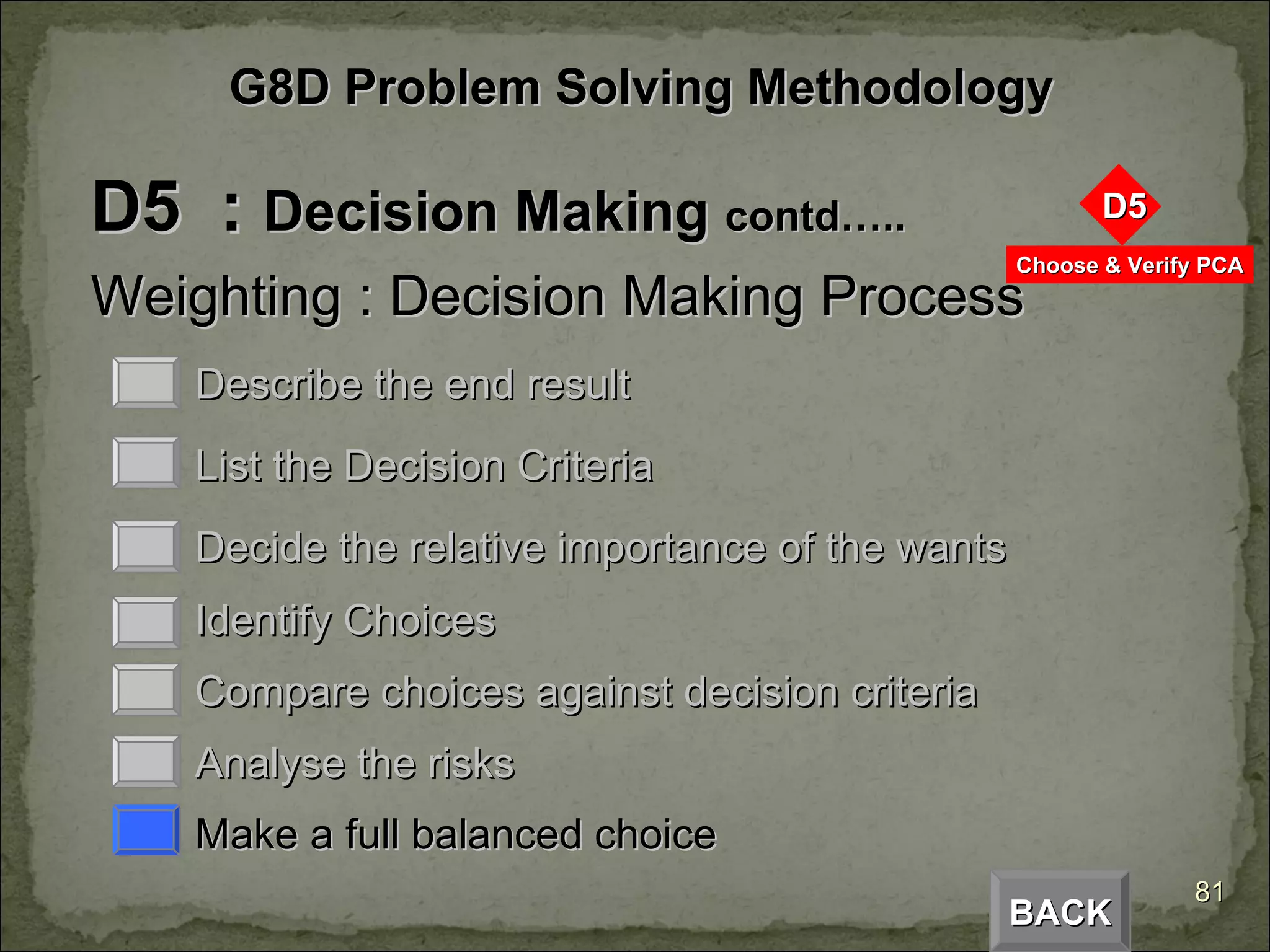
D5  :  Decision Making  contd….. Weighting : Decision Making Process Describe the end result List the Decision Criteria Decide the relative importance of the wants Identify Choices Compare choices against decision criteria Analyse the risks Make a full balanced choice BACK G8D Problem Solving Methodology
D5  :  Decision Making  contd….. Make Best Balanced Choice : WHAT  : A balanced choice must be based on information WHY  : Confident that the balanced choice is the best choice possible HOW  : Balance the Risks & Benefits BACK
D5  :  Verification Once the decision is made test it practically for feasibility in order to avoid an expensive failure include real world usage conditions examples of verification methods are test bed runs, road tests, production run, etc. BACK
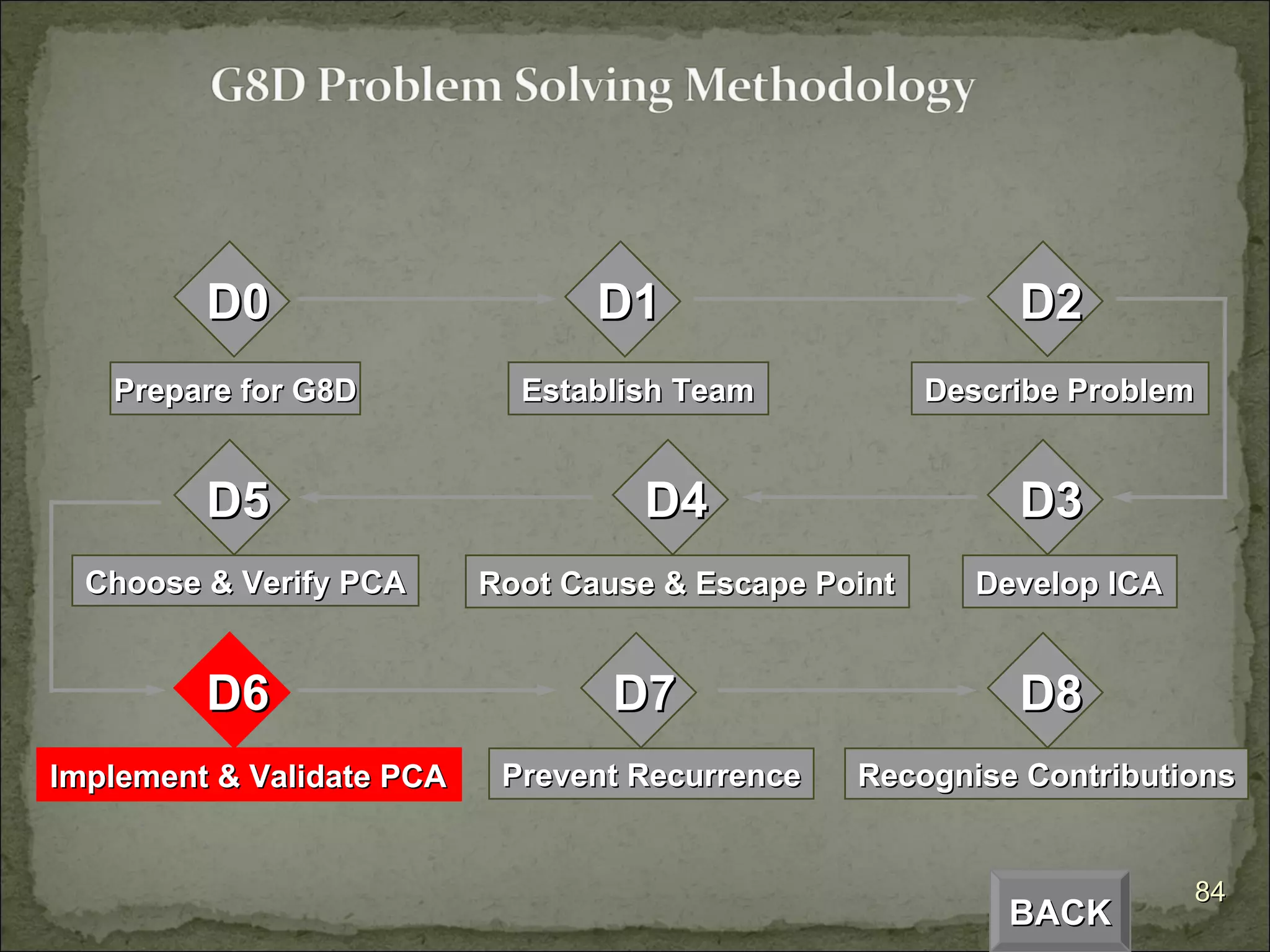
BACK D6 Implement & Validate PCA D4 Root Cause & Escape Point D3 Develop ICA D2 Describe Problem D1 Establish Team D5 Choose & Verify PCA D7 Prevent Recurrence D8 Recognise Contributions D0 Prepare for G8D
BACK
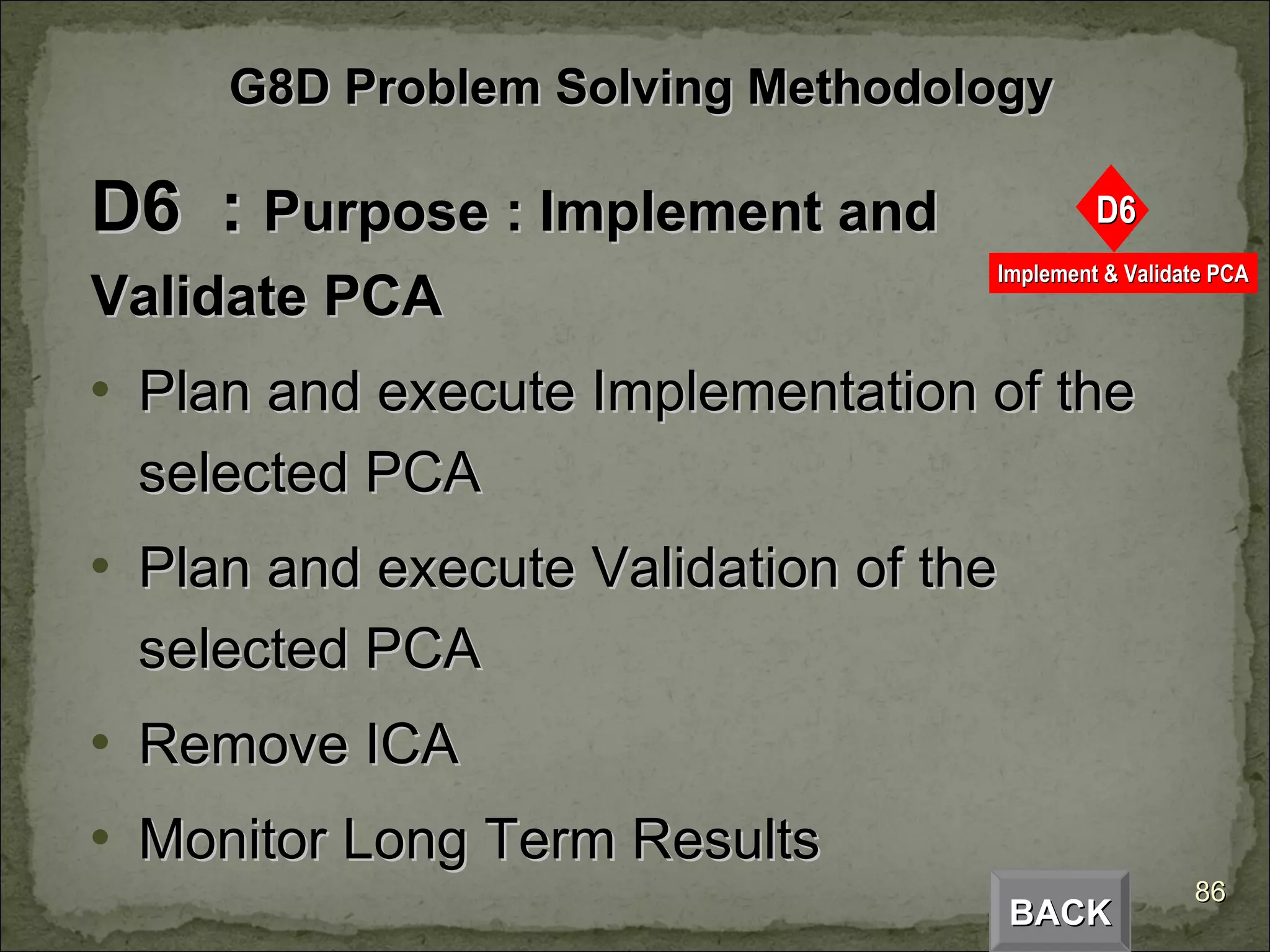
D6  :  Purpose : Implement and  Validate PCA Plan and execute Implementation of the selected PCA Plan and execute Validation of the selected PCA  Remove ICA Monitor Long Term Results BACK G8D Problem Solving Methodology
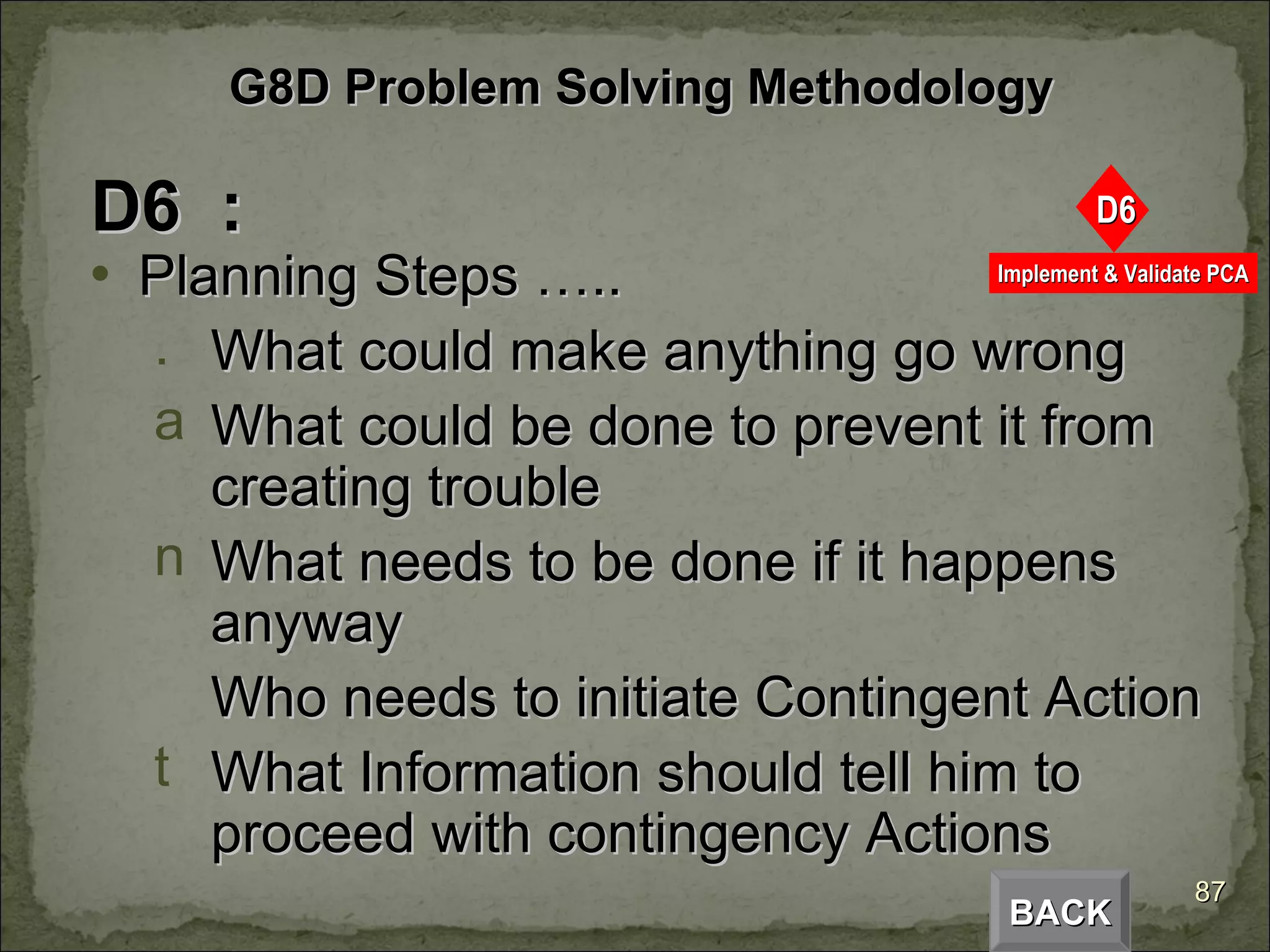
D6  : Planning Steps ….. What could make anything go wrong What could be done to prevent it from creating trouble What needs to be done if it happens anyway Who needs to initiate Contingent Action What Information should tell him to proceed with contingency Actions BACK G8D Problem Solving Methodology
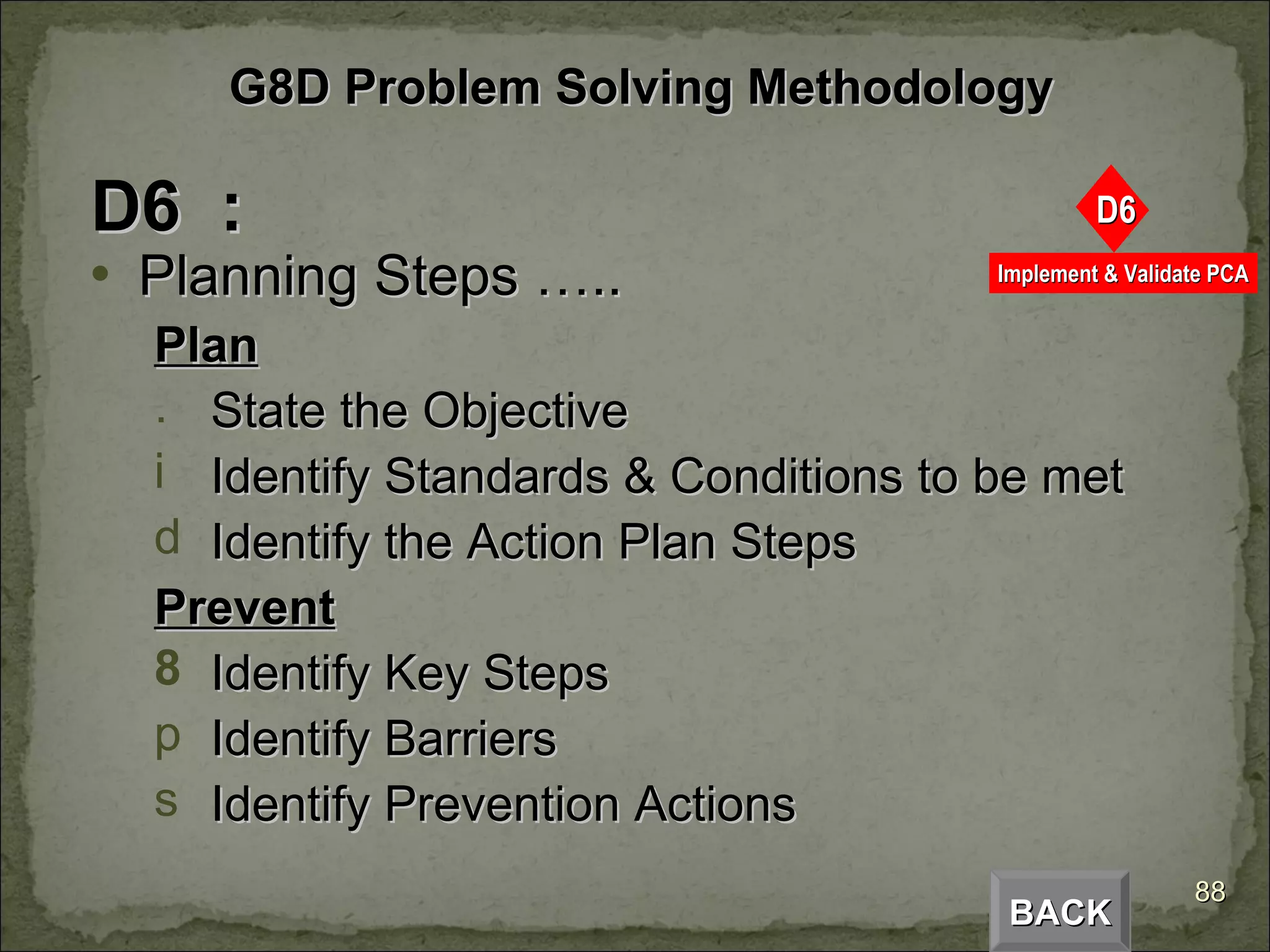
D6  : Planning Steps ….. Plan State the Objective Identify Standards & Conditions to be met Identify the Action Plan Steps Prevent Identify Key Steps Identify Barriers Identify Prevention Actions BACK G8D Problem Solving Methodology
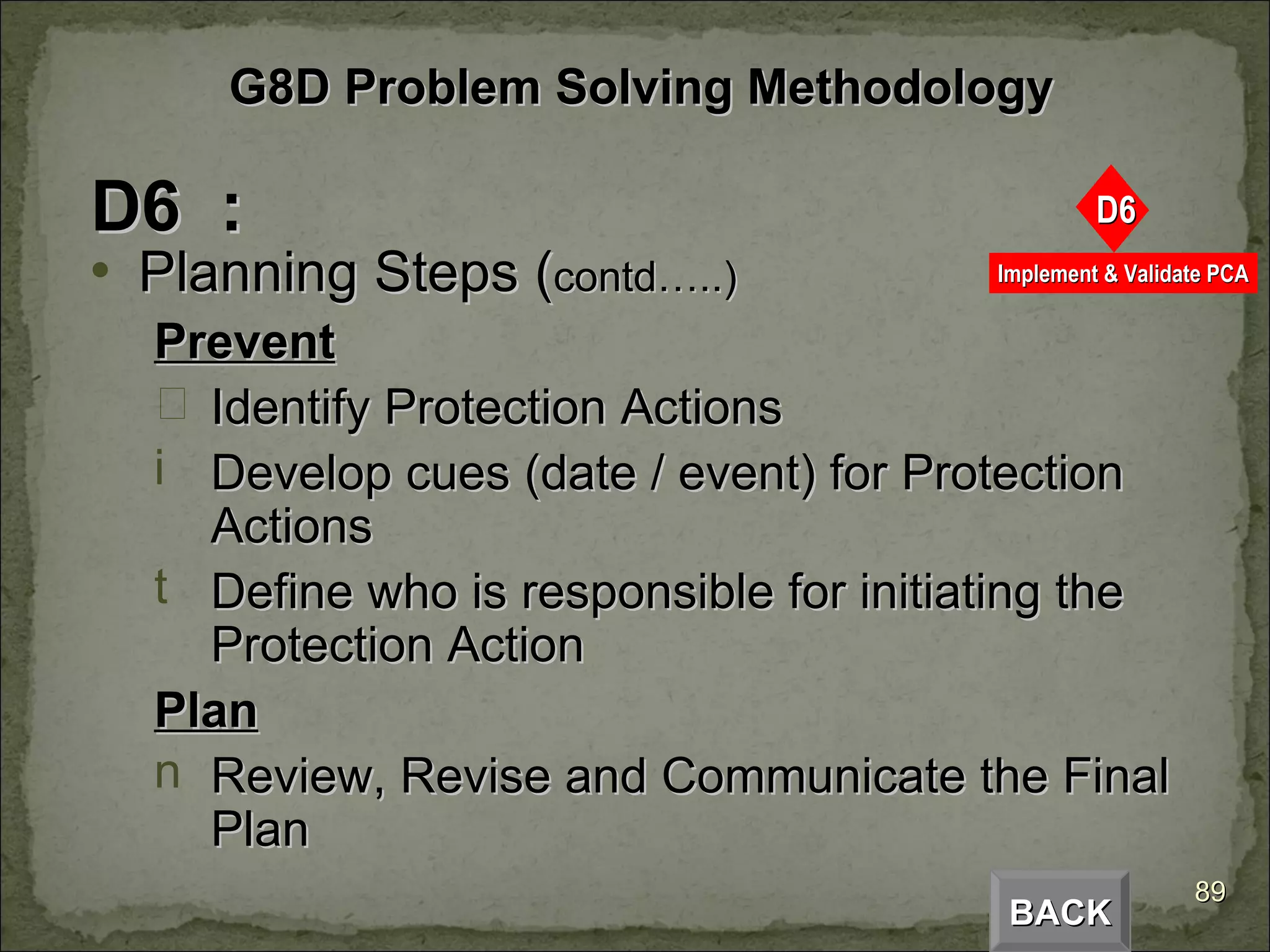
D6  : Planning Steps ( contd…..) Prevent Identify Protection Actions Develop cues (date / event) for Protection Actions Define who is responsible for initiating the Protection Action Plan Review, Revise and Communicate the Final Plan BACK G8D Problem Solving Methodology
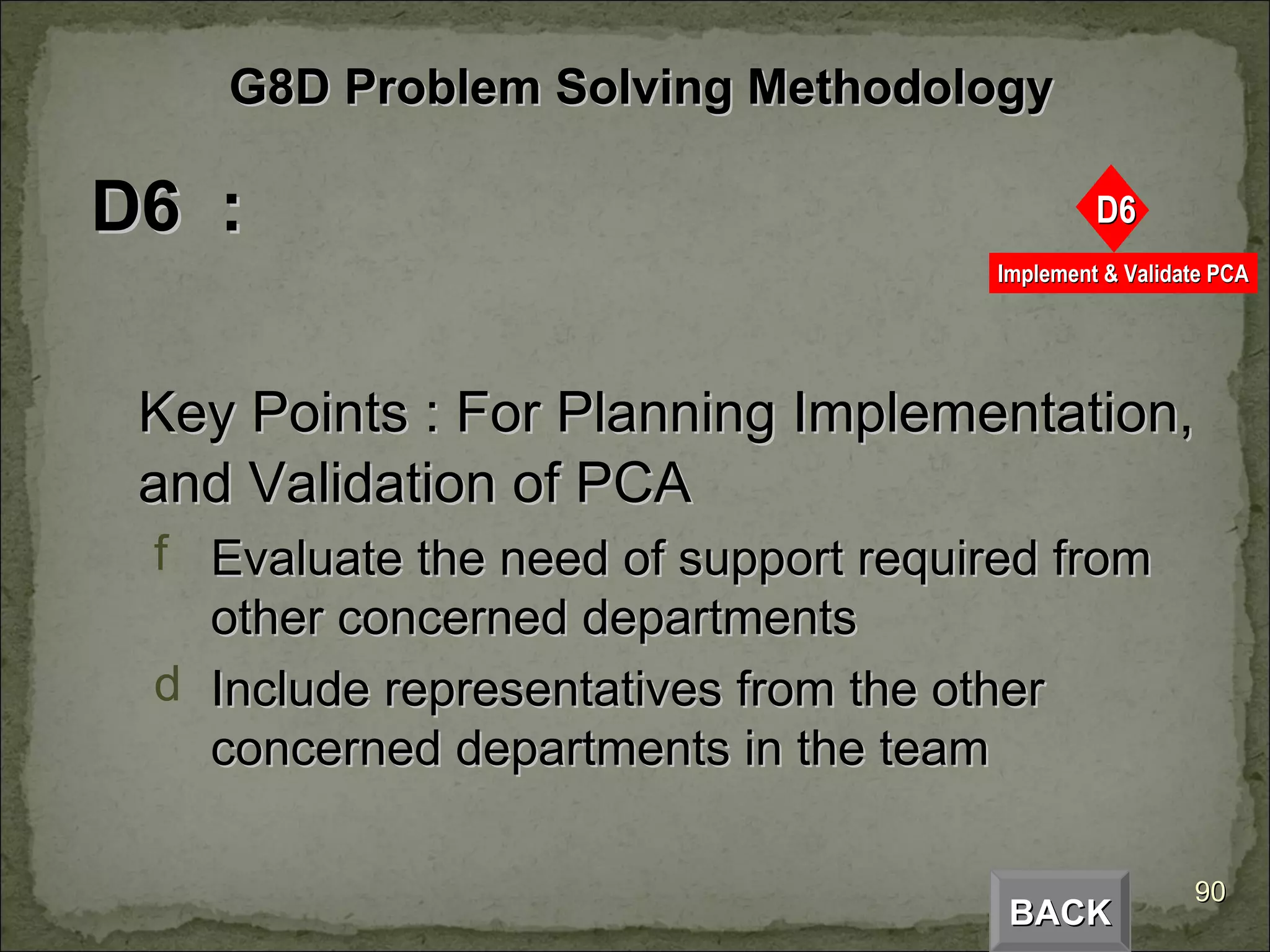
D6  :  Key Points : For Planning Implementation, and Validation of PCA Evaluate the need of support required from other concerned departments Include representatives from the other concerned departments in the team  BACK G8D Problem Solving Methodology
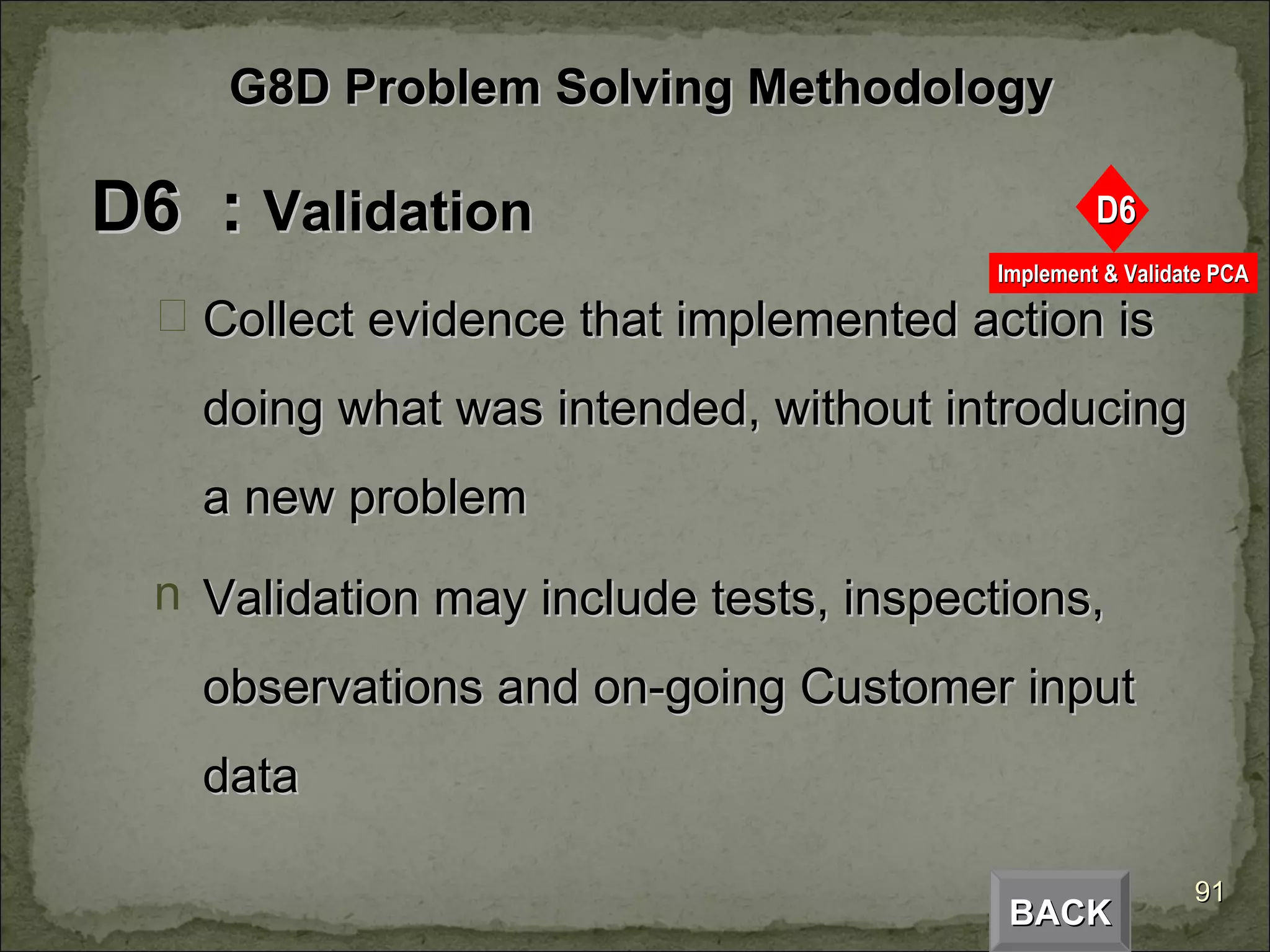
D6  :  Validation Collect evidence that implemented action is doing what was intended, without introducing a new problem Validation may include tests, inspections, observations and on-going Customer input data BACK G8D Problem Solving Methodology
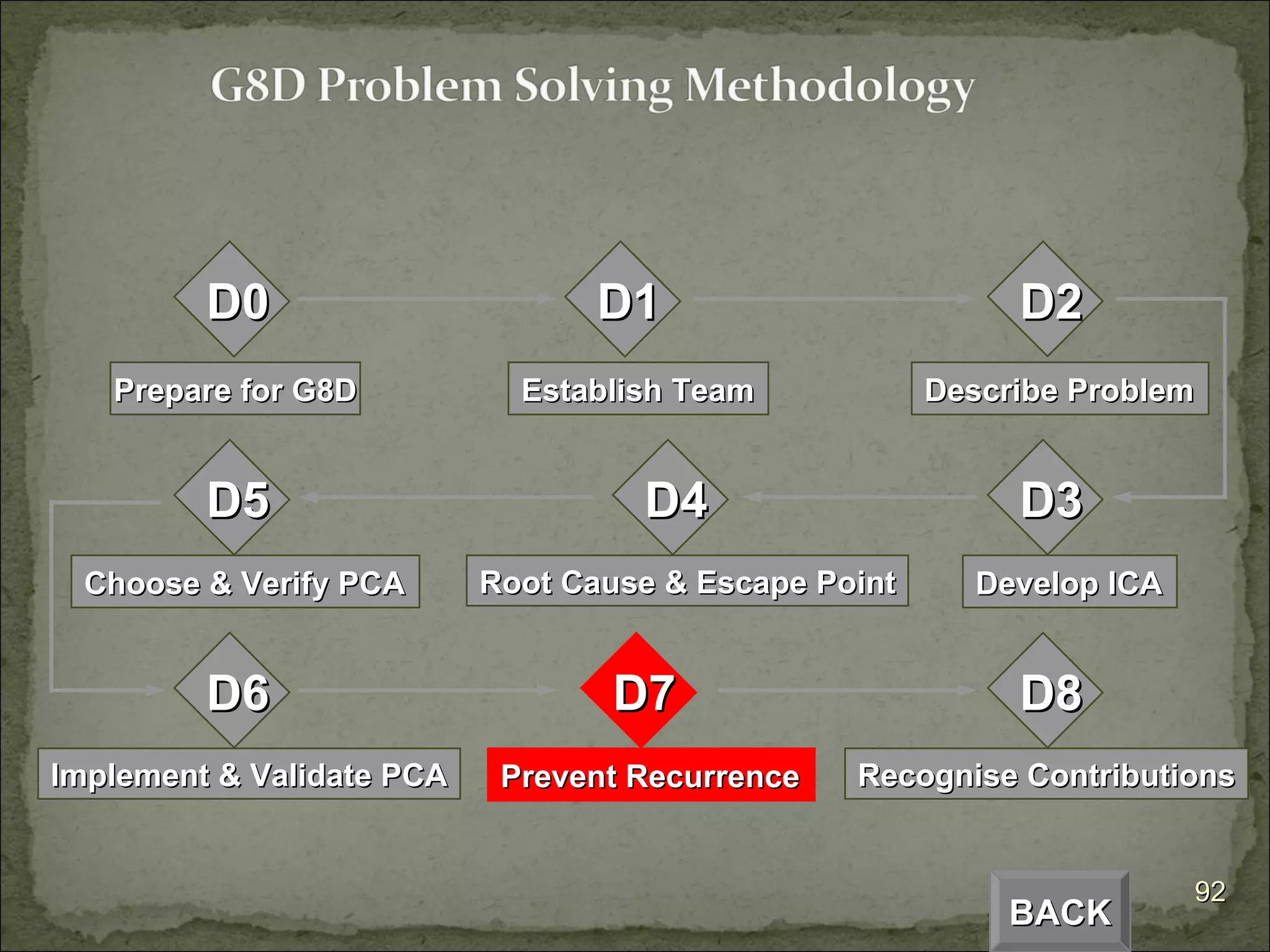
BACK D7 Prevent Recurrence D5 Choose & Verify PCA D3 Develop ICA D2 Describe Problem D1 Establish Team D4 Root Cause & Escape Point D6 Implement & Validate PCA D8 Recognise Contributions D0 Prepare for G8D
BACK
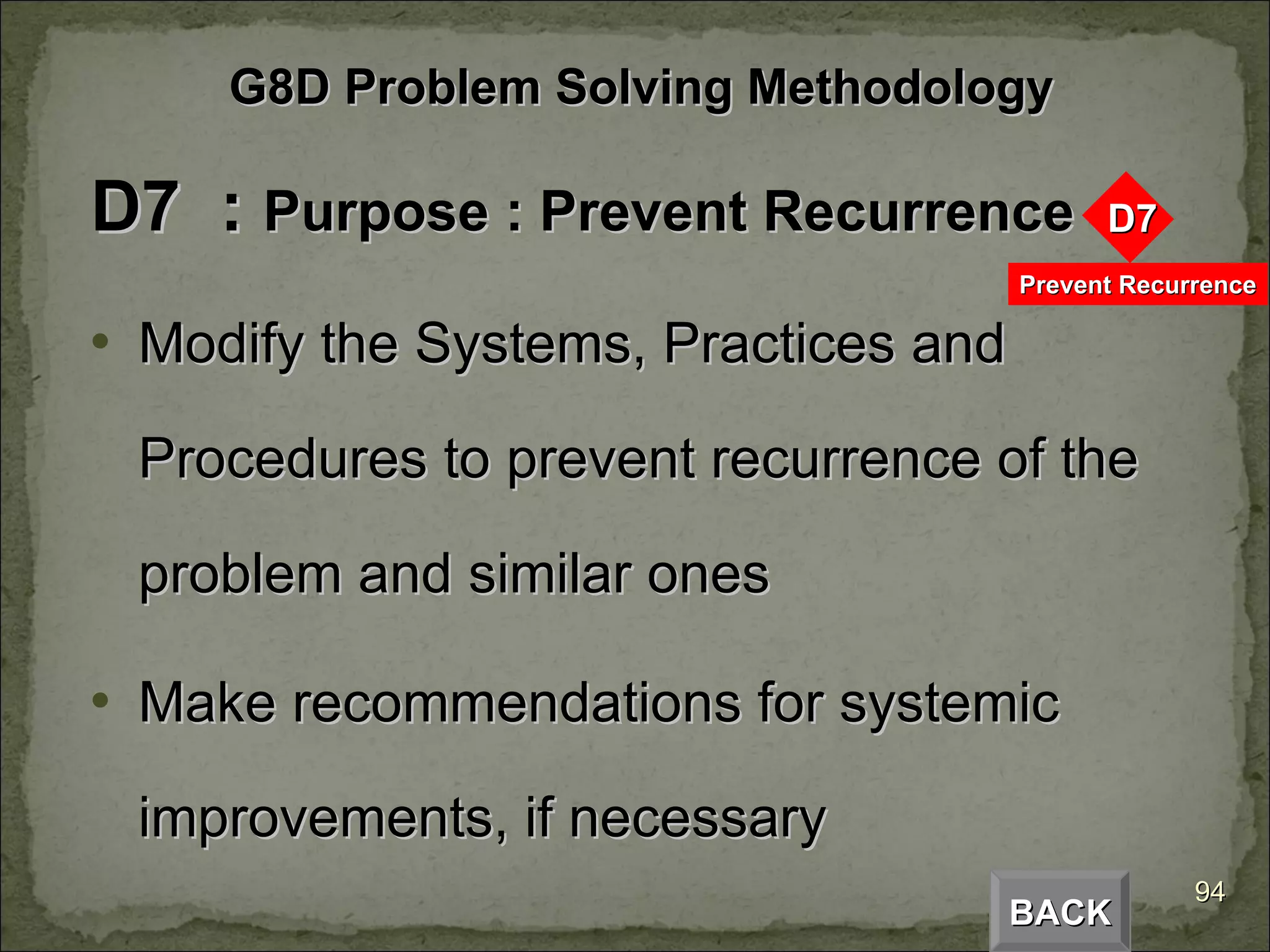
D7  :  Purpose : Prevent Recurrence Modify the Systems, Practices and Procedures to prevent recurrence of the problem and similar ones Make recommendations for systemic improvements, if necessary BACK G8D Problem Solving Methodology
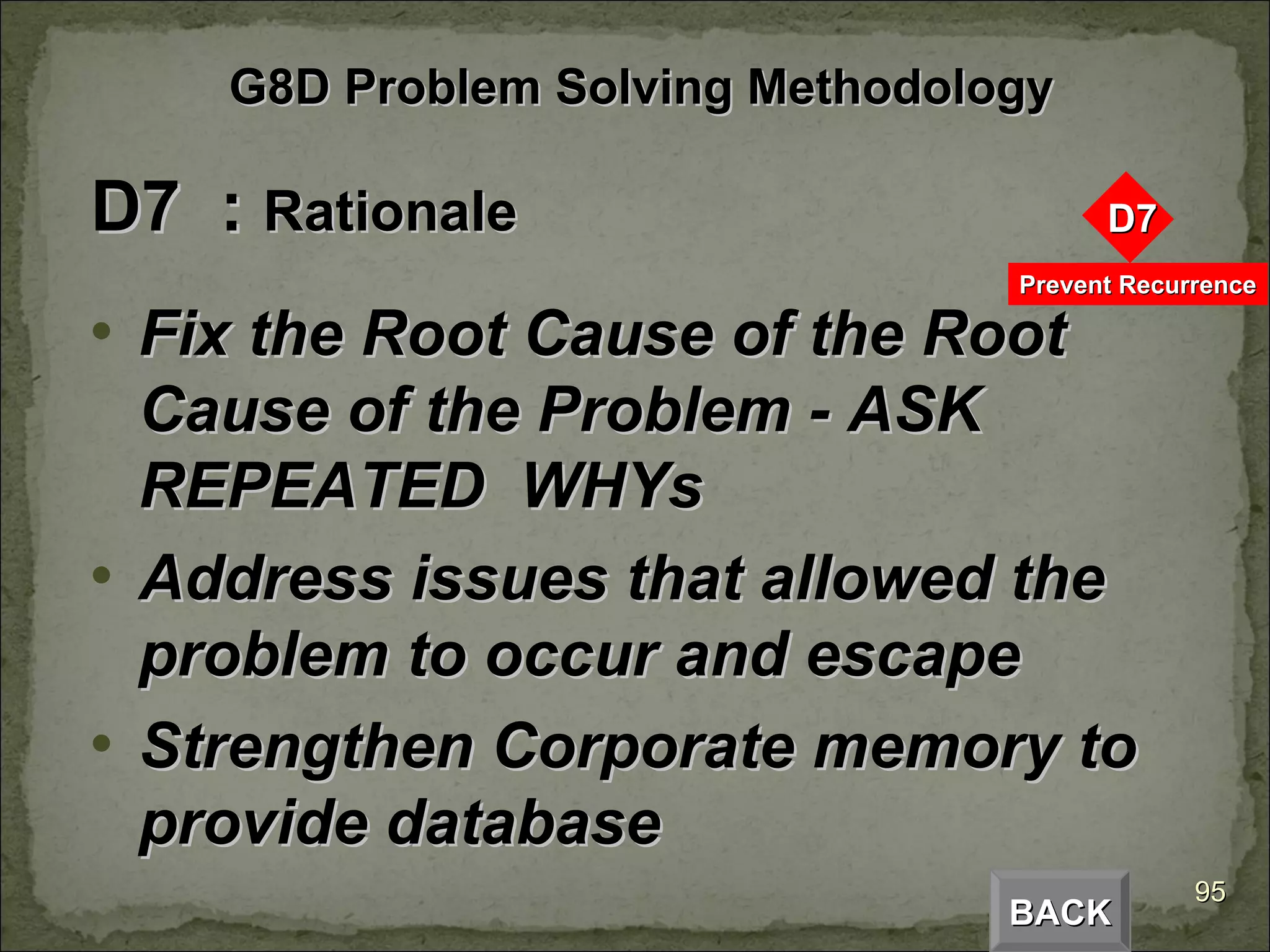
D7  :  Rationale Fix the Root Cause of the Root Cause of the Problem - ASK  REPEATED  WHYs Address issues that allowed the problem to occur and escape Strengthen Corporate memory to provide database BACK G8D Problem Solving Methodology
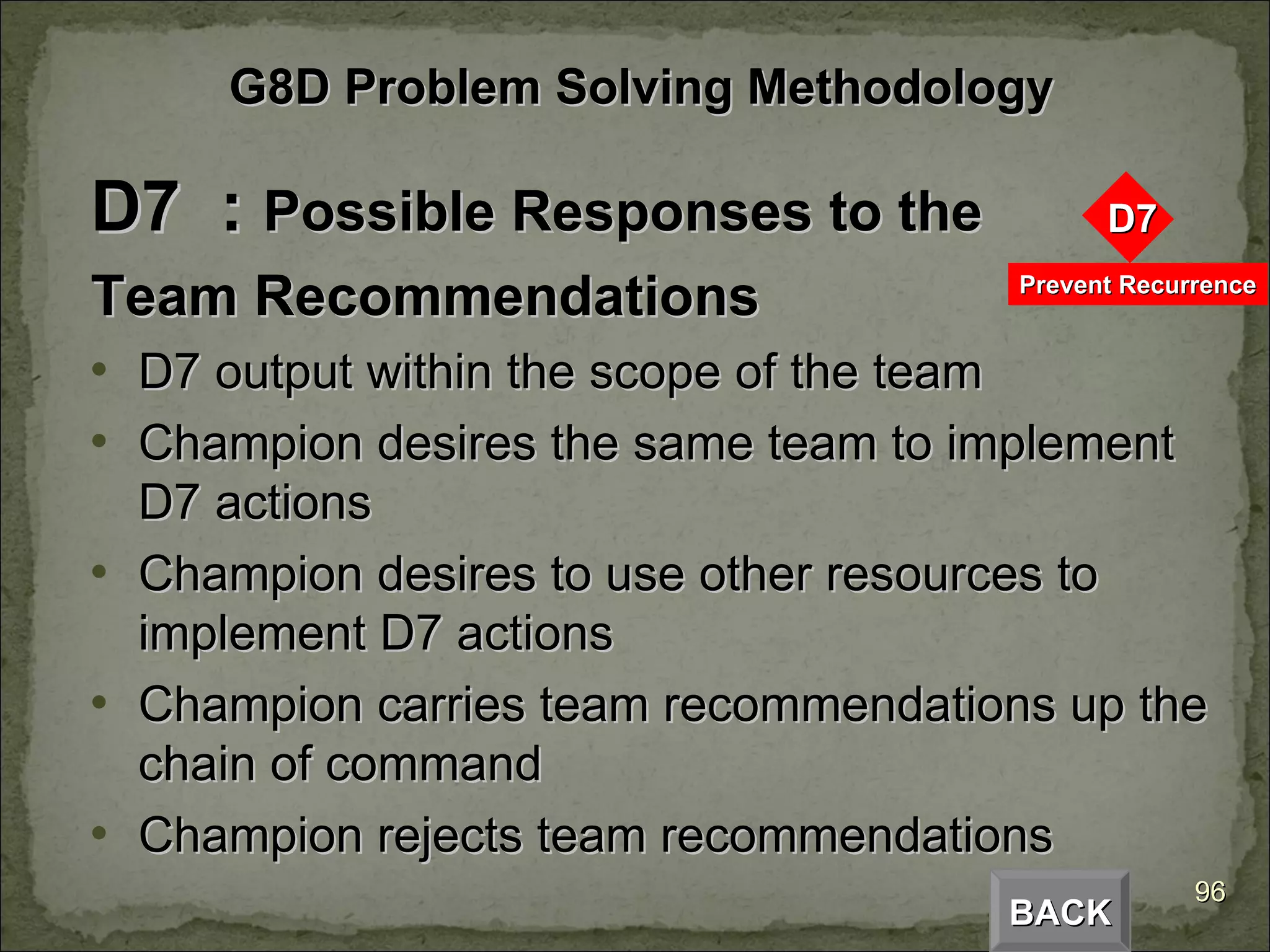
D7  :  Possible Responses to the Team Recommendations D7 output within the scope of the team Champion desires the same team to implement D7 actions Champion desires to use other resources to implement D7 actions Champion carries team recommendations up the chain of command Champion rejects team recommendations BACK G8D Problem Solving Methodology
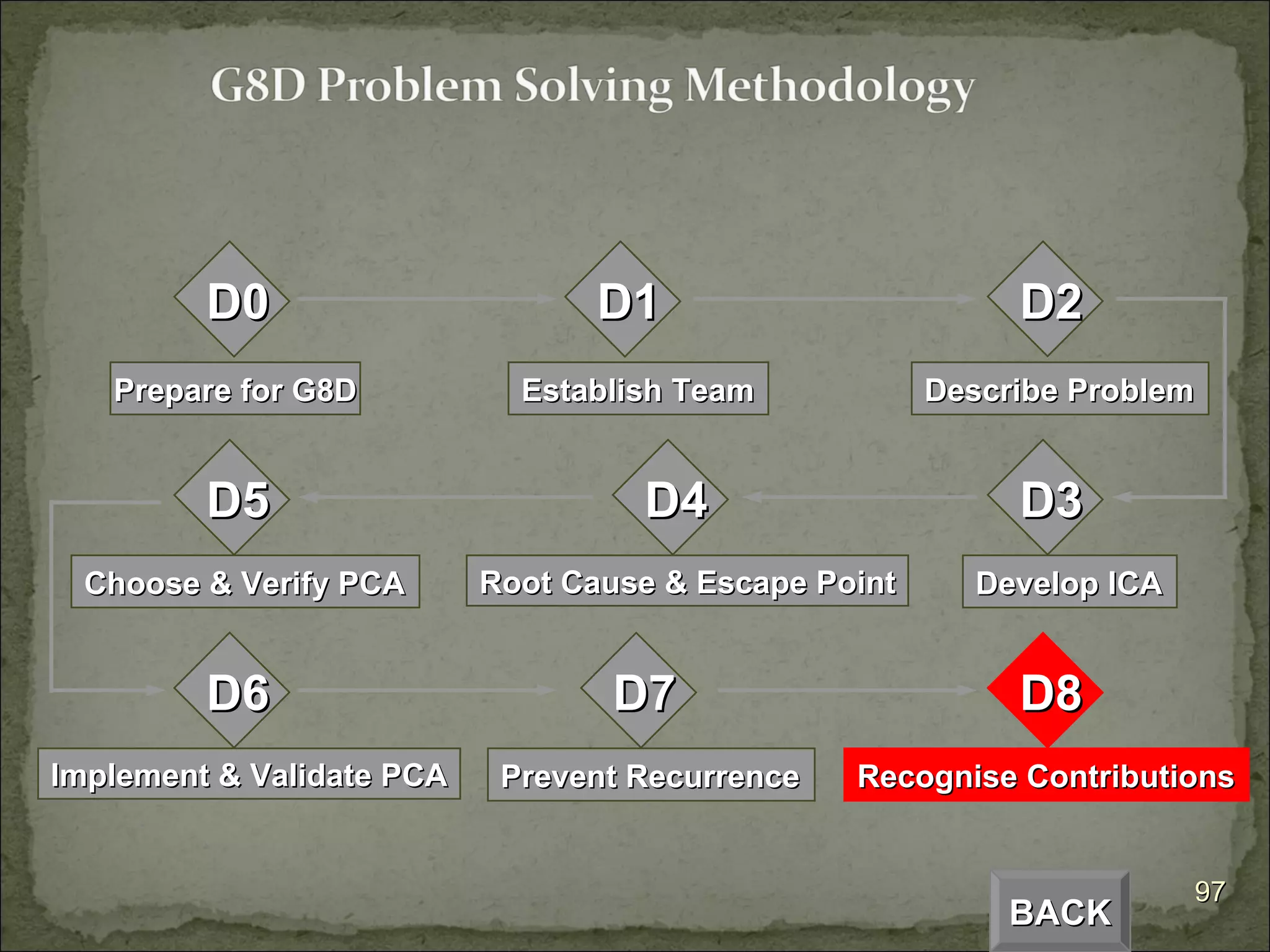
BACK D8 Recognise Contributions D5 Choose & Verify PCA D3 Develop ICA D2 Describe Problem D1 Establish Team D4 Root Cause & Escape Point D6 Implement & Validate PCA D7 Prevent Recurrence D0 Prepare for G8D
BACK
D8  :  Purpose : Recognise Contributions Finish unfinished Business Activities before disbanding the team Recognise Contributions of the Team Individuals Others outside the team Celebrate  BACK G8D Problem Solving Methodology
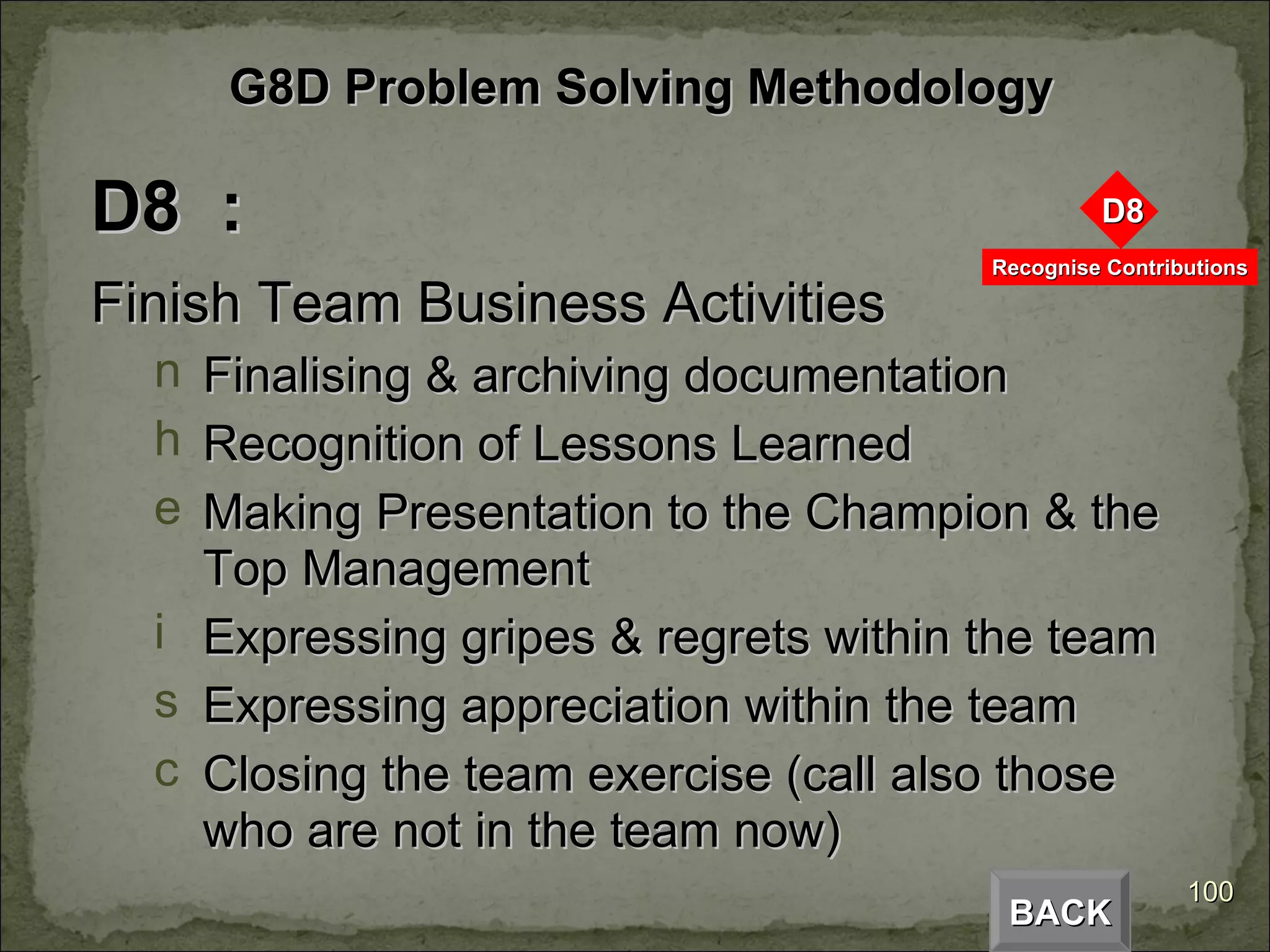
D8  : Finish Team Business Activities Finalising & archiving documentation Recognition of Lessons Learned Making Presentation to the Champion & the Top Management Expressing gripes & regrets within the team Expressing appreciation within the team Closing the team exercise (call also those who are not in the team now) BACK G8D Problem Solving Methodology
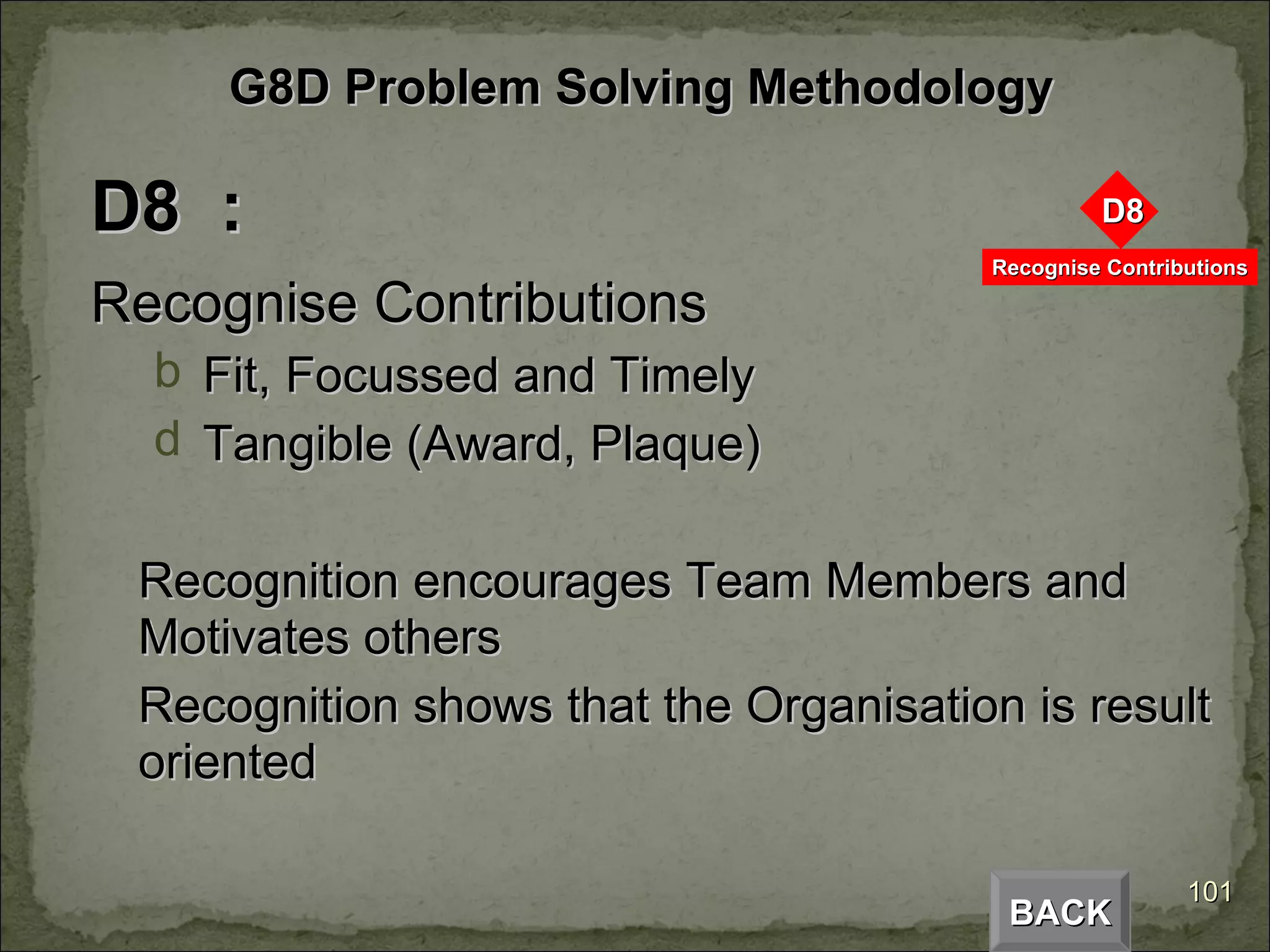
D8  : Recognise Contributions Fit, Focussed and Timely Tangible (Award, Plaque) Recognition encourages Team Members and Motivates others Recognition shows that the Organisation is result oriented BACK G8D Problem Solving Methodology
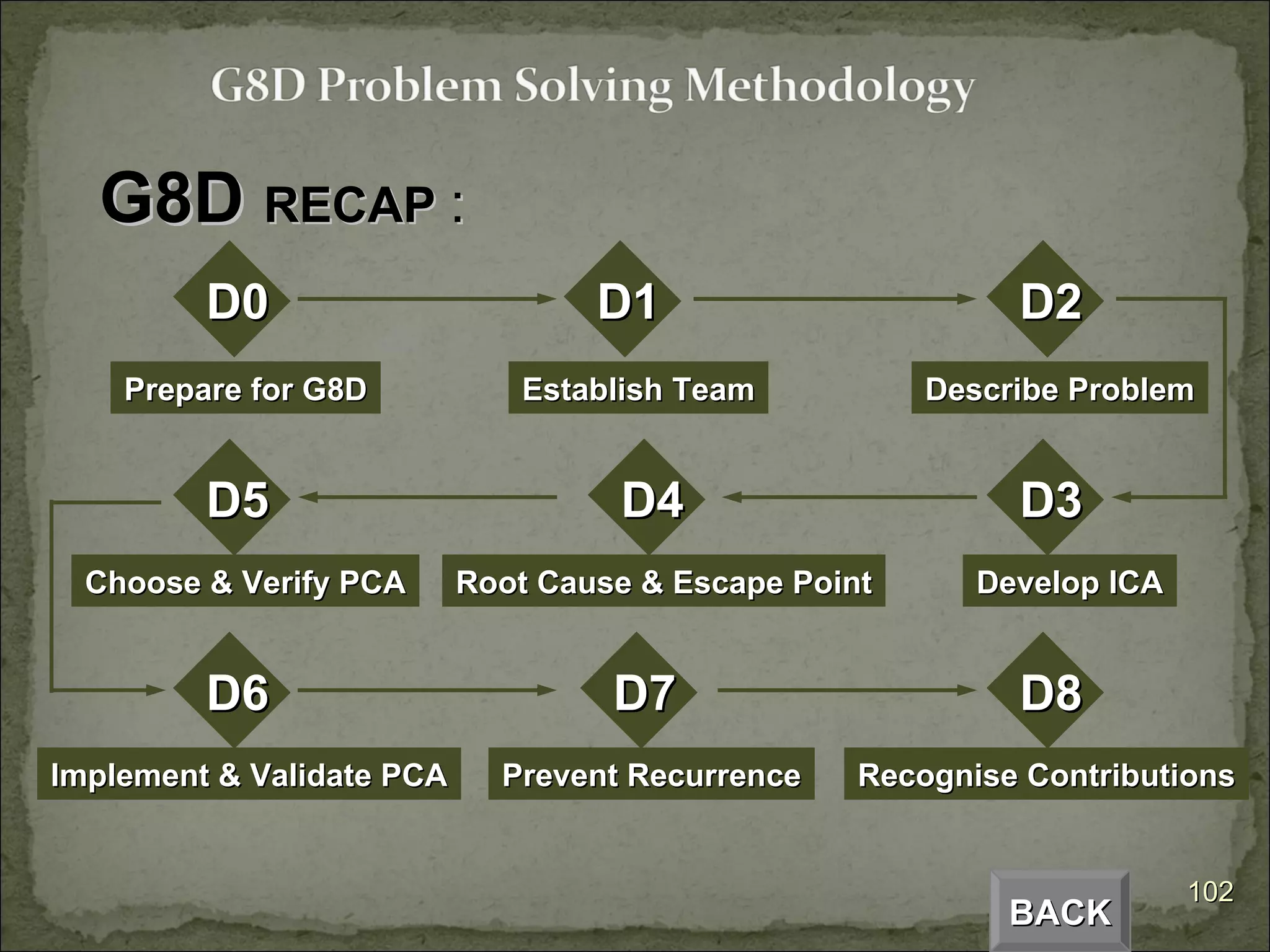
G8D  RECAP  : Prepare for G8D Establish Team Describe Problem Choose & Verify PCA Root Cause & Escape Point Develop ICA Implement & Validate PCA Prevent Recurrence Recognise Contributions BACK D0 D1 D2 D5 D4 D3 D6 D7 D8
ANY QUESTIONS BACK G8D Problem Solving Methodology

Presentation On G8D

  • 1.
  • 2.
    Welcome tothis overview session on Global 8D….. The session will provide you, Necessary analytical and procedural description about G8D Necessary inputs to participate in the concern resolution process using G8D BACK
  • 3.
    A primary responsibilityof every level of an Organisation is to solve problems. Rarely easy, this has been recognised as essential but challenging work. Disciplined and rigorous use of the G8D process within a robust Quality Operating System manages the overall problem solving efforts of an Organisation. - QP&L, FAO BACK
  • 4.
    Problems in ProblemSolving : Management Impatient leading to Quick fixes are appreciated Incorrect description of the problem Illogical prioritisation Poor team participation Possible causes become root causes Corrective actions are not permanent No / incomplete documentation and storage, hence Corporate Memory starves BACK
  • 5.
    BACK Global 8D is a Standardised Problem Solving Technique used by FAO that provides an effective framework through step-by-step disciplines and integration of different skills, to resolve concerns and prevent their recurrence.
  • 6.
    G8D Overview : Prepare for G8D Establish Team Describe Problem Choose & Verify PCA Root Cause & Escape Point Develop ICA Implement & Validate PCA Prevent Recurrence Recognise Contributions BACK D0 D1 D2 D5 D4 D3 D6 D7 D8
  • 7.
    G8D hasbeen proven over time and supports the Ford 2000 Seven Strategies Empowered People to implement corrective actions, prevent recurrence through right people with right skills at the right time Nimble through Process Leadership : A standard process, hence, global communication is faster, Corporate Memory avoids duplication, helps with replication & assistance facilities for faster and effective problem solving Lead in Customer Satisfaction : Customer protected throughout the problem solving process - ERA / ICA, Concern Definition, Verification & Validation BACK
  • 8.
    G8D addresses3 types of problem solving approaches Rational Approach : Fact & Data based People Approach : Team Work, Employee Involvement, Participative Management and Experience Sharing Creative Approach : Brain Storming, SIT, etc. BACK
  • 9.
    G8D tasksto be carried out throughout the resolution process Common Tasks : Document changes Review Team Review Measurables Determine if any additional action / service is required Address & review the Assessing Questions Update G8D format(s) BACK
  • 10.
    Assessing Questions - Purpose Keep the team and the champion linked, on task and in agreement Provide Quality Assurance Check for each discipline Serve as an advance organiser for planning activities and resources Trigger actions that need to be taking place in the organisation outside the G8D process BACK
  • 11.
    BACK D1 EstablishTeam D2 Describe Problem D5 Choose & Verify PCA D4 Root Cause & Escape Point D3 Develop ICA D6 Implement & Validate PCA D7 Prevent Recurrence D8 Recognise Contributions
  • 12.
  • 13.
    D0 : PURPOSE : Prepare for G8D In response to a Symptom, evaluate the need for the G8D process If necessary, provide Emergency Response Action to protect the Customer and initiate the G8D process BACK
  • 14.
    D0 : G8D Application Criteria The Symptom has been identified and quantified Customers / Affected Parties who experienced the symptom(s) have been identified Performance gaps exist between the symptoms and the desired and / or the priority of the symptom warrants initiation of G8D The Root Cause of the Concern is not known BACK
  • 15.
    D0 : G8D Application Criteria contd…. Symptom complexity exceeds the ability of one person to resolve the Problem The Concern (same or similar in nature) was not resolved in the past The Management is committed to dedicate the necessary resources to fix the problem at the root-cause level and prevent its recurrence BACK
  • 16.
    D0 : G8D Application Criteria contd…. G8D can be applied to ‘Change Induced Situation’ as well as to ‘Never Been There Situation’ BACK
  • 17.
    BACK D1 EstablishTeam D2 Describe Problem D5 Choose & Verify PCA D4 Root Cause & Escape Point D3 Develop ICA D6 Implement & Validate PCA D7 Prevent Recurrence D8 Recognise Contributions D0 Prepare for G8D
  • 18.
  • 19.
    D1 : Purpose : Form TEAM Establish a small group of people with required product / process knowledge allocated time authority requisite technical skills in respective discipline(s) to solve the problem(s) and implement corrective action(s) BACK
  • 20.
    D1 : The ‘TEAM’ Process Composition / Membership a good mix of members with technical skills required for concern resolution size should be limited between four & ten members membership need not be constant throughout and should change according to the stage within the concern resolution process BACK
  • 21.
    D1 : The ‘TEAM’ Process contd….. Team Functions Champion Leader Facilitator Time Manager Scribe Recorder BACK
  • 22.
    D1 : The ‘TEAM’ Process contd….. TEAM Meetings : The 3 phases through which any TEAM meeting should go through are, TASKS OBSERVATIONS MAINTENANCE BACK
  • 23.
    D1 : The ‘TEAM’ Process contd….. TEAM Meetings (contd…) : Task is the Business Plan. Any agenda item that addresses business occurs in the Task phase. e.g. information, decision, solution, etc. Maintenance involves recognition of feelings that affect TEAM process and addressing them. e.g. attention, respect, sense of belonging, etc. Observation relates to dynamics of the meeting & guiding back into the Meeting Process Phase. e.g. cautioning about ‘time’, ‘one at a time’, 'your attention please’, etc. BACK
  • 24.
    D1 : The ‘TEAM’ Process contd….. TEAM Operating Procedures : Adopting roles assists the TEAM making guidelines for any TEAM meeting follow meeting time disciplines, meet agenda requirements perform roles - share process oriented roles (Facilitator, Time Manager) complete homework - come prepared and do tasks between meetings BACK
  • 25.
    D1 : The ‘TEAM’ Process contd….. TEAM Operating Procedures (contd…) : do not offer opinions, trace them to observations restate and build on proposals BACK
  • 26.
    BACK D2 DescribeProblem D1 Establish Team D5 Choose & Verify PCA D4 Root Cause & Escape Point D3 Develop ICA D6 Implement & Validate PCA D7 Prevent Recurrence D8 Recognise Contributions D0 Prepare for G8D
  • 27.
  • 28.
    D2 : Purpose : Describe Problem Describe internal / external problem by identifying ‘what is wrong with what’ detailing the problem in quantifiable terms “ The Goal is to translate Customer’s Symptoms into a Problem Statement and Problem Description” BACK
  • 29.
    D2 : Function The function of D2 is to identify the Object and the Defect describe the problem based on data and observations define the problem as accurately as possible drive the rest of the G8D process based on this problem definition BACK
  • 30.
    D2 WhyDefine the Problem ??? Any vagueness or inaccuracy at D2 will lead the team to wrong cause followed by a wrong corrective action Reexamination of facts is extremely difficult, once conclusion(s) is/are drawn BACK
  • 31.
    D2 : Problem Statement to Problem Description Problem Statement Problem Description BACK
  • 32.
    D2 : Problem Statement contd….. Development Step 1 : identify the ‘object’ and the ‘defect’ by asking “WHAT IS WRONG WITH WHAT” ‘ what is wrong….’ is the defect ‘… .with what’ is the object Step 2 : after establishing the object and the defect, ask “WHY IS THAT HAPPENING” BACK
  • 33.
    D2 : Problem Statement contd….. Development (contd…) Step 2 : Continue asking WHY until there is no certain answer. WHY excludes illogical possibilities Refine the statement to get as near as possible to the root cause using the existing data Devise the problem statement following the above steps based on ‘object - defect - certain reason’ BACK
  • 34.
    D2 : Problem Statement contd….. Development (contd…) In case of complex problems (with multiple defect / multiple root causes) Separate : Symptoms are broken down and subdivided according to complexity Prioritise : Pareto Charts are used to identify problems that create difficulties with highest frequency. Certain other criteria also can be used such as severity, urgency based on Customer Inputs BACK
  • 35.
    D2 : Problem Description Problem Description narrows down the search for concern resolution Provide information on What the problem is and what it is not, but could be Where the problem is and where it is not, but could be When the problem occurs and when it does not, but could How big the problem is and how big it is not, but could be BACK
  • 36.
    BACK D3 DevelopICA D2 Describe Problem D1 Establish Team D5 Choose & Verify PCA D4 Root Cause & Escape Point D6 Implement & Validate PCA D7 Prevent Recurrence D8 Recognise Contributions D0 Prepare for G8D
  • 37.
  • 38.
    D3 : Purpose : Develop ICA Define, Verify, Validate and Implement Interim Containment Action (ICA) to isolate the effects of the problem from any internal / external customer & affected party until a Permanent Corrective Action (PCA) is implemented BACK
  • 39.
    D3 : D3 is the only optional Step in G8D The rationale is to, ‘ buy time’ to identify the root cause further protect the Customer from the effects of the problem contain the problem from cost, performance & time perspective BACK
  • 40.
    D3 : What is an ICA ??? Improved derivation of an ERA but must not create other problem downstream Unlike ERA, an ICA is chosen after preliminary investigation and data collection in D2 (effective ICA makes ‘Is’ from ‘Is / Is Not’ Analysis go away) Requires continuous monitoring for effectiveness Adds costs BACK
  • 41.
    D3 : Activities involved Verify and Validate ICA Develop an Action Plan for implementation & follow-up What - describe the action Who - responsibility of the action When - action completion time BACK
  • 42.
    BACK D4 RootCause & Escape Point D3 Develop ICA D2 Describe Problem D1 Establish Team D5 Choose & Verify PCA D6 Implement & Validate PCA D7 Prevent Recurrence D8 Recognise Contributions D0 Prepare for G8D
  • 43.
  • 44.
    D4 : Purpose : Root Cause and Escape Point Isolate and verify the root cause by testing each Root Cause Theory against the Problem Description and Test Data Isolate and Verify the place in the process where the effects of the Root Cause could have been detected and contained, but was not (Escape Point) BACK
  • 45.
    D4 :Identify the Most Likely Cause of the Problem Identify the Escape Point of the problem Verify Root Cause and Escape Point of the Problem BACK
  • 46.
    D4 : Determining Root Cause In cases ‘change induced’ systems (when the desired and the actual were same but are now different), the Root Cause will be a CHANGE of some type. Anchor the search based on the thorough defect profile built around the Problem Statement & Problem Description BACK
  • 47.
    D4 : Determining Root Cause contd….. Arriving at a Root Cause will be based on deductive logics A series of questions that yield answers, to which another question is applied The result is a steady reduction of the number of possible causes to be investigated Two Methods can be applied BACK
  • 48.
    D4 : Determining Root Cause contd….. Method ‘A Method ‘B’ 1. Problem Statement 1. Problem Statement 2. Problem Description 2. Problem Description 3. List changes over time 3a. List differences 3b. List changes in differences 4. Develop theories based 4. Develop theories based on changes on changes 5. Trial run Theories 5. Trial run Theories 6. Verify most likely cause 6. Verify most likely cause BACK
  • 49.
    D4 : Determining Root Cause contd….. The Problem solver can use a series of questions to gather information, as this information, though useful, is not considered significant by the one who have it. STEP 1 : Develop Problem Statement What is wrong with what BACK
  • 50.
    D4 : Determining Root Cause contd….. STEP 2 : Develop Problem Description What ……. Is / Is Not the defect Where ……. Is / Is Not the defect When ……. Is / Is Not the defect How big ……. Is / Is Not the defect BACK
  • 51.
    D4 : Determining Root Cause contd….. STEP 3 (Method ‘A’) : List all changes on a time line What is unique, peculiar, different, distinctive and unusual about ‘Is’ consider features such as people, methods, material, machines and environment BACK
  • 52.
    D4 : Determining Root Cause contd….. STEP 3a (Method ‘B’) : List Differences Same as Step 3 of Method ‘A’ STEP 3b (Method ‘B’) : List Changes in Differences What has changed ‘in’, ‘on’, ‘around’ or ‘about’ this difference consider features such as people, methods, material, machines and environment BACK
  • 53.
    D4 : Determining Root Cause contd….. STEP 4 : Develop Root Cause Theories based on Changes In what ways might this change create the defect on the object OR How could this change create the defect on the object During this step be specific and avoid using terms like ‘out of specs’, ‘poor quality’, etc. BACK
  • 54.
    D4 : Determining Root Cause contd….. STEP 5 : Trial Run the theories using Test Matrix Does this ‘change how’ theory completely explain ‘Is’ as well as ‘Is Not’ Explains Fully : If the data explains fully why the effect manifests itself in the ‘Is’ dimension but never manifests itself in the ‘Is Not’ dimension, then a plus (+) symbol should be entered in the Test Matrix for that element. THIS THEORY FULLY EXPLAINS THE ELEMENT BACK
  • 55.
    D4 : Determining Root Cause contd….. Cannot Explain : If the data cannot explain why the effect manifests itself in the ‘Is’ dimension and / or never manifests itself in the ‘Is Not’ dimension, then a minus (-) symbol should be entered in the Test Matrix for that element. THIS THEORY DEFINITELY DOES NOT EXPLAIN THIS ELEMENT AND THEREFORE CANNOT BE THE CAUSE BACK
  • 56.
    D4 : Determining Root Cause contd….. Insufficient Data : If the theory could explain the effect but there are insufficient data to explain fully why the effect manifests itself in the ‘Is’ dimension and / or never manifests itself in the ‘Is Not’ dimension, then a question mark (?) symbol should be entered in the Test Matrix for that element and a comment added at that point to indicate the further data collection / analysis required. THIS THEORY COULD EXPLAIN THIS ELEMENT ELEMENT BUT MORE DATA / ANALYSIS ARE REQUIRED BACK
  • 57.
    D4 : Determining Root Cause contd….. Insufficient Data (contd…) : In practice, particularly when multiple root causes are considered, more than one theory may pass the trial run with a combination of pluses and question marks. In such cases, and where it is feasible and practical, collect and analyse the missing data and reexamine the theory to resolve the question marks to either pluses or minuses. Else, proceed to Step 6, starting with the theory with most pluses. BACK
  • 58.
    D4 : Determining Root Cause contd….. STEP 6 : Verify Most Likely Cause Verification has to be done in the real world and not on a problem solving form Verification is either Passive (done by observation) or Active (make the defect come & go) BACK
  • 59.
    D4 : Determining Root Cause contd….. STEP 7 : Acknowledge the Root Cause Confirmed root cause is then acknowledged as the as the Root Cause BACK
  • 60.
    D4 : Determining Root Cause contd….. For ‘never been there’ situation, there is a need for process or design change as the product / service is functioning normal but the customers or management seeks a higher performance. As there is no root cause that created the effect, uncovering differences unique to the ‘Is’ when compared to the corresponding ‘Is Not’ may help in developing a theory to create desired improvement BACK
  • 61.
    D4 : Escape Point Concepts Determine where in the process the root cause could have been detected, but was not. Review the Control System and the Control Point BACK
  • 62.
    BACK D5 Choose& Verify PCA D4 Root Cause & Escape Point D3 Develop ICA D2 Describe Problem D1 Establish Team D6 Implement & Validate PCA D7 Prevent Recurrence D8 Recognise Contributions D0 Prepare for G8D
  • 63.
  • 64.
    D5 : Purpose : Choose Verify PCA Select the best Permanent Corrective Action (PCA) to eliminate Root Cause Select the best Permanent Corrective Action (PCA) to address the Escape Point Verify that both the decisions will demonstrate success when implemented and not cause any other undesirable effect BACK
  • 65.
    D5 : Decision Making Decision Making can be done by Unilateral : Autocratic approach Polling : Democratic way, where every one is involved, however, can result in a wrong decision based on majority psychology Compromise : Compromise can reduce conflict and allow everyone to be heard. Necessary when results are not achieved BACK
  • 66.
    D5 : Decision Making contd….. Prioritisation : Rational process that weighs the pros & cons. Though time consuming, it allows for several courses of alternatives. Criteria can be based on nature of situation which can influence decision Consensus : 70% approval and 100% support Most powerful method for the TEAM process (agreement, force, support, etc.) BACK
  • 67.
    D5 : Decision Making contd….. Weighting : Decisions reached analytically through assigning weightages to various alternatives Judgement : Alternatives offered for reviews to the subject matter experts BACK
  • 68.
    D5 : Decision Making contd….. Weighting : Decision Making Process Describe the end result List the Decision Criteria Decide the relative importance of the wants Identify Choices Compare choices against decision criteria Analyse the risks Make a full balanced choice BACK
  • 69.
    D5 : Decision Making contd….. Describe the End Result : WHAT : End result is brief statement that describes the desired outcome of the decision WHY : End result is identified in order to define the scope of the decision and provide a focus HOW : Describe the end result by identifying an action and an object BACK
  • 70.
    D5 : Decision Making contd….. Weighting : Decision Making Process Describe the end result List the Decision Criteria Decide the relative importance of the wants Identify Choices Compare choices against decision criteria Analyse the risks Make a full balanced choice BACK G8D Problem Solving Methodology
  • 71.
    D5 : Decision Making contd….. List the Decision Criteria : GIVENS : These are objectively measurable, non-negotiable, realistic features of the decision. Givens are the constraints (minimum criteria) and are used as filters. Givens often concern money, deadlines, company procedures, legislations, etc. WANTS : These are desirable (as opposed to essentials) features of the decision and enable to determine which remaining choices are preferable BACK
  • 72.
    D5 : Decision Making contd….. Weighting : Decision Making Process Describe the end result List the Decision Criteria Decide the relative importance of the wants Identify Choices Compare choices against decision criteria Analyse the risks Make a full balanced choice BACK G8D Problem Solving Methodology
  • 73.
    D5 : Decision Making contd….. Decide the Relative Importance of Wants WHAT : Wants have an importance relative to each other when considered against the end result WHY : The relative importance enables the performance of each available option to be evaluated that reflects its relative merit HOW : Rate on a 0 to 10 scale, with 10 points to the most important BACK
  • 74.
    D5 : Decision Making contd….. Weighting : Decision Making Process Describe the end result List the Decision Criteria Decide the relative importance of the wants Identify Choices Compare choices against decision criteria Analyse the risks Make a full balanced choice BACK G8D Problem Solving Methodology
  • 75.
    D5 : Decision Making contd….. Identify Choices WHAT : Generate a list of alternatives WHY : Generate choices to ensure a Quality Decision by having a range from which to choose HOW : Devised based on Team Experience, External Information, Subject Matter Experts, Educational Institutes, Literature, etc. BACK
  • 76.
    D5 : Decision Making contd….. Weighting : Decision Making Process Describe the end result List the Decision Criteria Decide the relative importance of the wants Identify Choices Compare choices against decision criteria Analyse the risks Make a full balanced choice BACK G8D Problem Solving Methodology
  • 77.
    D5 : Decision Making contd….. Compare choices against Decision Criteria : WHAT : Comparison allows evaluation of how well each choice meets the decision criteria in relative terms WHY : Make comparisons arrive at the most desirable HOW : Compare the choices against the GIVENs, using a go / no-go process BACK
  • 78.
    D5 : Decision Making contd….. Compare choices against Decision Criteria : HOW : Evaluate choices against WANTs. Rate each want on a 0 to 10 scale Multiply the ‘how good’ value of choice by the importance value of each want Total the scores for each choice BACK
  • 79.
    D5 : Decision Making contd….. Weighting : Decision Making Process Describe the end result List the Decision Criteria Decide the relative importance of the wants Identify Choices Compare choices against decision criteria Analyse the risks Make a full balanced choice BACK G8D Problem Solving Methodology
  • 80.
    D5 : Decision Making contd….. Analyse Risk : WHAT : Look at what can go wrong WHY : Examine if choices with big benefits have big risks HOW : Make a Risk Statement - ‘If (an event) happens then ….. will be the consequence Consider probability and seriousness, and ask ‘does the choice - just meets GIVENs ….. performs poorly against an important want BACK
  • 81.
    D5 : Decision Making contd….. Weighting : Decision Making Process Describe the end result List the Decision Criteria Decide the relative importance of the wants Identify Choices Compare choices against decision criteria Analyse the risks Make a full balanced choice BACK G8D Problem Solving Methodology
  • 82.
    D5 : Decision Making contd….. Make Best Balanced Choice : WHAT : A balanced choice must be based on information WHY : Confident that the balanced choice is the best choice possible HOW : Balance the Risks & Benefits BACK
  • 83.
    D5 : Verification Once the decision is made test it practically for feasibility in order to avoid an expensive failure include real world usage conditions examples of verification methods are test bed runs, road tests, production run, etc. BACK
  • 84.
    BACK D6 Implement& Validate PCA D4 Root Cause & Escape Point D3 Develop ICA D2 Describe Problem D1 Establish Team D5 Choose & Verify PCA D7 Prevent Recurrence D8 Recognise Contributions D0 Prepare for G8D
  • 85.
  • 86.
    D6 : Purpose : Implement and Validate PCA Plan and execute Implementation of the selected PCA Plan and execute Validation of the selected PCA Remove ICA Monitor Long Term Results BACK G8D Problem Solving Methodology
  • 87.
    D6 :Planning Steps ….. What could make anything go wrong What could be done to prevent it from creating trouble What needs to be done if it happens anyway Who needs to initiate Contingent Action What Information should tell him to proceed with contingency Actions BACK G8D Problem Solving Methodology
  • 88.
    D6 :Planning Steps ….. Plan State the Objective Identify Standards & Conditions to be met Identify the Action Plan Steps Prevent Identify Key Steps Identify Barriers Identify Prevention Actions BACK G8D Problem Solving Methodology
  • 89.
    D6 :Planning Steps ( contd…..) Prevent Identify Protection Actions Develop cues (date / event) for Protection Actions Define who is responsible for initiating the Protection Action Plan Review, Revise and Communicate the Final Plan BACK G8D Problem Solving Methodology
  • 90.
    D6 : Key Points : For Planning Implementation, and Validation of PCA Evaluate the need of support required from other concerned departments Include representatives from the other concerned departments in the team BACK G8D Problem Solving Methodology
  • 91.
    D6 : Validation Collect evidence that implemented action is doing what was intended, without introducing a new problem Validation may include tests, inspections, observations and on-going Customer input data BACK G8D Problem Solving Methodology
  • 92.
    BACK D7 PreventRecurrence D5 Choose & Verify PCA D3 Develop ICA D2 Describe Problem D1 Establish Team D4 Root Cause & Escape Point D6 Implement & Validate PCA D8 Recognise Contributions D0 Prepare for G8D
  • 93.
  • 94.
    D7 : Purpose : Prevent Recurrence Modify the Systems, Practices and Procedures to prevent recurrence of the problem and similar ones Make recommendations for systemic improvements, if necessary BACK G8D Problem Solving Methodology
  • 95.
    D7 : Rationale Fix the Root Cause of the Root Cause of the Problem - ASK REPEATED WHYs Address issues that allowed the problem to occur and escape Strengthen Corporate memory to provide database BACK G8D Problem Solving Methodology
  • 96.
    D7 : Possible Responses to the Team Recommendations D7 output within the scope of the team Champion desires the same team to implement D7 actions Champion desires to use other resources to implement D7 actions Champion carries team recommendations up the chain of command Champion rejects team recommendations BACK G8D Problem Solving Methodology
  • 97.
    BACK D8 RecogniseContributions D5 Choose & Verify PCA D3 Develop ICA D2 Describe Problem D1 Establish Team D4 Root Cause & Escape Point D6 Implement & Validate PCA D7 Prevent Recurrence D0 Prepare for G8D
  • 98.
  • 99.
    D8 : Purpose : Recognise Contributions Finish unfinished Business Activities before disbanding the team Recognise Contributions of the Team Individuals Others outside the team Celebrate BACK G8D Problem Solving Methodology
  • 100.
    D8 :Finish Team Business Activities Finalising & archiving documentation Recognition of Lessons Learned Making Presentation to the Champion & the Top Management Expressing gripes & regrets within the team Expressing appreciation within the team Closing the team exercise (call also those who are not in the team now) BACK G8D Problem Solving Methodology
  • 101.
    D8 :Recognise Contributions Fit, Focussed and Timely Tangible (Award, Plaque) Recognition encourages Team Members and Motivates others Recognition shows that the Organisation is result oriented BACK G8D Problem Solving Methodology
  • 102.
    G8D RECAP : Prepare for G8D Establish Team Describe Problem Choose & Verify PCA Root Cause & Escape Point Develop ICA Implement & Validate PCA Prevent Recurrence Recognise Contributions BACK D0 D1 D2 D5 D4 D3 D6 D7 D8
  • 103.
    ANY QUESTIONS BACKG8D Problem Solving Methodology