(C) The School of Continuous Improvement
1
Yellow Belt– Process improvement
Training and Certification Module
Disclaimer
(C) The School of Continuous Improvement
2
This Yellow Belt – Process Improvement Training and Certification program is being
offered free of charge to the interested individuals who wish to learn more about Process
Improvement.
Reproducing this module or distributing or selling it to achieve financial benefits will invite stringent
action under the concerned law of jurisdiction by the institution facilitating this module.
With the end-objective/ deliverable of identifying a process improvement opportunity in your
organization, read the module and have fun.
Of course, you would have an assessment at the end of the module based on which you would be certified.
Body of knowledge
(C) The School of Continuous Improvement
3
a. How to link strategic goals to process improvement initiatives
b. Introduction to Kaizen, PDCA, Lean and Six Sigma
c. Pre-requisites to process improvement
d. Key financial indicators
e. How to choose a process improvement approach
f. 7 QC Tools
(C) The School of Continuous Improvement
4
How to link strategic goals to
process improvement initiatives
Strategic goals to process improvement
(C) The School of Continuous Improvement
5
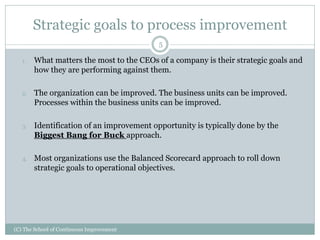
1. What matters the most to the CEOs of a company is their strategic goals and
how they are performing against them.
2. The organization can be improved. The business units can be improved.
Processes within the business units can be improved.
3. Identification of an improvement opportunity is typically done by the
Biggest Bang for Buck approach.
4. Most organizations use the Balanced Scorecard approach to roll down
strategic goals to operational objectives.
Balanced scorecard
(C) The School of Continuous Improvement
6
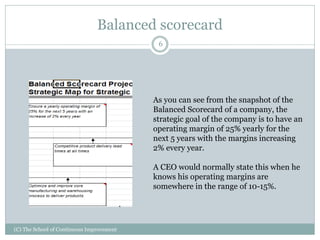
As you can see from the snapshot of the
Balanced Scorecard of a company, the
strategic goal of the company is to have an
operating margin of 25% yearly for the
next 5 years with the margins increasing
2% every year.
A CEO would normally state this when he
knows his operating margins are
somewhere in the range of 10-15%.
Balanced scorecard
(C) The School of Continuous Improvement
7
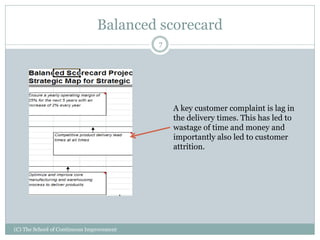
A key customer complaint is lag in
the delivery times. This has led to
wastage of time and money and
importantly also led to customer
attrition.
Balanced scorecard
(C) The School of Continuous Improvement
8
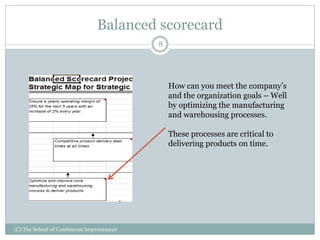
How can you meet the company’s
and the organization goals – Well
by optimizing the manufacturing
and warehousing processes.
These processes are critical to
delivering products on time.
Notes
(C) The School of Continuous Improvement
9
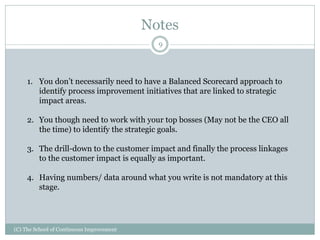
1. You don’t necessarily need to have a Balanced Scorecard approach to
identify process improvement initiatives that are linked to strategic
impact areas.
2. You though need to work with your top bosses (May not be the CEO all
the time) to identify the strategic goals.
3. The drill-down to the customer impact and finally the process linkages
to the customer impact is equally as important.
4. Having numbers/ data around what you write is not mandatory at this
stage.
(C) The School of Continuous Improvement
10
Introduction to Kaizen, 8D,
lean and six sigma
What is Business process improvement?
(C) The School of Continuous Improvement
11
1. Business Process Improvement is about improving the performance of an
operational metric from its historical state(As-is) to a new level (Future state).
2. This improvement can be slow and incremental or breakthrough.
3. Business processes are improved to impact strategic indices like:
a. COGS: Cost of Goods Sold
b. Customer Satisfaction
c. EBITDA: Earnings before Interest, Taxes, Depreciation and Amortization
d. COPQ
e. Operating Margins
(C) The School of Continuous Improvement
12
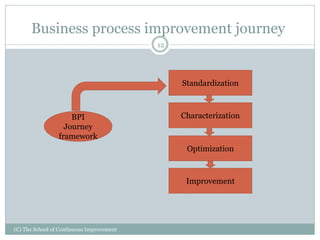
BPI
Journey
framework
Standardization
Characterization
Optimization
Improvement
Business process improvement journey
(C) The School of Continuous Improvement
13
Business process improvement journey
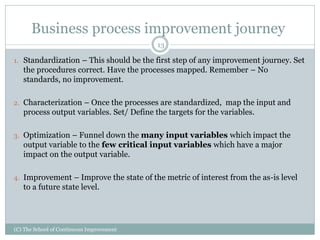
1. Standardization – This should be the first step of any improvement journey. Set
the procedures correct. Have the processes mapped. Remember – No
standards, no improvement.
2. Characterization – Once the processes are standardized, map the input and
process output variables. Set/ Define the targets for the variables.
3. Optimization – Funnel down the many input variables which impact the
output variable to the few critical input variables which have a major
impact on the output variable.
4. Improvement – Improve the state of the metric of interest from the as-is level
to a future state level.
Pre-requisites for business process improvement
(C) The School of Continuous Improvement
14
1. Top management buy-in is mandatory.
2. Processes should be standardized in documentation.
3. Data should be readily available from the process.
4. Trained resources.
5. Established communication channels
With these 5 basic pre-requisites, any one can improve a business process in an
organization.
Improvement and Innovation are two different things altogether. A Business
may want to innovate at first, or they may want to improve and then innovate.
Business process improvement approaches
(C) The School of Continuous Improvement
15
1. Global 8D: An easy to understand and an effective problem solving technique
used for complex problems.
2. Kaizen Blitz: An easy to deploy mechanism used for relatively simpler problems
intended to drive small improvements.
3. Theory of Constraints: A scientific approach to improvement that focuses on
the weakest link in the chain and looks at improving.
4. Lean Six Sigma: An interwoven set of approaches combining statistical tools
and techniques to help identify causes of variations and wastes in the process
and reduce them.
5. PDCA: Plan, Do, Check and Act is a reiterative process for improvements where
closing of one project drives another.
(C) The School of Continuous Improvement
16
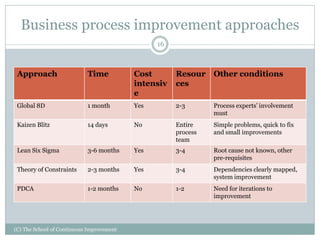
Approach Time Cost
intensiv
e
Resour
ces
Other conditions
Global 8D 1 month Yes 2-3 Process experts’ involvement
must
Kaizen Blitz 14 days No Entire
process
team
Simple problems, quick to fix
and small improvements
Lean Six Sigma 3-6 months Yes 3-4 Root cause not known, other
pre-requisites
Theory of Constraints 2-3 months Yes 3-4 Dependencies clearly mapped,
system improvement
PDCA 1-2 months No 1-2 Need for iterations to
improvement
Business process improvement approaches
Choosing the right bpi approach
(C) The School of Continuous Improvement
17
Answer the following questions in form of a check list and send to the
Trainer of the module to help understand how to choose the right
approach to the problem:
1. Does your organization want a quick fix to the problem?
2. Can your organization spend 1-2 hours/ resource for every resource for 2 weeks?
3. Does your organization care about long term improvement?
4. Do you want to improve the entire system or just one process in the organization?
5. Does your organization permit you spending 1-2 hours every day for 3-6 months on
process improvement work?
6. Does your organization believe in the principle of continuous improvement?
7. What is the Strength of your company and how many departments do you have?
8. Which sector does your company belong to (Services, Manufacturing)?
9. Which sub-sector does your company belong to (Warehousing, Distribution etc)?
Case Studies
(C) The School of Continuous Improvement
18
Example 1
An organization wanted to improve a key process metric Cycle time for products that it
had identified for improvement. Improving this metric was critical as the company had
relatively high cycle time resulting in customer waiting and some times also moving to
competitors.
The organization wanted a solution to the problem within a month as a temporary fix.
Once the “bleeding” stopped, the organization was also willing to invest resources to
improvement initiatives.
Which improvement initiative/ approach combination should the
organization choose to work with?
Case Studies
(C) The School of Continuous Improvement
19
Example 2
An organization wanted to improve the efficiency of its distribution system. This
distribution system involved taking in products from 6 different companies and
supplying it to the customers. The reasons for inefficiencies in the distribution system
were well known and the company had data to back up the reasons.
The company was in a very competitive sphere and wanted to reduce the inefficiencies,
which resulted in high cost of services provided resulting in lowering their profit margins.
The team had 50 FTE and the company was willing to allow 1 hour per day for every
resource for 2 weeks to fix the problem at hand.
Which improvement initiative/ approach combination should the
organization choose to work with?
Case studies
(C) The School of Continuous Improvement
20
Example 3
An organization wanted to improve the OEE (Overall Equipment Effectiveness) of its
operating factory. The OEE was measured at 61% daily and one of the main reasons why
the OEE metric was down was due to frequent downtimes due to knife change. The
organization wanted to fix specifically the knife change issue doing which they would
have resulted the OEE to go up to 75% for which they had one week.
Which project initiative or approach should they use?
Case studies answers
(C) The School of Continuous Improvement
21
Example 1
8D: 8D has one discipline step which is called Interim containment action. This
talks about the bandaid approaches. Implementing 8D for a month will get the temporary
fix. Another discipline speaks of Permanent Corrective Action. To implement permanent
corrective actions, the organizations need to invest money. Thus, a simple 8D
implementation will do the trick.
Example 2
Kaizen Blitz/ Theory of Constraints: The fact that the organization wanted to address the
issue quickly and was also ready to commit resources to the project with the reasons
being known, you could either take the Blitz approach or Theory of Constraint Drum
– Buffer – Rope approach.
Example 3
Shortage in time means Kaizen Blitz is the only possible approach that can be taken.
By now, you should know
(C) The School of Continuous Improvement
22
Which process improvement
approach should you choose for your
problems?
(C) The School of Continuous Improvement
23
8D and Kaizen Blitz
8D
(C) The School of Continuous Improvement
24
1. 8D or Global 8D Method of problem solving is a scientific
approach to solve problems.
2. This method constitutes 8 steps or 8 disciplines arranged in a
chronological order.
3. The problem solving closely resembles the y = f(x)
approach.
4. Practitioners should use 8D when they have about 1-2 months to
solve the problem and if they can have a team of 3-4 working on
the project.
5. 8D is also used to find temporary actions that will help taking
care of immediate concerns.
8D
(C) The School of Continuous Improvement
25
Example
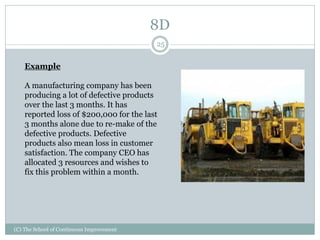
A manufacturing company has been
producing a lot of defective products
over the last 3 months. It has
reported loss of $200,000 for the last
3 months alone due to re-make of the
defective products. Defective
products also mean loss in customer
satisfaction. The company CEO has
allocated 3 resources and wishes to
fix this problem within a month.
8D
(C) The School of Continuous Improvement
26
D1: Form the Team
1. The team had 3 members. One of them was the project leader,
and one was a quality engineer with the other being a production
line supervisor.
2. The total experience in the process amongst the 3 individuals was
about 15 years.
3. The team was first briefed about the problem, and were asked to
study symptoms of defects found in the defective units.
(C) The School of Continuous Improvement
27
D2: Problem Description
1. The team conducted a 5 WHY analysis on the defects noted.
2. Reasons for populated under categories in a tool known as
Affinity Diagram.
3. Pareto Charts were drawn to understand the reasons and also to
help the project team freeze to the root cause of the problem of
high number of defects.
8D
8D
(C) The School of Continuous Improvement
28
D2: Problem Description
Nailsrustwithin10days
Strengthofnailsisbad
Nailbreaks
Nailtipisnotsharp
Nailheadisnotround
Nailisnotcentred
0%
20%
40%
60%
80%
100%
0
10
20
30
40
50
60
Cumulative%
Defects
Causes
[Pareto Chart for Defects]
Vital Few Useful Many
75% of defects happen due to
Nails rusting quickly and nails
breaking earlier than expected.
8D
(C) The School of Continuous Improvement
29
D2: Problem Description
1. 5 WHY Analysis was used as a Root Cause investigation technique.
2. Prior to using 5 WHY, the team may decide to use Affinity Diagram to
understand major causes contributing to the two prioritized defects from
Pareto Charts.
3. It was found out that 75% of nails were being found defective due to two main
reasons:
a. Nail raw materials were not being picked in a FIFO mechanism.
b. Variations were found in the finishing powder quantity used to polish
nail raw materials before passing on to nail machines.
8D
(C) The School of Continuous Improvement
30
D2: Problem Description
The company had incurred a loss of $200,000 due to defective nails being
produced. About 40% of the quantity of the nails had been returned back by
customers.
75% of defects causing defective nails were due to nails rusting and breaking
earlier than the expected 2 months timeframe.
The root causes of this problem are:
a. Nail raw materials were not being picked in a FIFO mechanism.
b. Variations were found in the finishing powder quantity used to polish
nail raw materials before passing on to nail machines.
8D
(C) The School of Continuous Improvement
31
D3: Interim Containment Action
1. The team proposes two quick solutions to fix the issue:
2. Solution 1 – One operator from the pool of 8 operators will be devoted to
checking the quality of raw materials. Only passed materials will move to
production. He would use Acceptance Sampling logic and reject the entire lot
if he finds more than 2% of the weight not proper.
3. Solution 2 – A bucket of finishing powder would be kept near to nail polishing
machine and will be replenished every 1 hour. The replenishment individual
will keep providing feedback to the polishing operator if adequate quantity of
polishing powder is not used.
8D
(C) The School of Continuous Improvement
32
D3: Interim Containment Action
Deal with change resistance
1. In an 8D project and in fact in any improvement project, change
management is important.
2. Any attempt to improve the process, step 1 for that being an Interim
Containment Action, will need to have the backing of the employees of the
process.
3. Possible resistance questions are:
a. Why should I do it this way?
b. What benefit would I get?
c. Are you sure this is the right way?
8D
(C) The School of Continuous Improvement
33
D3: Interim Containment Action
Deal with change resistance
Explain to the operator
1. The fix is a temporary fix, to ensure we deliver to client expectations as we are
defaulting on it by approximately 40%.
2. With your proactive participation in our next activity in the project, we shall
be able to find a permanent solution to the problem at hand, which will
alleviate this present work.
3. As the permanent solution may take some time coming, these temporary fixes
will ensure we reduce the percentage of defective nails.
8D
(C) The School of Continuous Improvement
34
D3: Interim Containment Action
Validating effects of Interim Containment Action
1. Statistical tests like a Paired t test or a 2 Sample proportions test can be used
to validate the effects of Interim containment action.
2. These effects can also be validated by shop floor observations or checking the
daily defective report.
8D
(C) The School of Continuous Improvement
35
D4: Root Cause Analysis and Escape points
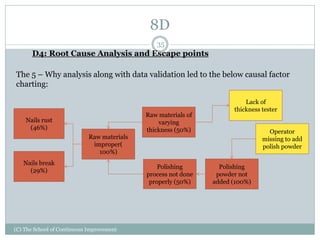
The 5 – Why analysis along with data validation led to the below causal factor
charting:
Nails rust
(46%)
Nails break
(29%)
Raw materials
improper(
100%)
Raw materials of
varying
thickness (50%)
Polishing
process not done
properly (50%)
Polishing
powder not
added (100%)
Operator
missing to add
polish powder
Lack of
thickness tester
8D
(C) The School of Continuous Improvement
36
D4: Root Cause Analysis and Escape points
1. The detailed root cause analysis included shop floor visits to ensure facts are
collected.
2. The root cause analysis reveals that if this issue of defective nails need to be
fixed to 75%, the company needs to purchase a hardness tester and also think
of a way to automate the gun powder addition process.
3. While the project team thinks of permanent corrective actions, the interim
containment actions are already taking care of temporary corrections.
8D
(C) The School of Continuous Improvement
37
D5: Installing Permanent Corrective Actions
1. A solution, if a well planned one, will always work.
2. With the issue of adding hardness testers and automating the polishing
machine process needing possible financial investments, present a quote and
get necessary approvals.
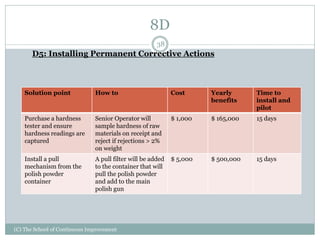
3. Obviously, this financial investment needs to be backed up by good ROI.
4. For our reference, we will use the simple ROI Calculation shown in next slide.
8D
(C) The School of Continuous Improvement
38
D5: Installing Permanent Corrective Actions
Solution point How to Cost Yearly
benefits
Time to
install and
pilot
Purchase a hardness
tester and ensure
hardness readings are
captured
Senior Operator will
sample hardness of raw
materials on receipt and
reject if rejections > 2%
on weight
$ 1,000 $ 165,000 15 days
Install a pull
mechanism from the
polish powder
container
A pull filter will be added
to the container that will
pull the polish powder
and add to the main
polish gun
$ 5,000 $ 500,000 15 days
8D
(C) The School of Continuous Improvement
39
D5: Installing Permanent Corrective Actions
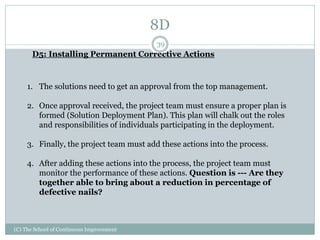
1. The solutions need to get an approval from the top management.
2. Once approval received, the project team must ensure a proper plan is
formed (Solution Deployment Plan). This plan will chalk out the roles
and responsibilities of individuals participating in the deployment.
3. Finally, the project team must add these actions into the process.
4. After adding these actions into the process, the project team must
monitor the performance of these actions. Question is --- Are they
together able to bring about a reduction in percentage of
defective nails?
8D
(C) The School of Continuous Improvement
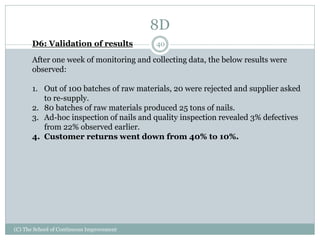
40D6: Validation of results
After one week of monitoring and collecting data, the below results were
observed:
1. Out of 100 batches of raw materials, 20 were rejected and supplier asked
to re-supply.
2. 80 batches of raw materials produced 25 tons of nails.
3. Ad-hoc inspection of nails and quality inspection revealed 3% defectives
from 22% observed earlier.
4. Customer returns went down from 40% to 10%.
8D
(C) The School of Continuous Improvement
41
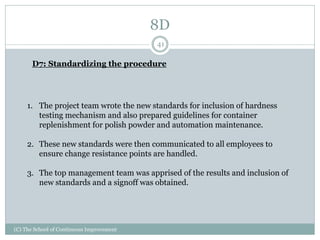
D7: Standardizing the procedure
1. The project team wrote the new standards for inclusion of hardness
testing mechanism and also prepared guidelines for container
replenishment for polish powder and automation maintenance.
2. These new standards were then communicated to all employees to
ensure change resistance points are handled.
3. The top management team was apprised of the results and inclusion of
new standards and a signoff was obtained.
8D
(C) The School of Continuous Improvement
42
D8: Celebrating the milestone
1. The final step of “Celebrating the success of the project” is an
important one, often not to be undermined.
2. An open hall meeting to be conducted with all the employees where the
role of all employees and project team members should be acknowledged
by the Project Leader.
3. Monetary incentives may or may not be provided, but a formal
recognition by means of certification should be provided as a motivation
tool for line workers.
8D
(C) The School of Continuous Improvement
43
Problem
1. Identify an opportunity to improve in your organization.
2. Ask the below questions:
a. Should the problem have a temporary fix first?
b. Should the problem be solved in a maximum time frame of 1 month?
c. Should the problem have a long-lasting solution?
d. Should the problem need the involvement of at least 3-4 team members?
e. Will the organization be able to commit 3-4 resources for 1 month for at least 3-4 hours
a day?
f. Will the organization be able to commit to spending money on installing solutions?
g. Are we equipped to handle change in our company?
8D
(C) The School of Continuous Improvement
44
Project Task
D1: Identify the team members
D2: Collect data on the problem, quantify the problem and present the problem description.
D3: Identify and implement temporary fixes to the problem. Present cost impact if any.
D4: Conduct a thorough Root Cause Study on failure points.
D5: Develop and implement permanent actions. Present cost impact and deal with change
resistance issues.
D6: Validate results of D5.
D7: Standardize the new procedures by integrating them into your SOPs
Kaizen Blitz
(C) The School of Continuous Improvement
45
 Kaizen stands for “Modify to make things better”.
 Any act of improvement is known as Kaizen. Kaizen Blitz or
“Conventional Kaizen” are known as “Quick Win” projects.
 Other forms of Kaizen are Line Kaizen, Cube Kaizen, Teian Kaizen
etc.
 Kaizen events run for at the most 14-21 days.
 The entire process team along with the top management
participates in the Kaizen event.
 A Kaizen event may or may not fetch direct financial impact.
 A Kaizen event may only result in at the most 10-15% in the
performance of the operational metric.
Kaizen Blitz
(C) The School of Continuous Improvement
46
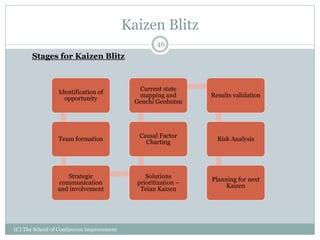
Stages for Kaizen Blitz
Identification of
opportunity
Team formation
Strategic
communication
and involvement
Solutions
prioritization –
Teian Kaizen
Causal Factor
Charting
Current state
mapping and
Genchi Genbutsu
Results validation
Risk Analysis
Planning for next
Kaizen
Kaizen Blitz
(C) The School of Continuous Improvement
47
Stages for Kaizen Blitz
1. An opportunity qualifies for Kaizen Blitz, if the top management
supports with involvement of themselves and the process team.
2. The project has to be completed within 14-21 days of commencement.
3. The project is considered relatively simple to complete. Complexity of a
project can often be determined by votes from the process experts.
Let us now go through each step for a Kaizen Blitz project for
an identified opportunity in a manufacturing company.
Kaizen Blitz
(C) The School of Continuous Improvement
48
Sample case
The company manufactures chairs, which are then sent to the customers
for use. The customers pay $150 per chair. The company incurs a total cost
of $110 per chair which includes labor cost, administrative costs and
shipping costs.
The top management identified an opportunity of saving $10 from the cost
of the chair. Thus, by the end of the project, the operational costs intend to
go down from $110 to $100 per chair.
Kaizen Blitz
(C) The School of Continuous Improvement
49
Identification of Opportunity
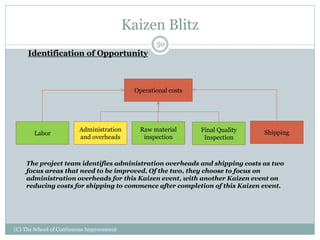
1. The strategic goal of the Kaizen project is savings of $10 per chair or
10% saving in operational costs.
2. The project team draws a simple Tree Diagram to illustrate the
impacting factors to operational costs.
3. This tree diagram will help the project team understand which area to
focus on. This decision can be taken based on complexity of the focus
area.
Kaizen Blitz
(C) The School of Continuous Improvement
50
Identification of Opportunity
Operational costs
Labor
Administration
and overheads
Raw material
inspection
Final Quality
Inspection
Shipping
The project team identifies administration overheads and shipping costs as two
focus areas that need to be improved. Of the two, they choose to focus on
administration overheads for this Kaizen event, with another Kaizen event on
reducing costs for shipping to commence after completion of this Kaizen event.
Kaizen Blitz
(C) The School of Continuous Improvement
51
Identification of Opportunity
Problem statement
The reported administration overheads costs for producing chairs for our
customers is at $50. With other costs contributing to $60, the goal of this
project is to reduce the administration overheads costs by $10.
By reducing the administration overheads costs by $10, the company will be
able to reduce the cost per chair from $110 to $100, resulting in a saving of
$10 per chair = 10% cost savings.
A variability check can be done using Regression Analysis.
Kaizen Blitz
(C) The School of Continuous Improvement
52
Team formation and Strategic communication
1. The team for a Kaizen event should include the below mentioned
individuals:
a. Project team leader
b. Process Owner
c. Process Manager or supervisor
d. 2 – 3 Level 1 employees
Once the team has been formed, the process owner/ CEO of the
company should announce the Kaizen event with the purpose of it,
either by email or by an official communication to all employees of the
functional unit.
Kaizen Blitz
(C) The School of Continuous Improvement
53
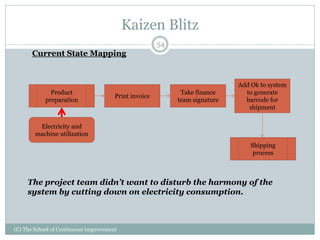
Current State Mapping
In order to improve anything, you need to know where to start.
Knowing your current process is the perfect start.
1. Kaizen would not work if your processes are not standardized.
2. Thus, if the process is not standardized, standardize them first.
3. A standardized process may have variants.
4. If so, the variants must also be captured in the process document.
In our case, we need to do the process mapping of all the tasks done in the
administration department. The core function of the administration
department is to prepare the paper work for all deliveries and ensure all
electrical connections are being utilized properly.
Kaizen Blitz
(C) The School of Continuous Improvement
54
Current State Mapping
Product
preparation
Electricity and
machine utilization
Print invoice
Take finance
team signature
Add Ok to system
to generate
barcode for
shipment
Shipping
process
The project team didn’t want to disturb the harmony of the
system by cutting down on electricity consumption.
Kaizen Blitz
(C) The School of Continuous Improvement
55
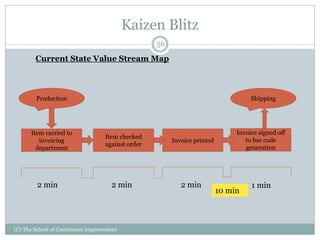
Genchi Genbutsu
1. The project team now conducts shop floor visits for a week to
identify the entire chain of activities that happen from printing of
invoice to bar code generation.
2. This is known as Genchi Genbutsu in Lean.
3. Observations from the Genchi Genbutsu can be used to build the
Current State Value Stream Map.
4. By knowing the Current State Value Stream Map, one can easily
identify areas of improvement.
Kaizen Blitz
(C) The School of Continuous Improvement
56
Current State Value Stream Map
Production Shipping
Item carried to
invoicing
department
Item checked
against order
Invoice printed
Invoice signed off
to bar code
generation
2 min 2 min 2 min 1 min
10 min
Kaizen Blitz
(C) The School of Continuous Improvement
57
Causal Factor Charting
1. The project team uses the Current State Value Stream Map to do the
causal factor charting. Causal factor charting is a technique used in
all improvement projects.
2. This is a critical thinking tool, which helps project teams map the
causes that contribute to the problem.
3. Here is the causal factor charting for the problem at hand:
High wait time of invoices to be signed off  Delay in invoice
signing and return for bar code generation  Delay results in
finance team waiting for invoices to return after signing off
Higher administrative costs.
Kaizen Blitz
(C) The School of Continuous Improvement
58
Solutions Prioritization
1. The project team gets together and identifies possible solutions for solving the problem.
2. The project team understands that the invoice needn’t wait to be signed off after the
product is made. The product making cycle time is 75 minutes, and the invoice could be
signed off during this time.
3. Thus, the finance team is asked to pull the customer order numbers and generate
invoices based on customer orders.
4. Invoice then sent to signoff, and signoff accepted. Production continues in parallel.
5. Once production completed, bar code fixed and sent to shipping directly.
Kaizen Blitz
(C) The School of Continuous Improvement
59
Results Validation
1. The project team observes the data for 2-3 days for the improvement suggested in the
previous slide.
2. As we can see, the printing of invoice to Bar code generation activities are moved to as
parallel processing to production schedules.
3. Additionally, a digital signature of the finance manager is accepted by the ERP system.
4. Due to the digital signature, the invoice needn’t need to wait for the finance manager
signature.
5. Thus the 10 minute wait is completely eliminated.
6. Staff in the last step of the production department empowered to generate bar codes.
Kaizen Blitz
(C) The School of Continuous Improvement
60
Results Validation
0
2
4
6
8
10
12
Day 1 Day 2 Day 3 Day 4 Day 5 Day 6 Day 7 Day 8 Day 9 Day
10
Day 11Day 12Day 13 Day
14
Wait time
Wait time
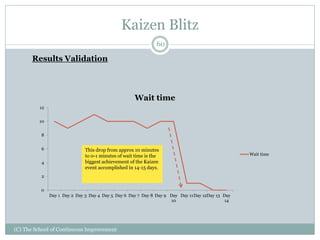
This drop from approx 10 minutes
to 0-1 minutes of wait time is the
biggest achievement of the Kaizen
event accomplished in 14-15 days.
Kaizen Blitz
(C) The School of Continuous Improvement
61
Risk Analysis
1. Production team members may have difficulty in using the ERP
Software to generate bar codes.
2. Finance Manager may object to loss of authority in signing off
invoices.
3. Incomplete products could get sign off and sent for shipping.
The project team may think of possible improvement
measures/ mitigation measures which shall alleviate the
impact of the risks mentioned.
Kaizen Blitz
(C) The School of Continuous Improvement
62
Planning for next Kaizen
1. Only one Kaizen event may only give a small benefit to the
company.
2. If the company wishes to maximize the returns from Kaizen, it
should run multiple Kaizen events.
3. This is known as Kaizen after Kaizen, or it is known as the Plan Do
Check Act Cycle.
4. The effectiveness of a Kaizen event is determined on the
basis of non-occurrences of failures addressed by the
Kaizen project.
Kaizen Blitz
(C) The School of Continuous Improvement
63
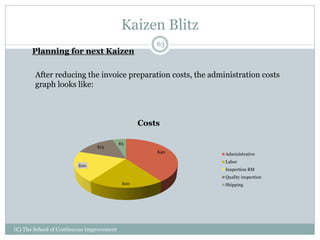
Planning for next Kaizen
After reducing the invoice preparation costs, the administration costs
graph looks like:
$40
$20
$20
$15
$5
Costs
Administrative
Labor
Inspection RM
Quality inspection
Shipping
Kaizen Blitz
(C) The School of Continuous Improvement
64
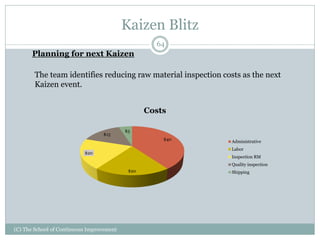
Planning for next Kaizen
The team identifies reducing raw material inspection costs as the next
Kaizen event.
$40
$20
$20
$15
$5
Costs
Administrative
Labor
Inspection RM
Quality inspection
Shipping
Kaizen Blitz
(C) The School of Continuous Improvement
65
Project Task
1. Identify an opportunity for improvement where a maximum of 10% improvement in the
performance of operational metric is desired.
2. Form the team
3. Map the macro level process and localize the problem.
4. Describe the problem and conduct shop floor visits to understand the contributors.
5. Prepare the current state value stream map or appropriate replacement.
6. Identify NVA steps and identify solutions.
7. Pilot solutions, validate and showcase next Kaizen goals.
Lean, Six Sigma and Lean Six Sigma
(C) The School of Continuous Improvement
66
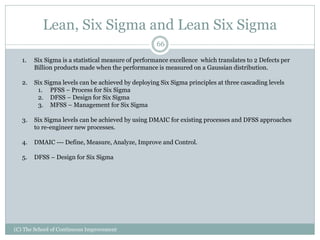
1. Six Sigma is a statistical measure of performance excellence which translates to 2 Defects per
Billion products made when the performance is measured on a Gaussian distribution.
2. Six Sigma levels can be achieved by deploying Six Sigma principles at three cascading levels
1. PFSS – Process for Six Sigma
2. DFSS – Design for Six Sigma
3. MFSS – Management for Six Sigma
3. Six Sigma levels can be achieved by using DMAIC for existing processes and DFSS approaches
to re-engineer new processes.
4. DMAIC --- Define, Measure, Analyze, Improve and Control.
5. DFSS – Design for Six Sigma
Lean, Six Sigma and Lean Six Sigma
(C) The School of Continuous Improvement
67
1. Lean is a culture and a way of thinking and has taken a lot of learnings from Toyota
Production System.
2. As per Lean, where work is done, waste is generated.
3. Thus Lean initiatives relentlessly pursue a waste elimination approach.
4. Any work that doesn’t add value should be removed from the company’s work board.
5. Six Sigma uses a Data approach to solve problems. Lean uses a Process Approach
to solve problems.
6. A ‘marriage ‘of Lean and Six Sigma is known as Lean Six Sigma which combine to deliver
increased efficiency and effectiveness.
By now
(C) The School of Continuous Improvement
68
With knowledge about the 8D, Kaizen Blitz approaches in the way how they
work, use your trainer’s support and you should be able to identify a project
opportunity in your organization and implement it using these approaches.
(C) The School of Continuous Improvement
69
Key Financial Indicators
Importance of Financial Indicators
1. Top management approval and support is extremely important for Lean Six
Sigma initiatives to sustain and give excellent financial benefits.
2. Top management would approve or deny a project only if they see clear
financial benefits from the project.
3. Financial benefits are reported with the help of Financial indicators.
4. Thus, it is important for the process improvement practitioner to understand
these financial indicators and know how to calculate them.
5. Understanding and showing the financial indicators’ performance is
often considered the first step in most process improvement
projects.
70
(C) The School of Continuous Improvement
COGS
1. COGS is the abbreviation for Cost of Goods Sold and is a popular financial
indicator.
2. COGS is the direct cost incurred by the company in producing a product or
delivering a service. When services are delivered, COGS moves to an indicator
known as COSG (Cost of Service Given).
3. This is also known as COS (Cost of Sales) in some companies.
4. Material costs, Labor costs and Inventory costs are included in the calculation
of COGS. Distribution and sales costs are excluded from the calculation of
COGS.
71
(C) The School of Continuous Improvement
COGS
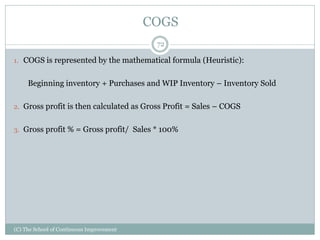
1. COGS is represented by the mathematical formula (Heuristic):
Beginning inventory + Purchases and WIP Inventory – Inventory Sold
2. Gross profit is then calculated as Gross Profit = Sales – COGS
3. Gross profit % = Gross profit/ Sales * 100%
72
(C) The School of Continuous Improvement
COGS
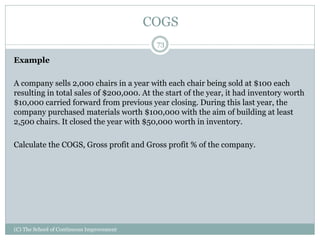
Example
A company sells 2,000 chairs in a year with each chair being sold at $100 each
resulting in total sales of $200,000. At the start of the year, it had inventory worth
$10,000 carried forward from previous year closing. During this last year, the
company purchased materials worth $100,000 with the aim of building at least
2,500 chairs. It closed the year with $50,000 worth in inventory.
Calculate the COGS, Gross profit and Gross profit % of the company.
73
(C) The School of Continuous Improvement
COGS
Example
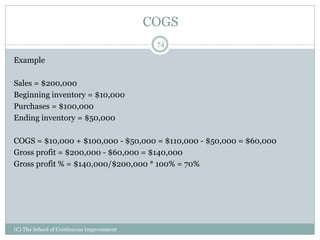
Sales = $200,000
Beginning inventory = $10,000
Purchases = $100,000
Ending inventory = $50,000
COGS = $10,000 + $100,000 - $50,000 = $110,000 - $50,000 = $60,000
Gross profit = $200,000 - $60,000 = $140,000
Gross profit % = $140,000/$200,000 * 100% = 70%
74
(C) The School of Continuous Improvement
COGS
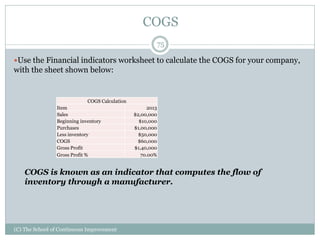
Use the Financial indicators worksheet to calculate the COGS for your company,
with the sheet shown below:
75
(C) The School of Continuous Improvement
COGS Calculation
Item 2013
Sales $2,00,000
Beginning inventory $10,000
Purchases $1,00,000
Less inventory $50,000
COGS $60,000
Gross Profit $1,40,000
Gross Profit % 70.00%
COGS is known as an indicator that computes the flow of
inventory through a manufacturer.
EBITDA
1. EBITDA is a financial indicator used by companies and stands for Earnings
before Interest, Taxes, Depreciation and Amortization.
2. EBITDA indicates the company’s operating efficiency, but is not the only
indicator to do so.
3. EBITDA is a rather controversial financial indicator to be used standalone, as
there are many subjective parameters involved in calculation of EBITDA.
76
(C) The School of Continuous Improvement
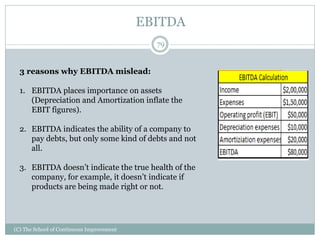
EBITDA
Example
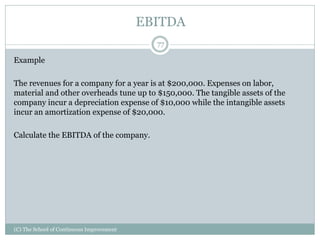
The revenues for a company for a year is at $200,000. Expenses on labor,
material and other overheads tune up to $150,000. The tangible assets of the
company incur a depreciation expense of $10,000 while the intangible assets
incur an amortization expense of $20,000.
Calculate the EBITDA of the company.
77
(C) The School of Continuous Improvement
EBITDA
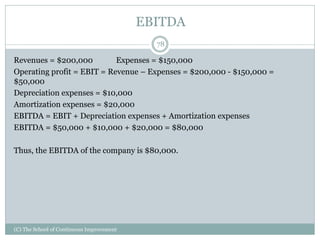
Revenues = $200,000 Expenses = $150,000
Operating profit = EBIT = Revenue – Expenses = $200,000 - $150,000 =
$50,000
Depreciation expenses = $10,000
Amortization expenses = $20,000
EBITDA = EBIT + Depreciation expenses + Amortization expenses
EBITDA = $50,000 + $10,000 + $20,000 = $80,000
Thus, the EBITDA of the company is $80,000.
78
(C) The School of Continuous Improvement
EBITDA
79
(C) The School of Continuous Improvement
3 reasons why EBITDA mislead:
1. EBITDA places importance on assets
(Depreciation and Amortization inflate the
EBIT figures).
2. EBITDA indicates the ability of a company to
pay debts, but only some kind of debts and not
all.
3. EBITDA doesn’t indicate the true health of the
company, for example, it doesn’t indicate if
products are being made right or not.
COPQ
1. While Cost of Goods Sold and EBITDA remain strictly strategic financial
indicators, Cost of Poor Quality or COPQ is a strategic cum operational
indicator.
2. Cost of Poor Quality is a price a company pays for making poor quality products
or making products in an incorrect manner.
3. Cost of Poor Quality = Visible losses + Invisible (Hidden losses).
4. Only 20% of the losses are visible to the company.
5. And thus, determining COPQ or COPQ% is extremely critical for any operation
or any project. This is often considered the first step of most process
improvement projects assuming COGS and EBITDA are determined
by top level management.
80
(C) The School of Continuous Improvement
COPQ
1. The first trigger for COPQ determination is studying the number of returns of
the products by its customers.
2. Returns are classified into three categories:
a. Paid for returns’ service
b. Returns’ replacement under warranty service
c. Returns’ service under warranty
The project team must determine with the help of historical data a stratification
of each of these three types of returns/ complaints.
81
(C) The School of Continuous Improvement
COPQ
Example
In the last one year, 1,000 products were returned by customers out of 3,000 sold
by the company. Out of the 1,000 products returned, 300 were out of the warranty
period. 500 new products were issued to the customers to replace the defective
products. 200 were serviced as only minor faults were reported in the product.
The sale price per unit was $100. Product manufacturing and selling costs added
to $50. Service costs were $30.
Calculate the COPQ % of the company.
82
(C) The School of Continuous Improvement
COPQ
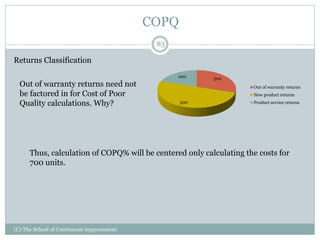
Returns Classification
83
(C) The School of Continuous Improvement
300
500
200
Out of warranty returns
New product returns
Product service returns
Out of warranty returns need not
be factored in for Cost of Poor
Quality calculations. Why?
Thus, calculation of COPQ% will be centered only calculating the costs for
700 units.
COPQ
COPQ Calculation
84
(C) The School of Continuous Improvement
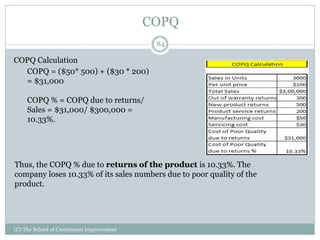
COPQ = ($50* 500) + ($30 * 200)
= $31,000
COPQ % = COPQ due to returns/
Sales = $31,000/ $300,000 =
10.33%.
Thus, the COPQ % due to returns of the product is 10.33%. The
company loses 10.33% of its sales numbers due to poor quality of the
product.
COPQ
85
(C) The School of Continuous Improvement
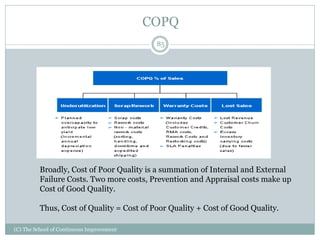
Broadly, Cost of Poor Quality is a summation of Internal and External
Failure Costs. Two more costs, Prevention and Appraisal costs make up
Cost of Good Quality.
Thus, Cost of Quality = Cost of Poor Quality + Cost of Good Quality.
COPQ
86
(C) The School of Continuous Improvement
COPQ as a starting point for most projects
1. COPQ represents the financial opportunity for the project.
2. COPQ can be determined on an organizational level just by looking at the
returns of the products, as that is the first customer interface.
3. Some companies estimate Cost of Poor Quality for their supply chain and
don’t really limit themselves to product returns.
4. In such a scenario, we may have multiple COPQ numbers for the
organization and then the project team may use a prioritization index to
identify a project opportunity.
COPQ
87
(C) The School of Continuous Improvement
How process improvement helps in reducing the COPQ%?
1. Every customer product or need has its own set of expectations/
specifications. These are known as Critical to Customer Quality
Requirements or CTCQR, or simply CTC.
2. Variation in these CTCQRs result in customers returning the products
purchased.
3. Process improvement approaches like Six Sigma DMAIC work to reduce
these variations resulting in less complaints from customers.
4. Less complaints mean companies incur less loss.
COPQ
88
(C) The School of Continuous Improvement
COPQ Problem
A company sells 100 units of chairs in a month to its customers operating on a
B2C model. Every chair is priced at $100 each.
Every month about 10 customers come back with complaints for chairs they
bought the same month. The company has a 3 month warranty clause under
which they replace the defective chairs with new ones. The old chairs are
scrapped and not used any further.
Historical data for the company shows monthly a 5% attrition in client is seen.
Calculate the COPQ % for the company, which can be used as an improvement
opportunity for a project.
7 QC Tools
89
(C) The School of Continuous Improvement
Read the summary case study of application of 7 QC Tools to
understand the importance and the usage of the 7 QC Tools.
Assessment
90
(C) The School of Continuous Improvement
We have 3 levels of assessment for the Yellow Belt Certification:
1. Objective questions assessment – Trainees will answer 25 objective
questions.
2. Project Identification – Trainees will need to present a project case
from their companies.
Trainees completing both the steps above will be awarded with a Yellow Belt
– Process Improvement: Functional Certification.
(C) The School of Continuous Improvement 91
Thank you….

Yellow belt process improvement training and certification module

  • 1.
    (C) The Schoolof Continuous Improvement 1 Yellow Belt– Process improvement Training and Certification Module
  • 2.
    Disclaimer (C) The Schoolof Continuous Improvement 2 This Yellow Belt – Process Improvement Training and Certification program is being offered free of charge to the interested individuals who wish to learn more about Process Improvement. Reproducing this module or distributing or selling it to achieve financial benefits will invite stringent action under the concerned law of jurisdiction by the institution facilitating this module. With the end-objective/ deliverable of identifying a process improvement opportunity in your organization, read the module and have fun. Of course, you would have an assessment at the end of the module based on which you would be certified.
  • 3.
    Body of knowledge (C)The School of Continuous Improvement 3 a. How to link strategic goals to process improvement initiatives b. Introduction to Kaizen, PDCA, Lean and Six Sigma c. Pre-requisites to process improvement d. Key financial indicators e. How to choose a process improvement approach f. 7 QC Tools
  • 4.
    (C) The Schoolof Continuous Improvement 4 How to link strategic goals to process improvement initiatives
  • 5.
    Strategic goals toprocess improvement (C) The School of Continuous Improvement 5 1. What matters the most to the CEOs of a company is their strategic goals and how they are performing against them. 2. The organization can be improved. The business units can be improved. Processes within the business units can be improved. 3. Identification of an improvement opportunity is typically done by the Biggest Bang for Buck approach. 4. Most organizations use the Balanced Scorecard approach to roll down strategic goals to operational objectives.
  • 6.
    Balanced scorecard (C) TheSchool of Continuous Improvement 6 As you can see from the snapshot of the Balanced Scorecard of a company, the strategic goal of the company is to have an operating margin of 25% yearly for the next 5 years with the margins increasing 2% every year. A CEO would normally state this when he knows his operating margins are somewhere in the range of 10-15%.
  • 7.
    Balanced scorecard (C) TheSchool of Continuous Improvement 7 A key customer complaint is lag in the delivery times. This has led to wastage of time and money and importantly also led to customer attrition.
  • 8.
    Balanced scorecard (C) TheSchool of Continuous Improvement 8 How can you meet the company’s and the organization goals – Well by optimizing the manufacturing and warehousing processes. These processes are critical to delivering products on time.
  • 9.
    Notes (C) The Schoolof Continuous Improvement 9 1. You don’t necessarily need to have a Balanced Scorecard approach to identify process improvement initiatives that are linked to strategic impact areas. 2. You though need to work with your top bosses (May not be the CEO all the time) to identify the strategic goals. 3. The drill-down to the customer impact and finally the process linkages to the customer impact is equally as important. 4. Having numbers/ data around what you write is not mandatory at this stage.
  • 10.
    (C) The Schoolof Continuous Improvement 10 Introduction to Kaizen, 8D, lean and six sigma
  • 11.
    What is Businessprocess improvement? (C) The School of Continuous Improvement 11 1. Business Process Improvement is about improving the performance of an operational metric from its historical state(As-is) to a new level (Future state). 2. This improvement can be slow and incremental or breakthrough. 3. Business processes are improved to impact strategic indices like: a. COGS: Cost of Goods Sold b. Customer Satisfaction c. EBITDA: Earnings before Interest, Taxes, Depreciation and Amortization d. COPQ e. Operating Margins
  • 12.
    (C) The Schoolof Continuous Improvement 12 BPI Journey framework Standardization Characterization Optimization Improvement Business process improvement journey
  • 13.
    (C) The Schoolof Continuous Improvement 13 Business process improvement journey 1. Standardization – This should be the first step of any improvement journey. Set the procedures correct. Have the processes mapped. Remember – No standards, no improvement. 2. Characterization – Once the processes are standardized, map the input and process output variables. Set/ Define the targets for the variables. 3. Optimization – Funnel down the many input variables which impact the output variable to the few critical input variables which have a major impact on the output variable. 4. Improvement – Improve the state of the metric of interest from the as-is level to a future state level.
  • 14.
    Pre-requisites for businessprocess improvement (C) The School of Continuous Improvement 14 1. Top management buy-in is mandatory. 2. Processes should be standardized in documentation. 3. Data should be readily available from the process. 4. Trained resources. 5. Established communication channels With these 5 basic pre-requisites, any one can improve a business process in an organization. Improvement and Innovation are two different things altogether. A Business may want to innovate at first, or they may want to improve and then innovate.
  • 15.
    Business process improvementapproaches (C) The School of Continuous Improvement 15 1. Global 8D: An easy to understand and an effective problem solving technique used for complex problems. 2. Kaizen Blitz: An easy to deploy mechanism used for relatively simpler problems intended to drive small improvements. 3. Theory of Constraints: A scientific approach to improvement that focuses on the weakest link in the chain and looks at improving. 4. Lean Six Sigma: An interwoven set of approaches combining statistical tools and techniques to help identify causes of variations and wastes in the process and reduce them. 5. PDCA: Plan, Do, Check and Act is a reiterative process for improvements where closing of one project drives another.
  • 16.
    (C) The Schoolof Continuous Improvement 16 Approach Time Cost intensiv e Resour ces Other conditions Global 8D 1 month Yes 2-3 Process experts’ involvement must Kaizen Blitz 14 days No Entire process team Simple problems, quick to fix and small improvements Lean Six Sigma 3-6 months Yes 3-4 Root cause not known, other pre-requisites Theory of Constraints 2-3 months Yes 3-4 Dependencies clearly mapped, system improvement PDCA 1-2 months No 1-2 Need for iterations to improvement Business process improvement approaches
  • 17.
    Choosing the rightbpi approach (C) The School of Continuous Improvement 17 Answer the following questions in form of a check list and send to the Trainer of the module to help understand how to choose the right approach to the problem: 1. Does your organization want a quick fix to the problem? 2. Can your organization spend 1-2 hours/ resource for every resource for 2 weeks? 3. Does your organization care about long term improvement? 4. Do you want to improve the entire system or just one process in the organization? 5. Does your organization permit you spending 1-2 hours every day for 3-6 months on process improvement work? 6. Does your organization believe in the principle of continuous improvement? 7. What is the Strength of your company and how many departments do you have? 8. Which sector does your company belong to (Services, Manufacturing)? 9. Which sub-sector does your company belong to (Warehousing, Distribution etc)?
  • 18.
    Case Studies (C) TheSchool of Continuous Improvement 18 Example 1 An organization wanted to improve a key process metric Cycle time for products that it had identified for improvement. Improving this metric was critical as the company had relatively high cycle time resulting in customer waiting and some times also moving to competitors. The organization wanted a solution to the problem within a month as a temporary fix. Once the “bleeding” stopped, the organization was also willing to invest resources to improvement initiatives. Which improvement initiative/ approach combination should the organization choose to work with?
  • 19.
    Case Studies (C) TheSchool of Continuous Improvement 19 Example 2 An organization wanted to improve the efficiency of its distribution system. This distribution system involved taking in products from 6 different companies and supplying it to the customers. The reasons for inefficiencies in the distribution system were well known and the company had data to back up the reasons. The company was in a very competitive sphere and wanted to reduce the inefficiencies, which resulted in high cost of services provided resulting in lowering their profit margins. The team had 50 FTE and the company was willing to allow 1 hour per day for every resource for 2 weeks to fix the problem at hand. Which improvement initiative/ approach combination should the organization choose to work with?
  • 20.
    Case studies (C) TheSchool of Continuous Improvement 20 Example 3 An organization wanted to improve the OEE (Overall Equipment Effectiveness) of its operating factory. The OEE was measured at 61% daily and one of the main reasons why the OEE metric was down was due to frequent downtimes due to knife change. The organization wanted to fix specifically the knife change issue doing which they would have resulted the OEE to go up to 75% for which they had one week. Which project initiative or approach should they use?
  • 21.
    Case studies answers (C)The School of Continuous Improvement 21 Example 1 8D: 8D has one discipline step which is called Interim containment action. This talks about the bandaid approaches. Implementing 8D for a month will get the temporary fix. Another discipline speaks of Permanent Corrective Action. To implement permanent corrective actions, the organizations need to invest money. Thus, a simple 8D implementation will do the trick. Example 2 Kaizen Blitz/ Theory of Constraints: The fact that the organization wanted to address the issue quickly and was also ready to commit resources to the project with the reasons being known, you could either take the Blitz approach or Theory of Constraint Drum – Buffer – Rope approach. Example 3 Shortage in time means Kaizen Blitz is the only possible approach that can be taken.
  • 22.
    By now, youshould know (C) The School of Continuous Improvement 22 Which process improvement approach should you choose for your problems?
  • 23.
    (C) The Schoolof Continuous Improvement 23 8D and Kaizen Blitz
  • 24.
    8D (C) The Schoolof Continuous Improvement 24 1. 8D or Global 8D Method of problem solving is a scientific approach to solve problems. 2. This method constitutes 8 steps or 8 disciplines arranged in a chronological order. 3. The problem solving closely resembles the y = f(x) approach. 4. Practitioners should use 8D when they have about 1-2 months to solve the problem and if they can have a team of 3-4 working on the project. 5. 8D is also used to find temporary actions that will help taking care of immediate concerns.
  • 25.
    8D (C) The Schoolof Continuous Improvement 25 Example A manufacturing company has been producing a lot of defective products over the last 3 months. It has reported loss of $200,000 for the last 3 months alone due to re-make of the defective products. Defective products also mean loss in customer satisfaction. The company CEO has allocated 3 resources and wishes to fix this problem within a month.
  • 26.
    8D (C) The Schoolof Continuous Improvement 26 D1: Form the Team 1. The team had 3 members. One of them was the project leader, and one was a quality engineer with the other being a production line supervisor. 2. The total experience in the process amongst the 3 individuals was about 15 years. 3. The team was first briefed about the problem, and were asked to study symptoms of defects found in the defective units.
  • 27.
    (C) The Schoolof Continuous Improvement 27 D2: Problem Description 1. The team conducted a 5 WHY analysis on the defects noted. 2. Reasons for populated under categories in a tool known as Affinity Diagram. 3. Pareto Charts were drawn to understand the reasons and also to help the project team freeze to the root cause of the problem of high number of defects. 8D
  • 28.
    8D (C) The Schoolof Continuous Improvement 28 D2: Problem Description Nailsrustwithin10days Strengthofnailsisbad Nailbreaks Nailtipisnotsharp Nailheadisnotround Nailisnotcentred 0% 20% 40% 60% 80% 100% 0 10 20 30 40 50 60 Cumulative% Defects Causes [Pareto Chart for Defects] Vital Few Useful Many 75% of defects happen due to Nails rusting quickly and nails breaking earlier than expected.
  • 29.
    8D (C) The Schoolof Continuous Improvement 29 D2: Problem Description 1. 5 WHY Analysis was used as a Root Cause investigation technique. 2. Prior to using 5 WHY, the team may decide to use Affinity Diagram to understand major causes contributing to the two prioritized defects from Pareto Charts. 3. It was found out that 75% of nails were being found defective due to two main reasons: a. Nail raw materials were not being picked in a FIFO mechanism. b. Variations were found in the finishing powder quantity used to polish nail raw materials before passing on to nail machines.
  • 30.
    8D (C) The Schoolof Continuous Improvement 30 D2: Problem Description The company had incurred a loss of $200,000 due to defective nails being produced. About 40% of the quantity of the nails had been returned back by customers. 75% of defects causing defective nails were due to nails rusting and breaking earlier than the expected 2 months timeframe. The root causes of this problem are: a. Nail raw materials were not being picked in a FIFO mechanism. b. Variations were found in the finishing powder quantity used to polish nail raw materials before passing on to nail machines.
  • 31.
    8D (C) The Schoolof Continuous Improvement 31 D3: Interim Containment Action 1. The team proposes two quick solutions to fix the issue: 2. Solution 1 – One operator from the pool of 8 operators will be devoted to checking the quality of raw materials. Only passed materials will move to production. He would use Acceptance Sampling logic and reject the entire lot if he finds more than 2% of the weight not proper. 3. Solution 2 – A bucket of finishing powder would be kept near to nail polishing machine and will be replenished every 1 hour. The replenishment individual will keep providing feedback to the polishing operator if adequate quantity of polishing powder is not used.
  • 32.
    8D (C) The Schoolof Continuous Improvement 32 D3: Interim Containment Action Deal with change resistance 1. In an 8D project and in fact in any improvement project, change management is important. 2. Any attempt to improve the process, step 1 for that being an Interim Containment Action, will need to have the backing of the employees of the process. 3. Possible resistance questions are: a. Why should I do it this way? b. What benefit would I get? c. Are you sure this is the right way?
  • 33.
    8D (C) The Schoolof Continuous Improvement 33 D3: Interim Containment Action Deal with change resistance Explain to the operator 1. The fix is a temporary fix, to ensure we deliver to client expectations as we are defaulting on it by approximately 40%. 2. With your proactive participation in our next activity in the project, we shall be able to find a permanent solution to the problem at hand, which will alleviate this present work. 3. As the permanent solution may take some time coming, these temporary fixes will ensure we reduce the percentage of defective nails.
  • 34.
    8D (C) The Schoolof Continuous Improvement 34 D3: Interim Containment Action Validating effects of Interim Containment Action 1. Statistical tests like a Paired t test or a 2 Sample proportions test can be used to validate the effects of Interim containment action. 2. These effects can also be validated by shop floor observations or checking the daily defective report.
  • 35.
    8D (C) The Schoolof Continuous Improvement 35 D4: Root Cause Analysis and Escape points The 5 – Why analysis along with data validation led to the below causal factor charting: Nails rust (46%) Nails break (29%) Raw materials improper( 100%) Raw materials of varying thickness (50%) Polishing process not done properly (50%) Polishing powder not added (100%) Operator missing to add polish powder Lack of thickness tester
  • 36.
    8D (C) The Schoolof Continuous Improvement 36 D4: Root Cause Analysis and Escape points 1. The detailed root cause analysis included shop floor visits to ensure facts are collected. 2. The root cause analysis reveals that if this issue of defective nails need to be fixed to 75%, the company needs to purchase a hardness tester and also think of a way to automate the gun powder addition process. 3. While the project team thinks of permanent corrective actions, the interim containment actions are already taking care of temporary corrections.
  • 37.
    8D (C) The Schoolof Continuous Improvement 37 D5: Installing Permanent Corrective Actions 1. A solution, if a well planned one, will always work. 2. With the issue of adding hardness testers and automating the polishing machine process needing possible financial investments, present a quote and get necessary approvals. 3. Obviously, this financial investment needs to be backed up by good ROI. 4. For our reference, we will use the simple ROI Calculation shown in next slide.
  • 38.
    8D (C) The Schoolof Continuous Improvement 38 D5: Installing Permanent Corrective Actions Solution point How to Cost Yearly benefits Time to install and pilot Purchase a hardness tester and ensure hardness readings are captured Senior Operator will sample hardness of raw materials on receipt and reject if rejections > 2% on weight $ 1,000 $ 165,000 15 days Install a pull mechanism from the polish powder container A pull filter will be added to the container that will pull the polish powder and add to the main polish gun $ 5,000 $ 500,000 15 days
  • 39.
    8D (C) The Schoolof Continuous Improvement 39 D5: Installing Permanent Corrective Actions 1. The solutions need to get an approval from the top management. 2. Once approval received, the project team must ensure a proper plan is formed (Solution Deployment Plan). This plan will chalk out the roles and responsibilities of individuals participating in the deployment. 3. Finally, the project team must add these actions into the process. 4. After adding these actions into the process, the project team must monitor the performance of these actions. Question is --- Are they together able to bring about a reduction in percentage of defective nails?
  • 40.
    8D (C) The Schoolof Continuous Improvement 40D6: Validation of results After one week of monitoring and collecting data, the below results were observed: 1. Out of 100 batches of raw materials, 20 were rejected and supplier asked to re-supply. 2. 80 batches of raw materials produced 25 tons of nails. 3. Ad-hoc inspection of nails and quality inspection revealed 3% defectives from 22% observed earlier. 4. Customer returns went down from 40% to 10%.
  • 41.
    8D (C) The Schoolof Continuous Improvement 41 D7: Standardizing the procedure 1. The project team wrote the new standards for inclusion of hardness testing mechanism and also prepared guidelines for container replenishment for polish powder and automation maintenance. 2. These new standards were then communicated to all employees to ensure change resistance points are handled. 3. The top management team was apprised of the results and inclusion of new standards and a signoff was obtained.
  • 42.
    8D (C) The Schoolof Continuous Improvement 42 D8: Celebrating the milestone 1. The final step of “Celebrating the success of the project” is an important one, often not to be undermined. 2. An open hall meeting to be conducted with all the employees where the role of all employees and project team members should be acknowledged by the Project Leader. 3. Monetary incentives may or may not be provided, but a formal recognition by means of certification should be provided as a motivation tool for line workers.
  • 43.
    8D (C) The Schoolof Continuous Improvement 43 Problem 1. Identify an opportunity to improve in your organization. 2. Ask the below questions: a. Should the problem have a temporary fix first? b. Should the problem be solved in a maximum time frame of 1 month? c. Should the problem have a long-lasting solution? d. Should the problem need the involvement of at least 3-4 team members? e. Will the organization be able to commit 3-4 resources for 1 month for at least 3-4 hours a day? f. Will the organization be able to commit to spending money on installing solutions? g. Are we equipped to handle change in our company?
  • 44.
    8D (C) The Schoolof Continuous Improvement 44 Project Task D1: Identify the team members D2: Collect data on the problem, quantify the problem and present the problem description. D3: Identify and implement temporary fixes to the problem. Present cost impact if any. D4: Conduct a thorough Root Cause Study on failure points. D5: Develop and implement permanent actions. Present cost impact and deal with change resistance issues. D6: Validate results of D5. D7: Standardize the new procedures by integrating them into your SOPs
  • 45.
    Kaizen Blitz (C) TheSchool of Continuous Improvement 45  Kaizen stands for “Modify to make things better”.  Any act of improvement is known as Kaizen. Kaizen Blitz or “Conventional Kaizen” are known as “Quick Win” projects.  Other forms of Kaizen are Line Kaizen, Cube Kaizen, Teian Kaizen etc.  Kaizen events run for at the most 14-21 days.  The entire process team along with the top management participates in the Kaizen event.  A Kaizen event may or may not fetch direct financial impact.  A Kaizen event may only result in at the most 10-15% in the performance of the operational metric.
  • 46.
    Kaizen Blitz (C) TheSchool of Continuous Improvement 46 Stages for Kaizen Blitz Identification of opportunity Team formation Strategic communication and involvement Solutions prioritization – Teian Kaizen Causal Factor Charting Current state mapping and Genchi Genbutsu Results validation Risk Analysis Planning for next Kaizen
  • 47.
    Kaizen Blitz (C) TheSchool of Continuous Improvement 47 Stages for Kaizen Blitz 1. An opportunity qualifies for Kaizen Blitz, if the top management supports with involvement of themselves and the process team. 2. The project has to be completed within 14-21 days of commencement. 3. The project is considered relatively simple to complete. Complexity of a project can often be determined by votes from the process experts. Let us now go through each step for a Kaizen Blitz project for an identified opportunity in a manufacturing company.
  • 48.
    Kaizen Blitz (C) TheSchool of Continuous Improvement 48 Sample case The company manufactures chairs, which are then sent to the customers for use. The customers pay $150 per chair. The company incurs a total cost of $110 per chair which includes labor cost, administrative costs and shipping costs. The top management identified an opportunity of saving $10 from the cost of the chair. Thus, by the end of the project, the operational costs intend to go down from $110 to $100 per chair.
  • 49.
    Kaizen Blitz (C) TheSchool of Continuous Improvement 49 Identification of Opportunity 1. The strategic goal of the Kaizen project is savings of $10 per chair or 10% saving in operational costs. 2. The project team draws a simple Tree Diagram to illustrate the impacting factors to operational costs. 3. This tree diagram will help the project team understand which area to focus on. This decision can be taken based on complexity of the focus area.
  • 50.
    Kaizen Blitz (C) TheSchool of Continuous Improvement 50 Identification of Opportunity Operational costs Labor Administration and overheads Raw material inspection Final Quality Inspection Shipping The project team identifies administration overheads and shipping costs as two focus areas that need to be improved. Of the two, they choose to focus on administration overheads for this Kaizen event, with another Kaizen event on reducing costs for shipping to commence after completion of this Kaizen event.
  • 51.
    Kaizen Blitz (C) TheSchool of Continuous Improvement 51 Identification of Opportunity Problem statement The reported administration overheads costs for producing chairs for our customers is at $50. With other costs contributing to $60, the goal of this project is to reduce the administration overheads costs by $10. By reducing the administration overheads costs by $10, the company will be able to reduce the cost per chair from $110 to $100, resulting in a saving of $10 per chair = 10% cost savings. A variability check can be done using Regression Analysis.
  • 52.
    Kaizen Blitz (C) TheSchool of Continuous Improvement 52 Team formation and Strategic communication 1. The team for a Kaizen event should include the below mentioned individuals: a. Project team leader b. Process Owner c. Process Manager or supervisor d. 2 – 3 Level 1 employees Once the team has been formed, the process owner/ CEO of the company should announce the Kaizen event with the purpose of it, either by email or by an official communication to all employees of the functional unit.
  • 53.
    Kaizen Blitz (C) TheSchool of Continuous Improvement 53 Current State Mapping In order to improve anything, you need to know where to start. Knowing your current process is the perfect start. 1. Kaizen would not work if your processes are not standardized. 2. Thus, if the process is not standardized, standardize them first. 3. A standardized process may have variants. 4. If so, the variants must also be captured in the process document. In our case, we need to do the process mapping of all the tasks done in the administration department. The core function of the administration department is to prepare the paper work for all deliveries and ensure all electrical connections are being utilized properly.
  • 54.
    Kaizen Blitz (C) TheSchool of Continuous Improvement 54 Current State Mapping Product preparation Electricity and machine utilization Print invoice Take finance team signature Add Ok to system to generate barcode for shipment Shipping process The project team didn’t want to disturb the harmony of the system by cutting down on electricity consumption.
  • 55.
    Kaizen Blitz (C) TheSchool of Continuous Improvement 55 Genchi Genbutsu 1. The project team now conducts shop floor visits for a week to identify the entire chain of activities that happen from printing of invoice to bar code generation. 2. This is known as Genchi Genbutsu in Lean. 3. Observations from the Genchi Genbutsu can be used to build the Current State Value Stream Map. 4. By knowing the Current State Value Stream Map, one can easily identify areas of improvement.
  • 56.
    Kaizen Blitz (C) TheSchool of Continuous Improvement 56 Current State Value Stream Map Production Shipping Item carried to invoicing department Item checked against order Invoice printed Invoice signed off to bar code generation 2 min 2 min 2 min 1 min 10 min
  • 57.
    Kaizen Blitz (C) TheSchool of Continuous Improvement 57 Causal Factor Charting 1. The project team uses the Current State Value Stream Map to do the causal factor charting. Causal factor charting is a technique used in all improvement projects. 2. This is a critical thinking tool, which helps project teams map the causes that contribute to the problem. 3. Here is the causal factor charting for the problem at hand: High wait time of invoices to be signed off  Delay in invoice signing and return for bar code generation  Delay results in finance team waiting for invoices to return after signing off Higher administrative costs.
  • 58.
    Kaizen Blitz (C) TheSchool of Continuous Improvement 58 Solutions Prioritization 1. The project team gets together and identifies possible solutions for solving the problem. 2. The project team understands that the invoice needn’t wait to be signed off after the product is made. The product making cycle time is 75 minutes, and the invoice could be signed off during this time. 3. Thus, the finance team is asked to pull the customer order numbers and generate invoices based on customer orders. 4. Invoice then sent to signoff, and signoff accepted. Production continues in parallel. 5. Once production completed, bar code fixed and sent to shipping directly.
  • 59.
    Kaizen Blitz (C) TheSchool of Continuous Improvement 59 Results Validation 1. The project team observes the data for 2-3 days for the improvement suggested in the previous slide. 2. As we can see, the printing of invoice to Bar code generation activities are moved to as parallel processing to production schedules. 3. Additionally, a digital signature of the finance manager is accepted by the ERP system. 4. Due to the digital signature, the invoice needn’t need to wait for the finance manager signature. 5. Thus the 10 minute wait is completely eliminated. 6. Staff in the last step of the production department empowered to generate bar codes.
  • 60.
    Kaizen Blitz (C) TheSchool of Continuous Improvement 60 Results Validation 0 2 4 6 8 10 12 Day 1 Day 2 Day 3 Day 4 Day 5 Day 6 Day 7 Day 8 Day 9 Day 10 Day 11Day 12Day 13 Day 14 Wait time Wait time This drop from approx 10 minutes to 0-1 minutes of wait time is the biggest achievement of the Kaizen event accomplished in 14-15 days.
  • 61.
    Kaizen Blitz (C) TheSchool of Continuous Improvement 61 Risk Analysis 1. Production team members may have difficulty in using the ERP Software to generate bar codes. 2. Finance Manager may object to loss of authority in signing off invoices. 3. Incomplete products could get sign off and sent for shipping. The project team may think of possible improvement measures/ mitigation measures which shall alleviate the impact of the risks mentioned.
  • 62.
    Kaizen Blitz (C) TheSchool of Continuous Improvement 62 Planning for next Kaizen 1. Only one Kaizen event may only give a small benefit to the company. 2. If the company wishes to maximize the returns from Kaizen, it should run multiple Kaizen events. 3. This is known as Kaizen after Kaizen, or it is known as the Plan Do Check Act Cycle. 4. The effectiveness of a Kaizen event is determined on the basis of non-occurrences of failures addressed by the Kaizen project.
  • 63.
    Kaizen Blitz (C) TheSchool of Continuous Improvement 63 Planning for next Kaizen After reducing the invoice preparation costs, the administration costs graph looks like: $40 $20 $20 $15 $5 Costs Administrative Labor Inspection RM Quality inspection Shipping
  • 64.
    Kaizen Blitz (C) TheSchool of Continuous Improvement 64 Planning for next Kaizen The team identifies reducing raw material inspection costs as the next Kaizen event. $40 $20 $20 $15 $5 Costs Administrative Labor Inspection RM Quality inspection Shipping
  • 65.
    Kaizen Blitz (C) TheSchool of Continuous Improvement 65 Project Task 1. Identify an opportunity for improvement where a maximum of 10% improvement in the performance of operational metric is desired. 2. Form the team 3. Map the macro level process and localize the problem. 4. Describe the problem and conduct shop floor visits to understand the contributors. 5. Prepare the current state value stream map or appropriate replacement. 6. Identify NVA steps and identify solutions. 7. Pilot solutions, validate and showcase next Kaizen goals.
  • 66.
    Lean, Six Sigmaand Lean Six Sigma (C) The School of Continuous Improvement 66 1. Six Sigma is a statistical measure of performance excellence which translates to 2 Defects per Billion products made when the performance is measured on a Gaussian distribution. 2. Six Sigma levels can be achieved by deploying Six Sigma principles at three cascading levels 1. PFSS – Process for Six Sigma 2. DFSS – Design for Six Sigma 3. MFSS – Management for Six Sigma 3. Six Sigma levels can be achieved by using DMAIC for existing processes and DFSS approaches to re-engineer new processes. 4. DMAIC --- Define, Measure, Analyze, Improve and Control. 5. DFSS – Design for Six Sigma
  • 67.
    Lean, Six Sigmaand Lean Six Sigma (C) The School of Continuous Improvement 67 1. Lean is a culture and a way of thinking and has taken a lot of learnings from Toyota Production System. 2. As per Lean, where work is done, waste is generated. 3. Thus Lean initiatives relentlessly pursue a waste elimination approach. 4. Any work that doesn’t add value should be removed from the company’s work board. 5. Six Sigma uses a Data approach to solve problems. Lean uses a Process Approach to solve problems. 6. A ‘marriage ‘of Lean and Six Sigma is known as Lean Six Sigma which combine to deliver increased efficiency and effectiveness.
  • 68.
    By now (C) TheSchool of Continuous Improvement 68 With knowledge about the 8D, Kaizen Blitz approaches in the way how they work, use your trainer’s support and you should be able to identify a project opportunity in your organization and implement it using these approaches.
  • 69.
    (C) The Schoolof Continuous Improvement 69 Key Financial Indicators
  • 70.
    Importance of FinancialIndicators 1. Top management approval and support is extremely important for Lean Six Sigma initiatives to sustain and give excellent financial benefits. 2. Top management would approve or deny a project only if they see clear financial benefits from the project. 3. Financial benefits are reported with the help of Financial indicators. 4. Thus, it is important for the process improvement practitioner to understand these financial indicators and know how to calculate them. 5. Understanding and showing the financial indicators’ performance is often considered the first step in most process improvement projects. 70 (C) The School of Continuous Improvement
  • 71.
    COGS 1. COGS isthe abbreviation for Cost of Goods Sold and is a popular financial indicator. 2. COGS is the direct cost incurred by the company in producing a product or delivering a service. When services are delivered, COGS moves to an indicator known as COSG (Cost of Service Given). 3. This is also known as COS (Cost of Sales) in some companies. 4. Material costs, Labor costs and Inventory costs are included in the calculation of COGS. Distribution and sales costs are excluded from the calculation of COGS. 71 (C) The School of Continuous Improvement
  • 72.
    COGS 1. COGS isrepresented by the mathematical formula (Heuristic): Beginning inventory + Purchases and WIP Inventory – Inventory Sold 2. Gross profit is then calculated as Gross Profit = Sales – COGS 3. Gross profit % = Gross profit/ Sales * 100% 72 (C) The School of Continuous Improvement
  • 73.
    COGS Example A company sells2,000 chairs in a year with each chair being sold at $100 each resulting in total sales of $200,000. At the start of the year, it had inventory worth $10,000 carried forward from previous year closing. During this last year, the company purchased materials worth $100,000 with the aim of building at least 2,500 chairs. It closed the year with $50,000 worth in inventory. Calculate the COGS, Gross profit and Gross profit % of the company. 73 (C) The School of Continuous Improvement
  • 74.
    COGS Example Sales = $200,000 Beginninginventory = $10,000 Purchases = $100,000 Ending inventory = $50,000 COGS = $10,000 + $100,000 - $50,000 = $110,000 - $50,000 = $60,000 Gross profit = $200,000 - $60,000 = $140,000 Gross profit % = $140,000/$200,000 * 100% = 70% 74 (C) The School of Continuous Improvement
  • 75.
    COGS Use the Financialindicators worksheet to calculate the COGS for your company, with the sheet shown below: 75 (C) The School of Continuous Improvement COGS Calculation Item 2013 Sales $2,00,000 Beginning inventory $10,000 Purchases $1,00,000 Less inventory $50,000 COGS $60,000 Gross Profit $1,40,000 Gross Profit % 70.00% COGS is known as an indicator that computes the flow of inventory through a manufacturer.
  • 76.
    EBITDA 1. EBITDA isa financial indicator used by companies and stands for Earnings before Interest, Taxes, Depreciation and Amortization. 2. EBITDA indicates the company’s operating efficiency, but is not the only indicator to do so. 3. EBITDA is a rather controversial financial indicator to be used standalone, as there are many subjective parameters involved in calculation of EBITDA. 76 (C) The School of Continuous Improvement
  • 77.
    EBITDA Example The revenues fora company for a year is at $200,000. Expenses on labor, material and other overheads tune up to $150,000. The tangible assets of the company incur a depreciation expense of $10,000 while the intangible assets incur an amortization expense of $20,000. Calculate the EBITDA of the company. 77 (C) The School of Continuous Improvement
  • 78.
    EBITDA Revenues = $200,000Expenses = $150,000 Operating profit = EBIT = Revenue – Expenses = $200,000 - $150,000 = $50,000 Depreciation expenses = $10,000 Amortization expenses = $20,000 EBITDA = EBIT + Depreciation expenses + Amortization expenses EBITDA = $50,000 + $10,000 + $20,000 = $80,000 Thus, the EBITDA of the company is $80,000. 78 (C) The School of Continuous Improvement
  • 79.
    EBITDA 79 (C) The Schoolof Continuous Improvement 3 reasons why EBITDA mislead: 1. EBITDA places importance on assets (Depreciation and Amortization inflate the EBIT figures). 2. EBITDA indicates the ability of a company to pay debts, but only some kind of debts and not all. 3. EBITDA doesn’t indicate the true health of the company, for example, it doesn’t indicate if products are being made right or not.
  • 80.
    COPQ 1. While Costof Goods Sold and EBITDA remain strictly strategic financial indicators, Cost of Poor Quality or COPQ is a strategic cum operational indicator. 2. Cost of Poor Quality is a price a company pays for making poor quality products or making products in an incorrect manner. 3. Cost of Poor Quality = Visible losses + Invisible (Hidden losses). 4. Only 20% of the losses are visible to the company. 5. And thus, determining COPQ or COPQ% is extremely critical for any operation or any project. This is often considered the first step of most process improvement projects assuming COGS and EBITDA are determined by top level management. 80 (C) The School of Continuous Improvement
  • 81.
    COPQ 1. The firsttrigger for COPQ determination is studying the number of returns of the products by its customers. 2. Returns are classified into three categories: a. Paid for returns’ service b. Returns’ replacement under warranty service c. Returns’ service under warranty The project team must determine with the help of historical data a stratification of each of these three types of returns/ complaints. 81 (C) The School of Continuous Improvement
  • 82.
    COPQ Example In the lastone year, 1,000 products were returned by customers out of 3,000 sold by the company. Out of the 1,000 products returned, 300 were out of the warranty period. 500 new products were issued to the customers to replace the defective products. 200 were serviced as only minor faults were reported in the product. The sale price per unit was $100. Product manufacturing and selling costs added to $50. Service costs were $30. Calculate the COPQ % of the company. 82 (C) The School of Continuous Improvement
  • 83.
    COPQ Returns Classification 83 (C) TheSchool of Continuous Improvement 300 500 200 Out of warranty returns New product returns Product service returns Out of warranty returns need not be factored in for Cost of Poor Quality calculations. Why? Thus, calculation of COPQ% will be centered only calculating the costs for 700 units.
  • 84.
    COPQ COPQ Calculation 84 (C) TheSchool of Continuous Improvement COPQ = ($50* 500) + ($30 * 200) = $31,000 COPQ % = COPQ due to returns/ Sales = $31,000/ $300,000 = 10.33%. Thus, the COPQ % due to returns of the product is 10.33%. The company loses 10.33% of its sales numbers due to poor quality of the product.
  • 85.
    COPQ 85 (C) The Schoolof Continuous Improvement Broadly, Cost of Poor Quality is a summation of Internal and External Failure Costs. Two more costs, Prevention and Appraisal costs make up Cost of Good Quality. Thus, Cost of Quality = Cost of Poor Quality + Cost of Good Quality.
  • 86.
    COPQ 86 (C) The Schoolof Continuous Improvement COPQ as a starting point for most projects 1. COPQ represents the financial opportunity for the project. 2. COPQ can be determined on an organizational level just by looking at the returns of the products, as that is the first customer interface. 3. Some companies estimate Cost of Poor Quality for their supply chain and don’t really limit themselves to product returns. 4. In such a scenario, we may have multiple COPQ numbers for the organization and then the project team may use a prioritization index to identify a project opportunity.
  • 87.
    COPQ 87 (C) The Schoolof Continuous Improvement How process improvement helps in reducing the COPQ%? 1. Every customer product or need has its own set of expectations/ specifications. These are known as Critical to Customer Quality Requirements or CTCQR, or simply CTC. 2. Variation in these CTCQRs result in customers returning the products purchased. 3. Process improvement approaches like Six Sigma DMAIC work to reduce these variations resulting in less complaints from customers. 4. Less complaints mean companies incur less loss.
  • 88.
    COPQ 88 (C) The Schoolof Continuous Improvement COPQ Problem A company sells 100 units of chairs in a month to its customers operating on a B2C model. Every chair is priced at $100 each. Every month about 10 customers come back with complaints for chairs they bought the same month. The company has a 3 month warranty clause under which they replace the defective chairs with new ones. The old chairs are scrapped and not used any further. Historical data for the company shows monthly a 5% attrition in client is seen. Calculate the COPQ % for the company, which can be used as an improvement opportunity for a project.
  • 89.
    7 QC Tools 89 (C)The School of Continuous Improvement Read the summary case study of application of 7 QC Tools to understand the importance and the usage of the 7 QC Tools.
  • 90.
    Assessment 90 (C) The Schoolof Continuous Improvement We have 3 levels of assessment for the Yellow Belt Certification: 1. Objective questions assessment – Trainees will answer 25 objective questions. 2. Project Identification – Trainees will need to present a project case from their companies. Trainees completing both the steps above will be awarded with a Yellow Belt – Process Improvement: Functional Certification.
  • 91.
    (C) The Schoolof Continuous Improvement 91 Thank you….