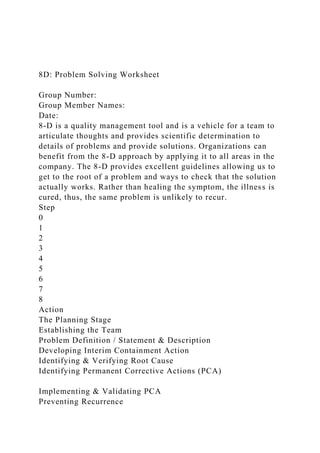
8D: Problem Solving Worksheet
Group Number:
Group Member Names:
Date:
8-D is a quality management tool and is a vehicle for a team to
articulate thoughts and provides scientific determination to
details of problems and provide solutions. Organizations can
benefit from the 8-D approach by applying it to all areas in the
company. The 8-D provides excellent guidelines allowing us to
get to the root of a problem and ways to check that the solution
actually works. Rather than healing the symptom, the illness is
cured, thus, the same problem is unlikely to recur.
Step
0
1
2
3
4
5
6
7
8
Action
The Planning Stage
Establishing the Team
Problem Definition / Statement & Description
Developing Interim Containment Action
Identifying & Verifying Root Cause
Identifying Permanent Corrective Actions (PCA)
Implementing & Validating PCA
Preventing Recurrence
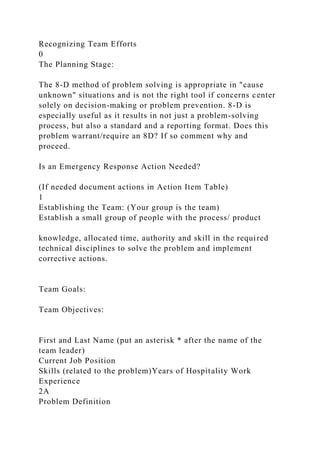
Recognizing Team Efforts
0
The Planning Stage:
The 8-D method of problem solving is appropriate in "cause
unknown" situations and is not the right tool if concerns center
solely on decision-making or problem prevention. 8-D is
especially useful as it results in not just a problem-solving
process, but also a standard and a reporting format. Does this
problem warrant/require an 8D? If so comment why and
proceed.
Is an Emergency Response Action Needed?
(If needed document actions in Action Item Table)
1
Establishing the Team: (Your group is the team)
Establish a small group of people with the process/ product
knowledge, allocated time, authority and skill in the required
technical disciplines to solve the problem and implement
corrective actions.
Team Goals:
Team Objectives:
First and Last Name (put an asterisk * after the name of the
team leader)
Current Job Position
Skills (related to the problem)Years of Hospitality Work
Experience
2A
Problem Definition
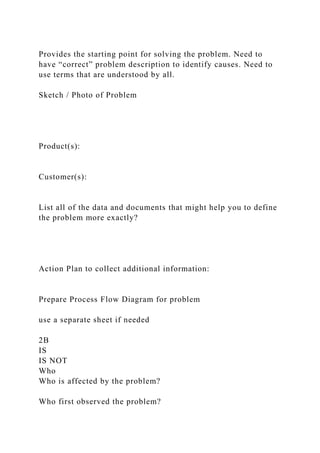
Provides the starting point for solving the problem. Need to
have “correct” problem description to identify causes. Need to
use terms that are understood by all.
Sketch / Photo of Problem
Product(s):
Customer(s):
List all of the data and documents that might help you to define
the problem more exactly?
Action Plan to collect additional information:
Prepare Process Flow Diagram for problem
use a separate sheet if needed
2B
IS
IS NOT
Who
Who is affected by the problem?
Who first observed the problem?
To whom was the problem reported?
Who is not affected by the problem?
Who did not find the problem?
What
What type of problem is it?
What has the problem (food, service, etc)?
What is happening with the process & with containment?
Do we have physical evidence of the problem?
What does not have the problem?
What could be happening but is not?
What could be the problem but is not?
Why
Why is this a problem (degraded performance)?
Is the process stable?
Why is it not a problem?
Where
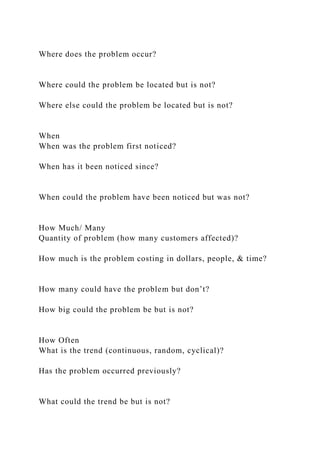
Where was the problem observed?
Where does the problem occur?
Where could the problem be located but is not?
Where else could the problem be located but is not?
When
When was the problem first noticed?
When has it been noticed since?
When could the problem have been noticed but was not?
How Much/ Many
Quantity of problem (how many customers affected)?
How much is the problem costing in dollars, people, & time?
How many could have the problem but don’t?
How big could the problem be but is not?
How Often
What is the trend (continuous, random, cyclical)?
Has the problem occurred previously?
What could the trend be but is not?
2C
Problem Description
(based on the information gathered so far, provide a concise
problem description)
3
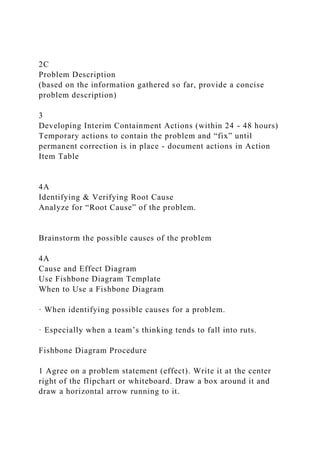
Developing Interim Containment Actions (within 24 - 48 hours)
Temporary actions to contain the problem and “fix” until
permanent correction is in place - document actions in Action
Item Table
4A
Identifying & Verifying Root Cause
Analyze for “Root Cause” of the problem.
Brainstorm the possible causes of the problem
4A
Cause and Effect Diagram
Use Fishbone Diagram Template
When to Use a Fishbone Diagram
· When identifying possible causes for a problem.
· Especially when a team’s thinking tends to fall into ruts.
Fishbone Diagram Procedure
1 Agree on a problem statement (effect). Write it at the center
right of the flipchart or whiteboard. Draw a box around it and
draw a horizontal arrow running to it.
2 Brainstorm the major categories of causes of the problem. If
this is difficult use generic headings:
· Tools
· Procedures
· Employees
· Systems
· Process
· Managers
3 Write the categories of causes as branches from the main
arrow.
4 Brainstorm all the possible causes of the problem. Ask: “Why
does this happen?” As each idea is given, the facilitator writes
it as a branch from the appropriate category. Causes can be
written in several places if they relate to several categories.
5 Again ask “why does this happen?” about each cause. Write
sub–causes branching off the causes. Continue to ask “Why?”
and generate deeper levels of causes. Layers of branches
indicate causal relationships.
6 By the end of the process, you should have 3-4 common
themes
.
4B
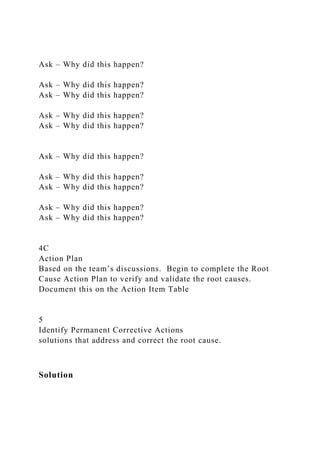
Use the 5 Why Analysis for Each of the Top 3 Suspected Causes
(from fishbone)
Ask – Why did this happen?
4C
Action Plan
Based on the team’s discussions. Begin to complete the Root
Cause Action Plan to verify and validate the root causes.
Document this on the Action Item Table
5
Identify Permanent Corrective Actions
solutions that address and correct the root cause.
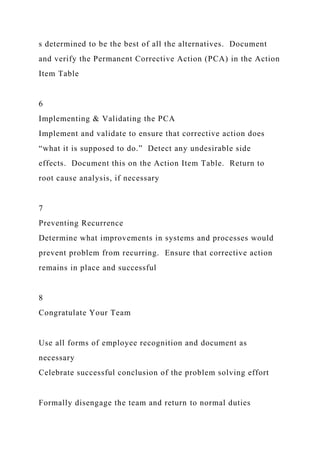
Solution
s determined to be the best of all the alternatives. Document
and verify the Permanent Corrective Action (PCA) in the Action
Item Table
6
Implementing & Validating the PCA
Implement and validate to ensure that corrective action does
“what it is supposed to do.” Detect any undesirable side
effects. Document this on the Action Item Table. Return to
root cause analysis, if necessary
7
Preventing Recurrence
Determine what improvements in systems and processes would
prevent problem from recurring. Ensure that corrective action
remains in place and successful
8
Congratulate Your Team
Use all forms of employee recognition and document as
necessary
Celebrate successful conclusion of the problem solving effort
Formally disengage the team and return to normal duties
Was this problem solving exercise effective? Has it been
verified with a follow-up?
Yes
No
Signature / Title / Date
Findings
Page 1 of 6
Ethics Assignment Score Sheet – 30 points
Excellent
Good
Acceptable
Weak
Unacceptable
A.Identify the Ethical Problem - Explain whether you have an
ethical problem using the Categories of Ethical Dilemmas
presented in the course material. Which category or categories
does the problem fall into? [Grading note, if more than one
category is applicable and you fail to recognize it, then you will
not receive full credit.]
3
2.5
2
1.5
1
.5
0
B. Apply the Steps for analyzing Ethical Dilemmas
Step 1:Gather facts. Include a summary of the case.
3
2.5
2
1.5
1
.5
0
Step 2: List missing info and assumptions. What
informationwould you like to know that you do not have. Think
through this. For every problem, information is missing.
3
2.5
2
1.5
1
.5
0
Step 3: List each stakeholder’s interests (concerns) in the
dilemma. Explain what each stakeholder’s interests are. [Note:
You should analyze at least 6 stakeholders and their interests.]
3
2.5
2
1.5
1
.5
0
Step 4: Generate list of alternatives. Include multiple
alternatives. The more thought that you put into this, the better
the score. Saying “don’t break the law” or “call a lawyer” is
not sufficient analysis.
3
2.5
2
1.5
1
.5
0
Step 5: Evaluate resolutions for cost, legality and impact (apply
models). In your analysis of Step 5, you may not use moral
relativism, ethical egoism or utilitarianism but use at least two
other models (Laura Nash, Blanchard and Peale, Wall Street
Journal, or Front Page of the Newspaper). Be thorough. If you
only answer one question in a model, this is not thorough.
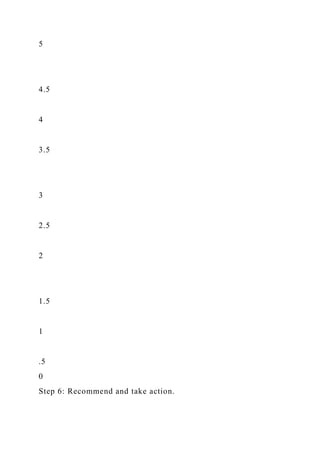
6
5.5
5
4.5
4
3.5
3
2.5
2
1.5
1
.5
0
Step 6: Recommend and take action.
3
2.5
2
1.5
1
.5
0
Step 7: Make changes to managerial practices to prevent
recurrence. This is critical. Use your knowledge from LES and
other business courses.
3
2.5
2
1.5
1
.5
0
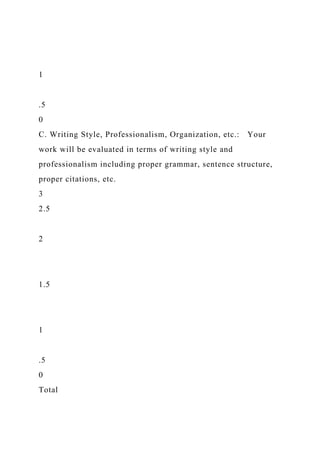
C. Writing Style, Professionalism, Organization, etc.: Your
work will be evaluated in terms of writing style and
professionalism including proper grammar, sentence structure,
proper citations, etc.
3
2.5
2
1.5
1
.5
0
Total
Ethical Decision-Making Exercise
In this exercise, you will be applying the concepts that we
learned from class to a current business problem.
First, you have the choice of which ethics problem to address.
You may choose form the topics below. If there is a topic
you’d like to address that is not listed below, please e-mail me
with your idea at least 3 days in advance of the due date so I
can review your proposal and approve it.
Option 1: You are a middle manager in the Information
Technology Department at Volkswagen and you have heard that
someone in your department is installing software into the
company’s cars that would circumvent the emissions testing
equipment that allows autos to pass emissions when they should
fail. Pollution-control systems on cars work normally when
being tested for harmful emissions coming out of the tailpipe —
but shut off during regular driving.
http://www.nytimes.com/2015/09/27/business/as-vw-pushed-to-
be-no-1-ambitions-fueled-a-scandal.html
Option 2: You are a high-level manager at Wells Fargo and you
just learned that some of your employees are opening accounts
for customers that are not authorized.
http://www.wsj.com/articles/how-wells-fargos-high-pressure-
sales-culture-spiraled-out-of-control-1474053044
Option 3: You are the CEO for Samsung. After the Galaxy Note
7 debacle, how should the company handle the Galaxy Note 8
that is not yet in production?
http://www.androidauthority.com/galaxy-note-7-defect-causes-
721528/
Option 4: You are in senior management at Mylan
Pharmaceuticals. The company’s main competitor just had a
huge recall of its life-saving device and the company is trying
to price its Epi-Pen.
http://www.nytimes.com/2016/09/16/business/epipen-maker-
mylan-preventative-drug-campaign.html
A. Explain whether you have an ethical problem using the
Categories of Ethical Dilemmas presented in the course
material. Which category or categories does the problem fall
into? [Grading note, if more than one category is applicable
and you fail to recognize it, then you will not receive full
credit.]
B. Apply the Steps for Analyzing Ethical Dilemmas. Be sure to
go through each step thoroughly.
Step 1:Gather facts. Review the article above and any others
that you have reviewed on your topic and present a summary of
the relevant facts. You must properly cite any articles that you
use, including the one that I provided to you on your topic. The
reason is to avoid any issues relating to defamation or
plagiarism.
Step 2: List missing info and assumptions. No one knows all of
the facts. Think through your topic carefully. What do you
want to know to help you with your decision?
Step 3: List each stakeholder’s interests (concerns) in the
dilemma. [Note: You should analyze at least 6 stakeholders
and their interests.]
Step 4: Generate list of alternatives. You should generate
several alternatives. The more thought that you put into this, the
better the score. Saying “don’t break the law” or “call a
lawyer” is not sufficient analysis.
Step 5: Evaluate resolutions for cost, legality and impact (apply
models).
In your analysis of Step 5, you may not use moral relativism,
ethical egoism or utilitarianism but use at least two other
models (Laura Nash, Blanchard and Peale, Wall Street Journal,
or Front Page of the Newspaper). Be thorough. If you only
answer one question in a model, this is not thorough.
Step 6: Recommend and take action.
Step 7: Make changes to managerial practices to prevent
recurrence.
Look to your other courses and LES to think through what you
need to do to avoid this problem again.
C. Formatting. This may sound obvious, but include your name,
class day and time and page number on every page of your
paper. Your paper must be stapled before you turn it in.
D. Grammar, Punctuation, etc. Your work will be evaluated in
terms of writing style and professionalism including proper
grammar, sentence structure, proper citations, etc. Use the
Writing Center if you have trouble with grammar and so forth.
E. Citation. To avoid a charge of defamation or a case of
plagiarism, you should properly cite the sources of the material
in your paper. You may use the source that I provided to you
and any other reputable sources (not Wikipedia). You are not
required to do any additional research. You may use MLA
(https://owl.english.purdue.edu/owl/resource/747/01/) or APA
(https://owl.english.purdue.edu/owl/resource/560/01/) citation
format.

8D Problem Solving WorksheetGroup NumberGroup Member Nam.docx

  • 1.
    8D: Problem SolvingWorksheet Group Number: Group Member Names: Date: 8-D is a quality management tool and is a vehicle for a team to articulate thoughts and provides scientific determination to details of problems and provide solutions. Organizations can benefit from the 8-D approach by applying it to all areas in the company. The 8-D provides excellent guidelines allowing us to get to the root of a problem and ways to check that the solution actually works. Rather than healing the symptom, the illness is cured, thus, the same problem is unlikely to recur. Step 0 1 2 3 4 5 6 7 8 Action The Planning Stage Establishing the Team Problem Definition / Statement & Description Developing Interim Containment Action Identifying & Verifying Root Cause Identifying Permanent Corrective Actions (PCA) Implementing & Validating PCA Preventing Recurrence
  • 2.
    Recognizing Team Efforts 0 ThePlanning Stage: The 8-D method of problem solving is appropriate in "cause unknown" situations and is not the right tool if concerns center solely on decision-making or problem prevention. 8-D is especially useful as it results in not just a problem-solving process, but also a standard and a reporting format. Does this problem warrant/require an 8D? If so comment why and proceed. Is an Emergency Response Action Needed? (If needed document actions in Action Item Table) 1 Establishing the Team: (Your group is the team) Establish a small group of people with the process/ product knowledge, allocated time, authority and skill in the required technical disciplines to solve the problem and implement corrective actions. Team Goals: Team Objectives: First and Last Name (put an asterisk * after the name of the team leader) Current Job Position Skills (related to the problem)Years of Hospitality Work Experience 2A Problem Definition
  • 3.
    Provides the startingpoint for solving the problem. Need to have “correct” problem description to identify causes. Need to use terms that are understood by all. Sketch / Photo of Problem Product(s): Customer(s): List all of the data and documents that might help you to define the problem more exactly? Action Plan to collect additional information: Prepare Process Flow Diagram for problem use a separate sheet if needed 2B IS IS NOT Who Who is affected by the problem? Who first observed the problem?
  • 4.
    To whom wasthe problem reported? Who is not affected by the problem? Who did not find the problem? What What type of problem is it? What has the problem (food, service, etc)? What is happening with the process & with containment? Do we have physical evidence of the problem? What does not have the problem? What could be happening but is not? What could be the problem but is not? Why Why is this a problem (degraded performance)? Is the process stable? Why is it not a problem? Where Where was the problem observed?
  • 5.
    Where does theproblem occur? Where could the problem be located but is not? Where else could the problem be located but is not? When When was the problem first noticed? When has it been noticed since? When could the problem have been noticed but was not? How Much/ Many Quantity of problem (how many customers affected)? How much is the problem costing in dollars, people, & time? How many could have the problem but don’t? How big could the problem be but is not? How Often What is the trend (continuous, random, cyclical)? Has the problem occurred previously? What could the trend be but is not?
  • 6.
    2C Problem Description (based onthe information gathered so far, provide a concise problem description) 3 Developing Interim Containment Actions (within 24 - 48 hours) Temporary actions to contain the problem and “fix” until permanent correction is in place - document actions in Action Item Table 4A Identifying & Verifying Root Cause Analyze for “Root Cause” of the problem. Brainstorm the possible causes of the problem 4A Cause and Effect Diagram Use Fishbone Diagram Template When to Use a Fishbone Diagram · When identifying possible causes for a problem. · Especially when a team’s thinking tends to fall into ruts. Fishbone Diagram Procedure 1 Agree on a problem statement (effect). Write it at the center right of the flipchart or whiteboard. Draw a box around it and draw a horizontal arrow running to it.
  • 7.
    2 Brainstorm themajor categories of causes of the problem. If this is difficult use generic headings: · Tools · Procedures · Employees · Systems · Process · Managers 3 Write the categories of causes as branches from the main arrow. 4 Brainstorm all the possible causes of the problem. Ask: “Why does this happen?” As each idea is given, the facilitator writes it as a branch from the appropriate category. Causes can be written in several places if they relate to several categories. 5 Again ask “why does this happen?” about each cause. Write sub–causes branching off the causes. Continue to ask “Why?” and generate deeper levels of causes. Layers of branches indicate causal relationships. 6 By the end of the process, you should have 3-4 common themes . 4B Use the 5 Why Analysis for Each of the Top 3 Suspected Causes (from fishbone) Ask – Why did this happen? Ask – Why did this happen? Ask – Why did this happen? Ask – Why did this happen? Ask – Why did this happen?
  • 8.
    Ask – Whydid this happen? Ask – Why did this happen? Ask – Why did this happen? Ask – Why did this happen? Ask – Why did this happen? Ask – Why did this happen? Ask – Why did this happen? Ask – Why did this happen? Ask – Why did this happen? Ask – Why did this happen? 4C Action Plan Based on the team’s discussions. Begin to complete the Root Cause Action Plan to verify and validate the root causes. Document this on the Action Item Table 5 Identify Permanent Corrective Actions solutions that address and correct the root cause. Solution
  • 9.
    s determined tobe the best of all the alternatives. Document and verify the Permanent Corrective Action (PCA) in the Action Item Table 6 Implementing & Validating the PCA Implement and validate to ensure that corrective action does “what it is supposed to do.” Detect any undesirable side effects. Document this on the Action Item Table. Return to root cause analysis, if necessary 7 Preventing Recurrence Determine what improvements in systems and processes would prevent problem from recurring. Ensure that corrective action remains in place and successful 8 Congratulate Your Team Use all forms of employee recognition and document as necessary Celebrate successful conclusion of the problem solving effort Formally disengage the team and return to normal duties
  • 10.
    Was this problemsolving exercise effective? Has it been verified with a follow-up? Yes No Signature / Title / Date Findings Page 1 of 6
  • 11.
    Ethics Assignment ScoreSheet – 30 points Excellent Good Acceptable Weak Unacceptable A.Identify the Ethical Problem - Explain whether you have an ethical problem using the Categories of Ethical Dilemmas presented in the course material. Which category or categories does the problem fall into? [Grading note, if more than one category is applicable and you fail to recognize it, then you will not receive full credit.] 3 2.5 2 1.5 1 .5
  • 12.
    0 B. Apply theSteps for analyzing Ethical Dilemmas Step 1:Gather facts. Include a summary of the case. 3 2.5 2 1.5 1 .5 0 Step 2: List missing info and assumptions. What informationwould you like to know that you do not have. Think through this. For every problem, information is missing. 3 2.5 2
  • 13.
    1.5 1 .5 0 Step 3: Listeach stakeholder’s interests (concerns) in the dilemma. Explain what each stakeholder’s interests are. [Note: You should analyze at least 6 stakeholders and their interests.] 3 2.5 2 1.5 1 .5 0 Step 4: Generate list of alternatives. Include multiple alternatives. The more thought that you put into this, the better
  • 14.
    the score. Saying“don’t break the law” or “call a lawyer” is not sufficient analysis. 3 2.5 2 1.5 1 .5 0 Step 5: Evaluate resolutions for cost, legality and impact (apply models). In your analysis of Step 5, you may not use moral relativism, ethical egoism or utilitarianism but use at least two other models (Laura Nash, Blanchard and Peale, Wall Street Journal, or Front Page of the Newspaper). Be thorough. If you only answer one question in a model, this is not thorough. 6 5.5
  • 15.
  • 16.
    3 2.5 2 1.5 1 .5 0 Step 7: Makechanges to managerial practices to prevent recurrence. This is critical. Use your knowledge from LES and other business courses. 3 2.5 2 1.5
  • 17.
    1 .5 0 C. Writing Style,Professionalism, Organization, etc.: Your work will be evaluated in terms of writing style and professionalism including proper grammar, sentence structure, proper citations, etc. 3 2.5 2 1.5 1 .5 0 Total
  • 18.
    Ethical Decision-Making Exercise Inthis exercise, you will be applying the concepts that we learned from class to a current business problem. First, you have the choice of which ethics problem to address. You may choose form the topics below. If there is a topic you’d like to address that is not listed below, please e-mail me with your idea at least 3 days in advance of the due date so I can review your proposal and approve it. Option 1: You are a middle manager in the Information Technology Department at Volkswagen and you have heard that someone in your department is installing software into the company’s cars that would circumvent the emissions testing
  • 19.
    equipment that allowsautos to pass emissions when they should fail. Pollution-control systems on cars work normally when being tested for harmful emissions coming out of the tailpipe — but shut off during regular driving. http://www.nytimes.com/2015/09/27/business/as-vw-pushed-to- be-no-1-ambitions-fueled-a-scandal.html Option 2: You are a high-level manager at Wells Fargo and you just learned that some of your employees are opening accounts for customers that are not authorized. http://www.wsj.com/articles/how-wells-fargos-high-pressure- sales-culture-spiraled-out-of-control-1474053044 Option 3: You are the CEO for Samsung. After the Galaxy Note 7 debacle, how should the company handle the Galaxy Note 8 that is not yet in production? http://www.androidauthority.com/galaxy-note-7-defect-causes- 721528/ Option 4: You are in senior management at Mylan Pharmaceuticals. The company’s main competitor just had a huge recall of its life-saving device and the company is trying to price its Epi-Pen. http://www.nytimes.com/2016/09/16/business/epipen-maker- mylan-preventative-drug-campaign.html A. Explain whether you have an ethical problem using the Categories of Ethical Dilemmas presented in the course material. Which category or categories does the problem fall
  • 20.
    into? [Grading note,if more than one category is applicable and you fail to recognize it, then you will not receive full credit.] B. Apply the Steps for Analyzing Ethical Dilemmas. Be sure to go through each step thoroughly. Step 1:Gather facts. Review the article above and any others that you have reviewed on your topic and present a summary of the relevant facts. You must properly cite any articles that you use, including the one that I provided to you on your topic. The reason is to avoid any issues relating to defamation or plagiarism. Step 2: List missing info and assumptions. No one knows all of the facts. Think through your topic carefully. What do you want to know to help you with your decision? Step 3: List each stakeholder’s interests (concerns) in the dilemma. [Note: You should analyze at least 6 stakeholders and their interests.] Step 4: Generate list of alternatives. You should generate several alternatives. The more thought that you put into this, the better the score. Saying “don’t break the law” or “call a lawyer” is not sufficient analysis. Step 5: Evaluate resolutions for cost, legality and impact (apply models).
  • 21.
    In your analysisof Step 5, you may not use moral relativism, ethical egoism or utilitarianism but use at least two other models (Laura Nash, Blanchard and Peale, Wall Street Journal, or Front Page of the Newspaper). Be thorough. If you only answer one question in a model, this is not thorough. Step 6: Recommend and take action. Step 7: Make changes to managerial practices to prevent recurrence. Look to your other courses and LES to think through what you need to do to avoid this problem again. C. Formatting. This may sound obvious, but include your name, class day and time and page number on every page of your paper. Your paper must be stapled before you turn it in. D. Grammar, Punctuation, etc. Your work will be evaluated in terms of writing style and professionalism including proper grammar, sentence structure, proper citations, etc. Use the Writing Center if you have trouble with grammar and so forth. E. Citation. To avoid a charge of defamation or a case of plagiarism, you should properly cite the sources of the material in your paper. You may use the source that I provided to you and any other reputable sources (not Wikipedia). You are not required to do any additional research. You may use MLA (https://owl.english.purdue.edu/owl/resource/747/01/) or APA
  • 22.