Download free for 30 days
Sign in
Upload
Language (EN)
Support
Business
Mobile
Social Media
Marketing
Technology
Art & Photos
Career
Design
Education
Presentations & Public Speaking
Government & Nonprofit
Healthcare
Internet
Law
Leadership & Management
Automotive
Engineering
Software
Recruiting & HR
Retail
Sales
Services
Science
Small Business & Entrepreneurship
Food
Environment
Economy & Finance
Data & Analytics
Investor Relations
Sports
Spiritual
News & Politics
Travel
Self Improvement
Real Estate
Entertainment & Humor
Health & Medicine
Devices & Hardware
Lifestyle
Change Language
Language
English
Español
Português
Français
Deutsche
Cancel
Save
EN
Uploaded by
Palkesh Trivedi
30 views
5 Why Root Cause Corrective Action Course Objectives What is Root Cause? Benefits The Problem Solving Process Examples and Exercises
All about RCA
Data & Analytics
◦
Related topics:
Root Cause Analysis
•
Read more
0
Save
Share
Embed
Embed presentation
Download
Download to read offline
1
/ 27
2
/ 27
3
/ 27
4
/ 27
5
/ 27
6
/ 27
7
/ 27
8
/ 27
9
/ 27
10
/ 27
11
/ 27
12
/ 27
13
/ 27
14
/ 27
15
/ 27
16
/ 27
17
/ 27
18
/ 27
19
/ 27
20
/ 27
21
/ 27
22
/ 27
23
/ 27
24
/ 27
25
/ 27
26
/ 27
27
/ 27
More Related Content
PDF
8D analysis presentation
by
PRASHANT KSHIRSAGAR
PPT
8D Problem Solving Approach
by
Timothy Wooi
PPTX
5_Why_Root_Cause_Corrective_Actions.pptx
by
DeepakMore54
PDF
8D Training Material From VDiversify.com | 8D Training Material PDF Free Down...
by
VDiversify
PPT
8d problem solving Tool for manufacturing.ppt
by
shiva3305
PDF
8d_en.pdf
by
DeepakMore54
PPTX
8D Problem Solving
by
Ajay Garg
PDF
Global 8D Problem Solving Process Training Module
by
Frank-G. Adler
8D analysis presentation
by
PRASHANT KSHIRSAGAR
8D Problem Solving Approach
by
Timothy Wooi
5_Why_Root_Cause_Corrective_Actions.pptx
by
DeepakMore54
8D Training Material From VDiversify.com | 8D Training Material PDF Free Down...
by
VDiversify
8d problem solving Tool for manufacturing.ppt
by
shiva3305
8d_en.pdf
by
DeepakMore54
8D Problem Solving
by
Ajay Garg
Global 8D Problem Solving Process Training Module
by
Frank-G. Adler
Similar to 5 Why Root Cause Corrective Action Course Objectives What is Root Cause? Benefits The Problem Solving Process Examples and Exercises
PPT
Presentation On G8D
by
RRChandran
PDF
8D Training Presentation for Customer & Internal Issue.pdf
by
vishalnalegaonkar21
PDF
8D Training Presentation (tai lieu tham khao)
by
nguyenanvuong2007
PPT
Problem solving techniques
by
Ahsan Saleem
PPT
8 D
by
yassin86
PPT
1404167_634713377024257181
by
Senthil kumar
PPT
8D Training.PPT
by
MSICPLPlant2
PDF
8D Report
by
NikeshDesai4
PDF
8-D problem solving tools training m.pdf
by
prabhatsinghrajput93
PDF
8D Problem Solving (Oshkosh).pdf
by
Pars Six Sigma Excellence
PDF
8D_Problem_Solving_Ppt_1752783726.pdfkkkkk
by
MaheshSharma931927
PPT
8 d problem solving rev01
by
Jitesh Gaurav
PDF
Applying Real-Time Data to The Eight Discipline Problem Solving Process in Ma...
by
Catavolt, Inc.
PDF
The Global 8D Problem Solving Process
by
Flevy.com Best Practices
PPTX
8D Problem Solving Concepts with Lean Six Sigma.pptx
by
MindCypress .
PPTX
8 disciplines
by
Mohsen Jafari K.
PPT
PDCA
by
Juan Carlos Fernandez
PPT
QM-021-PDCA
by
handbook
PPTX
How to solve problems (or at least try) with 8D
by
Stefan Kovacs
PDF
8 Disciplines (8D) Training
by
J. García - Verdugo
Presentation On G8D
by
RRChandran
8D Training Presentation for Customer & Internal Issue.pdf
by
vishalnalegaonkar21
8D Training Presentation (tai lieu tham khao)
by
nguyenanvuong2007
Problem solving techniques
by
Ahsan Saleem
8 D
by
yassin86
1404167_634713377024257181
by
Senthil kumar
8D Training.PPT
by
MSICPLPlant2
8D Report
by
NikeshDesai4
8-D problem solving tools training m.pdf
by
prabhatsinghrajput93
8D Problem Solving (Oshkosh).pdf
by
Pars Six Sigma Excellence
8D_Problem_Solving_Ppt_1752783726.pdfkkkkk
by
MaheshSharma931927
8 d problem solving rev01
by
Jitesh Gaurav
Applying Real-Time Data to The Eight Discipline Problem Solving Process in Ma...
by
Catavolt, Inc.
The Global 8D Problem Solving Process
by
Flevy.com Best Practices
8D Problem Solving Concepts with Lean Six Sigma.pptx
by
MindCypress .
8 disciplines
by
Mohsen Jafari K.
PDCA
by
Juan Carlos Fernandez
QM-021-PDCA
by
handbook
How to solve problems (or at least try) with 8D
by
Stefan Kovacs
8 Disciplines (8D) Training
by
J. García - Verdugo
Recently uploaded
DOCX
CBLM SETUP COMPUTER NETWORK (2).docxMKKKKKKKKKKKKKKKKKKKKK
by
CathyrineLazona
PPTX
Basic-Strategies-for-Developing-Literacy_021301.pptx
by
MarkAnthonyMLotivio
PPTX
Reading and Writing Skills - Critical Reading ppt.pptx
by
MargieJavier2
PDF
What is Context Engineering for Agentforce Developer and Architect
by
Paris Salesforce Developer Group
PDF
"Essential Excel Tips for Beginners & Professionals – 50+ Techniques to Maste...
by
CA Suvidha Chaplot
PDF
Baltic Startup Funding Report 2025 by FIRSTPICK and Practica Capital
by
FIRSTPICK VC
PDF
Khan Traders Fish Meal – MSDS Material Safety Data Sheet
by
Khan Traders Karachi
PDF
SF User Group - Account-Contact Relationship Feb 2026
by
Lukas Lunow
PPTX
Quartiles_Ungrouped_Data_Grade_10-1.pptx
by
xiandexter21
PDF
"Master Excel with CA Suvidha Chaplot: 40 Must-Know Tips for Efficiency"
by
CA Suvidha Chaplot
PPTX
GENPHYSICS-2.pptx this about general physics. Grade 11 lesson
by
GwynMorata
PPT
Data Warehousing and Data Mining – Concepts, Architecture and Applications
by
stark317700
PDF
Plainte française dans le cadre de l'affaire Epstein
by
Société Tripalio
PDF
Machine_Psychology_2050_Strategic_Scenarios.pdf
by
Kambs Consulting
PPTX
Internship ppt about multiple disease prediction
by
GOUTHAMTr2
PPTX
Audit_of_Construction_Companies (1).pptx
by
kylezambale
PDF
T1 DPB20042 Management Information System.pdf
by
68gr55d8f9
PDF
LECTURE - Overcoming the AI Failure Rate - AIG, DQM.pdf
by
Sami Laine
PPTX
Autism types, forms and everything we need to know
by
fuzertamas
PDF
Data Science vs Machine Learning vs AI | Industry Skills Explained
by
muhsinam9074
CBLM SETUP COMPUTER NETWORK (2).docxMKKKKKKKKKKKKKKKKKKKKK
by
CathyrineLazona
Basic-Strategies-for-Developing-Literacy_021301.pptx
by
MarkAnthonyMLotivio
Reading and Writing Skills - Critical Reading ppt.pptx
by
MargieJavier2
What is Context Engineering for Agentforce Developer and Architect
by
Paris Salesforce Developer Group
"Essential Excel Tips for Beginners & Professionals – 50+ Techniques to Maste...
by
CA Suvidha Chaplot
Baltic Startup Funding Report 2025 by FIRSTPICK and Practica Capital
by
FIRSTPICK VC
Khan Traders Fish Meal – MSDS Material Safety Data Sheet
by
Khan Traders Karachi
SF User Group - Account-Contact Relationship Feb 2026
by
Lukas Lunow
Quartiles_Ungrouped_Data_Grade_10-1.pptx
by
xiandexter21
"Master Excel with CA Suvidha Chaplot: 40 Must-Know Tips for Efficiency"
by
CA Suvidha Chaplot
GENPHYSICS-2.pptx this about general physics. Grade 11 lesson
by
GwynMorata
Data Warehousing and Data Mining – Concepts, Architecture and Applications
by
stark317700
Plainte française dans le cadre de l'affaire Epstein
by
Société Tripalio
Machine_Psychology_2050_Strategic_Scenarios.pdf
by
Kambs Consulting
Internship ppt about multiple disease prediction
by
GOUTHAMTr2
Audit_of_Construction_Companies (1).pptx
by
kylezambale
T1 DPB20042 Management Information System.pdf
by
68gr55d8f9
LECTURE - Overcoming the AI Failure Rate - AIG, DQM.pdf
by
Sami Laine
Autism types, forms and everything we need to know
by
fuzertamas
Data Science vs Machine Learning vs AI | Industry Skills Explained
by
muhsinam9074
5 Why Root Cause Corrective Action Course Objectives What is Root Cause? Benefits The Problem Solving Process Examples and Exercises
1.
© 2013 Brooks
Automation, Inc. Supplier Training 8D Problem Solving Approach
2.
What is the
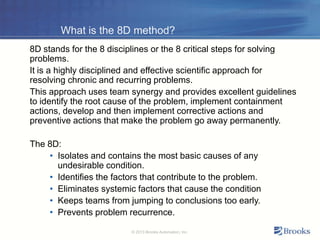
8D method? 8D stands for the 8 disciplines or the 8 critical steps for solving problems. It is a highly disciplined and effective scientific approach for resolving chronic and recurring problems. This approach uses team synergy and provides excellent guidelines to identify the root cause of the problem, implement containment actions, develop and then implement corrective actions and preventive actions that make the problem go away permanently. The 8D: • Isolates and contains the most basic causes of any undesirable condition. • Identifies the factors that contribute to the problem. • Eliminates systemic factors that cause the condition • Keeps teams from jumping to conclusions too early. • Prevents problem recurrence. © 2013 Brooks Automation, Inc.
3.
What are the
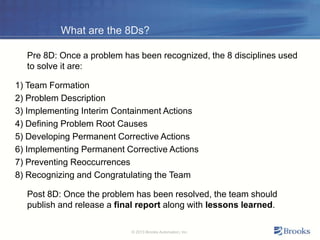
8Ds? Pre 8D: Once a problem has been recognized, the 8 disciplines used to solve it are: 1) Team Formation 2) Problem Description 3) Implementing Interim Containment Actions 4) Defining Problem Root Causes 5) Developing Permanent Corrective Actions 6) Implementing Permanent Corrective Actions 7) Preventing Reoccurrences 8) Recognizing and Congratulating the Team Post 8D: Once the problem has been resolved, the team should publish and release a final report along with lessons learned. © 2013 Brooks Automation, Inc.
4.
When is an
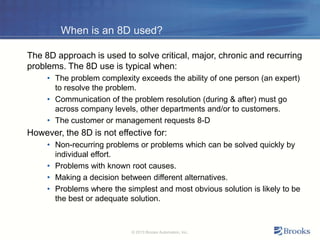
8D used? The 8D approach is used to solve critical, major, chronic and recurring problems. The 8D use is typical when: • The problem complexity exceeds the ability of one person (an expert) to resolve the problem. • Communication of the problem resolution (during & after) must go across company levels, other departments and/or to customers. • The customer or management requests 8-D However, the 8D is not effective for: • Non-recurring problems or problems which can be solved quickly by individual effort. • Problems with known root causes. • Making a decision between different alternatives. • Problems where the simplest and most obvious solution is likely to be the best or adequate solution. © 2013 Brooks Automation, Inc.
5.
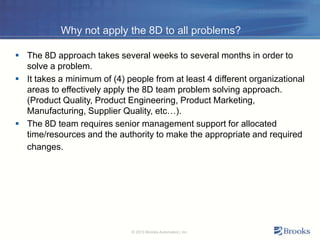
Why not apply
the 8D to all problems? The 8D approach takes several weeks to several months in order to solve a problem. It takes a minimum of (4) people from at least 4 different organizational areas to effectively apply the 8D team problem solving approach. (Product Quality, Product Engineering, Product Marketing, Manufacturing, Supplier Quality, etc…). The 8D team requires senior management support for allocated time/resources and the authority to make the appropriate and required changes. © 2013 Brooks Automation, Inc.
6.
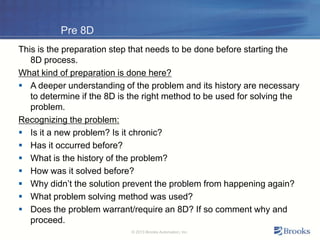
Pre 8D This is
the preparation step that needs to be done before starting the 8D process. What kind of preparation is done here? A deeper understanding of the problem and its history are necessary to determine if the 8D is the right method to be used for solving the problem. Recognizing the problem: Is it a new problem? Is it chronic? Has it occurred before? What is the history of the problem? How was it solved before? Why didn’t the solution prevent the problem from happening again? What problem solving method was used? Does the problem warrant/require an 8D? If so comment why and proceed. © 2013 Brooks Automation, Inc.
7.
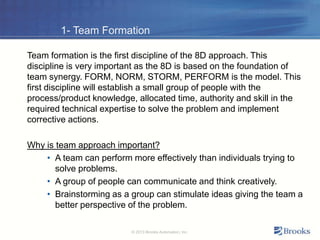
1- Team Formation Team
formation is the first discipline of the 8D approach. This discipline is very important as the 8D is based on the foundation of team synergy. FORM, NORM, STORM, PERFORM is the model. This first discipline will establish a small group of people with the process/product knowledge, allocated time, authority and skill in the required technical expertise to solve the problem and implement corrective actions. Why is team approach important? • A team can perform more effectively than individuals trying to solve problems. • A group of people can communicate and think creatively. • Brainstorming as a group can stimulate ideas giving the team a better perspective of the problem. © 2013 Brooks Automation, Inc.
8.
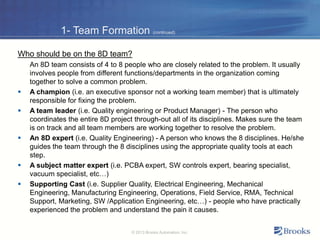
1- Team Formation
(continued) Who should be on the 8D team? An 8D team consists of 4 to 8 people who are closely related to the problem. It usually involves people from different functions/departments in the organization coming together to solve a common problem. A champion (i.e. an executive sponsor not a working team member) that is ultimately responsible for fixing the problem. A team leader (i.e. Quality engineering or Product Manager) - The person who coordinates the entire 8D project through-out all of its disciplines. Makes sure the team is on track and all team members are working together to resolve the problem. An 8D expert (i.e. Quality Engineering) - A person who knows the 8 disciplines. He/she guides the team through the 8 disciplines using the appropriate quality tools at each step. A subject matter expert (i.e. PCBA expert, SW controls expert, bearing specialist, vacuum specialist, etc…) Supporting Cast (i.e. Supplier Quality, Electrical Engineering, Mechanical Engineering, Manufacturing Engineering, Operations, Field Service, RMA, Technical Support, Marketing, SW /Application Engineering, etc…) - people who have practically experienced the problem and understand the pain it causes. © 2013 Brooks Automation, Inc.
9.
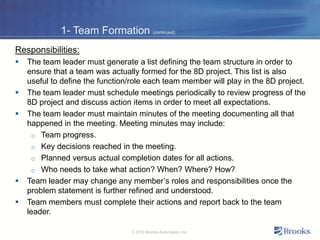
1- Team Formation
(continued) Responsibilities: The team leader must generate a list defining the team structure in order to ensure that a team was actually formed for the 8D project. This list is also useful to define the function/role each team member will play in the 8D project. The team leader must schedule meetings periodically to review progress of the 8D project and discuss action items in order to meet all expectations. The team leader must maintain minutes of the meeting documenting all that happened in the meeting. Meeting minutes may include: o Team progress. o Key decisions reached in the meeting. o Planned versus actual completion dates for all actions. o Who needs to take what action? When? Where? How? Team leader may change any member’s roles and responsibilities once the problem statement is further refined and understood. Team members must complete their actions and report back to the team leader. © 2013 Brooks Automation, Inc.
10.
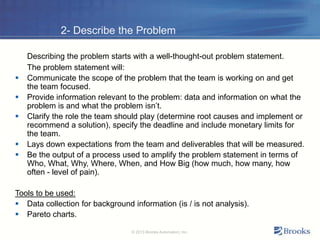
2- Describe the
Problem Describing the problem starts with a well-thought-out problem statement. The problem statement will: Communicate the scope of the problem that the team is working on and get the team focused. Provide information relevant to the problem: data and information on what the problem is and what the problem isn’t. Clarify the role the team should play (determine root causes and implement or recommend a solution), specify the deadline and include monetary limits for the team. Lays down expectations from the team and deliverables that will be measured. Be the output of a process used to amplify the problem statement in terms of Who, What, Why, Where, When, and How Big (how much, how many, how often - level of pain). Tools to be used: Data collection for background information (is / is not analysis). Pareto charts. © 2013 Brooks Automation, Inc.
11.
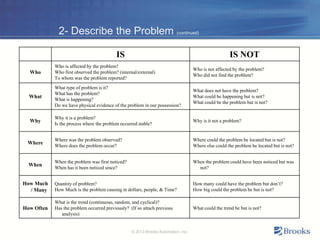
2- Describe the
Problem (continued) IS IS NOT Who Who is affected by the problem? Who first observed the problem? (internal/external) To whom was the problem reported? Who is not affected by the problem? Who did not find the problem? What What type of problem is it? What has the problem? What is happening? Do we have physical evidence of the problem in our possession? What does not have the problem? What could be happening but is not? What could be the problem but is not? Why Why it is a problem? Is the process where the problem occurred stable? Why is it not a problem? Where Where was the problem observed? Where does the problem occur? Where could the problem be located but is not? Where else could the problem be located but is not? When When the problem was first noticed? When has it been noticed since? When the problem could have been noticed but was not? How Much / Many Quantity of problem? How Much is the problem causing in dollars, people, & Time? How many could have the problem but don’t? How big could the problem be but is not? How Often What is the trend (continuous, random, and cyclical)? Has the problem occurred previously? (If so attach previous analysis) What could the trend be but is not? © 2013 Brooks Automation, Inc.
12.
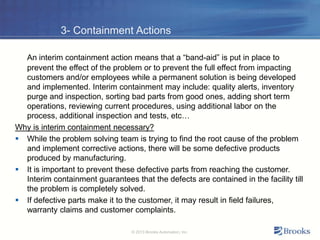
3- Containment Actions An
interim containment action means that a “band-aid” is put in place to prevent the effect of the problem or to prevent the full effect from impacting customers and/or employees while a permanent solution is being developed and implemented. Interim containment may include: quality alerts, inventory purge and inspection, sorting bad parts from good ones, adding short term operations, reviewing current procedures, using additional labor on the process, additional inspection and tests, etc… Why is interim containment necessary? While the problem solving team is trying to find the root cause of the problem and implement corrective actions, there will be some defective products produced by manufacturing. It is important to prevent these defective parts from reaching the customer. Interim containment guarantees that the defects are contained in the facility till the problem is completely solved. If defective parts make it to the customer, it may result in field failures, warranty claims and customer complaints. © 2013 Brooks Automation, Inc.
13.
3- Containment Actions
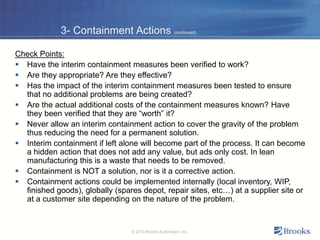
(continued) Check Points: Have the interim containment measures been verified to work? Are they appropriate? Are they effective? Has the impact of the interim containment measures been tested to ensure that no additional problems are being created? Are the actual additional costs of the containment measures known? Have they been verified that they are “worth” it? Never allow an interim containment action to cover the gravity of the problem thus reducing the need for a permanent solution. Interim containment if left alone will become part of the process. It can become a hidden action that does not add any value, but ads only cost. In lean manufacturing this is a waste that needs to be removed. Containment is NOT a solution, nor is it a corrective action. Containment actions could be implemented internally (local inventory, WIP, finished goods), globally (spares depot, repair sites, etc…) at a supplier site or at a customer site depending on the nature of the problem. © 2013 Brooks Automation, Inc.
14.
4- Develop Root
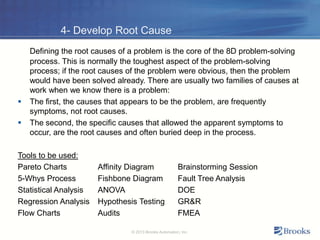
Cause Defining the root causes of a problem is the core of the 8D problem-solving process. This is normally the toughest aspect of the problem-solving process; if the root causes of the problem were obvious, then the problem would have been solved already. There are usually two families of causes at work when we know there is a problem: The first, the causes that appears to be the problem, are frequently symptoms, not root causes. The second, the specific causes that allowed the apparent symptoms to occur, are the root causes and often buried deep in the process. Tools to be used: Pareto Charts Affinity Diagram Brainstorming Session 5-Whys Process Fishbone Diagram Fault Tree Analysis Statistical Analysis ANOVA DOE Regression Analysis Hypothesis Testing GR&R Flow Charts Audits FMEA © 2013 Brooks Automation, Inc.
15.
4- Develop Root
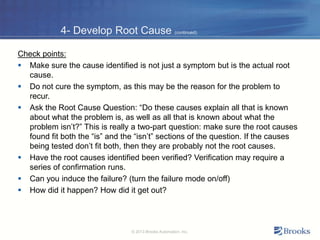
Cause (continued) Check points: Make sure the cause identified is not just a symptom but is the actual root cause. Do not cure the symptom, as this may be the reason for the problem to recur. Ask the Root Cause Question: “Do these causes explain all that is known about what the problem is, as well as all that is known about what the problem isn’t?” This is really a two-part question: make sure the root causes found fit both the “is” and the “isn’t” sections of the question. If the causes being tested don’t fit both, then they are probably not the root causes. Have the root causes identified been verified? Verification may require a series of confirmation runs. Can you induce the failure? (turn the failure mode on/off) How did it happen? How did it get out? © 2013 Brooks Automation, Inc.
16.
4- Develop Root
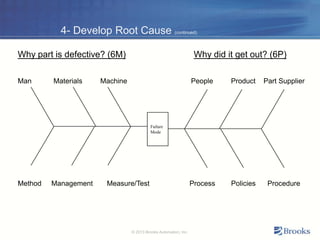
Cause (continued) Why part is defective? (6M) Why did it get out? (6P) Man Materials Machine People Product Part Supplier Method Management Measure/Test Process Policies Procedure Failure Mode © 2013 Brooks Automation, Inc.
17.
4- Develop Root
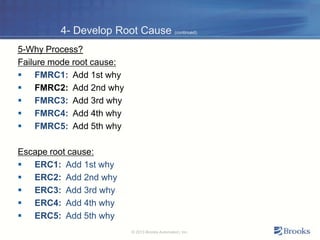
Cause (continued) 5-Why Process? Failure mode root cause: FMRC1: Add 1st why FMRC2: Add 2nd why FMRC3: Add 3rd why FMRC4: Add 4th why FMRC5: Add 5th why Escape root cause: ERC1: Add 1st why ERC2: Add 2nd why ERC3: Add 3rd why ERC4: Add 4th why ERC5: Add 5th why © 2013 Brooks Automation, Inc.
18.
5- Develop Permanent
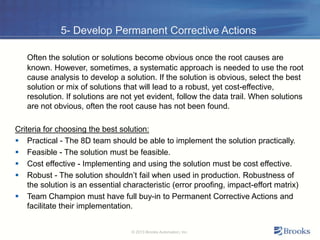
Corrective Actions Often the solution or solutions become obvious once the root causes are known. However, sometimes, a systematic approach is needed to use the root cause analysis to develop a solution. If the solution is obvious, select the best solution or mix of solutions that will lead to a robust, yet cost-effective, resolution. If solutions are not yet evident, follow the data trail. When solutions are not obvious, often the root cause has not been found. Criteria for choosing the best solution: Practical - The 8D team should be able to implement the solution practically. Feasible - The solution must be feasible. Cost effective - Implementing and using the solution must be cost effective. Robust - The solution shouldn’t fail when used in production. Robustness of the solution is an essential characteristic (error proofing, impact-effort matrix) Team Champion must have full buy-in to Permanent Corrective Actions and facilitate their implementation. © 2013 Brooks Automation, Inc.
19.
5- Develop Permanent
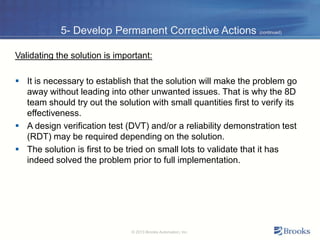
Corrective Actions (continued) Validating the solution is important: It is necessary to establish that the solution will make the problem go away without leading into other unwanted issues. That is why the 8D team should try out the solution with small quantities first to verify its effectiveness. A design verification test (DVT) and/or a reliability demonstration test (RDT) may be required depending on the solution. The solution is first to be tried on small lots to validate that it has indeed solved the problem prior to full implementation. © 2013 Brooks Automation, Inc.
20.
5- Develop Permanent
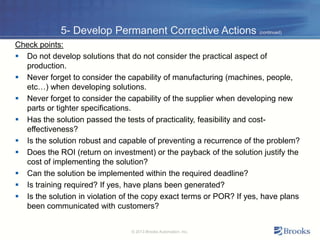
Corrective Actions (continued) Check points: Do not develop solutions that do not consider the practical aspect of production. Never forget to consider the capability of manufacturing (machines, people, etc…) when developing solutions. Never forget to consider the capability of the supplier when developing new parts or tighter specifications. Has the solution passed the tests of practicality, feasibility and cost- effectiveness? Is the solution robust and capable of preventing a recurrence of the problem? Does the ROI (return on investment) or the payback of the solution justify the cost of implementing the solution? Can the solution be implemented within the required deadline? Is training required? If yes, have plans been generated? Is the solution in violation of the copy exact terms or POR? If yes, have plans been communicated with customers? © 2013 Brooks Automation, Inc.
21.
6- Implement Permanent
Corrective Actions Once the solution and its implementation are approved, the next step is to create an Action Plan. The Action Plan outlines what steps are needed to implement the solution, who will do them, and when they will be completed. A Simple Action Plan merely documents what needs to be done, who will do it, and when will it be done by. A complex solution needs more thorough planning and documentation. Check points: Is a Simple Action Plan (who will do what by when) adequate or will a Complex Action Plan be needed? If a Complex Action Plan is needed, have Activity Plans, Gantt Charts and PERT Charts been developed? Part of implementing a solution is to document new procedures or changes to procedures as well as any changes that relate to the organization’s quality system; has this been done? Has training to support the new system (s) been developed and provided? After people use the new or revised process a few times, they most likely will have some improvement ideas. Have the suggestions been assessed, and have corresponding adjustments been made to the process, has the documentation been updated, and has retraining been provided? © 2013 Brooks Automation, Inc.
22.
7- Prevent Re-occurrence The
job of a problem-solving team is not complete once the solution is implemented. Preventing recurrence is an important part of a problem’s solution. To prevent recurrence of the problem, the team must verify that the outcome of their Action Plan works and they must validate that the outcome is on-target. Verification is testing that the solution produces the desired outcome; validation is ensuring that the outcome really solves the problem. Check points: Has the outcome of the Action Plan been verified to work? Has the outcome been validated to be on-target? Have Action Plan results been documented, related procedures updated, and corresponding changes to any affected quality system elements made? Have audits been established to assess the use and effectiveness of the solution to ensure that the gains are held? Have the results been leveraged to prevent occurrences of like problems in all similar operations? Are all necessary controls for the solution are in place? Tools to be used: Control charts Control plans Histogram Capability Analysis FMEA GR&R © 2013 Brooks Automation, Inc.
23.
8- Recognize the
Team Once a team has completed implementing the solution and ensured that the solution works, all team members deserve to be congratulated. Team members need to know that their efforts are appreciated and that the organization knows about their accomplishments. The organization (leadership group) shall recognize the team for their efforts in a timely manner. The project team shall recognize those that have provided the team with support and assistance. © 2013 Brooks Automation, Inc.
24.
Post 8D Once the
problem has been resolved, the team should publish and release a final report along with lessons learned. The 8D report gives a quick snapshot of what was done in the project and categorizes them under the 8 Disciplines. The report serves as a communication tool showing overall progress of the 8D project along with actions taken. Also, a very useful tool to share is the "Lessons Learned" and project findings. Completed 8Ds to be posted on the shared quality site (under 8D reports). © 2013 Brooks Automation, Inc.
25.
8D Problem Report Add
Report Title Add report author name Add report date © 2013 Brooks Automation, Inc.
26.
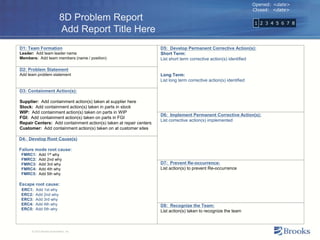
8D Problem Report Add
Report Title Here © 2013 Brooks Automation, Inc. D1: Team Formation Leader: Add team leader name Members: Add team members (name / position) D5: Develop Permanent Corrective Action(s): Short Term: List short term corrective action(s) identified Long Term: List long term corrective action(s) identified D3: Containment Action(s): Supplier: Add containment action(s) taken at supplier here Stock: Add containment action(s) taken in parts in stock WIP: Add containment action(s) taken on parts in WIP FGI: Add containment action(s) taken on parts in FGI Repair Centers: Add containment action(s) taken at repair centers Customer: Add containment action(s) taken on at customer sites D2: Problem Statement Add team problem statement D4: Develop Root Cause(s) Failure mode root cause: FMRC1: Add 1st why FMRC2: Add 2nd why FMRC3: Add 3rd why FMRC4: Add 4th why FMRC5: Add 5th why Escape root cause: ERC1: Add 1st why ERC2: Add 2nd why ERC3: Add 3rd why ERC4: Add 4th why ERC5: Add 5th why Opened: <date> Closed: <date> D6: Implement Permanent Corrective Action(s): List corrective action(s) implemented D7: Prevent Re-occurrence: List action(s) to prevent Re-occurrence D8: Recognize the Team: List action(s) taken to recognize the team 5 2 1 3 6 4 7 8
27.
© 2013 Brooks
Automation, Inc. # Actions Owner Date Due Date Completed Comments Status Action Item Table
Download