Tourism
Unit 3 – June 6th 2014
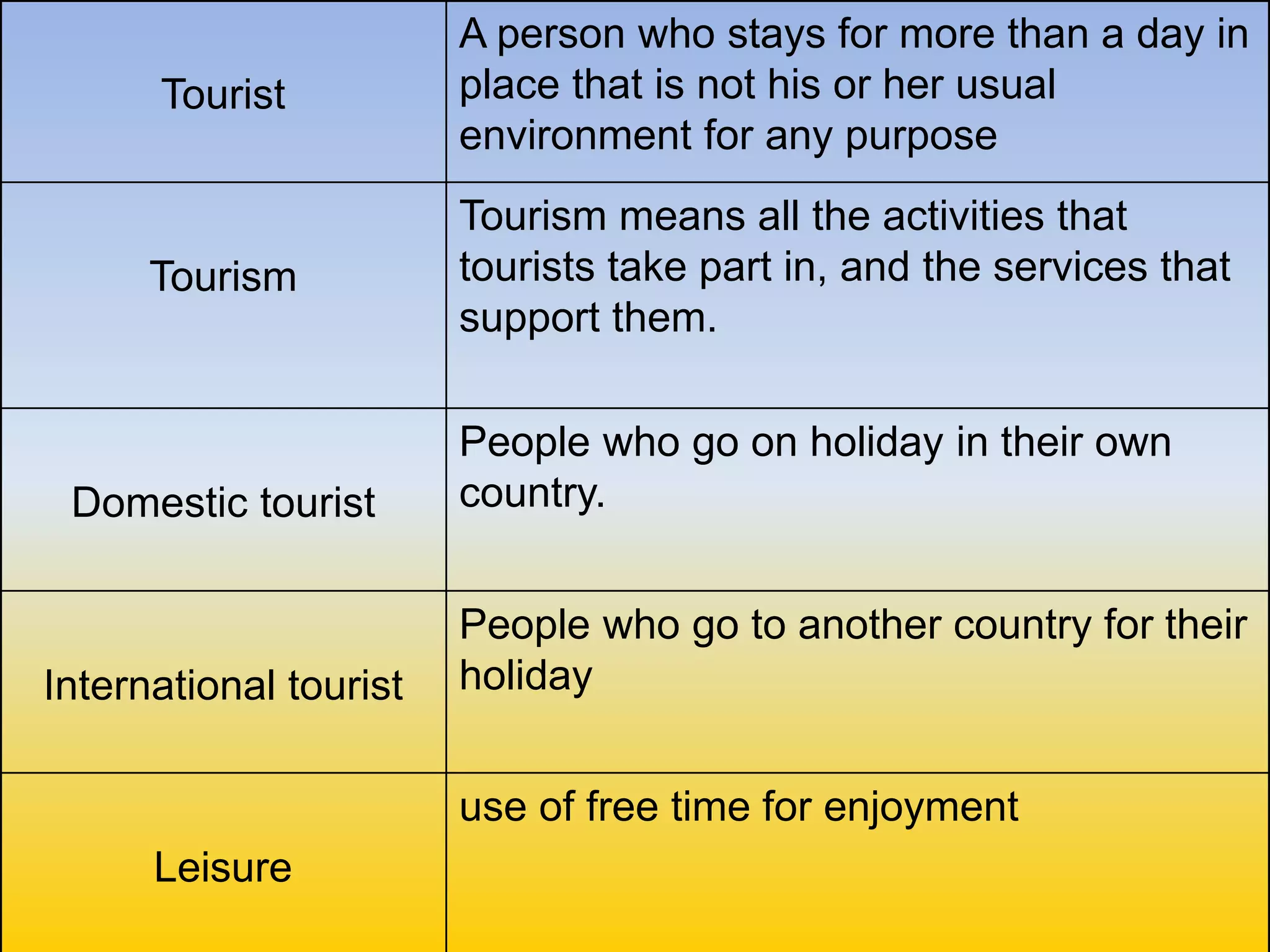
Tourist
A person who stays for more than a day in
place that is not his or her usual
environment for any purpose
Tourism
Tourism means all the activities that
tourists take part in, and the services that
support them.
Domestic tourist
People who go on holiday in their own
country.
International tourist
People who go to another country for their
holiday
Leisure
use of free time for enjoyment
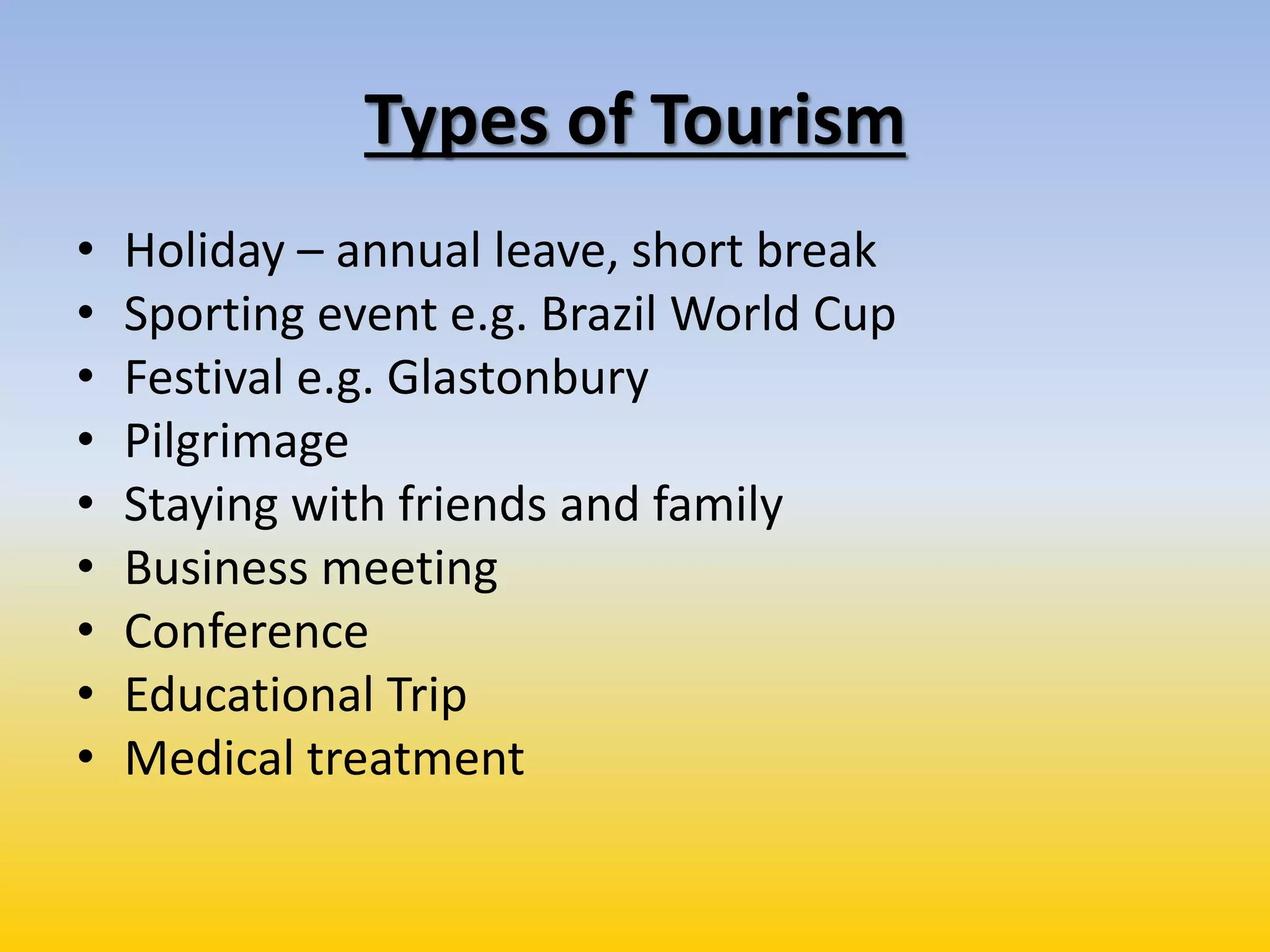
Types of Tourism
• Holiday – annual leave, short break
• Sporting event e.g. Brazil World Cup
• Festival e.g. Glastonbury
• Pilgrimage
• Staying with friends and family
• Business meeting
• Conference
• Educational Trip
• Medical treatment
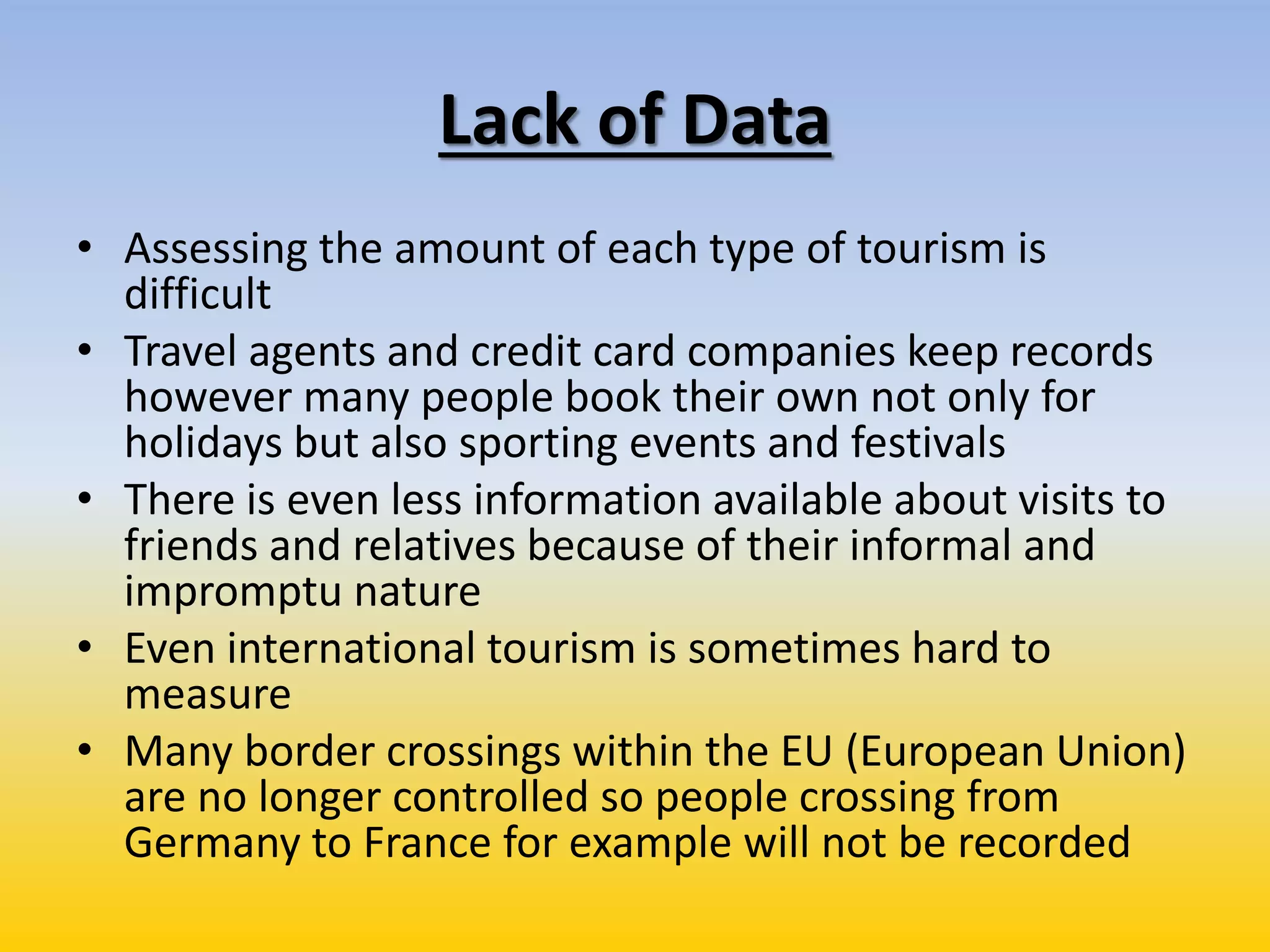
Lack of Data
• Assessing the amount of each type of tourism is
difficult
• Travel agents and credit card companies keep records
however many people book their own not only for
holidays but also sporting events and festivals
• There is even less information available about visits to
friends and relatives because of their informal and
impromptu nature
• Even international tourism is sometimes hard to
measure
• Many border crossings within the EU (European Union)
are no longer controlled so people crossing from
Germany to France for example will not be recorded
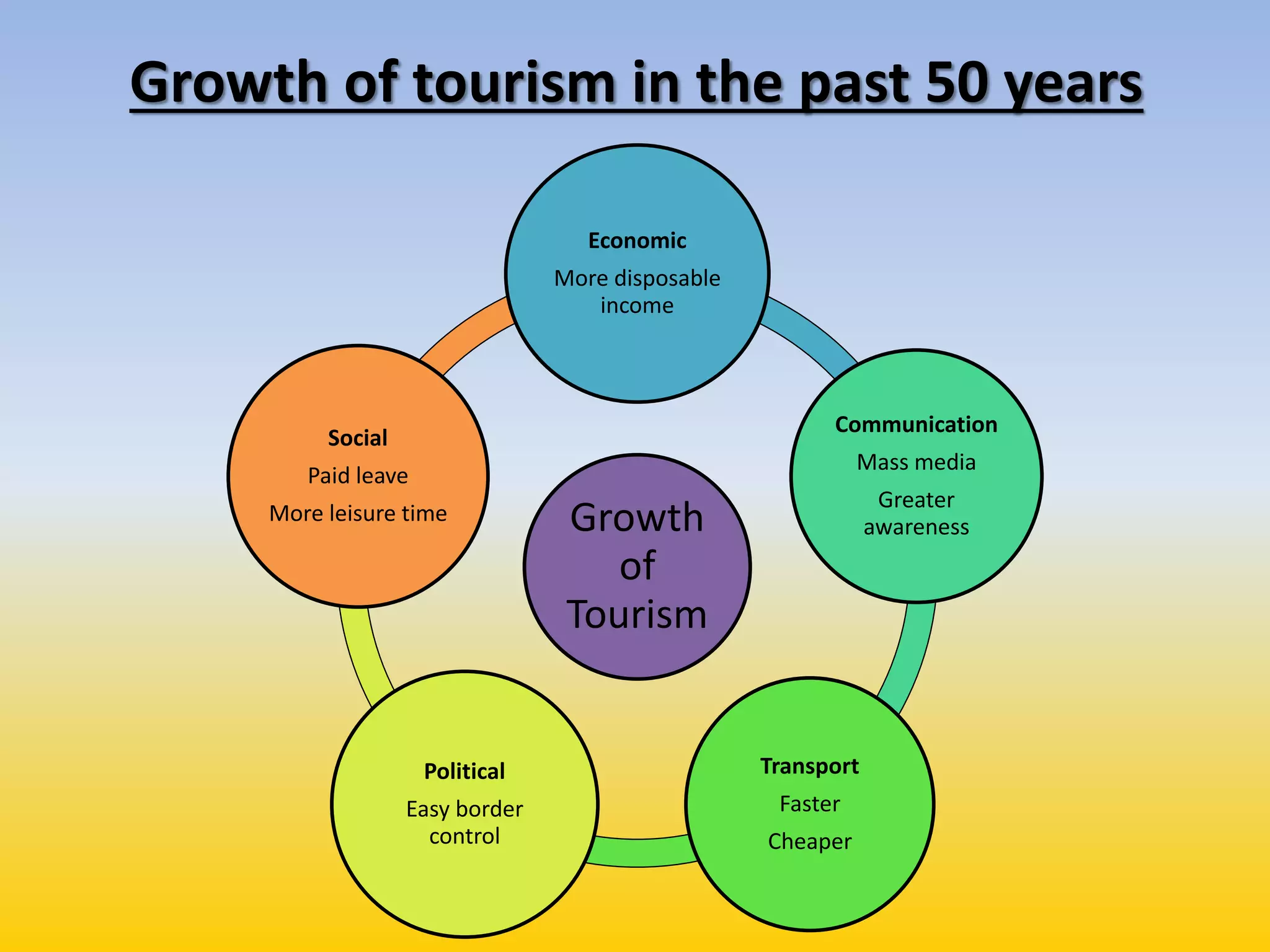
Growth of tourism in the past 50 years
Growth
of
Tourism
Economic
More disposable
income
Communication
Mass media
Greater
awareness
Transport
Faster
Cheaper
Political
Easy border
control
Social
Paid leave
More leisure time
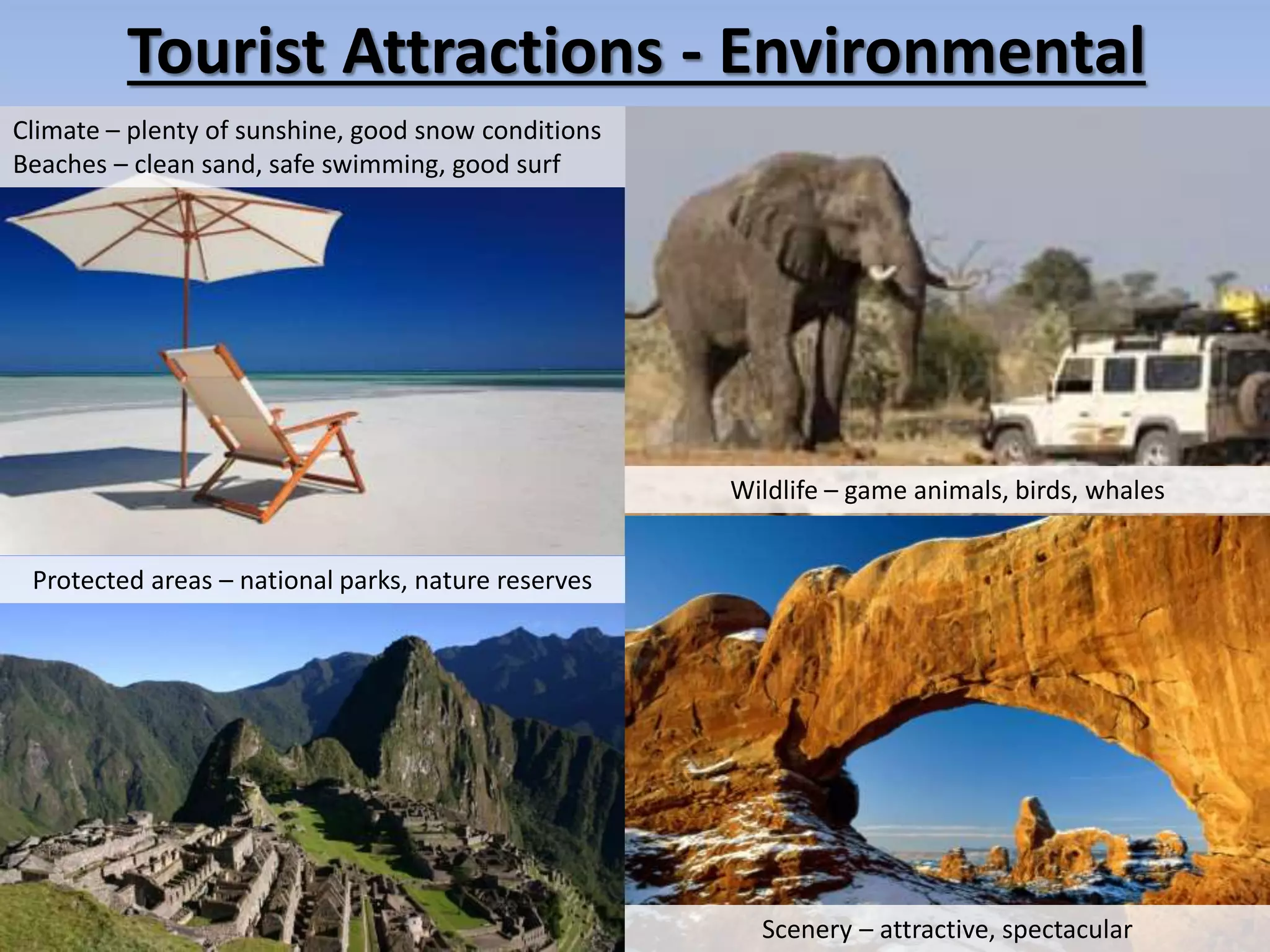
Tourist Attractions - Environmental
Climate – plenty of sunshine, good snow conditions
Beaches – clean sand, safe swimming, good surf
Protected areas – national parks, nature reserves
Scenery – attractive, spectacular
Wildlife – game animals, birds, whales
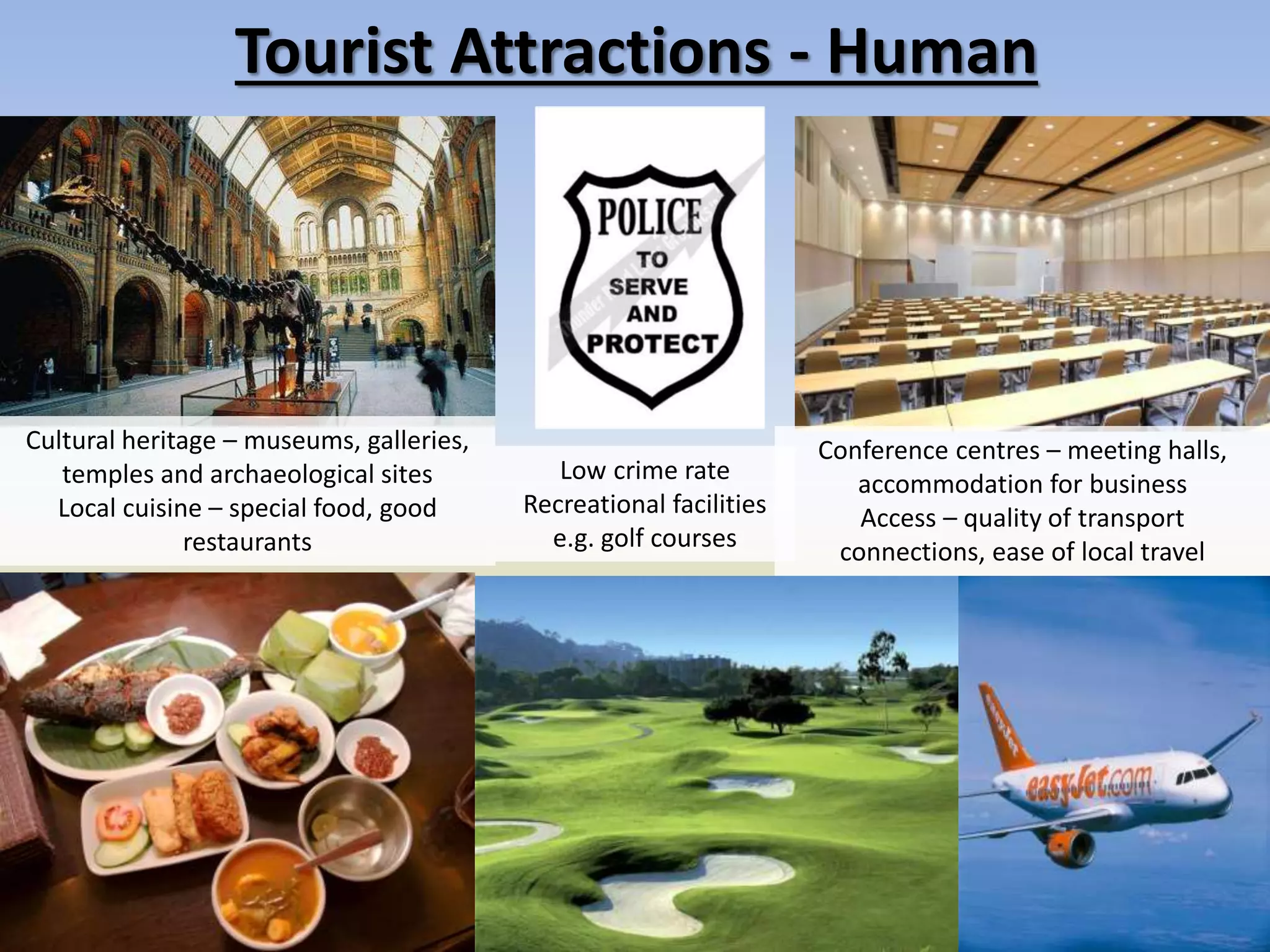
Tourist Attractions - Human
Cultural heritage – museums, galleries,
temples and archaeological sites
Local cuisine – special food, good
restaurants
Conference centres – meeting halls,
accommodation for business
Access – quality of transport
connections, ease of local travel
Low crime rate
Recreational facilities
e.g. golf courses
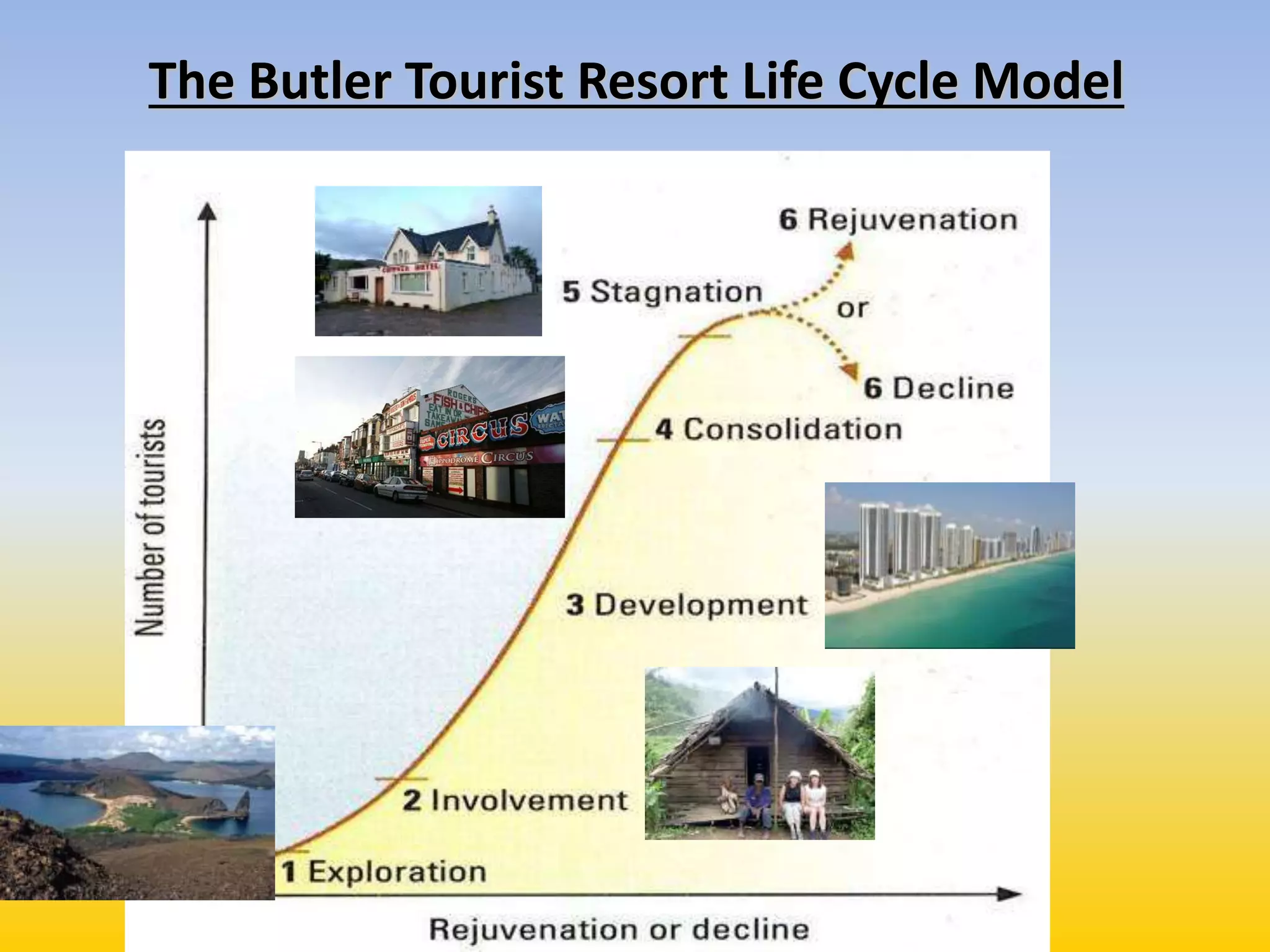
The Butler Tourist Resort Life Cycle Model
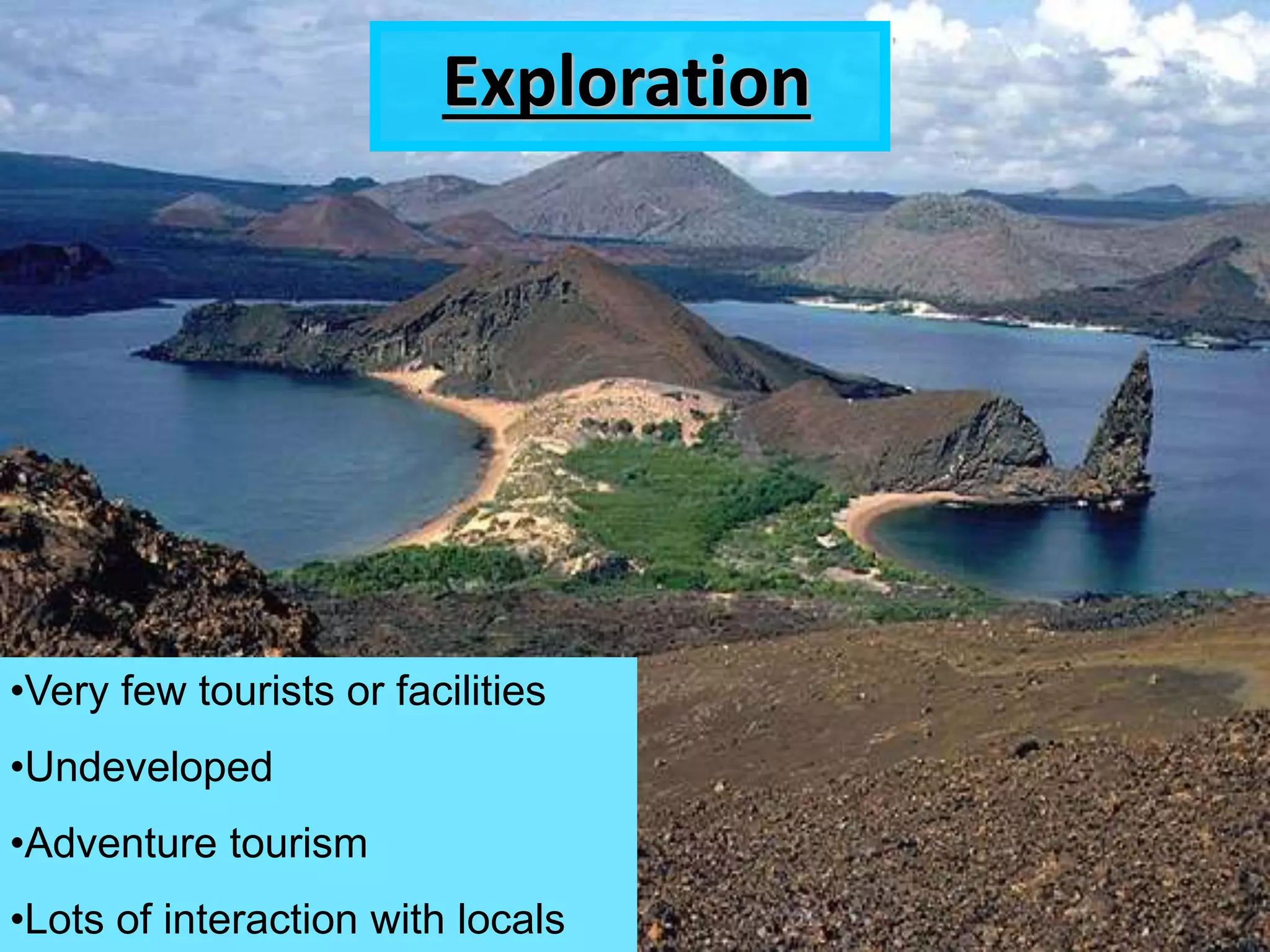
Exploration
•Very few tourists or facilities
•Undeveloped
•Adventure tourism
•Lots of interaction with locals
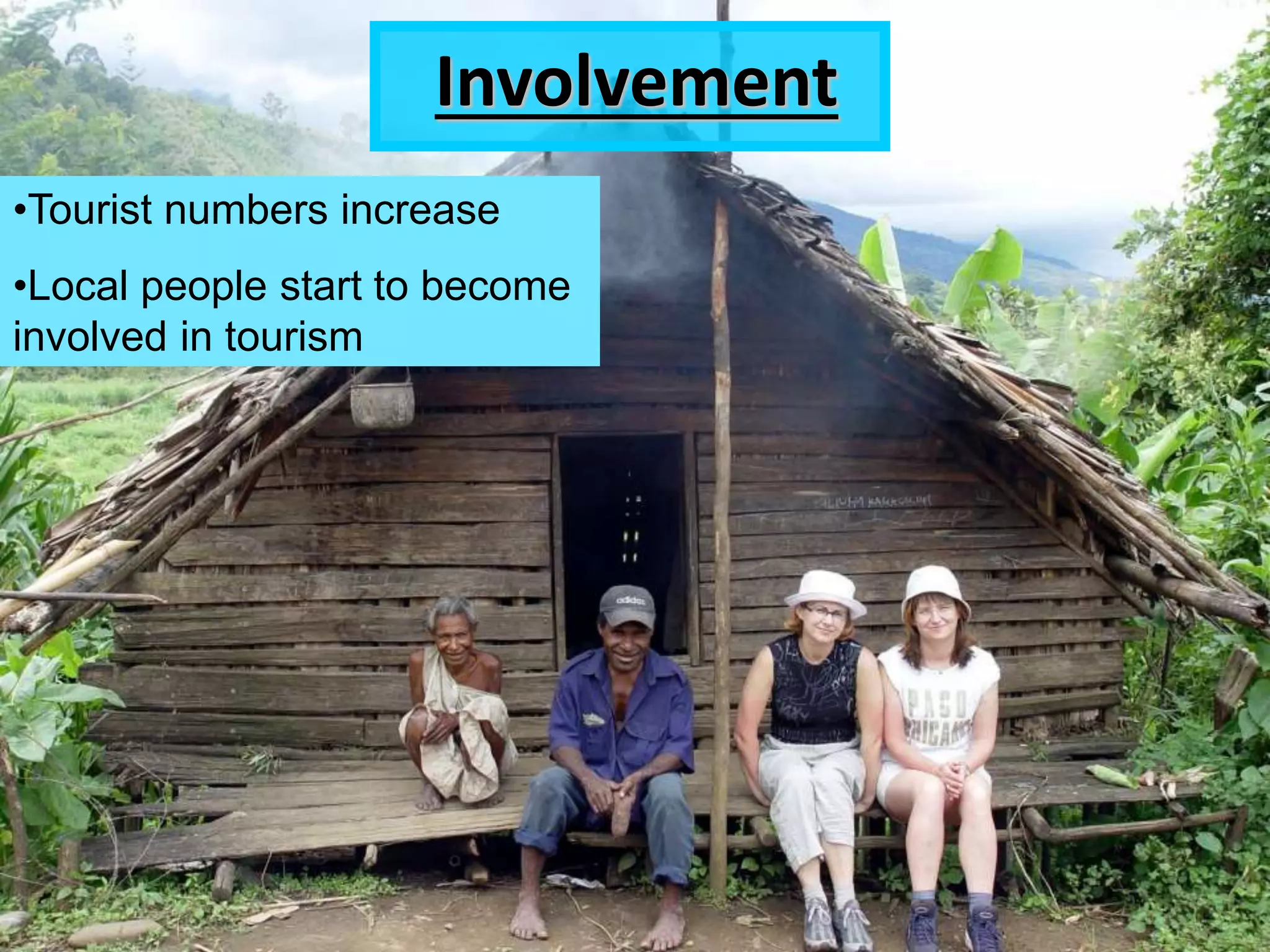
Involvement
•Tourist numbers increase
•Local people start to become
involved in tourism
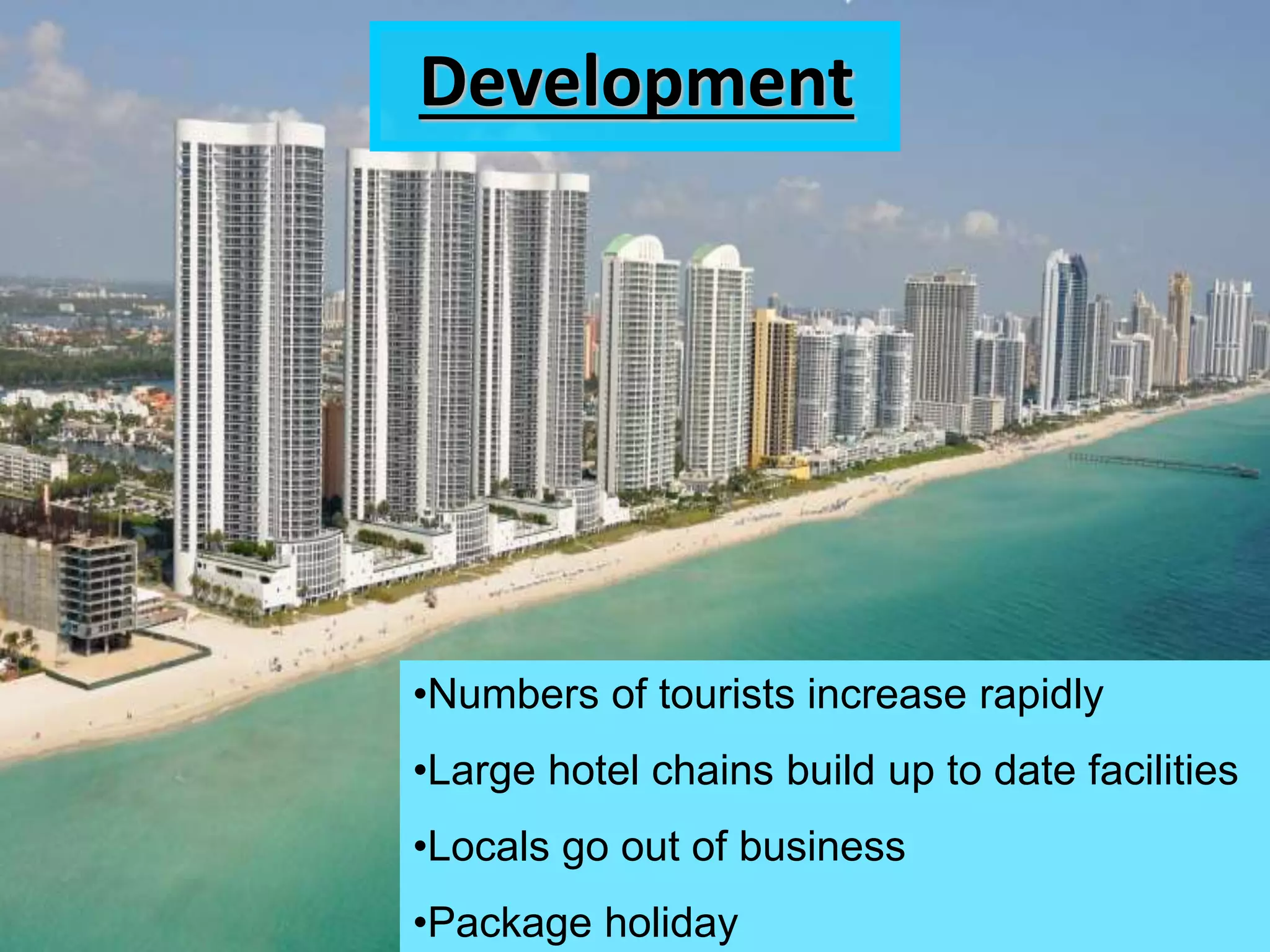
Development
•Numbers of tourists increase rapidly
•Large hotel chains build up to date facilities
•Locals go out of business
•Package holiday
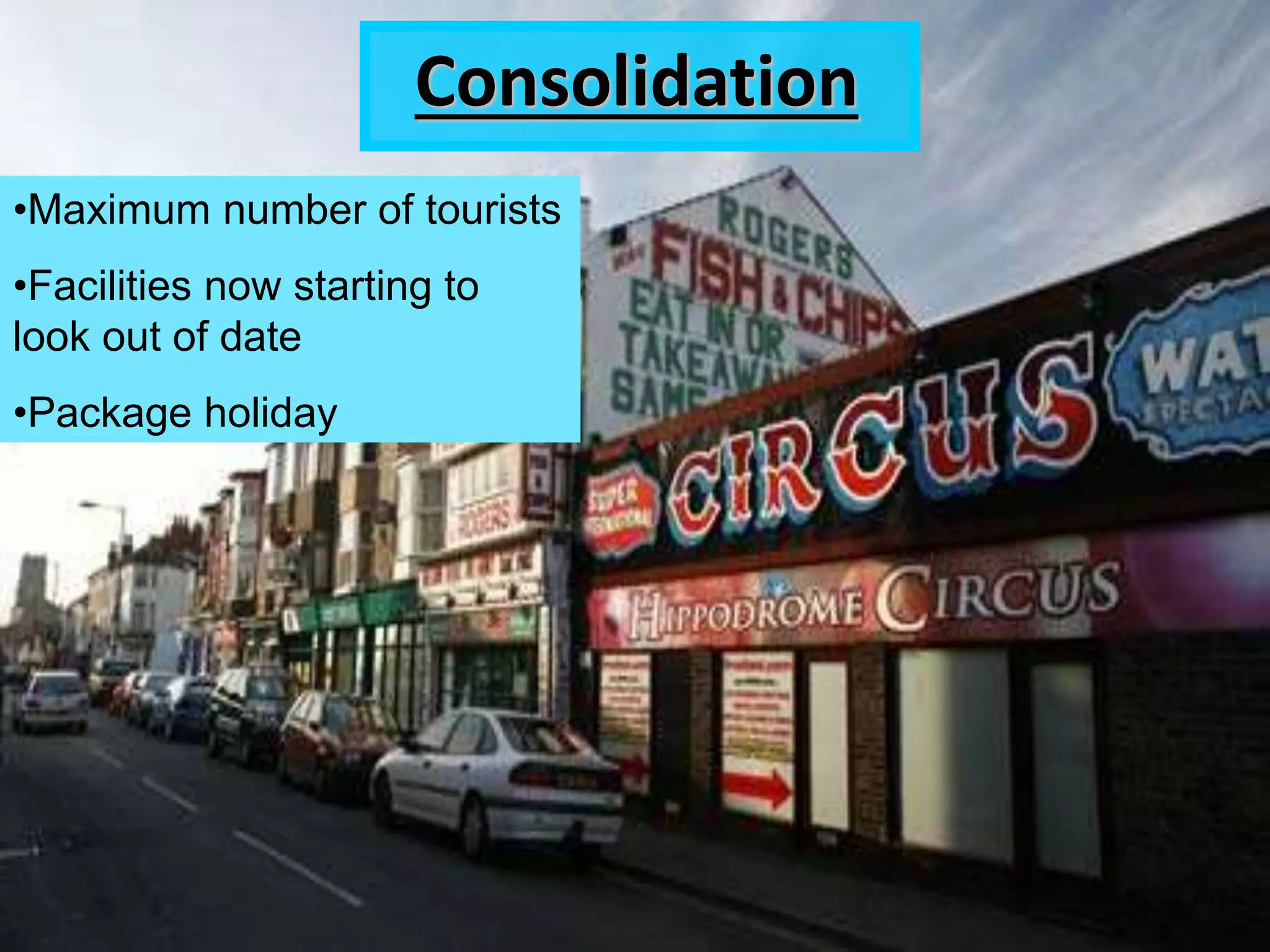
Consolidation
•Maximum number of tourists
•Facilities now starting to
look out of date
•Package holiday
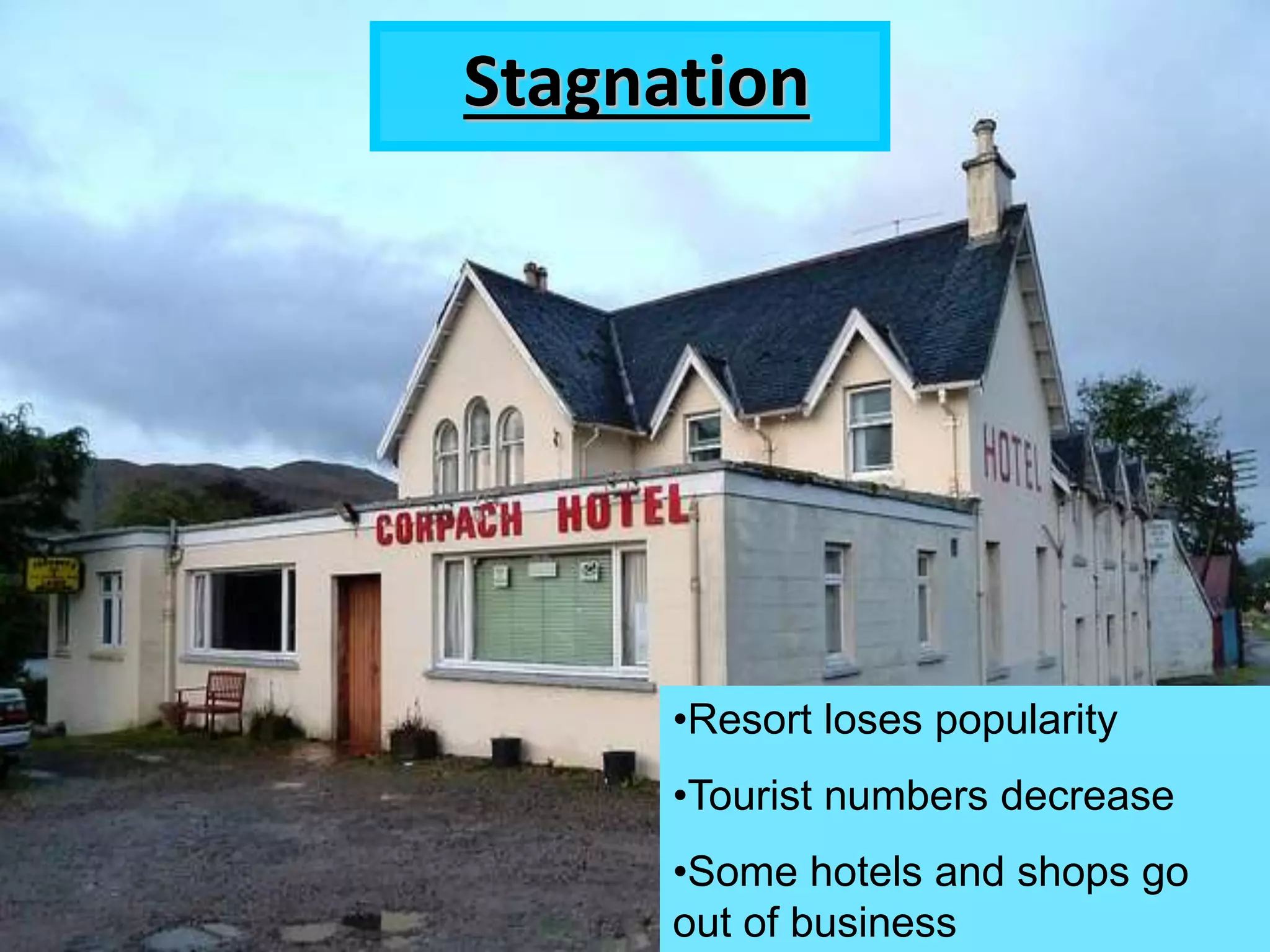
Stagnation
•Resort loses popularity
•Tourist numbers decrease
•Some hotels and shops go
out of business
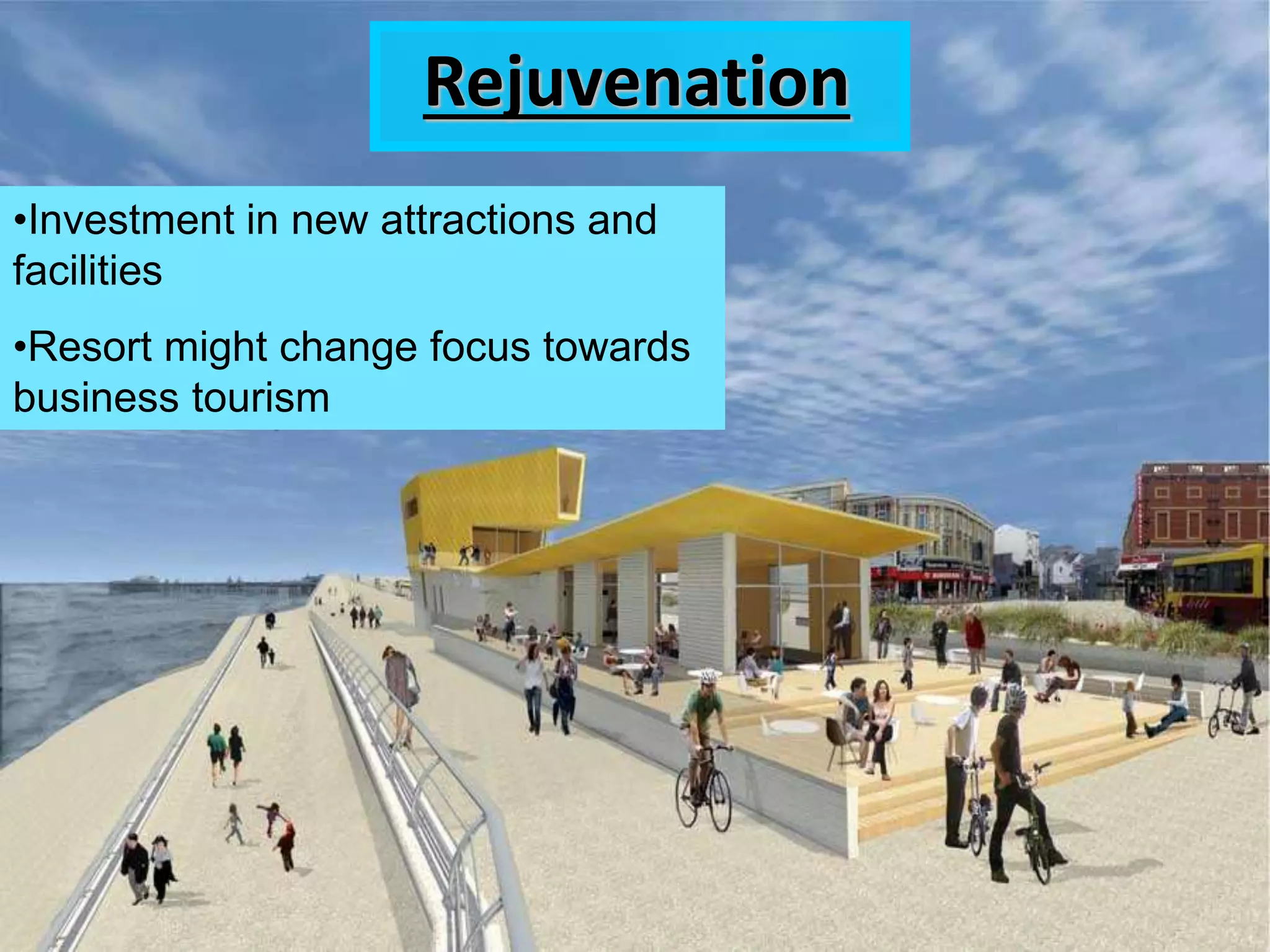
Rejuvenation
•Investment in new attractions and
facilities
•Resort might change focus towards
business tourism
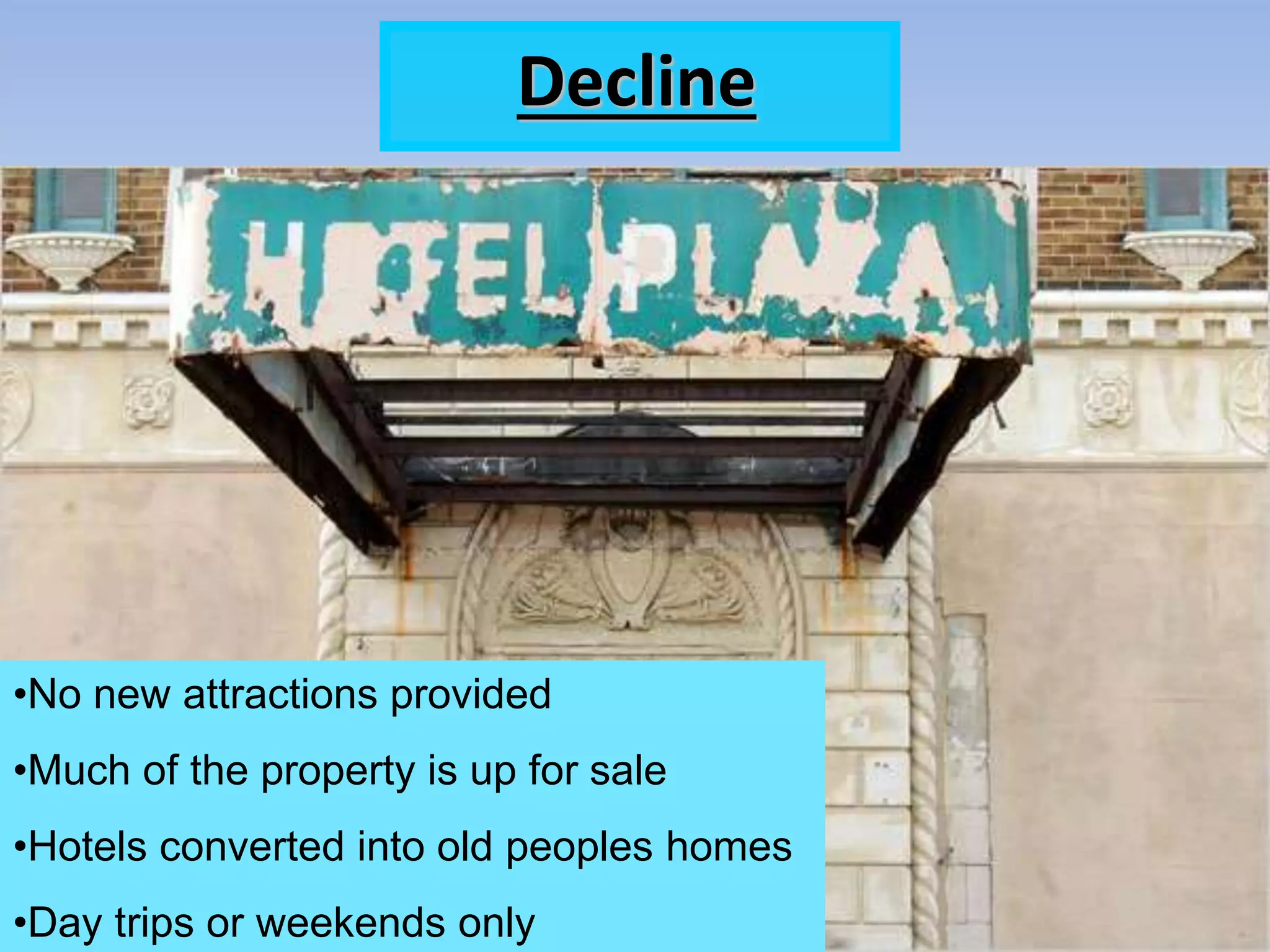
Decline
•No new attractions provided
•Much of the property is up for sale
•Hotels converted into old peoples homes
•Day trips or weekends only
Blackpool on the Butler Model
• 1800 = exploration. Only wealthy people
• 1846 = involvement. New railway means many
people now able to visit
• 1870 = development. Workers get annual
holiday. The tower, promenade, piers,
amusement arcades, theatres and music halls
built.
• 1918 – 1939 = consolidation. Popularity
continued, one of Europe’s leading resorts
• 1960 = decline. Package holidays to Spain now
more popular, few new attractions
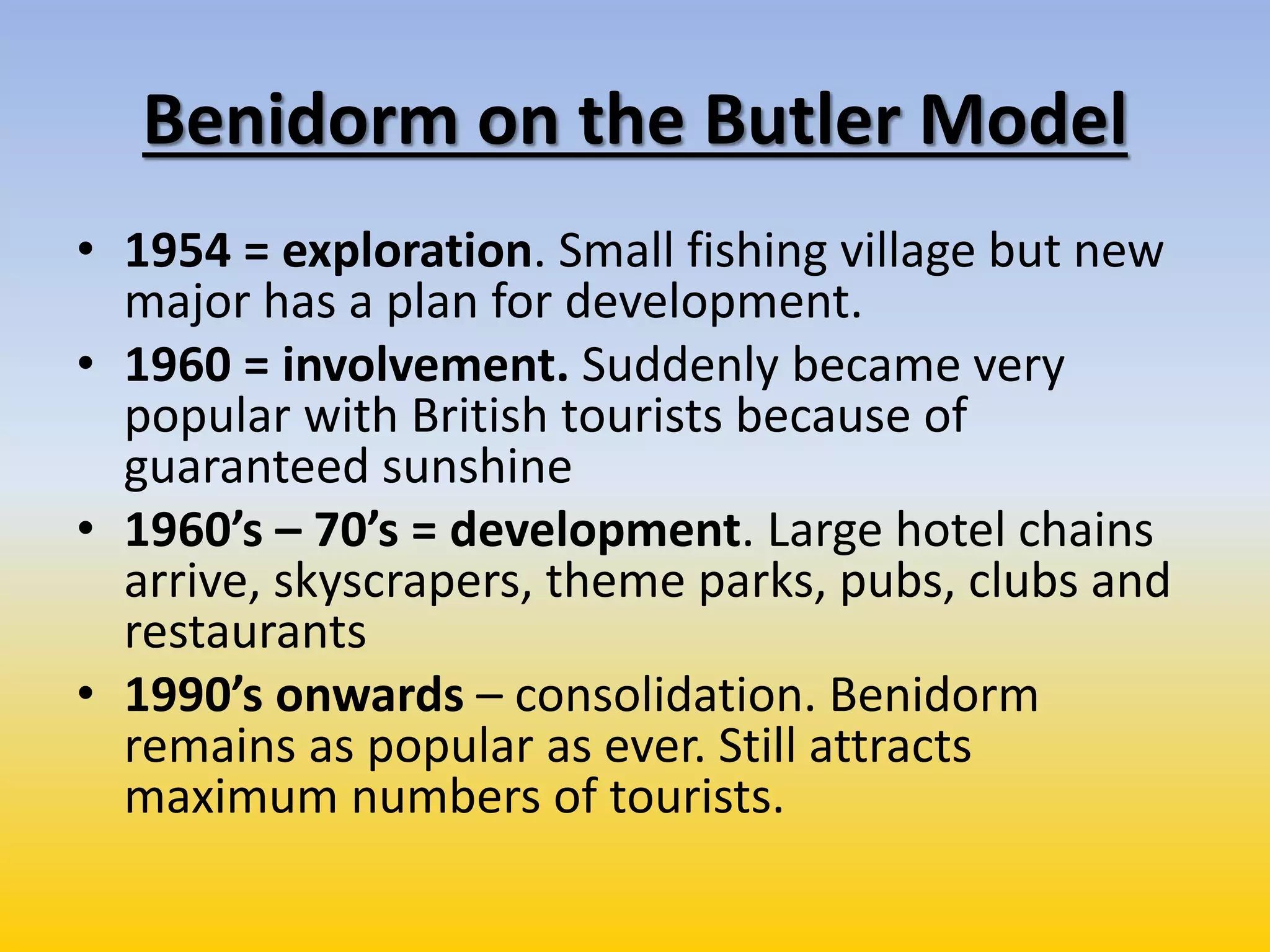
Benidorm on the Butler Model
• 1954 = exploration. Small fishing village but new
major has a plan for development.
• 1960 = involvement. Suddenly became very
popular with British tourists because of
guaranteed sunshine
• 1960’s – 70’s = development. Large hotel chains
arrive, skyscrapers, theme parks, pubs, clubs and
restaurants
• 1990’s onwards – consolidation. Benidorm
remains as popular as ever. Still attracts
maximum numbers of tourists.
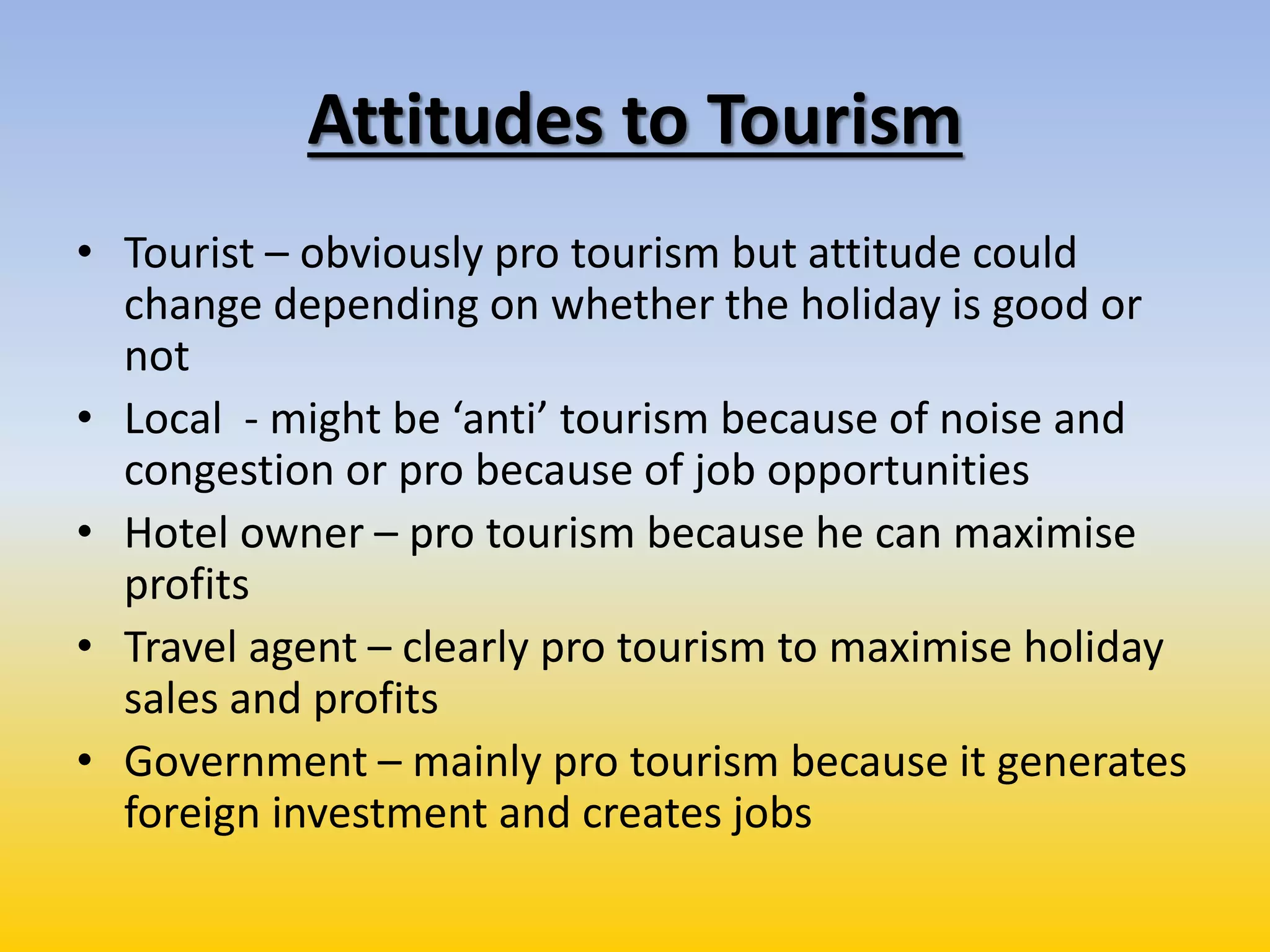
Attitudes to Tourism
• Tourist – obviously pro tourism but attitude could
change depending on whether the holiday is good or
not
• Local - might be ‘anti’ tourism because of noise and
congestion or pro because of job opportunities
• Hotel owner – pro tourism because he can maximise
profits
• Travel agent – clearly pro tourism to maximise holiday
sales and profits
• Government – mainly pro tourism because it generates
foreign investment and creates jobs
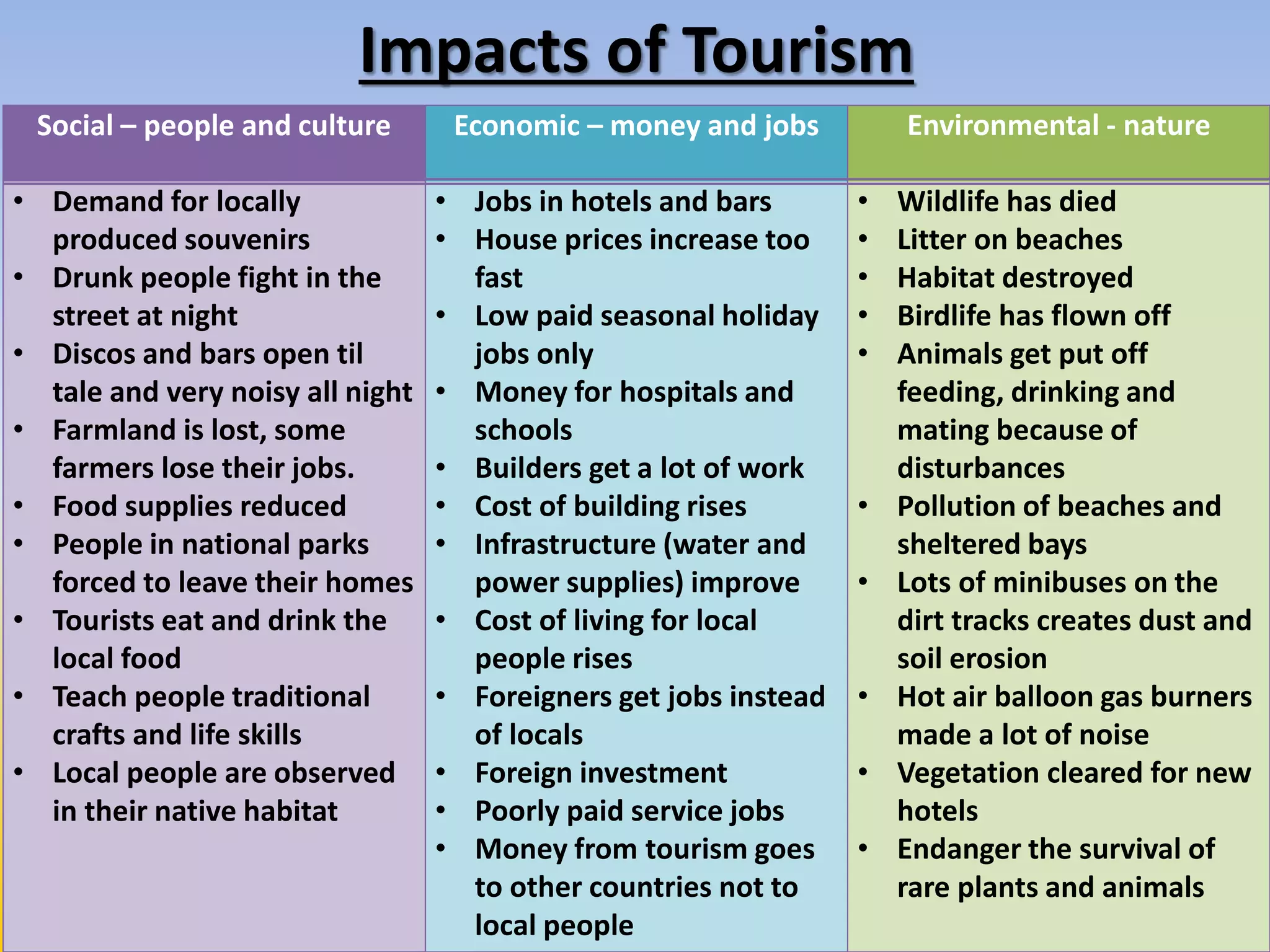
Impacts of Tourism
Social – people and culture Economic – money and jobs Environmental - nature
• Demand for locally
produced souvenirs
• Drunk people fight in the
street at night
• Discos and bars open til
tale and very noisy all night
• Farmland is lost, some
farmers lose their jobs.
• Food supplies reduced
• People in national parks
forced to leave their homes
• Tourists eat and drink the
local food
• Teach people traditional
crafts and life skills
• Local people are observed
in their native habitat
• Jobs in hotels and bars
• House prices increase too
fast
• Low paid seasonal holiday
jobs only
• Money for hospitals and
schools
• Builders get a lot of work
• Cost of building rises
• Infrastructure (water and
power supplies) improve
• Cost of living for local
people rises
• Foreigners get jobs instead
of locals
• Foreign investment
• Poorly paid service jobs
• Money from tourism goes
to other countries not to
local people
• Wildlife has died
• Litter on beaches
• Habitat destroyed
• Birdlife has flown off
• Animals get put off
feeding, drinking and
mating because of
disturbances
• Pollution of beaches and
sheltered bays
• Lots of minibuses on the
dirt tracks creates dust and
soil erosion
• Hot air balloon gas burners
made a lot of noise
• Vegetation cleared for new
hotels
• Endanger the survival of
rare plants and animals
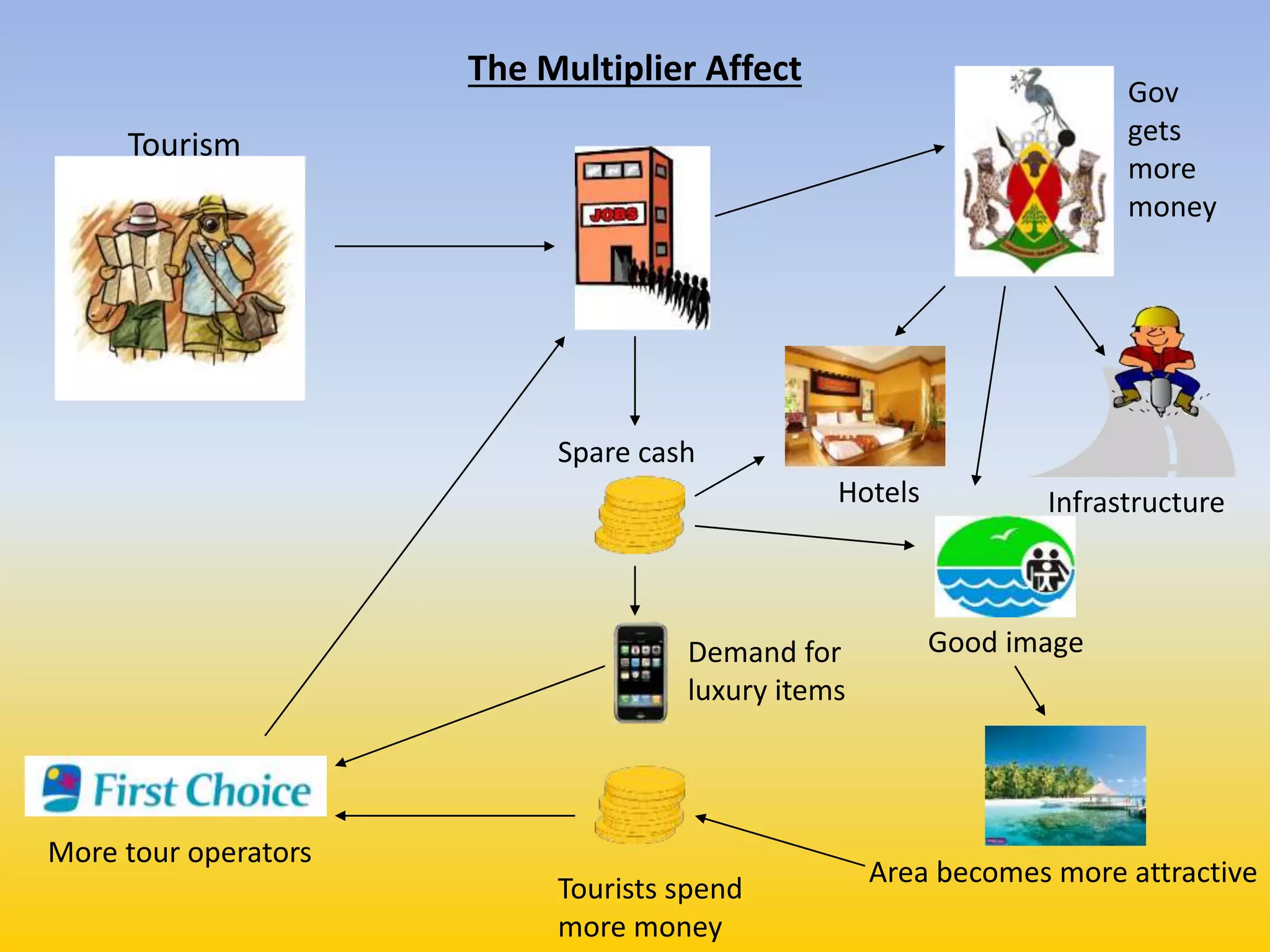
The Multiplier Affect
Tourism
Spare cash
Demand for
luxury items
More tour operators
Gov
gets
more
money
Hotels
Good image
Infrastructure
Area becomes more attractive
Tourists spend
more money
Impacts of Tourism in Nepal (LIC)
Social
• Young men have left the village to become porters or guides
• Not enough men left to work the farms. Women take over
• Tourists bring western foods, diet and health improves
• Electricity supplies in more homes
• Schools built, education improves
Economic
• Men have set up businesses in the capital
• Wages are good enough for people to be able to build or improve
houses
• Basic food prices rise
Environmental
• Forested areas are being cleared as more wood for fuel is needed
Ecotourism – The Galapagos Islands
• The islands are famous because there are animals there that are not found
anywhere else in the world. Enabled Charles Darwin to form his theory of
evolution.
How Tourism is Managed?
• They only visit on small boats of 10-16 people which are owned by locals
• Only allowed to visit certain places on the islands
• Have to pay a £25 fee that goes towards conservation of the islands
• Visitors are educated in how to protect and conserve island life while they
are there
• Cost is very expensive so puts off mass tourism
Benefits
• Ecotourism offers jobs for the locals without damaging the environment.
• Local people run small hotels and provide for the needs of tourists not
hotel chains
• Companies run by locals to provide boat trips around island
• Money earned stays with the locals rather than going to large hotel chains
• Improves locals quality of life

EDEXCEL GCSE Geography Unit 3 Tourism Revision

  • 1.
    Tourism Unit 3 –June 6th 2014
  • 2.
    Tourist A person whostays for more than a day in place that is not his or her usual environment for any purpose Tourism Tourism means all the activities that tourists take part in, and the services that support them. Domestic tourist People who go on holiday in their own country. International tourist People who go to another country for their holiday Leisure use of free time for enjoyment
  • 3.
    Types of Tourism •Holiday – annual leave, short break • Sporting event e.g. Brazil World Cup • Festival e.g. Glastonbury • Pilgrimage • Staying with friends and family • Business meeting • Conference • Educational Trip • Medical treatment
  • 4.
    Lack of Data •Assessing the amount of each type of tourism is difficult • Travel agents and credit card companies keep records however many people book their own not only for holidays but also sporting events and festivals • There is even less information available about visits to friends and relatives because of their informal and impromptu nature • Even international tourism is sometimes hard to measure • Many border crossings within the EU (European Union) are no longer controlled so people crossing from Germany to France for example will not be recorded
  • 5.
    Growth of tourismin the past 50 years Growth of Tourism Economic More disposable income Communication Mass media Greater awareness Transport Faster Cheaper Political Easy border control Social Paid leave More leisure time
  • 6.
    Tourist Attractions -Environmental Climate – plenty of sunshine, good snow conditions Beaches – clean sand, safe swimming, good surf Protected areas – national parks, nature reserves Scenery – attractive, spectacular Wildlife – game animals, birds, whales
  • 7.
    Tourist Attractions -Human Cultural heritage – museums, galleries, temples and archaeological sites Local cuisine – special food, good restaurants Conference centres – meeting halls, accommodation for business Access – quality of transport connections, ease of local travel Low crime rate Recreational facilities e.g. golf courses
  • 8.
    The Butler TouristResort Life Cycle Model
  • 9.
    Exploration •Very few touristsor facilities •Undeveloped •Adventure tourism •Lots of interaction with locals
  • 10.
    Involvement •Tourist numbers increase •Localpeople start to become involved in tourism
  • 11.
    Development •Numbers of touristsincrease rapidly •Large hotel chains build up to date facilities •Locals go out of business •Package holiday
  • 12.
    Consolidation •Maximum number oftourists •Facilities now starting to look out of date •Package holiday
  • 13.
    Stagnation •Resort loses popularity •Touristnumbers decrease •Some hotels and shops go out of business
  • 14.
    Rejuvenation •Investment in newattractions and facilities •Resort might change focus towards business tourism
  • 15.
    Decline •No new attractionsprovided •Much of the property is up for sale •Hotels converted into old peoples homes •Day trips or weekends only
  • 16.
    Blackpool on theButler Model • 1800 = exploration. Only wealthy people • 1846 = involvement. New railway means many people now able to visit • 1870 = development. Workers get annual holiday. The tower, promenade, piers, amusement arcades, theatres and music halls built. • 1918 – 1939 = consolidation. Popularity continued, one of Europe’s leading resorts • 1960 = decline. Package holidays to Spain now more popular, few new attractions
  • 17.
    Benidorm on theButler Model • 1954 = exploration. Small fishing village but new major has a plan for development. • 1960 = involvement. Suddenly became very popular with British tourists because of guaranteed sunshine • 1960’s – 70’s = development. Large hotel chains arrive, skyscrapers, theme parks, pubs, clubs and restaurants • 1990’s onwards – consolidation. Benidorm remains as popular as ever. Still attracts maximum numbers of tourists.
  • 18.
    Attitudes to Tourism •Tourist – obviously pro tourism but attitude could change depending on whether the holiday is good or not • Local - might be ‘anti’ tourism because of noise and congestion or pro because of job opportunities • Hotel owner – pro tourism because he can maximise profits • Travel agent – clearly pro tourism to maximise holiday sales and profits • Government – mainly pro tourism because it generates foreign investment and creates jobs
  • 19.
    Impacts of Tourism Social– people and culture Economic – money and jobs Environmental - nature • Demand for locally produced souvenirs • Drunk people fight in the street at night • Discos and bars open til tale and very noisy all night • Farmland is lost, some farmers lose their jobs. • Food supplies reduced • People in national parks forced to leave their homes • Tourists eat and drink the local food • Teach people traditional crafts and life skills • Local people are observed in their native habitat • Jobs in hotels and bars • House prices increase too fast • Low paid seasonal holiday jobs only • Money for hospitals and schools • Builders get a lot of work • Cost of building rises • Infrastructure (water and power supplies) improve • Cost of living for local people rises • Foreigners get jobs instead of locals • Foreign investment • Poorly paid service jobs • Money from tourism goes to other countries not to local people • Wildlife has died • Litter on beaches • Habitat destroyed • Birdlife has flown off • Animals get put off feeding, drinking and mating because of disturbances • Pollution of beaches and sheltered bays • Lots of minibuses on the dirt tracks creates dust and soil erosion • Hot air balloon gas burners made a lot of noise • Vegetation cleared for new hotels • Endanger the survival of rare plants and animals
  • 20.
    The Multiplier Affect Tourism Sparecash Demand for luxury items More tour operators Gov gets more money Hotels Good image Infrastructure Area becomes more attractive Tourists spend more money
  • 21.
    Impacts of Tourismin Nepal (LIC) Social • Young men have left the village to become porters or guides • Not enough men left to work the farms. Women take over • Tourists bring western foods, diet and health improves • Electricity supplies in more homes • Schools built, education improves Economic • Men have set up businesses in the capital • Wages are good enough for people to be able to build or improve houses • Basic food prices rise Environmental • Forested areas are being cleared as more wood for fuel is needed
  • 22.
    Ecotourism – TheGalapagos Islands Ecotourism – The Galapagos Islands • The islands are famous because there are animals there that are not found anywhere else in the world. Enabled Charles Darwin to form his theory of evolution. How Tourism is Managed? • They only visit on small boats of 10-16 people which are owned by locals • Only allowed to visit certain places on the islands • Have to pay a £25 fee that goes towards conservation of the islands • Visitors are educated in how to protect and conserve island life while they are there • Cost is very expensive so puts off mass tourism Benefits • Ecotourism offers jobs for the locals without damaging the environment. • Local people run small hotels and provide for the needs of tourists not hotel chains • Companies run by locals to provide boat trips around island • Money earned stays with the locals rather than going to large hotel chains • Improves locals quality of life