
Things you should know off
         by heart!
     When I saw off by heart I mean
      anything that’s written in this
  PowerPoint you should be able to write
             in your exam!!
Constructive and Destructive
             Waves
• At least two differences between
  constructive and destructive waves e.g.
  – Constructive waves are long, low waves that
    build up the beach.
  – Destructive waves are much more frequent
    waves with a shorter wave length and erode
    the beach.
Erosion
• Hydraulic action – air gets forced into cracks
  and then pops like air from a champagne bottle

• Abrasion – rocks hit the cliff

• Attrition – rocks hit other rocks wearing each
  other away

• Corrosion – sea water dissolves the rock
Mass Movement
                 • Bottom of the cliff eroded by waves
                 and undercut
                 • Rainfall saturates cliff and makes it
                 heavier
                 •Rocks slide down cliff
                 •Often happens in clay


 • Rocks are weathered on the cliff face
 • They break loose and fall under the influence of gravity
Wave Cut Platforms
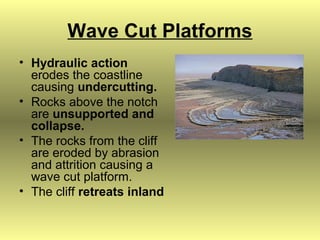
• Hydraulic action
  erodes the coastline
  causing undercutting.
• Rocks above the notch
  are unsupported and
  collapse.
• The rocks from the cliff
  are eroded by abrasion
  and attrition causing a
  wave cut platform.
• The cliff retreats inland
Rate of cliff recession
• The longer the fetch, the further the wave
  has to travel. It picks up more energy and
  so erodes the cliff quicker

• The softer the geology (rock) the easier it
  is to erode so cliff recession happens
  more quickly
Cave, arch, stack, stump
Longshore Drift
          • The direction of the
            wind forces waves
            onto the beach at an
            angle
          • Swash carries
            sediment (sand and
            rocks) up the cliff
          • Backwash pulls
            material off the
            beach under
            gravity.
          • Sediment is
            transported along
            the coast
Formation of a spit
• Longshore drift carries material along the
  coastline
• When the coastline changes direction,
  longshore drift continues and extends the beach
  into open water
• The end of the spit often becomes curved
  because of changes in the wind direction
• Sediment often builds up in the sheltered water
  behind the spit to form a salt marsh
Effects of coastal recession
Human
• Loss of land
• Loss of property and belongings
• Insurance has to pay out a lot of money

Environmental
• Loss of habitat for animals
• Loss of breeding grounds for birds
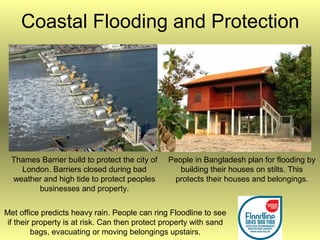
Coastal Flooding and Protection


  Thames Barrier build to protect the city of   People in Bangladesh plan for flooding by
    London. Barriers closed during bad             building their houses on stilts. This
  weather and high tide to protect peoples       protects their houses and belongings.
        businesses and property.


Met office predicts heavy rain. People can ring Floodline to see
 if their property is at risk. Can then protect property with sand
         bags, evacuating or moving belongings upstairs.
Hard Engineering
• Groynes – stop longshore drift
• Revetments – protect the cliff and capture
  sediment
• Seawall – protects the cliff
• Riprap – absorbs wave energy and
  protects the cliff
• Offshore reefs – absorb wave energy to
  allow a wide beach to develop.
Soft Engineering
• Beach replenishment – taking sand from
  the bottom of the ocean and putting it back
  on the beach
• Managed retreat – coastal erosion is
  allowed to happen
• Cliff regrading – making the cliff face
  longer and less steep to stop slumping.
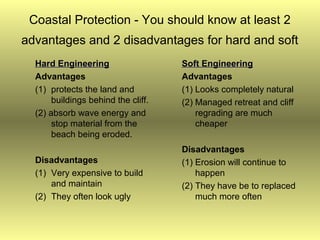
Coastal Protection - You should know at least 2
advantages and 2 disadvantages for hard and soft
  Hard Engineering                   Soft Engineering
  Advantages                         Advantages
  (1) protects the land and          (1) Looks completely natural
       buildings behind the cliff.   (2) Managed retreat and cliff
  (2) absorb wave energy and             regrading are much
       stop material from the            cheaper
       beach being eroded.
                                     Disadvantages
  Disadvantages                      (1) Erosion will continue to
  (1) Very expensive to build            happen
      and maintain                   (2) They have be to replaced
  (2) They often look ugly               much more often
Swanage
Swanage is build on clay which is susceptible to
  erosion. To protect Swanage:
• A seawall was built as a barrier to wave attack
• The cliff was regraded to prevent slumping
• A series of groynes were installed to reduce
  longshore drift.
• 90000m3 of sand was pumped onto the beach.

Coasts at a glance

  • 1.
    Things you shouldknow off by heart! When I saw off by heart I mean anything that’s written in this PowerPoint you should be able to write in your exam!!
  • 2.
    Constructive and Destructive Waves • At least two differences between constructive and destructive waves e.g. – Constructive waves are long, low waves that build up the beach. – Destructive waves are much more frequent waves with a shorter wave length and erode the beach.
  • 3.
    Erosion • Hydraulic action– air gets forced into cracks and then pops like air from a champagne bottle • Abrasion – rocks hit the cliff • Attrition – rocks hit other rocks wearing each other away • Corrosion – sea water dissolves the rock
  • 4.
    Mass Movement • Bottom of the cliff eroded by waves and undercut • Rainfall saturates cliff and makes it heavier •Rocks slide down cliff •Often happens in clay • Rocks are weathered on the cliff face • They break loose and fall under the influence of gravity
  • 5.
    Wave Cut Platforms •Hydraulic action erodes the coastline causing undercutting. • Rocks above the notch are unsupported and collapse. • The rocks from the cliff are eroded by abrasion and attrition causing a wave cut platform. • The cliff retreats inland
  • 6.
    Rate of cliffrecession • The longer the fetch, the further the wave has to travel. It picks up more energy and so erodes the cliff quicker • The softer the geology (rock) the easier it is to erode so cliff recession happens more quickly
  • 7.
  • 8.
    Longshore Drift • The direction of the wind forces waves onto the beach at an angle • Swash carries sediment (sand and rocks) up the cliff • Backwash pulls material off the beach under gravity. • Sediment is transported along the coast
  • 9.
    Formation of aspit • Longshore drift carries material along the coastline • When the coastline changes direction, longshore drift continues and extends the beach into open water • The end of the spit often becomes curved because of changes in the wind direction • Sediment often builds up in the sheltered water behind the spit to form a salt marsh
  • 10.
    Effects of coastalrecession Human • Loss of land • Loss of property and belongings • Insurance has to pay out a lot of money Environmental • Loss of habitat for animals • Loss of breeding grounds for birds
  • 11.
    Coastal Flooding andProtection Thames Barrier build to protect the city of People in Bangladesh plan for flooding by London. Barriers closed during bad building their houses on stilts. This weather and high tide to protect peoples protects their houses and belongings. businesses and property. Met office predicts heavy rain. People can ring Floodline to see if their property is at risk. Can then protect property with sand bags, evacuating or moving belongings upstairs.
  • 12.
    Hard Engineering • Groynes– stop longshore drift • Revetments – protect the cliff and capture sediment • Seawall – protects the cliff • Riprap – absorbs wave energy and protects the cliff • Offshore reefs – absorb wave energy to allow a wide beach to develop.
  • 13.
    Soft Engineering • Beachreplenishment – taking sand from the bottom of the ocean and putting it back on the beach • Managed retreat – coastal erosion is allowed to happen • Cliff regrading – making the cliff face longer and less steep to stop slumping.
  • 14.
    Coastal Protection -You should know at least 2 advantages and 2 disadvantages for hard and soft Hard Engineering Soft Engineering Advantages Advantages (1) protects the land and (1) Looks completely natural buildings behind the cliff. (2) Managed retreat and cliff (2) absorb wave energy and regrading are much stop material from the cheaper beach being eroded. Disadvantages Disadvantages (1) Erosion will continue to (1) Very expensive to build happen and maintain (2) They have be to replaced (2) They often look ugly much more often
  • 15.
    Swanage Swanage is buildon clay which is susceptible to erosion. To protect Swanage: • A seawall was built as a barrier to wave attack • The cliff was regraded to prevent slumping • A series of groynes were installed to reduce longshore drift. • 90000m3 of sand was pumped onto the beach.