Tour Guiding Interpretation
Interpretation – what is it? “ An educational activity which aims to reveal meanings and relationships through the use of original objects, by firsthand experience, and by illustrative media, rather than simply to communicate factual information.” Freeman Tilden –  Interpreting Our Heritage
Interpretation – what is it? interpretation is… an explanation of the natural, cultural or historic values attached to places. It enables visitors to gain insights and understanding about the reasons for conservation and ongoing protection of heritage  According to the New Zealand Department of Conservation
Principles of Interpretation Interpretation should be meaningful for the  audience , it should provoke curiosity, attention and interest and educate To do this the interpretation must relate in some way to the participants  personality  and/or  experience
The Audience Interpretive audiences are special – why? They are  participating of their own free will In their own time They want to see something in a new way They are seeking inspiration and recreation
Principles of Interpretation Information is only a part of the interpretation. It should enlighten the audience and involve all the senses and styles of learning For example Information  (facts) The Southern Alps have formed along a tectonic plate boundary and are eroded by weather. The erosion rate and the uplift rate are very similar…
Principles of Interpetation Interpretation  (revelation ) Colliding plates on the earth’s surface created the Southern Alps. Just as when you push two pieces of paper together they buckle, fold and rise, so does the earth. Weather is working to slow the rise of the mountains, by tearing away at them with wind, rain and snow. As much as the Southern Alps get pushed up each year, the weather wears them back down again so they stay a fairly constant height.
Principles of Interpretation Interpretation contains many forms of art. The materials may be scientific, historical or architectural (all of which can be taught) However interpretation should stimulate, provoke and inspire How?
How? By Being relevant and interactive Satisfying visitor curiosity Creating meaning Providing entertainment Provoking thought
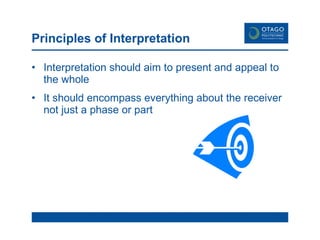
Principles of Interpretation Interpretation should aim to present and appeal to the whole  It should encompass everything about the receiver not just a phase or part
Essentials of Interpretation The  Message(s) These relate to the theme or general topic Natural  care for the environment Cultural  preservation of the language  The  Message Must relate to the specific  audience  and their characteristics
Essentials of Interpretation The  Message Must be appropriate to the  setting  and  context  in which the interpretation is taking place Setting   site or place where interpretation is being held Context   reason or background to  interpretation
Essentials of Interpretation Techniques The methods used to communicate the ideas and feelings They should encompass all learning styles They should help the message to provoke change if necessary
Different types of interpretation Guided tour Guide takes group on a tour and offers interpretation Point duty Interpretation at a specific point. Effective way of managing large group of visitors in a limited time frame Roving Interpretation Moving about to where events are happening and visitors are found
Different types of interpretation Presentations Talk, static or moving Visual presentation or audio recording Demonstrations Showing how something is done, usually involves the audience Living   history Living portrayal or characters or events includes dress, dialect, objects or artefacts and acting
Different types of interpretation Interactive Engaging an audience with the interpreter or some device or  resource Lecture or talk Oral presentation usually with visual aids Drama Using theatre to provide the interpretation – role plays, theatre sports, puppets
Different types of Interpretation Non personal Print  Brochures, books, posters Self guiding Programmes, signs, interpretive panels, use of audio tapes Exhibits Displays, collections, museums and galleries
Different types of Interpretation Non Personal Visitor Centres Combination of media, displays, guides etc Museum Paintings, sculptures, buildings – through the use of objects
Different types of interpretation Audio Visual Devices Media repeater A recording at a specific site providing information Portable media player MP3, CD player, audio tour Closed Circuit TV Audio visual presentation
Different types of interpretation Audio Visual Devices Computer Audience can interact with software Laser Disc Visual media with audio input (DVD) Video Film support or demonstration Slideshow Power point or photographic slides
Different types of interpretation Interactive Media Observation Hides Camouflaged places  used to observe activities Information Poles Visual and audio material activated by those wanting to see and listen
Interpretation  - Personal Nature Walk Strengths Person to person communication Can ask questions and get answer Can be easily adapted, updated and changed
Interpretation - Personal Nature walk Weakness Tour must move at the pace of the speaker Difficult for hearing impaired Language barrier
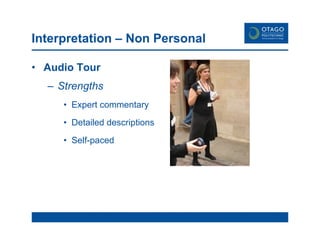
Interpretation – Non Personal Audio Tour Strengths Expert commentary Detailed descriptions Self-paced
Interpretation – Non Personal Audio Tour Weaknesses Cannot ask questions Requires some technical expertise to set up Difficult for hearing impaired Isolating
Interpretation – Non Personal Signs Strengths Can be translated into all languages Can be indoors or outside Can be utalised at own pace
Interpretation Signs Weaknesses Can be damaged Can be expensive Questions cannot be answered

Tour Guiding Interpretation

  • 1.
  • 2.
    Interpretation – whatis it? “ An educational activity which aims to reveal meanings and relationships through the use of original objects, by firsthand experience, and by illustrative media, rather than simply to communicate factual information.” Freeman Tilden – Interpreting Our Heritage
  • 3.
    Interpretation – whatis it? interpretation is… an explanation of the natural, cultural or historic values attached to places. It enables visitors to gain insights and understanding about the reasons for conservation and ongoing protection of heritage According to the New Zealand Department of Conservation
  • 4.
    Principles of InterpretationInterpretation should be meaningful for the audience , it should provoke curiosity, attention and interest and educate To do this the interpretation must relate in some way to the participants personality and/or experience
  • 5.
    The Audience Interpretiveaudiences are special – why? They are participating of their own free will In their own time They want to see something in a new way They are seeking inspiration and recreation
  • 6.
    Principles of InterpretationInformation is only a part of the interpretation. It should enlighten the audience and involve all the senses and styles of learning For example Information (facts) The Southern Alps have formed along a tectonic plate boundary and are eroded by weather. The erosion rate and the uplift rate are very similar…
  • 7.
    Principles of InterpetationInterpretation (revelation ) Colliding plates on the earth’s surface created the Southern Alps. Just as when you push two pieces of paper together they buckle, fold and rise, so does the earth. Weather is working to slow the rise of the mountains, by tearing away at them with wind, rain and snow. As much as the Southern Alps get pushed up each year, the weather wears them back down again so they stay a fairly constant height.
  • 8.
    Principles of InterpretationInterpretation contains many forms of art. The materials may be scientific, historical or architectural (all of which can be taught) However interpretation should stimulate, provoke and inspire How?
  • 9.
    How? By Beingrelevant and interactive Satisfying visitor curiosity Creating meaning Providing entertainment Provoking thought
  • 10.
    Principles of InterpretationInterpretation should aim to present and appeal to the whole It should encompass everything about the receiver not just a phase or part
  • 11.
    Essentials of InterpretationThe Message(s) These relate to the theme or general topic Natural care for the environment Cultural preservation of the language The Message Must relate to the specific audience and their characteristics
  • 12.
    Essentials of InterpretationThe Message Must be appropriate to the setting and context in which the interpretation is taking place Setting site or place where interpretation is being held Context reason or background to interpretation
  • 13.
    Essentials of InterpretationTechniques The methods used to communicate the ideas and feelings They should encompass all learning styles They should help the message to provoke change if necessary
  • 14.
    Different types ofinterpretation Guided tour Guide takes group on a tour and offers interpretation Point duty Interpretation at a specific point. Effective way of managing large group of visitors in a limited time frame Roving Interpretation Moving about to where events are happening and visitors are found
  • 15.
    Different types ofinterpretation Presentations Talk, static or moving Visual presentation or audio recording Demonstrations Showing how something is done, usually involves the audience Living history Living portrayal or characters or events includes dress, dialect, objects or artefacts and acting
  • 16.
    Different types ofinterpretation Interactive Engaging an audience with the interpreter or some device or resource Lecture or talk Oral presentation usually with visual aids Drama Using theatre to provide the interpretation – role plays, theatre sports, puppets
  • 17.
    Different types ofInterpretation Non personal Print Brochures, books, posters Self guiding Programmes, signs, interpretive panels, use of audio tapes Exhibits Displays, collections, museums and galleries
  • 18.
    Different types ofInterpretation Non Personal Visitor Centres Combination of media, displays, guides etc Museum Paintings, sculptures, buildings – through the use of objects
  • 19.
    Different types ofinterpretation Audio Visual Devices Media repeater A recording at a specific site providing information Portable media player MP3, CD player, audio tour Closed Circuit TV Audio visual presentation
  • 20.
    Different types ofinterpretation Audio Visual Devices Computer Audience can interact with software Laser Disc Visual media with audio input (DVD) Video Film support or demonstration Slideshow Power point or photographic slides
  • 21.
    Different types ofinterpretation Interactive Media Observation Hides Camouflaged places used to observe activities Information Poles Visual and audio material activated by those wanting to see and listen
  • 22.
    Interpretation -Personal Nature Walk Strengths Person to person communication Can ask questions and get answer Can be easily adapted, updated and changed
  • 23.
    Interpretation - PersonalNature walk Weakness Tour must move at the pace of the speaker Difficult for hearing impaired Language barrier
  • 24.
    Interpretation – NonPersonal Audio Tour Strengths Expert commentary Detailed descriptions Self-paced
  • 25.
    Interpretation – NonPersonal Audio Tour Weaknesses Cannot ask questions Requires some technical expertise to set up Difficult for hearing impaired Isolating
  • 26.
    Interpretation – NonPersonal Signs Strengths Can be translated into all languages Can be indoors or outside Can be utalised at own pace
  • 27.
    Interpretation Signs WeaknessesCan be damaged Can be expensive Questions cannot be answered