Capiz Processed
Food and Seafood
Trading
Feasibility Study
Impacts &
Significance of
TOURISM
presented by:
Hanna Vi B. Polido
MBAHM Student
Introduction
Tourism is considered as an industry. This industry involves
the movement of people from one place to another. The
movement of people requires infrastructure related with
transport. Moving to another place, in turn, requires the
accommodation for the people, which further leads to foods
and drinks for them. Stay at a place leads to the interaction
with the people. All these are generating job opportunity
and economic activities. Interaction with local people is
further associated with intermingling of the cultures of
different origins. Consumption pattern of tourists is different
from the local people. Waste generation and disposal of the
same is a great challenge.
Objectives
• Have a basic understanding on various impacts of
tourism;
• Be aware that tourism impacts can be categorized as
positive or negative;
• Know the range of perspectives of tourism impacts;
• And outline methods (open discussion) on mitigating the
negative impacts of tourism.
Economic impact
TYPES TOURISM IMPACTS
Socio-cultural impacts
Political impacts
Environmental impacts
The importance of the economics of this sector could be judged by
the number of people involved in it as well the income generated.
Directly or indirectly, large number of people are involved in the tourism
sector.
It includes areas like transportation, accommodation, food, ticketing,
guiding, boating, rafting, trekking, maintenance of the tourist sites etc.
Host provides all required services and facilities to the guests. The
guest pays for all these services. Hence, the tourism generates
considerable benefits for the people of the origin place of the tourist as
well as people on destinations.
By developing the infrastructures in various tourism related activities
enables better movement facilities from one place to another for both
incoming or outgoing tourists
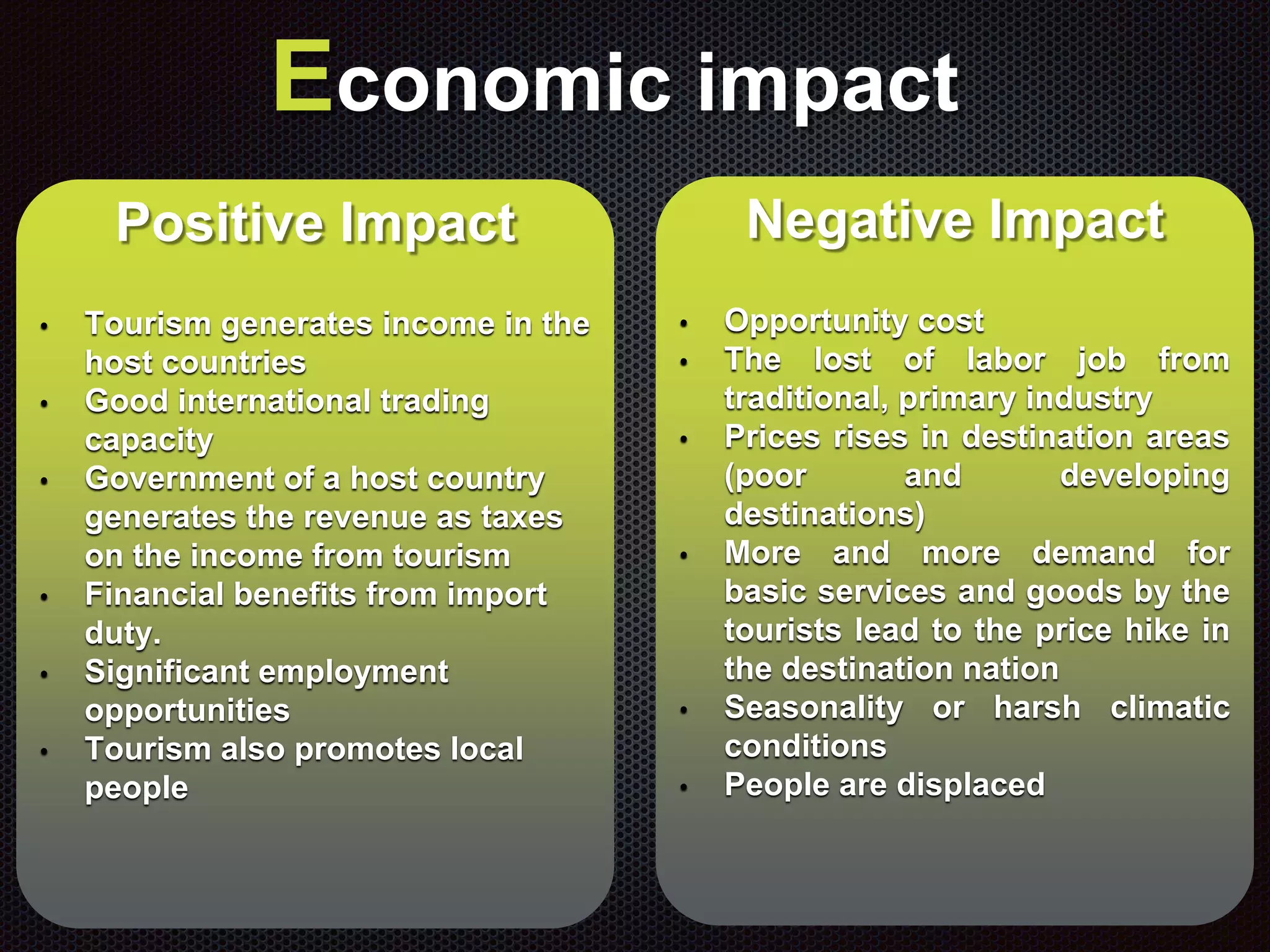
Economic
• Tourism generates income in the
host countries
• Good international trading
capacity
• Government of a host country
generates the revenue as taxes
on the income from tourism
• Financial benefits from import
duty.
• Significant employment
opportunities
• Tourism also promotes local
people
Economic impact
• Opportunity cost
• The lost of labor job from
traditional, primary industry
• Prices rises in destination areas
(poor and developing
destinations)
• More and more demand for
basic services and goods by the
tourists lead to the price hike in
the destination nation
• Seasonality or harsh climatic
conditions
• People are displaced
Positive Impact Negative Impact
• Society is a community or broad grouping of people living in a certain area that
has common traditions, institutions, activities and interests. society is a system of
relationship of people who share some sense of common identity.
• Culture is the practices of that society which binds people of the society together.
It includes manners, morals, beliefs, behavior, values and norms.
• Good manner is socially acceptable way of relationship. It includes care and
consideration for others.
• Morality is a set of rules, principles and duties applicable to a group of people or
a society which is generally independent of religion.
• Belief is the foundation of attitude.
• Attitude determines the outlook and thinking process of an individual and the
society.
• Behavior is the way in which an individual or a member of the society behaves or
acts.
• Norms are the formal rules of the society. It regulates the members of the
community, group or society in maintaining harmony.
• Values are those ideals that a society holds above all, like honesty, respect,
faithfulness. These values are the building blocks of norms
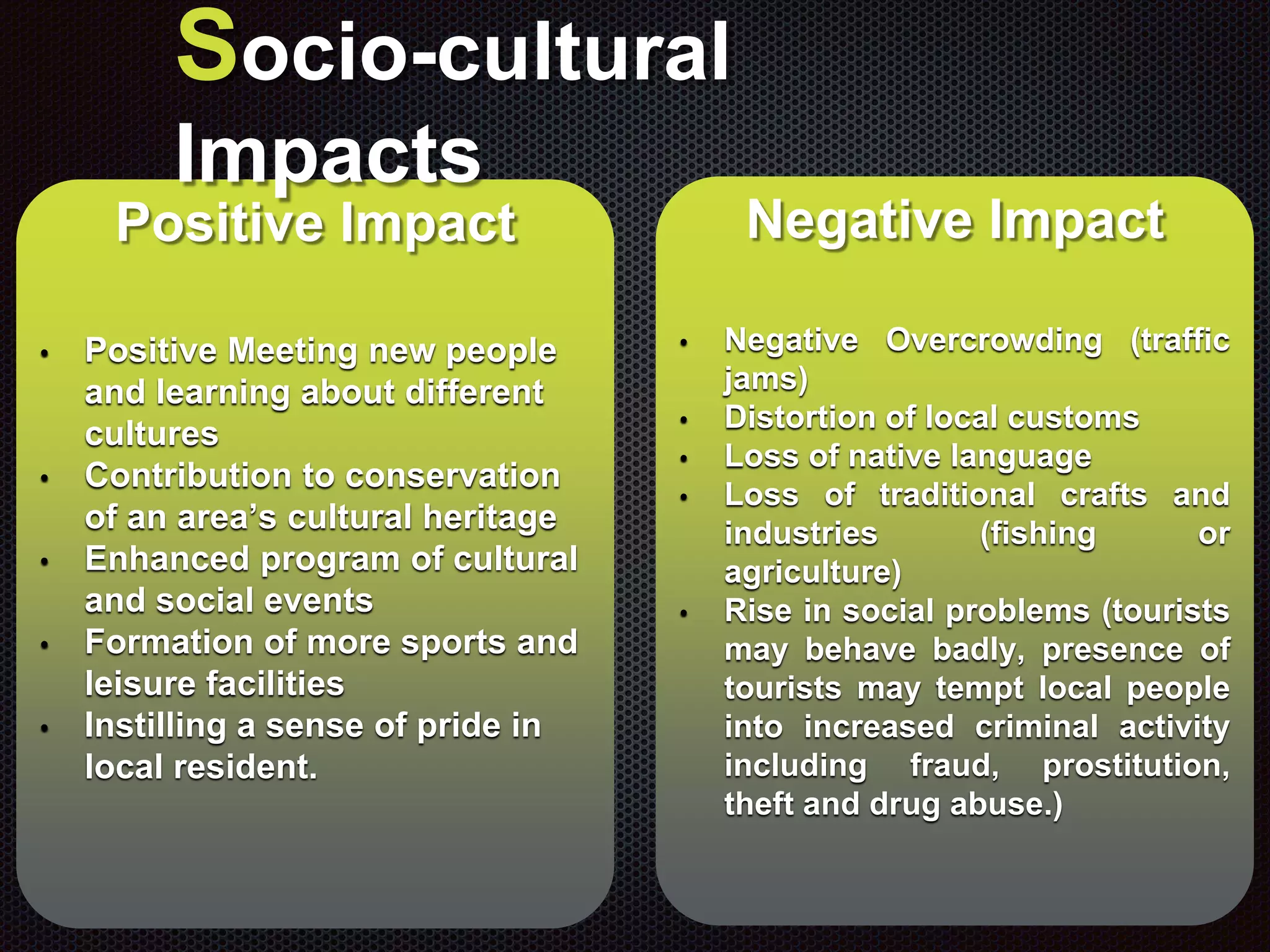
Socio-cultural
• Positive Meeting new people
and learning about different
cultures
• Contribution to conservation
of an area’s cultural heritage
• Enhanced program of cultural
and social events
• Formation of more sports and
leisure facilities
• Instilling a sense of pride in
local resident.
• Negative Overcrowding (traffic
jams)
• Distortion of local customs
• Loss of native language
• Loss of traditional crafts and
industries (fishing or
agriculture)
• Rise in social problems (tourists
may behave badly, presence of
tourists may tempt local people
into increased criminal activity
including fraud, prostitution,
theft and drug abuse.)
Positive Impact Negative Impact
Socio-cultural
Impacts
Political impacts are seen on the tourism rather than tourism impacts
on the politics directly. But indirectly, the governments of the developed
countries, from where the well-off tourists come, influences the
governments for a congenial condition to be provided to the visitors.
Everyone is very much concerned about the safe and secure journey to
the tourist destination and back to the origin place.
A tourism policy gives the direction to the tourism. This policy is a
set of rules, regulations, guidelines, and directives for development and
promotion of tourism. It provides a framework with which the collective
and individual decisions affect the tourism development
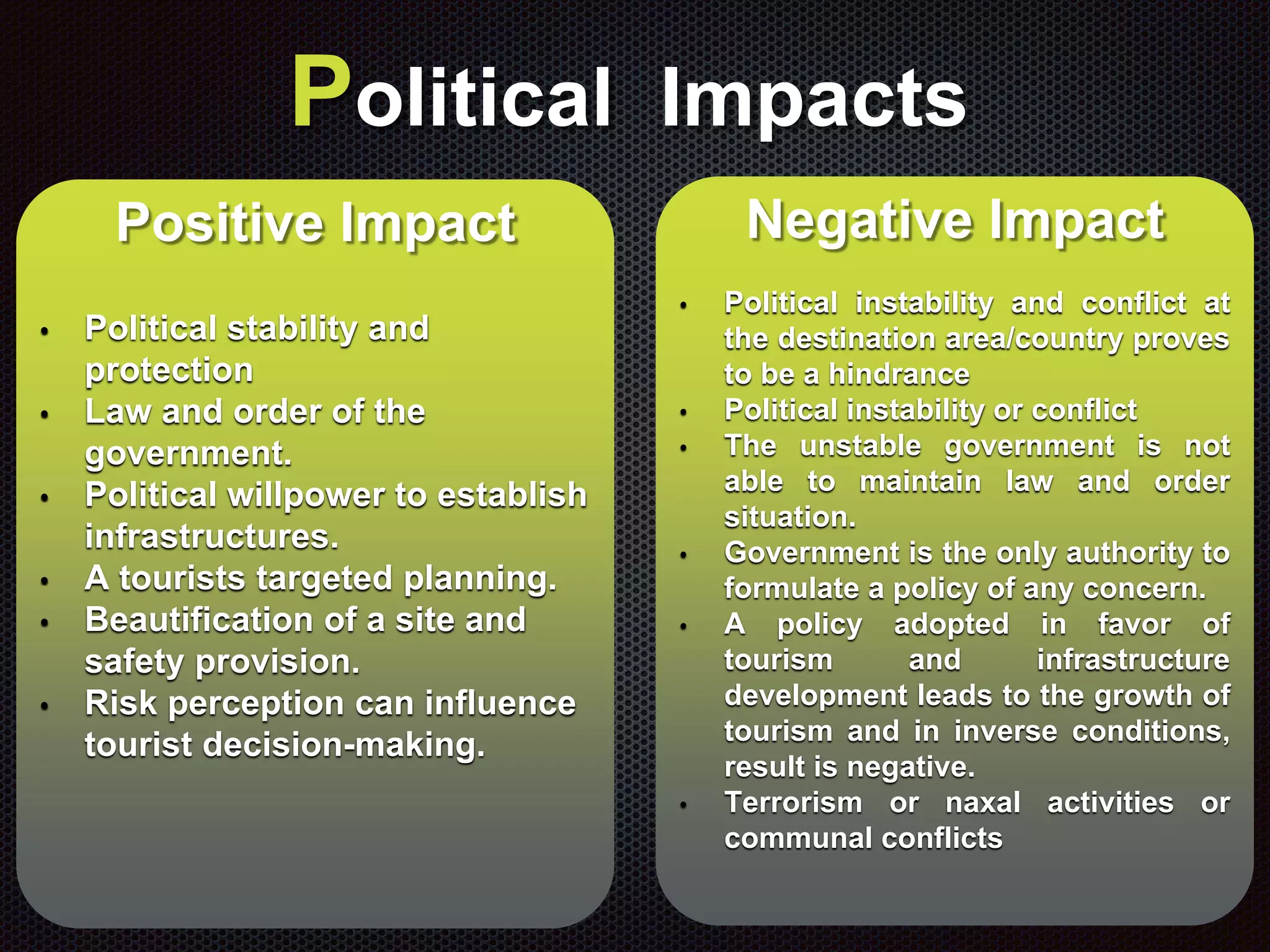
Political
• Political stability and
protection
• Law and order of the
government.
• Political willpower to establish
infrastructures.
• A tourists targeted planning.
• Beautification of a site and
safety provision.
• Risk perception can influence
tourist decision-making.
• Political instability and conflict at
the destination area/country proves
to be a hindrance
• Political instability or conflict
• The unstable government is not
able to maintain law and order
situation.
• Government is the only authority to
formulate a policy of any concern.
• A policy adopted in favor of
tourism and infrastructure
development leads to the growth of
tourism and in inverse conditions,
result is negative.
• Terrorism or naxal activities or
communal conflicts
Positive Impact Negative Impact
Political Impacts
Environment is the total surroundings or conditions in which a
person, animal or plant lives or interacts. It includes houses, buildings,
fellow persons, animals, plants, land, water, temperature, light, air, flora
and fauna, other human developed infrastructures etc. The living plants
and animals not only exist in the surroundings but also interact with
each other.
Tourism brings huge number of people to an area continuously who
have diverse attitudes. Huge number of people arriving at those
locations poses intense pressure on various resources. More and more
infrastructures are created to accommodate them due to which great
changes in the landscape of the area are made. Some of the
environmental improvements are also observed to attract more and
more tourists. Therefore, tourism helps in preserving the environment.
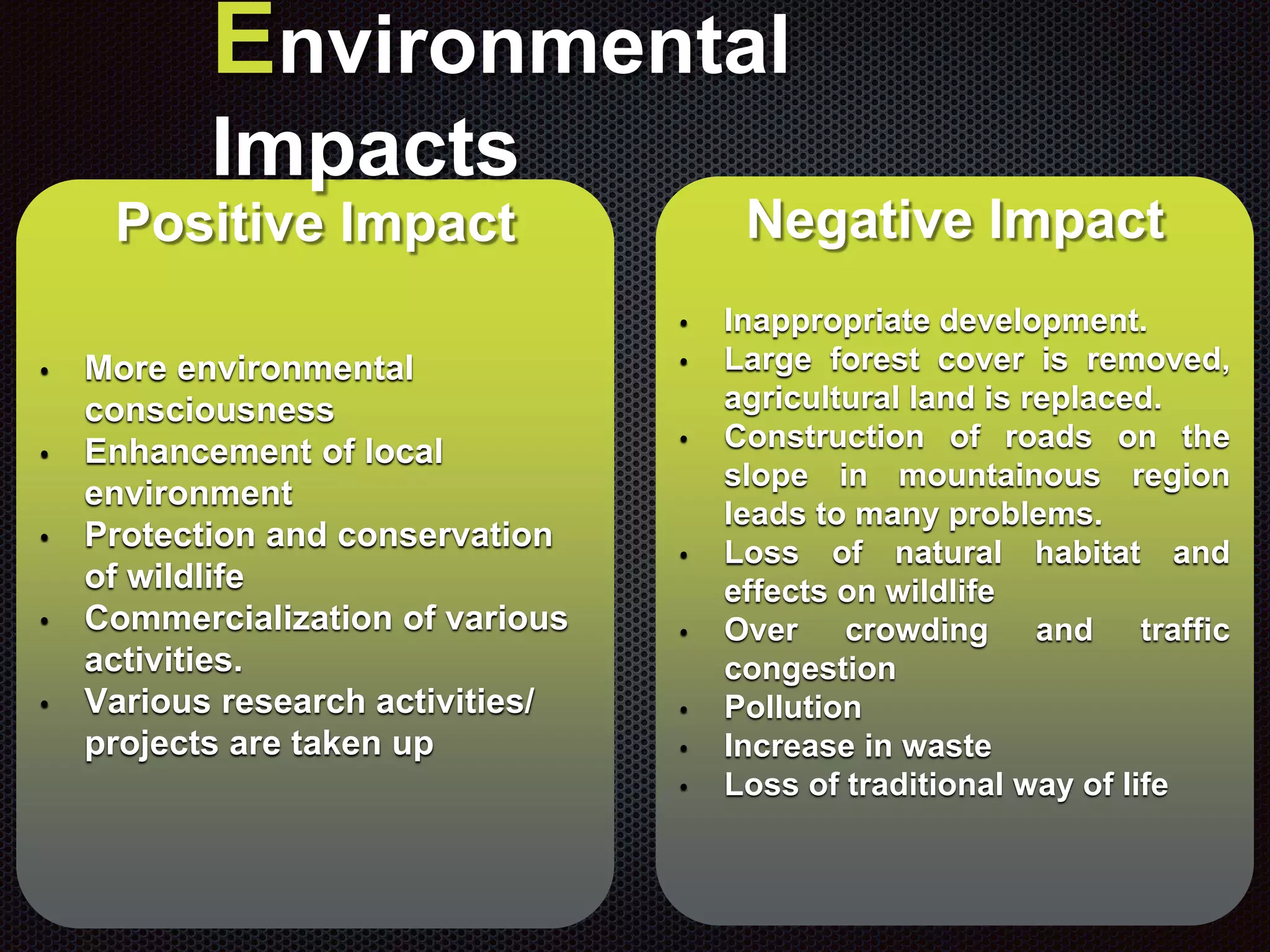
Environmental
• More environmental
consciousness
• Enhancement of local
environment
• Protection and conservation
of wildlife
• Commercialization of various
activities.
• Various research activities/
projects are taken up
• Inappropriate development.
• Large forest cover is removed,
agricultural land is replaced.
• Construction of roads on the
slope in mountainous region
leads to many problems.
• Loss of natural habitat and
effects on wildlife
• Over crowding and traffic
congestion
• Pollution
• Increase in waste
• Loss of traditional way of life
Positive Impact Negative Impact
Environmental
Impacts
• Tourism is a major contributor to
employment creation particularly for
women, youth, migrant workers,
rural communities and indigenous
peoples and has numerous linkages
with other sectors.
• Tourism can lead to the reduction of
poverty and to the promotion of
socio-economic development and
decent work. However, if tourism
does not respect local cultures and
is uncontrolled, unsustainable or
not socially accountable, it can also
have a negative impact on local
communities, their heritage and
environment, exacerbating
inequalities.
Employmen
t
• Tourism provides both direct and
indirect employment.
• Firms such as hotels, restaurants,
airlines, cruise lines, and resorts
provide direct employment because
their employees are in contact with
tourists and provide the tourist
experience.
• Employees of firms providing goods
and services to the direct employment
firms, such as aircraft manufacturers,
construction firms, and restaurant
suppliers, create indirect employment
Employmen
t
• Income is generated from
- wages and salaries
- interest
- rent
- profits
• In labor intensive industry
such as tourism the greatest
proportion is likely to be
derived from wages and
salaries paid to those working
in jobs either directly serving
the needs of tourists or
benefiting indirectly from the
tourists’ expenditure
Effect on Income
• Income will be greater in
the areas which:
 generates large number of
tourist.
 Where visitors tend to stay for
longer periods
 Where the destination attracts
an up-market or more free-
spending clientele, and
 Where there are many
opportunities to spend.
Effect on Income
• Tourism’s contribution to the income of an area is
enhanced by a phenomenon known as the tourism
income multiplier (TIM).
• This arises because money spent by tourists in the area
will be re-spent by recipients, augmenting the total.
• The multiplier is the factor by which tourist spend is
increased in this process.
Multiplier Effect
• Local hotels may also be foreign owned, so that profits
achieved are then transmitted to the hotel chain’s head office
and so lost to the area.
• This might be true of other tourist facilities in the area, and even
local ground-handling agents or coach operators may be owned
by companies based elsewhere, leading to further losses in the
multiplier effect.
• Leakage is minimum when the firms are in the hands of the
locals hence TIM is higher.
Multiplier Effect
• The principal reasons for leakages include:
 Cost of imported goods, especially food and drink
 Foreign exchange costs of imports for the development of
tourist facilities
 Remittance of profits abroad
 Remittance of wages by expatriates
 Management fees or royalties for franchises
 Payments to overseas carriers and travel companies
 Costs of overseas promotion
 Additional expenditure on imports resulting from the earnings
of those benefiting from tourism.
Leakage
s
• Tourism has a great potential in generating
employment (direct and indirect)
• Lesser the leakages from the economy greater is
multiplier effect of the expenditure made in the local
economy.
• Tourism income multiplier is very low for the
developing countries as compared to the developed
nations because of their dependency on imports of
tourism products from outside.
• It is economically beneficial for a nation to have
greater number of inbound travelers as compared to
outbound.
Conclusion
s
THANK YOU!

Impacts and Significance of Tourism .pptx

  • 1.
    Capiz Processed Food andSeafood Trading Feasibility Study
  • 2.
    Impacts & Significance of TOURISM presentedby: Hanna Vi B. Polido MBAHM Student
  • 3.
    Introduction Tourism is consideredas an industry. This industry involves the movement of people from one place to another. The movement of people requires infrastructure related with transport. Moving to another place, in turn, requires the accommodation for the people, which further leads to foods and drinks for them. Stay at a place leads to the interaction with the people. All these are generating job opportunity and economic activities. Interaction with local people is further associated with intermingling of the cultures of different origins. Consumption pattern of tourists is different from the local people. Waste generation and disposal of the same is a great challenge.
  • 4.
    Objectives • Have abasic understanding on various impacts of tourism; • Be aware that tourism impacts can be categorized as positive or negative; • Know the range of perspectives of tourism impacts; • And outline methods (open discussion) on mitigating the negative impacts of tourism.
  • 5.
    Economic impact TYPES TOURISMIMPACTS Socio-cultural impacts Political impacts Environmental impacts
  • 6.
    The importance ofthe economics of this sector could be judged by the number of people involved in it as well the income generated. Directly or indirectly, large number of people are involved in the tourism sector. It includes areas like transportation, accommodation, food, ticketing, guiding, boating, rafting, trekking, maintenance of the tourist sites etc. Host provides all required services and facilities to the guests. The guest pays for all these services. Hence, the tourism generates considerable benefits for the people of the origin place of the tourist as well as people on destinations. By developing the infrastructures in various tourism related activities enables better movement facilities from one place to another for both incoming or outgoing tourists Economic
  • 7.
    • Tourism generatesincome in the host countries • Good international trading capacity • Government of a host country generates the revenue as taxes on the income from tourism • Financial benefits from import duty. • Significant employment opportunities • Tourism also promotes local people Economic impact • Opportunity cost • The lost of labor job from traditional, primary industry • Prices rises in destination areas (poor and developing destinations) • More and more demand for basic services and goods by the tourists lead to the price hike in the destination nation • Seasonality or harsh climatic conditions • People are displaced Positive Impact Negative Impact
  • 8.
    • Society isa community or broad grouping of people living in a certain area that has common traditions, institutions, activities and interests. society is a system of relationship of people who share some sense of common identity. • Culture is the practices of that society which binds people of the society together. It includes manners, morals, beliefs, behavior, values and norms. • Good manner is socially acceptable way of relationship. It includes care and consideration for others. • Morality is a set of rules, principles and duties applicable to a group of people or a society which is generally independent of religion. • Belief is the foundation of attitude. • Attitude determines the outlook and thinking process of an individual and the society. • Behavior is the way in which an individual or a member of the society behaves or acts. • Norms are the formal rules of the society. It regulates the members of the community, group or society in maintaining harmony. • Values are those ideals that a society holds above all, like honesty, respect, faithfulness. These values are the building blocks of norms Socio-cultural
  • 9.
    • Positive Meetingnew people and learning about different cultures • Contribution to conservation of an area’s cultural heritage • Enhanced program of cultural and social events • Formation of more sports and leisure facilities • Instilling a sense of pride in local resident. • Negative Overcrowding (traffic jams) • Distortion of local customs • Loss of native language • Loss of traditional crafts and industries (fishing or agriculture) • Rise in social problems (tourists may behave badly, presence of tourists may tempt local people into increased criminal activity including fraud, prostitution, theft and drug abuse.) Positive Impact Negative Impact Socio-cultural Impacts
  • 10.
    Political impacts areseen on the tourism rather than tourism impacts on the politics directly. But indirectly, the governments of the developed countries, from where the well-off tourists come, influences the governments for a congenial condition to be provided to the visitors. Everyone is very much concerned about the safe and secure journey to the tourist destination and back to the origin place. A tourism policy gives the direction to the tourism. This policy is a set of rules, regulations, guidelines, and directives for development and promotion of tourism. It provides a framework with which the collective and individual decisions affect the tourism development Political
  • 11.
    • Political stabilityand protection • Law and order of the government. • Political willpower to establish infrastructures. • A tourists targeted planning. • Beautification of a site and safety provision. • Risk perception can influence tourist decision-making. • Political instability and conflict at the destination area/country proves to be a hindrance • Political instability or conflict • The unstable government is not able to maintain law and order situation. • Government is the only authority to formulate a policy of any concern. • A policy adopted in favor of tourism and infrastructure development leads to the growth of tourism and in inverse conditions, result is negative. • Terrorism or naxal activities or communal conflicts Positive Impact Negative Impact Political Impacts
  • 12.
    Environment is thetotal surroundings or conditions in which a person, animal or plant lives or interacts. It includes houses, buildings, fellow persons, animals, plants, land, water, temperature, light, air, flora and fauna, other human developed infrastructures etc. The living plants and animals not only exist in the surroundings but also interact with each other. Tourism brings huge number of people to an area continuously who have diverse attitudes. Huge number of people arriving at those locations poses intense pressure on various resources. More and more infrastructures are created to accommodate them due to which great changes in the landscape of the area are made. Some of the environmental improvements are also observed to attract more and more tourists. Therefore, tourism helps in preserving the environment. Environmental
  • 13.
    • More environmental consciousness •Enhancement of local environment • Protection and conservation of wildlife • Commercialization of various activities. • Various research activities/ projects are taken up • Inappropriate development. • Large forest cover is removed, agricultural land is replaced. • Construction of roads on the slope in mountainous region leads to many problems. • Loss of natural habitat and effects on wildlife • Over crowding and traffic congestion • Pollution • Increase in waste • Loss of traditional way of life Positive Impact Negative Impact Environmental Impacts
  • 14.
    • Tourism isa major contributor to employment creation particularly for women, youth, migrant workers, rural communities and indigenous peoples and has numerous linkages with other sectors. • Tourism can lead to the reduction of poverty and to the promotion of socio-economic development and decent work. However, if tourism does not respect local cultures and is uncontrolled, unsustainable or not socially accountable, it can also have a negative impact on local communities, their heritage and environment, exacerbating inequalities. Employmen t
  • 15.
    • Tourism providesboth direct and indirect employment. • Firms such as hotels, restaurants, airlines, cruise lines, and resorts provide direct employment because their employees are in contact with tourists and provide the tourist experience. • Employees of firms providing goods and services to the direct employment firms, such as aircraft manufacturers, construction firms, and restaurant suppliers, create indirect employment Employmen t
  • 16.
    • Income isgenerated from - wages and salaries - interest - rent - profits • In labor intensive industry such as tourism the greatest proportion is likely to be derived from wages and salaries paid to those working in jobs either directly serving the needs of tourists or benefiting indirectly from the tourists’ expenditure Effect on Income
  • 17.
    • Income willbe greater in the areas which:  generates large number of tourist.  Where visitors tend to stay for longer periods  Where the destination attracts an up-market or more free- spending clientele, and  Where there are many opportunities to spend. Effect on Income
  • 18.
    • Tourism’s contributionto the income of an area is enhanced by a phenomenon known as the tourism income multiplier (TIM). • This arises because money spent by tourists in the area will be re-spent by recipients, augmenting the total. • The multiplier is the factor by which tourist spend is increased in this process. Multiplier Effect
  • 19.
    • Local hotelsmay also be foreign owned, so that profits achieved are then transmitted to the hotel chain’s head office and so lost to the area. • This might be true of other tourist facilities in the area, and even local ground-handling agents or coach operators may be owned by companies based elsewhere, leading to further losses in the multiplier effect. • Leakage is minimum when the firms are in the hands of the locals hence TIM is higher. Multiplier Effect
  • 20.
    • The principalreasons for leakages include:  Cost of imported goods, especially food and drink  Foreign exchange costs of imports for the development of tourist facilities  Remittance of profits abroad  Remittance of wages by expatriates  Management fees or royalties for franchises  Payments to overseas carriers and travel companies  Costs of overseas promotion  Additional expenditure on imports resulting from the earnings of those benefiting from tourism. Leakage s
  • 21.
    • Tourism hasa great potential in generating employment (direct and indirect) • Lesser the leakages from the economy greater is multiplier effect of the expenditure made in the local economy. • Tourism income multiplier is very low for the developing countries as compared to the developed nations because of their dependency on imports of tourism products from outside. • It is economically beneficial for a nation to have greater number of inbound travelers as compared to outbound. Conclusion s
  • 22.