1) Curves are gradual bends provided in transportation infrastructure like roads, railways and canals to allow for a smooth change in direction or grade.
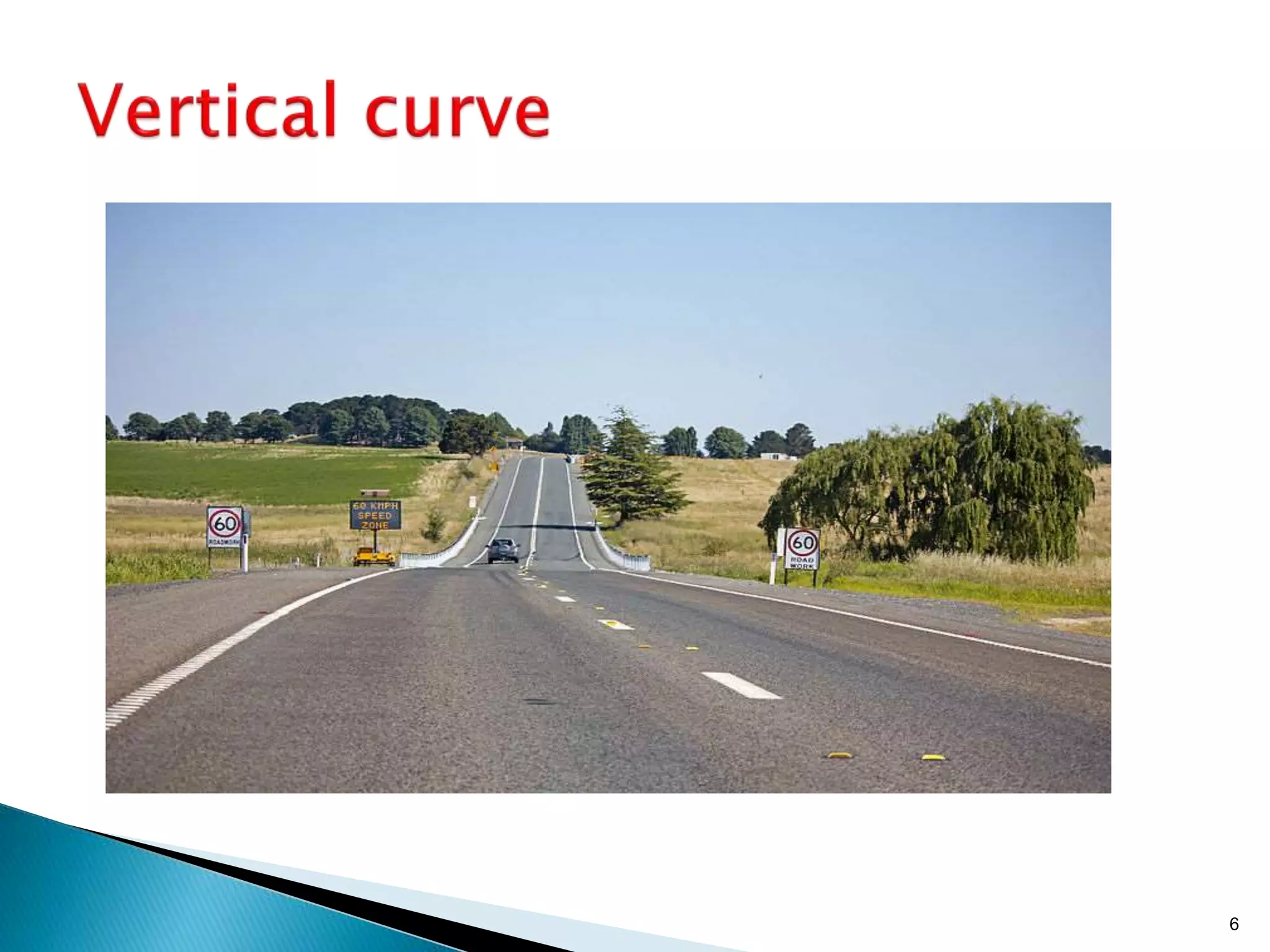
2) There are two main types of curves - horizontal curves which provide a gradual change in direction, and vertical curves which provide a gradual change in grade.
3) Curves are needed to safely guide vehicles and traffic when changing directions or grades, to improve visibility, and to prevent erosion of canal banks from water pressure.
CURVES
Curves are regularbends provided in the lines
of communication like roads, railways and
canals etc. to bring about gradual change of
direction.
2
3.
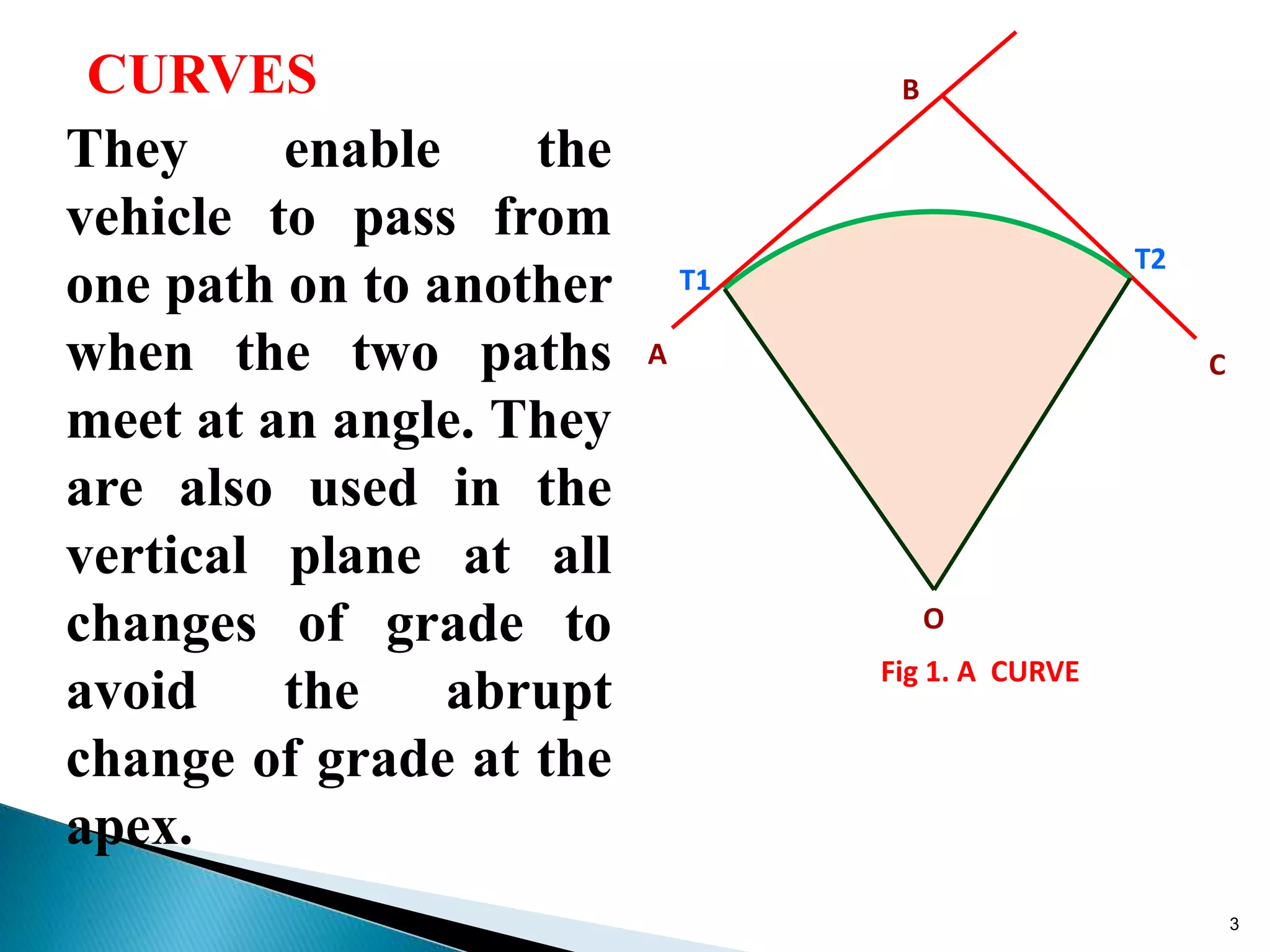
T1
A
B
C
T2
O
Fig 1. ACURVE
CURVES
They enable the
vehicle to pass from
one path on to another
when the two paths
meet at an angle. They
are also used in the
vertical plane at all
changes of grade to
avoid the abrupt
change of grade at the
apex.
3
4.
HORIZONTAL CURVES
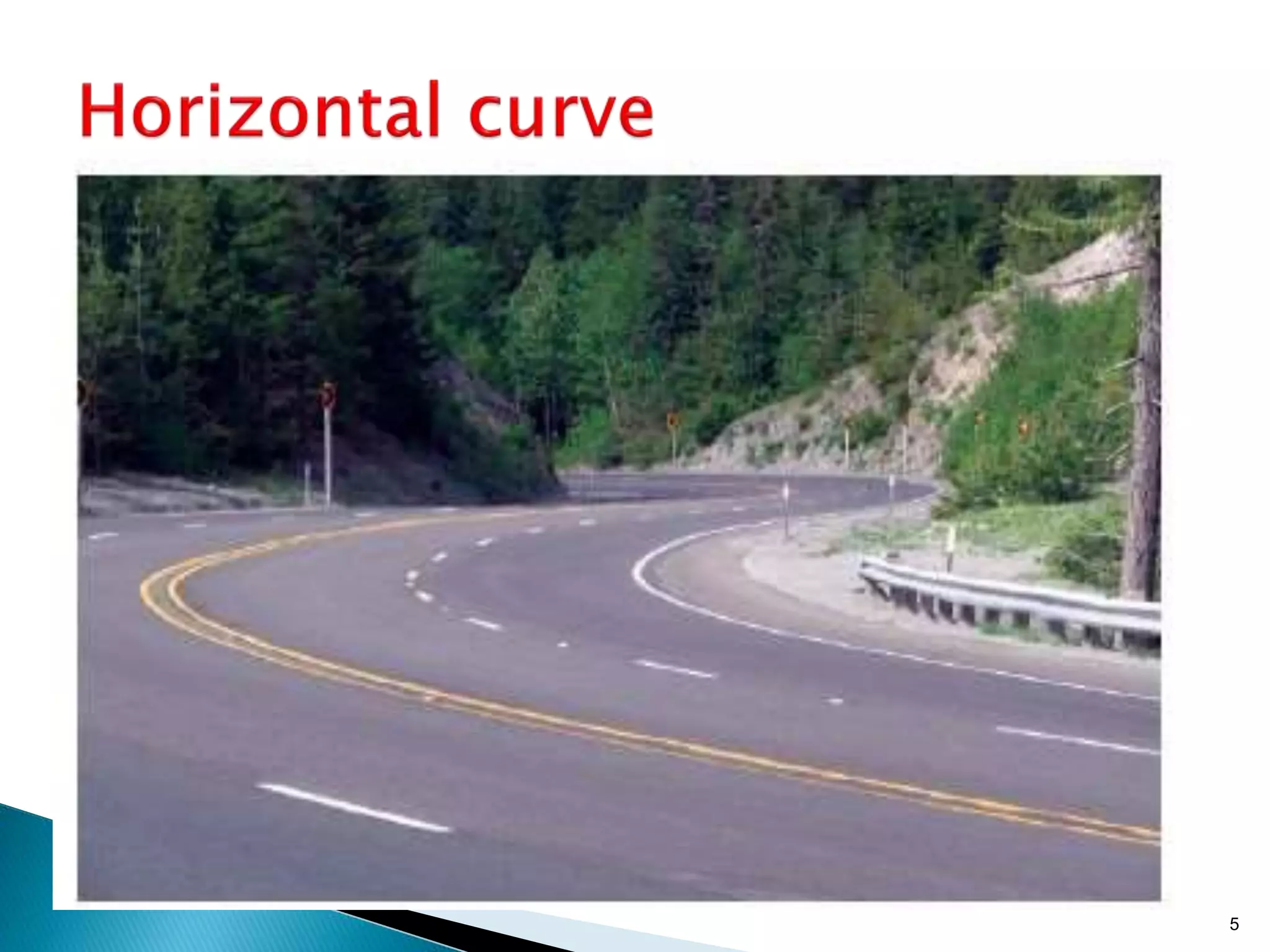
Curves providedin the horizontal plane to have
the gradual change in direction are known as
horizontal curves.
VERTICAL CURVES
Curves provided in the vertical plane to obtain
the gradual change in grade are called as
vertical curves.
4
NEED OF PROVIDINGCURVES
Curves are needed on Highways, railways
and canals for bringing about gradual change
of direction of motion. They are provided for
following reasons:-
i) To bring about gradual change in
direction of motion.
ii) To bring about gradual change in grade
and for good visibility.
7
8.
NEED OF PROVIDINGCURVES
iii) To alert the driver so that he may not fall
asleep.
iv) To layout Canal alignment.
v) To control erosion of canal banks by the
thrust of flowing water in a canal.
8
9.
CLASSIFICATION OF CIRCULARCURVES
Circular curves are classified as :
(i) Simple Curves.
(ii) Compound Curves.
(iii) Reverse Curves.
9
10.
T1
A
B
C
T2
O
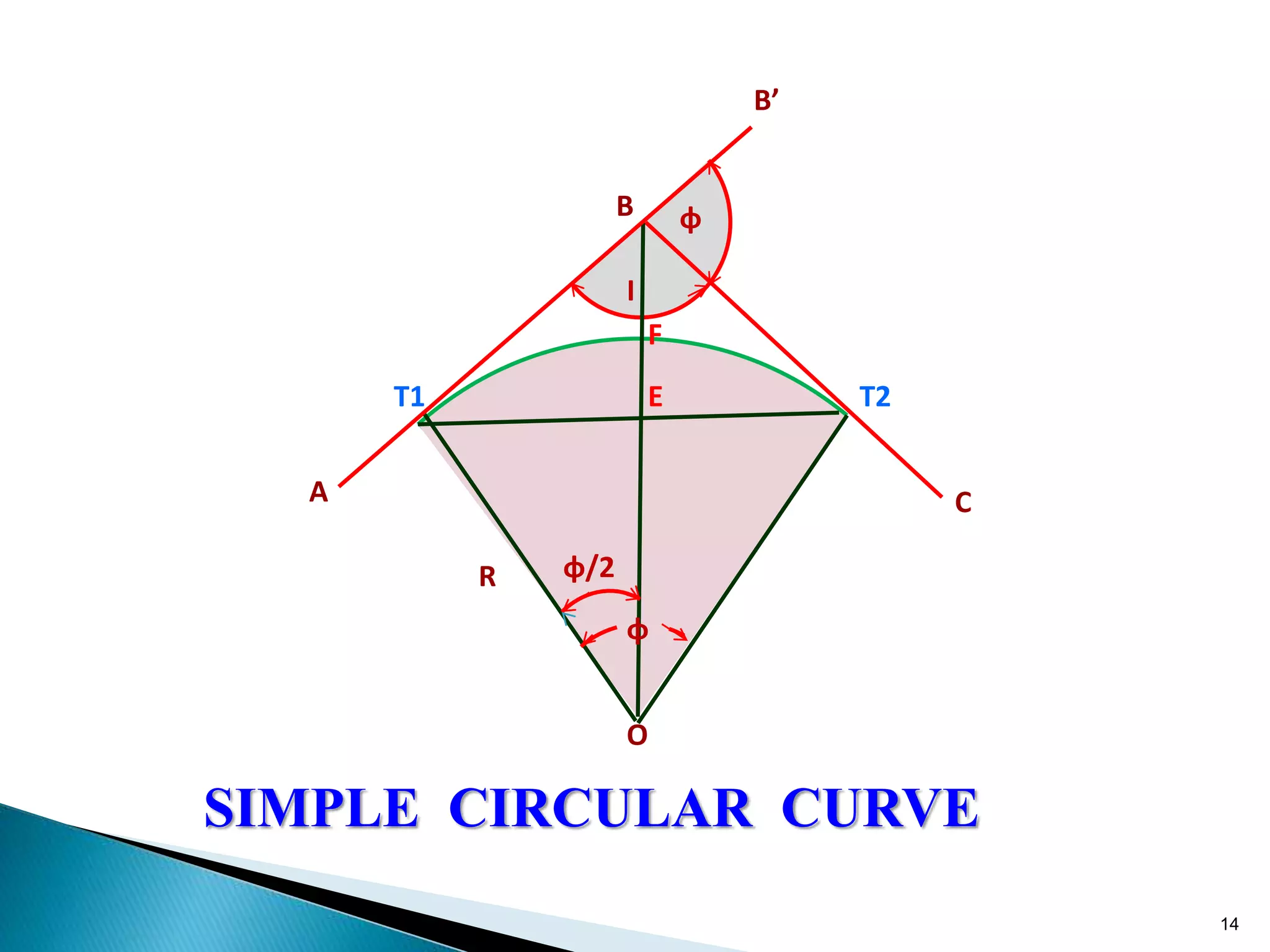
Fig. 2. ASIMPLE CURVE
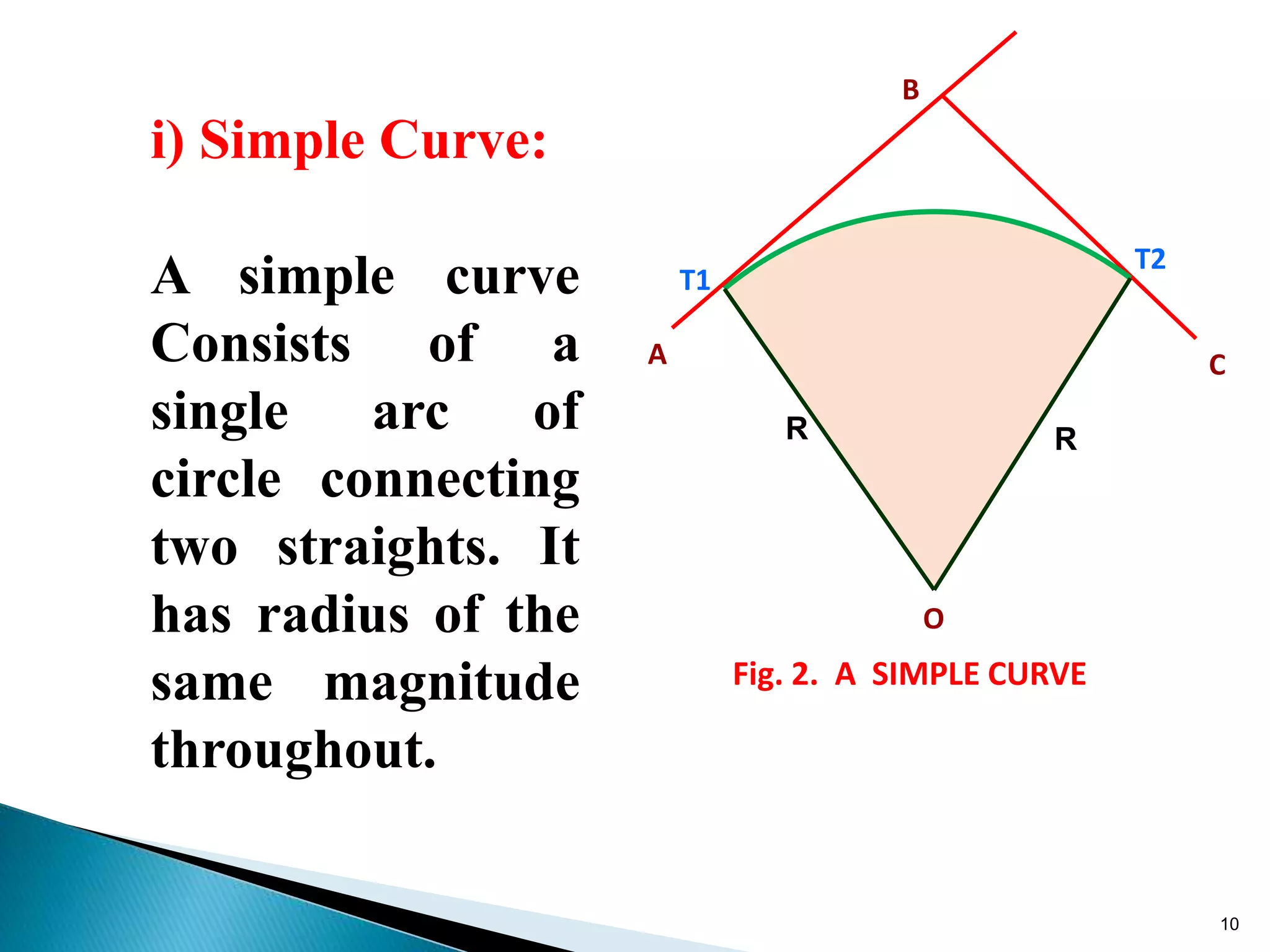
i) Simple Curve:
A simple curve
Consists of a
single arc of
circle connecting
two straights. It
has radius of the
same magnitude
throughout.
10
R R
11.
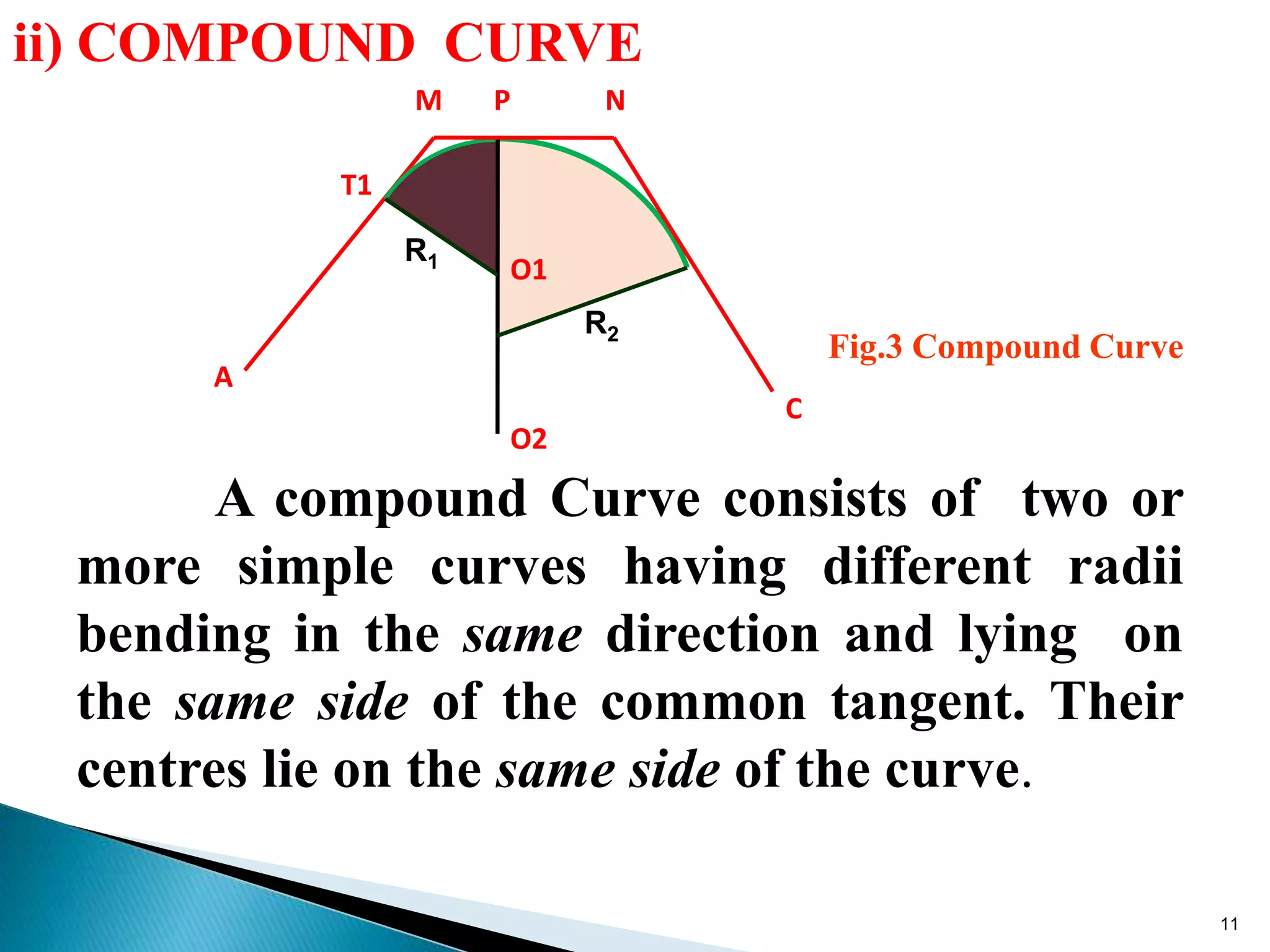
ii) COMPOUND CURVE
Acompound Curve consists of two or
more simple curves having different radii
bending in the same direction and lying on
the same side of the common tangent. Their
centres lie on the same side of the curve.
A
T1
M P N
C
O1
O2
Fig.3 Compound Curve
11
R2
R1
12.
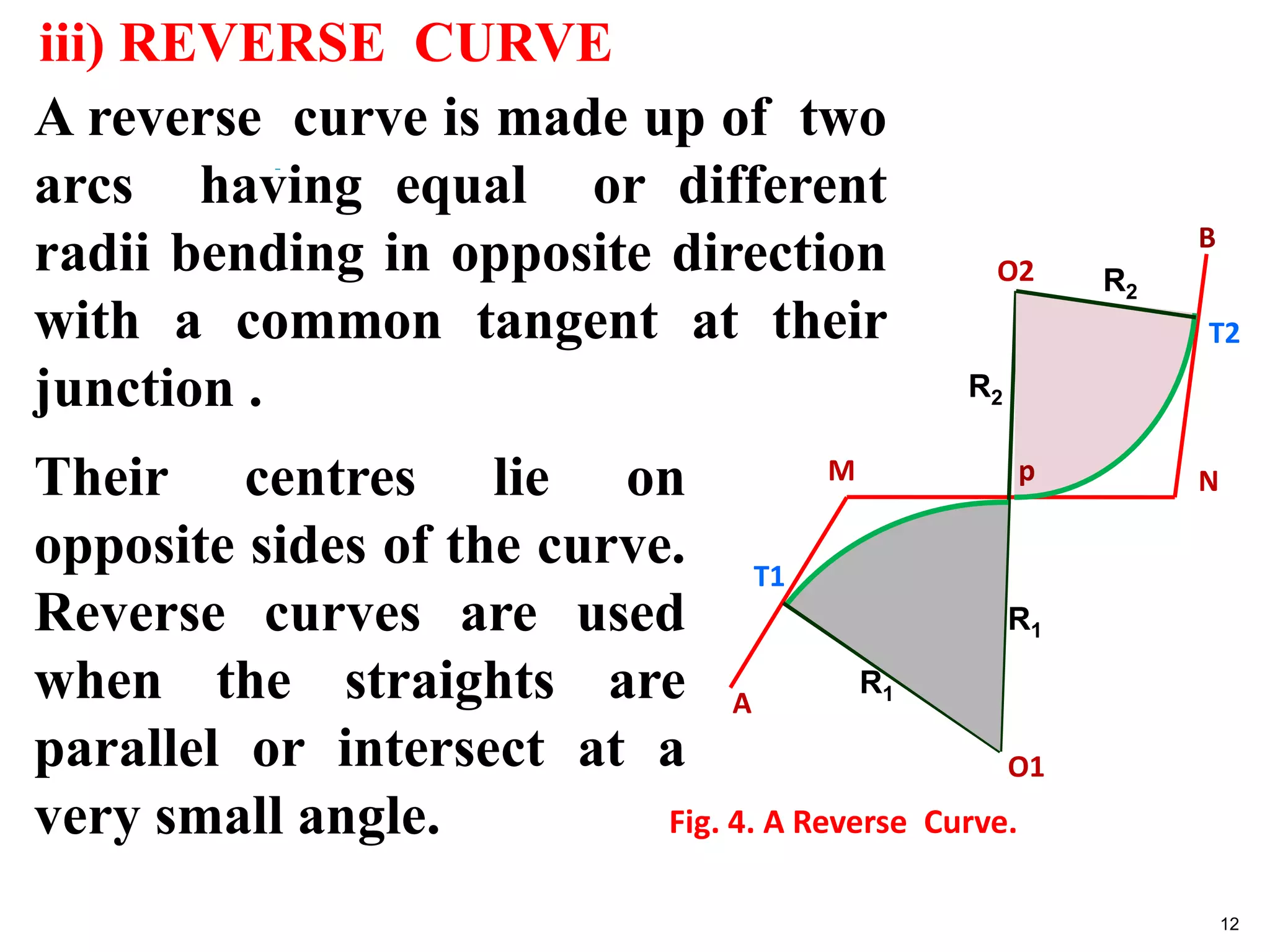
iii) REVERSE CURVE
Areverse curve is made up of two
arcs having equal or different
radii bending in opposite direction
with a common tangent at their
junction .
Fig. 4. A Reverse Curve.
MTheir centres lie on
opposite sides of the curve.
Reverse curves are used
when the straights are
parallel or intersect at a
very small angle.
N
O2
O1
A
T1
T2
p
B
12
R1
R2
R2
R1
13.
REVERSE CURVE
Fig.5 AReverse Curve.
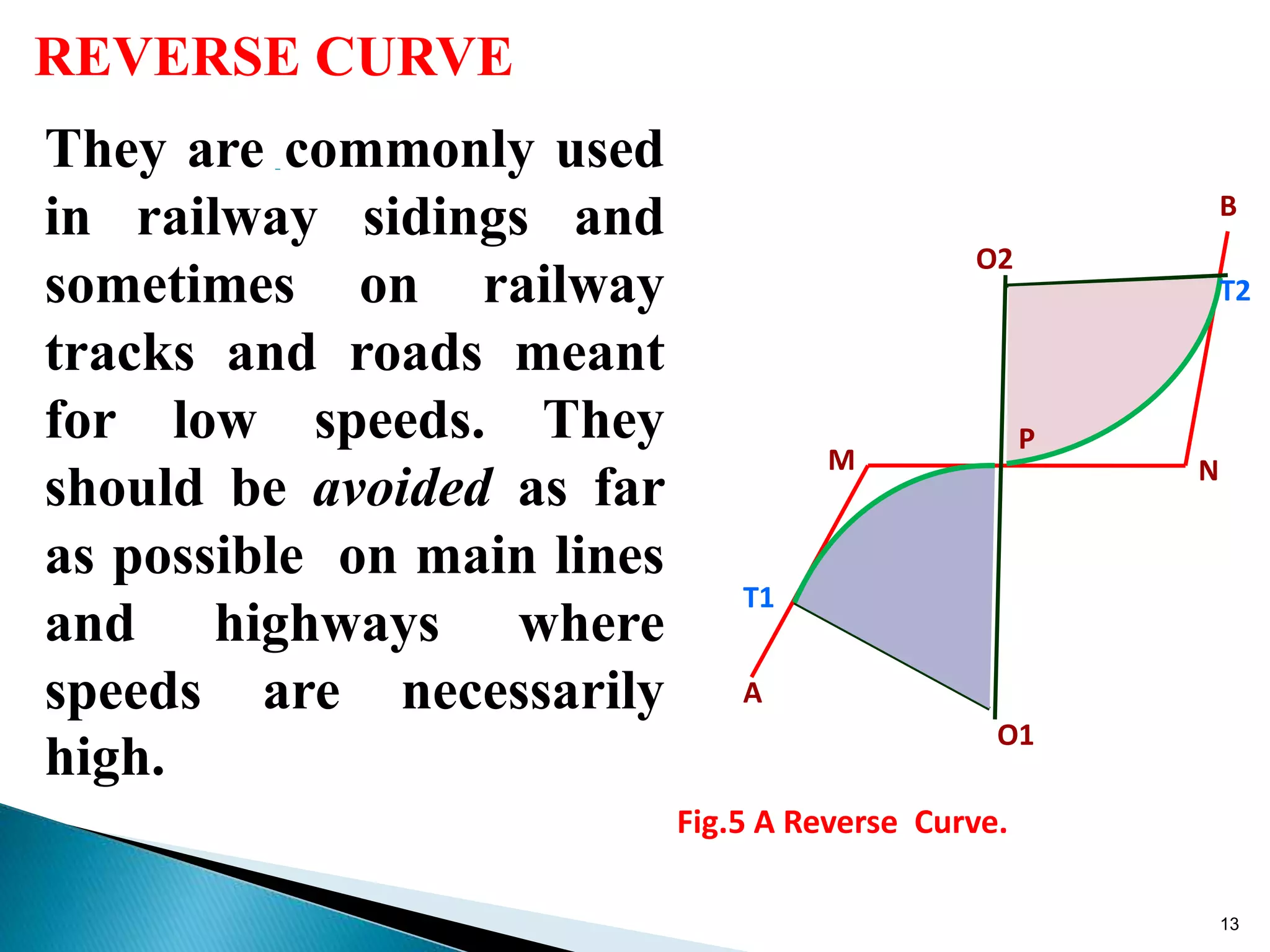
They are commonly used
in railway sidings and
sometimes on railway
tracks and roads meant
for low speeds. They
should be avoided as far
as possible on main lines
and highways where
speeds are necessarily
high.
A
T1
T2
O2
O1
M N
B
P
13
NAMES OF VARIOUSPARTS OF CURVE
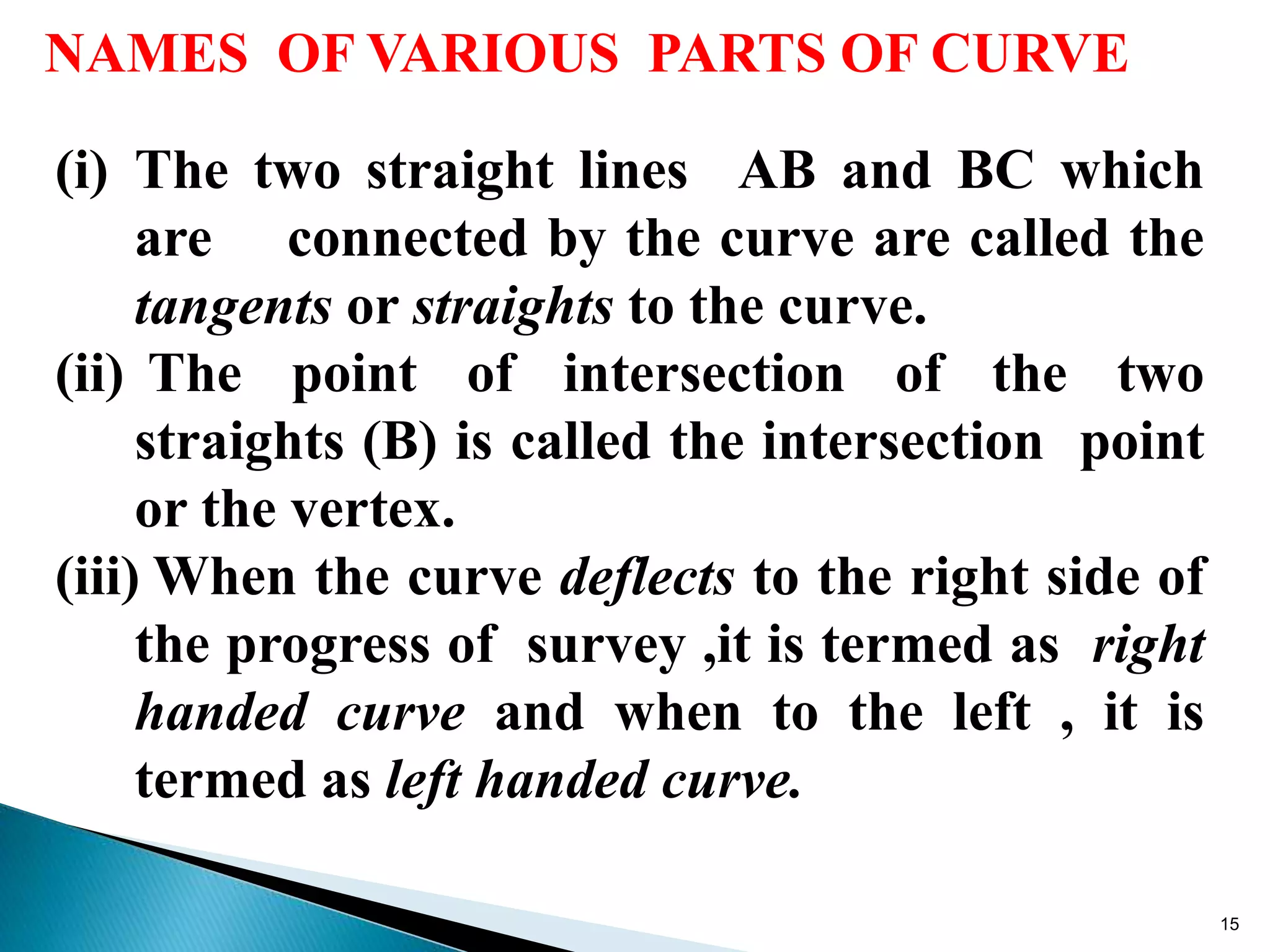
(i) The two straight lines AB and BC which
are connected by the curve are called the
tangents or straights to the curve.
(ii) The point of intersection of the two
straights (B) is called the intersection point
or the vertex.
(iii) When the curve deflects to the right side of
the progress of survey ,it is termed as right
handed curve and when to the left , it is
termed as left handed curve.
15
16.
NAMES OF VARIOUSPARTS OF CURVE
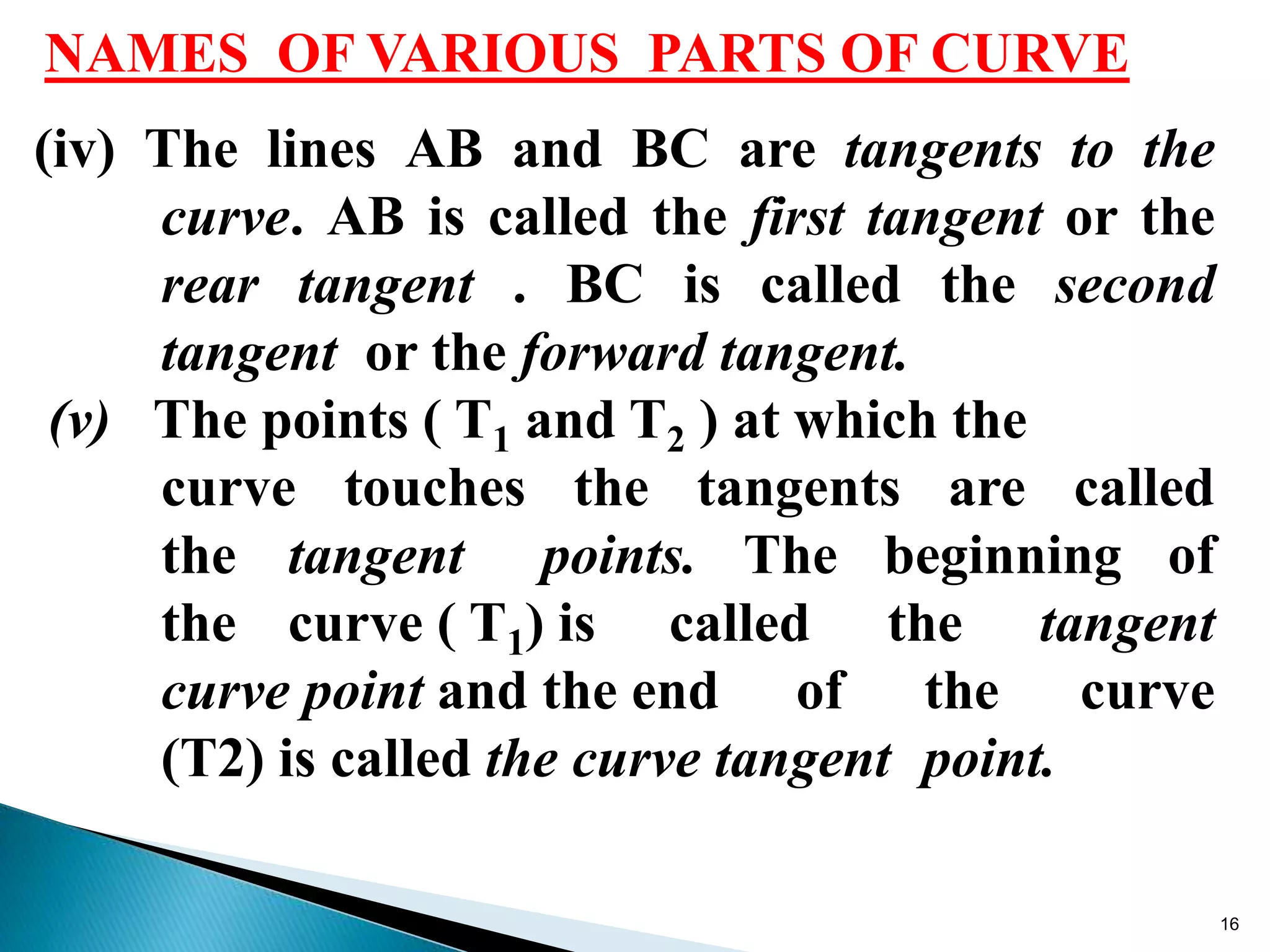
(iv) The lines AB and BC are tangents to the
curve. AB is called the first tangent or the
rear tangent . BC is called the second
tangent or the forward tangent.
(v) The points ( T1 and T2 ) at which the
curve touches the tangents are called
the tangent points. The beginning of
the curve ( T1) is called the tangent
curve point and the end of the curve
(T2) is called the curve tangent point.
16
17.
NAMES OF VARIOUSPARTS OF CURVE
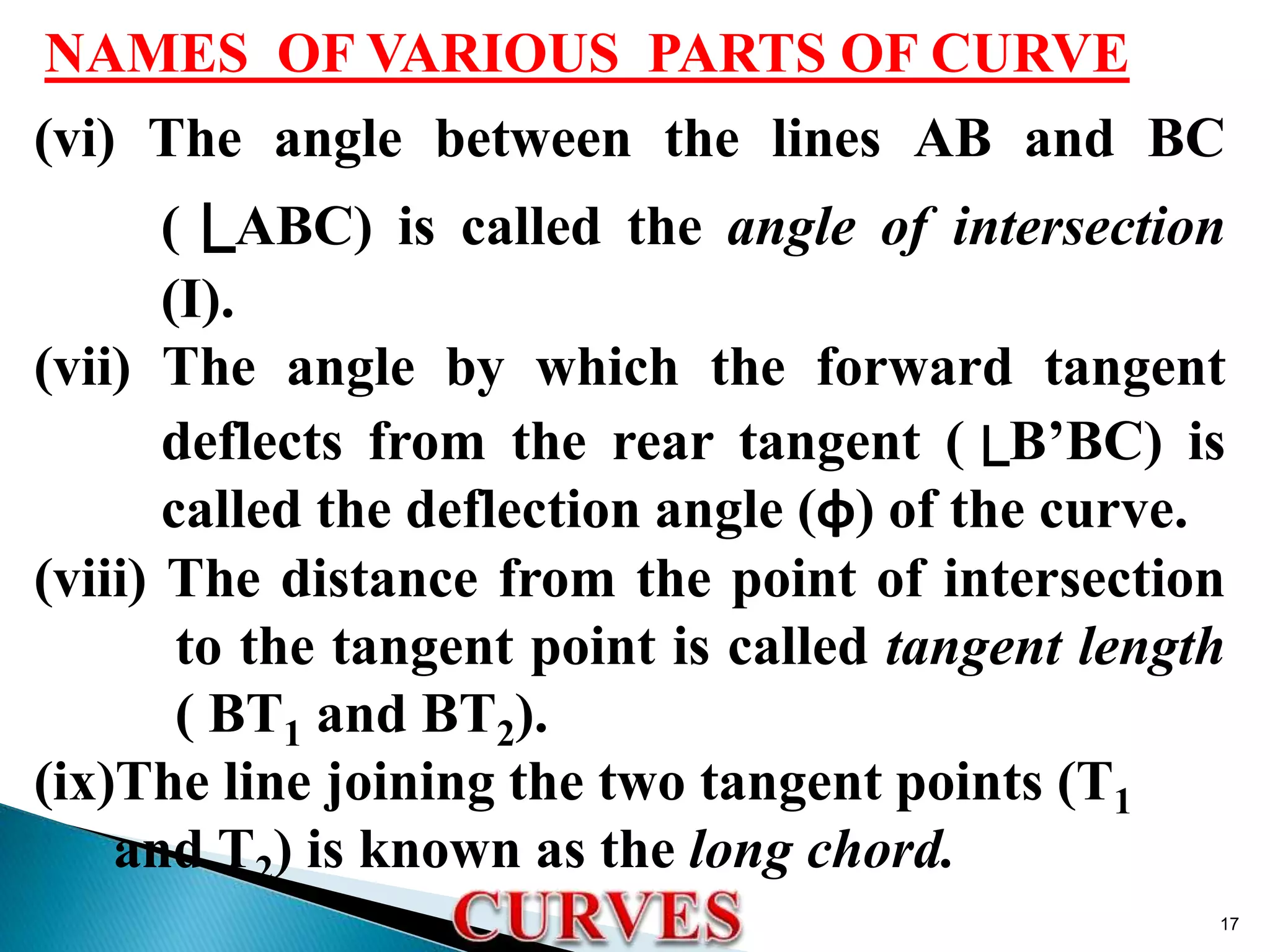
(vi) The angle between the lines AB and BC
(
└ABC) is called the angle of intersection
(I).
(vii) The angle by which the forward tangent
deflects from the rear tangent (└B’BC) is
called the deflection angle (φ) of the curve.
(viii) The distance from the point of intersection
to the tangent point is called tangent length
( BT1 and BT2).
(ix)The line joining the two tangent points (T1
and T2) is known as the long chord.
17
18.
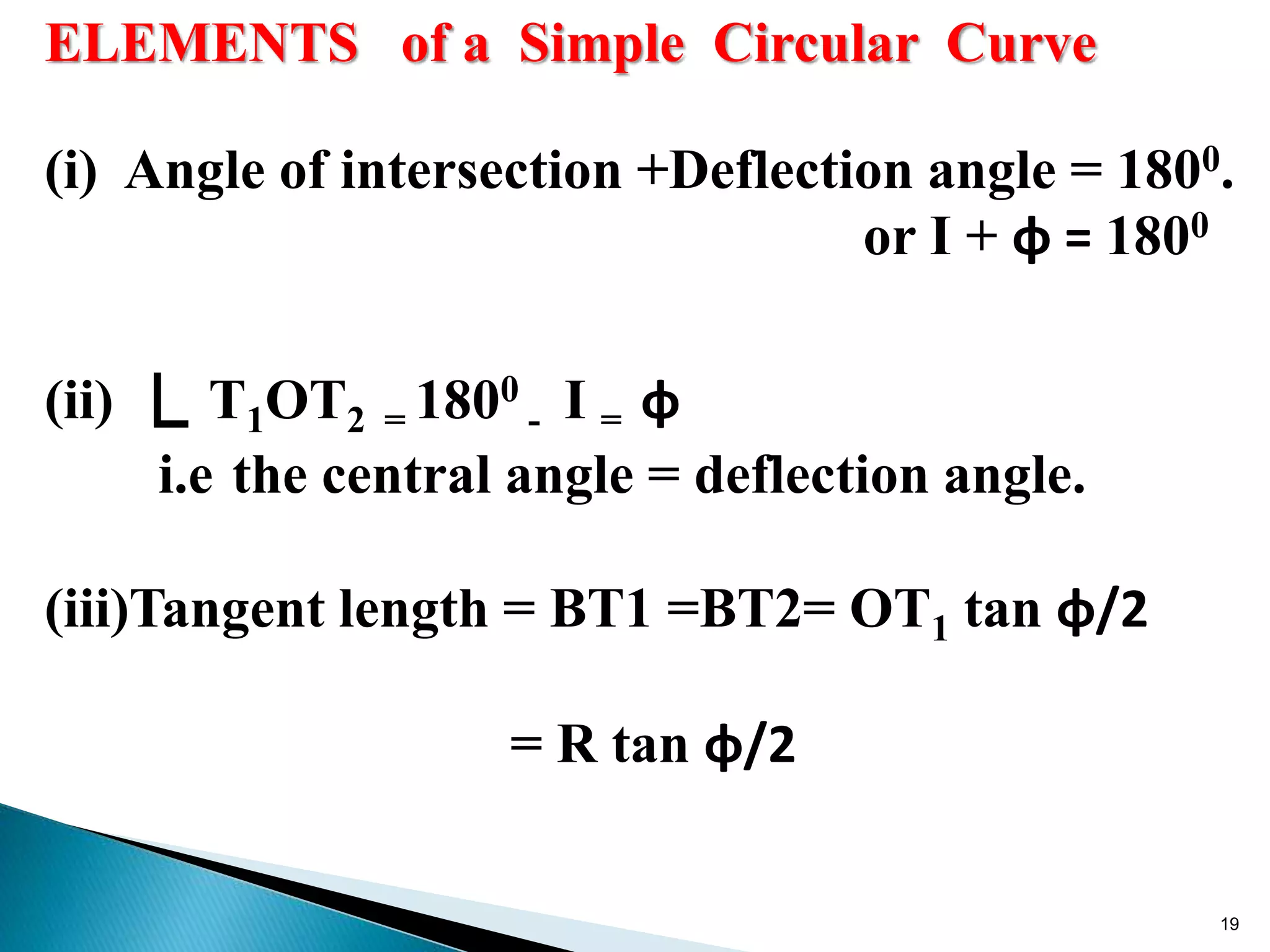
(x) The arcT1FT2 is called the length of curve.
(xi) The mid point(F) of the arc (T1FT2) is called
the summit or apex of the curve.
(xii) The distance from the point of intersection
to the apex of the curve BF is called the
apex distance.
(xiii) The distance between the apex of the curve
and the mid point of the long chord (EF) is
called versed sine of the curve.
(xiv) The angle subtended at the centre of the
curve by the arc T1FT2 is known as
central angle and is equal to the deflection
angle (φ) .
18
19.
ELEMENTS of aSimple Circular Curve
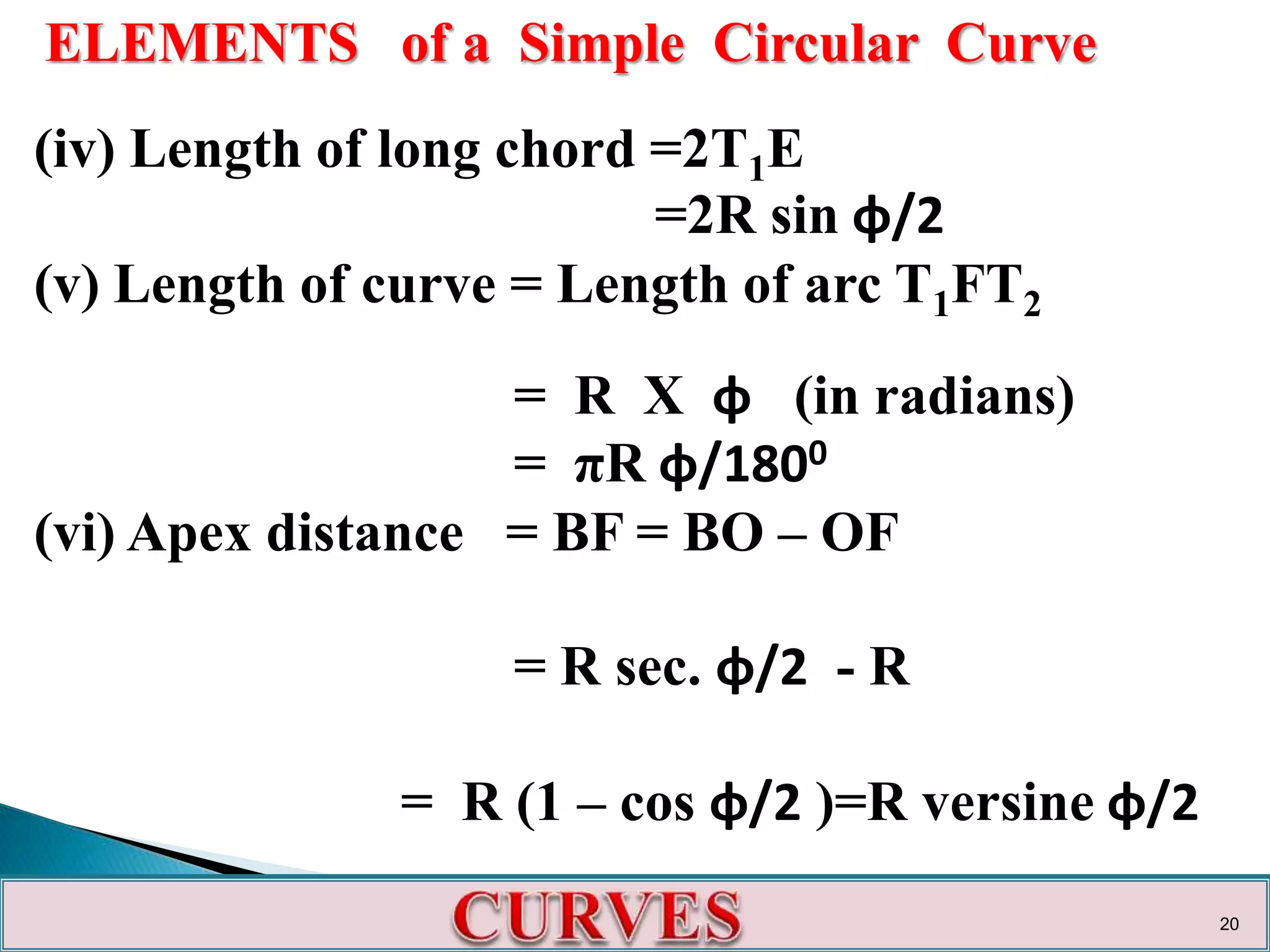
(i) Angle of intersection +Deflection angle = 1800.
or I + φ = 1800
(ii)
└ T1OT2 = 1800
- I = φ
i.e the central angle = deflection angle.
(iii)Tangent length = BT1 =BT2= OT1 tan φ/2
= R tan φ/2
19
20.
ELEMENTS of aSimple Circular Curve
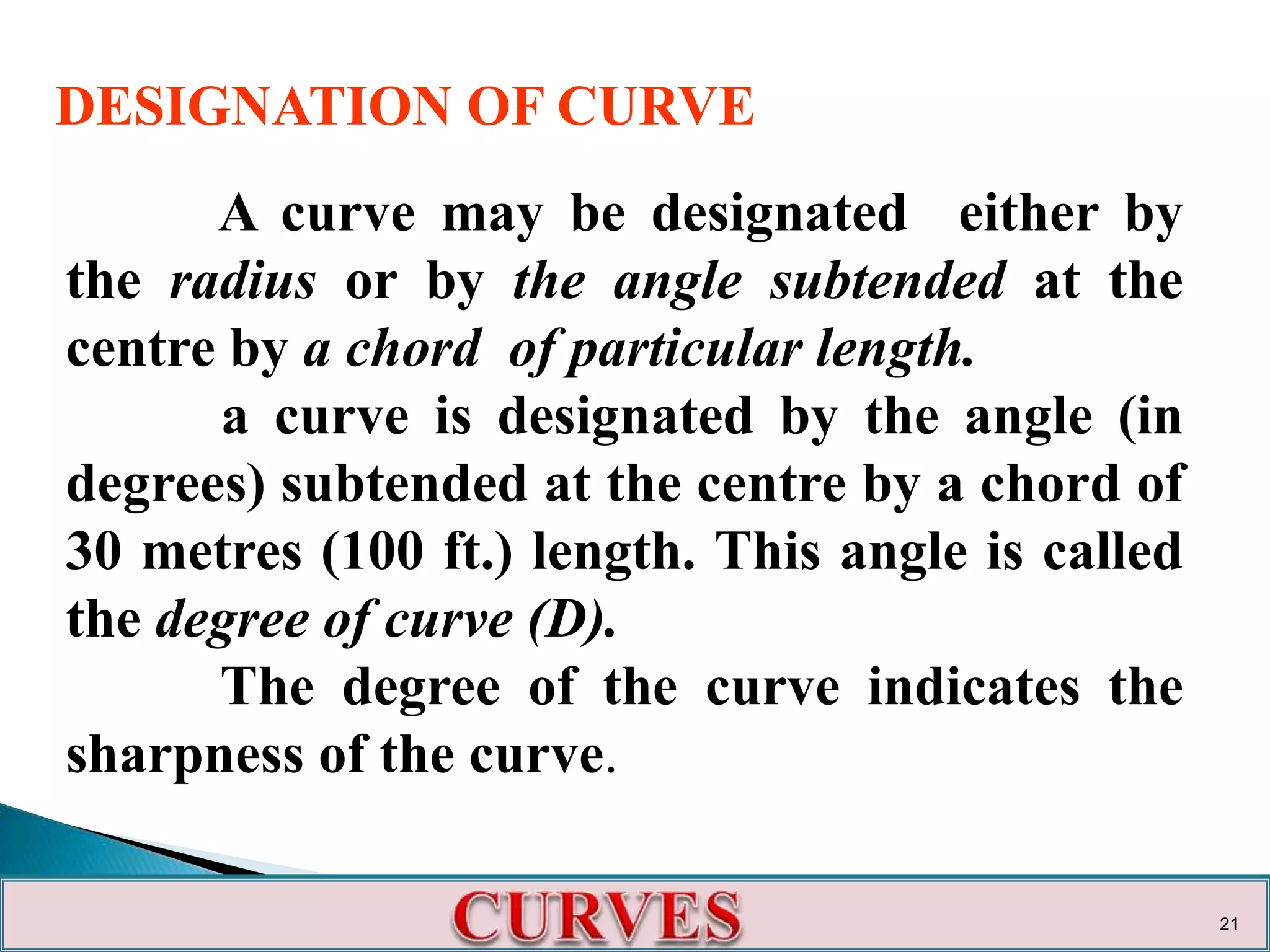
(iv) Length of long chord =2T1E
=2R sin φ/2
(v) Length of curve = Length of arc T1FT2
= R X φ (in radians)
= πR φ/1800
(vi) Apex distance = BF = BO – OF
= R sec. φ/2 - R
= R (1 – cos φ/2 )=R versine φ/2
20
21.
A curve maybe designated either by
the radius or by the angle subtended at the
centre by a chord of particular length.
a curve is designated by the angle (in
degrees) subtended at the centre by a chord of
30 metres (100 ft.) length. This angle is called
the degree of curve (D).
The degree of the curve indicates the
sharpness of the curve.
DESIGNATION OF CURVE
21
22.
DESIGNATION OF CURVES.
InEnglish practice , a curve is defined
by the radius of the curve in terms of chains,
such as a six chain curve means a curve having
radius equal to six full chains, chain being 30
metres unless otherwise specified.
In America,Canada,India and some
other countries a curve is designated by the
degree of the curve
22
23.
RELATION between theRadius of curve and
Degree of Curve.
The relation between the radius
and the degree of the curve may
be determined as follows:-
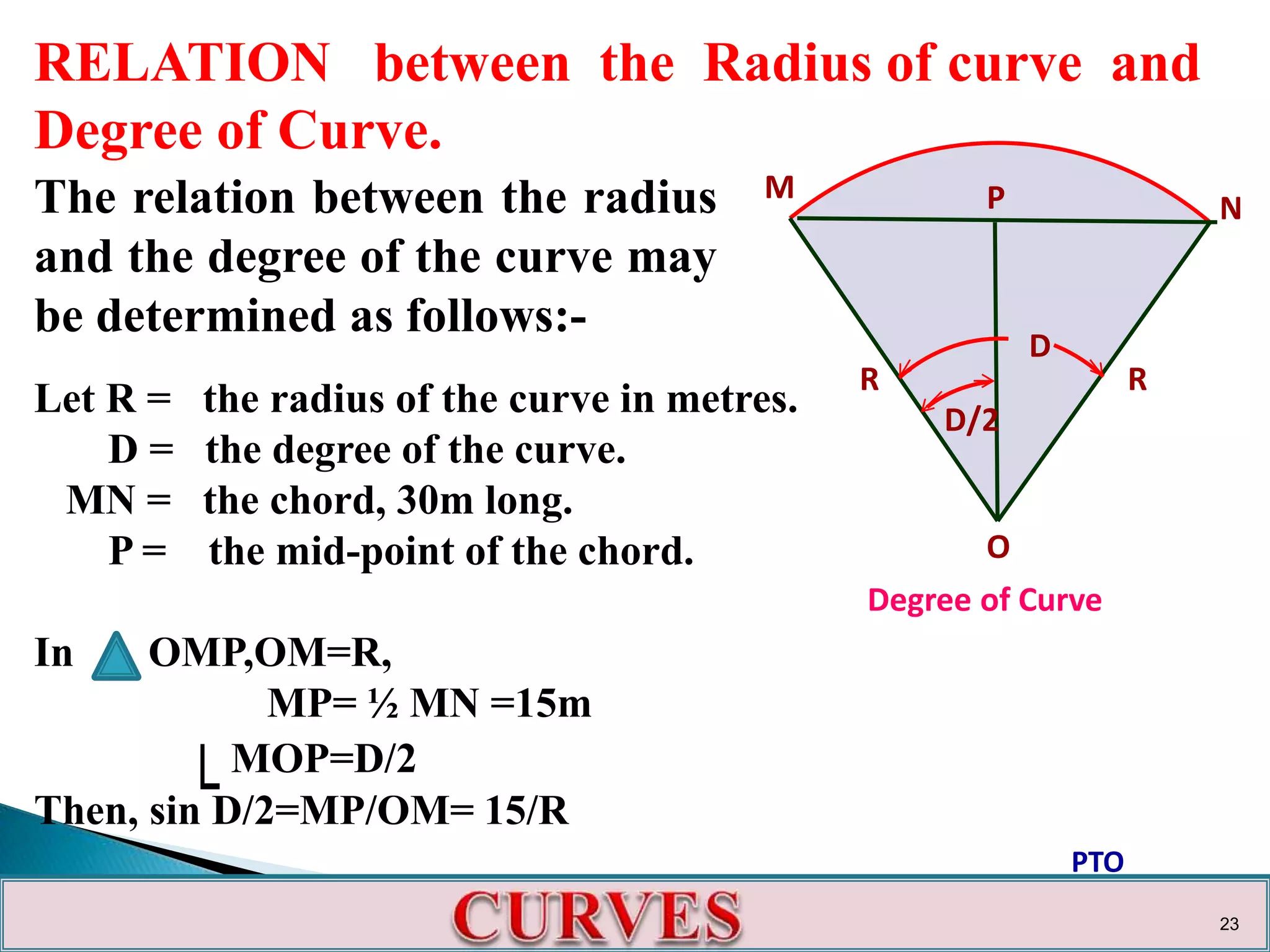
Let R = the radius of the curve in metres.
D = the degree of the curve.
MN = the chord, 30m long.
P = the mid-point of the chord.
In OMP,OM=R,
MP= ½ MN =15m
MOP=D/2
Then, sin D/2=MP/OM= 15/R
M
N
O
D
D/2
R R
Degree of Curve
P
PTO
23
24.
RELATION between theRadius of curve and
Degree of Curve.
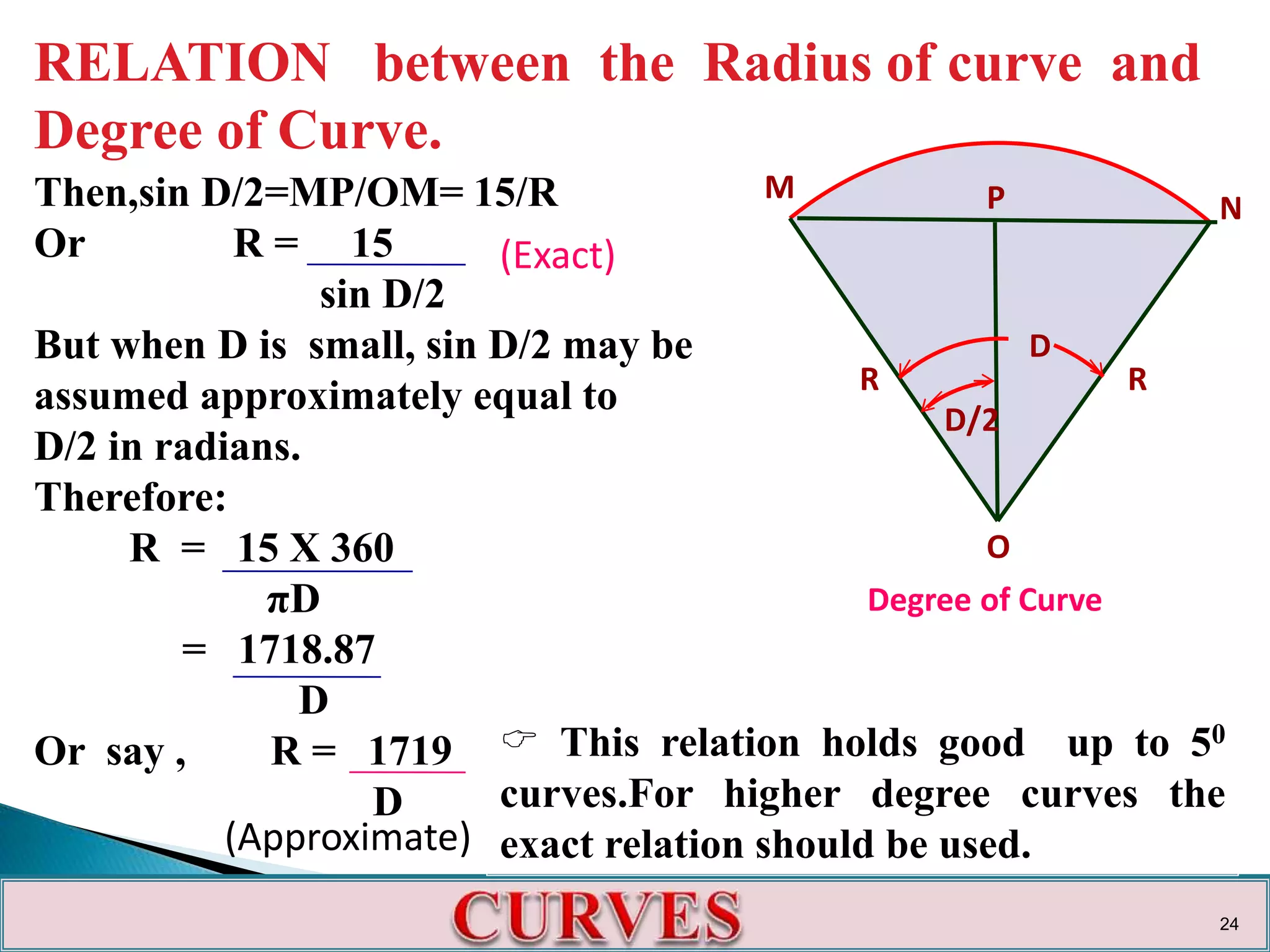
Then,sin D/2=MP/OM= 15/R
Or R = 15
sin D/2
But when D is small, sin D/2 may be
assumed approximately equal to
D/2 in radians.
Therefore:
R = 15 X 360
πD
= 1718.87
D
Or say , R = 1719
D
M
N
O
D
D/2
R R
Degree of Curve
P
This relation holds good up to 50
curves.For higher degree curves the
exact relation should be used.
(Exact)
(Approximate)
24
25.
METHODS OF CURVERANGING
A curve may be set out
(1) By linear Methods, where chain and tape
are used or
(2) By Angular or instrumental methods,
where a theodolite with or without a chain is
used.
Before starting setting out a curve by any
method, the exact positions of the tangents
points between which the curve lies ,must be
determined. Following procedure is adopted:-
25
26.
METHODS OF SETTINGOUT A CURVE
Procedure :-
i) After fixing the directions of the straights,
produce them to meet in point (B)
ii) Set up the Theodolite at the intersection
point (B) and measure the angle of
intersection (I) .Then find the deflection
angle ( ) by subtracting (I) from 1800 i.e
φ=1800 – I.
iii) Calculate the tangent length from the
following equation
Tangent length = R tanφ/2
φ
26
27.
METHODS OF SETTINGOUT A CURVE
Procedure :-
iv) Measure the tangent length (BT1)
backward along the rear tangent BA from
the intersection point B, thus locating the
position of T1.
vi) Similarly, locate the position of T2 by
measuring the same distance forward
along the forward tangent BC from B.
27
28.
METHODS OF SETTINGOUT A CURVE
Procedure (contd…) :-
After locating the positions of the tangent
points T1 and T2 ,their chainages may be
determined. The chainage of T1 is obtained by
subtracting the tangent length from the known
chainage of the intersection point B. And the
chainage of T2 is found by adding the length
of curve to the chainage of T1.
Then the pegs are fixed at equal intervals
on the curve.The interval between pegs is
usually 30m or one chain length.
28
29.
METHODS OF SETTINGOUT A CURVE
Procedure (contd…) :-
This distance should actually be measured along
the arc ,but in practice it is measured along
the chord ,as the difference between the chord
and the corresponding arc is small and hence
negligible. In order that this difference is
always small and negligible ,the length of the
chord should not be more than 1/20th of the
radius of the curve. The curve is then obtained
by joining all these pegs.
29
30.
METHODS OF SETTINGOUT A CURVE
Procedure (contd…) :-
The distances along the centre line of the
curve are continuously measured from the
point of beginning of the line up to the end .i.e
the pegs along the centre line of the work
should be at equal interval from the beginning
of the line up to the end. There should be no
break in the regularity of their spacing in
passing from a tangent to a curve or from a
curve to the tangent. For this reason ,the first
peg on the curve is fixed
30
31.
METHODS OF SETTINGOUT A CURVE
Procedure (contd…) :-
at such a distance from the first tangent point (T1)
that its chainage becomes the whole number of
chains i.e the whole number of peg interval. The
length of the first sub chord is thus less than the
peg interval and it is called a sub-chord. Similarly
there will be a sub-chord at the end of the curve.
Thus a curve usually consists of two sub-chords
and a no. of full chords.
31
32.
LINEAR METHODS ofsetting out Curves
The following are the methods of setting out
simple circular curves by the use of chain
and tape :-
(i) By offsets from the tangents.
(ii) By successive bisection of arcs.
(iii) By offsets from chords produced.
32
33.
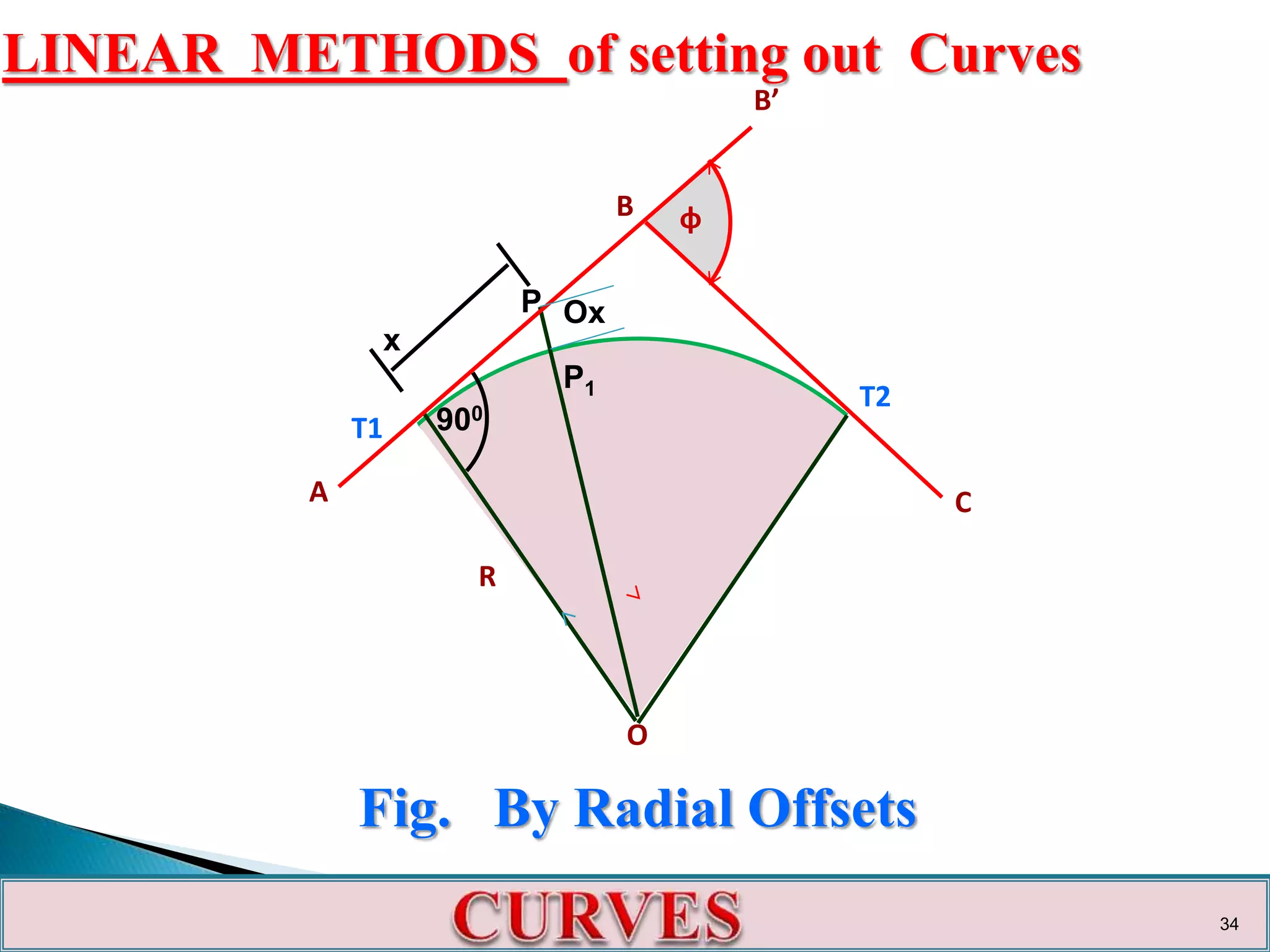
LINEAR METHODS ofsetting out Curves
1. By offsets from the tangents. When the
deflection angle and the radius of the
curve both are small, the curves are set out
by offsets from the tangents.
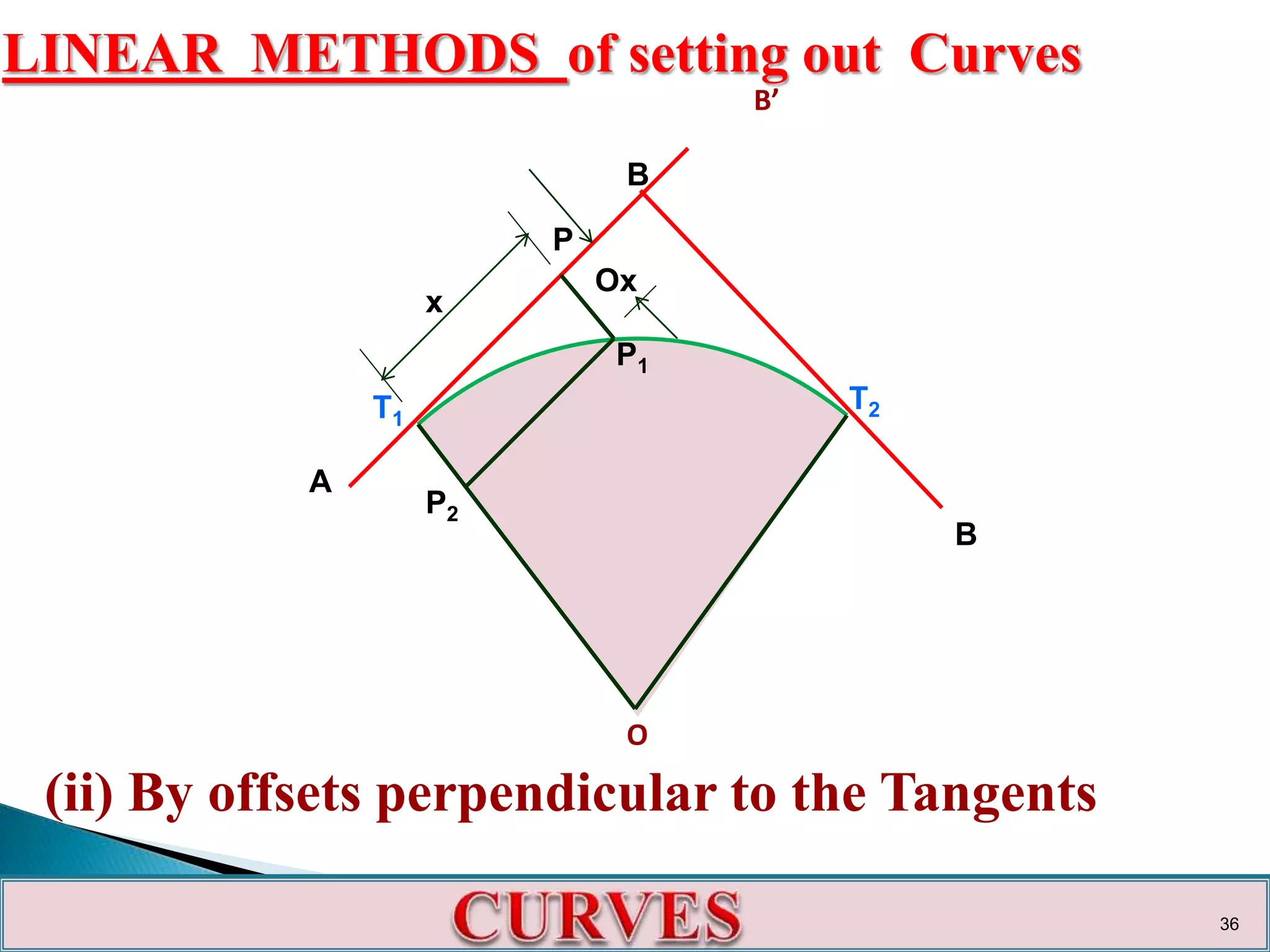
Offsets are set out either
(i) radially or
(ii) perpendicular to the tangents
according as the centre of the curve is
accessible or inaccessible
33
B’
By Radial Offsets
LINEARMETHODS of setting out Curves
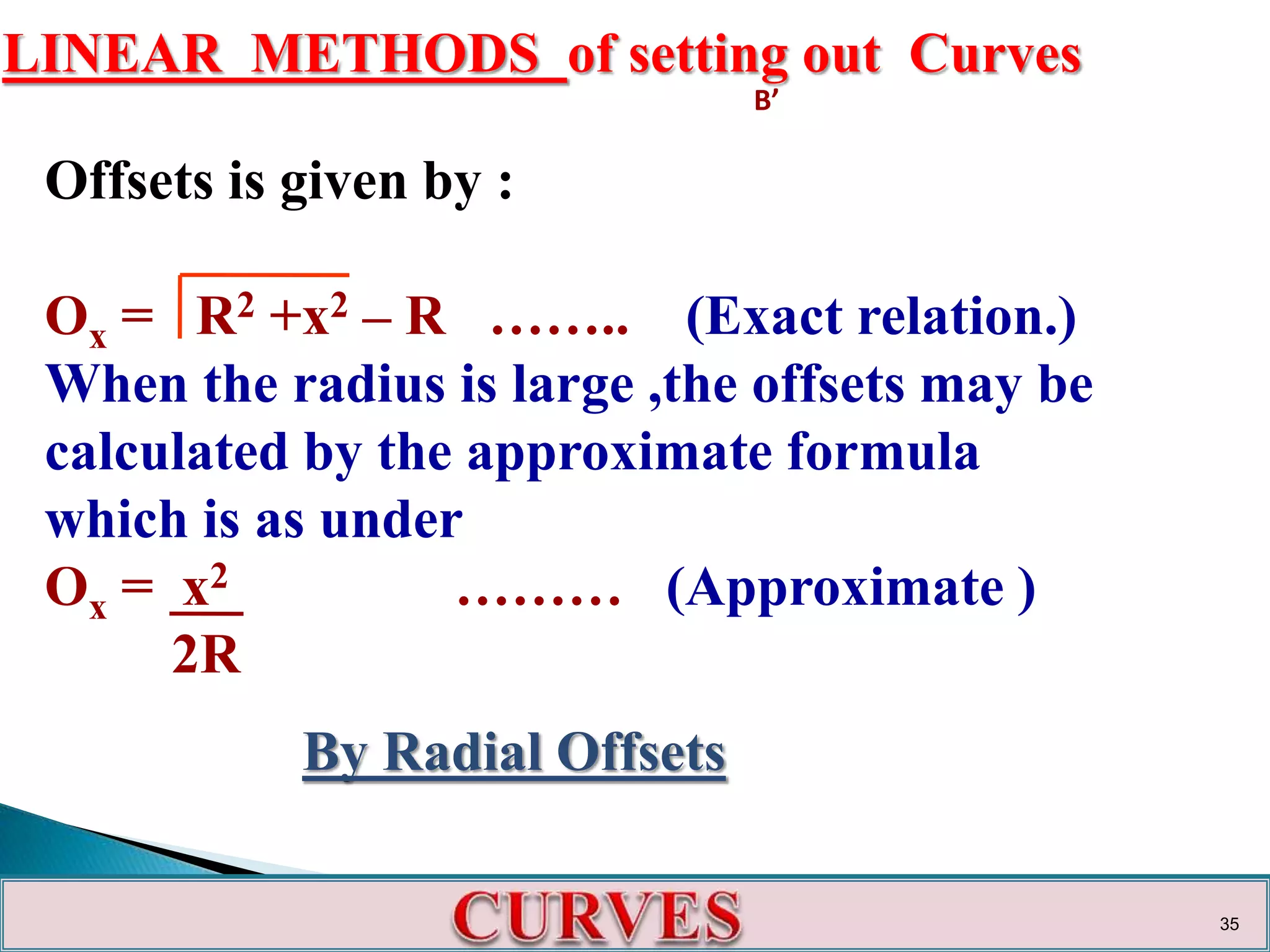
Offsets is given by :
Ox = R2 +x2 – R …….. (Exact relation.)
When the radius is large ,the offsets may be
calculated by the approximate formula
which is as under
Ox = x2 ……… (Approximate )
2R
35
36.
B’
O
(ii) By offsetsperpendicular to the Tangents
LINEAR METHODS of setting out Curves
Ox
x
P
P1
P2
B
A
B
T2T1
36
37.
LINEAR METHODS ofsetting out Curves
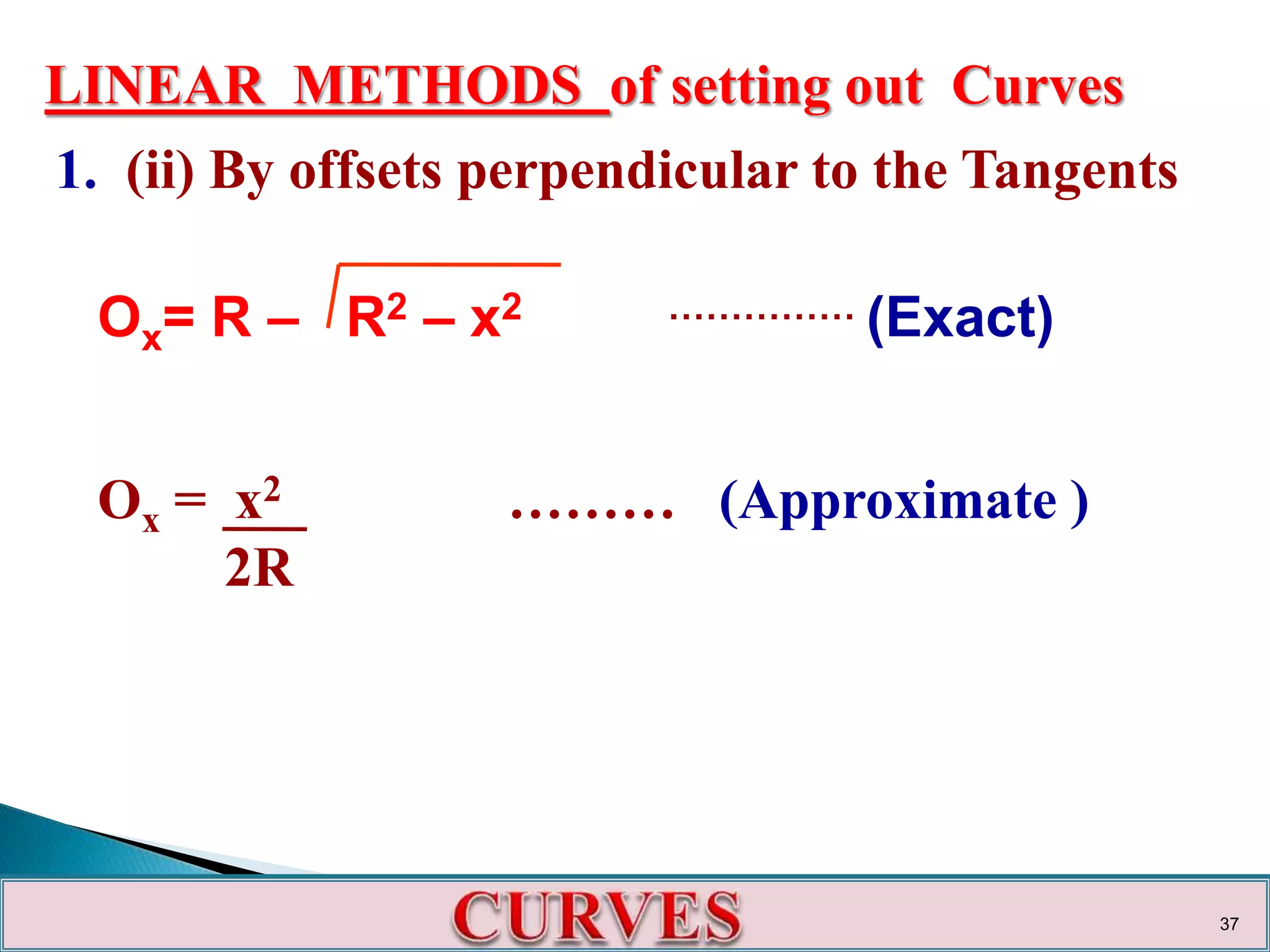
1. (ii) By offsets perpendicular to the Tangents
Ox= R – R2 – x2 …………… (Exact)
Ox = x2 ……… (Approximate )
2R
37
38.
LINEAR METHODS ofsetting out Curves
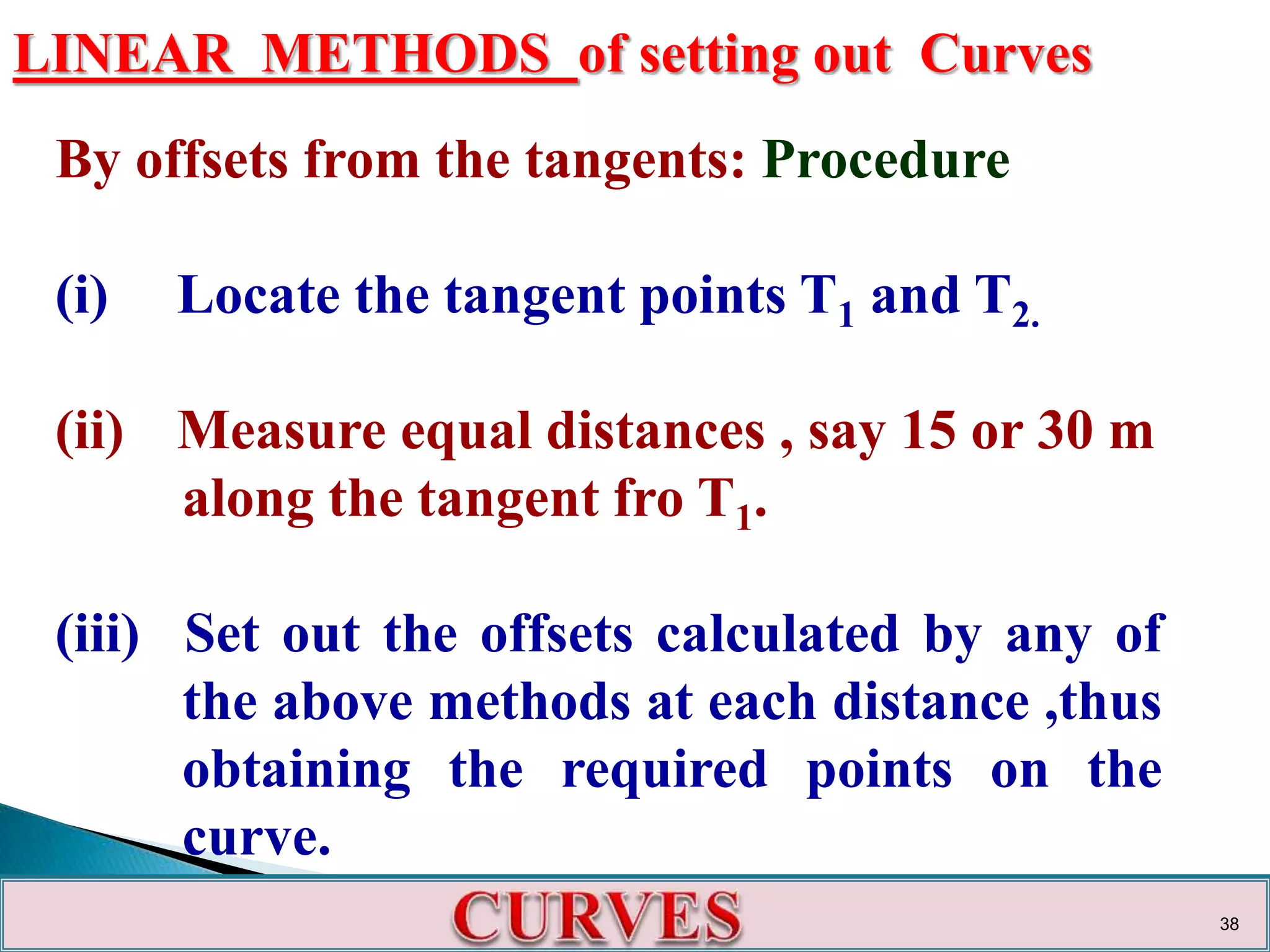
By offsets from the tangents: Procedure
(i) Locate the tangent points T1 and T2.
(ii) Measure equal distances , say 15 or 30 m
along the tangent fro T1.
(iii) Set out the offsets calculated by any of
the above methods at each distance ,thus
obtaining the required points on the
curve.
38
39.
LINEAR METHODS ofsetting out Curves
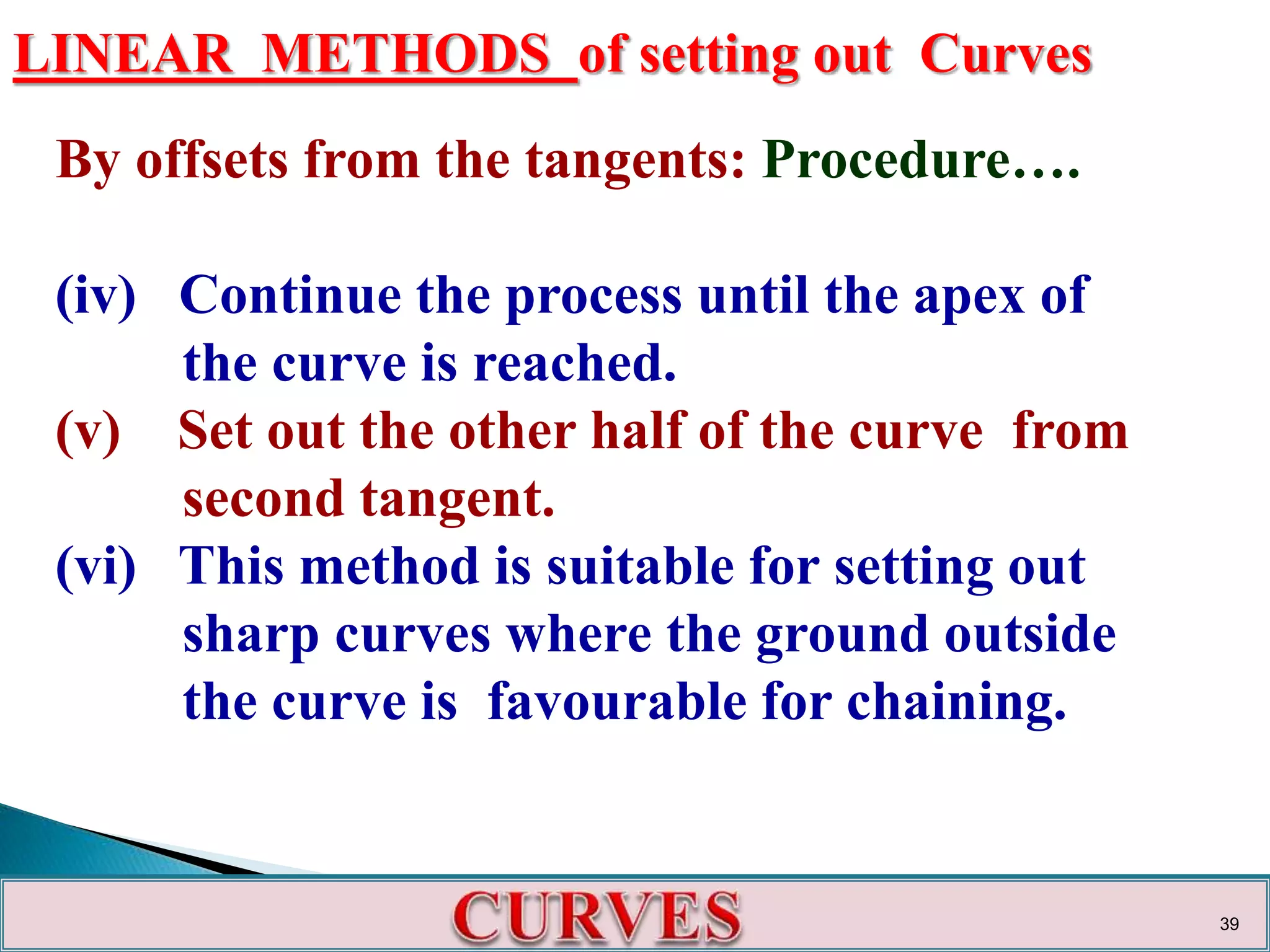
By offsets from the tangents: Procedure….
(iv) Continue the process until the apex of
the curve is reached.
(v) Set out the other half of the curve from
second tangent.
(vi) This method is suitable for setting out
sharp curves where the ground outside
the curve is favourable for chaining.
39
40.
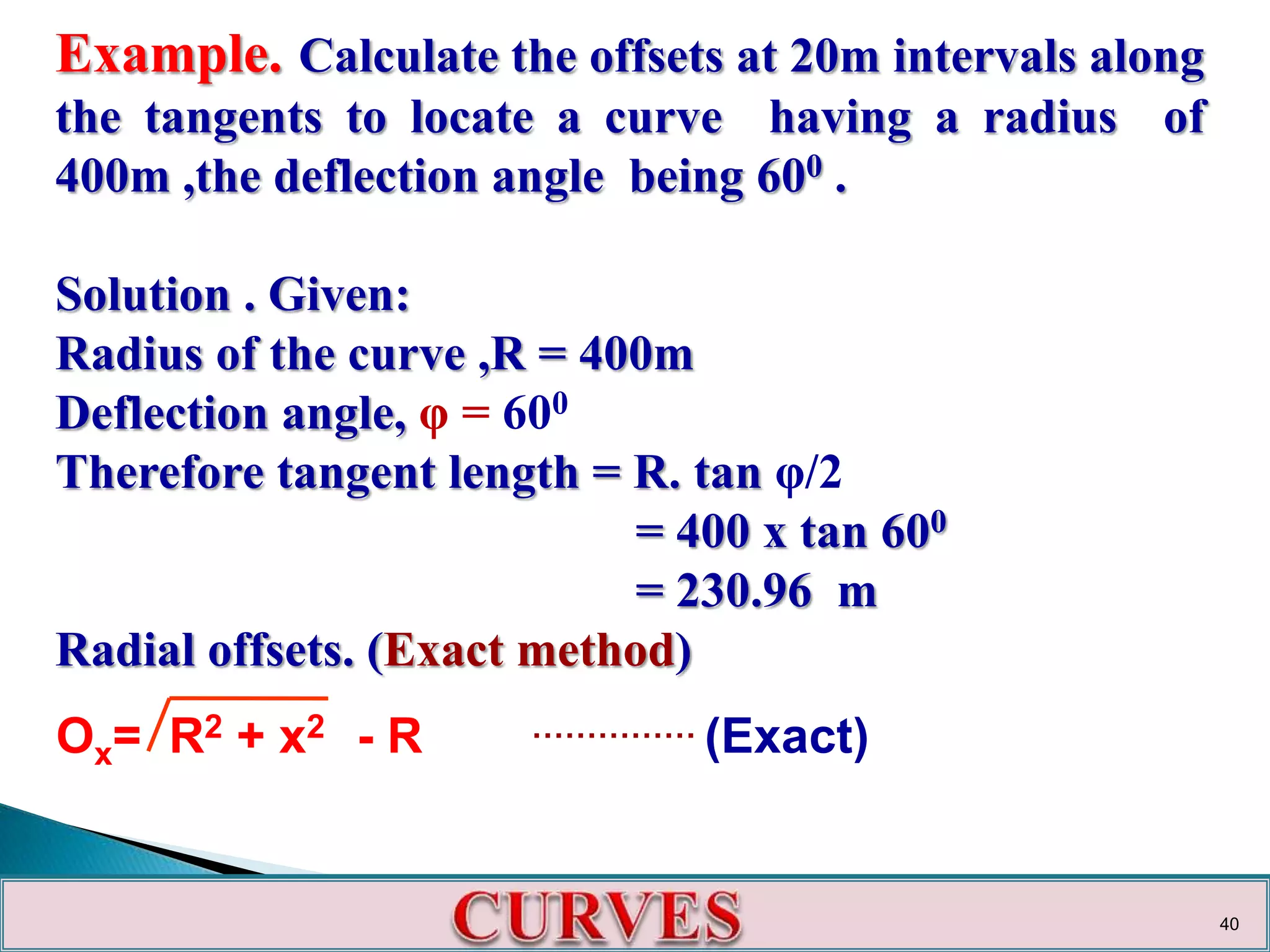
Example. Calculate theoffsets at 20m intervals along
the tangents to locate a curve having a radius of
400m ,the deflection angle being 600 .
Solution . Given:
Radius of the curve ,R = 400m
Deflection angle, φ = 600
Therefore tangent length = R. tan φ/2
= 400 x tan 600
= 230.96 m
Radial offsets. (Exact method)
Ox= R2 + x2 - R …………… (Exact)
40
41.
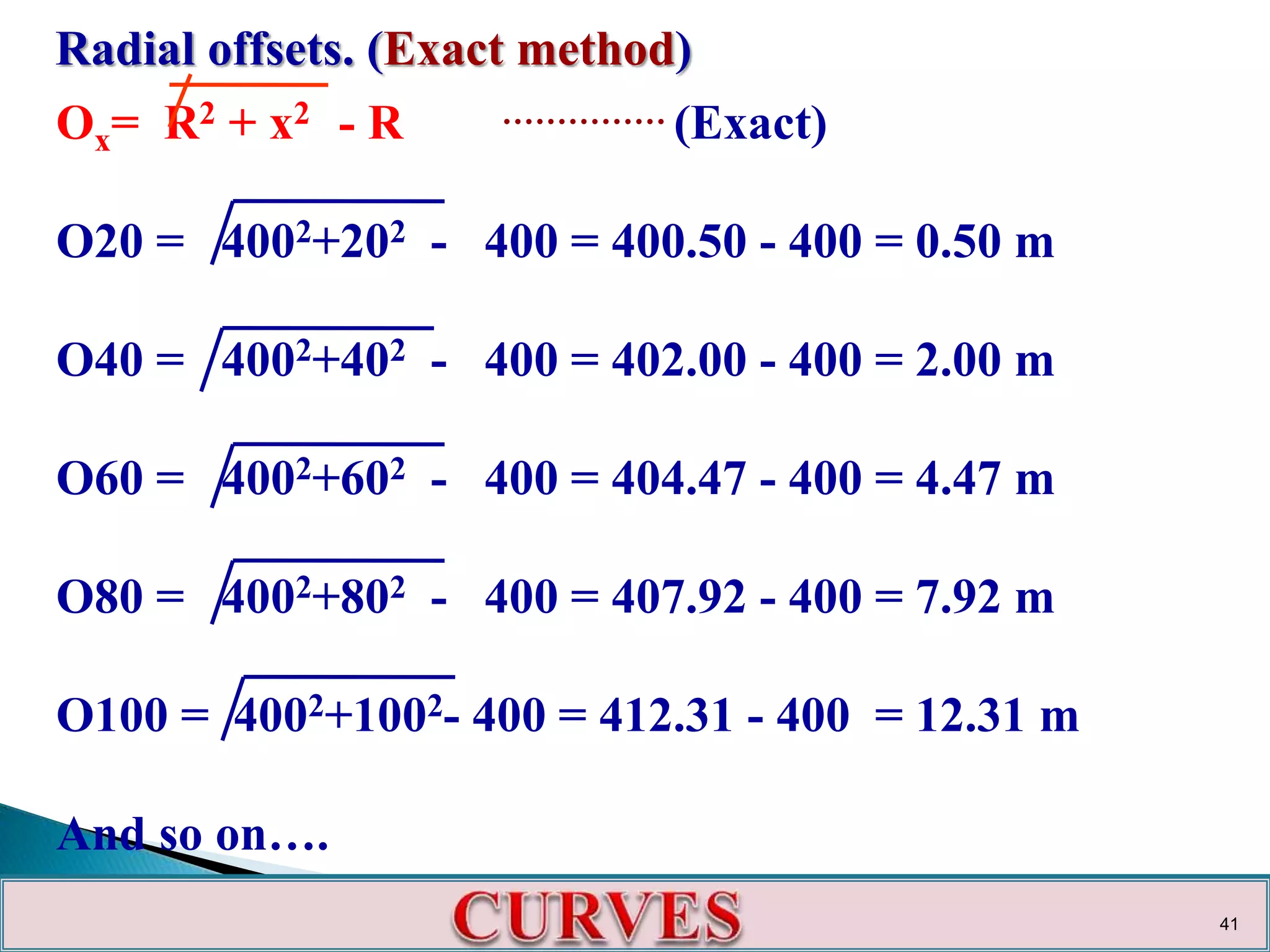
Radial offsets. (Exactmethod)
Ox= R2 + x2 - R …………… (Exact)
O20 = 4002+202 - 400 = 400.50 - 400 = 0.50 m
O40 = 4002+402 - 400 = 402.00 - 400 = 2.00 m
O60 = 4002+602 - 400 = 404.47 - 400 = 4.47 m
O80 = 4002+802 - 400 = 407.92 - 400 = 7.92 m
O100 = 4002+1002- 400 = 412.31 - 400 = 12.31 m
And so on….
41
42.
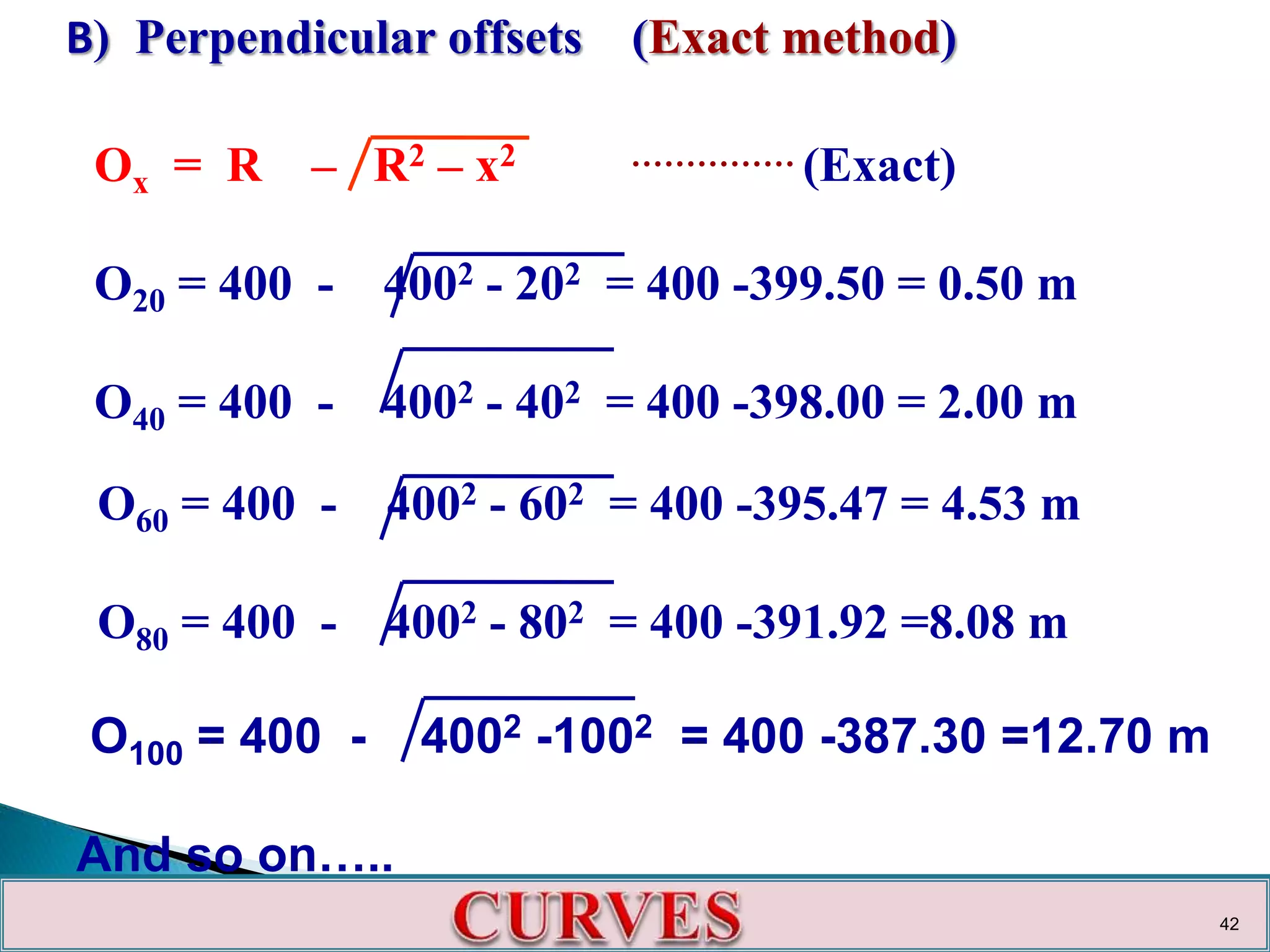
B) Perpendicular offsets(Exact method)
Ox = R – R2 – x2 …………… (Exact)
O20 = 400 - 4002 - 202 = 400 -399.50 = 0.50 m
O40 = 400 - 4002 - 402 = 400 -398.00 = 2.00 m
O60 = 400 - 4002 - 602 = 400 -395.47 = 4.53 m
O80 = 400 - 4002 - 802 = 400 -391.92 =8.08 m
O100 = 400 - 4002 -1002 = 400 -387.30 =12.70 m
And so on…..
42
43.
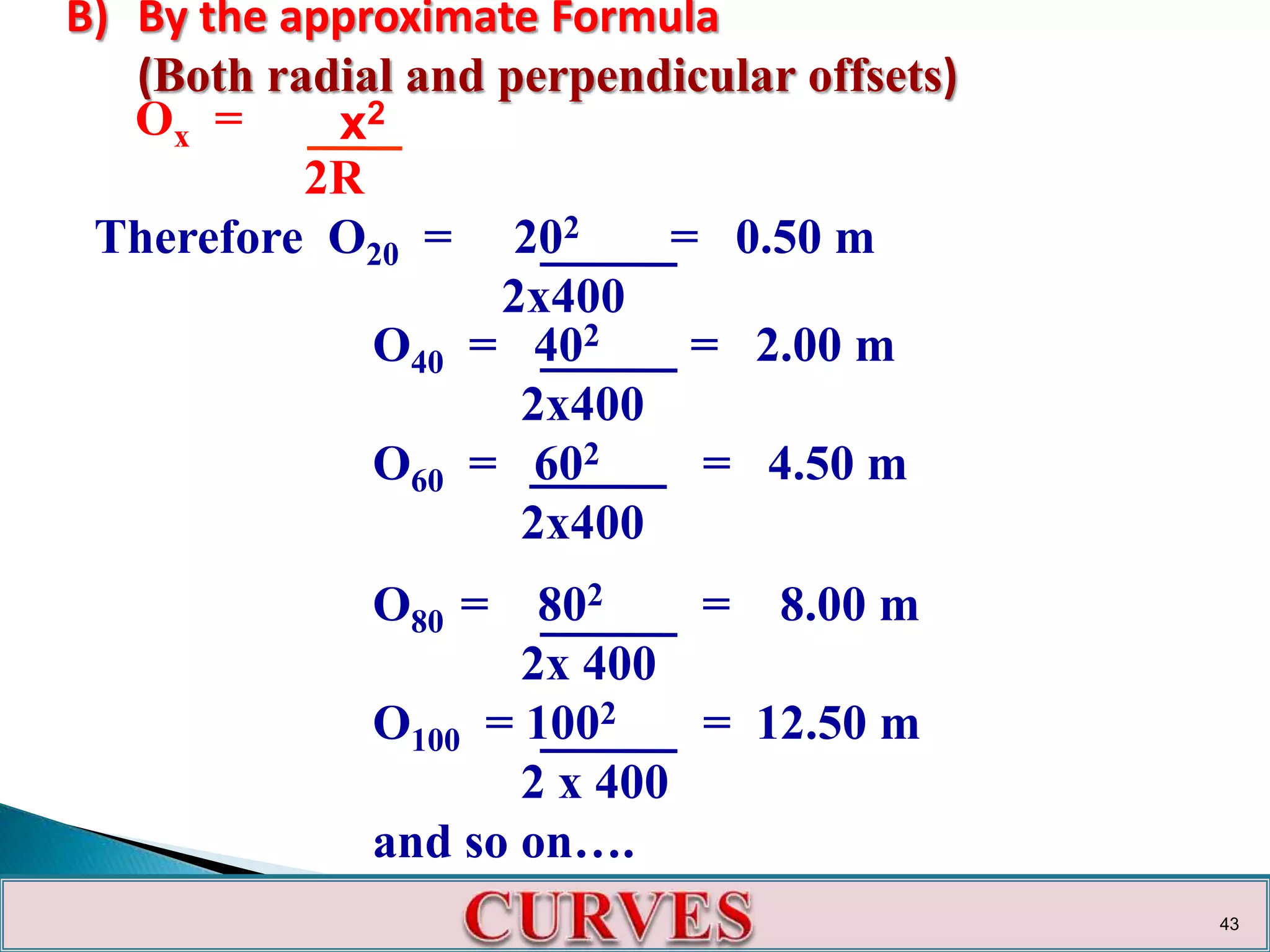
B) By theapproximate Formula
(Both radial and perpendicular offsets)
Ox =
2R
Therefore O20 = 202 = 0.50 m
2x400
x2
O40 = 402 = 2.00 m
2x400
O60 = 602 = 4.50 m
2x400
O80 = 802 = 8.00 m
2x 400
O100 = 1002 = 12.50 m
2 x 400
and so on….
43