Scientific Article – Reading and WritingKaustavMajumderALES-204, 19th October, 2011
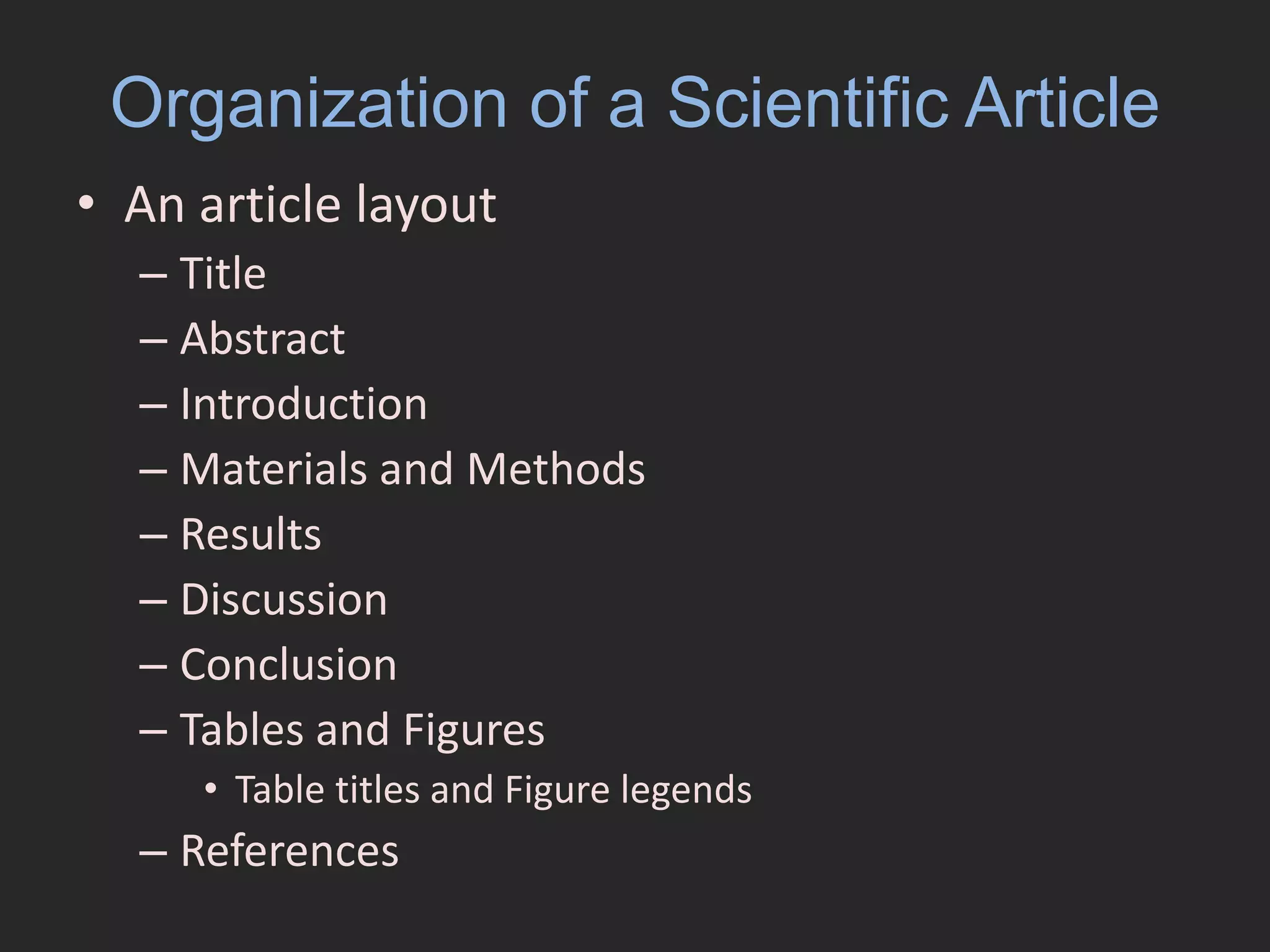
Organization of a Scientific ArticleAn article layoutTitleAbstractIntroductionMaterials and MethodsResultsDiscussionConclusionTables and FiguresTable titles and Figure legends References
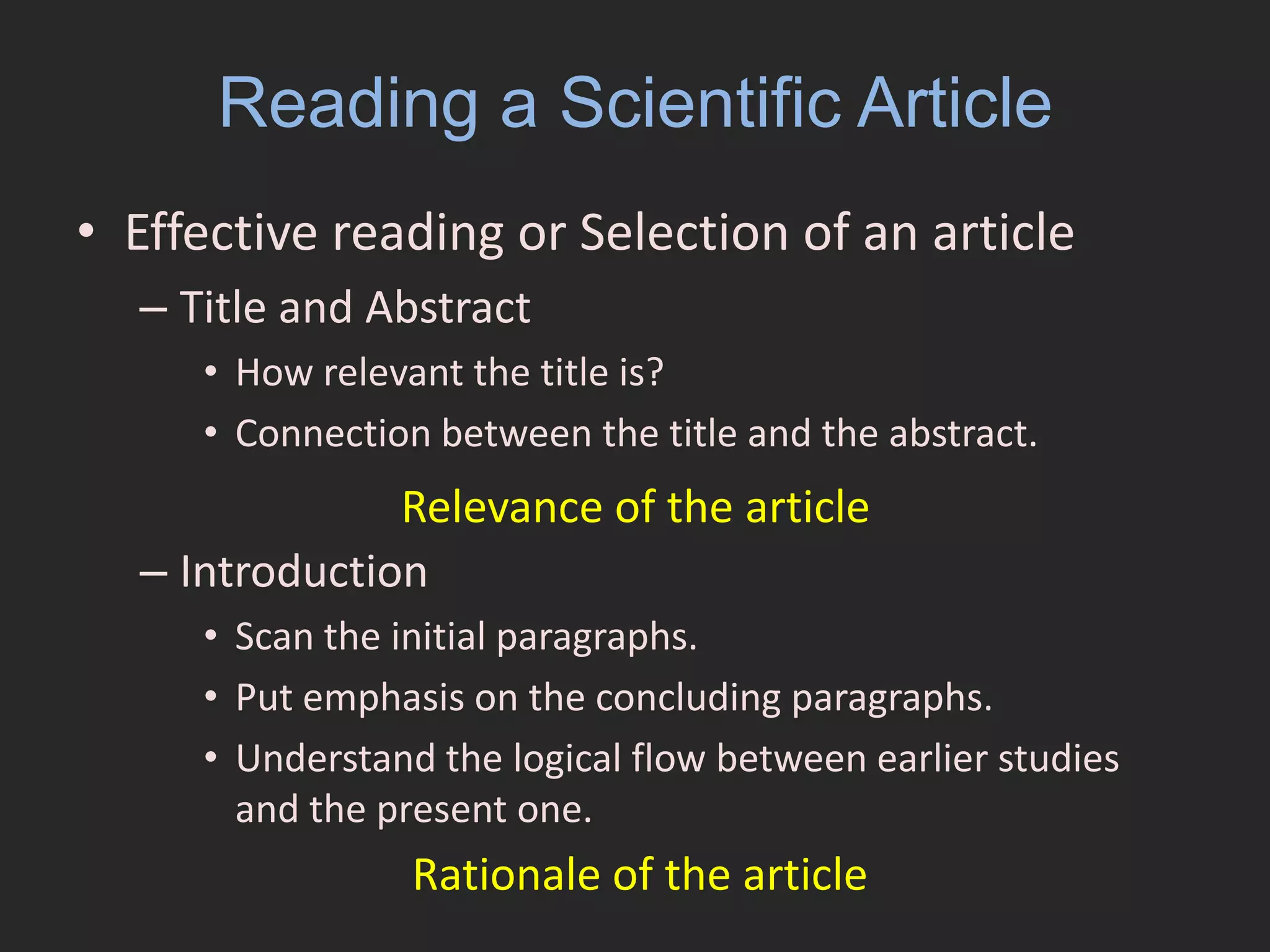
Reading a Scientific ArticleEffective reading or Selection of an article Title and AbstractHow relevant the title is?Connection between the title and the abstract. IntroductionScan the initial paragraphs.Put emphasis on the concluding paragraphs.Understand the logical flow between earlier studies and the present one.Relevance of the article Rationale of the article
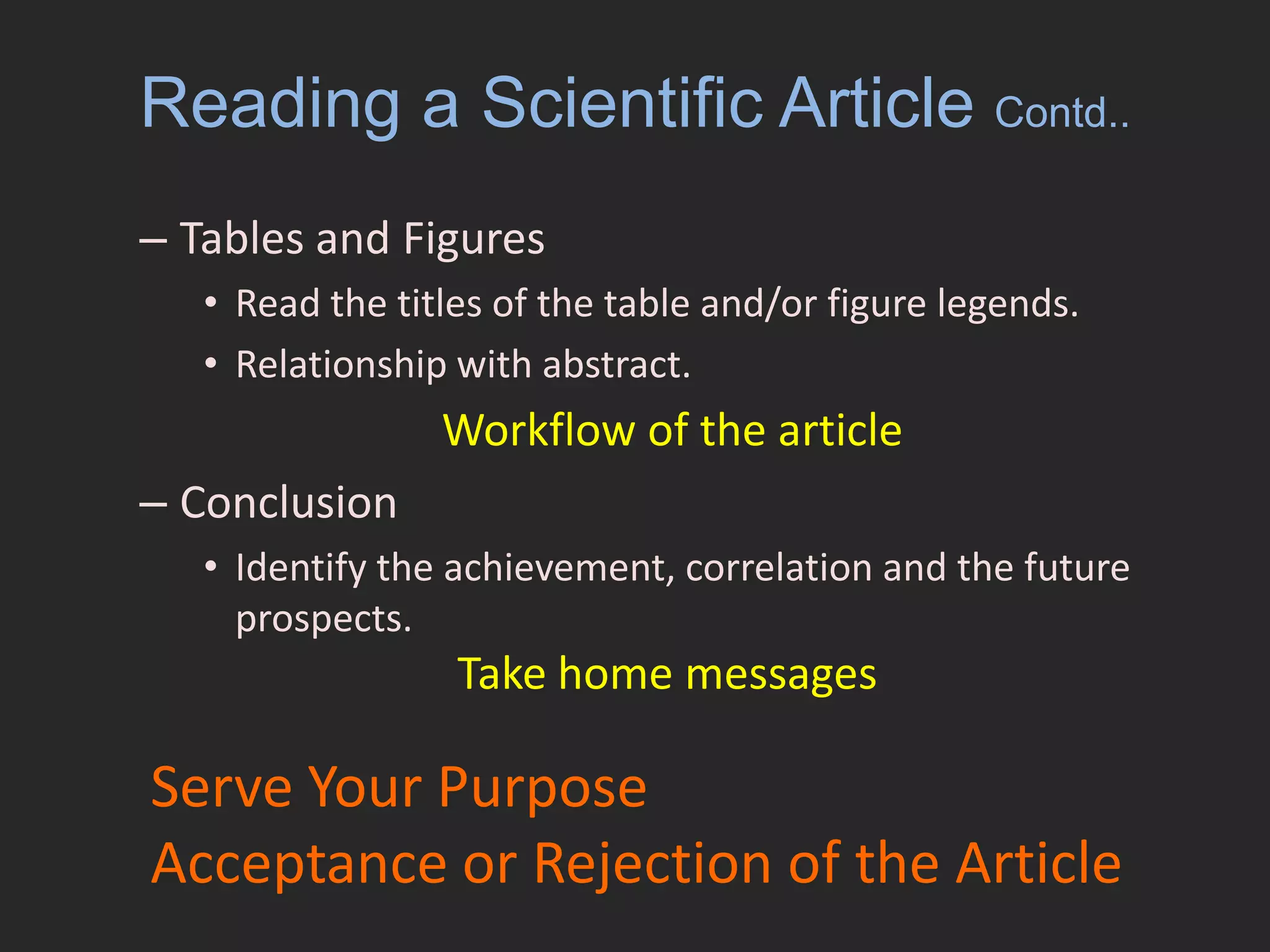
Reading a Scientific Article Contd..Tables and FiguresRead the titles of the table and/or figure legends.Relationship with abstract.  ConclusionIdentify the achievement, correlation and the future prospects. Workflow of the article Take home messagesServe Your PurposeAcceptance or Rejection of the Article
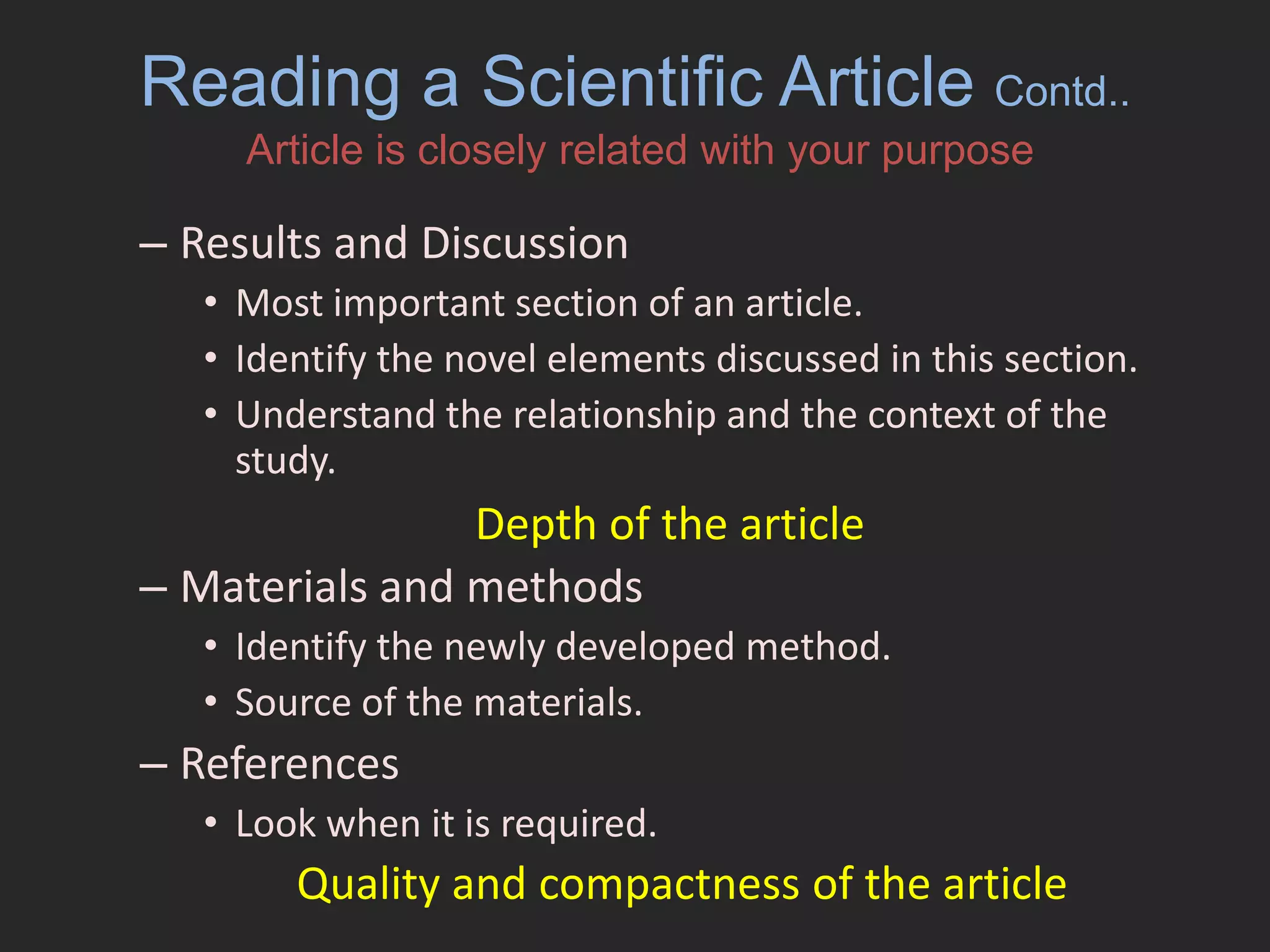
Reading a Scientific Article Contd..Article is closely related with your purposeResults and DiscussionMost important section of an article.Identify the novel elements discussed in this section.Understand the relationship and the context of the study.Materials and methodsIdentify the newly developed method.Source of the materials.ReferencesLook when it is required.Depth of the article Quality and compactness of the article
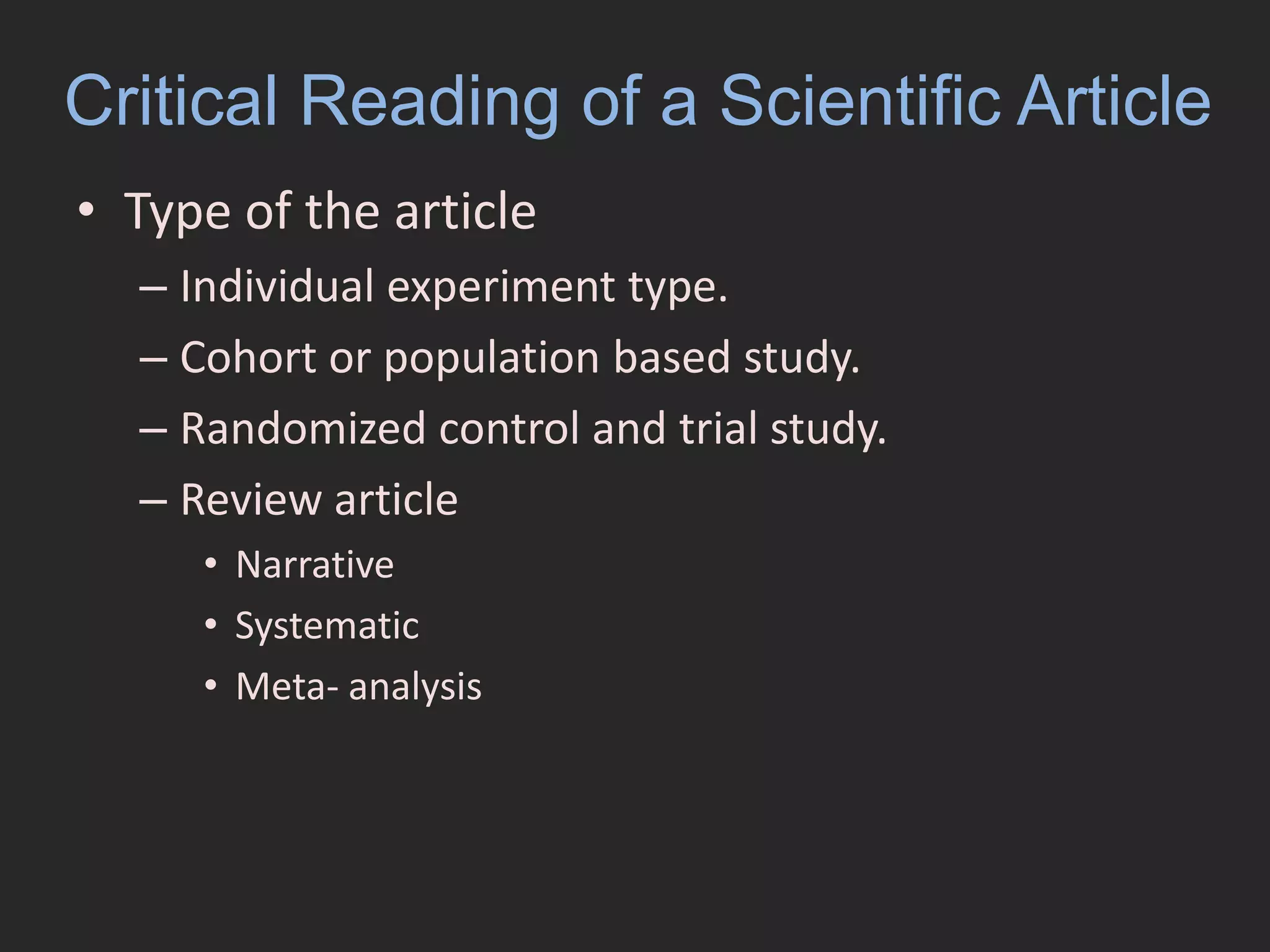
Critical Reading of a Scientific ArticleType of the articleIndividual experiment type.Cohort or population based study.Randomized control and trial study.Review articleNarrative Systematic Meta- analysis
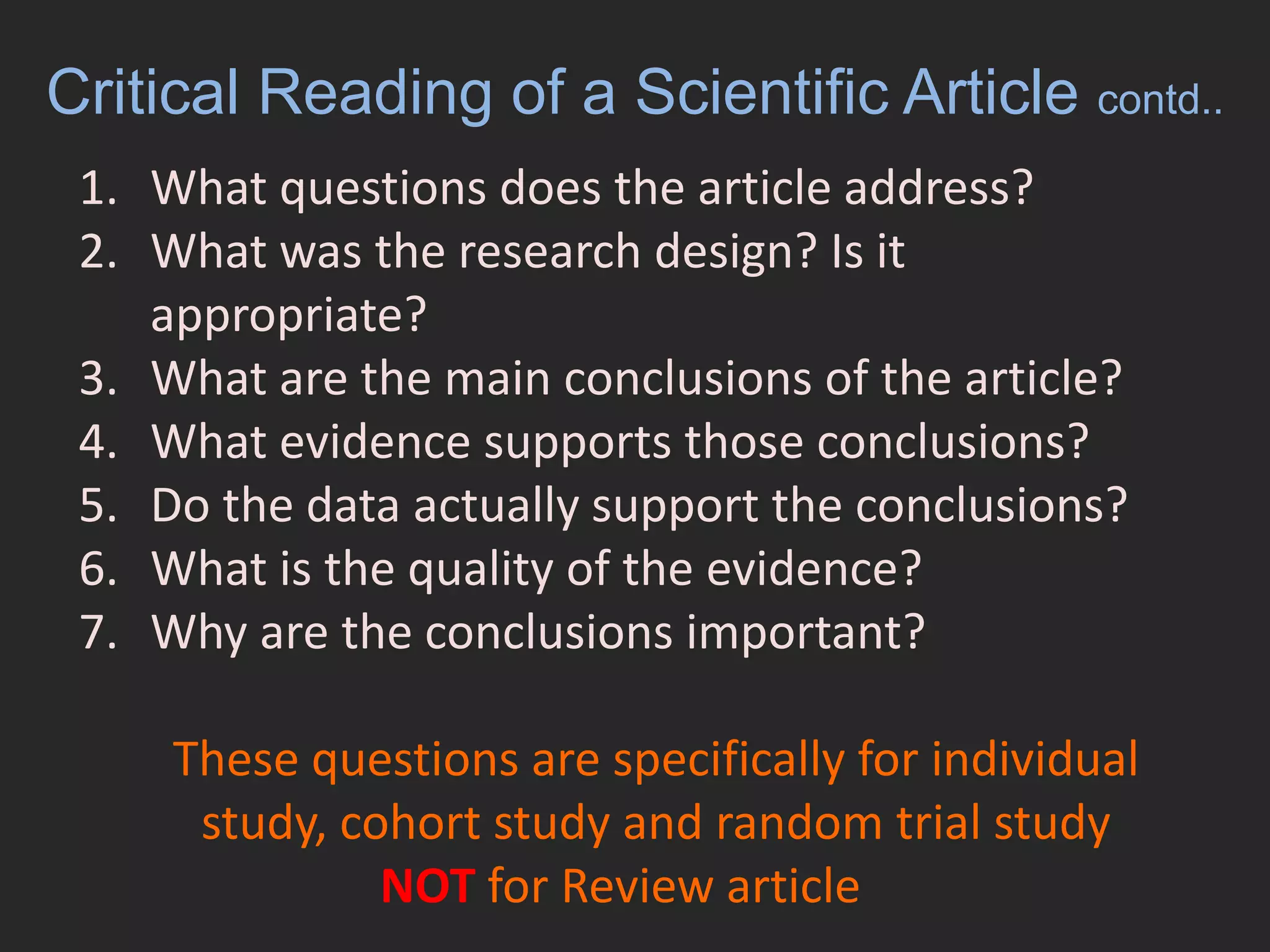
Critical Reading of a Scientific Article contd..What questions does the article address?What was the research design? Is it appropriate? What are the main conclusions of the article?What evidence supports those conclusions?Do the data actually support the conclusions?What is the quality of the evidence?Why are the conclusions important?These questions are specifically for individual study, cohort study and random trial studyNOT for Review article
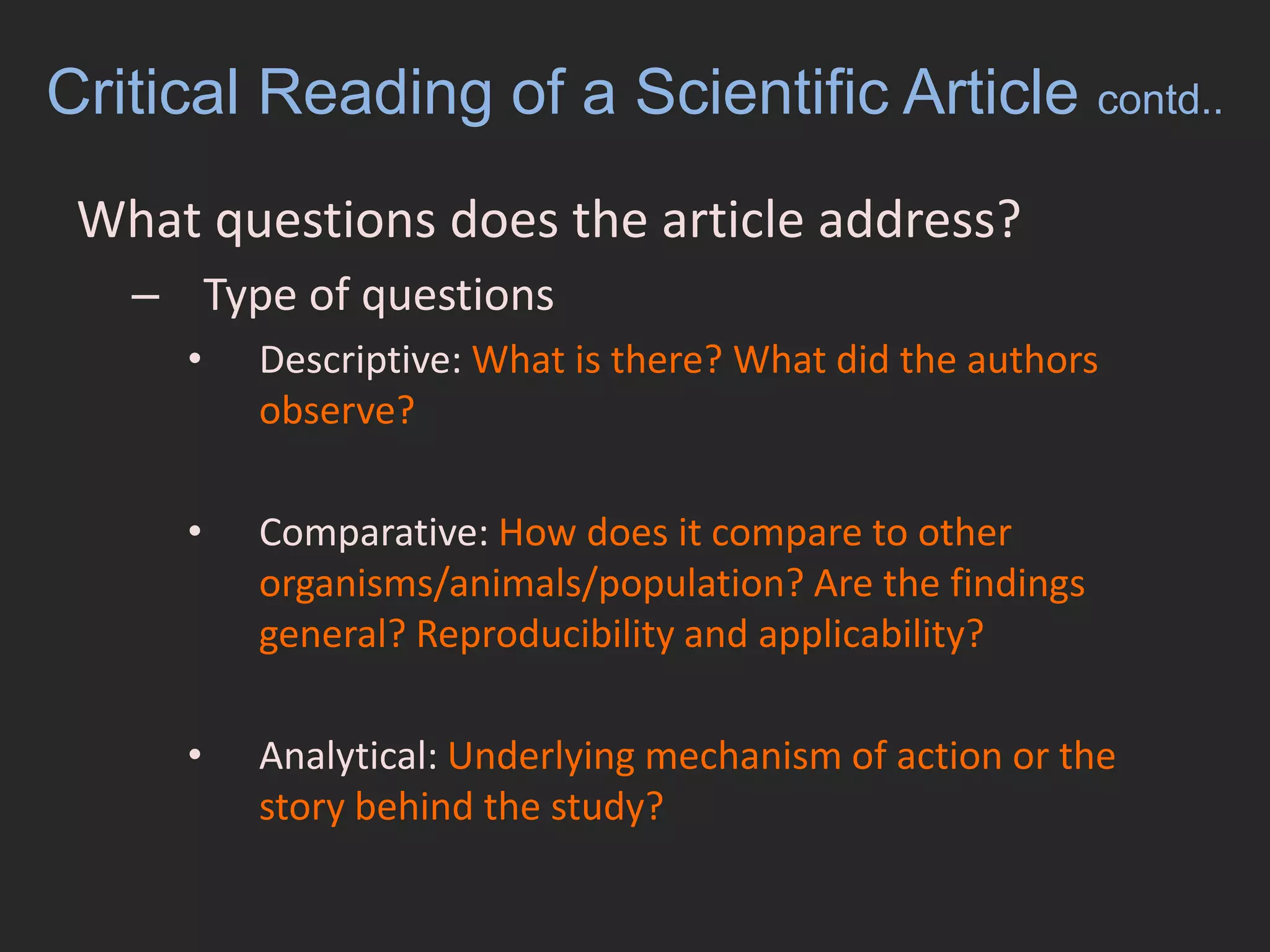
Critical Reading of a Scientific Article contd..What questions does the article address?Type of questionsDescriptive: What is there? What did the authors observe?Comparative: How does it compare to other organisms/animals/population? Are the findings general? Reproducibility and applicability?Analytical: Underlying mechanism of action or the story behind the study?
Critical Reading of a Scientific Article contd..What was the research design? Is it appropriate? 	The design of the study can answer the addressed questionThe statistical strength of the design and relevant statistical analysisCorrect use of an animal model/ cell-line or proper use of a computer simulation
Critical Reading of a Scientific Article contd..What are the main conclusions of the article?	Did the authors properly answer the questions mentioned in the abstract section?Relevant outcome of the study What evidence supports the conclusion?	The rationale of drawing the conclusion
Does the primary experiment supports the point?Critical Reading of a Scientific Article contd..Do the data actually support the conclusions?	Do the authors properly interpret the obtained data? – find the logical connectionDo the data actually support/reject the hypothesis?Do the authors had covered required sample size to reach the statistical significance? Statistics is Important
Critical Reading of a Scientific Article contd..What is the quality of the evidence?	The methods used in the study is well establishedA new method should be published on a peer-reviewed journal first..The methods are reproducible.Materials?
Critical Reading of a Scientific Article contd..Why are the conclusions important?	Do the conclusions make a significant advance in your knowledge? Do the conclusions help in the advancement of future scientific research? Do they lead to new insights, or even new research directions?
Critical Reading of a Review ArticleNarrative or Classical Review 	The “traditional” or “classic” reviewArticles used in the review are chosen by the author.Author may be biased- Major concern.Systematic Review 	Comparative analysis…most common for analytical methods
Should include both inclusion and exclusion criteria.
Should support with the scientific evidences.Critical Reading of a Review Article Contd..Meta analysis	Close to systematic review.
Often deals with numeric data.
Uses statistical/mathematical methods to combine numerical data from various earlier studies Writing a Scientific ArticleWriting StructureAnalysisBefore writing anything, Analyze Your Data!Identify the key conceptsTarget the audience, do audience analysis.Indentify the actual technical material.DesignOrganize all information and dataGroup the key concepts.Structure the layout.. (Tables and figures)
Writing a Scientific Article Contd..ImplementationWrite…edit…edit…edit…Strive for accuracy and clarityEmphasize the central ideaIdentify the ‘Junks’….delete them PublicationChoose the JournalRead the instructions to the authors.Maintain the style and proper formatSelect reviewers and editor.Submit for publication.
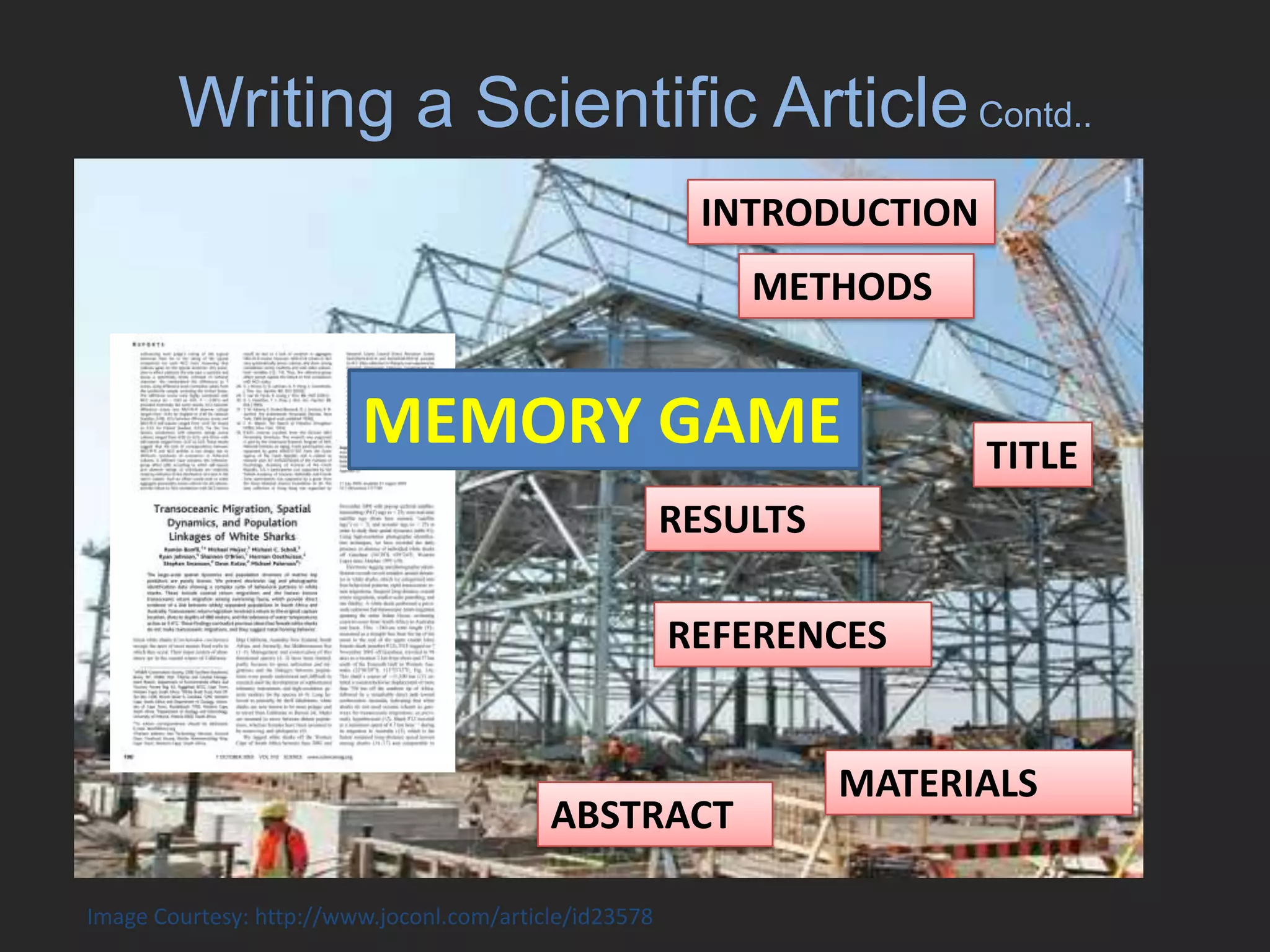
Writing a Scientific Article Contd..INTRODUCTIONMETHODSMEMORY GAMETITLERESULTSREFERENCESMATERIALSABSTRACTImage Courtesy: http://www.joconl.com/article/id23578
Publishing a Scientific ArticleSelect a specific JournalChoose the quality of the JournalImpact factorQuality of the journal in a specific field of studyCalculating Impact factor:Citation of recent items/Number of recent items. (last year Vs current year) Immediacy IndexHow the journal is currently operationCalculation of Immediacy indexCitation of recent items/Number of recent items. (current year Vs current year)
Journal DatabasesGeneral databasePUBMEDWEB of SCIENCESpecialized databaseFood and Nutrition : Food Science and Technology Abstracts (FSTA)AgricolaCAB AbstractsSCOPUSFoodNetBase (for e-books)CINAHLEMBASENatural StandardSCOPUS

Ales 204: Kaustav Guest Lecture on Academic Writing in Science

  • 1.
    Scientific Article –Reading and WritingKaustavMajumderALES-204, 19th October, 2011
  • 2.
    Organization of aScientific ArticleAn article layoutTitleAbstractIntroductionMaterials and MethodsResultsDiscussionConclusionTables and FiguresTable titles and Figure legends References
  • 3.
    Reading a ScientificArticleEffective reading or Selection of an article Title and AbstractHow relevant the title is?Connection between the title and the abstract. IntroductionScan the initial paragraphs.Put emphasis on the concluding paragraphs.Understand the logical flow between earlier studies and the present one.Relevance of the article Rationale of the article
  • 4.
    Reading a ScientificArticle Contd..Tables and FiguresRead the titles of the table and/or figure legends.Relationship with abstract. ConclusionIdentify the achievement, correlation and the future prospects. Workflow of the article Take home messagesServe Your PurposeAcceptance or Rejection of the Article
  • 5.
    Reading a ScientificArticle Contd..Article is closely related with your purposeResults and DiscussionMost important section of an article.Identify the novel elements discussed in this section.Understand the relationship and the context of the study.Materials and methodsIdentify the newly developed method.Source of the materials.ReferencesLook when it is required.Depth of the article Quality and compactness of the article
  • 6.
    Critical Reading ofa Scientific ArticleType of the articleIndividual experiment type.Cohort or population based study.Randomized control and trial study.Review articleNarrative Systematic Meta- analysis
  • 7.
    Critical Reading ofa Scientific Article contd..What questions does the article address?What was the research design? Is it appropriate? What are the main conclusions of the article?What evidence supports those conclusions?Do the data actually support the conclusions?What is the quality of the evidence?Why are the conclusions important?These questions are specifically for individual study, cohort study and random trial studyNOT for Review article
  • 8.
    Critical Reading ofa Scientific Article contd..What questions does the article address?Type of questionsDescriptive: What is there? What did the authors observe?Comparative: How does it compare to other organisms/animals/population? Are the findings general? Reproducibility and applicability?Analytical: Underlying mechanism of action or the story behind the study?
  • 9.
    Critical Reading ofa Scientific Article contd..What was the research design? Is it appropriate? The design of the study can answer the addressed questionThe statistical strength of the design and relevant statistical analysisCorrect use of an animal model/ cell-line or proper use of a computer simulation
  • 10.
    Critical Reading ofa Scientific Article contd..What are the main conclusions of the article? Did the authors properly answer the questions mentioned in the abstract section?Relevant outcome of the study What evidence supports the conclusion? The rationale of drawing the conclusion
  • 11.
    Does the primaryexperiment supports the point?Critical Reading of a Scientific Article contd..Do the data actually support the conclusions? Do the authors properly interpret the obtained data? – find the logical connectionDo the data actually support/reject the hypothesis?Do the authors had covered required sample size to reach the statistical significance? Statistics is Important
  • 12.
    Critical Reading ofa Scientific Article contd..What is the quality of the evidence? The methods used in the study is well establishedA new method should be published on a peer-reviewed journal first..The methods are reproducible.Materials?
  • 13.
    Critical Reading ofa Scientific Article contd..Why are the conclusions important? Do the conclusions make a significant advance in your knowledge? Do the conclusions help in the advancement of future scientific research? Do they lead to new insights, or even new research directions?
  • 14.
    Critical Reading ofa Review ArticleNarrative or Classical Review The “traditional” or “classic” reviewArticles used in the review are chosen by the author.Author may be biased- Major concern.Systematic Review Comparative analysis…most common for analytical methods
  • 15.
    Should include bothinclusion and exclusion criteria.
  • 16.
    Should support withthe scientific evidences.Critical Reading of a Review Article Contd..Meta analysis Close to systematic review.
  • 17.
    Often deals withnumeric data.
  • 18.
    Uses statistical/mathematical methodsto combine numerical data from various earlier studies Writing a Scientific ArticleWriting StructureAnalysisBefore writing anything, Analyze Your Data!Identify the key conceptsTarget the audience, do audience analysis.Indentify the actual technical material.DesignOrganize all information and dataGroup the key concepts.Structure the layout.. (Tables and figures)
  • 19.
    Writing a ScientificArticle Contd..ImplementationWrite…edit…edit…edit…Strive for accuracy and clarityEmphasize the central ideaIdentify the ‘Junks’….delete them PublicationChoose the JournalRead the instructions to the authors.Maintain the style and proper formatSelect reviewers and editor.Submit for publication.
  • 20.
    Writing a ScientificArticle Contd..INTRODUCTIONMETHODSMEMORY GAMETITLERESULTSREFERENCESMATERIALSABSTRACTImage Courtesy: http://www.joconl.com/article/id23578
  • 21.
    Publishing a ScientificArticleSelect a specific JournalChoose the quality of the JournalImpact factorQuality of the journal in a specific field of studyCalculating Impact factor:Citation of recent items/Number of recent items. (last year Vs current year) Immediacy IndexHow the journal is currently operationCalculation of Immediacy indexCitation of recent items/Number of recent items. (current year Vs current year)
  • 22.
    Journal DatabasesGeneral databasePUBMEDWEBof SCIENCESpecialized databaseFood and Nutrition : Food Science and Technology Abstracts (FSTA)AgricolaCAB AbstractsSCOPUSFoodNetBase (for e-books)CINAHLEMBASENatural StandardSCOPUS
  • 23.
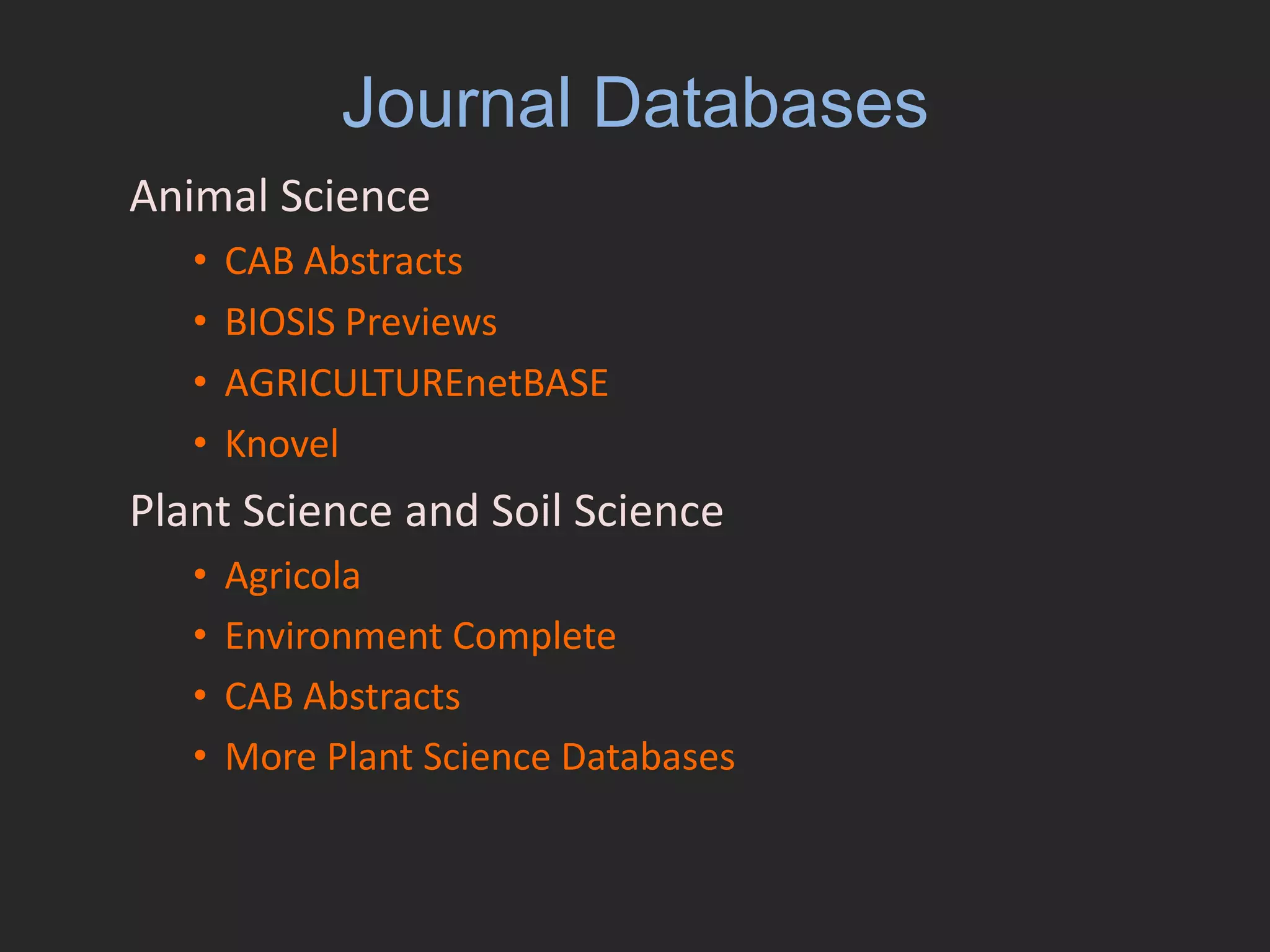
    Journal DatabasesAnimal ScienceCABAbstractsBIOSIS PreviewsAGRICULTUREnetBASEKnovelPlant Science and Soil ScienceAgricolaEnvironment CompleteCAB AbstractsMore Plant Science Databases
  • 24.
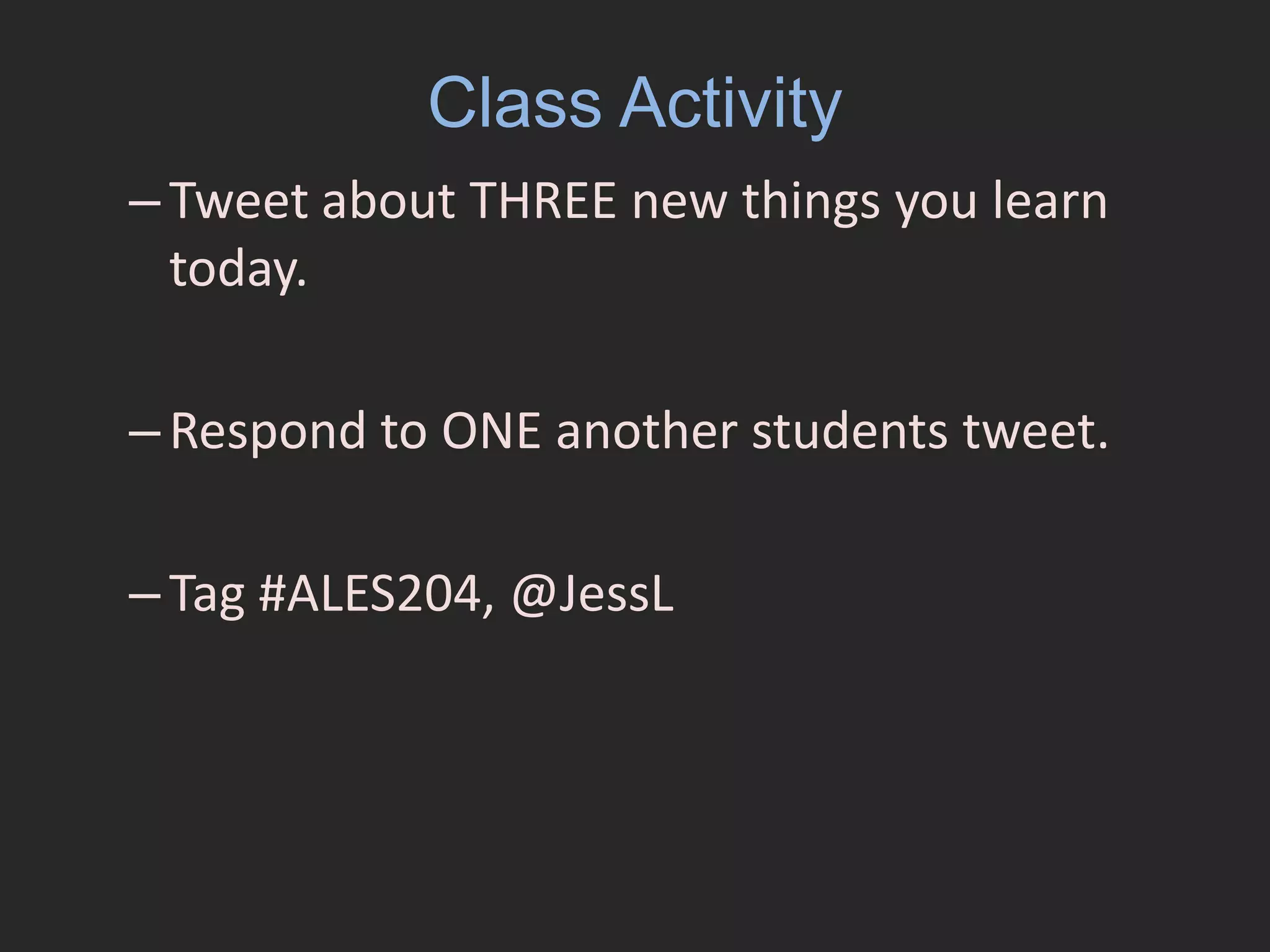
    Class ActivityTweet aboutTHREE new things you learn today.Respond to ONE another students tweet.Tag #ALES204, @JessL