Literature Reviews Skills Talk Medical Microbiology Dr Preneshni R Naicker
Objectives What is a Literature Review? Functions of a Literature Review How to conduct a Literature Review Writing up a Literature Review
What is a Literature Review ? “ Review of literature is the process of taking stock of existing knowledge in order to make informed choices about policy, practice, research direction and resource allocation” (Chalmers, 2003) Also called ‘research syntheses’, ‘overviews’ or ‘secondary research’ Forms part of a research protocol, thesis, grant application or research publication, but may also be a stand alone activity Should not merely be a summary of previous findings, but involve a critical examination and synthesis of existing reports Distinction between  ‘traditional reviews’  (use informal subjective methods) and  ‘systematic reviews’  (use explicit reproducible methods)
Functions of a Literature Review? Jusification of Future Research   To avoid unnecessary duplication of research ‘ Repeating’ research in a new context is sometimes justified Show what gaps in knowledge the proposed research intends to fill Putting new findings into context New findings must be related to what has gone before This could entail adding to or overturning established knowledge
3.  The results of a new study must be interpreted in the light of existing knowledge Making sense of research Studies may have conflicting findings claiming to answer the same question Literature reviews contribute to deciphering and interpreting research
Coping with information overload Massive increase in health information available Literature reviews help researchers, medical practitioners and policy-makers keep up to date with information
Facilitating access to relevant research Access to research is often haphazard or biased Studies with ‘negative’ or ‘disappointing’ results are less likely to be published If they are, they are less likely than ‘positive’ studies to be published in full, in journals that are widely read, or in English They are therefore less likely to be cited in reports of subsequent studies Good Literature Reviews reduce bias resulting from selective reporting of research
How to conduct a Literature Review? Format Will depend on the reason Overview of a broad topic (eg studies that report on the diagnosis & management of rheumatic fever) Focused synthesis (eg the most reliable evidence on the effect of BCG vaccine in preventing TB) Traditional approach used subjective & opportunistic methods in synthesising research – biased, leading to false conclusions
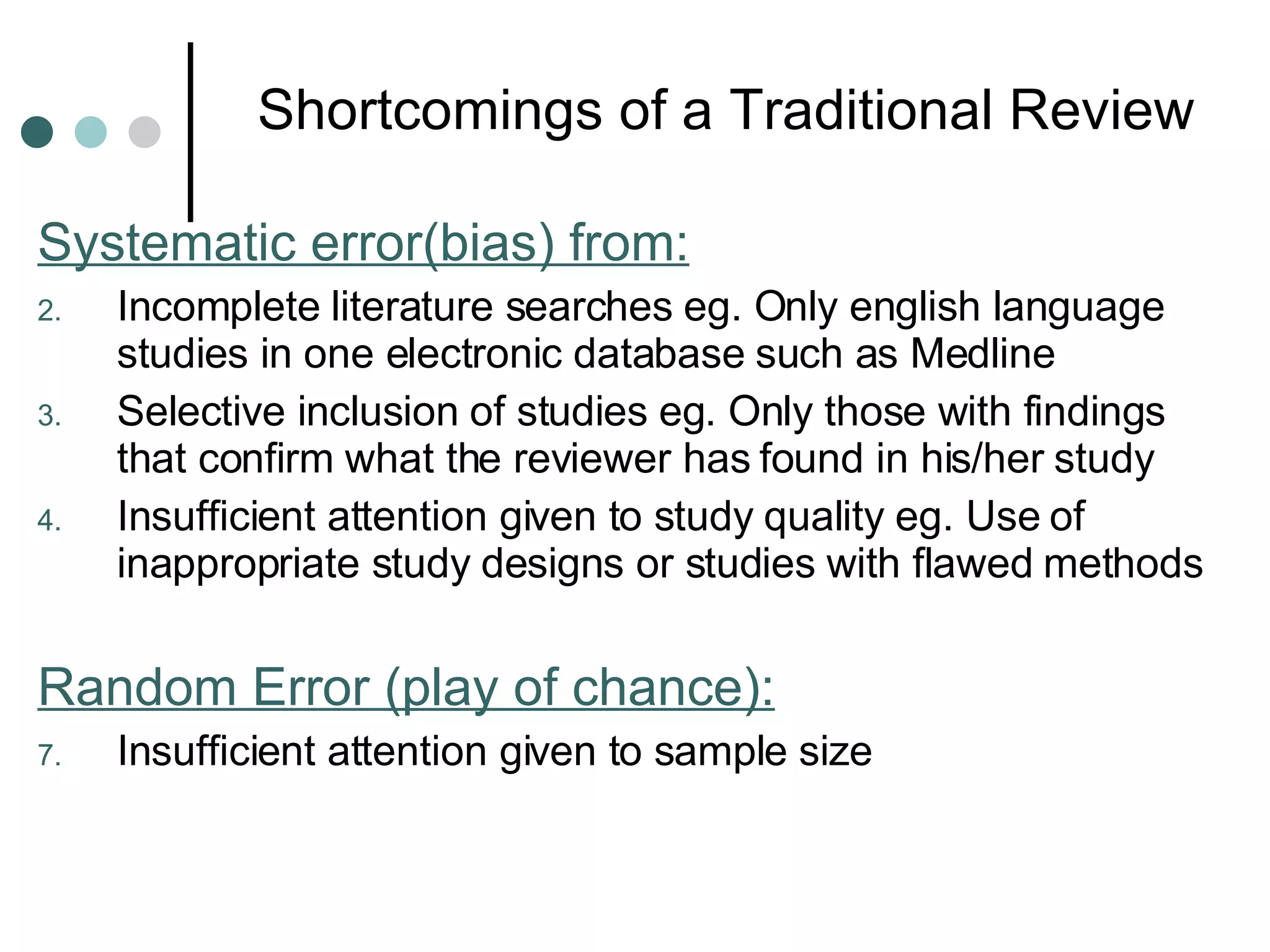
Shortcomings of a Traditional Review Systematic error(bias) from: Incomplete literature searches eg. Only english language studies in one electronic database such as Medline Selective inclusion of studies eg. Only those with findings that confirm what the reviewer has found in his/her study Insufficient attention given to study quality eg. Use of inappropriate study designs or studies with flawed methods Random Error (play of chance): Insufficient attention given to sample size
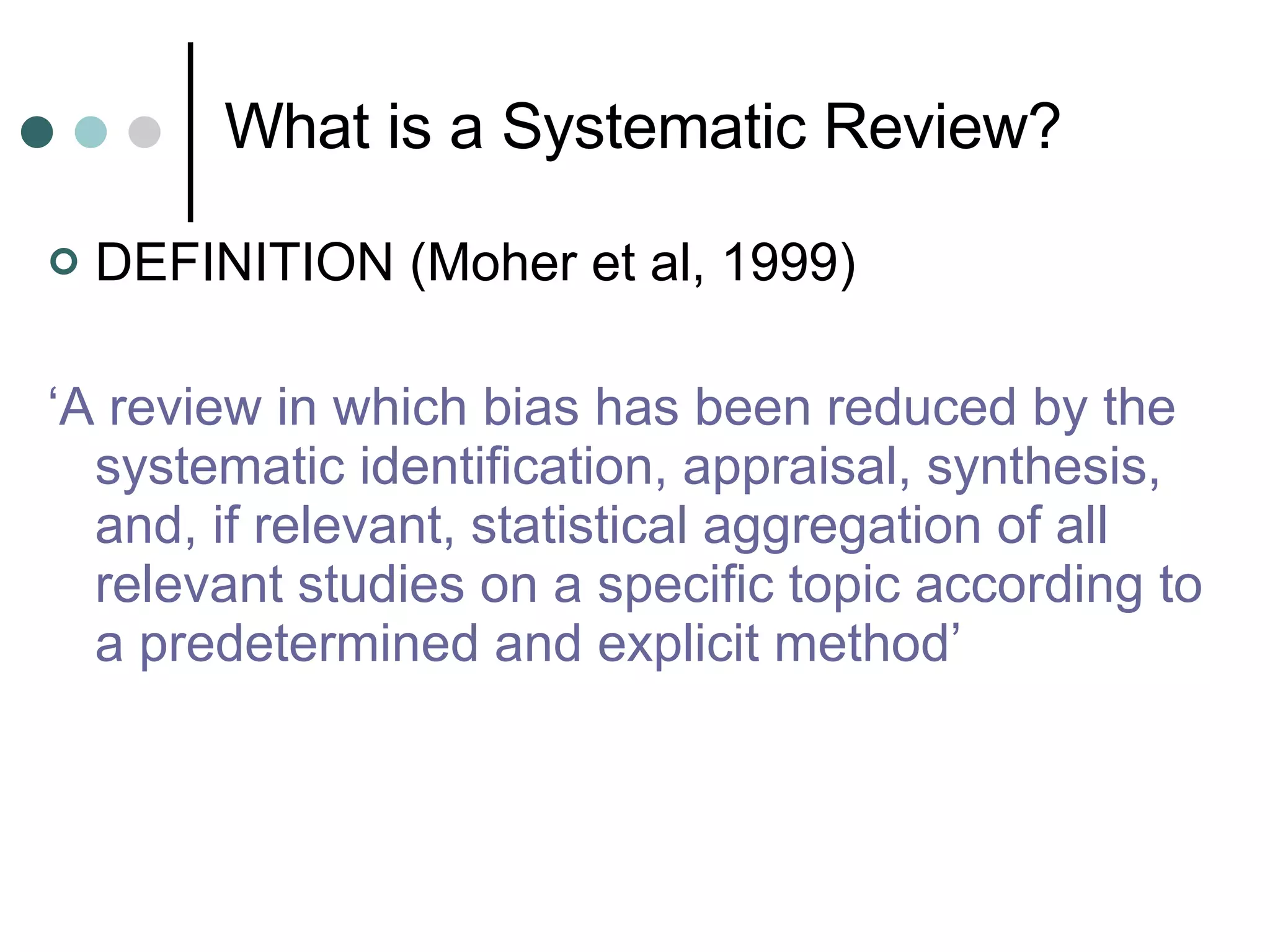
What is a Systematic Review? DEFINITION (Moher et al, 1999) ‘ A review in which bias has been reduced by the systematic identification, appraisal, synthesis, and, if relevant, statistical aggregation of all relevant studies on a specific topic according to a predetermined and explicit method’
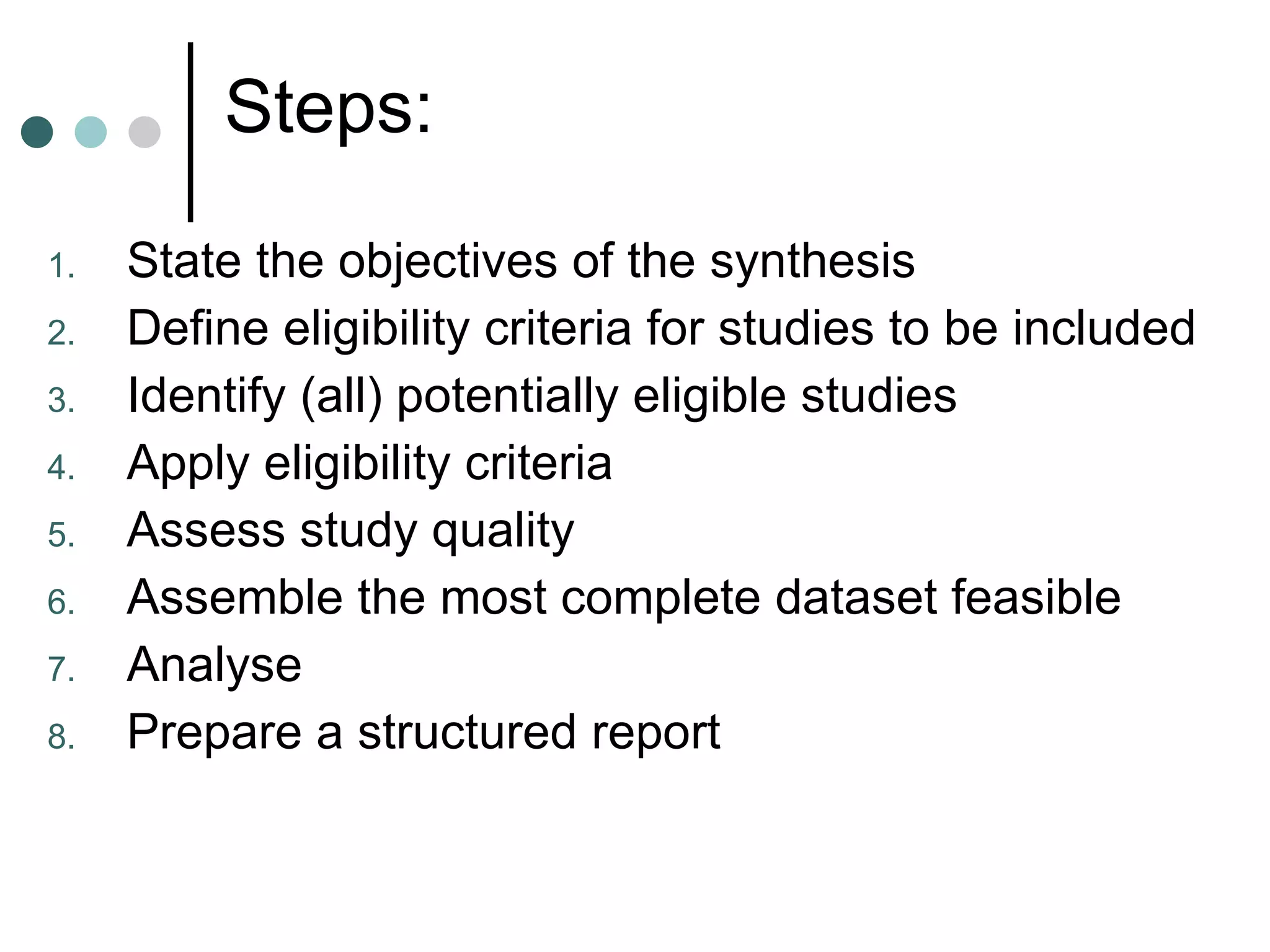
Steps: State the objectives of the synthesis Define eligibility criteria for studies to be included Identify (all) potentially eligible studies Apply eligibility criteria Assess study quality Assemble the most complete dataset feasible Analyse Prepare a structured report
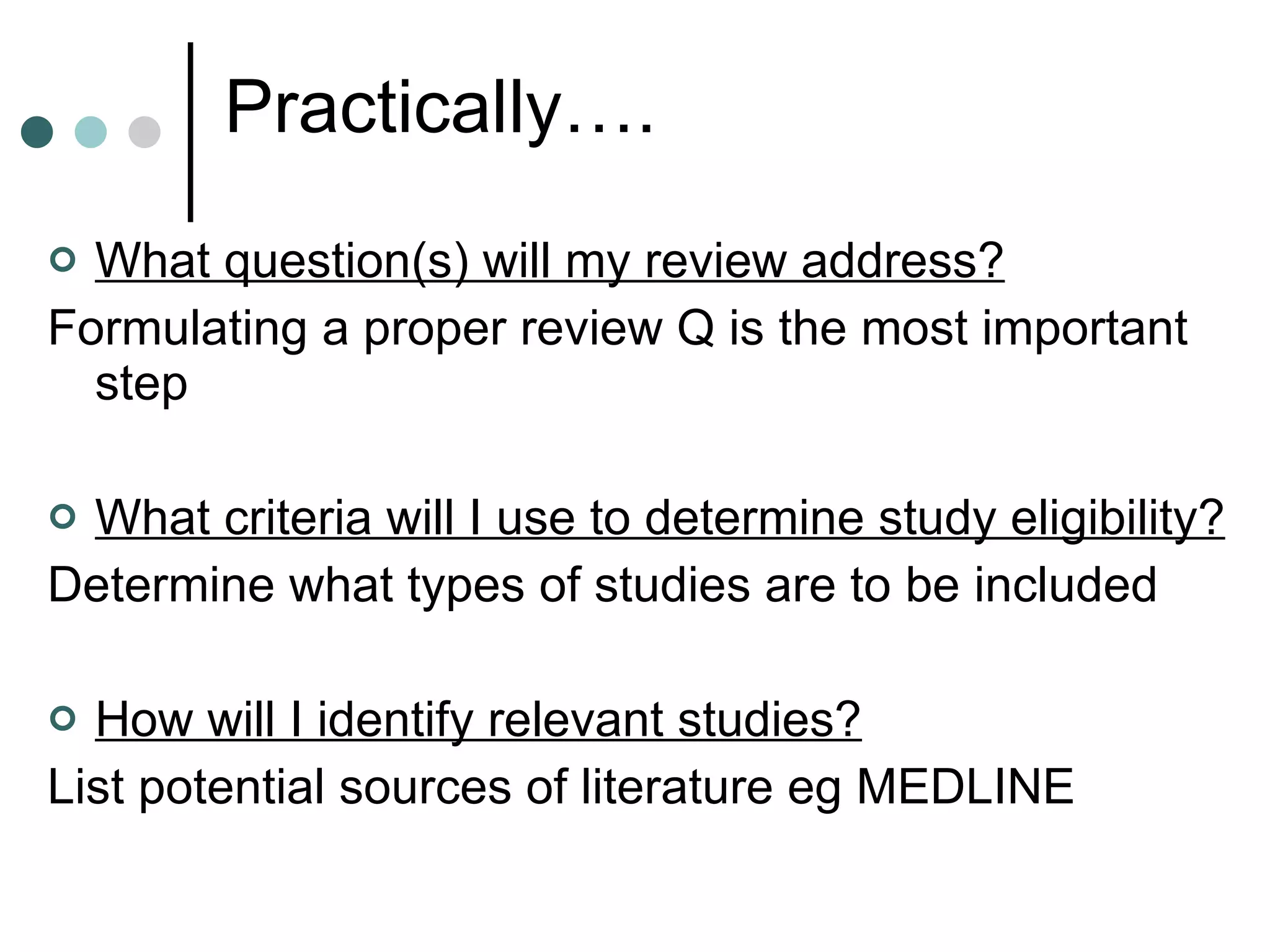
Practically…. What question(s) will my review address? Formulating a proper review Q is the most important step What criteria will I use to determine study eligibility? Determine what types of studies are to be included How will I identify relevant studies? List potential sources of literature eg MEDLINE
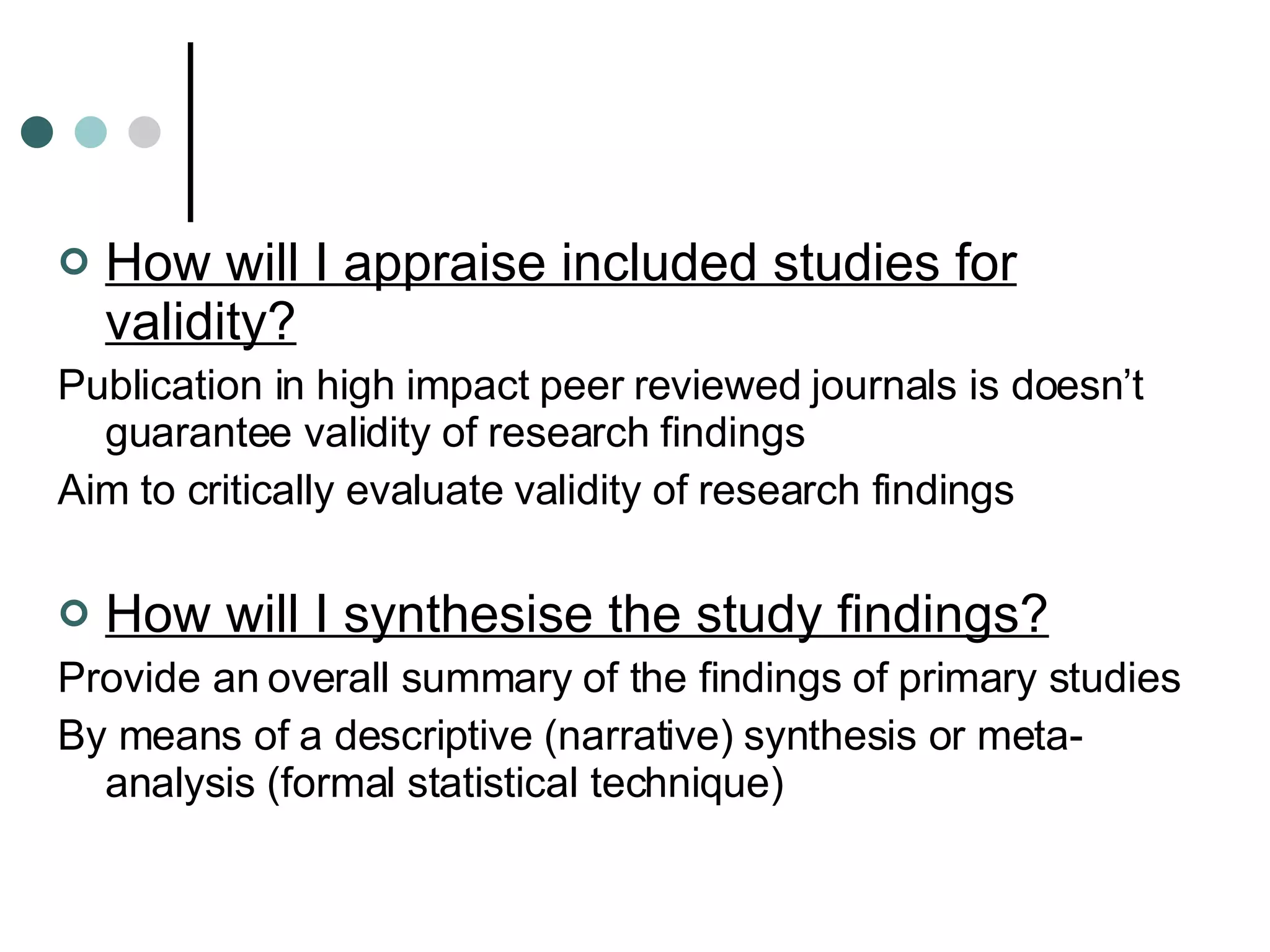
How will I appraise included studies for validity? Publication in high impact peer reviewed journals is doesn’t guarantee validity of research findings Aim to critically evaluate validity of research findings How will I synthesise the study findings? Provide an overall summary of the findings of primary studies By means of a descriptive (narrative) synthesis or meta-analysis (formal statistical technique)
Writing up the literature review Determine the citation style required by the university or journal (Harvard vs Vancouver) before embarking on the review Communicate clearly the  AIMS METHODS RESULTS  IMPLICATIONS Avoid Plagiarism ************************************************
Thank you Reference Joubert G, Ehrlich R (eds). Epidemiology: A Research Manual for South Africa. 2 nd  ed:66-76. Oxford University Press

Literature Reviews

  • 1.
    Literature Reviews SkillsTalk Medical Microbiology Dr Preneshni R Naicker
  • 2.
    Objectives What isa Literature Review? Functions of a Literature Review How to conduct a Literature Review Writing up a Literature Review
  • 3.
    What is aLiterature Review ? “ Review of literature is the process of taking stock of existing knowledge in order to make informed choices about policy, practice, research direction and resource allocation” (Chalmers, 2003) Also called ‘research syntheses’, ‘overviews’ or ‘secondary research’ Forms part of a research protocol, thesis, grant application or research publication, but may also be a stand alone activity Should not merely be a summary of previous findings, but involve a critical examination and synthesis of existing reports Distinction between ‘traditional reviews’ (use informal subjective methods) and ‘systematic reviews’ (use explicit reproducible methods)
  • 4.
    Functions of aLiterature Review? Jusification of Future Research To avoid unnecessary duplication of research ‘ Repeating’ research in a new context is sometimes justified Show what gaps in knowledge the proposed research intends to fill Putting new findings into context New findings must be related to what has gone before This could entail adding to or overturning established knowledge
  • 5.
    3. Theresults of a new study must be interpreted in the light of existing knowledge Making sense of research Studies may have conflicting findings claiming to answer the same question Literature reviews contribute to deciphering and interpreting research
  • 6.
    Coping with informationoverload Massive increase in health information available Literature reviews help researchers, medical practitioners and policy-makers keep up to date with information
  • 7.
    Facilitating access torelevant research Access to research is often haphazard or biased Studies with ‘negative’ or ‘disappointing’ results are less likely to be published If they are, they are less likely than ‘positive’ studies to be published in full, in journals that are widely read, or in English They are therefore less likely to be cited in reports of subsequent studies Good Literature Reviews reduce bias resulting from selective reporting of research
  • 8.
    How to conducta Literature Review? Format Will depend on the reason Overview of a broad topic (eg studies that report on the diagnosis & management of rheumatic fever) Focused synthesis (eg the most reliable evidence on the effect of BCG vaccine in preventing TB) Traditional approach used subjective & opportunistic methods in synthesising research – biased, leading to false conclusions
  • 9.
    Shortcomings of aTraditional Review Systematic error(bias) from: Incomplete literature searches eg. Only english language studies in one electronic database such as Medline Selective inclusion of studies eg. Only those with findings that confirm what the reviewer has found in his/her study Insufficient attention given to study quality eg. Use of inappropriate study designs or studies with flawed methods Random Error (play of chance): Insufficient attention given to sample size
  • 10.
    What is aSystematic Review? DEFINITION (Moher et al, 1999) ‘ A review in which bias has been reduced by the systematic identification, appraisal, synthesis, and, if relevant, statistical aggregation of all relevant studies on a specific topic according to a predetermined and explicit method’
  • 11.
    Steps: State theobjectives of the synthesis Define eligibility criteria for studies to be included Identify (all) potentially eligible studies Apply eligibility criteria Assess study quality Assemble the most complete dataset feasible Analyse Prepare a structured report
  • 12.
    Practically…. What question(s)will my review address? Formulating a proper review Q is the most important step What criteria will I use to determine study eligibility? Determine what types of studies are to be included How will I identify relevant studies? List potential sources of literature eg MEDLINE
  • 13.
    How will Iappraise included studies for validity? Publication in high impact peer reviewed journals is doesn’t guarantee validity of research findings Aim to critically evaluate validity of research findings How will I synthesise the study findings? Provide an overall summary of the findings of primary studies By means of a descriptive (narrative) synthesis or meta-analysis (formal statistical technique)
  • 14.
    Writing up theliterature review Determine the citation style required by the university or journal (Harvard vs Vancouver) before embarking on the review Communicate clearly the AIMS METHODS RESULTS IMPLICATIONS Avoid Plagiarism ************************************************
  • 15.
    Thank you ReferenceJoubert G, Ehrlich R (eds). Epidemiology: A Research Manual for South Africa. 2 nd ed:66-76. Oxford University Press