
What do journals hesitate to publish?
Two types of submissions
Replication studies Negative results
Let’s understand these two types of submissions better.
Replication studies
What are replication studies?
A replication study involves
repeating a study using the same methods but
with different subjects and experimenters.
Replication studies:
 Ensure that results are reliable and valid
 Apply the previous results to new situations
 Inspire new research that builds upon previous
findings from related studies
Importance of replication studies
Scientific experiments must be reproducible!
If you cannot repeat a trial using a different set of parameters, your
scientific method has failed.
Did you know?
The results of a landmark study, which had been cited
over 1,900 times, could not be reproduced even by the
original researchers in their own laboratory.
 Validation of research findings is the cornerstone of science.
 If you cannot replicate the results of a study, you must report
it. This can lead to new discoveries and a better understanding
of the original study.
Why most journals do not favor
replication studies
Replication studies may not interest some journals because
their publishers:
 Are biased towards publishing original research
 Feel that this will give authors an easy way to get published
 Believe that replication studies don’t reveal new information
 Think the results are not dramatic enough to attract the
journal’s readership
 Want to avoid any potential controversy regarding the
results of the replication
 Prefer to publish successful replication results, and not all
replication studies are successful
This is a problem
If journals do not publish replication studies:
× Fewer researchers will choose to perform
reproducibility experiments.
× Scientific development could be at stake.
× In the case of clinical trials, in particular, this
could lead to serious health care consequences.
Some solutions
Journals could publish yearly special issues/include regular
sections dedicated to replication studies.
Publishers could set up forums that encourage alternative forms
of publishing, e.g., a website/blog that publishes replication
studies.
We need tools to validate scientific research data. One such tool
is CrossMark, which validates content with a unique approval
stamp and displays most updated data: readers can assume that
information without the approval stamp is not up to date/has not
yet been taken up for a replication check and that the results
may be inaccurate.
Negative results
What are negative results?
Example:
A researcher conducts a study to prove that drug X can
destroy cancerous cells in the human body.
But the researcher finds out that drug X is incapable of
fighting cancerous cells.
Thus, he ends up with a negative result.
When a hypothesis turns out to be incorrect,
the study is considered to have produced
negative results.
Why journals do not favor negative results
 Negative findings have lesser impact than
positive results.
 Papers with negative results may not have a
high number of citations, affecting the journal’s
impact factor.
 Readers may not be as interested in reading
about negative results as they would be in
breakthrough results.
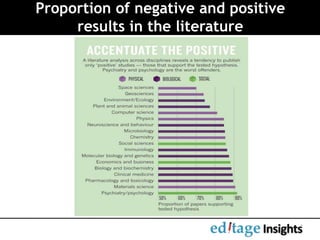
Proportion of negative and positive
results in the literature
Did you know this about negative results?
 More than 60% of research experiments fail to produce results or
expected discoveries.
 Negative results have been gradually disappearing from academic
literature over the past two decades.
 Articles primarily and clearly stating positive results have grown by
22% between 1990 and 2007. Annual odds of a positive result getting
published have increased by around 6% every year.
This is a problem!
Just because an experiment failed, it does not mean that it should not be
shared/published. In fact, publishing negative results will only give other
researchers the opportunity to build upon the data and make further discoveries.
How can we solve this problem?
The perspective towards negative results can be changed by:
 Creating awareness (among authors, journals, and publishers) about the
importance of publishing negative results
 Increased focus on journals that publish negative results (e.g. Journal of
Negative Results in Biomedicine, PLoS ONE, The All Results Journals)
 Universities, funding committees, and companies backing researchers for
publishing important negative findings
Together!
Every member of the academic publishing community should
work towards embracing negative results and their publication.
Moving towards scientific progress
The next time you want to
replicate an experiment
OR
Publish negative results of your
study
Go ahead and submit it
because…
Authors Publishers
By doing so, you’re helping science grow!
The next time you receive a
replication study
OR
A paper that describes negative
results
Give it a fair chance
because…
References
● http://scholarlykitchen.sspnet.org/2012/07/18/a-proposed-list-60-things-journal-
publishers-do/
● http://scholarlykitchen.sspnet.org//?s=what+do+journals+consider+when+accepting+
a+paper+for+publication
● https://becker.wustl.edu/sites/default/files/archived-pdfs/preparepub.pdf
● http://jech.bmj.com/content/65/2/119
● http://scx.sagepub.com/content/early/2013/01/24/1075547012472684.abstract
● http://www.nature.com/news/replication-studies-bad-copy-1.10634
● http://andrewgelman.com/2011/06/13/how_should_jour/
● http://www.crossref.org/crossmark/
● http://blogs.nature.com/news/2012/12/is-the-scientific-literature-self-
correcting.html
www.editage.com/insights
@EditageInsights
Visit our website
Connect with us

Learn more about replication studies and negative results

  • 2.
    What do journalshesitate to publish? Two types of submissions Replication studies Negative results Let’s understand these two types of submissions better.
  • 3.
  • 4.
    What are replicationstudies? A replication study involves repeating a study using the same methods but with different subjects and experimenters. Replication studies:  Ensure that results are reliable and valid  Apply the previous results to new situations  Inspire new research that builds upon previous findings from related studies
  • 5.
    Importance of replicationstudies Scientific experiments must be reproducible! If you cannot repeat a trial using a different set of parameters, your scientific method has failed. Did you know? The results of a landmark study, which had been cited over 1,900 times, could not be reproduced even by the original researchers in their own laboratory.  Validation of research findings is the cornerstone of science.  If you cannot replicate the results of a study, you must report it. This can lead to new discoveries and a better understanding of the original study.
  • 6.
    Why most journalsdo not favor replication studies Replication studies may not interest some journals because their publishers:  Are biased towards publishing original research  Feel that this will give authors an easy way to get published  Believe that replication studies don’t reveal new information  Think the results are not dramatic enough to attract the journal’s readership  Want to avoid any potential controversy regarding the results of the replication  Prefer to publish successful replication results, and not all replication studies are successful
  • 7.
    This is aproblem If journals do not publish replication studies: × Fewer researchers will choose to perform reproducibility experiments. × Scientific development could be at stake. × In the case of clinical trials, in particular, this could lead to serious health care consequences.
  • 8.
    Some solutions Journals couldpublish yearly special issues/include regular sections dedicated to replication studies. Publishers could set up forums that encourage alternative forms of publishing, e.g., a website/blog that publishes replication studies. We need tools to validate scientific research data. One such tool is CrossMark, which validates content with a unique approval stamp and displays most updated data: readers can assume that information without the approval stamp is not up to date/has not yet been taken up for a replication check and that the results may be inaccurate.
  • 9.
  • 10.
    What are negativeresults? Example: A researcher conducts a study to prove that drug X can destroy cancerous cells in the human body. But the researcher finds out that drug X is incapable of fighting cancerous cells. Thus, he ends up with a negative result. When a hypothesis turns out to be incorrect, the study is considered to have produced negative results.
  • 11.
    Why journals donot favor negative results  Negative findings have lesser impact than positive results.  Papers with negative results may not have a high number of citations, affecting the journal’s impact factor.  Readers may not be as interested in reading about negative results as they would be in breakthrough results.
  • 12.
    Proportion of negativeand positive results in the literature
  • 13.
    Did you knowthis about negative results?  More than 60% of research experiments fail to produce results or expected discoveries.  Negative results have been gradually disappearing from academic literature over the past two decades.  Articles primarily and clearly stating positive results have grown by 22% between 1990 and 2007. Annual odds of a positive result getting published have increased by around 6% every year. This is a problem! Just because an experiment failed, it does not mean that it should not be shared/published. In fact, publishing negative results will only give other researchers the opportunity to build upon the data and make further discoveries.
  • 14.
    How can wesolve this problem? The perspective towards negative results can be changed by:  Creating awareness (among authors, journals, and publishers) about the importance of publishing negative results  Increased focus on journals that publish negative results (e.g. Journal of Negative Results in Biomedicine, PLoS ONE, The All Results Journals)  Universities, funding committees, and companies backing researchers for publishing important negative findings Together! Every member of the academic publishing community should work towards embracing negative results and their publication.
  • 15.
    Moving towards scientificprogress The next time you want to replicate an experiment OR Publish negative results of your study Go ahead and submit it because… Authors Publishers By doing so, you’re helping science grow! The next time you receive a replication study OR A paper that describes negative results Give it a fair chance because…
  • 16.
    References ● http://scholarlykitchen.sspnet.org/2012/07/18/a-proposed-list-60-things-journal- publishers-do/ ● http://scholarlykitchen.sspnet.org//?s=what+do+journals+consider+when+accepting+ a+paper+for+publication ●https://becker.wustl.edu/sites/default/files/archived-pdfs/preparepub.pdf ● http://jech.bmj.com/content/65/2/119 ● http://scx.sagepub.com/content/early/2013/01/24/1075547012472684.abstract ● http://www.nature.com/news/replication-studies-bad-copy-1.10634 ● http://andrewgelman.com/2011/06/13/how_should_jour/ ● http://www.crossref.org/crossmark/ ● http://blogs.nature.com/news/2012/12/is-the-scientific-literature-self- correcting.html
  • 17.