Reading a Scientific
(Psychology) Article
Diane Clark, MLIS, MEd
MacEwan University 2018
Learning outcomes
By the end of this class you will be able to
1. Describe the difference between a scholarly/scientific
article and
2. Develop skills to read a scientific article in psychology
What is a scholarly article?
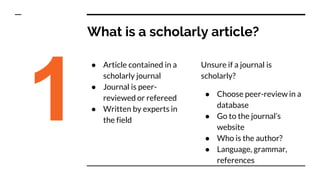
● Article contained in a
scholarly journal
● Journal is peer-
reviewed or refereed
● Written by experts in
the field1
Unsure if a journal is
scholarly?
● Choose peer-review in a
database
● Go to the journal’s
website
● Who is the author?
● Language, grammar,
references
Information is not equal
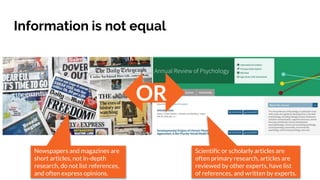
Newspapers and magazines are
short articles, not in-depth
research, do not list references,
and often express opinions.
OR
Scientific or scholarly articles are
often primary research, articles are
reviewed by other experts, have list
of references, and written by experts.
Me when asked to read a scientific paper.
(Hendrickson)
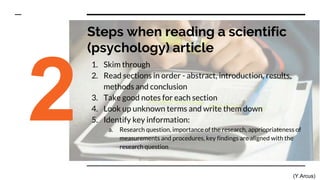
Steps when reading a scientific
(psychology) article
1. Skim through
2. Read sections in order - abstract, introduction, results,
methods and conclusion
3. Take good notes for each section
4. Look up unknown terms and write them down
5. Identify key information:
a. Research question, importance of the research, appriopriateness of
measurements and procedures, key findings are aligned with the
research question
2
(Y.Arcus)
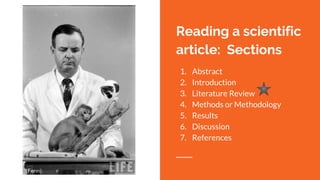
Reading a scientific
article: Sections
1. Abstract
2. Introduction
3. Literature Review
4. Methods or Methodology
5. Results
6. Discussion
7. References
(Fenn)
Reading a scientific article: Sections
Abstract
● Describes the research article
Introduction
● Introduces the research problem and describes
why the results need to be obtained
Literature Review
● Provides the foundation for your research,
demonstrates you understand what other
researchers have published
Methods or Methodology
● Describes the processes used in minute detail
in clear and concise language
● Discusses the theoretical framework applied
to answer the research question
● Describes:
○ Population (age, gender, ethnicity etc),
location of study (classroom, lab etc),
how participants were found, materials
or questions used, type of study
(quantitative/qualitative), procedures
used to gather information
● Study must be able to be replicated by another
researcher
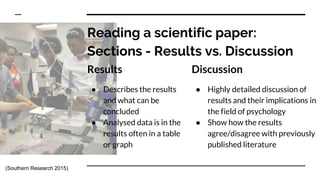
Results
● Describes the results
and what can be
concluded
● Analysed data is in the
results often in a table
or graph
(Southern Research 2015)
Reading a scientific paper:
Sections - Results vs. Discussion
Discussion
● Highly detailed discussion of
results and their implications in
the field of psychology
● Show how the results
agree/disagree with previously
published literature
References
Fenn, A. (Photographer). Harlow with rhesus monkey [digital image]. Retrieved from
http://images.google.com/hosted/life/fd55c8d0ff5bee43.html
Pain, E. (2016). How to (seriously) read a scientific paper. Science, 360(6391),
doi:10.1126/science.caredit.a1600047
Southern Research. (Photographer). (2015) Local high school students perform life sciences and
engineering experiments in Southern Research Labs [digital image]. Retrieved from
https://southernresearch.org/news/local-high-school-students-perform-life-sciences-and-engineering-
experiments-in-southern-research-labs

Reading a scientific paper

  • 1.
    Reading a Scientific (Psychology)Article Diane Clark, MLIS, MEd MacEwan University 2018
  • 3.
    Learning outcomes By theend of this class you will be able to 1. Describe the difference between a scholarly/scientific article and 2. Develop skills to read a scientific article in psychology
  • 4.
    What is ascholarly article? ● Article contained in a scholarly journal ● Journal is peer- reviewed or refereed ● Written by experts in the field1 Unsure if a journal is scholarly? ● Choose peer-review in a database ● Go to the journal’s website ● Who is the author? ● Language, grammar, references
  • 5.
    Information is notequal Newspapers and magazines are short articles, not in-depth research, do not list references, and often express opinions. OR Scientific or scholarly articles are often primary research, articles are reviewed by other experts, have list of references, and written by experts.
  • 6.
    Me when askedto read a scientific paper. (Hendrickson)
  • 7.
    Steps when readinga scientific (psychology) article 1. Skim through 2. Read sections in order - abstract, introduction, results, methods and conclusion 3. Take good notes for each section 4. Look up unknown terms and write them down 5. Identify key information: a. Research question, importance of the research, appriopriateness of measurements and procedures, key findings are aligned with the research question 2 (Y.Arcus)
  • 8.
    Reading a scientific article:Sections 1. Abstract 2. Introduction 3. Literature Review 4. Methods or Methodology 5. Results 6. Discussion 7. References (Fenn)
  • 9.
    Reading a scientificarticle: Sections Abstract ● Describes the research article Introduction ● Introduces the research problem and describes why the results need to be obtained Literature Review ● Provides the foundation for your research, demonstrates you understand what other researchers have published Methods or Methodology ● Describes the processes used in minute detail in clear and concise language ● Discusses the theoretical framework applied to answer the research question ● Describes: ○ Population (age, gender, ethnicity etc), location of study (classroom, lab etc), how participants were found, materials or questions used, type of study (quantitative/qualitative), procedures used to gather information ● Study must be able to be replicated by another researcher
  • 10.
    Results ● Describes theresults and what can be concluded ● Analysed data is in the results often in a table or graph (Southern Research 2015) Reading a scientific paper: Sections - Results vs. Discussion Discussion ● Highly detailed discussion of results and their implications in the field of psychology ● Show how the results agree/disagree with previously published literature
  • 11.
    References Fenn, A. (Photographer).Harlow with rhesus monkey [digital image]. Retrieved from http://images.google.com/hosted/life/fd55c8d0ff5bee43.html Pain, E. (2016). How to (seriously) read a scientific paper. Science, 360(6391), doi:10.1126/science.caredit.a1600047 Southern Research. (Photographer). (2015) Local high school students perform life sciences and engineering experiments in Southern Research Labs [digital image]. Retrieved from https://southernresearch.org/news/local-high-school-students-perform-life-sciences-and-engineering- experiments-in-southern-research-labs