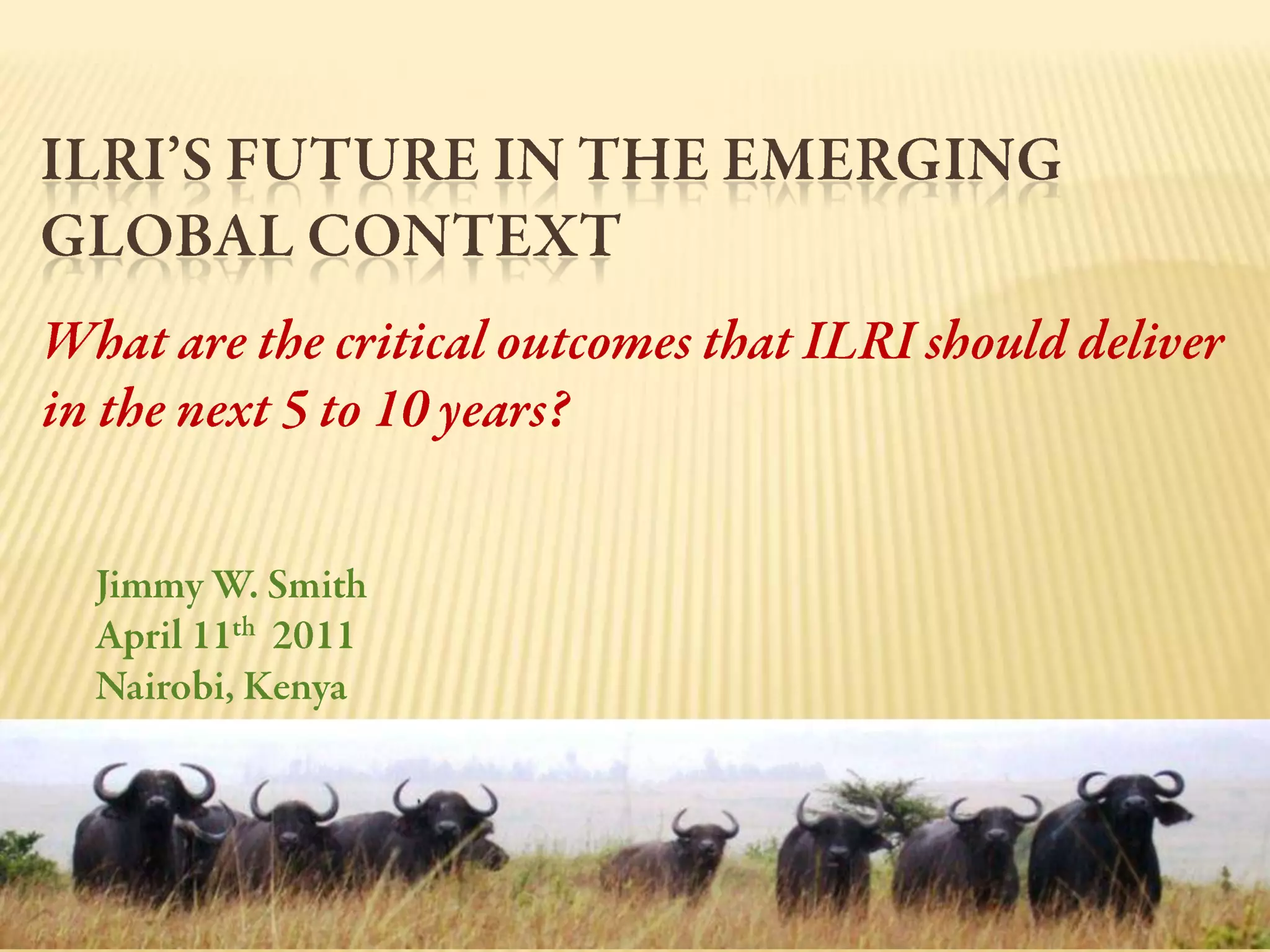
ILRI’s Future in the Emerging Global Context What are the critical outcomes that ILRI should deliver in the next 5 to 10 years?Jimmy W. SmithApril 11th  2011Nairobi, Kenya
Presentation OutlineThe changing global contextILRI’s continuing response & deliverablesA bit about me
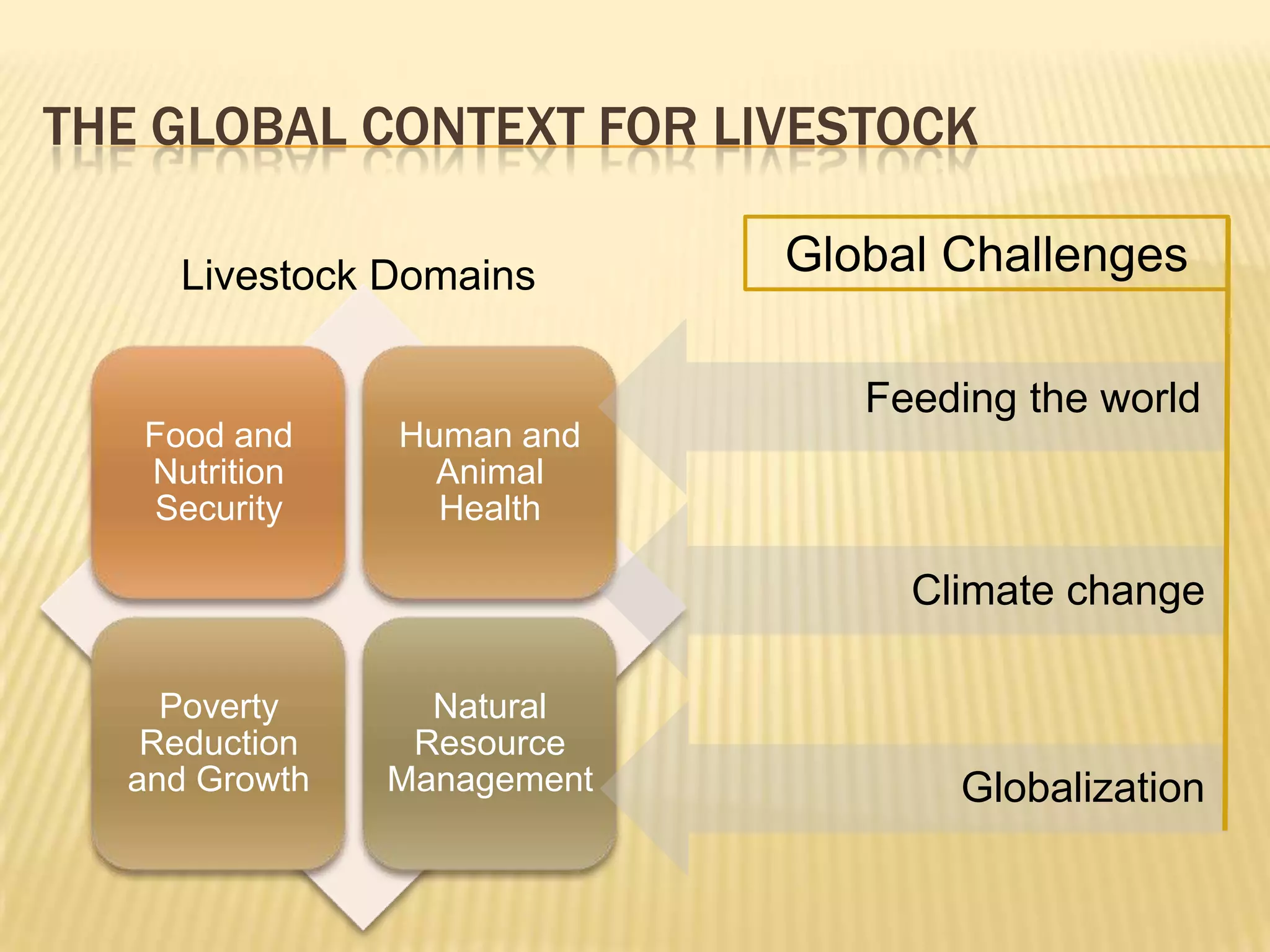
The Global Context for LivestockGlobal ChallengesLivestock DomainsFeeding the world Climate change  Globalization
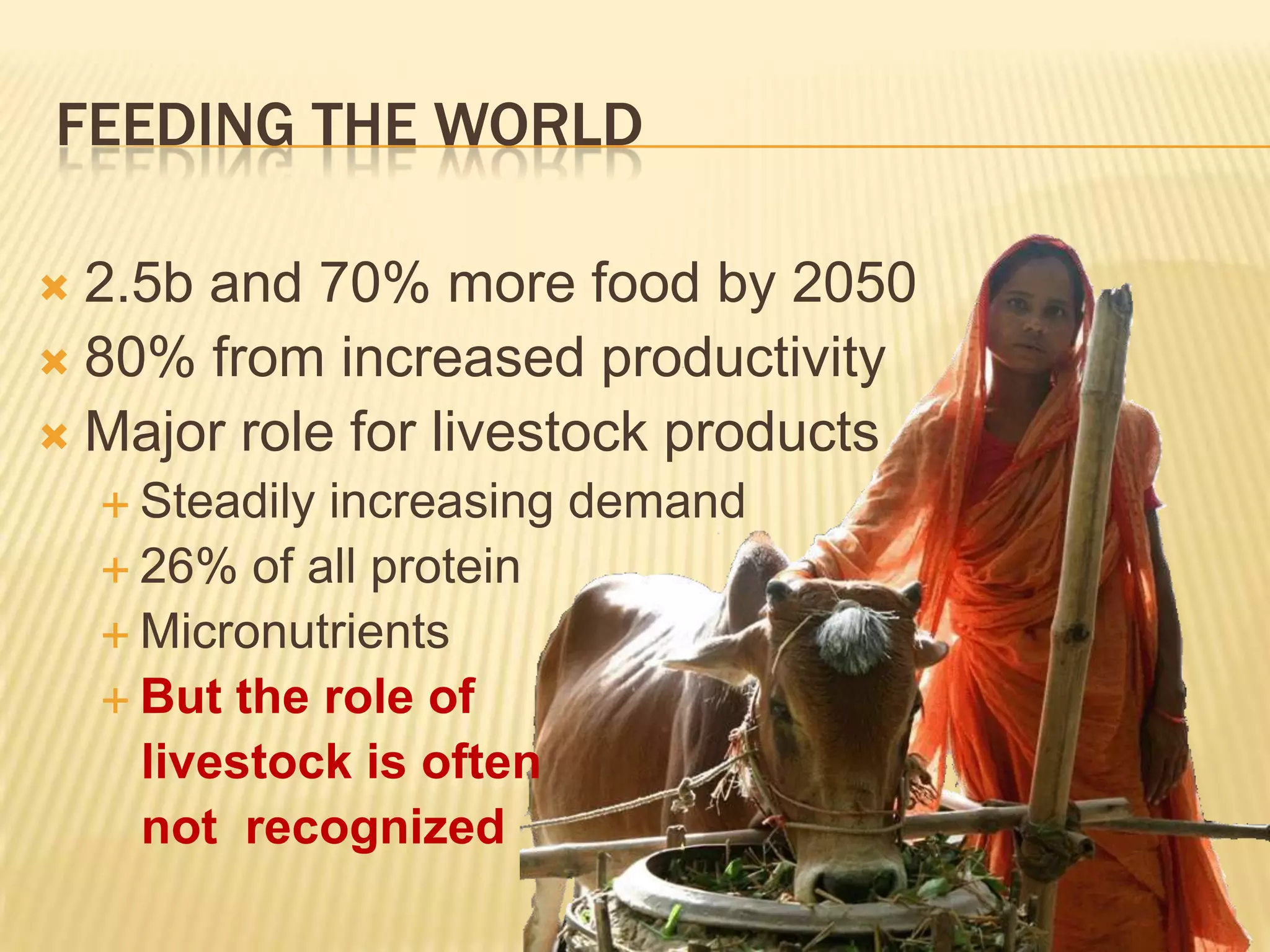
Feeding the World2.5b and 70% more food by 205080% from increased productivityMajor role for livestock productsSteadily increasing demand26% of all proteinMicronutrients But the role of    livestock is often    not  recognized
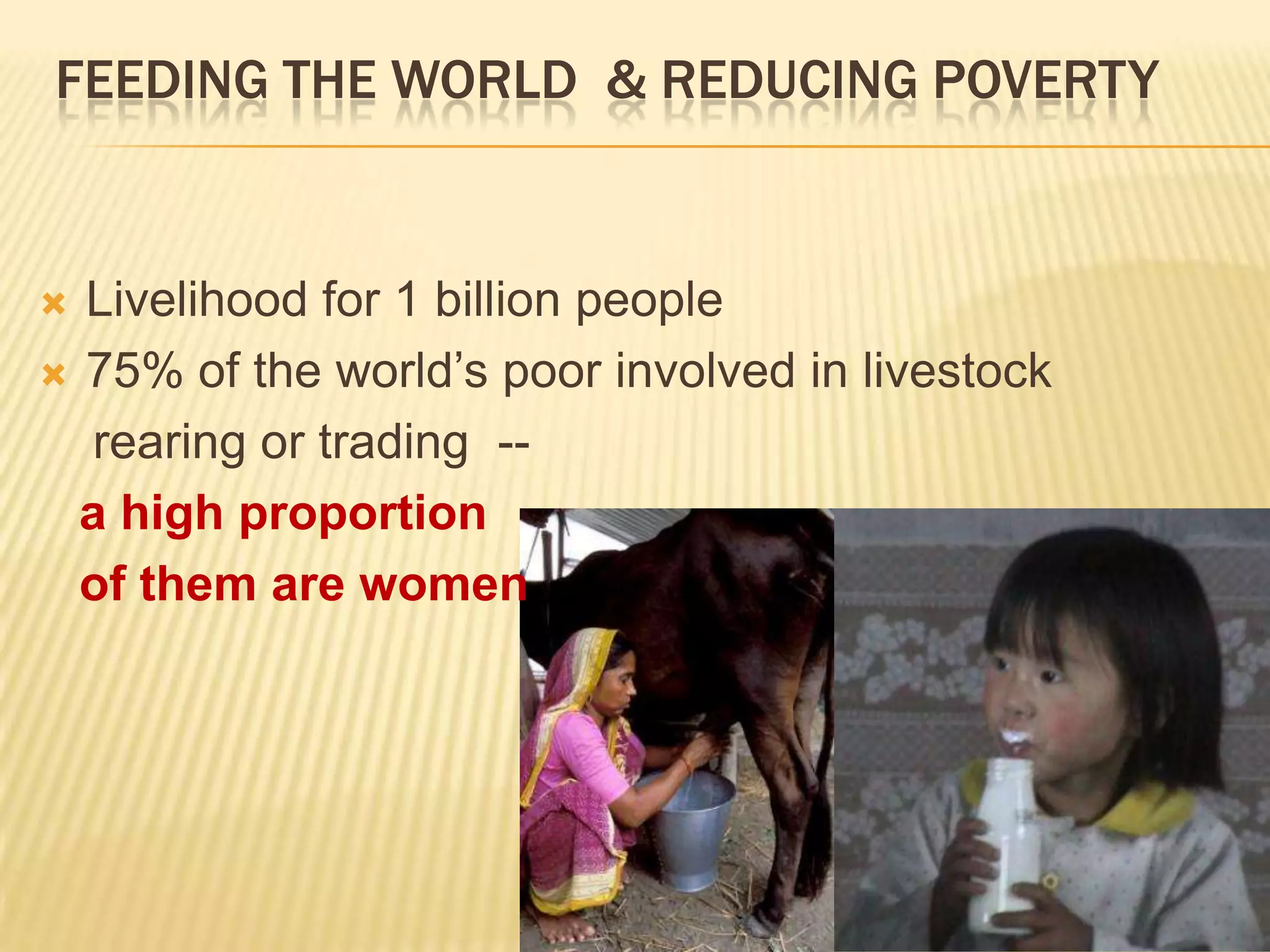
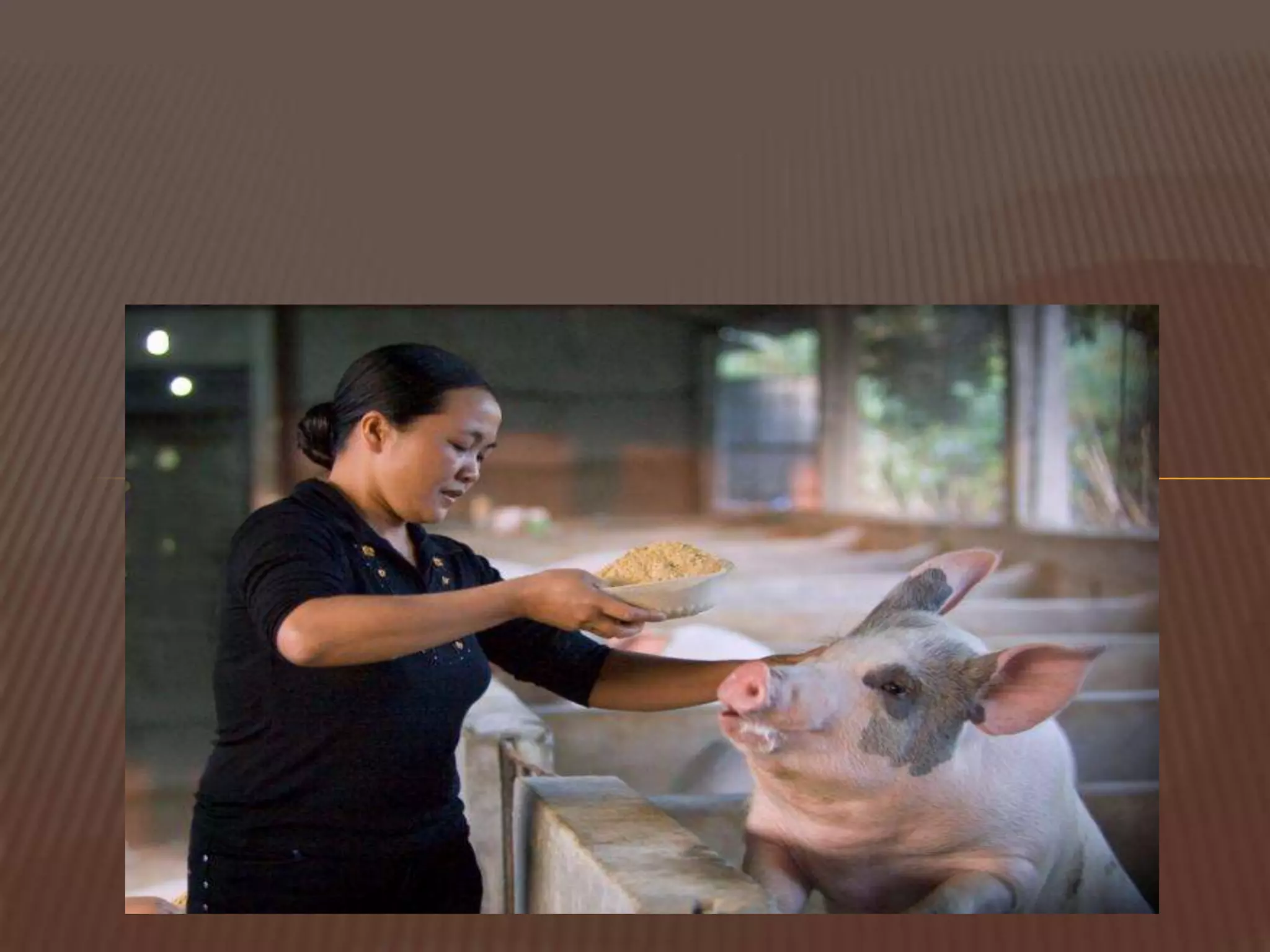
Feeding the World  & REDUCING POVERTYLivelihood for 1 billion people75% of the world’s poor involved in livestock     rearing or trading  --a high proportion    of them are women
Climate ChangeImpact on poor people’s livestock systemsCut emissions by 2/3 in 25 years –2 degree trackLivestock part of the problem 18 % of GHG emissionsLivestock part of the solution soil carbonIncreasing productivity  --contributing to two goals
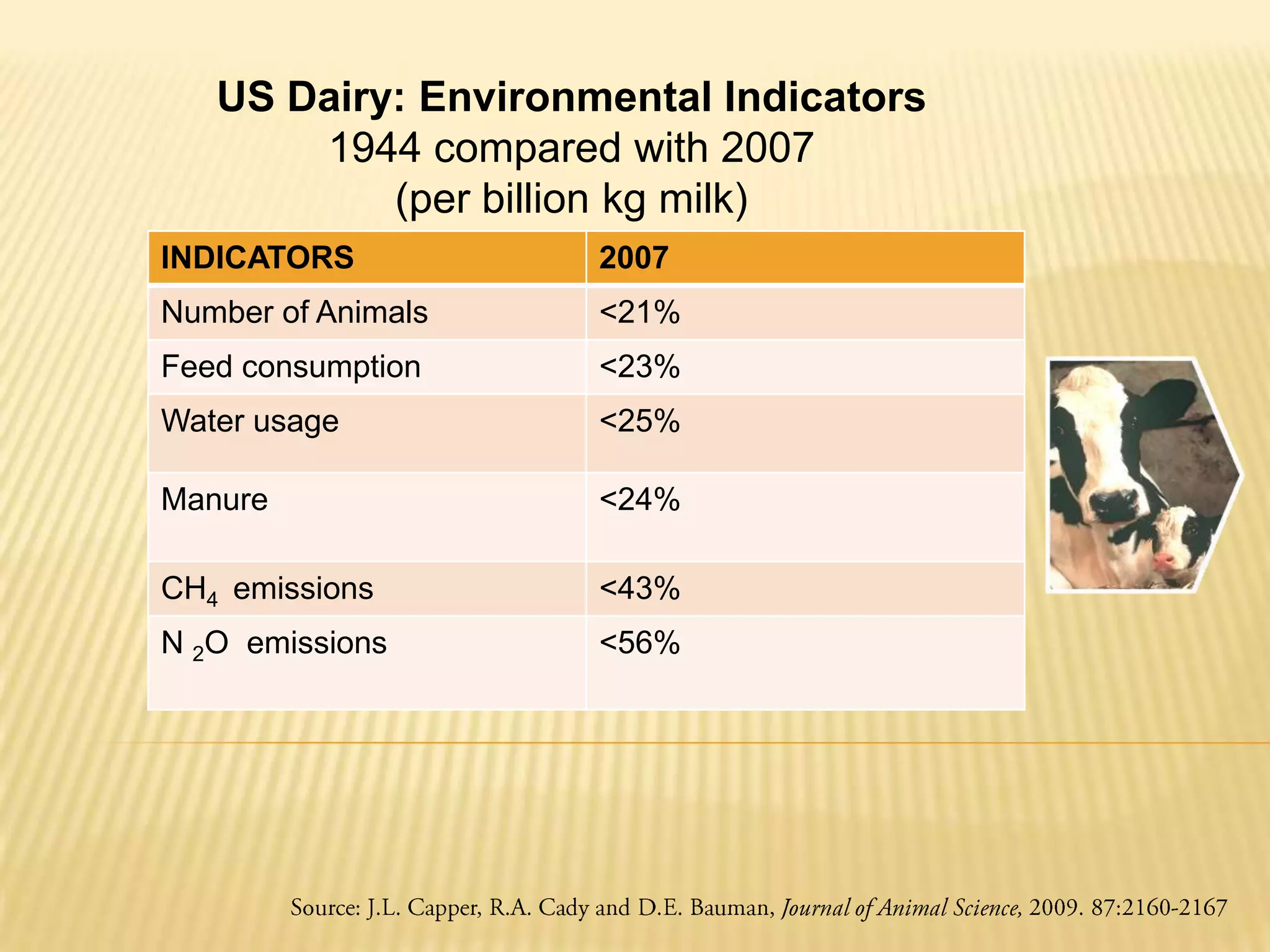
US Dairy: Environmental Indicators1944 compared with 2007(per billion kg milk)Source: J.L. Capper, R.A. Cady and D.E. Bauman, Journal of Animal Science, 2009. 87:2160-2167
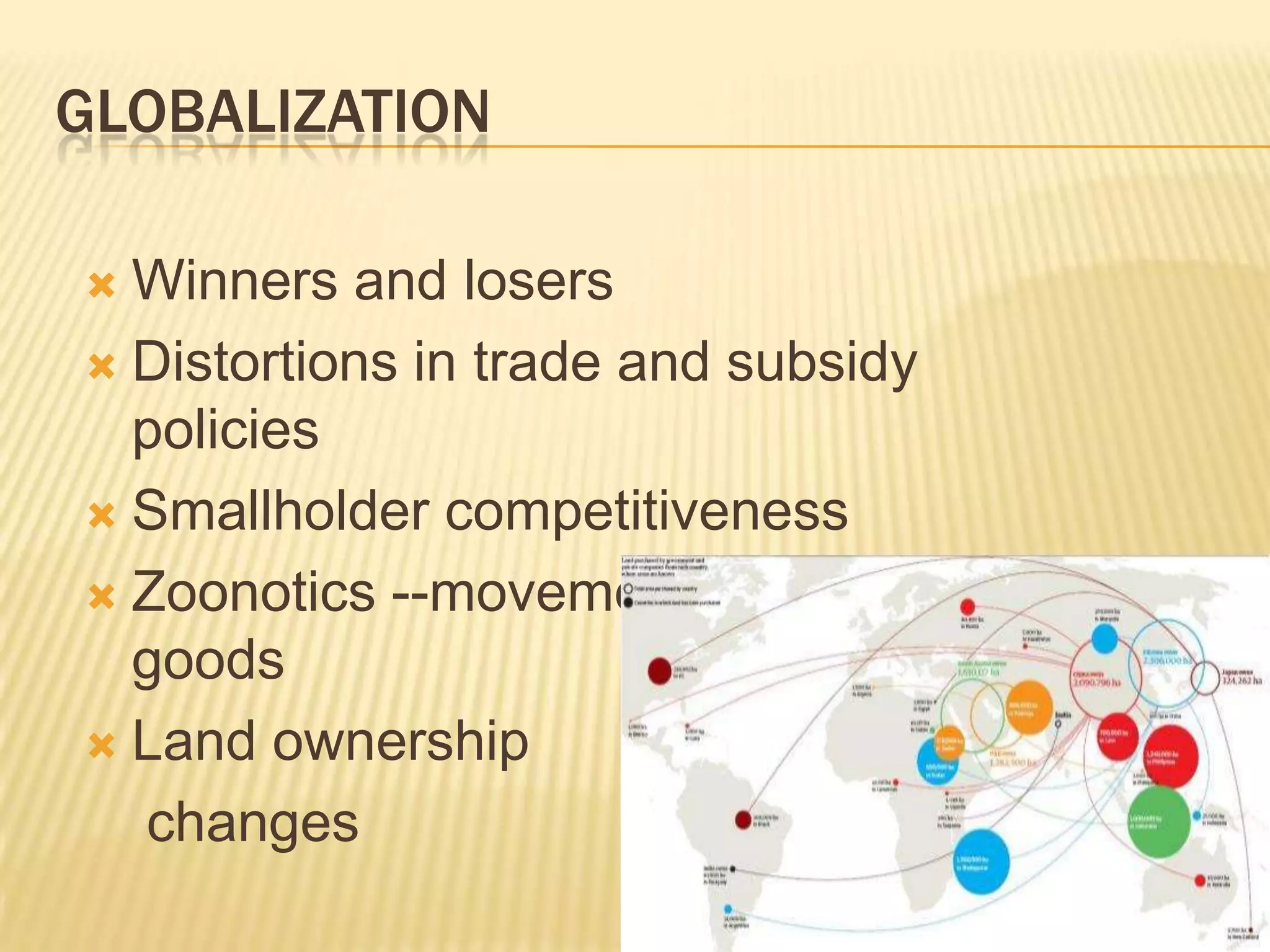
GlobalizationWinners and losersDistortions in trade and subsidy policiesSmallholder competitivenessZoonotics --movement of people and goods Land ownership     changes
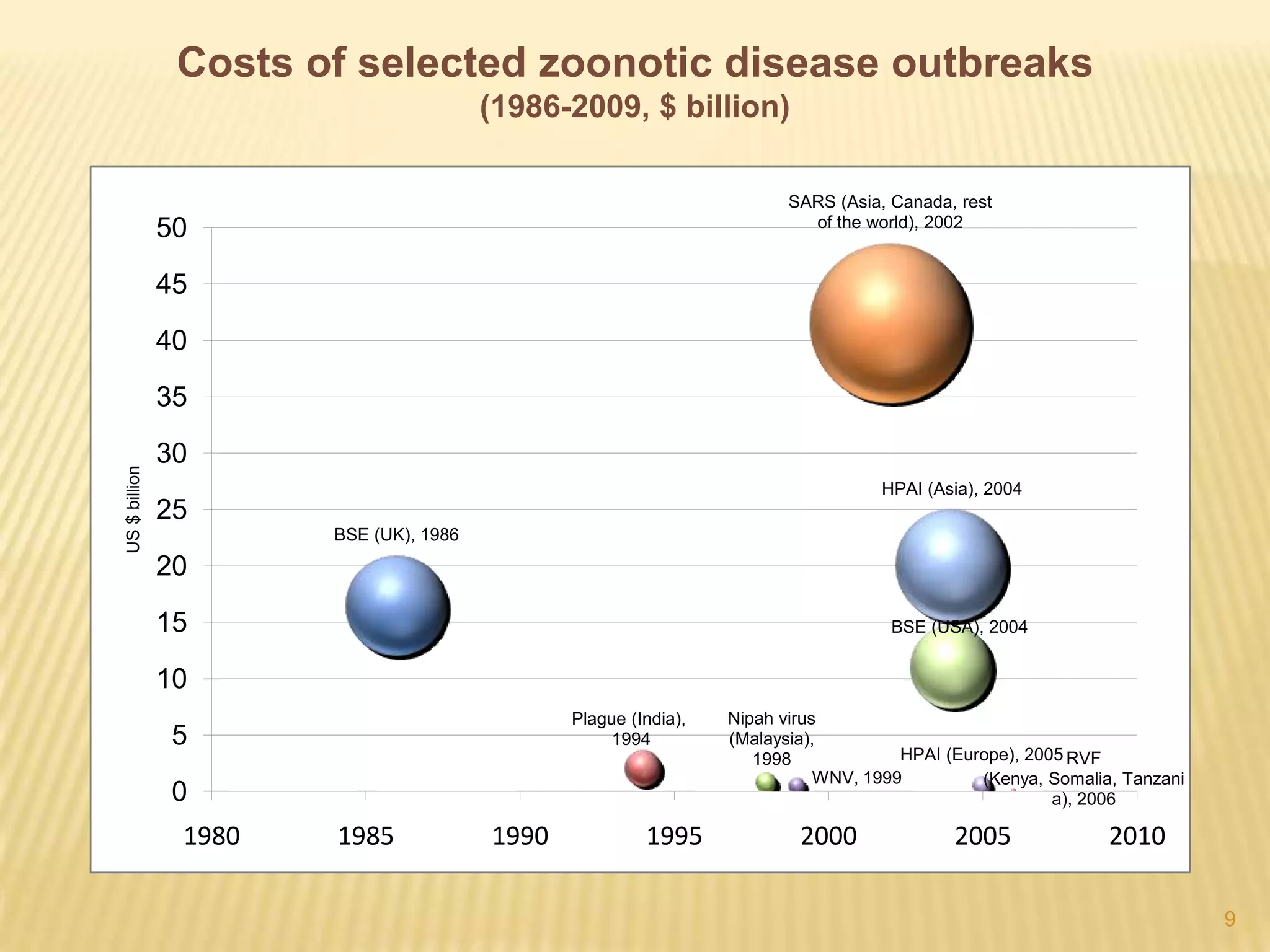
9Costs of selected zoonotic disease outbreaks (1986-2009, $ billion)
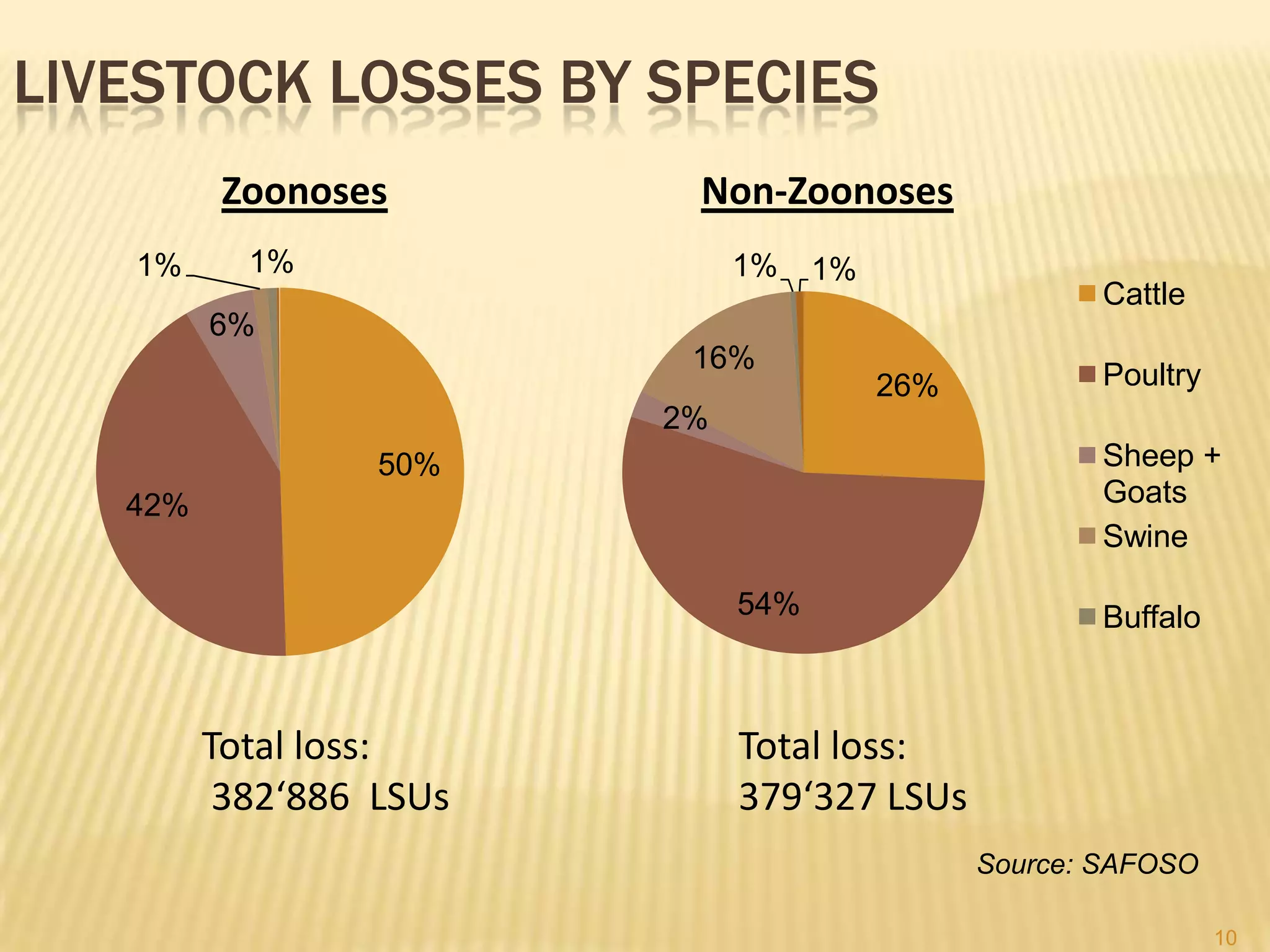
Livestock losses by speciesZoonosesNon-ZoonosesTotal loss: 382‘886  LSUsTotal loss:379‘327 LSUsSource: SAFOSO 10
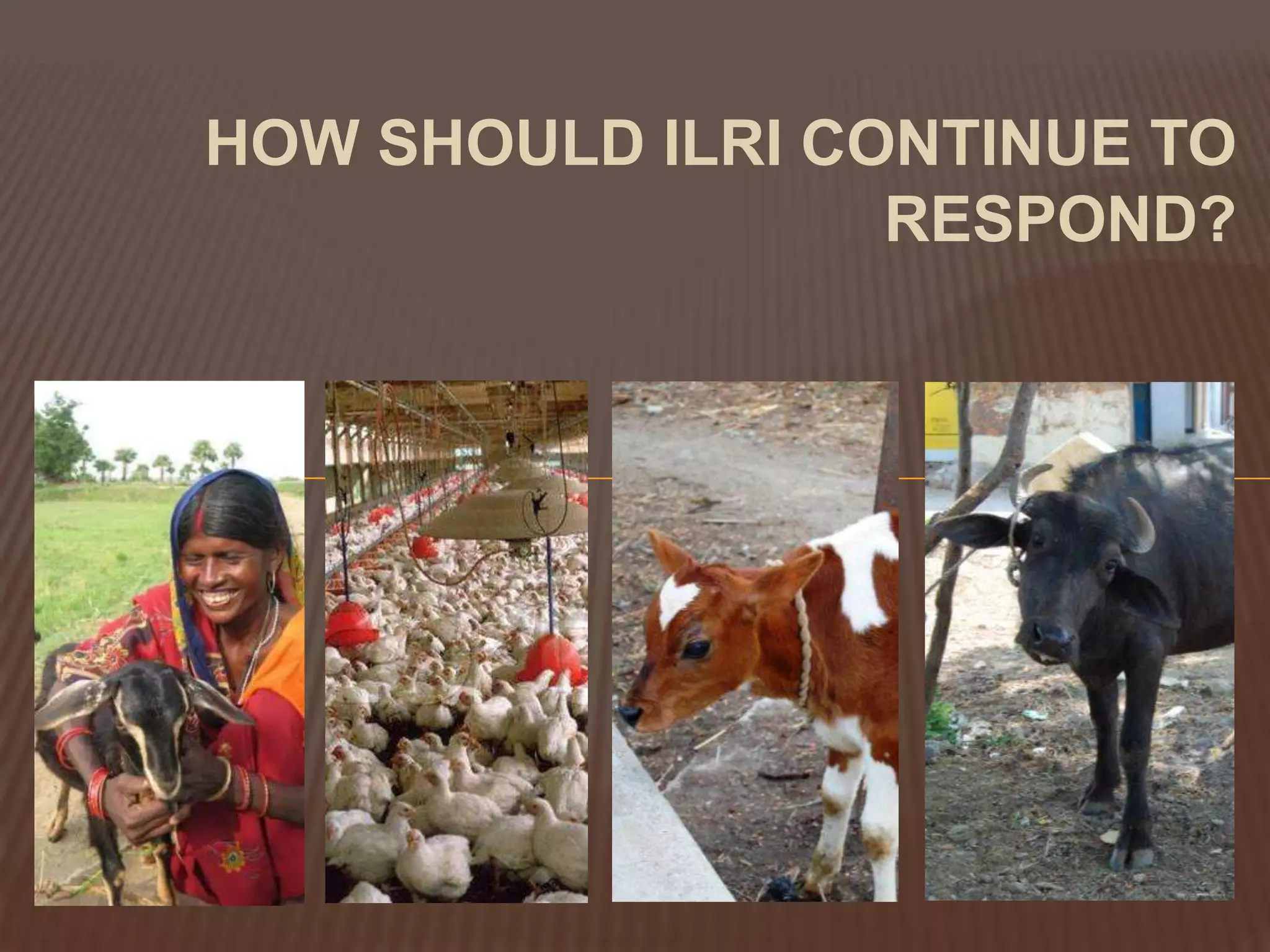
HOW SHOULD ILRI CONTINUE TO RESPOND?
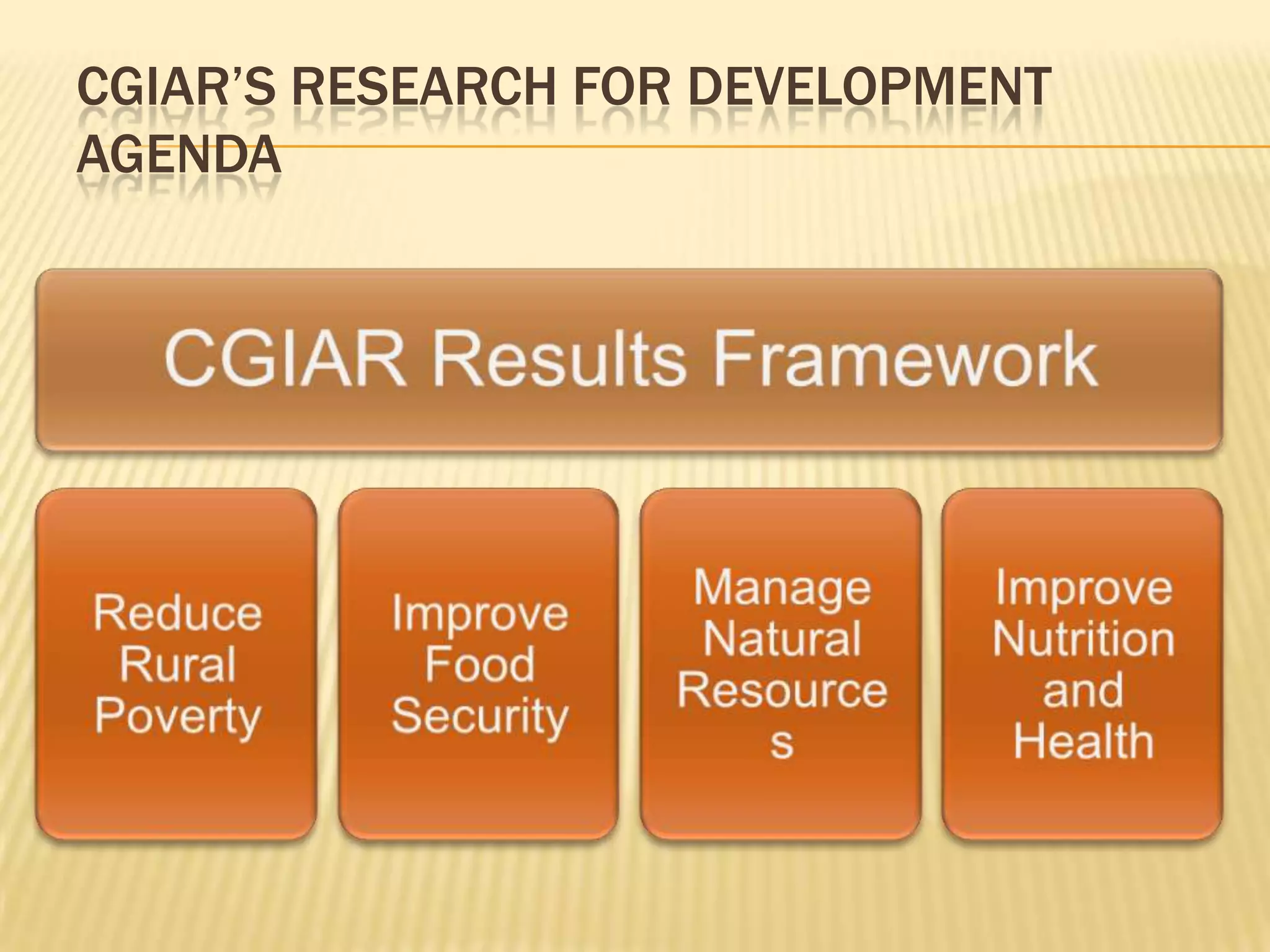
CGIAR’s Research for Development Agenda
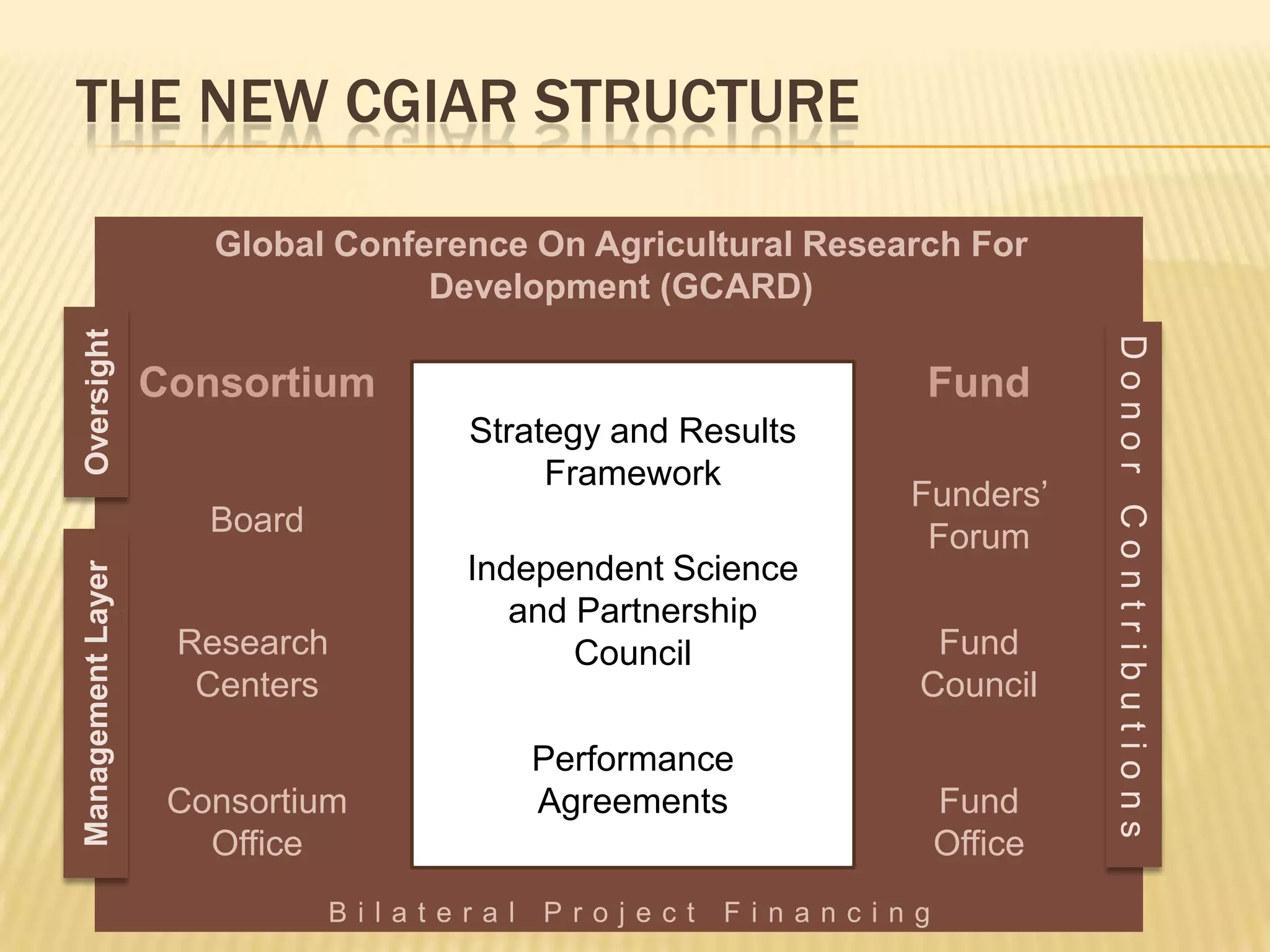
The New CGIAR StructureGlobal Conference On Agricultural Research For Development (GCARD)OversightConsortiumFundStrategy and Results FrameworkFunders’ ForumBoardManagement LayerIndependent Science and Partnership CouncilDonor ContributionsResearch CentersFund CouncilPerformance AgreementsConsortiumOfficeFund OfficeBilateral Project Financing
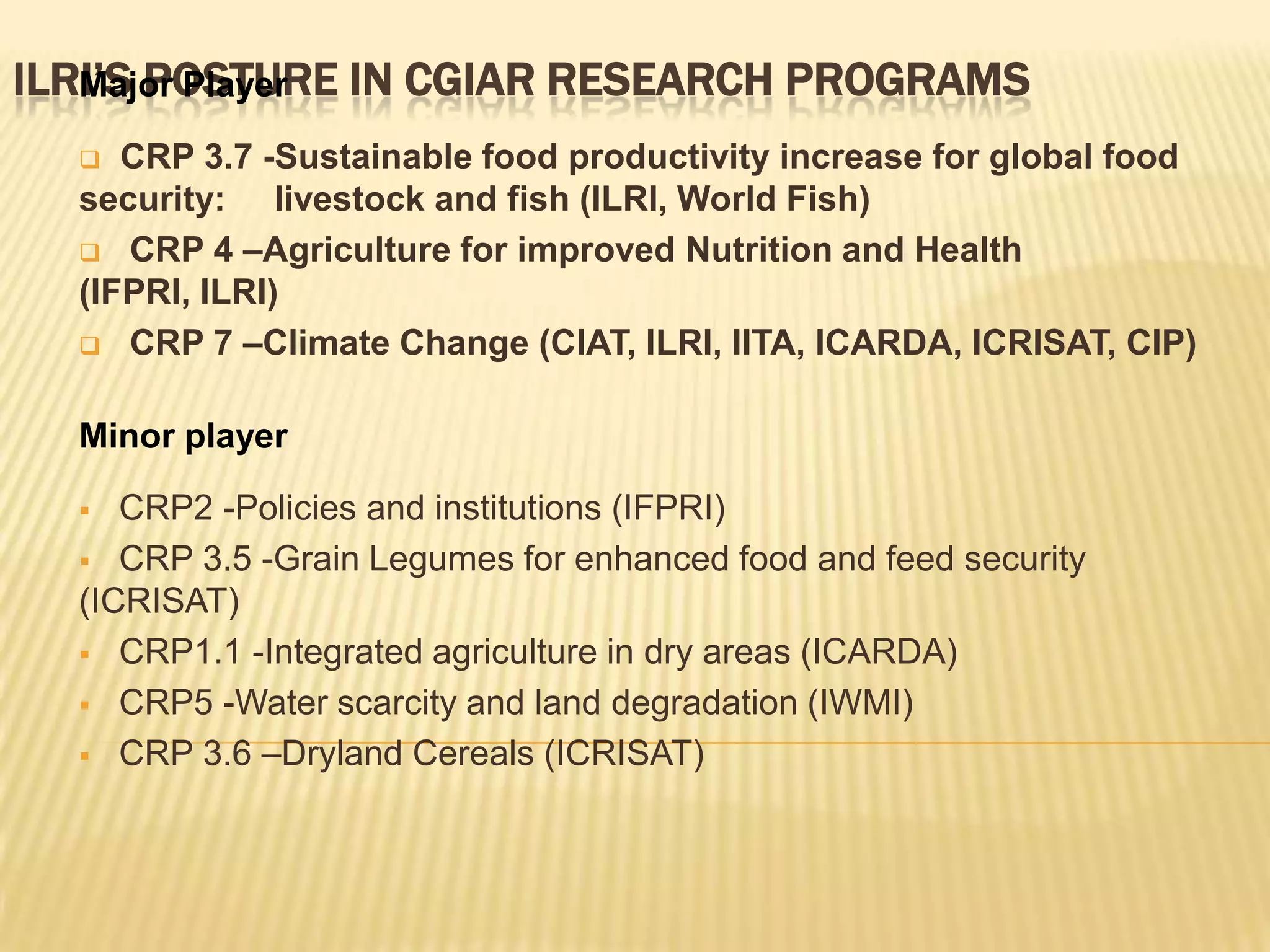
ILRI’s POSTURE in CGIAR Research programsMajor PlayerCRP 3.7 -Sustainable food productivity increase for global food   security:     livestock and fish (ILRI, World Fish)
   CRP 4 –Agriculture for improved Nutrition and Health (IFPRI, ILRI)
  CRP 7 –Climate Change (CIAT, ILRI, IITA, ICARDA, ICRISAT, CIP)Minor player   CRP2 -Policies and institutions (IFPRI)
   CRP 3.5 -Grain Legumes for enhanced food and feed security (ICRISAT)
   CRP1.1 -Integrated agriculture in dry areas (ICARDA)
   CRP5 -Water scarcity and land degradation (IWMI)
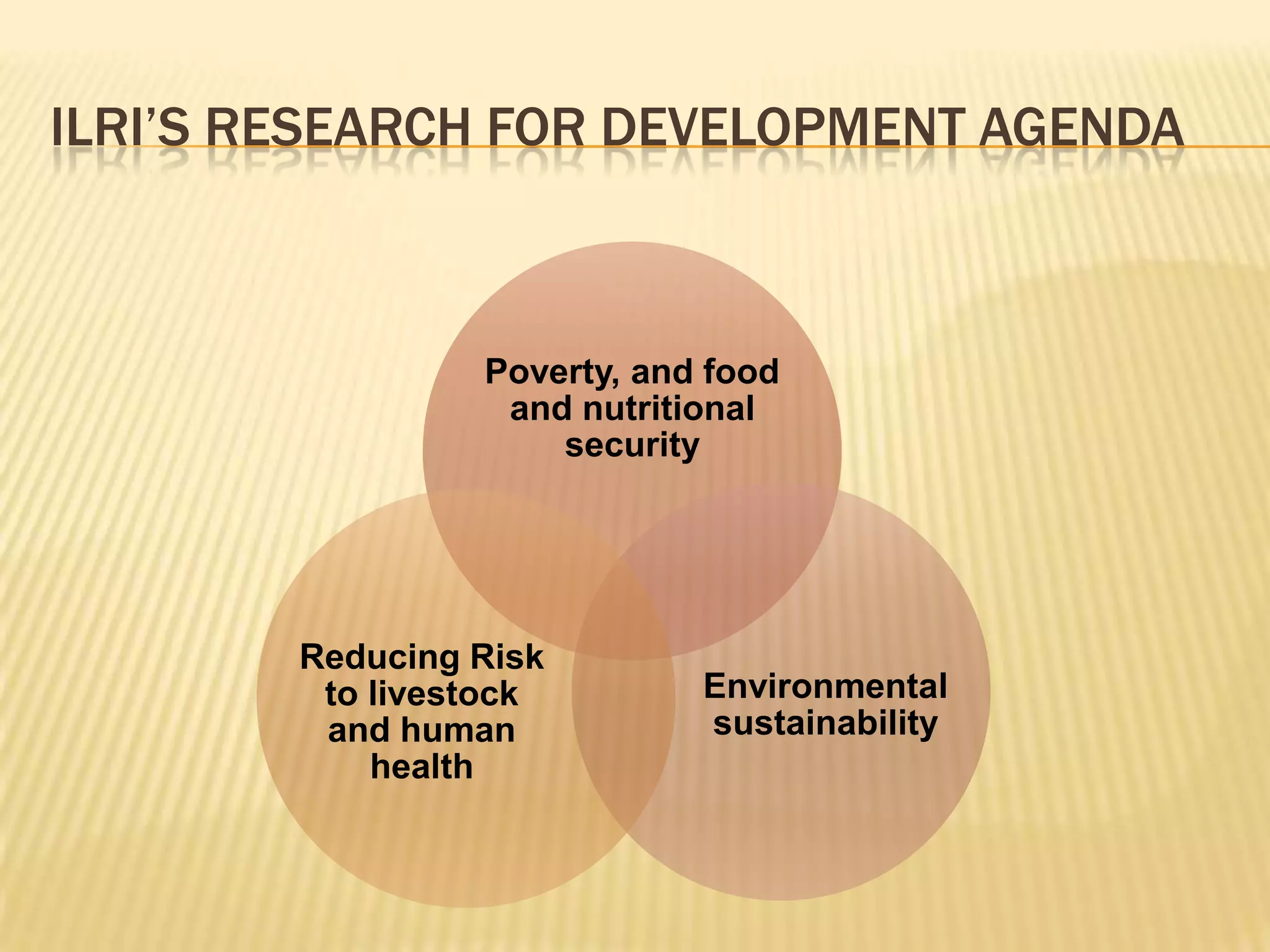
  CRP 3.6 –Dryland Cereals (ICRISAT)ILRI’s Research for Development Agenda
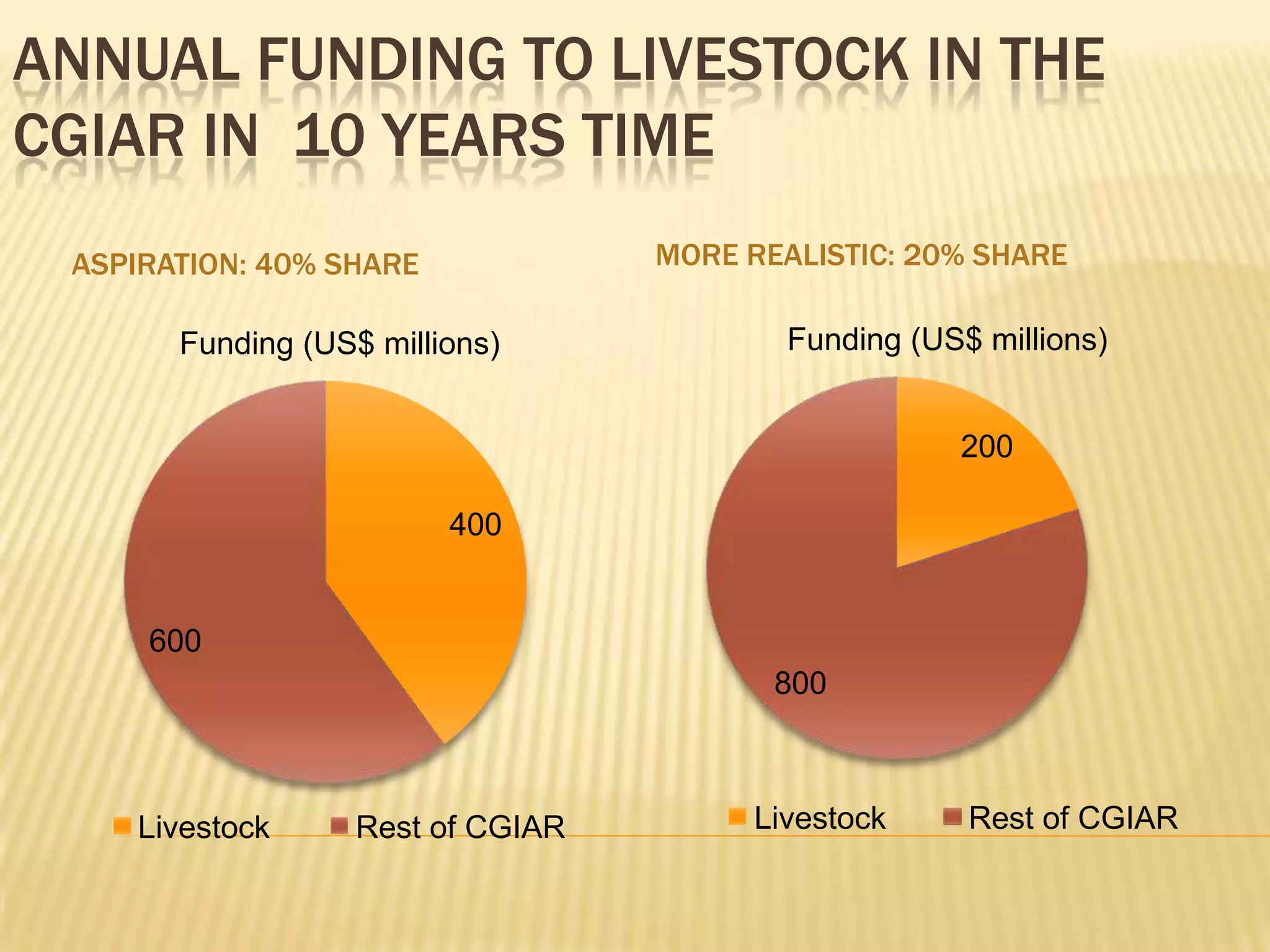
Annual funding to Livestock in the cgiar in  10 years timeMore Realistic: 20% shareAspiration: 40% share
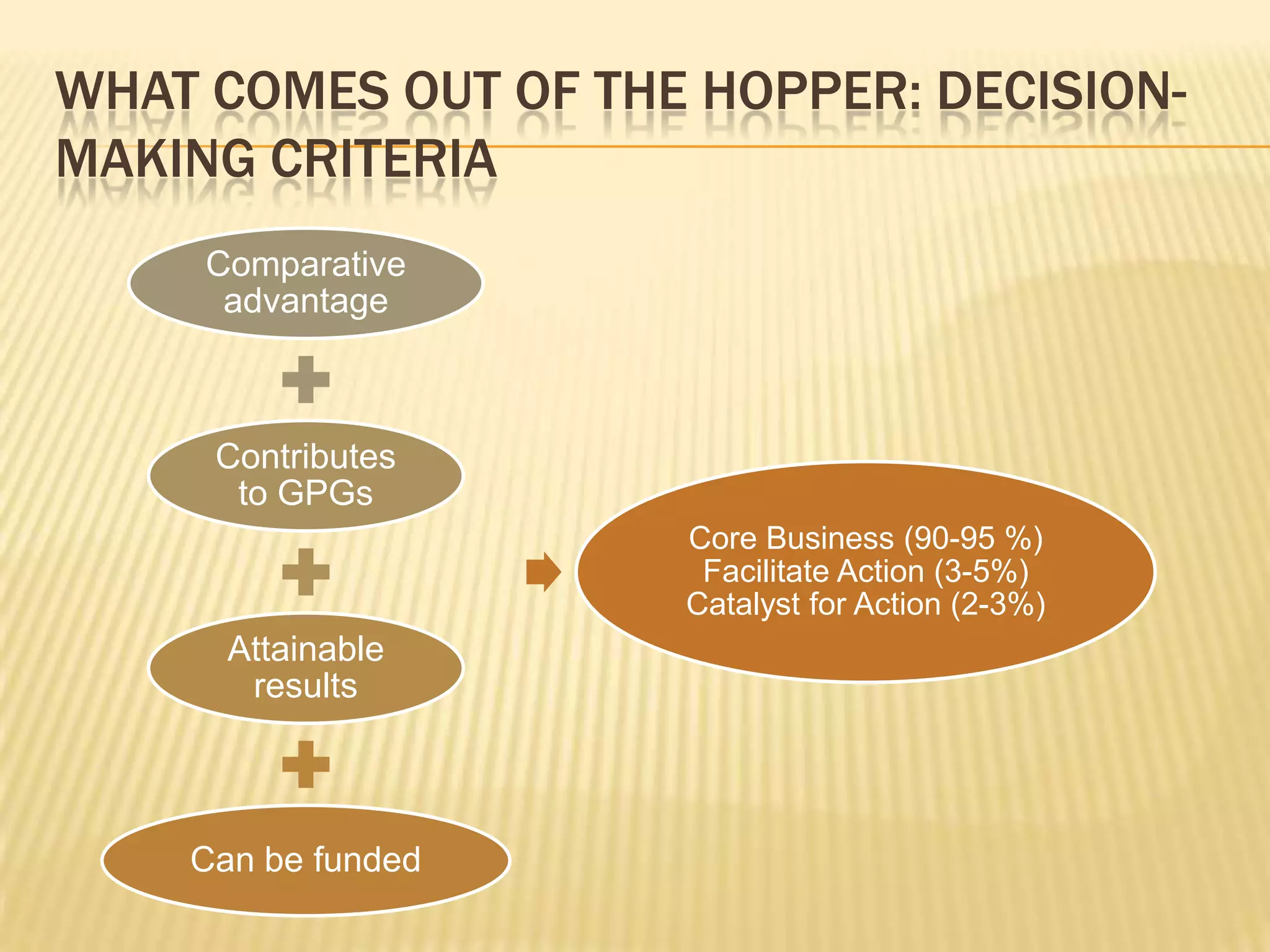
What Comes out of the Hopper: Decision-making criteria
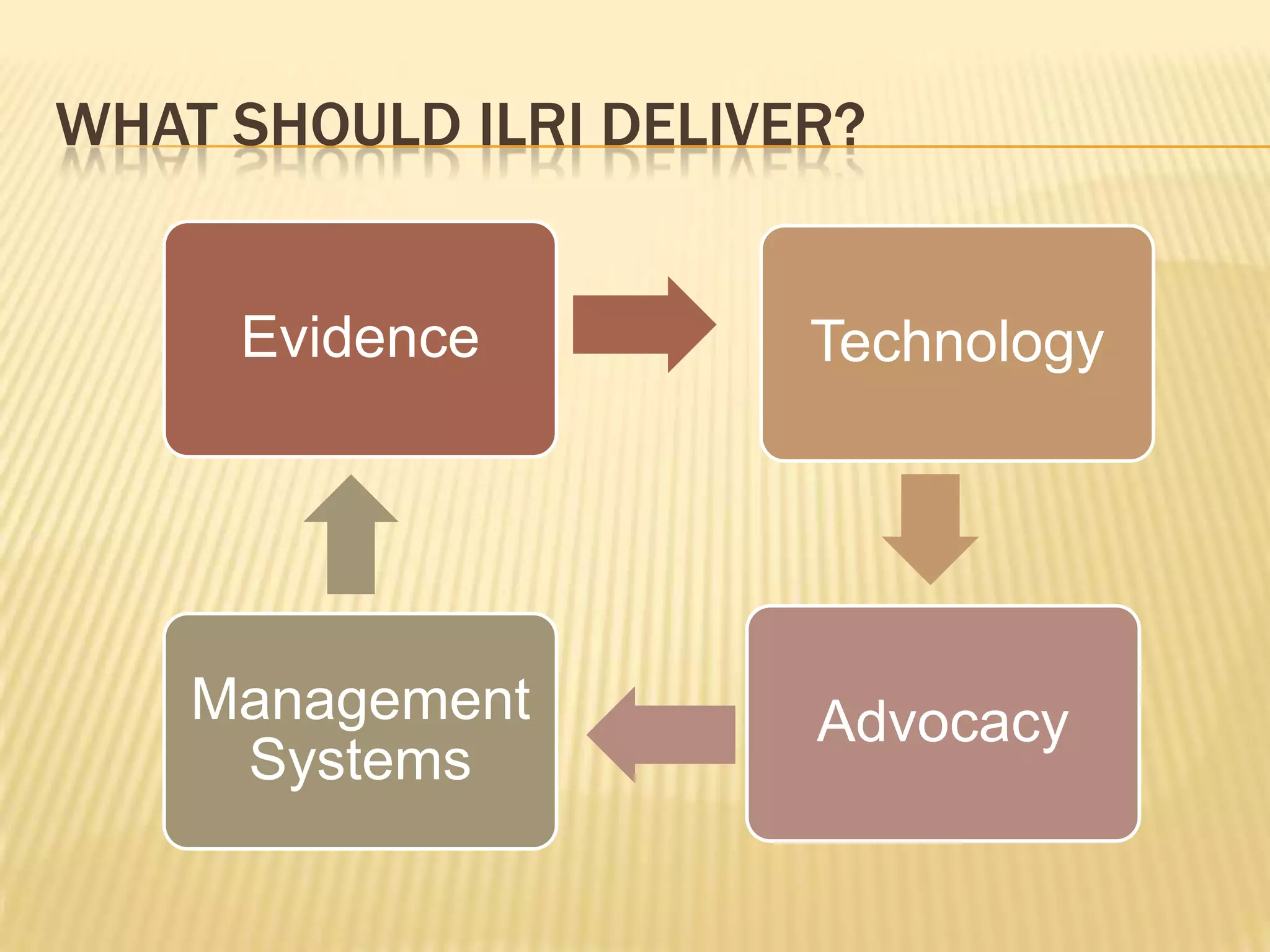
What would ILRI deliver in next 5-10 years?Poverty, and food and nutritional securityTechnologies and institutions to link smallholder to markets nationally and internationallySafer livestock productsGender to the top of the agendaclose the attainment gap between male and female headed farms, and 100 million fewer people will be hungry.   FAO State of Food and Agriculture 2010
What would ILRI deliver in next 5-10 years?Reduce risk to livestock and human healthVaccines, diagnostics and institutional options to protect the assets of the poorAdvance the  One Health approach to attain better animal-human-ecosystems health outcomesContinue to leverage BecA to contribute to livestock productivity, conservation and adaptation, as well as to animal health
What would ILRI deliver in next 5-10 years?Environmental sustainabilityPromote Climate Smart Livestock Systems Technologies  that demonstrate sustainable increase in resource use efficiency, reduce the carbon foot print and build resilience Bring rangelands (especially pastoral systems) into Payment for Environmental Services  schemes
What should ILRI deliver?
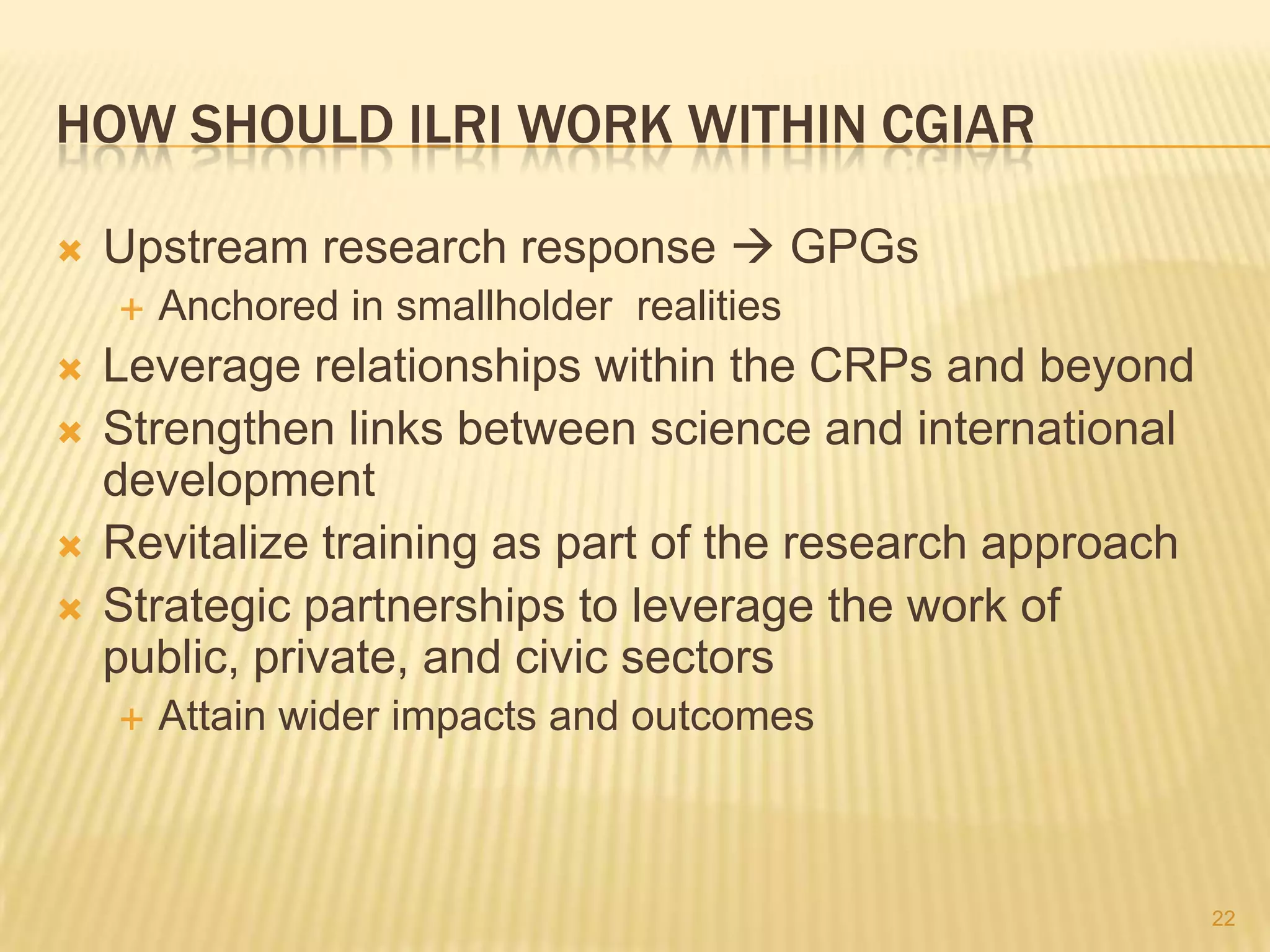
How Should ILRI work within CGIAR Upstream research response  GPGsAnchored in smallholder  realitiesLeverage relationships within the CRPs and beyondStrengthen links between science and international development Revitalize training as part of the research approach Strategic partnerships to leverage the work of public, private, and civic sectorsAttain wider impacts and outcomes22
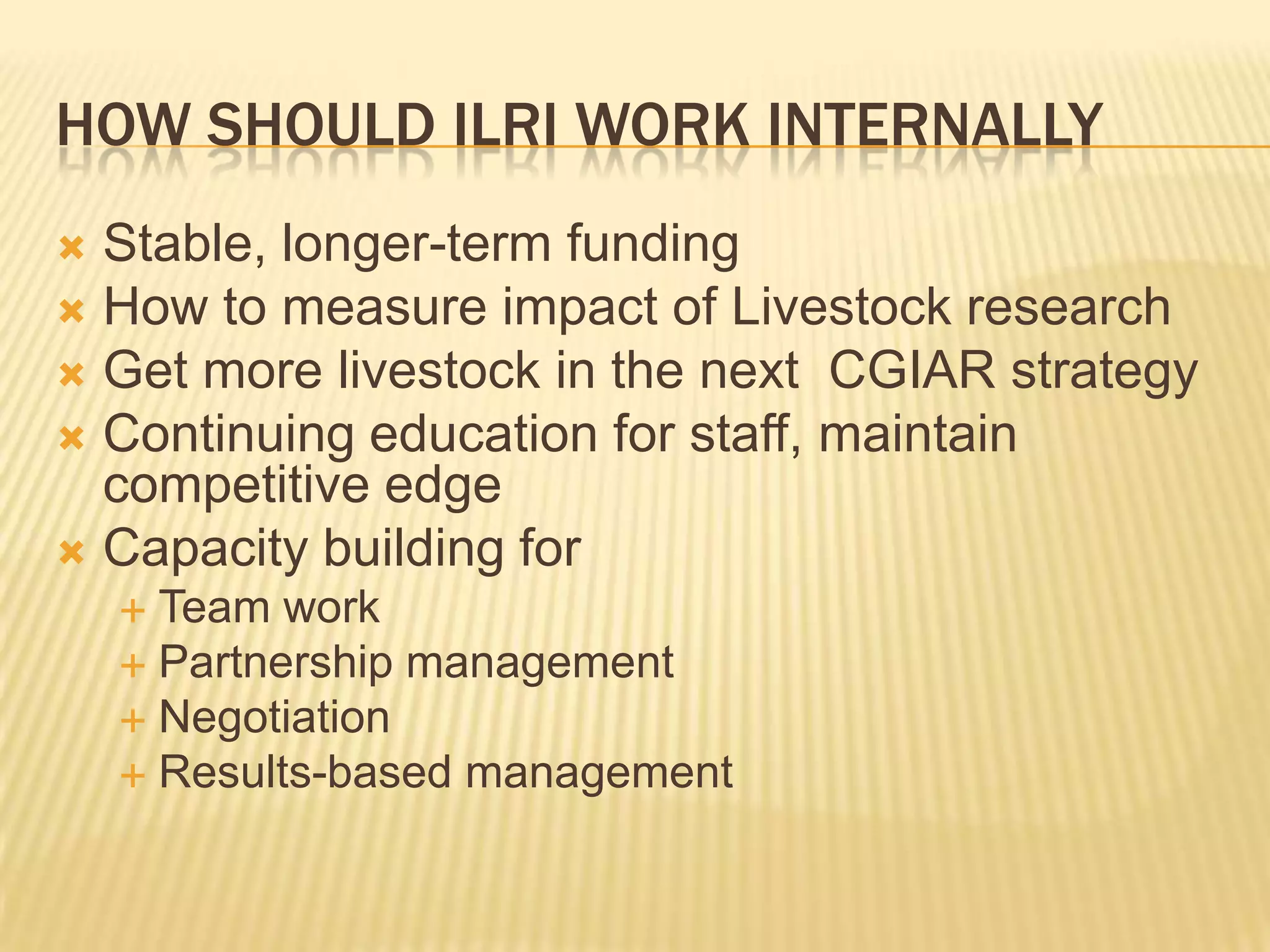
How should ILRI work internallyStable, longer-term fundingHow to measure impact of Livestock researchGet more livestock in the next  CGIAR strategyContinuing education for staff, maintain competitive edgeCapacity building for Team workPartnership managementNegotiationResults-based management
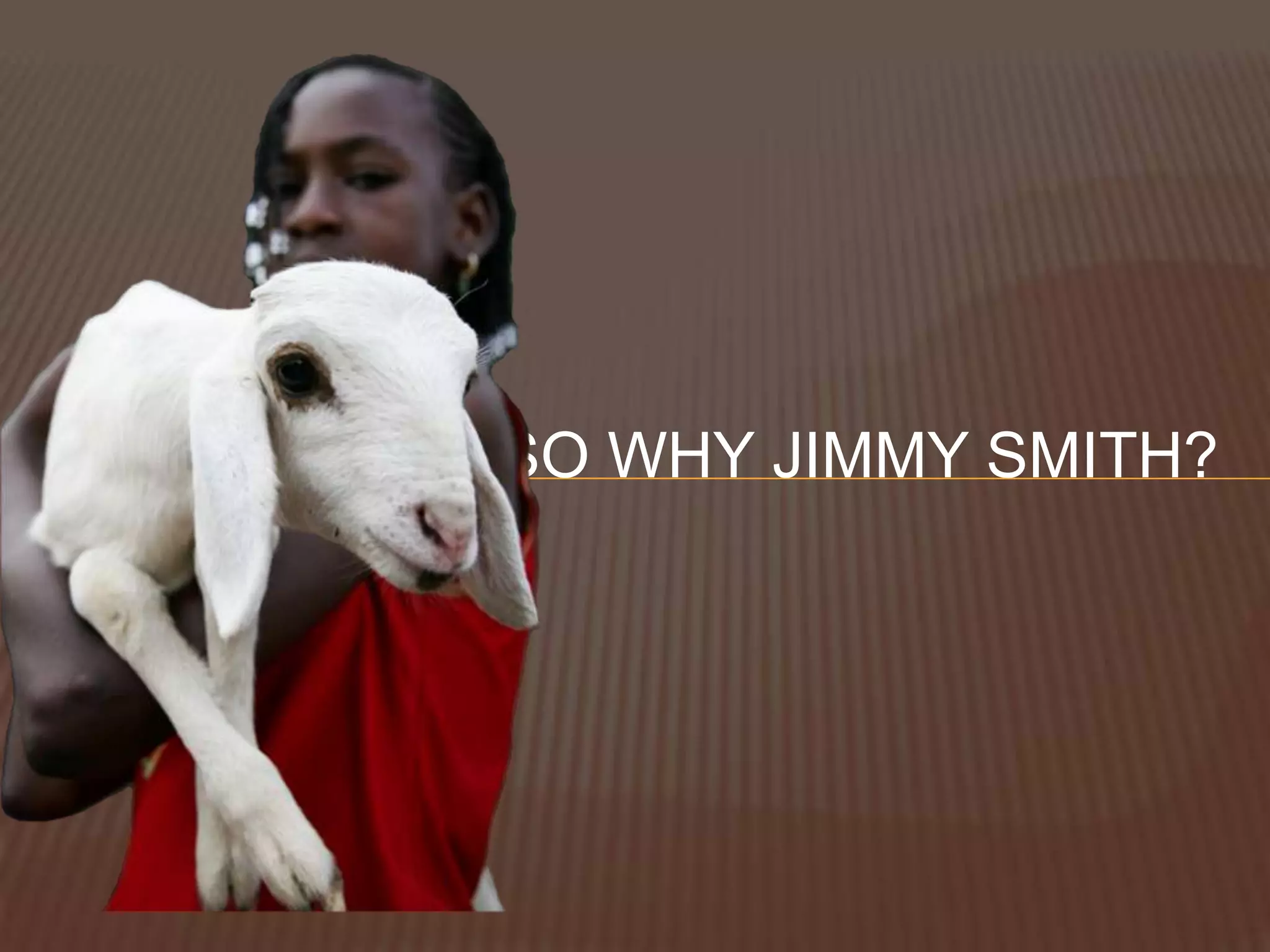
So Why Jimmy Smith?
Familiarity with primary constituenciesRaised on a small farm with mixed crop-livestock system
Clear understanding of NARS, CGIAR, and Regional partner relationships
Served in the CGIAR
Have been a bi-lateral Donor
Agriculture from $50m to $350m annually
      CGIAR from $17m to $46m
Serving within a co-sponsor – World Bank
      Livestock from $200m to $1.5b
      Worked with others to protect investments in the CGIAR25
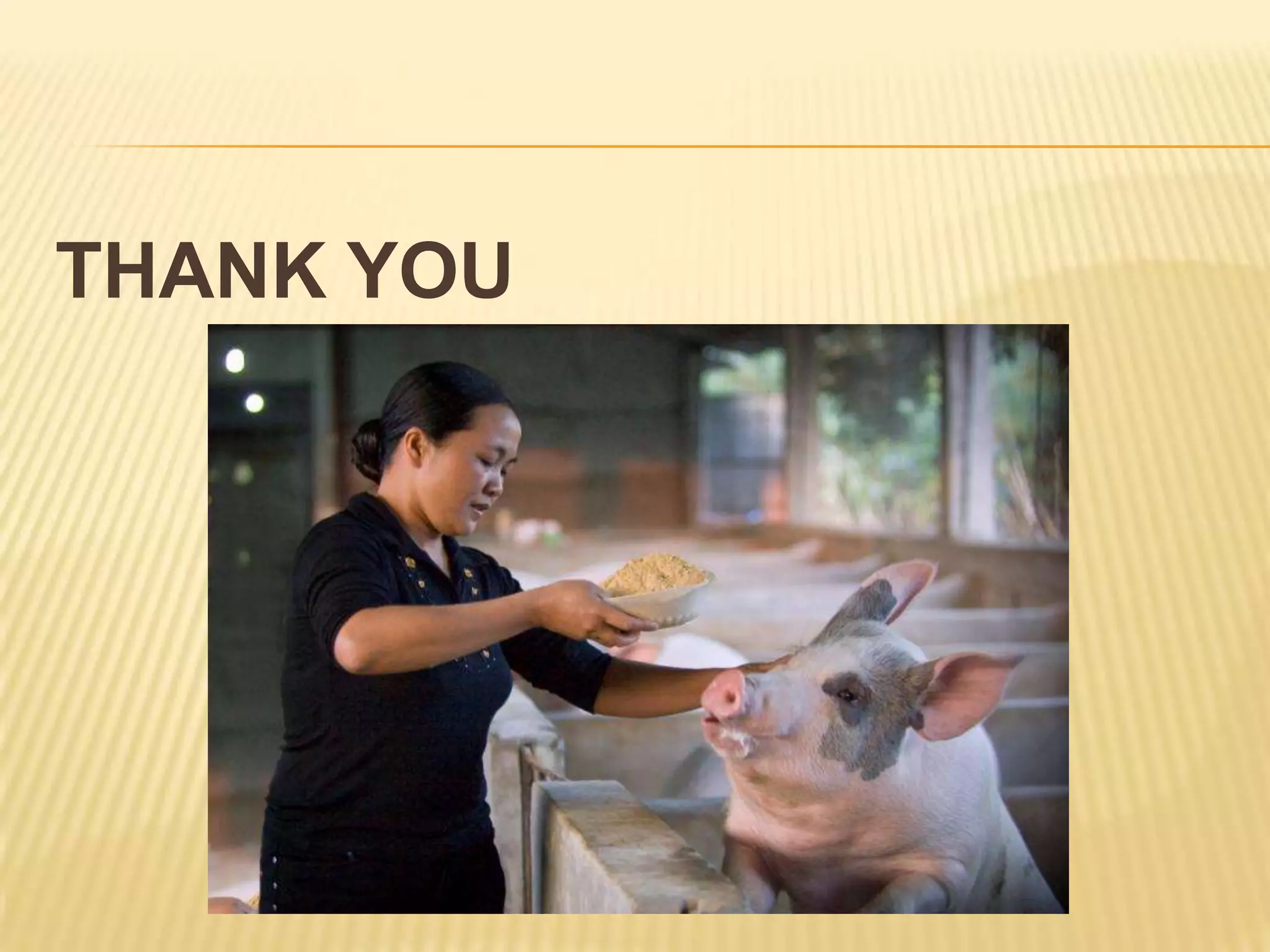
PARTING WORDSCongratulations to Carlos and the TeamAttention to Agriculture -Perhaps a once in a lifetimeMove Livestock up the global agendaMobilize resources to respond at scaleBuild Partnerships to leverage investments, facilitate uptake and expand our influence.
THANK YOU

ILRI’s Future in the Emerging Global Context: What are the critical outcomes that ILRI should deliver in the next 5 to 10 years?

  • 1.
    ILRI’s Future inthe Emerging Global Context What are the critical outcomes that ILRI should deliver in the next 5 to 10 years?Jimmy W. SmithApril 11th 2011Nairobi, Kenya
  • 2.
    Presentation OutlineThe changingglobal contextILRI’s continuing response & deliverablesA bit about me
  • 3.
    The Global Contextfor LivestockGlobal ChallengesLivestock DomainsFeeding the world Climate change Globalization
  • 4.
    Feeding the World2.5band 70% more food by 205080% from increased productivityMajor role for livestock productsSteadily increasing demand26% of all proteinMicronutrients But the role of livestock is often not recognized
  • 5.
    Feeding the World & REDUCING POVERTYLivelihood for 1 billion people75% of the world’s poor involved in livestock rearing or trading --a high proportion of them are women
  • 6.
    Climate ChangeImpact onpoor people’s livestock systemsCut emissions by 2/3 in 25 years –2 degree trackLivestock part of the problem 18 % of GHG emissionsLivestock part of the solution soil carbonIncreasing productivity --contributing to two goals
  • 7.
    US Dairy: EnvironmentalIndicators1944 compared with 2007(per billion kg milk)Source: J.L. Capper, R.A. Cady and D.E. Bauman, Journal of Animal Science, 2009. 87:2160-2167
  • 8.
    GlobalizationWinners and losersDistortionsin trade and subsidy policiesSmallholder competitivenessZoonotics --movement of people and goods Land ownership changes
  • 9.
    9Costs of selectedzoonotic disease outbreaks (1986-2009, $ billion)
  • 10.
    Livestock losses byspeciesZoonosesNon-ZoonosesTotal loss: 382‘886 LSUsTotal loss:379‘327 LSUsSource: SAFOSO 10
  • 11.
    HOW SHOULD ILRICONTINUE TO RESPOND?
  • 12.
    CGIAR’s Research forDevelopment Agenda
  • 13.
    The New CGIARStructureGlobal Conference On Agricultural Research For Development (GCARD)OversightConsortiumFundStrategy and Results FrameworkFunders’ ForumBoardManagement LayerIndependent Science and Partnership CouncilDonor ContributionsResearch CentersFund CouncilPerformance AgreementsConsortiumOfficeFund OfficeBilateral Project Financing
  • 14.
    ILRI’s POSTURE inCGIAR Research programsMajor PlayerCRP 3.7 -Sustainable food productivity increase for global food security: livestock and fish (ILRI, World Fish)
  • 15.
    CRP 4 –Agriculture for improved Nutrition and Health (IFPRI, ILRI)
  • 16.
    CRP7 –Climate Change (CIAT, ILRI, IITA, ICARDA, ICRISAT, CIP)Minor player CRP2 -Policies and institutions (IFPRI)
  • 17.
    CRP 3.5 -Grain Legumes for enhanced food and feed security (ICRISAT)
  • 18.
    CRP1.1 -Integrated agriculture in dry areas (ICARDA)
  • 19.
    CRP5 -Water scarcity and land degradation (IWMI)
  • 20.
    CRP3.6 –Dryland Cereals (ICRISAT)ILRI’s Research for Development Agenda
  • 21.
    Annual funding toLivestock in the cgiar in 10 years timeMore Realistic: 20% shareAspiration: 40% share
  • 22.
    What Comes outof the Hopper: Decision-making criteria
  • 23.
    What would ILRIdeliver in next 5-10 years?Poverty, and food and nutritional securityTechnologies and institutions to link smallholder to markets nationally and internationallySafer livestock productsGender to the top of the agendaclose the attainment gap between male and female headed farms, and 100 million fewer people will be hungry. FAO State of Food and Agriculture 2010
  • 24.
    What would ILRIdeliver in next 5-10 years?Reduce risk to livestock and human healthVaccines, diagnostics and institutional options to protect the assets of the poorAdvance the One Health approach to attain better animal-human-ecosystems health outcomesContinue to leverage BecA to contribute to livestock productivity, conservation and adaptation, as well as to animal health
  • 25.
    What would ILRIdeliver in next 5-10 years?Environmental sustainabilityPromote Climate Smart Livestock Systems Technologies that demonstrate sustainable increase in resource use efficiency, reduce the carbon foot print and build resilience Bring rangelands (especially pastoral systems) into Payment for Environmental Services schemes
  • 26.
  • 27.
    How Should ILRIwork within CGIAR Upstream research response  GPGsAnchored in smallholder realitiesLeverage relationships within the CRPs and beyondStrengthen links between science and international development Revitalize training as part of the research approach Strategic partnerships to leverage the work of public, private, and civic sectorsAttain wider impacts and outcomes22
  • 28.
    How should ILRIwork internallyStable, longer-term fundingHow to measure impact of Livestock researchGet more livestock in the next CGIAR strategyContinuing education for staff, maintain competitive edgeCapacity building for Team workPartnership managementNegotiationResults-based management
  • 29.
  • 30.
    Familiarity with primaryconstituenciesRaised on a small farm with mixed crop-livestock system
  • 31.
    Clear understanding ofNARS, CGIAR, and Regional partner relationships
  • 32.
  • 33.
    Have been abi-lateral Donor
  • 34.
    Agriculture from $50mto $350m annually
  • 35.
    CGIAR from $17m to $46m
  • 36.
    Serving within aco-sponsor – World Bank
  • 37.
    Livestock from $200m to $1.5b
  • 38.
    Worked with others to protect investments in the CGIAR25
  • 39.
    PARTING WORDSCongratulations toCarlos and the TeamAttention to Agriculture -Perhaps a once in a lifetimeMove Livestock up the global agendaMobilize resources to respond at scaleBuild Partnerships to leverage investments, facilitate uptake and expand our influence.
  • 40.
  • 42.
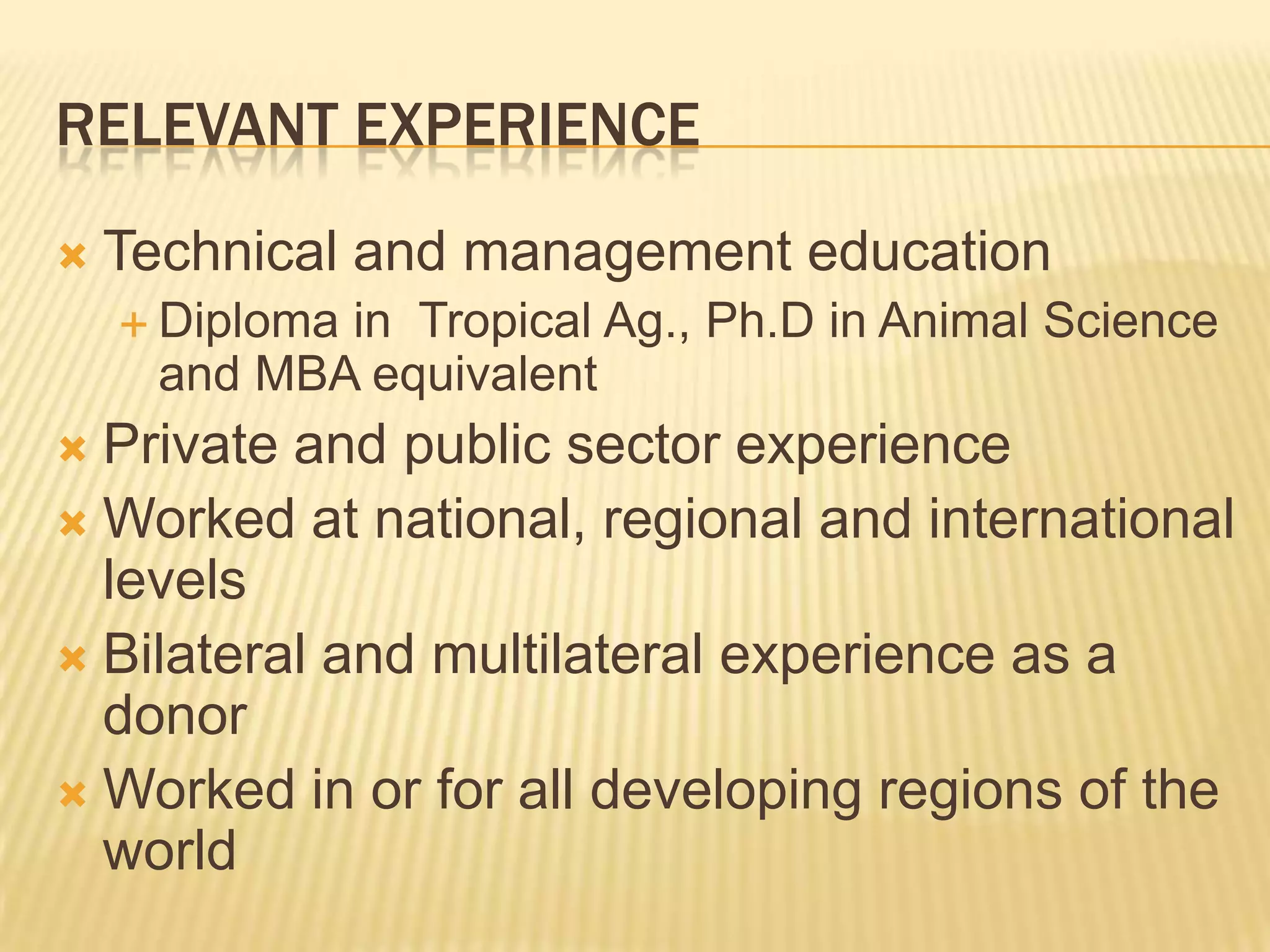
    Relevant experienceTechnical andmanagement educationDiploma in Tropical Ag., Ph.D in Animal Science and MBA equivalentPrivate and public sector experienceWorked at national, regional and international levelsBilateral and multilateral experience as a donor Worked in or for all developing regions of the world
  • 43.
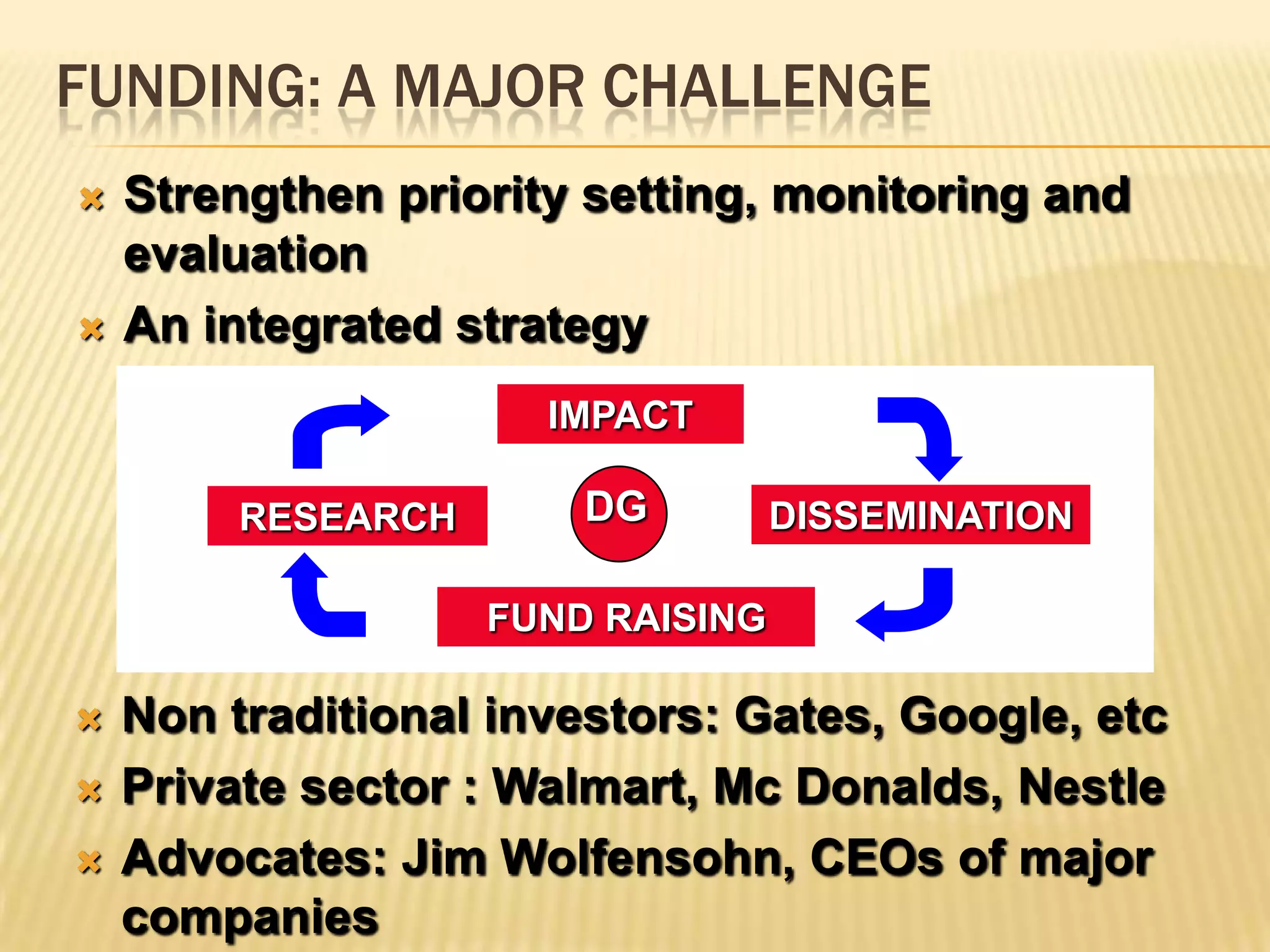
    FUNDING: A MAJORCHALLENGEStrengthen priority setting, monitoring and evaluationAn integrated strategyIMPACTDGDISSEMINATIONRESEARCHFUND RAISINGNon traditional investors: Gates, Google, etc
  • 44.
    Private sector :Walmart, Mc Donalds, Nestle
  • 45.
    Advocates: Jim Wolfensohn,CEOs of major companies
  • 46.
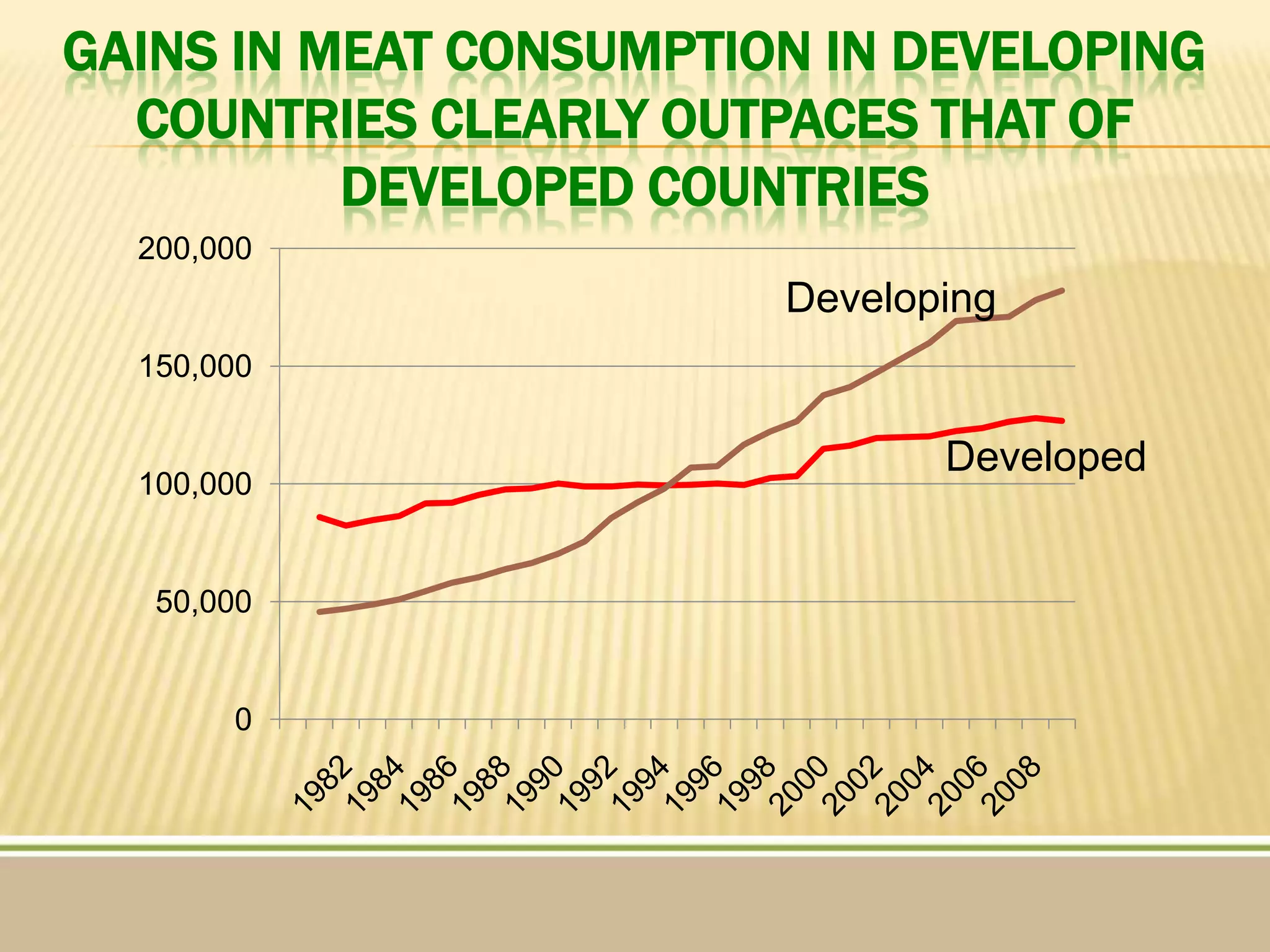
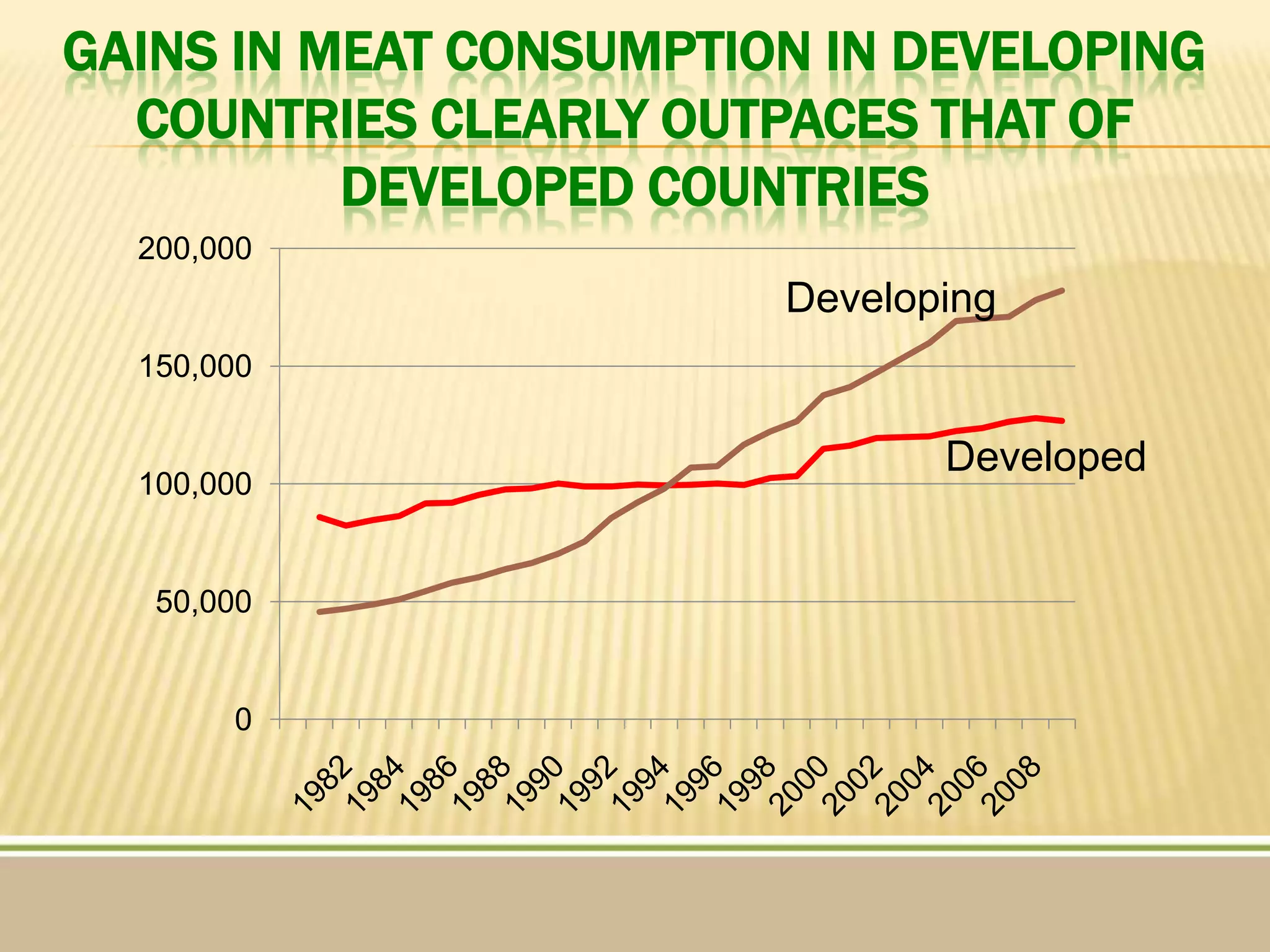
    Gains in meatconsumption in developing countries clearly outpaces that of developed countriesDevelopingDeveloped
  • 47.
    Gains in meatconsumption in developing countries clearly outpaces that of developed countriesDevelopingDeveloped
  • 48.
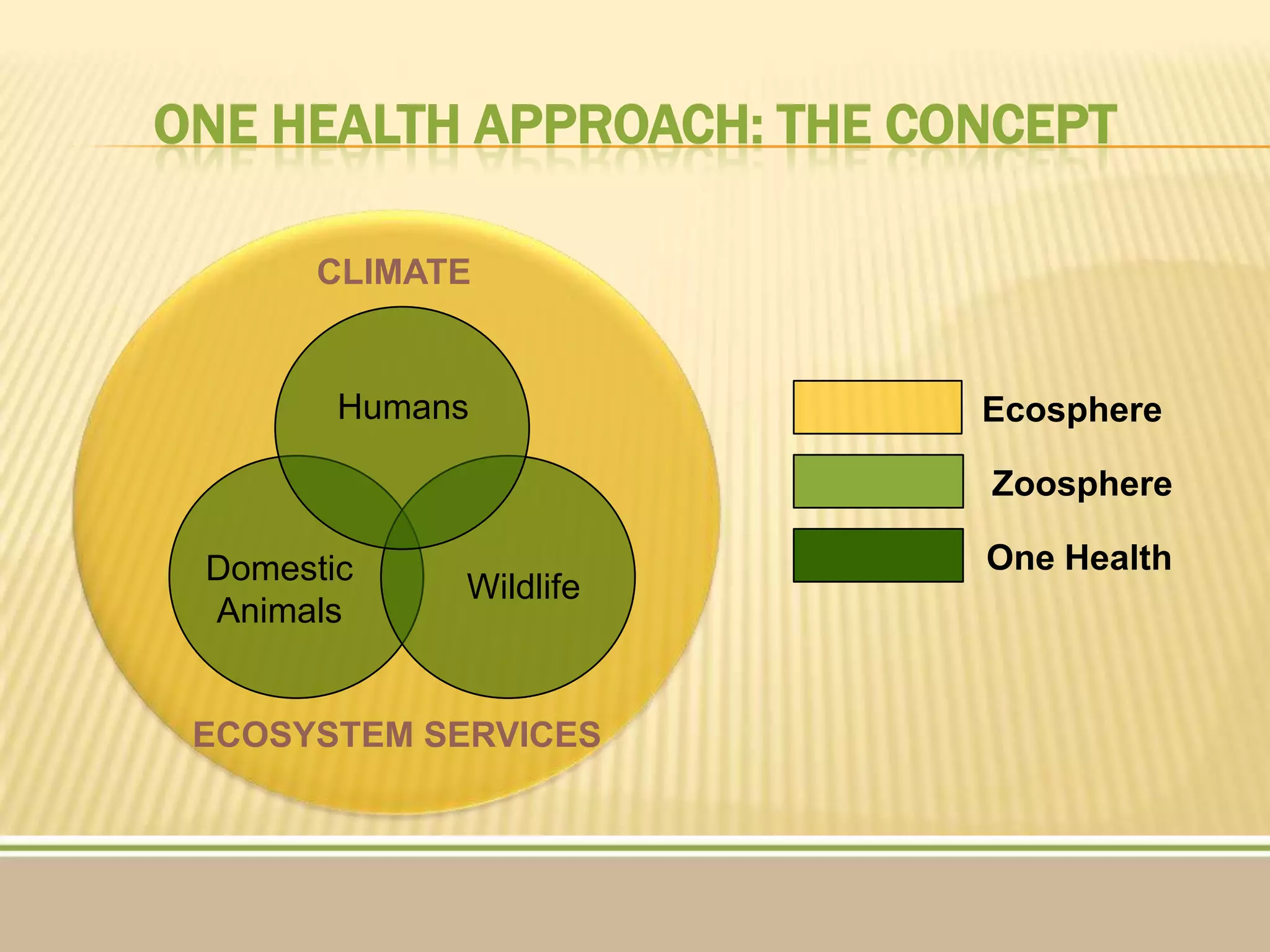
    One Health Approach:the conceptCLIMATEEcosphereZoosphereHumansOne HealthDomestic AnimalsWildlifeECOSYSTEM SERVICES
  • 49.
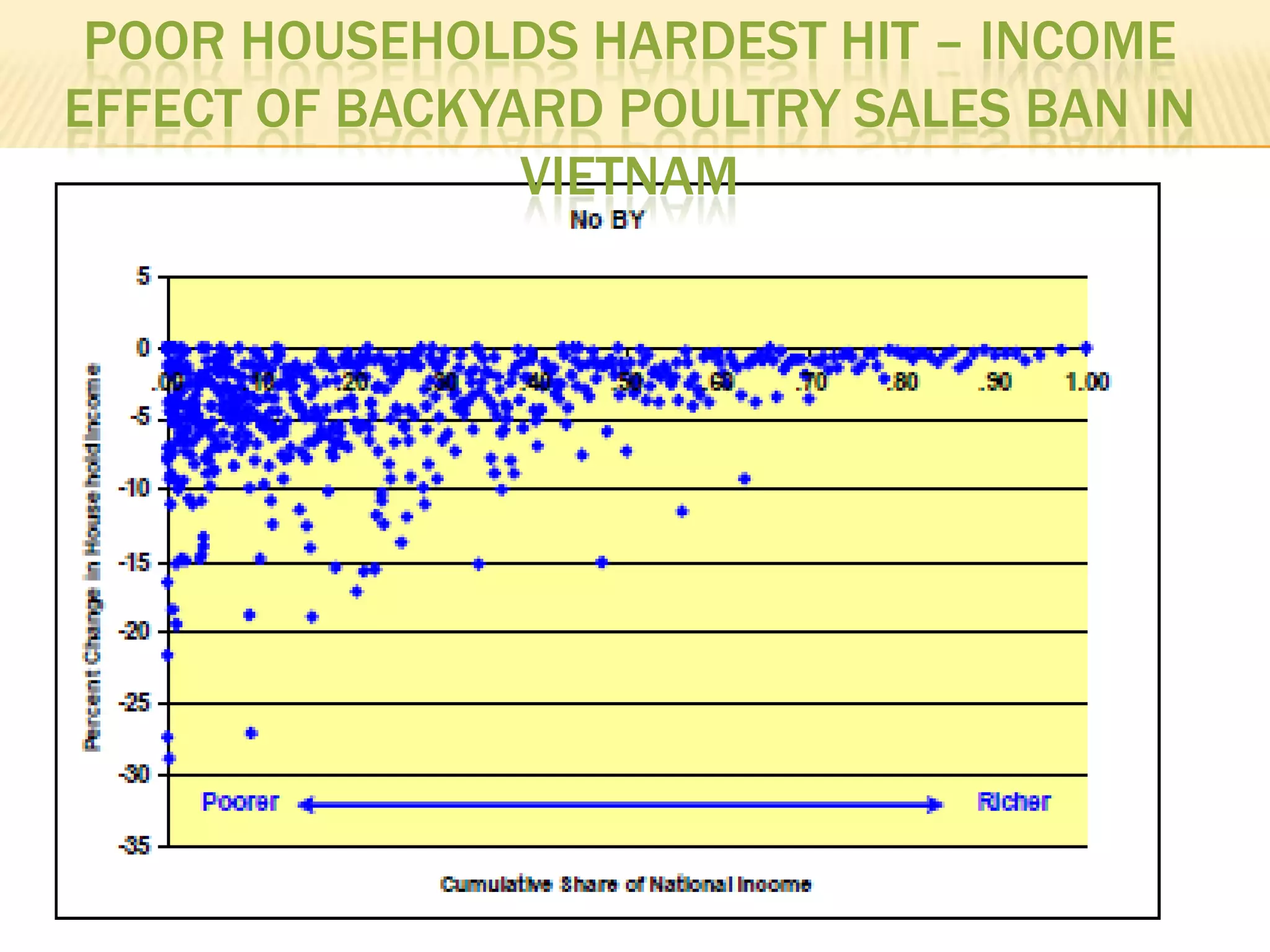
    Poor households hardesthit – income effect of backyard poultry sales ban in Vietnam
  • 50.
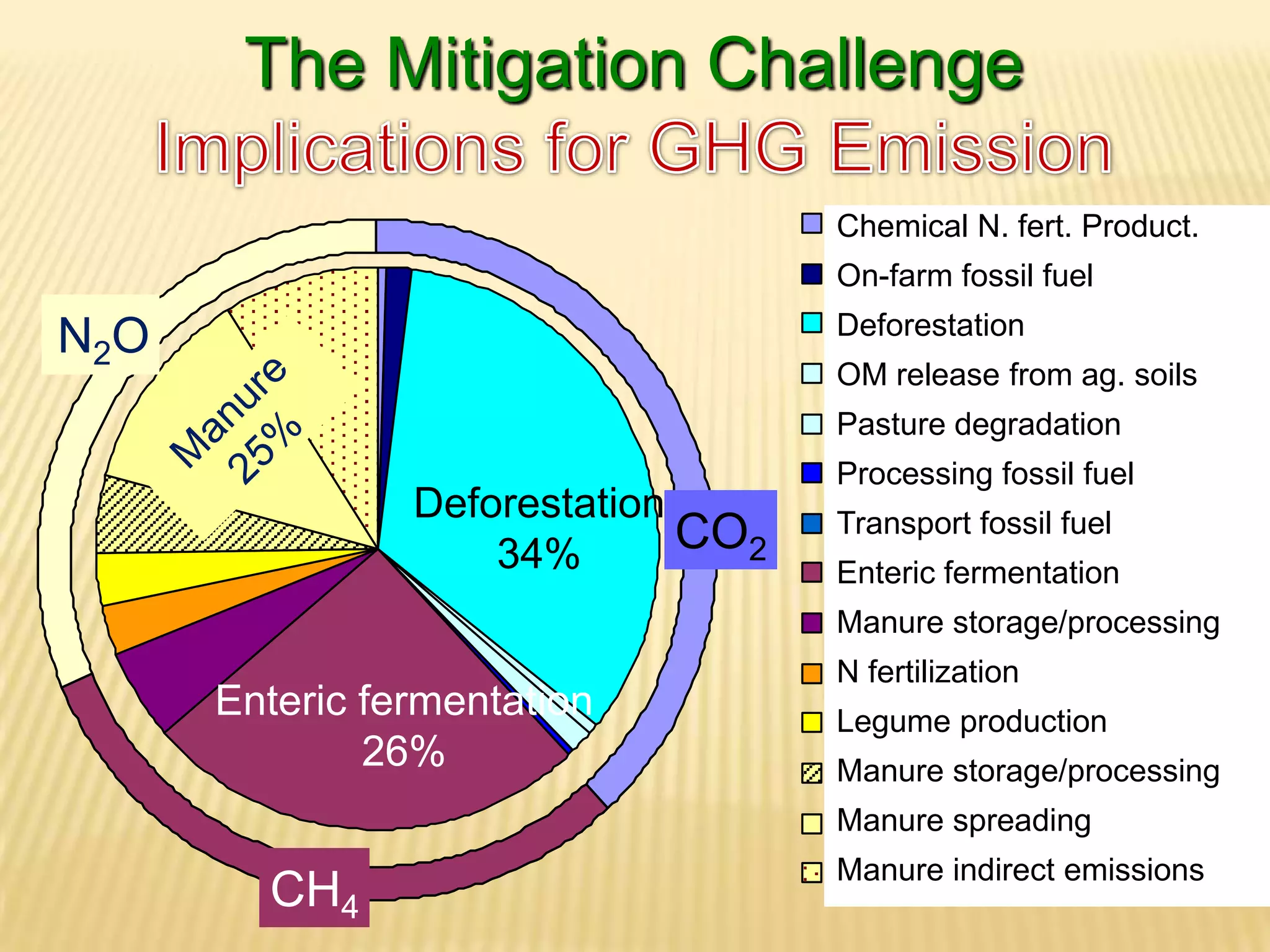
    The Mitigation ChallengeImplicationsfor GHG EmissionChemical N. fert. Product.On-farm fossil fuelDeforestationOM release from ag. soilsPasture degradationProcessing fossil fuelTransport fossil fuelEnteric fermentationManure storage/processingN fertilizationLegume productionManure storage/processingManure spreadingManure indirect emissionsN2OManure 25%Deforestation34%CO2Enteric fermentation26%CH4
  • 51.
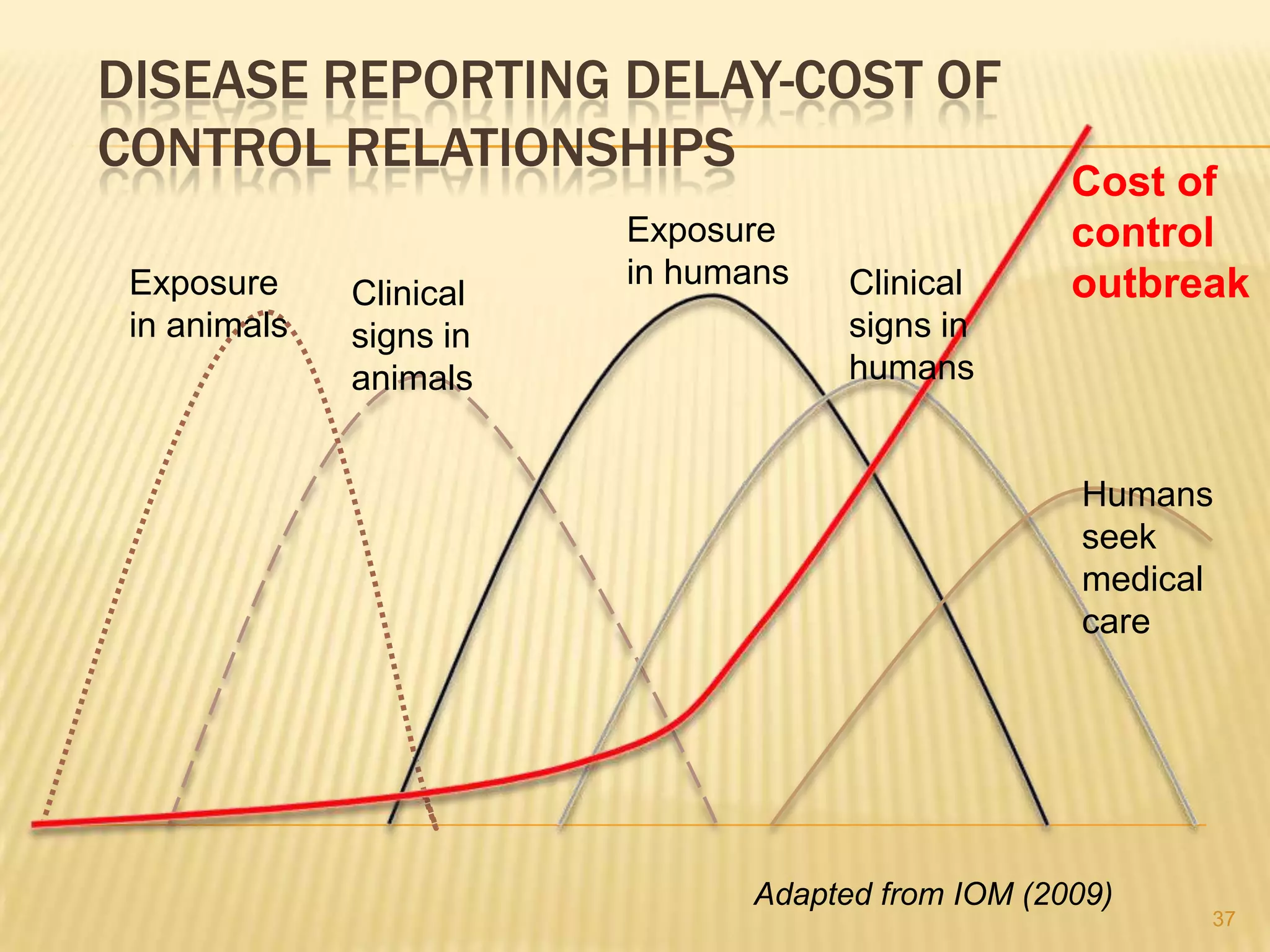
    Disease reporting delay-costof control relationshipsCost of control outbreakExposure in humansExposure in animalsClinical signs in humansClinical signs in animalsHumans seek medical careAdapted from IOM (2009)37
  • 52.
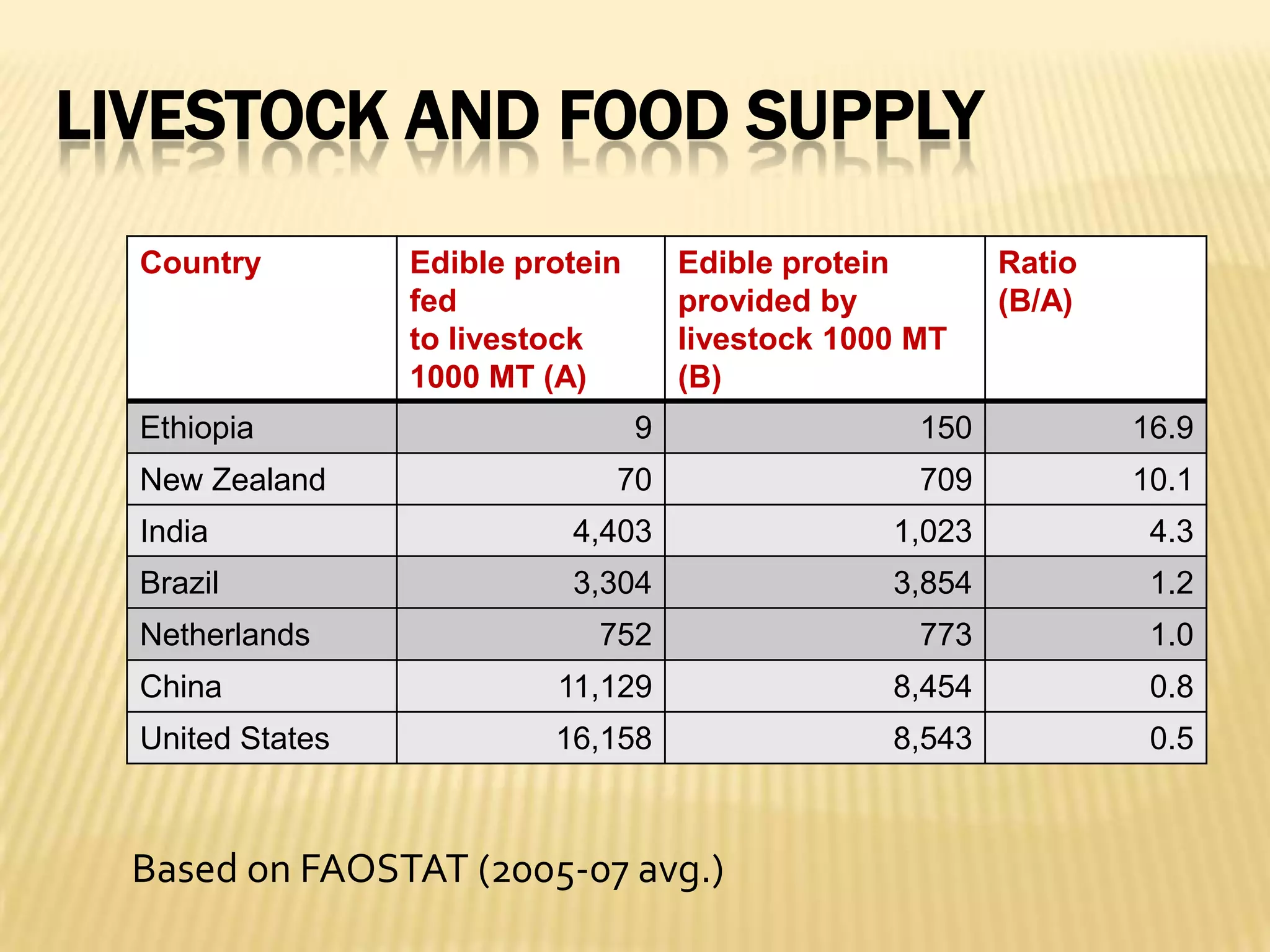
    Livestock and FoodSupplyBased on FAOSTAT (2005-07 avg.)
  • 53.
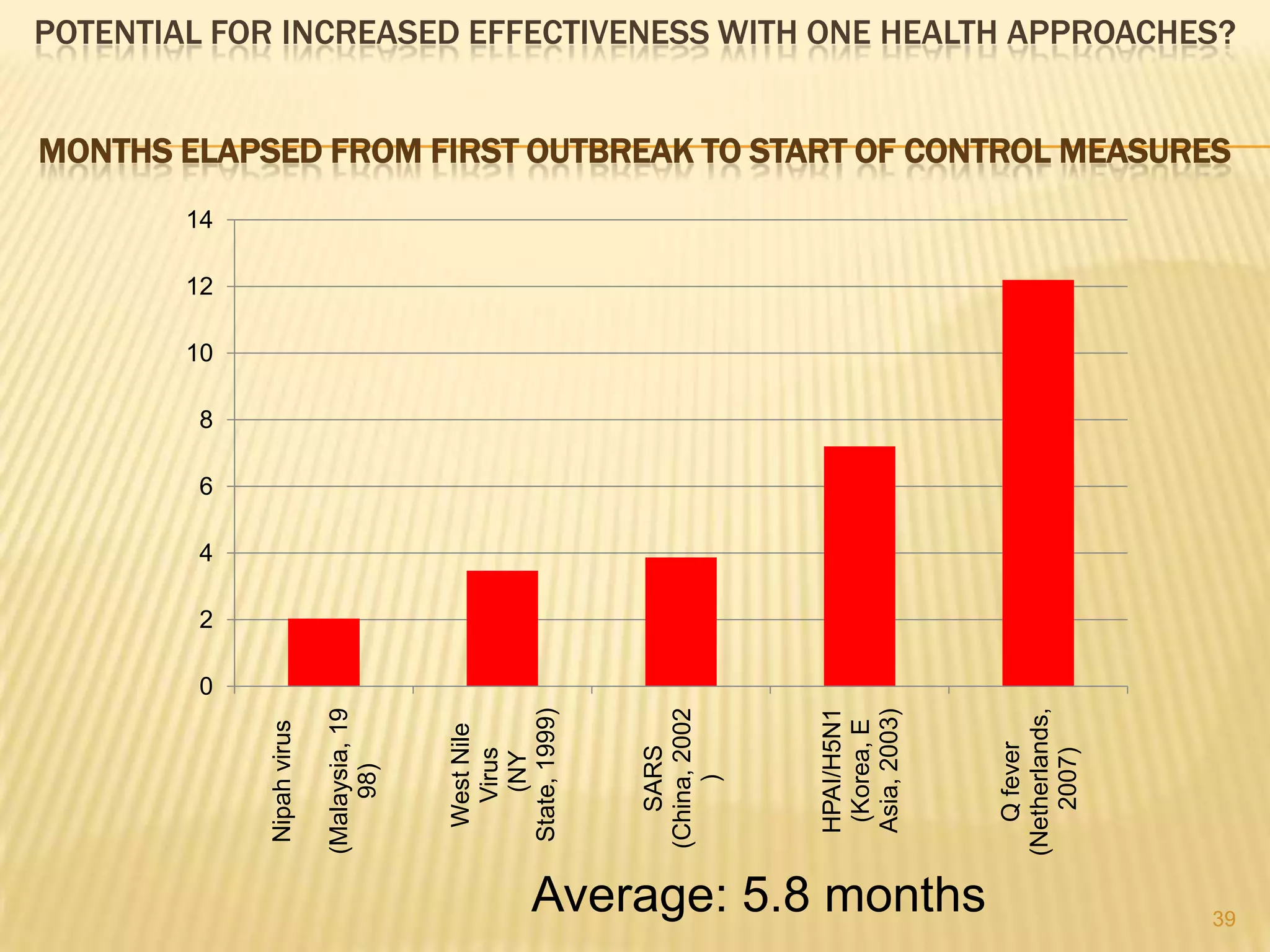
    Potential for IncreasedEffectiveness with One Health Approaches?Months elapsed from first outbreak to start of control measures39Average: 5.8 months
  • 54.
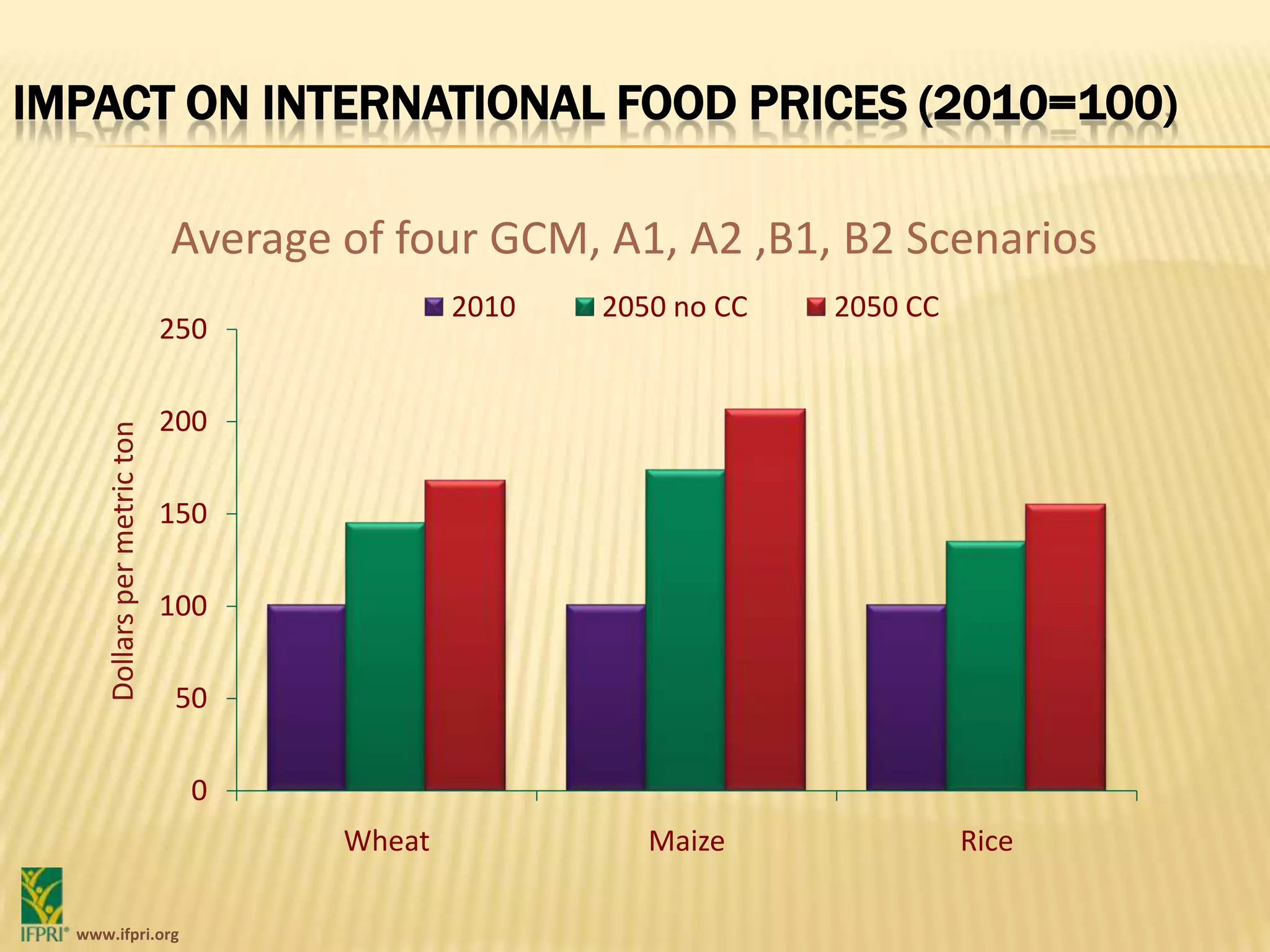
    Impact on InternationalFood Prices (2010=100) Average of four GCM, A1, A2 ,B1, B2 Scenarios

Editor's Notes

  • #10 Period Disease (Country) Start Estimate 1986-2009 Bovine Spongiform Encephalopathy (UK) 1986 15,500,000,000 6.1 billion in 1997-2009 1994 Plague (India) 1994 2,000,000,000 Sept. 1998-April 1999 Nipah virus (Malaysia) 1998 671,000,000 January 1999-Dec. 2008 West Nile fever (USA) 1999 400,000,000 Nov. 2002-July 2003 Severe Acute Respiratory Syndrome (CD, China, ROW)2002 41,500,000,000 January 2004-January 2009Highly Pathogenic Avian Influenza (Asia) 2004 20,000,000,000 2003-2007 Bovine Spongiform Encephalopathy (USA) 2004 11,000,000,000 Oct. 2005-Jan. 2009 Highly Pathogenic Avian Influenza (Europe) 2005 500,000,000 Nov. 2005-January 2009 Highly Pathogenic Avian Influenza (Africa) 2005 Nov. 2006-May 2007 Rift Valley Fever (Tanzania, Kenya, Somalia) 2006 30,000,000There appears to be a trend over time of increasing frequency and increasing costs – but these are just selected major outbreaks. It would be interesting to add persistent, endemic zoonoses and to try to obtain the costs of all outbreaks…In the first year of the crisis, the total economic loss from BSE to the U.K. was estimated at [pound]740-[pound]980 million (Atkinson, 1999) (US$1.07-$1.4 billion assuming [pound]=US$1.444). The cumulative gross budgetary cost of BSE to the U.K. between March 1996 and March 31, 2000 stands at roughly [pound]3.5 billion (US$5.05 billion), and was expected to reach [pound]4 billion (US$5.8 billion) by March 31, 2001.The export ban was lifted in 2000, so I expect that from then on, we can just take the cost of testing. Over the period 2001-2006, the cost amounted to Pound 214 million (or US $ 300 million, so we can add this to the US $ 5.8 billion, coming to a total of US $ 6.1 billion over the period 1997-2006. See http://www.publications.parliament.uk/pa/ld200607/ldhansrd/text/70416w0001.htm#07041619000002
  • #11 Poultry and cattle account for most of the losses, especially for zoonoses (more than 90%).
  • #17 There is also: CGIAR US$1.6 billion target to 2025 --to attain 1.7% annual growth--
  • #19 Close the attainment gap between women and men livestock enterprises and promote expanded opportunities for both
  • #24 Expand efforts to secure more stable longer term funding for the global public good livestock agenda and help NARS mobilize resources as wellContinue the efforts to devote more attention to Livestock in the next edition of the CGIAR StrategyContinue to build ILRI’s internal capabilities, confidence and reputation to exert even more influence on the global architecture that governs agriculture/livestock Build internal capabilities to excel in internal team work and external partnership management (including the private sector), negotiating, and performance based management
  • #27 Expand efforts to secure more stable longer term funding for the global public good livestock agenda and help NARS mobilize resources as wellContinue the efforts to devote more attention to Livestock in the next edition of the CGIAR StrategyContinue to build ILRI’s internal capabilities, confidence and reputation to exert even more influence on the global architecture that governs agriculture/livestock Build internal capabilities to excel in internal team work and external partnership management (including the private sector), negotiating, and performance based management
  • #28 Expand efforts to secure more stable longer term funding for the global public good livestock agenda and help NARS mobilize resources as wellContinue the efforts to devote more attention to Livestock in the next edition of the CGIAR StrategyContinue to build ILRI’s internal capabilities, confidence and reputation to exert even more influence on the global architecture that governs agriculture/livestock Build internal capabilities to excel in internal team work and external partnership management (including the private sector), negotiating, and performance based management
  • #35 This slide shows the scope for One Health – at the intersection of animal, human,wildlife and ecosystem health
  • #36 Initial Assessment of the Impact of Poultry Sales and Production Bans on Household Incomes in VietnamD. Roland-Holst, J. Otte, D. Pfeiffer, FAO, 2006; study of data on 600 households.1.Income declines up to 20% for poorest householdsThe poorer the household (left side) the greater the decline in incomeImpact on food security, nutrition