Where does the natural energy of a reservoir come from? Liberation and expansion of solution gas Influx of aquifer water  Contraction of reservoir rock skeleton Expansion of original reservoir fluids Free gas, if present Interstitial water Oil, if present Gravitational forces
Oil Reservoir Drive Mechanisms Solution gas drive Gas-cap drive Water drive Gravity-drainage drive Combination drive Gas Reservoir Drive Mechanisms Volumetric reservoir (gas expansion drive) Water drive Ultimate oil and gas recoveries vary depending on the drive mechanism. For oil; water drive is most effective. Typical primary recoveries are in the 25-40% range (maximum 75%).  For gas; gravity drainage, water drive and depletion drive can provide  > 80% recovery.
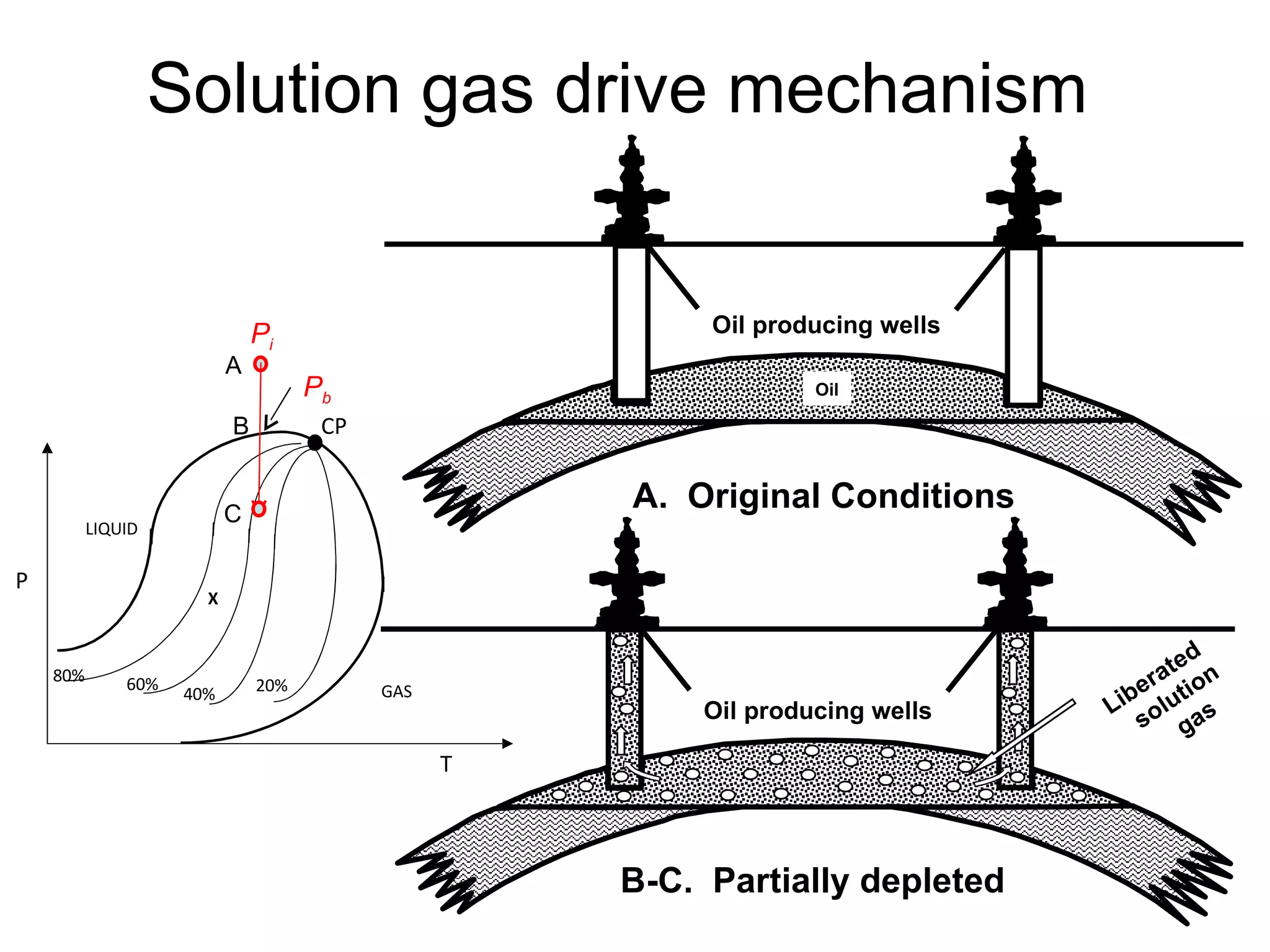
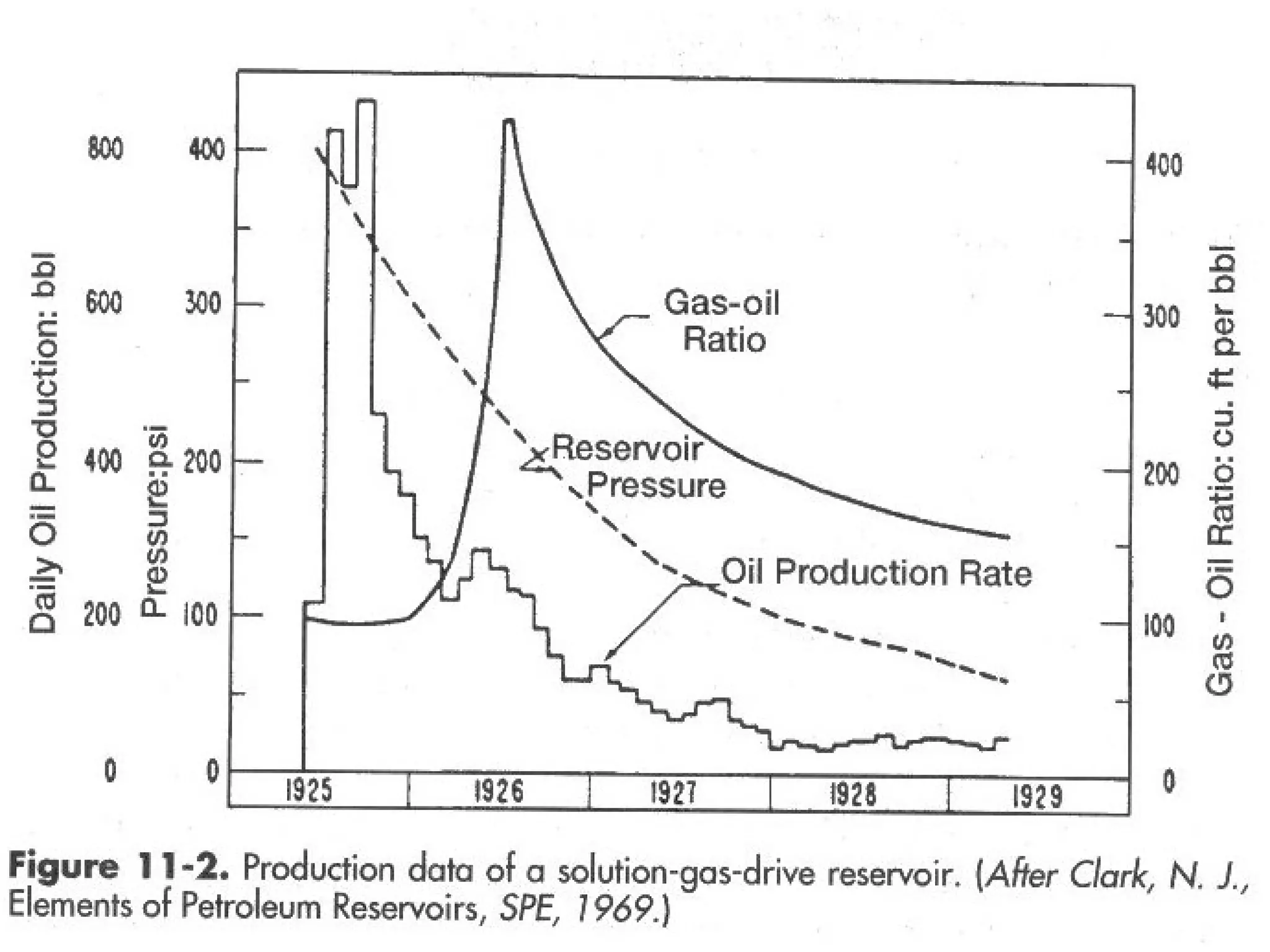
Solution gas Drive The principle of solution gas drive or depletion drive is the expansion of dissolved gas and liquid oil in response to a pressure drop. The change in fluid volume results in production. Above the bubble point, only liquid oil expansion occurs .  Below the bubble point, both liquid oil expansion and gas expansion contribute to volume change.   The Upper Cretaceous Cardium sand reservoir is an example of a solution gas drive reservoir.
Solution gas drive mechanism P i P b A B C Oil A.  Original Conditions B-C.  Partially depleted Oil producing wells Oil producing wells Liberated solution gas
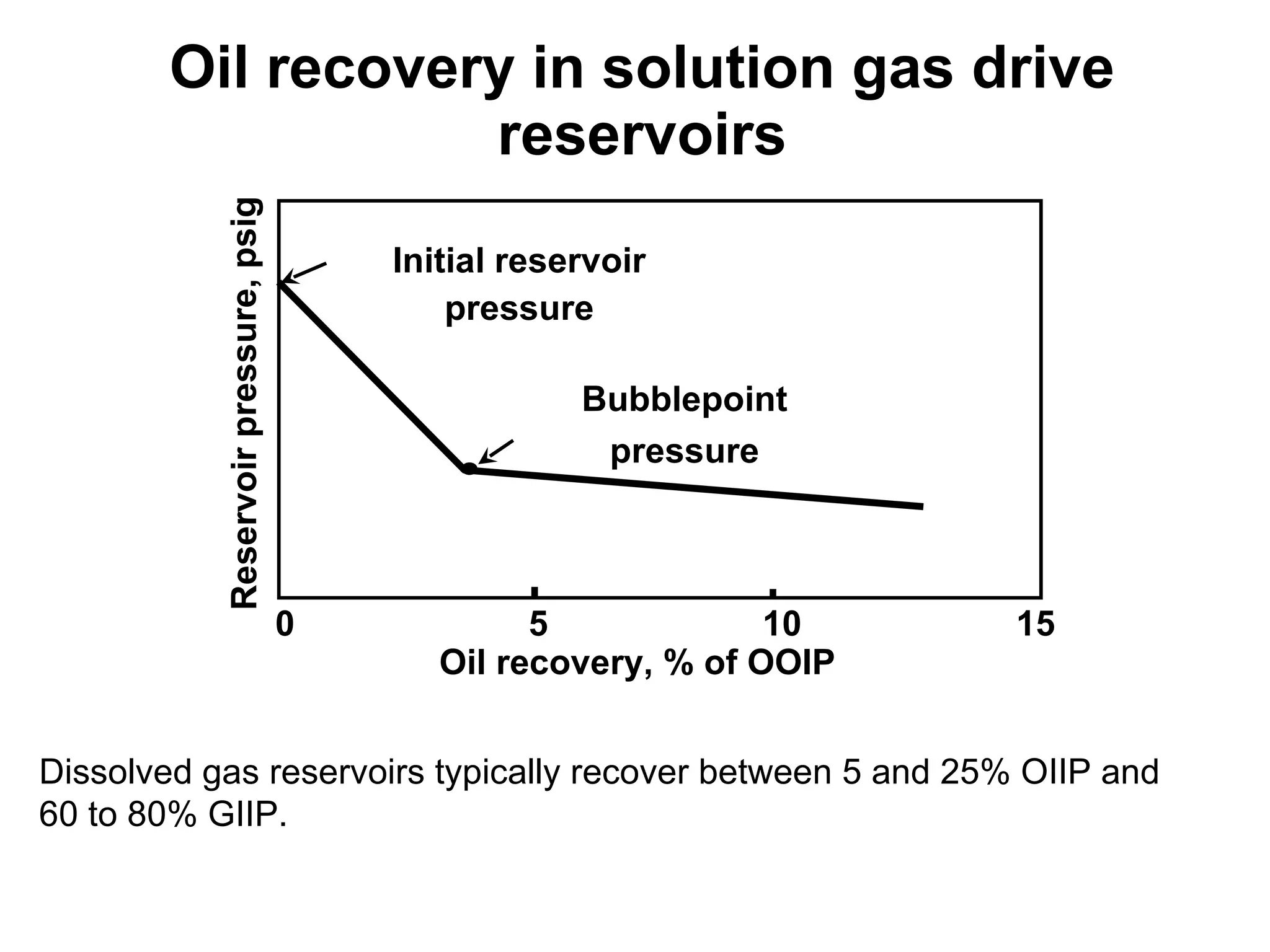
Oil recovery in solution gas drive reservoirs Dissolved gas reservoirs typically recover between 5 and 25% OIIP and 60 to 80% GIIP. Bubblepoint pressure Initial reservoir pressure 0  5  10  15  Oil recovery, % of OOIP Reservoir pressure, psig
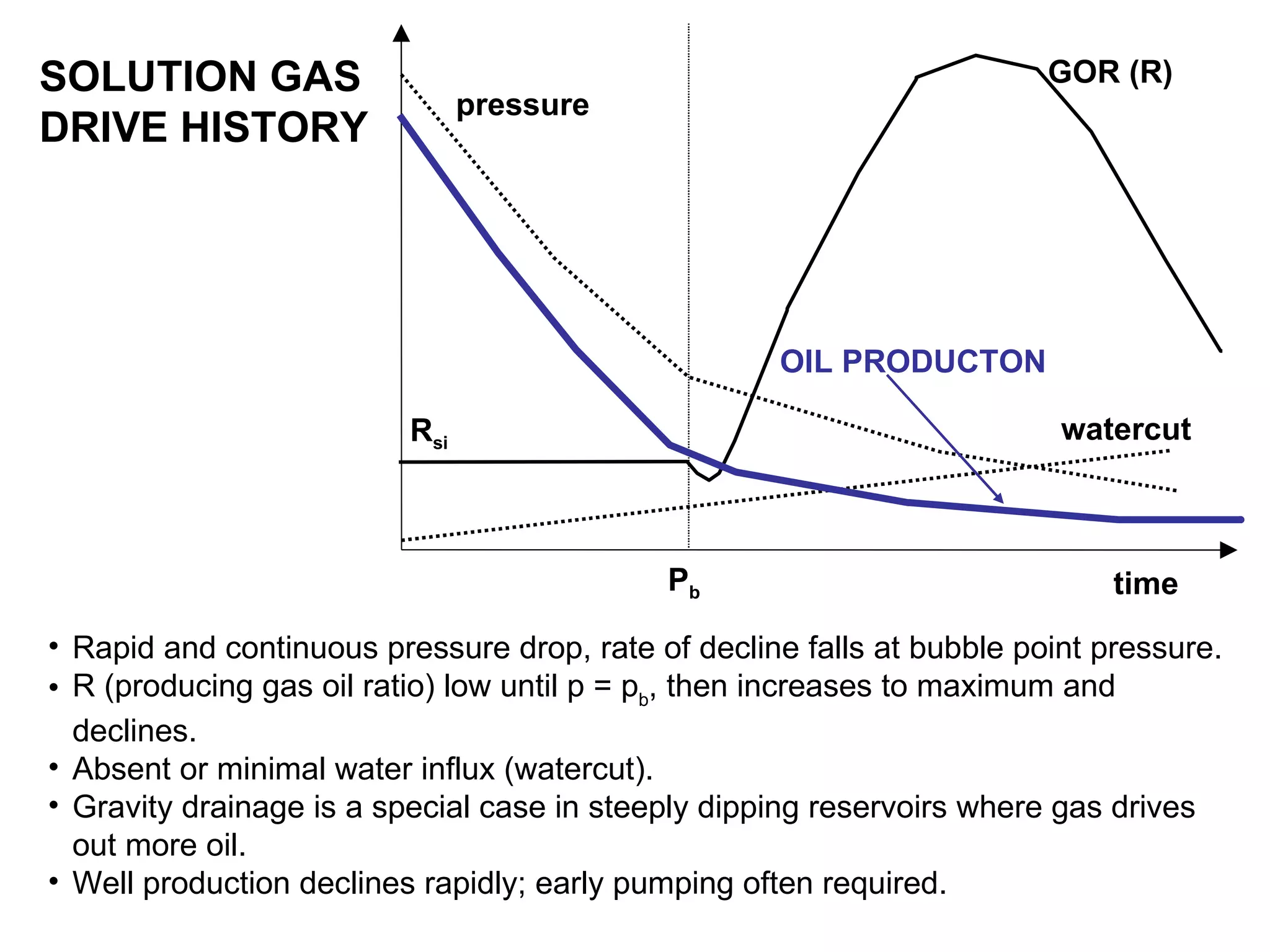
SOLUTION GAS DRIVE HISTORY   watercut GOR (R) pressure time R si OIL PRODUCTON Rapid and continuous pressure drop, rate of decline falls at bubble point pressure. R (producing gas oil ratio) low until p = p b , then increases to maximum and declines. Absent or minimal water influx (watercut). Gravity drainage is a special case in steeply dipping reservoirs where gas drives out more oil. Well production declines rapidly; early pumping often required.   P b
 
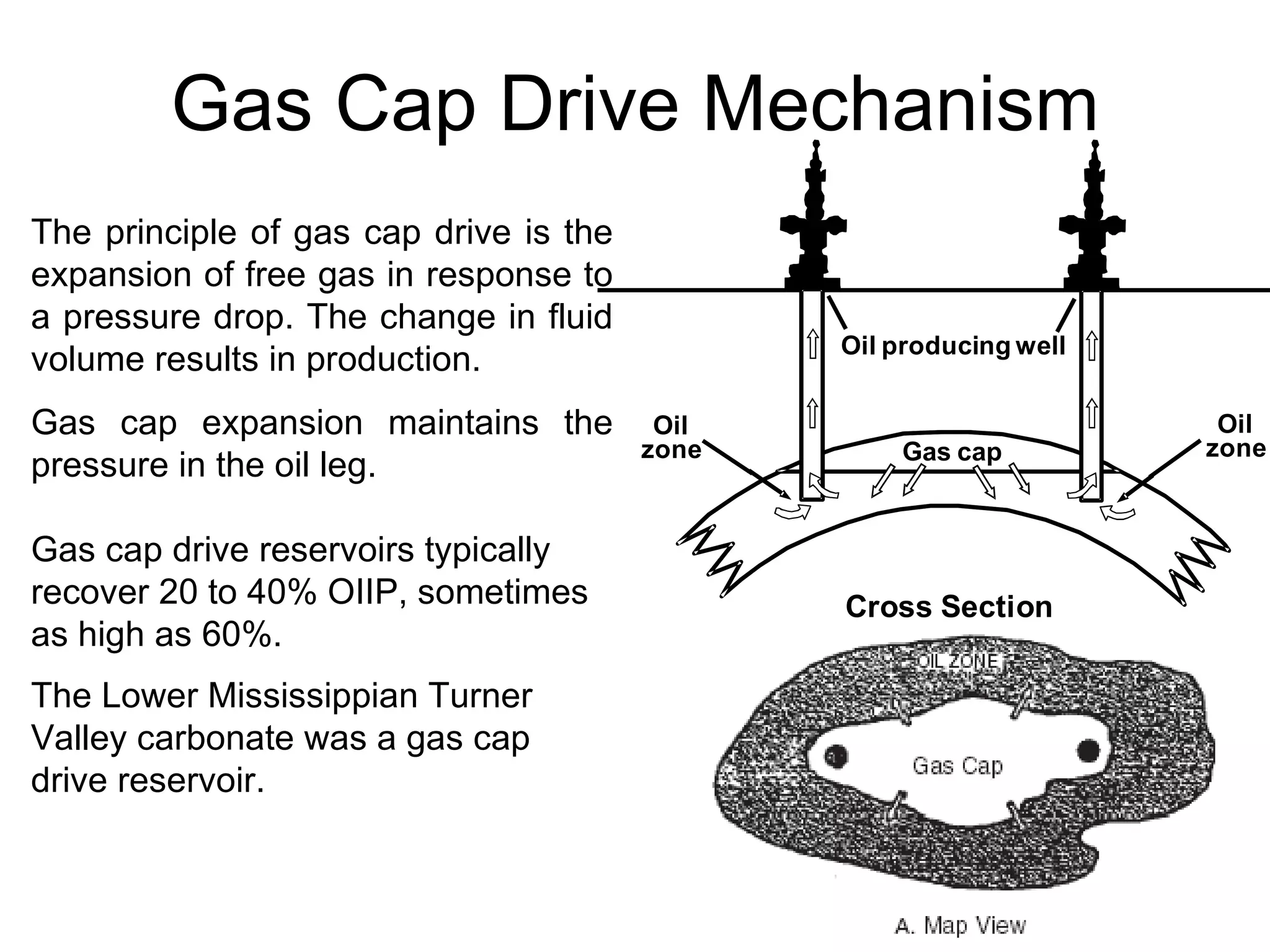
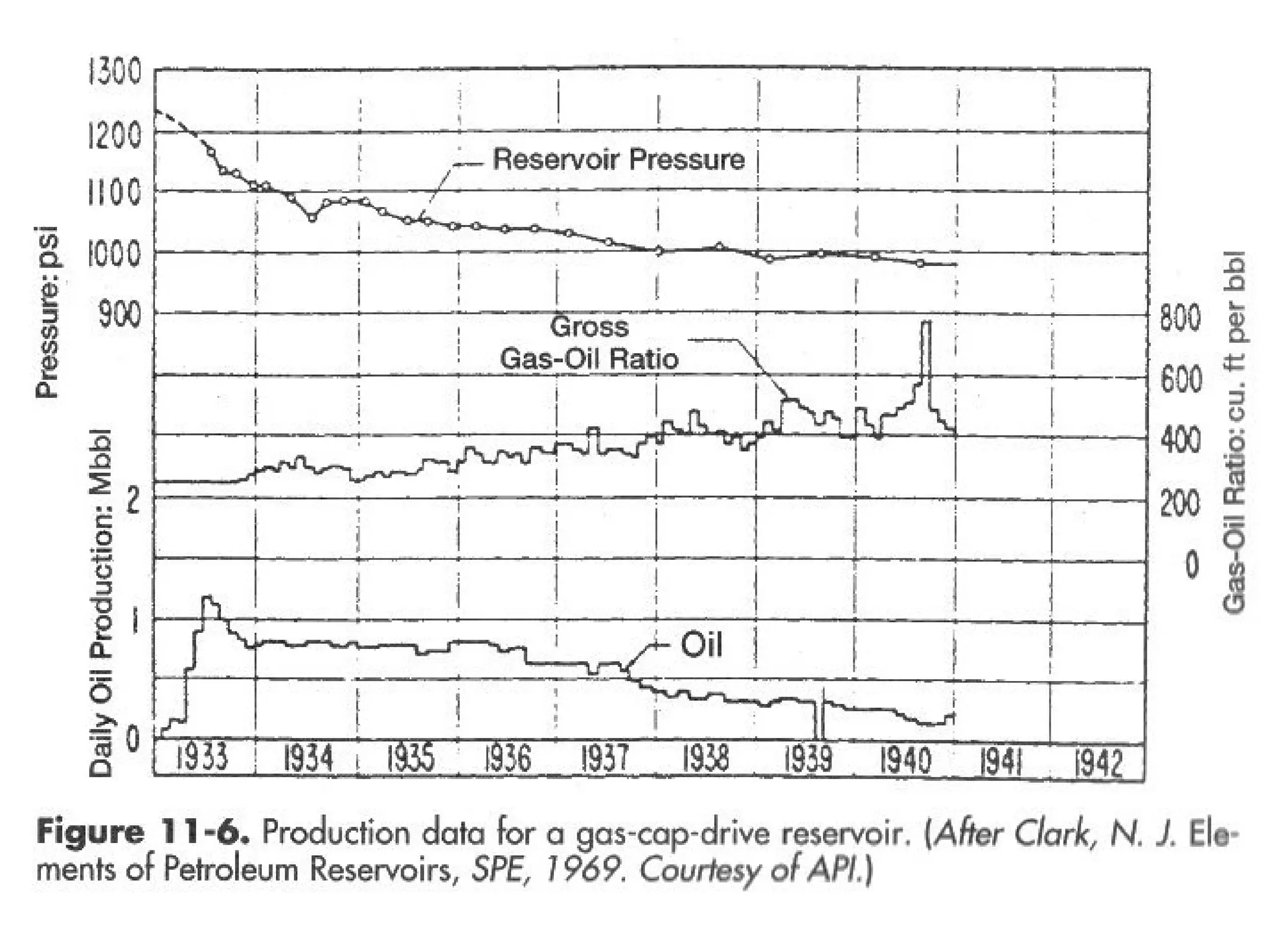
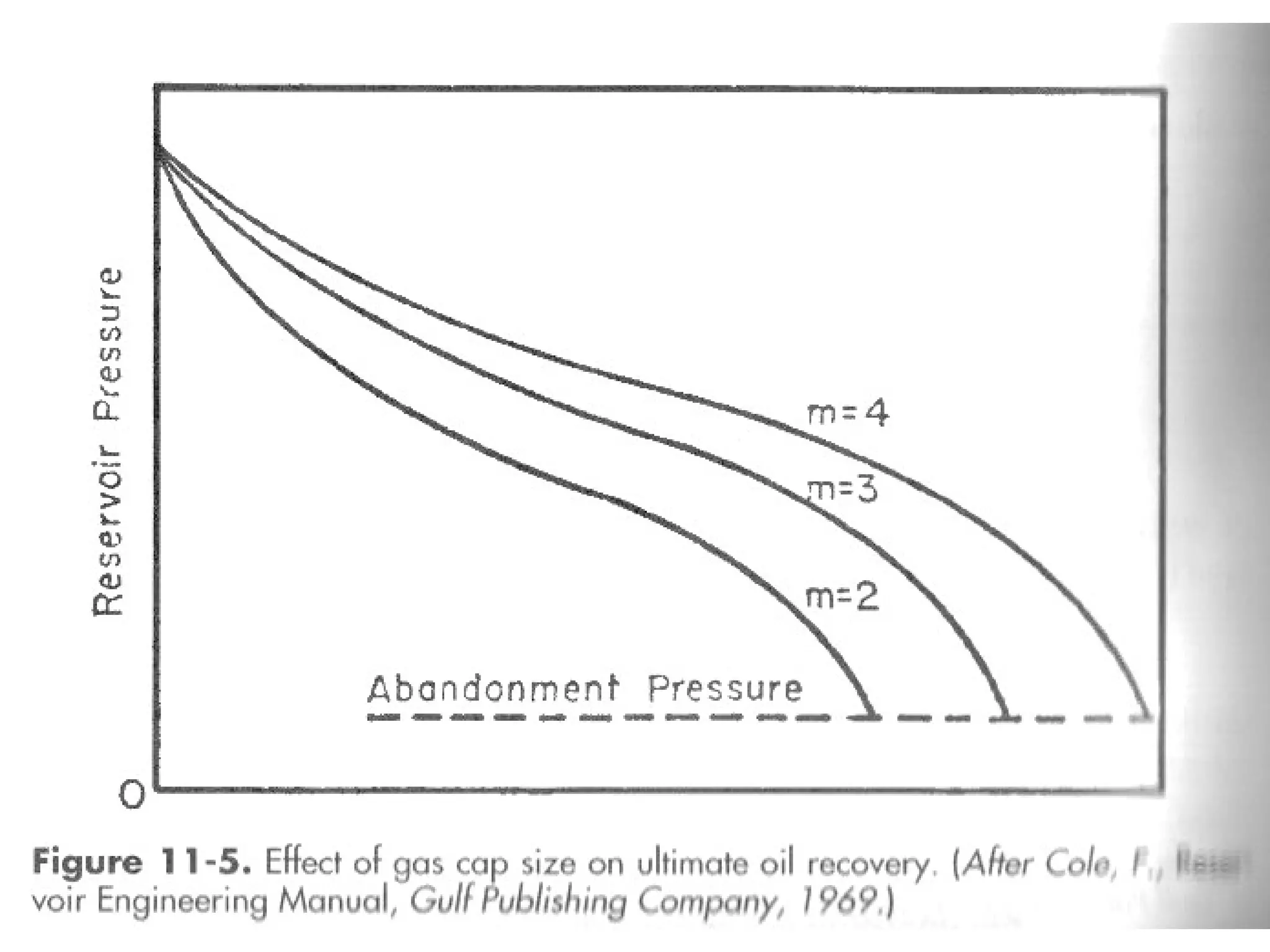
Gas Cap Drive Mechanism The principle of gas cap drive is the expansion of free gas in response to a pressure drop. The change in fluid volume results in production. Gas cap expansion maintains the pressure in the oil leg. Gas cap drive reservoirs typically recover 20 to 40% OIIP, sometimes as high as 60%. The Lower Mississippian Turner Valley carbonate was a gas cap drive reservoir.
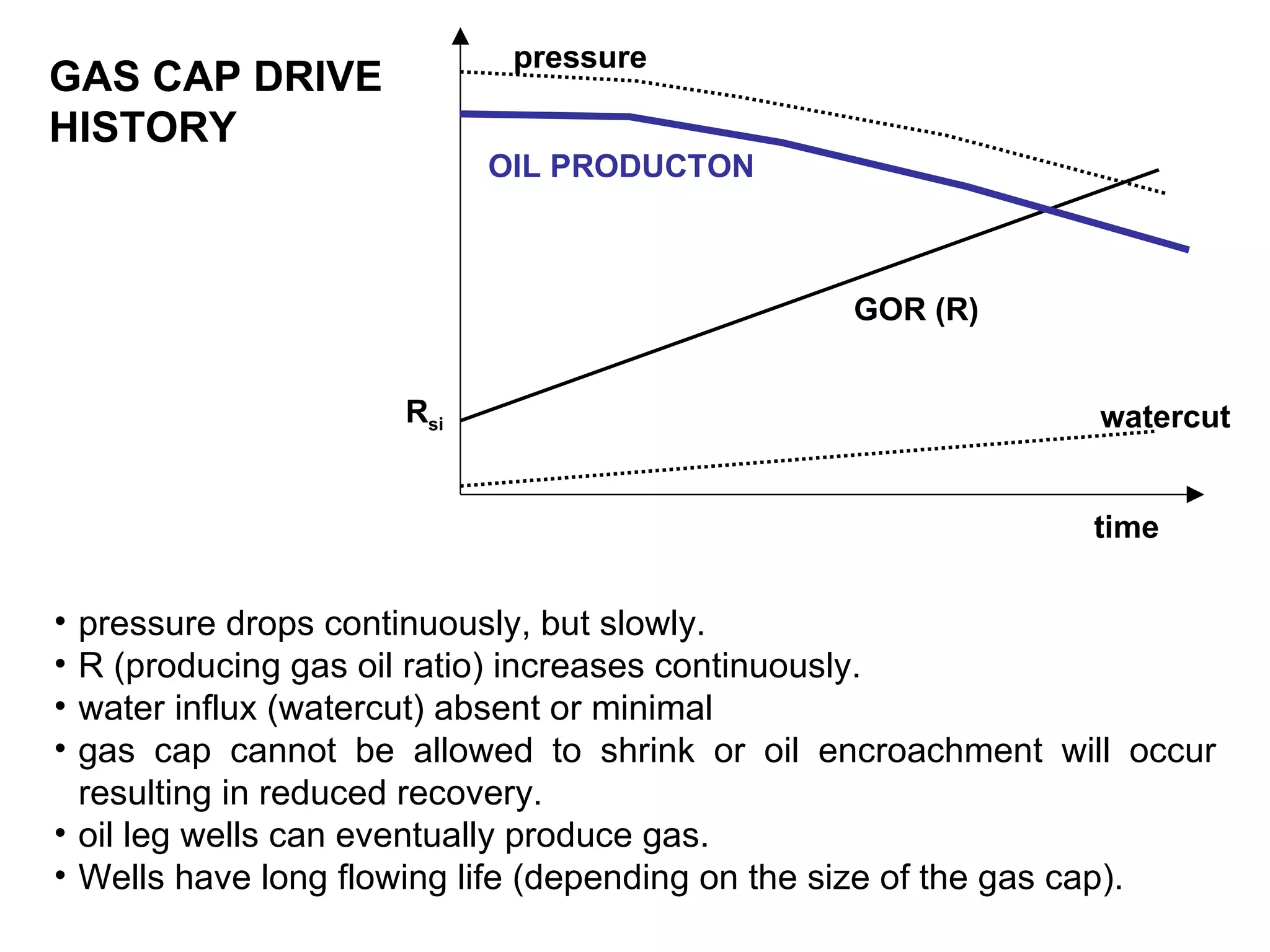
GAS CAP DRIVE HISTORY pressure drops continuously, but slowly. R (producing gas oil ratio) increases continuously. water influx (watercut) absent or minimal gas cap cannot be allowed to shrink or oil encroachment will occur resulting in reduced recovery. oil leg wells can eventually produce gas. Wells have long flowing life (depending on the size of the gas cap). watercut GOR (R) pressure time R si OIL PRODUCTON
 
 
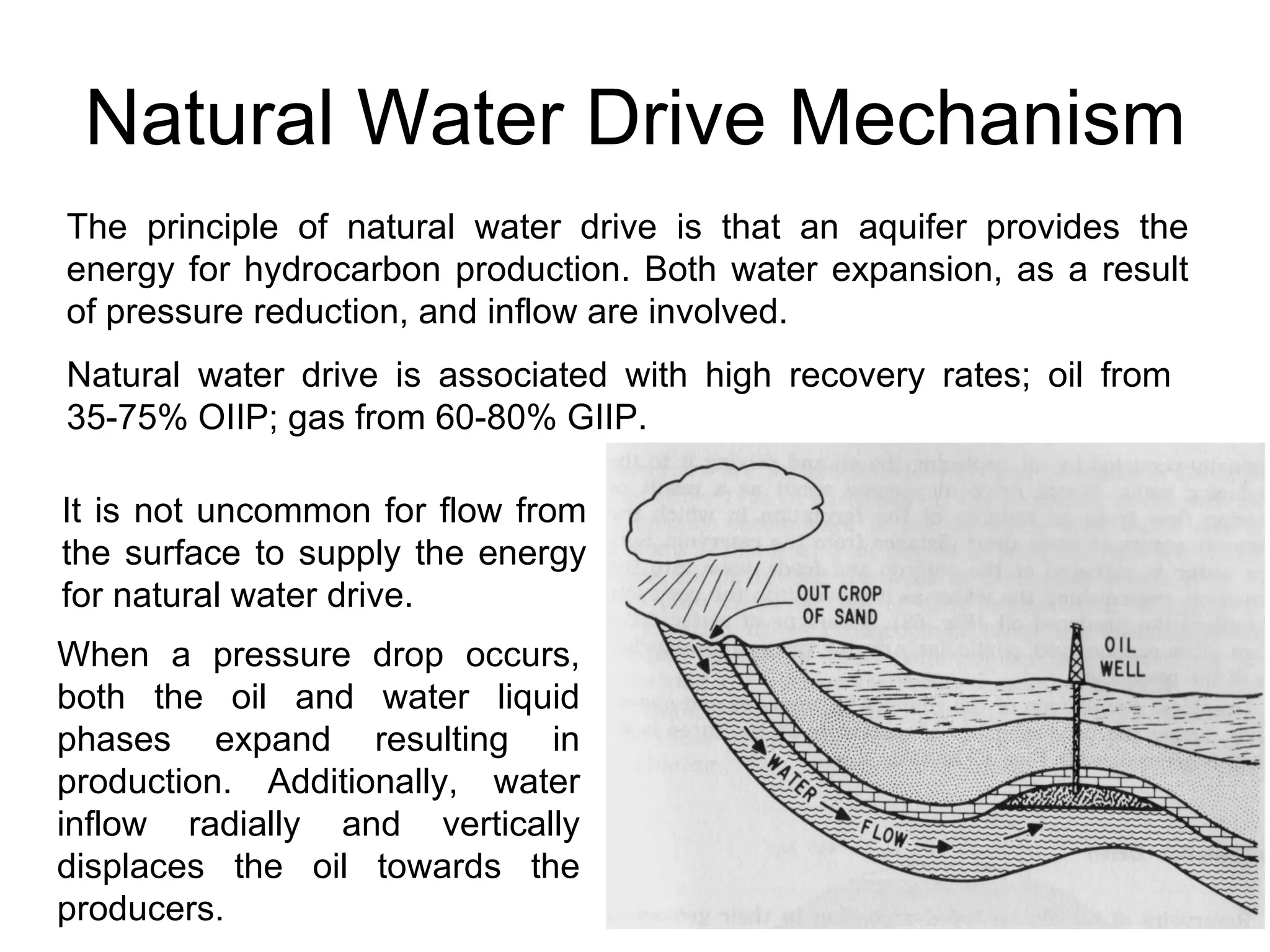
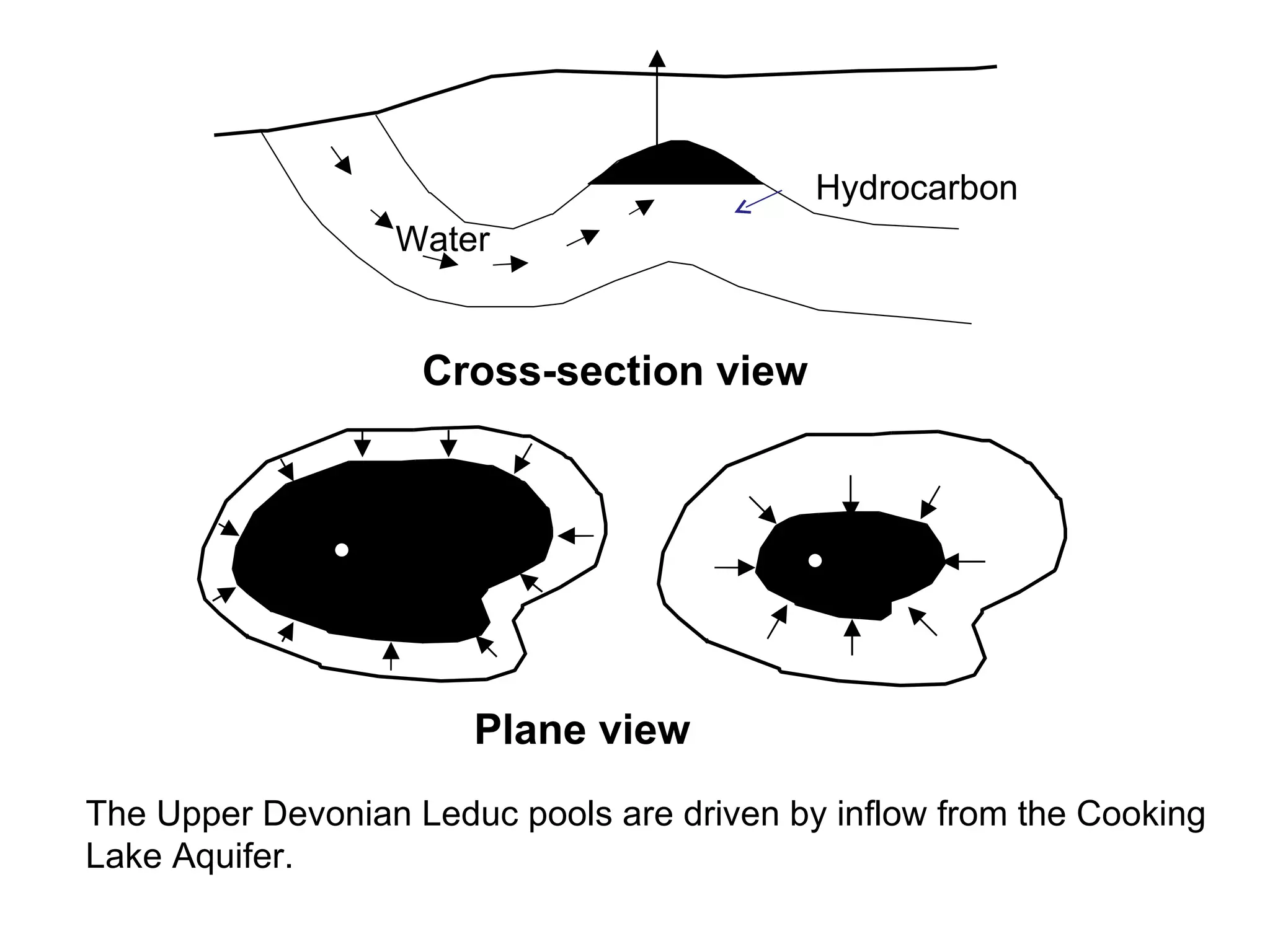
Natural Water Drive Mechanism The principle of natural water drive is that an aquifer provides the energy for hydrocarbon production. Both water expansion, as a result of pressure reduction, and inflow are involved. Natural water drive is associated with high recovery rates; oil from  35-75% OIIP; gas from 60-80% GIIP. It is not uncommon for flow from the surface to supply the energy for natural water drive. When a pressure drop occurs, both the oil and water liquid phases expand resulting in production. Additionally, water inflow radially and vertically displaces the oil towards the producers.
Cross-section view Plane view Water Hydrocarbon The Upper Devonian Leduc pools are driven by inflow from the Cooking Lake Aquifer.
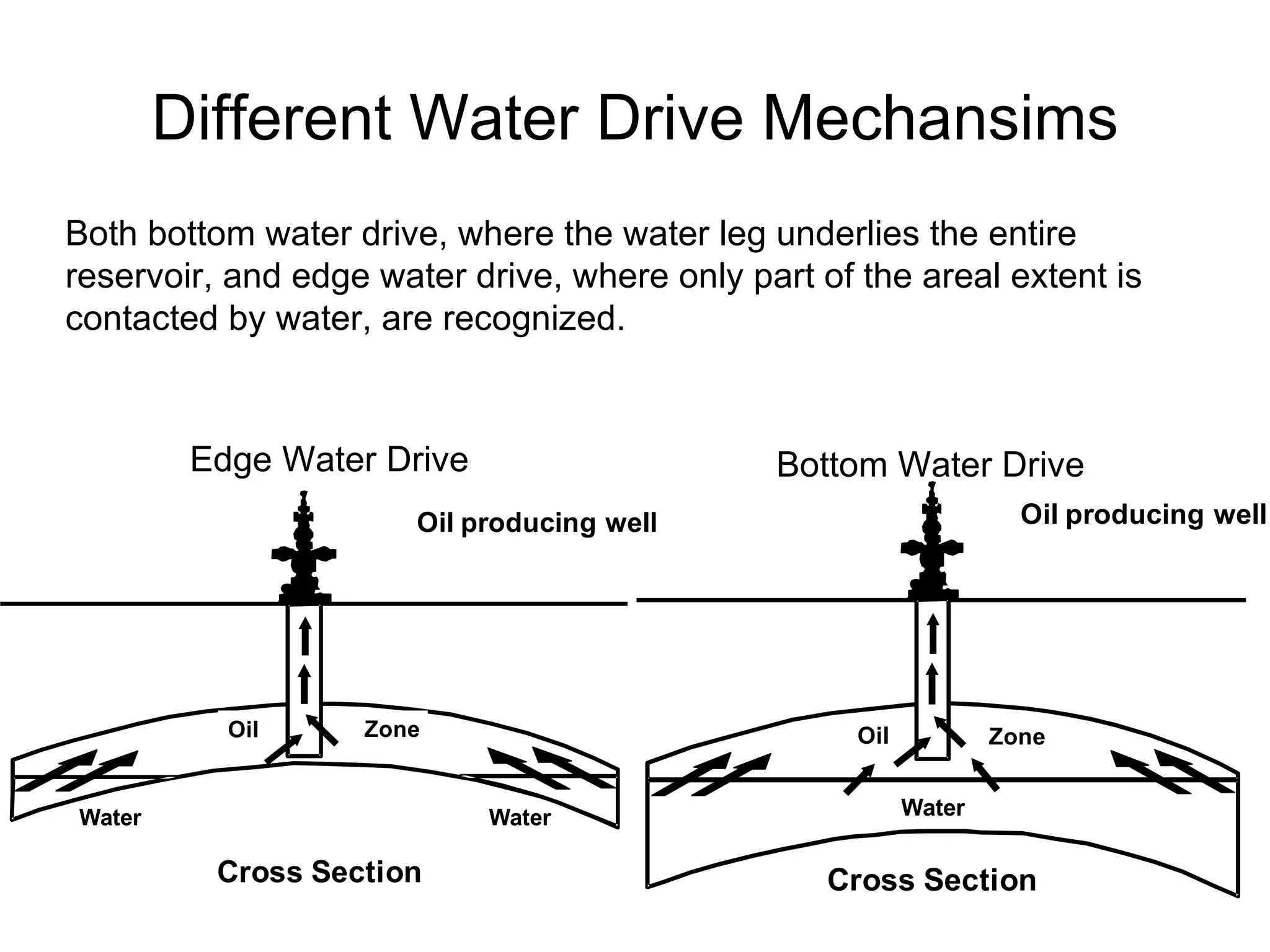
Different Water Drive Mechansims Both bottom water drive, where the water leg underlies the entire reservoir, and edge water drive, where only part of the areal extent is contacted by water, are recognized. Edge Water Drive Bottom Water Drive
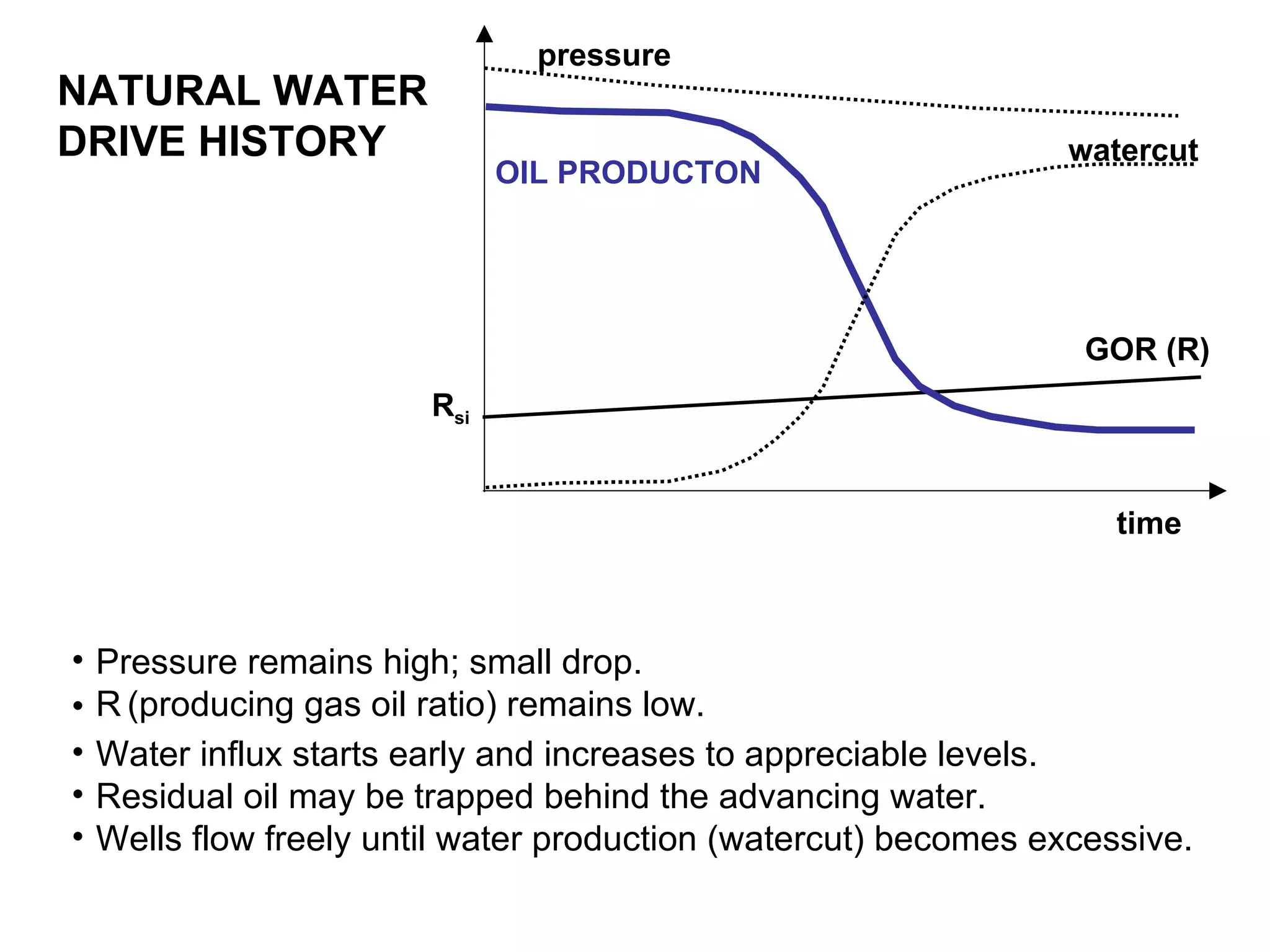
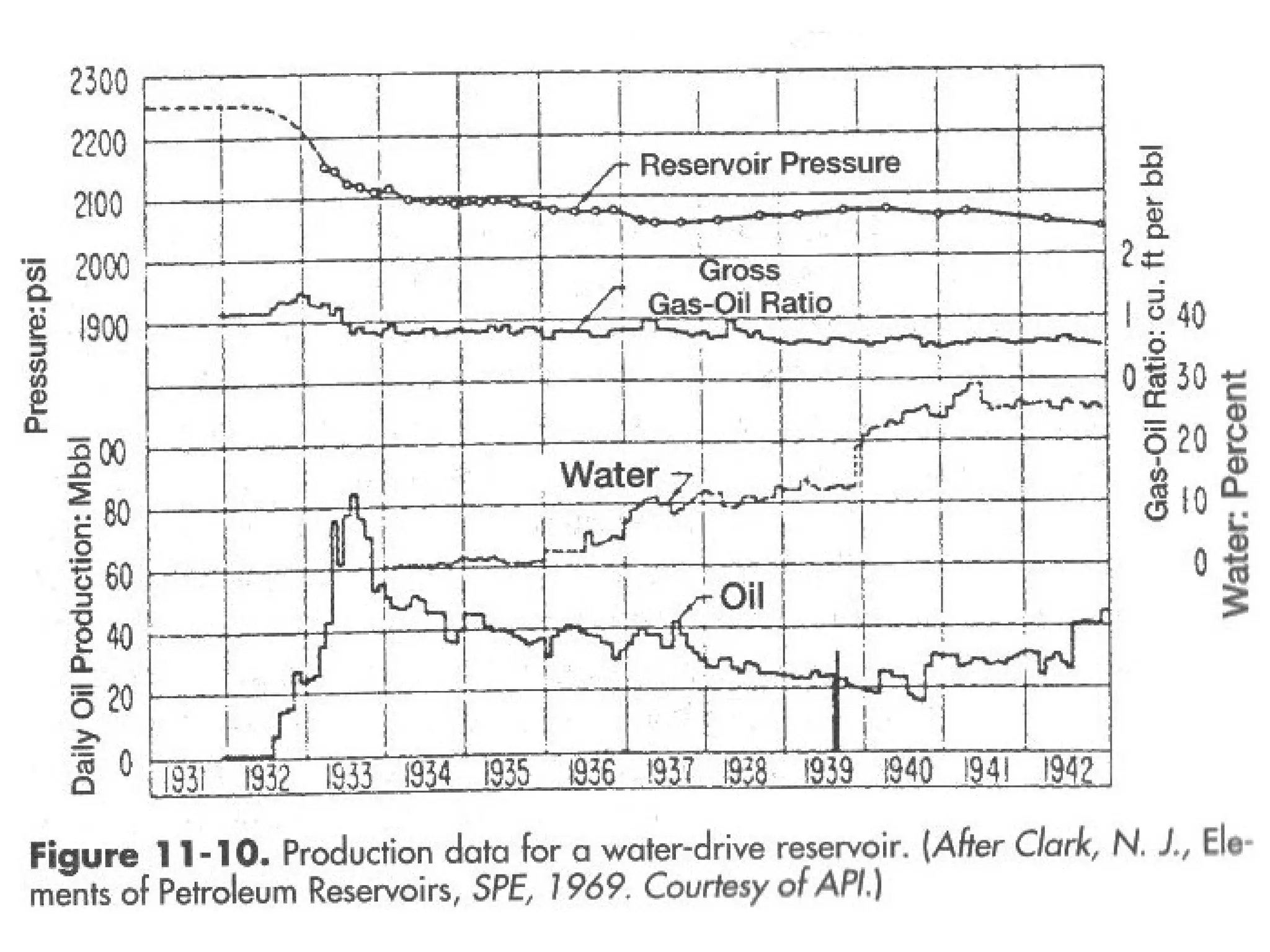
NATURAL WATER DRIVE HISTORY   Pressure remains high; small drop. R   (producing gas oil ratio) remains low. Water influx starts early and increases to appreciable levels. Residual oil may be trapped behind the advancing water. Wells flow freely until water production (watercut) becomes excessive. watercut GOR (R) pressure time R si OIL PRODUCTON
 
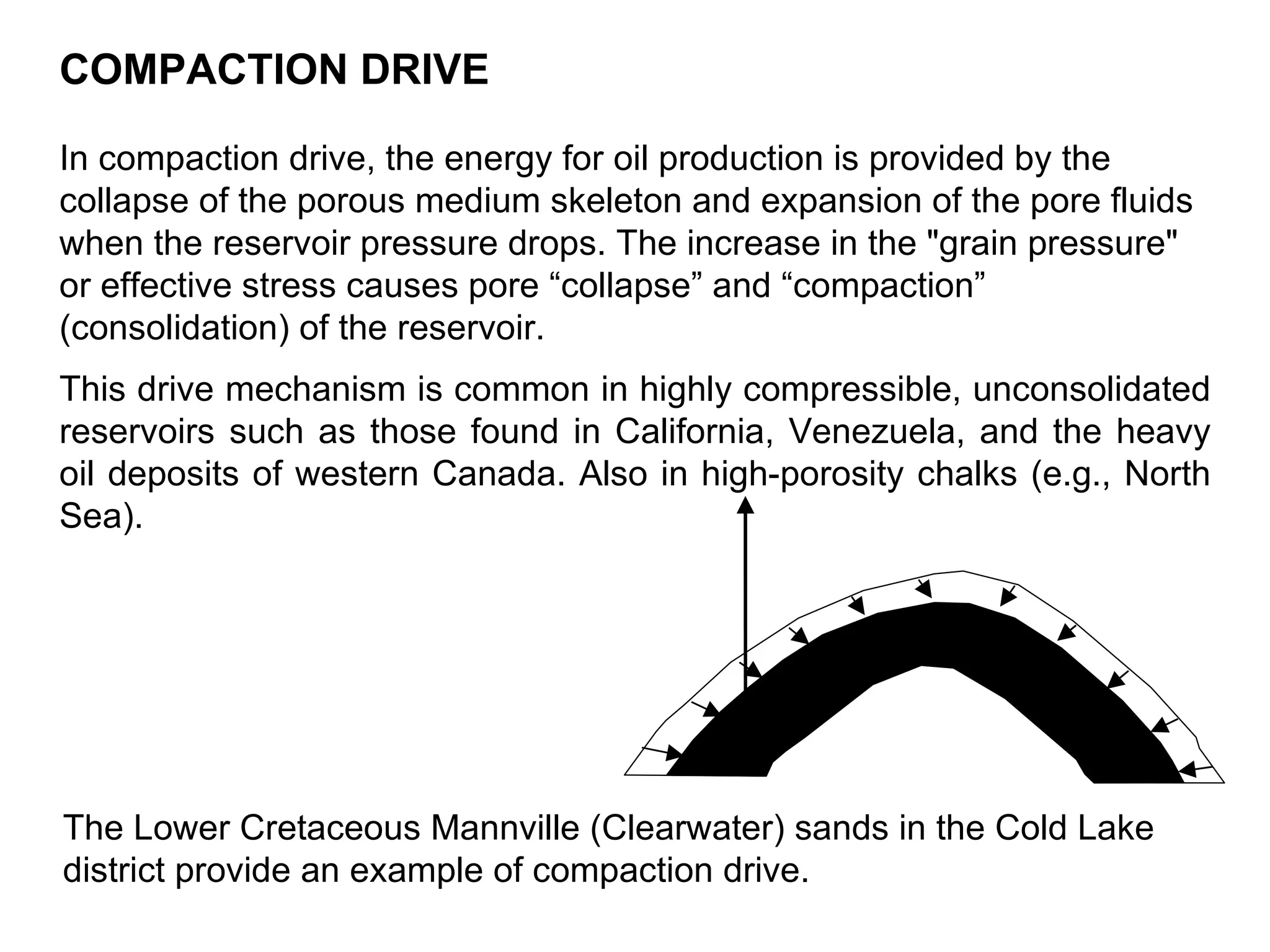
COMPACTION DRIVE In compaction drive, the energy for oil production is provided by the collapse of the porous medium skeleton and expansion of the pore fluids when the reservoir pressure drops. The increase in the "grain pressure" or effective stress causes pore “collapse” and “compaction” (consolidation) of the reservoir. This drive mechanism is common in highly compressible, unconsolidated reservoirs such as those found in California, Venezuela, and the heavy oil deposits of western Canada. Also in high-porosity chalks (e.g., North Sea). The Lower Cretaceous Mannville (Clearwater) sands in the Cold Lake district provide an example of compaction drive.
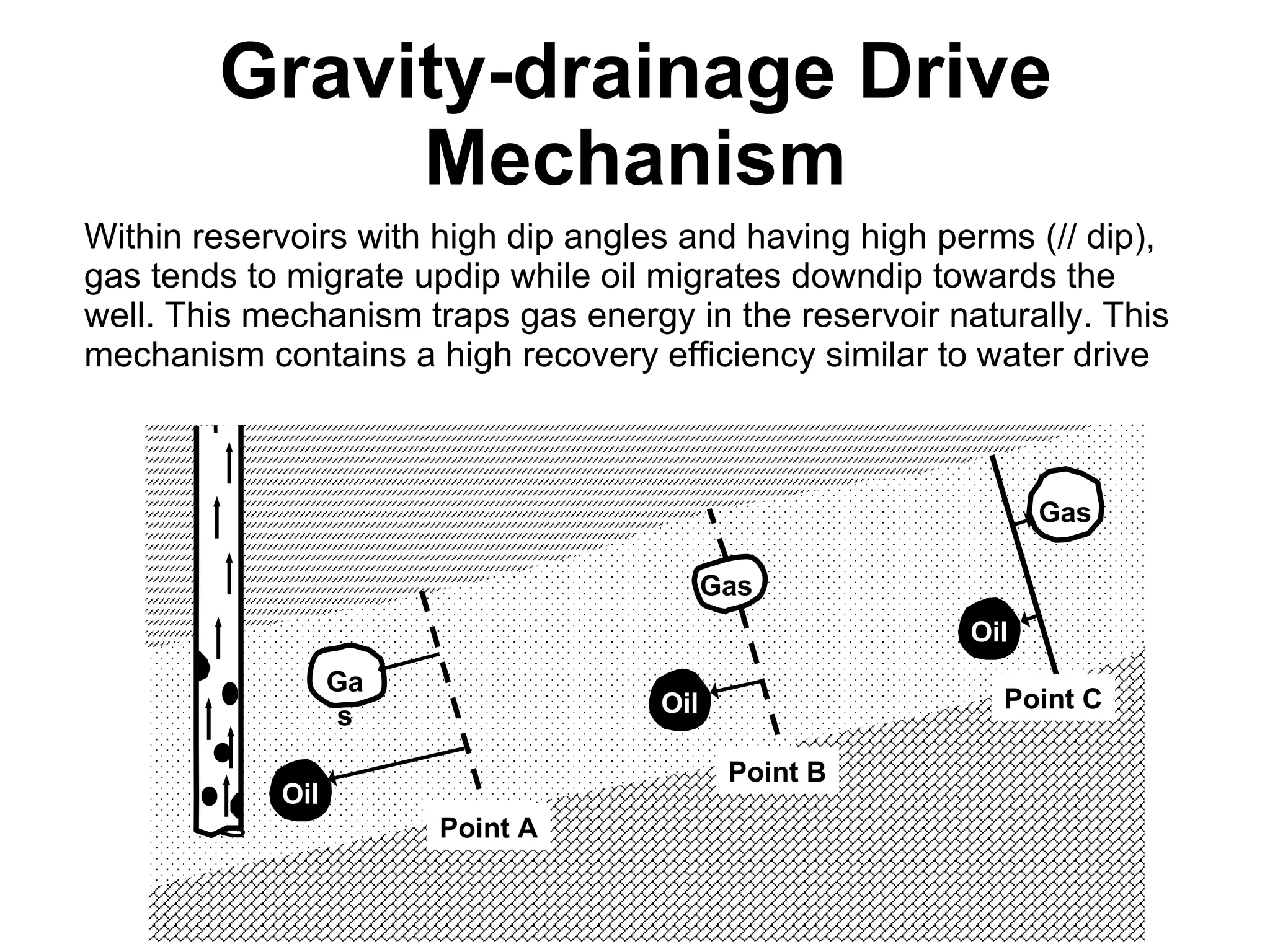
Gravity-drainage Drive Mechanism Within reservoirs with high dip angles and having high perms (// dip), gas tends to migrate updip while oil migrates downdip towards the well. This mechanism traps gas energy in the reservoir naturally. This mechanism contains a high recovery efficiency similar to water drive Oil Oil Oil Point A Point B Point C Gas Gas Gas
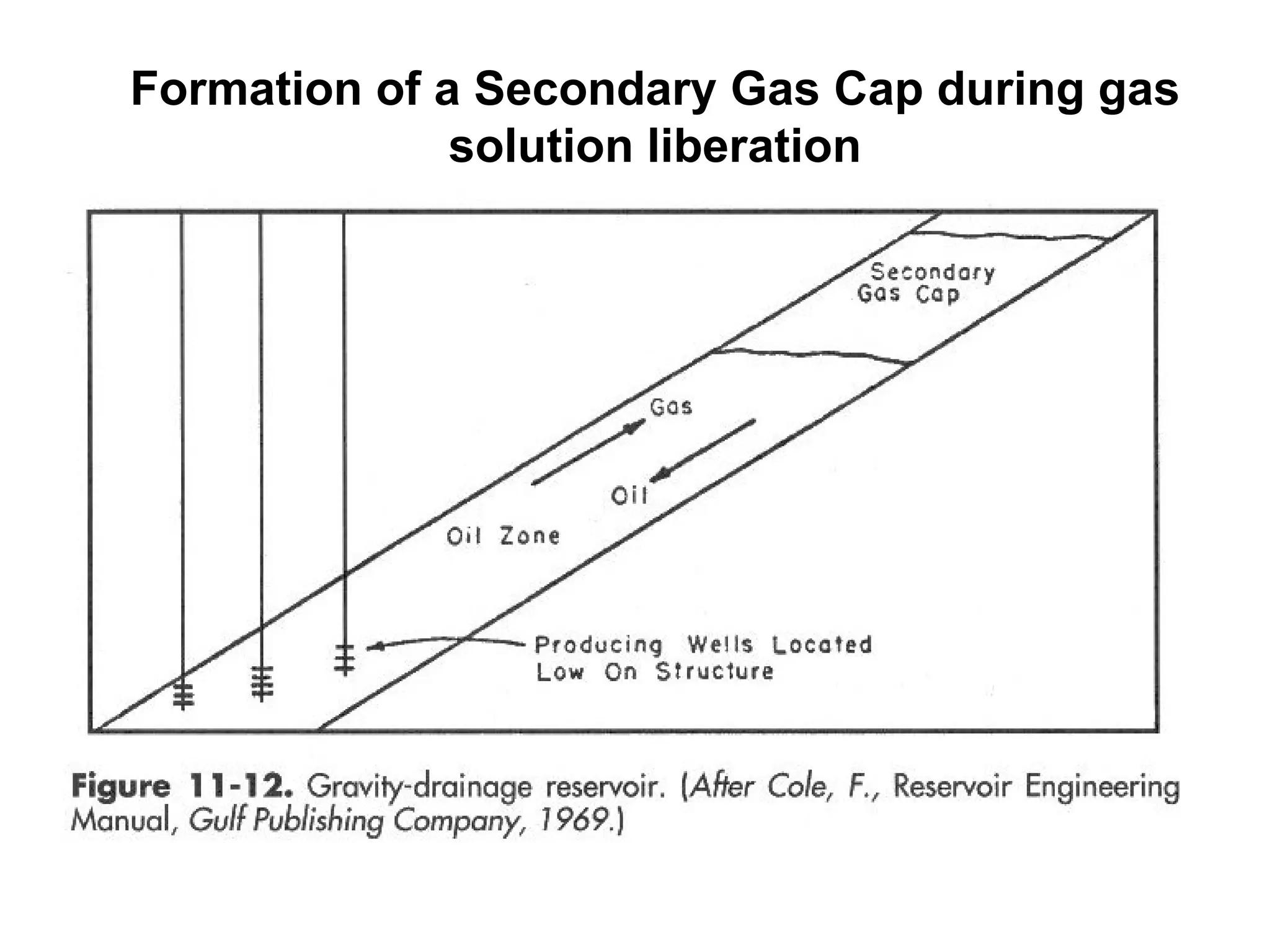
Formation of a Secondary Gas Cap during gas solution liberation
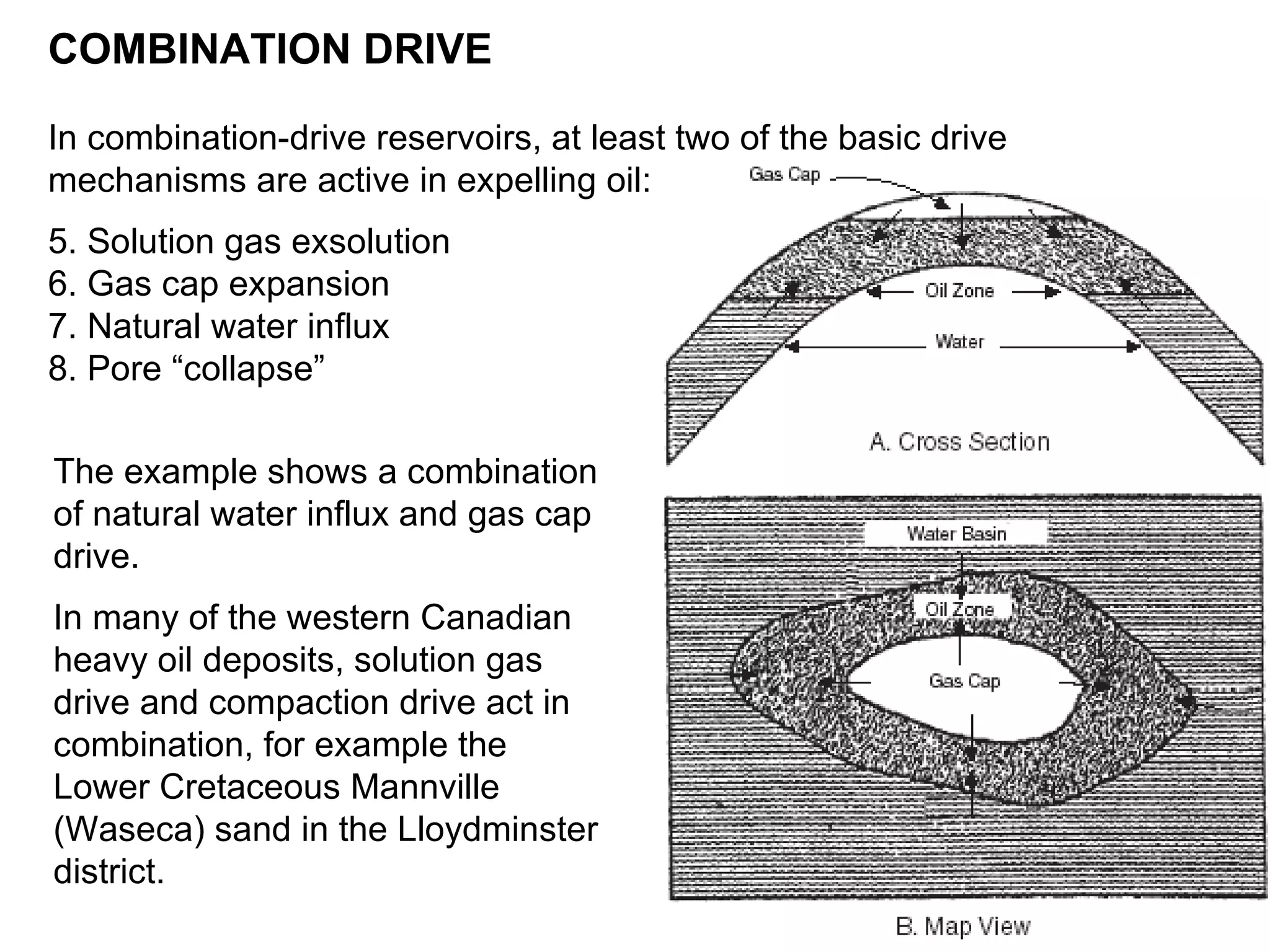
The example shows a combination of natural water influx and gas cap drive. In many of the western Canadian heavy oil deposits, solution gas drive and compaction drive act in combination, for example the Lower Cretaceous Mannville (Waseca) sand in the Lloydminster district.   COMBINATION DRIVE In combination-drive reservoirs, at least two of the basic drive mechanisms are active in expelling oil: Solution gas exsolution Gas cap expansion Natural water influx Pore “collapse”
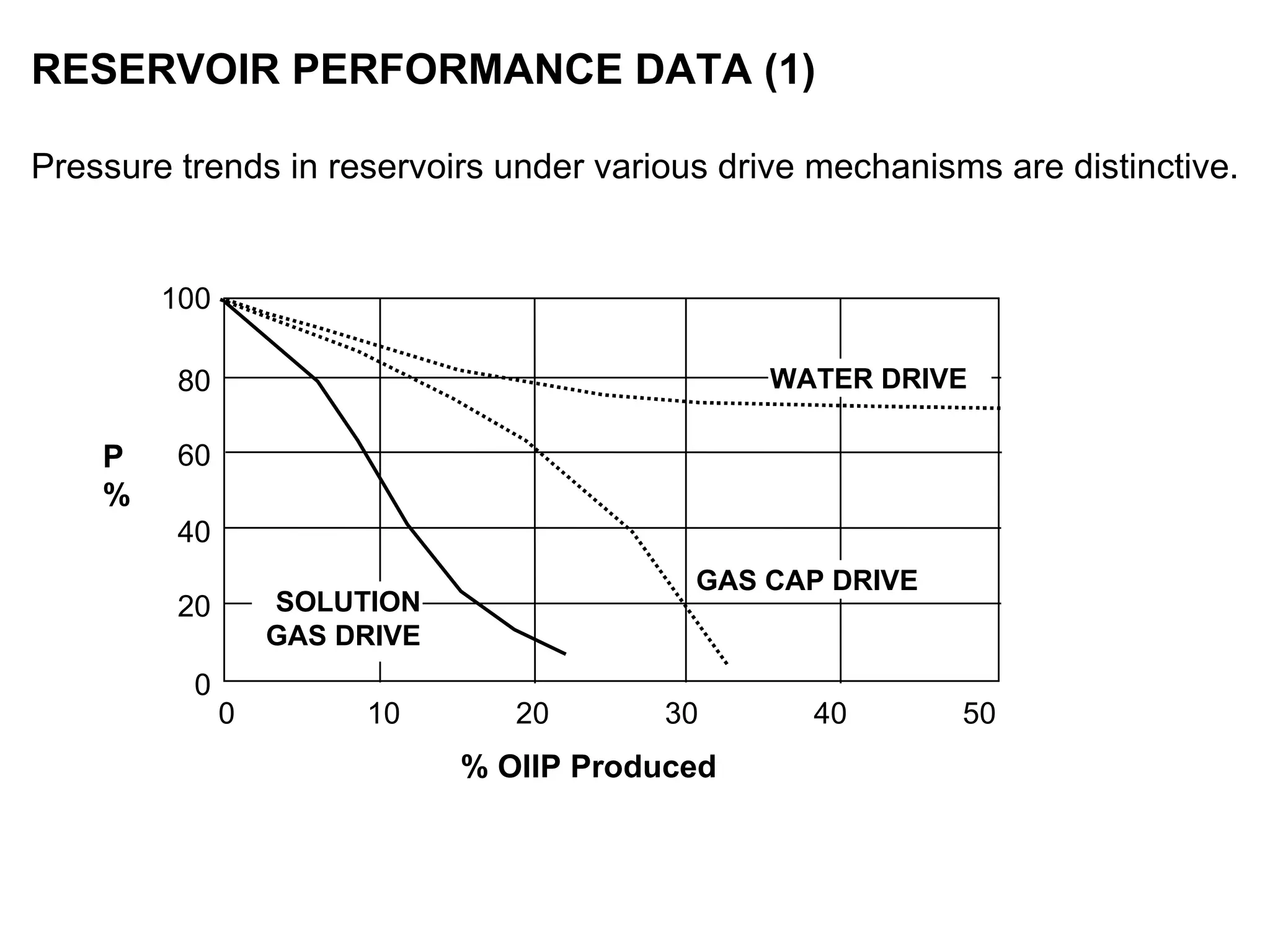
RESERVOIR PERFORMANCE DATA (1) Pressure trends in reservoirs under various drive mechanisms are distinctive. 100 0  10  20  30  40  50 % OIIP Produced P % WATER DRIVE GAS CAP DRIVE SOLUTION GAS DRIVE 80 60 40 20 0
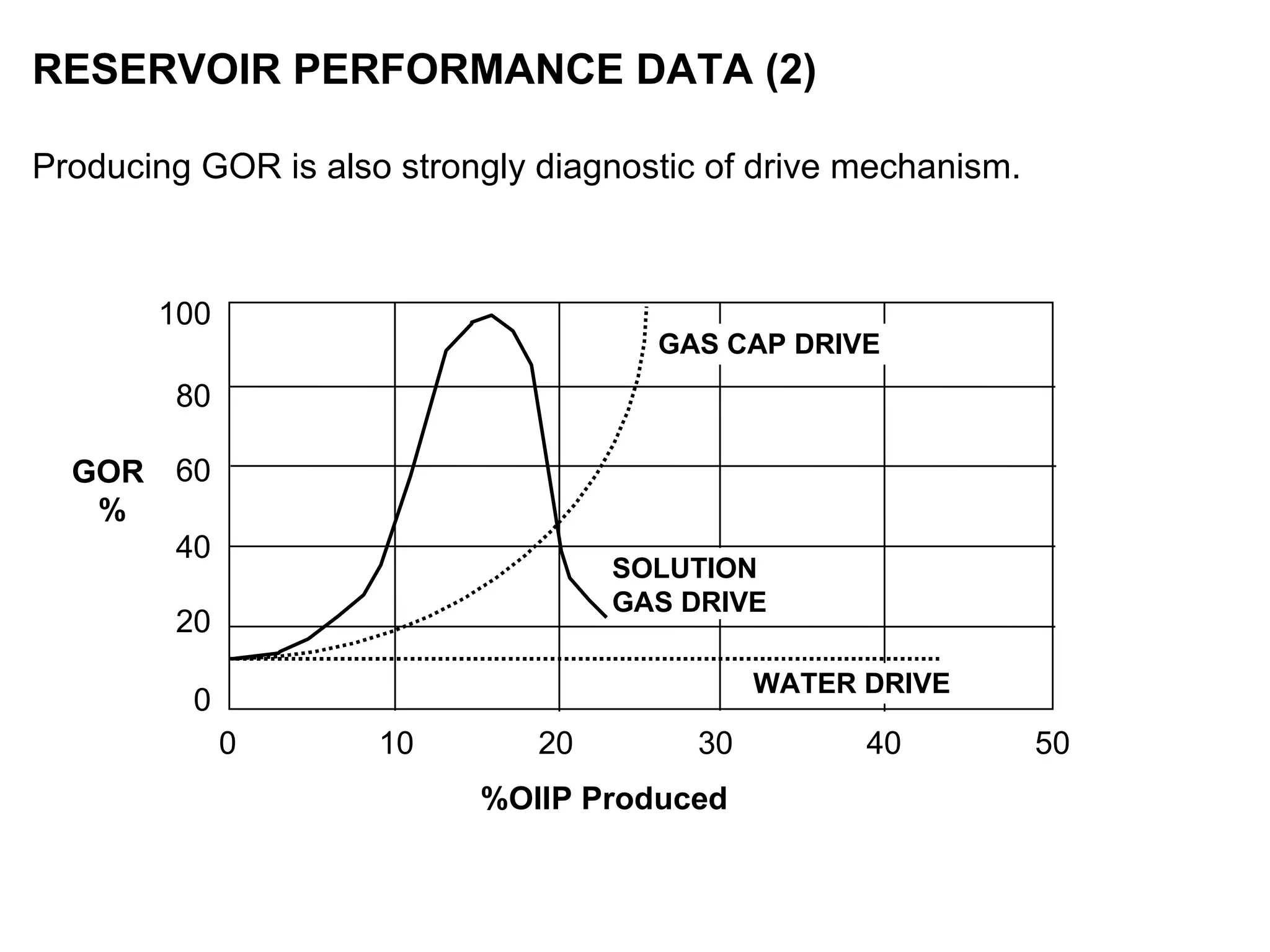
RESERVOIR PERFORMANCE DATA (2) Producing GOR is also strongly diagnostic of drive mechanism. 0  10  20  30  40  50 %OIIP Produced GOR % SOLUTION GAS DRIVE GAS CAP DRIVE WATER DRIVE 100 80 60 40 20 0
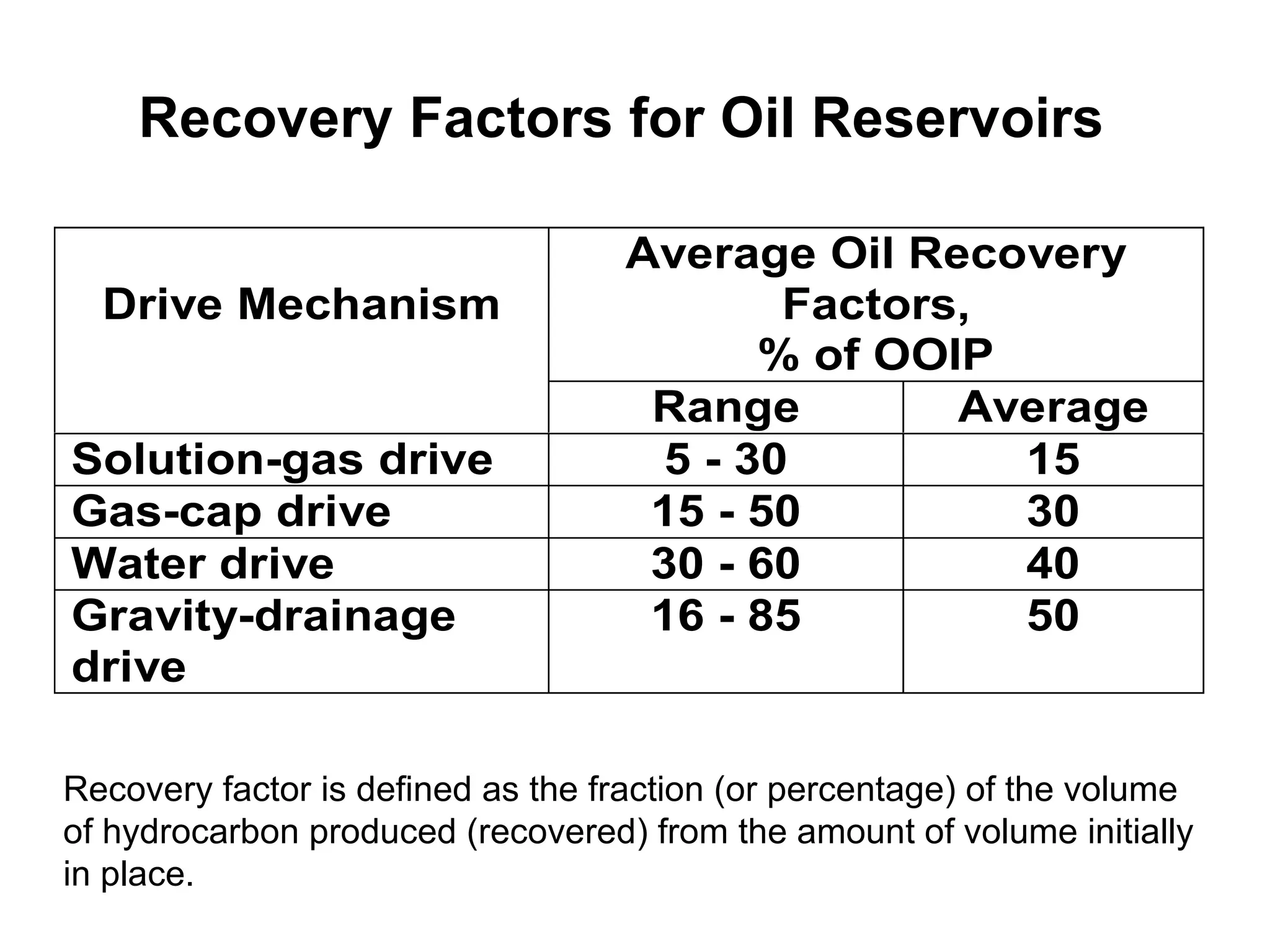
Recovery Factors for Oil Reservoirs Recovery factor is defined as the fraction (or percentage) of the volume of hydrocarbon produced (recovered) from the amount of volume initially in place.
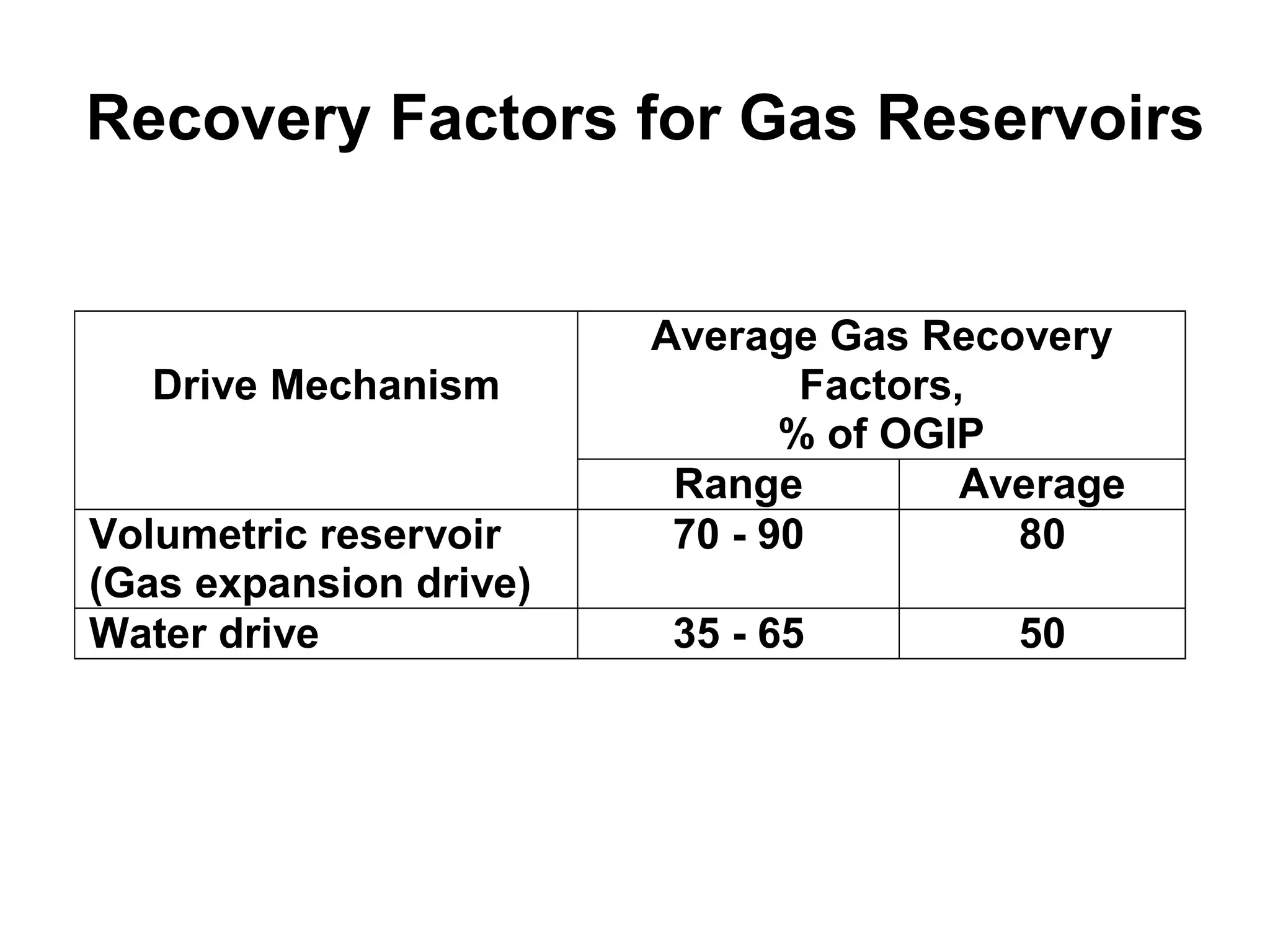
Recovery Factors for Gas Reservoirs
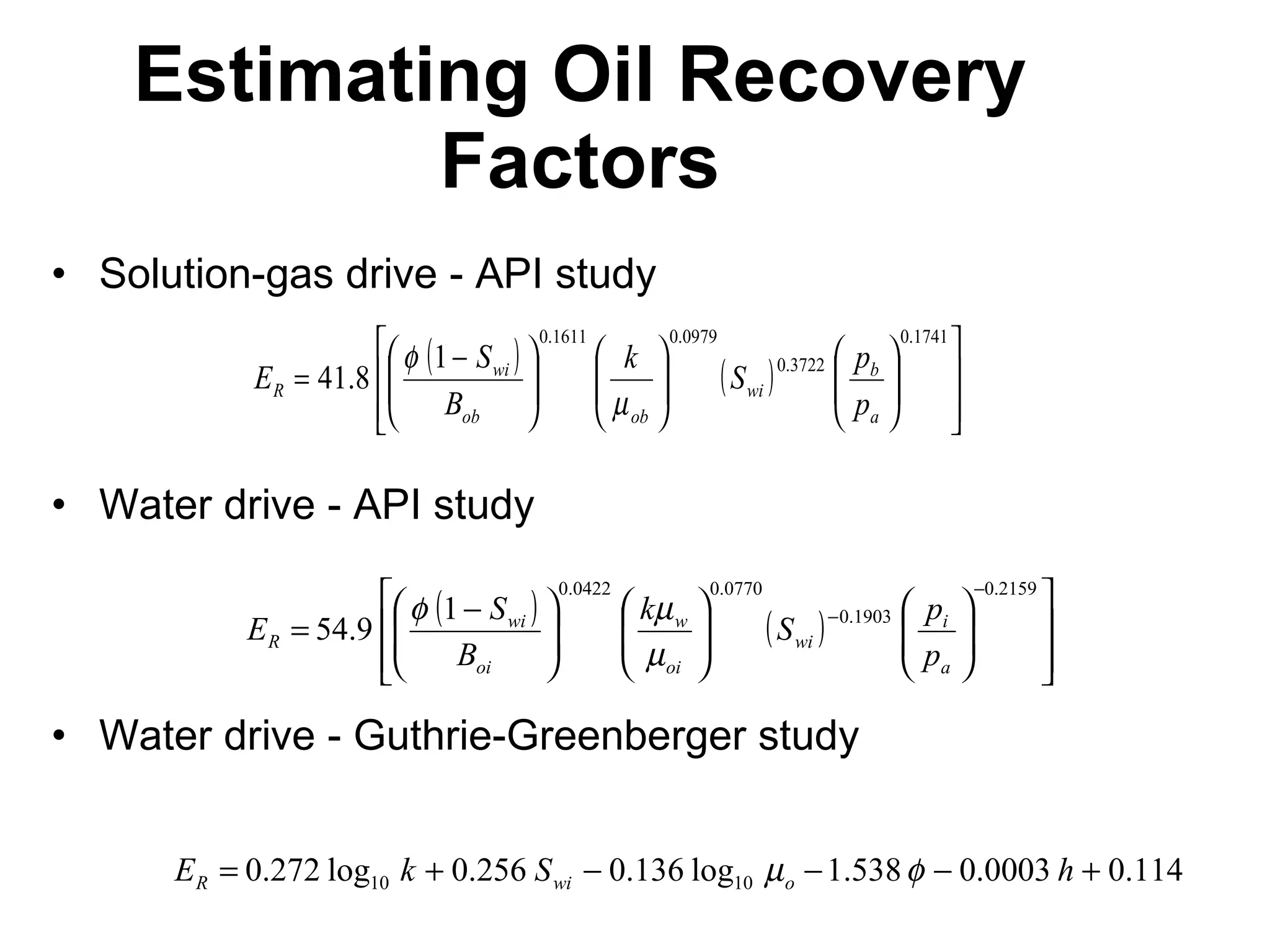
Estimating Oil Recovery Factors Solution-gas drive - API study Water drive - API study Water drive - Guthrie-Greenberger study
These correlations work best for  sandstone reservoirs . Nomenclature E R = Oil recovery efficiency (recovery factor), [% (for API study); fraction (for G-G study)]  = Reservoir porosity, fraction S wi  = Interstitial water saturation, fraction B ob = Formation volume factor of oil at bubblepoint, RB/STB k  = Reservoir permeability, [darcy (for API study); md  (For G-G study)]  ob =  Oil viscosity at bubblepoint pressure, cp p b =  Bubblepoint pressure of oil, psig p a   =  Abandonment reservoir pressure, psig
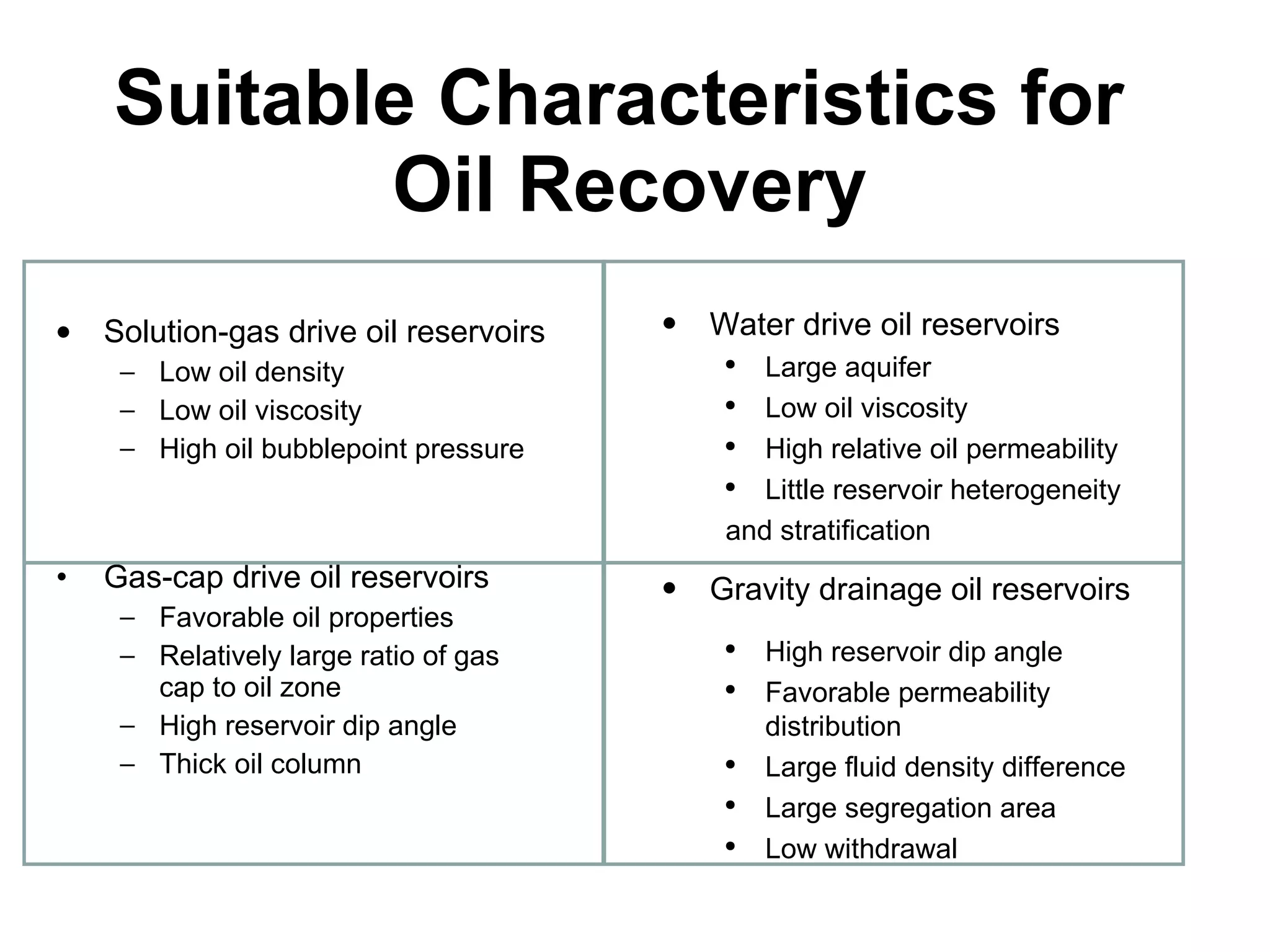
Suitable Characteristics for  Oil Recovery Solution-gas drive oil reservoirs Low oil density Low oil viscosity High oil bubblepoint pressure Gas-cap drive oil reservoirs Favorable oil properties Relatively large ratio of gas cap to oil zone High reservoir dip angle Thick oil column Water drive oil reservoirs Large aquifer Low oil viscosity High relative oil permeability Little reservoir heterogeneity  and stratification  Gravity drainage oil reservoirs High reservoir dip angle Favorable permeability distribution Large fluid density difference Large segregation area Low withdrawal
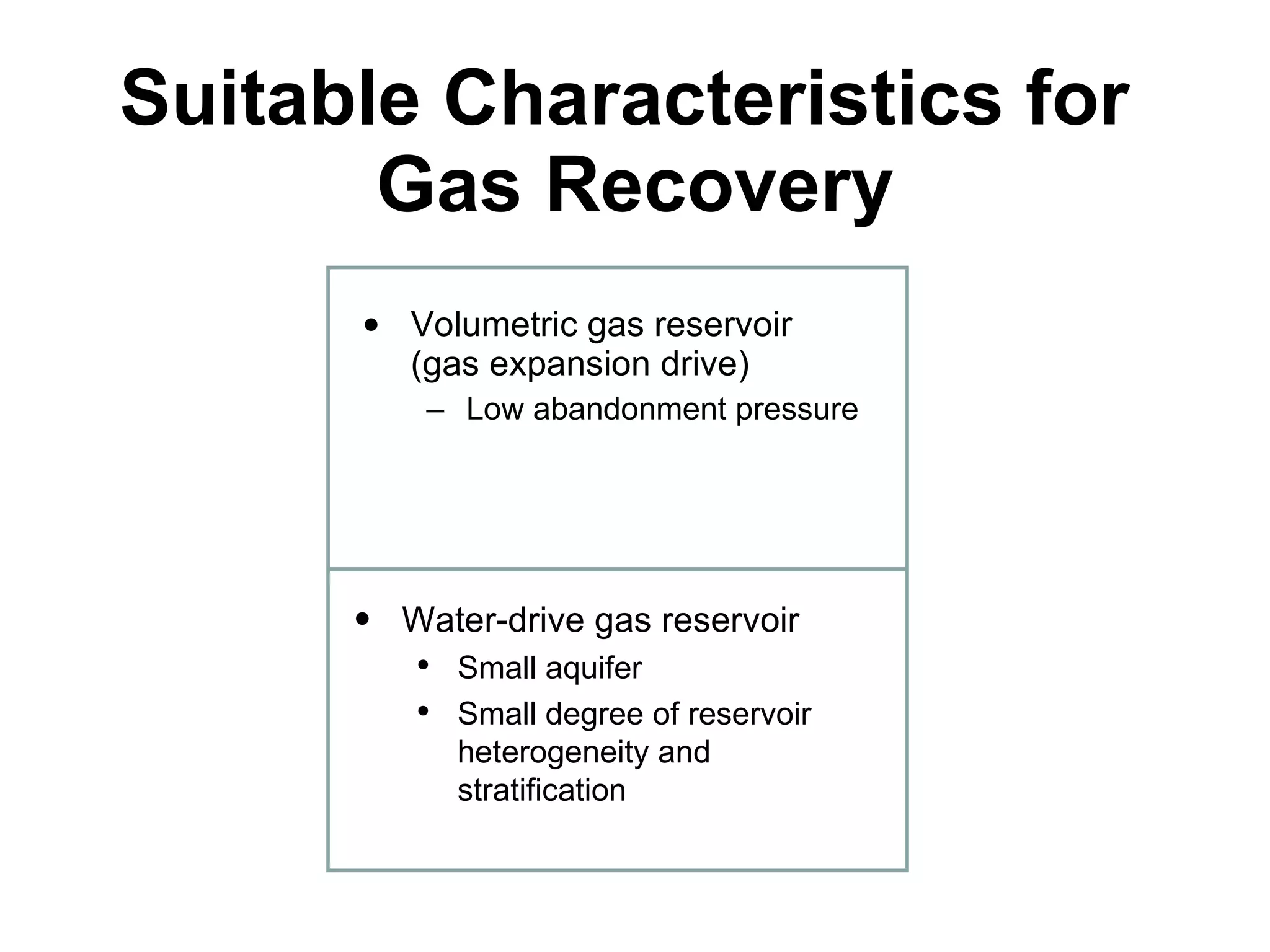
Suitable Characteristics for  Gas Recovery Volumetric gas reservoir (gas expansion drive) Low abandonment pressure Water-drive gas reservoir Small aquifer Small degree of reservoir heterogeneity and stratification

4 1 reservoir-drive_mechanisms

  • 1.
    Where does thenatural energy of a reservoir come from? Liberation and expansion of solution gas Influx of aquifer water Contraction of reservoir rock skeleton Expansion of original reservoir fluids Free gas, if present Interstitial water Oil, if present Gravitational forces
  • 2.
    Oil Reservoir DriveMechanisms Solution gas drive Gas-cap drive Water drive Gravity-drainage drive Combination drive Gas Reservoir Drive Mechanisms Volumetric reservoir (gas expansion drive) Water drive Ultimate oil and gas recoveries vary depending on the drive mechanism. For oil; water drive is most effective. Typical primary recoveries are in the 25-40% range (maximum 75%). For gas; gravity drainage, water drive and depletion drive can provide > 80% recovery.
  • 3.
    Solution gas DriveThe principle of solution gas drive or depletion drive is the expansion of dissolved gas and liquid oil in response to a pressure drop. The change in fluid volume results in production. Above the bubble point, only liquid oil expansion occurs . Below the bubble point, both liquid oil expansion and gas expansion contribute to volume change. The Upper Cretaceous Cardium sand reservoir is an example of a solution gas drive reservoir.
  • 4.
    Solution gas drivemechanism P i P b A B C Oil A. Original Conditions B-C. Partially depleted Oil producing wells Oil producing wells Liberated solution gas
  • 5.
    Oil recovery insolution gas drive reservoirs Dissolved gas reservoirs typically recover between 5 and 25% OIIP and 60 to 80% GIIP. Bubblepoint pressure Initial reservoir pressure 0 5 10 15 Oil recovery, % of OOIP Reservoir pressure, psig
  • 6.
    SOLUTION GAS DRIVEHISTORY watercut GOR (R) pressure time R si OIL PRODUCTON Rapid and continuous pressure drop, rate of decline falls at bubble point pressure. R (producing gas oil ratio) low until p = p b , then increases to maximum and declines. Absent or minimal water influx (watercut). Gravity drainage is a special case in steeply dipping reservoirs where gas drives out more oil. Well production declines rapidly; early pumping often required. P b
  • 7.
  • 8.
    Gas Cap DriveMechanism The principle of gas cap drive is the expansion of free gas in response to a pressure drop. The change in fluid volume results in production. Gas cap expansion maintains the pressure in the oil leg. Gas cap drive reservoirs typically recover 20 to 40% OIIP, sometimes as high as 60%. The Lower Mississippian Turner Valley carbonate was a gas cap drive reservoir.
  • 9.
    GAS CAP DRIVEHISTORY pressure drops continuously, but slowly. R (producing gas oil ratio) increases continuously. water influx (watercut) absent or minimal gas cap cannot be allowed to shrink or oil encroachment will occur resulting in reduced recovery. oil leg wells can eventually produce gas. Wells have long flowing life (depending on the size of the gas cap). watercut GOR (R) pressure time R si OIL PRODUCTON
  • 10.
  • 11.
  • 12.
    Natural Water DriveMechanism The principle of natural water drive is that an aquifer provides the energy for hydrocarbon production. Both water expansion, as a result of pressure reduction, and inflow are involved. Natural water drive is associated with high recovery rates; oil from 35-75% OIIP; gas from 60-80% GIIP. It is not uncommon for flow from the surface to supply the energy for natural water drive. When a pressure drop occurs, both the oil and water liquid phases expand resulting in production. Additionally, water inflow radially and vertically displaces the oil towards the producers.
  • 13.
    Cross-section view Planeview Water Hydrocarbon The Upper Devonian Leduc pools are driven by inflow from the Cooking Lake Aquifer.
  • 14.
    Different Water DriveMechansims Both bottom water drive, where the water leg underlies the entire reservoir, and edge water drive, where only part of the areal extent is contacted by water, are recognized. Edge Water Drive Bottom Water Drive
  • 15.
    NATURAL WATER DRIVEHISTORY Pressure remains high; small drop. R (producing gas oil ratio) remains low. Water influx starts early and increases to appreciable levels. Residual oil may be trapped behind the advancing water. Wells flow freely until water production (watercut) becomes excessive. watercut GOR (R) pressure time R si OIL PRODUCTON
  • 16.
  • 17.
    COMPACTION DRIVE Incompaction drive, the energy for oil production is provided by the collapse of the porous medium skeleton and expansion of the pore fluids when the reservoir pressure drops. The increase in the "grain pressure" or effective stress causes pore “collapse” and “compaction” (consolidation) of the reservoir. This drive mechanism is common in highly compressible, unconsolidated reservoirs such as those found in California, Venezuela, and the heavy oil deposits of western Canada. Also in high-porosity chalks (e.g., North Sea). The Lower Cretaceous Mannville (Clearwater) sands in the Cold Lake district provide an example of compaction drive.
  • 18.
    Gravity-drainage Drive MechanismWithin reservoirs with high dip angles and having high perms (// dip), gas tends to migrate updip while oil migrates downdip towards the well. This mechanism traps gas energy in the reservoir naturally. This mechanism contains a high recovery efficiency similar to water drive Oil Oil Oil Point A Point B Point C Gas Gas Gas
  • 19.
    Formation of aSecondary Gas Cap during gas solution liberation
  • 20.
    The example showsa combination of natural water influx and gas cap drive. In many of the western Canadian heavy oil deposits, solution gas drive and compaction drive act in combination, for example the Lower Cretaceous Mannville (Waseca) sand in the Lloydminster district. COMBINATION DRIVE In combination-drive reservoirs, at least two of the basic drive mechanisms are active in expelling oil: Solution gas exsolution Gas cap expansion Natural water influx Pore “collapse”
  • 21.
    RESERVOIR PERFORMANCE DATA(1) Pressure trends in reservoirs under various drive mechanisms are distinctive. 100 0 10 20 30 40 50 % OIIP Produced P % WATER DRIVE GAS CAP DRIVE SOLUTION GAS DRIVE 80 60 40 20 0
  • 22.
    RESERVOIR PERFORMANCE DATA(2) Producing GOR is also strongly diagnostic of drive mechanism. 0 10 20 30 40 50 %OIIP Produced GOR % SOLUTION GAS DRIVE GAS CAP DRIVE WATER DRIVE 100 80 60 40 20 0
  • 23.
    Recovery Factors forOil Reservoirs Recovery factor is defined as the fraction (or percentage) of the volume of hydrocarbon produced (recovered) from the amount of volume initially in place.
  • 24.
    Recovery Factors forGas Reservoirs
  • 25.
    Estimating Oil RecoveryFactors Solution-gas drive - API study Water drive - API study Water drive - Guthrie-Greenberger study
  • 26.
    These correlations workbest for sandstone reservoirs . Nomenclature E R = Oil recovery efficiency (recovery factor), [% (for API study); fraction (for G-G study)]  = Reservoir porosity, fraction S wi = Interstitial water saturation, fraction B ob = Formation volume factor of oil at bubblepoint, RB/STB k = Reservoir permeability, [darcy (for API study); md (For G-G study)]  ob = Oil viscosity at bubblepoint pressure, cp p b = Bubblepoint pressure of oil, psig p a = Abandonment reservoir pressure, psig
  • 27.
    Suitable Characteristics for Oil Recovery Solution-gas drive oil reservoirs Low oil density Low oil viscosity High oil bubblepoint pressure Gas-cap drive oil reservoirs Favorable oil properties Relatively large ratio of gas cap to oil zone High reservoir dip angle Thick oil column Water drive oil reservoirs Large aquifer Low oil viscosity High relative oil permeability Little reservoir heterogeneity and stratification Gravity drainage oil reservoirs High reservoir dip angle Favorable permeability distribution Large fluid density difference Large segregation area Low withdrawal
  • 28.
    Suitable Characteristics for Gas Recovery Volumetric gas reservoir (gas expansion drive) Low abandonment pressure Water-drive gas reservoir Small aquifer Small degree of reservoir heterogeneity and stratification

Editor's Notes

  • #6 Reservoir Drive Mechanisms and Producing Characteristics
  • #14 GEOE 412 19/10/11
  • #24 Reservoir Drive Mechanisms and Producing Characteristics The recovery factor is defined as the percentage of the amount of hydrocarbon produced (recovered) from the amount of hydrocarbon initially in place.
  • #25 Reservoir Drive Mechanisms and Producing Characteristics
  • #26 Reservoir Drive Mechanisms and Producing Characteristics These correlations work best for sandstone reservoirs . Nomenclature E R = Oil recovery efficiency (recovery factor), [% (for API study); fraction (for G-G study)]  = Reservoir porosity, fraction S wi = Interstitial water saturation, fraction B ob = Formation volume factor of oil at bubblepoint, RB/STB k = Reservoir permeability, [darcy (for API study); md (For G-G study)]  ob = Oil viscosity at bubblepoint pressure, cp p b = Bubblepoint pressure of oil, psig p a = Abandonment reservoir pressure, psig
  • #27 Reservoir Drive Mechanisms and Producing Characteristics
  • #28 Reservoir Drive Mechanisms and Producing Characteristics Hydrocarbon recovery for a reservoir under a specified drive mechanism will increase if the reservoir has the following characteristics. Solution-gas drive oil reservoirs Favorable oil properties Low oil density: lighter oil (larger o API gravity)  higher recovery Low oil viscosity (   ): (less viscous oil)  higher recovery High oil bubblepoint pressure (p b )  higher recovery Oil with higher p b usually has: Higher solution gas/oil ratio (R s ), and Higher oil formation volume factor (B o ).
  • #29 Reservoir Drive Mechanisms and Producing Characteristics Hydrocarbon recovery for a reservoir under a specified drive mechanism will increase if the reservoir has the following characteristics. Solution-gas drive oil reservoirs Favorable oil properties Low oil density: lighter oil (larger o API gravity)  higher recovery Low oil viscosity (   ): (less viscous oil)  higher recovery High oil bubblepoint pressure (p b )  higher recovery Oil with higher p b usually has: Higher solution gas/oil ratio (R s ), and Higher oil formation volume factor (B o ).