Estimation of skin factor by using pressure transient
Formation damage can occur during drilling, completion or production operations, reducing permeability near the wellbore. Well testing methods like drawdown and build-up tests are used to determine the skin factor, a measure of this damage. A positive skin factor indicates damage through reduced effective wellbore radius, while a negative skin indicates enhanced flow. Integrating pressure analysis with integral analysis allows consistent evaluation of well test data to derive skin factor and other reservoir properties. This project aims to evaluate skin factors from pressure transient test results using analytical and simulation methods.
In this document
Powered by AI
This slide introduces the presentation, prepared by Muhammad S. Amin, focusing on estimating skin factor.
This slide outlines objectives including skin factor introduction, well testing methods, and integrating pressure analysis.
Discusses formation damage in oil recovery, indicators like permeability impairment, and operations leading to damage.
Covering observations on shallow damage impact and how production is affected by permeability loss.
Introduces skin factor as a measure of flow restriction, explaining both positive and negative skin effects.
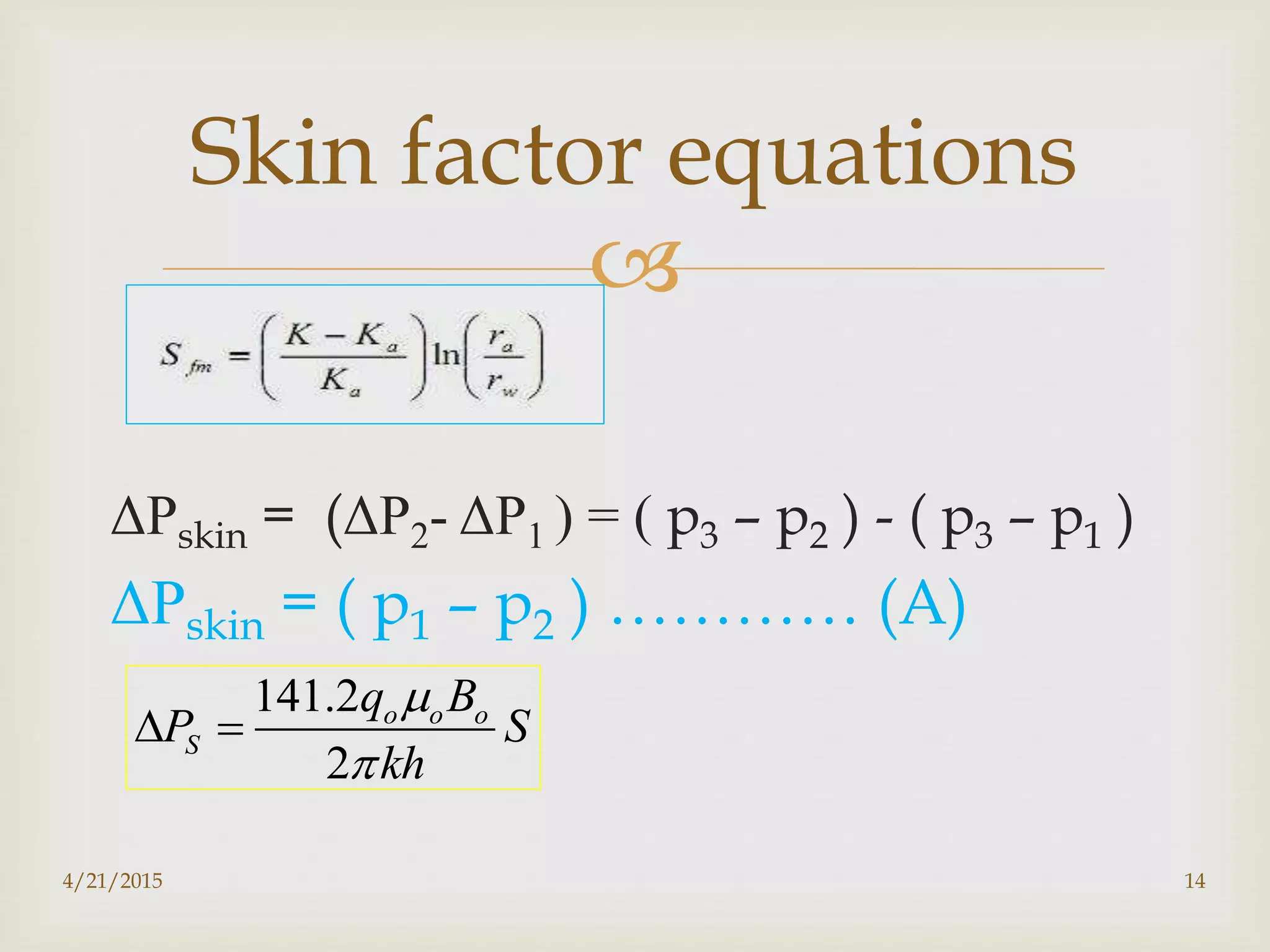
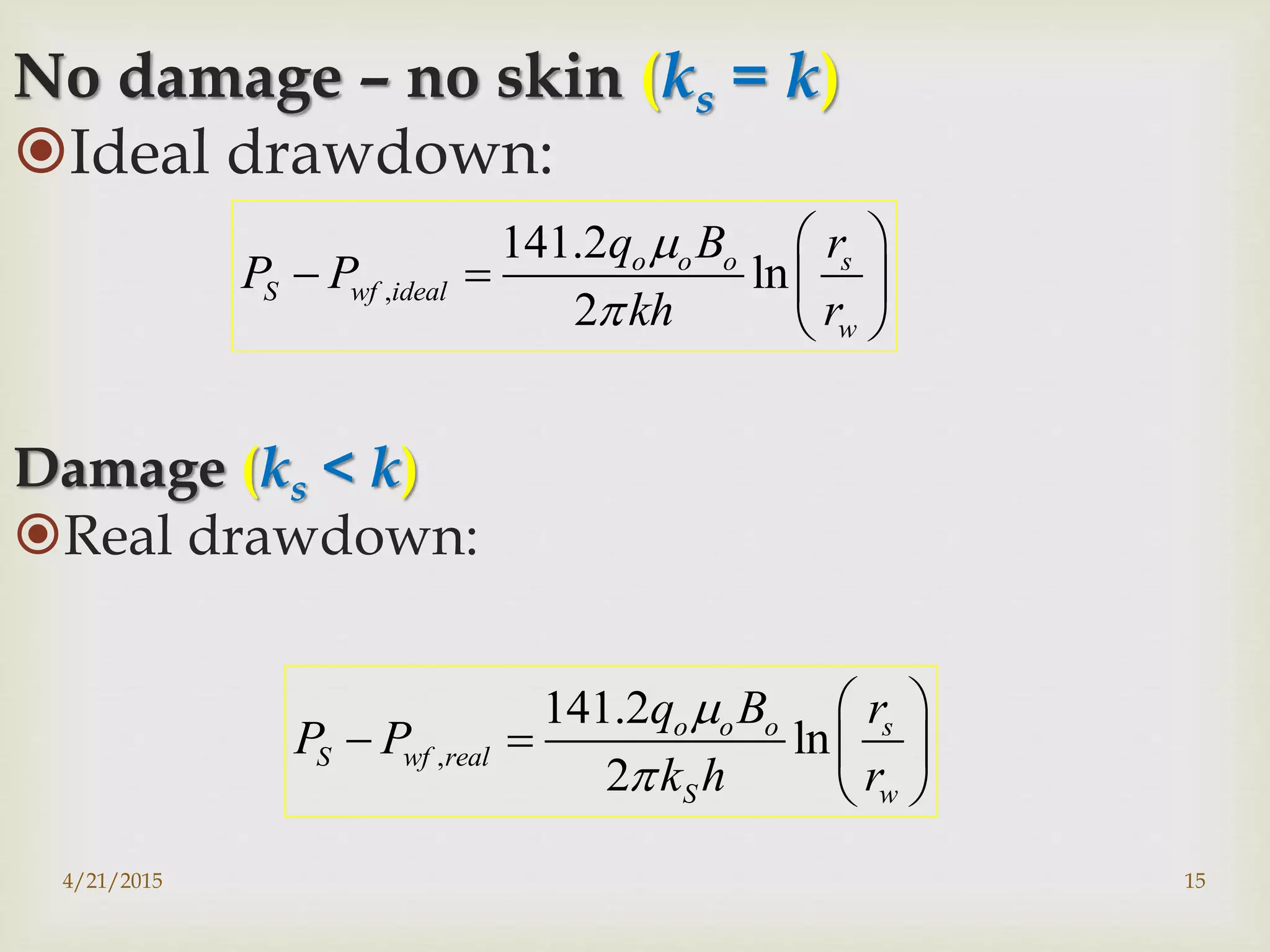
Presents equations related to skin factors, damage conditions, and their implications on the ideal drawdown.
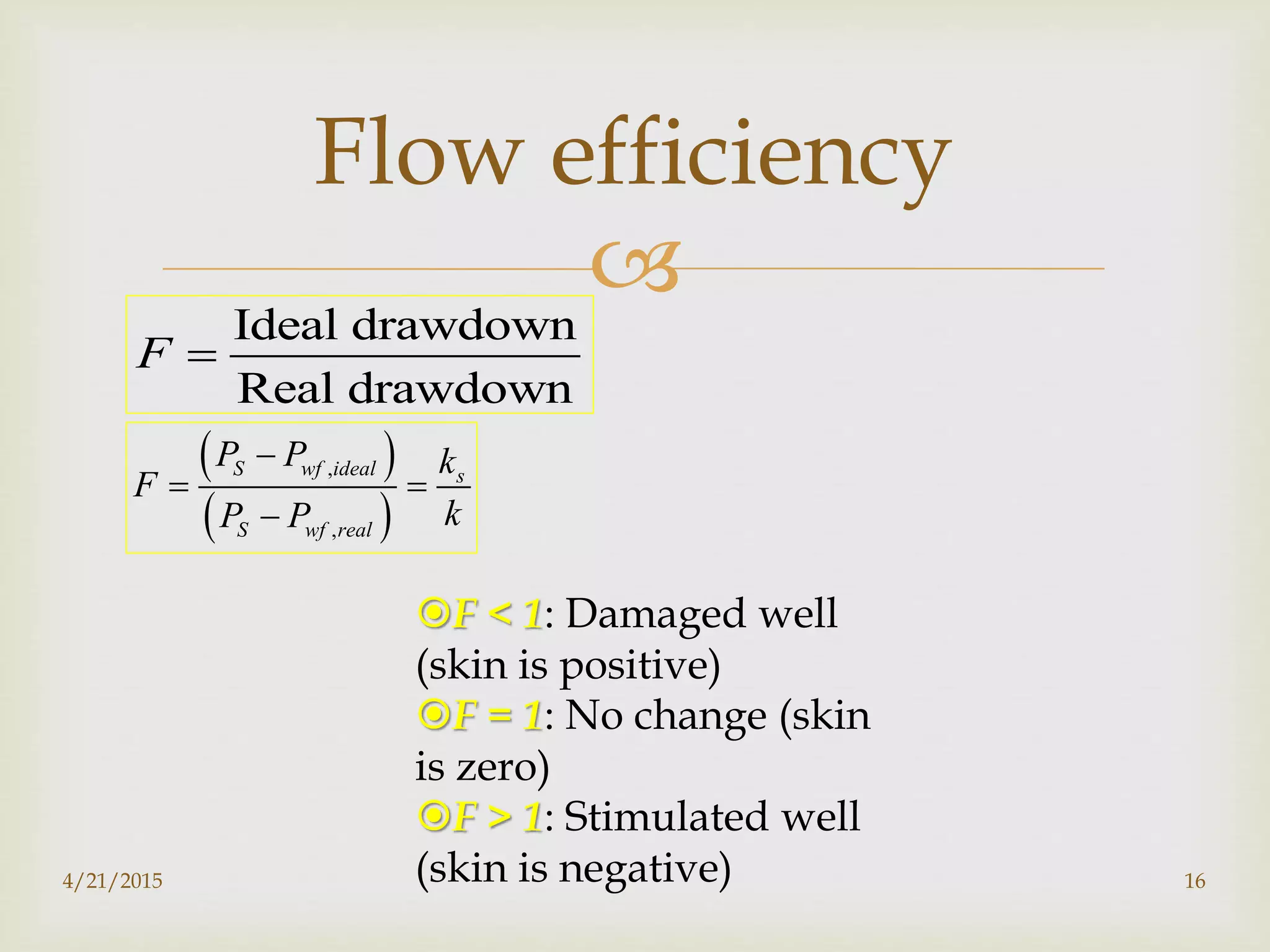
Describes flow efficiency parameters and the rationale for testing a well to determine pressure and skin factors.
Discusses various well test types, specifically focusing on pressure drawdown and build-up tests, their advantages, and disadvantages.
Summarizes formation damage, skin factors, and emphasizes the importance of well testing for oil well performance evaluation.
Mentions future work with PanSystem, indicating ongoing tests in formation evaluation.
Lists several references that provide additional context and information related to petroleum engineering.
Estimation of skin factor by using pressure transient
1.
Prepared by :
Muhammad.S. Amin
Estimation of Skin Factor by Using
Pressure Transient Testing Results
4/21/2015 1
2.
4/21/2015 2
Objectives
Introducingskin factor and formation damage.
Introducing well testing as a tool to describe the productivity
and future of a reservoir.
Different methods of well testing such as Drawdown and
Build Up tests has been applied to determine Skin factor
We will integrate the pressure analysis approach with the
pressure integral analysis approach and develop a consistent
and applicable method for the analysis of well test data to
evaluate skin factor.
In this project, PanSystem program will also be applied to
evaluate the effect and value of skin factor
3.
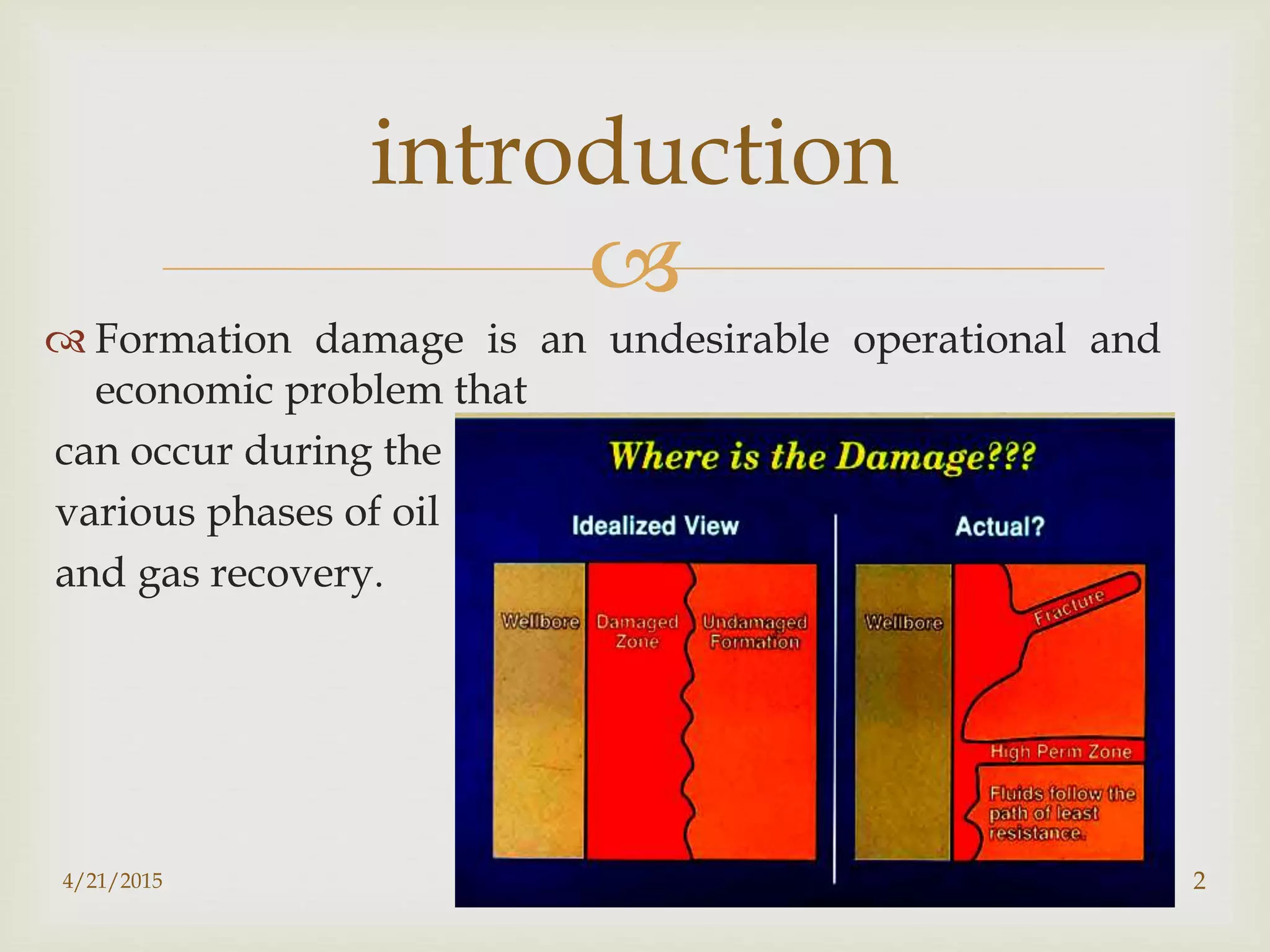
Formation damageis an undesirable operational and
economic problem that
can occur during the
various phases of oil
and gas recovery.
introduction
4/21/2015 2
4.
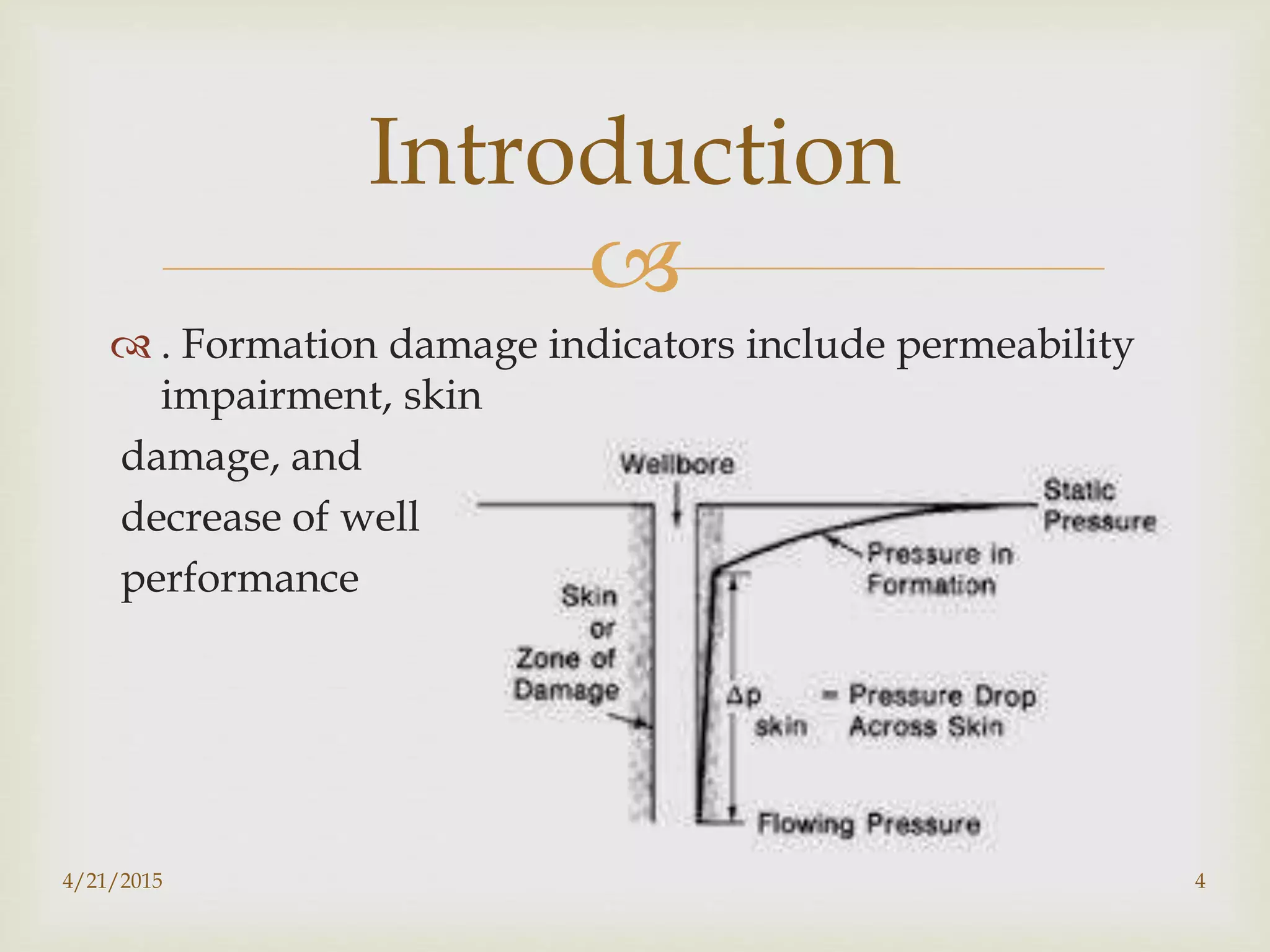
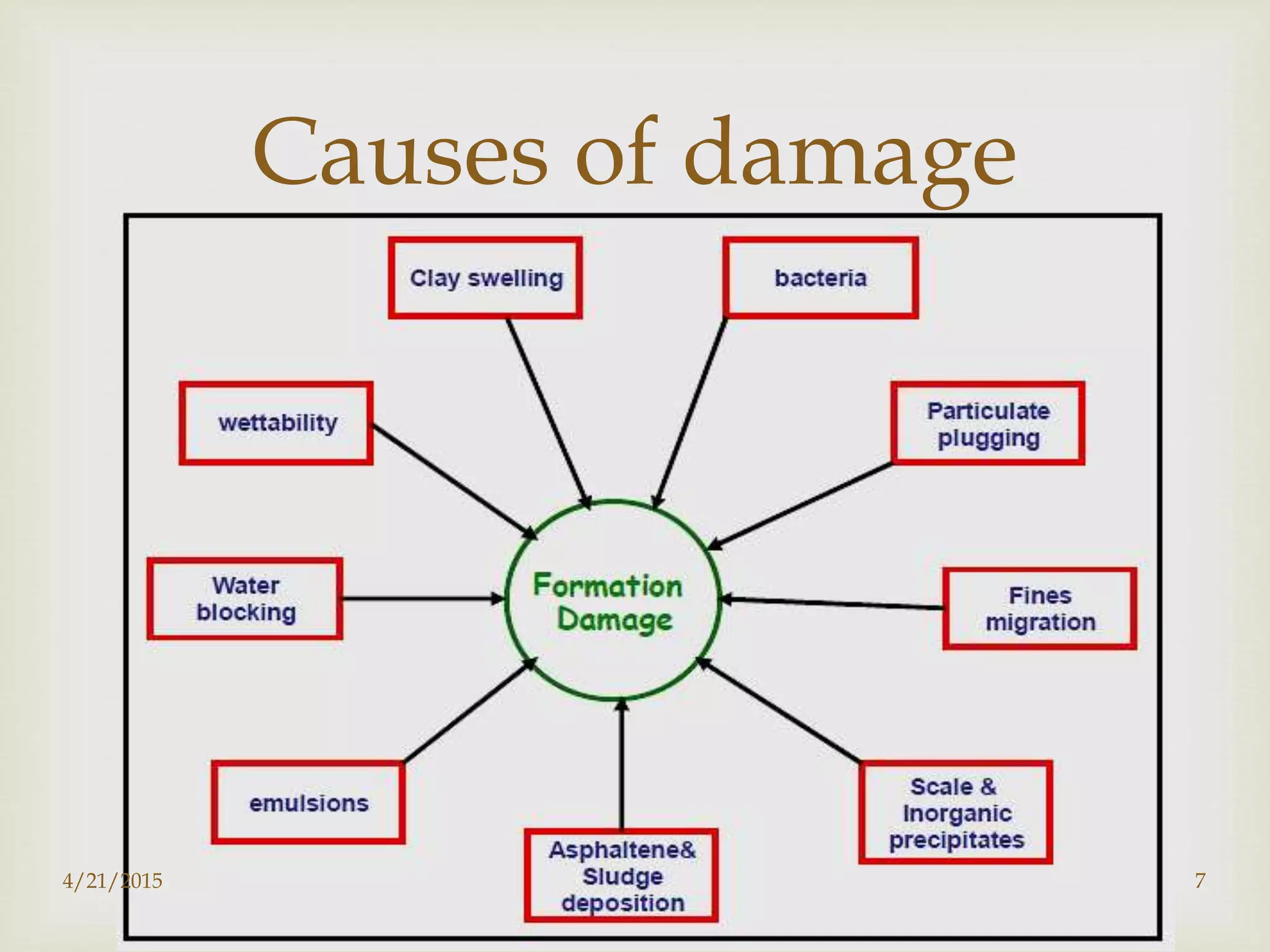
. Formationdamage indicators include permeability
impairment, skin
damage, and
decrease of well
performance
Introduction
4/21/2015 4
5.
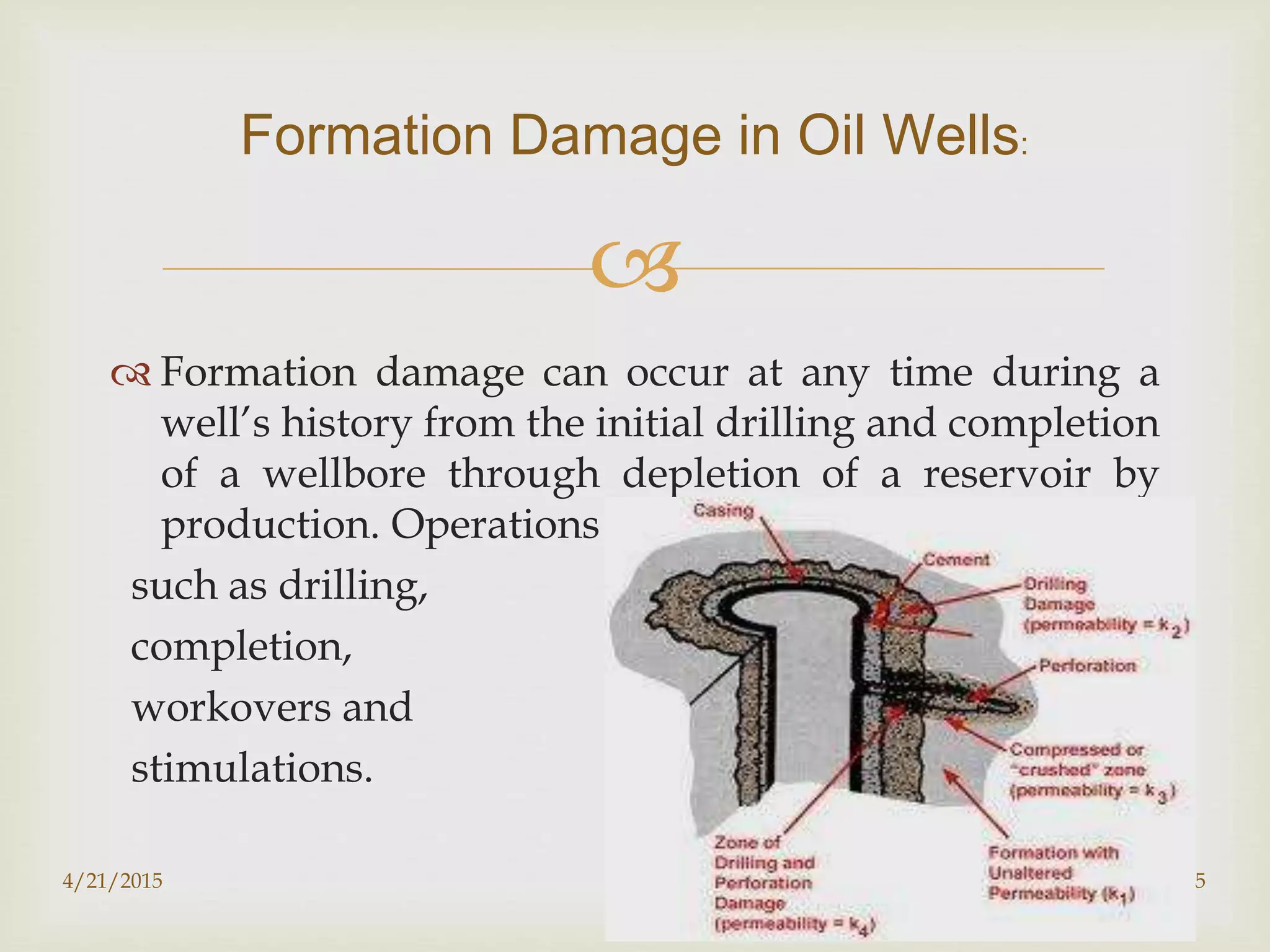
Formation damagecan occur at any time during a
well’s history from the initial drilling and completion
of a wellbore through depletion of a reservoir by
production. Operations
such as drilling,
completion,
workovers and
stimulations.
Formation Damage in Oil Wells:
4/21/2015 5
6.
1. Shallowdamage is the most common and makes
the biggest impact on production.
2. It may take significant damage to create large
drops in production
3. The problem, however, is that the highest
permeability zones are the easiest to damage, and
that can have a major impact on productivity
Observations on Damage:
4/21/2015 6
Skin factordenoted by the symbol S .
What ever is the reason of the pressure loss or losses
in production (flow efficiency) there is a measure of
severity of for this reduction which is called skin
factor (S).
Skin has no physical dimension.
Skin can be zero (no effect), positive or negative.
Concept of Skin factor
4/21/2015 8
9.
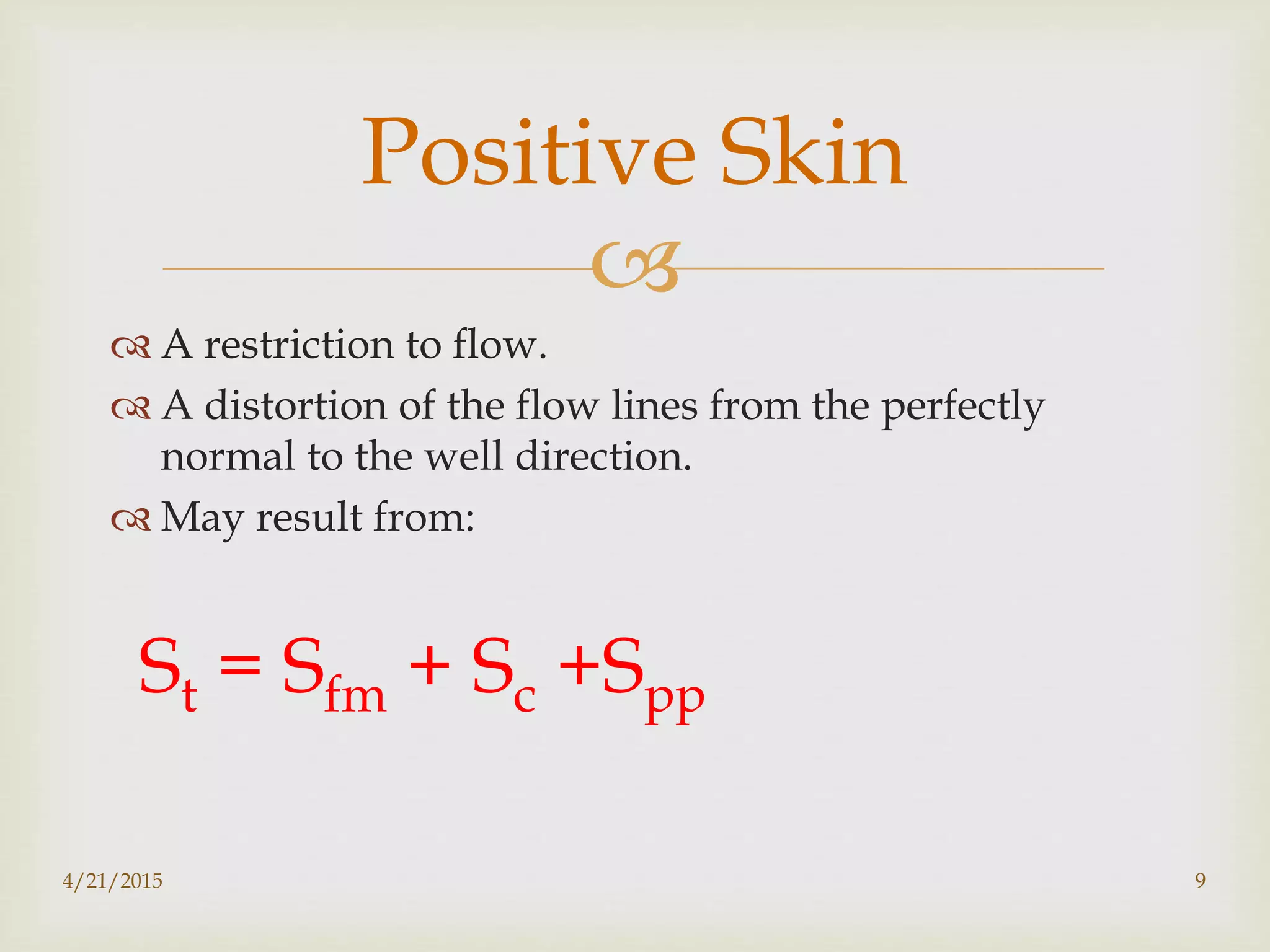
A restrictionto flow.
A distortion of the flow lines from the perfectly
normal to the well direction.
May result from:
Positive Skin
St = Sfm + Sc +Spp
4/21/2015 9
ΔΡskin = (ΔΡ2-ΔΡ1 ) = ( p3 – p2 ) - ( p3 – p1 )
ΔΡskin = ( p1 – p2 ) ………… (A)
Skin factor equations
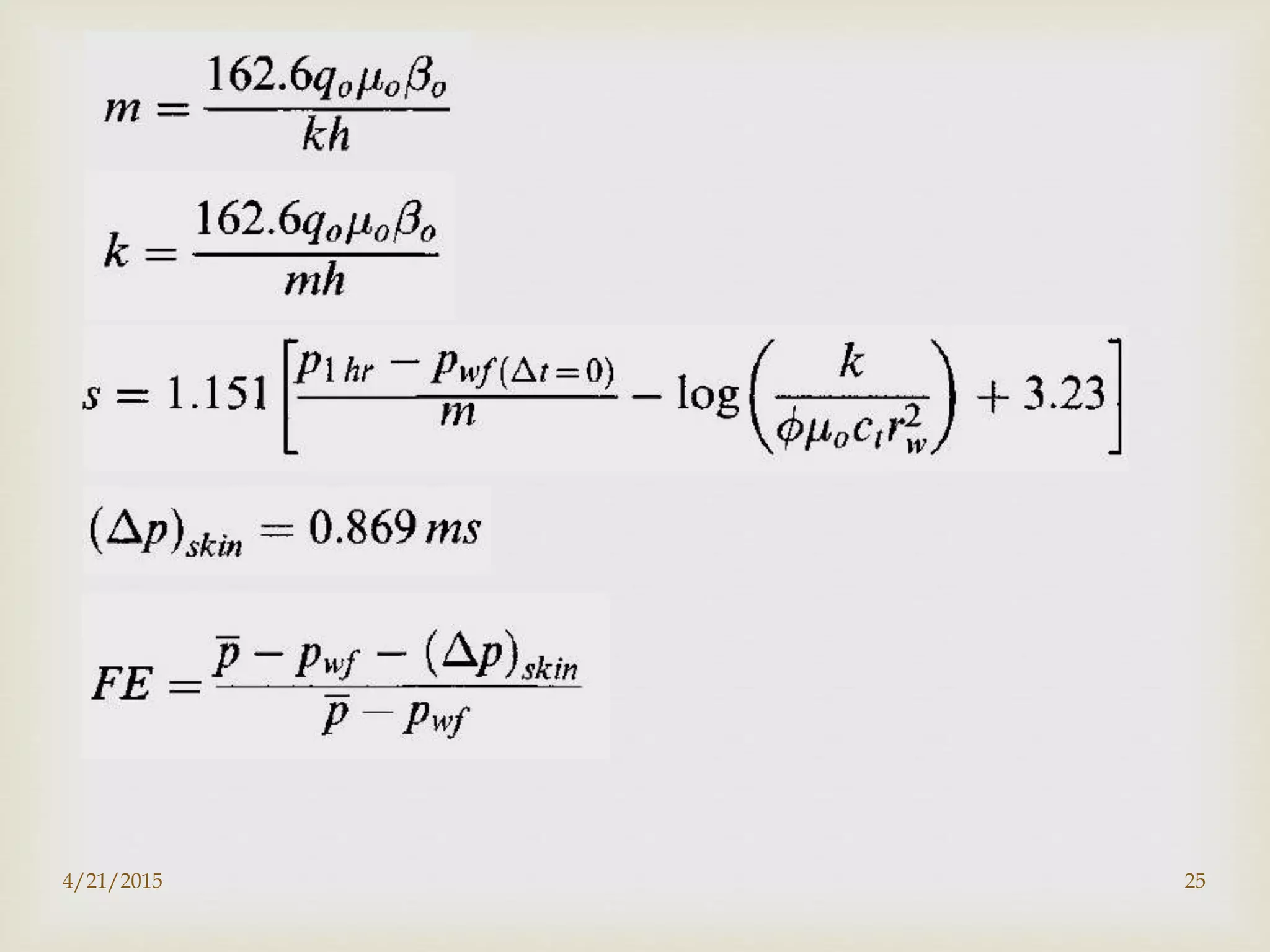
141.2
2
o o o
S
q B
P S
kh
4/21/2015 14
15.
No damage –no skin (ks = k)
Ideal drawdown:
Damage (ks < k)
Real drawdown:
,
141.2
ln
2
o o o s
S wf ideal
w
q B r
P P
kh r
,
141.2
ln
2
o o o s
S wf real
S w
q B r
P P
k h r
4/21/2015 15
16.
Flow efficiency
Ideal drawdown
Realdrawdown
F
,
,
S wf ideal s
S wf real
P P k
F
kP P
F < 1: Damaged well
(skin is positive)
F = 1: No change (skin
is zero)
F > 1: Stimulated well
(skin is negative)4/21/2015 16
17.
To determine thefollowing parameters
Initial pressure (p)
Average pressure within the drainage boundary (p)
Permeability thickness product(kh) and
permeability(k)
Mechanical skin factor (S)
Area drained (A)
Why test a well
4/21/2015 17
18.
• Pressure Drawdown
•Pressure Build up
• Multirate
• Injection/fall-off
• Interference
• Pulse
Types of Well Tests
4/21/2015 18
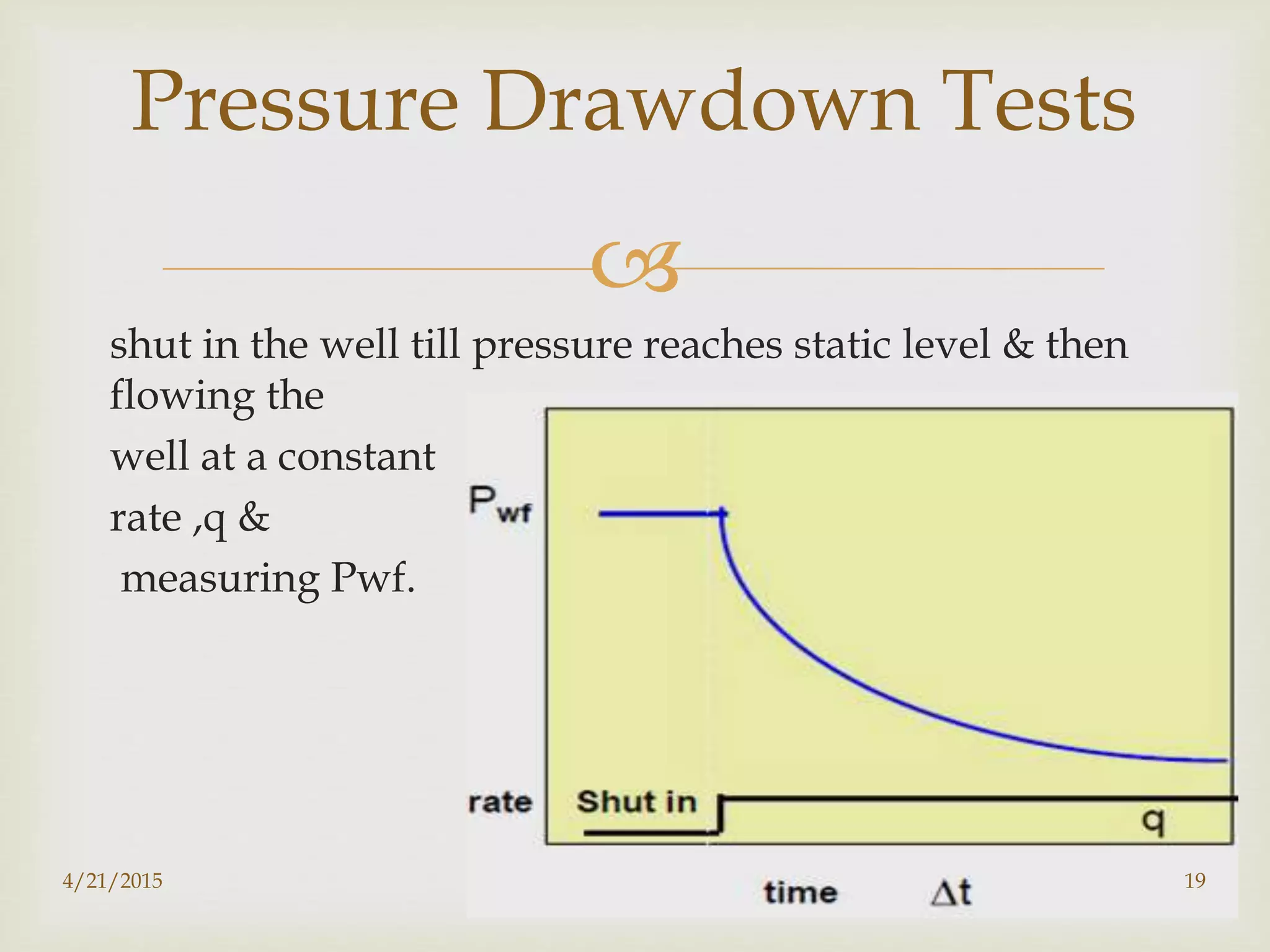
19.
shut in thewell till pressure reaches static level & then
flowing the
well at a constant
rate ,q &
measuring Pwf.
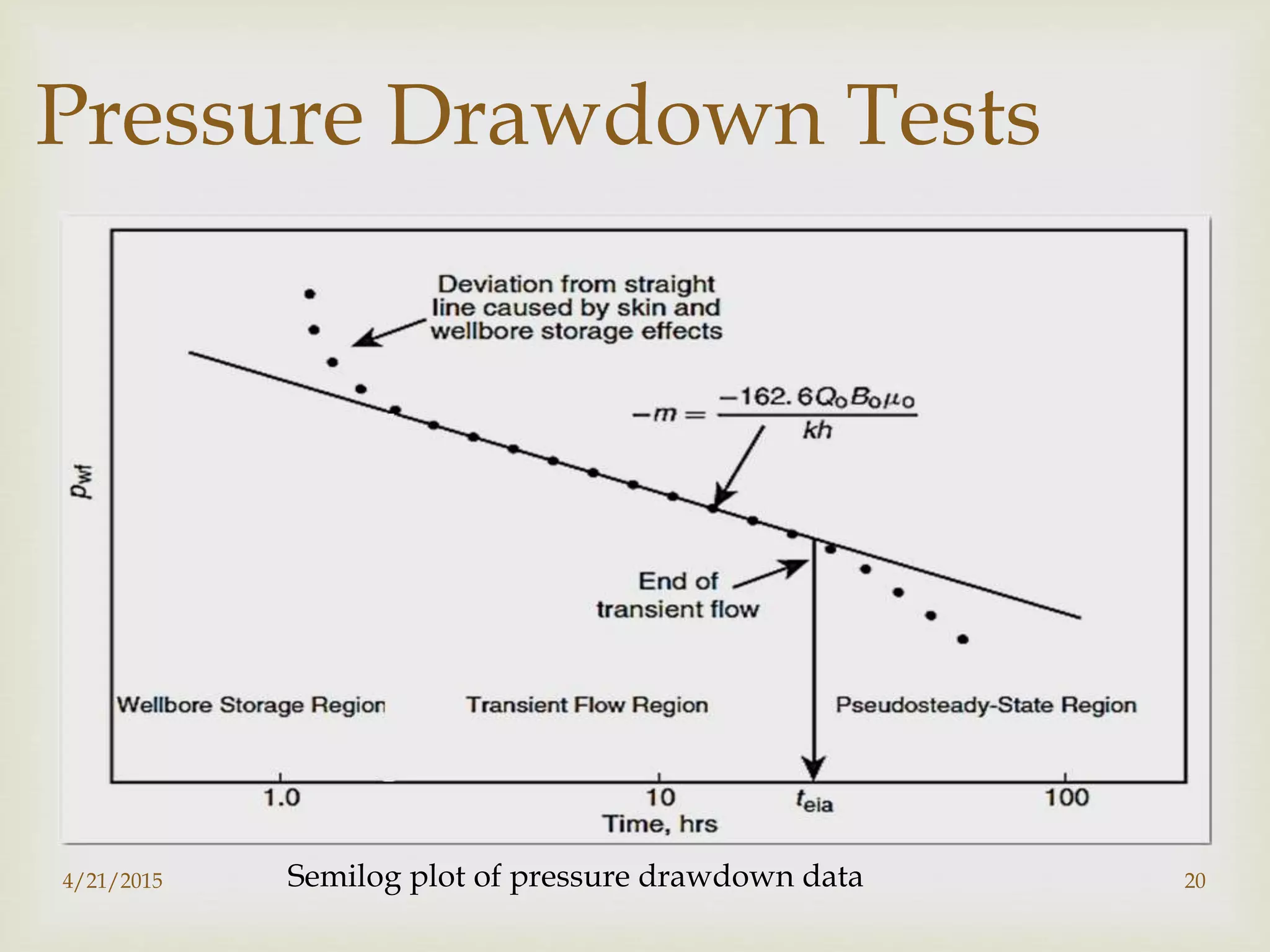
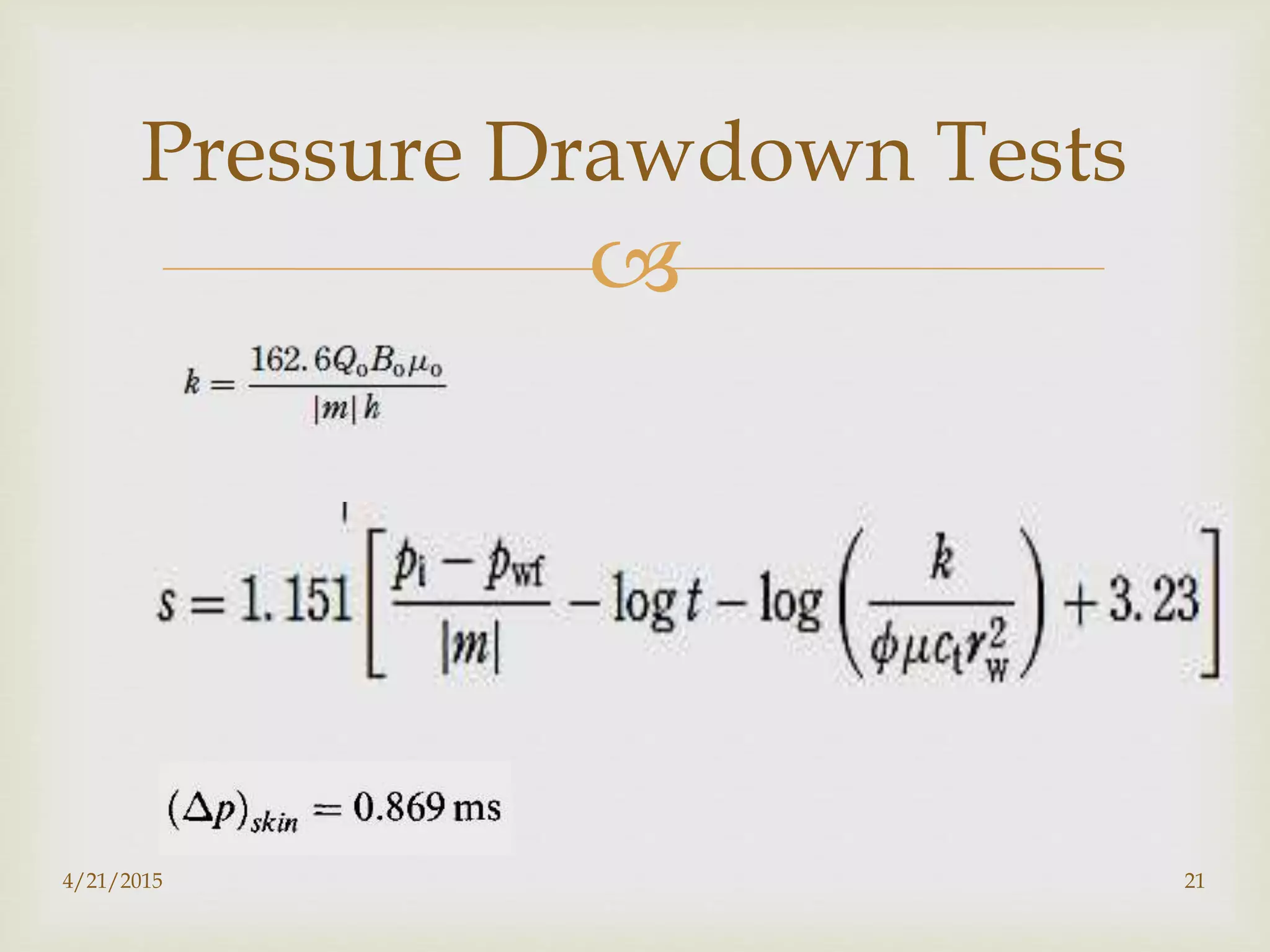
Pressure Drawdown Tests
4/21/2015 19
•Advantages:
–Suitable in newwells
–No need to lose production
– K, S, reservoir size can be determined
•Disadvantages:
–Difficult to maintain constant production rate.
Pressure Drawdown Tests
4/21/2015 22
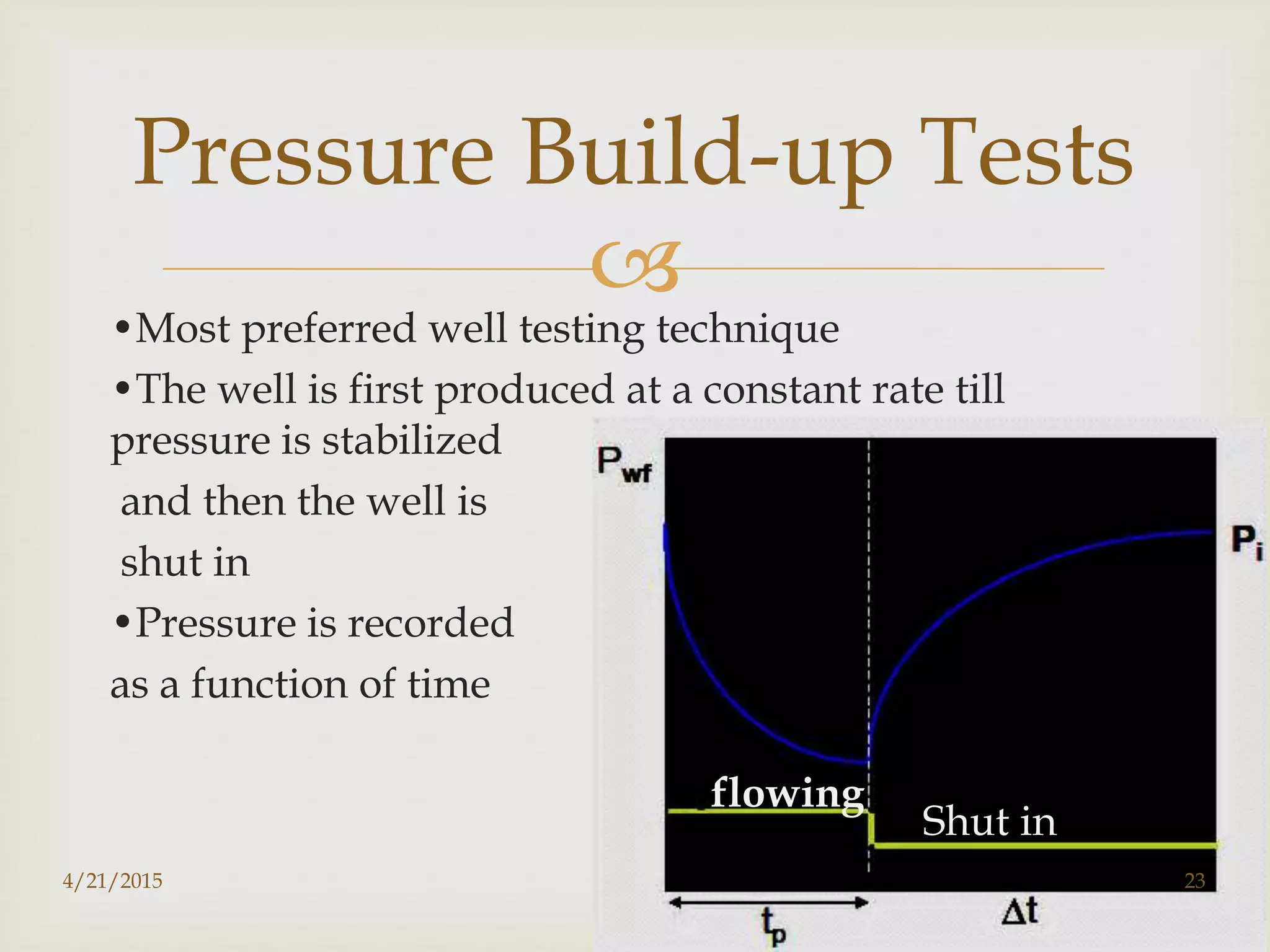
23.
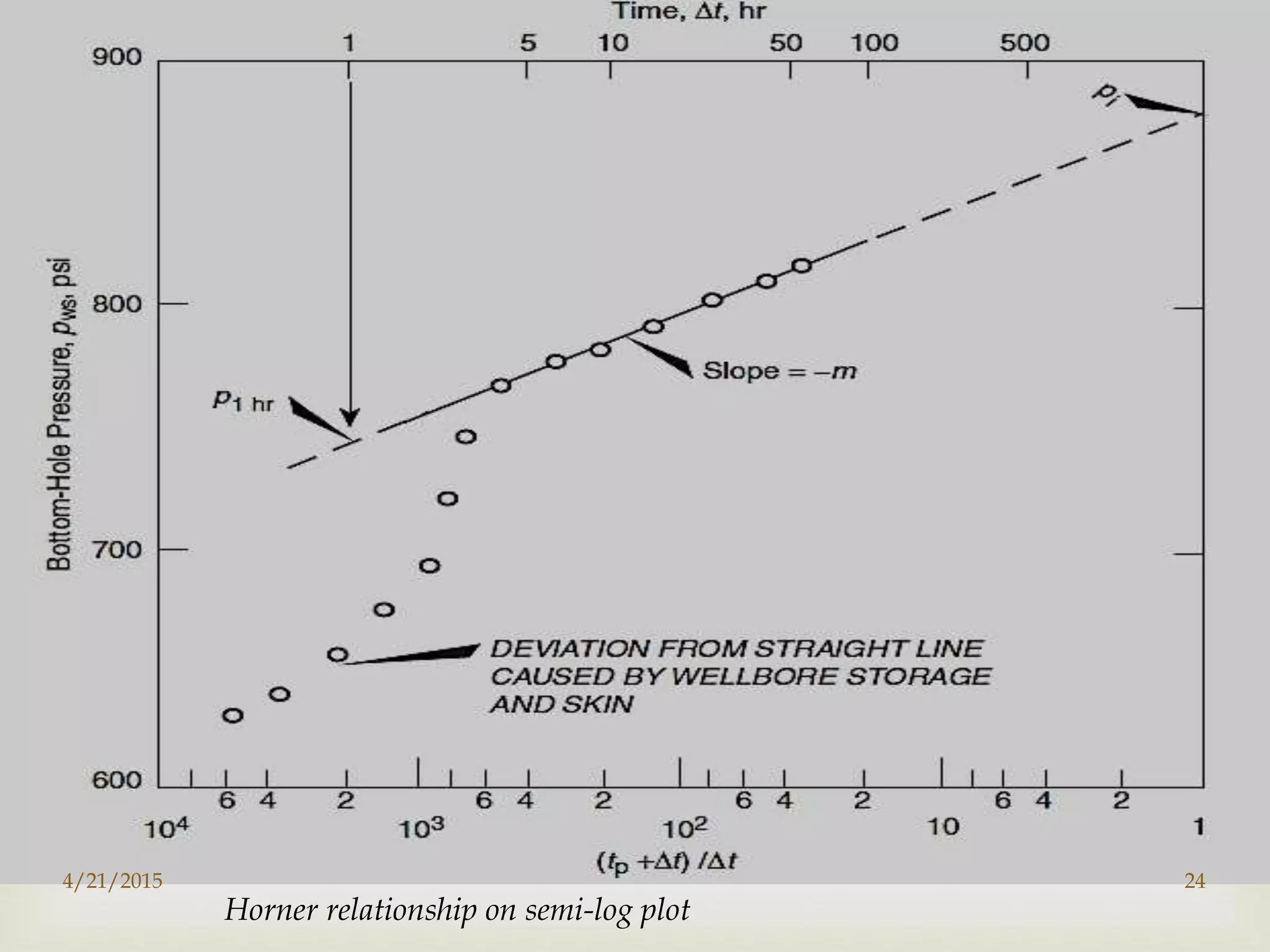
•Most preferred welltesting technique
•The well is first produced at a constant rate till
pressure is stabilized
and then the well is
shut in
•Pressure is recorded
as a function of time
Pressure Build-up Tests
Shut in
flowing
4/21/2015 23
•Advantages:
–Precise control ofrate
–P* can be determined
•Disadvantages:
–Loss of production due to shut in.
Pressure Build-up Tests
4/21/2015 26
27.
Formation damagecan be occurred in different stages of oil
well operations.
Skin factors can be positive or negative .
Well testing can help reservoir engineer as a formation
evaluation tool to describe the future performance of oil wells
in terms of pressure drop and flow efficiency.
Different methods of well testing such as Build-up,
drawdown, injection, fall of, can be applied at different case
to determine skin factor of oil wells.
Petroleum engineer need to monitor oil well timely, therefore
different action need to be don,
Sometime formation damage can be due to partial penetration
. of the pay zone .
Conclusion
4/21/2015 27





![well_test_lectures__Lo4[1].ppt well testing](https://cdn.slidesharecdn.com/ss_thumbnails/welltestlectureslo41-250203120844-25dfcd18-thumbnail.jpg?width=640&height=640&fit=bounds)


