PART 7: RESERVOIR DRIVE MECHANISMS
Objectives
 Introduce and give a detailed discussion of the various
primary recovery mechanisms and their effects on the overall
performance of oil reservoirs.
 Provide the basic principles of the material balance equation
and other governing relationships that can be used to predict
the volumetric performance of oil reservoirs.
1
TTOWG!
CU PET 323, 2012/2013
PET 323– Reservoir Engineering I – D. Abraham and O. Olabode
PART 7: RESERVOIR DRIVE MECHANISMS
2
TTOWG!
CU PET 323, 2012/2013
PET 323– Reservoir Engineering I – D. Abraham and O. Olabode
PART 7: RESERVOIR DRIVE MECHANISMS
Introduction
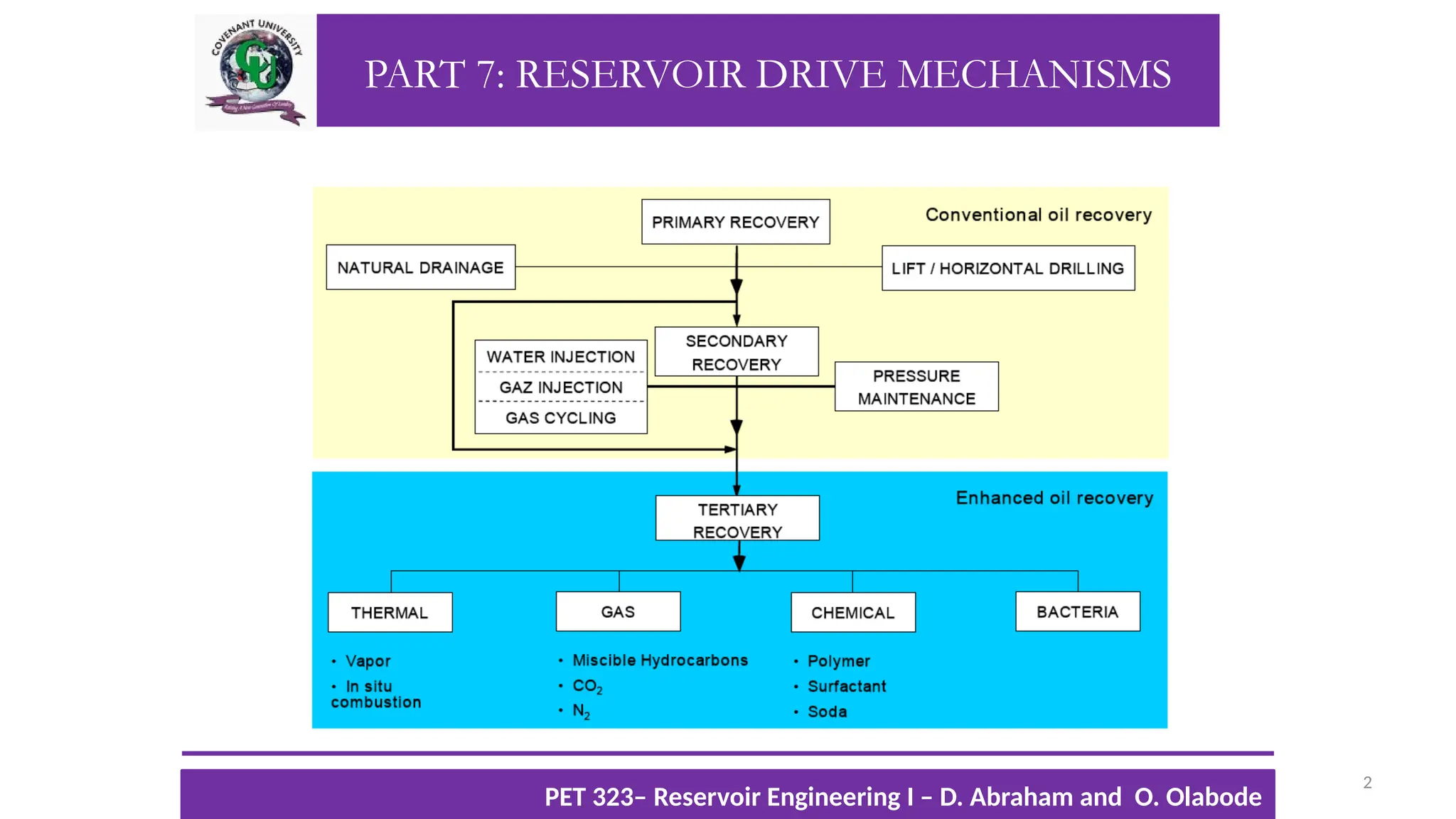
 All petroleum reservoirs can be grouped according to the
primary recovery mechanism by which they produce.
 Each drive mechanism is characterized by a unique
performance in terms of:
 Ultimate recovery factor
 Pressure decline rate
 Gas-oil ratio evolution
 Water production evolution
Primary Recovery
 This refers to all hydrocarbons produced using the internal
energy of the reservoir without any form of supplements
such as water or gas injection.
3
TTOWG!
CU PET 323, 2012/2013
PET 323– Reservoir Engineering I – D. Abraham and O. Olabode
PART 7: RESERVOIR DRIVE MECHANISMS
Primary Drive Mechanisms
 In order to be able to predict and optimize the future
performance of the reservoir, it is important to know the
main drive mechanism(s) or energie(s) at play in a reservoir.
 There are six basic reservoir drive mechanisms and they are:
 Rock and liquid expansion drive
 Depletion drive
 Gas cap drive
 Water drive
 Gravity drainage and
 Combination drive
4
TTOWG!
CU PET 323, 2012/2013
PET 323– Reservoir Engineering I – D. Abraham and O. Olabode
PART 7: RESERVOIR DRIVE MECHANISMS
Primary Drive Mechanisms
Rock and Liquid Expansion
 An under saturated reservoir is one which exists above the
bubble point pressure (no gas cap).
 Oil, connate water and rocks are the only materials present in
a reservoir above the bubble point pressure.
 In the course of producing the reservoir fluid (crude oil), the
pressure declines and as the pressure reduces, the rock and
fluids expand due to their compressibilities.
5
TTOWG!
CU PET 323, 2012/2013
PET 323– Reservoir Engineering I – D. Abraham and O. Olabode
PART 7: RESERVOIR DRIVE MECHANISMS
Primary Drive Mechanisms
Rock and Liquid Expansion Above Bubble Point Pressure, Pb
 Two factors influence the reservoir rock compressiblity:
 Expansion of individual rock grains
 Formation compaction due to increase in net overburden pressure
 These two factors act to reduce the pore volume thus forcing
reservoir fluids out of the pore spaces and pushing them
towards the wellbore
 Since the rock and fluids are only slightly compressible, the
reservoir pressure will decline rapidly as production
proceeds.
 This mechanism is the least effective and recovers on average
less than 7 percent of the oil in place.
6
TTOWG!
CU PET 323, 2012/2013
PET 323– Reservoir Engineering I – D. Abraham and O. Olabode
PART 7: RESERVOIR DRIVE MECHANISMS
Primary Drive Mechanisms
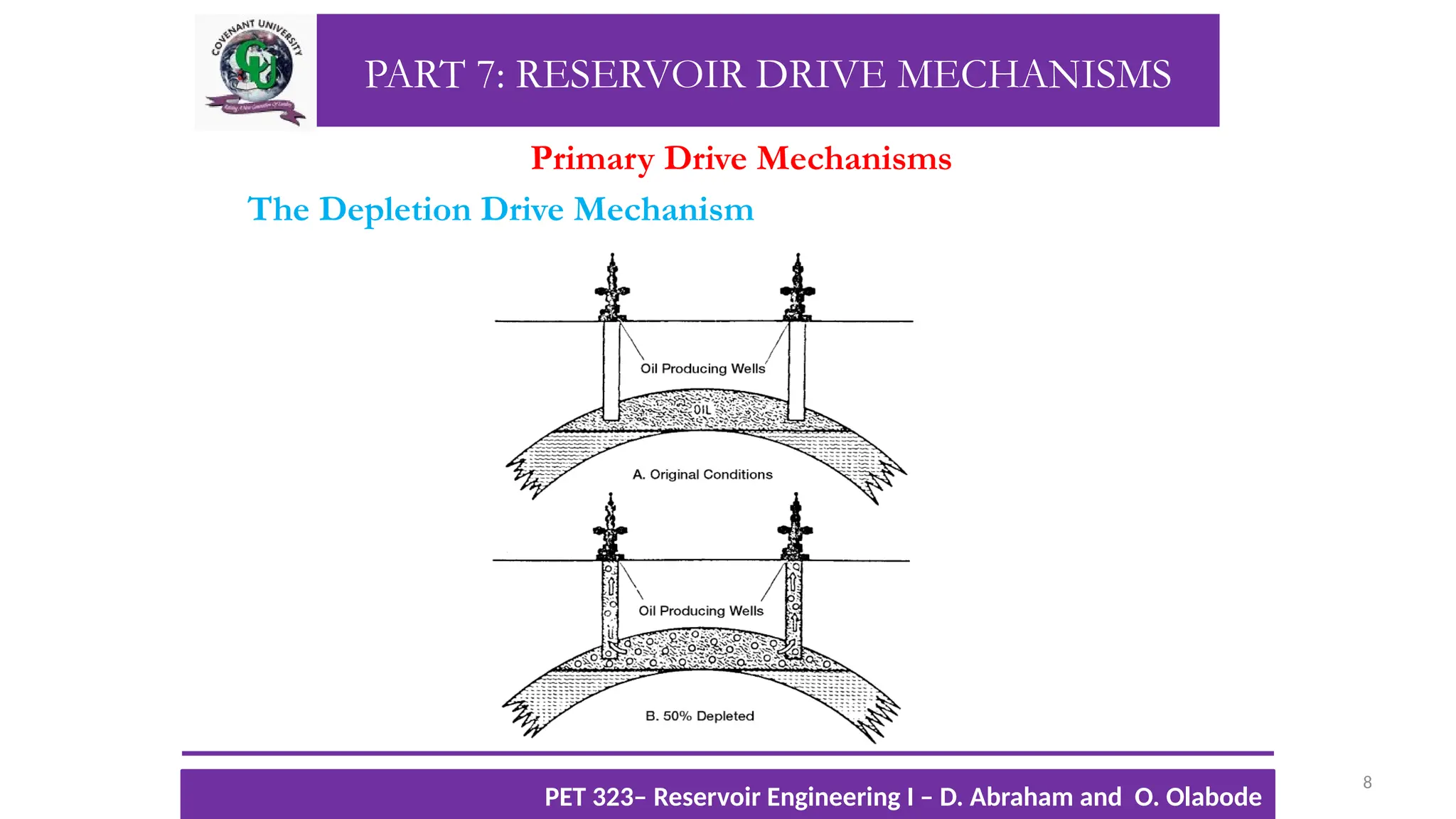
The Depletion Drive Mechanism
 This drive is also known as: Solution Gas Drive, Dissolved
Gas Drive and Internal Gas Drive
 For an initially under saturated reservoir, as the reservoir
pressure decline below the bubble point pressure, dissolved
gas is released from solution
 In this kind of reservoir, the main source of reservoir energy
comes from the expansion of gas bubbles released from
solution as the reservoir pressure declines below the bubble
point
 As production proceeds further, the gas bubbles then expand
and force the crude oil out of the pores and into the well
7
TTOWG!
CU PET 323, 2012/2013
PET 323– Reservoir Engineering I – D. Abraham and O. Olabode
PART 7: RESERVOIR DRIVE MECHANISMS
Primary Drive Mechanisms
The Depletion Drive Mechanism
8
TTOWG!
CU PET 323, 2012/2013
PET 323– Reservoir Engineering I – D. Abraham and O. Olabode
PART 7: RESERVOIR DRIVE MECHANISMS
Primary Drive Mechanisms
The Depletion Drive Mechanism
9
TTOWG!
CU PET 323, 2012/2013
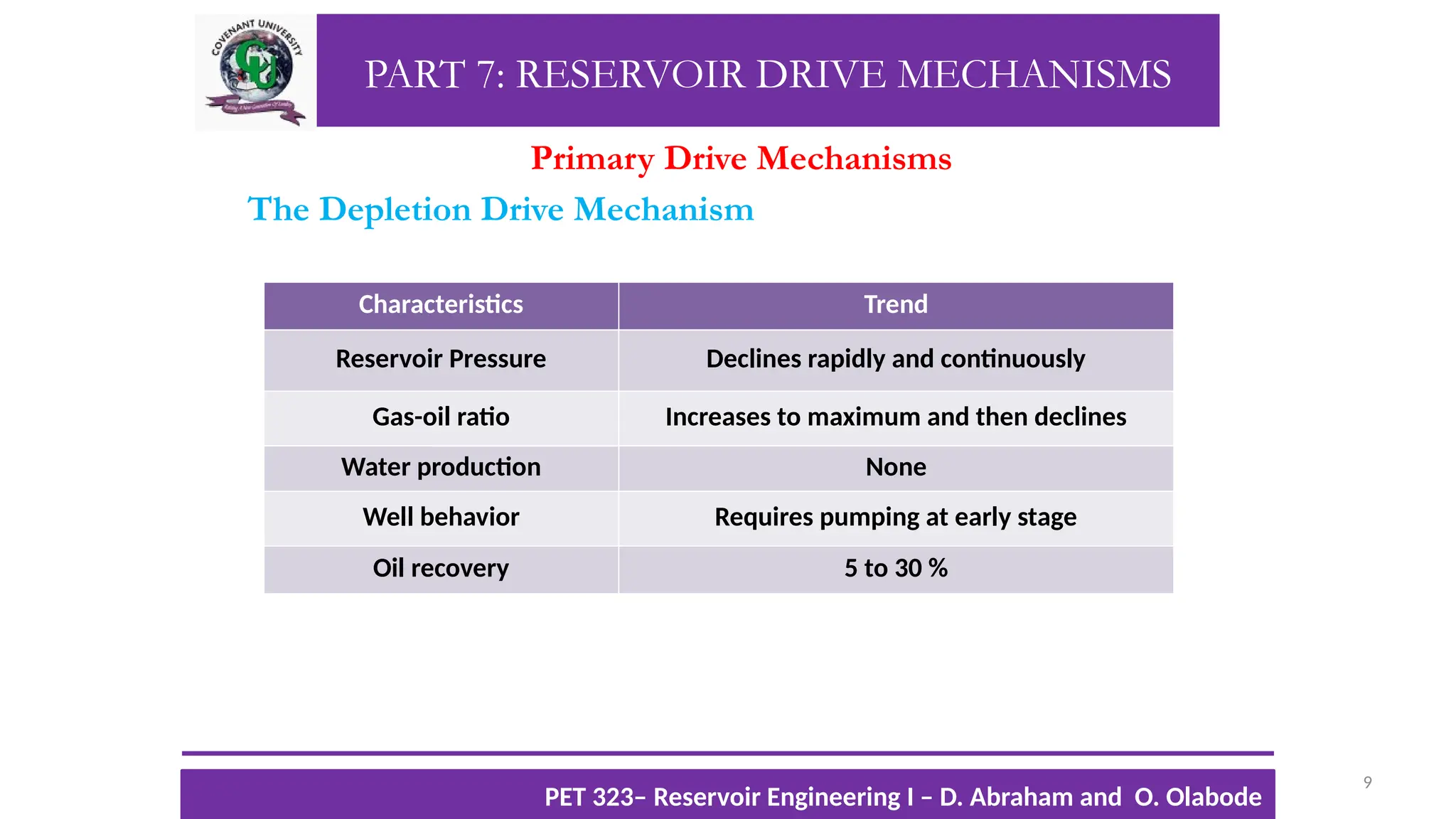
Characteristics Trend
Reservoir Pressure Declines rapidly and continuously
Gas-oil ratio Increases to maximum and then declines
Water production None
Well behavior Requires pumping at early stage
Oil recovery 5 to 30 %
PET 323– Reservoir Engineering I – D. Abraham and O. Olabode
PART 7: RESERVOIR DRIVE MECHANISMS
Primary Drive Mechanisms
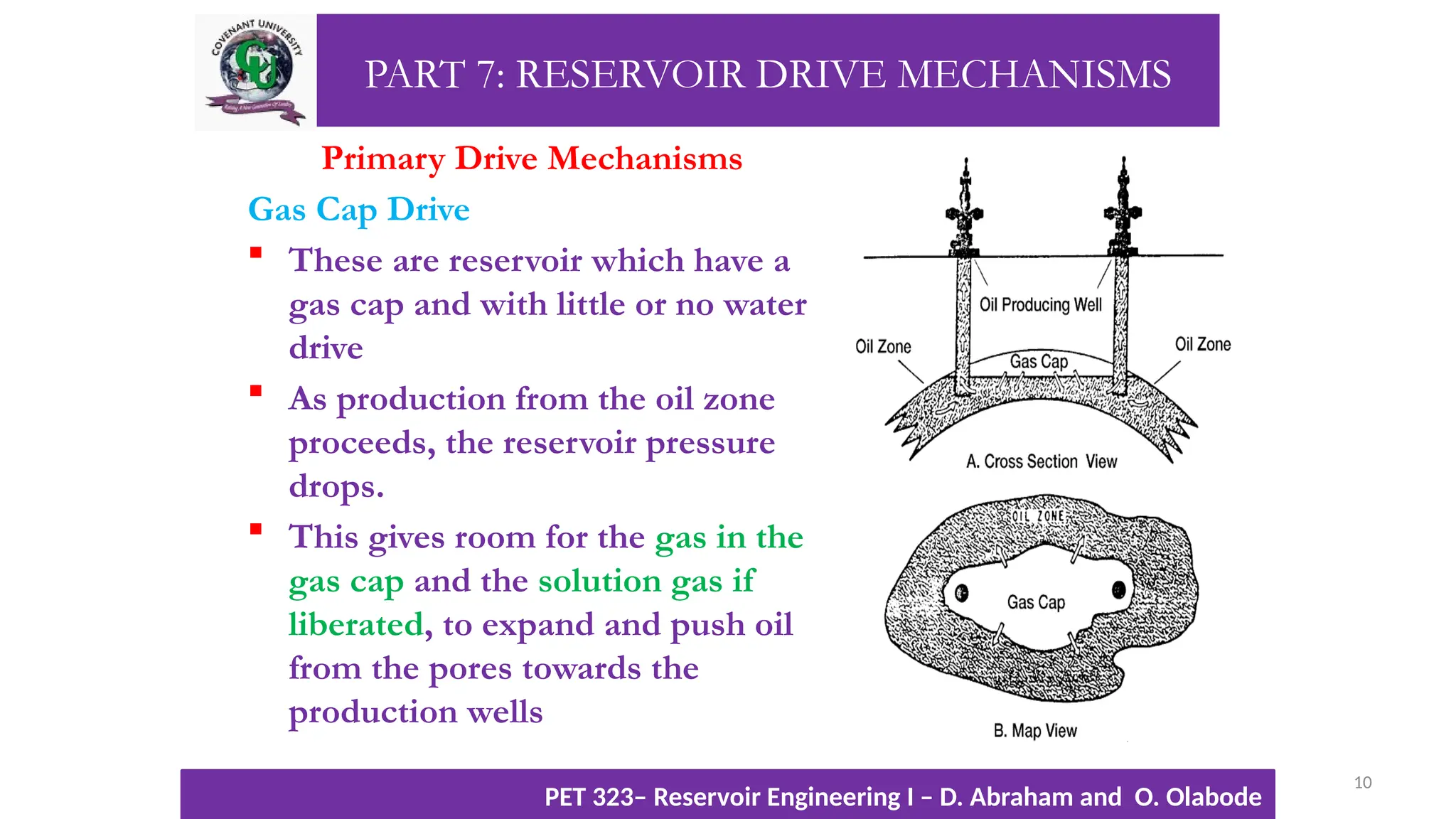
Gas Cap Drive
 These are reservoir which have a
gas cap and with little or no water
drive
 As production from the oil zone
proceeds, the reservoir pressure
drops.
 This gives room for the gas in the
gas cap and the solution gas if
liberated, to expand and push oil
from the pores towards the
production wells
10
TTOWG!
CU PET 323, 2012/2013
PET 323– Reservoir Engineering I – D. Abraham and O. Olabode
PART 7: RESERVOIR DRIVE MECHANISMS
Primary Drive Mechanisms
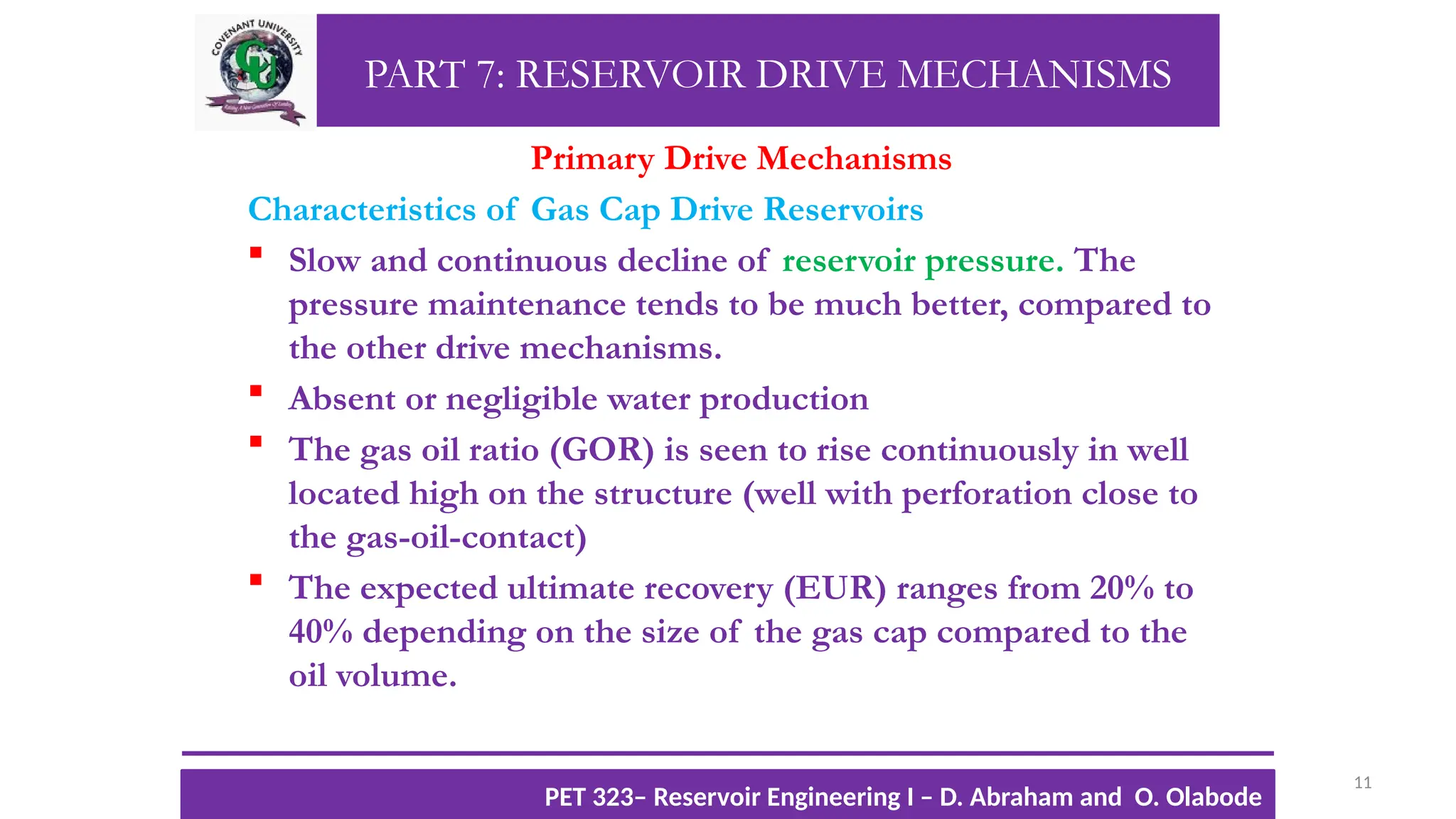
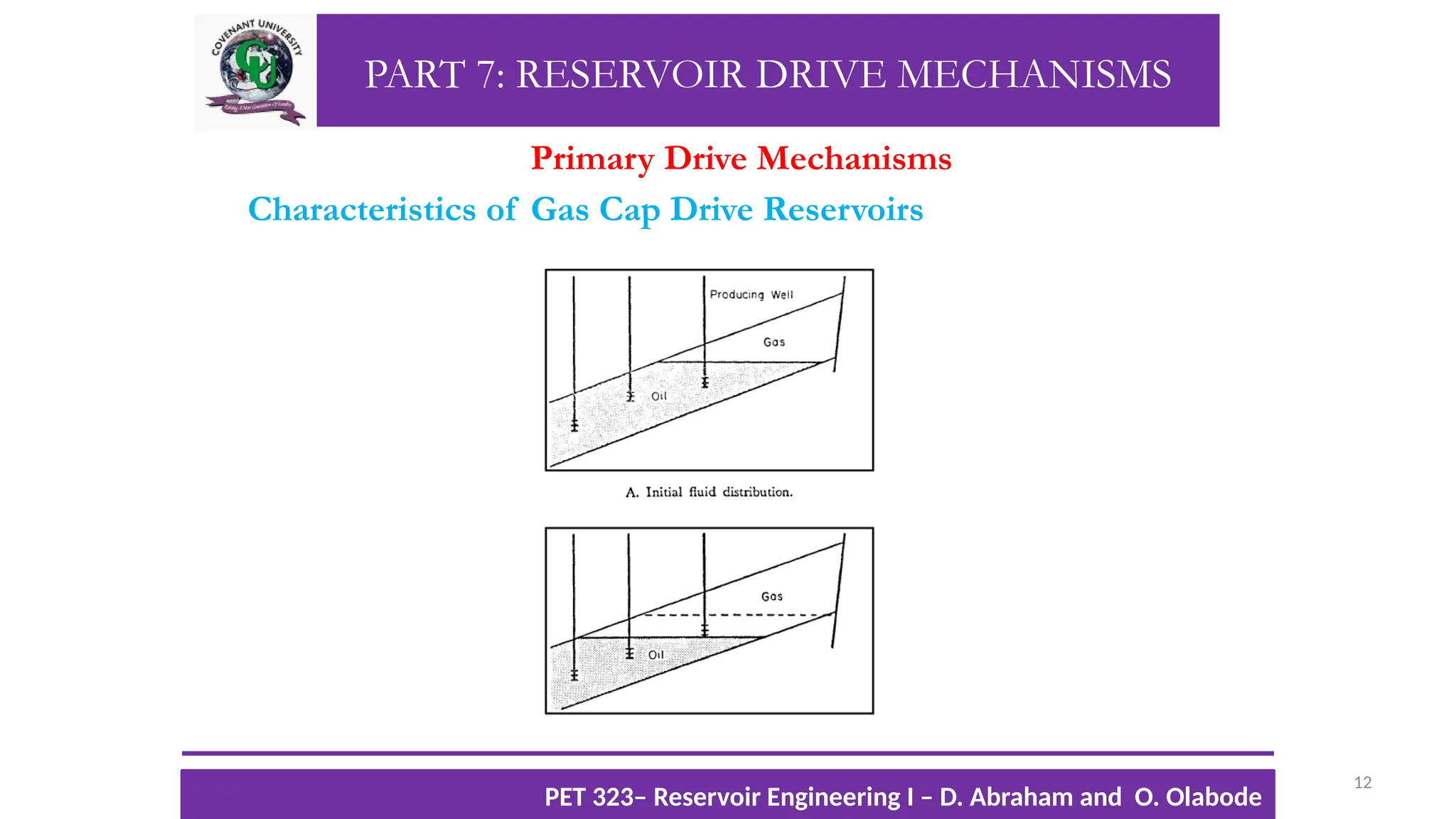
Characteristics of Gas Cap Drive Reservoirs
 Slow and continuous decline of reservoir pressure. The
pressure maintenance tends to be much better, compared to
the other drive mechanisms.
 Absent or negligible water production
 The gas oil ratio (GOR) is seen to rise continuously in well
located high on the structure (well with perforation close to
the gas-oil-contact)
 The expected ultimate recovery (EUR) ranges from 20% to
40% depending on the size of the gas cap compared to the
oil volume.
11
TTOWG!
CU PET 323, 2012/2013
PET 323– Reservoir Engineering I – D. Abraham and O. Olabode
PART 7: RESERVOIR DRIVE MECHANISMS
Primary Drive Mechanisms
Characteristics of Gas Cap Drive Reservoirs
12
TTOWG!
CU PET 323, 2012/2013
PET 323– Reservoir Engineering I – D. Abraham and O. Olabode
PART 7: RESERVOIR DRIVE MECHANISMS
Primary Drive Mechanisms
Characteristics of Gas Cap Drive Reservoirs
 Well Behavior
Factors which Affect the Performance of Gas Cap Drive Reservoirs
 Size of the Original Gas Cap – Impacts on the ultimate recovery
 Vertical Permeability – If high, the evolved gas will migrate
upwards towards the gas cap
 Oil Viscosity – Oil viscosity reduces and evolved gas bypasses oil
and reach the wells
 Degree of Conservation of the Gas - Shut in wells with high
GORs
 Oil Production Rate
 Dip Angle – The higher this is, the more effective the gravity
drainage becomes
13
TTOWG!
CU PET 323, 2012/2013
PET 323– Reservoir Engineering I – D. Abraham and O. Olabode
PART 7: RESERVOIR DRIVE MECHANISMS
Primary Drive Mechanisms
Characteristics of Gas Cap Drive Reservoirs
14
TTOWG!
CU PET 323, 2012/2013
PET 323– Reservoir Engineering I – D. Abraham and O. Olabode
PART 7: RESERVOIR DRIVE MECHANISMS
Primary Drive Mechanisms
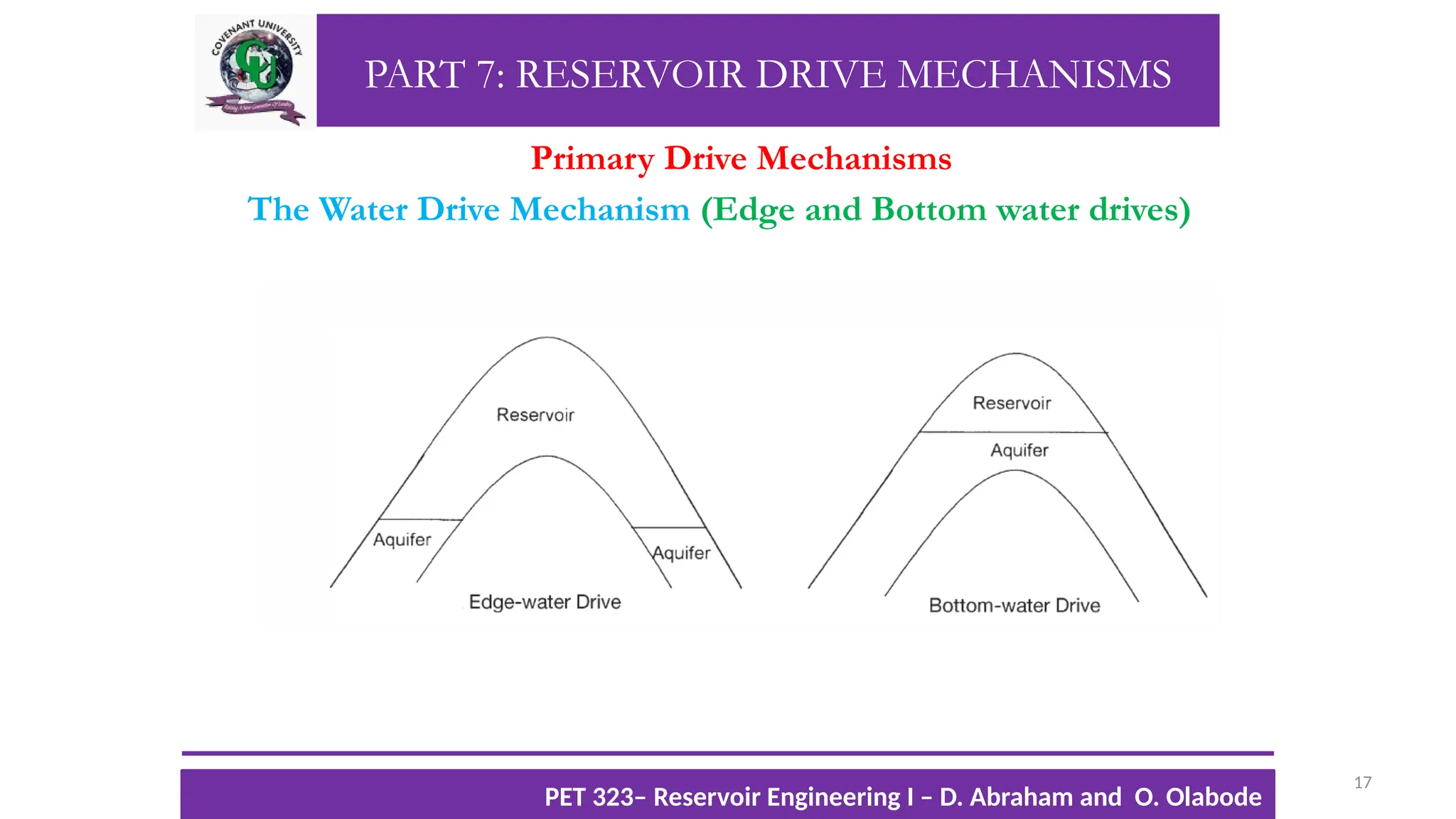
The Water Drive Mechanism
 This results owing to the fact that many reservoirs are
connected to water bearing rocks called “Aquifers”. In other
instances, the reservoir rock simply outcrops and gets
replenished by surface waters
Types of Water Drive
 Bottom Water Drive
 Edge Water Drive
 Artesian Water Drive
15
TTOWG!
CU PET 323, 2012/2013
PET 323– Reservoir Engineering I – D. Abraham and O. Olabode
PART 7: RESERVOIR DRIVE MECHANISMS
Primary Drive Mechanisms
The Water Drive Mechanism (Artesian Water Drive)
16
TTOWG!
CU PET 323, 2012/2013
PET 323– Reservoir Engineering I – D. Abraham and O. Olabode
PART 7: RESERVOIR DRIVE MECHANISMS
Primary Drive Mechanisms
The Water Drive Mechanism (Edge and Bottom water drives)
17
TTOWG!
CU PET 323, 2012/2013
PET 323– Reservoir Engineering I – D. Abraham and O. Olabode
PART 7: RESERVOIR DRIVE MECHANISMS
Primary Drive Mechanisms
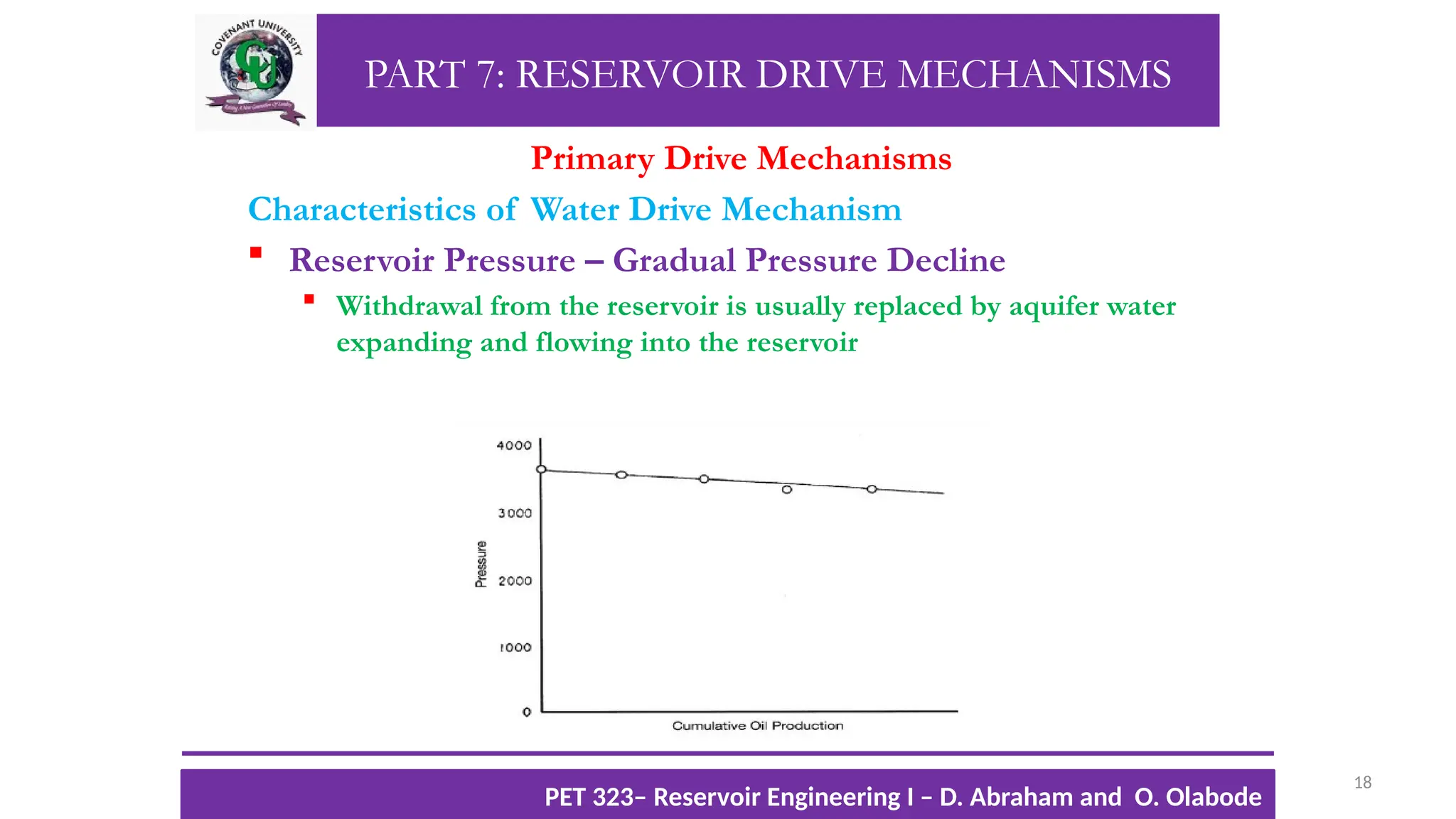
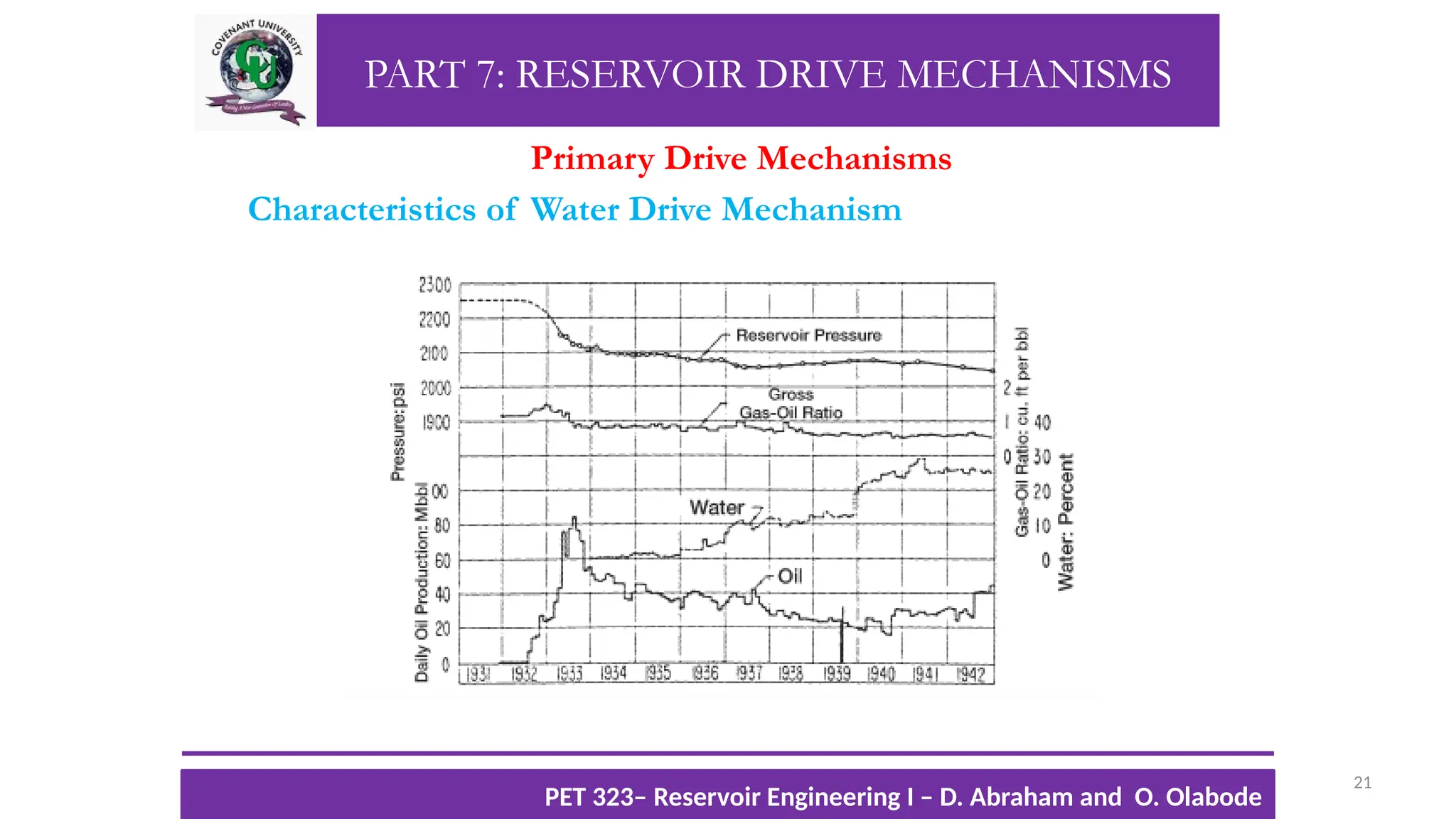
Characteristics of Water Drive Mechanism
 Reservoir Pressure – Gradual Pressure Decline
 Withdrawal from the reservoir is usually replaced by aquifer water
expanding and flowing into the reservoir
18
TTOWG!
CU PET 323, 2012/2013
PET 323– Reservoir Engineering I – D. Abraham and O. Olabode
PART 7: RESERVOIR DRIVE MECHANISMS
Primary Drive Mechanisms
Characteristics of Water Drive Mechanism
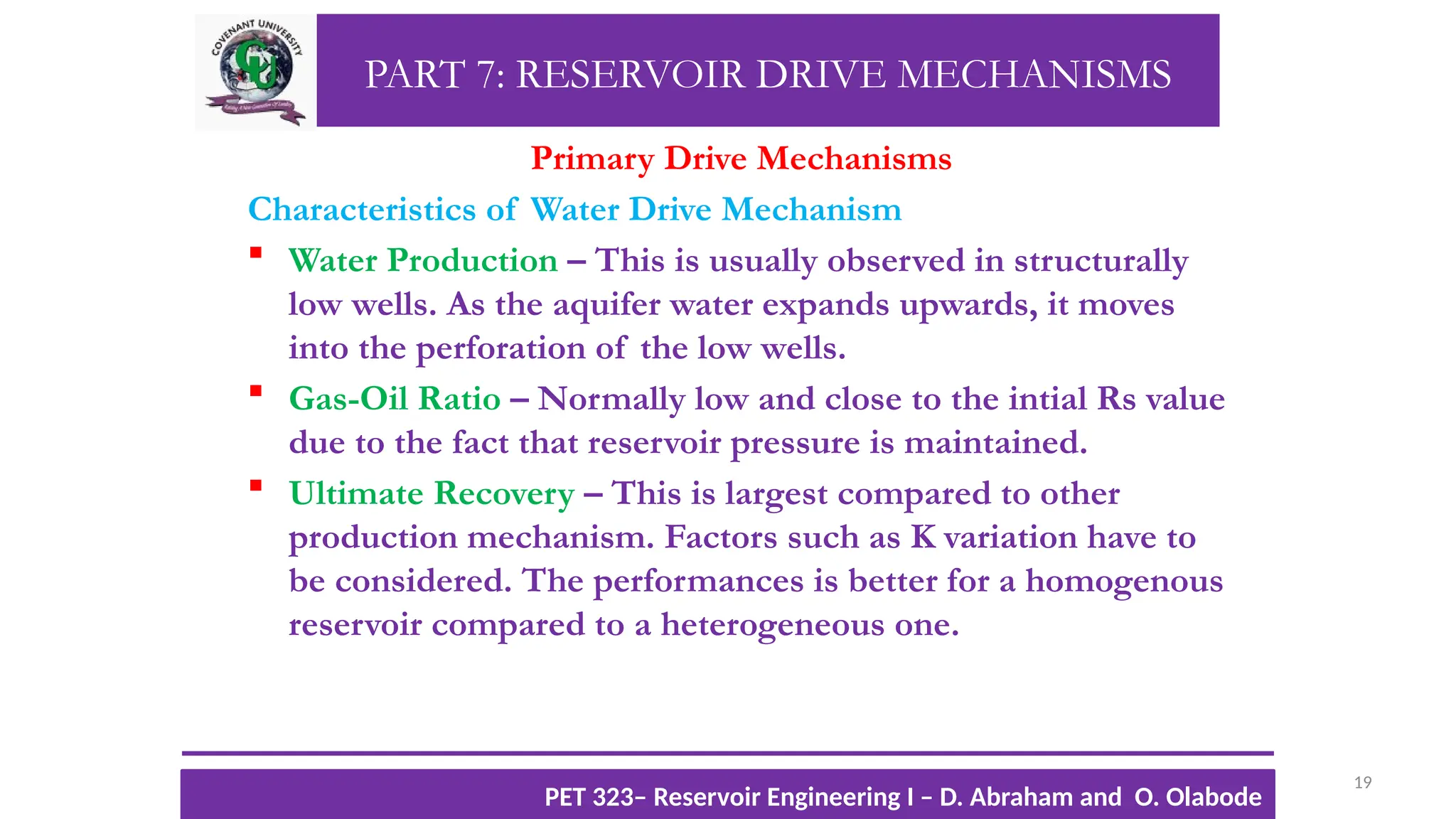
 Water Production – This is usually observed in structurally
low wells. As the aquifer water expands upwards, it moves
into the perforation of the low wells.
 Gas-Oil Ratio – Normally low and close to the intial Rs value
due to the fact that reservoir pressure is maintained.
 Ultimate Recovery – This is largest compared to other
production mechanism. Factors such as K variation have to
be considered. The performances is better for a homogenous
reservoir compared to a heterogeneous one.
19
TTOWG!
CU PET 323, 2012/2013
PET 323– Reservoir Engineering I – D. Abraham and O. Olabode
PART 7: RESERVOIR DRIVE MECHANISMS
Primary Drive Mechanisms
Characteristics of Water Drive Mechanism
20
TTOWG!
CU PET 323, 2012/2013
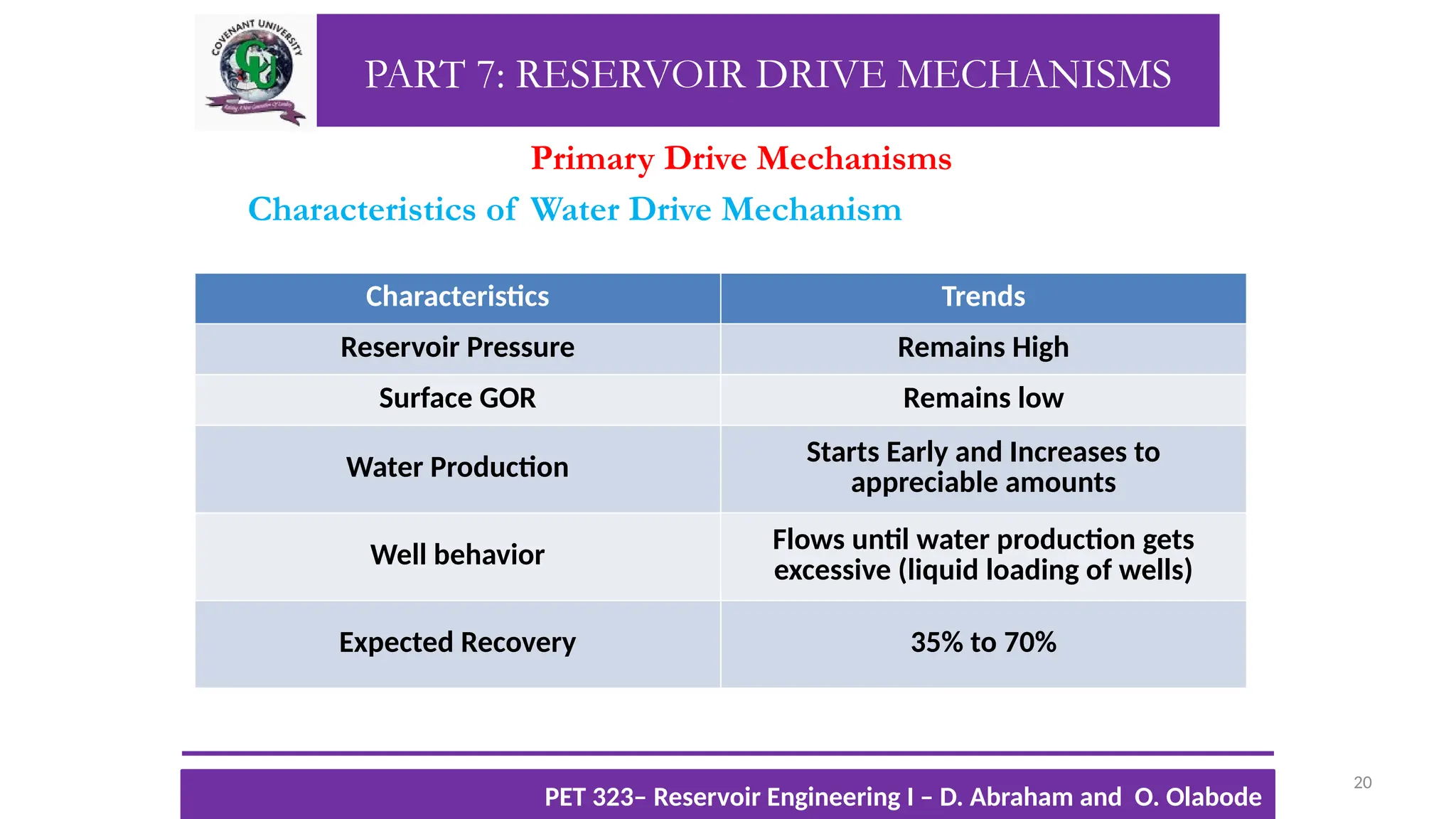
Characteristics Trends
Reservoir Pressure Remains High
Surface GOR Remains low
Water Production
Starts Early and Increases to
appreciable amounts
Well behavior
Flows until water production gets
excessive (liquid loading of wells)
Expected Recovery 35% to 70%
PET 323– Reservoir Engineering I – D. Abraham and O. Olabode
PART 7: RESERVOIR DRIVE MECHANISMS
Primary Drive Mechanisms
Characteristics of Water Drive Mechanism
21
TTOWG!
CU PET 323, 2012/2013
PET 323– Reservoir Engineering I – D. Abraham and O. Olabode
PART 7: RESERVOIR DRIVE MECHANISMS
Primary Drive Mechanisms
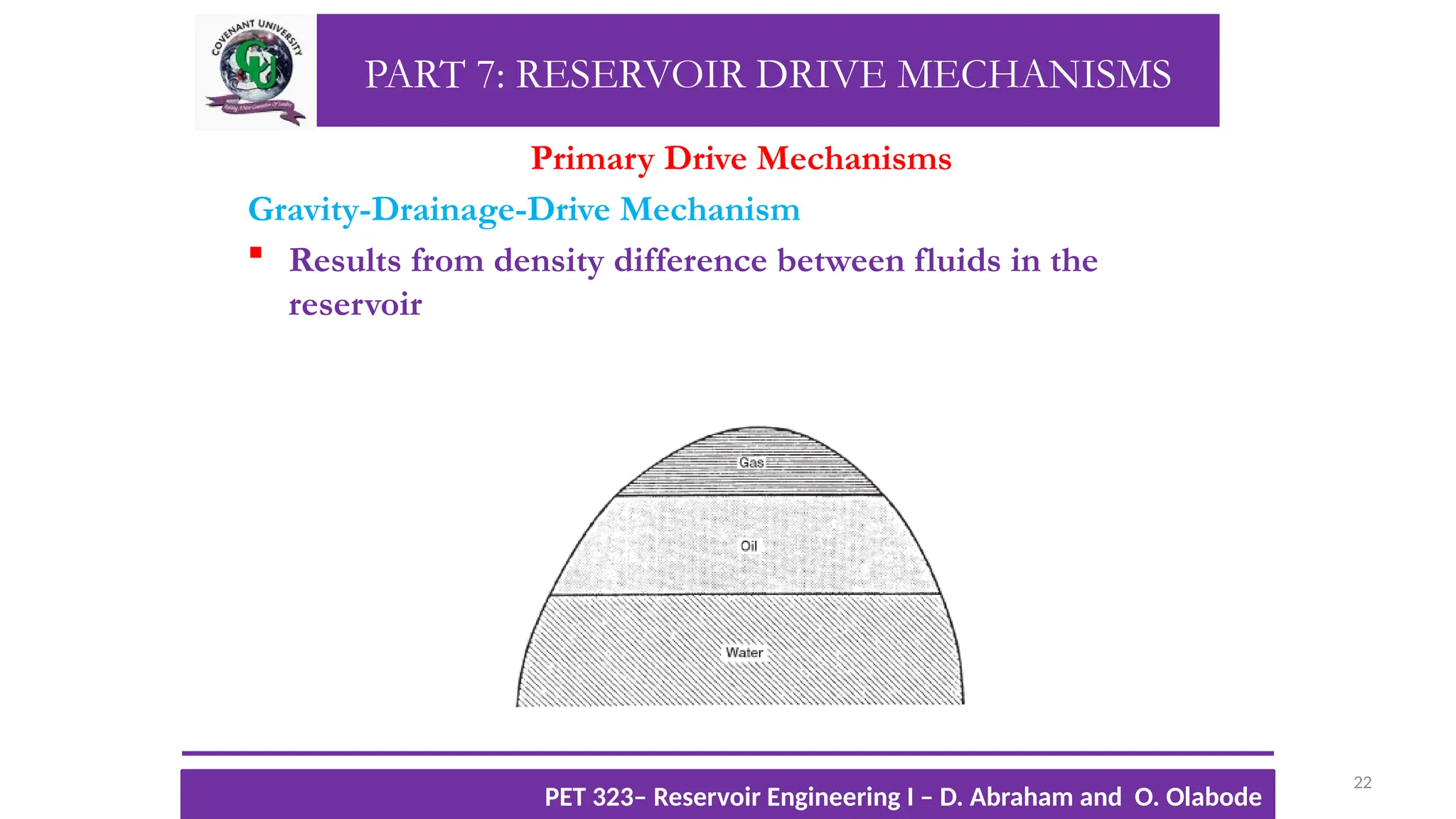
Gravity-Drainage-Drive Mechanism
 Results from density difference between fluids in the
reservoir
22
TTOWG!
CU PET 323, 2012/2013
PET 323– Reservoir Engineering I – D. Abraham and O. Olabode

Reservoir Drive Mechanisms in Reservoir Engineering

  • 1.
    PART 7: RESERVOIRDRIVE MECHANISMS Objectives  Introduce and give a detailed discussion of the various primary recovery mechanisms and their effects on the overall performance of oil reservoirs.  Provide the basic principles of the material balance equation and other governing relationships that can be used to predict the volumetric performance of oil reservoirs. 1 TTOWG! CU PET 323, 2012/2013 PET 323– Reservoir Engineering I – D. Abraham and O. Olabode
  • 2.
    PART 7: RESERVOIRDRIVE MECHANISMS 2 TTOWG! CU PET 323, 2012/2013 PET 323– Reservoir Engineering I – D. Abraham and O. Olabode
  • 3.
    PART 7: RESERVOIRDRIVE MECHANISMS Introduction  All petroleum reservoirs can be grouped according to the primary recovery mechanism by which they produce.  Each drive mechanism is characterized by a unique performance in terms of:  Ultimate recovery factor  Pressure decline rate  Gas-oil ratio evolution  Water production evolution Primary Recovery  This refers to all hydrocarbons produced using the internal energy of the reservoir without any form of supplements such as water or gas injection. 3 TTOWG! CU PET 323, 2012/2013 PET 323– Reservoir Engineering I – D. Abraham and O. Olabode
  • 4.
    PART 7: RESERVOIRDRIVE MECHANISMS Primary Drive Mechanisms  In order to be able to predict and optimize the future performance of the reservoir, it is important to know the main drive mechanism(s) or energie(s) at play in a reservoir.  There are six basic reservoir drive mechanisms and they are:  Rock and liquid expansion drive  Depletion drive  Gas cap drive  Water drive  Gravity drainage and  Combination drive 4 TTOWG! CU PET 323, 2012/2013 PET 323– Reservoir Engineering I – D. Abraham and O. Olabode
  • 5.
    PART 7: RESERVOIRDRIVE MECHANISMS Primary Drive Mechanisms Rock and Liquid Expansion  An under saturated reservoir is one which exists above the bubble point pressure (no gas cap).  Oil, connate water and rocks are the only materials present in a reservoir above the bubble point pressure.  In the course of producing the reservoir fluid (crude oil), the pressure declines and as the pressure reduces, the rock and fluids expand due to their compressibilities. 5 TTOWG! CU PET 323, 2012/2013 PET 323– Reservoir Engineering I – D. Abraham and O. Olabode
  • 6.
    PART 7: RESERVOIRDRIVE MECHANISMS Primary Drive Mechanisms Rock and Liquid Expansion Above Bubble Point Pressure, Pb  Two factors influence the reservoir rock compressiblity:  Expansion of individual rock grains  Formation compaction due to increase in net overburden pressure  These two factors act to reduce the pore volume thus forcing reservoir fluids out of the pore spaces and pushing them towards the wellbore  Since the rock and fluids are only slightly compressible, the reservoir pressure will decline rapidly as production proceeds.  This mechanism is the least effective and recovers on average less than 7 percent of the oil in place. 6 TTOWG! CU PET 323, 2012/2013 PET 323– Reservoir Engineering I – D. Abraham and O. Olabode
  • 7.
    PART 7: RESERVOIRDRIVE MECHANISMS Primary Drive Mechanisms The Depletion Drive Mechanism  This drive is also known as: Solution Gas Drive, Dissolved Gas Drive and Internal Gas Drive  For an initially under saturated reservoir, as the reservoir pressure decline below the bubble point pressure, dissolved gas is released from solution  In this kind of reservoir, the main source of reservoir energy comes from the expansion of gas bubbles released from solution as the reservoir pressure declines below the bubble point  As production proceeds further, the gas bubbles then expand and force the crude oil out of the pores and into the well 7 TTOWG! CU PET 323, 2012/2013 PET 323– Reservoir Engineering I – D. Abraham and O. Olabode
  • 8.
    PART 7: RESERVOIRDRIVE MECHANISMS Primary Drive Mechanisms The Depletion Drive Mechanism 8 TTOWG! CU PET 323, 2012/2013 PET 323– Reservoir Engineering I – D. Abraham and O. Olabode
  • 9.
    PART 7: RESERVOIRDRIVE MECHANISMS Primary Drive Mechanisms The Depletion Drive Mechanism 9 TTOWG! CU PET 323, 2012/2013 Characteristics Trend Reservoir Pressure Declines rapidly and continuously Gas-oil ratio Increases to maximum and then declines Water production None Well behavior Requires pumping at early stage Oil recovery 5 to 30 % PET 323– Reservoir Engineering I – D. Abraham and O. Olabode
  • 10.
    PART 7: RESERVOIRDRIVE MECHANISMS Primary Drive Mechanisms Gas Cap Drive  These are reservoir which have a gas cap and with little or no water drive  As production from the oil zone proceeds, the reservoir pressure drops.  This gives room for the gas in the gas cap and the solution gas if liberated, to expand and push oil from the pores towards the production wells 10 TTOWG! CU PET 323, 2012/2013 PET 323– Reservoir Engineering I – D. Abraham and O. Olabode
  • 11.
    PART 7: RESERVOIRDRIVE MECHANISMS Primary Drive Mechanisms Characteristics of Gas Cap Drive Reservoirs  Slow and continuous decline of reservoir pressure. The pressure maintenance tends to be much better, compared to the other drive mechanisms.  Absent or negligible water production  The gas oil ratio (GOR) is seen to rise continuously in well located high on the structure (well with perforation close to the gas-oil-contact)  The expected ultimate recovery (EUR) ranges from 20% to 40% depending on the size of the gas cap compared to the oil volume. 11 TTOWG! CU PET 323, 2012/2013 PET 323– Reservoir Engineering I – D. Abraham and O. Olabode
  • 12.
    PART 7: RESERVOIRDRIVE MECHANISMS Primary Drive Mechanisms Characteristics of Gas Cap Drive Reservoirs 12 TTOWG! CU PET 323, 2012/2013 PET 323– Reservoir Engineering I – D. Abraham and O. Olabode
  • 13.
    PART 7: RESERVOIRDRIVE MECHANISMS Primary Drive Mechanisms Characteristics of Gas Cap Drive Reservoirs  Well Behavior Factors which Affect the Performance of Gas Cap Drive Reservoirs  Size of the Original Gas Cap – Impacts on the ultimate recovery  Vertical Permeability – If high, the evolved gas will migrate upwards towards the gas cap  Oil Viscosity – Oil viscosity reduces and evolved gas bypasses oil and reach the wells  Degree of Conservation of the Gas - Shut in wells with high GORs  Oil Production Rate  Dip Angle – The higher this is, the more effective the gravity drainage becomes 13 TTOWG! CU PET 323, 2012/2013 PET 323– Reservoir Engineering I – D. Abraham and O. Olabode
  • 14.
    PART 7: RESERVOIRDRIVE MECHANISMS Primary Drive Mechanisms Characteristics of Gas Cap Drive Reservoirs 14 TTOWG! CU PET 323, 2012/2013 PET 323– Reservoir Engineering I – D. Abraham and O. Olabode
  • 15.
    PART 7: RESERVOIRDRIVE MECHANISMS Primary Drive Mechanisms The Water Drive Mechanism  This results owing to the fact that many reservoirs are connected to water bearing rocks called “Aquifers”. In other instances, the reservoir rock simply outcrops and gets replenished by surface waters Types of Water Drive  Bottom Water Drive  Edge Water Drive  Artesian Water Drive 15 TTOWG! CU PET 323, 2012/2013 PET 323– Reservoir Engineering I – D. Abraham and O. Olabode
  • 16.
    PART 7: RESERVOIRDRIVE MECHANISMS Primary Drive Mechanisms The Water Drive Mechanism (Artesian Water Drive) 16 TTOWG! CU PET 323, 2012/2013 PET 323– Reservoir Engineering I – D. Abraham and O. Olabode
  • 17.
    PART 7: RESERVOIRDRIVE MECHANISMS Primary Drive Mechanisms The Water Drive Mechanism (Edge and Bottom water drives) 17 TTOWG! CU PET 323, 2012/2013 PET 323– Reservoir Engineering I – D. Abraham and O. Olabode
  • 18.
    PART 7: RESERVOIRDRIVE MECHANISMS Primary Drive Mechanisms Characteristics of Water Drive Mechanism  Reservoir Pressure – Gradual Pressure Decline  Withdrawal from the reservoir is usually replaced by aquifer water expanding and flowing into the reservoir 18 TTOWG! CU PET 323, 2012/2013 PET 323– Reservoir Engineering I – D. Abraham and O. Olabode
  • 19.
    PART 7: RESERVOIRDRIVE MECHANISMS Primary Drive Mechanisms Characteristics of Water Drive Mechanism  Water Production – This is usually observed in structurally low wells. As the aquifer water expands upwards, it moves into the perforation of the low wells.  Gas-Oil Ratio – Normally low and close to the intial Rs value due to the fact that reservoir pressure is maintained.  Ultimate Recovery – This is largest compared to other production mechanism. Factors such as K variation have to be considered. The performances is better for a homogenous reservoir compared to a heterogeneous one. 19 TTOWG! CU PET 323, 2012/2013 PET 323– Reservoir Engineering I – D. Abraham and O. Olabode
  • 20.
    PART 7: RESERVOIRDRIVE MECHANISMS Primary Drive Mechanisms Characteristics of Water Drive Mechanism 20 TTOWG! CU PET 323, 2012/2013 Characteristics Trends Reservoir Pressure Remains High Surface GOR Remains low Water Production Starts Early and Increases to appreciable amounts Well behavior Flows until water production gets excessive (liquid loading of wells) Expected Recovery 35% to 70% PET 323– Reservoir Engineering I – D. Abraham and O. Olabode
  • 21.
    PART 7: RESERVOIRDRIVE MECHANISMS Primary Drive Mechanisms Characteristics of Water Drive Mechanism 21 TTOWG! CU PET 323, 2012/2013 PET 323– Reservoir Engineering I – D. Abraham and O. Olabode
  • 22.
    PART 7: RESERVOIRDRIVE MECHANISMS Primary Drive Mechanisms Gravity-Drainage-Drive Mechanism  Results from density difference between fluids in the reservoir 22 TTOWG! CU PET 323, 2012/2013 PET 323– Reservoir Engineering I – D. Abraham and O. Olabode