ARIHANT INSTITUTE
OF TEACHERS
TRAINING
NAME: Shendkar Rupali P.
COURSE NO: 103
Teaching and Learning
UNIT: Dual coding theory
General Information
 Dual coding is a theory of cognition
introduced by Allan Paivio in late 1960s.
 This theory suggests that there are two
distinct subsystems contributing to
cognition: one is specialized for language
and verbal information, and the other for
images and non-verbal information.
 According to Paivio,
“Human cognition is unique in that it has
become specialized for dealing simultaneously
with language and with nonverbal objects and
events.”1)
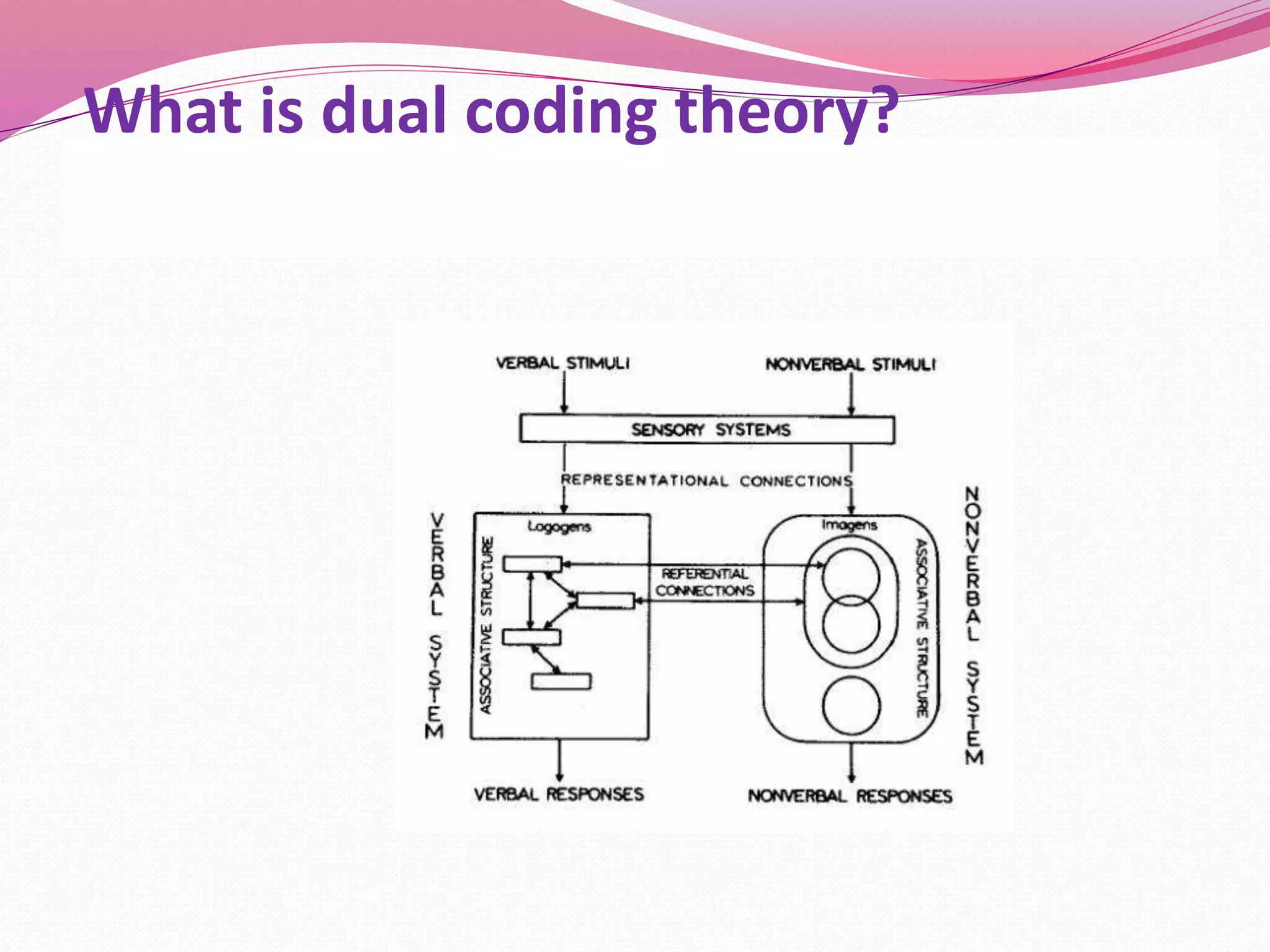
What is dual coding theory?
Dual code theory
● “The most general assumption in dual coding theory is
that there are two classes of phenomena handled
cognitively by separate subsystems, one specialized for
the representation and processing of information
concerning nonverbal objects and events, the other
specialized for dealing with language.”2)
Dual code theory
 The two mentioned kinds of processing systems, verbal and non-
verbal are functionally and structurally independent.
 This means that each of them can work independently of the other one
and that they work on different kinds of representational units.
 Representational units are “relatively stable long-term information
corresponding to perceptually identifiable objects and activities, both
verbal and nonverbal.”.3)
: Dual code theory
 3) They are divided into:
 logogens, referring to verbal entities (spoken or written
words) and organized in terms of associations and
hierarchies, and
 imagens, referring to mental images and non-verbal
entities and organized in terms of part-whole
relationships.
 For example, a written or spoken word will be processed
using the verbal processor and stored as a verbal
representation - logogen, but a sound not related to
language will be processed by the non-verbal processor
and stored as a non-verbal representation -
imagen.Novak and Cañas (2006) also made
Dual code theory
 Logogens and imagens are connected with two kinds of connections:
 Referential connections, which represent links between logogens and
imagens.
Referential connections enable performing operations like
imaging to words and naming to pictures or images to words.
 For example, associations of an image of a school building or an
unpleasant feeling (both non-verbal entities) elicited by the word
school (a verbal entity).
: Dual code theory
 Logogens and imagens are connected with two kinds of connections:
 Associative connections, which represent connections between
logogens or between imagens. Associative connections on the other
hand enable forming verbal-verbal or non-verbal-non-verbal
associations. For example, the word school can elicit verbal entities
blackboard, or boredom.
 Both referential and associative types of connections help forming the
complex networks of human memory.
 Paivio also refers to the issue of problem-solving. Problem-solving is,
according to Pavio, the result of joined work of both verbal and non-
verbal processing, but if the task is more concrete and non-verbal, the
contribution of non-verbal processing system will be more crucial to
the outcome and vice-versa.
: Dual code theory
 Dual coding theory is a general theory of cognition and mind. It
originated in the 1960s to explain the powerful effects that
mental imagery has on memory, and it has been extended since
to account for increasingly more mental phenomena.
 Dual coding theory has inspired much research and debate in
psychology, and it has played a major role in stimulating a
modern resurgence of interest in mental imagery and its role in
mind.
 It has been described as “one of the most influential theories of
cognition this century” (Marks, 1997). It has been directly
applied to education in several fields.
 The major volumes that detail the theory, its extensions, and its
empirical base are Paivio (1971, 1986, 1991, 2007), Paivio and Begg
(1981), and Sadoski and Paivio (2001).
: Dual code theory
 Dual coding theory is sometimes referred to as a theory of mental
imagery, particularly visual imagery. However, the theory is more
than that. From an historical perspective, it is the first systematic,
scientific attempt to bridge two traditions in philosophy and
psychology: the imagery tradition and the verbal tradition.
 The imagery tradition can be traced to the emphasis on concrete
experience and thought in Aristotle, the Renaissance educators'
slogan of “things not words,” the pragmatism of George Herbert
Mead and John Dewey, and aspects of the cognitive revolution in
modern psychology.
 The verbal tradition emphasized the abstract and can be traced to
the idealist philosophy of Plato, Peter Ramus's epitome of linear
verbal organization, Immanuel Kant's transcendental idealism, and
the exclusive emphasis on language in behav-iorist psychology. The
historical tension between these traditions is recounted in Yates
(1966), Carruthers (1993), Paivio (1971, 2007), and Sadoski and
Paivio (2001). The implications of bridging these two traditions are
far reaching but remain controversial in the early 2000s
Basic principles of Dual code theory
 The core ideas of dual coding theory can be stated succinctly:
The theory assumes that cognition involves the activity
of two qualitatively different mental codes, a verbal code
specialized for dealing with language in all its forms and a
nonverbal code specialized for dealing with nonlinguistic objects
and events in the form of mental images.
 These coding systems are separate but interconnected so that
they can operate independently, in parallel, or through their
interconnections.
 The linguistic, or verbal, code dominates in some tasks, the
nonverbal code dominates in others, and both systems are
frequently used together.
 The great diversity and flexibility of cognition all comes from
activity within and between these codes. No deeper, abstract
code is assumed.
Basic principles of Dual code theory
 Dual coding theory is based on the common assumption of a
continuity between perception and memory.
 External experiences occur through the stimulation of people's
senses and are encoded in memory traces that retain some of
their original, concrete qualities as words and things.
 The theory is, therefore, multimodal because both verbal and
nonverbal experiences can occur in different sense modalities,
including vision, hearing, and touch (Braille) in the case of
language, and all five senses in the case of mental images.
 Theories of working memory that propose different, modality-
specific memory stores are generally consistent with dual coding
theory.
 For example, the working memory theory of Baddeley and
Hitch (1974) proposes a phonological loop for rehearsing inner
speech and a visuospatial sketchpad for manipulating visual
images.
Basic principles of Dual code theory
 Dual coding theory also assumes innate contributions
to cognition and individual differences because all
human nature is the product of the interaction of
genes and the environment.
 More layers of complexity are built on these basic
assumptions, including accounts of meaning, memory,
knowledge organization, and learning.
 One direct implication of the theory is that pictures or
concrete language (e.g., juicy hamburger) should be
understood and recalled better than abstract language
(e.g., basic assumption), a consistent research finding.
Basic principles of Dual code theory
 The core ideas of dual coding theory can be stated succinctly: The
theory assumes that cognition involves the activity of two
qualitatively different mental codes, a verbal code specialized for
dealing with language in all its forms and a nonverbal code
specialized for dealing with nonlinguistic objects and events in
the form of mental images. These coding systems are separate but
interconnected so that they can operate independently, in parallel,
or through their interconnections.
 The linguistic, or verbal, code dominates in some tasks, the
nonverbal code dominates in others, and both systems are
frequently used together. The great diversity and flexibility of
cognition all comes from activity within and between these codes.
No deeper, abstract code is assumed.
Basic principles of Dual code theory
 Dual coding theory is based on the common assumption of a
continuity between perception and memory. External experiences
occur through the stimulation of people's senses and are encoded
in memory traces that retain some of their original, concrete
qualities as words and things.
 The theory is, therefore, multimodal because both verbal and
nonverbal experiences can occur in different sense modalities,
including vision, hearing, and touch (Braille) in the case of
language, and all five senses in the case of mental images.
 Theories of working memory that propose different, modality-
specific memory stores are generally consistent with dual coding
theory. For example, the working memory theory of Baddeley and
Hitch (1974) proposes a phonological loop for rehearsing inner
speech and a visuospatial sketchpad for manipulating visual
images.
 Dual coding theory assumes that long-term memory is modality
specific as well.
: Basic principles of Dual code theory
 Dual coding theory also assumes innate contributions to
cognition and individual differences because all human
nature is the product of the interaction of genes and the
environment.
 More layers of complexity are built on these basic
assumptions, including accounts of meaning, memory,
knowledge organization, and learning.
 One direct implication of the theory is that pictures or
concrete language (e.g., juicy hamburger) should be
understood and recalled better than abstract language
(e.g., basic assumption), a consistent research finding.
: Classroom Implication and Teaching Strategies
 CHALLENGES AND CONTROVERSIES
 Dual coding theory can be contrasted with theories which assume that all
cognition has a common, abstract code in the form of schemata or
propositions (Sadoski, Paivio, & Goetz, 1991).
 This mentalese is assumed to be computational in nature, built into the brain
like a computer's built-in machine code (Pylyshyn, 2003).
 Proponents believe that this conception is more elegant and parsimonious
than dual coding theory, and some aspects of cognition have been modeled in
computers to a degree (Seidenberg, 2005).
 However, Paivio (2007) responded that such theories lack elegance because of
the complexity of their programming, and they cannot account for findings
involving mental imagery, concreteness effects, and neuropsychological
evidence.
 These debates remain unresolved and challenging.
•THANK YOU

Aittpavio's dual coding theory

  • 1.
  • 2.
    NAME: Shendkar RupaliP. COURSE NO: 103 Teaching and Learning UNIT: Dual coding theory
  • 3.
    General Information  Dualcoding is a theory of cognition introduced by Allan Paivio in late 1960s.  This theory suggests that there are two distinct subsystems contributing to cognition: one is specialized for language and verbal information, and the other for images and non-verbal information.  According to Paivio, “Human cognition is unique in that it has become specialized for dealing simultaneously with language and with nonverbal objects and events.”1)
  • 4.
    What is dualcoding theory?
  • 5.
    Dual code theory ●“The most general assumption in dual coding theory is that there are two classes of phenomena handled cognitively by separate subsystems, one specialized for the representation and processing of information concerning nonverbal objects and events, the other specialized for dealing with language.”2)
  • 6.
    Dual code theory The two mentioned kinds of processing systems, verbal and non- verbal are functionally and structurally independent.  This means that each of them can work independently of the other one and that they work on different kinds of representational units.  Representational units are “relatively stable long-term information corresponding to perceptually identifiable objects and activities, both verbal and nonverbal.”.3)
  • 7.
    : Dual codetheory  3) They are divided into:  logogens, referring to verbal entities (spoken or written words) and organized in terms of associations and hierarchies, and  imagens, referring to mental images and non-verbal entities and organized in terms of part-whole relationships.  For example, a written or spoken word will be processed using the verbal processor and stored as a verbal representation - logogen, but a sound not related to language will be processed by the non-verbal processor and stored as a non-verbal representation - imagen.Novak and Cañas (2006) also made
  • 8.
    Dual code theory Logogens and imagens are connected with two kinds of connections:  Referential connections, which represent links between logogens and imagens. Referential connections enable performing operations like imaging to words and naming to pictures or images to words.  For example, associations of an image of a school building or an unpleasant feeling (both non-verbal entities) elicited by the word school (a verbal entity).
  • 9.
    : Dual codetheory  Logogens and imagens are connected with two kinds of connections:  Associative connections, which represent connections between logogens or between imagens. Associative connections on the other hand enable forming verbal-verbal or non-verbal-non-verbal associations. For example, the word school can elicit verbal entities blackboard, or boredom.  Both referential and associative types of connections help forming the complex networks of human memory.  Paivio also refers to the issue of problem-solving. Problem-solving is, according to Pavio, the result of joined work of both verbal and non- verbal processing, but if the task is more concrete and non-verbal, the contribution of non-verbal processing system will be more crucial to the outcome and vice-versa.
  • 10.
    : Dual codetheory  Dual coding theory is a general theory of cognition and mind. It originated in the 1960s to explain the powerful effects that mental imagery has on memory, and it has been extended since to account for increasingly more mental phenomena.  Dual coding theory has inspired much research and debate in psychology, and it has played a major role in stimulating a modern resurgence of interest in mental imagery and its role in mind.  It has been described as “one of the most influential theories of cognition this century” (Marks, 1997). It has been directly applied to education in several fields.  The major volumes that detail the theory, its extensions, and its empirical base are Paivio (1971, 1986, 1991, 2007), Paivio and Begg (1981), and Sadoski and Paivio (2001).
  • 11.
    : Dual codetheory  Dual coding theory is sometimes referred to as a theory of mental imagery, particularly visual imagery. However, the theory is more than that. From an historical perspective, it is the first systematic, scientific attempt to bridge two traditions in philosophy and psychology: the imagery tradition and the verbal tradition.  The imagery tradition can be traced to the emphasis on concrete experience and thought in Aristotle, the Renaissance educators' slogan of “things not words,” the pragmatism of George Herbert Mead and John Dewey, and aspects of the cognitive revolution in modern psychology.  The verbal tradition emphasized the abstract and can be traced to the idealist philosophy of Plato, Peter Ramus's epitome of linear verbal organization, Immanuel Kant's transcendental idealism, and the exclusive emphasis on language in behav-iorist psychology. The historical tension between these traditions is recounted in Yates (1966), Carruthers (1993), Paivio (1971, 2007), and Sadoski and Paivio (2001). The implications of bridging these two traditions are far reaching but remain controversial in the early 2000s
  • 12.
    Basic principles ofDual code theory  The core ideas of dual coding theory can be stated succinctly: The theory assumes that cognition involves the activity of two qualitatively different mental codes, a verbal code specialized for dealing with language in all its forms and a nonverbal code specialized for dealing with nonlinguistic objects and events in the form of mental images.  These coding systems are separate but interconnected so that they can operate independently, in parallel, or through their interconnections.  The linguistic, or verbal, code dominates in some tasks, the nonverbal code dominates in others, and both systems are frequently used together.  The great diversity and flexibility of cognition all comes from activity within and between these codes. No deeper, abstract code is assumed.
  • 13.
    Basic principles ofDual code theory  Dual coding theory is based on the common assumption of a continuity between perception and memory.  External experiences occur through the stimulation of people's senses and are encoded in memory traces that retain some of their original, concrete qualities as words and things.  The theory is, therefore, multimodal because both verbal and nonverbal experiences can occur in different sense modalities, including vision, hearing, and touch (Braille) in the case of language, and all five senses in the case of mental images.  Theories of working memory that propose different, modality- specific memory stores are generally consistent with dual coding theory.  For example, the working memory theory of Baddeley and Hitch (1974) proposes a phonological loop for rehearsing inner speech and a visuospatial sketchpad for manipulating visual images.
  • 14.
    Basic principles ofDual code theory  Dual coding theory also assumes innate contributions to cognition and individual differences because all human nature is the product of the interaction of genes and the environment.  More layers of complexity are built on these basic assumptions, including accounts of meaning, memory, knowledge organization, and learning.  One direct implication of the theory is that pictures or concrete language (e.g., juicy hamburger) should be understood and recalled better than abstract language (e.g., basic assumption), a consistent research finding.
  • 15.
    Basic principles ofDual code theory  The core ideas of dual coding theory can be stated succinctly: The theory assumes that cognition involves the activity of two qualitatively different mental codes, a verbal code specialized for dealing with language in all its forms and a nonverbal code specialized for dealing with nonlinguistic objects and events in the form of mental images. These coding systems are separate but interconnected so that they can operate independently, in parallel, or through their interconnections.  The linguistic, or verbal, code dominates in some tasks, the nonverbal code dominates in others, and both systems are frequently used together. The great diversity and flexibility of cognition all comes from activity within and between these codes. No deeper, abstract code is assumed.
  • 16.
    Basic principles ofDual code theory  Dual coding theory is based on the common assumption of a continuity between perception and memory. External experiences occur through the stimulation of people's senses and are encoded in memory traces that retain some of their original, concrete qualities as words and things.  The theory is, therefore, multimodal because both verbal and nonverbal experiences can occur in different sense modalities, including vision, hearing, and touch (Braille) in the case of language, and all five senses in the case of mental images.  Theories of working memory that propose different, modality- specific memory stores are generally consistent with dual coding theory. For example, the working memory theory of Baddeley and Hitch (1974) proposes a phonological loop for rehearsing inner speech and a visuospatial sketchpad for manipulating visual images.  Dual coding theory assumes that long-term memory is modality specific as well.
  • 17.
    : Basic principlesof Dual code theory  Dual coding theory also assumes innate contributions to cognition and individual differences because all human nature is the product of the interaction of genes and the environment.  More layers of complexity are built on these basic assumptions, including accounts of meaning, memory, knowledge organization, and learning.  One direct implication of the theory is that pictures or concrete language (e.g., juicy hamburger) should be understood and recalled better than abstract language (e.g., basic assumption), a consistent research finding.
  • 18.
    : Classroom Implicationand Teaching Strategies  CHALLENGES AND CONTROVERSIES  Dual coding theory can be contrasted with theories which assume that all cognition has a common, abstract code in the form of schemata or propositions (Sadoski, Paivio, & Goetz, 1991).  This mentalese is assumed to be computational in nature, built into the brain like a computer's built-in machine code (Pylyshyn, 2003).  Proponents believe that this conception is more elegant and parsimonious than dual coding theory, and some aspects of cognition have been modeled in computers to a degree (Seidenberg, 2005).  However, Paivio (2007) responded that such theories lack elegance because of the complexity of their programming, and they cannot account for findings involving mental imagery, concreteness effects, and neuropsychological evidence.  These debates remain unresolved and challenging.
  • 19.