Allan Paivio and Dual Coding Theory Eric Langhorst – Walden University – EdD Student – September 2009 EDUC – 8140 – 7  -  “Leadership for Today’s Schools” Instructor – Jerita Whaley
Allan Paivio Born December 1, 1941 Professor of Psychology at University of Western Ontario Author of Dual Coding Theory
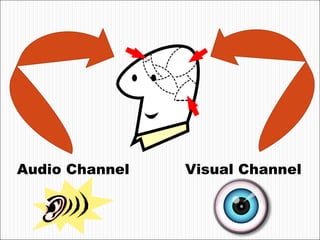
Origins of Theory Paivio had subjects recall a list of words and a list of pictures Pictures and words were recalled in a different order Theory we process information in two separate channels
Audio Channel Visual Channel
Dual Coding Theory Theory of cognition which states both visual and verbal information is processed separately
Example Watching a television show with video footage of a rainforest while describing how the ecosystem works
Anderson & Bower (1973) Verbal information can be enhanced when paired with a visual image, real or imagined.
Stone & Glock (1981) College students were given written assembly instruction Fewer errors when shown pictures with text
Levie & Lentz (1982) Children learned more from text that was presented with illustrations Learning increased by one-third with illustrations
Mayer & Sims (1994) Multimedia can be effective when used for education but only if used in appropriate ways OR X
Idea #1 Use words and pictures rather than just words alone TEXT
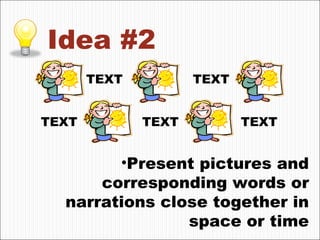
Idea #2 Present pictures and corresponding words or narrations close together in space or time TEXT TEXT TEXT TEXT TEXT
Idea #3 Minimize irrelevant details only display the most important information
Idea #4 Present words as speech rather than on-screen text
Implications Incorporating the dual coding theory with the proper technology can make the educational process more powerful
References Anderson, J. R., & Bower, G. H. (1973).  Human associative memory.  Washington, DC: Winston. Levie, W. H., & Lentz, R. (1982). Effects of text illustrations: A review of research.  Educational Communication and Technology Journal, 26 , 233-243. Mayer, R. E., & Sims, V.K. (1994). For whom is a picture worth a thousand words? Extensions of a dual-coding theory of multimedia learning.  Journal of Educational Psychology, 86 (3), 389-401. Paivio, A. (1991). Dual coding theory: Retrospect and current status.  Canadian Journal of Psychology, 45 , 255-287. Stone, D., & Glock, M. (1981). How do young adults read directions with and without pictures?  Journal of Educational Psychology, 73 , 419-426.

Dual Coding Theory E Langhorst

  • 1.
    Allan Paivio andDual Coding Theory Eric Langhorst – Walden University – EdD Student – September 2009 EDUC – 8140 – 7 - “Leadership for Today’s Schools” Instructor – Jerita Whaley
  • 2.
    Allan Paivio BornDecember 1, 1941 Professor of Psychology at University of Western Ontario Author of Dual Coding Theory
  • 3.
    Origins of TheoryPaivio had subjects recall a list of words and a list of pictures Pictures and words were recalled in a different order Theory we process information in two separate channels
  • 4.
  • 5.
    Dual Coding TheoryTheory of cognition which states both visual and verbal information is processed separately
  • 6.
    Example Watching atelevision show with video footage of a rainforest while describing how the ecosystem works
  • 7.
    Anderson & Bower(1973) Verbal information can be enhanced when paired with a visual image, real or imagined.
  • 8.
    Stone & Glock(1981) College students were given written assembly instruction Fewer errors when shown pictures with text
  • 9.
    Levie & Lentz(1982) Children learned more from text that was presented with illustrations Learning increased by one-third with illustrations
  • 10.
    Mayer & Sims(1994) Multimedia can be effective when used for education but only if used in appropriate ways OR X
  • 11.
    Idea #1 Usewords and pictures rather than just words alone TEXT
  • 12.
    Idea #2 Presentpictures and corresponding words or narrations close together in space or time TEXT TEXT TEXT TEXT TEXT
  • 13.
    Idea #3 Minimizeirrelevant details only display the most important information
  • 14.
    Idea #4 Presentwords as speech rather than on-screen text
  • 15.
    Implications Incorporating thedual coding theory with the proper technology can make the educational process more powerful
  • 16.
    References Anderson, J.R., & Bower, G. H. (1973). Human associative memory. Washington, DC: Winston. Levie, W. H., & Lentz, R. (1982). Effects of text illustrations: A review of research. Educational Communication and Technology Journal, 26 , 233-243. Mayer, R. E., & Sims, V.K. (1994). For whom is a picture worth a thousand words? Extensions of a dual-coding theory of multimedia learning. Journal of Educational Psychology, 86 (3), 389-401. Paivio, A. (1991). Dual coding theory: Retrospect and current status. Canadian Journal of Psychology, 45 , 255-287. Stone, D., & Glock, M. (1981). How do young adults read directions with and without pictures? Journal of Educational Psychology, 73 , 419-426.