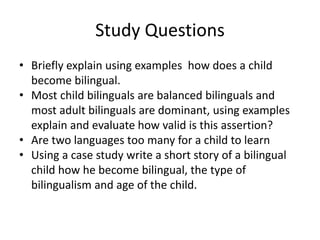
This document discusses bilingualism and language acquisition in children. It defines bilingualism as the ability to use two or more languages. Child bilinguals are those who learn two languages from birth, such as from parents who speak different native languages. Bilingualism in children can be simultaneous, learning both languages from birth, or successive, learning a second language after already learning the first. Factors that can lead to child bilingualism include being born into a bilingual family, acquiring a second language at school, or intentional planning by parents to raise their child bilingually. While some debate the effects of bilingualism, it may provide benefits like improved cognitive awareness.





![Theories Of Language Acquisition[1]](https://cdn.slidesharecdn.com/ss_thumbnails/theories-of-language-acquisition1-1225480010904742-8-thumbnail.jpg?width=640&height=640&fit=bounds)


