Why UX in libraries
is a thing now
Andy Priestner
Cambridge Judge Business School
Why UX in libraries
is a thing now
Andy Priestner
Cambridge Judge Business School
• What is UX?
• Ethnography
• The Old Ways
• Adidas case study
• Library ethnography
• UX in Libraries conference
‘In some quarters UX is still viewed narrowly as analysing web metrics
and web usability testing. Those are great things and necessary to
practicing UX, but UX has extended far beyond the web and so
should our conversation. We should be talking about applying UX in
physical spaces and in any other context where it might be useful.’
www.weaveux.org / Journal of Library User Experience
What is UX?
What is ethnography?
‘The scientific description of peoples and cultures with
their customs, habits, and mutual differences’
(OED)
‘...a practice in which researchers spend long periods
living within a culture in order to study it. The term has
been adopted within qualitative market research to
describe occasions where researchers spend time -
hours, days or weeks - observing and/or interacting with
participants in areas of their everyday lives.’
(Association for Qualitative Research)
• Usability
• Space design
• Service design
• User profiling/personas
• Ethnographic research
What does this broader definition
of UX include?
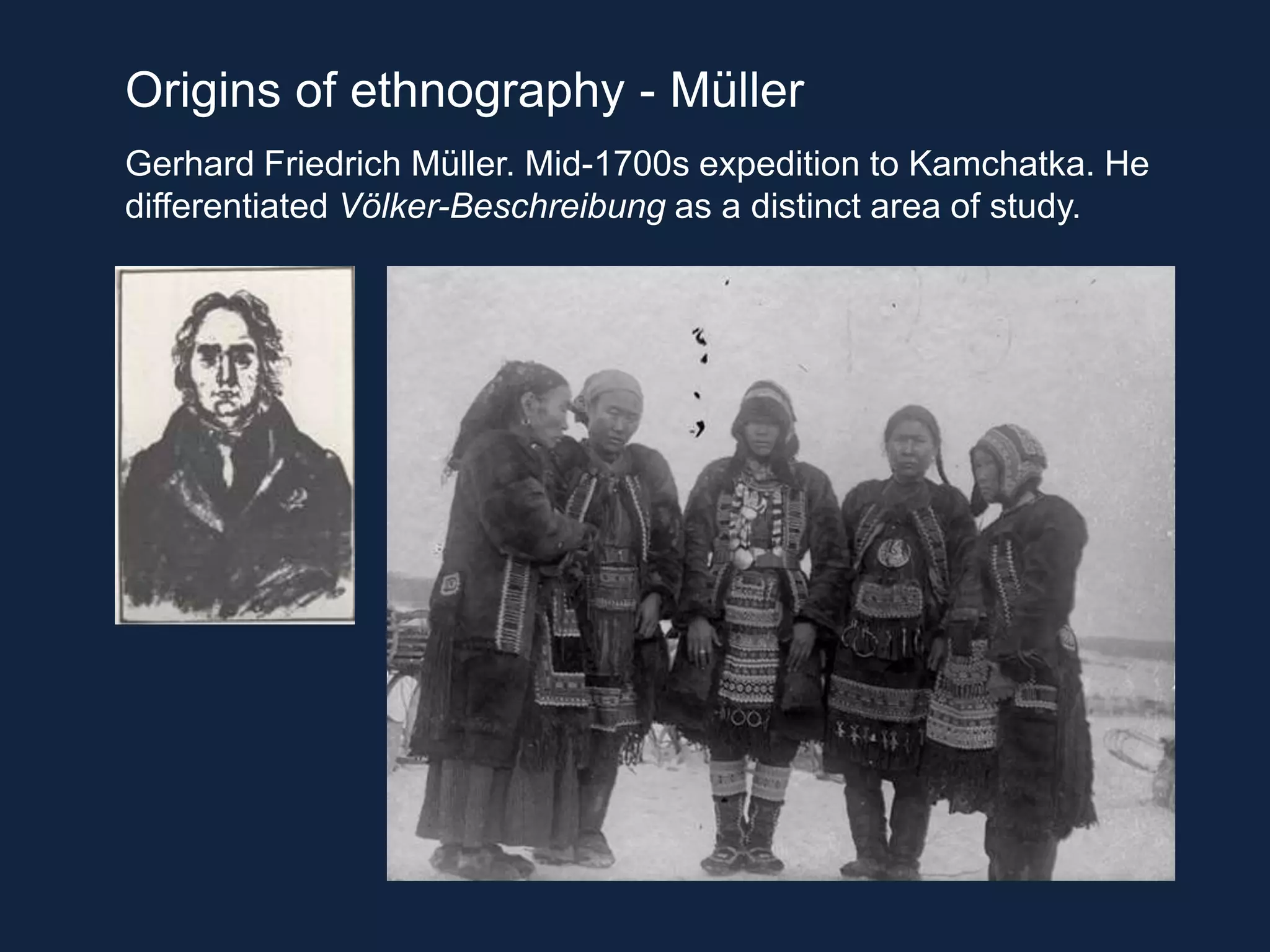
Origins of ethnography - Müller
Gerhard Friedrich Müller. Mid-1700s expedition to Kamchatka. He
differentiated Völker-Beschreibung as a distinct area of study.
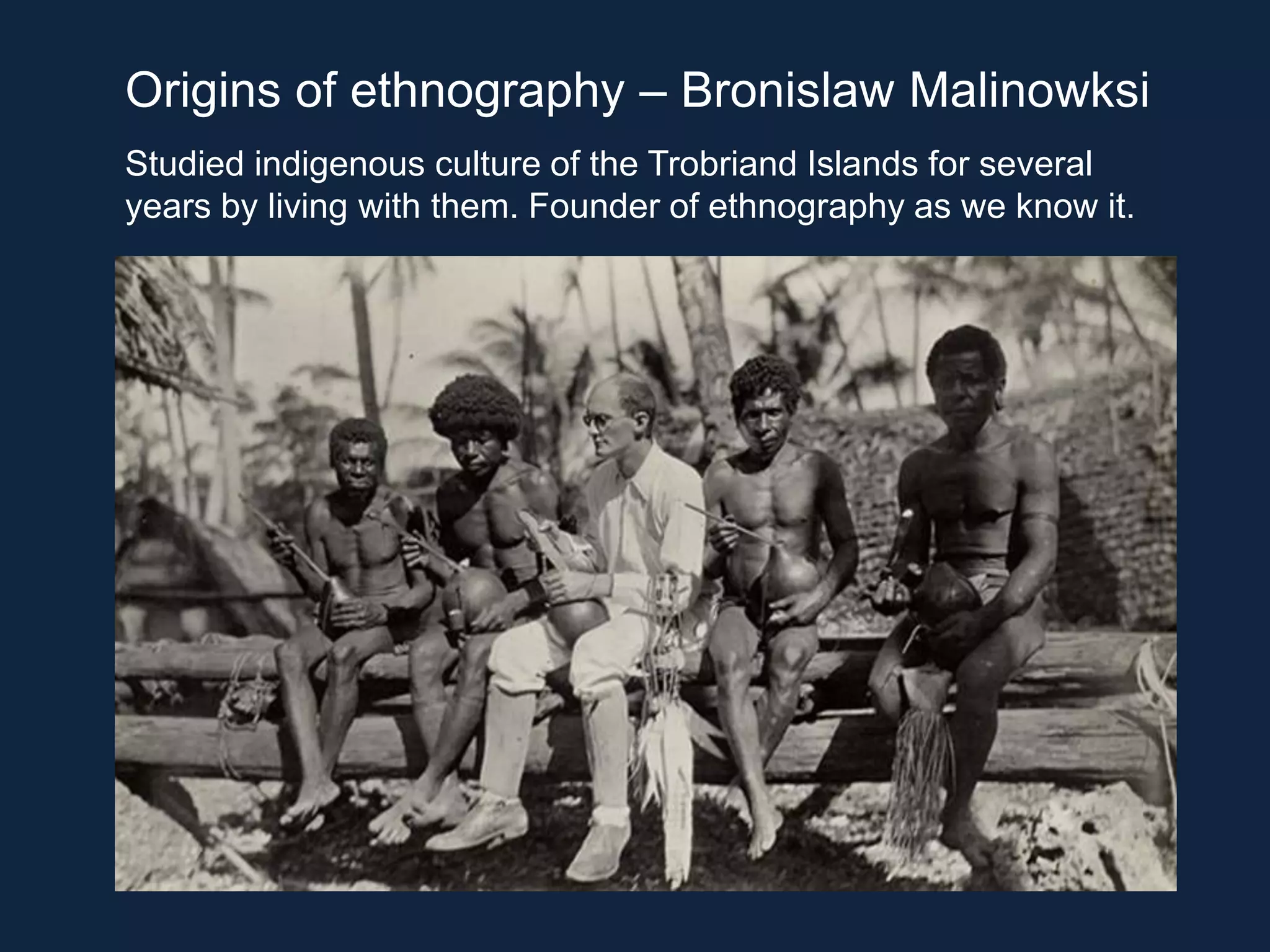
Origins of ethnography – Bronislaw Malinowksi
Studied indigenous culture of the Trobriand Islands for several
years by living with them. Founder of ethnography as we know it.
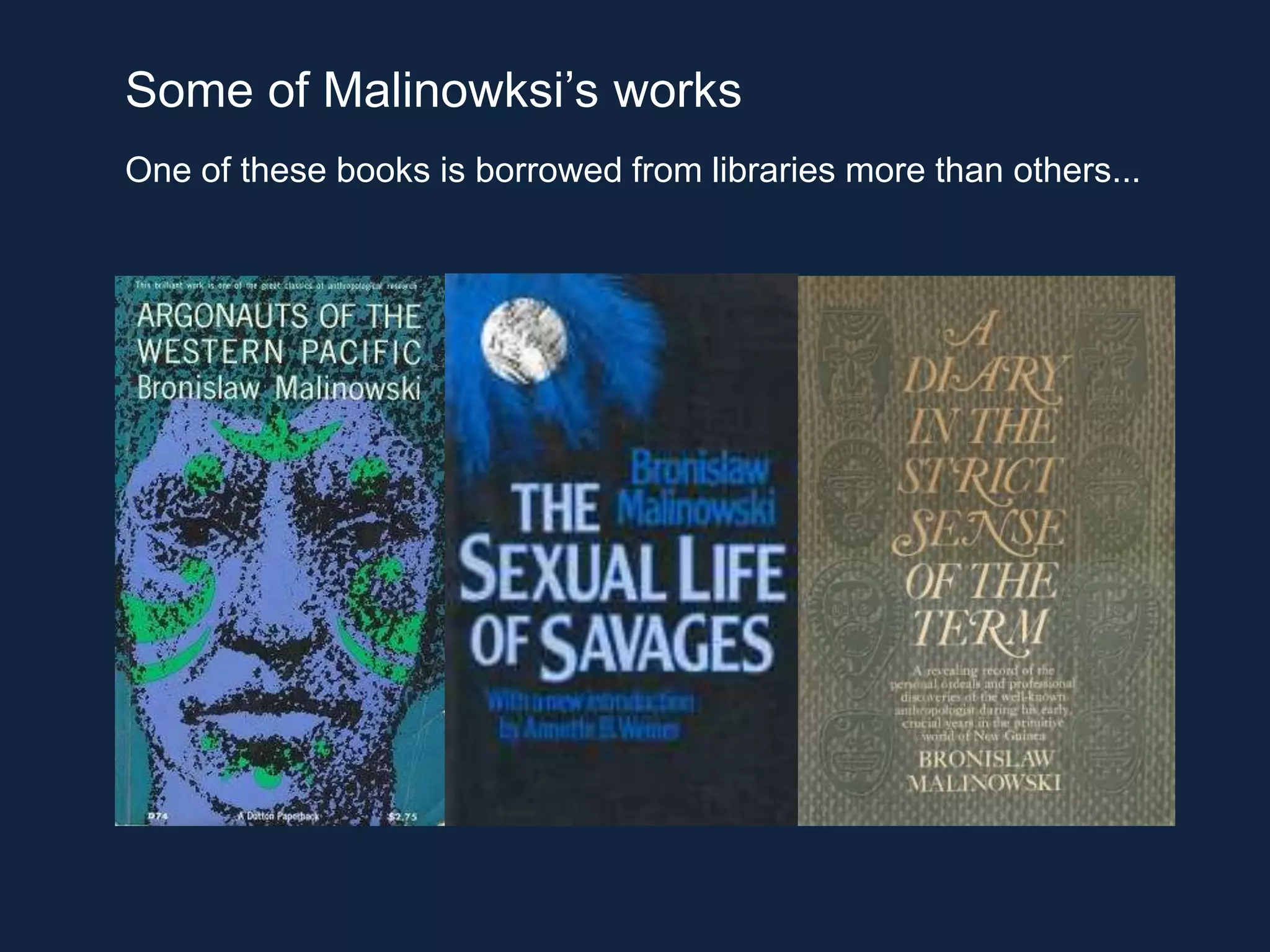
Some of Malinowksi’s works
One of these books is borrowed from libraries more than others...
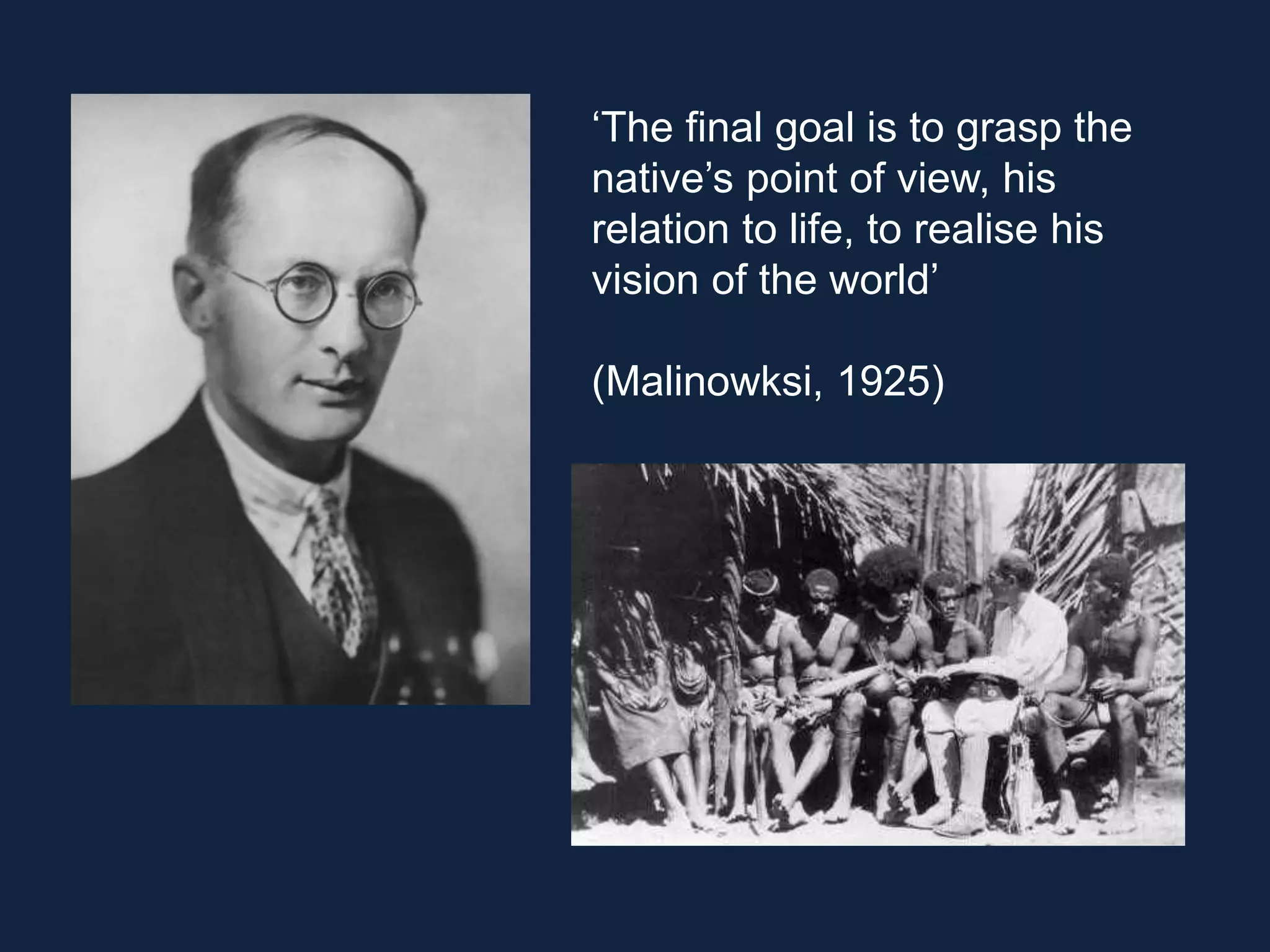
‘The final goal is to grasp the
native’s point of view, his
relation to life, to realise his
vision of the world’
(Malinowksi, 1925)
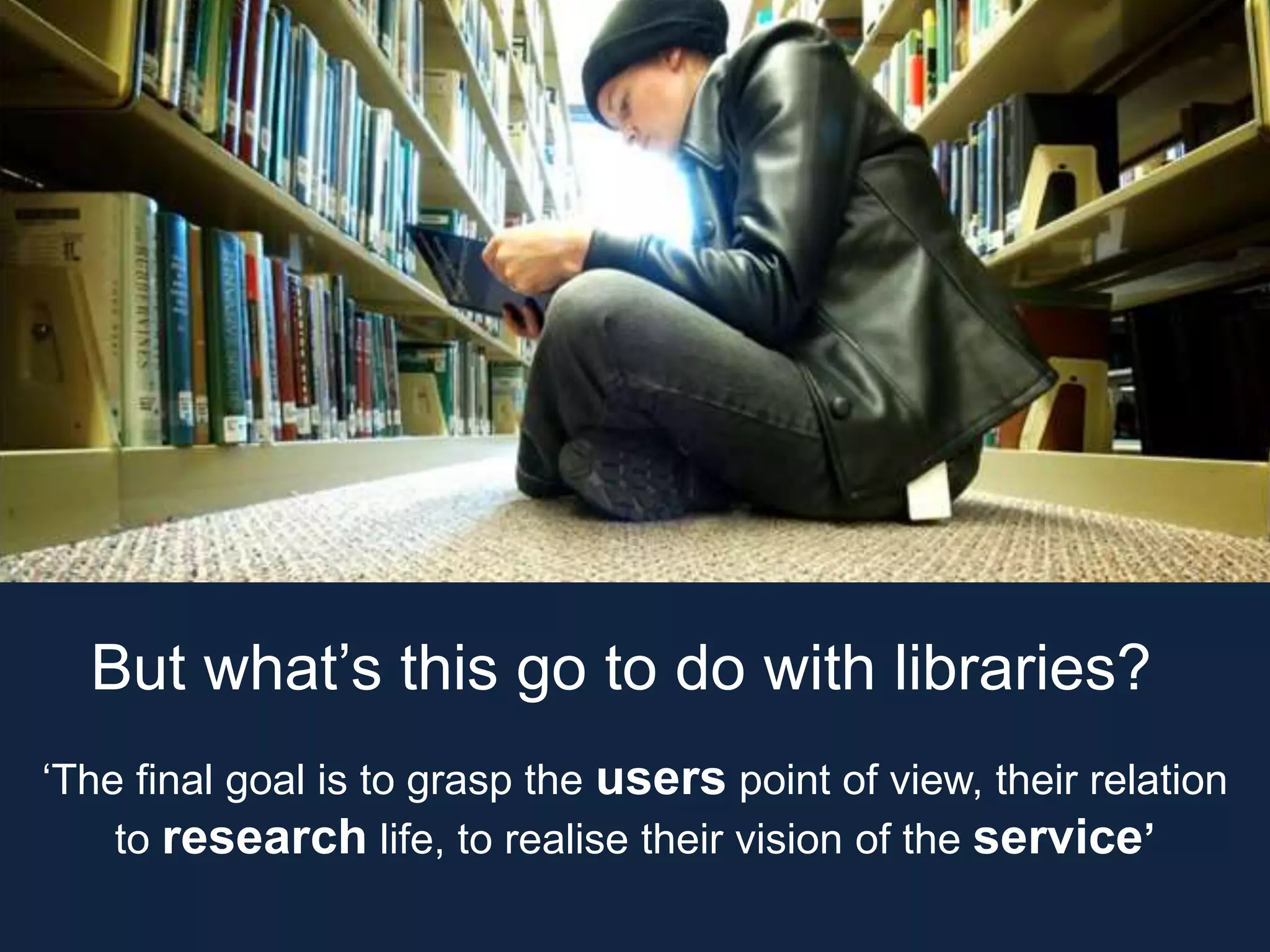
But what’s this go to do with libraries?
‘The final goal is to grasp the users point of view, their relation
to research life, to realise their vision of the service’
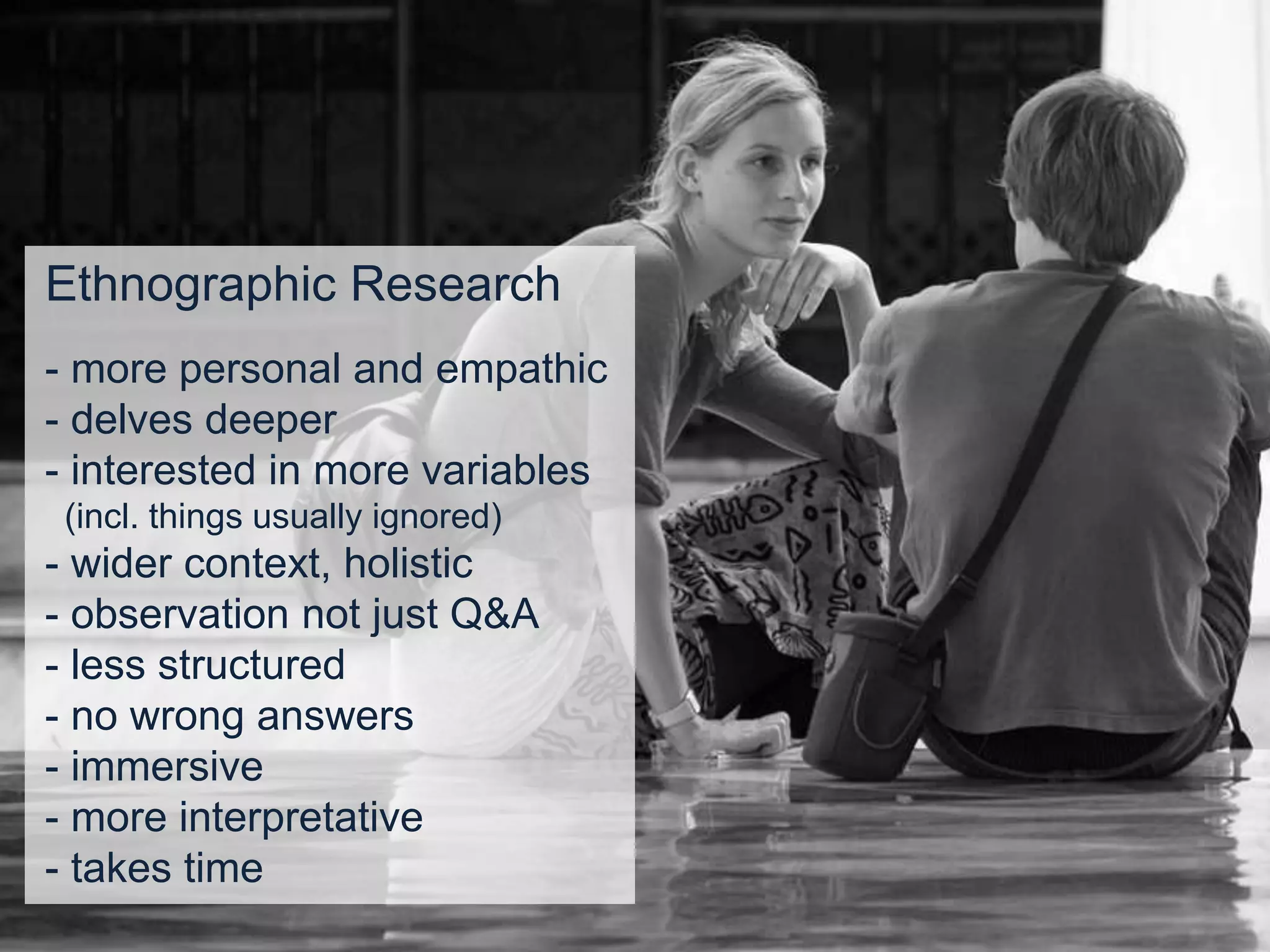
Ethnographic Research
- more personal and empathic
- delves deeper
- interested in more variables
(incl. things usually ignored)
- wider context, holistic
- observation not just Q&A
- less structured
- no wrong answers
- immersive
- more interpretative
- takes time
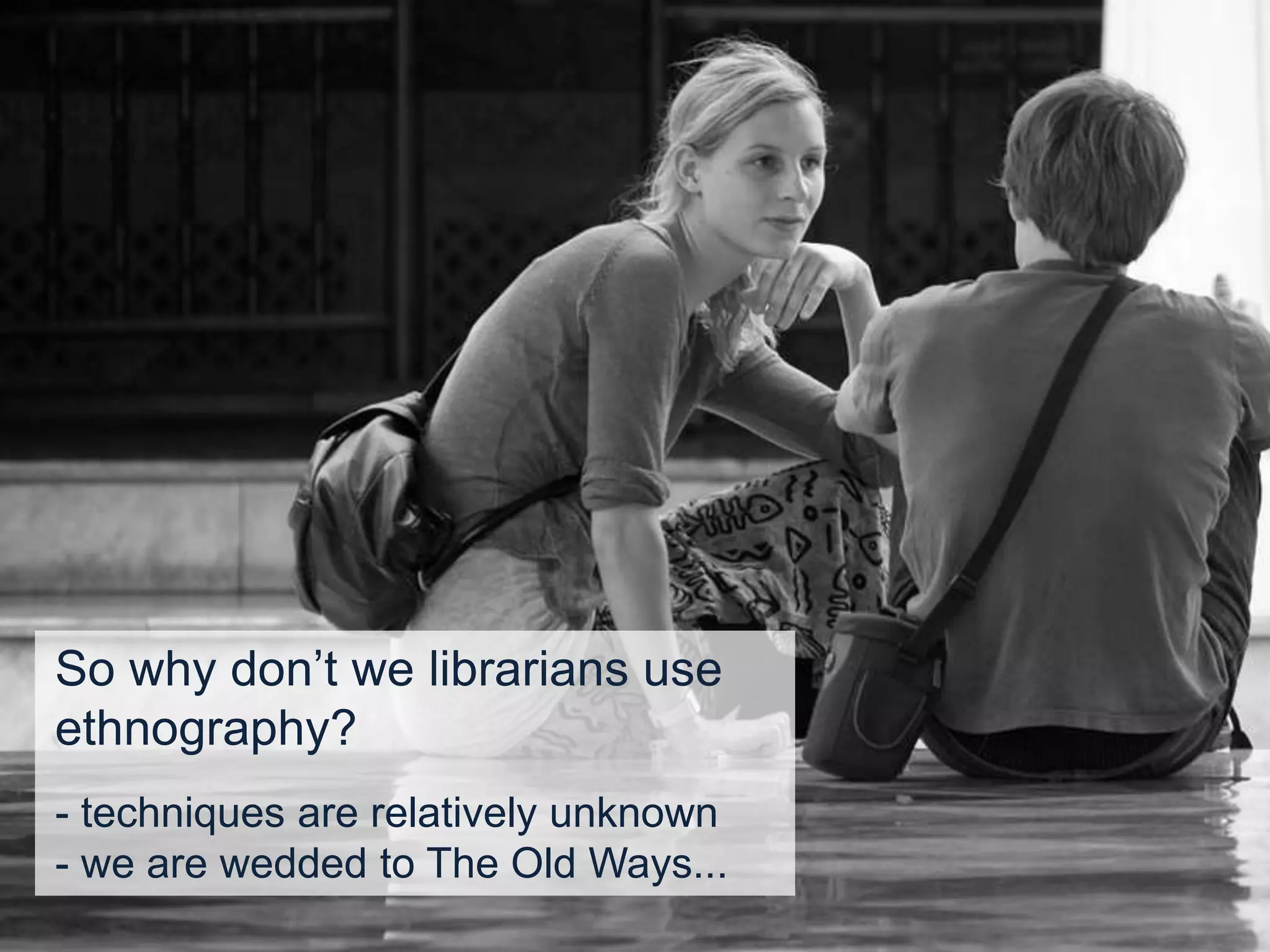
So why don’t we librarians use
ethnography?
- techniques are relatively unknown
- we are wedded to The Old Ways...
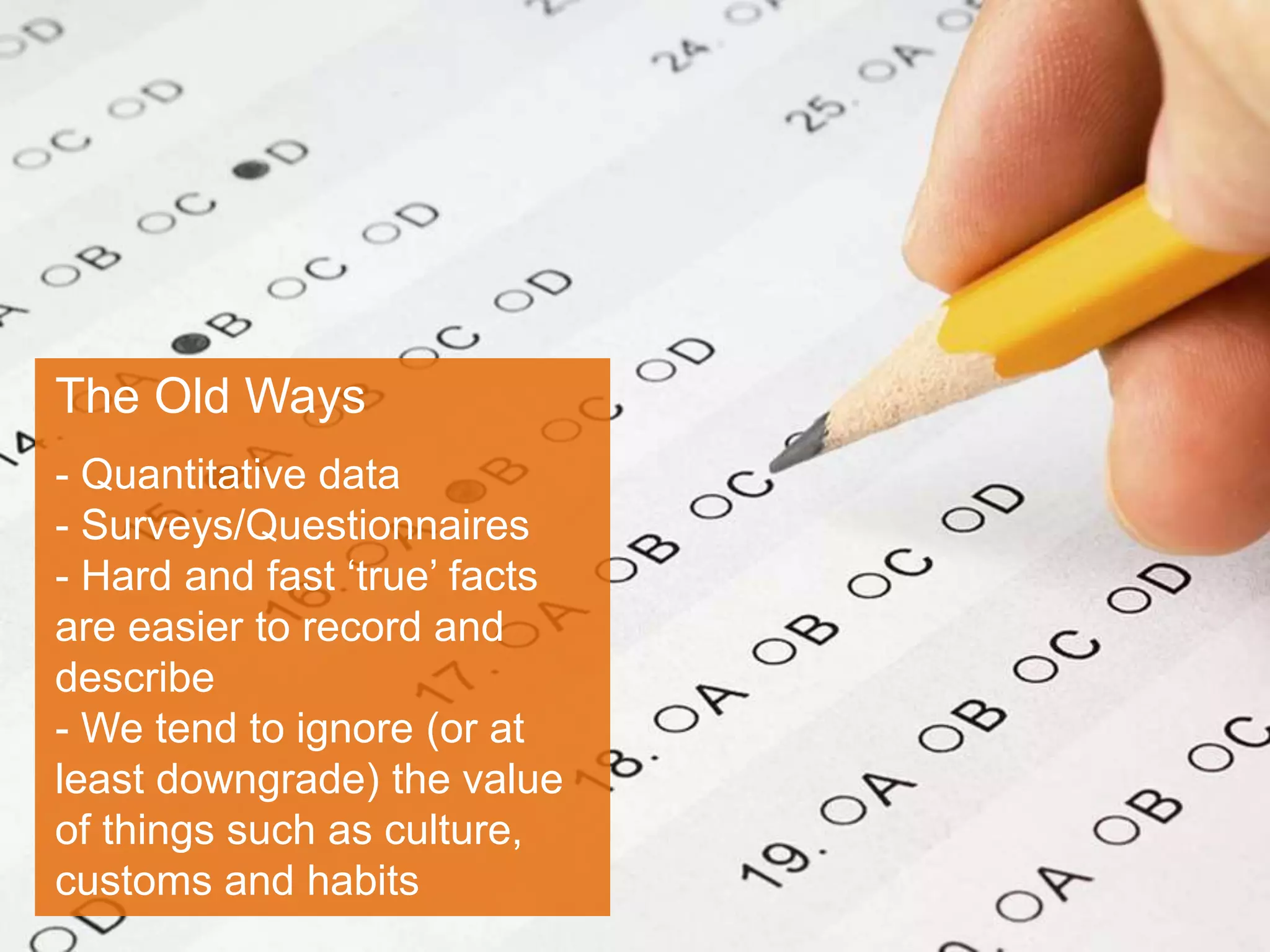
The Old Ways
- Quantitative data
- Surveys/Questionnaires
- Hard and fast ‘true’ facts
are easier to record and
describe
- We tend to ignore (or at
least downgrade) the value
of things such as culture,
customs and habits
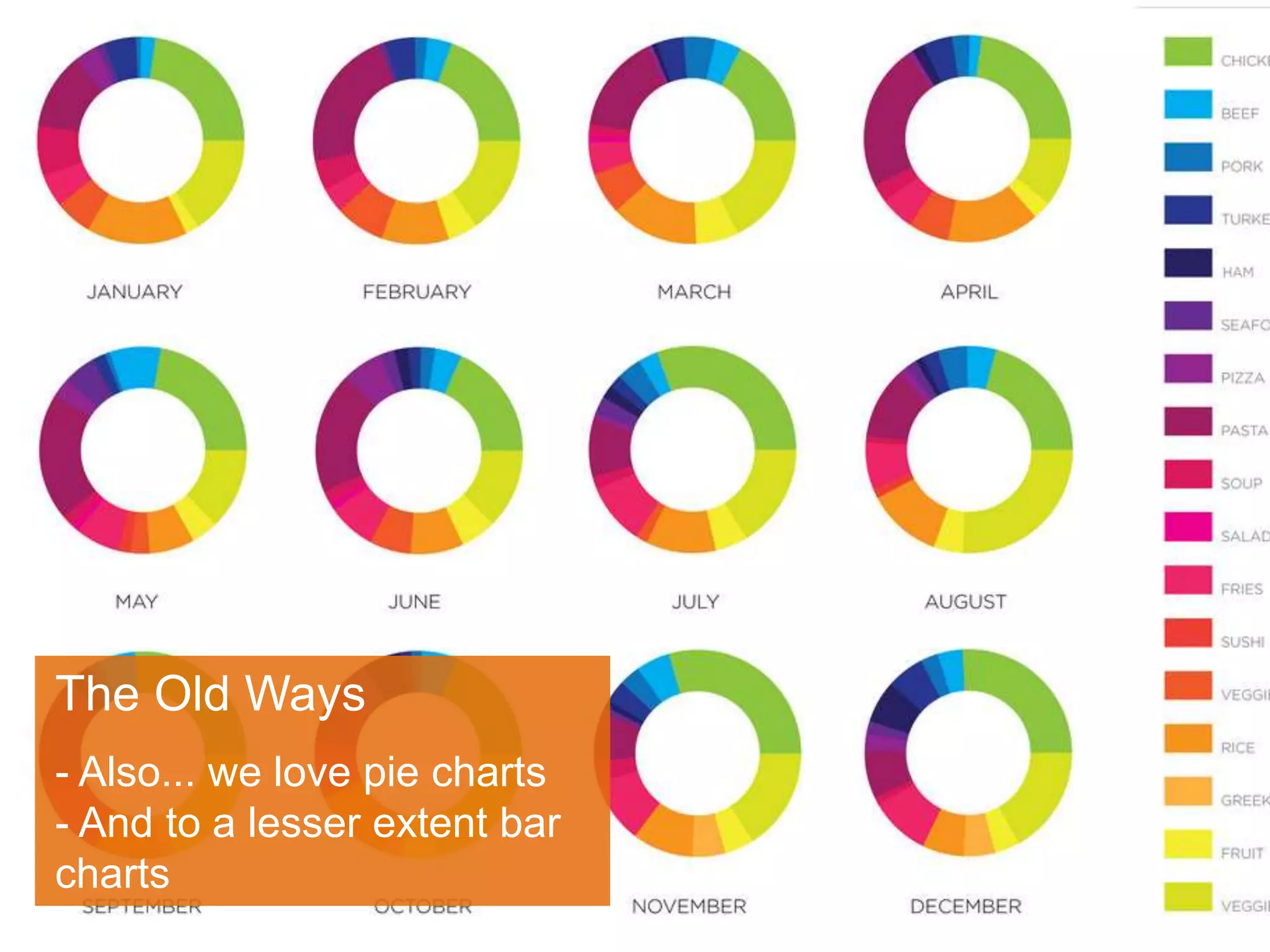
The Old Ways
- Also... we love pie charts
- And to a lesser extent bar
charts
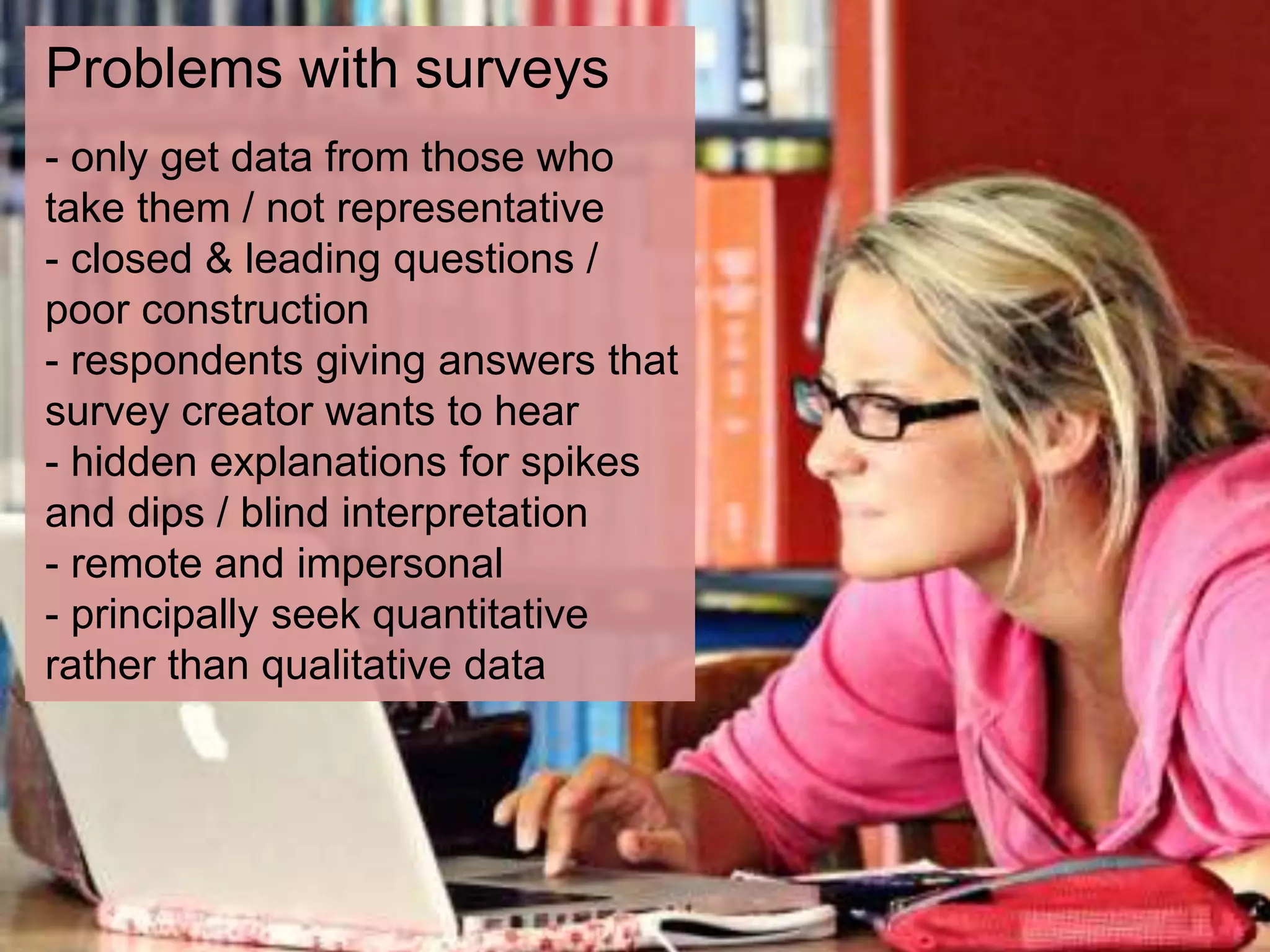
Problems with surveys
- only get data from those who
take them / not representative
- closed & leading questions /
poor construction
- respondents giving answers that
survey creator wants to hear
- hidden explanations for spikes
and dips / blind interpretation
- remote and impersonal
- principally seek quantitative
rather than qualitative data
RIP quantitative data
and surveys?
- no, just need a more balanced approach
- ramp up qualitative approaches
- offer more than just those gaping white
empty free-text boxes
Rise of Corporate Ethnography (from 1990s)
Adidas and... IBM, Apple, Intel, Xerox, Microsoft, Herman Miller all
engaged in ethnographic research and/or hired ethnographers
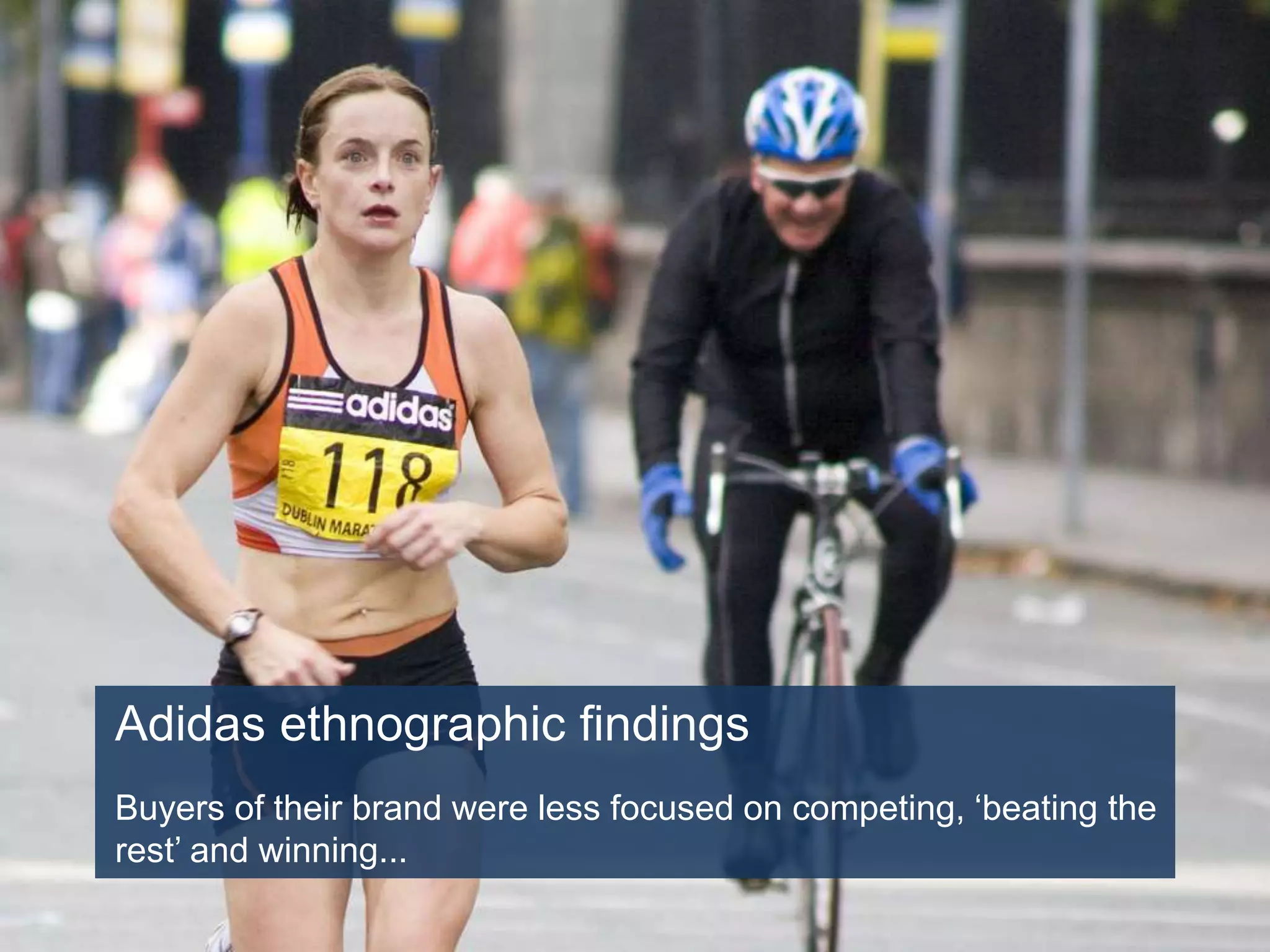
Adidas ethnographic findings
Buyers of their brand were less focused on competing, ‘beating the
rest’ and winning...
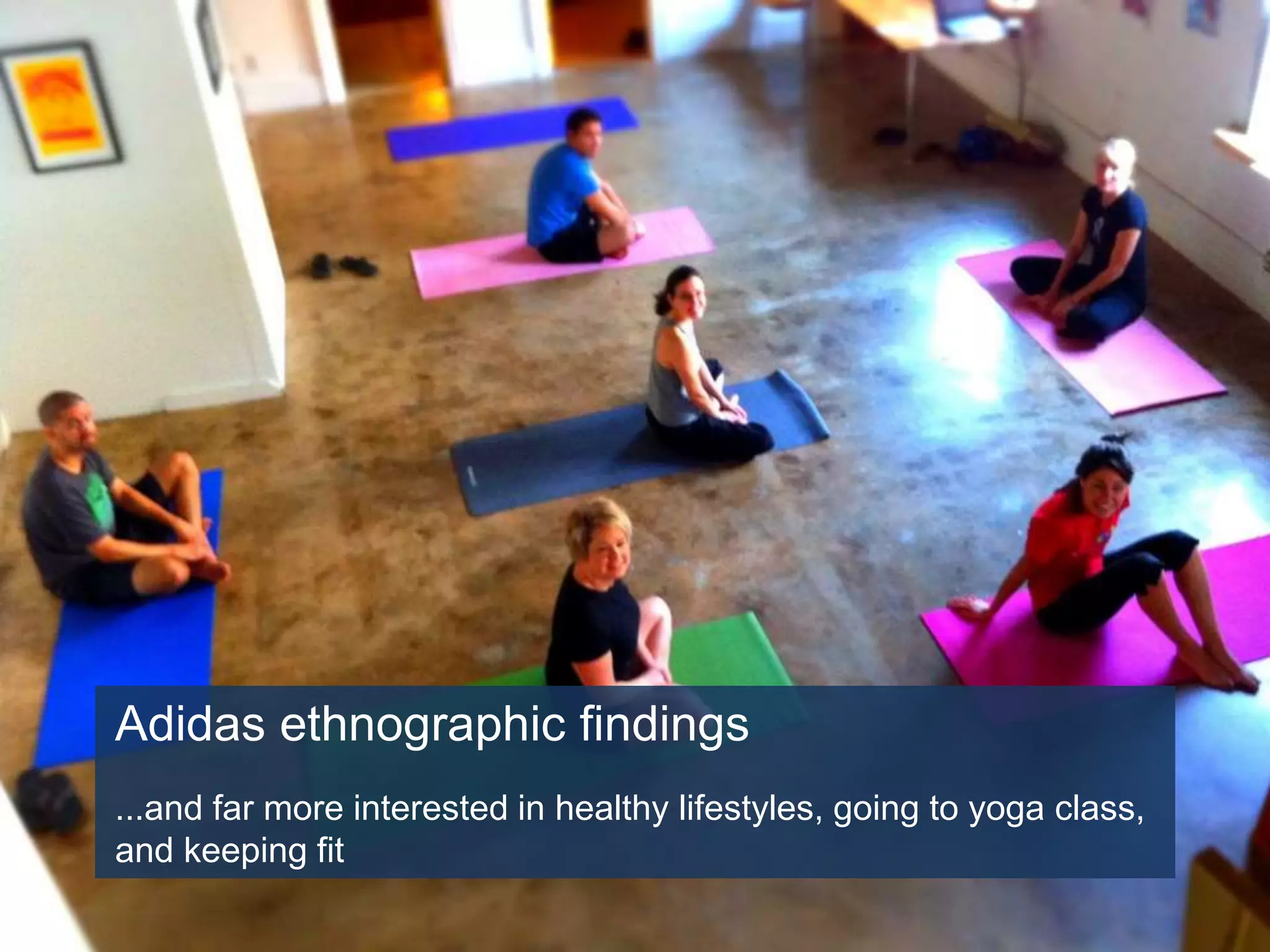
Adidas ethnographic findings
...and far more interested in healthy lifestyles, going to yoga class,
and keeping fit
Ethnography and libraries
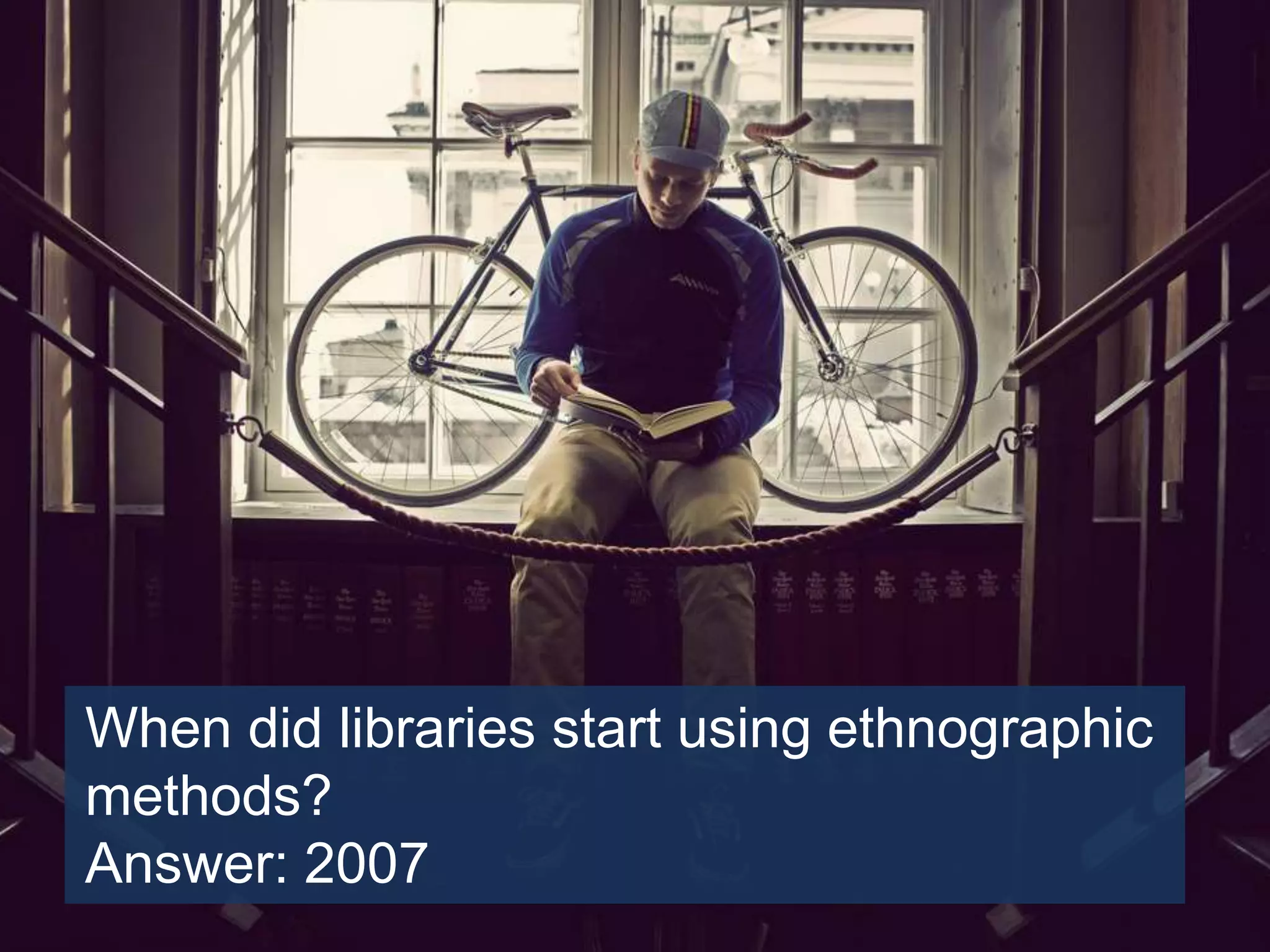
When did libraries start using ethnographic
methods?
Answer: 2007
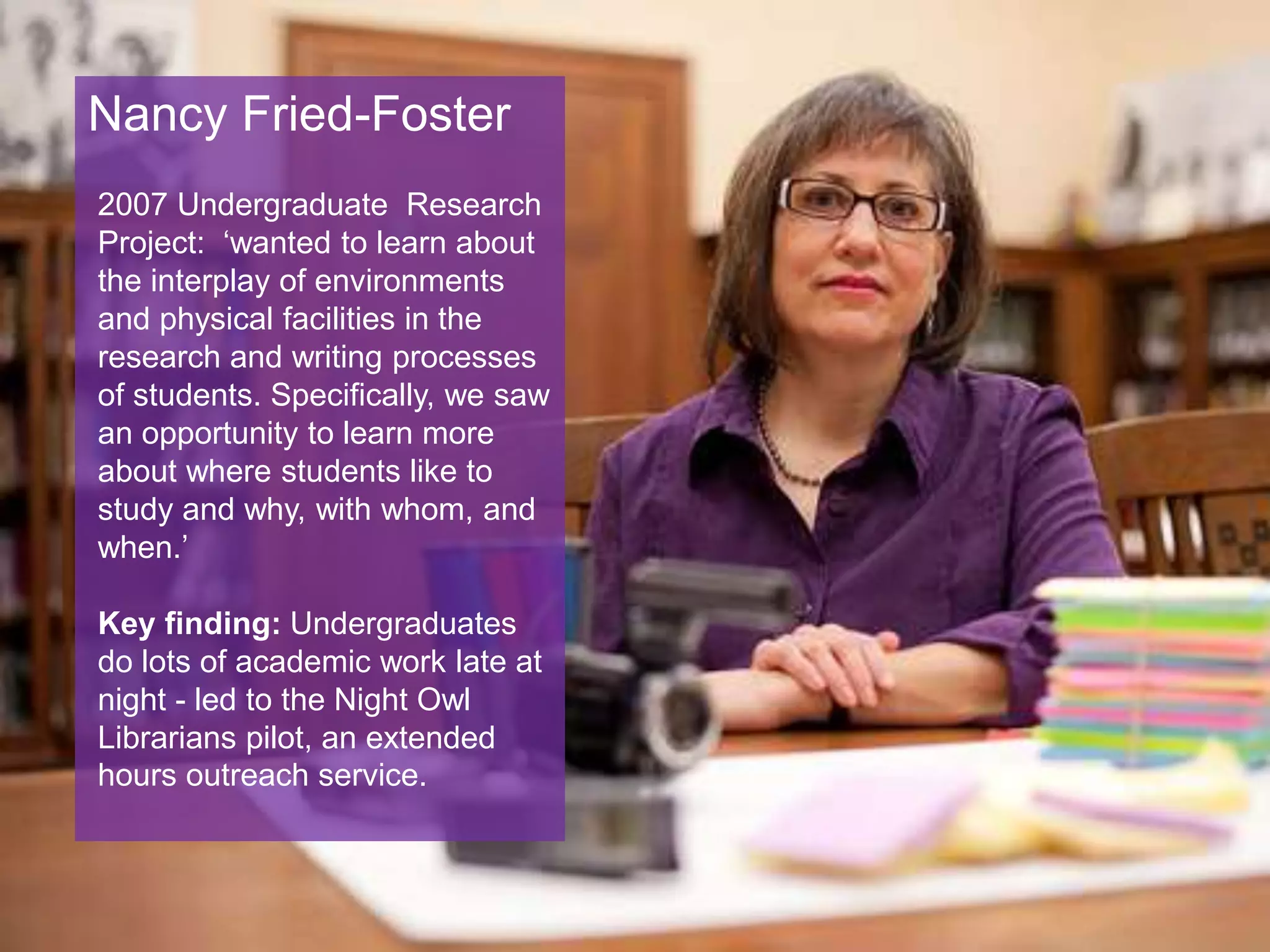
Nancy Fried-Foster
Anthropologist at the University
of Rochester, New York
Nancy Fried-Foster
2007 Undergraduate Research
Project: ‘wanted to learn about
the interplay of environments
and physical facilities in the
research and writing processes
of students. Specifically, we saw
an opportunity to learn more
about where students like to
study and why, with whom, and
when.’
Key finding: Undergraduates
do lots of academic work late at
night - led to the Night Owl
Librarians pilot, an extended
hours outreach service.
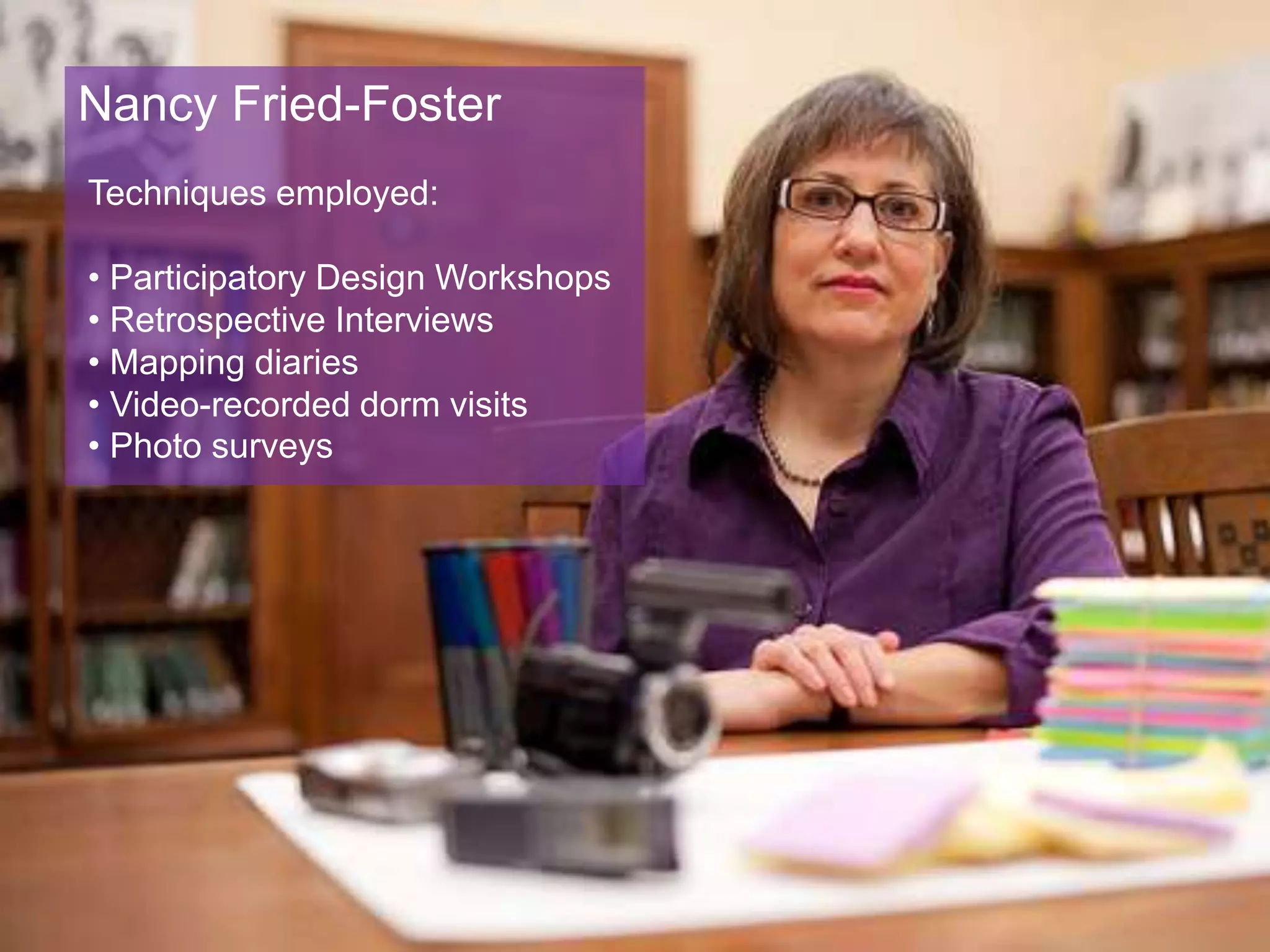
Nancy Fried-Foster
Techniques employed:
• Participatory Design Workshops
• Retrospective Interviews
• Mapping diaries
• Video-recorded dorm visits
• Photo surveys
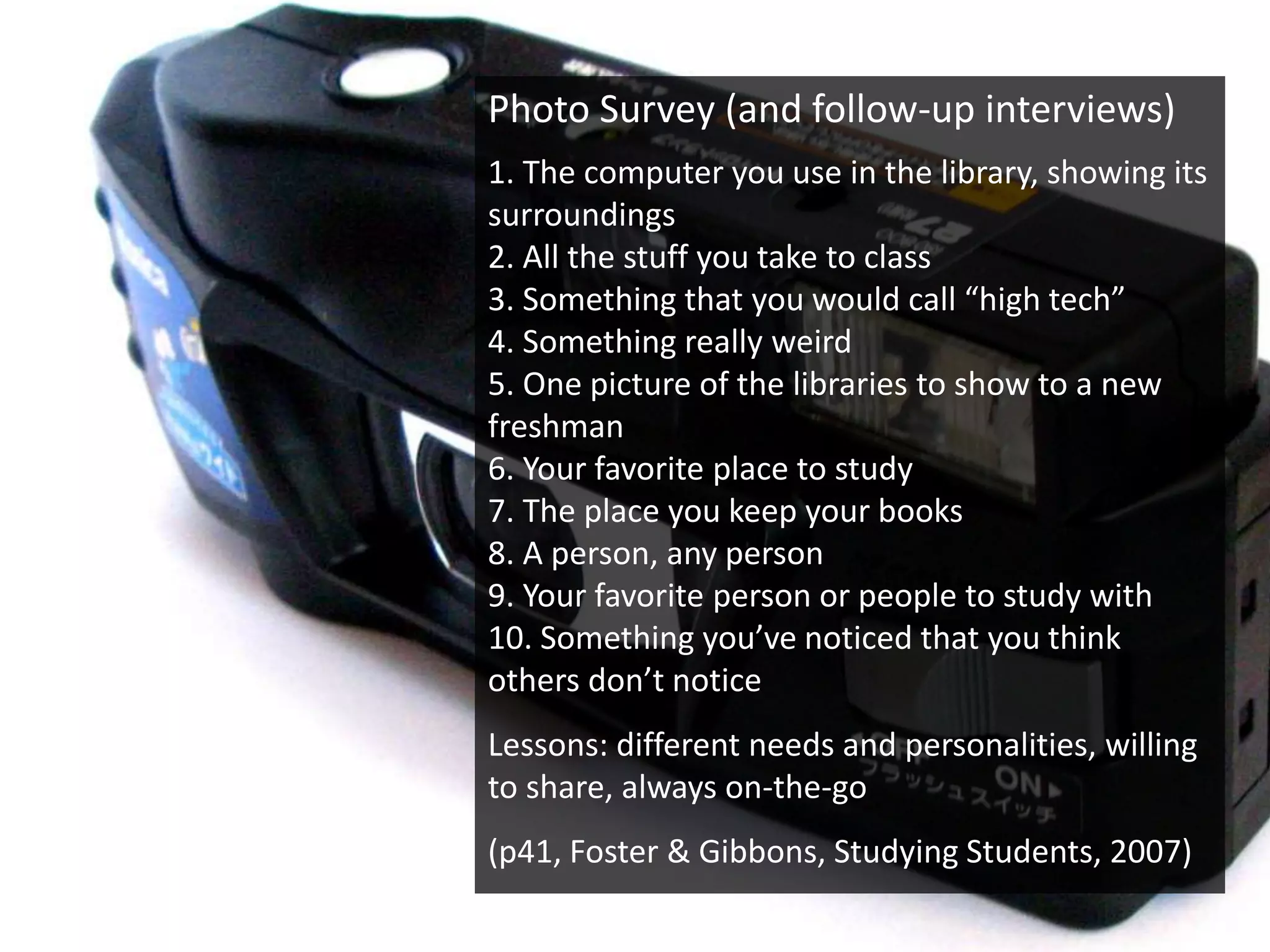
Photo Survey (and follow-up interviews)
1. The computer you use in the library, showing its
surroundings
2. All the stuff you take to class
3. Something that you would call “high tech”
4. Something really weird
5. One picture of the libraries to show to a new
freshman
6. Your favorite place to study
7. The place you keep your books
8. A person, any person
9. Your favorite person or people to study with
10. Something you’ve noticed that you think
others don’t notice
Lessons: different needs and personalities, willing
to share, always on-the-go
(p41, Foster & Gibbons, Studying Students, 2007)
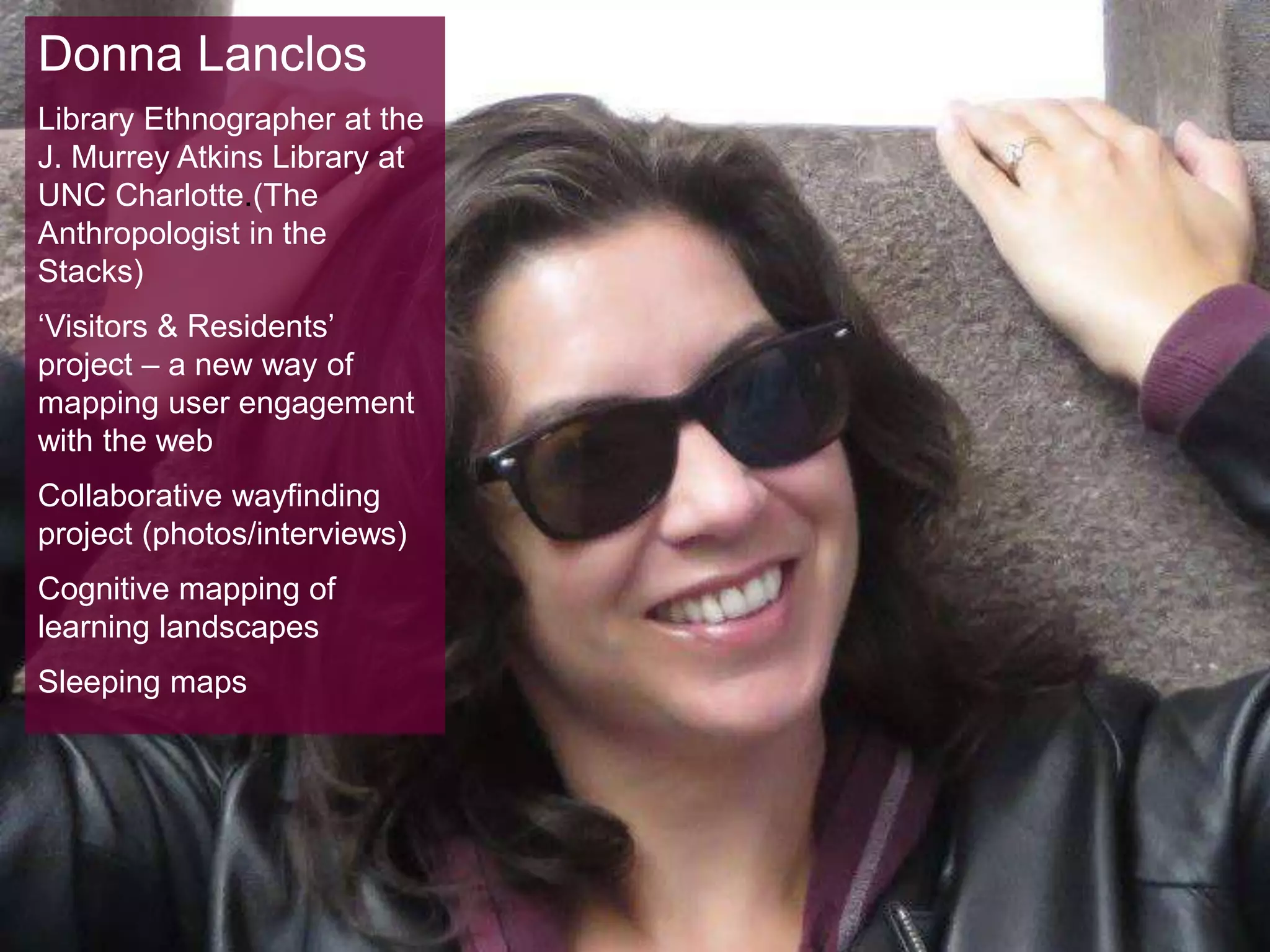
Donna Lanclos
Library Ethnographer at the
J. Murrey Atkins Library at
UNC Charlotte.(The
Anthropologist in the
Stacks)
‘Visitors & Residents’
project – a new way of
mapping user engagement
with the web
Collaborative wayfinding
project (photos/interviews)
Cognitive mapping of
learning landscapes
Sleeping maps
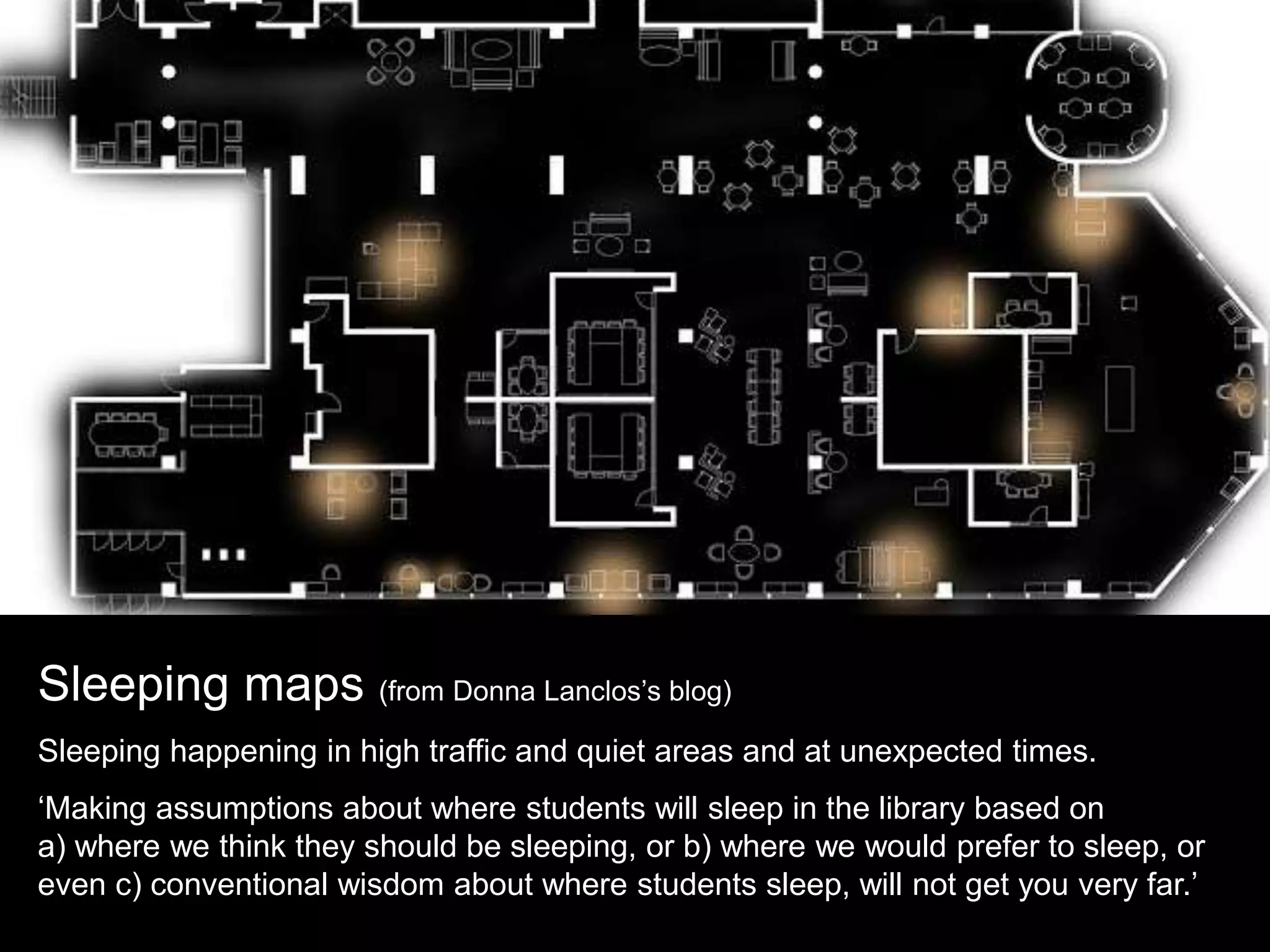
Sleeping maps (from Donna Lanclos’s blog)
Sleeping happening in high traffic and quiet areas and at unexpected times.
‘Making assumptions about where students will sleep in the library based on
a) where we think they should be sleeping, or b) where we would prefer to sleep, or
even c) conventional wisdom about where students sleep, will not get you very far.’
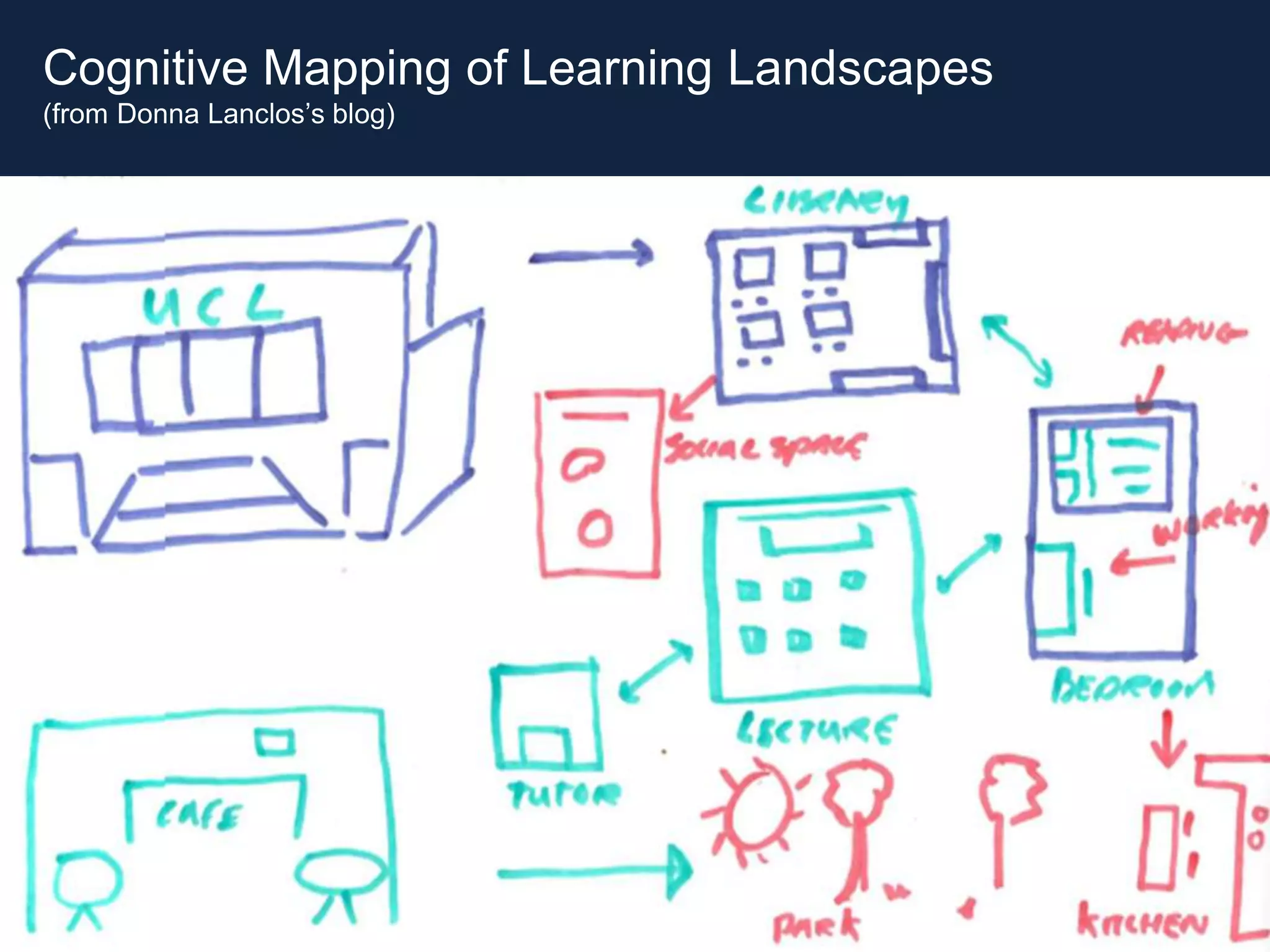
Cognitive Mapping of Learning Landscapes
(from Donna Lanclos’s blog)
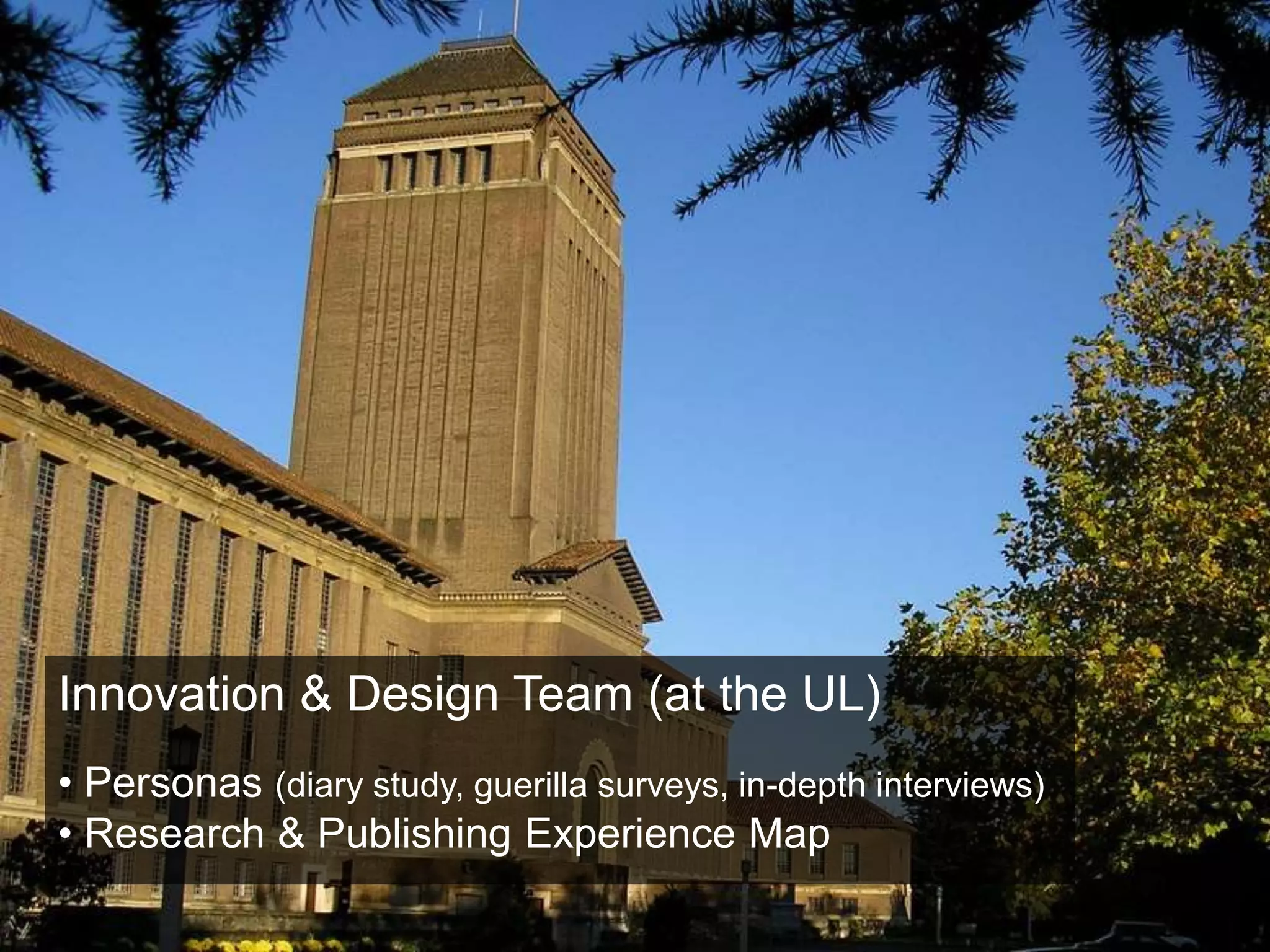
Innovation & Design Team (at the UL)
• Personas (diary study, guerilla surveys, in-depth interviews)
• Research & Publishing Experience Map
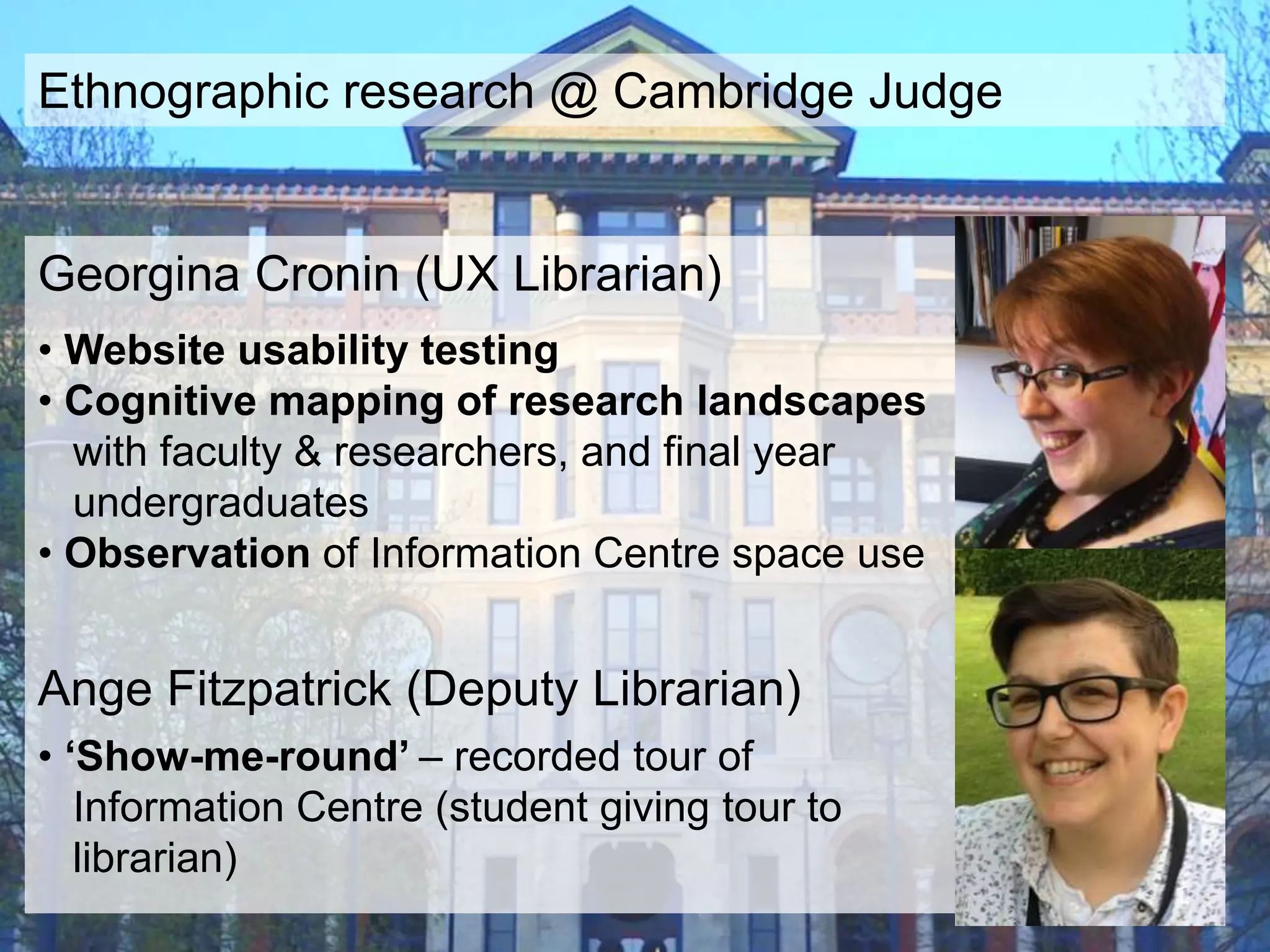
Georgina Cronin (UX Librarian)
• Website usability testing
• Cognitive mapping of research landscapes
with faculty & researchers, and final year
undergraduates
• Observation of Information Centre space use
Ange Fitzpatrick (Deputy Librarian)
• ‘Show-me-round’ – recorded tour of
Information Centre (student giving tour to
librarian)
Ethnographic research @ Cambridge Judge
Why UX in libraries
is a thing now
Andy Priestner
Cambridge Judge Business School
Resources/Links
UX in Libraries conference: www.uxlib.org
UX in Libraries twitter: https://twitter.com/UXLibs
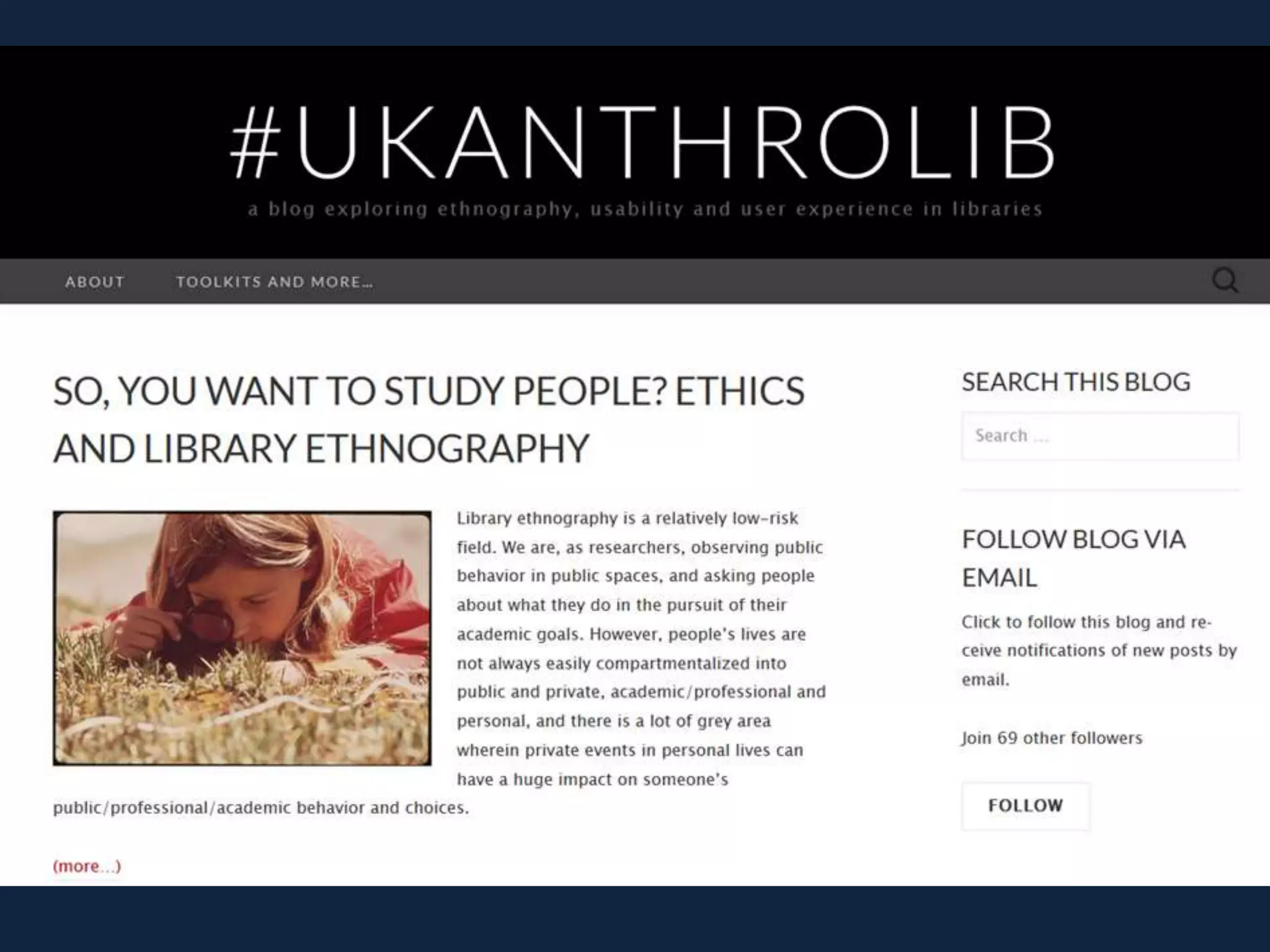
UK Anthrolib blog: http://ukanthrolib.wordpress.com/
The Anthropologist in the Stacks: http://atkinsanthro.blogspot.co.uk
Studying Students PDF (Fried-Foster): http://bit.ly/1ouo6io
BBC Four documentary on Malinowski: http://bit.ly/1qVP7w3
Weave UX/Journal of Library User Experience: http://weaveux.org/
Photo credits
Man with binoculars: http://www.flickr.com/photos/practicalowl/314989744 (CC)
Kamchatka women: http://blogs.princeton.edu/pia/personal/xinjiang/history/
Malinowski: London School of Economics and Political Science
Library user in hat: https://www.flickr.com/photos/jstar/345712329/ (CC)
Pencil questionnaire: https://www.flickr.com/photos/albertogp123/5843577306 (CC)
Pie charts: http://www.flickr.com/photos/laurenmanning/5658985469/ (CC)
Person struggling with survey: https://www.flickr.com/photos/clemsonunivlibrary/7845287468 (CC)
Cemetery: https://www.flickr.com/photos/mugley/2592160631/ (CC)
Women in conversation: http://www.flickr.com/photos/collin_key/6080864794/ (CC)
Adidas trainers: http://www.flickr.com/photos/cornyjoke/444473490/ (CC)
Woman running: https://www.flickr.com/photos/infomatique/1799996163 (CC)
Yoga class: https://www.flickr.com/photos/63045810@N00/5018250456/ (CC)
Student with bike in library: https://www.flickr.com/photos/jonastana/5568637762 (CC)
Nancy Fried-Foster: http://www.rochester.edu/currents/V40/N03/Foster.html
Disposable camera: https://www.flickr.com/photos/37227626@N00/2894263073/ (CC)
Donna Lanclos, Sleep Map, Cognitive Map: Donna Lanclos, The Anthropologist in the Stacks
Cambridge University Library: https://www.flickr.com/photos/34255186@N05/565866377 (CC)
Cambridge Judge Business School: https://www.flickr.com/photos/geoffjones/2437638720 (CC)
Georgina, Ange: Andy Priestner
UKAnthrolib screenshot: Slide 27: bit.ly/1gAYCKi (Wikimedia Commons)
UX in Libraries website: Matt Borg, Paul Jervis-Heath

Why UX in libraries is a thing now

  • 1.
    Why UX inlibraries is a thing now Andy Priestner Cambridge Judge Business School
  • 2.
    Why UX inlibraries is a thing now Andy Priestner Cambridge Judge Business School • What is UX? • Ethnography • The Old Ways • Adidas case study • Library ethnography • UX in Libraries conference
  • 3.
    ‘In some quartersUX is still viewed narrowly as analysing web metrics and web usability testing. Those are great things and necessary to practicing UX, but UX has extended far beyond the web and so should our conversation. We should be talking about applying UX in physical spaces and in any other context where it might be useful.’ www.weaveux.org / Journal of Library User Experience What is UX?
  • 4.
    What is ethnography? ‘Thescientific description of peoples and cultures with their customs, habits, and mutual differences’ (OED) ‘...a practice in which researchers spend long periods living within a culture in order to study it. The term has been adopted within qualitative market research to describe occasions where researchers spend time - hours, days or weeks - observing and/or interacting with participants in areas of their everyday lives.’ (Association for Qualitative Research)
  • 5.
    • Usability • Spacedesign • Service design • User profiling/personas • Ethnographic research What does this broader definition of UX include?
  • 6.
    Origins of ethnography- Müller Gerhard Friedrich Müller. Mid-1700s expedition to Kamchatka. He differentiated Völker-Beschreibung as a distinct area of study.
  • 7.
    Origins of ethnography– Bronislaw Malinowksi Studied indigenous culture of the Trobriand Islands for several years by living with them. Founder of ethnography as we know it.
  • 8.
    Some of Malinowksi’sworks One of these books is borrowed from libraries more than others...
  • 9.
    ‘The final goalis to grasp the native’s point of view, his relation to life, to realise his vision of the world’ (Malinowksi, 1925)
  • 10.
    But what’s thisgo to do with libraries? ‘The final goal is to grasp the users point of view, their relation to research life, to realise their vision of the service’
  • 11.
    Ethnographic Research - morepersonal and empathic - delves deeper - interested in more variables (incl. things usually ignored) - wider context, holistic - observation not just Q&A - less structured - no wrong answers - immersive - more interpretative - takes time
  • 12.
    So why don’twe librarians use ethnography? - techniques are relatively unknown - we are wedded to The Old Ways...
  • 13.
    The Old Ways -Quantitative data - Surveys/Questionnaires - Hard and fast ‘true’ facts are easier to record and describe - We tend to ignore (or at least downgrade) the value of things such as culture, customs and habits
  • 14.
    The Old Ways -Also... we love pie charts - And to a lesser extent bar charts
  • 15.
    Problems with surveys -only get data from those who take them / not representative - closed & leading questions / poor construction - respondents giving answers that survey creator wants to hear - hidden explanations for spikes and dips / blind interpretation - remote and impersonal - principally seek quantitative rather than qualitative data
  • 16.
    RIP quantitative data andsurveys? - no, just need a more balanced approach - ramp up qualitative approaches - offer more than just those gaping white empty free-text boxes
  • 17.
    Rise of CorporateEthnography (from 1990s) Adidas and... IBM, Apple, Intel, Xerox, Microsoft, Herman Miller all engaged in ethnographic research and/or hired ethnographers
  • 18.
    Adidas ethnographic findings Buyersof their brand were less focused on competing, ‘beating the rest’ and winning...
  • 19.
    Adidas ethnographic findings ...andfar more interested in healthy lifestyles, going to yoga class, and keeping fit
  • 20.
    Ethnography and libraries Whendid libraries start using ethnographic methods? Answer: 2007
  • 21.
    Nancy Fried-Foster Anthropologist atthe University of Rochester, New York
  • 22.
    Nancy Fried-Foster 2007 UndergraduateResearch Project: ‘wanted to learn about the interplay of environments and physical facilities in the research and writing processes of students. Specifically, we saw an opportunity to learn more about where students like to study and why, with whom, and when.’ Key finding: Undergraduates do lots of academic work late at night - led to the Night Owl Librarians pilot, an extended hours outreach service.
  • 23.
    Nancy Fried-Foster Techniques employed: •Participatory Design Workshops • Retrospective Interviews • Mapping diaries • Video-recorded dorm visits • Photo surveys
  • 24.
    Photo Survey (andfollow-up interviews) 1. The computer you use in the library, showing its surroundings 2. All the stuff you take to class 3. Something that you would call “high tech” 4. Something really weird 5. One picture of the libraries to show to a new freshman 6. Your favorite place to study 7. The place you keep your books 8. A person, any person 9. Your favorite person or people to study with 10. Something you’ve noticed that you think others don’t notice Lessons: different needs and personalities, willing to share, always on-the-go (p41, Foster & Gibbons, Studying Students, 2007)
  • 25.
    Donna Lanclos Library Ethnographerat the J. Murrey Atkins Library at UNC Charlotte.(The Anthropologist in the Stacks) ‘Visitors & Residents’ project – a new way of mapping user engagement with the web Collaborative wayfinding project (photos/interviews) Cognitive mapping of learning landscapes Sleeping maps
  • 26.
    Sleeping maps (fromDonna Lanclos’s blog) Sleeping happening in high traffic and quiet areas and at unexpected times. ‘Making assumptions about where students will sleep in the library based on a) where we think they should be sleeping, or b) where we would prefer to sleep, or even c) conventional wisdom about where students sleep, will not get you very far.’
  • 27.
    Cognitive Mapping ofLearning Landscapes (from Donna Lanclos’s blog)
  • 28.
    Innovation & DesignTeam (at the UL) • Personas (diary study, guerilla surveys, in-depth interviews) • Research & Publishing Experience Map
  • 29.
    Georgina Cronin (UXLibrarian) • Website usability testing • Cognitive mapping of research landscapes with faculty & researchers, and final year undergraduates • Observation of Information Centre space use Ange Fitzpatrick (Deputy Librarian) • ‘Show-me-round’ – recorded tour of Information Centre (student giving tour to librarian) Ethnographic research @ Cambridge Judge
  • 32.
    Why UX inlibraries is a thing now Andy Priestner Cambridge Judge Business School Resources/Links UX in Libraries conference: www.uxlib.org UX in Libraries twitter: https://twitter.com/UXLibs UK Anthrolib blog: http://ukanthrolib.wordpress.com/ The Anthropologist in the Stacks: http://atkinsanthro.blogspot.co.uk Studying Students PDF (Fried-Foster): http://bit.ly/1ouo6io BBC Four documentary on Malinowski: http://bit.ly/1qVP7w3 Weave UX/Journal of Library User Experience: http://weaveux.org/
  • 33.
    Photo credits Man withbinoculars: http://www.flickr.com/photos/practicalowl/314989744 (CC) Kamchatka women: http://blogs.princeton.edu/pia/personal/xinjiang/history/ Malinowski: London School of Economics and Political Science Library user in hat: https://www.flickr.com/photos/jstar/345712329/ (CC) Pencil questionnaire: https://www.flickr.com/photos/albertogp123/5843577306 (CC) Pie charts: http://www.flickr.com/photos/laurenmanning/5658985469/ (CC) Person struggling with survey: https://www.flickr.com/photos/clemsonunivlibrary/7845287468 (CC) Cemetery: https://www.flickr.com/photos/mugley/2592160631/ (CC) Women in conversation: http://www.flickr.com/photos/collin_key/6080864794/ (CC) Adidas trainers: http://www.flickr.com/photos/cornyjoke/444473490/ (CC) Woman running: https://www.flickr.com/photos/infomatique/1799996163 (CC) Yoga class: https://www.flickr.com/photos/63045810@N00/5018250456/ (CC) Student with bike in library: https://www.flickr.com/photos/jonastana/5568637762 (CC) Nancy Fried-Foster: http://www.rochester.edu/currents/V40/N03/Foster.html Disposable camera: https://www.flickr.com/photos/37227626@N00/2894263073/ (CC) Donna Lanclos, Sleep Map, Cognitive Map: Donna Lanclos, The Anthropologist in the Stacks Cambridge University Library: https://www.flickr.com/photos/34255186@N05/565866377 (CC) Cambridge Judge Business School: https://www.flickr.com/photos/geoffjones/2437638720 (CC) Georgina, Ange: Andy Priestner UKAnthrolib screenshot: Slide 27: bit.ly/1gAYCKi (Wikimedia Commons) UX in Libraries website: Matt Borg, Paul Jervis-Heath