Leaders, managers and
power mongers
Hugh Murphy
LAI CDG
Oct 14 2016
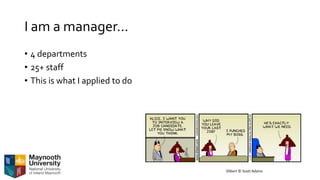
I am a manager…
• 4 departments
• 25+ staff
• This is what I applied to do
Dilbert © Scott Adams
Managers
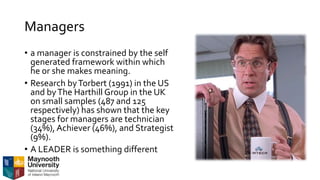
• a manager is constrained by the self
generated framework within which
he or she makes meaning.
• Research byTorbert (1991) in the US
and byThe Harthill Group in the UK
on small samples (487 and 125
respectively) has shown that the key
stages for managers are technician
(34%), Achiever (46%), and Strategist
(9%).
• A LEADER is something different
I am a leader…?
• Of whom?
• In what?
• How did I get here?
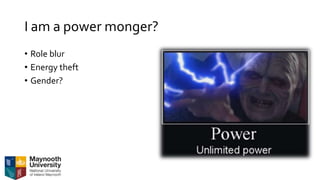
I am a power monger?
• Role blur
• Energy theft
• Gender?
So…
YOU ARE APPOINTED TO BE A MANAGER
YOU CHOOSE TO BE A LEADER
YOU CHOOSE TO BE A POWER MONGER
The challenge of capacity and view
Do we restrict our potential for change by viewing through a
traditional lens?
KEY LEARNING: in librarianship, we are a smart and capable group.
Typically issues of ‘capacity’ do not relate to intellect, endeavour or
intention, but to emotion and confidence and the ability to ‘make
meaning’
Synchronicity idea:
if everyone, by working in harmony can change the
world, then traditional hierarchies and power
structures need no longer apply – what can we take
from this to apply it to our own personal and
professional situations?
If our profession is changing so dramatically and so
radically (it is) then perhaps Given the fluidity we
see in world society, coupled with globalisation,
economic liberalisation and the tearing down of
traditional power structures, the importance of
thinking in a new way becomes even more
apparent
What constitutes success?
The result?
The process?
The change
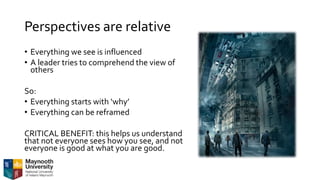
Perspectives are relative
• Everything we see is influenced
• A leader tries to comprehend the view of
others
So:
• Everything starts with ‘why’
• Everything can be reframed
CRITICAL BENEFIT: this helps us understand
that not everyone sees how you see, and not
everyone is good at what you are good.
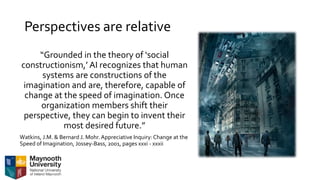
Perspectives are relative
“Grounded in the theory of ‘social
constructionism,’ AI recognizes that human
systems are constructions of the
imagination and are, therefore, capable of
change at the speed of imagination. Once
organization members shift their
perspective, they can begin to invent their
most desired future.”
Watkins, J.M. & Bernard J. Mohr. Appreciative Inquiry:Change at the
Speed of Imagination, Jossey-Bass, 2001, pages xxxi - xxxii
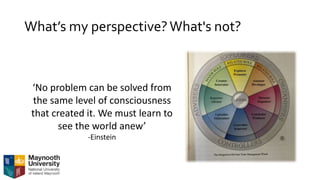
What’s my perspective?What's not?
‘No problem can be solved from
the same level of consciousness
that created it. We must learn to
see the world anew’
-Einstein
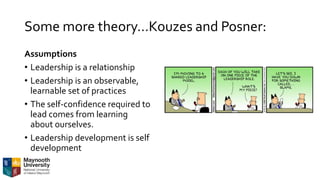
Some more theory…Kouzes and Posner:
Assumptions
• Leadership is a relationship
• Leadership is an observable,
learnable set of practices
• The self-confidence required to
lead comes from learning
about ourselves.
• Leadership development is self
development
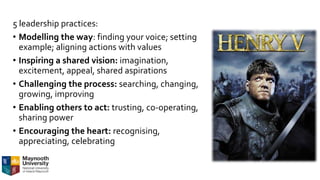
5 leadership practices:
• Modelling the way: finding your voice; setting
example; aligning actions with values
• Inspiring a shared vision: imagination,
excitement, appeal, shared aspirations
• Challenging the process: searching, changing,
growing, improving
• Enabling others to act: trusting, co-operating,
sharing power
• Encouraging the heart: recognising,
appreciating, celebrating
Key leadership questions:
If the core of leadership is sharing,
authenticity, challenging and
changing our views….
…how do we do this in a
hierarchical situation
If I put myself ‘out there’ will it be
exploited by the ‘power
mongers’?
Can you live with the decision?
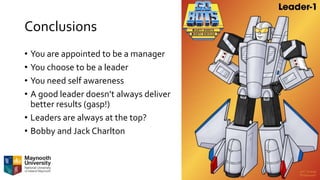
Conclusions
• You are appointed to be a manager
• You choose to be a leader
• You need self awareness
• A good leader doesn’t always deliver
better results (gasp!)
• Leaders are always at the top?
• Bobby and Jack Charlton
Thank you!
Hugh Murphy
Hugh.murphy@nuim.ie
@hughtweet

Leaders, managers and power mongers

  • 1.
    Leaders, managers and powermongers Hugh Murphy LAI CDG Oct 14 2016
  • 2.
    I am amanager… • 4 departments • 25+ staff • This is what I applied to do Dilbert © Scott Adams
  • 3.
    Managers • a manageris constrained by the self generated framework within which he or she makes meaning. • Research byTorbert (1991) in the US and byThe Harthill Group in the UK on small samples (487 and 125 respectively) has shown that the key stages for managers are technician (34%), Achiever (46%), and Strategist (9%). • A LEADER is something different
  • 4.
    I am aleader…? • Of whom? • In what? • How did I get here?
  • 5.
    I am apower monger? • Role blur • Energy theft • Gender?
  • 6.
    So… YOU ARE APPOINTEDTO BE A MANAGER YOU CHOOSE TO BE A LEADER YOU CHOOSE TO BE A POWER MONGER
  • 7.
    The challenge ofcapacity and view Do we restrict our potential for change by viewing through a traditional lens? KEY LEARNING: in librarianship, we are a smart and capable group. Typically issues of ‘capacity’ do not relate to intellect, endeavour or intention, but to emotion and confidence and the ability to ‘make meaning’
  • 8.
    Synchronicity idea: if everyone,by working in harmony can change the world, then traditional hierarchies and power structures need no longer apply – what can we take from this to apply it to our own personal and professional situations? If our profession is changing so dramatically and so radically (it is) then perhaps Given the fluidity we see in world society, coupled with globalisation, economic liberalisation and the tearing down of traditional power structures, the importance of thinking in a new way becomes even more apparent
  • 9.
    What constitutes success? Theresult? The process? The change
  • 10.
    Perspectives are relative •Everything we see is influenced • A leader tries to comprehend the view of others So: • Everything starts with ‘why’ • Everything can be reframed CRITICAL BENEFIT: this helps us understand that not everyone sees how you see, and not everyone is good at what you are good.
  • 11.
    Perspectives are relative “Groundedin the theory of ‘social constructionism,’ AI recognizes that human systems are constructions of the imagination and are, therefore, capable of change at the speed of imagination. Once organization members shift their perspective, they can begin to invent their most desired future.” Watkins, J.M. & Bernard J. Mohr. Appreciative Inquiry:Change at the Speed of Imagination, Jossey-Bass, 2001, pages xxxi - xxxii
  • 12.
    What’s my perspective?What'snot? ‘No problem can be solved from the same level of consciousness that created it. We must learn to see the world anew’ -Einstein
  • 13.
    Some more theory…Kouzesand Posner: Assumptions • Leadership is a relationship • Leadership is an observable, learnable set of practices • The self-confidence required to lead comes from learning about ourselves. • Leadership development is self development
  • 14.
    5 leadership practices: •Modelling the way: finding your voice; setting example; aligning actions with values • Inspiring a shared vision: imagination, excitement, appeal, shared aspirations • Challenging the process: searching, changing, growing, improving • Enabling others to act: trusting, co-operating, sharing power • Encouraging the heart: recognising, appreciating, celebrating
  • 15.
    Key leadership questions: Ifthe core of leadership is sharing, authenticity, challenging and changing our views…. …how do we do this in a hierarchical situation If I put myself ‘out there’ will it be exploited by the ‘power mongers’? Can you live with the decision?
  • 16.
    Conclusions • You areappointed to be a manager • You choose to be a leader • You need self awareness • A good leader doesn’t always deliver better results (gasp!) • Leaders are always at the top? • Bobby and Jack Charlton
  • 17.

Editor's Notes

  • #2 Great opportunity, but was reluctant to do it on an instinctive level. The main reason was a real person struggle with the concept of ‘power’ which, good and bad is central to both leadership and management. Power is a multifaceted thing.
  • #3 Important to stress that management and leadership are vastly different. As a manager I have staff who are mandated to report in to me and (in so far as is possible) follow my direction – maybe? I applied for this job, and was luck enough to get it.
  • #4 Typically (in a very broad context) managers have a limited and in some cases entirely ‘operational’ view
  • #5 Leadership is something far less tangible and can happen anywhere. Because it is not ‘ordained’ and is so nebulous you would be forgiven for asking how?
  • #6 Not to dwell on this, but we all know they type and sometimes, (due to lack of self awareness, lack of time to properly reflect) we are power mongers. We steal impetus and energy. I am not sure how many people in librarianship are actively pursuing this (although I have met a few) It seems to me that gender must play a role here, but I am not sure
  • #7 So there is an element of choice here and we always need to be conscious of this. Ultimately anyone could become a leader but to be a good one, you need to Have the right reasons for doing it Have some experiences (in life, work) Be ready to learn Exhibit certain values
  • #8 Two key issues: personal capacity and view In many places there are capacity issues and I am not suggesting we don’t have them. But in my experience our profession is capable so a lot of times it comes down to emotion and viewpoint
  • #9 Worth asking the question whether hierarchy prevents us improving? Can we dispense with it? What happens to responsibility? The world is changing and traditional structures are changing. Pragmatic reality: a move towards some form of consensus is merited but not at the expense of apportioning responsibility. The best leaders display vision and achieve buy in which brings some degree of synchronicity
  • #10 A key difference between leaders and managers is in the interpretation of ‘success’ and lens through which it is viewed A classic example might be the implementation of an LMS: is the successful implementation the success or is it the effect it had on galvanising the team, initiating a reconsideration of workflows and asking the big questions about what we are doing?
  • #11 So, it all comes down to perspective What distinguishes a really good leader is the understanding that we all view and make meaning differently. If we can view the issue through different lenses and enquire as to why, we can flip the question
  • #12 And we all need to do this. For example: a medical background is reputed to be poor training for leadership as everyone does what you say. Hard to change perspective and no compunction to enquire
  • #13 Dramatic realisation: creator innovator. Understanding that I see things differently to others That’s not a bad thing My view point is valid I have power Huge road to Damascus moment, but worthless unless you continue to reflect and acknowledge it
  • #14 K+P are big fish here since the 1980s and have generated a lot of useful insights
  • #15 Some are more difficult than others, and what I find challenging you may not. Personally: I believe in the importance of modelling the way, but how do you know you are doing it? You have to be authentic to you views Trust can be hard but is made infinitely easier if you can view through the other persons lens Appreciate and celebrate – you cant give a bonus, so give credit where it is due
  • #16 So How do we challenge / flip in a situation which is fundamentally hierarchical? How do we trust and open up while worrying about power mongers Personally two key questions: is what I am doing right? And for the right reasons? Which can be boiled down to ‘can I live with it?’
  • #17 Self awareness: reflect, document all the time Define success? Leaders are everywhere – great LA in General collections Leadership is not always instinctive: Bobby Charlton v Jack