Library
Programming for
Babies
Suzanne Walker
Indiana State Library
suwalker@library.in.gov
@suzieecw
Who is this person?
What about my LEUs?
What are we talking about?
• Babies – ages 0-11 mos
• Ages 0-1 month should really not be exposed
to lots of other babies…up to you
• It’s never to late to start educating the
parents
Why should we have
programming just for babies?
• To educate their parents or caregivers.
What do we do in a baby
program?
• Talking, Singing, Reading, Writing, Playing
What do we do in a baby
program?
• We need to teach parents how to Talk, Sing,
Read, Write, and Play with their babies.
What do we do in a baby
program?
• Show them how to talk with their child.
• Show them how to play with their child.
• Model dialogic reading.
• Work on motor skills. (Precursor to Writing)
• Help them see that singing to their child
doesn’t have to be scary or intimidating (Yes.
This means you HAVE to sing to children).
Wait. I just want to play with
babies. You mean I have to
talk to parents?
• It is our job to enhance our storytimes and
programs for baby with great information for
parents and caregivers.
• Yes. Programming for babies should be fun,
but we need to be thoughtful about our
delivery of information to parents.
Quote from book:
1. We become more aware of how storytime
components support early literacy.
2. We can better articulate early literacy
information to other staff and to
administrators.
3. We become better child advocates in the
community.
4. We not only model but also explain early
literacy information to parents/caregivers…
Early Literacy Storytimes @ Your Library by Saroj Ghoting and Pamela Martin-Diaz
What programs can we have
for babies?
• So many options! But today we will focus on:
–Storytimes
–Playtimes
–Parent Education Programs
–Handouts for Parents
But first…about the senses…
Hearing
• Newborns can’t hear some very quiet
sounds, but the sense of hearing is well
developed
• After about 3 month baby will turn head
toward a sound
• By 4-8 months baby’s sense of hearing is
fully developed and she can hear the full
range of sound frequencies
• Good sense to focus on in our programs.
But first…about the senses…
Smell
• Newborn sense of smell is really, really good
• Breast pad experiment
• One of the most well developed senses when
baby is born
But first…about the senses…
Taste
• Newborns can distinguish between sweet,
salty, sour, and bitter
• Full taste sensitivity develops by about 12-19
months
But first…about the senses…
Touch
• Newborns can sense heat and cold and can
feel pain.
• The hands and the mouth are especially
sensitive to touch.
• Texture sensitivity develops from 1-9
months.
• Good sense to focus on in our programs.
But first…about the senses…
Vision
• Newborns can see in front of them only 8-15
inches in front of her face and have limited
color vision
• One month – about 3 feet, can track
movement with eyes
• Two months – can see basic colors
• Full color vision comes around 4-7 months
• Depth perception develops between 3-7
months and keeps developing until baby is
around 2 years old
Baby Storytimes
• How many people can you have?
• Parents or caregivers should ALWAYS be
in attendance. Some libraries call it
Lapsit for that very reason.
• Remember, babies have short attention
spans.
• Model with a friendly puppet or doll
Baby Storytimes –
Doesn’t Make Sense
• Flannel boards with small pieces
• Reading lots of books or long books
• Lots and lots of screen time
• Having an hour long program
• Expecting babies to be calm all the time
• Parachute
Baby Storytimes –
Does Make Sense
• Repetition + Variety
• Book sharing instead of you reading
• Invite parents to feel free to leave and
come back if their child is not happy
• Toy time or play time being a chunk of
your program
• Puppets, music, rhymes, fingerplays
• Have words available for parents
Baby Storytimes –
One Outline
• Pre-activity: Song with Scarves for example
• Opening Song, Introduction, Expectations
• Finger play – more complicated
• Rhyme with puppets
• Share the book
• Clapping song
• Finger play - easier
• Song with instruments
• Toy time
• Closing song
Baby Storytimes –
A Finger Play –
You do it / Baby does it
Way up high in the Apple Tree (Point finger up)
Five red apples smiled at me. (Hold up five fingers)
I shook that tree as hard as I could, (Clasp hands
together and shake back and forth)
Down fell an apple, mmm it was good. (Rub tummy
with both hands)
Baby Storytimes –
Your Repertoire
• Keep notes as to what works in your story time and
what doesn’t work
• Make sure to keep some back up plans with you
during storytime in case something falls flat
• Develop your own list of your favorite things to do
Play Times
• Play Times are great ways to educate parents
about the positive benefits of play
• “Many parents have not heard that play is
itself a rich and unparalleled learning activity.”
– Read, Play, Grow article
Play Times
• A couple of ideas for Play Times:
– Baby Dance Party / Baby Rock Band
– Toy Time @ the Library / Include Blocks!
Play Times – Baby Dance Party
• All music program facilitated by you
• Keep it short and simple…maybe ½ hour with
time for parent networking or a quick Early
Literacy Minute at the end
• Could require a 1:1 ratio
Play Times – Baby Dance Party
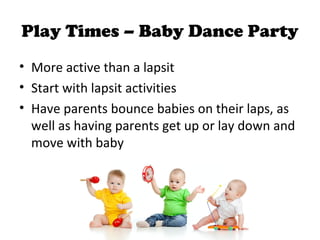
• More active than a lapsit
• Start with lapsit activities
• Have parents bounce babies on their laps, as
well as having parents get up or lay down and
move with baby
Play Times – Baby Dance Party
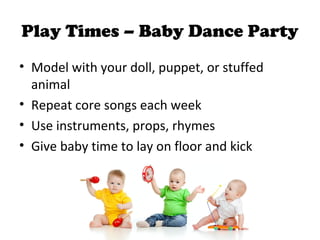
• Model with your doll, puppet, or stuffed
animal
• Repeat core songs each week
• Use instruments, props, rhymes
• Give baby time to lay on floor and kick
Play Times – Toy time
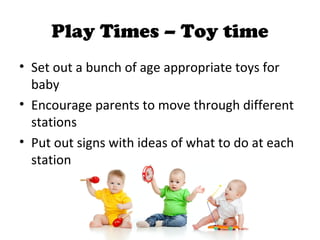
• Set out a bunch of age appropriate toys for
baby
• Encourage parents to move through different
stations
• Put out signs with ideas of what to do at each
station
Play Times – Toy time
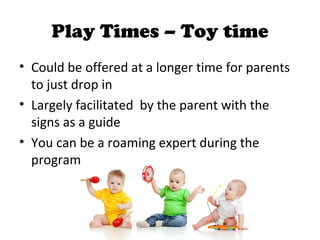
• Could be offered at a longer time for parents
to just drop in
• Largely facilitated by the parent with the
signs as a guide
• You can be a roaming expert during the
program
Play Times – Toy time
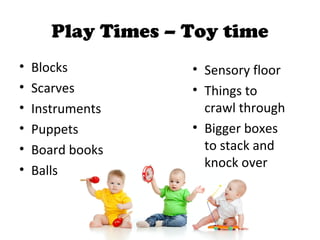
• Blocks
• Scarves
• Instruments
• Puppets
• Board books
• Balls
• Sensory floor
• Things to
crawl through
• Bigger boxes
to stack and
knock over
Parent Education Programs
• Use your Every Child Ready to Read
information
• Partner with area experts on things like
– Car Seats
– Breastfeeding
– Local resources
– Baby Sign Language
– Speech Therapist
Parent Education Programs
• Calendar of activities
• Grab and Gos / Busy Bags
• Parenting Kits
• Parenting Resources
• Baby Shower
– Totally trick them into taking a parenting class
Baby Programming Resources
• Bloggers
– http://storytimesecrets.blogspot.com/
– http://melissa.depperfamily.net/blog/
• Twitter
– @sotomorrow
– @abbylibrarian
• Books
• Mother Goose on the Loose
• Websites
• Other Librarians
Bibliography
• https://sites.google.com/site/laptimeandstorytime/librarylap
time
• http://www.teachpreschool.org/2009/04/what-is-a-
fingerplay/#ixzz2bD6plSl1
• Storytime Magic by Kathy MacMillan
• Early Literacy Storytimes @ Your Library by Saroj Ghoting and
Pamela Martin-Diaz
• Baby Development Stages: The First Year – WebMD
• How Your Child’s Sensory System Develops –
www.abilitypath.org
• Read, Play, Grow! By Rachel G. Payne / School Library
Journal. Jul2013, Vol. 59 Issue 7, pg. 22

Programming for Babies at your Library

  • 1.
    Library Programming for Babies Suzanne Walker IndianaState Library suwalker@library.in.gov @suzieecw
  • 2.
    Who is thisperson? What about my LEUs?
  • 3.
    What are wetalking about? • Babies – ages 0-11 mos • Ages 0-1 month should really not be exposed to lots of other babies…up to you • It’s never to late to start educating the parents
  • 4.
    Why should wehave programming just for babies? • To educate their parents or caregivers.
  • 5.
    What do wedo in a baby program? • Talking, Singing, Reading, Writing, Playing
  • 6.
    What do wedo in a baby program? • We need to teach parents how to Talk, Sing, Read, Write, and Play with their babies.
  • 7.
    What do wedo in a baby program? • Show them how to talk with their child. • Show them how to play with their child. • Model dialogic reading. • Work on motor skills. (Precursor to Writing) • Help them see that singing to their child doesn’t have to be scary or intimidating (Yes. This means you HAVE to sing to children).
  • 8.
    Wait. I justwant to play with babies. You mean I have to talk to parents? • It is our job to enhance our storytimes and programs for baby with great information for parents and caregivers. • Yes. Programming for babies should be fun, but we need to be thoughtful about our delivery of information to parents.
  • 9.
    Quote from book: 1.We become more aware of how storytime components support early literacy. 2. We can better articulate early literacy information to other staff and to administrators. 3. We become better child advocates in the community. 4. We not only model but also explain early literacy information to parents/caregivers… Early Literacy Storytimes @ Your Library by Saroj Ghoting and Pamela Martin-Diaz
  • 10.
    What programs canwe have for babies? • So many options! But today we will focus on: –Storytimes –Playtimes –Parent Education Programs –Handouts for Parents
  • 11.
    But first…about thesenses… Hearing • Newborns can’t hear some very quiet sounds, but the sense of hearing is well developed • After about 3 month baby will turn head toward a sound • By 4-8 months baby’s sense of hearing is fully developed and she can hear the full range of sound frequencies • Good sense to focus on in our programs.
  • 12.
    But first…about thesenses… Smell • Newborn sense of smell is really, really good • Breast pad experiment • One of the most well developed senses when baby is born
  • 13.
    But first…about thesenses… Taste • Newborns can distinguish between sweet, salty, sour, and bitter • Full taste sensitivity develops by about 12-19 months
  • 14.
    But first…about thesenses… Touch • Newborns can sense heat and cold and can feel pain. • The hands and the mouth are especially sensitive to touch. • Texture sensitivity develops from 1-9 months. • Good sense to focus on in our programs.
  • 15.
    But first…about thesenses… Vision • Newborns can see in front of them only 8-15 inches in front of her face and have limited color vision • One month – about 3 feet, can track movement with eyes • Two months – can see basic colors • Full color vision comes around 4-7 months • Depth perception develops between 3-7 months and keeps developing until baby is around 2 years old
  • 16.
    Baby Storytimes • Howmany people can you have? • Parents or caregivers should ALWAYS be in attendance. Some libraries call it Lapsit for that very reason. • Remember, babies have short attention spans. • Model with a friendly puppet or doll
  • 17.
    Baby Storytimes – Doesn’tMake Sense • Flannel boards with small pieces • Reading lots of books or long books • Lots and lots of screen time • Having an hour long program • Expecting babies to be calm all the time • Parachute
  • 18.
    Baby Storytimes – DoesMake Sense • Repetition + Variety • Book sharing instead of you reading • Invite parents to feel free to leave and come back if their child is not happy • Toy time or play time being a chunk of your program • Puppets, music, rhymes, fingerplays • Have words available for parents
  • 19.
    Baby Storytimes – OneOutline • Pre-activity: Song with Scarves for example • Opening Song, Introduction, Expectations • Finger play – more complicated • Rhyme with puppets • Share the book • Clapping song • Finger play - easier • Song with instruments • Toy time • Closing song
  • 20.
    Baby Storytimes – AFinger Play – You do it / Baby does it Way up high in the Apple Tree (Point finger up) Five red apples smiled at me. (Hold up five fingers) I shook that tree as hard as I could, (Clasp hands together and shake back and forth) Down fell an apple, mmm it was good. (Rub tummy with both hands)
  • 21.
    Baby Storytimes – YourRepertoire • Keep notes as to what works in your story time and what doesn’t work • Make sure to keep some back up plans with you during storytime in case something falls flat • Develop your own list of your favorite things to do
  • 22.
    Play Times • PlayTimes are great ways to educate parents about the positive benefits of play • “Many parents have not heard that play is itself a rich and unparalleled learning activity.” – Read, Play, Grow article
  • 23.
    Play Times • Acouple of ideas for Play Times: – Baby Dance Party / Baby Rock Band – Toy Time @ the Library / Include Blocks!
  • 24.
    Play Times –Baby Dance Party • All music program facilitated by you • Keep it short and simple…maybe ½ hour with time for parent networking or a quick Early Literacy Minute at the end • Could require a 1:1 ratio
  • 25.
    Play Times –Baby Dance Party • More active than a lapsit • Start with lapsit activities • Have parents bounce babies on their laps, as well as having parents get up or lay down and move with baby
  • 26.
    Play Times –Baby Dance Party • Model with your doll, puppet, or stuffed animal • Repeat core songs each week • Use instruments, props, rhymes • Give baby time to lay on floor and kick
  • 27.
    Play Times –Toy time • Set out a bunch of age appropriate toys for baby • Encourage parents to move through different stations • Put out signs with ideas of what to do at each station
  • 28.
    Play Times –Toy time • Could be offered at a longer time for parents to just drop in • Largely facilitated by the parent with the signs as a guide • You can be a roaming expert during the program
  • 29.
    Play Times –Toy time • Blocks • Scarves • Instruments • Puppets • Board books • Balls • Sensory floor • Things to crawl through • Bigger boxes to stack and knock over
  • 30.
    Parent Education Programs •Use your Every Child Ready to Read information • Partner with area experts on things like – Car Seats – Breastfeeding – Local resources – Baby Sign Language – Speech Therapist
  • 31.
    Parent Education Programs •Calendar of activities • Grab and Gos / Busy Bags • Parenting Kits • Parenting Resources • Baby Shower – Totally trick them into taking a parenting class
  • 32.
    Baby Programming Resources •Bloggers – http://storytimesecrets.blogspot.com/ – http://melissa.depperfamily.net/blog/ • Twitter – @sotomorrow – @abbylibrarian • Books • Mother Goose on the Loose • Websites • Other Librarians
  • 33.
    Bibliography • https://sites.google.com/site/laptimeandstorytime/librarylap time • http://www.teachpreschool.org/2009/04/what-is-a- fingerplay/#ixzz2bD6plSl1 •Storytime Magic by Kathy MacMillan • Early Literacy Storytimes @ Your Library by Saroj Ghoting and Pamela Martin-Diaz • Baby Development Stages: The First Year – WebMD • How Your Child’s Sensory System Develops – www.abilitypath.org • Read, Play, Grow! By Rachel G. Payne / School Library Journal. Jul2013, Vol. 59 Issue 7, pg. 22

Editor's Notes

  • #3 Parents are a child’s first teacher and the most important influence in a child’s life. You would think with the internet and everything that parents would up on the latest and greatest early childhood research, but the simple fact is that they are not. Parents are too busy with work, other children, and taking care of daily needs to find good information regarding childhood development. Some parents are uneducated and just don’t know what they don’t know Some parents don’t have the economical backing to allow them access to the internet There is no requirement that parents take a parenting class before having a child.
  • #4 Parents are a child’s first teacher and the most important influence in a child’s life. You would think with the internet and everything that parents would up on the latest and greatest early childhood research, but the simple fact is that they are not. Parents are too busy with work, other children, and taking care of daily needs to find good information regarding childhood development. Some parents are uneducated and just don’t know what they don’t know Some parents don’t have the economical backing to allow them access to the internet There is no requirement that parents take a parenting class before having a child.
  • #5 Parents are a child’s first teacher and the most important influence in a child’s life. You would think with the internet and everything that parents would up on the latest and greatest early childhood research, but the simple fact is that they are not. Parents are too busy with work, other children, and taking care of daily needs to find good information regarding childhood development. Some parents are uneducated and just don’t know what they don’t know Some parents don’t have the economical backing to allow them access to the internet There is no requirement that parents take a parenting class before having a child.
  • #6 We all know that Every Child Ready to Read is a research based tool kit for parents. We all know that babies will do better in life if they have meaningful interactions with their parents using Talking, Singing, Reading, Writing, and Playing…but many parents don’t know that.