IFLA Wrocław • 22 August 2017
Capturing the Behaviors of the Elusive User:
Strategies for Library Ethnography
Lynn Silipigni Connaway, PhD
Senior Research Scientist & Director of User Research, OCLC
connawal@oclc.org
@LynnConnaway
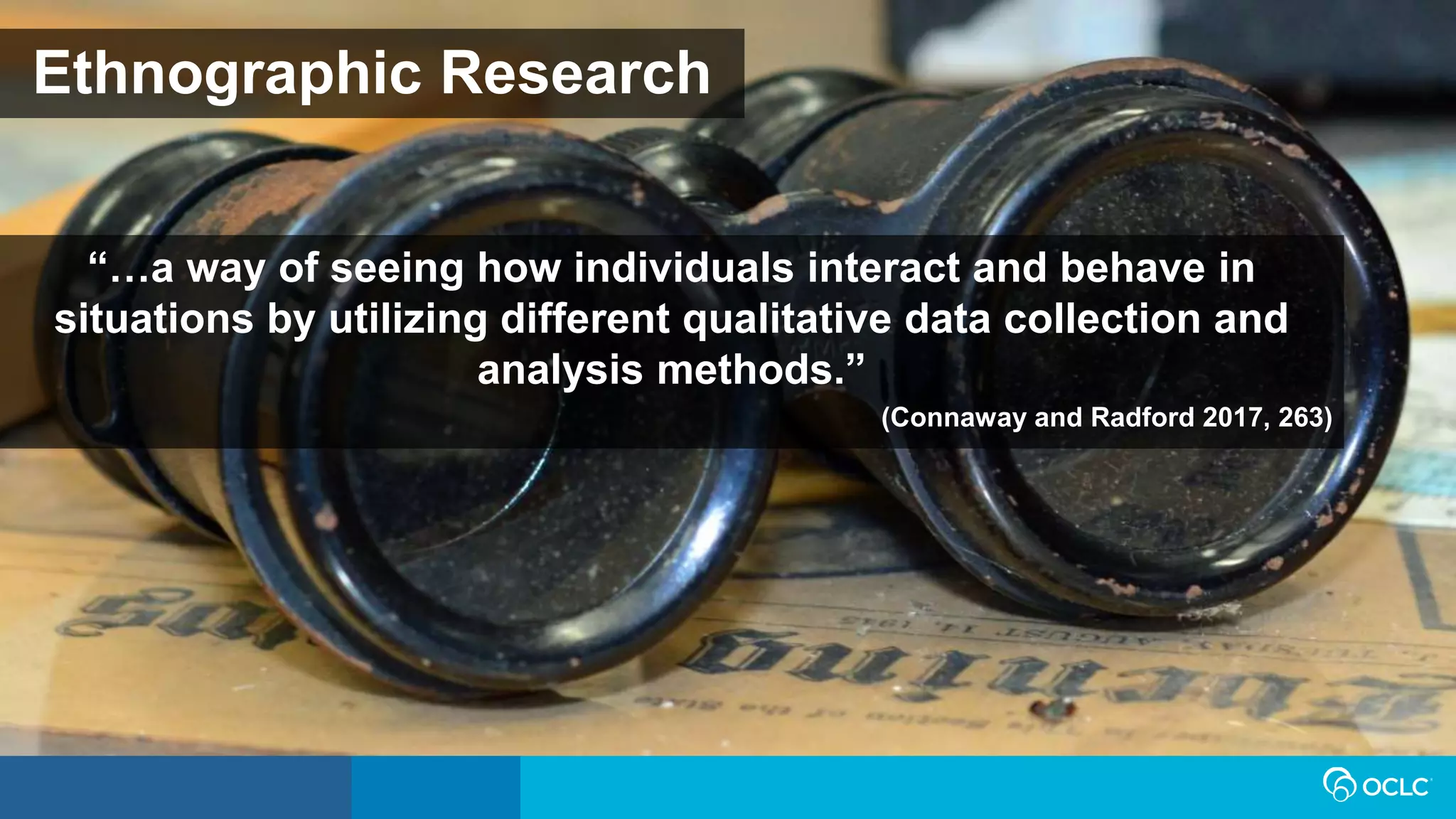
Ethnographic Research
“…a way of seeing how individuals interact and behave in
situations by utilizing different qualitative data collection and
analysis methods.”
(Connaway and Radford 2017, 263)
Qualitative Research Definition
A type of scientific research that:
• Seeks answers to a question
• Systematically uses predefined set of
procedures to answer question
• Collects evidence
• Produces findings that:
• Are not determined in advance
• Apply beyond immediate boundaries of
study
What is Qualitative Research?
“…a situated activity that locates the observer in the world. It consists of a
set of interpretive, material practices that make the world visible. These
practices transform the world. They turn the world into a series of
representations, including field notes, interviews, conversations,
photographs, recordings, & memos to the self.
At this level, qualitative research involves an interpretive, naturalistic
approach to the world. This means that qualitative researchers study
things in their natural settings, attempting to make sense of, or to
interpret, phenomena in terms of the meanings people bring to them.”
(Denzin and Lincoln 2005)
ETHNOGRAPHIC DATA
COLLECTION TOOLS AND
METHODS
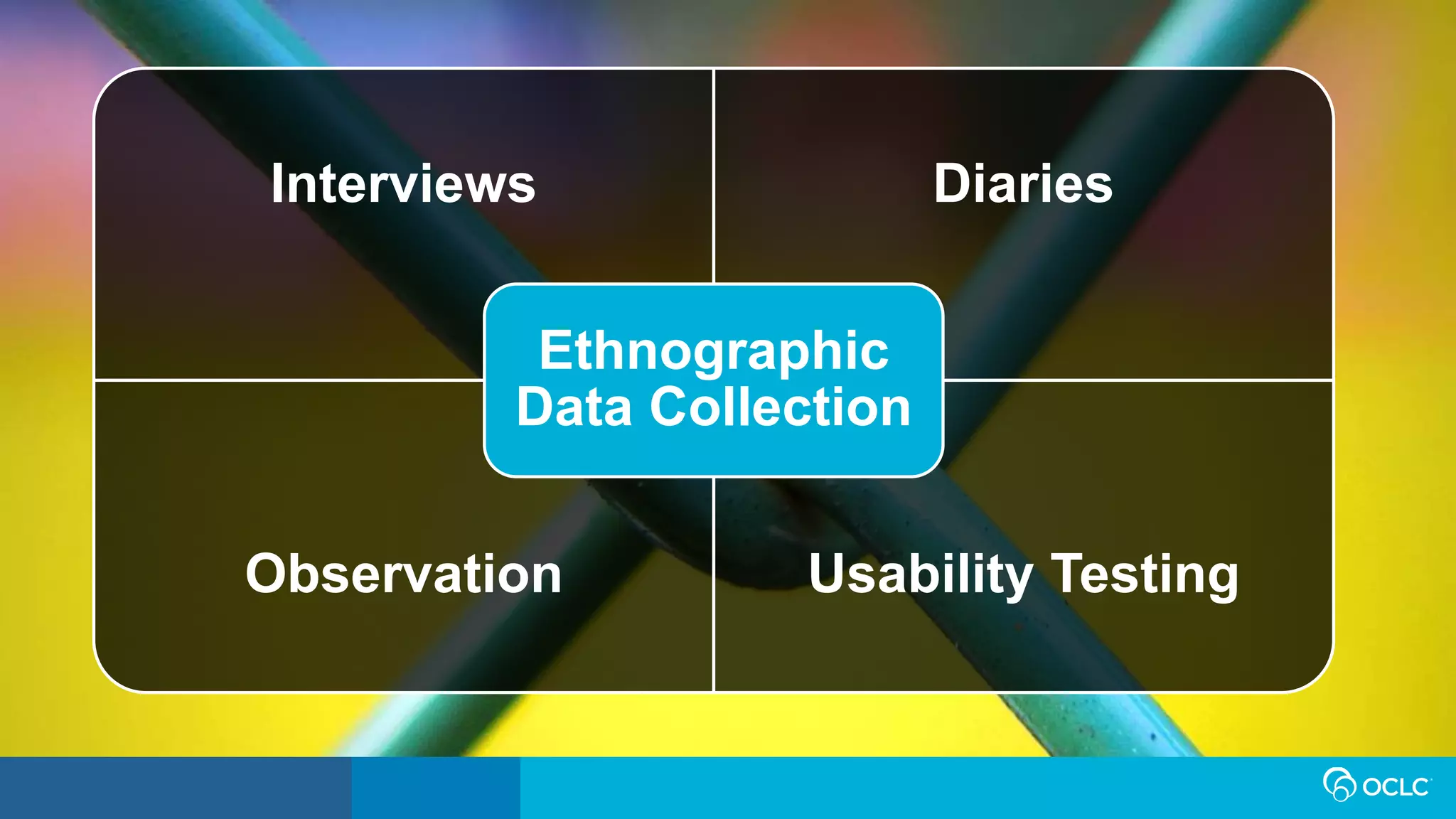
Interviews Diaries
Observation Usability Testing
Ethnographic
Data Collection
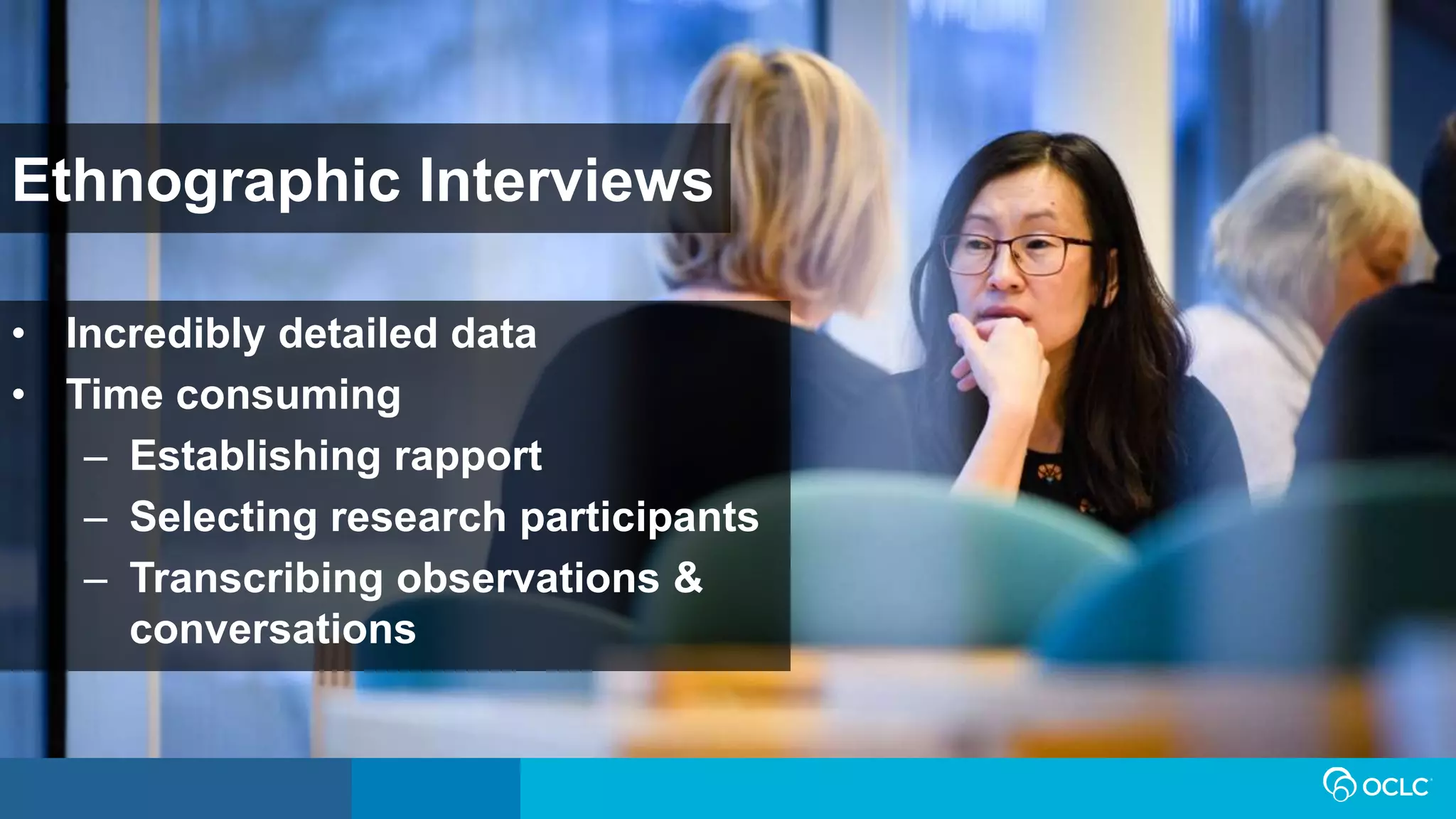
Ethnographic Interviews
• Incredibly detailed data
• Time consuming
– Establishing rapport
– Selecting research participants
– Transcribing observations &
conversations
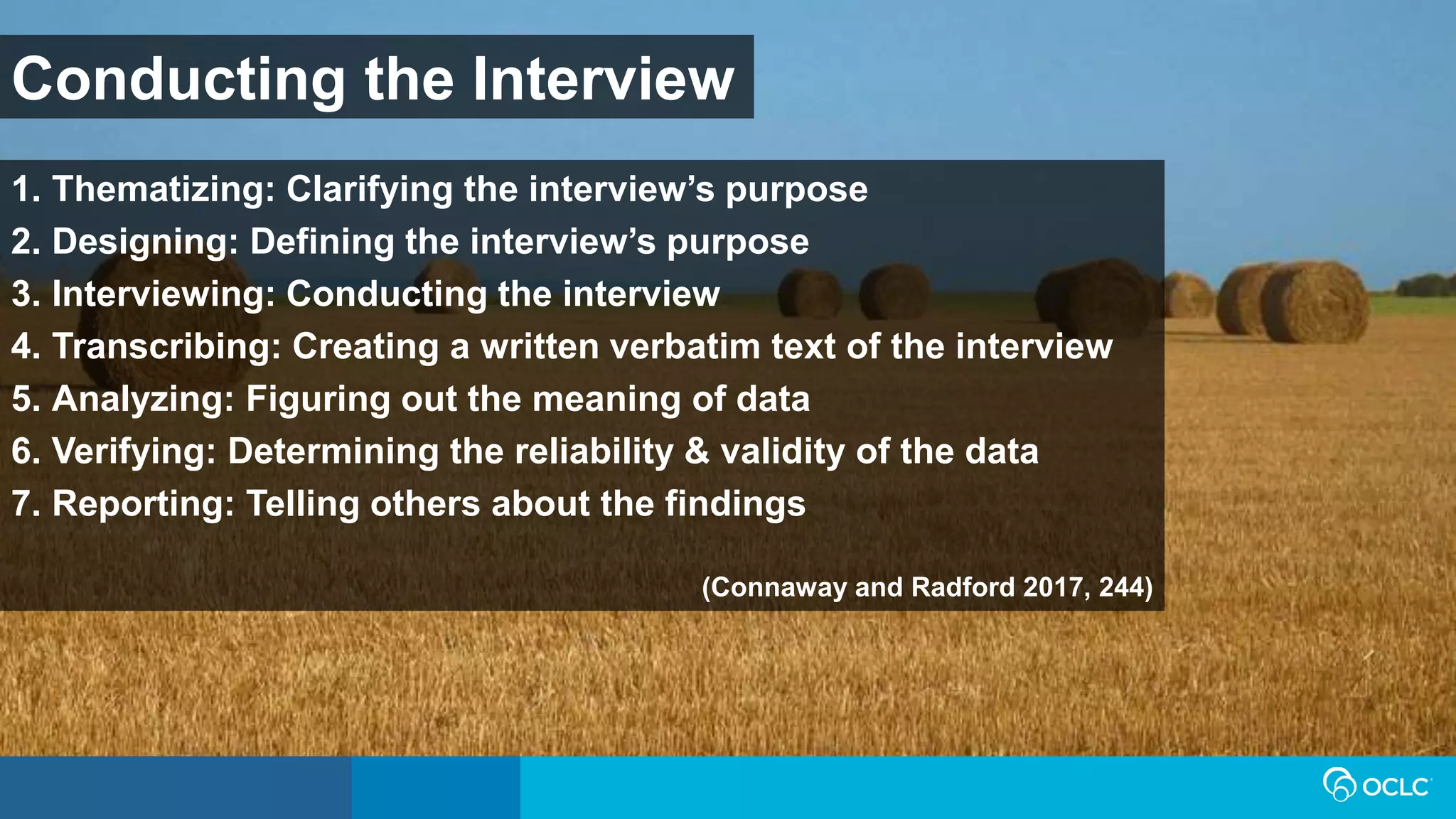
Conducting the Interview
1. Thematizing: Clarifying the interview’s purpose
2. Designing: Defining the interview’s purpose
3. Interviewing: Conducting the interview
4. Transcribing: Creating a written verbatim text of the interview
5. Analyzing: Figuring out the meaning of data
6. Verifying: Determining the reliability & validity of the data
7. Reporting: Telling others about the findings
(Connaway and Radford 2017, 244)
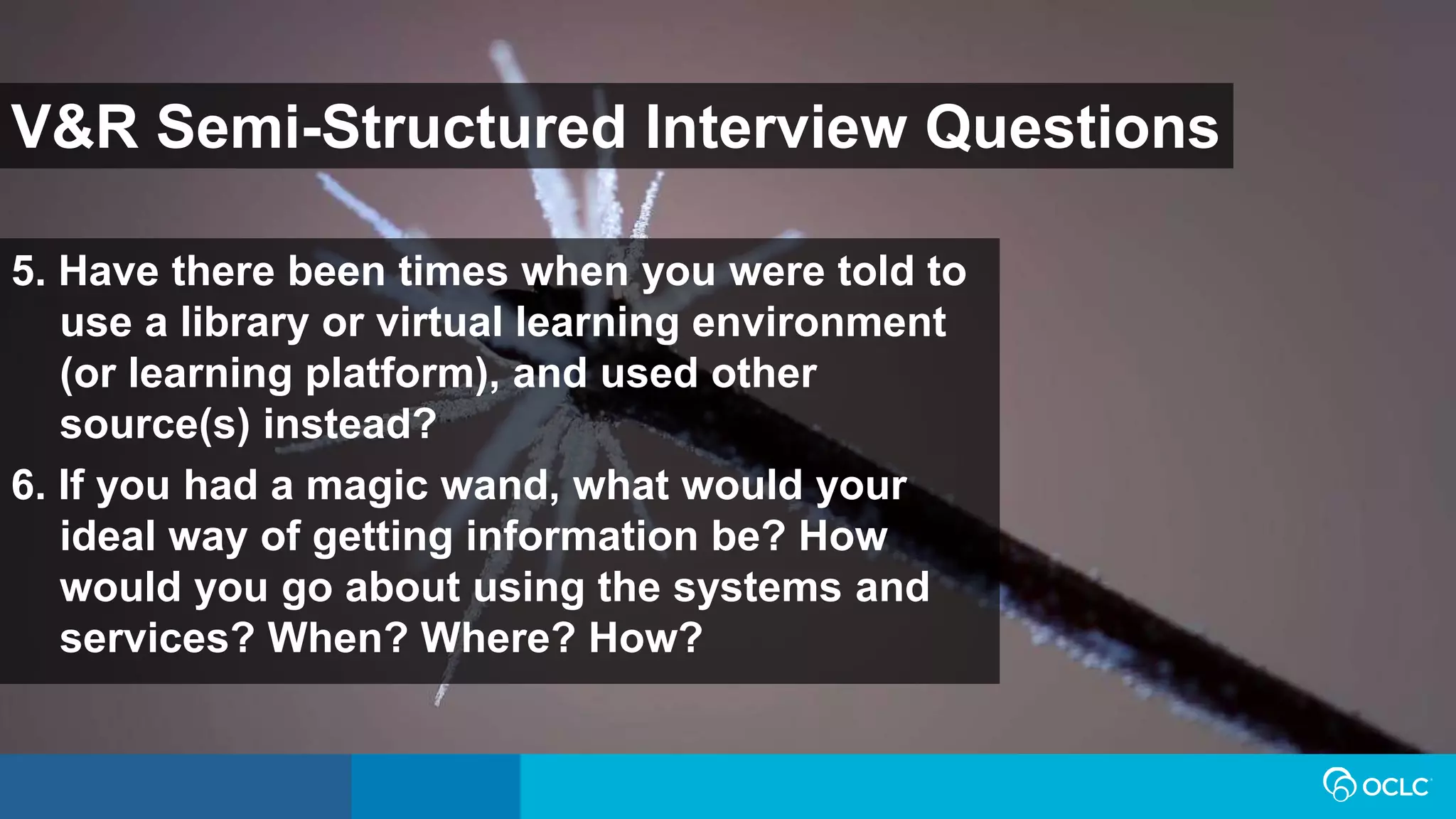
V&R Semi-Structured Interview Questions
5. Have there been times when you were told to
use a library or virtual learning environment
(or learning platform), and used other
source(s) instead?
6. If you had a magic wand, what would your
ideal way of getting information be? How
would you go about using the systems and
services? When? Where? How?
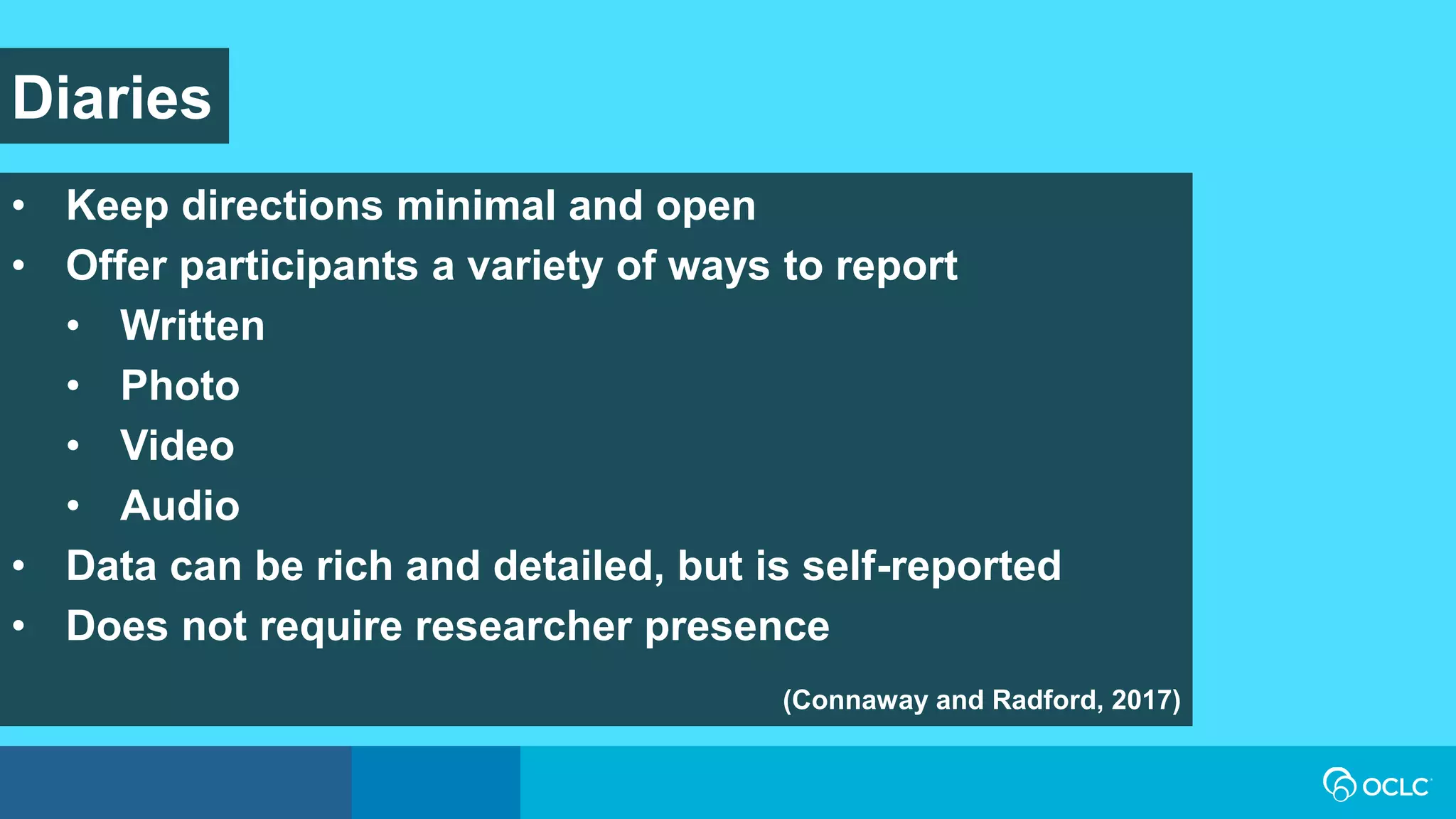
Diaries
• Keep directions minimal and open
• Offer participants a variety of ways to report
• Written
• Photo
• Video
• Audio
• Data can be rich and detailed, but is self-reported
• Does not require researcher presence
(Connaway and Radford, 2017)
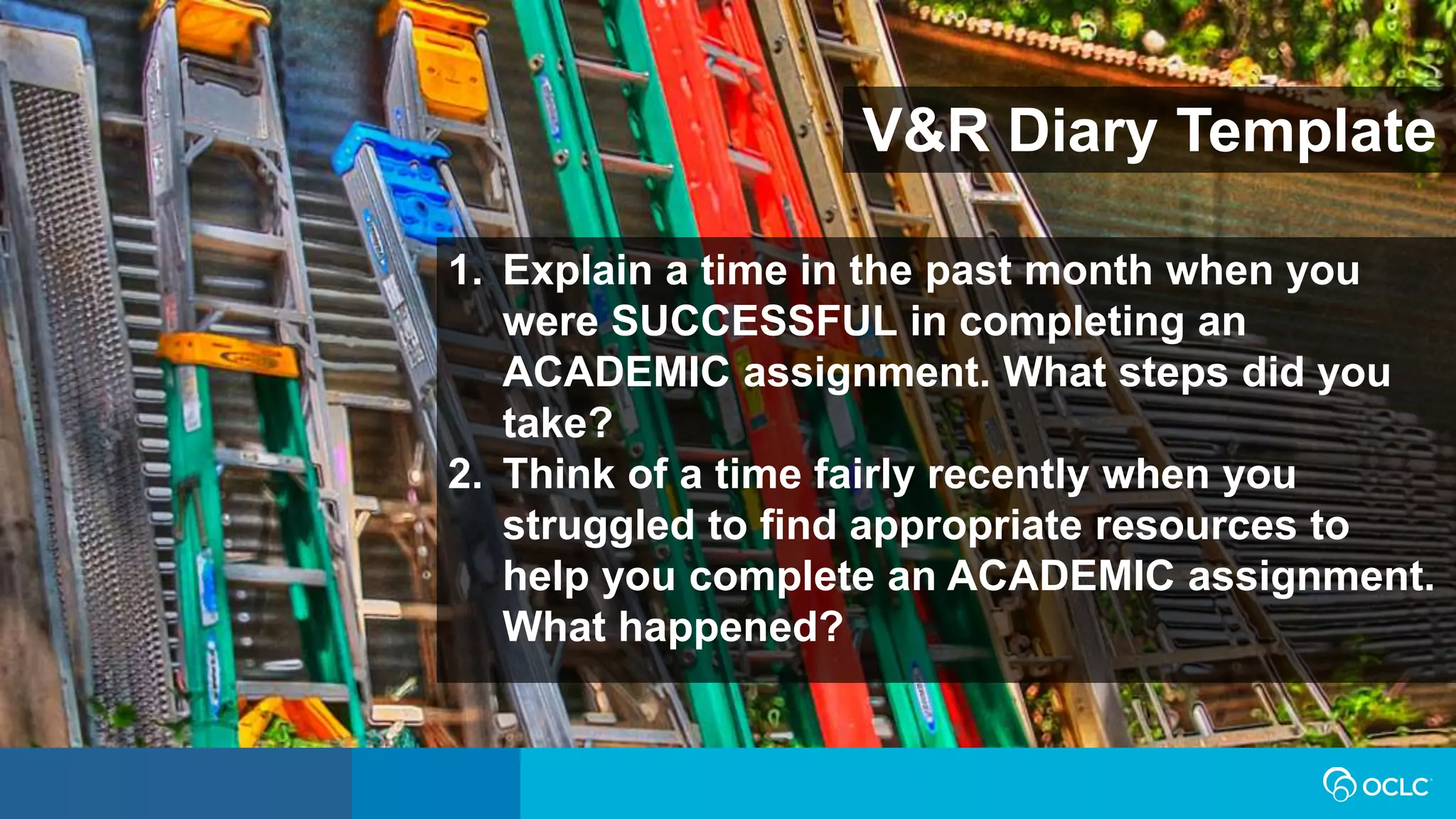
V&R Diary Template
1. Explain a time in the past month when you
were SUCCESSFUL in completing an
ACADEMIC assignment. What steps did you
take?
2. Think of a time fairly recently when you
struggled to find appropriate resources to
help you complete an ACADEMIC assignment.
What happened?
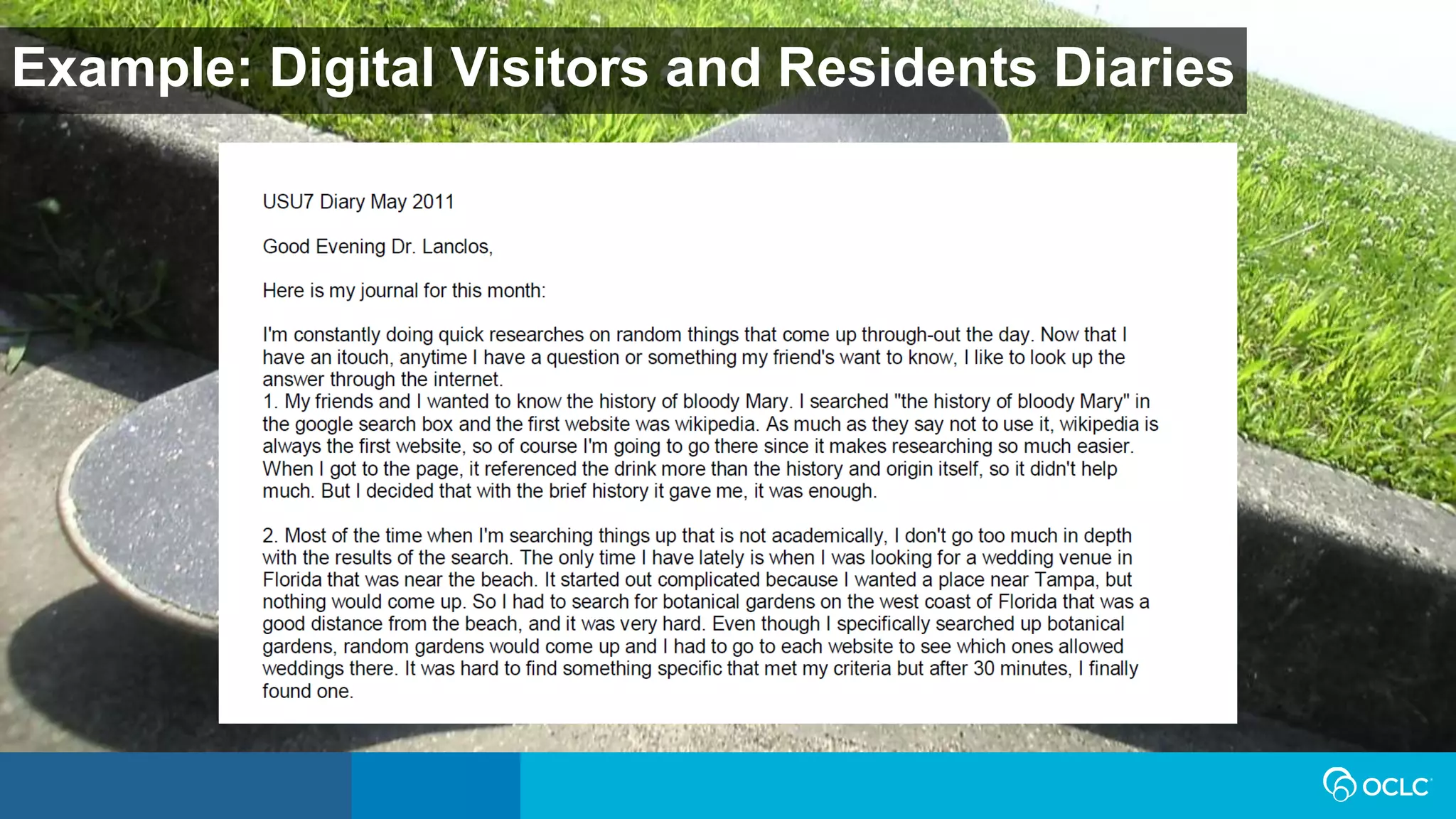
Example: Digital Visitors and Residents Diaries
“Perhaps the most convenient method of
studying the consequences of this law will
be to follow the reader from the moment
he enters the library to the moment he
leaves it…”
(Ranganathan 1931, 337)
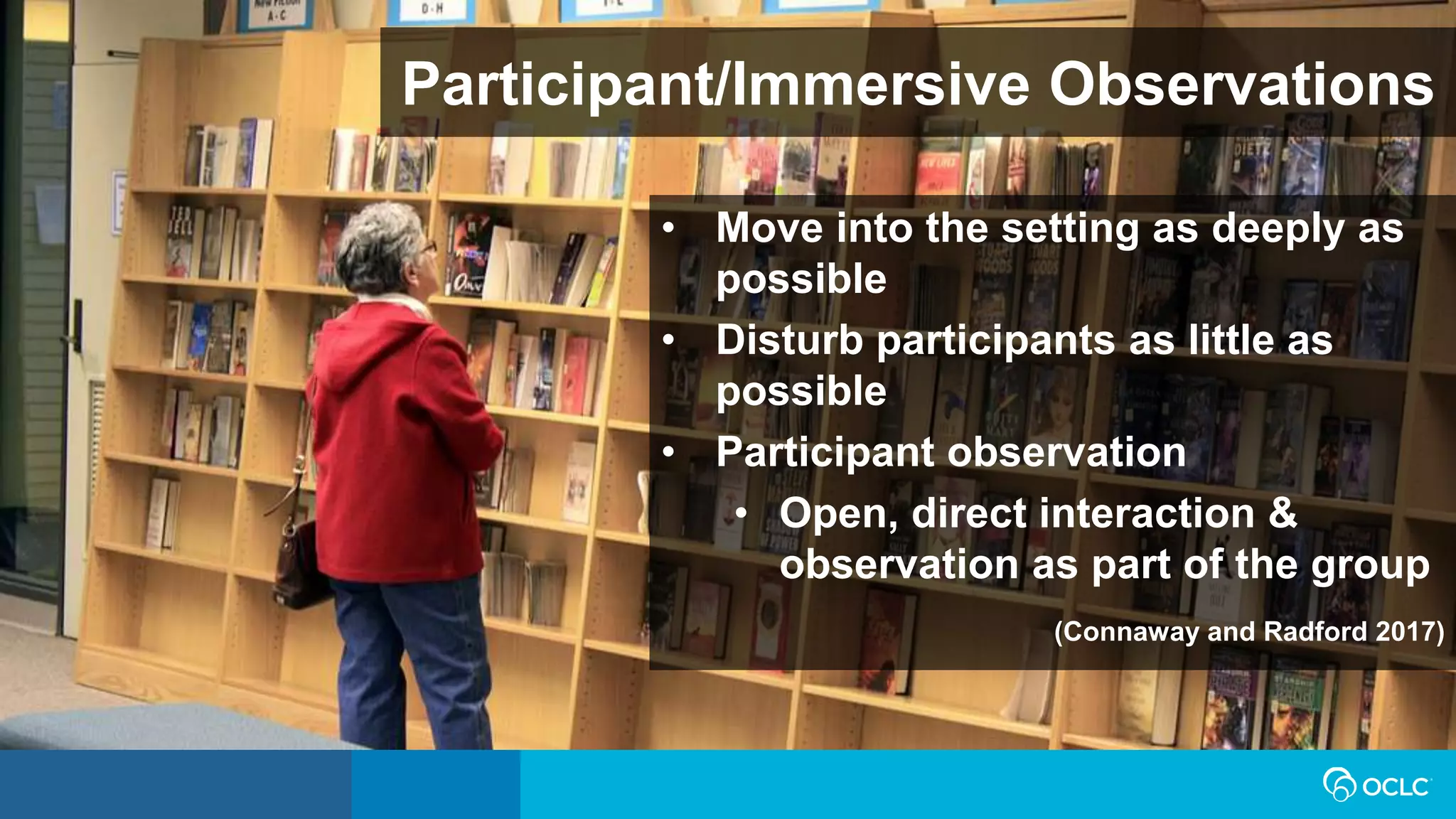
Participant/Immersive Observations
• Move into the setting as deeply as
possible
• Disturb participants as little as
possible
• Participant observation
• Open, direct interaction &
observation as part of the group
(Connaway and Radford 2017)
Participant/Immersive Observations
• Unstructured observation
• No predetermined categories of behavior
• Flexible, exploratory
• Notes should be recorded as soon as possible
• Structured observation
• Predeveloped observational categories
• Rating scales and/or checklists
• Audio and/or video recording
(Connaway and Radford, 2017)
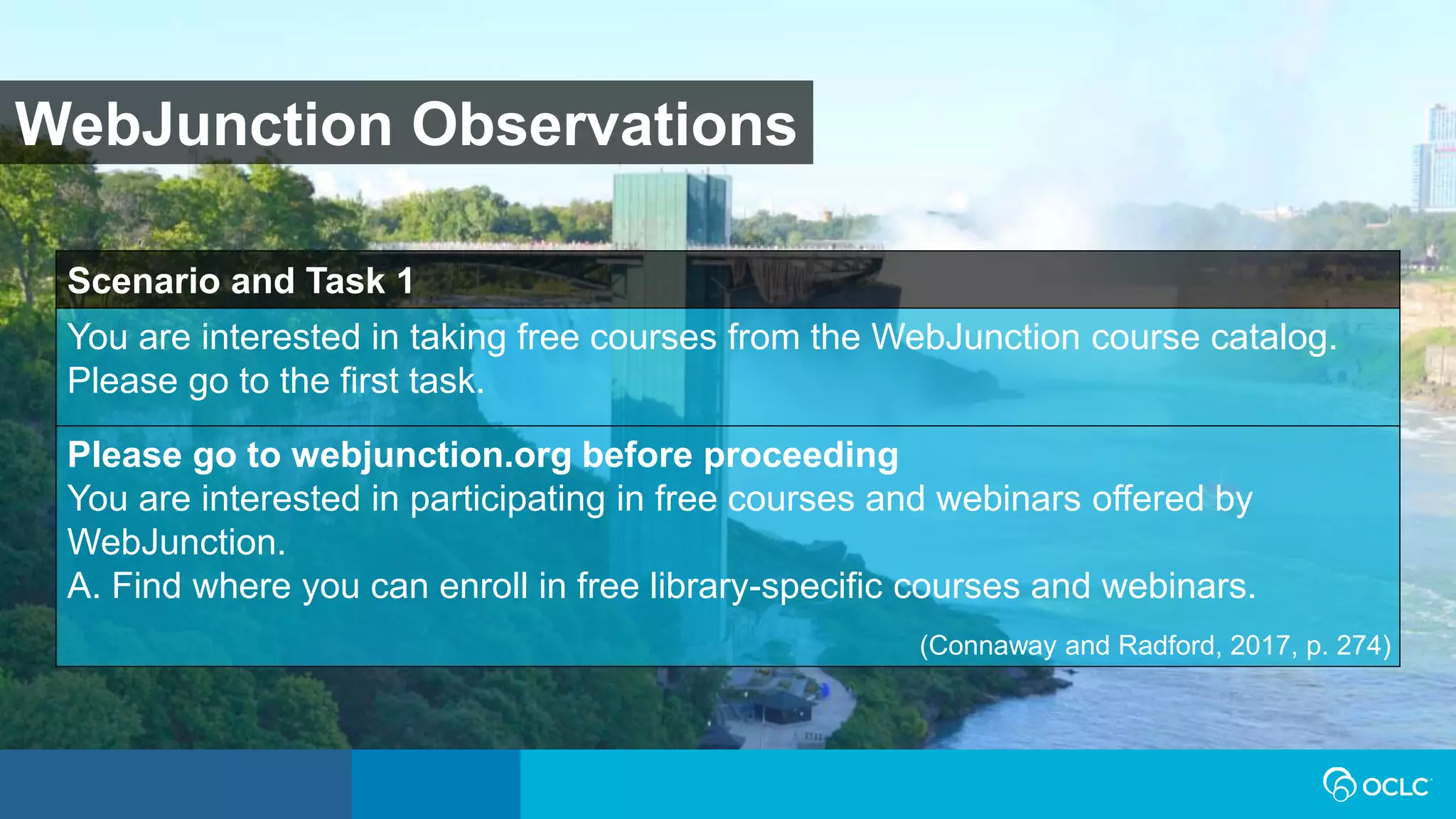
WebJunction Observations
Scenario and Task 1
You are interested in taking free courses from the WebJunction course catalog.
Please go to the first task.
Please go to webjunction.org before proceeding
You are interested in participating in free courses and webinars offered by
WebJunction.
A. Find where you can enroll in free library-specific courses and webinars.
(Connaway and Radford, 2017, p. 274)
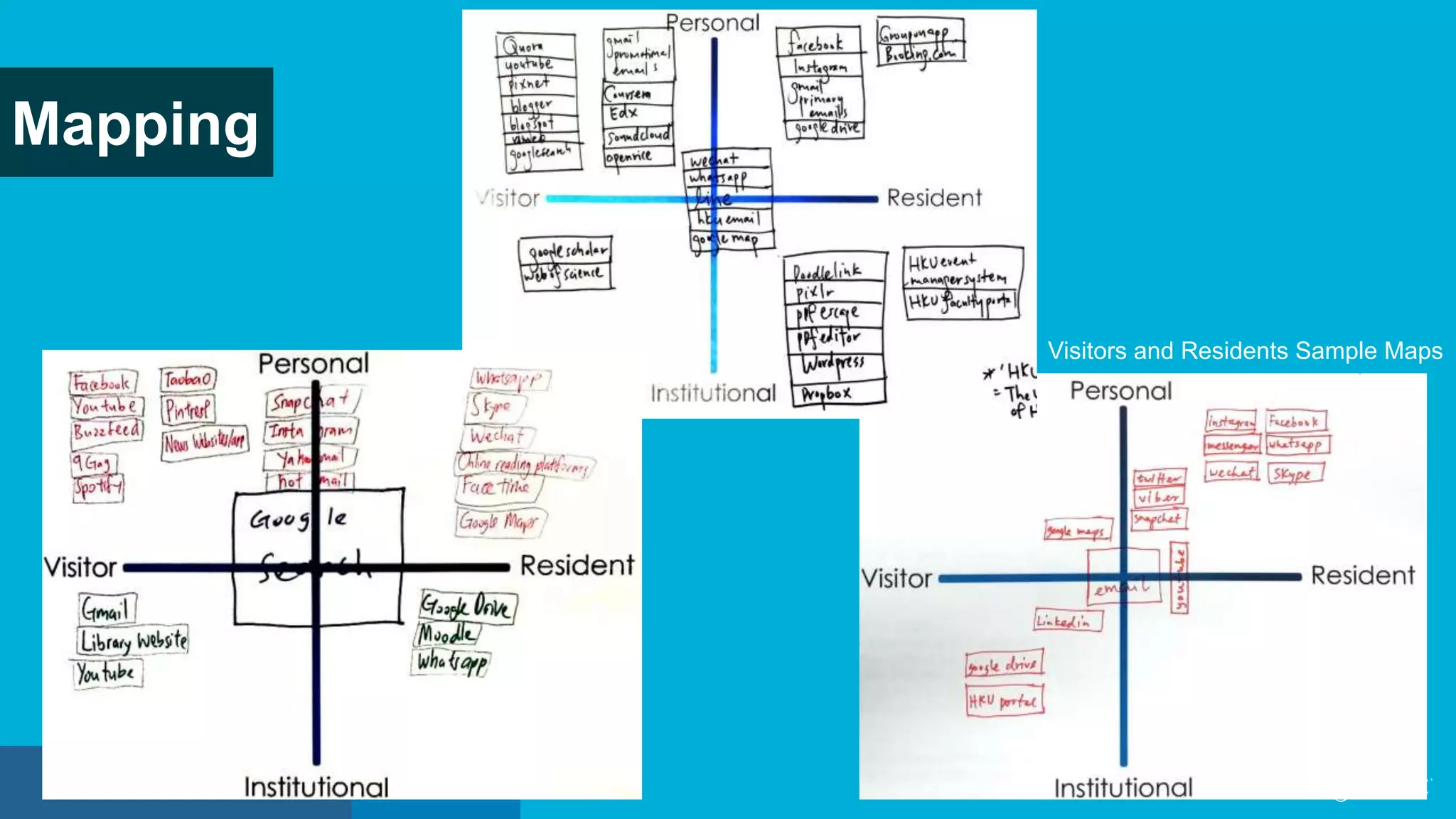
Mapping
Visitors and Residents Sample Maps
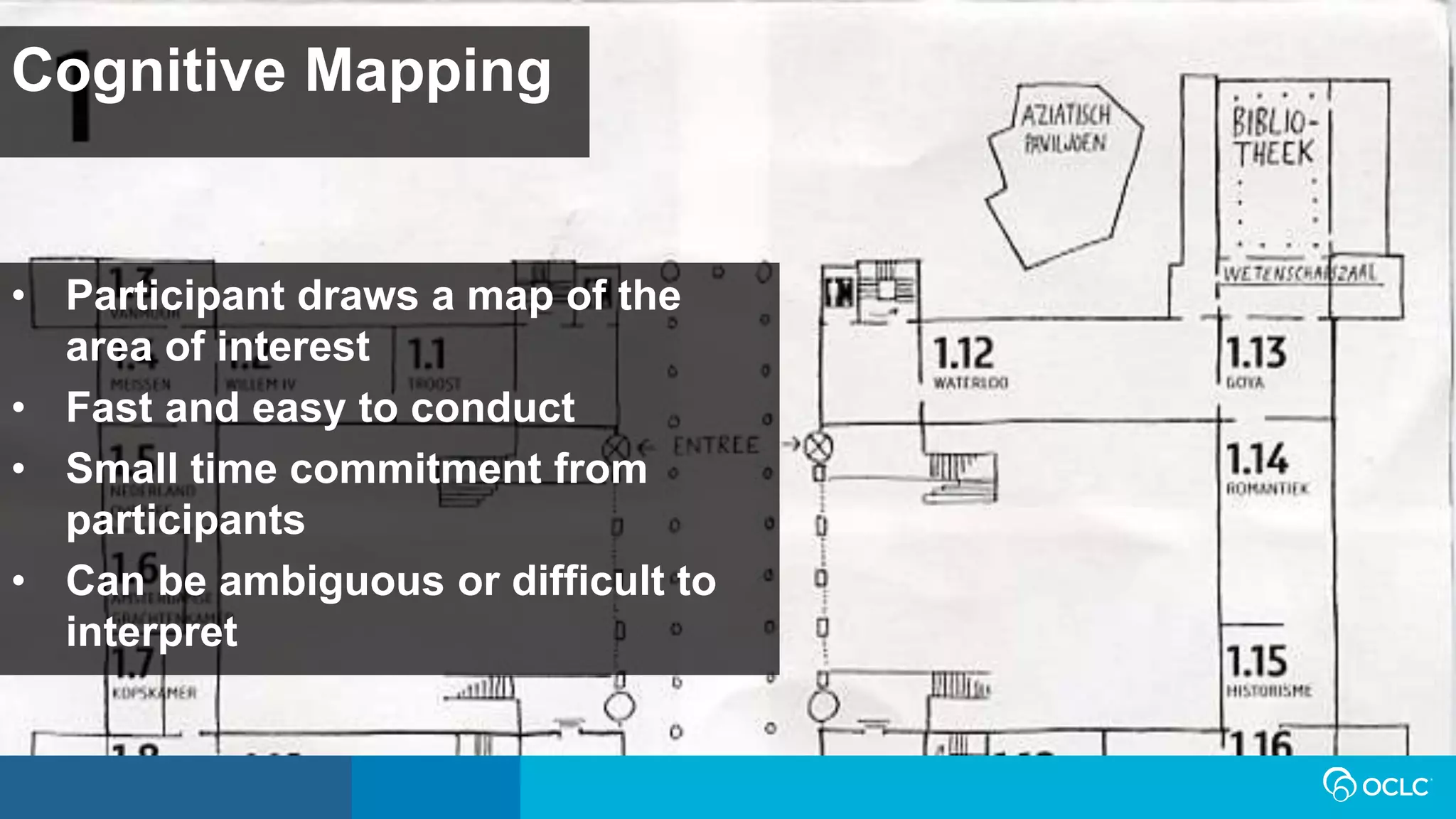
Cognitive Mapping
• Participant draws a map of the
area of interest
• Fast and easy to conduct
• Small time commitment from
participants
• Can be ambiguous or difficult to
interpret
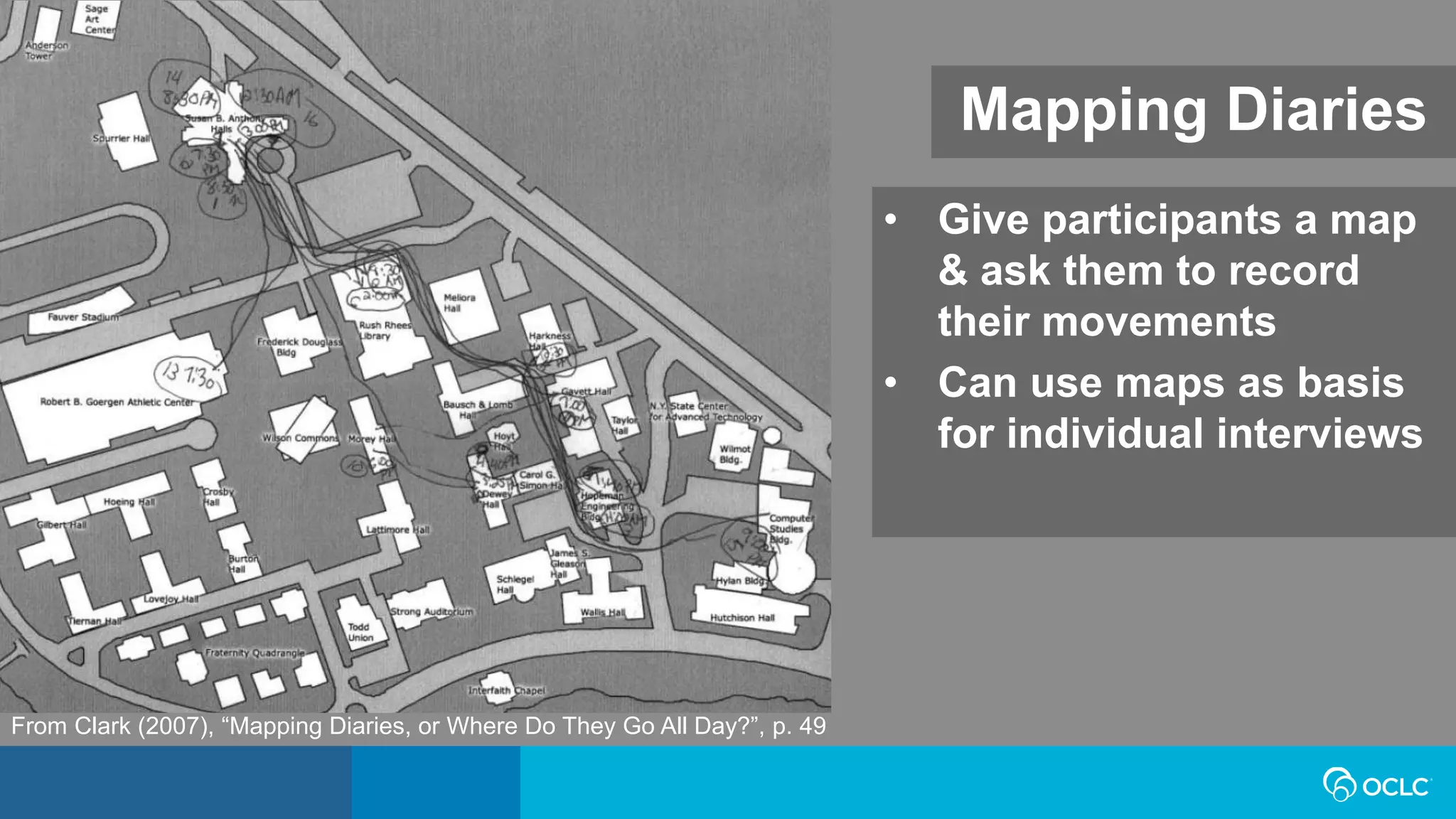
Mapping Diaries
• Give participants a map
& ask them to record
their movements
• Can use maps as basis
for individual interviews
From Clark (2007), “Mapping Diaries, or Where Do They Go All Day?”, p. 49
Usability Testing
• Degree to which a user can successfully learn
& use a product to achieve a goal
• Evaluation research methodology
• Observation & analysis of user behavior while
users use a product or product prototype to
achieve a goal
(Dumas and Redish 1993, 22)
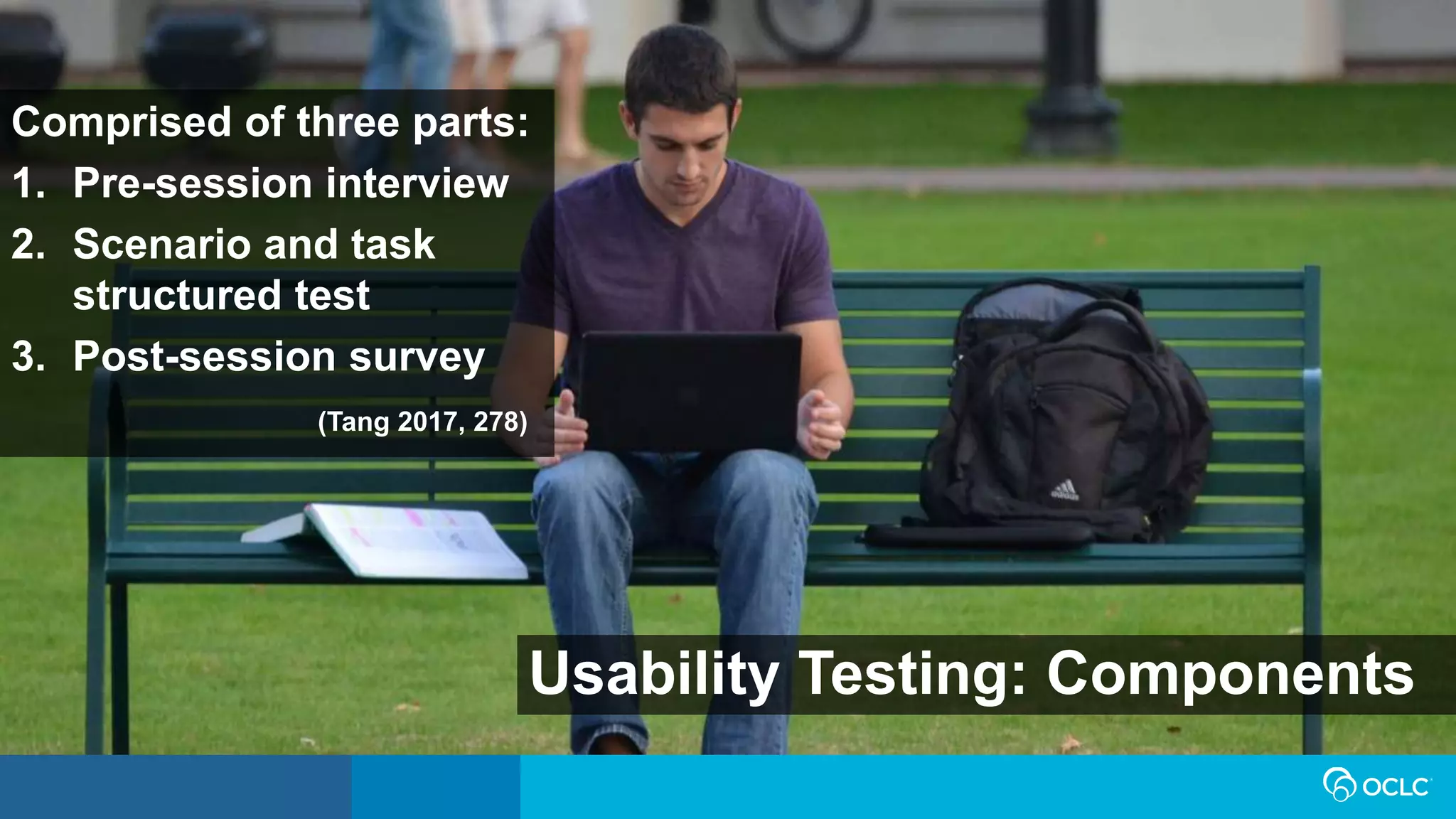
Usability Testing: Components
Comprised of three parts:
1. Pre-session interview
2. Scenario and task
structured test
3. Post-session survey
(Tang 2017, 278)
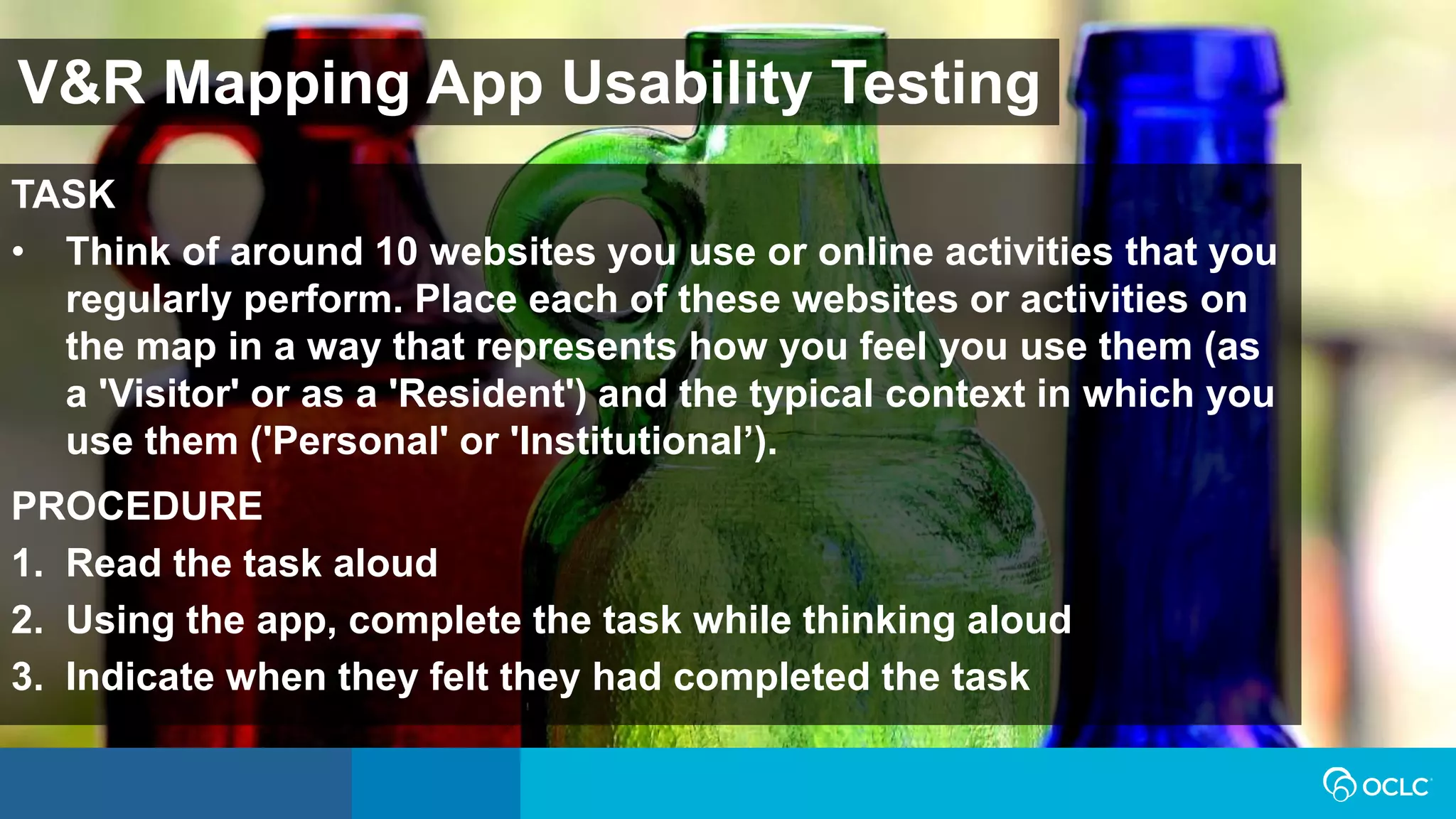
V&R Mapping App Usability Testing
TASK
• Think of around 10 websites you use or online activities that you
regularly perform. Place each of these websites or activities on
the map in a way that represents how you feel you use them (as
a 'Visitor' or as a 'Resident') and the typical context in which you
use them ('Personal' or 'Institutional’).
PROCEDURE
1. Read the task aloud
2. Using the app, complete the task while thinking aloud
3. Indicate when they felt they had completed the task
Usability Testing: Methodology
• Artificial environment
(laboratory)
• Maintain more control
• May provide more
specific data on a
particular feature
• Natural environment
• Better holistic
representation of real
people doing real work
(Tang 2017, 278)
ETHNOGRAPHIC DATA ANALYSIS
TOOLS AND METHODS
Ethnographic Analysis
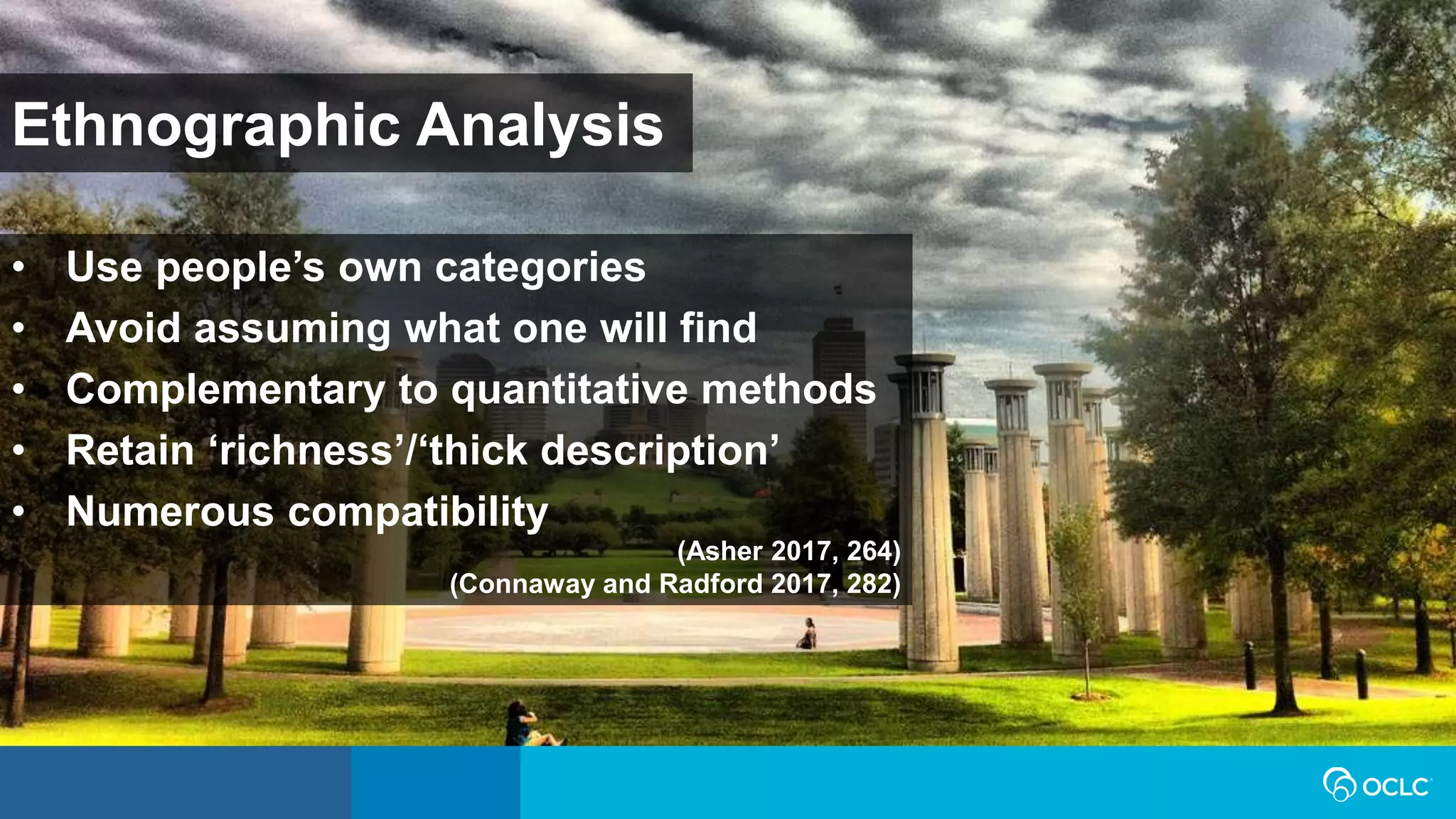
• Use people’s own categories
• Avoid assuming what one will find
• Complementary to quantitative methods
• Retain ‘richness’/‘thick description’
• Numerous compatibility
(Asher 2017, 264)
(Connaway and Radford 2017, 282)
• Contain all data sources
• Creating & applying codes
• Queries
• Visualizations
• Reports
(Connaway and Radford 2017)
Computer-Assisted Qualitative Data Analysis
Software (CAQDAS)
• Draw on data...in service of
developing new conceptual
categories
• Develop inductive abstract analytic
categories through systematic data
analysis
• Emphasize theory construction
rather than description or
application of current theories
(Connaway and Radford 2017)
Grounded Theory
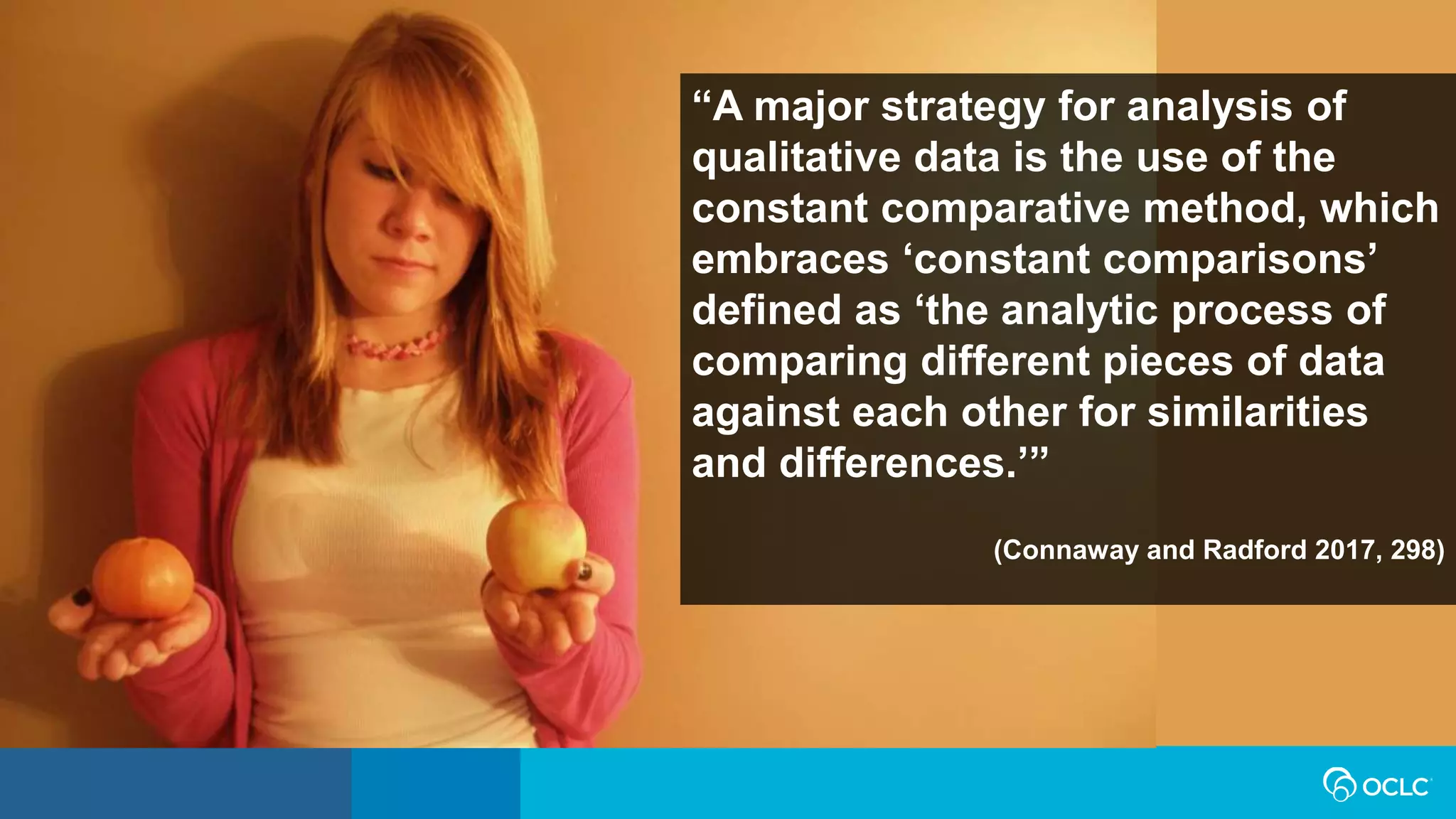
“A major strategy for analysis of
qualitative data is the use of the
constant comparative method, which
embraces ‘constant comparisons’
defined as ‘the analytic process of
comparing different pieces of data
against each other for similarities
and differences.’”
(Connaway and Radford 2017, 298)
Conversation Analysis
• Context & social conduct
Discourse Analysis
• The library within a larger social
& cultural context
(Connaway and Radford 2017)
Challenges: Ethnographic Research
• Data collection & analysis
• Costs and time
• Bias
• Sampling
• Not generalizable
Opportunities: Ethnographic Research
• Rich data and thick description
• Can answer why and how questions
• Provides information to support decisions
about resources and services
• Can help motivate and increase buy-in for
change
• Provides the opportunity to build
relationships
(Connaway and Radford, 2017; Asher and Miller, 2011)
“The creative process is not like a situation
where you get struck by a single lightning
bolt. You have ongoing discoveries, and
there are ongoing creative revelations. Yes,
it's really helpful to be marching toward a
specific destination, but, along the way, you
must allow yourself room for your ideas to
blossom, take root, and grow.”
–Carlton Cuse
References
Asher, Andrew. 2017. “On Ethnographic Research: How do Students Find the Information They Need?” In
Research Methods for Library and Information Science, 6th ed., edited by Lynn Silipigni Connaway and
Marie L. Radford, 264. Westport, CT: Libraries Unlimited.
Asher, Andrew and Miller, Susan. 2011. So You Want to Do Anthropology in Your Library? Or a Practical
Guide to Ethnographic Research in Academic Libraries. Chicago: The ERIAL Project.
Budd, John M. 2006. “Discourse Analysis and the Study of Communication in LIS.” Library Trends 55, no. 1:
65-82.
Clark, K. (2007). Mapping Diaries, or Where Do They Go All Day? In N. Foster & S. Gibbons (Eds.), Studying
Students: The Undergraduate Research Project at the University of Rochester. Chicago: Association College
and Research Libraries.
Connaway, Lynn Silipigni, and Ixchel M. Faniel. 2014. Reordering Ranganathan: Shifting user behaviors,
shifting priorities. Dublin, OH: OCLC Research.
http://www.oclc.org/content/dam/research/publications/library/2014/oclcresearch-reordering-ranganathan-
2014.pdf.
Connaway, Lynn Silipigni, and Marie L. Radford. 2017. Research Methods for Library and Information
Science, 6th ed. Westport, CT: Libraries Unlimited.
References
Denzin, Norman K., and Yvonna S. Lincoln. 2005. The Sage Handbook of Qualitative Research, 4th ed.
Thousand Oaks, CA: Sage Publications.
Dumas, Joseph S., and Janice C. Redish. 1993. A Practical Guide to Usability Testing. Portland, OR: Intellect
Books.
Khoo, Michael, Lily Rozaklis, and Catherine Hall. 2012. “A Survey of the Use of Ethnographic Methods in the
Study of Libraries and Library Users.” Library and Information Science Research 34, no. 2: 82-91.
Ranganathan, Shiyali Ramamrita. 1931. The five laws of library science. London: Edward Goldston, Ltd.
Tang, Rong. 2017. “Usability Research.” In Research Methods for Library and Information Science, 6th ed.,
edited by Lynn Silipigni Connaway and Marie L. Radford, 277-278. Westport, CT: Libraries Unlimited.
White, David S., and Lynn Silipigni Connaway. 2011-2014. Visitors & Residents: What Motivates Engagement
with the Digital Information Environment. Funded by JISC, OCLC, and Oxford University.
http://www.oclc.org/research/activities/vandr/.
Image Attribution
Slide 2: Image: https://www.flickr.com/photos/pmillera4/13570027834/ by Peter Miller / CC BY-NC-ND 2.0
Slide 3: Image: https://www.flickr.com/photos/katesheets/5772901616/ by katesheets / CC BY-NC 2.0
Slide 4: Image: https://www.flickr.com/photos/ddrmaxgt37/387453140/ by Arun Venkatesan / CC BY-NC 2.0
Slide 6: Image: https://www.flickr.com/photos/28481088@N00/3091698923/ by tanakawho / CC BY-NC 2.0
Slide 7: Image: https://www.flickr.com/photos/nordforsk/32225539214/ by NordForsk / CC BY-NC-ND 2.0
Slide 8: Image: https://www.flickr.com/photos/meanestindian/903380690/ by Meena Kadri / CC BY 2.0
Slide 9: Image: https://www.flickr.com/photos/photophilde/4353228184 by photophilde / CC BY-SA 2.0
Slide 11: Image: https://www.flickr.com/photos/elliotmar/8913124849 by Elliot Margolies / CC BY-NC-ND 2.0
Slide 12: Image: https://www.flickr.com/photos/dancingpapa2007/3674686528 by Naoki Tomeno / CC BY 2.0
Slide 14: Image: https://www.flickr.com/photos/njla/3306454031/ by NJLA: New Jersey Library Association / CC
BY-NC-ND 2.0
Slide 15: Image: https://www.flickr.com/photos/dawncreations/2894171562 by I am just Dawn Marie / CC BY-NC-ND
2.0
Slide 16: Image: https://www.flickr.com/photos/larrywkoester/21500417954 by Larry Koester / CC BY 2.0
Image Attribution
Slide 18: Image: https://www.flickr.com/photos/dutchsimba/15704925354 by Dutch Simba / CC BY-NC-ND 2.0
Slide 20: Image: https://www.flickr.com/photos/deanhochman/14481958642/ by Dean Hochman / CC BY 2.0
Slide 21: Image: https://www.flickr.com/photos/78428166@N00/8120708019/ by Tony Alter / CC BY 2.0
Slide 22: Image: https://www.flickr.com/photos/marcelxxl/14217231657/ by M.G.N. – Marcel / CC BY-NC-ND 2.0
Slide 23: Image: https://www.flickr.com/photos/carnesaurus/32160924864/ by Stinson Beach Playground / CC BY-
NC-ND 2.0
Slide 25: Image: https://www.flickr.com/photos/respres/6041698098/ by Jeff Turner / CC BY 2.0
Slide 26: Image: https://www.flickr.com/photos/flakepardigm/4687752030/ by Tyler Nienhouse / CC BY 2.0
Slide 27: Image: https://www.flickr.com/photos/adambindslev/4727853016/ by Adam Bindslev / CC BY-NC 2.0
Slide 28: Image: https://www.flickr.com/photos/carleycomartin/4030726428/ by Carley Comartin / CC BY-NC 2.0
Slide 29: Image: https://www.flickr.com/photos/juanillooo/1231088474/ by Juan Salmoral / CC BY-NC-ND 2.0
Slide 30: Image: https://www.flickr.com/photos/therichbrooks/2600080329/ by Rich Brooks / CC BY 2.0
Slide 31: Image: https://www.flickr.com/photos/dougww/2132598574 by Doug Waldron / CC BY-SA 2.0
Slide 32: Image: https://flic.kr/p/AuDyn by Pete Hunt / CC BY-NC 2.0
Questions &
Discussion
Lynn Silipigni Connaway, PhD
Senior Research Scientist & Director of User
Research
connawal@oclc.org
@LynnConnaway

Capturing the Behaviors of the Elusive User: Strategies for Library Ethnography

  • 1.
    IFLA Wrocław •22 August 2017 Capturing the Behaviors of the Elusive User: Strategies for Library Ethnography Lynn Silipigni Connaway, PhD Senior Research Scientist & Director of User Research, OCLC connawal@oclc.org @LynnConnaway
  • 2.
    Ethnographic Research “…a wayof seeing how individuals interact and behave in situations by utilizing different qualitative data collection and analysis methods.” (Connaway and Radford 2017, 263)
  • 3.
    Qualitative Research Definition Atype of scientific research that: • Seeks answers to a question • Systematically uses predefined set of procedures to answer question • Collects evidence • Produces findings that: • Are not determined in advance • Apply beyond immediate boundaries of study
  • 4.
    What is QualitativeResearch? “…a situated activity that locates the observer in the world. It consists of a set of interpretive, material practices that make the world visible. These practices transform the world. They turn the world into a series of representations, including field notes, interviews, conversations, photographs, recordings, & memos to the self. At this level, qualitative research involves an interpretive, naturalistic approach to the world. This means that qualitative researchers study things in their natural settings, attempting to make sense of, or to interpret, phenomena in terms of the meanings people bring to them.” (Denzin and Lincoln 2005)
  • 5.
  • 6.
    Interviews Diaries Observation UsabilityTesting Ethnographic Data Collection
  • 7.
    Ethnographic Interviews • Incrediblydetailed data • Time consuming – Establishing rapport – Selecting research participants – Transcribing observations & conversations
  • 8.
    Conducting the Interview 1.Thematizing: Clarifying the interview’s purpose 2. Designing: Defining the interview’s purpose 3. Interviewing: Conducting the interview 4. Transcribing: Creating a written verbatim text of the interview 5. Analyzing: Figuring out the meaning of data 6. Verifying: Determining the reliability & validity of the data 7. Reporting: Telling others about the findings (Connaway and Radford 2017, 244)
  • 9.
    V&R Semi-Structured InterviewQuestions 5. Have there been times when you were told to use a library or virtual learning environment (or learning platform), and used other source(s) instead? 6. If you had a magic wand, what would your ideal way of getting information be? How would you go about using the systems and services? When? Where? How?
  • 10.
    Diaries • Keep directionsminimal and open • Offer participants a variety of ways to report • Written • Photo • Video • Audio • Data can be rich and detailed, but is self-reported • Does not require researcher presence (Connaway and Radford, 2017)
  • 11.
    V&R Diary Template 1.Explain a time in the past month when you were SUCCESSFUL in completing an ACADEMIC assignment. What steps did you take? 2. Think of a time fairly recently when you struggled to find appropriate resources to help you complete an ACADEMIC assignment. What happened?
  • 12.
    Example: Digital Visitorsand Residents Diaries
  • 13.
    “Perhaps the mostconvenient method of studying the consequences of this law will be to follow the reader from the moment he enters the library to the moment he leaves it…” (Ranganathan 1931, 337)
  • 14.
    Participant/Immersive Observations • Moveinto the setting as deeply as possible • Disturb participants as little as possible • Participant observation • Open, direct interaction & observation as part of the group (Connaway and Radford 2017)
  • 15.
    Participant/Immersive Observations • Unstructuredobservation • No predetermined categories of behavior • Flexible, exploratory • Notes should be recorded as soon as possible • Structured observation • Predeveloped observational categories • Rating scales and/or checklists • Audio and/or video recording (Connaway and Radford, 2017)
  • 16.
    WebJunction Observations Scenario andTask 1 You are interested in taking free courses from the WebJunction course catalog. Please go to the first task. Please go to webjunction.org before proceeding You are interested in participating in free courses and webinars offered by WebJunction. A. Find where you can enroll in free library-specific courses and webinars. (Connaway and Radford, 2017, p. 274)
  • 17.
  • 18.
    Cognitive Mapping • Participantdraws a map of the area of interest • Fast and easy to conduct • Small time commitment from participants • Can be ambiguous or difficult to interpret
  • 19.
    Mapping Diaries • Giveparticipants a map & ask them to record their movements • Can use maps as basis for individual interviews From Clark (2007), “Mapping Diaries, or Where Do They Go All Day?”, p. 49
  • 20.
    Usability Testing • Degreeto which a user can successfully learn & use a product to achieve a goal • Evaluation research methodology • Observation & analysis of user behavior while users use a product or product prototype to achieve a goal (Dumas and Redish 1993, 22)
  • 21.
    Usability Testing: Components Comprisedof three parts: 1. Pre-session interview 2. Scenario and task structured test 3. Post-session survey (Tang 2017, 278)
  • 22.
    V&R Mapping AppUsability Testing TASK • Think of around 10 websites you use or online activities that you regularly perform. Place each of these websites or activities on the map in a way that represents how you feel you use them (as a 'Visitor' or as a 'Resident') and the typical context in which you use them ('Personal' or 'Institutional’). PROCEDURE 1. Read the task aloud 2. Using the app, complete the task while thinking aloud 3. Indicate when they felt they had completed the task
  • 23.
    Usability Testing: Methodology •Artificial environment (laboratory) • Maintain more control • May provide more specific data on a particular feature • Natural environment • Better holistic representation of real people doing real work (Tang 2017, 278)
  • 24.
  • 25.
    Ethnographic Analysis • Usepeople’s own categories • Avoid assuming what one will find • Complementary to quantitative methods • Retain ‘richness’/‘thick description’ • Numerous compatibility (Asher 2017, 264) (Connaway and Radford 2017, 282)
  • 26.
    • Contain alldata sources • Creating & applying codes • Queries • Visualizations • Reports (Connaway and Radford 2017) Computer-Assisted Qualitative Data Analysis Software (CAQDAS)
  • 27.
    • Draw ondata...in service of developing new conceptual categories • Develop inductive abstract analytic categories through systematic data analysis • Emphasize theory construction rather than description or application of current theories (Connaway and Radford 2017) Grounded Theory
  • 28.
    “A major strategyfor analysis of qualitative data is the use of the constant comparative method, which embraces ‘constant comparisons’ defined as ‘the analytic process of comparing different pieces of data against each other for similarities and differences.’” (Connaway and Radford 2017, 298)
  • 29.
    Conversation Analysis • Context& social conduct Discourse Analysis • The library within a larger social & cultural context (Connaway and Radford 2017)
  • 30.
    Challenges: Ethnographic Research •Data collection & analysis • Costs and time • Bias • Sampling • Not generalizable
  • 31.
    Opportunities: Ethnographic Research •Rich data and thick description • Can answer why and how questions • Provides information to support decisions about resources and services • Can help motivate and increase buy-in for change • Provides the opportunity to build relationships (Connaway and Radford, 2017; Asher and Miller, 2011)
  • 32.
    “The creative processis not like a situation where you get struck by a single lightning bolt. You have ongoing discoveries, and there are ongoing creative revelations. Yes, it's really helpful to be marching toward a specific destination, but, along the way, you must allow yourself room for your ideas to blossom, take root, and grow.” –Carlton Cuse
  • 33.
    References Asher, Andrew. 2017.“On Ethnographic Research: How do Students Find the Information They Need?” In Research Methods for Library and Information Science, 6th ed., edited by Lynn Silipigni Connaway and Marie L. Radford, 264. Westport, CT: Libraries Unlimited. Asher, Andrew and Miller, Susan. 2011. So You Want to Do Anthropology in Your Library? Or a Practical Guide to Ethnographic Research in Academic Libraries. Chicago: The ERIAL Project. Budd, John M. 2006. “Discourse Analysis and the Study of Communication in LIS.” Library Trends 55, no. 1: 65-82. Clark, K. (2007). Mapping Diaries, or Where Do They Go All Day? In N. Foster & S. Gibbons (Eds.), Studying Students: The Undergraduate Research Project at the University of Rochester. Chicago: Association College and Research Libraries. Connaway, Lynn Silipigni, and Ixchel M. Faniel. 2014. Reordering Ranganathan: Shifting user behaviors, shifting priorities. Dublin, OH: OCLC Research. http://www.oclc.org/content/dam/research/publications/library/2014/oclcresearch-reordering-ranganathan- 2014.pdf. Connaway, Lynn Silipigni, and Marie L. Radford. 2017. Research Methods for Library and Information Science, 6th ed. Westport, CT: Libraries Unlimited.
  • 34.
    References Denzin, Norman K.,and Yvonna S. Lincoln. 2005. The Sage Handbook of Qualitative Research, 4th ed. Thousand Oaks, CA: Sage Publications. Dumas, Joseph S., and Janice C. Redish. 1993. A Practical Guide to Usability Testing. Portland, OR: Intellect Books. Khoo, Michael, Lily Rozaklis, and Catherine Hall. 2012. “A Survey of the Use of Ethnographic Methods in the Study of Libraries and Library Users.” Library and Information Science Research 34, no. 2: 82-91. Ranganathan, Shiyali Ramamrita. 1931. The five laws of library science. London: Edward Goldston, Ltd. Tang, Rong. 2017. “Usability Research.” In Research Methods for Library and Information Science, 6th ed., edited by Lynn Silipigni Connaway and Marie L. Radford, 277-278. Westport, CT: Libraries Unlimited. White, David S., and Lynn Silipigni Connaway. 2011-2014. Visitors & Residents: What Motivates Engagement with the Digital Information Environment. Funded by JISC, OCLC, and Oxford University. http://www.oclc.org/research/activities/vandr/.
  • 35.
    Image Attribution Slide 2:Image: https://www.flickr.com/photos/pmillera4/13570027834/ by Peter Miller / CC BY-NC-ND 2.0 Slide 3: Image: https://www.flickr.com/photos/katesheets/5772901616/ by katesheets / CC BY-NC 2.0 Slide 4: Image: https://www.flickr.com/photos/ddrmaxgt37/387453140/ by Arun Venkatesan / CC BY-NC 2.0 Slide 6: Image: https://www.flickr.com/photos/28481088@N00/3091698923/ by tanakawho / CC BY-NC 2.0 Slide 7: Image: https://www.flickr.com/photos/nordforsk/32225539214/ by NordForsk / CC BY-NC-ND 2.0 Slide 8: Image: https://www.flickr.com/photos/meanestindian/903380690/ by Meena Kadri / CC BY 2.0 Slide 9: Image: https://www.flickr.com/photos/photophilde/4353228184 by photophilde / CC BY-SA 2.0 Slide 11: Image: https://www.flickr.com/photos/elliotmar/8913124849 by Elliot Margolies / CC BY-NC-ND 2.0 Slide 12: Image: https://www.flickr.com/photos/dancingpapa2007/3674686528 by Naoki Tomeno / CC BY 2.0 Slide 14: Image: https://www.flickr.com/photos/njla/3306454031/ by NJLA: New Jersey Library Association / CC BY-NC-ND 2.0 Slide 15: Image: https://www.flickr.com/photos/dawncreations/2894171562 by I am just Dawn Marie / CC BY-NC-ND 2.0 Slide 16: Image: https://www.flickr.com/photos/larrywkoester/21500417954 by Larry Koester / CC BY 2.0
  • 36.
    Image Attribution Slide 18:Image: https://www.flickr.com/photos/dutchsimba/15704925354 by Dutch Simba / CC BY-NC-ND 2.0 Slide 20: Image: https://www.flickr.com/photos/deanhochman/14481958642/ by Dean Hochman / CC BY 2.0 Slide 21: Image: https://www.flickr.com/photos/78428166@N00/8120708019/ by Tony Alter / CC BY 2.0 Slide 22: Image: https://www.flickr.com/photos/marcelxxl/14217231657/ by M.G.N. – Marcel / CC BY-NC-ND 2.0 Slide 23: Image: https://www.flickr.com/photos/carnesaurus/32160924864/ by Stinson Beach Playground / CC BY- NC-ND 2.0 Slide 25: Image: https://www.flickr.com/photos/respres/6041698098/ by Jeff Turner / CC BY 2.0 Slide 26: Image: https://www.flickr.com/photos/flakepardigm/4687752030/ by Tyler Nienhouse / CC BY 2.0 Slide 27: Image: https://www.flickr.com/photos/adambindslev/4727853016/ by Adam Bindslev / CC BY-NC 2.0 Slide 28: Image: https://www.flickr.com/photos/carleycomartin/4030726428/ by Carley Comartin / CC BY-NC 2.0 Slide 29: Image: https://www.flickr.com/photos/juanillooo/1231088474/ by Juan Salmoral / CC BY-NC-ND 2.0 Slide 30: Image: https://www.flickr.com/photos/therichbrooks/2600080329/ by Rich Brooks / CC BY 2.0 Slide 31: Image: https://www.flickr.com/photos/dougww/2132598574 by Doug Waldron / CC BY-SA 2.0 Slide 32: Image: https://flic.kr/p/AuDyn by Pete Hunt / CC BY-NC 2.0
  • 37.
    Questions & Discussion Lynn SilipigniConnaway, PhD Senior Research Scientist & Director of User Research connawal@oclc.org @LynnConnaway